
STRUCTURE ACTIVITY RELATIONSHIP
      ANTI - PSYCHOTICS

         TULASI RAMAN P
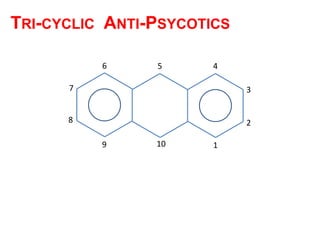
TRI-CYCLIC ANTI-PSYCOTICS

          6     5      4

      7                     3


      8                     2

          9     10     1
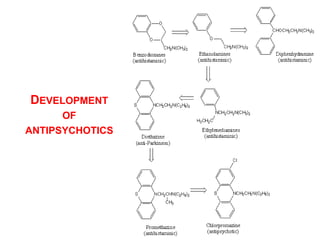
DEVELOPMENT
      OF
ANTIPSYCHOTICS
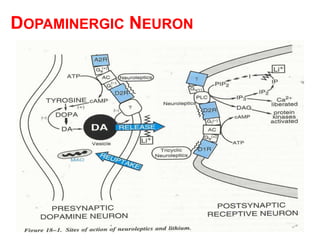
DOPAMINERGIC NEURON
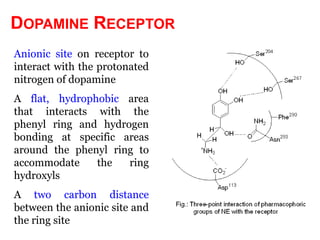
DOPAMINE RECEPTOR
Anionic site on receptor to
interact with the protonated
nitrogen of dopamine
A flat, hydrophobic area
that interacts with the
phenyl ring and hydrogen
bonding at specific areas
around the phenyl ring to
accommodate    the   ring
hydroxyls
A two carbon distance
between the anionic site and
the ring site
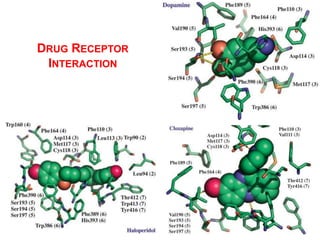
DRUG RECEPTOR
 INTERACTION
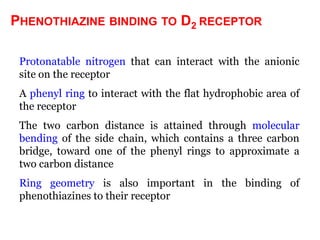
PHENOTHIAZINE BINDING TO D2 RECEPTOR

 Protonatable nitrogen that can interact with the anionic
 site on the receptor
 A phenyl ring to interact with the flat hydrophobic area of
 the receptor
 The two carbon distance is attained through molecular
 bending of the side chain, which contains a three carbon
 bridge, toward one of the phenyl rings to approximate a
 two carbon distance
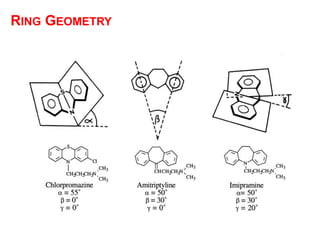
 Ring geometry is also important in the binding of
 phenothiazines to their receptor
RING GEOMETRY
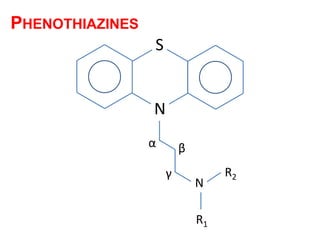
PHENOTHIAZINES
                 S


                 N
                 α       β
                     γ            R2
                             N

                             R1
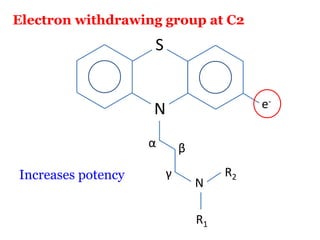
Electron withdrawing group at C2
                    S


                    N                     e-

                    α       β

Increases potency       γ            R2
                                N

                                R1
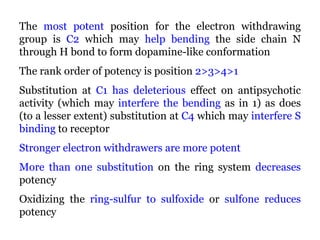
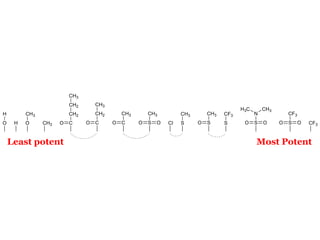
The most potent position for the electron withdrawing
group is C2 which may help bending the side chain N
through H bond to form dopamine-like conformation
The rank order of potency is position 2>3>4>1
Substitution at C1 has deleterious effect on antipsychotic
activity (which may interfere the bending as in 1) as does
(to a lesser extent) substitution at C4 which may interfere S
binding to receptor
Stronger electron withdrawers are more potent
More than one substitution on the ring system decreases
potency
Oxidizing the ring-sulfur to sulfoxide or sulfone reduces
potency
CH3
                         CH2       CH3
                                                                                          H3C       CH3
H        CH3             CH2       CH2       CH3       CH3          CH3       CH3   CF3         N             CF3
O    H   O     CH3   O   C     O   C     O   C     O   S   O   Cl   S     O   S     S      O    S   O     O   S     O   CF3


    Least potent                                                                                Most Potent
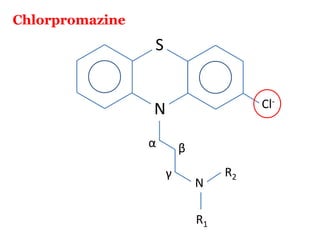
Chlorpromazine
                 S


                 N                     Cl-

                 α       β
                     γ            R2
                             N

                             R1
ALKYL SIDE CHAIN
                                             CH3
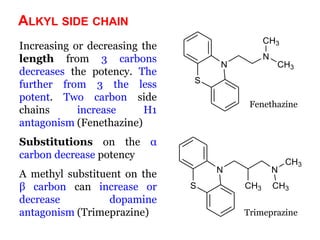
Increasing or decreasing the
length from 3 carbons                        N
                                   N             CH3
decreases the potency. The
                               S
further from 3 the less
potent. Two carbon side
                                        Fenethazine
chains      increase     H1
antagonism (Fenethazine)
Substitutions on the α
carbon decrease potency
                                                     CH3
                                   N             N
A methyl substituent on the
β carbon can increase or       S       CH3       CH3
decrease          dopamine
antagonism (Trimeprazine)              Trimeprazine
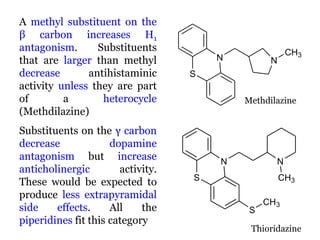
A methyl substituent on the
β carbon increases H1
antagonism.      Substituents                         CH3
that are larger than methyl            N         N
decrease       antihistaminic      S
activity unless they are part
of        a       heterocycle              Methdilazine
(Methdilazine)
Substituents on the γ carbon
decrease             dopamine
antagonism but increase                N          N
anticholinergic        activity.
                                   S                 CH3
These would be expected to
produce less extrapyramidal
                                                CH3
side    effects.     All    the             S
piperidines fit this category
                                            Thioridazine
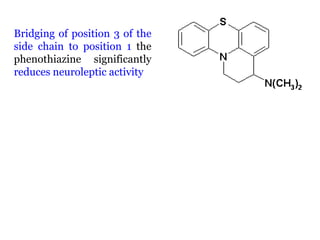
Bridging of position 3 of the
side chain to position 1 the
phenothiazine significantly
reduces neuroleptic activity
SUBSTITUENTS ON THE γ NITROGEN

  There are three classes of phenothiazines based
         on the nature of this substituent


           1. N,N-Dimethyl (aliphatic)

           2. Piperazine

           3. Piperidine
Thioridazine
                       S


                       N                  S
Piperidine ring
                       α                 CH3
Low EPS risk               β
Central antimuscarinic
QTc prolongation                   CH3
                               N
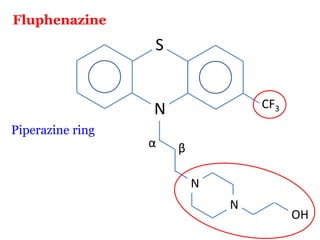
Fluphenazine
                  S


                  N               CF3
Piperazine ring
                  α   β

                          N
                              N
                                        OH
BASIC AMINO GROUP
Maximum neuroleptic potency is observed in
aminoalkylated phenothiazines having a tertiary
amino group.

In general, alkylation of the basic amino group with
groups larger than methyl decreases the
neuroleptic potency.

Quaternization of the terminal nitrogen result in
loss of activity due to inability of these polar
compounds to cross the BBB.
POTENCY COMPARISON

Potency at the D2 receptors:

Given equal C2 substituents, ranked from most
potent to least potent - Piperazine > Aliphatic >
Piperidine

Of drugs on the market, however, the rank is -
Piperazine > Piperidine > Aliphatic

Anticholinergic potency: Piperidine > Aliphatic >
Piperazine
α Receptor antagonism: Aliphatic > Piperidine >
Piperazine (This may be due to the fact that in
order to get a good antipsychotic effect (D2
antagonism) large doses must be given and so the
α receptor antagonism, although weak, is seen
more)

Extrapyramidal side effects: Piperazine > Aliphatic
> Piperidine (Low anticholinergic potency in the
presence of strong D2 block)

Sedation: Piperidine > Aliphatic > Piperazine
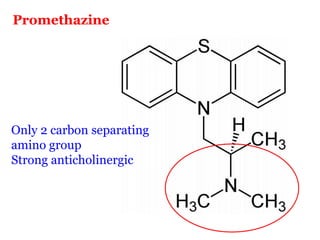
Promethazine


Only 2 carbon separating
amino group
Strong anticholinergic
METABOLISM

S-oxidation to give sulfoxide derivative  inactive.

Terminal N demethylation  is still active

C7 hydroxylation  inactive compound

Terminal N-oxidation  N-oxide derivative is
inactive
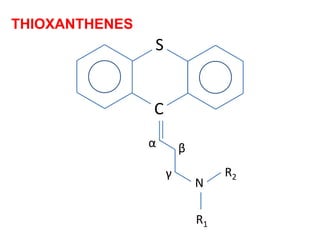
THIOXANTHENES
                S


                C
                α       β
                    γ            R2
                            N

                            R1
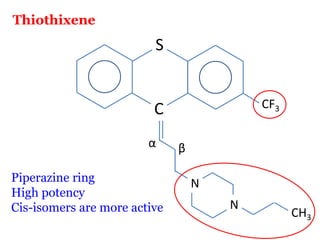
Thiothixene
                         S


                         C                CF3

                        α     β

Piperazine ring                   N
High potency
Cis-isomers are more active           N
                                                CH3
BUTYROPHENONES
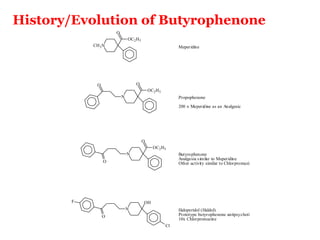
History/Evolution of Butyrophenone
                     O
                             OC2 H5
           CH 3 N                                       Meperidine


             O                   O
                                          OC2 H5
                         N                              Propophenone

                                                        200 x Meperidine as an Analgesic


                                      O
                                            OC2 H5
                             N                          Butyrophenone
                                                        Analgesia s imilar to Meperidine
                 O                                      Other activity similar to Chlorpromazine


       F                              OH
                             N                          Haloperidol (Haldol)
                 O                                      Prototype butyrophenone antipsychotic
                                                        10x Chlorpromazine
                                                   Cl
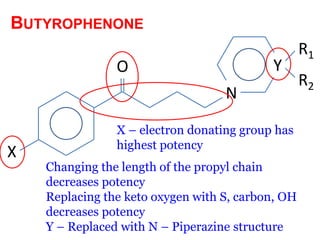
BUTYROPHENONE
                                                   R1
                O                          Y
                                                   R2
                                   N

                X – electron donating group has
                highest potency
X
    Changing the length of the propyl chain
    decreases potency
    Replacing the keto oxygen with S, carbon, OH
    decreases potency
    Y – Replaced with N – Piperazine structure
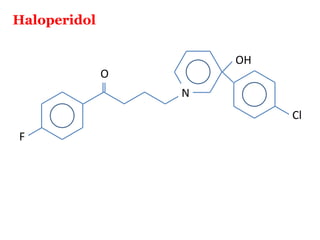
Haloperidol

                      OH
              O
                  N
                           Cl
F
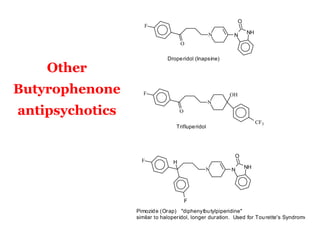
O
                    F
                                                  N             NH
                                                         N
                                    O

                             Drope ridol (Inapsine)

    Other
Butyrophenone      F                                   OH
                                                  N

antipsychotics                      O

                                                                     CF3
                                 Triflupe ridol


                                                         O
                   F            H
                                              N         N       NH


                                        F
                 Pimozid e (Orap) "diphenylbu tylpiperidine"
                 similar to haloperidol, longer duration. Used for Tou rette's Syndrome.
ATYPICAL ANTIPSYCHOTICS
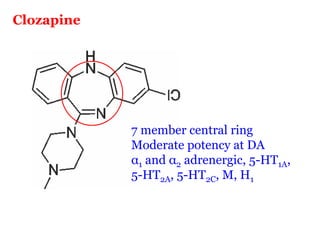
Clozapine


            7 member central ring
            Moderate potency at DA
            α1 and α2 adrenergic, 5-HT1A,
            5-HT2A, 5-HT2C, M, H1
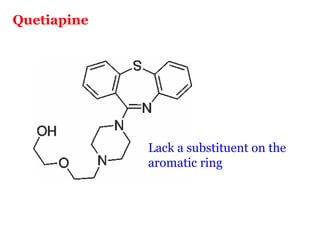
Quetiapine


             Lack a substituent on the
             aromatic ring
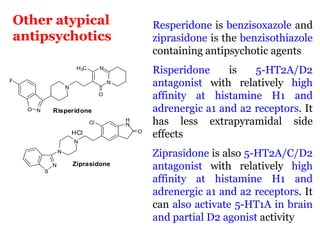
Other atypical                                        Resperidone is benzisoxazole and
antipsychotics                                        ziprasidone is the benzisothiazole
                                                      containing antipsychotic agents
                           H3C        N
                                                      Risperidone     is   5-HT2A/D2
F
                      N
                                          N           antagonist with relatively high
                                      O
                                                      affinity at histamine H1 and
    O N       Risperidone                             adrenergic a1 and a2 receptors. It
                                 Cl           H
                                              N       has less extrapyramidal side
                          HCl                     O
                                                      effects
                          N
                  N
                                                      Ziprasidone is also 5-HT2A/C/D2
          S
              N           Ziprasidone
                                                      antagonist with relatively high
                                                      affinity at histamine H1 and
                                                      adrenergic a1 and a2 receptors. It
                                                      can also activate 5-HT1A in brain
                                                      and partial D2 agonist activity
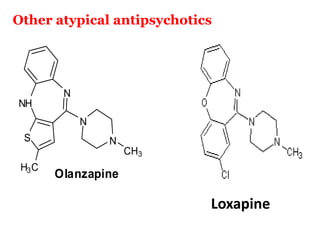
Other atypical antipsychotics


         N
NH
             N
 S               N
                     CH3
 H3 C
        Olanzapine

                            Loxapine
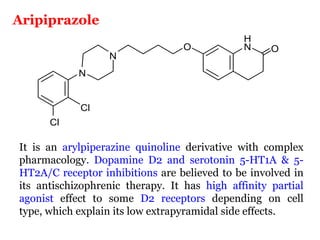
Aripiprazole
                                              H
                                  O           N     O
                  N
            N


            Cl
                        Aripiprazole
      Cl

It is an arylpiperazine quinoline derivative with complex
pharmacology. Dopamine D2 and serotonin 5-HT1A & 5-
HT2A/C receptor inhibitions are believed to be involved in
its antischizophrenic therapy. It has high affinity partial
agonist effect to some D2 receptors depending on cell
type, which explain its low extrapyramidal side effects.
CURRENT CONCEPTS
Presently, antipsychotic agents include many different
chemical structures with a range of activities at different
neurotransmitter receptors (e.g., 5-HT2A antagonism, 5-
HT1A partial agonism).
As a result, structure-function relationships that were relied
upon in the past have become less important.
Instead, receptor-function relationships and functional
assays are more clinically relevant.
Aripiprazole represents a good example of how an
examination of the structure provides little insight into its
mechanism, which is based on dopamine partial agonism.
THANK YOU

Structure Activity Relationships - Antipsychotics

  • 1.
    STRUCTURE ACTIVITY RELATIONSHIP ANTI - PSYCHOTICS TULASI RAMAN P
  • 2.
    TRI-CYCLIC ANTI-PSYCOTICS 6 5 4 7 3 8 2 9 10 1
  • 3.
    DEVELOPMENT OF ANTIPSYCHOTICS
  • 4.
  • 5.
    DOPAMINE RECEPTOR Anionic siteon receptor to interact with the protonated nitrogen of dopamine A flat, hydrophobic area that interacts with the phenyl ring and hydrogen bonding at specific areas around the phenyl ring to accommodate the ring hydroxyls A two carbon distance between the anionic site and the ring site
  • 6.
  • 7.
    PHENOTHIAZINE BINDING TOD2 RECEPTOR Protonatable nitrogen that can interact with the anionic site on the receptor A phenyl ring to interact with the flat hydrophobic area of the receptor The two carbon distance is attained through molecular bending of the side chain, which contains a three carbon bridge, toward one of the phenyl rings to approximate a two carbon distance Ring geometry is also important in the binding of phenothiazines to their receptor
  • 8.
  • 9.
    PHENOTHIAZINES S N α β γ R2 N R1
  • 10.
    Electron withdrawing groupat C2 S N e- α β Increases potency γ R2 N R1
  • 11.
    The most potentposition for the electron withdrawing group is C2 which may help bending the side chain N through H bond to form dopamine-like conformation The rank order of potency is position 2>3>4>1 Substitution at C1 has deleterious effect on antipsychotic activity (which may interfere the bending as in 1) as does (to a lesser extent) substitution at C4 which may interfere S binding to receptor Stronger electron withdrawers are more potent More than one substitution on the ring system decreases potency Oxidizing the ring-sulfur to sulfoxide or sulfone reduces potency
  • 12.
    CH3 CH2 CH3 H3C CH3 H CH3 CH2 CH2 CH3 CH3 CH3 CH3 CF3 N CF3 O H O CH3 O C O C O C O S O Cl S O S S O S O O S O CF3 Least potent Most Potent
  • 13.
    Chlorpromazine S N Cl- α β γ R2 N R1
  • 14.
    ALKYL SIDE CHAIN CH3 Increasing or decreasing the length from 3 carbons N N CH3 decreases the potency. The S further from 3 the less potent. Two carbon side Fenethazine chains increase H1 antagonism (Fenethazine) Substitutions on the α carbon decrease potency CH3 N N A methyl substituent on the β carbon can increase or S CH3 CH3 decrease dopamine antagonism (Trimeprazine) Trimeprazine
  • 15.
    A methyl substituenton the β carbon increases H1 antagonism. Substituents CH3 that are larger than methyl N N decrease antihistaminic S activity unless they are part of a heterocycle Methdilazine (Methdilazine) Substituents on the γ carbon decrease dopamine antagonism but increase N N anticholinergic activity. S CH3 These would be expected to produce less extrapyramidal CH3 side effects. All the S piperidines fit this category Thioridazine
  • 16.
    Bridging of position3 of the side chain to position 1 the phenothiazine significantly reduces neuroleptic activity
  • 17.
    SUBSTITUENTS ON THEγ NITROGEN There are three classes of phenothiazines based on the nature of this substituent 1. N,N-Dimethyl (aliphatic) 2. Piperazine 3. Piperidine
  • 18.
    Thioridazine S N S Piperidine ring α CH3 Low EPS risk β Central antimuscarinic QTc prolongation CH3 N
  • 19.
    Fluphenazine S N CF3 Piperazine ring α β N N OH
  • 20.
    BASIC AMINO GROUP Maximumneuroleptic potency is observed in aminoalkylated phenothiazines having a tertiary amino group. In general, alkylation of the basic amino group with groups larger than methyl decreases the neuroleptic potency. Quaternization of the terminal nitrogen result in loss of activity due to inability of these polar compounds to cross the BBB.
  • 21.
    POTENCY COMPARISON Potency atthe D2 receptors: Given equal C2 substituents, ranked from most potent to least potent - Piperazine > Aliphatic > Piperidine Of drugs on the market, however, the rank is - Piperazine > Piperidine > Aliphatic Anticholinergic potency: Piperidine > Aliphatic > Piperazine
  • 22.
    α Receptor antagonism:Aliphatic > Piperidine > Piperazine (This may be due to the fact that in order to get a good antipsychotic effect (D2 antagonism) large doses must be given and so the α receptor antagonism, although weak, is seen more) Extrapyramidal side effects: Piperazine > Aliphatic > Piperidine (Low anticholinergic potency in the presence of strong D2 block) Sedation: Piperidine > Aliphatic > Piperazine
  • 23.
    Promethazine Only 2 carbonseparating amino group Strong anticholinergic
  • 24.
    METABOLISM S-oxidation to givesulfoxide derivative  inactive. Terminal N demethylation  is still active C7 hydroxylation  inactive compound Terminal N-oxidation  N-oxide derivative is inactive
  • 25.
    THIOXANTHENES S C α β γ R2 N R1
  • 26.
    Thiothixene S C CF3 α β Piperazine ring N High potency Cis-isomers are more active N CH3
  • 27.
  • 28.
    History/Evolution of Butyrophenone O OC2 H5 CH 3 N Meperidine O O OC2 H5 N Propophenone 200 x Meperidine as an Analgesic O OC2 H5 N Butyrophenone Analgesia s imilar to Meperidine O Other activity similar to Chlorpromazine F OH N Haloperidol (Haldol) O Prototype butyrophenone antipsychotic 10x Chlorpromazine Cl
  • 29.
    BUTYROPHENONE R1 O Y R2 N X – electron donating group has highest potency X Changing the length of the propyl chain decreases potency Replacing the keto oxygen with S, carbon, OH decreases potency Y – Replaced with N – Piperazine structure
  • 30.
    Haloperidol OH O N Cl F
  • 31.
    O F N NH N O Drope ridol (Inapsine) Other Butyrophenone F OH N antipsychotics O CF3 Triflupe ridol O F H N N NH F Pimozid e (Orap) "diphenylbu tylpiperidine" similar to haloperidol, longer duration. Used for Tou rette's Syndrome.
  • 32.
  • 33.
    Clozapine 7 member central ring Moderate potency at DA α1 and α2 adrenergic, 5-HT1A, 5-HT2A, 5-HT2C, M, H1
  • 34.
    Quetiapine Lack a substituent on the aromatic ring
  • 35.
    Other atypical Resperidone is benzisoxazole and antipsychotics ziprasidone is the benzisothiazole containing antipsychotic agents H3C N Risperidone is 5-HT2A/D2 F N N antagonist with relatively high O affinity at histamine H1 and O N Risperidone adrenergic a1 and a2 receptors. It Cl H N has less extrapyramidal side HCl O effects N N Ziprasidone is also 5-HT2A/C/D2 S N Ziprasidone antagonist with relatively high affinity at histamine H1 and adrenergic a1 and a2 receptors. It can also activate 5-HT1A in brain and partial D2 agonist activity
  • 36.
    Other atypical antipsychotics N NH N S N CH3 H3 C Olanzapine Loxapine
  • 37.
    Aripiprazole H O N O N N Cl Aripiprazole Cl It is an arylpiperazine quinoline derivative with complex pharmacology. Dopamine D2 and serotonin 5-HT1A & 5- HT2A/C receptor inhibitions are believed to be involved in its antischizophrenic therapy. It has high affinity partial agonist effect to some D2 receptors depending on cell type, which explain its low extrapyramidal side effects.
  • 38.
    CURRENT CONCEPTS Presently, antipsychoticagents include many different chemical structures with a range of activities at different neurotransmitter receptors (e.g., 5-HT2A antagonism, 5- HT1A partial agonism). As a result, structure-function relationships that were relied upon in the past have become less important. Instead, receptor-function relationships and functional assays are more clinically relevant. Aripiprazole represents a good example of how an examination of the structure provides little insight into its mechanism, which is based on dopamine partial agonism.
  • 39.