The problem ofString Matching
Given a string ‘S’, the problem of string
matching deals with finding whether a
pattern ‘p’ occurs in ‘S’ and if ‘p’ does
occur then returning position in ‘S’ where
‘p’ occurs.
3.
…. a O(mn)approach
One of the most obvious approach towards the
string matching problem would be to compare
the first element of the pattern to be searched
‘p’, with the first element of the string ‘S’ in which
to locate ‘p’. If the first element of ‘p’ matches
the first element of ‘S’, compare the second
element of ‘p’ with second element of ‘S’. If
match found proceed likewise until entire ‘p’ is
found. If a mismatch is found at any position,
shift ‘p’ one position to the right and repeat
comparison beginning from first element of ‘p’.
4.
How does theO(mn) approach
work
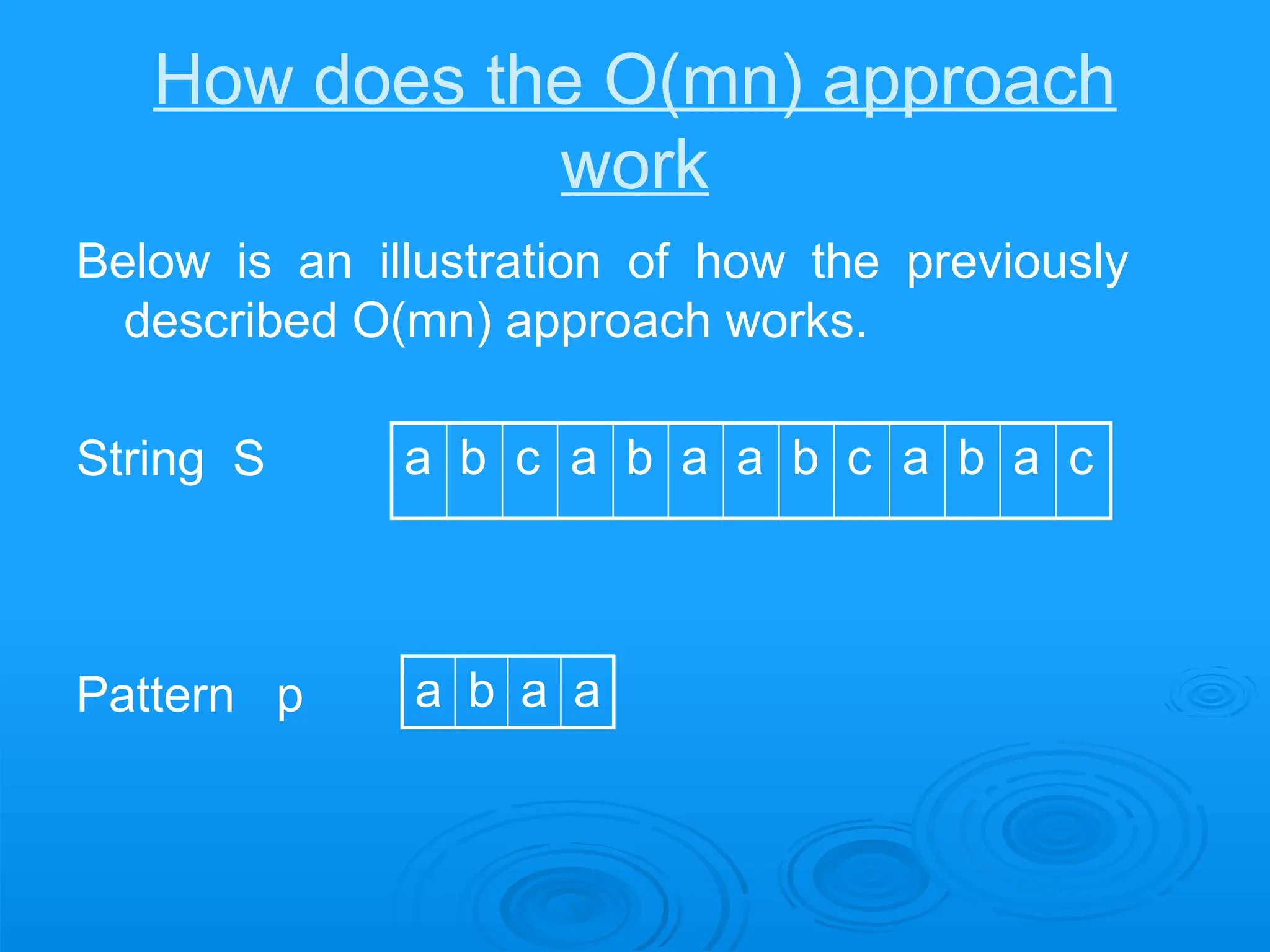
Below is an illustration of how the previously
described O(mn) approach works.
String S a b c a b a a b c a b a c
Pattern p a b a a
5.
Step 1:compare p[1]with S[1]
S a b c a b a a b c a b a c
p a b a a
Step 2: compare p[2] with S[2]
S a b c a b a a b c a b a c
p a b a a
6.
Step 3: comparep[3] with S[3]
S
p a b a a
Mismatch occurs here..
Since mismatch is detected, shift ‘p’ one position to the left and
perform steps analogous to those from step 1 to step 3. At position
where mismatch is detected, shift ‘p’ one position to the right and
repeat matching procedure.
a b c a b a a b c a b a c
7.
S a bc a b a a b c a b a c
p a b a a
Finally, a match would be found after shifting ‘p’ three times to the right side.
Drawbacks of this approach: if ‘m’ is the length of pattern ‘p’ and ‘n’ the length
of string ‘S’, the matching time is of the order O(mn). This is a certainly a very
slow running algorithm.
What makes this approach so slow is the fact that elements of ‘S’ with which
comparisons had been performed earlier are involved again and again in
comparisons in some future iterations. For example: when mismatch is
detected for the first time in comparison of p[3] with S[3], pattern ‘p’ would be
moved one position to the right and matching procedure would resume from
here. Here the first comparison that would take place would be between p[0]=‘a’
and S[1]=‘b’. It should be noted here that S[1]=‘b’ had been previously involved
in a comparison in step 2. this is a repetitive use of S[1] in another comparison.
It is these repetitive comparisons that lead to the runtime of O(mn).
8.
The Knuth-Morris-Pratt Algorithm
Knuth,Morris and Pratt proposed a linear
time algorithm for the string matching
problem.
A matching time of O(n) is achieved by
avoiding comparisons with elements of ‘S’
that have previously been involved in
comparison with some element of the
pattern ‘p’ to be matched. i.e.,
backtracking on the string ‘S’ never occurs
9.
Components of KMPalgorithm
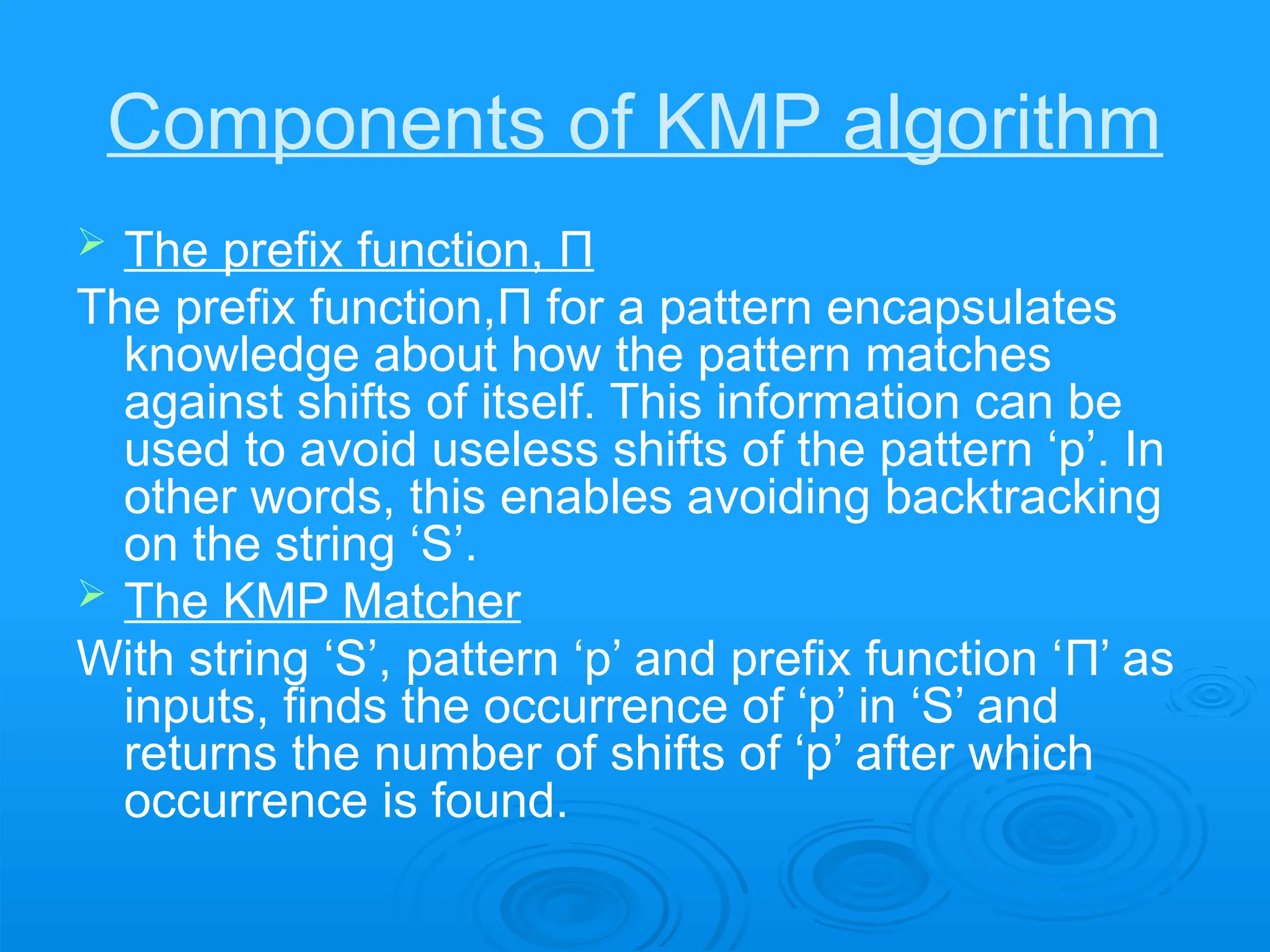
The prefix function, Π
The prefix function,Π for a pattern encapsulates
knowledge about how the pattern matches
against shifts of itself. This information can be
used to avoid useless shifts of the pattern ‘p’. In
other words, this enables avoiding backtracking
on the string ‘S’.
The KMP Matcher
With string ‘S’, pattern ‘p’ and prefix function ‘Π’ as
inputs, finds the occurrence of ‘p’ in ‘S’ and
returns the number of shifts of ‘p’ after which
occurrence is found.
10.
The prefix function,Π
Following pseudocode computes the prefix fucnction, Π:
Compute-Prefix-Function (p)
1 m length[p] //’p’ pattern to be matched
2 Π[1] 0
3 k 0
4 for q 2 to m
5 do while k > 0 and p[k+1] != p[q]
6 do k Π[k]
7 If p[k+1] = p[q]
8 then k k +1
9 Π[q] k
10 return Π
11.
Example: compute Πfor the pattern ‘p’ below:
p a b a b a c a
Initially: m = length[p] = 7
Π[1] = 0
k = 0
Step 1: q = 2, k=0
Π[2] = 0
Step 2: q = 3, k = 0,
Π[3] = 1
Step 3: q = 4, k = 1
Π[4] = 2
q 1 2 3 4 5 6 7
p a b a b a c a
Π 0 0
q 1 2 3 4 5 6 7
p a b a b a c a
Π 0 0 1
q 1 2 3 4 5 6 7
p a b a b a c A
Π 0 0 1 2
12.
Step 4: q= 5, k =2
Π[5] = 3
Step 5: q = 6, k = 3
Π[6] = 1
Step 6: q = 7, k = 1
Π[7] = 1
After iterating 6 times, the prefix
function computation is
complete:
q 1 2 3 4 5 6 7
p a b a b a c a
Π 0 0 1 2 3
q 1 2 3 4 5 6 7
p a b a b a c a
Π 0 0 1 2 3 1
q 1 2 3 4 5 6 7
p a b a b a c a
Π 0 0 1 2 3 1 1
q 1 2 3 4 5 6 7
p a b A b a c a
Π 0 0 1 2 3 1 1
13.
The KMP Matcher
TheKMP Matcher, with pattern ‘p’, string ‘S’ and prefix function ‘Π’ as input, finds a match of p in S.
Following pseudocode computes the matching component of KMP algorithm:
KMP-Matcher(S,p)
1 n length[S]
2 m length[p]
3 Π Compute-Prefix-Function(p)
4 q 0 //number of characters matched
5 for i 1 to n //scan S from left to right
6 do while q > 0 and p[q+1] != S[i]
7 do q Π[q] //next character does not match
8 if p[q+1] = S[i]
9 then q q + 1 //next character matches
10 if q = m //is all of p matched?
11 then print “Pattern occurs with shift” i – m
12 q Π[ q] // look for the next match
Note: KMP finds every occurrence of a ‘p’ in ‘S’. That is why KMP does not terminate in step 12,
rather it searches remainder of ‘S’ for any more occurrences of ‘p’.
14.
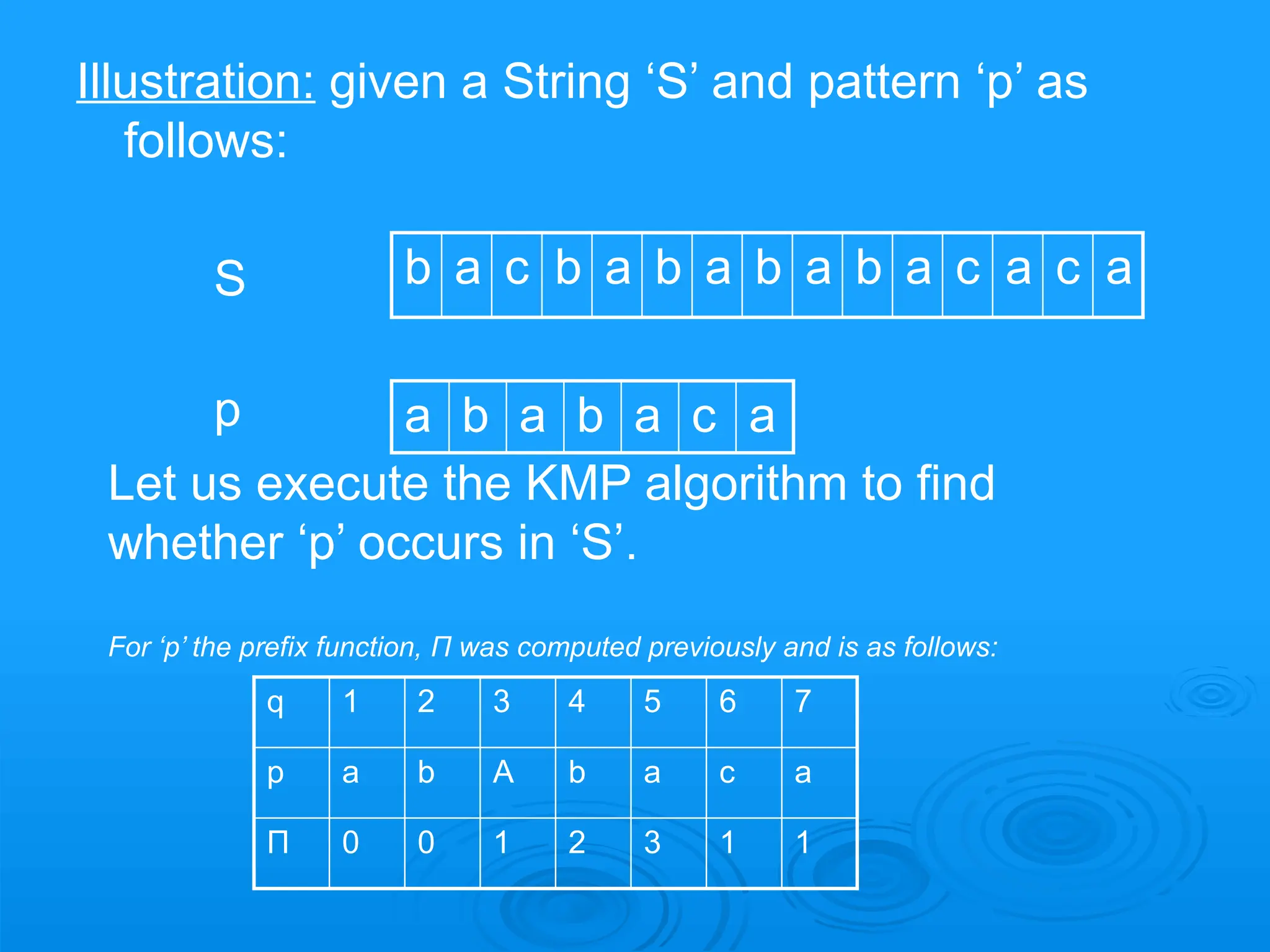
Illustration: given aString ‘S’ and pattern ‘p’ as
follows:
S b a c b a b a b a b a c a c a
p a b a b a c a
Let us execute the KMP algorithm to find
whether ‘p’ occurs in ‘S’.
For ‘p’ the prefix function, Π was computed previously and is as follows:
q 1 2 3 4 5 6 7
p a b A b a c a
Π 0 0 1 2 3 1 1
15.
b a cb a b a b a b a c a a b
b a c b a b a b a b a c a a b
a b a b a c a
Initially: n = size of S = 15;
m = size of p = 7
Step 1: i = 1, q = 0
comparing p[1] with S[1]
S
p
P[1] does not match with S[1]. ‘p’ will be shifted one position to the right.
S
p a b a b a c a
Step 2: i = 2, q = 0
comparing p[1] with S[2]
P[1] matches S[2]. Since there is a match, p is not shifted.
16.
Step 3: i= 3, q = 1
b a c b a b a b a b a c a a b
Comparing p[2] with S[3]
S
a b a b a c a
b a c b a b a b a b a c a a b
b a c b a b a b a b a c a a b
a b a b a c a
a b a b a c a
p
S
p
S
p
p[2] does not match with S[3]
Backtracking on p, comparing p[1] and S[3]
Step 4: i = 4, q = 0
comparing p[1] with S[4] p[1] does not match with S[4]
Step 5: i = 5, q = 0
comparing p[1] with S[5] p[1] matches with S[5]
17.
b a cb a b a b a b a c a a b
b a c b a b a b a b a c a a b
b a c b a b a b a b a c a a b
a b a b a c a
a b a b a c a
a b a b a c a
Step 6: i = 6, q = 1
S
p
Comparing p[2] with S[6] p[2] matches with S[6]
S
p
Step 7: i = 7, q = 2
Comparing p[3] with S[7] p[3] matches with S[7]
Step 8: i = 8, q = 3
Comparing p[4] with S[8] p[4] matches with S[8]
S
p
18.
Step 9: i= 9, q = 4
Comparing p[5] with S[9]
Comparing p[6] with S[10]
Comparing p[5] with S[11]
Step 10: i = 10, q = 5
Step 11: i = 11, q = 4
S
S
S
p
p
p
b a c b a b a b a b a c a a b
b a c b a b a b a b a c a a b
b a c b a b a b a b a c a a b
a b a b a c a
a b a b a c a
a b a b a c a
p[6] doesn’t match with S[10]
Backtracking on p, comparing p[4] with S[10] because after mismatch q = Π[5] = 3
p[5] matches with S[9]
p[5] matches with S[11]
19.
b a cb a b a b a b a c a a b
b a c b a b a b a b a c a a b
a b a b a c a
a b a b a c a
Step 12: i = 12, q = 5
Comparing p[6] with S[12]
Comparing p[7] with S[13]
S
S
p
p
Step 13: i = 13, q = 6
p[6] matches with S[12]
p[7] matches with S[13]
Pattern ‘p’ has been found to completely occur in string ‘S’. The total number of shifts
that took place for the match to be found are: i – m = 13 – 7 = 6 shifts.
20.
Running - timeanalysis
Compute-Prefix-Function (Π)
1 m length[p] //’p’ pattern to be matched
2 Π[1] 0
3 k 0
4 for q 2 to m
5 do while k > 0 and p[k+1] != p[q]
6 do k Π[k]
7 If p[k+1] = p[q]
8 then k k +1
9 Π[q] k
10 return Π
In the above pseudocode for computing the prefix function, the for loop from step 4 to step 10 runs
‘m’ times. Step 1 to step 3 take constant time. Hence the running time of compute prefix
function is Θ(m).
KMP Matcher
1 n length[S]
2 m length[p]
3 Π Compute-Prefix-Function(p)
4 q 0
5 for i 1 to n
6 do while q > 0 and p[q+1] != S[i]
7 do q Π[q]
8 if p[q+1] = S[i]
9 then q q + 1
10 if q = m
11 then print “Pattern occurs with shift” i –
m
12 q Π[ q]
The for loop beginning in step 5 runs ‘n’ times,
i.e., as long as the length of the string ‘S’.
Since step 1 to step 4 take constant time,
the running time is dominated by this for
loop. Thus running time of matching function
is Θ(n).

![Step 1:compare p[1] with S[1]
S a b c a b a a b c a b a c
p a b a a
Step 2: compare p[2] with S[2]
S a b c a b a a b c a b a c
p a b a a](https://image.slidesharecdn.com/string-matching-250308045442-24234758/75/String-Matching-algorithms-KNuth-Morri-Pratt-pptx-5-2048.jpg)
![Step 3: compare p[3] with S[3]
S
p a b a a
Mismatch occurs here..
Since mismatch is detected, shift ‘p’ one position to the left and
perform steps analogous to those from step 1 to step 3. At position
where mismatch is detected, shift ‘p’ one position to the right and
repeat matching procedure.
a b c a b a a b c a b a c](https://image.slidesharecdn.com/string-matching-250308045442-24234758/75/String-Matching-algorithms-KNuth-Morri-Pratt-pptx-6-2048.jpg)
![S a b c a b a a b c a b a c
p a b a a
Finally, a match would be found after shifting ‘p’ three times to the right side.
Drawbacks of this approach: if ‘m’ is the length of pattern ‘p’ and ‘n’ the length
of string ‘S’, the matching time is of the order O(mn). This is a certainly a very
slow running algorithm.
What makes this approach so slow is the fact that elements of ‘S’ with which
comparisons had been performed earlier are involved again and again in
comparisons in some future iterations. For example: when mismatch is
detected for the first time in comparison of p[3] with S[3], pattern ‘p’ would be
moved one position to the right and matching procedure would resume from
here. Here the first comparison that would take place would be between p[0]=‘a’
and S[1]=‘b’. It should be noted here that S[1]=‘b’ had been previously involved
in a comparison in step 2. this is a repetitive use of S[1] in another comparison.
It is these repetitive comparisons that lead to the runtime of O(mn).](https://image.slidesharecdn.com/string-matching-250308045442-24234758/75/String-Matching-algorithms-KNuth-Morri-Pratt-pptx-7-2048.jpg)
![The prefix function, Π
Following pseudocode computes the prefix fucnction, Π:
Compute-Prefix-Function (p)
1 m length[p] //’p’ pattern to be matched
2 Π[1] 0
3 k 0
4 for q 2 to m
5 do while k > 0 and p[k+1] != p[q]
6 do k Π[k]
7 If p[k+1] = p[q]
8 then k k +1
9 Π[q] k
10 return Π](https://image.slidesharecdn.com/string-matching-250308045442-24234758/75/String-Matching-algorithms-KNuth-Morri-Pratt-pptx-10-2048.jpg)
![Example: compute Π for the pattern ‘p’ below:
p a b a b a c a
Initially: m = length[p] = 7
Π[1] = 0
k = 0
Step 1: q = 2, k=0
Π[2] = 0
Step 2: q = 3, k = 0,
Π[3] = 1
Step 3: q = 4, k = 1
Π[4] = 2
q 1 2 3 4 5 6 7
p a b a b a c a
Π 0 0
q 1 2 3 4 5 6 7
p a b a b a c a
Π 0 0 1
q 1 2 3 4 5 6 7
p a b a b a c A
Π 0 0 1 2](https://image.slidesharecdn.com/string-matching-250308045442-24234758/75/String-Matching-algorithms-KNuth-Morri-Pratt-pptx-11-2048.jpg)
![Step 4: q = 5, k =2
Π[5] = 3
Step 5: q = 6, k = 3
Π[6] = 1
Step 6: q = 7, k = 1
Π[7] = 1
After iterating 6 times, the prefix
function computation is
complete:
q 1 2 3 4 5 6 7
p a b a b a c a
Π 0 0 1 2 3
q 1 2 3 4 5 6 7
p a b a b a c a
Π 0 0 1 2 3 1
q 1 2 3 4 5 6 7
p a b a b a c a
Π 0 0 1 2 3 1 1
q 1 2 3 4 5 6 7
p a b A b a c a
Π 0 0 1 2 3 1 1](https://image.slidesharecdn.com/string-matching-250308045442-24234758/75/String-Matching-algorithms-KNuth-Morri-Pratt-pptx-12-2048.jpg)
![The KMP Matcher
The KMP Matcher, with pattern ‘p’, string ‘S’ and prefix function ‘Π’ as input, finds a match of p in S.
Following pseudocode computes the matching component of KMP algorithm:
KMP-Matcher(S,p)
1 n length[S]
2 m length[p]
3 Π Compute-Prefix-Function(p)
4 q 0 //number of characters matched
5 for i 1 to n //scan S from left to right
6 do while q > 0 and p[q+1] != S[i]
7 do q Π[q] //next character does not match
8 if p[q+1] = S[i]
9 then q q + 1 //next character matches
10 if q = m //is all of p matched?
11 then print “Pattern occurs with shift” i – m
12 q Π[ q] // look for the next match
Note: KMP finds every occurrence of a ‘p’ in ‘S’. That is why KMP does not terminate in step 12,
rather it searches remainder of ‘S’ for any more occurrences of ‘p’.](https://image.slidesharecdn.com/string-matching-250308045442-24234758/75/String-Matching-algorithms-KNuth-Morri-Pratt-pptx-13-2048.jpg)
![b a c b a b a b a b a c a a b
b a c b a b a b a b a c a a b
a b a b a c a
Initially: n = size of S = 15;
m = size of p = 7
Step 1: i = 1, q = 0
comparing p[1] with S[1]
S
p
P[1] does not match with S[1]. ‘p’ will be shifted one position to the right.
S
p a b a b a c a
Step 2: i = 2, q = 0
comparing p[1] with S[2]
P[1] matches S[2]. Since there is a match, p is not shifted.](https://image.slidesharecdn.com/string-matching-250308045442-24234758/75/String-Matching-algorithms-KNuth-Morri-Pratt-pptx-15-2048.jpg)
![Step 3: i = 3, q = 1
b a c b a b a b a b a c a a b
Comparing p[2] with S[3]
S
a b a b a c a
b a c b a b a b a b a c a a b
b a c b a b a b a b a c a a b
a b a b a c a
a b a b a c a
p
S
p
S
p
p[2] does not match with S[3]
Backtracking on p, comparing p[1] and S[3]
Step 4: i = 4, q = 0
comparing p[1] with S[4] p[1] does not match with S[4]
Step 5: i = 5, q = 0
comparing p[1] with S[5] p[1] matches with S[5]](https://image.slidesharecdn.com/string-matching-250308045442-24234758/75/String-Matching-algorithms-KNuth-Morri-Pratt-pptx-16-2048.jpg)
![b a c b a b a b a b a c a a b
b a c b a b a b a b a c a a b
b a c b a b a b a b a c a a b
a b a b a c a
a b a b a c a
a b a b a c a
Step 6: i = 6, q = 1
S
p
Comparing p[2] with S[6] p[2] matches with S[6]
S
p
Step 7: i = 7, q = 2
Comparing p[3] with S[7] p[3] matches with S[7]
Step 8: i = 8, q = 3
Comparing p[4] with S[8] p[4] matches with S[8]
S
p](https://image.slidesharecdn.com/string-matching-250308045442-24234758/75/String-Matching-algorithms-KNuth-Morri-Pratt-pptx-17-2048.jpg)
![Step 9: i = 9, q = 4
Comparing p[5] with S[9]
Comparing p[6] with S[10]
Comparing p[5] with S[11]
Step 10: i = 10, q = 5
Step 11: i = 11, q = 4
S
S
S
p
p
p
b a c b a b a b a b a c a a b
b a c b a b a b a b a c a a b
b a c b a b a b a b a c a a b
a b a b a c a
a b a b a c a
a b a b a c a
p[6] doesn’t match with S[10]
Backtracking on p, comparing p[4] with S[10] because after mismatch q = Π[5] = 3
p[5] matches with S[9]
p[5] matches with S[11]](https://image.slidesharecdn.com/string-matching-250308045442-24234758/75/String-Matching-algorithms-KNuth-Morri-Pratt-pptx-18-2048.jpg)
![b a c b a b a b a b a c a a b
b a c b a b a b a b a c a a b
a b a b a c a
a b a b a c a
Step 12: i = 12, q = 5
Comparing p[6] with S[12]
Comparing p[7] with S[13]
S
S
p
p
Step 13: i = 13, q = 6
p[6] matches with S[12]
p[7] matches with S[13]
Pattern ‘p’ has been found to completely occur in string ‘S’. The total number of shifts
that took place for the match to be found are: i – m = 13 – 7 = 6 shifts.](https://image.slidesharecdn.com/string-matching-250308045442-24234758/75/String-Matching-algorithms-KNuth-Morri-Pratt-pptx-19-2048.jpg)
![Running - time analysis
Compute-Prefix-Function (Π)
1 m length[p] //’p’ pattern to be matched
2 Π[1] 0
3 k 0
4 for q 2 to m
5 do while k > 0 and p[k+1] != p[q]
6 do k Π[k]
7 If p[k+1] = p[q]
8 then k k +1
9 Π[q] k
10 return Π
In the above pseudocode for computing the prefix function, the for loop from step 4 to step 10 runs
‘m’ times. Step 1 to step 3 take constant time. Hence the running time of compute prefix
function is Θ(m).
KMP Matcher
1 n length[S]
2 m length[p]
3 Π Compute-Prefix-Function(p)
4 q 0
5 for i 1 to n
6 do while q > 0 and p[q+1] != S[i]
7 do q Π[q]
8 if p[q+1] = S[i]
9 then q q + 1
10 if q = m
11 then print “Pattern occurs with shift” i –
m
12 q Π[ q]
The for loop beginning in step 5 runs ‘n’ times,
i.e., as long as the length of the string ‘S’.
Since step 1 to step 4 take constant time,
the running time is dominated by this for
loop. Thus running time of matching function
is Θ(n).](https://image.slidesharecdn.com/string-matching-250308045442-24234758/75/String-Matching-algorithms-KNuth-Morri-Pratt-pptx-20-2048.jpg)


![Gp 27[string matching].pptx](https://cdn.slidesharecdn.com/ss_thumbnails/gp27stringmatching-230422183348-6f0879e9-thumbnail.jpg?width=640&height=640&fit=bounds)


