Download as PDF, PPTX



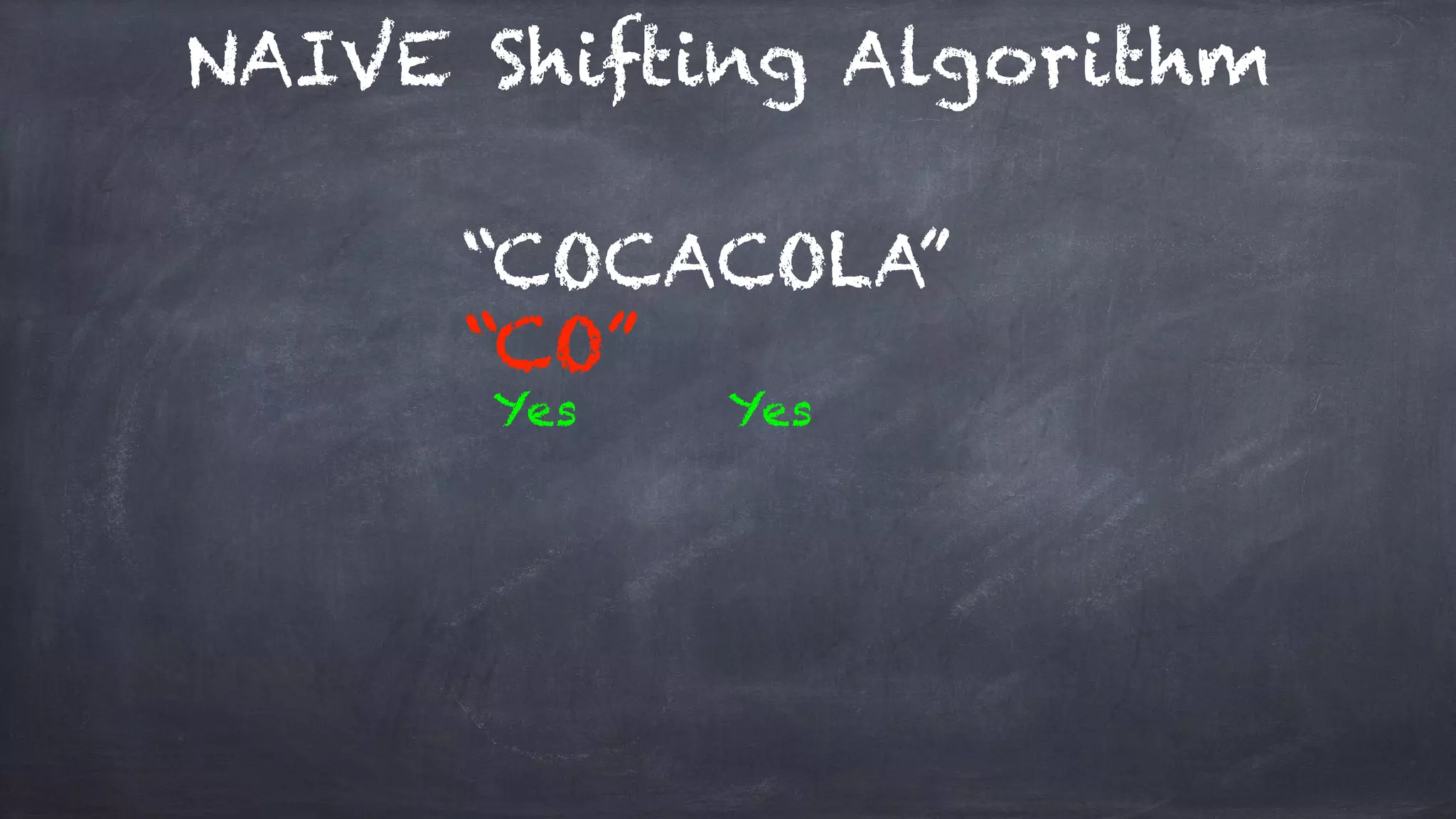
![NAIVE Shifting Algorithm
NAIVE-String-Macher(T,P)
1 n = T.length
2 m = P.length
3 for s = 0 to n-m
4 if p[1..m] == T[s+1 .. s+m]
5 print “Pattern occurs with shift” s](https://image.slidesharecdn.com/stringmatchingalgorithms-150812061543-lva1-app6892/75/String-matching-algorithms-7-2048.jpg)

![The Rabin-Karp Algorithm
Rabin-Karp-Matcher(T, P, d, q)
1 n = T.length
2 m = P.length
3 h = d^(m-1) mod q
4 p = 0
5 t0 = 0
6 for i = 1 to m //PreProcessing
7 p = (dp + p[i]) mod q
8 t0 = (dt0 + T[i]) mod q
9 for s = 0 to n-m //Matching
10 if p == ts
11 if P[1..m] == T[s+1..s+m]
12 print “Pattern occurs with shift” s
13 if s < n-m
14 ts+1 = (d(ts - T[s + 1]h) + T[s + m + 1]) mod 1](https://image.slidesharecdn.com/stringmatchingalgorithms-150812061543-lva1-app6892/75/String-matching-algorithms-13-2048.jpg)
![Construct string matching Automaton
Pattern: ababaca
a a
a
a
a
a
aab b
b
b
c
320 1 654 7
i - 1 2 3 4 5 6 7 8 9 10 11
T[i] - a b a b a b a c a b a
State 0 1 2 3 4 5 4 5 6 7 2 3](https://image.slidesharecdn.com/stringmatchingalgorithms-150812061543-lva1-app6892/75/String-matching-algorithms-18-2048.jpg)
![Finite Automaton Matcher
Finite-Automaton-Matcher(T, 𝝈, m)
1 n = T.length
2 q = 0
3 for i=0 to n
4 q = 𝝈 (q, T[i])
5 if q == m
6 print ”Pattern occurs with shift” i-m](https://image.slidesharecdn.com/stringmatchingalgorithms-150812061543-lva1-app6892/75/String-matching-algorithms-19-2048.jpg)
![Compute-Prefix-Function
Compute-Prefix-Function(P)
1 m = P.length
2 let π[1..m] be a new array
3 π[1] = 0
4 k = 0
5 for q = 2 to m
6 while k > 0 and P[k + 1] ≠ P[q]
7 k = π[k]
8 if P[k + 1] == P[q]
9 k = k + 1
10 π[q] = k
11 return π](https://image.slidesharecdn.com/stringmatchingalgorithms-150812061543-lva1-app6892/75/String-matching-algorithms-22-2048.jpg)
![Compute-Prefix-Function
i 1 2 3 4 5 6 7
P[i] a b a b a c a
π[i] 0 0 1 2 3 0 1](https://image.slidesharecdn.com/stringmatchingalgorithms-150812061543-lva1-app6892/75/String-matching-algorithms-23-2048.jpg)
![KMP Algorithm
KMP-Macher(T, P)
1 n = T.length
2 m = P.length
3 π = Compute-Prefix-Function(P)
4 q = 0 //number of characters matched
5 for i = 0 to n //scan the text from left to right
6 while q > 0 and P[q + 1] ≠ T[i]
7 q = π[q] //next character does not match
8 if P[q + 1] == T[i]
9 q = q + 1 //next character matches
10 if q == m //is all of P matched
11 print ” Pattern occurs with shift ” i-m
12 q = π[q] //look for the next match](https://image.slidesharecdn.com/stringmatchingalgorithms-150812061543-lva1-app6892/75/String-matching-algorithms-24-2048.jpg)
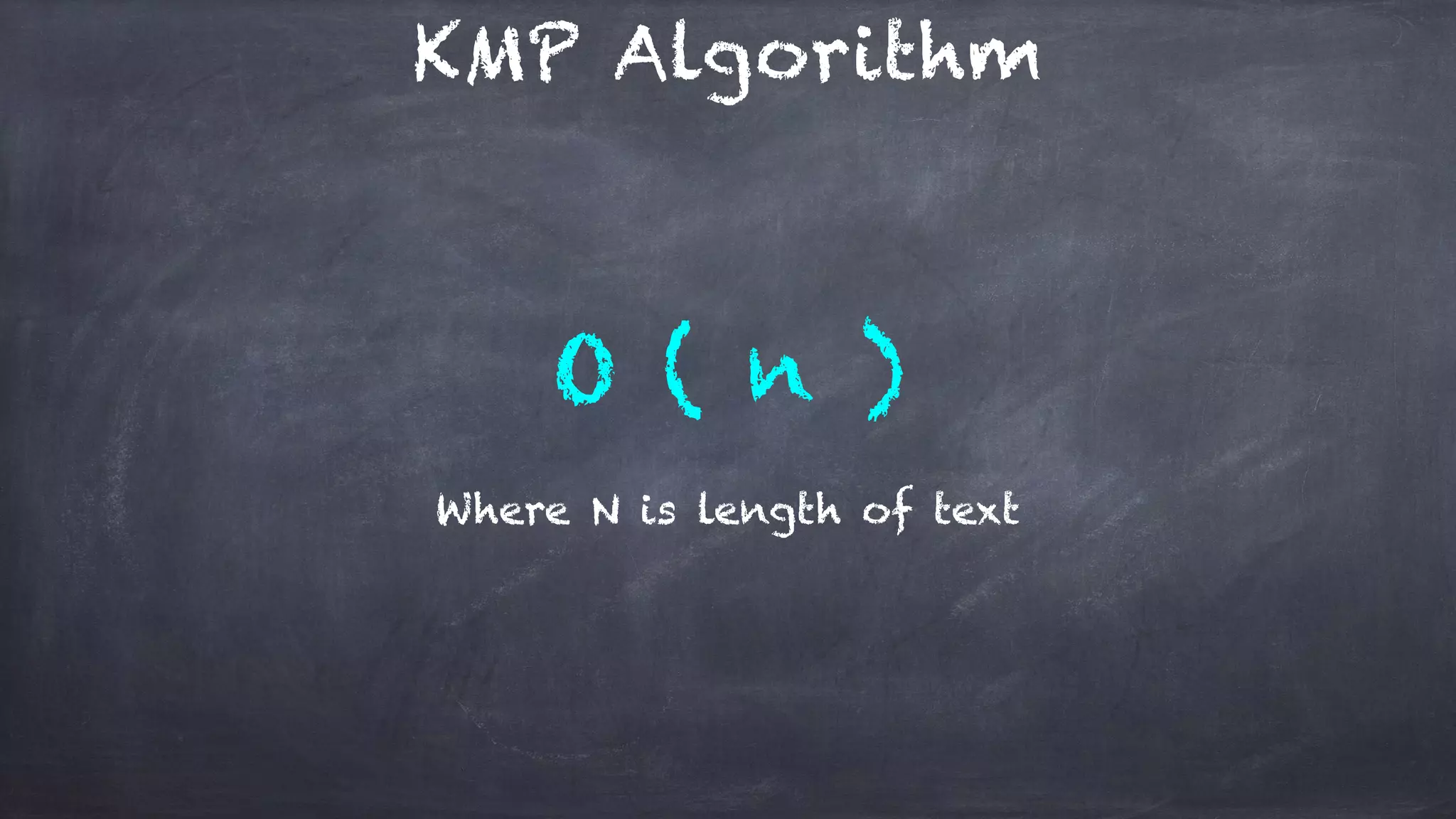


This document summarizes and compares several string matching algorithms: the Naive Shifting Algorithm, Rabin-Karp Algorithm, Finite Automaton String Matching, and Knuth-Morris-Pratt (KMP) Algorithm. It provides high-level descriptions of each algorithm, including their time complexities, which range from O(n*m) for the Naive algorithm to O(n) for the Rabin-Karp, Finite Automaton, and KMP algorithms. It also includes examples and pseudocode to illustrate how some of the algorithms work.
Presentation by Mahdi Esmail oghli discussing string matching algorithms with Dr. Bagheri at Amirkabir University.
Explanation of the terminology used in string matching: 'Pattern' refers to the searched string and 'Text' is where the search occurs.
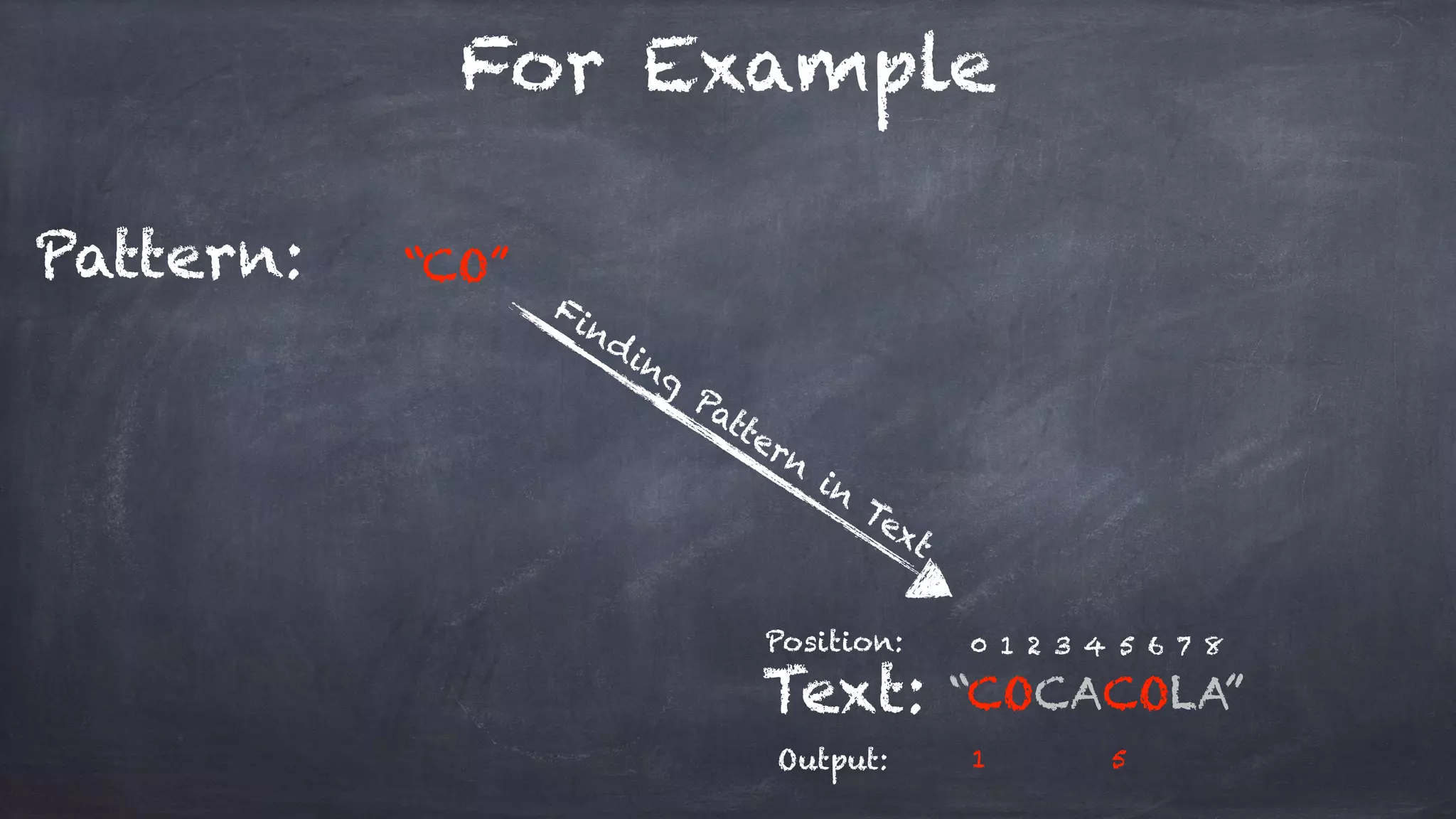
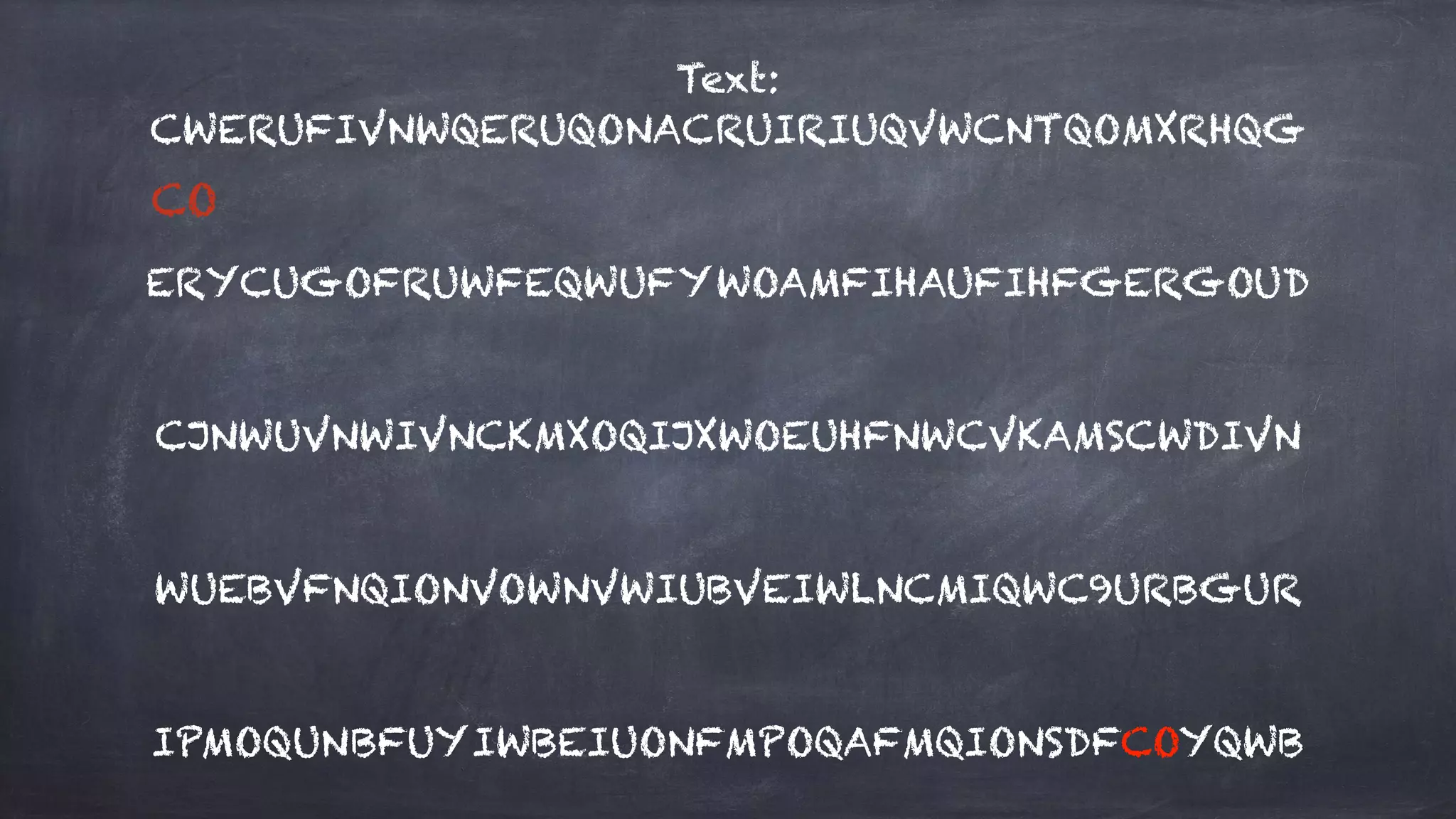
Illustrative example showing pattern 'CO' in the text 'COCACOLA' with positions returned as 1 and 5.
Discusses applications including searching systems and genetic studies such as BLAST.
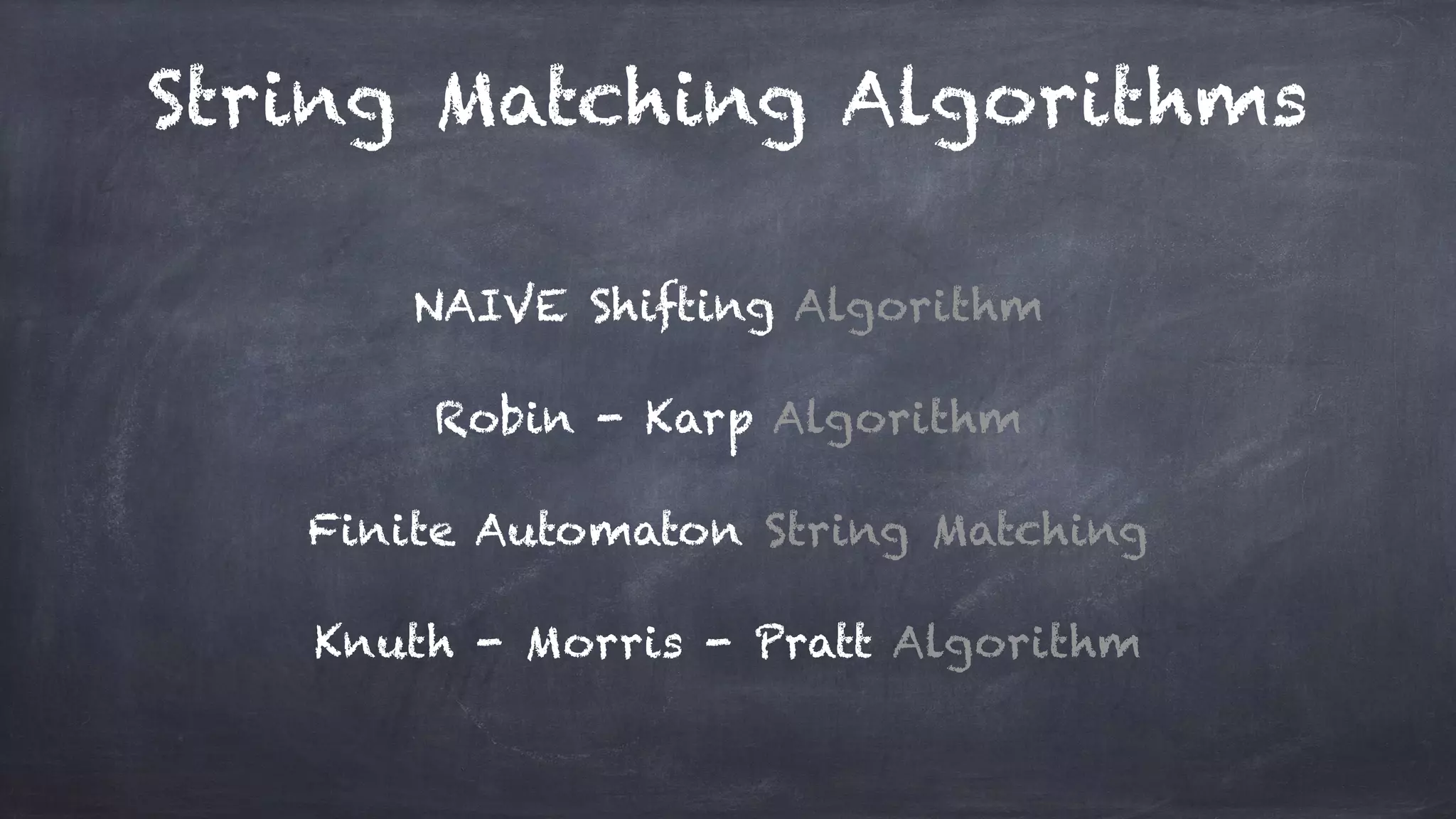
Overview of various string matching algorithms: Naive Shifting, Rabin-Karp, Finite Automaton, and KMP.
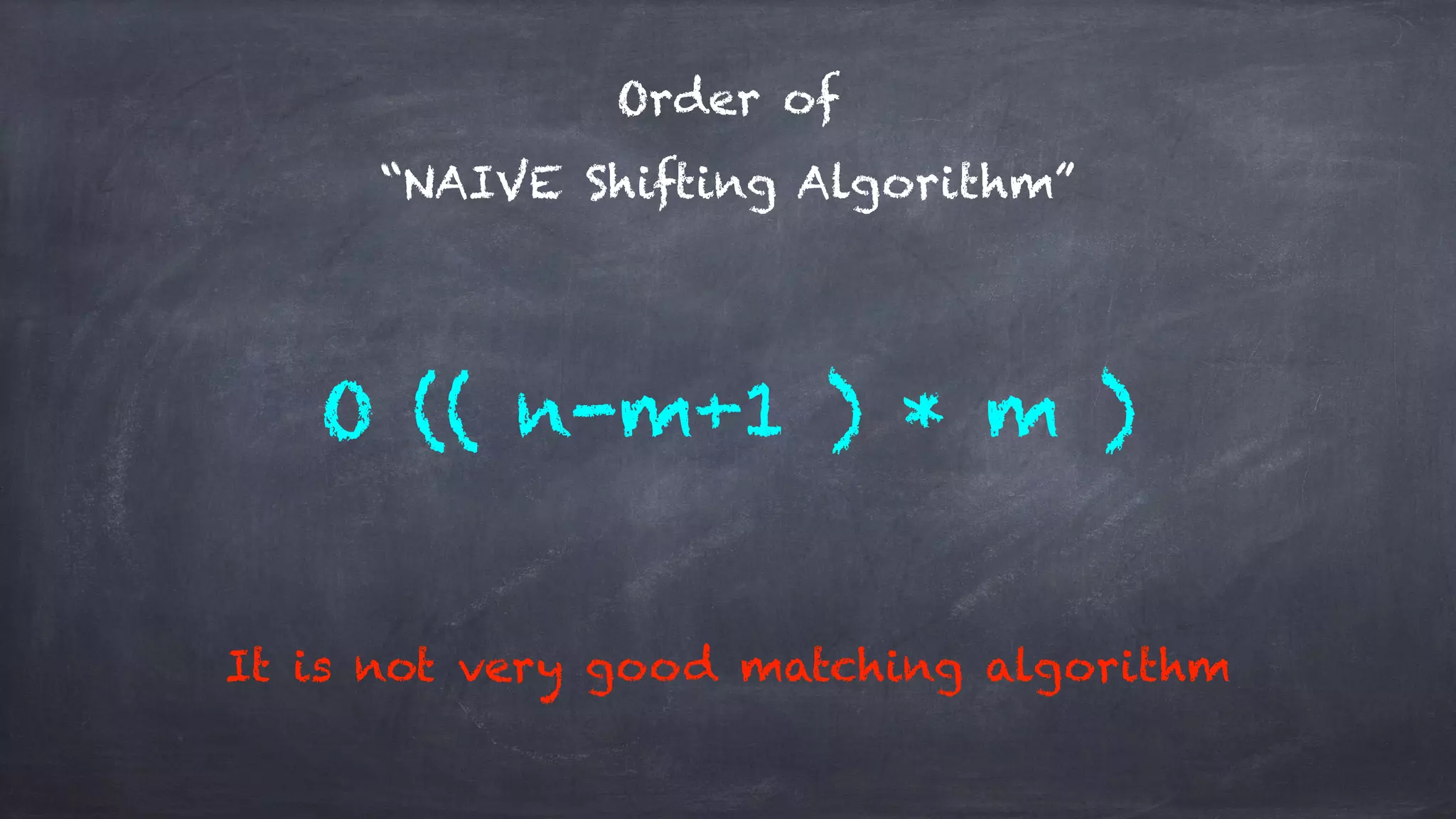
Details of Naive Shifting Algorithm steps and complexities, with example showing its inefficiencies.
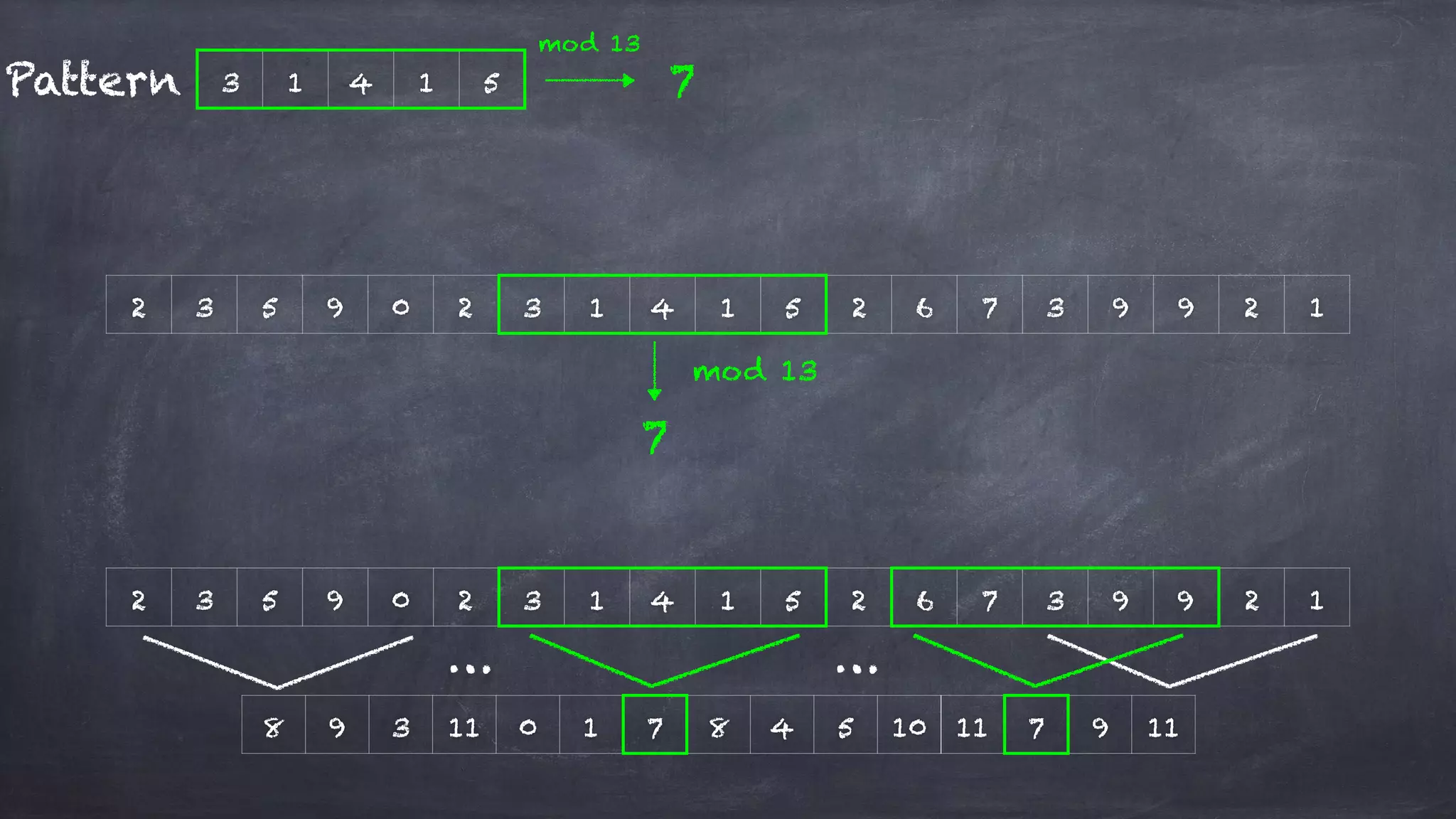
Introduction to the Rabin-Karp algorithm, preprocessing steps, and matching method with a focus on hashing.
Discussion on finite automata in string matching and their efficiency, including construction and matching processes.
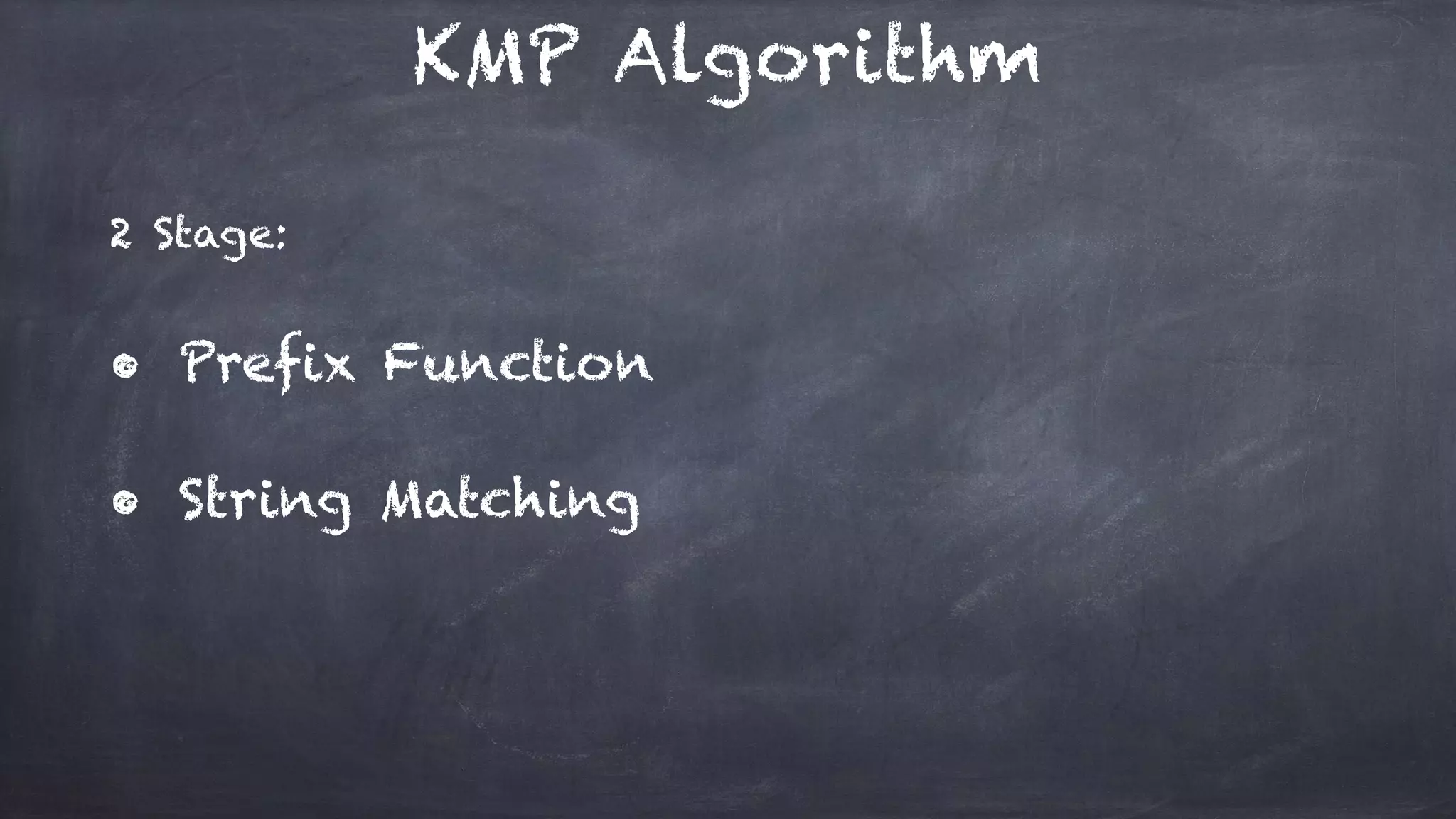
Introduction of the Knuth-Morris-Pratt (KMP) algorithm which offers linear-time complexity.
Details on the computation of the prefix function and the KMP algorithm's matching mechanism.
Summary of the KMP algorithm, confirming its linear complexity O(n), where n is the text length.
Closing remarks and thank you from the presenter.


![Gp 27[string matching].pptx](https://cdn.slidesharecdn.com/ss_thumbnails/gp27stringmatching-230422183348-6f0879e9-thumbnail.jpg?width=640&height=640&fit=bounds)


