Strategy in Turbulent Times
R.Kannan
Hinduja Group
16th
March 2016
Emerging Trends
• Global Economic Crisis of 2008 have spill over effects
• world is yet to come out of the impact of this crisis
• We are living in a VUCA world.
• The risks have increased over the years
• Predictability has become one of the challenges.
• Proven models of forecasting don’t work.
• Companies are not able to plan for long term.
• Many of the developed economies have seen their
economic growth falling.
• Oil and commodity prices have seen a big fall.
• Unemployment has reached unprecedented levels.
Emerging Trends
• No visible options available for kick starting the economy in
many of the leading economies in the world.
• Lower economic growth in countries led to lower trade and
lower corporate Growth
• Corporates are finding it difficult to increase the volume
demand for their products and there is a pressure on pricing.
• Risks have become multi fold in the last few years and they
are arising from various directions.
• There is an increased in uncertainty in Economic, Political,
Social , Technological and Environment aspects .
• This has a great bearing on performance of a corporate
Emerging Trends
• Growing world Population and it will be 8.3 billion People by
2030 with a Median Age increasing by 5 years to 34 years.
59% of world population will live in cities.
• Globalisation and future Markets . The globalisation of
markets will continue and exports and FDI are likely to grow
faster than GDP.
• Resources Security. Primary Energy consumption will rise by
26%.Half the world population will have water scarcity. There
will be increased food demand.
• Co2 oxide emissions will rise by 16% and Global warning will
be one of the major issues for management. Average
temperature will rise by 0.5% to 1.5% .
Risks
• China experiences a sharp economic slowdown
• Russia's interventions in Ukraine and Syria precede a new
"cold war" .
• Volatility culminates in an emerging markets corporate debt
crisis.
• Due to external and internal pressures, the EU begins to
fracture .
• Grexit" is followed by a euro zone break-up.
• The rising threat of Jihadi terrorism destabilises the global
economy.
• The UK votes to leave the EU.
• A collapse in investment in the oil sector prompts a future oil
price Shock
India CEO Survey
• 64 per cent of Indian respondents are very confident of their
growth prospects in the next 12 months as compared to 35
per cent globally.
• Indian CEO’s are preparing themselves for the technology
disruption and and the global risks arising from various
Economic, Political and other global events.
• Speed of technological change is a top concern for Indian
CEOs this year. 79 per cent of CEOs are concerned about the
influence the speed of technological change . 80 per cent of
CEOs believe that over the next five years, technological
advances will transform wider stakeholder expectations
• Exchange rate volatility concerns 80 per cent of CEOs in India
and 73 per cent of CEOs globally.
India CEO Survey
• Demographic shifts and change in global economic power will
transform wider stakeholder expectations.
• 63 per cent of CEOs expect that customers are seeking a mix
of cost, convenience and functionality in products/services.
• Up to 92 per cent of the CEOs in India reported that they are
changing the way they use technology to assess and deliver
on wider stakeholder expectations.
• Data and analytics lead the way, with 78 per cent of CEOs
feeling the need for it.
• Customer relationship management systems come next,
followed by research and development and innovation.
CII Industry Survey – Dec 15
• CII Business Confidence Index (CII- BCI) for October-December
2015 quarter stood at 53.9, up from 53.4 in the previous
quarter.
• Majority of the respondents seem unsure about the recovery
in credit growth.
• 64 per cent felt that the government’s initiatives for
Improving ease of doing business have had a 10-30% impact
at the ground-level.
• 55 per cent expect the exchange rate to range between Rs
63-67 per US dollar in 2015-16.
• 44 per cent expect improvement in both sales and new
orders.
CII Industry Survey
• Major share of the businesses expect capacity utilization to
remain at the 50-75%.
• Majority of the respondents anticipate no changes in raw
material, fuel and credit cost, while Salaries are expected to
increase .
• Most of the respondents expect status quo in after tax profits.
• Majority of the respondents expect no significant change in
external trade .
• Low domestic demand and lack of political consensus on
economic reforms emerge as the major concerns
Conclusions from Surveys
• Customers and clients are top priority. The development of
online business models have removed the scope for
differentiation .
• 90% CEO’s say Customers have the biggest impact on
strategy.
• Technology and risk management are the top areas .
• Data and analytics technologies as generating the greatest
return for stakeholder engagement.
• CEOs are most likely to change their talent strategy to focus
on their leadership pipeline.
• Business could do more to measure the impact and value of
innovation
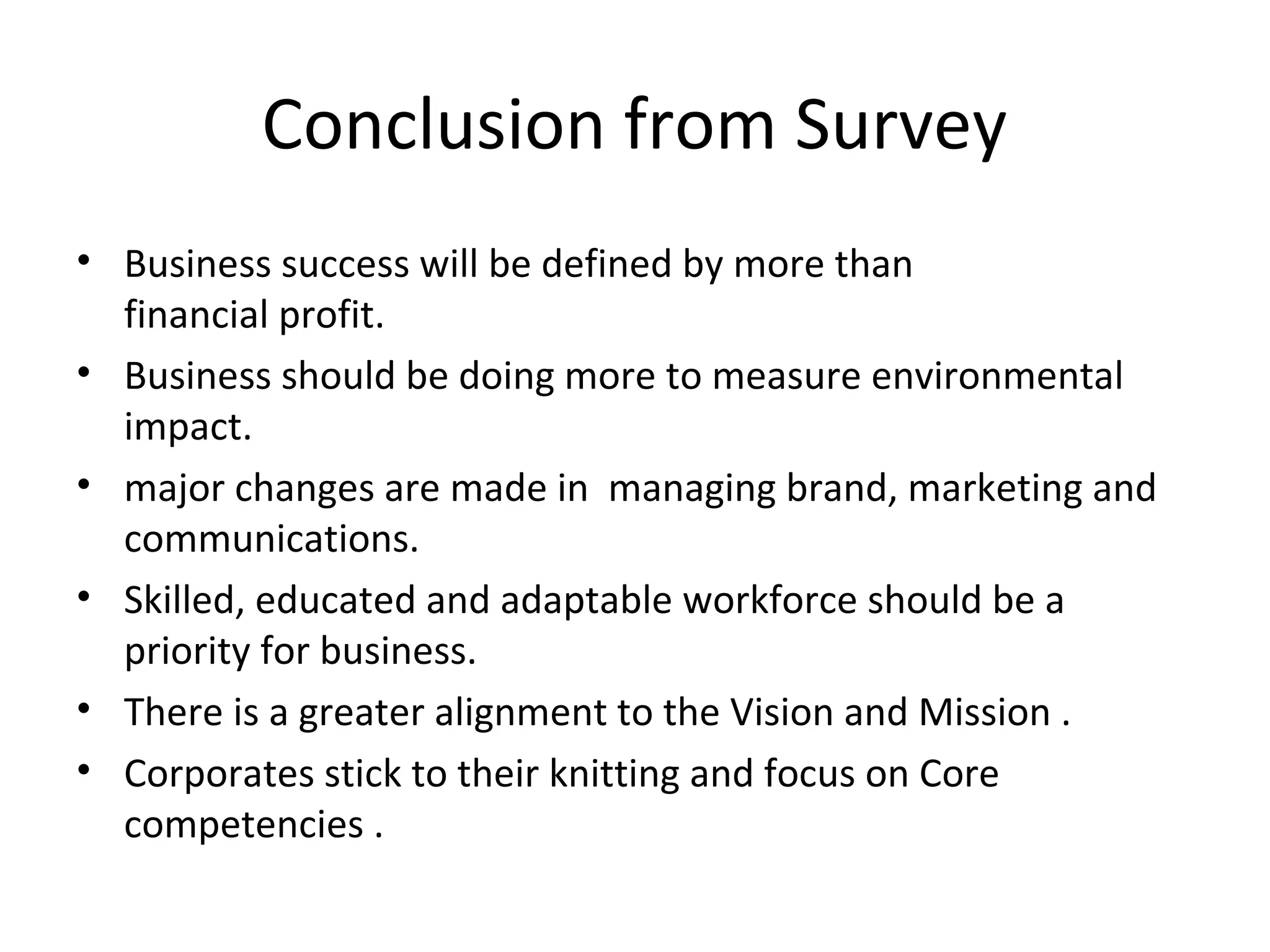
Conclusion from Survey
• Business success will be defined by more than
financial profit.
• Business should be doing more to measure environmental
impact.
• major changes are made in managing brand, marketing and
communications.
• Skilled, educated and adaptable workforce should be a
priority for business.
• There is a greater alignment to the Vision and Mission .
• Corporates stick to their knitting and focus on Core
competencies .
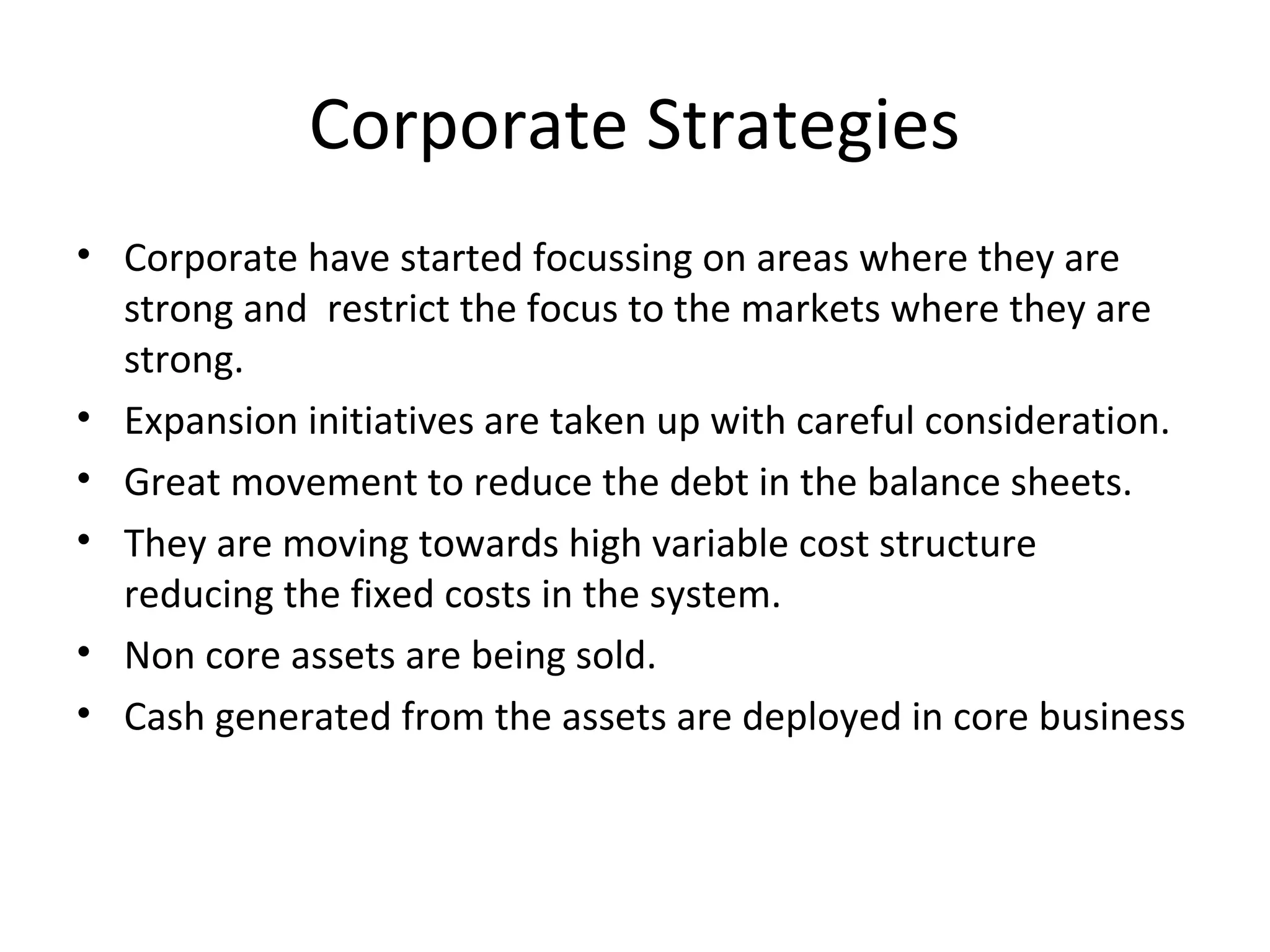
Corporate Strategies
• Corporate have started focussing on areas where they are
strong and restrict the focus to the markets where they are
strong.
• Expansion initiatives are taken up with careful consideration.
• Great movement to reduce the debt in the balance sheets.
• They are moving towards high variable cost structure
reducing the fixed costs in the system.
• Non core assets are being sold.
• Cash generated from the assets are deployed in core business
Corporate Strategies to Focus
• To build asset light business models.
• Convert most of the fixed costs into variable costs.
• Explore outsourcing as a main plank of the strategy.
• Focus on growth should be on emerging high growth markets.
• Focus should be on middle class consumer segments and fast
growing sectors.
• Fast response. The enterprise should become highly agile and
adaptive to the developments at a good speed.
• Increased Focus on short term performance.
• Closely monitor the environmental developments and the
corporate performance on a continuous basis
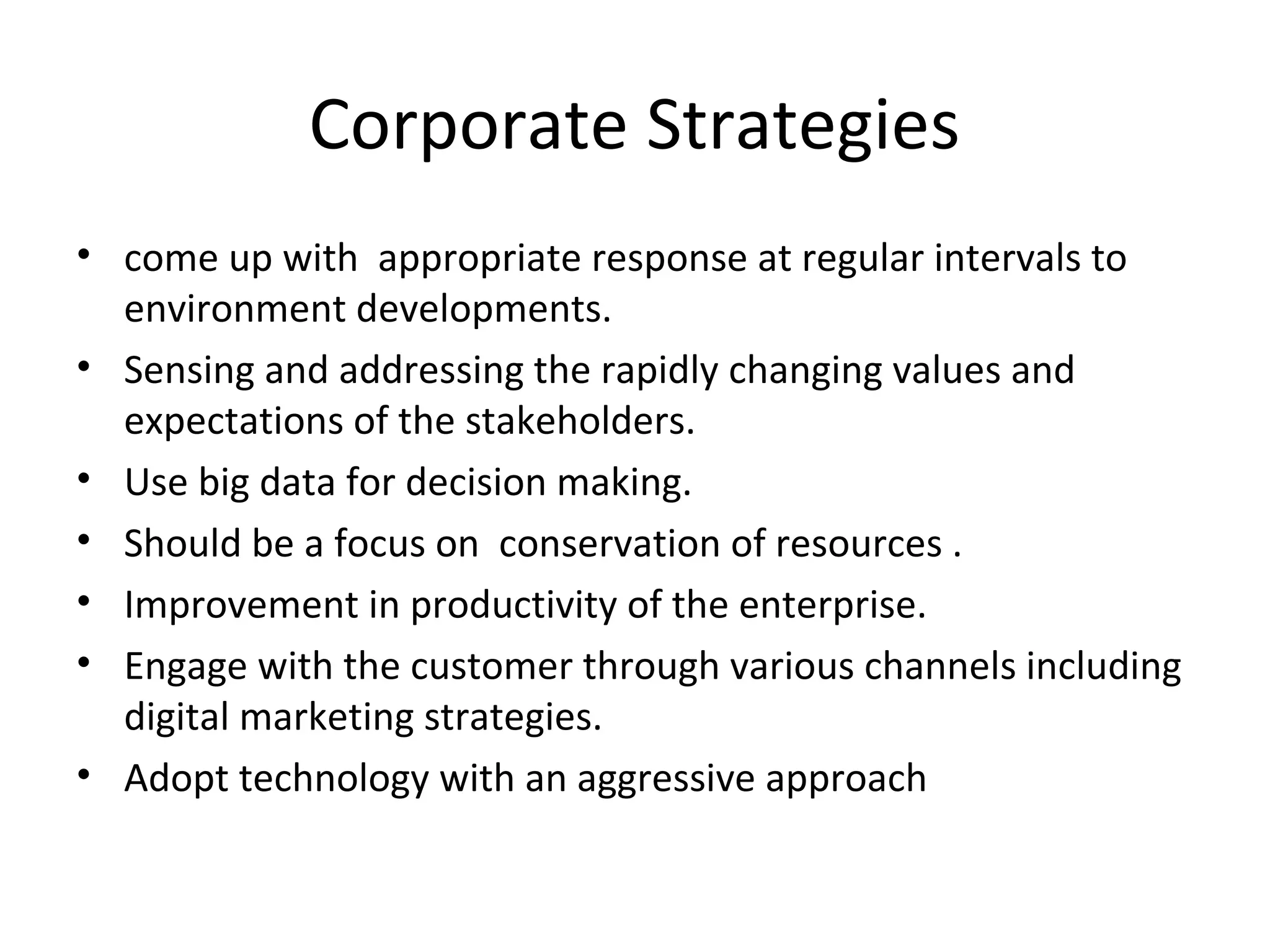
Corporate Strategies
• come up with appropriate response at regular intervals to
environment developments.
• Sensing and addressing the rapidly changing values and
expectations of the stakeholders.
• Use big data for decision making.
• Should be a focus on conservation of resources .
• Improvement in productivity of the enterprise.
• Engage with the customer through various channels including
digital marketing strategies.
• Adopt technology with an aggressive approach
Thank You

Strategy in turbulent times

  • 1.
    Strategy in TurbulentTimes R.Kannan Hinduja Group 16th March 2016
  • 2.
    Emerging Trends • GlobalEconomic Crisis of 2008 have spill over effects • world is yet to come out of the impact of this crisis • We are living in a VUCA world. • The risks have increased over the years • Predictability has become one of the challenges. • Proven models of forecasting don’t work. • Companies are not able to plan for long term. • Many of the developed economies have seen their economic growth falling. • Oil and commodity prices have seen a big fall. • Unemployment has reached unprecedented levels.
  • 3.
    Emerging Trends • Novisible options available for kick starting the economy in many of the leading economies in the world. • Lower economic growth in countries led to lower trade and lower corporate Growth • Corporates are finding it difficult to increase the volume demand for their products and there is a pressure on pricing. • Risks have become multi fold in the last few years and they are arising from various directions. • There is an increased in uncertainty in Economic, Political, Social , Technological and Environment aspects . • This has a great bearing on performance of a corporate
  • 4.
    Emerging Trends • Growingworld Population and it will be 8.3 billion People by 2030 with a Median Age increasing by 5 years to 34 years. 59% of world population will live in cities. • Globalisation and future Markets . The globalisation of markets will continue and exports and FDI are likely to grow faster than GDP. • Resources Security. Primary Energy consumption will rise by 26%.Half the world population will have water scarcity. There will be increased food demand. • Co2 oxide emissions will rise by 16% and Global warning will be one of the major issues for management. Average temperature will rise by 0.5% to 1.5% .
  • 5.
    Risks • China experiencesa sharp economic slowdown • Russia's interventions in Ukraine and Syria precede a new "cold war" . • Volatility culminates in an emerging markets corporate debt crisis. • Due to external and internal pressures, the EU begins to fracture . • Grexit" is followed by a euro zone break-up. • The rising threat of Jihadi terrorism destabilises the global economy. • The UK votes to leave the EU. • A collapse in investment in the oil sector prompts a future oil price Shock
  • 6.
    India CEO Survey •64 per cent of Indian respondents are very confident of their growth prospects in the next 12 months as compared to 35 per cent globally. • Indian CEO’s are preparing themselves for the technology disruption and and the global risks arising from various Economic, Political and other global events. • Speed of technological change is a top concern for Indian CEOs this year. 79 per cent of CEOs are concerned about the influence the speed of technological change . 80 per cent of CEOs believe that over the next five years, technological advances will transform wider stakeholder expectations • Exchange rate volatility concerns 80 per cent of CEOs in India and 73 per cent of CEOs globally.
  • 7.
    India CEO Survey •Demographic shifts and change in global economic power will transform wider stakeholder expectations. • 63 per cent of CEOs expect that customers are seeking a mix of cost, convenience and functionality in products/services. • Up to 92 per cent of the CEOs in India reported that they are changing the way they use technology to assess and deliver on wider stakeholder expectations. • Data and analytics lead the way, with 78 per cent of CEOs feeling the need for it. • Customer relationship management systems come next, followed by research and development and innovation.
  • 8.
    CII Industry Survey– Dec 15 • CII Business Confidence Index (CII- BCI) for October-December 2015 quarter stood at 53.9, up from 53.4 in the previous quarter. • Majority of the respondents seem unsure about the recovery in credit growth. • 64 per cent felt that the government’s initiatives for Improving ease of doing business have had a 10-30% impact at the ground-level. • 55 per cent expect the exchange rate to range between Rs 63-67 per US dollar in 2015-16. • 44 per cent expect improvement in both sales and new orders.
  • 9.
    CII Industry Survey •Major share of the businesses expect capacity utilization to remain at the 50-75%. • Majority of the respondents anticipate no changes in raw material, fuel and credit cost, while Salaries are expected to increase . • Most of the respondents expect status quo in after tax profits. • Majority of the respondents expect no significant change in external trade . • Low domestic demand and lack of political consensus on economic reforms emerge as the major concerns
  • 10.
    Conclusions from Surveys •Customers and clients are top priority. The development of online business models have removed the scope for differentiation . • 90% CEO’s say Customers have the biggest impact on strategy. • Technology and risk management are the top areas . • Data and analytics technologies as generating the greatest return for stakeholder engagement. • CEOs are most likely to change their talent strategy to focus on their leadership pipeline. • Business could do more to measure the impact and value of innovation
  • 11.
    Conclusion from Survey •Business success will be defined by more than financial profit. • Business should be doing more to measure environmental impact. • major changes are made in managing brand, marketing and communications. • Skilled, educated and adaptable workforce should be a priority for business. • There is a greater alignment to the Vision and Mission . • Corporates stick to their knitting and focus on Core competencies .
  • 12.
    Corporate Strategies • Corporatehave started focussing on areas where they are strong and restrict the focus to the markets where they are strong. • Expansion initiatives are taken up with careful consideration. • Great movement to reduce the debt in the balance sheets. • They are moving towards high variable cost structure reducing the fixed costs in the system. • Non core assets are being sold. • Cash generated from the assets are deployed in core business
  • 13.
    Corporate Strategies toFocus • To build asset light business models. • Convert most of the fixed costs into variable costs. • Explore outsourcing as a main plank of the strategy. • Focus on growth should be on emerging high growth markets. • Focus should be on middle class consumer segments and fast growing sectors. • Fast response. The enterprise should become highly agile and adaptive to the developments at a good speed. • Increased Focus on short term performance. • Closely monitor the environmental developments and the corporate performance on a continuous basis
  • 14.
    Corporate Strategies • comeup with appropriate response at regular intervals to environment developments. • Sensing and addressing the rapidly changing values and expectations of the stakeholders. • Use big data for decision making. • Should be a focus on conservation of resources . • Improvement in productivity of the enterprise. • Engage with the customer through various channels including digital marketing strategies. • Adopt technology with an aggressive approach
  • 15.