STRATEGIC MANAGEMENT
Michael A Hitt; Robert E Hoskisonn; R Duane Ireland
Limkokwing Univ. - Confidential 1
Centre of Post Graduate Studies and Professional Development
Limkokwing University of Creative Technology, Malaysia
Chapter 1: Strategic Management Inputs
 Strategic Management Process
 Concepts and Cases
OBJECTIVES
In this session you will be learning,
• Strategic Management Process
• Stakeholders
• Strategic Leaders
• Leadership Management Process
2
Limkokwing Univ. - Confidential
Limkokwing Univ. - Confidential 3
• Competitive Advantage
When a firm implements a strategy that its competitors are unable
to duplicate or find too costly to try to imitate.
• Strategic Competitiveness
When a firm successfully formulates and implements a value-
creating strategy.
• Strategy
An integrated and coordinated set of commitments and actions
designed to exploit core competencies and gain a competitive
advantage.
FUNDAMENTAL CONCEPTS
Limkokwing Univ. - Confidential 4
• Risk
An investor’s uncertainty about the economic gains or losses that
will result from a particular investment.
• Average Returns
Returns equal to those an investor expects to earn from other
investments with a similar amount of risk.
• Above-average Returns
Returns in excess of what an investor expects to earn from other
investments with a similar amount of risk.
FUNDAMENTAL CONCEPTS
Limkokwing Univ. - Confidential 5
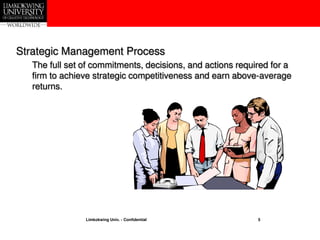
Strategic Management Process
The full set of commitments, decisions, and actions required for a
firm to achieve strategic competitiveness and earn above-average
returns.
1–6
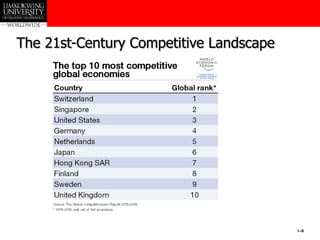
The 21st-Century Competitive Landscape
Only 16 of the 100 largest U.S. companies at the start of the 20th
century are still identifiable today!
Recently in 2016, around 44,367 businesses has filed for bankruptcy
and many more businesses has failed
1–7
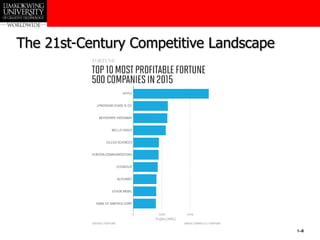
The 21st-Century Competitive Landscape
Lets see some Statistics
1–8
The 21st-Century Competitive Landscape
1–9
The 21st-Century Competitive Landscape
1–10
The 21st-Century Competitive Landscape
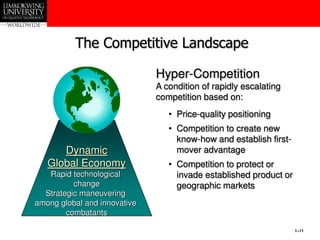
• Terrifying Business World
– Rapid changes in industry boundaries and markets
– Conventional sources of competitive advantage losing
effectiveness
– Enormous investments required to compete globally
– Severe consequences for failure
1–11
Dynamic
Global Economy
Rapid technological
change
Strategic maneuvering
among global and innovative
combatants
The Competitive Landscape
Hyper-Competition
A condition of rapidly escalating
competition based on:
• Price-quality positioning
• Competition to create new
know-how and establish first-
mover advantage
• Competition to protect or
invade established product or
geographic markets
1–12
Global Economy
• The Global Economy
– Extended borders
Goods, people, skills, and ideas move freely across geographic borders.
– Expansion into global arena complicates a firm’s
competitive environment.
1–13
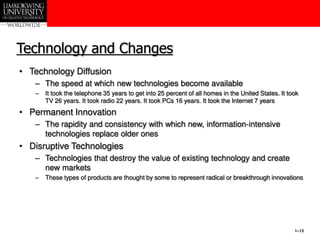
Technology and Changes
• Technology Diffusion
– The speed at which new technologies become available
– It took the telephone 35 years to get into 25 percent of all homes in the United States. It took
TV 26 years. It took radio 22 years. It took PCs 16 years. It took the Internet 7 years
• Permanent Innovation
– The rapidity and consistency with which new, information-intensive
technologies replace older ones
• Disruptive Technologies
– Technologies that destroy the value of existing technology and create
new markets
– These types of products are thought by some to represent radical or breakthrough innovations
1–14
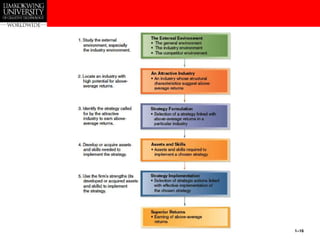
Industrial Organization Model
(I/O Model)
of
Above-Average Returns
1–15
Industrial Organization Model
(I/O Model)
The Industrial Organization model suggests that
above-average returns for any firm are largely
determined by characteristics outside the firm
1–16
1–17
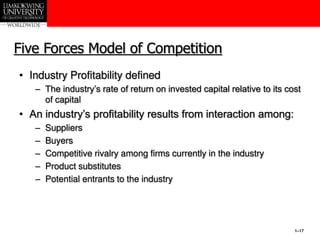
Five Forces Model of Competition
• Industry Profitability defined
– The industry’s rate of return on invested capital relative to its cost
of capital
• An industry’s profitability results from interaction among:
– Suppliers
– Buyers
– Competitive rivalry among firms currently in the industry
– Product substitutes
– Potential entrants to the industry
Limkokwing Univ. - Confidential 18
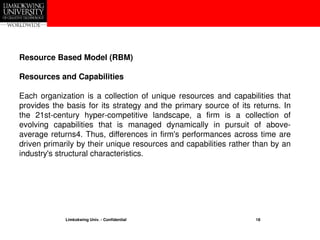
Resource Based Model (RBM)
Resources and Capabilities
Each organization is a collection of unique resources and capabilities that
provides the basis for its strategy and the primary source of its returns. In
the 21st-century hyper-competitive landscape, a firm is a collection of
evolving capabilities that is managed dynamically in pursuit of above-
average returns4. Thus, differences in firm's performances across time are
driven primarily by their unique resources and capabilities rather than by an
industry's structural characteristics.
1–19
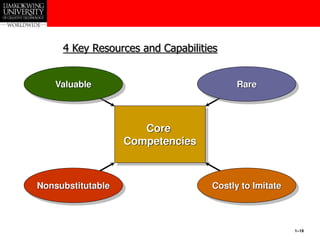
4 Key Resources and Capabilities
Core
Competencies
Valuable Rare
Costly to Imitate
Nonsubstitutable
1–20
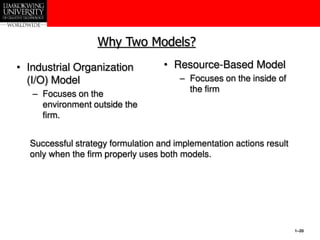
Why Two Models?
• Industrial Organization
(I/O) Model
– Focuses on the
environment outside the
firm.
• Resource-Based Model
– Focuses on the inside of
the firm
Successful strategy formulation and implementation actions result
only when the firm properly uses both models.
1–21
Vision and Mission
• Vision
– A enduring picture of what the firm wants to be and, in broad terms,
what it wants to ultimately achieve.
• Effective vision statements are:
– Developed by a host of people from across the organization.
– Clearly tied to external and internal environmental conditions.
– Consistent with strategic leaders’ decisions and actions.
1–22
• Mission
– Specifies the business or businesses in which the firm intends to
compete and the customers it intends to serve.
– Is more concrete than the firm’s vision.
– Is more effective when it fosters strong ethical standards.
Above-average returns are the fruits of the firm’s efforts to
achieve its vision and mission.
Vision and Mission
1–23
Stakeholders
• Individuals and groups who can affect, and are affected
by, the strategic outcomes achieved and who have
enforceable claims on a firm’s performance.
– Claims on the firm’s performance are enforced by the
stakeholder’s ability to withhold participation essential to the
firm’s survival.
– The more critical and valued a stakeholder’s participation, the
greater a firm’s dependency on it.
– Managers must find ways to either accommodate or insulate the
organization from the demands of stakeholders controlling
critical resources.
1–24
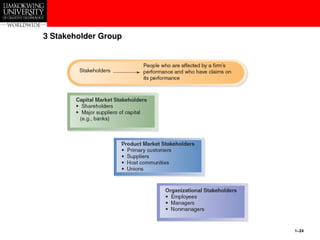
3 Stakeholder Group
1–25
Capital Market Stakeholders
• Shareholders and lenders expect the firm to preserve and enhance
the wealth they have entrusted to it.
– Want the return on their investment (and, hence, their wealth) to be
maximized.
– Expect returns to be commensurate with the degree of risk to the
shareholder.
• Management must balance the interests of shareholders and lenders
with its concerns for the firm’s future competitive ability.
1–26
Product Market Stakeholders
• Customers
– Demand reliable products at low prices
• Suppliers
– Seek loyal customers willing to pay highest sustainable prices for
goods and services
• Host communities
– Want companies willing to be long-term employers and providers
of tax revenues while minimizing demands on public support
services
• Union officials
– Want secure jobs and desirable working conditions
1–27
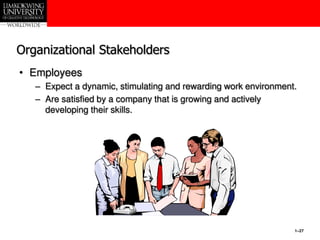
Organizational Stakeholders
• Employees
– Expect a dynamic, stimulating and rewarding work environment.
– Are satisfied by a company that is growing and actively
developing their skills.
1–28
Strategic Leaders
• Strategic Leaders
– People located in different parts of the firm who are using the
strategic management process to help the firm reach its vision
and mission.
• Prerequisites for Effective Strategic Leadership
– Hard work
– Thorough analyses
– Honesty
– Desire for accomplishment
– Common sense
SUMMARY
In this session you have learnt,
• Vision and Mission
• Stakeholders
• Strategic Leaders
• Leadership Management Process
29
Limkokwing Univ. - Confidential
Limkokwing Univ. – Confidential 30

STRATEGIC_MANAGEMENT_Chapter_1_Strategic (1).pdf

  • 1.
    STRATEGIC MANAGEMENT Michael AHitt; Robert E Hoskisonn; R Duane Ireland Limkokwing Univ. - Confidential 1 Centre of Post Graduate Studies and Professional Development Limkokwing University of Creative Technology, Malaysia Chapter 1: Strategic Management Inputs  Strategic Management Process  Concepts and Cases
  • 2.
    OBJECTIVES In this sessionyou will be learning, • Strategic Management Process • Stakeholders • Strategic Leaders • Leadership Management Process 2 Limkokwing Univ. - Confidential
  • 3.
    Limkokwing Univ. -Confidential 3 • Competitive Advantage When a firm implements a strategy that its competitors are unable to duplicate or find too costly to try to imitate. • Strategic Competitiveness When a firm successfully formulates and implements a value- creating strategy. • Strategy An integrated and coordinated set of commitments and actions designed to exploit core competencies and gain a competitive advantage. FUNDAMENTAL CONCEPTS
  • 4.
    Limkokwing Univ. -Confidential 4 • Risk An investor’s uncertainty about the economic gains or losses that will result from a particular investment. • Average Returns Returns equal to those an investor expects to earn from other investments with a similar amount of risk. • Above-average Returns Returns in excess of what an investor expects to earn from other investments with a similar amount of risk. FUNDAMENTAL CONCEPTS
  • 5.
    Limkokwing Univ. -Confidential 5 Strategic Management Process The full set of commitments, decisions, and actions required for a firm to achieve strategic competitiveness and earn above-average returns.
  • 6.
    1–6 The 21st-Century CompetitiveLandscape Only 16 of the 100 largest U.S. companies at the start of the 20th century are still identifiable today! Recently in 2016, around 44,367 businesses has filed for bankruptcy and many more businesses has failed
  • 7.
    1–7 The 21st-Century CompetitiveLandscape Lets see some Statistics
  • 8.
  • 9.
  • 10.
    1–10 The 21st-Century CompetitiveLandscape • Terrifying Business World – Rapid changes in industry boundaries and markets – Conventional sources of competitive advantage losing effectiveness – Enormous investments required to compete globally – Severe consequences for failure
  • 11.
    1–11 Dynamic Global Economy Rapid technological change Strategicmaneuvering among global and innovative combatants The Competitive Landscape Hyper-Competition A condition of rapidly escalating competition based on: • Price-quality positioning • Competition to create new know-how and establish first- mover advantage • Competition to protect or invade established product or geographic markets
  • 12.
    1–12 Global Economy • TheGlobal Economy – Extended borders Goods, people, skills, and ideas move freely across geographic borders. – Expansion into global arena complicates a firm’s competitive environment.
  • 13.
    1–13 Technology and Changes •Technology Diffusion – The speed at which new technologies become available – It took the telephone 35 years to get into 25 percent of all homes in the United States. It took TV 26 years. It took radio 22 years. It took PCs 16 years. It took the Internet 7 years • Permanent Innovation – The rapidity and consistency with which new, information-intensive technologies replace older ones • Disruptive Technologies – Technologies that destroy the value of existing technology and create new markets – These types of products are thought by some to represent radical or breakthrough innovations
  • 14.
    1–14 Industrial Organization Model (I/OModel) of Above-Average Returns
  • 15.
    1–15 Industrial Organization Model (I/OModel) The Industrial Organization model suggests that above-average returns for any firm are largely determined by characteristics outside the firm
  • 16.
  • 17.
    1–17 Five Forces Modelof Competition • Industry Profitability defined – The industry’s rate of return on invested capital relative to its cost of capital • An industry’s profitability results from interaction among: – Suppliers – Buyers – Competitive rivalry among firms currently in the industry – Product substitutes – Potential entrants to the industry
  • 18.
    Limkokwing Univ. -Confidential 18 Resource Based Model (RBM) Resources and Capabilities Each organization is a collection of unique resources and capabilities that provides the basis for its strategy and the primary source of its returns. In the 21st-century hyper-competitive landscape, a firm is a collection of evolving capabilities that is managed dynamically in pursuit of above- average returns4. Thus, differences in firm's performances across time are driven primarily by their unique resources and capabilities rather than by an industry's structural characteristics.
  • 19.
    1–19 4 Key Resourcesand Capabilities Core Competencies Valuable Rare Costly to Imitate Nonsubstitutable
  • 20.
    1–20 Why Two Models? •Industrial Organization (I/O) Model – Focuses on the environment outside the firm. • Resource-Based Model – Focuses on the inside of the firm Successful strategy formulation and implementation actions result only when the firm properly uses both models.
  • 21.
    1–21 Vision and Mission •Vision – A enduring picture of what the firm wants to be and, in broad terms, what it wants to ultimately achieve. • Effective vision statements are: – Developed by a host of people from across the organization. – Clearly tied to external and internal environmental conditions. – Consistent with strategic leaders’ decisions and actions.
  • 22.
    1–22 • Mission – Specifiesthe business or businesses in which the firm intends to compete and the customers it intends to serve. – Is more concrete than the firm’s vision. – Is more effective when it fosters strong ethical standards. Above-average returns are the fruits of the firm’s efforts to achieve its vision and mission. Vision and Mission
  • 23.
    1–23 Stakeholders • Individuals andgroups who can affect, and are affected by, the strategic outcomes achieved and who have enforceable claims on a firm’s performance. – Claims on the firm’s performance are enforced by the stakeholder’s ability to withhold participation essential to the firm’s survival. – The more critical and valued a stakeholder’s participation, the greater a firm’s dependency on it. – Managers must find ways to either accommodate or insulate the organization from the demands of stakeholders controlling critical resources.
  • 24.
  • 25.
    1–25 Capital Market Stakeholders •Shareholders and lenders expect the firm to preserve and enhance the wealth they have entrusted to it. – Want the return on their investment (and, hence, their wealth) to be maximized. – Expect returns to be commensurate with the degree of risk to the shareholder. • Management must balance the interests of shareholders and lenders with its concerns for the firm’s future competitive ability.
  • 26.
    1–26 Product Market Stakeholders •Customers – Demand reliable products at low prices • Suppliers – Seek loyal customers willing to pay highest sustainable prices for goods and services • Host communities – Want companies willing to be long-term employers and providers of tax revenues while minimizing demands on public support services • Union officials – Want secure jobs and desirable working conditions
  • 27.
    1–27 Organizational Stakeholders • Employees –Expect a dynamic, stimulating and rewarding work environment. – Are satisfied by a company that is growing and actively developing their skills.
  • 28.
    1–28 Strategic Leaders • StrategicLeaders – People located in different parts of the firm who are using the strategic management process to help the firm reach its vision and mission. • Prerequisites for Effective Strategic Leadership – Hard work – Thorough analyses – Honesty – Desire for accomplishment – Common sense
  • 29.
    SUMMARY In this sessionyou have learnt, • Vision and Mission • Stakeholders • Strategic Leaders • Leadership Management Process 29 Limkokwing Univ. - Confidential
  • 30.
    Limkokwing Univ. –Confidential 30