CERTIFICATE: MUNICIPAL FINANCIALMANAGEMENT
ID 48965 LEVEL 6 – 166 CREDITS
SKILLS PROGRAM 3:
LEARNER GUIDE
SAQA : 116342;116358
MUNICIPAL STRATEGIC PLANNING AND
IMPLEMENTATION
2 | P a g e
2.
3 | Pa g e
Learner Information:
Details Please Complete this Section
Name & Surname:
Organization:
Unit/Dept:
Facilitator Name:
Date Started:
Date of Completion:
Copyright
All rights reserved. The copyright of this document, its previous editions and any annexure
thereto, is protected and expressly reserved. No part of this document may be reproduced,
stored in a retrievable system, or transmitted, in any form or by any means, electronic,
mechanical, photocopying, recording or otherwise without the prior permission.
3.
4 | Pa g e
Key to Icons
The following icons may be used in this Learner Guide to indicate specific functions:
Books
This icon means that other books are available for further information on
a particular topic/subject.
References
This icon refers to any examples, handouts, checklists, etc…
Important
This icon represents important information related to a specific topic or
section of the guide.
Activities
This icon helps you to be prepared for the learning to follow or assist you
to demonstrate understanding of module content. Shows transference of
knowledge and skill.
Exercises
This icon represents any exercise to be completed on a specific topic at
home by you or in a group.
Tasks/Projects
An important aspect of the assessment process is proof of competence.
This can be achieved by observation or a portfolio of evidence should
be submitted in this regard.
4.
Workplace Activities
An importantaspect of learning is through workplace experience.
Activities with this icon can only be completed once a learner is in the
workplace
Tips
This icon indicates practical tips you can adopt in the future.
Notes
This icon represents important notes you must remember as part of the
learning process.
5 | P a g e
5.
Learner Guide Introduction
Aboutthe Learner
Guide…
This Learner Guide provides a comprehensive overview of the
MUNICIPAL STRATEGIC PLANNING AND IMPLEMENTATION, and forms part
of a series of Learner Guides that have been developed for
CERTIFICATE: MUNICIPAL FINANCIAL MANAGEMENT AT NQF LEVEL 6,
WORTH 166 CREDITS.
The series of Learner Guides are conceptualized in modular’s format
and developed for CERTIFICATE: MUNICIPAL FINANCIAL MANAGEMENT.
They are designed to improve the skills and knowledge of learners, and
thus enabling them to effectively and efficiently complete specific
tasks.
Learners are required to attend training workshops as a group or as
specified by their organization. These workshops are presented in
modules, and conducted by a qualified facilitator.
Purpose The purpose of this Learner Guide is to provide learners with the
necessary knowledge related to CERTIFICATE: MUNICIPAL FINANCIAL
MANAGEMENT.
Assessment Criteria The only way to establish whether a learner is competent and has
accomplished the specific outcomes is through an assessment process.
Assessment involves collecting and interpreting evidence about the
learner’s ability to perform a task.
This guide may include assessments in the form of activities,
assignments, tasks or projects, as well as workplace practical tasks.
Learners are required to perform tasks on the job to collect enough and
appropriate evidence for their portfolio of evidence, proof signed by
their supervisor that the tasks were performed successfully.
To qualify To qualify and receive credits towards the learning program, a
registered assessor will conduct an evaluation and assessment of the
learner’s portfolio of evidence and competency
Range of Learning This describes the situation and circumstance in which competence
must be demonstrated and the parameters in which learners operate
6 | P a g e
6.
Responsibility The responsibilityof learning rest with the learner, so:
Be proactive and ask questions,
Seek assistance and help from your facilitators, if required.
7 | P a g e
7.
88 | Pa g e
1
Contribute to the strategic planning
process in a South African municipality
Learning Unit
UNIT STANDARD NUMBER : 116358
LEVEL ON THE NQF : 6
CREDITS : 15
FIELD : Business, Commerce and Management Studies
SUB FIELD : Public Administration
PURPOSE:
This Unit Standard deals with the strategic planning process, which is specific for
municipal government, but includes competencies applicable to a range of
organisations, including private sector organisations.
Qualifying learners are able to:
Participate effectively in the strategic planning process within their municipality,
irrespective of their position in the organisation structure.
Impact on social and economic development through assisting municipal
organisations in planning better, which should lead to improved service
delivery.
LEARNING ASSUMED TO BE IN PLACE:
It is assumed that the Learners are competent in:
• Communication at Level 4.
• Mathematical Literacy at Level 4.
• Economics at Level 4.
8.
99 | Pa g e
SESSION 1:
Formulate vision and mission statements in a south African
municipality as required by the local government legislative
framework.
Learning Outcomes
The various role-players for consultation typically required in the formulation of
municipal 'vision' and 'mission' statements are identified for consultation.
A process is designed for formulating 'vision' and 'mission' statements including all
role-players and in accordance with relevant legislation.
Different municipal mission statements are evaluated in the context of the actual
service delivery programmes and evolving macro environment.
Programmes are formulated to carry out service delivery activities required to
support an already formulated mission statement.
1.1. Strategic planning
Strategic planning is a systematic process for identifying and implementing programs
that capitalize on the municipality’s strengths and weaknesses, while recognizing there
are external threats and opportunities that have an impact upon the municipality.
Quite simply, it provides the means for a municipality to chart a future it desires rather
than reacting to events as they unfold. It provides the opportunity for the municipality to
develop a vision of the desired future of the municipality with the participation from all
stakeholders. The process also includes steps to ensure the strategic plan remains
current, and responds and adapts to a changing environment.
There are seven basic steps in preparing a strategic plan, which are as follows:
1. Getting Organized
Striking a Strategic Planning Team
Setting Organizational Framework
Identifying Municipality’s Mandates
9.
1010 | Pa g
e
2. Clarifying Values and Mission
Stakeholder Analysis
10.
1111 | Pa g
e
Municipality’s Values
Municipality’s Mission Statement
3. Assessing the Situation
Situation Assessment
SWOT Analysis (strengths, weaknesses, opportunities and threats)
Identifying Strategic Issues
4. Strategic Plan
Formulate Strategies
Integrating Strategies to Strategic Plan
Municipality’s Vision Statement
Evaluation Process
Prepare Document.
5. Adopting the Strategic Plan
6. Implementation
Formulate Implementation Process
7. Strategic Issue Management
Reassess Strategies and Strategic Planning Process
There are five main benefits of conducting a strategic plan:
It promotes strategic thought and action.
It focuses attention to critical issues.
It enhances a municipality’s organizational responsiveness and performance.
Policy makers and decision makers are better able to fulfill their roles and
the team work of municipal staff is strengthened.
A strategic plan provides the ground work for a municipal business plan.
The Strategic Plan can take twelve to twenty working days spread over a six to twelve
month period, depending on the breadth and complexity of issues to be addressed. For
any municipality, this is a manageable and rewarding endeavor, as a review of many
successful municipalities will indicate; a strategic plan is the cornerstone to their success.
11.
1212 | Pa g
e
1.2. Articulating Mission and Vision
12.
1313 | Pa g
e
A mission statement is like an introductory paragraph: it lets the reader know where the
writer is going, and it also shows that the writer knows where he or she is going. Likewise,
a mission statement must communicate the essence of an organisation to the reader.
An organisation's ability to articulate its mission indicates its focus and purposefulness. A
mission statement typically describes an organisation in terms of it’s:
Purpose - why the organisation exists, and what it seeks to accomplish.
Business – the main method of activity through which the organisation tries to fulfill its
purpose.
Values – the principles and believes that guide an organisations members.
Whereas the mission statement summaries the what, how, and why of an organisations
work, a vision statement presents an image of what success will look like. For example,
the mission statement of the Support Centres of America is as follows:
The mission of the Support Centres of America is to increase the effectiveness of the non-
profit sector by providing management consulting, training and research. Their guiding
principles are: promote client independence, expand cultural proficiency, collaborate
with others, ensure our own competence, and act as one organisation
With mission and vision statements in hand, an organisation has taken an important step
towards creating a shared, coherent idea of what it is strategically planning for.
1.2. Who should be involved in the Strategic Planning Process?
The key decision makers in a municipality cannot prepare a strategic plan in a vacuum.
Rather the major stakeholders must be included in the discussions. This would include
customers (interested members of the public and interest groups), councillors and the
mayor or warden, municipal managers, employees and unions.
This overall balanced approach to forming a Strategic Planning Team is critical for its
success, and each municipality will have to strike the right balance to ensure all major
parties are involved. This provides for a collaborative and interactive process at all levels.
Consider the following
Leadership doesn’t stop at the top. Leadership at the top levels is important, but
leadership by employees in solving problems is equally important to contributing
to a successful organization.
13.
1414 | Pa g
e
Listen to your customers and stakeholders. What is really important to them? It
may not always be the same as what the managers and elected officials may
think.
Listen to your employees and unions. The employees have the historical
knowledge and experience at the day to day operations level. This information
and expertise can be very influential to obtaining achievable results from a
strategic plan.
With respect to unions, their mandate is to protect and forward the interests of their
membership. If union membership is significant in the municipality, their involvement may
be critical to the final success, as it ensures the employee’s interests are represented as
well as a “buy in” on the process and final results. This principle is especially critical in
achieving culture change within an organization.
The rationale for including a broad-based committee is two fold:
Those who are consulted about the plan will take a greater interest and may
adopt all or part of it as their own.
The plan will reflect a broader spectrum of viewpoints and a wider range of
resources if more people have an opportunity to contribute.
Integrated development planning
Integrated development planning is an approach to planning that is aimed at involving
the municipality and the community in finding the best solutions towards sustainable
development.
An Integrated Development Plan (IDP) is a super plan for an area that gives an overall
framework for development. It aims to co-ordinate the work of local and other spheres
of government in a coherent plan to improve the quality of life for all the people living in
an area. It takes into account the existing conditions and problems and resources
available for development.
Through Integrated Development Planning, which necessitates the involvement of all
relevant stakeholders, a municipality?
Identifies its key development priorities
Formulates a clear vision, mission and values
Formulates appropriate strategies
14.
1515 | Pa g
e
Develops the appropriate organisational structure and systems to realise the vision
and mission
Aligns resources with developmental priorities
A process for formulating vision and mission statements
Obviously, a municipality cannot include all of the interested parties or stakeholders. The
Strategic Planning Team must be a manageable group and as the number of
participants increases the process is likely to become more unwieldy. Similarly, the
greater the diversity among the participants the more time-consuming it will be to reach
a consensus. Therefore, tradeoffs will have to be made during the selection process to
encourage key participants to join the Strategic Planning Team, based on time and
budgetary constraints of the process. It has been suggested if the numbers are to be
limited at the outset, consider which individuals might be in a position to veto or block
the implementation of the strategy (high-ranking officials and policy makers). These are
the people to include at the outset in the Strategic Planning Team. Generally speaking,
the Strategic Planning Team should not be more than 15 members. The Strategic
Planning Team should also be large enough to operate at two-thirds in full attendance.
The appropriate roles for this committee will include the following:
Develop or approve a list of key issues to be addressed in the planning process.
Review the draft reports.
Assist in the identification and allocation of resources, both for the planning effort
itself and for the implementation of results.
Deciding initial issues such as the area to be addressed and major areas of
concern.
Divide up implementation responsibilities among participating organizations.
Develop or endorse broad goals and at some later point broad strategies.
15.
CITY/ MUNICIPAL MUNICIPALMISSION STATEMENTS
1 Buffalo City Metropolitan
Municipality
Vision
“A responsive, people-centred and developmental City”
Mission
Promote a culture of good governance;
Provide effective and efficient municipal services;
Invest in the development and retention of human capital
to service the City and its community;
Promote social and equitable economic development;
Ensure municipal sustainability and financial viability;
Create a safe and healthy environment; and
Place Batho Pele principles at the centre of service
delivery
2 Cacadu District
Municipality
Vision
A transformed and integrated Cacadu District Municipality
contributing to a sustainable quality of life in our urban and rural
communities.
Mission
To provide equitable, affordable services and sustainable socio-
economic development to improve the quality of life in our
communities, through community participation, capacity-
building and efficient and effective management of resources
3 Amathole District
Municipality
14 | P a g e
16.
1515 | Pa g
e
SESSION 2:
Conduct a stakeholder analysis and develop a framework
for a community participation process.
Learning Outcomes
Various stakeholders are identified that should be consulted in a municipal strategic
planning process.
Current practices with respect to stakeholder analysis and participation are applied
in a municipality's strategic planning process.
Principles are identified from legislation pertaining to community participation as
part of integrated development planning.
2.1. Municipal Stakeholders
The purpose of the IDP process is to determine the needs and priorities of a municipality’s
stakeholders and community which should be addressed towards improving the quality
of life in respect of those concerned. Community and stakeholder participation in
determining those needs is therefore at the heart of the IDP process. The Constitution
and the Systems Act clearly stipulate that a municipality must mobilise the involvement
and commitment of its stakeholders by establishing an effective participatory process.
The municipality should especially ensure participation by previously disadvantaged
groups.
Stakeholder groups that are not organised, i.e. Non-Governmental Organisations
(NGO’s), play a critical role to voice the interests of those groups. Thus it is the nature of
the IDP process to allow all stakeholders who reside or conduct business within a
municipal area to contribute to the preparation and implementation of the IDP.
Stakeholders, or “interested parties,” can be grouped into the following categories:
international/donors, national political (legislators, governors), public (ministry of health
[MOH], social security agency, ministry of finance), labor (unions, medical associations),
commercial/private for-profit, nonprofit (nongovernmental organizations [NGOs],
foundations), civil society, and users/consumers.
17.
1616 | Pa g
e
What Are the Steps in Stakeholder Analysis?
There are eight major steps in the process:
1. Planning the process
2. Selecting and defining a policy
3. Identifying key stakeholders
4. Adapting the tools
5. Collecting and recording the information
6. Filling in the stakeholder table
7. Analyzing the stakeholder table
8. Using the
information.
What Can Be Achieved with Stakeholder Analysis?
Stakeholder analysis yields useful and accurate information about those persons and
organizations that have an interest in health reform. This information can be used to
provide input for other analyses; to develop action plans to increase support for a reform
policy; and to guide a participatory, consensus-building process.
To increase support or build consensus for reform, policymakers and managers must take
additional steps following the stakeholder analysis. In the next phases of the policy
process—constituency-building, resource mobilization, and implementation—
policymakers and managers should use the information generated by the stakeholder
analysis to develop and implement strategic communication, advocacy, and
negotiation plans.
Why is Strategic Planning Important
Municipalities that implement a strategic plan can be more effective and efficient at
utilizing their scare resources to meet the present and future needs of their communities.
Strategic planning helps municipal councils to define a clear purpose; set defined and
realistic goals; provide guidance to administration on day-to-day activities; and be
proactive rather than reactive.
The Seven Steps
Strategic planning can be done in many different ways. In this resource, a seven-step
process is presented.
18.
1717 | Pa g
e
1. Making the Commitment to Plan
It is important that everyone on council, and senior administration members, are on the
same page about the planning process and equally committed to working through it.
Set out a timeline, and make sure you’ve set aside enough resources to make it all
happen. Your municipality should consider whether or not you need to get an outside
facilitator to help you through the planning process. This is highly recommended;
especially the first time you develop a strategic plan.
2. Agreeing on the Municipality’s Responsibilities
In this step, your municipality identifies the things that you are required to do as well as
the things that you do by choice.
3. Developing Mission and Vision Statements
A mission statement describes the what, how and why of the organization’s work;
or who the municipality is, what it wants to do, for whom, where and when.
A vision statement expresses where you want your municipality to be over the
long-term.
Both of these statements are useful to the planning process, however it is often
during arguments over wording of these statements that planning processes
break down. Make sure that you don’t let disagreement derail the planning
process. You can always come back to this step at a later time.
The objective of the step is to describe the work you do and what you want your
municipality to look like at a defined period in the future.
4. SWOT Analysis
SWOT stands for Strengths, Weaknesses, Opportunities, and Threats. SWOT is a
simple tool for completing the essential environmental scan, which provides your
municipality with the information you need to have in order to be able to begin
making decisions.
Strengths and Weaknesses are internally focused lenses. The idea is to examine
your municipality and honestly assess yourself.
19.
1818 | Pa g
e
Opportunities and Threats are externally focused lenses. In this case, your
municipality must consider all of the external factors that impact your
municipality.
A completed SWOT analysis paints a good picture of the environment in which
your municipality must operate.
5. Prioritizing the Issues
Once you know the environment you’re operating in, and you know where you
want to go (Vision/Mission), then you need to begin to identify what you are
going to do to get there. One way to do this is through open brainstorming,
where everyone gets to contribute their ideas.
Eventually, you will need to look at all of your ideas and start to prioritize them.
Make sure to consider which ideas will have the greatest impact, for the minimum
amount of effort, in helping your municipality achieve its goals.
6. Creating an “Action Plan”
Once you have prioritized your ideas/strategies, you need to develop specific
action plans to show how you will implement them. While your vision statement
might look ten years down the road, your action plan should be focused on a
timeline more like three years.
For each idea/strategy, identify what will be done to work towards it, by when, by
whom, and using what resources. Be as specific as you can, and make sure that
everyone knows how their work is contributing towards progress.
7. Monitoring and Evaluating the Plan
Reviewing the plan, and evaluating your progress, is a critically important step if
your municipality’s strategic planning efforts are to be useful. Evaluations are
most effective when everyone has some degree of accountability.
Regular reports to council (at least quarterly) are one way to keep everyone
focused. It is also important for the council to feel free to make changes to the
strategic plan if unforeseen circumstances arise. This can’t happen without an
ongoing process of monitoring and evaluating the plan.
20.
1919 | Pa g
e
SESSION 3:
Identify key performance areas applicable to institutional
strategies as required by the local government legislative
framework.
Learning Outcomes
Key performance areas are identified as required by legislation in the context of a
municipality.
Key performance areas are aligned with vision and mission statements.
Key performance areas are evaluated in terms of institutional arrangements.
3.1. Performance management
Performance management is a new requirement for local government in South Africa.
Moreover it is a specialised field with concepts usually interpreted and applied
differently. This learning unit, therefore, seeks to assist councilors, managers, officials and
local government stakeholders in developing and implementing a performance
management system in terms of the requirements of the legislation. The learning unit also
strives to establish common language and thereby ensure some level of consistency and
uniformity in the application of concepts.
The learning unit is not meant to prescribe what municipalities must do, but only to
provide guidelines. It is also not meant to go into detail about the integrated
development planning processes and employee performance management, but only
to draw the necessary linkages to the overall organisational performance management.
3.2 Policy Background
3.2.1 The Batho Pele White Paper
The Batho Pele White Paper notes that the development of a service-orientated culture
requires the active participation of the wider community. Municipalities need constant
feedback from service-users if they are to improve their operations. Local partners can
be mobilised to assist in building a service culture. For example, local businesses or non-
21.
2020 | Pa g
e
governmental organisations may assist with funding a help line, providing information
about specific services, identifying service gaps or conducting a customer survey.
3.2.2 The White Paper on Local Government
The White Paper on Local Government (1998) proposed the introduction of performance
management systems to local government, as a tool to ensure Developmental Local
Government. It concludes that:
"Integrated development planning, budgeting and performance management are
powerful tools which can assist municipalities to develop an integrated perspective on
development in their area. It will enable them to focus on priorities within an increasingly
complex and diverse set of demands. It will enable them to direct resource allocations
and institutional systems to a new set of development objectives."
The White Paper adds that:
"Involving communities in developing some municipal key performance indicators
increases the accountability of the municipality. Some communities may prioritise the
amount of time it takes a municipality to answer a query; others will prioritise the
cleanliness of an area or the provision of water to a certain number of households.
Whatever the priorities, by involving communities in setting key performance indicators
and reporting back to communities on performance, accountability is increased, and
public trust in the local government system enhanced".
3.3 Legislative Requirements
3.3.1 The Municipal Systems Act
Following the processes of developing a policy framework on performance
management, the Municipal Systems Act, containing the framework was passed. The
Municipal Systems Act, enacted in November 2000, requires all municipalities to:
Develop a performance management system
Set targets, monitor and review performance based on indicators linked to their
integrated development plan (IDP)
Publish an annual report on performance for the councillors, staff, the public and
other spheres of government
Incorporate and report on a set of general indicators prescribed nationally by the
minister responsible for local government
Conduct an internal audit on performance before tabling the report
22.
2121 | Pa g
e
Have their annual performance report audited by the Auditor-General
Involve the community in setting indicators and targets and reviewing municipal
performance.
3.4. Setting Key Performance Indicators (KPIs)
What are Indicators?
They are measurements that tell us whether progress is being made in achieving our
goals. They essentially describe the performance dimension that is considered key in
measuring performance. The ethos of performance management as implemented in
local governments internationally and as captured in the White Paper on Local
Government and the Municipal Systems Bill, rely centrally on the use of KPIs.
Value of Indicators
Indicators are important as they:
Provide a common framework for gathering data for measurements and
reporting
Translate complex concepts into simple operational measurable va riables
Enable the review of goals and objectives
Assist in policy review processes
Help focus the organisation on strategic areas
Help provide feedback to the organisation and staff
Types of Indicators
With all the talk of indicators in local government recently, it is possible that you have
heard many names describing different types of indicators. This section will try to explain
some of the useful types of indicators.
A. Input Indicators
These are indicators that measure economy and efficiency. That is, they measure what it
cost the municipality to purchase the essentials for producing desired outputs
(economy), and whether the organisation achieves more with less, in resource terms
(efficiency) without compromising quality. The economy indicators are usually expressed
in unit cost terms. For example, the unit cost for delivering water to a single household.
On the other hand, efficiency indicators may be the amount of time, money or number
of people it took the municipality to deliver water to a single household.
2323 | Pa g
e
These are the indicators that measure whether a set of activities or processes yields the
desired products. They are essentially effectiveness indicators. They are usually expressed
in quantitative terms (i.e. number of or % of). An example would be the number of
households connected to electricity as a result of the municipality’s electrification
programme. The output indicators relate to programme activities or processes.
C. Outcome Indicators
These are the indicators that measure the quality as well as the impact of the products in
terms of the achievement of the overall objectives. In terms of quality, they measure
whether the products meet the set standards in terms of the perceptions of the
beneficiaries of the service rendered. Examples of quality indicators include an
assessment of whether the service provided to households complies with the applicable
standards or percentage of complaints by the community. In terms of impact, they
measure the net effect of the products/services on the overall objective. An example
would be percentage reduction in the number of houses burnt due to other sources of
energy, as a result of the electrification programme. Outcome indicators relate to
programme objectives.
D. Cost, Input, Process, Output & Outcome Indicators
These sets of different indicators relate to the ingredients, products and effects of
organisational processes
Inputs are what go into a process
Costs are what the inputs cost us
Processes are the set of activities involved in producing something
Output is the product or service generated
25.
2424 | Pa g
e
Outcome is the impact or effect of the output being produced and the process
undertaken
The measurement of costs, inputs, process, outputs and outcomes are valuable in
developmental local government. Let us look at an example of addressing housing
needs:
The Housing Process can be seen as follows:
The outcome indicators here are particularly useful in telling us about the quality of
houses and the housing process and whether we are producing the right outputs in the
right location. For example:
A municipality decides that it wishes to reduce the percentage of population not living
in formal serviced structures by 5% a year. To effect this, it decides to build 3000 houses
per year. Two years later, in measuring its performance, it finds it has built 3000 houses
per year, but discovers that the percentage of population not living in formal houses has
only decreased by 1% a year.
There are many possible reasons for this, but the most significant is that either the output
or the process is inappropriate:
The number of houses planned for could be too low
The location of the houses could be highly inaccessible to work and other
resources
The community may not have been consulted on the type of houses or their
location
The houses may be too small or of poor quality
26.
2525 | Pa g
e
The houses may not be affordable
Outcome indicators allow us to check whether our development strategies and policies
are working. They help us to identify gaps and improve strategies and policies.
The Municipal Systems Act requires local government to measure its performance on
outputs and outcomes. The measurement of inputs and processes are also useful, at a
local level.
E. Composite Indicators
Outcome indicators can be developed for each local government function. Each
function can have a variety of outcomes that need to be measured. The danger of this
is that the municipality can end up with a very long list of indicators that becomes
difficult to manage and communicate. One possible response to this problem is to use
composite indicators for each sector (transport, water, sanitation, electricity, public
participation, housing, etc.) or across sectors. Composite indices combine a set of
different indicators into one index by developing a mathematical relationship between
them.
An example of a popular composite index is the Human Development Index. It measures
three basic elements of human development: life expectancy, educational attainment
(adult literacy combined with primary, secondary and tertiary enrolment) and real gross
domestic product (GDP) per capita.
Composite indices are useful in simplifying a long list of indicators and the complex
relationships between them into one index. However, they do have their disadvantages.
It is very difficult to ensure citizen and community involvement in developing,
understanding and monitoring composite indices, as they appear to be unrelated to
everyday life. Additionally, certain specific problem areas can become hidden and are
often overlooked when aggregated into a single composite index. Knowing their
usefulness and their disadvantages, it is up to your council to decide whether or not
composite indicators are appropriate. It is however advisable to start your PM system at
the very basic level, which may mean identifying a handful of priorities and setting as
few as possible indicators for those priority areas. Composite indicators can be
introduced in later years when the list of indicators gets longer and the capacity of
citizens to participate is developed.
F. Baseline Indicators
27.
2626 | Pa g
e
These are indicators that show the status quo or the current situation. They may indicate
the level of poverty, service, infrastructure and so forth. They are usually utilised in the
planning phase to indicate the challenges the organisation is faced with. They are
important, since organisations use them to assess whether programmes are indeed
changing the situation.
How to Identify Indicators
In identifying indicators, it is important that a municipality:
Looks at the priorities and objectives set in the IDPs
Clusters the development objectives into key performance areas including
service delivery, development, institutional transformation, governance and
financial issues
Looks at the activities and processes identified in the IDP to achieve the
objectives
Looks at the resources earmarked to achieve the objectives
Identifies the indicators for inputs, outputs and outcomes
Input indicators are used to measure resources, output indicators are used to measure
the activities or processes while the outcome indicators are used to measure impact.
A municipality must identify indicators for each of the areas outlined above, brainstorm
them and rigorously check whether they are:
28.
2727 | Pa g
e
The process of setting indicators may be a sensitive one. It is therefore important that the
political leadership and communities be involved centrally. There has to be a political
champion for this process. Communities can be involved through various means
including participation in structures established by Council, consultations and public
hearings.
It is however important to note that there will never be a stage where there is complete
consensus on indicators among everybody and therefore Council will have to take
decisions at some point.
It is also important to start on a small scale and use output/quantity indicators in the
beginning. However, municipalities need to avoid the temptation to set indicators for
areas that easily lend themselves s to measurements. This is important and is the reason
that government decided to develop national indicators. These indicators have to be
incorporated into the local indicators.
Another important factor in choosing an indicator is whether data is available for its
measurement in your municipal area. A municipality needs to be clear about what data
it currently collects and what data it will have the capacity to collect in the near future.
It will also be useful for your municipality to know what data is being collected by other
institutions, such as universities, technikons, schools and hospitals in your municipal area.
It is advisable to co-operate with these institutions in sharing information that is useful.
29.
2828 | Pa g
e
Statistics South Africa collects a significant amount of data, primarily through the
National Census. Other data sources include the October Household Survey and the
Development Bank of Southern Africa.
International experience has shown that "home-grown" indicators can be very useful in
ensuring public participation in the performance management process. "Home grown"
indicators are indicators suggested by citizens and communities that are directly
relevant to the development plans and challenges of the area. The inclusion of some
"home-grown" indicators will ensure greater credibility, legitimacy and participation from
citizens and communities.
30.
2929 | Pa g
e
SESSION 4:
Formulate institutional strategies
Learning Outcomes
Participatory processes are applied to inform institutional strategies.
The economic, social and environmental context of a municipality is evaluated
when weighing alternative strategies.
Institutional strategies are identified in alignment with national and provincial plans
and programmes
Programmes are developed to align service delivery activities to the institutional
strategies.
4.1. Introduction.
‘Institutional strategy’ is a pattern of organizational action that is directed toward
managing the institutional structures within which firms compete for resources, either
through the reproduction or transformation of those structures.
4.2. Institutional economics
Institutions are indiscernible joint concepts created by human beings, which are difficult
to identify and measure. Polski and Ostrom (1998, p59) stated, “Rules are the do’s and
don’ts that one learns on the ground that may not exist in any written document”. Hess
and Ostrom (2004) described institutions as the rules, norms and behaviours that two or
more people use in interacting and making decisions that produce outcomes and
consequences. North (2005) described institutions as “humanly-devised constraints or a
regulatory framework of laws, rules, regulations, norms, practices and procedures that
structure human interaction”. Gabre-Madhin (2001) noted that institutions are
governance tools that help individuals cooperate and overcome market failures. North
(1990) described institutions as arrangements between economic agents in attempt to
decrease insecurity and costs in trading and ownership. Lastly, Commons (1931) defined
an institution as a collective action in control, liberation and expansion of individual
action; collective action being more than control and liberation of an individuals’ action
while individual actions are transactions not individuals’ behaviour.
31.
3030 | Pa g
e
New Institutional Economists describe institutions as the “Rules of the Game” of a society
(Nothard et al, 2005, Kherallah and Kirsten, 2002; Langlois, 1986; North, 1990; North, 2005).
“Rules of the Game” are the strategies used or tactics of the players that have an
influence on the processes and outcomes of the game.
Institutions are the prime motivation for individuals to engage and produce economic
products efficiently. Thus, institutional designing enables players within a system to
acquire essential information, skills and tactics, which will be of great importance in
effective resource allocation thereby leading to profit maximization and efficiency within
that system (Kherallah and Kirsten 2002). In a war scenario, if an untrained army is taken
to a war/fighting zone usually that army will lose usually because of lack of confidence.
Lack of confidence in this case will be due to lack of skills and tactics to win the war. In
farming, the war is usually around market share and maximisation of profit. Therefore, a
successful farmer is that one who will after careful planning gain a larger share of the
market (profit) when compared to other farmers. North (1990) noted that not all
institutions are efficient, since they are crafted by human beings. This means that some
institutions are better (more efficient) than others as with the varying of intelligence
among different individuals. North (2005) went on to say institutions can be designed to
achieve either efficient or inefficient outcomes, thus they cannot be ignored in
economic analysis, as they play a significant role in economic performance. Therefore,
one can say institutions are created to serve the interests of those with the power to
create new rules
4.3. Institutional arrangements versus institutional environment
The study of New Institutional Economics consists of two study levels, the macro and
micro level. The macro level deals with the institutional environments, which are the
background constraints or ‘rules of the game’, that guide individuals’ behaviour and
performance of economic actors (Davis and North, 1971). The background constraints
are the result of the goals, beliefs and choices of individual actors. Williamson (1993)
describes background constraints as the set of fundamental political, social and legal
ground rules that establish the basis for production, exchange and distribution.
The micro level analysis, also known as the institutional arrangements, deals with the
institutions of governance. An institution of governance is the playing of the game within
institutional environment using markets, hybrids, firms or bureaus (Ellis, 2004). Institutional
arrangements are specific strategies or governance structures made by specific
32.
3030 | Pa g
e
individuals to administer their own relationships and assist particular exchanges.
Contracts, organizations, the business firm, public bureaucracies, other contractual
agreements, competitive coordination, interlocking and regulated monopolies are
examples of institutional arrangements that need to be central to any analysis of the
effects of trade liberalization on smallholder farmers (Klein, 1999, FAO, 2006). According
to Kherallah and Kirsten (2002), institutional arrangements refer to the modes of
managing transactions (market, hierarchical modes of contracting, hybrids, firms or
bureaus, etc) or are arrangements between economic units that govern the ways in
which its members can cooperate and / or compete.
4.4. Coordination within economic systems
Coordination efficiency within economic systems is studied under transaction costs
economics of which today’s survival, way of doing things and a large part of our
national income is devoted to transacting. It is hypothesized under Transaction Cost
Economics that institutions are transaction cost-minimizing arrangements (Ellis, 2004);
which can be observed through relationships between producers, consumers and
market chain intermediaries. Cost-minimizing arrangements make it easier, cheaper and
less risky for producers, consumers and market chain intermediaries to communicate
and to trade with one another over longer distances between different communities.
Ellis (2004) noted that mechanical systems have friction, which he equated transaction
costs as the friction within economic systems. A transaction occurs when a good or
service is transferred from one individual to another across a technologically divisible
crossing point (Kherallah and Kirsten 2002). On a smooth crossing point, transfers occur
smoothly and cost free but if the crossing point has an impediment, transaction costs
increase as the level of the impediment increases. Therefore, since transaction costs are
fixed per transaction or per transaction relationship, increasing traded volumes as
observed in commercial farming can also reduce transaction costs per unit good
transacted.
Transaction costs include search, monitoring, information, coordination, arbitration,
definitions of property rights, changing of institutional arrangements, decision, policing
and enforcement of contract costs (Ellis, 2004; Williamson, 1985; Kherallah and Kirsten,
2002). Every transaction involves these costs; the costs in turn are influenced by social,
legal, political and economic institutions.
33.
3131 | Pa g
e
Table 2.1: Institutional groupings
GROUP OF INSTITUTION DEFINITION
Social Institutions Norms of behaviour
Legal Institutions Definition and enforcement of property rights
Political Institutions Mechanisms by which property rights are allocated
Economic Institutions Availability and efficiency of markets
Tavares de Araujo (1997) noted that transaction costs are raised by cumbersome judicial
systems, inefficient public services or lack of human capital; in contrast, they can be
reduced by deregulation, trade liberalization, transparent public procedures and
technical progress. The level of transaction costs or the costs of coordination within an
organisation are influenced by its ability to purchase inputs from other organisations; the
supply of those inputs depends in part on costs of coordination and the level of
transaction costs (Ellis, 2004). This interaction on its own without the additions of other
institutions like laws, social system, culture and the effects of technological changes is a
complex and interrelated structure. The level and nature of transaction costs is
determined by the extent of imperfect information involved in making a transaction,
which in turn influences the ease or difficulty of contracting (Kherallah and Kirsten, 2002).
Information asymmetries yield incomplete contracts, which result in high transaction
costs, market failures and incomplete markets as often observed in developing
countries. Therefore, the key challenge for smallholder farmers is to devise institutional
arrangements, which are able to reduce transactions costs.
Contracts have an essential role in Transaction Costs Economics. They protect parties
from the opportunistic behaviour of seeking private gain at the expense of other parties.
Contracts also enable both parties involved in a transaction to fulfil their obligations, in
the process decreasing the transaction costs (Ortmann and King, 2006). It should also be
noted that contracts are not equally effective. Effectiveness of a contract in facilitating
exchange depends on its completeness and the relevant body of contract law.
Incomplete contracts will manifestly result in transaction costs and opportunism. Causal
factors of incomplete contracts are bounded rationality, information lop-sidedness and
complications in measuring performance (Royer, 1999). Williamson (1985) mentioned
that all transaction costs are derived from a combination of bounded rationality and
opportunism.
34.
3232 | Pa g
e
The principal dimensions describing a transaction, according to Williamson (1985), are
uncertainty, frequency of exchange, and asset specificity. These three dimensions are
critical in designing an optimal institutional arrangement. In the agricultural sector,
available studies have tended to focus on distance to market as a single indicator of
transaction costs (Omamo, 1995; Oruko, 1999). Conclusively, high transaction costs result
in bad economic performance as it will be costly for human beings to interact and
engage in various kinds of economic activity. The ultimate result will be poor
performance leading to poverty.
35.
3333 | Pa g
e
SESSION 5:
Demonstrate knowledge of the legislative framework for
integrated development planning and apply requirements
of legislation.
Learning Outcomes
Legislative pre-requisites are interpreted with regard to the adoption of an
integrated development plan.
Core components of an integrated development plan are identified based on
legislative requirements
An integrated development plan is completed in terms of relevant legislative
requirements
An integrated development plan is reviewed in terms of the requirements of the
legislated annual review and amendment process.
5.1. Integrated development planning
Integrated development planning is an approach to planning that is aimed at involving
the municipality and the community in finding the best solutions towards sustainable
development.
An Integrated Development Plan (IDP) is a super plan for an area that gives an overall
framework for development. It aims to co-ordinate the work of local and other spheres
of government in a coherent plan to improve the quality of life for all the people living in
an area. It takes into account the existing conditions and problems and resources
available for development.
Through Integrated Development Planning, which necessitates the involvement of all
relevant stakeholders, a municipality?
Identifies its key development priorities
Formulates a clear vision, mission and values
Formulates appropriate strategies
Develops the appropriate organisational structure and systems to realise the vision
and mission
36.
3434 | Pa g
e
Aligns resources with developmental priorities
5.2. Legal status of IDP.
In terms of the Systems Act, all municipalities (i.e. metropolitan, district and local) have to
undertake an IDP process to produce IDP’s. As the IDP is a legislative requirement it has a
legal status and it supersedes all other plans that guide development at local
government level.
Chapter 5 Municipal Systems Act Section 25(1)
25.(1) Each municipal council must, within a prescribed period after the start of its
elected term, adopt a single, inclusive and strategic plan for the development of the
municipality which –
(a) links, integrates and co-ordinates plans and takes into account proposals for the
development of the municipality;
(b) aligns the resources and capacity of the municipality with the implementation of the
plan;
(c) forms the policy framework and general basis on which annual budgets must be
based;
(d) complies with the provisions of this Chapter; and
(e) is compatible with national and provincial development plans and planning
requirements binding on the municipality in terms of legislation
5.3. Core components of an integrated development plan
In a nutshell, the IDP process entails an assessment of the existing level of development
and the identification of key development priorities. The vision and mission statements for
long term development flow from the aforesaid, with specific reference to critical
developmental and internal transformational needs. The development strategies and
objectives will be directed at bridging the gap between the existing level of
development and the vision and mission.
A very critical phase of the IDP process is to link planning to the municipal budget (i.e.
allocation of internal or external funding to the identified projects), because this will
ensure that the IDP directs the development and implementation of projects.
37.
3535 | Pa g
e
Municipal Systems Act, 2000, Section 26:-
26. An integrated development plan must reflect –
(a) the municipal council’s vision for the long term development of the municipality with
special emphasis on the municipality’s most critical development and internal
transformation needs;
(b) an assessment of the existing level of development in the municipality, which must
include an identification of communities which do not have access to basic municipal
services;
(c) the council’s development priorities and objectives for its elected term, including its
local economic development aims and its internal transformation needs;
(d) the council’s development strategies which must be aligned with any national or
provincial sectoral plans and planning requirements binding on the municipality in terms
of legislation;
(e) a spatial development framework which must include the provision of basic
guidelines for a land use management system for the municipality;
(f) the council’s operational strategies;
(g) applicable disaster management plans;
(h) a financial plan, which must include a budget projection for at least the next three
years; and
(i) the key performance indicators and performance targets determined in terms of
section 41.
38.
The following isa proposed IDP process that a municipality can follow:
36 | P a g e
5.4. The IDPplanning process
Strategic management is the process whereby managers establish an organisation’s long-term direction, set specific
performance objectives and develop strategies to achieve these objectives in the light of all the relevant internal and external
circumstances, and undertake to execute the chosen action plans.
Strategic management basically comprises of the following:
Defining the organisation’s business and developing a strategic vision and mission as a basis for establishing what the
organisation does and doesn’t do and where it is heading;
Formulate strategies as well as strategic objectives and performance targets;
Implementing and executing the chosen strategic plan; and evaluating strategic performance and making corrective
adjustments in strategy and/or how it is being implemented in light of actual experience, changing conditions, and new
ideas and opportunities.
Integrated development planning may be defined as the strategic management process utilised by local government. It is a
process through which municipalities prepare a strategic development plan, for a five (5) year period. The IDP is the product of
the IDP process. The IDP is the principal strategy planning instrument which guides and informs all planning, budgeting,
management and decision-making processes in a municipality.
38 | P a g e
PHASE 1: ANALYSIS
Duringthis phase an analysis of the existing problems faced by people in a specific
municipal area is conducted. The issues normally range from lack of basic services to
crime and unemployment. The identified problems are considered and prioritised
according to levels of urgency and/or
importance, thus constituting the key
development priorities.
During this phase it is important that a
municipality understands not only the
symptoms, but also the causes of
problems in order to make informed
decisions on appropriate solutions.
Stakeholder and community
participation is very critical in this phase.
The municipality must not make assumptions on what the problems are in its area. The
people affected should be involved in determining the problems and priorities.
It is important to determine the key development priorities, due to the fact that the
municipality will not have sufficient resources to address all the issues identified by
different segments of the community. Prioritisation assists the municipality to allocate
scarce resources to those issues highlighted as more important and/or urgent.
The municipality must be aware of existing and accessible resources and of resource
limitations in order to devise realistic strategies.
40 | P a g e
4343 | Pa g
e
SESSION 6:
Formulate programs and develop methods for monitoring
the implementation of a strategic plan and related
programmes.
Learning Outcomes
Methods are developed which will allow the implementation of the plan to be
monitored throughout the time period of the planned program.
Indicators are developed to be used in the measurement of the delivery of all
elements of a plan.
SEE YOUR SUMMATIVE ASSESSMENT PROJECT.
46.
2
4444 | Pa g
e
Apply approaches to managing
municipal income and expenditure within
Learning Unit
a multi-year framework
UNIT STANDARD NUMBER : 116342
LEVEL ON THE NQF : 6
CREDITS : 15
FIELD : Business, Commerce and Management Studies
SUB FIELD : Public Administration
PURPOSE:
This Unit Standard is for all people involved in municipal financial management. The unit
standard can contribute to social and economic transformation through equipping municipal
practitioners with skills in managing income and expenditure, which could transla te into
better use of resources and improved delivery of services that will benefit the economy and
social development.
The qualifying learner will be able to:
Advise on, and choose from a range of approaches that will ensure a municipality uses
its resources and revenue raising instruments in an efficient and sustainable manner.
Contribute to managing municipal income and expenditure over the medium term.
Budget in a manner, which conforms to the legislative framework for local
government.
LEARNING ASSUMED TO BE IN PLACE:
It is assumed that the Learners are competent in:
• Communication at Level 4.
• Mathematical Literacy at Level 4.
• Economics at Level 4.
47.
4545 | Pa g
e
SESSION 1:
Develop approaches to managing a municipality's revenue
in a sustainable manner.
Learning Outcomes
The Criteria for assessing tax instruments and user charges are applied in the local
government context.
Recommendations for achieving sustainability are provided in relation to municipal
revenue.
Tax incidence of revenue levying collection legislation is explained as it relates to
the local government context.
The incentive effects of municipal tariffs and user charges are estimated in the local
government context.
2.1. Taxes and user changes
To tax is to impose a financial charge or other levy upon a taxpayer (an individual or
legal entity) by a state or the functional equivalent of a state such that failure to pay is
punishable by law.
Taxes are also imposed by many subnational entities. Taxes consist of direct tax or
indirect tax, and may be paid in money or as its labour equivalent (often but not always
unpaid labour). A tax may be defined as a "pecuniary burden laid upon individuals or
property owners to support the government; a payment exacted by legislative
authority." A tax "is not a voluntary payment or donation, but an enforced contribution,
exacted pursuant to legislative authority" and is "any contribution imposed by
government [...] whether under the name of toll, tribute, tallage, gabel, impost, duty,
custom, excise, subsidy, aid, supply, or other name.
Taxation has four main purposes or effects: Revenue, Redistribution, Repricing, and
Representation.
48.
4646 | Pa g
e
The main purpose is revenue: taxes raise money to spend on armies, roads,
schools and hospitals, and on more indirect government functions like market
regulation or legal systems.
A second is redistribution. Normally, this means transferring wealth from the richer
sections of society to poorer sections.
A third purpose of taxation is repricing. Taxes are levied to address externalities; for
example, tobacco is taxed to discourage smoking, and a carbon tax discourages
use of carbon-based fuels.
A fourth, consequential effect of taxation in its historical setting has been
representation. The American revolutionary slogan "no taxation without
representation" implied this: rulers tax citizens, and citizens demand accountability
from their rulers as the other part of this bargain. Studies have shown that direct
taxation (such as income taxes) generates the greatest degree of accountability
and better governance, while indirect taxation tends to have smaller effects.
Dedicated taxes and user charges in use at present
Dedicated taxes are usually based on some indirect link between the incidence of the
tax and utilisation of the services in question. Dedicated taxes currently employed in
South Africa include levies on the sale of fuel (assigned to the Multilateral Motor Vehicle
Accident (MVA) Fund, the Equalization Fund for subsidisation of Sasol and Mossgas and
the National Road Safety Fund), social security taxes (unemployment insurance
contributions and workmen's compensation levies) and RSC levies on turnover and
payroll (for financing local infrastructure). In addition, minor selective taxes, levies or fees
are assigned to various extra-budgetary agencies (see appendix 1) and local property
taxes and surpluses on municipal water and electricity trading accounts are earmarked
for municipal services.
User charges, on the other hand, imply a direct link between financing and the use of
services or exercise of certain rights. Examples include admission charges to museums
and public parks, sales of agricultural or forestry produce, road tolls, charges for
passports or ID documents, licence fees, mining leases, and hospital or school fees. User
charges, like taxes, can be either collected as part of general revenue or retained as
income of service providers. In some cases, the distinction between dedicated levies
49.
4747 | Pa g
e
and user charges is hard to draw. TV licence fees and training board levies, for example,
can be thought of as selective "benefit taxes" or as earmarked user charges
50.
4848 | Pa g
e
It appears that earmarked taxes outside of the national and provincial budget
appropriations amount to about 1,5 per cent of GDP, or about 6 per cent of total tax
revenue. During 1993 or 1993/94, social security taxes amounted to about R2 billion,
levies on fuel contributed R1,11 billion to the Motor Vehicle Accident Fund and R1,15
billion to the subsidisation of Sasol and Mossgas, and RSC levies amounted to R1,7 billion.
Selective taxes or levies contributed R167 million to the financing of other extra-
budgetary accounts or funds
User charges and sales contribute at least a further 1,5 per cent of GDP to public sector
revenue. Departmental and other non-tax current receipts generated R721 million at the
national level of Government in 1993/94 and R1,6 billion at the provincial level in 1992/93.
In addition to these contributions of user charges to the fiscus, sales of goods and
services accounted for R1,5 billion of the income of government enterprises in 1993/94,
R1,8 billion of the 1993 income of universities and technikons, and R726 million of the
1993/94 income of extra-budgetary accounts and funds.
Arguments for and against tax earmarking and user charges
The main argument for selective taxes or user charges is that they provide a link between
the costs and benefits of public services, and accordingly enhance the efficiency and
fairness of public sector resource allocation. User fees impose a direct cost on consumers
of services. Where this is not possible, selective taxes can provide an indirect substitute
linkage. It is also sometimes argued that dedicated taxes serve to enhance public
awareness of the general links between services and the required burden of financing,
or that public expenditure management is enhanced by restricting funding of specific
programmes to specific sources of revenue.
It must immediately be pointed out that the above arguments in favour of dedicated
taxes do not encompass the proposition that important functions of government might
derive additional resources from the employment of such financing arrangements. The
overall quantum of resources available to the public sector is unavoidably constrained
by macroeconomic considerations, so that financing mechanisms which enhance
resource flows of one kind must be offset by reduced allocations elsewhere. The case for
vesting particular departments or agencies of government with the right to impose
selective taxes or fees cannot be made on the grounds of need for additional sources of
finance, but must rather be sought in the efficiency and fairness of such assignments.
51.
4949 | Pa g
e
Levies and User Charges
Enterprises of all sizes are directly impacted by the rates, tariffs and levies imposed by
municipalities for the delivery of certain services. Due to the range of services provided
by municipalities, the rates and tariffs faced by enterprises include tariffs for water,
sanitation; refuse removal and electricity and regional service council (RSC) levies. Figure
2.1 indicates the different income categories for municipalities based on data from 6
metropolitan and 17 local municipalities. From the graph it is clear that user charges
make up a significant source of revenue for municipalities and therefore have a direct
impact on their financial position. Thus it is imperative to include policies that guide the
levying of user charges in any discussion about the impact of local government
regulation on small businesses.
2.2. Recommendations for achieving sustainability.
Like any private enterprise, a public utility will face financial obligations in the normal
course of its operations. If society expects the service to be provided indefinitely, it must
ensure that the utility has sufficient funds to meet its financial obligations as they occur.
The funds required to sustain the utility can come from a variety of sources, including
52.
5050 | Pa g
e
transfers from the government’s general revenue (direct subsidies), from loans or equity,
or from revenue collected through user charges.
Financial sustainability, like good governance, is always a relevant goal, but it is most
important when the utility has not been subject to strict financial discipline. For example,
even if the utility charged for its services, the government might have implicitly assumed
responsibility for sustaining the utility, thereby removing any effective budget constraint.
Focusing on financial sustainability can limit or reduce the government’s financial
commitment, and improve the utility’s performance.
A public utility is financially sustainable (or “sustainable”) if it has sufficient funding to
meet the financial obligations it will incur in the future. The identified financial obligations
must be consistent with maintaining the targeted level of service, and the funding must
be secure, regardless of the source.
Financial sustainability
Pursuing financial sustainability involves two different kinds of analyses: (i) a financial
analysis, to determine the funds that the utility requires to maintain the targeted level of
service; and (ii) if the utility is to be subsidized, an analysis of the rationale and security of
the subsidy.
The financial analysis is largely a cash flow or accounting exercise, focused on
establishing the financial obligations the utility would necessarily face in both the short
and medium run. Measuring and identifying costs is an important part of this step, but
the focus is not strictly on costs. Instead, the focus is on establishing the funds required to
sustain the utility.
Costs are also important in other goals, such as economic efficiency and price fairness,
where the term may have different meanings and implications, and so it is important
that “costs” be defined and used precisely. In the context of financial sustainability,
“cost” is strictly a financial or accounting concept, and the only costs that are relevant
are those that are part of the utility’s future financial obligations. These obligations may
include a profit element, at whatever level the public decides.
For example, the utility may be required to pay income or property tax. Such a tax may
not represent a social cost, but since the utility is obligated to pay the tax, it is a financial
obligation that is relevant to sustainability. Similarly, a utility may purchase inputs, such as
fuel, whose price is subsidized by the government. The cost of the fuel to the utility may
53.
5050 | Pa g
e
be less than the cost to the society, but as long as the subsidy is stable and likely to
persist into the future, the price the utility pays is the only thing relevant to financial
sustainability
Although subsidies may pose problems for other goals, subsidies are consistent with
financial sustainability as long as they are explicit and secure. Such subsidies could be
specific (for example, the government will provide a given amount per poor person
served) or open-ended. A non-toll road network, for example, is a public service that is
guaranteed to be funded by subsidies.
If the utility is directly subsidized, analysis of the subsidy should establish its rationale,
timing, and extent; the government’s commitment to the subsidy; and the government’s
financial capacity to fulfill that commitment. This involves social, economic, and political
analyses, and so establishing the security of a subsidy significantly increases the effort
required to develop a financially sustainable tariff. Without such an analysis, however,
the financial sustainability of the utility cannot be assured, and the tariff should be
designed to generate sufficient revenue without the subsidy.
The difference between the funds required to sustain the utility, and the fund available
from subsidies (or other sources of income) determines the revenue required from the
tariff. The aim of a tariff, with respect to sustainability, is only to generate this required
level of revenue. How the tariff generates that revenue is irrelevant to achieving
sustainability, and so sustainability does not directly restrict the structure of the tariff.
Conflicts with Other Goal
As mentioned above, financial sustainability can conflict with predictability, if
sustainability requires a significant increase in charges. In that case, both goals cannot
be achieved in the short term.
A gradual increase in charges can preserve predictability, and achieve financial
sustainability in the medium term.
Financial sustainability can conflict with distributive justice, if a sufficient number of the
utility’s customers cannot afford the service at a charge consistent with financial
sustainability. The next section discusses further the potential conflict between
sustainability and justice.
54.
5151 | Pa g
e
2.3. Tax incidence of revenue levying collection legislation
Tax incidence is an economic term for the division of a tax burden between buyers and
sellers. Tax incidence is related to the price elasticity of supply and demand. When
supply is more elastic than demand, the tax burden falls on the buyers. If demand is
more elastic than supply, producers will bear the cost of the tax.
Tax incidence reveals which group, the consumers or producers, will pay the price of a
new tax. For example, the demand for cigarettes is fairly inelastic, which means that
despite changes in price, the demand for cigarettes will remain relatively constant. Let's
imagine the government decided to impose an increased tax on cigarettes. In this
case, the producers may increase the sale price by the full amount of the tax. If
consumers still purchased cigarettes in the same amount after the increase in price, it
would be said that the tax incidence fell entirely on the buyers.
55.
5252 | Pa g
e
SESSION 2:
Develop a subsidy framework for municipal rates and tariffs
that encourages efficient and effective use of resources
while promoting equity.
Learning Outcomes
The need for subsidies is identified at a municipal level.
An indigent policy for payment is developed which is legislatively compliant and
municipally specific
The socio-economic impact is calculated for a subsidy framework
A range of subsidy designs is applied and control instruments are designed for
"subsidy leakages".
Information sets are developed to manage an effective subsidy framework
2.1. The need for subsidies
A municipality should base its decisions about target options on its knowledge of local
conditions. There are at least seven steps that will aid the decision-making process. One
set of decisions often needs to be informed by another, making the process long,
cyclical and difficult.
TYPE OF SERVICE
The municipality should define precisely the levels of service it wishes to subsidise based
on its knowledge of the pressing service needs of the population in its jurisdiction. This
decision should also be informed by the amount of resources available for targeted
subsidies.
TARGET GROUPS
The municipality should decide who is most severely affected by a lack of access to
services. It should then identify and assess the available information sets that will help to
identify the beneficiaries. If the municipality requires other information, it must work out
how it will collect it. The municipality should also understand its own ability to analyse
and manipulate data. Using all the collected information, the target group can then be
rigorously defined.
56.
5353 | Pa g
e
The way the target is defined determines the size of the beneficiary group. The definition
of the target group should also be informed by the size of the available budget. The
municipality will have to make trade-offs on the accuracy of targeting using the
information it has available (and resources for collecting more information), and the size
of the target based on the budget it has available for targeting.
BUDGET FOR THE SUBSIDY
Municipalities can draw resources for targeting from existing sources:
the equitable share, CMIP grants and other capital grants;
profits generated from the sale of luxury services or levels of consumption.
For these resources to be used for a new purpose they would have to be uncommitted.
This implies that most municipalities will have to cut activities to find the necessary
resources for subsidies. This needs to be done sensitively. Cutting should not interrupt the
functioning of the municipal area and the municipality should still be able to deliver
sufficient services to generate the revenue it requires to remain viable.
The alternatives to cutting services are:
to induce resource savings through increasing delivery efficiency;
to introduce additional sources of revenue.
An example of the latter would be a surcharge on service consumption in wealthier
areas.
VALUE OF THE SUBSIDY
Once the budget and the target group have been decided, the value of the subsidy
can easily be worked out by simply dividing the budget by the number of households in
target group (if there is only one level of subsidy going to one target group). This may not
be adequate, as no account has been taken so far of the cost of providing the service
to be subsidised. More planning may have to be done to determine a meaningful
subsidy.
Another decision that is necessary to determine the value of the subsidy is the
contribution beneficiaries should make towards meeting the costs of providing the
services. This decision, in turn, should be informed by the costs of collecting this
contribution.
2.2. Indigent policy for payment
57.
5454 | Pa g
e
The term ‘indigent’ means ‘lacking the necessities of life ’. In interpreting this for the
purpose of this policy a position has to be taken on the ‘necessities of life’ in a South
African context. The Constitution provides a guide in this regard, leading to the view that
the following goods and services are considered as necessities for an individual to
survive:
• Sufficient water.
• Basic sanitation.
• Refuse removal in denser settlements.
• Environmental health.
• Basic energy.
• Health care.
• Housing.
• Food and clothing.
Anyone who does not have access to these goods and services is considered indigent.
It is notable that this list of goods and services is not intended to represent the full range
of requirements that people need to live a full life. Individuals, supported by government
and the private sector, need to progressively enhance their circumstances. However, it
remains important for an essential package of good and services to be identified as a
benchmark for determining the condition of being indigent and to allow for the national
effort to be focused on a primary goal of supporting individuals to get beyond this point.
Further, it should be noted that this definition explicitly excludes a household income
condition. This is partly due to the difficulties of measuring income but, more importantly,
it relates to the fact that the condition of being indigent is experienced by the lack of
these basic goods and services and their cost and the way they are provided in different
locations in the country is highly variable.
Three parts of an indigent policy
Introduction to the structure of an indigent policy
There are three parts to a well functioning indigent policy which are shown on the
diagram below.
58.
5555 | Pa g
e
The first part, gaining access, relates to the need for the indigent to firstly have physical
access to the service. In other words, the infrastructure required must be in place. The
second part relates to the fact that the service provided must be properly functional in
the long term if the service is to have the desired impact in improving the lives of the
indigent. Finally, access to the service must be properly targeted. This is based on the
recognition that in all municipalities there are a mix of those who are indigent and those
who are not and can afford to pay for the services provided. The municipality must
apply subsidies to reduce the charge to those who are indigent and ensure that those
who can afford to pay do not get subsidised. This requires careful targeting as described
later in this document.
Gaining access
In order to gain access to the services which make up the essential services package
provided to the indigent, capital investment is needed in order to design and construct
the necessary infrastructure, including water supply, sanitation and refuse removal
systems. Capital is raised through grants and loans and, as noted earlier, grants made
available from the national fiscus are an appropriate way of funding the delivery of
these services. The municipal infrastructure grant (MIG) is specifically designed for this
purpose.
No municipalities in South Africa have yet achieved a situation where all the indigent in
their areas of jurisdiction have gained access to basic services. However, many
59.
5656 | Pa g
e
economically strong municipalities have reached the point where the numbers of un-
served households represent only 5 to 10% of their population. In contrast, in many
economically weak municipalities 50% of their residents may not have basic sanitation
infrastructure and health services may be poor.
The group of people in municipalities who do not yet have access are the most
marginalised and, therefore, emphasis must be placed strongly on the gaining access
component. While national government is placing emphasis on providing sufficient
capital, in the form of the municipal infrastructure grant, severe constraints remain,
notably:
• Lack of capacity to implement projects, particularly in rural areas.
• Lack of capacity of service providers to take over the infrastructure and manage it
properly (which leads to the ‘maintaining access’ part).
Blockages in the housing process in urban areas, leading to long delays in making
registered land and associated housing opportunities, available to the indigent.
In the latter case it is notable that the process of delivering a services package is related
to the process of delivering serviced land which is part of the housing process. There are
also a particular set of constraints applicable to gaining access in inner city locations.
Housing in such situations is often unaffordable to the indigent and, in not being able to
gain access to housing in such locations, people do not gain access to water and
sanitation services and, therefore, remain indigent.
Maintaining access
If the services required by the indigent are not properly operating and maintained, and
become dysfunctional, the indigent do not have effective access and, therefore, have
to continue to live without the basic necessities of life. This relates directly to what has
been termed ‘institutional poverty’ earlier in this document. Where there is a substantial
lack of financial and human resources in municipalities, high proportions of the
population in such municipalities will remain indigent.
Targeting the poor
Assuming a basic services package has been provided to all the indigent within a
municipal area, and this package of services is properly operated, it does not necessarily
mean that the indigent are getting this service free. This occurs because of the necessity
for a municipality to remain financially viable and the associated necessity for a
municipality to raise revenue from those who are not indigent and who can afford to
60.
5757 | Pa g
e
pay for the services provided. In order to ensure that the indigent get the service free
and others pay for it, an arrangement of subsidies is required, as described in Section 7
below. An indigent policy will only be fully functional once subsidies are targeted in such
a way that the indigent benefit and those who are not indigent pay.
Once again the importance of a municipality having capacity to manage revenue must
be emphasised. Since poverty is often the outcome of institutional failure a particular
challenge is to ensure that, in rolling out basic infrastructure, access to free basic services
can be regulated to ensure that subsidies are well targeted to the indigent while not
compromising the financial viability of municipalities.
61.
5858 | Pa g
e
SESSION 3:
Apply the different approaches to forecasting municipal
income and expenditure over the medium term.
Learning Outcomes
Information sets are developed for forecasting income and expenditure over the
medium term
Programme cycles are identified in the municipal context.
Social, institutional, economic, environmental and technical influences are forecast
on municipal revenue over the medium term.
Indicators are interpreted relating to municipal income and expenditure.
3.1. Forecast Revenues and Expenditures
A financial forecast, or multi-year revenue and expenditure forecast, is a useful
management and policy making tool that allows a municipality to evaluate the impact
of various government decisions over time. Since policy choices often affect the town’s
financial condition for years to come, it is beneficial to analyze the associated fiscal
impacts over a multiyear period. For example,
What is the impact of a multi-year collective bargaining agreement?
What is the impact of financing a new school and what impact will the debt
service have on the tax rate?
How much will a proposed development add to the tax levy and what are the
associated added service costs?
What is the impact of moving solid waste disposal to a full cost recovery basis over
the next three years?
Financial forecasting provides an effective approach to evaluating these and other
policy choices being considered by a municipality.
A forecast can also serve as an early warning system to detect a future gap between
revenues and expenditures. While it cannot insulate a community from all forms of fiscal
surprises, analyzing its financial picture in this type of comprehensive and structured
manner will reduce the risk of overlooking key information.
62.
5959 | Pa g
e
Detecting problems early gives management more time to consider corrective action.
Assuming that the forecast is done with spreadsheet software, it is a simple matter to
hold all the other components of the forecast constant and isolate the impact of various
policy solutions on the bottom line.
It is important to recognize that forecasting is more of an art than an exact science. A
simple, common sense approach may be just as useful and accurate as an intricate
econometric model. While beginning a revenue and expenditure forecast can be a
daunting task given the complex interactions of numerous variables, it is more
manageable if you follow the guidelines below.
1. While you can choose a longer period, accuracy will decline rapidly as you move
beyond five years. Of course, much of the focus should be to project revenues
accurately in the first forecast year. These numbers provide a starting point in the annual
budget debate and can be used to develop budget guidelines to assist department
heads in preparing their appropriation requests.
2. The forecast need not be as detailed as the annual budget. The forecast should be
presented at a summary level with revenues and expenditures broken into manageable
components. For example, expenditures can be summarized as school expenditures,
municipal departmental expenditures, employee benefits, debt service, reserves, state
and county charges and other amounts to be raised. Revenues can be consolidated
into tax levy, state aid, local receipts and available funds. Subsidiary worksheets, with
the necessary detail you need for accuracy, can be created with totals that tie to your
summary worksheets. Presenting the forecast at the summary level makes it easier to
understand and helps readers distinguish the forecasting document from the
recommended budget. As a general rule, we advise communities to organize revenue
categories, as a summary or subsidiary worksheet, to match the Tax Recap sheet.
3. The forecast is more useful if the numbers are accompanied by written assumptions
detailing how numbers were arrived at. Realistic assumptions play a large role in
ensuring a credible forecast.
Credibility is important because other officials and citizens must believe that the forecast
is a sound and reasonable portrayal of a municipality’s fiscal condition. Otherwise, the
forecast has little use in the budget planning process.
63.
6060 | Pa g
e
4. A reliable forecast is the product of accurate historical data and up-to-date
information from many different sources. To coordinate the gathering of financial data
necessary to complete a forecast, it is best that one knowledgeable person lead the
process. This individual could be the manager/administrator, finance director,
accountant, or a finance committee member in a town, or a chief financial officer or
auditor in a city. Ultimately, the person that emerges depends on your community’s
form of government. Due to the myriad variables that can impact fiscal condition,
however, a credible forecast requires the input and cooperation of all finance officers.
By enlisting their support and utilizing their expertise, forecasting becomes a valuable
team building exercise, where meetings held initially to gather data for a forecast can
evolve into more widespread efforts to improve financial operations. Work on a forecast
should begin in October or early November and end in December, so that conclusions
can be incorporated into budget guidelines for department managers.
5. For forecasting revenues, a moderately conservative approach should be used. Upon
review of historical information, conservative assumptions should be made about dollar
or percentage adjustments to the current year’s revenues in order to arrive at
projections for the first forecast year. The same analysis should be made for each
successive year in the forecast. As new information becomes available or
circumstances change, the forecast is revised. With this approach, if projected revenues
increase (e.g., Governor’s budget, new growth, user fees, and free cash), then a
corresponding expenditure increase may be made to the recommended operating or
capital budget. Alternatively, the potential revenue gain could be diverted to reserves,
or left unexpended and allowed to close at year-end to free cash.
6. For forecasting expenditures, an approach should be determined. In forecasting
expenditures, a community has the option of developing a maintenance (level service)
budget, a level funded budget, or costs can be adjusted (across the board or by
department) by a specified percentage increase or decrease.
64.
6161 | Pa g
e
SESSION 4:
Assess the organisational implications of planning income
and expenditure over the medium term.
Learning Outcomes
The impact of political 'buy in' is commented on in writing explaining its relation to
setting revenue-management approaches over the medium term.
An organisational structure is developed to facilitate revenue and expenditure
management over the medium term.
The key role players are identified in the revenue management process.
The responsibilities of the key role players are discussed in relation to revenue and
expenditure management over the medium term.
Discuss the impact of political 'buy in' explaining its relation to setting
revenue-management approaches over the medium term.
.2. High Level Roles and Responsibilities for Revenue Management
65.
6262 | Pa g
e
Revenue management is the process of understanding, anticipating and influencing
consumer behavior in order to maximize yield or profits from a fixed, perishable resource
(such as airline seats or hotel room reservations).
As a specific, inventory-focused branch of revenue management, yield management
involves strategic control of inventory to sell it to the right customer at the right time for
the right price. This process can result in price discrimination, where a firm charges
customers consuming otherwise identical goods or services a different price for doing so.
The function of managing revenue is a threefold one that is according to the Municipal
Finance Management Act No. 56 of 2003 a mutual responsibility, created through
appropriate delegations to the following role-players.
The Accounting Officer
The Top Management and,
The Chief Financial Officer
Any Official & External Consultant duly appointed
1. Roles and Responsibilities of the Accounting Officer
The municipal manager is the accounting officer of this municipality for the purposes of
the MFMA, and, as accounting officer, must -
(a) exercise the functions and powers assigned to an accounting officer in terms of
MFMA; and
(b) provide guidance and advice on compliance with MFMA to-
(i) the political structures, political office-bearers and officials of the municipality;
and
(ii) any municipal entity under the sole or shared control of the municipality.
2. Role and Responsibilities of Top Management
The top management of the municipality's administration who is in terms of the MFMA
assist the accounting officer in managing and coordinating the financial administration
of the municipality, which includes revenue management and or sections there-of
consists of-
(a) the accounting officer;
(b) the chief financial officer;
(c) all senior managers who are responsible for managing the respective votes of the
municipality and to whom powers and duties for this purpose have been delegated in
terms of section 79 of the MFMA; and
66.
6363 | Pa g
e
(d) any other senior officials designated by the accounting officer.
2.1. Role and Responsibilities of Chief Financial Officer
(a) is administratively in charge of the budget and treasury office;
(b) must advise the accounting officer on the exercise of powers and duties assigned to
the accounting officer in terms of the MFMA;
(c) must assist the accounting officer in the administration of the municipality's bank
accounts and in the preparation and implementation of the municipality's budget;
(d) must advise senior managers and other senior officials in the exercise of powers and
duties assigned to them; and
(e) must perform such budgeting, accounting, analysis, financial reporting, cash
management, debt management, supply chain management, financial management,
review and other duties as delegated by the accounting officer to the chief financial
officer.
(2) The chief financial officer of a municipality is accountable to the accounting officer
(municipal manager) for the performance of the duties referred to above
67.
6464 | Pa g
e
SESSION 5:
Contribute to the design rates, tariffs and user charges.
Learning Outcomes
The legislative framework affecting the structure and types of tariffs permitted by
municipalities and the various tariff-types are explained in a written report.
Tariffs and rates and policy is designed and evaluated according to a municipal
economic development context.
The administrative implications are forecast for a tariff and rates policy
The financial effects are appraised for different rates, tariffs and user charges.
Do the activities in your summative assessment guide
68.
6565 | Pa g
e
SESSION 6:
Develop a credit control and debt collection policy.
Learning Outcomes
The legislatively required components of a credit control policy are identified and
evaluated in the context of a municipality.
A municipal specific credit control policy is developed that satisfies the requirements
of the local government legislative framework
Sound principles of debtor management are explained and applied in a
municipality
6.1. Credit control and debtor management
Activity aimed at serving the dual purpose of (1) increasing sales revenue by extending
credit to customers who are deemed a good credit risk, and (2) minimizing risk of loss
from bad debts by restricting or denying credit to customers who are not a good credit
risk.
Effectiveness of credit control lies in procedures employed for judging a prospect's
creditworthiness, rather than in procedures used in extracting the owed money.
Meaning of Debtor management
Debtor management means the process of decisions relating to the investment in
business debtors. In credit selling, it is certain that we have to pay the cost of getting
money from debtors and to take some risk of loss due to bad debts. To minimize the loss
due to not receiving money from debtors is the main aim of debtor management
6.2. Developing a Credit Policy
Developing a credit policy is something a business eventually has to face. One of the
basic decisions you have to make when starting a business is whether or not you are
going to extend credit to other businesses and consumers. This is a decision to be taken
very seriously as it will impact your cash flow and even your profit.
69.
6666 | Pa g
e
Here are six factors that you should consider when developing a credit policy and that
should influence your decision whether or not to extend credit to customers. You should
grant credit only if the positives of doing so outweigh the negatives. Often, this is difficult
to determine.
The Effect on Sales Revenue
The reason you would grant credit in the first place is so your customers can delay
paying you. This is convenient for your customers and will probably win customers for
you, but it is not so convenient for you and your bottom line, at least on an immediate
basis. Sales revenue from the sale you made to your customer will be delayed for either
the discount period or the credit period, or perhaps longer if the customer is late in
making the payment. The upside is that you may be able to raise your prices if you offer
credit.
You have a trade-off. The possibility of more customers and higher sales prices if you
offer credit in exchange for possible delayed and late payments. Unfortunately, it's hard
to quantify this.
The Effect on Cost of Goods Sold
Whether you sell products or services you have to have them available and, in the case
of products, in stock, when a sale is made. When you extend credit, that means paying
for that product or service in order to have it in stock but not getting paid for it
immediately when it is purchased. Even though you will eventually get paid, your
business has to have enough cash flow to compensate for the delayed payment. In
addition, you lose any interest income you might have earned on that money.
Again, you have a trade-off. This time it is more customers and higher sale prices in
exchange for lost interest income and temporarily lower cash flow.
The Probability of Bad Debts
If a company makes all its sales for cash, there is no possibility of bad debts or debts it
cannot collect. If any percentage of the company's sales are on credit, there exists the
possibility of bad debts or debts you, as a business owner, will never collect. When you
70.
6767 | Pa g
e
are developing your credit policy, you should allow for some percentage of your credit
accounts that will never be paid.
The trade-off here is that some percentage of your credit sales will never be paid. You
have to decide if this factor is worth more customers and higher sales prices.
Offering a Cash Discount
Particularly when you offer credit on a business-to-business (B2B) basis, most companies
offer other businesses a cash discount. In other words, if the business pays the bill within
the discount period, that business gets a discount. If they don't pay within the discount
period, then they must pay within the credit period or the original period within which the
bill is due.
Cash discounts are often stated like this example: 2/10, net 30. If those are your credit
terms, it means that you offer a 2% discount if the bill is paid in 10 days. If you don't take
the discount, the bill is due within the 30 day credit period.
Is getting your money in 10 days worth the 2% discount that you offer? That's the trade-
off you have regarding cash discounts and whether you should offer them.
Taking on Debt
If you, as a business owner, decide to offer credit to your customers, chances are you will
have to take on debt to finance your accounts receivables. As a small business, you
may not be able to afford to sell your products or services without immediate payment
unless you have a good working capital base. If you have to take on debt, you have to
factor in the cost of short-term borrowing as part of your decision to offer credit.
Offering credit to your customers is a big decision with wide-reaching effects for your
company. You have to consider the factors above and more. Will offering credit result in
repeat business? Do you have the time and resources to collect late payments? Make
this decision wisely.
6.3. Main elements or dimensions of Debtors management
For effective debtor management, following elements should be analyzed
1. Credit policy
71.
6868 | Pa g
e
Credit policy effects debtor management because it guides management about how
to control debtors and how to make balance between liberal and strict credit. If
company does not restrict to sell the products on credit after a given limit of sale. This
liberated credit policy will increase the amount of sale and profitability. But risk will also
increase with increasing of sale. If we sell the good to those debtors whose capability to
pay is not good, then it is possible that some amount will become bad debts. Company
can increase the time limit for paying by such debtors. On the other hand, if company’s
credit policy is strict, then it will increase liquidity and security, but decrease the
profitability. So, finance manager should make credit policy at optimum level where
profitability and liquidity will be equal. We can show it graphically.
Sub part of credit policy
(a) Length of Credit period
Length of credit period is also an element that affects decisions of finance manager
relating to manage debtors. It is the time which allows to debtor to pay his debt for
purchasing goods on credit from vendor. Finance manager can increase the length of
credit period according to reputation of customers.
(b) Cash discount
Cash discount is technique to get money fastly from debtors. It is cost of investment in
72.
6969 | Pa g
e
credit sale.
2. Credit policy analysis
It means decision relating to analysis of credit policy. Evaluation and analysis of credit
policy is based on following factors.
a) Collection of debtor’s information
For analysis the financial position of debtors, we have to collect the information relating
to debtors. This information can be obtained from customer’s financial statements of
previous years, bank reports, and information given by credit rating agencies. These
information will be useful for deciding where debtors will our debt or not. It will also be
useful for knowing capability to pay the debt.
b) Credit Decisions
After collection and analysis the debtor’s information, manager has to decide whether
company should facilitate to sell goods on credit or not. If company sells the goods on
credit to particular debtor, then at what level it will be sold after seeing his position. For
this manager can fix the standard for providing goods on credit. If a particular debtor is
below than given standard, then he should not accept his proposal of buying goods on
credit.
3. Formulation Collection Policy
For getting fund fast from debtor, the following steps will be taken under formulation of
collection policy.
a) Send reminding letter for paying debt
b) Take the help of debt collection agency for getting bad debt.
c) To do legal action against bad debtors.
d) To request personally to debtor to pay his dues on mobile or email.
e) Finance manager should monitor collection position through average collection
period from past sundry
73.
7070 | Pa g
e
debtor and their turnover ratio.
f) To make ageing schedule.


![1515 | P a g
e
SESSION 2:
Conduct a stakeholder analysis and develop a framework
for a community participation process.
Learning Outcomes
Various stakeholders are identified that should be consulted in a municipal strategic
planning process.
Current practices with respect to stakeholder analysis and participation are applied
in a municipality's strategic planning process.
Principles are identified from legislation pertaining to community participation as
part of integrated development planning.
2.1. Municipal Stakeholders
The purpose of the IDP process is to determine the needs and priorities of a municipality’s
stakeholders and community which should be addressed towards improving the quality
of life in respect of those concerned. Community and stakeholder participation in
determining those needs is therefore at the heart of the IDP process. The Constitution
and the Systems Act clearly stipulate that a municipality must mobilise the involvement
and commitment of its stakeholders by establishing an effective participatory process.
The municipality should especially ensure participation by previously disadvantaged
groups.
Stakeholder groups that are not organised, i.e. Non-Governmental Organisations
(NGO’s), play a critical role to voice the interests of those groups. Thus it is the nature of
the IDP process to allow all stakeholders who reside or conduct business within a
municipal area to contribute to the preparation and implementation of the IDP.
Stakeholders, or “interested parties,” can be grouped into the following categories:
international/donors, national political (legislators, governors), public (ministry of health
[MOH], social security agency, ministry of finance), labor (unions, medical associations),
commercial/private for-profit, nonprofit (nongovernmental organizations [NGOs],
foundations), civil society, and users/consumers.](https://image.slidesharecdn.com/mfml6-sp3-learnerguide-250401214439-843d8140/75/STRATEGIC-PLANNING-PROCESS-IN-LOCAL-GOVERMENT-16-2048.jpg)


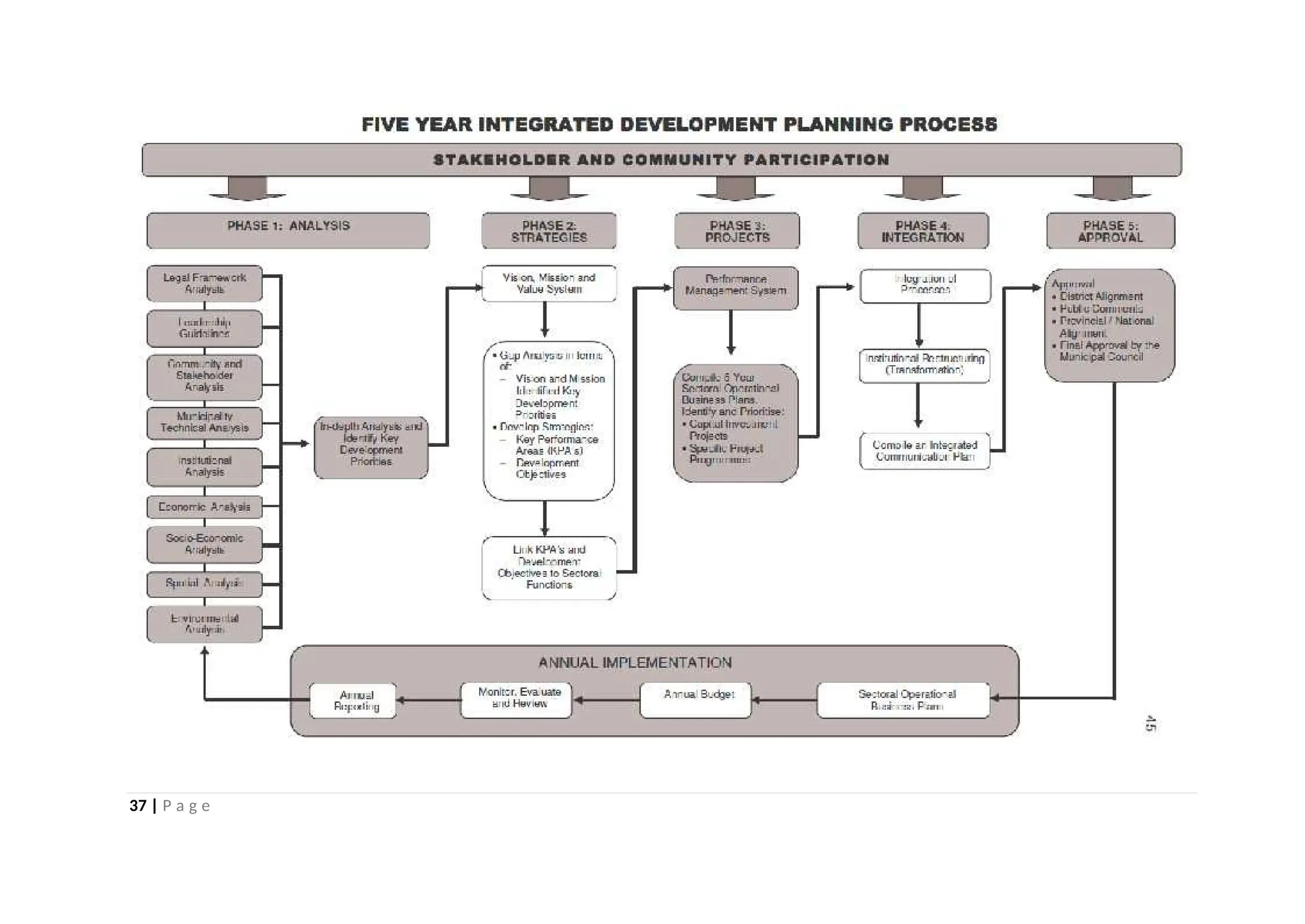


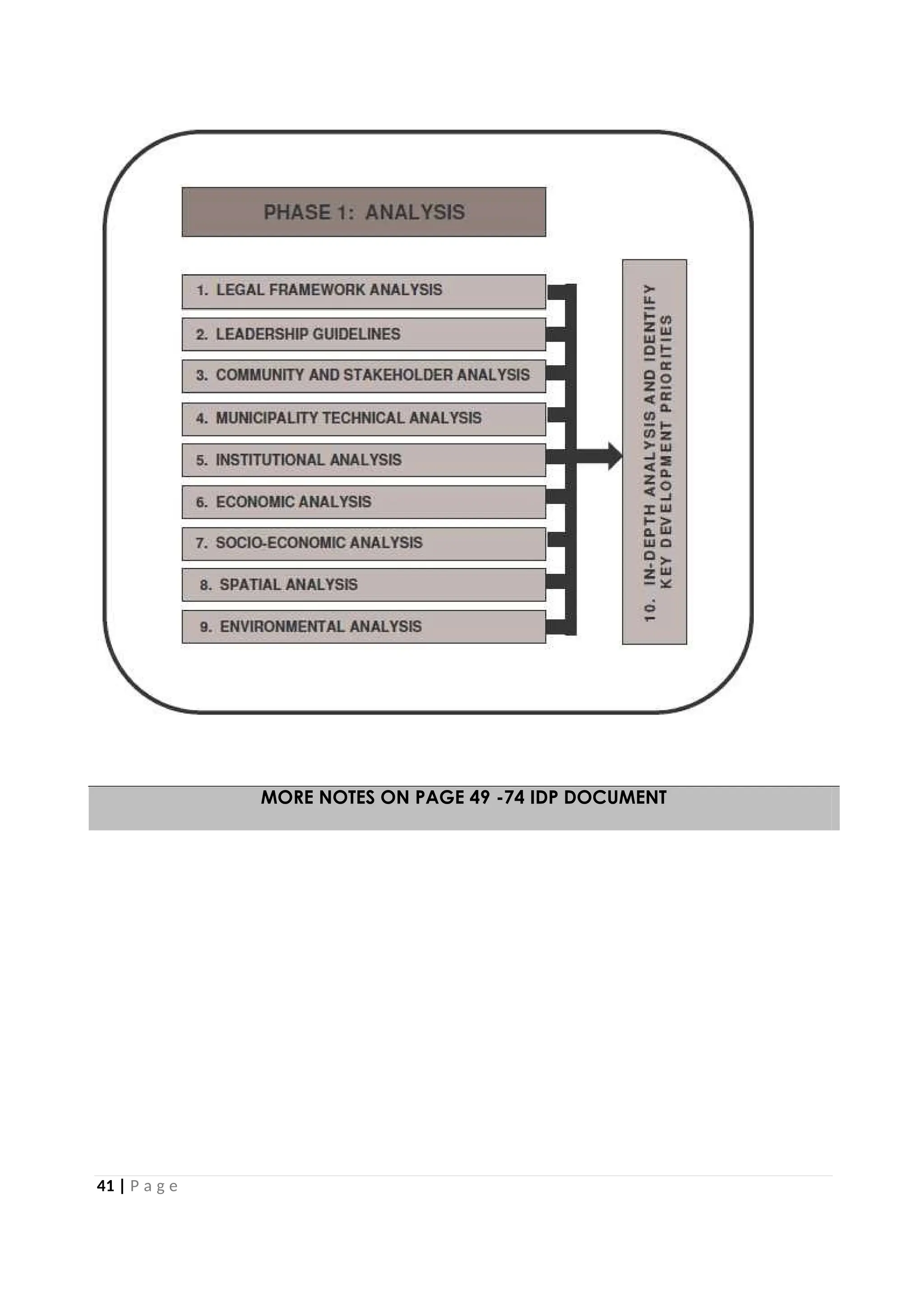


![4545 | P a g
e
SESSION 1:
Develop approaches to managing a municipality's revenue
in a sustainable manner.
Learning Outcomes
The Criteria for assessing tax instruments and user charges are applied in the local
government context.
Recommendations for achieving sustainability are provided in relation to municipal
revenue.
Tax incidence of revenue levying collection legislation is explained as it relates to
the local government context.
The incentive effects of municipal tariffs and user charges are estimated in the local
government context.
2.1. Taxes and user changes
To tax is to impose a financial charge or other levy upon a taxpayer (an individual or
legal entity) by a state or the functional equivalent of a state such that failure to pay is
punishable by law.
Taxes are also imposed by many subnational entities. Taxes consist of direct tax or
indirect tax, and may be paid in money or as its labour equivalent (often but not always
unpaid labour). A tax may be defined as a "pecuniary burden laid upon individuals or
property owners to support the government; a payment exacted by legislative
authority." A tax "is not a voluntary payment or donation, but an enforced contribution,
exacted pursuant to legislative authority" and is "any contribution imposed by
government [...] whether under the name of toll, tribute, tallage, gabel, impost, duty,
custom, excise, subsidy, aid, supply, or other name.
Taxation has four main purposes or effects: Revenue, Redistribution, Repricing, and
Representation.](https://image.slidesharecdn.com/mfml6-sp3-learnerguide-250401214439-843d8140/75/STRATEGIC-PLANNING-PROCESS-IN-LOCAL-GOVERMENT-47-2048.jpg)