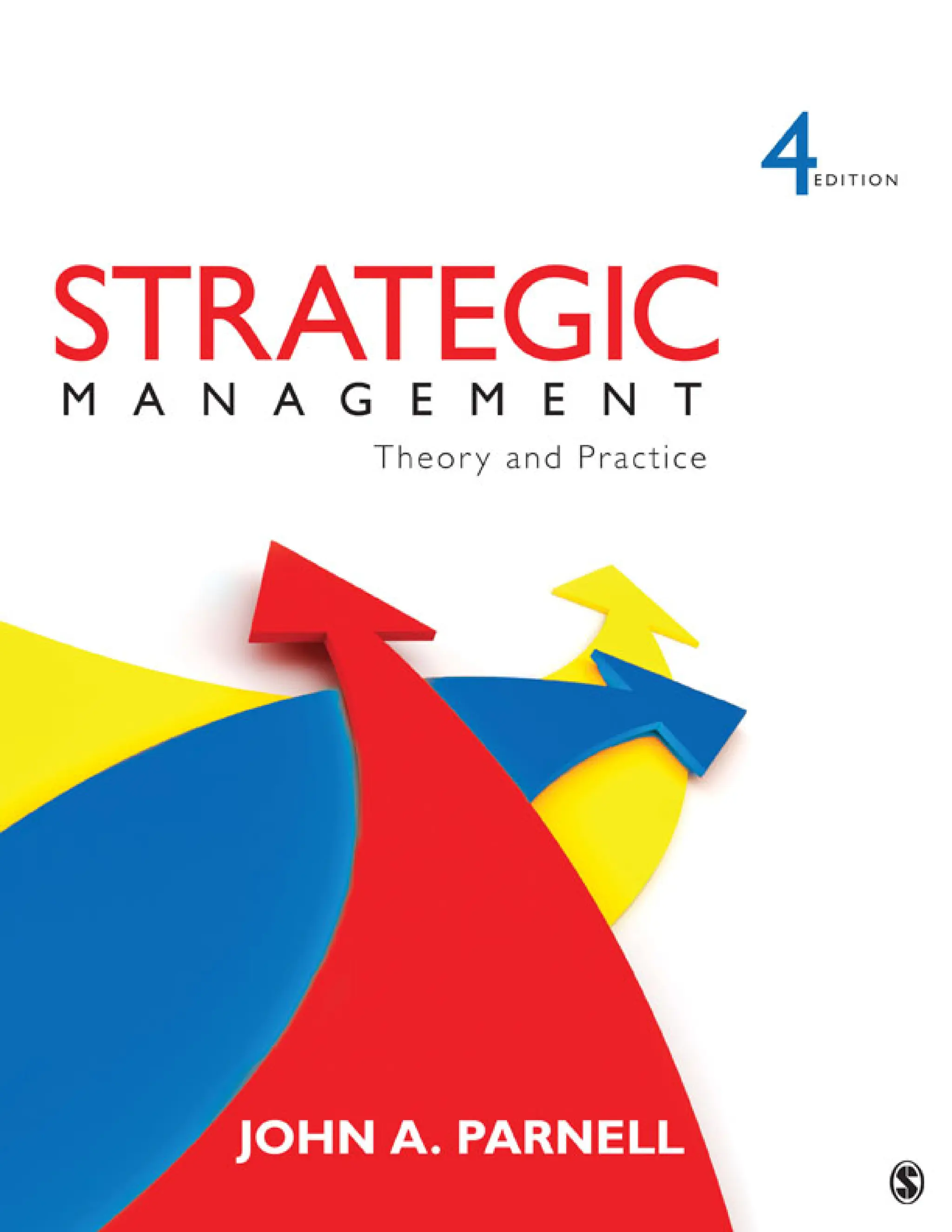
Strategic Management: Theory and Practice pdf
download
https://ebookmass.com/product/strategic-management-theory-and-
practice/
Explore and download more ebooks at ebookmass.com
We have selected some products that you may be interested in
Click the link to download now or visit ebookmass.com
for more options!.
Strategic Leadership and Management in Nonprofit
Organizations: Theory and Practice 2nd Edition Martha
Golensky
https://ebookmass.com/product/strategic-leadership-and-management-in-
nonprofit-organizations-theory-and-practice-2nd-edition-martha-
golensky/
Strategic Management: Theory: An Integrated Approach
Charles W.L. Hill
https://ebookmass.com/product/strategic-management-theory-an-
integrated-approach-charles-w-l-hill/
Financial Management Theory & Practice 16th Edition
Brigham
https://ebookmass.com/product/financial-management-theory-
practice-16th-edition-brigham/
Financial Management: Theory and Practice 10th 10th
Edition Prasanna Chandra
https://ebookmass.com/product/financial-management-theory-and-
practice-10th-10th-edition-prasanna-chandra/
Service Management: Theory and Practice 1st ed. Edition
John R. Bryson
https://ebookmass.com/product/service-management-theory-and-
practice-1st-ed-edition-john-r-bryson/
The Theory and Practice of Change Management, 6th Edition
John Hayes
https://ebookmass.com/product/the-theory-and-practice-of-change-
management-6th-edition-john-hayes/
Financial Management: Theory & Practice 15th Edition
Eugene F. Brigham
https://ebookmass.com/product/financial-management-theory-
practice-15th-edition-eugene-f-brigham/
Strategic Management 3rd Edition
https://ebookmass.com/product/strategic-management-3rd-edition/
(eTextbook PDF) for Financial Management Theory & Practice
15th by Eugene
https://ebookmass.com/product/etextbook-pdf-for-financial-management-
theory-practice-15th-by-eugene/
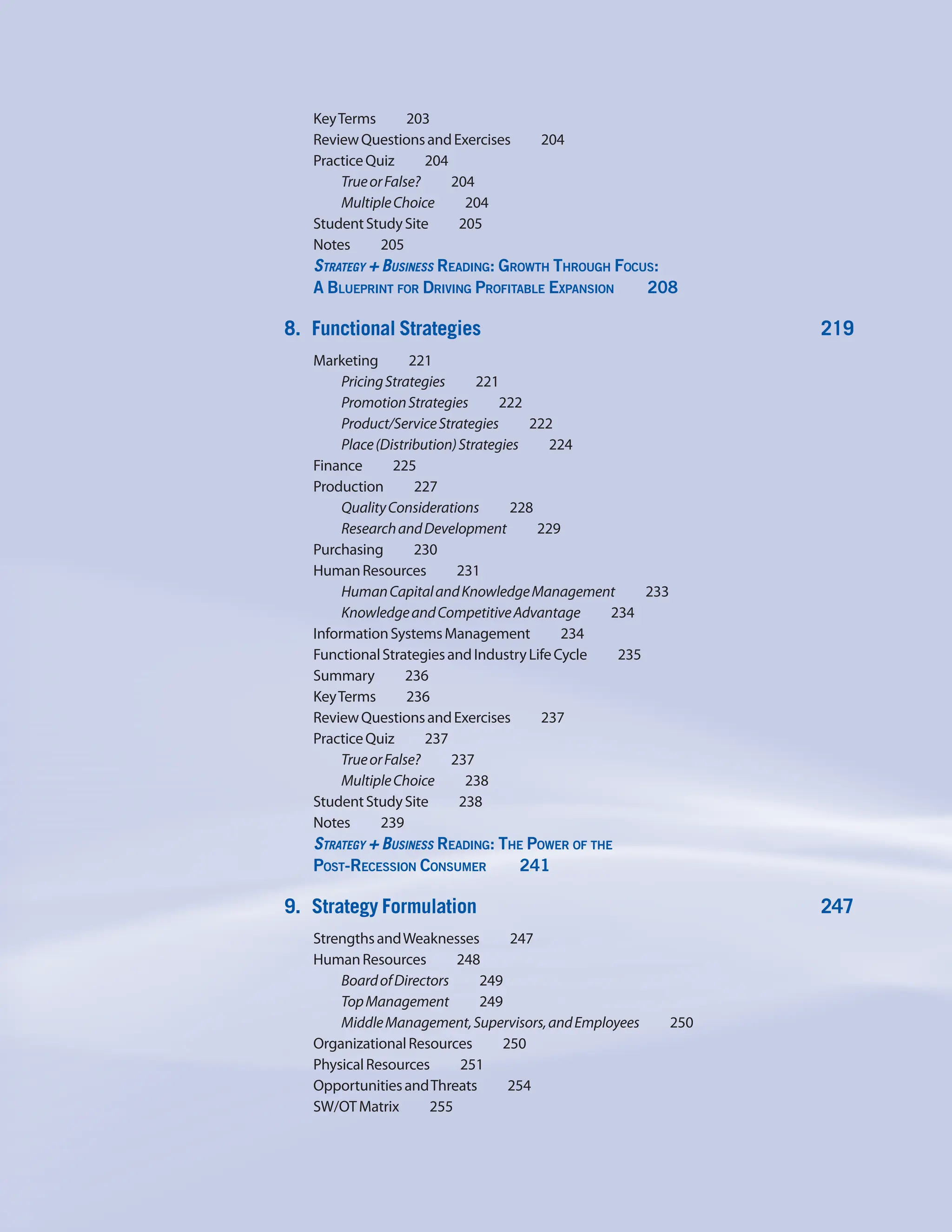
HighStrategicStakes    36
HighExitBarriers    36
ThreatofEntry    37
EconomiesofScale    38
BrandIdentityandProductDifferentiation     38
CapitalRequirements    39
SwitchingCosts    39
AccesstoDistributionChannels     39
CostAdvantagesIndependentofSize     39
GovernmentPolicy    39
PressureFromSubstituteProducts    40
BargainingPowerofBuyers    40
BargainingPowerofSuppliers    41
LimitationsofPorter’sFiveForcesModel     42
Summary    43
KeyTerms    43
ReviewQuestionsandExercises    44
PracticeQuiz    44
TrueorFalse?    44
MultipleChoice    45
StudentStudySite    45
Notes    46
Strategy + Business Reading: Focus and Scale on the Internet     47
3. The External Environment: Political-Legal
and Economic Forces 53
AnalysisoftheExternalEnvironment     53
Political-LegalForces    54
GlobalConsiderations    60
EconomicForces    63
GrossDomesticProduct    64
InflationRates    66
InterestRates    66
ExchangeRates    66
EcologicalInfluences    67
Summary    69
KeyTerms    69
ReviewQuestionsandExercises    69
PracticeQuiz    69
TrueorFalse?    69
MultipleChoice    70
StudentStudySite    70
Notes    71
Strategy + Business Reading: Competing for the Global Middle Class     73
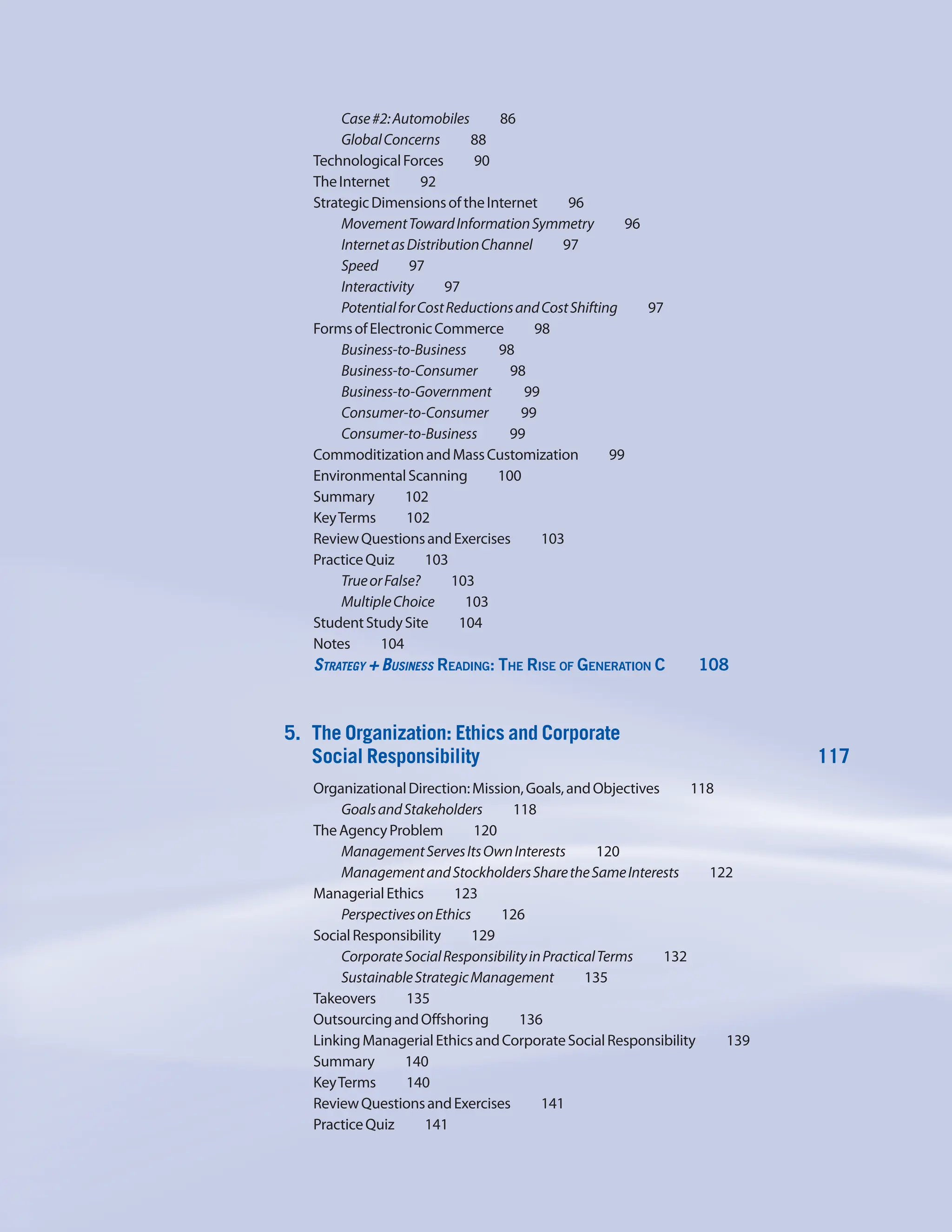
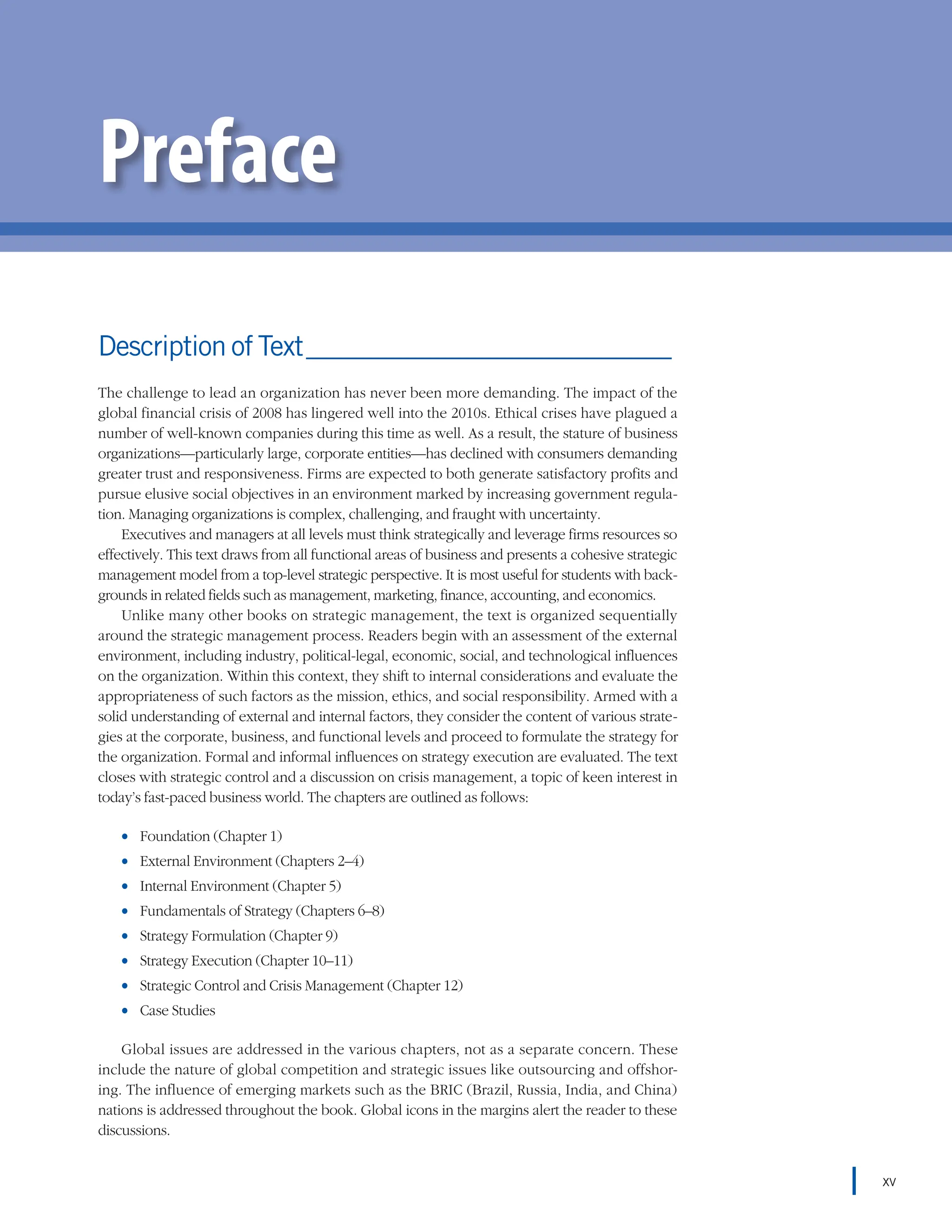
4. The External Environment: Social and Technological Forces 79
SocialForces    79
Case#1:EatingHabits    83
Case#2:Automobiles    86
GlobalConcerns    88
TechnologicalForces    90
TheInternet    92
StrategicDimensionsoftheInternet     96
MovementTowardInformationSymmetry     96
InternetasDistributionChannel     97
Speed    97
Interactivity    97
PotentialforCostReductionsandCostShifting     97
FormsofElectronicCommerce    98
Business-to-Business    98
Business-to-Consumer    98
Business-to-Government    99
Consumer-to-Consumer    99
Consumer-to-Business    99
CommoditizationandMassCustomization    99
EnvironmentalScanning    100
Summary    102
KeyTerms    102
ReviewQuestionsandExercises    103
PracticeQuiz    103
TrueorFalse?    103
MultipleChoice    103
StudentStudySite    104
Notes    104
Strategy + Business Reading: The Rise of Generation C     108
5. The Organization: Ethics and Corporate
Social Responsibility 117
OrganizationalDirection:Mission,Goals,andObjectives     118
GoalsandStakeholders    118
TheAgencyProblem    120
ManagementServesItsOwnInterests     120
ManagementandStockholdersSharetheSameInterests     122
ManagerialEthics    123
PerspectivesonEthics    126
SocialResponsibility    129
CorporateSocialResponsibilityinPracticalTerms     132
SustainableStrategicManagement    135
Takeovers    135
OutsourcingandOffshoring    136
LinkingManagerialEthicsandCorporateSocialResponsibility     139
Summary    140
KeyTerms    140
ReviewQuestionsandExercises    141
PracticeQuiz    141
TrueorFalse?    141
MultipleChoice    142
StudentStudySite    143
Notes    143
Strategy + Business Reading: Values vs. Value     146
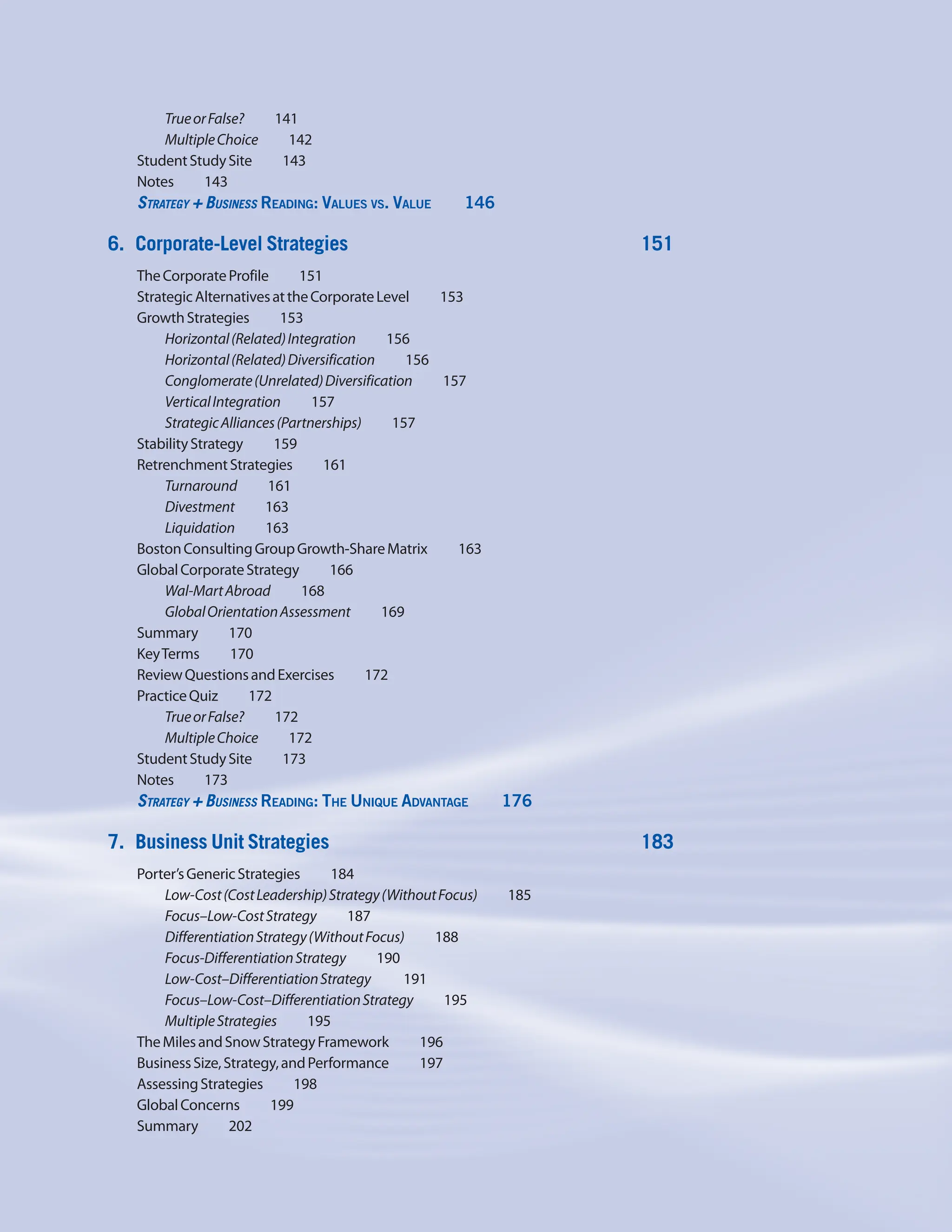
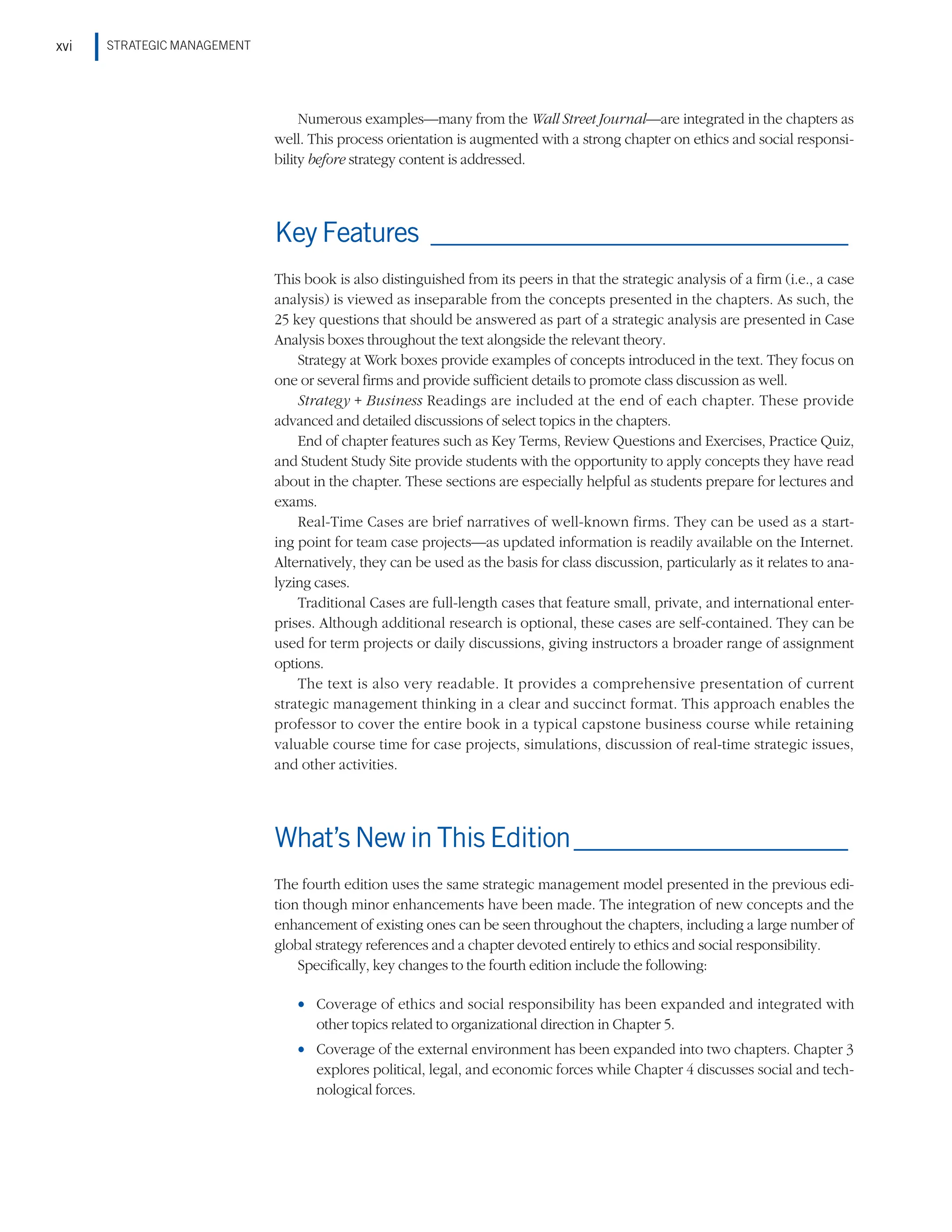
6. Corporate-Level Strategies 151
TheCorporateProfile    151
StrategicAlternativesattheCorporateLevel     153
GrowthStrategies    153
Horizontal(Related)Integration    156
Horizontal(Related)Diversification    156
Conglomerate(Unrelated)Diversification    157
VerticalIntegration    157
StrategicAlliances(Partnerships)    157
StabilityStrategy    159
RetrenchmentStrategies    161
Turnaround    161
Divestment    163
Liquidation    163
BostonConsultingGroupGrowth-ShareMatrix     163
GlobalCorporateStrategy    166
Wal-MartAbroad    168
GlobalOrientationAssessment    169
Summary    170
KeyTerms    170
ReviewQuestionsandExercises    172
PracticeQuiz    172
TrueorFalse?    172
MultipleChoice    172
StudentStudySite    173
Notes    173
Strategy + Business Reading: The Unique Advantage     176
7. Business Unit Strategies 183
Porter’sGenericStrategies    184
Low-Cost(CostLeadership)Strategy(WithoutFocus)     185
Focus–Low-CostStrategy    187
DifferentiationStrategy(WithoutFocus)     188
Focus-DifferentiationStrategy    190
Low-Cost–DifferentiationStrategy    191
Focus–Low-Cost–DifferentiationStrategy    195
MultipleStrategies    195
TheMilesandSnowStrategyFramework     196
BusinessSize,Strategy,andPerformance     197
AssessingStrategies    198
GlobalConcerns    199
Summary    202
KeyTerms    203
ReviewQuestionsandExercises    204
PracticeQuiz    204
TrueorFalse?    204
MultipleChoice    204
StudentStudySite    205
Notes    205
Strategy + Business Reading: Growth Through Focus:
A Blueprint for Driving Profitable Expansion     208
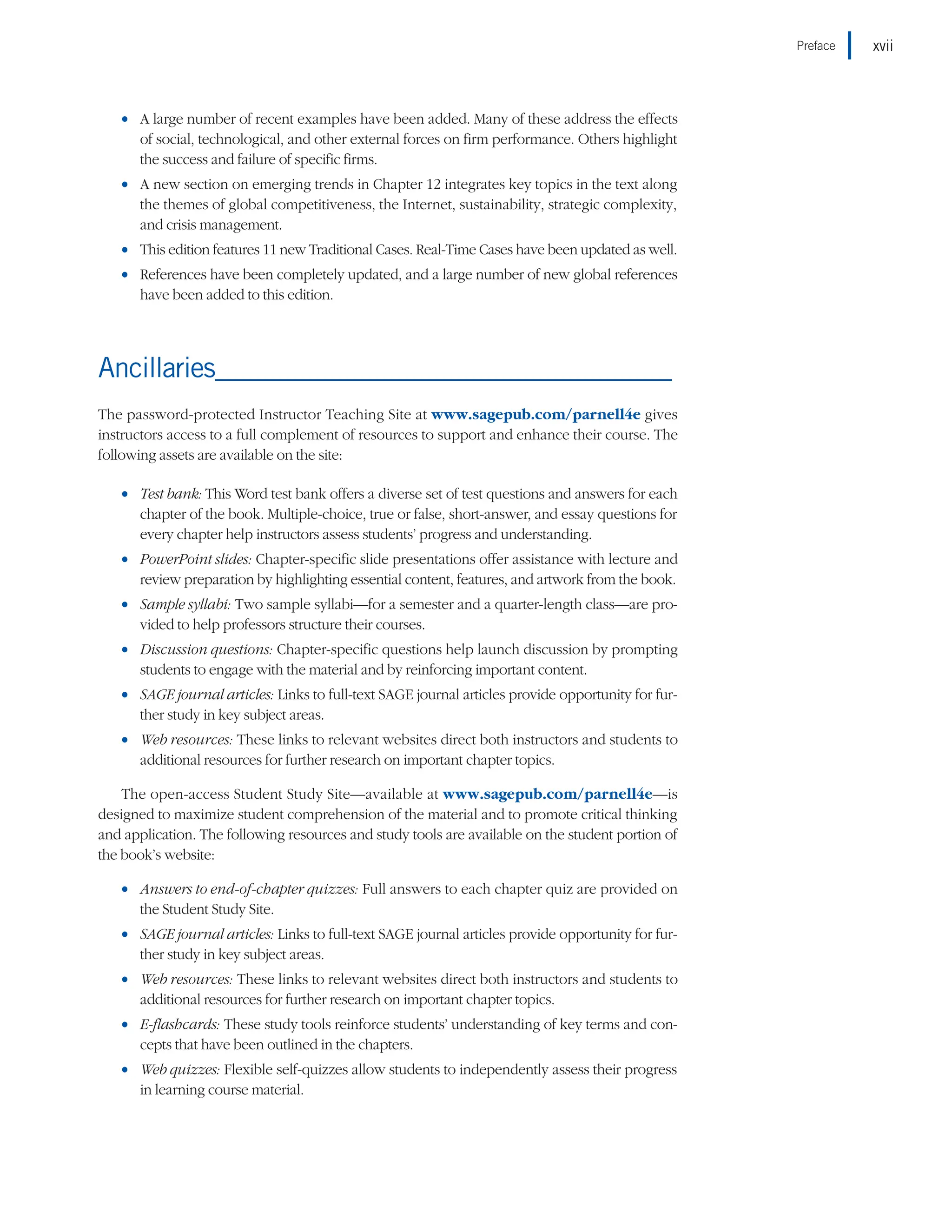
8. Functional Strategies 219
Marketing    221
PricingStrategies    221
PromotionStrategies    222
Product/ServiceStrategies    222
Place(Distribution)Strategies    224
Finance    225
Production    227
QualityConsiderations    228
ResearchandDevelopment    229
Purchasing    230
HumanResources    231
HumanCapitalandKnowledgeManagement     233
KnowledgeandCompetitiveAdvantage     234
InformationSystemsManagement    234
FunctionalStrategiesandIndustryLifeCycle     235
Summary    236
KeyTerms    236
ReviewQuestionsandExercises    237
PracticeQuiz    237
TrueorFalse?    237
MultipleChoice    238
StudentStudySite    238
Notes    239
Strategy + Business Reading: The Power of the
Post-Recession Consumer     241
9. Strategy Formulation 247
StrengthsandWeaknesses    247
HumanResources    248
BoardofDirectors    249
TopManagement    249
MiddleManagement,Supervisors,andEmployees     250
OrganizationalResources    250
PhysicalResources    251
OpportunitiesandThreats    254
SW/OTMatrix    255
IssuesinStrategyFormulation    260
EvaluatingStrategicChange     260
Strategy,CorporateSocialResponsibility,andManagerialEthics     262
EffectsonOrganizationalResources     262
AnticipatedResponsesFromCompetitorsandCustomers     262
Summary    263
KeyTerms    263
ReviewQuestionsandExercises    264
PracticeQuiz    264
TrueorFalse?    264
MultipleChoice    265
StudentStudySite    266
Notes    266
Strategy + Business Reading: 10 Clues to Opportunity     267
10. Strategy Execution: Structure 271
OrganizationalStructure    271
VerticalGrowth    273
HorizontalGrowth    274
StructuralForms    275
FunctionalStructure    275
ProductDivisionalStructure    276
GeographicDivisionalStructure    277
MatrixStructure    278
AssessingOrganizationalStructure    279
CorporateInvolvementinBusinessUnitOperations     281
CorporateRestructuring    282
Summary    282
KeyTerms    283
ReviewQuestionsandExercises    283
PracticeQuiz    284
TrueorFalse?    284
MultipleChoice    284
StudentStudySite    285
Notes    285
Strategy + Business Reading:
Design for Frugal Growth     286
11. Strategy Execution: Strategic Change,
Culture, and Leadership 293
OrganizationalCultureandStrategy    295
CulturalStrengthandDiversity     297
ShapingtheCulture    298
GlobalConcerns    298
StrategicLeadership    299
LeadershipStyle    300
ExecutingStrategicChange    303
RecognizetheNeedforChange     304
CreateaSharedVision     304
InstitutionalizetheChange    304
Summary    306
KeyTerms    306
ReviewQuestionsandExercises    307
PracticeQuiz    307
TrueorFalse?    307
MultipleChoice    307
StudentStudySite    308
Notes    308
Strategy + Business Reading: CEO Succession 2010:
The Four Types of CEOs     311
12. Strategic Control and Crisis Management 327
Step1:TheFocusofStrategicControl     328
Step2:StrategicControlStandards(Benchmarks)     329
PublishedInformationforStrategicControl     330
Product/ServiceQuality    330
Innovation    331
MarketShareandRelativeMarketShare     331
Steps3Through5:ExertingStrategicControl     332
ControlThroughtheFormalandInformalOrganizations     333
CrisisManagement    334
ProminentCrisesinRecentHistory     336
CrisisPlanning    339
TrendsinStrategicManagement    341
Summary    342
KeyTerms    342
ReviewQuestionsandExercises    342
PracticeQuiz    343
TrueorFalse?    343
MultipleChoice    343
StudentStudySite    344
Notes    344
Strategy + Business Reading: How to Prevent Self-Inflicted Disasters     347
Appendix    353
Case Analysis    354
Real-Time Cases    361
Case1:Allstate    361
Case2:Amazon.com    362
Case3:AmericanExpress    363
Case4:Anheuser-BuschInBev    364
Case5:AutoZone    366
Case6:Avon    366
Case7:BankofAmerica     368
Case8:BedBath&Beyond     369
Case9:StanleyBlack&Decker     370
Case10:Cici’sPizza    371
Case11:Costco    372
Case12:Dell    373
Case13:DeltaAirLines     374
Case14:DollarTree    375
Case15:FedEx    376
Case16:Ford    377
Case17:HomeDepot    378
Case18:InternationalPaper    379
Case19:JackintheBox     380
Case20:Kroger    382
Case21:Lands’ End    382
Case22:Mattel    384
Case23:Nike    385
Case24:PapaJohn’s    386
Case25:Pfizer    387
Case26:SouthwestAirlines    388
Case27:Starbucks    389
Case28:Walgreens    391
Case29:Wal-Mart    392
Case30:Yum!Brands    393
Traditional Cases     395
Case1:Bob’sSupermarket:CompetingWiththeBigBoys     395
Case2:Costco:MaximumEmployeeBenefitsorMaximumShareholder
Return?    407
Case3:DollarGeneral—Today’sNeighborhoodStore     422
Case4:FamilyDollarStores     448
Case5:GeneralElectric:EcomaginationasaCSRInitiative     476
Case6:Kapai,NewZealand:EatYourGreens!     484
Case7:Kodak’sChallenge:SurvivingtheDisruptive“WindsofChange”     499
Case8:Macy’s,Inc.2010:CouldMacy’sBringBacktheMagic?     518
Case9:Netflix:Entering,Engaging,andEmbracingInnovationintheMovieRental
Industry    539
Case10:SkodaAuto—2011    552
Case11:Staples—PantaloonRetailLimitedTie-Up:GoingforGrowthinIndia’sModern
RetailMarket    563
Case12:HittingtheBrakes:ToyotainCrisis     593
Glossary    611
Index    621
Description of Text_____________________________
The challenge to lead an organization has never been more demanding. The impact of the
global financial crisis of 2008 has lingered well into the 2010s. Ethical crises have plagued a
number of well-known companies during this time as well. As a result, the stature of business
organizations—particularly large, corporate entities—has declined with consumers demanding
greater trust and responsiveness. Firms are expected to both generate satisfactory profits and
pursue elusive social objectives in an environment marked by increasing government regula-
tion. Managing organizations is complex, challenging, and fraught with uncertainty.
Executives and managers at all levels must think strategically and leverage firms resources so
effectively. This text draws from all functional areas of business and presents a cohesive strategic
management model from a top-level strategic perspective. It is most useful for students with back-
grounds in related fields such as management, marketing, finance, accounting, and economics.
Unlike many other books on strategic management, the text is organized sequentially
around the strategic management process. Readers begin with an assessment of the external
environment, including industry, political-legal, economic, social, and technological influences
on the organization. Within this context, they shift to internal considerations and evaluate the
appropriateness of such factors as the mission, ethics, and social responsibility. Armed with a
solid understanding of external and internal factors, they consider the content of various strate-
gies at the corporate, business, and functional levels and proceed to formulate the strategy for
the organization. Formal and informal influences on strategy execution are evaluated. The text
closes with strategic control and a discussion on crisis management, a topic of keen interest in
today’s fast-paced business world. The chapters are outlined as follows:
•
• Foundation (Chapter 1)
•
• External Environment (Chapters 2–4)
•
• Internal Environment (Chapter 5)
•
• Fundamentals of Strategy (Chapters 6–8)
•
• Strategy Formulation (Chapter 9)
•
• Strategy Execution (Chapter 10–11)
•
• Strategic Control and Crisis Management (Chapter 12)
•
• Case Studies
Global issues are addressed in the various chapters, not as a separate concern. These
include the nature of global competition and strategic issues like outsourcing and offshor-
ing. The influence of emerging markets such as the BRIC (Brazil, Russia, India, and China)
nations is addressed throughout the book. Global icons in the margins alert the reader to these
discussions.
Preface
xv
Visit https://ebookmass.com today to explore
a vast collection of ebooks across various
genres, available in popular formats like
PDF, EPUB, and MOBI, fully compatible with
all devices. Enjoy a seamless reading
experience and effortlessly download high-
quality materials in just a few simple steps.
Plus, don’t miss out on exciting offers that
let you access a wealth of knowledge at the
best prices!
STRATEGIC MANAGEMENT
xvi
Numerous examples—many from the Wall Street Journal—are integrated in the chapters as
well. This process orientation is augmented with a strong chapter on ethics and social responsi-
bility before strategy content is addressed.
Key Features_________________________________
This book is also distinguished from its peers in that the strategic analysis of a firm (i.e., a case
analysis) is viewed as inseparable from the concepts presented in the chapters. As such, the
25 key questions that should be answered as part of a strategic analysis are presented in Case
Analysis boxes throughout the text alongside the relevant theory.
Strategy at Work boxes provide examples of concepts introduced in the text. They focus on
one or several firms and provide sufficient details to promote class discussion as well.
Strategy + Business Readings are included at the end of each chapter. These provide
advanced and detailed discussions of select topics in the chapters.
End of chapter features such as Key Terms, Review Questions and Exercises, Practice Quiz,
and Student Study Site provide students with the opportunity to apply concepts they have read
about in the chapter. These sections are especially helpful as students prepare for lectures and
exams.
Real-Time Cases are brief narratives of well-known firms. They can be used as a start-
ing point for team case projects—as updated information is readily available on the Internet.
Alternatively, they can be used as the basis for class discussion, particularly as it relates to ana-
lyzing cases.
Traditional Cases are full-length cases that feature small, private, and international enter-
prises. Although additional research is optional, these cases are self-contained. They can be
used for term projects or daily discussions, giving instructors a broader range of assignment
options.
The text is also very readable. It provides a comprehensive presentation of current
strategic management thinking in a clear and succinct format. This approach enables the
professor to cover the entire book in a typical capstone business course while retaining
valuable course time for case projects, simulations, discussion of real-time strategic issues,
and other activities.
What’s New in This Edition______________________
The fourth edition uses the same strategic management model presented in the previous edi-
tion though minor enhancements have been made. The integration of new concepts and the
enhancement of existing ones can be seen throughout the chapters, including a large number of
global strategy references and a chapter devoted entirely to ethics and social responsibility.
Specifically, key changes to the fourth edition include the following:
•
• Coverage of ethics and social responsibility has been expanded and integrated with
other topics related to organizational direction in Chapter 5.
•
• Coverage of the external environment has been expanded into two chapters. Chapter 3
explores political, legal, and economic forces while Chapter 4 discusses social and tech-
nological forces.
•
• A large number of recent examples have been added. Many of these address the effects
of social, technological, and other external forces on firm performance. Others highlight
the success and failure of specific firms.
•
• A new section on emerging trends in Chapter 12 integrates key topics in the text along
the themes of global competitiveness, the Internet, sustainability, strategic complexity,
and crisis management.
•
• This edition features 11 new Traditional Cases. Real-Time Cases have been updated as well.
•
• References have been completely updated, and a large number of new global references
have been added to this edition.
Ancillaries____________________________________
The password-protected Instructor Teaching Site at www.sagepub.com/parnell4e gives
instructors access to a full complement of resources to support and enhance their course. The
following assets are available on the site:
•
• Test bank: This Word test bank offers a diverse set of test questions and answers for each
chapter of the book. Multiple-choice, true or false, short-answer, and essay questions for
every chapter help instructors assess students’ progress and understanding.
•
• PowerPoint slides: Chapter-specific slide presentations offer assistance with lecture and
review preparation by highlighting essential content, features, and artwork from the book.
•
• Sample syllabi: Two sample syllabi—for a semester and a quarter-length class—are pro-
vided to help professors structure their courses.
•
• Discussion questions: Chapter-specific questions help launch discussion by prompting
students to engage with the material and by reinforcing important content.
•
• SAGE journal articles: Links to full-text SAGE journal articles provide opportunity for fur-
ther study in key subject areas.
•
• Web resources: These links to relevant websites direct both instructors and students to
additional resources for further research on important chapter topics.
The open-access Student Study Site—available at www.sagepub.com/parnell4e—is
designed to maximize student comprehension of the material and to promote critical thinking
and application. The following resources and study tools are available on the student portion of
the book’s website:
•
• Answers to end-of-chapter quizzes: Full answers to each chapter quiz are provided on
the Student Study Site.
•
• SAGE journal articles: Links to full-text SAGE journal articles provide opportunity for fur-
ther study in key subject areas.
•
• Web resources: These links to relevant websites direct both instructors and students to
additional resources for further research on important chapter topics.
•
• E-flashcards: These study tools reinforce students’ understanding of key terms and con-
cepts that have been outlined in the chapters.
•
• Web quizzes: Flexible self-quizzes allow students to independently assess their progress
in learning course material.
xvii
Preface
STRATEGIC MANAGEMENT
xviii
Acknowledgments_____________________________
SAGE and the author gratefully acknowledge the contributions of the following reviewers:
Kristin Backhaus, State University of New York at New Paltz; Thomas M. Box, Pittsburg State
University; Jacalyn M. Flom, The University of Toledo; John M. Guarino, Averett University;
Keith Harman, Oklahoma Baptist University; Maureen S. Heaphy, Ferris State University;
Mazhar Islam, Drexel University; Sonya B. Merrill, Towson University; David Olson, California
State University Bakersfield; Vasu Ramanujam, Case Western Reserve University; E. Kevin
Renshler, Florida Southern College; Peter Schneider, College of Saint Elizabeth; Jeffrey Slattery,
Regent University; David L. Sturges, The University of Texas-Pan American; James L. Whitney,
Champlain College; and Gregory F. Zerovnik, Touro University Worldwide.
chapter 12    Strategic Control and Crisis Management xix
Dr. John A. Parnell currently serves as the William Henry Belk Distinguished
Professor of Management at the University of North Carolina at Pembroke. He com-
pleted the BSBA, MBA, and MA Ed degree from East Carolina University, the EdD
degree from Campbell University, and the PhD degree from the University of Memphis.
His academic career includes a number of institutions, including service as professor
and head of the Department of Marketing & Management at Texas A&M University-
Commerce. He received the H. M. Lafferty Distinguished Faculty Award at Texas A&M-
Commerce in 2002, the Adolph Dial Award for Scholarly & Creative Activity at
UNC-Pembroke in 2005, and the Pope Center Spirit of Inquiry Award in 2011.
Dr. Parnell is a recognized authority in the field, having published more than 200 articles,
cases, proceedings, books, and book chapters in strategic management and related fields.
Recent work appears in leading journals such as Academy of Management Learning and
Education, Management Decision, and the British Journal of Management. He serves on a
number of academic journal editorial boards and consults with select firms in the area of stra-
tegic planning. He has also appeared frequently as a guest discussing issues related to business
and competitiveness on Sirius XM’s The Wilkow Majority.
Dr. Parnell has lectured at a number of institutions abroad, including Instituto Tecnologico
Y De Estudios Superiores De Monterrey-Campus Estado de Mexico (ITESM-CEM), Chung Yuan
Christian University in Taiwan, and China University of Geosciences in Beijing. He also served
as a Fulbright Scholar in Cairo, Egypt, in 1995.
AbouttheAuthor
xix
STRATEGIC MANAGEMENT
xx
xx
WhatIsStrategicManagement?
IntendedandRealizedStrategies
ScientificandArtisticPerspectivesonStrategicManagement
InfluenceonStrategicManagement
CorporateGovernanceandBoardsofDirectors
StrategicDecisions
TheGlobalImperative
Summary
KeyTerms
ReviewQuestionsandExercises
PracticeQuiz
StudentStudySite
Notes
Chapter Outline
xx
chapter 1    Fundamentals of Strategic Management 1
1
c h a p t e r 1
Fundamentalsof
StrategicManagement
What do Circuit City, Washington Mutual, Saab, Blockbuster, and Borders have in
common? All of these recognized companies filed for bankruptcy during the past
several years. While the situation surrounding each firm is different, all of them failed to
meet various strategic challenges. Put another way, organizations typically do not succeed
or fail randomly. Some plan, prepare, and execute more effectively than others.
Today’s business world is global, Internet-driven, and obsessed with speed. The challenges
it creates for strategic managers are often complex, ambiguous, and unstructured. Add to this
the incessant allegations of top management wrongdoings, economic stagnation, and increas-
ing executive compensation, and it is easy to see why firm leaders are under great pressure to
respond to strategic problems quickly, decisively, and responsibly. Indeed, the need for effec-
tive strategic management has never been more pronounced. This text presents a framework
for addressing today’s strategic challenges.
This chapter introduces the notion of strategic management, highlights its importance, and
presents a five-step process for strategically analyzing an organization. The remaining chapters
expand on the various steps in the process with special emphasis on their application to ongo-
ing enterprises.
What Is Strategic Management?_________________
Organizations exist for a purpose. The mission is articulated in a broadly defined but enduring
statement of purpose that identifies the scope of an organization’s operations and its offerings to
affected groups and entities. Most organizations of a significant size or stature have developed a
formal mission statement, a concept discussed further in Chapter 5.
Strategy refers to top management’s plans to develop and sustain competitive
advantage—a state whereby a firm’s successful strategies cannot be easily duplicated by its
1
STRATEGIC MANAGEMENT
2
competitors1
—so that the organization’s mission is fulfilled.2
Following this definition, it
is assumed that an organization has a plan, its competitive advantage is understood, and its
members understand the reason for its existence. These assumptions may appear self-evident,
but many strategic problems can be traced to fundamental misunderstandings associated with
defining the strategy. Debates over the nature of the organization’s competitive advantage, its
mission, and whether or not a strategic plan is really needed can be widespread.3
As such, com-
ments such as “We’re too busy to focus on developing a strategy” or “I’m not exactly sure what
my company is really trying to accomplish” can be overheard in many organizations.
Strategic management is a broader term than strategy and is a process that includes top
management’s analysis of the environment in which the organization operates prior to formulat-
ing a strategy, as well as the plan for implementation and control of the strategy. The difference
between a strategy and the strategic management process is that the latter includes considering
what must be done before a strategy is formulated through assessing whether or not the success
of an implemented strategy was successful. The strategic management process can be sum-
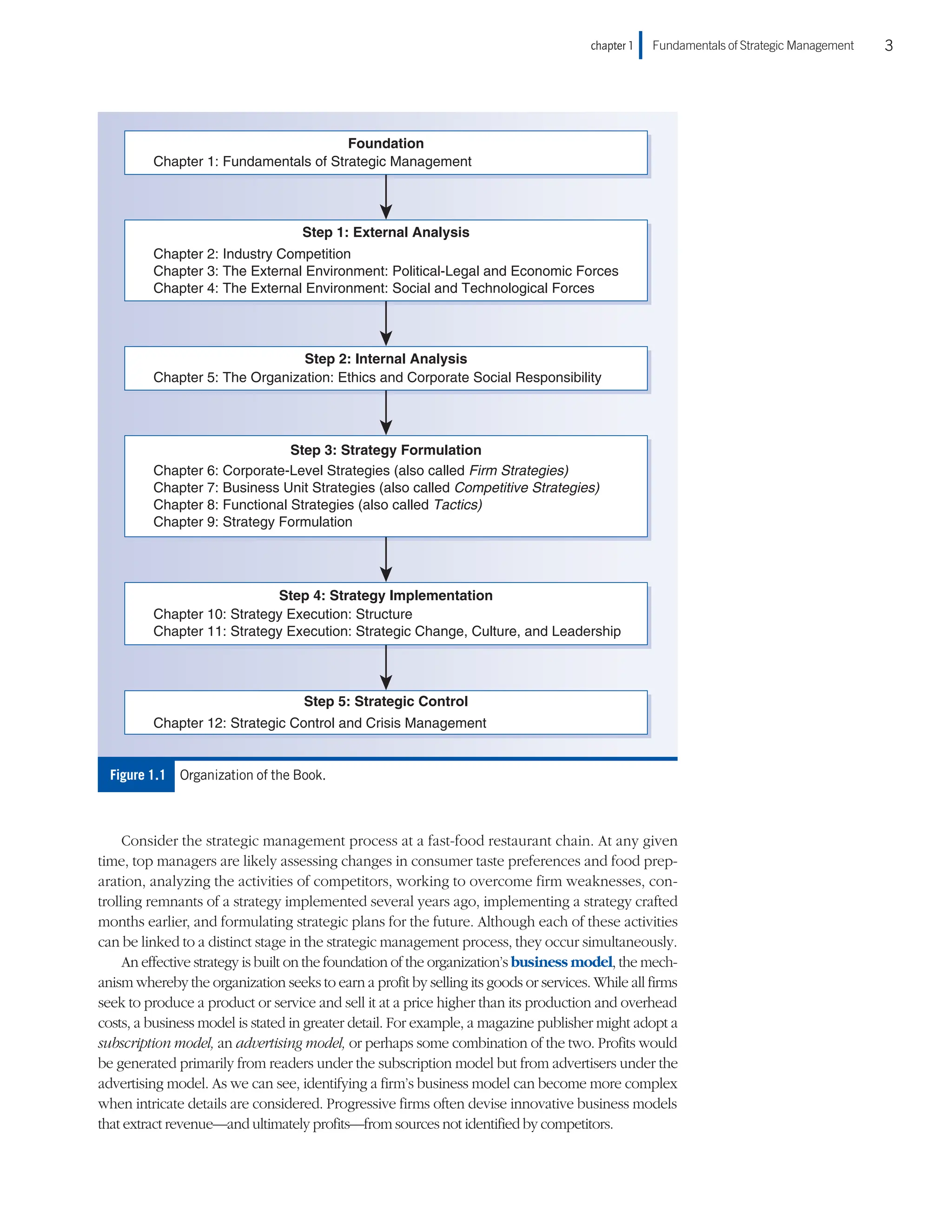
marized in five steps, each of which is discussed in greater detail in subsequent chapters of the
book (see Figure 1.1):4
1. External Analysis: Analyze the opportunities and threats, or constraints, that exist
in the organization’s external environment, including industry and forces in the
external environment.
2. Internal Analysis: Analyze the organization’s strengths and weaknesses in its
internal environment. Consider the context of managerial ethics and corporate
social responsibility.
3. Strategy Formulation: Formulate strategies that build and sustain competitive
advantage by matching the organization’s strengths and weaknesses with the
environment’s opportunities and threats.
4. Strategy Execution: Implement the strategies that have been developed.
5. Strategic Control: Measure success and make corrections when the strategies are
not producing the desired outcomes.
The sequential order of the steps is logical. A thorough understanding of the organization
and its environment is essential if the appropriate strategy is to be developed, put into action,
and controlled. One could transpose the first two steps and analyze the internal environment
before the external environment—the logic being that comprehending the organization informs
the strategic assessment of factors outside of the firm. The external environment is analyzed
before the internal environment in Figure 1.1, however, because internal goals, resources, and
competencies are viewed in a relative fashion to some extent and are understood within the
context of the industry and the factors that drive it. This dilemma resembles the chicken and egg
argument; in a practical sense, external and internal analysis often occurs simultaneously.
A distinction between outside and inside perspectives on strategy is also relevant. Outsiders
analyzing a firm should apply a systematic approach that progresses through these steps in
order. Doing so develops a holistic understanding of the firm, its industry, and its strategic
challenges.
Inside organizations, strategies are being formulated, implemented, and controlled simulta-
neously while external and internal factors are continually reassessed. In addition, changes in
one stage of the strategic management process will inevitably affect other stages as well. After
a planned strategy is implemented, it often requires modification as conditions change. Hence,
because these steps are so tightly intertwined, insiders tend to treat all of the steps as a single
integrated, ongoing process.5
chapter 1    Fundamentals of Strategic Management 3
Consider the strategic management process at a fast-food restaurant chain. At any given
time, top managers are likely assessing changes in consumer taste preferences and food prep-
aration, analyzing the activities of competitors, working to overcome firm weaknesses, con-
trolling remnants of a strategy implemented several years ago, implementing a strategy crafted
months earlier, and formulating strategic plans for the future. Although each of these activities
can be linked to a distinct stage in the strategic management process, they occur simultaneously.
An effective strategy is built on the foundation of the organization’s businessmodel, the mech-
anism whereby the organization seeks to earn a profit by selling its goods or services. While all firms
seek to produce a product or service and sell it at a price higher than its production and overhead
costs, a business model is stated in greater detail. For example, a magazine publisher might adopt a
subscription model, an advertising model, or perhaps some combination of the two. Profits would
be generated primarily from readers under the subscription model but from advertisers under the
advertising model. As we can see, identifying a firm’s business model can become more complex
when intricate details are considered. Progressive firms often devise innovative business models
that extract revenue—and ultimately profits—from sources not identified by competitors.
Figure 1.1  Organization of the Book.
Foundation
Chapter 1: Fundamentals of Strategic Management
Step 1: External Analysis
Chapter 2: Industry Competition
Chapter 3: The External Environment: Political-Legal and Economic Forces
Chapter 4: The External Environment: Social and Technological Forces
Step 2: Internal Analysis
Chapter 5: The Organization: Ethics and Corporate Social Responsibility
Step 3: Strategy Formulation
Chapter 6: Corporate-Level Strategies (also called Firm Strategies)
Chapter 7: Business Unit Strategies (also called Competitive Strategies)
Chapter 8: Functional Strategies (also called Tactics)
Chapter 9: Strategy Formulation
Step 4: Strategy Implementation
Chapter 10: Strategy Execution: Structure
Chapter 11: Strategy Execution: Strategic Change, Culture, and Leadership
Step 5: Strategic Control
Chapter 12: Strategic Control and Crisis Management
STRATEGIC MANAGEMENT
4
Consider the razor and blades business model invented by Gillette. A company gives away
or deeply discounts a product—the razor—while planning to profit from future sales of required
replacement or complementary products—the blades. Cell phones are often given to customers
willing to sign a 2-year service contract. Computer printers are typically sold below production
cost, but customers must periodically replace the ink cartridges, which are high-margin items.
This model is not foolproof, however. In a competitive marketplace, customers may be able to
purchase the required complementary products at lower prices from rivals not under pressure
to recoup initial losses.
Successful business models can change over time. Since the early 2000s, a number of
authors have strayed from the traditional business model whereby book publishers offer con-
tracts and pay royalties of 10% to 15%. Leveraging advances in publishing software, social
media, and a strong online retail book market, they have opted for a self-publishing model.
Enterprising authors who publish their own work also shoulder the initial risk but can net as
much as a 70% return on e-book sales from companies such as Amazon.com. The total print
book and e-book output of self-publishers in the United States rose from about 50,000 titles in
2006 to over 125,000 in 2010.6
While a successful strategy is built on the firm’s business model, crafting one can be a chal-
lenge. Realistically, a number of factors are typically associated with successful strategies. Some
of these factors including the following:
1. The organization’s competitive environment is well understood, in detail.
2. Strengths and weaknesses are assessed in a thorough and realistic manner.
3. The strategy is consistent with the mission and goals of the organization.
4. Plans for putting the strategy into action are designed with specificity before it
is implemented.
5. Possible future changes in the proposed strategy—a process called strategic
control—are evaluated before the strategy is adopted.
Careful consideration of these factors reinforces the interrelatedness of the steps in the
strategic management process. Each factor is most closely associated with one of the five steps,
yet they fit together like pieces of a puzzle. The details associated with the success factors—and
others—will be discussed in greater detail in subsequent chapters.
While some of these success factors are associated with the competitive environment in
profit-seeking firms, strategic management is not limited to for-profit organizations. Top manag-
ers of any organization, regardless of profit or nonprofit status, must understand the organiza-
tion’s environment and its capabilities and develop strategies to assist the enterprise in attaining
its goals. Former Drexel University president Constantine Papadakis, for example, was widely
considered to be a leading strategic thinker among university top executives. The innovative
Greek immigrant promoted Drexel through aggressive marketing, while campaigning for an all-
digital library without books. In many respects, he managed the university in the same way that
other executives manage profit-seeking enterprises. His annual salary was close to $1,000,000 in
the years preceding his death in 2009, making him one of the highest paid university presidents
in the country.7
IntendedandRealizedStrategies
One of the most critical challenges facing organizations is the reality that strategies are not
always implemented as originally planned. Sometimes strategic decisions seem to evolve.
In this respect, strategy formulation can be seen as an iterative process where decision
chapter 1    Fundamentals of Strategic Management 5
makers take actions, make sense of those actions afterward, and then decide how to
proceed.
Henry Mintzberg introduced two terms to help clarify the shift that often occurs between
the time a strategy is formulated and the time it is implemented. An intended strategy (i.e.,
what management originally planned) may be realized just as it was planned, in a modified
form, or even in an entirely different form. Occasionally, the strategy that management intends
is actually realized, but the intended strategy and the realized strategy—what management
actually implements—usually differ.8
Hence, the original strategy may be realized with desirable
or undesirable results, or it may be modified as changes in the firm or the environment become
known.
The gap between the intended and realized strategies usually results from unforeseen envi-
ronmental or organizational events, better information that was not available when the strat-
egy was formulated, or an improvement in top management’s ability to assess its environment.
Although it is important for managers to formulate responsible strategies based on a realistic and
thorough assessment of the firm and its environment, things invariably change along the way.
Hence, it is common for such a gap to exist, creating the need for constant strategic action if a
firm is to stay on course. Instead of resisting modest strategic changes when new information is
discovered, managers should search for new information and be willing to make such changes
when necessary. This activity is part of strategic control—the final step in the strategic manage-
ment process.
ScientificandArtisticPerspectiveson
StrategicManagement
There are two different perspectives on the approach that top executives should take to strate-
gic management. Most strategy scholars have endorsed a scientific perspective, whereby strategic
managers are encouraged to systematically assess the firm’s external environment and evaluate
the pros and cons of myriad alternatives before formulating strategy. The business environ-
ment is seen as largely objective, analyzable, and largely predictable. As such, strategic manag-
ers should follow a systematic process of environmental, competitive, and internal analysis and
build the organization’s strategy on this foundation.
According to this perspective, strategic managers should be trained, highly skilled analytical
thinkers capable of digesting a myriad of objective data and translating it into a desired direction
for the firm. Strategy scientists tend to minimize or reject altogether the role of imagination and
creativity in the strategy process and are not generally receptive to alternatives that emerge from
any process other than a comprehensive, analytical approach.
Others have a different view. According to the artistic perspective on strategy, the lack of
environmental predictability and the fast pace of change render elaborate strategy planning as
suspect at best. Instead, strategists should incorporate large doses of creativity and intuition in
order to design a comprehensive strategy for the firm.9
Henry Mintzberg’s notion of a crafts-
man—encompassing individual skill, dedication, and perfection through mastery of detail—
embodies the artistic model. The strategy artist senses the state of the organization, interprets
its subtleties, and seeks to mold its strategy like a potter molds clay. The artist visualizes the
outcomes associated with various alternatives and ultimately charts a course based on holistic
thinking, intuition, and imagination.10
Strategy artists may even view strategic planning exercises
as time poorly spent and may not be as likely as those in the science school to make the effort
necessary to maximize the value of a formal planning process.11
This text acknowledges the artistic perspective but emphasizes the science view. Creativity
and innovation are important and encouraged but are most likely to translate into organizational
success when they occur as part of a comprehensive, systematic approach to strategic manage-
ment. Nonetheless, the type of formal strategic planning proposed in this text is not without its
Visit https://ebookmass.com today to explore
a vast collection of ebooks across various
genres, available in popular formats like
PDF, EPUB, and MOBI, fully compatible with
all devices. Enjoy a seamless reading
experience and effortlessly download high-
quality materials in just a few simple steps.
Plus, don’t miss out on exciting offers that
let you access a wealth of knowledge at the
best prices!
Exploring the Variety of Random
Documents with Different Content
CHAPTER XLVII
THE FOOTSTEP IN THE DUST
St. Pierre had passed away and with St. Pierre, Marie, and with
Marie his will to live.
The extraordinary and most tragically poetic part of his drama
was the manner in which St. Pierre, the lost city, clung to the vision
of the woman he loved.
She wore it as a garment; he saw her surrounded by its beauty;
dawn lit her in the Street of the Precipice, morn in the music-
haunted Place de la Fontaine; evening in the twilit Jardin des
Plantes.
The super-mortal tragedy of the city had raised her image to
supernal heights. The passion, the agony that lives alone in the
highest poetry had mixed itself in this common man’s tragedy. The
city obliterated from the world was part of his grief.
As he lay like a man fascinated by a serpent, motionless,
scarcely seeming to breathe, with eyes fixed, and pupils dilated, the
roar of the anchor-chain through the hawse pipe shook the vessel.
He sat up, leaning on his elbow, exactly as a man sits up who has
been awakened suddenly from sleep.
A disc of reflected sunlight, liquid and tremulous as the water
from which it was reflected, was cast by the porthole upon the wall
of the cabin; it trembled and moved to the motion of the vessel as
she rocked at her moorings.
He gazed at it, following it with his eyes as it leapt and quivered;
then, slipping from the bunk he stood erect on the floor of the cabin.
He was fully dressed and, in the act of stepping from the bunk,
his full strength seemed to have returned to him. He opened the
door of the cabin and a moment later he was on deck.
All the crew were gathered forward; a boat was rowing away
from the ship, Captain Stock and the mate were in it, and they were
making for the nearest war-ship. The Anne Martin was close in shore
and the vast, formless, blanketed city cast its chill gray reflection on
the water of the harbour. Mounds of ashes terraced by the heavy
rains, wildernesses of ashes mounting to wildernesses of ashes,
ghosts of buildings vaguely outlined beneath their cerement of ashes
—cinders, dust, and ashes, and from all that immensity of desolation
not a sound, save now and then a call from one of the working
parties, half invisible amidst the ruins.
He cast his eyes over it all and then up to Pelée still fuming in
the windless blue; like a madman, exhausted, the great mountain
seemed inexpressibly sinister above the ruins of the city it had
protected for long years, fed with the gouyave water, sheltered from
the winds. Gaspard stretched out his arms, his fingers were crooked,
it was as though the man were saying to the mountain, “Ah, what
would I not do with you, if I only had you in my grip!”
Then he clambered over the starboard rail.
The men forward did not hear the splash, nor did they notice the
black head of the swimmer passing towards the shore.
He had not even kicked off the deck shoes he was wearing, he
swam with ease and half unconsciously; in his condition all things
were possible to him, he would have guided his way through a
turbulent sea just as surely as across this summer-smooth harbour.
And now he was clinging to the angle of a great block of stone
shaken out from the once quay-wall and slobbered round by the
tide. He dragged himself on to it, and from it to the next.
The Place Bertine had been here; here in the sunlight the
tamarinds had shaken their leaves to the wind and cast dancing
shadows on the sun-smitten pavement, the songs of the canotiers
had mixed with the sounds of trade—here where tamarind trees
would bloom no more; where the blasting scoriae had fused broken
stones and broken building; where the sunlight was horrible.
Around him lay nothing but mounds where once the sugar
barrels had been piled, where buildings had been. Mounds like the
sand dunes on a desolate coast. A little wind had arisen and, just as
amidst the dunes the wind brings the whisper of sand, here, it
brought the faint silky whisper of dust.
He had no objective—no object, here, but to feel the ruin; to
touch it, walk amidst it, become part of it. To torture his soul. All this
was her bed, the dust he trod on her winding sheet, the desolation
her silence.
He passed amidst the mounds. In the great mountain of ashes
before him the rains had washed out what seemed the bed of a
mountain torrent. It had once been a street. He began to climb it.
This horrible ravine was tainted by a faint sickly smell of corruption,
the crust of the scoriae broke beneath his feet so that he plunged
sometimes knee-deep, the sweat ran from his brow, and the sun
struck fiercely on him. The heat was terrific. Never, even in the old
days of the stokehold, had he experienced such heat, yet still he
climbed.
He had reached, now, a transverse ravine, a huge donga with
steep banks from which here and there broke out the walls of ruined
houses. It was the Rue Victor Hugo.
The silence here was terrible, the silence of Nineveh, the silence
of the Nothing, which is at the heart of things. Finotte and Lys; the
corrossole sellers; the merchants and traffickers; the coloured
crowd; the little children—nothing spoke of them here.
And, still, far above him went the mountain of ashes, the broken
streets, walls that had once been houses, charred stumps that had
once been palm trees. And still he climbed. He had cast off his coat,
never thinking of the treasure in its pocket, he had forgotten all that,
even Marie had become vague as a ghost in his mind. One thing
only stood clearly before him, half-mesmerised as he was by
exhaustion, heat, and the ruin around him—the beach of Grande
Anse. The soot-black beach and the green curling waves where a
man might find oblivion. He did not know in the least that it was the
vision of Marie that was calling him to the cliffs, where he had first
truly met her face to face.
At noon, broken, dazed, grimed with dust, having a dozen times
escaped by a miracle from death, he reached the summit of the
ruins of St. Pierre, and the path of ashes that had once been the
road to Morne Rouge. Gazing from here, and not glancing at the
ruined city, nothing had altered. The sea lay the same as of old, and
Dominica shewed ghostly and haze-blue on the far sea line, gulls
were flying over the bay. Eternal summer sat by the ruined city,
voiceless, and lost in eternal sleep. Though the silence of the Rue
Victor Hugo had been broken by no sound, up here, could be heard
a faint breathing from the sea. The requiem of the ocean whose tide
was now flooding into the bay.
“Ah, the palms, the coloured houses, the old sea-steps I used to
wash—the voices of the canotiers, the tall ships I brought thee,
where are they?” Vaguely, like a voice heard in a dream came the
whispered lament of the sea.
Gaspard did not hear it. He paused only to rest and breathe, he
had slipped and fallen many times in his ascent; coatless, his arms
were clay-coloured with sweat-caked volcanic dust; his face was
frightful; grimed and seamed—it looked as though spat upon by
Ruin. In a few short hours his eyes had become sunken, his cheeks
had fallen in; his lips baked and parched, and caked with dust were
inhuman, the lips of a tragic mask of antiquity. A frightful thirst filled
him, obliterating all other feelings. Beneath him lay the city, formless
and bulked out with cinders and dust, exactly as the ship of coral
had once lain beneath him bulked out with coral in the still lagoon.
Ah, that night when he had turned with Yves from the vision of
the sunken ship, feeling that what he had seen was evil; could he
but have seen this greater vision! This greater story of man’s futility
and the fate of the imaginers of vain things!
He turned, seeing nothing of it all but the great white sheet of
light that leapt from the horizon half-way to the zenith, and the
dazzle of the sea.
He came along the path of cinders that had once been a road
set with grenadillas and palms; merry with mule bells and songs of
the cane-cutters by day, drifted over by fireflies at night. The
volcanic dust, the sun, the terrible climb amidst the ruins had called
up the thirst which is known only in the desert. He walked scarcely
knowing where he went, casting his eyes from side to side of the
way in search of water. He had forgotten the black beach at Grande
Anse and his desire for the oblivion of the sea; he had only one
immediate desire, to drink.
Thirst in its acutest form like this is quite divorced from the
sensation which civilisation knows as thirst. It is a passion far
stronger than hatred or desire, it affects the soul no less than the
body, it drives all other feelings before it and reigns supreme. The
physical pangs are nothing compared to the mental desire which
drives all other desires away.
As he turned the shoulder of Pelée, the ashes ceased on the
road giving place to volcanic dust, for only St. Pierre and the western
portion of the island had been exposed to the full blast of the
eruption. The road became a road again, and, had he possessed
eyes to see, hope might have come to him.
For here, where Marie used to pause of a morning to drink in the
view before her, still lay the view as of old. The volcanic dust that
had lain grey on tree and shrub, had been washed away by rains,
and the green waving canes, the palms, and wild pines, the
tamarinds, and ceibas, the mornes, mountains, and valleys lay
stretched before him; who saw nothing of it all, walking like a
somnambulist in the dream of thirst.
He had passed Morne Rouge where there was no sign of life,
and the Morne d’Avril was showing green, but unseen, before him
when the voice of water, liquid, and laughing, broke the silence. It
was a way-side fountain. Crystal water spouting from a moss-grown
lion-head.
* * * * *
It was like drinking life; the mountains in the distance became
mountains again; the wind, the wind; and the sunlight, the sunlight;
the world of shadows and semi-delirium through which he had been
walking, faded away. Like a good enchantress, the water had
washed away the stains of his journey and the thirst from his soul.
In that moment, just like one convalescing from a severe illness, he
felt newborn. He was seated upon a bank, and above him in the
trade wind waved the huge fronds of ferns, and before him lay a
field of canes overripe, that had been spared the cane-cutters’
knives.
Half drowsy, still exhausted, but wrapped in the new feeling of
well-being, like a man who is recovering from an anaesthetic, he
noted his surroundings; and, as his eyes travelled from point to
point, they suddenly came to rest on a spot just before him.
On the dust of the road, sheltered by the bank and the ferns
from the wind, lay the imprint of a naked foot. A woman’s little foot
had pressed the dust of the road but a short time before; the print
was warm to the sight and living, one could almost see the fleeting
figure swiftly moving as the breeze, and graceful as the bending
palm. The print of the heel was far less marked than that of the fore
part.
The volcanic dust, though gone from the foliage, still lay upon
the road, and on this dust of ruin lay the woman’s foot mark, vivid,
triumphant over death. Gaspard gazed at it. He glanced at the
fountain beside him singing and laughing beneath the shadow of the
ferns, then he remembered. It was here that he had paused that
day with Marie; it was here that she had given him the ratifia, it was
here—it was here.
He rose to his feet, gazed again at the mark in the road and
followed its printing. Farther on he lost it, for the wind had blown
the dust across it; further on he found it, very faint, but still
discernible.
Then, where a little side path broke off from the road, he found
it clearly again.
She had taken the path.
Along the National Road you find many paths like these. Short
cuts to villages, paths used by the cane cutters and market folk,
often mere traces half smothered by the tropical grasses.
He followed the path which led towards a wood of ceibas and
angelines, palms with enormous trunks, thick as the trunks of full
grown oak trees; tree ferns and wild pines.
As he came a voice hailed him from the liquid shadow of the
trees, it was the voice of the siffleur de montagne; clear, silvery, bell-
like, the voice of the bird came through the silence of the sultry
noon. There was no other sound but the stirring of the palm fronds
in the wind.
Here, amidst the trees, by this old forgotten pathway lay a
shrine to the Virgin; one of the thousand shrines that are found on
the roads and pathways of Martinique. As he pushed the lianas and
the air shoots of the wild pine aside, a voice other than the voice of
the siffleur de montagne met his ear. The bird had ceased, and
through the murmur of the wind in the trees came this voice; the
voice of a woman, sweeter than the voice of the bird.
* * * * *
Moving silently as a shadow, pushing the leafy veils aside,
scarcely breathing, he reached a point from which he could see
vaguely in the twilight of the trees the shrine and the woman
kneeling before it.
Her voice was clear now, and the soft, childish Creole words of
the votary came to him for whom she was giving thanks.
No supplicatory prayer was this, but an assured thanksgiving for
the safety of one who had been spared the darkness and the terror
of chaos, the horror of death, the fate of her ruined world, for one
who was safe and who would return. “At morning, noon, and
evening, I have praised thee on my knees—”
It was the noonday prayer—and it passed devoutly from a prayer
of praise to one of supplication. Supplication for the souls of the
dead and for the living, for Missie Seguin who had been spared even
as she had been spared; for herself, a creature not deserving the
protection that had saved her, that had led her away to the safety of
Grande Anse when Pelée had spoken and the world had fallen in
ruins.
Then she rose to her feet, the white magic of Love and Faith still
like a light upon her face. As her eyes fell upon the man standing
beneath the trees, for one divine second she paused with breath
caught back, spirit like, and ringed with the twilight as with a charm.
* * * * *
Where the trade wind was blowing and the green waves
breaking on the beach of Grande Anse, welcome and a new life were
waiting for them.
The man he had saved from the fer de lance had the will and
the power to open the doors of a golden future for them, yet they
could not break from yesterday so soon.
Heedless of time or place they sat by the road-side fountain, till
the shadows were lengthening on the road and the valleys humming
with night. Darkness found them on the ruined road above the
ruined city.
They had come almost unconsciously to look at it again, to
breathe the air of the past through which they had so miraculously
wandered, and, as they stood clasping one another, gazing through
the vagueness at the lights of the warships in the bay, the sea of a
sudden became touched with silver and the rising moon broke above
the shoulder of Pelée.
The light flooded across the harbour and struck the shrouded
city like a tide. The ruins of the Place Bertine came into view; its
broken and veiled cathedral, the thread of darkness outlining the
Rue Victor Hugo.
In the moonlight the desolation became robbed of its terror and
all was touched with the poetry of deep antiquity, from the flooding
sea to the forms of the lovers set far above the ruins.
THE END.
Transcriber’s Notes
Punctuation, hyphenation, and spelling were made
consistent when a predominant preference was found in this
book; otherwise they were not changed.
Simple typographical errors were corrected; occasional
unbalanced quotation marks retained.
Ambiguous hyphens at the ends of lines were retained.
Page 1: The letters after the second “Ç” in the sub-title
“JEAN FRANÇOIS—JEAN FRANÇOIS” were missing; Transcriber
added what is shown in this ebook.
Page 294: “it was only connection with her” seems to be
missing the word “in”.
*** END OF THE PROJECT GUTENBERG EBOOK THE SHIP OF
CORAL ***
Updated editions will replace the previous one—the old editions
will be renamed.
Creating the works from print editions not protected by U.S.
copyright law means that no one owns a United States
copyright in these works, so the Foundation (and you!) can copy
and distribute it in the United States without permission and
without paying copyright royalties. Special rules, set forth in the
General Terms of Use part of this license, apply to copying and
distributing Project Gutenberg™ electronic works to protect the
PROJECT GUTENBERG™ concept and trademark. Project
Gutenberg is a registered trademark, and may not be used if
you charge for an eBook, except by following the terms of the
trademark license, including paying royalties for use of the
Project Gutenberg trademark. If you do not charge anything for
copies of this eBook, complying with the trademark license is
very easy. You may use this eBook for nearly any purpose such
as creation of derivative works, reports, performances and
research. Project Gutenberg eBooks may be modified and
printed and given away—you may do practically ANYTHING in
the United States with eBooks not protected by U.S. copyright
law. Redistribution is subject to the trademark license, especially
commercial redistribution.
START: FULL LICENSE
THE FULL PROJECT GUTENBERG LICENSE
PLEASE READ THIS BEFORE YOU DISTRIBUTE OR USE THIS WORK
To protect the Project Gutenberg™ mission of promoting the
free distribution of electronic works, by using or distributing this
work (or any other work associated in any way with the phrase
“Project Gutenberg”), you agree to comply with all the terms of
the Full Project Gutenberg™ License available with this file or
online at www.gutenberg.org/license.
Section 1. General Terms of Use and
Redistributing Project Gutenberg™
electronic works
1.A. By reading or using any part of this Project Gutenberg™
electronic work, you indicate that you have read, understand,
agree to and accept all the terms of this license and intellectual
property (trademark/copyright) agreement. If you do not agree
to abide by all the terms of this agreement, you must cease
using and return or destroy all copies of Project Gutenberg™
electronic works in your possession. If you paid a fee for
obtaining a copy of or access to a Project Gutenberg™
electronic work and you do not agree to be bound by the terms
of this agreement, you may obtain a refund from the person or
entity to whom you paid the fee as set forth in paragraph 1.E.8.
1.B. “Project Gutenberg” is a registered trademark. It may only
be used on or associated in any way with an electronic work by
people who agree to be bound by the terms of this agreement.
There are a few things that you can do with most Project
Gutenberg™ electronic works even without complying with the
full terms of this agreement. See paragraph 1.C below. There
are a lot of things you can do with Project Gutenberg™
electronic works if you follow the terms of this agreement and
help preserve free future access to Project Gutenberg™
electronic works. See paragraph 1.E below.
1.C. The Project Gutenberg Literary Archive Foundation (“the
Foundation” or PGLAF), owns a compilation copyright in the
collection of Project Gutenberg™ electronic works. Nearly all the
individual works in the collection are in the public domain in the
United States. If an individual work is unprotected by copyright
law in the United States and you are located in the United
States, we do not claim a right to prevent you from copying,
distributing, performing, displaying or creating derivative works
based on the work as long as all references to Project
Gutenberg are removed. Of course, we hope that you will
support the Project Gutenberg™ mission of promoting free
access to electronic works by freely sharing Project Gutenberg™
works in compliance with the terms of this agreement for
keeping the Project Gutenberg™ name associated with the
work. You can easily comply with the terms of this agreement
by keeping this work in the same format with its attached full
Project Gutenberg™ License when you share it without charge
with others.
1.D. The copyright laws of the place where you are located also
govern what you can do with this work. Copyright laws in most
countries are in a constant state of change. If you are outside
the United States, check the laws of your country in addition to
the terms of this agreement before downloading, copying,
displaying, performing, distributing or creating derivative works
based on this work or any other Project Gutenberg™ work. The
Foundation makes no representations concerning the copyright
status of any work in any country other than the United States.
1.E. Unless you have removed all references to Project
Gutenberg:
1.E.1. The following sentence, with active links to, or other
immediate access to, the full Project Gutenberg™ License must
appear prominently whenever any copy of a Project
Gutenberg™ work (any work on which the phrase “Project
Gutenberg” appears, or with which the phrase “Project
Gutenberg” is associated) is accessed, displayed, performed,
viewed, copied or distributed:
This eBook is for the use of anyone anywhere in the United
States and most other parts of the world at no cost and
with almost no restrictions whatsoever. You may copy it,
give it away or re-use it under the terms of the Project
Gutenberg License included with this eBook or online at
www.gutenberg.org. If you are not located in the United
States, you will have to check the laws of the country
where you are located before using this eBook.
1.E.2. If an individual Project Gutenberg™ electronic work is
derived from texts not protected by U.S. copyright law (does not
contain a notice indicating that it is posted with permission of
the copyright holder), the work can be copied and distributed to
anyone in the United States without paying any fees or charges.
If you are redistributing or providing access to a work with the
phrase “Project Gutenberg” associated with or appearing on the
work, you must comply either with the requirements of
paragraphs 1.E.1 through 1.E.7 or obtain permission for the use
of the work and the Project Gutenberg™ trademark as set forth
in paragraphs 1.E.8 or 1.E.9.
1.E.3. If an individual Project Gutenberg™ electronic work is
posted with the permission of the copyright holder, your use and
distribution must comply with both paragraphs 1.E.1 through
1.E.7 and any additional terms imposed by the copyright holder.
Additional terms will be linked to the Project Gutenberg™
License for all works posted with the permission of the copyright
holder found at the beginning of this work.
1.E.4. Do not unlink or detach or remove the full Project
Gutenberg™ License terms from this work, or any files
containing a part of this work or any other work associated with
Project Gutenberg™.
1.E.5. Do not copy, display, perform, distribute or redistribute
this electronic work, or any part of this electronic work, without
prominently displaying the sentence set forth in paragraph 1.E.1
with active links or immediate access to the full terms of the
Project Gutenberg™ License.
1.E.6. You may convert to and distribute this work in any binary,
compressed, marked up, nonproprietary or proprietary form,
including any word processing or hypertext form. However, if
you provide access to or distribute copies of a Project
Gutenberg™ work in a format other than “Plain Vanilla ASCII” or
other format used in the official version posted on the official
Project Gutenberg™ website (www.gutenberg.org), you must,
at no additional cost, fee or expense to the user, provide a copy,
a means of exporting a copy, or a means of obtaining a copy
upon request, of the work in its original “Plain Vanilla ASCII” or
other form. Any alternate format must include the full Project
Gutenberg™ License as specified in paragraph 1.E.1.
1.E.7. Do not charge a fee for access to, viewing, displaying,
performing, copying or distributing any Project Gutenberg™
works unless you comply with paragraph 1.E.8 or 1.E.9.
1.E.8. You may charge a reasonable fee for copies of or
providing access to or distributing Project Gutenberg™
electronic works provided that:
• You pay a royalty fee of 20% of the gross profits you derive
from the use of Project Gutenberg™ works calculated using the
method you already use to calculate your applicable taxes. The
fee is owed to the owner of the Project Gutenberg™ trademark,
but he has agreed to donate royalties under this paragraph to
the Project Gutenberg Literary Archive Foundation. Royalty
payments must be paid within 60 days following each date on
which you prepare (or are legally required to prepare) your
periodic tax returns. Royalty payments should be clearly marked
as such and sent to the Project Gutenberg Literary Archive
Foundation at the address specified in Section 4, “Information
about donations to the Project Gutenberg Literary Archive
Foundation.”
• You provide a full refund of any money paid by a user who
notifies you in writing (or by e-mail) within 30 days of receipt
that s/he does not agree to the terms of the full Project
Gutenberg™ License. You must require such a user to return or
destroy all copies of the works possessed in a physical medium
and discontinue all use of and all access to other copies of
Project Gutenberg™ works.
• You provide, in accordance with paragraph 1.F.3, a full refund of
any money paid for a work or a replacement copy, if a defect in
the electronic work is discovered and reported to you within 90
days of receipt of the work.
• You comply with all other terms of this agreement for free
distribution of Project Gutenberg™ works.
1.E.9. If you wish to charge a fee or distribute a Project
Gutenberg™ electronic work or group of works on different
terms than are set forth in this agreement, you must obtain
permission in writing from the Project Gutenberg Literary
Archive Foundation, the manager of the Project Gutenberg™
trademark. Contact the Foundation as set forth in Section 3
below.
1.F.
1.F.1. Project Gutenberg volunteers and employees expend
considerable effort to identify, do copyright research on,
transcribe and proofread works not protected by U.S. copyright
law in creating the Project Gutenberg™ collection. Despite these
efforts, Project Gutenberg™ electronic works, and the medium
on which they may be stored, may contain “Defects,” such as,
but not limited to, incomplete, inaccurate or corrupt data,
transcription errors, a copyright or other intellectual property
infringement, a defective or damaged disk or other medium, a
computer virus, or computer codes that damage or cannot be
read by your equipment.
1.F.2. LIMITED WARRANTY, DISCLAIMER OF DAMAGES - Except
for the “Right of Replacement or Refund” described in
paragraph 1.F.3, the Project Gutenberg Literary Archive
Foundation, the owner of the Project Gutenberg™ trademark,
and any other party distributing a Project Gutenberg™ electronic
work under this agreement, disclaim all liability to you for
damages, costs and expenses, including legal fees. YOU AGREE
THAT YOU HAVE NO REMEDIES FOR NEGLIGENCE, STRICT
LIABILITY, BREACH OF WARRANTY OR BREACH OF CONTRACT
EXCEPT THOSE PROVIDED IN PARAGRAPH 1.F.3. YOU AGREE
THAT THE FOUNDATION, THE TRADEMARK OWNER, AND ANY
DISTRIBUTOR UNDER THIS AGREEMENT WILL NOT BE LIABLE
TO YOU FOR ACTUAL, DIRECT, INDIRECT, CONSEQUENTIAL,
PUNITIVE OR INCIDENTAL DAMAGES EVEN IF YOU GIVE
NOTICE OF THE POSSIBILITY OF SUCH DAMAGE.
1.F.3. LIMITED RIGHT OF REPLACEMENT OR REFUND - If you
discover a defect in this electronic work within 90 days of
receiving it, you can receive a refund of the money (if any) you
paid for it by sending a written explanation to the person you
received the work from. If you received the work on a physical
medium, you must return the medium with your written
explanation. The person or entity that provided you with the
defective work may elect to provide a replacement copy in lieu
of a refund. If you received the work electronically, the person
or entity providing it to you may choose to give you a second
opportunity to receive the work electronically in lieu of a refund.
If the second copy is also defective, you may demand a refund
in writing without further opportunities to fix the problem.
1.F.4. Except for the limited right of replacement or refund set
forth in paragraph 1.F.3, this work is provided to you ‘AS-IS’,
WITH NO OTHER WARRANTIES OF ANY KIND, EXPRESS OR
IMPLIED, INCLUDING BUT NOT LIMITED TO WARRANTIES OF
MERCHANTABILITY OR FITNESS FOR ANY PURPOSE.
1.F.5. Some states do not allow disclaimers of certain implied
warranties or the exclusion or limitation of certain types of
damages. If any disclaimer or limitation set forth in this
agreement violates the law of the state applicable to this
agreement, the agreement shall be interpreted to make the
maximum disclaimer or limitation permitted by the applicable
state law. The invalidity or unenforceability of any provision of
this agreement shall not void the remaining provisions.
1.F.6. INDEMNITY - You agree to indemnify and hold the
Foundation, the trademark owner, any agent or employee of the
Foundation, anyone providing copies of Project Gutenberg™
electronic works in accordance with this agreement, and any
volunteers associated with the production, promotion and
distribution of Project Gutenberg™ electronic works, harmless
from all liability, costs and expenses, including legal fees, that
arise directly or indirectly from any of the following which you
do or cause to occur: (a) distribution of this or any Project
Gutenberg™ work, (b) alteration, modification, or additions or
deletions to any Project Gutenberg™ work, and (c) any Defect
you cause.
Section 2. Information about the Mission
of Project Gutenberg™
Project Gutenberg™ is synonymous with the free distribution of
electronic works in formats readable by the widest variety of
computers including obsolete, old, middle-aged and new
computers. It exists because of the efforts of hundreds of
volunteers and donations from people in all walks of life.
Volunteers and financial support to provide volunteers with the
assistance they need are critical to reaching Project
Gutenberg™’s goals and ensuring that the Project Gutenberg™
collection will remain freely available for generations to come. In
2001, the Project Gutenberg Literary Archive Foundation was
created to provide a secure and permanent future for Project
Gutenberg™ and future generations. To learn more about the
Project Gutenberg Literary Archive Foundation and how your
efforts and donations can help, see Sections 3 and 4 and the
Foundation information page at www.gutenberg.org.
Section 3. Information about the Project
Gutenberg Literary Archive Foundation
The Project Gutenberg Literary Archive Foundation is a non-
profit 501(c)(3) educational corporation organized under the
laws of the state of Mississippi and granted tax exempt status
by the Internal Revenue Service. The Foundation’s EIN or
federal tax identification number is 64-6221541. Contributions
to the Project Gutenberg Literary Archive Foundation are tax
deductible to the full extent permitted by U.S. federal laws and
your state’s laws.
The Foundation’s business office is located at 809 North 1500
West, Salt Lake City, UT 84116, (801) 596-1887. Email contact
links and up to date contact information can be found at the
Foundation’s website and official page at
www.gutenberg.org/contact
Section 4. Information about Donations to
the Project Gutenberg Literary Archive
Foundation
Project Gutenberg™ depends upon and cannot survive without
widespread public support and donations to carry out its mission
of increasing the number of public domain and licensed works
that can be freely distributed in machine-readable form
accessible by the widest array of equipment including outdated
equipment. Many small donations ($1 to $5,000) are particularly
important to maintaining tax exempt status with the IRS.
The Foundation is committed to complying with the laws
regulating charities and charitable donations in all 50 states of
the United States. Compliance requirements are not uniform
and it takes a considerable effort, much paperwork and many
fees to meet and keep up with these requirements. We do not
solicit donations in locations where we have not received written
confirmation of compliance. To SEND DONATIONS or determine
the status of compliance for any particular state visit
www.gutenberg.org/donate.
While we cannot and do not solicit contributions from states
where we have not met the solicitation requirements, we know
of no prohibition against accepting unsolicited donations from
donors in such states who approach us with offers to donate.
International donations are gratefully accepted, but we cannot
make any statements concerning tax treatment of donations
received from outside the United States. U.S. laws alone swamp
our small staff.
Please check the Project Gutenberg web pages for current
donation methods and addresses. Donations are accepted in a
number of other ways including checks, online payments and
credit card donations. To donate, please visit:
www.gutenberg.org/donate.
Section 5. General Information About
Project Gutenberg™ electronic works
Professor Michael S. Hart was the originator of the Project
Gutenberg™ concept of a library of electronic works that could
be freely shared with anyone. For forty years, he produced and
distributed Project Gutenberg™ eBooks with only a loose
network of volunteer support.
Project Gutenberg™ eBooks are often created from several
printed editions, all of which are confirmed as not protected by
copyright in the U.S. unless a copyright notice is included. Thus,
we do not necessarily keep eBooks in compliance with any
particular paper edition.
Most people start at our website which has the main PG search
facility: www.gutenberg.org.
This website includes information about Project Gutenberg™,
including how to make donations to the Project Gutenberg
Literary Archive Foundation, how to help produce our new
eBooks, and how to subscribe to our email newsletter to hear
about new eBooks.
Welcome to our website – the perfect destination for book lovers and
knowledge seekers. We believe that every book holds a new world,
offering opportunities for learning, discovery, and personal growth.
That’s why we are dedicated to bringing you a diverse collection of
books, ranging from classic literature and specialized publications to
self-development guides and children's books.
More than just a book-buying platform, we strive to be a bridge
connecting you with timeless cultural and intellectual values. With an
elegant, user-friendly interface and a smart search system, you can
quickly find the books that best suit your interests. Additionally,
our special promotions and home delivery services help you save time
and fully enjoy the joy of reading.
Join us on a journey of knowledge exploration, passion nurturing, and
personal growth every day!
ebookmasss.com
Strategic Management: Theory and Practice

  • 1.
    Strategic Management: Theoryand Practice pdf download https://ebookmass.com/product/strategic-management-theory-and- practice/ Explore and download more ebooks at ebookmass.com
  • 2.
    We have selectedsome products that you may be interested in Click the link to download now or visit ebookmass.com for more options!. Strategic Leadership and Management in Nonprofit Organizations: Theory and Practice 2nd Edition Martha Golensky https://ebookmass.com/product/strategic-leadership-and-management-in- nonprofit-organizations-theory-and-practice-2nd-edition-martha- golensky/ Strategic Management: Theory: An Integrated Approach Charles W.L. Hill https://ebookmass.com/product/strategic-management-theory-an- integrated-approach-charles-w-l-hill/ Financial Management Theory & Practice 16th Edition Brigham https://ebookmass.com/product/financial-management-theory- practice-16th-edition-brigham/ Financial Management: Theory and Practice 10th 10th Edition Prasanna Chandra https://ebookmass.com/product/financial-management-theory-and- practice-10th-10th-edition-prasanna-chandra/
  • 3.
    Service Management: Theoryand Practice 1st ed. Edition John R. Bryson https://ebookmass.com/product/service-management-theory-and- practice-1st-ed-edition-john-r-bryson/ The Theory and Practice of Change Management, 6th Edition John Hayes https://ebookmass.com/product/the-theory-and-practice-of-change- management-6th-edition-john-hayes/ Financial Management: Theory & Practice 15th Edition Eugene F. Brigham https://ebookmass.com/product/financial-management-theory- practice-15th-edition-eugene-f-brigham/ Strategic Management 3rd Edition https://ebookmass.com/product/strategic-management-3rd-edition/ (eTextbook PDF) for Financial Management Theory & Practice 15th by Eugene https://ebookmass.com/product/etextbook-pdf-for-financial-management- theory-practice-15th-by-eugene/
  • 6.
    HighStrategicStakes    36 HighExitBarriers    36 ThreatofEntry    37 EconomiesofScale    38 BrandIdentityandProductDifferentiation     38 CapitalRequirements    39 SwitchingCosts    39 AccesstoDistributionChannels     39 CostAdvantagesIndependentofSize    39 GovernmentPolicy    39 PressureFromSubstituteProducts    40 BargainingPowerofBuyers    40 BargainingPowerofSuppliers    41 LimitationsofPorter’sFiveForcesModel     42 Summary    43 KeyTerms    43 ReviewQuestionsandExercises    44 PracticeQuiz    44 TrueorFalse?    44 MultipleChoice    45 StudentStudySite    45 Notes    46 Strategy + Business Reading: Focus and Scale on the Internet     47 3. The External Environment: Political-Legal and Economic Forces 53 AnalysisoftheExternalEnvironment     53 Political-LegalForces    54 GlobalConsiderations    60 EconomicForces    63 GrossDomesticProduct    64 InflationRates    66 InterestRates    66 ExchangeRates    66 EcologicalInfluences    67 Summary    69 KeyTerms    69 ReviewQuestionsandExercises    69 PracticeQuiz    69 TrueorFalse?    69 MultipleChoice    70 StudentStudySite    70 Notes    71 Strategy + Business Reading: Competing for the Global Middle Class     73 4. The External Environment: Social and Technological Forces 79 SocialForces    79 Case#1:EatingHabits    83
  • 7.
    Case#2:Automobiles    86 GlobalConcerns    88 TechnologicalForces    90 TheInternet    92 StrategicDimensionsoftheInternet     96 MovementTowardInformationSymmetry     96 InternetasDistributionChannel    97 Speed    97 Interactivity    97 PotentialforCostReductionsandCostShifting     97 FormsofElectronicCommerce    98 Business-to-Business    98 Business-to-Consumer    98 Business-to-Government    99 Consumer-to-Consumer    99 Consumer-to-Business    99 CommoditizationandMassCustomization    99 EnvironmentalScanning    100 Summary    102 KeyTerms    102 ReviewQuestionsandExercises    103 PracticeQuiz    103 TrueorFalse?    103 MultipleChoice    103 StudentStudySite    104 Notes    104 Strategy + Business Reading: The Rise of Generation C     108 5. The Organization: Ethics and Corporate Social Responsibility 117 OrganizationalDirection:Mission,Goals,andObjectives     118 GoalsandStakeholders    118 TheAgencyProblem    120 ManagementServesItsOwnInterests     120 ManagementandStockholdersSharetheSameInterests     122 ManagerialEthics    123 PerspectivesonEthics    126 SocialResponsibility    129 CorporateSocialResponsibilityinPracticalTerms     132 SustainableStrategicManagement    135 Takeovers    135 OutsourcingandOffshoring    136 LinkingManagerialEthicsandCorporateSocialResponsibility     139 Summary    140 KeyTerms    140 ReviewQuestionsandExercises    141 PracticeQuiz    141
  • 8.
    TrueorFalse?    141 MultipleChoice    142 StudentStudySite    143 Notes    143 Strategy + BusinessReading: Values vs. Value     146 6. Corporate-Level Strategies 151 TheCorporateProfile    151 StrategicAlternativesattheCorporateLevel     153 GrowthStrategies    153 Horizontal(Related)Integration    156 Horizontal(Related)Diversification    156 Conglomerate(Unrelated)Diversification    157 VerticalIntegration    157 StrategicAlliances(Partnerships)    157 StabilityStrategy    159 RetrenchmentStrategies    161 Turnaround    161 Divestment    163 Liquidation    163 BostonConsultingGroupGrowth-ShareMatrix     163 GlobalCorporateStrategy    166 Wal-MartAbroad    168 GlobalOrientationAssessment    169 Summary    170 KeyTerms    170 ReviewQuestionsandExercises    172 PracticeQuiz    172 TrueorFalse?    172 MultipleChoice    172 StudentStudySite    173 Notes    173 Strategy + Business Reading: The Unique Advantage     176 7. Business Unit Strategies 183 Porter’sGenericStrategies    184 Low-Cost(CostLeadership)Strategy(WithoutFocus)     185 Focus–Low-CostStrategy    187 DifferentiationStrategy(WithoutFocus)     188 Focus-DifferentiationStrategy    190 Low-Cost–DifferentiationStrategy    191 Focus–Low-Cost–DifferentiationStrategy    195 MultipleStrategies    195 TheMilesandSnowStrategyFramework     196 BusinessSize,Strategy,andPerformance     197 AssessingStrategies    198 GlobalConcerns    199 Summary    202
  • 9.
    KeyTerms    203 ReviewQuestionsandExercises    204 PracticeQuiz    204 TrueorFalse?    204 MultipleChoice    204 StudentStudySite    205 Notes    205 Strategy + BusinessReading: Growth Through Focus: A Blueprint for Driving Profitable Expansion     208 8. Functional Strategies 219 Marketing    221 PricingStrategies    221 PromotionStrategies    222 Product/ServiceStrategies    222 Place(Distribution)Strategies    224 Finance    225 Production    227 QualityConsiderations    228 ResearchandDevelopment    229 Purchasing    230 HumanResources    231 HumanCapitalandKnowledgeManagement     233 KnowledgeandCompetitiveAdvantage     234 InformationSystemsManagement    234 FunctionalStrategiesandIndustryLifeCycle     235 Summary    236 KeyTerms    236 ReviewQuestionsandExercises    237 PracticeQuiz    237 TrueorFalse?    237 MultipleChoice    238 StudentStudySite    238 Notes    239 Strategy + Business Reading: The Power of the Post-Recession Consumer     241 9. Strategy Formulation 247 StrengthsandWeaknesses    247 HumanResources    248 BoardofDirectors    249 TopManagement    249 MiddleManagement,Supervisors,andEmployees     250 OrganizationalResources    250 PhysicalResources    251 OpportunitiesandThreats    254 SW/OTMatrix    255
  • 10.
    IssuesinStrategyFormulation    260 EvaluatingStrategicChange     260 Strategy,CorporateSocialResponsibility,andManagerialEthics     262 EffectsonOrganizationalResources    262 AnticipatedResponsesFromCompetitorsandCustomers     262 Summary    263 KeyTerms    263 ReviewQuestionsandExercises    264 PracticeQuiz    264 TrueorFalse?    264 MultipleChoice    265 StudentStudySite    266 Notes    266 Strategy + Business Reading: 10 Clues to Opportunity     267 10. Strategy Execution: Structure 271 OrganizationalStructure    271 VerticalGrowth    273 HorizontalGrowth    274 StructuralForms    275 FunctionalStructure    275 ProductDivisionalStructure    276 GeographicDivisionalStructure    277 MatrixStructure    278 AssessingOrganizationalStructure    279 CorporateInvolvementinBusinessUnitOperations     281 CorporateRestructuring    282 Summary    282 KeyTerms    283 ReviewQuestionsandExercises    283 PracticeQuiz    284 TrueorFalse?    284 MultipleChoice    284 StudentStudySite    285 Notes    285 Strategy + Business Reading: Design for Frugal Growth     286 11. Strategy Execution: Strategic Change, Culture, and Leadership 293 OrganizationalCultureandStrategy    295 CulturalStrengthandDiversity     297 ShapingtheCulture    298 GlobalConcerns    298 StrategicLeadership    299 LeadershipStyle    300 ExecutingStrategicChange    303
  • 11.
    RecognizetheNeedforChange     304 CreateaSharedVision     304 InstitutionalizetheChange    304 Summary    306 KeyTerms    306 ReviewQuestionsandExercises    307 PracticeQuiz    307 TrueorFalse?    307 MultipleChoice    307 StudentStudySite    308 Notes    308 Strategy+ Business Reading: CEO Succession 2010: The Four Types of CEOs     311 12. Strategic Control and Crisis Management 327 Step1:TheFocusofStrategicControl     328 Step2:StrategicControlStandards(Benchmarks)     329 PublishedInformationforStrategicControl     330 Product/ServiceQuality    330 Innovation    331 MarketShareandRelativeMarketShare     331 Steps3Through5:ExertingStrategicControl     332 ControlThroughtheFormalandInformalOrganizations     333 CrisisManagement    334 ProminentCrisesinRecentHistory     336 CrisisPlanning    339 TrendsinStrategicManagement    341 Summary    342 KeyTerms    342 ReviewQuestionsandExercises    342 PracticeQuiz    343 TrueorFalse?    343 MultipleChoice    343 StudentStudySite    344 Notes    344 Strategy + Business Reading: How to Prevent Self-Inflicted Disasters     347 Appendix    353 Case Analysis    354 Real-Time Cases    361 Case1:Allstate    361 Case2:Amazon.com    362 Case3:AmericanExpress    363 Case4:Anheuser-BuschInBev    364 Case5:AutoZone    366 Case6:Avon    366 Case7:BankofAmerica     368
  • 12.
    Case8:BedBath&Beyond     369 Case9:StanleyBlack&Decker     370 Case10:Cici’sPizza    371 Case11:Costco    372 Case12:Dell    373 Case13:DeltaAirLines    374 Case14:DollarTree    375 Case15:FedEx    376 Case16:Ford    377 Case17:HomeDepot    378 Case18:InternationalPaper    379 Case19:JackintheBox     380 Case20:Kroger    382 Case21:Lands’ End    382 Case22:Mattel    384 Case23:Nike    385 Case24:PapaJohn’s    386 Case25:Pfizer    387 Case26:SouthwestAirlines    388 Case27:Starbucks    389 Case28:Walgreens    391 Case29:Wal-Mart    392 Case30:Yum!Brands    393 Traditional Cases     395 Case1:Bob’sSupermarket:CompetingWiththeBigBoys     395 Case2:Costco:MaximumEmployeeBenefitsorMaximumShareholder Return?    407 Case3:DollarGeneral—Today’sNeighborhoodStore     422 Case4:FamilyDollarStores     448 Case5:GeneralElectric:EcomaginationasaCSRInitiative     476 Case6:Kapai,NewZealand:EatYourGreens!     484 Case7:Kodak’sChallenge:SurvivingtheDisruptive“WindsofChange”     499 Case8:Macy’s,Inc.2010:CouldMacy’sBringBacktheMagic?     518 Case9:Netflix:Entering,Engaging,andEmbracingInnovationintheMovieRental Industry    539 Case10:SkodaAuto—2011    552 Case11:Staples—PantaloonRetailLimitedTie-Up:GoingforGrowthinIndia’sModern RetailMarket    563 Case12:HittingtheBrakes:ToyotainCrisis     593 Glossary    611 Index    621
  • 14.
    Description of Text_____________________________ Thechallenge to lead an organization has never been more demanding. The impact of the global financial crisis of 2008 has lingered well into the 2010s. Ethical crises have plagued a number of well-known companies during this time as well. As a result, the stature of business organizations—particularly large, corporate entities—has declined with consumers demanding greater trust and responsiveness. Firms are expected to both generate satisfactory profits and pursue elusive social objectives in an environment marked by increasing government regula- tion. Managing organizations is complex, challenging, and fraught with uncertainty. Executives and managers at all levels must think strategically and leverage firms resources so effectively. This text draws from all functional areas of business and presents a cohesive strategic management model from a top-level strategic perspective. It is most useful for students with back- grounds in related fields such as management, marketing, finance, accounting, and economics. Unlike many other books on strategic management, the text is organized sequentially around the strategic management process. Readers begin with an assessment of the external environment, including industry, political-legal, economic, social, and technological influences on the organization. Within this context, they shift to internal considerations and evaluate the appropriateness of such factors as the mission, ethics, and social responsibility. Armed with a solid understanding of external and internal factors, they consider the content of various strate- gies at the corporate, business, and functional levels and proceed to formulate the strategy for the organization. Formal and informal influences on strategy execution are evaluated. The text closes with strategic control and a discussion on crisis management, a topic of keen interest in today’s fast-paced business world. The chapters are outlined as follows: • • Foundation (Chapter 1) • • External Environment (Chapters 2–4) • • Internal Environment (Chapter 5) • • Fundamentals of Strategy (Chapters 6–8) • • Strategy Formulation (Chapter 9) • • Strategy Execution (Chapter 10–11) • • Strategic Control and Crisis Management (Chapter 12) • • Case Studies Global issues are addressed in the various chapters, not as a separate concern. These include the nature of global competition and strategic issues like outsourcing and offshor- ing. The influence of emerging markets such as the BRIC (Brazil, Russia, India, and China) nations is addressed throughout the book. Global icons in the margins alert the reader to these discussions. Preface xv
  • 15.
    Visit https://ebookmass.com todayto explore a vast collection of ebooks across various genres, available in popular formats like PDF, EPUB, and MOBI, fully compatible with all devices. Enjoy a seamless reading experience and effortlessly download high- quality materials in just a few simple steps. Plus, don’t miss out on exciting offers that let you access a wealth of knowledge at the best prices!
  • 16.
    STRATEGIC MANAGEMENT xvi Numerous examples—manyfrom the Wall Street Journal—are integrated in the chapters as well. This process orientation is augmented with a strong chapter on ethics and social responsi- bility before strategy content is addressed. Key Features_________________________________ This book is also distinguished from its peers in that the strategic analysis of a firm (i.e., a case analysis) is viewed as inseparable from the concepts presented in the chapters. As such, the 25 key questions that should be answered as part of a strategic analysis are presented in Case Analysis boxes throughout the text alongside the relevant theory. Strategy at Work boxes provide examples of concepts introduced in the text. They focus on one or several firms and provide sufficient details to promote class discussion as well. Strategy + Business Readings are included at the end of each chapter. These provide advanced and detailed discussions of select topics in the chapters. End of chapter features such as Key Terms, Review Questions and Exercises, Practice Quiz, and Student Study Site provide students with the opportunity to apply concepts they have read about in the chapter. These sections are especially helpful as students prepare for lectures and exams. Real-Time Cases are brief narratives of well-known firms. They can be used as a start- ing point for team case projects—as updated information is readily available on the Internet. Alternatively, they can be used as the basis for class discussion, particularly as it relates to ana- lyzing cases. Traditional Cases are full-length cases that feature small, private, and international enter- prises. Although additional research is optional, these cases are self-contained. They can be used for term projects or daily discussions, giving instructors a broader range of assignment options. The text is also very readable. It provides a comprehensive presentation of current strategic management thinking in a clear and succinct format. This approach enables the professor to cover the entire book in a typical capstone business course while retaining valuable course time for case projects, simulations, discussion of real-time strategic issues, and other activities. What’s New in This Edition______________________ The fourth edition uses the same strategic management model presented in the previous edi- tion though minor enhancements have been made. The integration of new concepts and the enhancement of existing ones can be seen throughout the chapters, including a large number of global strategy references and a chapter devoted entirely to ethics and social responsibility. Specifically, key changes to the fourth edition include the following: • • Coverage of ethics and social responsibility has been expanded and integrated with other topics related to organizational direction in Chapter 5. • • Coverage of the external environment has been expanded into two chapters. Chapter 3 explores political, legal, and economic forces while Chapter 4 discusses social and tech- nological forces.

  • 17.
    • • A largenumber of recent examples have been added. Many of these address the effects of social, technological, and other external forces on firm performance. Others highlight the success and failure of specific firms. • • A new section on emerging trends in Chapter 12 integrates key topics in the text along the themes of global competitiveness, the Internet, sustainability, strategic complexity, and crisis management. • • This edition features 11 new Traditional Cases. Real-Time Cases have been updated as well. • • References have been completely updated, and a large number of new global references have been added to this edition. Ancillaries____________________________________ The password-protected Instructor Teaching Site at www.sagepub.com/parnell4e gives instructors access to a full complement of resources to support and enhance their course. The following assets are available on the site: • • Test bank: This Word test bank offers a diverse set of test questions and answers for each chapter of the book. Multiple-choice, true or false, short-answer, and essay questions for every chapter help instructors assess students’ progress and understanding. • • PowerPoint slides: Chapter-specific slide presentations offer assistance with lecture and review preparation by highlighting essential content, features, and artwork from the book. • • Sample syllabi: Two sample syllabi—for a semester and a quarter-length class—are pro- vided to help professors structure their courses. • • Discussion questions: Chapter-specific questions help launch discussion by prompting students to engage with the material and by reinforcing important content. • • SAGE journal articles: Links to full-text SAGE journal articles provide opportunity for fur- ther study in key subject areas. • • Web resources: These links to relevant websites direct both instructors and students to additional resources for further research on important chapter topics. The open-access Student Study Site—available at www.sagepub.com/parnell4e—is designed to maximize student comprehension of the material and to promote critical thinking and application. The following resources and study tools are available on the student portion of the book’s website: • • Answers to end-of-chapter quizzes: Full answers to each chapter quiz are provided on the Student Study Site. • • SAGE journal articles: Links to full-text SAGE journal articles provide opportunity for fur- ther study in key subject areas. • • Web resources: These links to relevant websites direct both instructors and students to additional resources for further research on important chapter topics. • • E-flashcards: These study tools reinforce students’ understanding of key terms and con- cepts that have been outlined in the chapters. • • Web quizzes: Flexible self-quizzes allow students to independently assess their progress in learning course material. xvii Preface
  • 18.
    STRATEGIC MANAGEMENT xviii Acknowledgments_____________________________ SAGE andthe author gratefully acknowledge the contributions of the following reviewers: Kristin Backhaus, State University of New York at New Paltz; Thomas M. Box, Pittsburg State University; Jacalyn M. Flom, The University of Toledo; John M. Guarino, Averett University; Keith Harman, Oklahoma Baptist University; Maureen S. Heaphy, Ferris State University; Mazhar Islam, Drexel University; Sonya B. Merrill, Towson University; David Olson, California State University Bakersfield; Vasu Ramanujam, Case Western Reserve University; E. Kevin Renshler, Florida Southern College; Peter Schneider, College of Saint Elizabeth; Jeffrey Slattery, Regent University; David L. Sturges, The University of Texas-Pan American; James L. Whitney, Champlain College; and Gregory F. Zerovnik, Touro University Worldwide.
  • 19.
    chapter 12    StrategicControl and Crisis Management xix Dr. John A. Parnell currently serves as the William Henry Belk Distinguished Professor of Management at the University of North Carolina at Pembroke. He com- pleted the BSBA, MBA, and MA Ed degree from East Carolina University, the EdD degree from Campbell University, and the PhD degree from the University of Memphis. His academic career includes a number of institutions, including service as professor and head of the Department of Marketing & Management at Texas A&M University- Commerce. He received the H. M. Lafferty Distinguished Faculty Award at Texas A&M- Commerce in 2002, the Adolph Dial Award for Scholarly & Creative Activity at UNC-Pembroke in 2005, and the Pope Center Spirit of Inquiry Award in 2011. Dr. Parnell is a recognized authority in the field, having published more than 200 articles, cases, proceedings, books, and book chapters in strategic management and related fields. Recent work appears in leading journals such as Academy of Management Learning and Education, Management Decision, and the British Journal of Management. He serves on a number of academic journal editorial boards and consults with select firms in the area of stra- tegic planning. He has also appeared frequently as a guest discussing issues related to business and competitiveness on Sirius XM’s The Wilkow Majority. Dr. Parnell has lectured at a number of institutions abroad, including Instituto Tecnologico Y De Estudios Superiores De Monterrey-Campus Estado de Mexico (ITESM-CEM), Chung Yuan Christian University in Taiwan, and China University of Geosciences in Beijing. He also served as a Fulbright Scholar in Cairo, Egypt, in 1995. AbouttheAuthor xix
  • 20.
  • 21.
    chapter 1    Fundamentalsof Strategic Management 1 1 c h a p t e r 1 Fundamentalsof StrategicManagement What do Circuit City, Washington Mutual, Saab, Blockbuster, and Borders have in common? All of these recognized companies filed for bankruptcy during the past several years. While the situation surrounding each firm is different, all of them failed to meet various strategic challenges. Put another way, organizations typically do not succeed or fail randomly. Some plan, prepare, and execute more effectively than others. Today’s business world is global, Internet-driven, and obsessed with speed. The challenges it creates for strategic managers are often complex, ambiguous, and unstructured. Add to this the incessant allegations of top management wrongdoings, economic stagnation, and increas- ing executive compensation, and it is easy to see why firm leaders are under great pressure to respond to strategic problems quickly, decisively, and responsibly. Indeed, the need for effec- tive strategic management has never been more pronounced. This text presents a framework for addressing today’s strategic challenges. This chapter introduces the notion of strategic management, highlights its importance, and presents a five-step process for strategically analyzing an organization. The remaining chapters expand on the various steps in the process with special emphasis on their application to ongo- ing enterprises. What Is Strategic Management?_________________ Organizations exist for a purpose. The mission is articulated in a broadly defined but enduring statement of purpose that identifies the scope of an organization’s operations and its offerings to affected groups and entities. Most organizations of a significant size or stature have developed a formal mission statement, a concept discussed further in Chapter 5. Strategy refers to top management’s plans to develop and sustain competitive advantage—a state whereby a firm’s successful strategies cannot be easily duplicated by its 1
  • 22.
    STRATEGIC MANAGEMENT 2 competitors1 —so thatthe organization’s mission is fulfilled.2 Following this definition, it is assumed that an organization has a plan, its competitive advantage is understood, and its members understand the reason for its existence. These assumptions may appear self-evident, but many strategic problems can be traced to fundamental misunderstandings associated with defining the strategy. Debates over the nature of the organization’s competitive advantage, its mission, and whether or not a strategic plan is really needed can be widespread.3 As such, com- ments such as “We’re too busy to focus on developing a strategy” or “I’m not exactly sure what my company is really trying to accomplish” can be overheard in many organizations. Strategic management is a broader term than strategy and is a process that includes top management’s analysis of the environment in which the organization operates prior to formulat- ing a strategy, as well as the plan for implementation and control of the strategy. The difference between a strategy and the strategic management process is that the latter includes considering what must be done before a strategy is formulated through assessing whether or not the success of an implemented strategy was successful. The strategic management process can be sum- marized in five steps, each of which is discussed in greater detail in subsequent chapters of the book (see Figure 1.1):4 1. External Analysis: Analyze the opportunities and threats, or constraints, that exist in the organization’s external environment, including industry and forces in the external environment. 2. Internal Analysis: Analyze the organization’s strengths and weaknesses in its internal environment. Consider the context of managerial ethics and corporate social responsibility. 3. Strategy Formulation: Formulate strategies that build and sustain competitive advantage by matching the organization’s strengths and weaknesses with the environment’s opportunities and threats. 4. Strategy Execution: Implement the strategies that have been developed. 5. Strategic Control: Measure success and make corrections when the strategies are not producing the desired outcomes. The sequential order of the steps is logical. A thorough understanding of the organization and its environment is essential if the appropriate strategy is to be developed, put into action, and controlled. One could transpose the first two steps and analyze the internal environment before the external environment—the logic being that comprehending the organization informs the strategic assessment of factors outside of the firm. The external environment is analyzed before the internal environment in Figure 1.1, however, because internal goals, resources, and competencies are viewed in a relative fashion to some extent and are understood within the context of the industry and the factors that drive it. This dilemma resembles the chicken and egg argument; in a practical sense, external and internal analysis often occurs simultaneously. A distinction between outside and inside perspectives on strategy is also relevant. Outsiders analyzing a firm should apply a systematic approach that progresses through these steps in order. Doing so develops a holistic understanding of the firm, its industry, and its strategic challenges. Inside organizations, strategies are being formulated, implemented, and controlled simulta- neously while external and internal factors are continually reassessed. In addition, changes in one stage of the strategic management process will inevitably affect other stages as well. After a planned strategy is implemented, it often requires modification as conditions change. Hence, because these steps are so tightly intertwined, insiders tend to treat all of the steps as a single integrated, ongoing process.5
  • 23.
    chapter 1    Fundamentalsof Strategic Management 3 Consider the strategic management process at a fast-food restaurant chain. At any given time, top managers are likely assessing changes in consumer taste preferences and food prep- aration, analyzing the activities of competitors, working to overcome firm weaknesses, con- trolling remnants of a strategy implemented several years ago, implementing a strategy crafted months earlier, and formulating strategic plans for the future. Although each of these activities can be linked to a distinct stage in the strategic management process, they occur simultaneously. An effective strategy is built on the foundation of the organization’s businessmodel, the mech- anism whereby the organization seeks to earn a profit by selling its goods or services. While all firms seek to produce a product or service and sell it at a price higher than its production and overhead costs, a business model is stated in greater detail. For example, a magazine publisher might adopt a subscription model, an advertising model, or perhaps some combination of the two. Profits would be generated primarily from readers under the subscription model but from advertisers under the advertising model. As we can see, identifying a firm’s business model can become more complex when intricate details are considered. Progressive firms often devise innovative business models that extract revenue—and ultimately profits—from sources not identified by competitors. Figure 1.1  Organization of the Book. Foundation Chapter 1: Fundamentals of Strategic Management Step 1: External Analysis Chapter 2: Industry Competition Chapter 3: The External Environment: Political-Legal and Economic Forces Chapter 4: The External Environment: Social and Technological Forces Step 2: Internal Analysis Chapter 5: The Organization: Ethics and Corporate Social Responsibility Step 3: Strategy Formulation Chapter 6: Corporate-Level Strategies (also called Firm Strategies) Chapter 7: Business Unit Strategies (also called Competitive Strategies) Chapter 8: Functional Strategies (also called Tactics) Chapter 9: Strategy Formulation Step 4: Strategy Implementation Chapter 10: Strategy Execution: Structure Chapter 11: Strategy Execution: Strategic Change, Culture, and Leadership Step 5: Strategic Control Chapter 12: Strategic Control and Crisis Management
  • 24.
    STRATEGIC MANAGEMENT 4 Consider therazor and blades business model invented by Gillette. A company gives away or deeply discounts a product—the razor—while planning to profit from future sales of required replacement or complementary products—the blades. Cell phones are often given to customers willing to sign a 2-year service contract. Computer printers are typically sold below production cost, but customers must periodically replace the ink cartridges, which are high-margin items. This model is not foolproof, however. In a competitive marketplace, customers may be able to purchase the required complementary products at lower prices from rivals not under pressure to recoup initial losses. Successful business models can change over time. Since the early 2000s, a number of authors have strayed from the traditional business model whereby book publishers offer con- tracts and pay royalties of 10% to 15%. Leveraging advances in publishing software, social media, and a strong online retail book market, they have opted for a self-publishing model. Enterprising authors who publish their own work also shoulder the initial risk but can net as much as a 70% return on e-book sales from companies such as Amazon.com. The total print book and e-book output of self-publishers in the United States rose from about 50,000 titles in 2006 to over 125,000 in 2010.6 While a successful strategy is built on the firm’s business model, crafting one can be a chal- lenge. Realistically, a number of factors are typically associated with successful strategies. Some of these factors including the following: 1. The organization’s competitive environment is well understood, in detail. 2. Strengths and weaknesses are assessed in a thorough and realistic manner. 3. The strategy is consistent with the mission and goals of the organization. 4. Plans for putting the strategy into action are designed with specificity before it is implemented. 5. Possible future changes in the proposed strategy—a process called strategic control—are evaluated before the strategy is adopted. Careful consideration of these factors reinforces the interrelatedness of the steps in the strategic management process. Each factor is most closely associated with one of the five steps, yet they fit together like pieces of a puzzle. The details associated with the success factors—and others—will be discussed in greater detail in subsequent chapters. While some of these success factors are associated with the competitive environment in profit-seeking firms, strategic management is not limited to for-profit organizations. Top manag- ers of any organization, regardless of profit or nonprofit status, must understand the organiza- tion’s environment and its capabilities and develop strategies to assist the enterprise in attaining its goals. Former Drexel University president Constantine Papadakis, for example, was widely considered to be a leading strategic thinker among university top executives. The innovative Greek immigrant promoted Drexel through aggressive marketing, while campaigning for an all- digital library without books. In many respects, he managed the university in the same way that other executives manage profit-seeking enterprises. His annual salary was close to $1,000,000 in the years preceding his death in 2009, making him one of the highest paid university presidents in the country.7 IntendedandRealizedStrategies One of the most critical challenges facing organizations is the reality that strategies are not always implemented as originally planned. Sometimes strategic decisions seem to evolve. In this respect, strategy formulation can be seen as an iterative process where decision
  • 25.
    chapter 1    Fundamentalsof Strategic Management 5 makers take actions, make sense of those actions afterward, and then decide how to proceed. Henry Mintzberg introduced two terms to help clarify the shift that often occurs between the time a strategy is formulated and the time it is implemented. An intended strategy (i.e., what management originally planned) may be realized just as it was planned, in a modified form, or even in an entirely different form. Occasionally, the strategy that management intends is actually realized, but the intended strategy and the realized strategy—what management actually implements—usually differ.8 Hence, the original strategy may be realized with desirable or undesirable results, or it may be modified as changes in the firm or the environment become known. The gap between the intended and realized strategies usually results from unforeseen envi- ronmental or organizational events, better information that was not available when the strat- egy was formulated, or an improvement in top management’s ability to assess its environment. Although it is important for managers to formulate responsible strategies based on a realistic and thorough assessment of the firm and its environment, things invariably change along the way. Hence, it is common for such a gap to exist, creating the need for constant strategic action if a firm is to stay on course. Instead of resisting modest strategic changes when new information is discovered, managers should search for new information and be willing to make such changes when necessary. This activity is part of strategic control—the final step in the strategic manage- ment process. ScientificandArtisticPerspectiveson StrategicManagement There are two different perspectives on the approach that top executives should take to strate- gic management. Most strategy scholars have endorsed a scientific perspective, whereby strategic managers are encouraged to systematically assess the firm’s external environment and evaluate the pros and cons of myriad alternatives before formulating strategy. The business environ- ment is seen as largely objective, analyzable, and largely predictable. As such, strategic manag- ers should follow a systematic process of environmental, competitive, and internal analysis and build the organization’s strategy on this foundation. According to this perspective, strategic managers should be trained, highly skilled analytical thinkers capable of digesting a myriad of objective data and translating it into a desired direction for the firm. Strategy scientists tend to minimize or reject altogether the role of imagination and creativity in the strategy process and are not generally receptive to alternatives that emerge from any process other than a comprehensive, analytical approach. Others have a different view. According to the artistic perspective on strategy, the lack of environmental predictability and the fast pace of change render elaborate strategy planning as suspect at best. Instead, strategists should incorporate large doses of creativity and intuition in order to design a comprehensive strategy for the firm.9 Henry Mintzberg’s notion of a crafts- man—encompassing individual skill, dedication, and perfection through mastery of detail— embodies the artistic model. The strategy artist senses the state of the organization, interprets its subtleties, and seeks to mold its strategy like a potter molds clay. The artist visualizes the outcomes associated with various alternatives and ultimately charts a course based on holistic thinking, intuition, and imagination.10 Strategy artists may even view strategic planning exercises as time poorly spent and may not be as likely as those in the science school to make the effort necessary to maximize the value of a formal planning process.11 This text acknowledges the artistic perspective but emphasizes the science view. Creativity and innovation are important and encouraged but are most likely to translate into organizational success when they occur as part of a comprehensive, systematic approach to strategic manage- ment. Nonetheless, the type of formal strategic planning proposed in this text is not without its
  • 26.
    Visit https://ebookmass.com todayto explore a vast collection of ebooks across various genres, available in popular formats like PDF, EPUB, and MOBI, fully compatible with all devices. Enjoy a seamless reading experience and effortlessly download high- quality materials in just a few simple steps. Plus, don’t miss out on exciting offers that let you access a wealth of knowledge at the best prices!
  • 27.
    Exploring the Varietyof Random Documents with Different Content
  • 28.
    CHAPTER XLVII THE FOOTSTEPIN THE DUST St. Pierre had passed away and with St. Pierre, Marie, and with Marie his will to live. The extraordinary and most tragically poetic part of his drama was the manner in which St. Pierre, the lost city, clung to the vision of the woman he loved. She wore it as a garment; he saw her surrounded by its beauty; dawn lit her in the Street of the Precipice, morn in the music- haunted Place de la Fontaine; evening in the twilit Jardin des Plantes. The super-mortal tragedy of the city had raised her image to supernal heights. The passion, the agony that lives alone in the highest poetry had mixed itself in this common man’s tragedy. The city obliterated from the world was part of his grief. As he lay like a man fascinated by a serpent, motionless, scarcely seeming to breathe, with eyes fixed, and pupils dilated, the roar of the anchor-chain through the hawse pipe shook the vessel. He sat up, leaning on his elbow, exactly as a man sits up who has been awakened suddenly from sleep. A disc of reflected sunlight, liquid and tremulous as the water from which it was reflected, was cast by the porthole upon the wall of the cabin; it trembled and moved to the motion of the vessel as she rocked at her moorings.
  • 29.
    He gazed atit, following it with his eyes as it leapt and quivered; then, slipping from the bunk he stood erect on the floor of the cabin. He was fully dressed and, in the act of stepping from the bunk, his full strength seemed to have returned to him. He opened the door of the cabin and a moment later he was on deck. All the crew were gathered forward; a boat was rowing away from the ship, Captain Stock and the mate were in it, and they were making for the nearest war-ship. The Anne Martin was close in shore and the vast, formless, blanketed city cast its chill gray reflection on the water of the harbour. Mounds of ashes terraced by the heavy rains, wildernesses of ashes mounting to wildernesses of ashes, ghosts of buildings vaguely outlined beneath their cerement of ashes —cinders, dust, and ashes, and from all that immensity of desolation not a sound, save now and then a call from one of the working parties, half invisible amidst the ruins. He cast his eyes over it all and then up to Pelée still fuming in the windless blue; like a madman, exhausted, the great mountain seemed inexpressibly sinister above the ruins of the city it had protected for long years, fed with the gouyave water, sheltered from the winds. Gaspard stretched out his arms, his fingers were crooked, it was as though the man were saying to the mountain, “Ah, what would I not do with you, if I only had you in my grip!” Then he clambered over the starboard rail. The men forward did not hear the splash, nor did they notice the black head of the swimmer passing towards the shore. He had not even kicked off the deck shoes he was wearing, he swam with ease and half unconsciously; in his condition all things were possible to him, he would have guided his way through a turbulent sea just as surely as across this summer-smooth harbour. And now he was clinging to the angle of a great block of stone shaken out from the once quay-wall and slobbered round by the tide. He dragged himself on to it, and from it to the next.
  • 30.
    The Place Bertinehad been here; here in the sunlight the tamarinds had shaken their leaves to the wind and cast dancing shadows on the sun-smitten pavement, the songs of the canotiers had mixed with the sounds of trade—here where tamarind trees would bloom no more; where the blasting scoriae had fused broken stones and broken building; where the sunlight was horrible. Around him lay nothing but mounds where once the sugar barrels had been piled, where buildings had been. Mounds like the sand dunes on a desolate coast. A little wind had arisen and, just as amidst the dunes the wind brings the whisper of sand, here, it brought the faint silky whisper of dust. He had no objective—no object, here, but to feel the ruin; to touch it, walk amidst it, become part of it. To torture his soul. All this was her bed, the dust he trod on her winding sheet, the desolation her silence. He passed amidst the mounds. In the great mountain of ashes before him the rains had washed out what seemed the bed of a mountain torrent. It had once been a street. He began to climb it. This horrible ravine was tainted by a faint sickly smell of corruption, the crust of the scoriae broke beneath his feet so that he plunged sometimes knee-deep, the sweat ran from his brow, and the sun struck fiercely on him. The heat was terrific. Never, even in the old days of the stokehold, had he experienced such heat, yet still he climbed. He had reached, now, a transverse ravine, a huge donga with steep banks from which here and there broke out the walls of ruined houses. It was the Rue Victor Hugo. The silence here was terrible, the silence of Nineveh, the silence of the Nothing, which is at the heart of things. Finotte and Lys; the corrossole sellers; the merchants and traffickers; the coloured crowd; the little children—nothing spoke of them here. And, still, far above him went the mountain of ashes, the broken streets, walls that had once been houses, charred stumps that had
  • 31.
    once been palmtrees. And still he climbed. He had cast off his coat, never thinking of the treasure in its pocket, he had forgotten all that, even Marie had become vague as a ghost in his mind. One thing only stood clearly before him, half-mesmerised as he was by exhaustion, heat, and the ruin around him—the beach of Grande Anse. The soot-black beach and the green curling waves where a man might find oblivion. He did not know in the least that it was the vision of Marie that was calling him to the cliffs, where he had first truly met her face to face. At noon, broken, dazed, grimed with dust, having a dozen times escaped by a miracle from death, he reached the summit of the ruins of St. Pierre, and the path of ashes that had once been the road to Morne Rouge. Gazing from here, and not glancing at the ruined city, nothing had altered. The sea lay the same as of old, and Dominica shewed ghostly and haze-blue on the far sea line, gulls were flying over the bay. Eternal summer sat by the ruined city, voiceless, and lost in eternal sleep. Though the silence of the Rue Victor Hugo had been broken by no sound, up here, could be heard a faint breathing from the sea. The requiem of the ocean whose tide was now flooding into the bay. “Ah, the palms, the coloured houses, the old sea-steps I used to wash—the voices of the canotiers, the tall ships I brought thee, where are they?” Vaguely, like a voice heard in a dream came the whispered lament of the sea. Gaspard did not hear it. He paused only to rest and breathe, he had slipped and fallen many times in his ascent; coatless, his arms were clay-coloured with sweat-caked volcanic dust; his face was frightful; grimed and seamed—it looked as though spat upon by Ruin. In a few short hours his eyes had become sunken, his cheeks had fallen in; his lips baked and parched, and caked with dust were inhuman, the lips of a tragic mask of antiquity. A frightful thirst filled him, obliterating all other feelings. Beneath him lay the city, formless and bulked out with cinders and dust, exactly as the ship of coral had once lain beneath him bulked out with coral in the still lagoon.
  • 32.
    Ah, that nightwhen he had turned with Yves from the vision of the sunken ship, feeling that what he had seen was evil; could he but have seen this greater vision! This greater story of man’s futility and the fate of the imaginers of vain things! He turned, seeing nothing of it all but the great white sheet of light that leapt from the horizon half-way to the zenith, and the dazzle of the sea. He came along the path of cinders that had once been a road set with grenadillas and palms; merry with mule bells and songs of the cane-cutters by day, drifted over by fireflies at night. The volcanic dust, the sun, the terrible climb amidst the ruins had called up the thirst which is known only in the desert. He walked scarcely knowing where he went, casting his eyes from side to side of the way in search of water. He had forgotten the black beach at Grande Anse and his desire for the oblivion of the sea; he had only one immediate desire, to drink. Thirst in its acutest form like this is quite divorced from the sensation which civilisation knows as thirst. It is a passion far stronger than hatred or desire, it affects the soul no less than the body, it drives all other feelings before it and reigns supreme. The physical pangs are nothing compared to the mental desire which drives all other desires away. As he turned the shoulder of Pelée, the ashes ceased on the road giving place to volcanic dust, for only St. Pierre and the western portion of the island had been exposed to the full blast of the eruption. The road became a road again, and, had he possessed eyes to see, hope might have come to him. For here, where Marie used to pause of a morning to drink in the view before her, still lay the view as of old. The volcanic dust that had lain grey on tree and shrub, had been washed away by rains, and the green waving canes, the palms, and wild pines, the tamarinds, and ceibas, the mornes, mountains, and valleys lay
  • 33.
    stretched before him;who saw nothing of it all, walking like a somnambulist in the dream of thirst. He had passed Morne Rouge where there was no sign of life, and the Morne d’Avril was showing green, but unseen, before him when the voice of water, liquid, and laughing, broke the silence. It was a way-side fountain. Crystal water spouting from a moss-grown lion-head. * * * * * It was like drinking life; the mountains in the distance became mountains again; the wind, the wind; and the sunlight, the sunlight; the world of shadows and semi-delirium through which he had been walking, faded away. Like a good enchantress, the water had washed away the stains of his journey and the thirst from his soul. In that moment, just like one convalescing from a severe illness, he felt newborn. He was seated upon a bank, and above him in the trade wind waved the huge fronds of ferns, and before him lay a field of canes overripe, that had been spared the cane-cutters’ knives. Half drowsy, still exhausted, but wrapped in the new feeling of well-being, like a man who is recovering from an anaesthetic, he noted his surroundings; and, as his eyes travelled from point to point, they suddenly came to rest on a spot just before him. On the dust of the road, sheltered by the bank and the ferns from the wind, lay the imprint of a naked foot. A woman’s little foot had pressed the dust of the road but a short time before; the print was warm to the sight and living, one could almost see the fleeting figure swiftly moving as the breeze, and graceful as the bending palm. The print of the heel was far less marked than that of the fore part. The volcanic dust, though gone from the foliage, still lay upon the road, and on this dust of ruin lay the woman’s foot mark, vivid, triumphant over death. Gaspard gazed at it. He glanced at the
  • 34.
    fountain beside himsinging and laughing beneath the shadow of the ferns, then he remembered. It was here that he had paused that day with Marie; it was here that she had given him the ratifia, it was here—it was here. He rose to his feet, gazed again at the mark in the road and followed its printing. Farther on he lost it, for the wind had blown the dust across it; further on he found it, very faint, but still discernible. Then, where a little side path broke off from the road, he found it clearly again. She had taken the path. Along the National Road you find many paths like these. Short cuts to villages, paths used by the cane cutters and market folk, often mere traces half smothered by the tropical grasses. He followed the path which led towards a wood of ceibas and angelines, palms with enormous trunks, thick as the trunks of full grown oak trees; tree ferns and wild pines. As he came a voice hailed him from the liquid shadow of the trees, it was the voice of the siffleur de montagne; clear, silvery, bell- like, the voice of the bird came through the silence of the sultry noon. There was no other sound but the stirring of the palm fronds in the wind. Here, amidst the trees, by this old forgotten pathway lay a shrine to the Virgin; one of the thousand shrines that are found on the roads and pathways of Martinique. As he pushed the lianas and the air shoots of the wild pine aside, a voice other than the voice of the siffleur de montagne met his ear. The bird had ceased, and through the murmur of the wind in the trees came this voice; the voice of a woman, sweeter than the voice of the bird. * * * * *
  • 35.
    Moving silently asa shadow, pushing the leafy veils aside, scarcely breathing, he reached a point from which he could see vaguely in the twilight of the trees the shrine and the woman kneeling before it. Her voice was clear now, and the soft, childish Creole words of the votary came to him for whom she was giving thanks. No supplicatory prayer was this, but an assured thanksgiving for the safety of one who had been spared the darkness and the terror of chaos, the horror of death, the fate of her ruined world, for one who was safe and who would return. “At morning, noon, and evening, I have praised thee on my knees—” It was the noonday prayer—and it passed devoutly from a prayer of praise to one of supplication. Supplication for the souls of the dead and for the living, for Missie Seguin who had been spared even as she had been spared; for herself, a creature not deserving the protection that had saved her, that had led her away to the safety of Grande Anse when Pelée had spoken and the world had fallen in ruins. Then she rose to her feet, the white magic of Love and Faith still like a light upon her face. As her eyes fell upon the man standing beneath the trees, for one divine second she paused with breath caught back, spirit like, and ringed with the twilight as with a charm. * * * * * Where the trade wind was blowing and the green waves breaking on the beach of Grande Anse, welcome and a new life were waiting for them. The man he had saved from the fer de lance had the will and the power to open the doors of a golden future for them, yet they could not break from yesterday so soon. Heedless of time or place they sat by the road-side fountain, till the shadows were lengthening on the road and the valleys humming
  • 36.
    with night. Darknessfound them on the ruined road above the ruined city. They had come almost unconsciously to look at it again, to breathe the air of the past through which they had so miraculously wandered, and, as they stood clasping one another, gazing through the vagueness at the lights of the warships in the bay, the sea of a sudden became touched with silver and the rising moon broke above the shoulder of Pelée. The light flooded across the harbour and struck the shrouded city like a tide. The ruins of the Place Bertine came into view; its broken and veiled cathedral, the thread of darkness outlining the Rue Victor Hugo. In the moonlight the desolation became robbed of its terror and all was touched with the poetry of deep antiquity, from the flooding sea to the forms of the lovers set far above the ruins. THE END.
  • 37.
    Transcriber’s Notes Punctuation, hyphenation,and spelling were made consistent when a predominant preference was found in this book; otherwise they were not changed. Simple typographical errors were corrected; occasional unbalanced quotation marks retained. Ambiguous hyphens at the ends of lines were retained. Page 1: The letters after the second “Ç” in the sub-title “JEAN FRANÇOIS—JEAN FRANÇOIS” were missing; Transcriber added what is shown in this ebook. Page 294: “it was only connection with her” seems to be missing the word “in”.
  • 38.
    *** END OFTHE PROJECT GUTENBERG EBOOK THE SHIP OF CORAL *** Updated editions will replace the previous one—the old editions will be renamed. Creating the works from print editions not protected by U.S. copyright law means that no one owns a United States copyright in these works, so the Foundation (and you!) can copy and distribute it in the United States without permission and without paying copyright royalties. Special rules, set forth in the General Terms of Use part of this license, apply to copying and distributing Project Gutenberg™ electronic works to protect the PROJECT GUTENBERG™ concept and trademark. Project Gutenberg is a registered trademark, and may not be used if you charge for an eBook, except by following the terms of the trademark license, including paying royalties for use of the Project Gutenberg trademark. If you do not charge anything for copies of this eBook, complying with the trademark license is very easy. You may use this eBook for nearly any purpose such as creation of derivative works, reports, performances and research. Project Gutenberg eBooks may be modified and printed and given away—you may do practically ANYTHING in the United States with eBooks not protected by U.S. copyright law. Redistribution is subject to the trademark license, especially commercial redistribution. START: FULL LICENSE
  • 39.
    THE FULL PROJECTGUTENBERG LICENSE
  • 40.
    PLEASE READ THISBEFORE YOU DISTRIBUTE OR USE THIS WORK To protect the Project Gutenberg™ mission of promoting the free distribution of electronic works, by using or distributing this work (or any other work associated in any way with the phrase “Project Gutenberg”), you agree to comply with all the terms of the Full Project Gutenberg™ License available with this file or online at www.gutenberg.org/license. Section 1. General Terms of Use and Redistributing Project Gutenberg™ electronic works 1.A. By reading or using any part of this Project Gutenberg™ electronic work, you indicate that you have read, understand, agree to and accept all the terms of this license and intellectual property (trademark/copyright) agreement. If you do not agree to abide by all the terms of this agreement, you must cease using and return or destroy all copies of Project Gutenberg™ electronic works in your possession. If you paid a fee for obtaining a copy of or access to a Project Gutenberg™ electronic work and you do not agree to be bound by the terms of this agreement, you may obtain a refund from the person or entity to whom you paid the fee as set forth in paragraph 1.E.8. 1.B. “Project Gutenberg” is a registered trademark. It may only be used on or associated in any way with an electronic work by people who agree to be bound by the terms of this agreement. There are a few things that you can do with most Project Gutenberg™ electronic works even without complying with the full terms of this agreement. See paragraph 1.C below. There are a lot of things you can do with Project Gutenberg™ electronic works if you follow the terms of this agreement and help preserve free future access to Project Gutenberg™ electronic works. See paragraph 1.E below.
  • 41.
    1.C. The ProjectGutenberg Literary Archive Foundation (“the Foundation” or PGLAF), owns a compilation copyright in the collection of Project Gutenberg™ electronic works. Nearly all the individual works in the collection are in the public domain in the United States. If an individual work is unprotected by copyright law in the United States and you are located in the United States, we do not claim a right to prevent you from copying, distributing, performing, displaying or creating derivative works based on the work as long as all references to Project Gutenberg are removed. Of course, we hope that you will support the Project Gutenberg™ mission of promoting free access to electronic works by freely sharing Project Gutenberg™ works in compliance with the terms of this agreement for keeping the Project Gutenberg™ name associated with the work. You can easily comply with the terms of this agreement by keeping this work in the same format with its attached full Project Gutenberg™ License when you share it without charge with others. 1.D. The copyright laws of the place where you are located also govern what you can do with this work. Copyright laws in most countries are in a constant state of change. If you are outside the United States, check the laws of your country in addition to the terms of this agreement before downloading, copying, displaying, performing, distributing or creating derivative works based on this work or any other Project Gutenberg™ work. The Foundation makes no representations concerning the copyright status of any work in any country other than the United States. 1.E. Unless you have removed all references to Project Gutenberg: 1.E.1. The following sentence, with active links to, or other immediate access to, the full Project Gutenberg™ License must appear prominently whenever any copy of a Project Gutenberg™ work (any work on which the phrase “Project
  • 42.
    Gutenberg” appears, orwith which the phrase “Project Gutenberg” is associated) is accessed, displayed, performed, viewed, copied or distributed: This eBook is for the use of anyone anywhere in the United States and most other parts of the world at no cost and with almost no restrictions whatsoever. You may copy it, give it away or re-use it under the terms of the Project Gutenberg License included with this eBook or online at www.gutenberg.org. If you are not located in the United States, you will have to check the laws of the country where you are located before using this eBook. 1.E.2. If an individual Project Gutenberg™ electronic work is derived from texts not protected by U.S. copyright law (does not contain a notice indicating that it is posted with permission of the copyright holder), the work can be copied and distributed to anyone in the United States without paying any fees or charges. If you are redistributing or providing access to a work with the phrase “Project Gutenberg” associated with or appearing on the work, you must comply either with the requirements of paragraphs 1.E.1 through 1.E.7 or obtain permission for the use of the work and the Project Gutenberg™ trademark as set forth in paragraphs 1.E.8 or 1.E.9. 1.E.3. If an individual Project Gutenberg™ electronic work is posted with the permission of the copyright holder, your use and distribution must comply with both paragraphs 1.E.1 through 1.E.7 and any additional terms imposed by the copyright holder. Additional terms will be linked to the Project Gutenberg™ License for all works posted with the permission of the copyright holder found at the beginning of this work. 1.E.4. Do not unlink or detach or remove the full Project Gutenberg™ License terms from this work, or any files
  • 43.
    containing a partof this work or any other work associated with Project Gutenberg™. 1.E.5. Do not copy, display, perform, distribute or redistribute this electronic work, or any part of this electronic work, without prominently displaying the sentence set forth in paragraph 1.E.1 with active links or immediate access to the full terms of the Project Gutenberg™ License. 1.E.6. You may convert to and distribute this work in any binary, compressed, marked up, nonproprietary or proprietary form, including any word processing or hypertext form. However, if you provide access to or distribute copies of a Project Gutenberg™ work in a format other than “Plain Vanilla ASCII” or other format used in the official version posted on the official Project Gutenberg™ website (www.gutenberg.org), you must, at no additional cost, fee or expense to the user, provide a copy, a means of exporting a copy, or a means of obtaining a copy upon request, of the work in its original “Plain Vanilla ASCII” or other form. Any alternate format must include the full Project Gutenberg™ License as specified in paragraph 1.E.1. 1.E.7. Do not charge a fee for access to, viewing, displaying, performing, copying or distributing any Project Gutenberg™ works unless you comply with paragraph 1.E.8 or 1.E.9. 1.E.8. You may charge a reasonable fee for copies of or providing access to or distributing Project Gutenberg™ electronic works provided that: • You pay a royalty fee of 20% of the gross profits you derive from the use of Project Gutenberg™ works calculated using the method you already use to calculate your applicable taxes. The fee is owed to the owner of the Project Gutenberg™ trademark, but he has agreed to donate royalties under this paragraph to the Project Gutenberg Literary Archive Foundation. Royalty
  • 44.
    payments must bepaid within 60 days following each date on which you prepare (or are legally required to prepare) your periodic tax returns. Royalty payments should be clearly marked as such and sent to the Project Gutenberg Literary Archive Foundation at the address specified in Section 4, “Information about donations to the Project Gutenberg Literary Archive Foundation.” • You provide a full refund of any money paid by a user who notifies you in writing (or by e-mail) within 30 days of receipt that s/he does not agree to the terms of the full Project Gutenberg™ License. You must require such a user to return or destroy all copies of the works possessed in a physical medium and discontinue all use of and all access to other copies of Project Gutenberg™ works. • You provide, in accordance with paragraph 1.F.3, a full refund of any money paid for a work or a replacement copy, if a defect in the electronic work is discovered and reported to you within 90 days of receipt of the work. • You comply with all other terms of this agreement for free distribution of Project Gutenberg™ works. 1.E.9. If you wish to charge a fee or distribute a Project Gutenberg™ electronic work or group of works on different terms than are set forth in this agreement, you must obtain permission in writing from the Project Gutenberg Literary Archive Foundation, the manager of the Project Gutenberg™ trademark. Contact the Foundation as set forth in Section 3 below. 1.F. 1.F.1. Project Gutenberg volunteers and employees expend considerable effort to identify, do copyright research on, transcribe and proofread works not protected by U.S. copyright
  • 45.
    law in creatingthe Project Gutenberg™ collection. Despite these efforts, Project Gutenberg™ electronic works, and the medium on which they may be stored, may contain “Defects,” such as, but not limited to, incomplete, inaccurate or corrupt data, transcription errors, a copyright or other intellectual property infringement, a defective or damaged disk or other medium, a computer virus, or computer codes that damage or cannot be read by your equipment. 1.F.2. LIMITED WARRANTY, DISCLAIMER OF DAMAGES - Except for the “Right of Replacement or Refund” described in paragraph 1.F.3, the Project Gutenberg Literary Archive Foundation, the owner of the Project Gutenberg™ trademark, and any other party distributing a Project Gutenberg™ electronic work under this agreement, disclaim all liability to you for damages, costs and expenses, including legal fees. YOU AGREE THAT YOU HAVE NO REMEDIES FOR NEGLIGENCE, STRICT LIABILITY, BREACH OF WARRANTY OR BREACH OF CONTRACT EXCEPT THOSE PROVIDED IN PARAGRAPH 1.F.3. YOU AGREE THAT THE FOUNDATION, THE TRADEMARK OWNER, AND ANY DISTRIBUTOR UNDER THIS AGREEMENT WILL NOT BE LIABLE TO YOU FOR ACTUAL, DIRECT, INDIRECT, CONSEQUENTIAL, PUNITIVE OR INCIDENTAL DAMAGES EVEN IF YOU GIVE NOTICE OF THE POSSIBILITY OF SUCH DAMAGE. 1.F.3. LIMITED RIGHT OF REPLACEMENT OR REFUND - If you discover a defect in this electronic work within 90 days of receiving it, you can receive a refund of the money (if any) you paid for it by sending a written explanation to the person you received the work from. If you received the work on a physical medium, you must return the medium with your written explanation. The person or entity that provided you with the defective work may elect to provide a replacement copy in lieu of a refund. If you received the work electronically, the person or entity providing it to you may choose to give you a second opportunity to receive the work electronically in lieu of a refund.
  • 46.
    If the secondcopy is also defective, you may demand a refund in writing without further opportunities to fix the problem. 1.F.4. Except for the limited right of replacement or refund set forth in paragraph 1.F.3, this work is provided to you ‘AS-IS’, WITH NO OTHER WARRANTIES OF ANY KIND, EXPRESS OR IMPLIED, INCLUDING BUT NOT LIMITED TO WARRANTIES OF MERCHANTABILITY OR FITNESS FOR ANY PURPOSE. 1.F.5. Some states do not allow disclaimers of certain implied warranties or the exclusion or limitation of certain types of damages. If any disclaimer or limitation set forth in this agreement violates the law of the state applicable to this agreement, the agreement shall be interpreted to make the maximum disclaimer or limitation permitted by the applicable state law. The invalidity or unenforceability of any provision of this agreement shall not void the remaining provisions. 1.F.6. INDEMNITY - You agree to indemnify and hold the Foundation, the trademark owner, any agent or employee of the Foundation, anyone providing copies of Project Gutenberg™ electronic works in accordance with this agreement, and any volunteers associated with the production, promotion and distribution of Project Gutenberg™ electronic works, harmless from all liability, costs and expenses, including legal fees, that arise directly or indirectly from any of the following which you do or cause to occur: (a) distribution of this or any Project Gutenberg™ work, (b) alteration, modification, or additions or deletions to any Project Gutenberg™ work, and (c) any Defect you cause. Section 2. Information about the Mission of Project Gutenberg™
  • 47.
    Project Gutenberg™ issynonymous with the free distribution of electronic works in formats readable by the widest variety of computers including obsolete, old, middle-aged and new computers. It exists because of the efforts of hundreds of volunteers and donations from people in all walks of life. Volunteers and financial support to provide volunteers with the assistance they need are critical to reaching Project Gutenberg™’s goals and ensuring that the Project Gutenberg™ collection will remain freely available for generations to come. In 2001, the Project Gutenberg Literary Archive Foundation was created to provide a secure and permanent future for Project Gutenberg™ and future generations. To learn more about the Project Gutenberg Literary Archive Foundation and how your efforts and donations can help, see Sections 3 and 4 and the Foundation information page at www.gutenberg.org. Section 3. Information about the Project Gutenberg Literary Archive Foundation The Project Gutenberg Literary Archive Foundation is a non- profit 501(c)(3) educational corporation organized under the laws of the state of Mississippi and granted tax exempt status by the Internal Revenue Service. The Foundation’s EIN or federal tax identification number is 64-6221541. Contributions to the Project Gutenberg Literary Archive Foundation are tax deductible to the full extent permitted by U.S. federal laws and your state’s laws. The Foundation’s business office is located at 809 North 1500 West, Salt Lake City, UT 84116, (801) 596-1887. Email contact links and up to date contact information can be found at the Foundation’s website and official page at www.gutenberg.org/contact
  • 48.
    Section 4. Informationabout Donations to the Project Gutenberg Literary Archive Foundation Project Gutenberg™ depends upon and cannot survive without widespread public support and donations to carry out its mission of increasing the number of public domain and licensed works that can be freely distributed in machine-readable form accessible by the widest array of equipment including outdated equipment. Many small donations ($1 to $5,000) are particularly important to maintaining tax exempt status with the IRS. The Foundation is committed to complying with the laws regulating charities and charitable donations in all 50 states of the United States. Compliance requirements are not uniform and it takes a considerable effort, much paperwork and many fees to meet and keep up with these requirements. We do not solicit donations in locations where we have not received written confirmation of compliance. To SEND DONATIONS or determine the status of compliance for any particular state visit www.gutenberg.org/donate. While we cannot and do not solicit contributions from states where we have not met the solicitation requirements, we know of no prohibition against accepting unsolicited donations from donors in such states who approach us with offers to donate. International donations are gratefully accepted, but we cannot make any statements concerning tax treatment of donations received from outside the United States. U.S. laws alone swamp our small staff. Please check the Project Gutenberg web pages for current donation methods and addresses. Donations are accepted in a number of other ways including checks, online payments and
  • 49.
    credit card donations.To donate, please visit: www.gutenberg.org/donate. Section 5. General Information About Project Gutenberg™ electronic works Professor Michael S. Hart was the originator of the Project Gutenberg™ concept of a library of electronic works that could be freely shared with anyone. For forty years, he produced and distributed Project Gutenberg™ eBooks with only a loose network of volunteer support. Project Gutenberg™ eBooks are often created from several printed editions, all of which are confirmed as not protected by copyright in the U.S. unless a copyright notice is included. Thus, we do not necessarily keep eBooks in compliance with any particular paper edition. Most people start at our website which has the main PG search facility: www.gutenberg.org. This website includes information about Project Gutenberg™, including how to make donations to the Project Gutenberg Literary Archive Foundation, how to help produce our new eBooks, and how to subscribe to our email newsletter to hear about new eBooks.
  • 50.
    Welcome to ourwebsite – the perfect destination for book lovers and knowledge seekers. We believe that every book holds a new world, offering opportunities for learning, discovery, and personal growth. That’s why we are dedicated to bringing you a diverse collection of books, ranging from classic literature and specialized publications to self-development guides and children's books. More than just a book-buying platform, we strive to be a bridge connecting you with timeless cultural and intellectual values. With an elegant, user-friendly interface and a smart search system, you can quickly find the books that best suit your interests. Additionally, our special promotions and home delivery services help you save time and fully enjoy the joy of reading. Join us on a journey of knowledge exploration, passion nurturing, and personal growth every day! ebookmasss.com