Storytelling
in Product
Management
Summer 2016
David Skrobela
Founder, Context First
About Me
I started my career in product-related work as a
consultant, building and implementing web content
management systems and supporting infrastructure
for clients across multiple industries (Consumers
Union, Standard & Poor’s, Creative Artist Agency).
For the past 13 years, I’ve been focused on
education technology, managing the launch of
digital products at The College Board, Teach For
America, and Centris Group. I am currently running
a consulting shop, Context First, that helps
organizations with early-stage product concept
validation and business case development.
First, a Moment of Levity
"Storytelling is one of the dumbest new media
words of the decade - it sounds fancy and
means nothing yet gets thrown around
constantly.”
- @BillSimmons, twitter, May 3, 2016
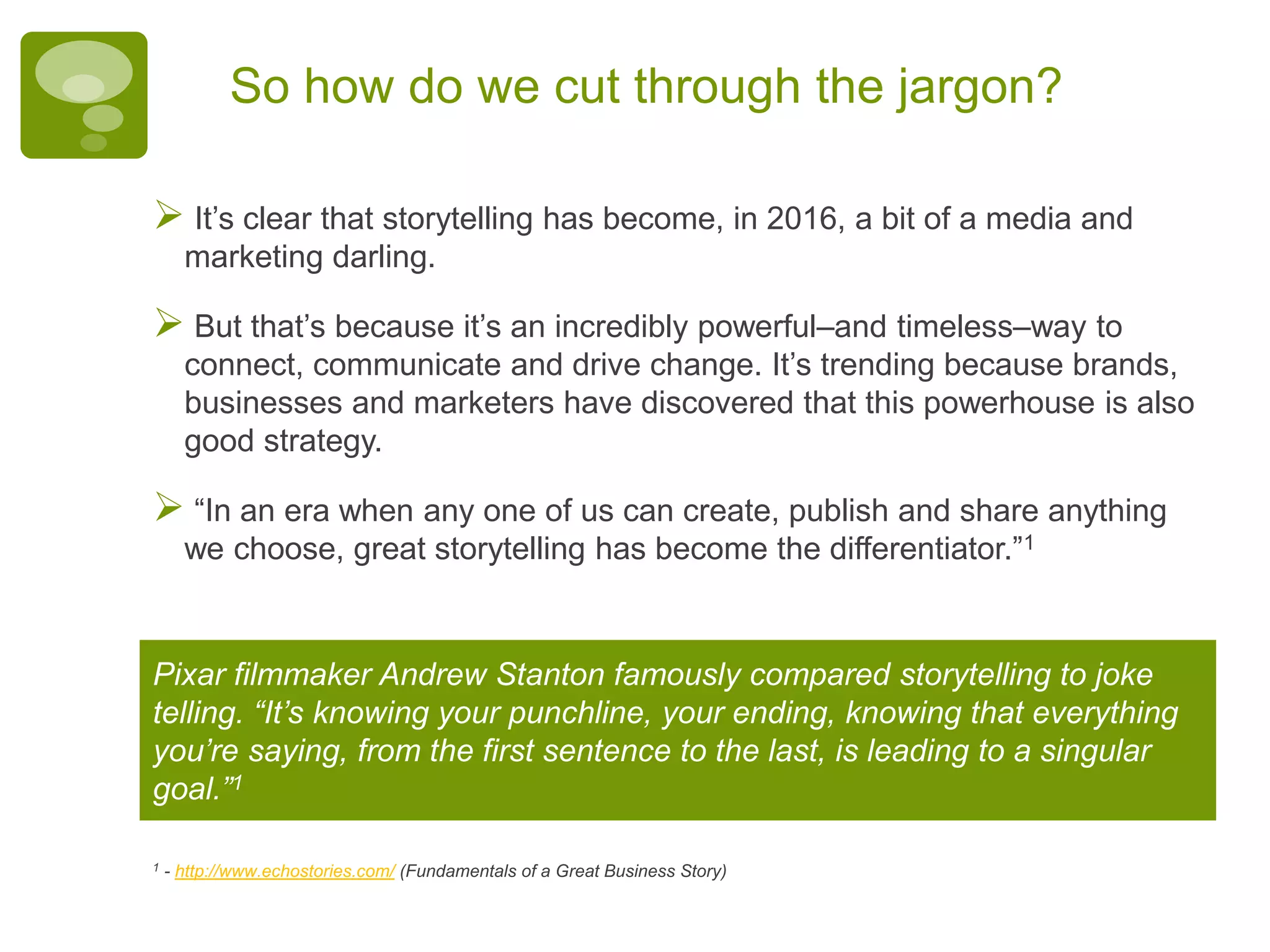
OK, then does it really mean anything?
 We’ve been telling and sharing stories since the dawn of time
 Consistent research supports the power of stories to inspire, motivate,
persuade, inform
 From a very early age (2-3 yrs old) we use stories to start to make sense
of the world
…..the short answer is YES
So how do we cut through the jargon?
 It’s clear that storytelling has become, in 2016, a bit of a media and
marketing darling.
 But that’s because it’s an incredibly powerful–and timeless–way to
connect, communicate and drive change. It’s trending because brands,
businesses and marketers have discovered that this powerhouse is also
good strategy.
 “In an era when any one of us can create, publish and share anything
we choose, great storytelling has become the differentiator.”1
Pixar filmmaker Andrew Stanton famously compared storytelling to joke
telling. “It’s knowing your punchline, your ending, knowing that everything
you’re saying, from the first sentence to the last, is leading to a singular
goal.”1
1 - http://www.echostories.com/ (Fundamentals of a Great Business Story)
Putting this in the context of business
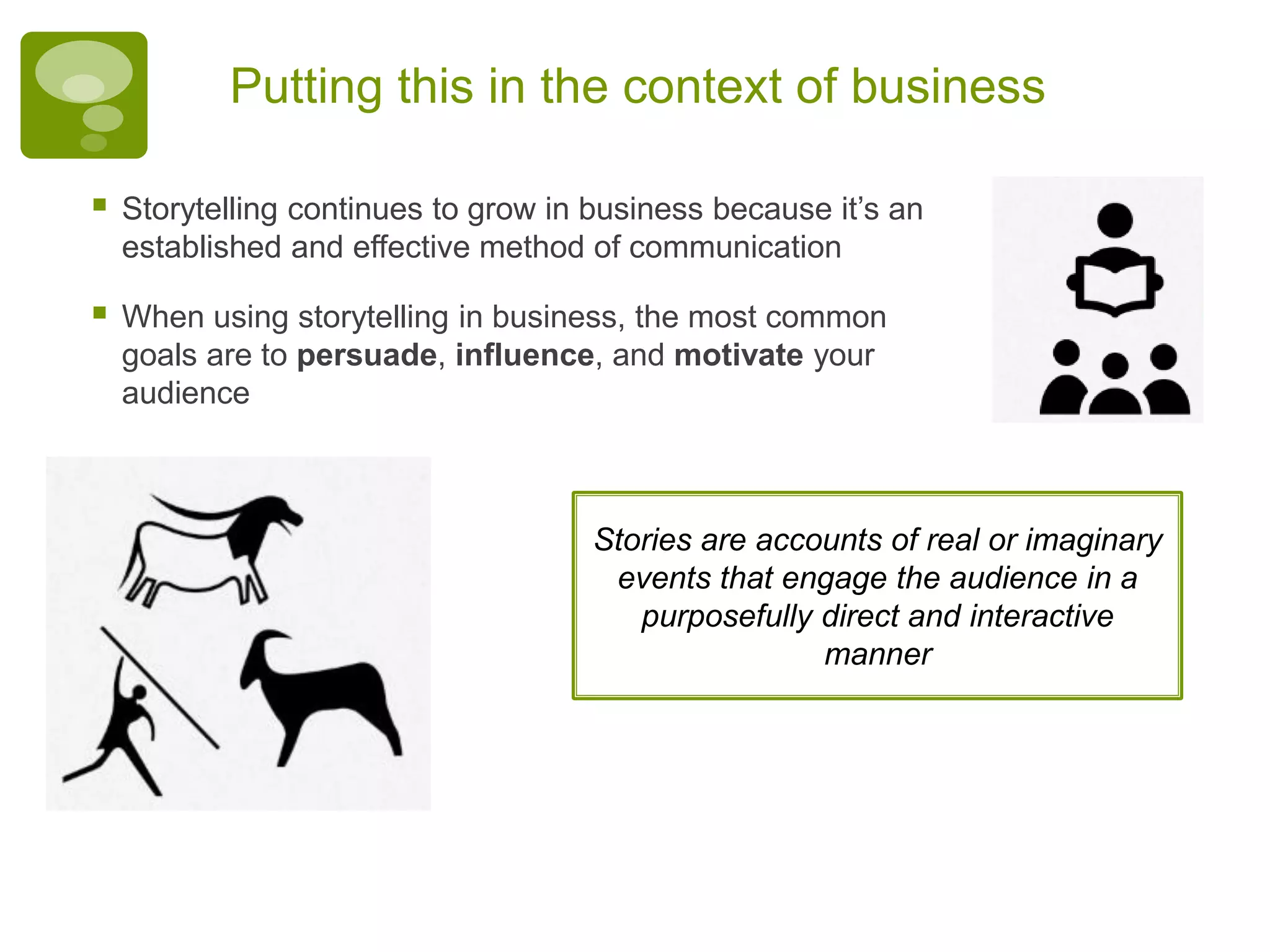
 Storytelling continues to grow in business because it’s an
established and effective method of communication
 When using storytelling in business, the most common
goals are to persuade, influence, and motivate your
audience
Stories are accounts of real or imaginary
events that engage the audience in a
purposefully direct and interactive
manner
The Power of Storytelling
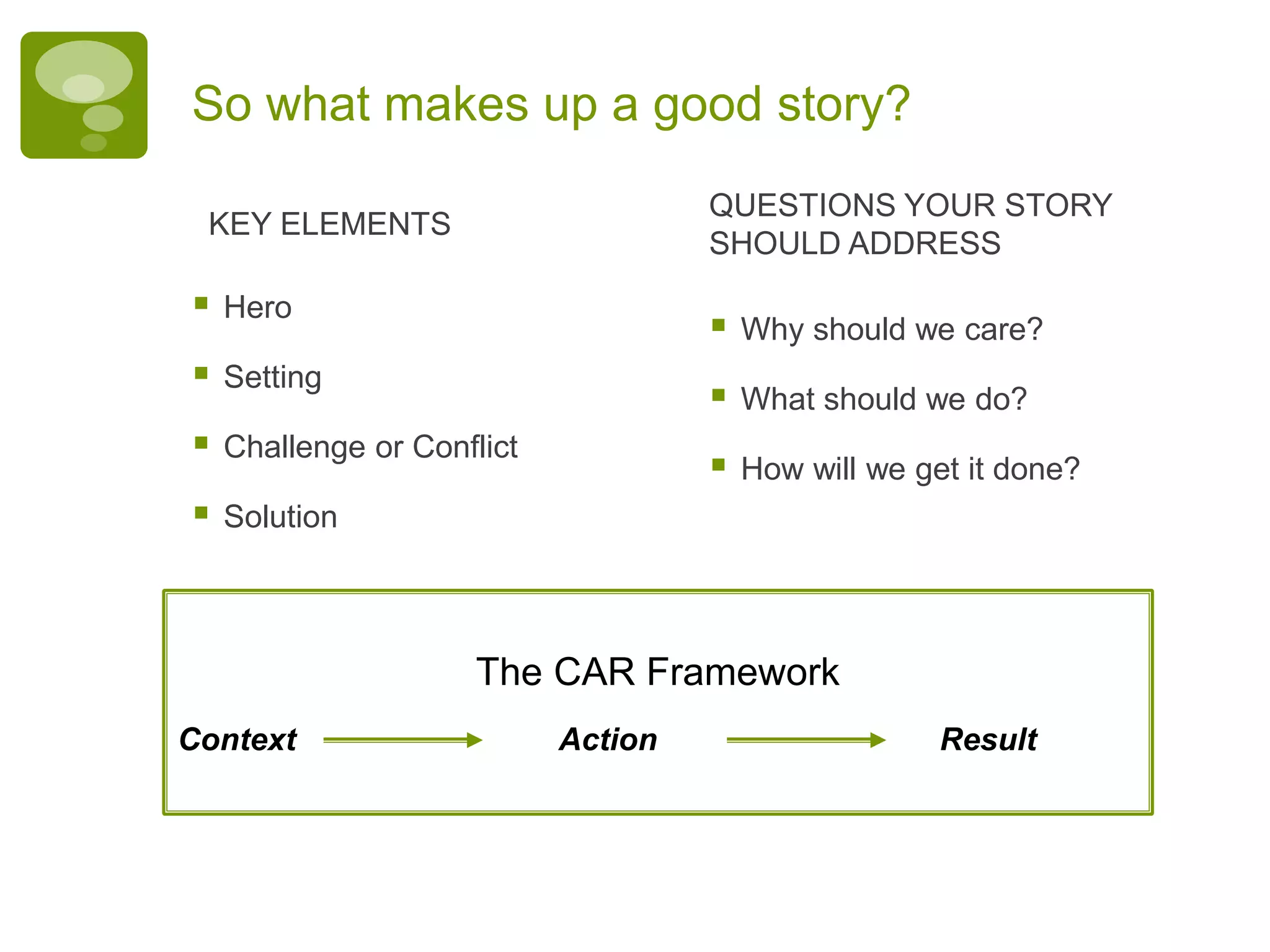
So what makes up a good story?
 Hero
 Setting
 Challenge or Conflict
 Solution
KEY ELEMENTS
 Why should we care?
 What should we do?
 How will we get it done?
QUESTIONS YOUR STORY
SHOULD ADDRESS
The CAR Framework
Context Action Result
What formats can we use to tell our
story?
 Storyboards / Customer Journey Maps
 Prototypes
 Presentations
 Blogs
 Whitepapers
 Videos
 Data Visualizations
This all feels so right-brain..
 While it’s true that storytelling typically
taps into to certain creative, social, and
emotional areas of the brain, there is
plenty of opportunity to integrate both the
analytical and inspirational
 This is becoming especially true in the
emerging field of Storytelling with Data image source – © Miriam Gilbert | Storytelling with Numbers
After a presentation, 63% of attendees remember stories.
Only 5% remembered statistics.
Source: Made to Stick, by Chip and Dan Heath (2007)
Data-driven storytelling
 A complete, robust story can be told with a single (or a few) visualizations
 Product managers increasingly are being asked to become data journalists
Source – Flowing Data, Nathan Yau
Basic Structure of Data Stories
Source – Miriam Gilbert, Storytelling with Numbers
 Beginning (context) – Start
with a background and
point(s) of reference
 Middle (discovery) – Explain
challenges, proposals for
change, and insights that lead
to confirm new solutions
 End (conclusion) – Include
concluding statements,
recommendations, or
suggested next steps
Bringing it back to product work
Source – Sarah Doody | Knowing your users & their stories
 Stories can help to clearly define the Why. Since it’s always critical
to start here, stories are one of the most natural ways to start the
conversation
 As we move our teams through the What and How, we can
continuously refer to our stories to help ensure alignment
Who is our story for or about?
Customers
Investors / Executives
Colleagues / Team
Members
Allows us to explore
the spaces our
customers and users
inhabit
Creates deeper
connection to the
addressable problem
and market
Helps them to
understand and truly
support the work
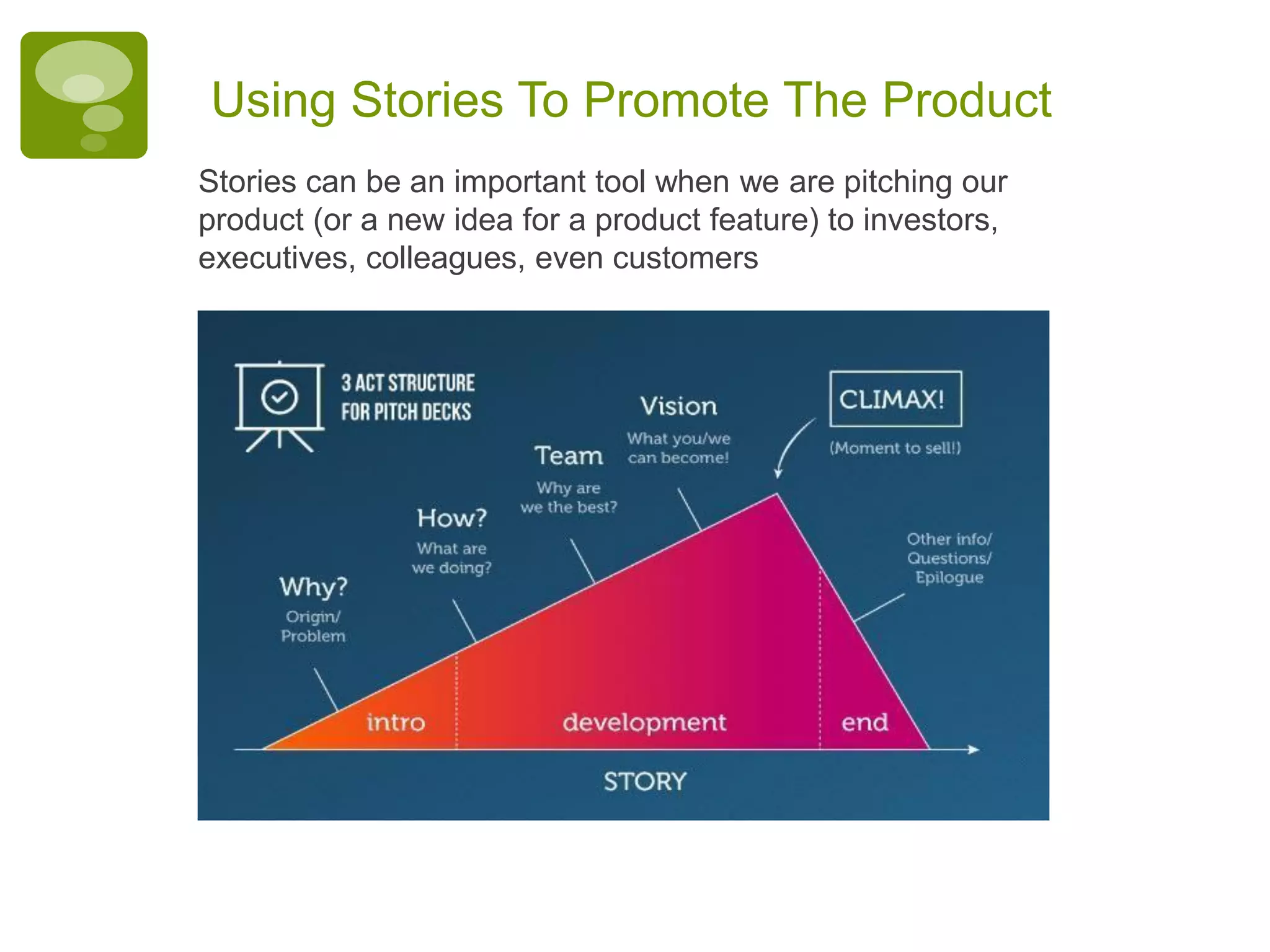
Using Stories To Promote The Product
Stories can be an important tool when we are pitching our
product (or a new idea for a product feature) to investors,
executives, colleagues, even customers
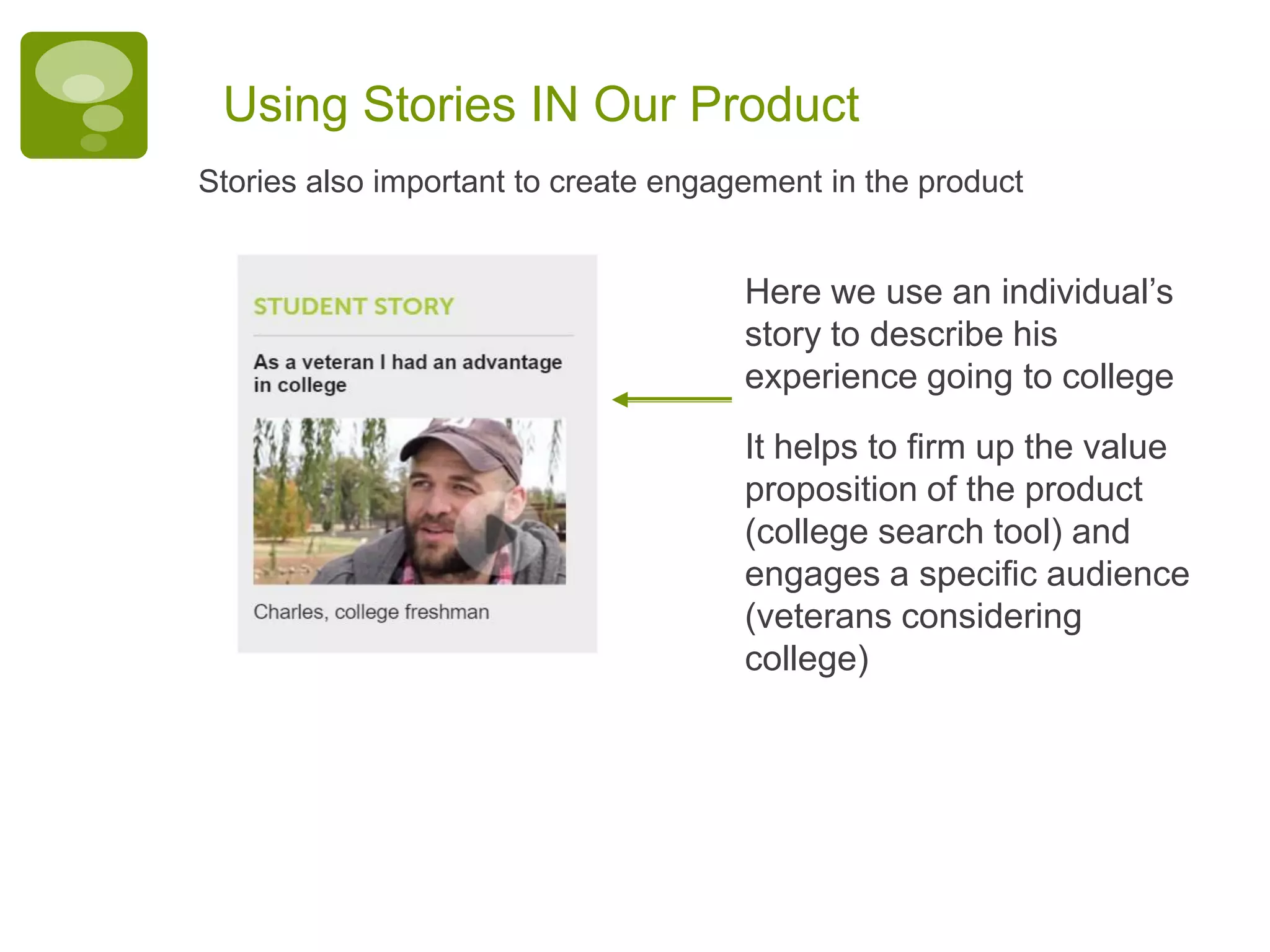
Using Stories IN Our Product
Here we use an individual’s
story to describe his
experience going to college
It helps to firm up the value
proposition of the product
(college search tool) and
engages a specific audience
(veterans considering
college)
Stories also important to create engagement in the product
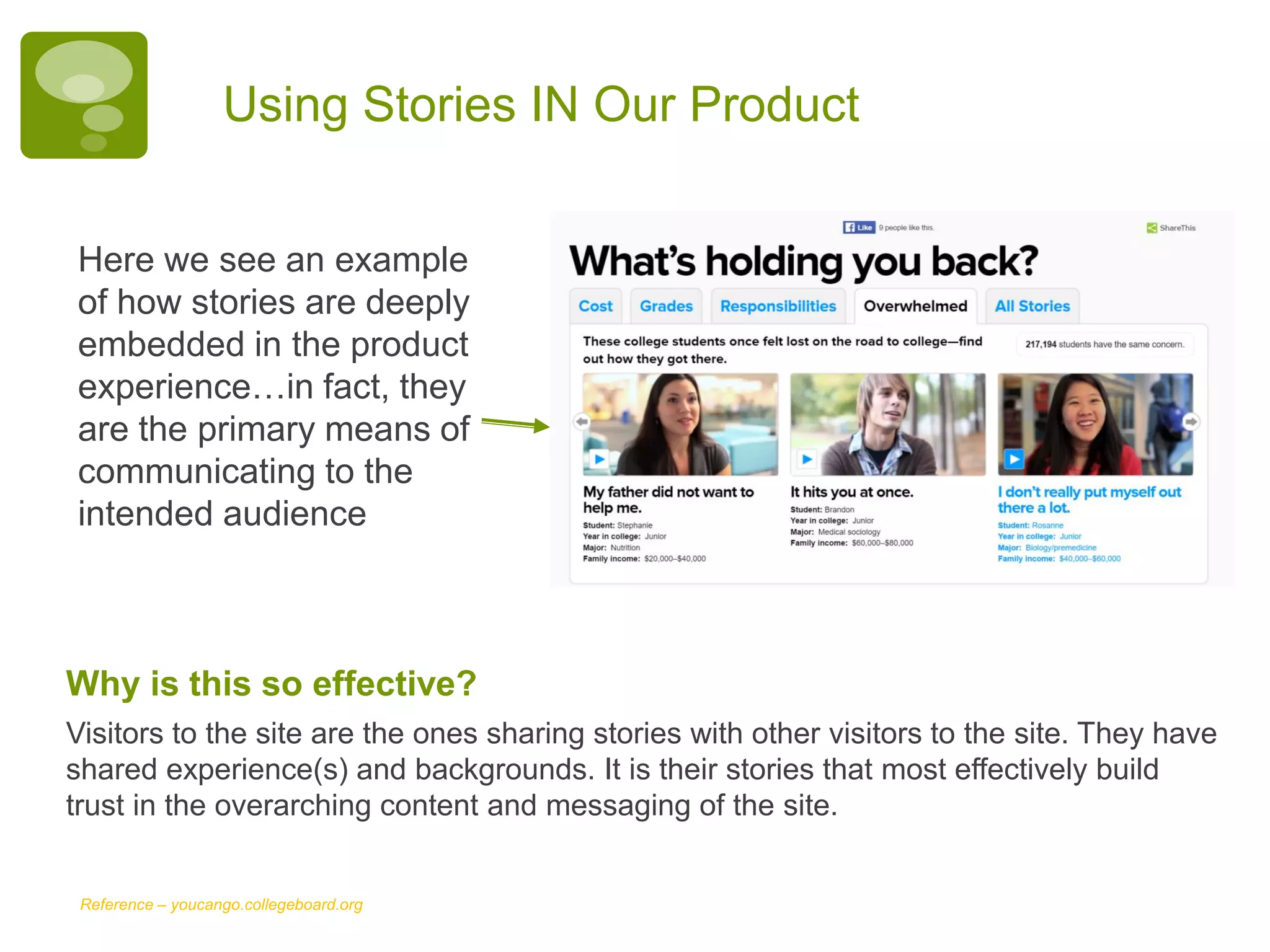
Using Stories IN Our Product
Here we see an example
of how stories are deeply
embedded in the product
experience…in fact, they
are the primary means of
communicating to the
intended audience
Why is this so effective?
Visitors to the site are the ones sharing stories with other visitors to the site. They have
shared experience(s) and backgrounds. It is their stories that most effectively build
trust in the overarching content and messaging of the site.
Reference – youcango.collegeboard.org
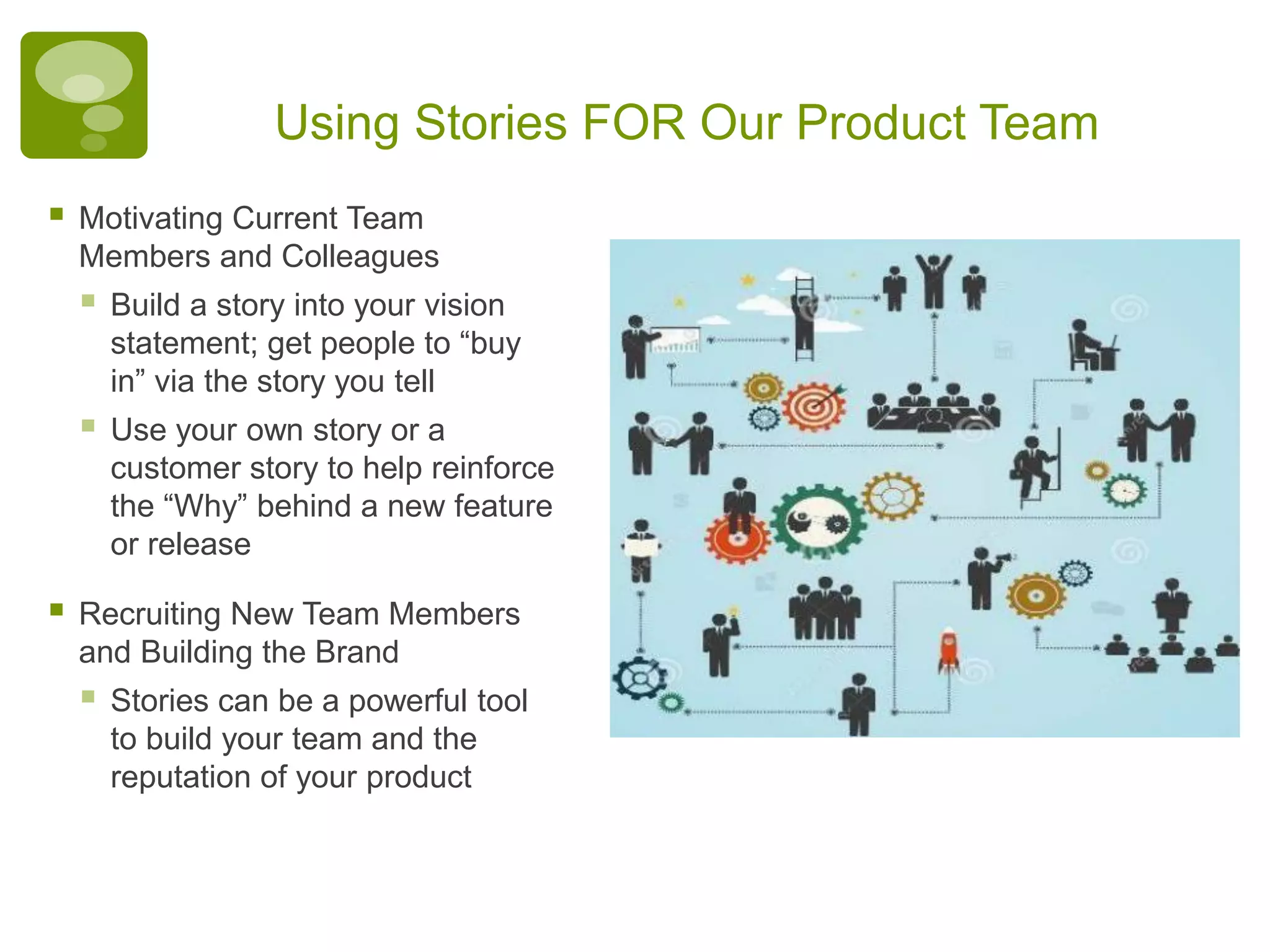
Using Stories FOR Our Product Team
 Motivating Current Team
Members and Colleagues
 Build a story into your vision
statement; get people to “buy
in” via the story you tell
 Use your own story or a
customer story to help reinforce
the “Why” behind a new feature
or release
 Recruiting New Team Members
and Building the Brand
 Stories can be a powerful tool
to build your team and the
reputation of your product
Where can I learn more?
 TEDtalks
https://www.ted.com/topics/storytelling
 Center for Digital Storytelling
http://www.storycenter.org
 Harvard Business Review
https://hbr.org/2014/03/the-irresistible-power-of-storytelling-as-a-strategic-business-tool/
 Lead With a Story
http://leadwithastory.com/
 Storytelling with Data
http://www.storytellingwithdata.com/
 Storytelling with Numbers
http://www.storytellingwithnumbers.com/
And because there’s a periodic table
for almost everything….
Source – designtaxi.com
THANK YOU!
https://www.linkedin.com/in/skrobela
@daveskrobela

Storytelling in Product Management

  • 1.
  • 2.
    About Me I startedmy career in product-related work as a consultant, building and implementing web content management systems and supporting infrastructure for clients across multiple industries (Consumers Union, Standard & Poor’s, Creative Artist Agency). For the past 13 years, I’ve been focused on education technology, managing the launch of digital products at The College Board, Teach For America, and Centris Group. I am currently running a consulting shop, Context First, that helps organizations with early-stage product concept validation and business case development.
  • 3.
    First, a Momentof Levity "Storytelling is one of the dumbest new media words of the decade - it sounds fancy and means nothing yet gets thrown around constantly.” - @BillSimmons, twitter, May 3, 2016
  • 4.
    OK, then doesit really mean anything?  We’ve been telling and sharing stories since the dawn of time  Consistent research supports the power of stories to inspire, motivate, persuade, inform  From a very early age (2-3 yrs old) we use stories to start to make sense of the world …..the short answer is YES
  • 5.
    So how dowe cut through the jargon?  It’s clear that storytelling has become, in 2016, a bit of a media and marketing darling.  But that’s because it’s an incredibly powerful–and timeless–way to connect, communicate and drive change. It’s trending because brands, businesses and marketers have discovered that this powerhouse is also good strategy.  “In an era when any one of us can create, publish and share anything we choose, great storytelling has become the differentiator.”1 Pixar filmmaker Andrew Stanton famously compared storytelling to joke telling. “It’s knowing your punchline, your ending, knowing that everything you’re saying, from the first sentence to the last, is leading to a singular goal.”1 1 - http://www.echostories.com/ (Fundamentals of a Great Business Story)
  • 6.
    Putting this inthe context of business  Storytelling continues to grow in business because it’s an established and effective method of communication  When using storytelling in business, the most common goals are to persuade, influence, and motivate your audience Stories are accounts of real or imaginary events that engage the audience in a purposefully direct and interactive manner
  • 7.
    The Power ofStorytelling
  • 8.
    So what makesup a good story?  Hero  Setting  Challenge or Conflict  Solution KEY ELEMENTS  Why should we care?  What should we do?  How will we get it done? QUESTIONS YOUR STORY SHOULD ADDRESS The CAR Framework Context Action Result
  • 9.
    What formats canwe use to tell our story?  Storyboards / Customer Journey Maps  Prototypes  Presentations  Blogs  Whitepapers  Videos  Data Visualizations
  • 10.
    This all feelsso right-brain..  While it’s true that storytelling typically taps into to certain creative, social, and emotional areas of the brain, there is plenty of opportunity to integrate both the analytical and inspirational  This is becoming especially true in the emerging field of Storytelling with Data image source – © Miriam Gilbert | Storytelling with Numbers After a presentation, 63% of attendees remember stories. Only 5% remembered statistics. Source: Made to Stick, by Chip and Dan Heath (2007)
  • 11.
    Data-driven storytelling  Acomplete, robust story can be told with a single (or a few) visualizations  Product managers increasingly are being asked to become data journalists Source – Flowing Data, Nathan Yau
  • 12.
    Basic Structure ofData Stories Source – Miriam Gilbert, Storytelling with Numbers  Beginning (context) – Start with a background and point(s) of reference  Middle (discovery) – Explain challenges, proposals for change, and insights that lead to confirm new solutions  End (conclusion) – Include concluding statements, recommendations, or suggested next steps
  • 13.
    Bringing it backto product work Source – Sarah Doody | Knowing your users & their stories  Stories can help to clearly define the Why. Since it’s always critical to start here, stories are one of the most natural ways to start the conversation  As we move our teams through the What and How, we can continuously refer to our stories to help ensure alignment
  • 14.
    Who is ourstory for or about? Customers Investors / Executives Colleagues / Team Members Allows us to explore the spaces our customers and users inhabit Creates deeper connection to the addressable problem and market Helps them to understand and truly support the work
  • 15.
    Using Stories ToPromote The Product Stories can be an important tool when we are pitching our product (or a new idea for a product feature) to investors, executives, colleagues, even customers
  • 16.
    Using Stories INOur Product Here we use an individual’s story to describe his experience going to college It helps to firm up the value proposition of the product (college search tool) and engages a specific audience (veterans considering college) Stories also important to create engagement in the product
  • 17.
    Using Stories INOur Product Here we see an example of how stories are deeply embedded in the product experience…in fact, they are the primary means of communicating to the intended audience Why is this so effective? Visitors to the site are the ones sharing stories with other visitors to the site. They have shared experience(s) and backgrounds. It is their stories that most effectively build trust in the overarching content and messaging of the site. Reference – youcango.collegeboard.org
  • 18.
    Using Stories FOROur Product Team  Motivating Current Team Members and Colleagues  Build a story into your vision statement; get people to “buy in” via the story you tell  Use your own story or a customer story to help reinforce the “Why” behind a new feature or release  Recruiting New Team Members and Building the Brand  Stories can be a powerful tool to build your team and the reputation of your product
  • 19.
    Where can Ilearn more?  TEDtalks https://www.ted.com/topics/storytelling  Center for Digital Storytelling http://www.storycenter.org  Harvard Business Review https://hbr.org/2014/03/the-irresistible-power-of-storytelling-as-a-strategic-business-tool/  Lead With a Story http://leadwithastory.com/  Storytelling with Data http://www.storytellingwithdata.com/  Storytelling with Numbers http://www.storytellingwithnumbers.com/
  • 20.
    And because there’sa periodic table for almost everything…. Source – designtaxi.com
  • 21.