Keeping
    Storage…
How we Keeping stuff?
• Movie, cinema killer?
• Who, how, where etc…?
• ?
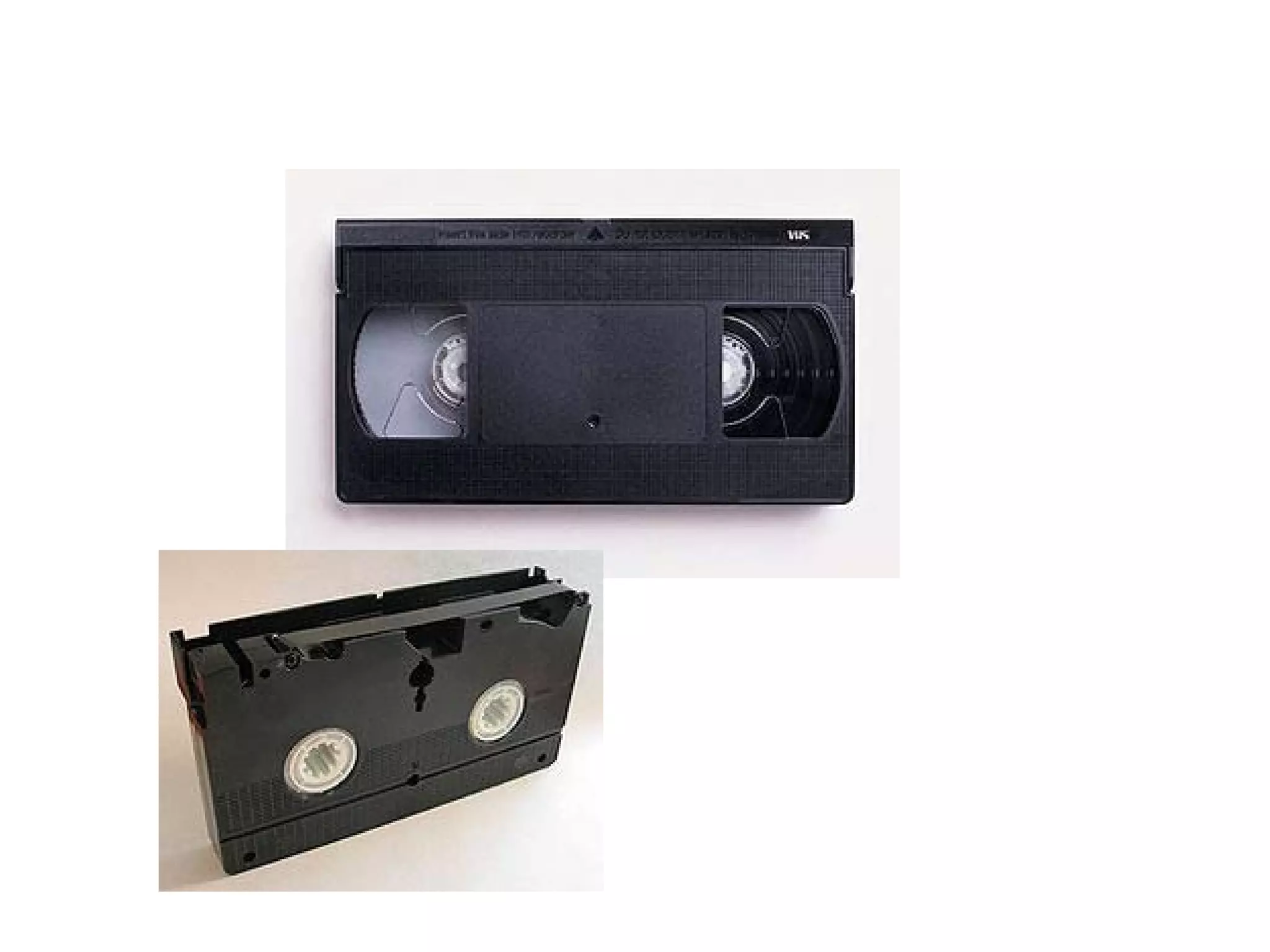
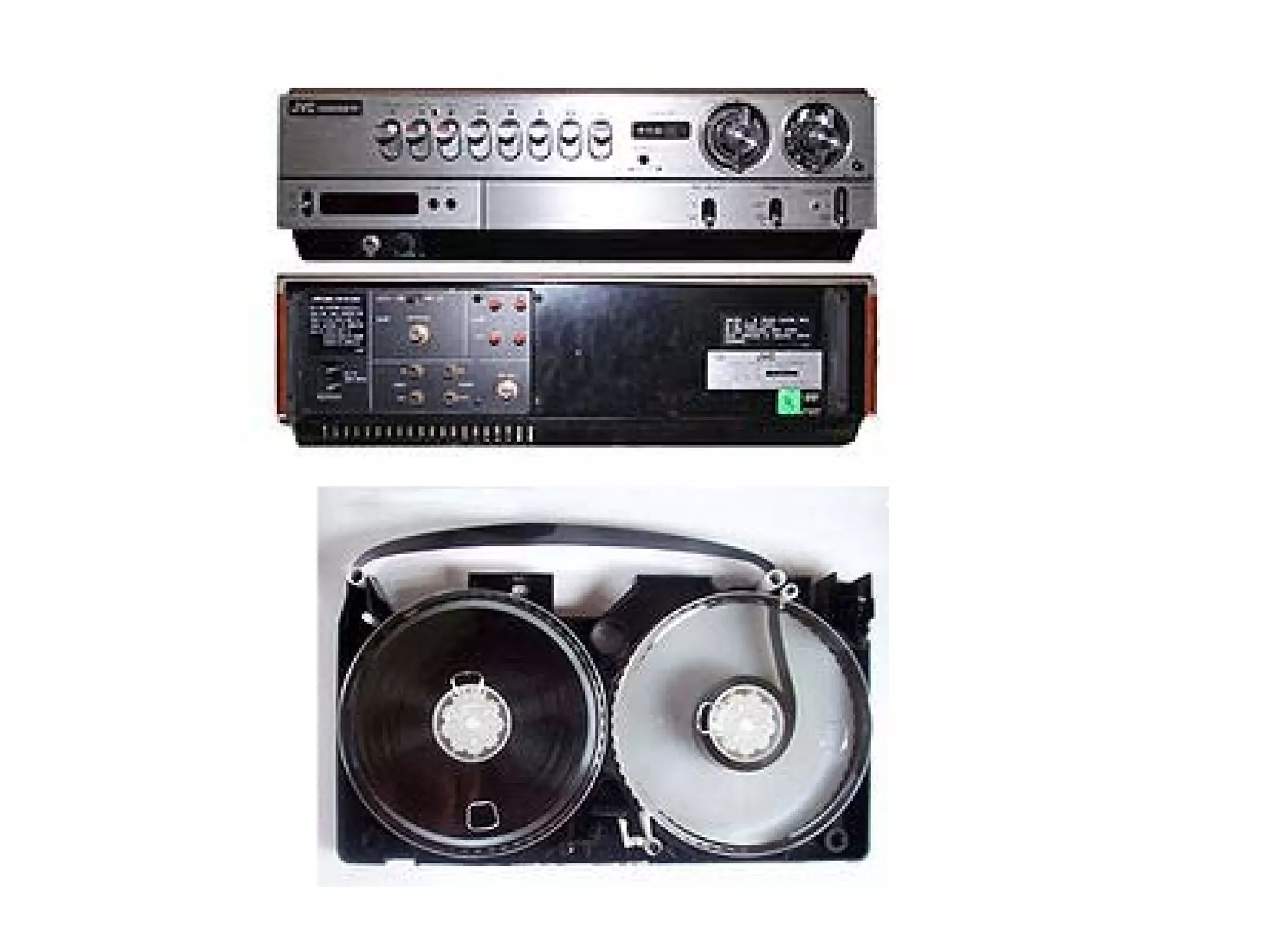
• The Video Home System (better known by its
  abbreviation VHS)is a consumer-level analog
  recording videotape-based cassette standard
  developed byVictor Company of Japan (JVC).
• The 1970s was a period when video recording
  became a major contributor to the television
  industry.
• Like many other technological innovations,
  each of several companies made an attempt
  to produce a television recording standard
  that the majority of the world would embrace.
• At the peak of it all, the home video industry
  was caught up in a series of videotape format
  wars.
• Two of the formats, VHS andBetamax,
  received the most media exposure. VHS would
  eventually win the war of, and therefore
  succeed as the dominant home video format,
  lasting throughout the tape format period
Betamax
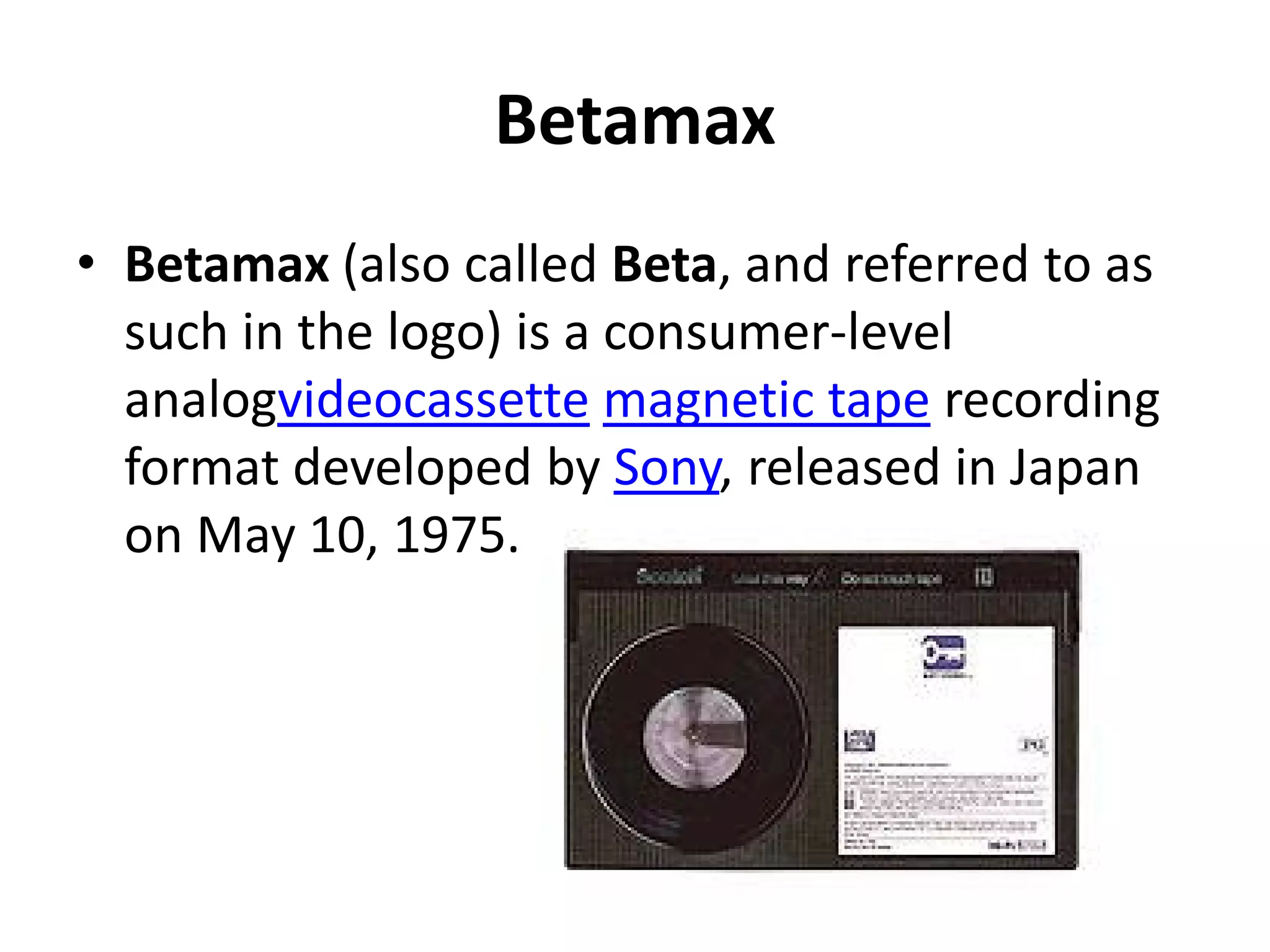
• Betamax (also called Beta, and referred to as
  such in the logo) is a consumer-level
  analogvideocassette magnetic tape recording
  format developed by Sony, released in Japan
  on May 10, 1975.
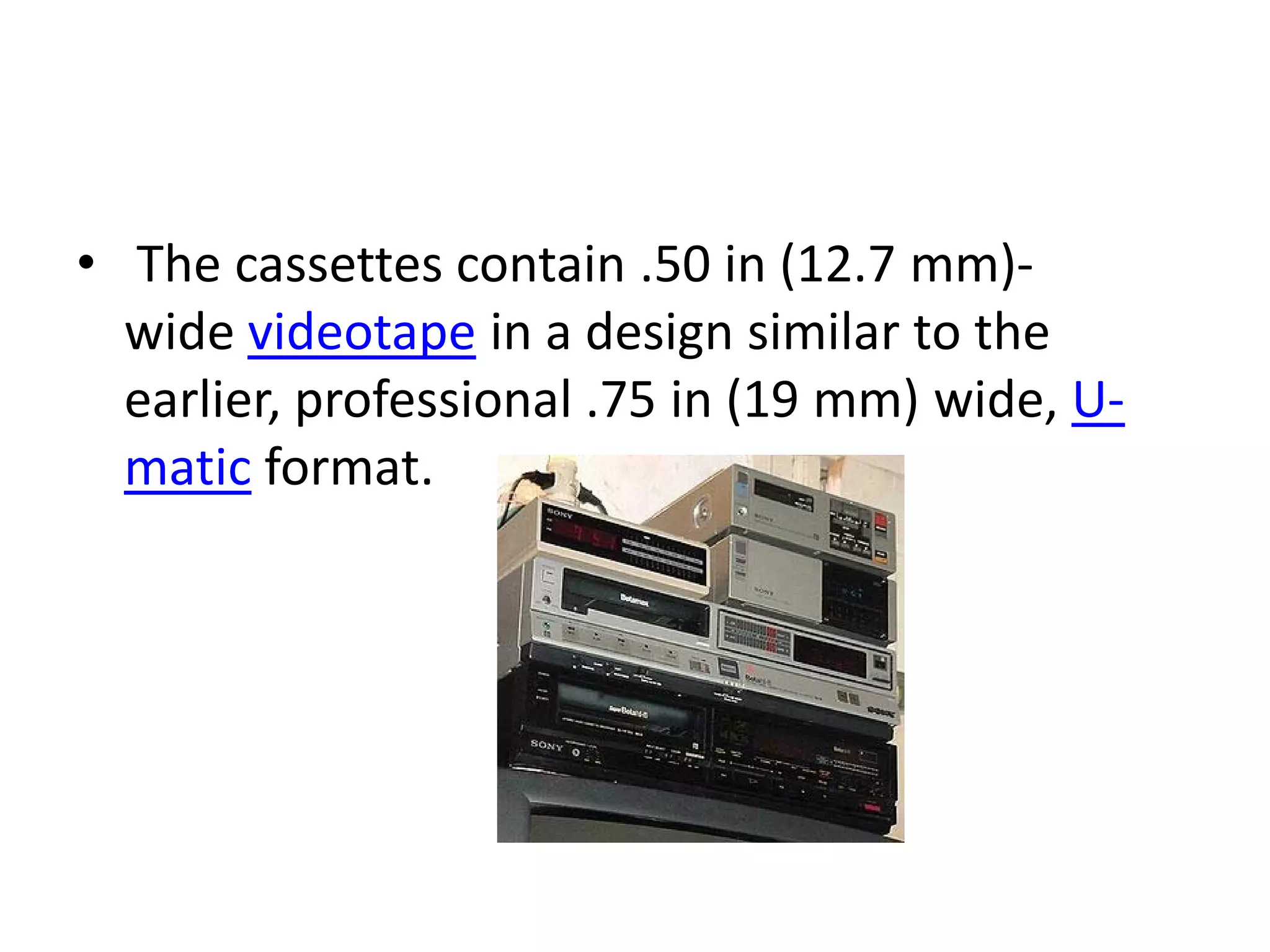
• The cassettes contain .50 in (12.7 mm)-
  wide videotape in a design similar to the
  earlier, professional .75 in (19 mm) wide, U-
  matic format.
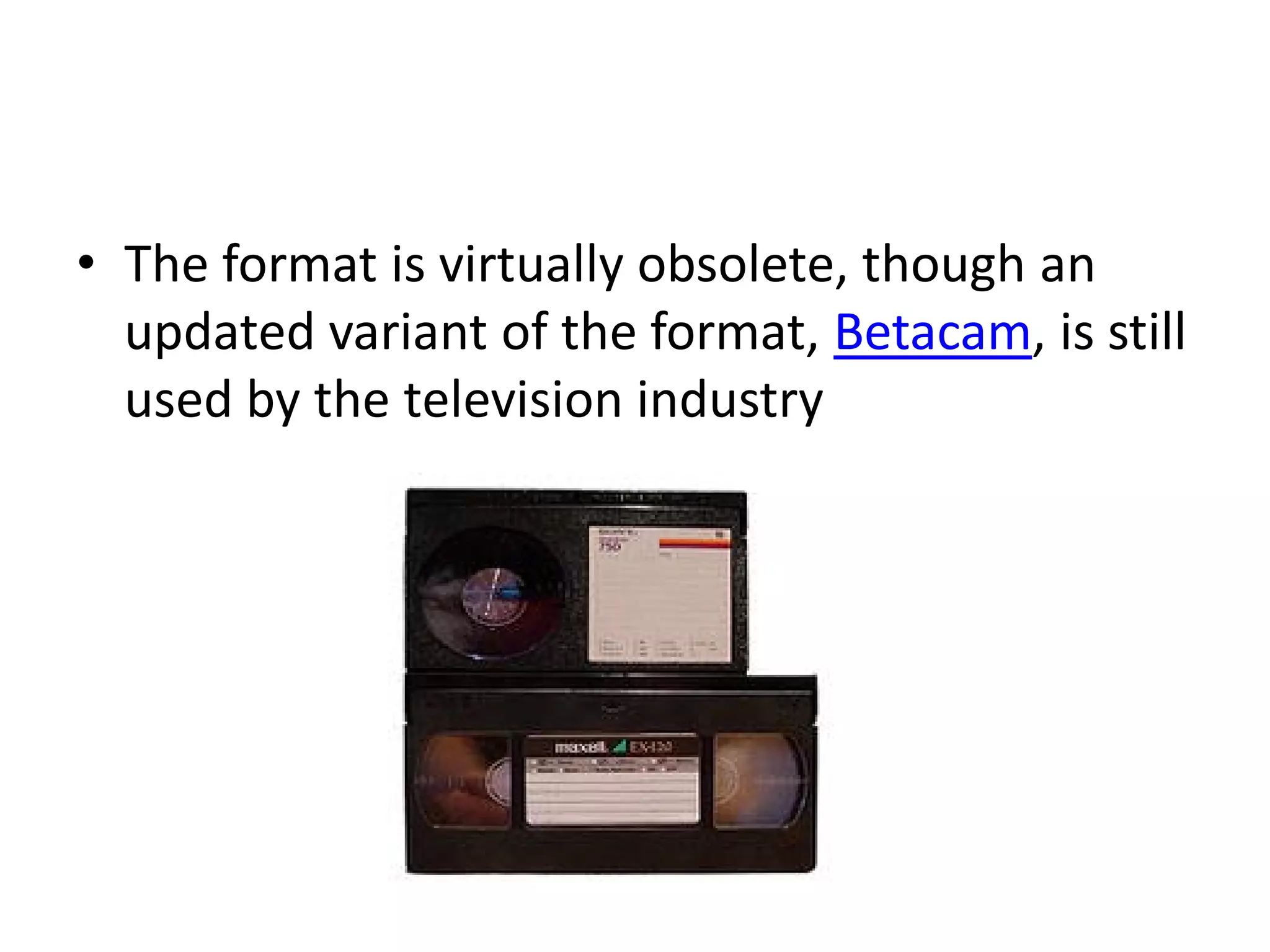
• The format is virtually obsolete, though an
  updated variant of the format, Betacam, is still
  used by the television industry
• Floppy disk
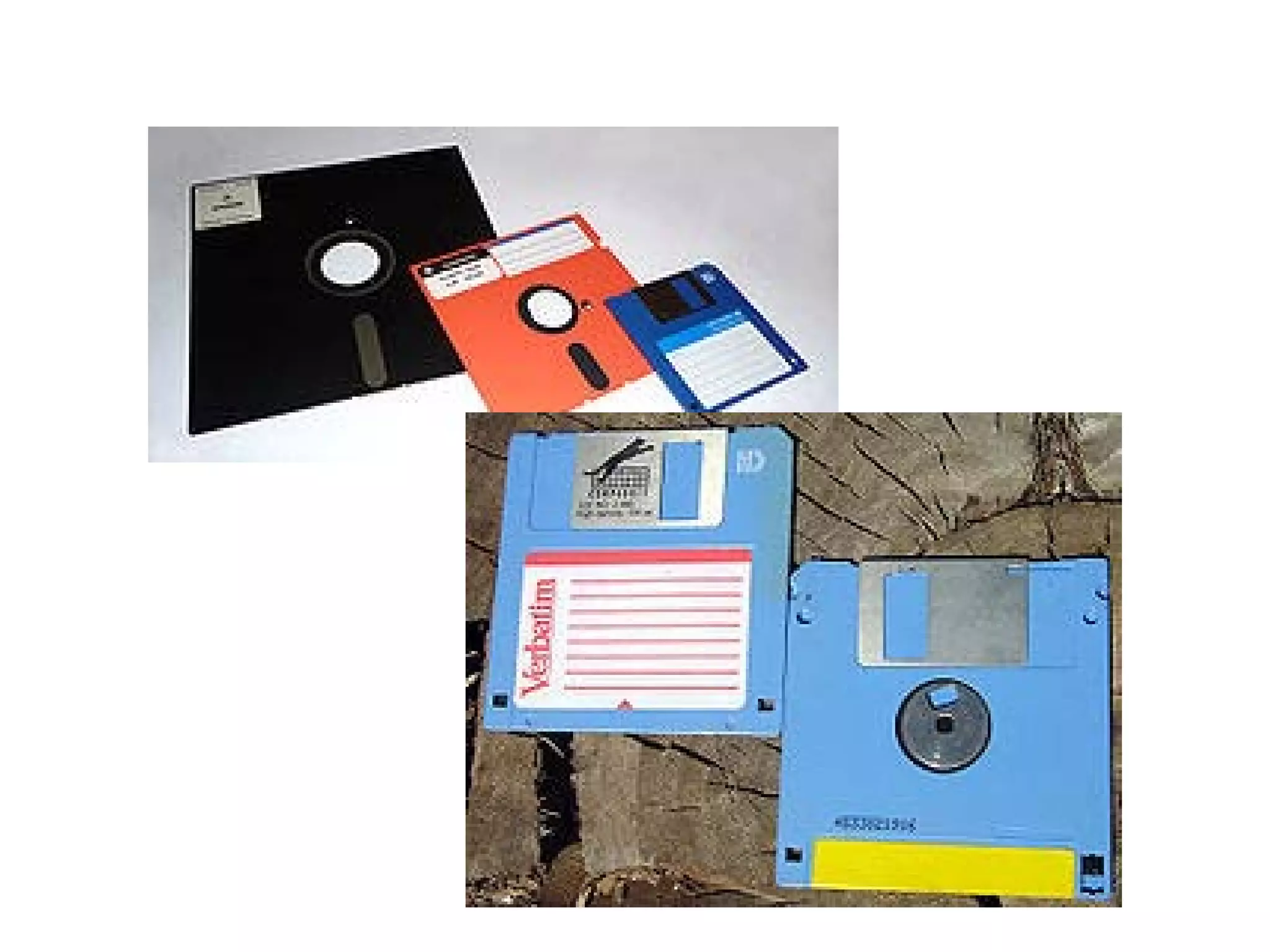
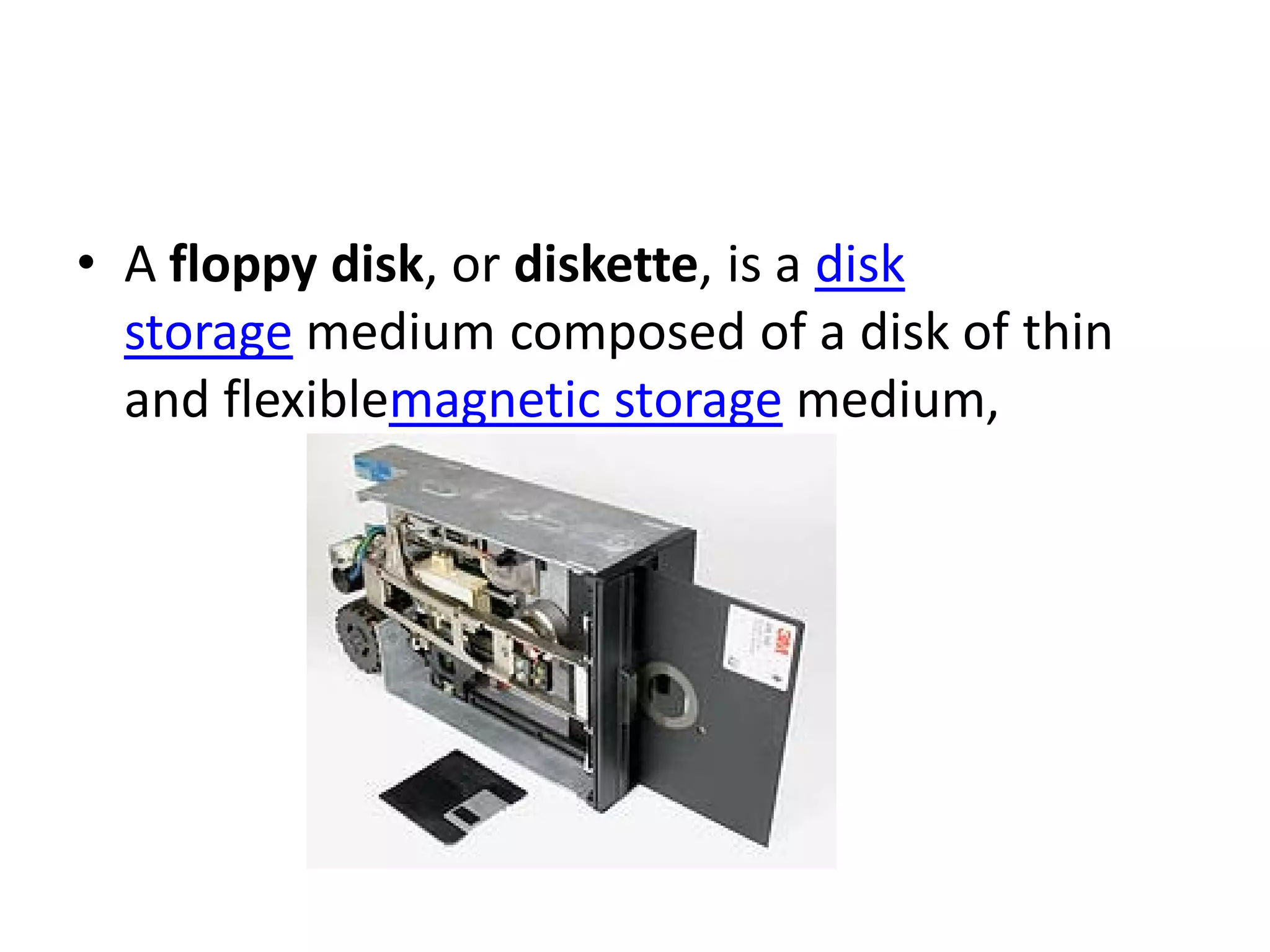
• A floppy disk, or diskette, is a disk
  storage medium composed of a disk of thin
  and flexiblemagnetic storage medium,
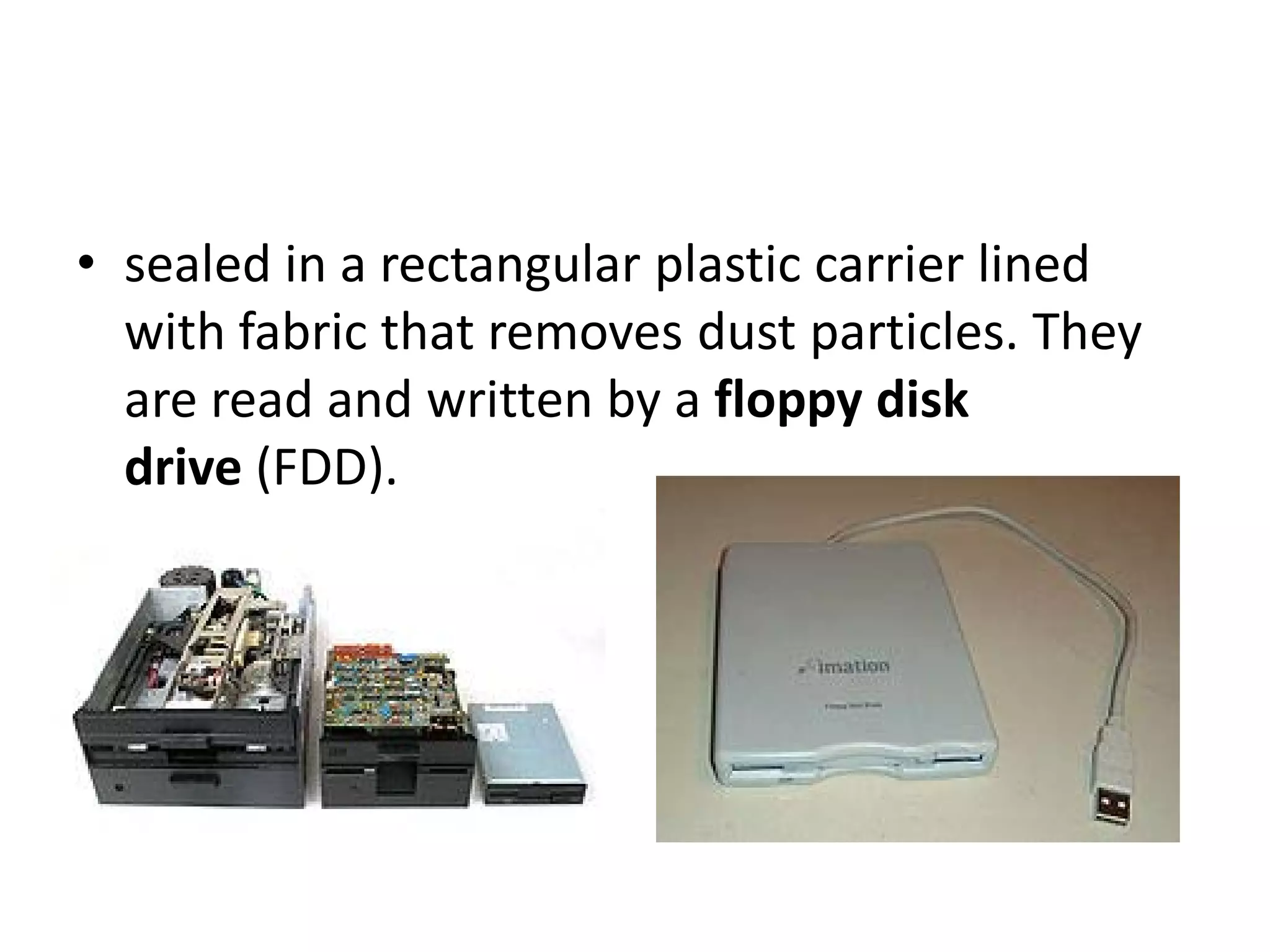
• sealed in a rectangular plastic carrier lined
  with fabric that removes dust particles. They
  are read and written by a floppy disk
  drive (FDD).
History
• The earliest floppy disks, developed in the late
  1960s, were 8 inches (200 mm) in diameter;
  they became commercially available in 1971.
• These disks and associated drives were
  produced and improved upon by IBM and
  other companies such as Memorex, Shugart
  Associates, and Burroughs Corporation.
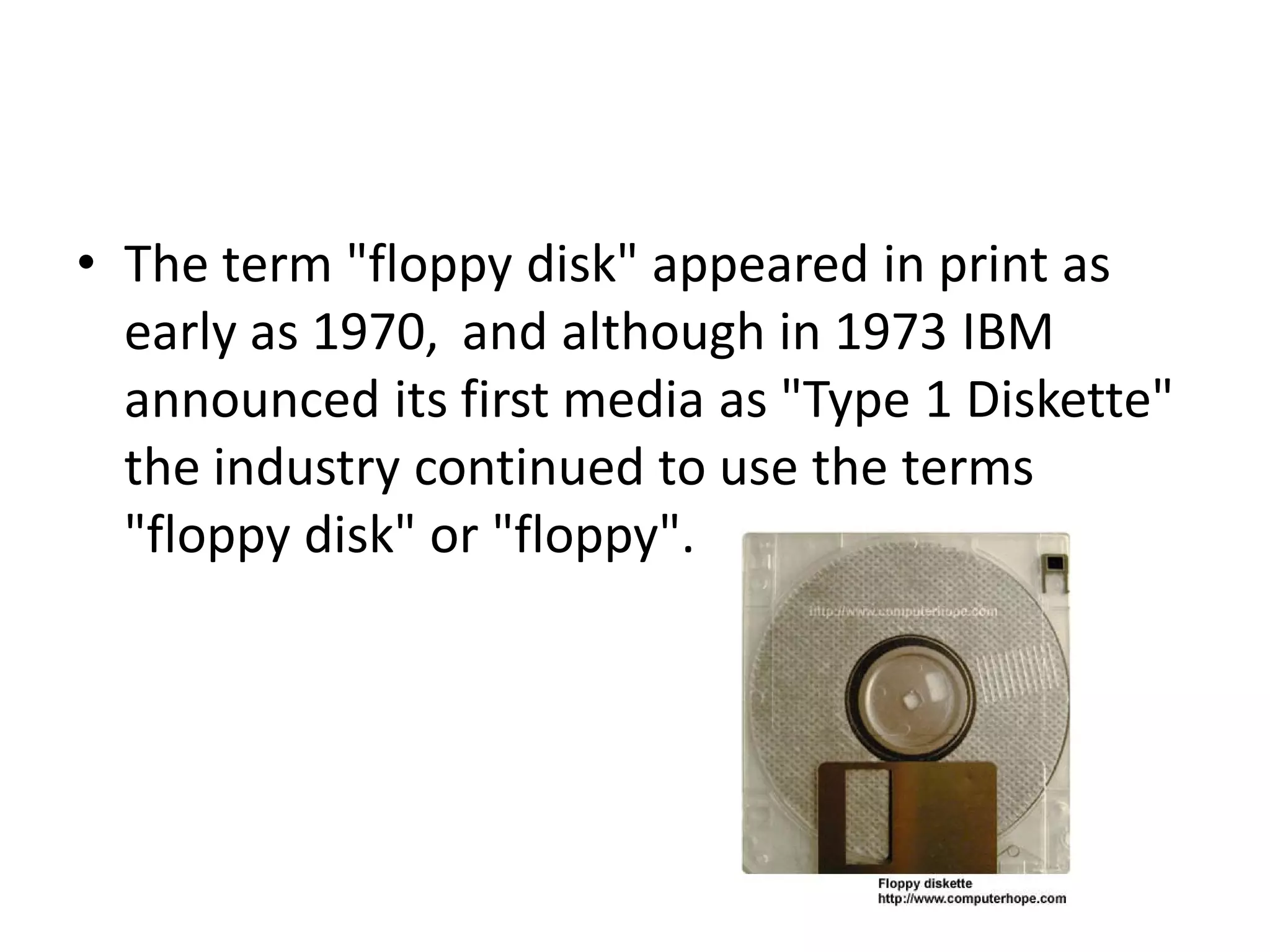
• The term "floppy disk" appeared in print as
  early as 1970, and although in 1973 IBM
  announced its first media as "Type 1 Diskette"
  the industry continued to use the terms
  "floppy disk" or "floppy".
Zip drive
• The Zip drive is a medium-capacity
  removable disk storage system that was
  introduced byIomega in late 1994. Originally,
  Zip disks launched with capacities of 100 MB,
  but later versions increased this to first
  250 MB and then 750 MB.
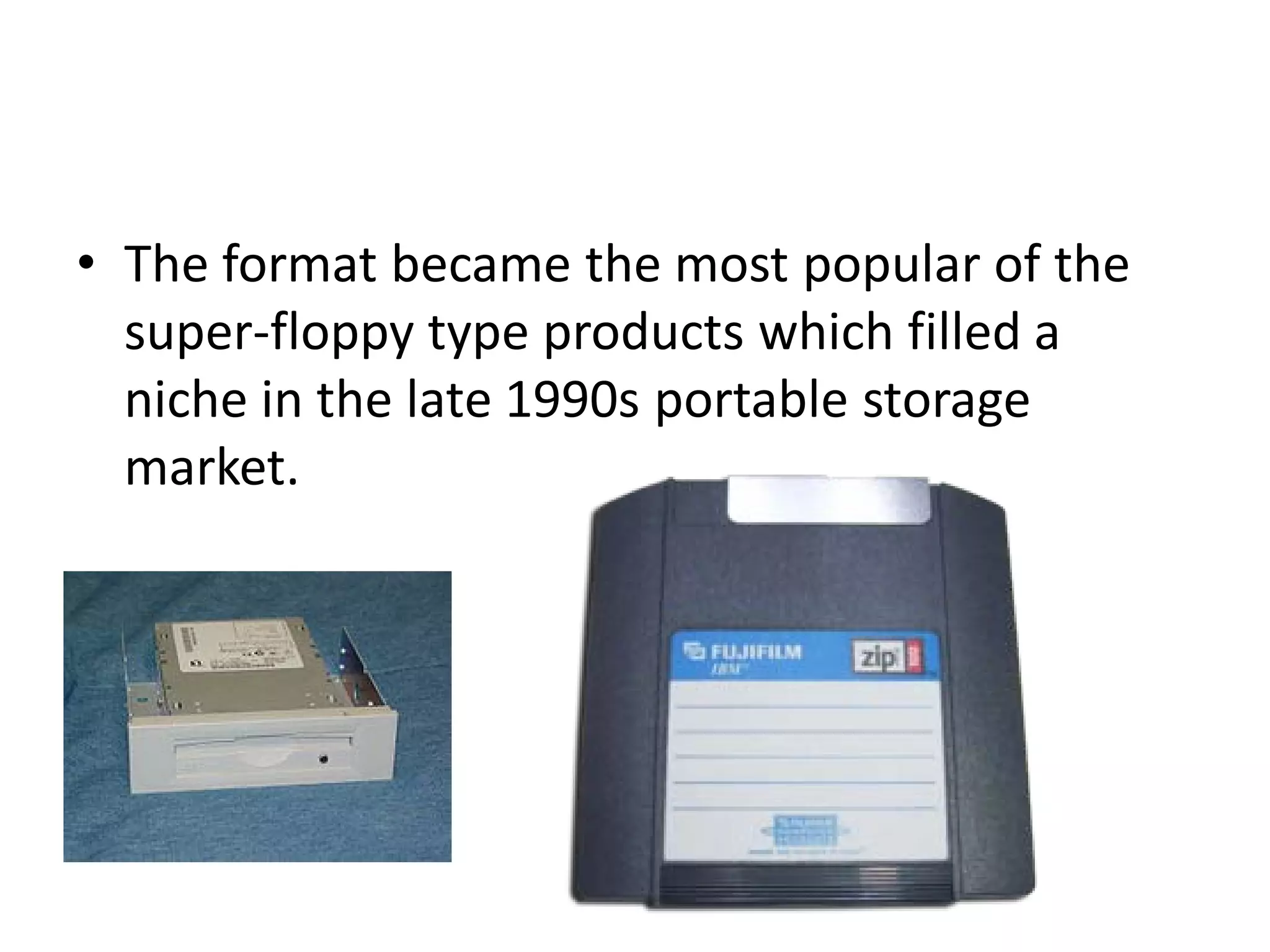
• The format became the most popular of the
  super-floppy type products which filled a
  niche in the late 1990s portable storage
  market.
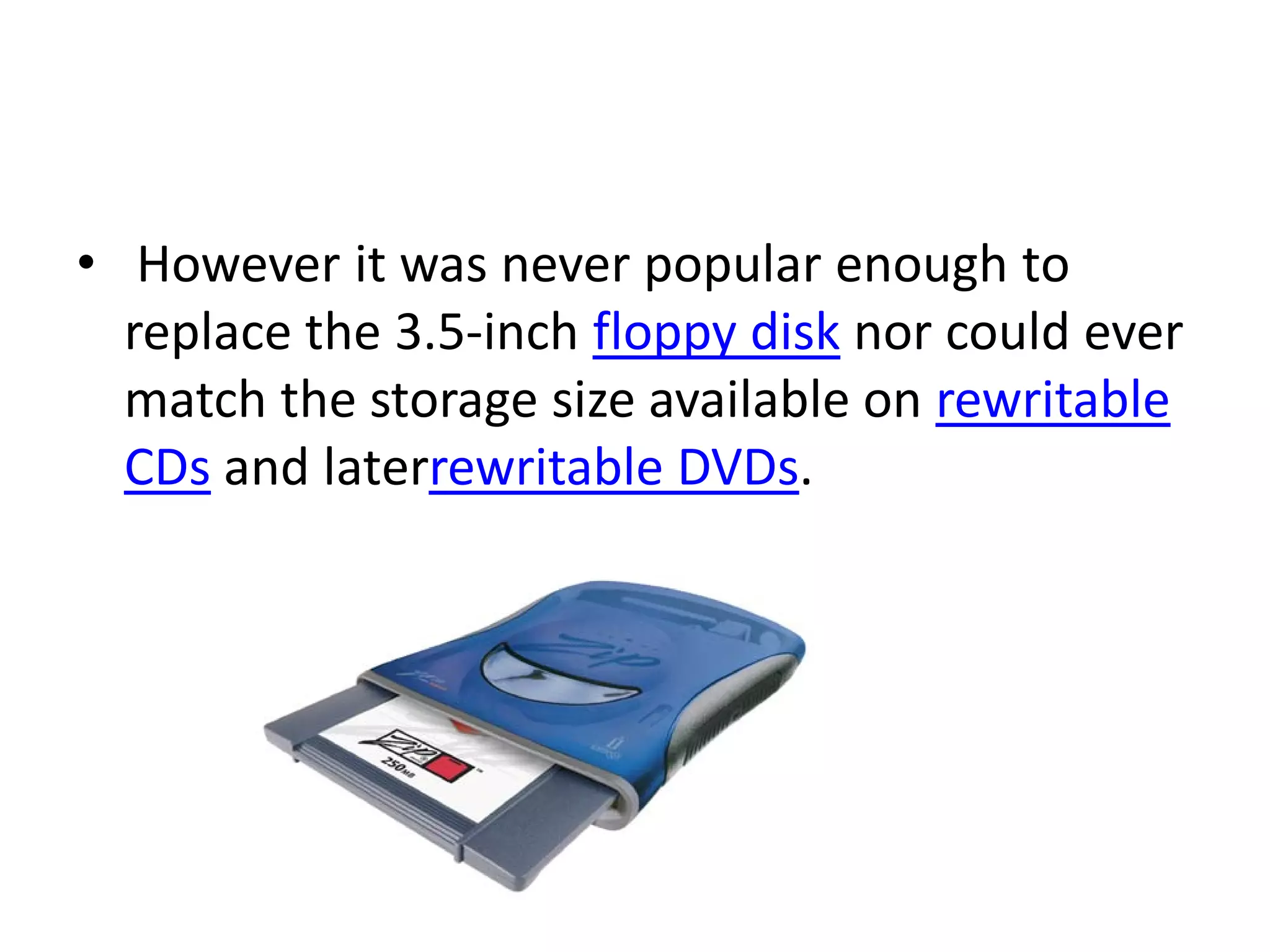
• However it was never popular enough to
  replace the 3.5-inch floppy disk nor could ever
  match the storage size available on rewritable
  CDs and laterrewritable DVDs.
• USB flash drives ultimately proved to be the
  better rewritable storage medium among the
  general public due to the near ubiquity of USB
  ports on personal computers and soon after
  because of the far greater storage sizes
  offered.
• Zip drives fell out of favor for mass portable
  storage during the early 2000s.
• The Zip brand later covered internal and
  external CD writers known as Zip-650 or Zip-
  CD, which had no relation to the Zip drive
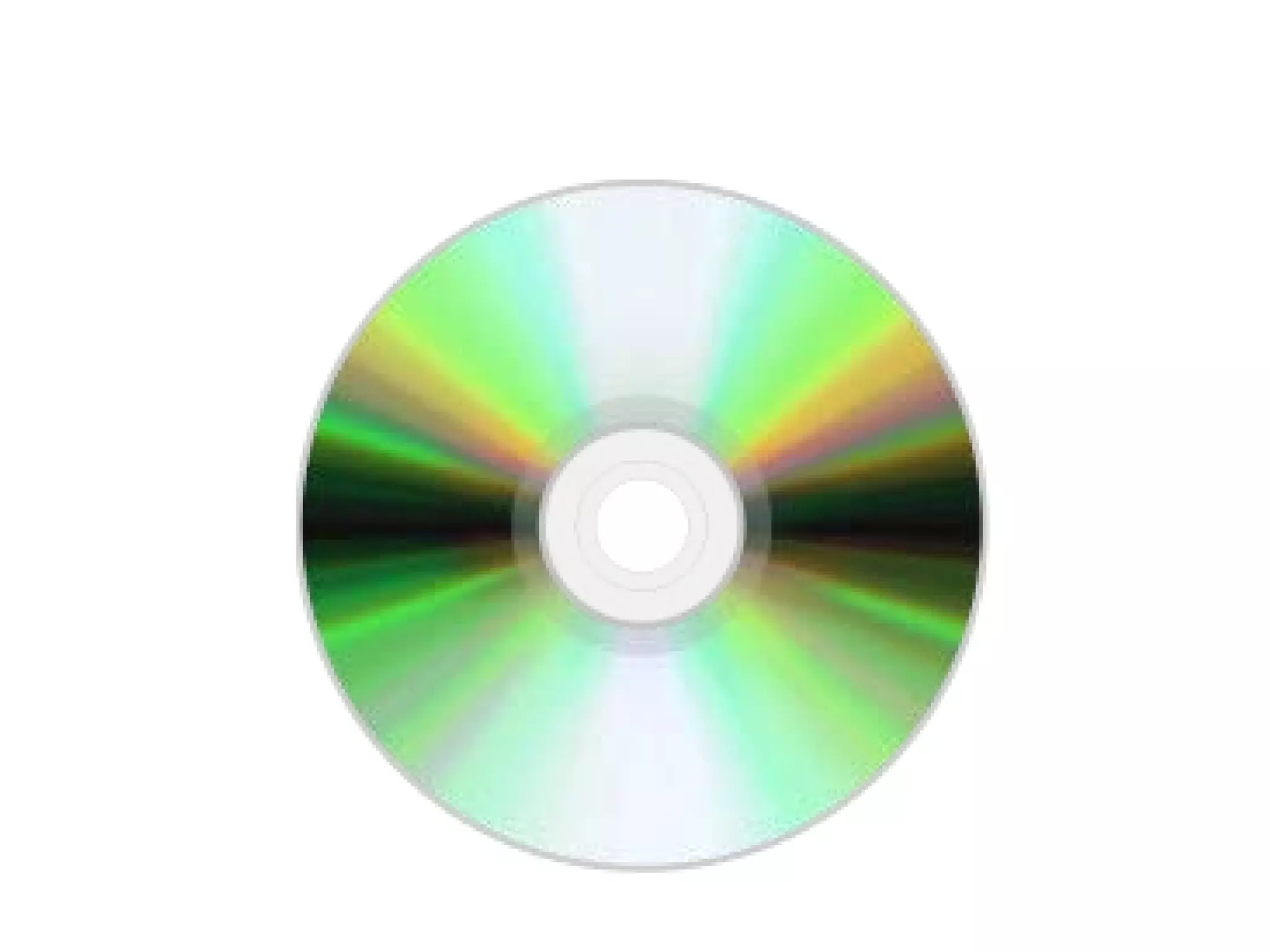
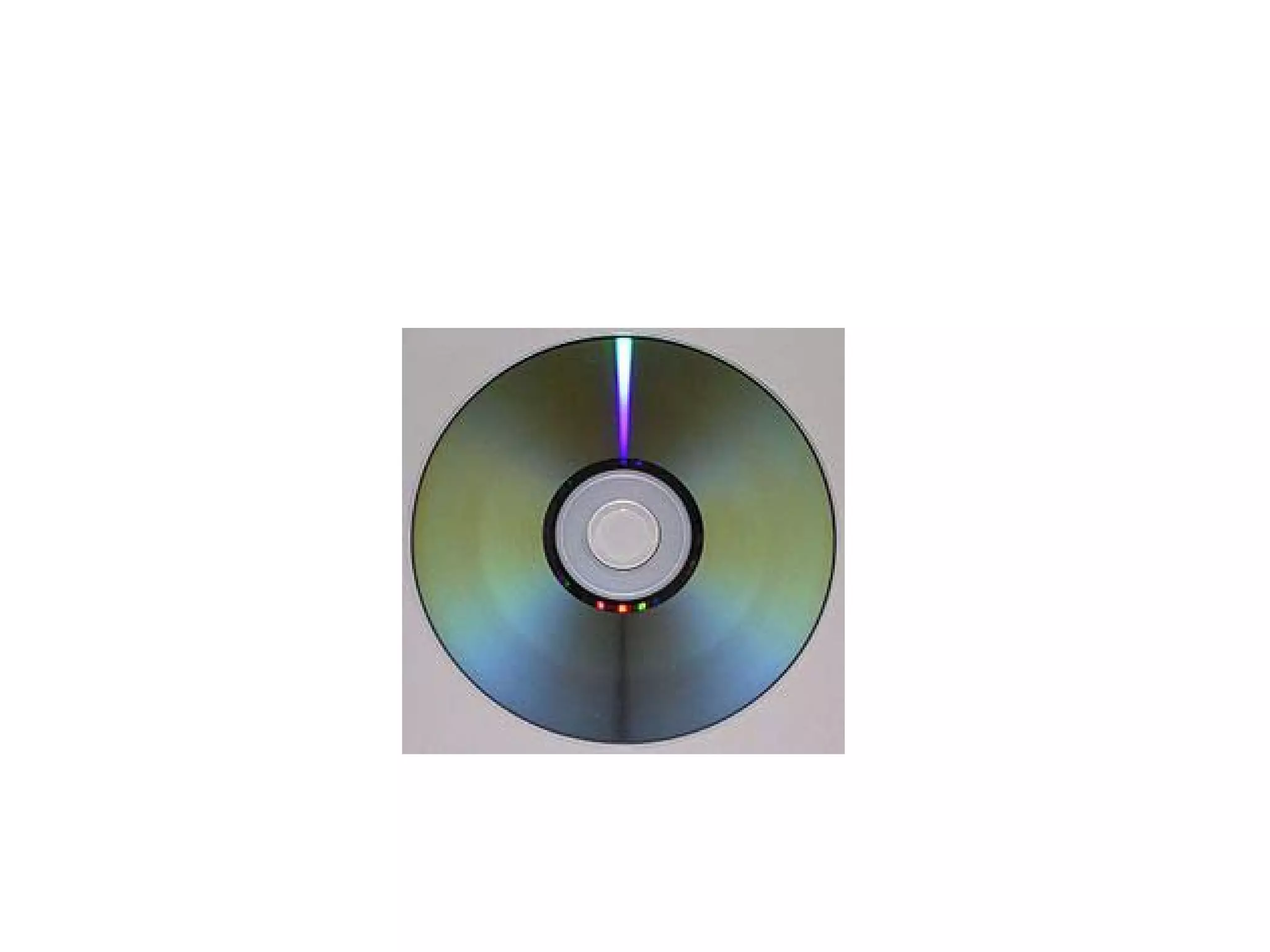
• The Compact Disc, or CD for short, is
  an optical disc used to store digital data.
• It was originally developed to store and play
  back sound recordings only,
• but the format was later adapted for storage
  of data (CD-ROM), write-once audio and data
  storage (CD-R), rewritable media (CD-RW),
  Video Compact Discs (VCD), Super Video
  Compact Discs (SVCD), PhotoCD, PictureCD,
  CD-i, and Enhanced CD.
• Audio CDs and audio CD players have been
  commercially available since October 1982.
• Standard CDs have a diameter of 120
  millimetres (4.7 in) and can hold up to 80
  minutes of uncompressed audio or 700 MB of
  data. The Mini CD has various diameters
  ranging from 60 to 80 millimetres (2.4 to 3.1
  in); they are sometimes used for CD singles,
  storing up to 24 minutes of audio or
  delivering device drivers.
• CD-ROMs and CD-Rs remain widely used
  technologies in the computer industry. The CD
  and its extensions are successful: in 2004,
  worldwide sales of CD audio, CD-ROM, and
  CD-R reached about 30 billion discs. By 2007,
  200 billion CDs had been sold worldwide.
• Compact Discs are increasingly being replaced
  or supplemented by other forms of digital
  distribution and storage, such as downloading
  and flash drives, with audio CD sales dropping
  nearly 50% from their peak in 2000
• DVD is an optical disc storage format, invented
  and developed by Philips, Sony, Toshiba,
  and Panasonic in 1995. DVDs offer higher
  storage capacity than Compact Discs while
  having the same dimensions.
• Pre-recorded DVDs are mass-produced
  using molding machines that physically stamp
  data onto the DVD.
• Such discs are known as DVD-ROM, because
  data can only be read and not written nor
  erased. Blank recordable DVD discs (DVD-
  R and DVD+R) can be recorded once using
  a DVD recorder and then function as a DVD-
  ROM.
• Rewritable DVDs (DVD-RW, DVD+RW,
  and DVD-RAM) can be recorded and erased
  multiple times.
• DVDs are used in DVD-Video consumer digital
  video format and in DVD-Audio consumer
  digital audio format, as well as for
  authoringAVCHD discs.
• DVDs containing other types of information
  may be referred to as DVD data discs.
History
• Before the advent of DVD in 1995, Video
  CD (VCD) became the first format for
  distributing digitally encoded films on
  standard 120 mm optical discs.
• (Its predecessor, CD Video, used analog video
  encoding.) VCD was on the market in 1993.
• In the same year, two new optical disc storage
  formats were being developed.
• One was the Multimedia Compact
  Disc (MMCD), backed by Philips and Sony, and
  the other was the Super Density (SD) disc,
  supported by Toshiba, Time
  Warner, Matsushita
  Electric, Hitachi, Mitsubishi
  Electric,Pioneer, Thomson, and JVC.
• DVD specifications created and updated by
  the DVD Forum are published as so-called DVD
  Books (e.g. DVD-ROM Book, DVD-Audio Book,
  DVD-Video Book, DVD-R Book, DVD-RW Book,
  DVD-RAM Book, DVD-AR Book, DVD-VR Book,
  etc.)
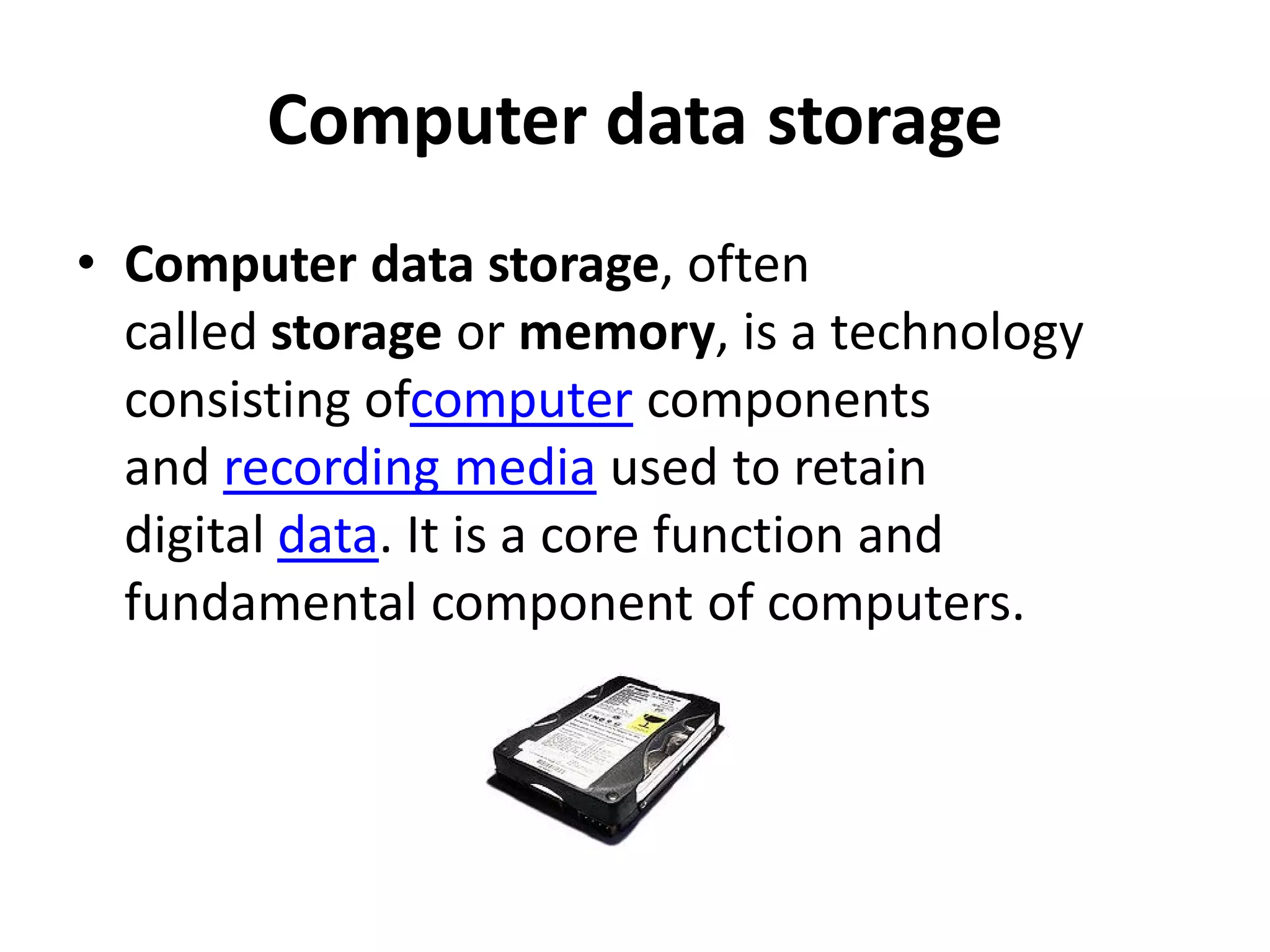
Computer data storage
• Computer data storage, often
  called storage or memory, is a technology
  consisting ofcomputer components
  and recording media used to retain
  digital data. It is a core function and
  fundamental component of computers.
• contemporary usage, memory is
  usually semiconductor storage read-
  write random-access memory,
• typically DRAM (Dynamic-RAM) or other
  forms of fast but temporary
  storage. Storageconsists of storage devices
  and their media not directly accessible by
  the CPU,
• (secondary ortertiary storage), typically hard
  disk drives, optical disc drives,
• and other devices slower than RAM but
  are non-volatile (retaining contents when
  powered down)
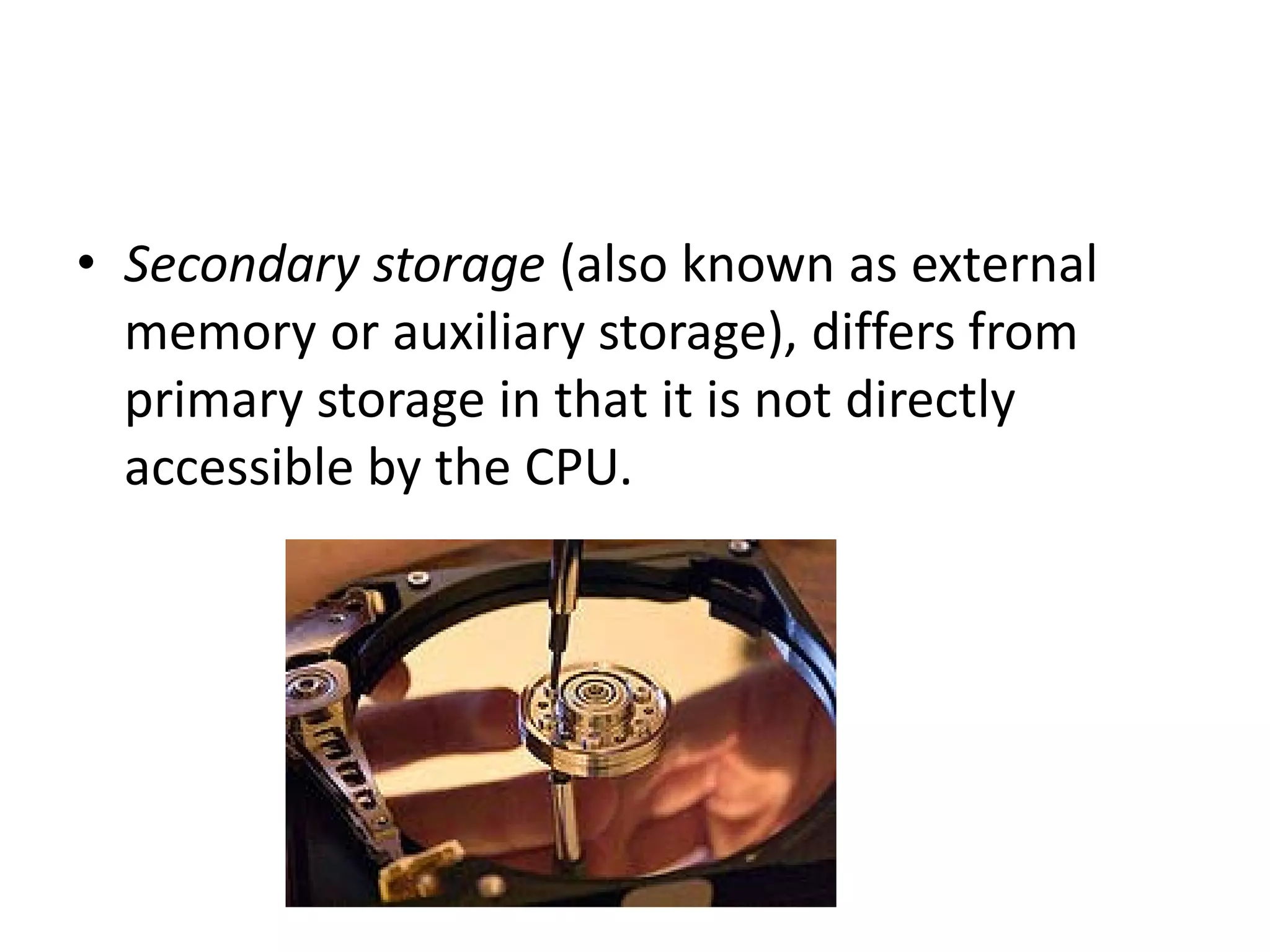
• Secondary storage (also known as external
  memory or auxiliary storage), differs from
  primary storage in that it is not directly
  accessible by the CPU.
• Secure Digital
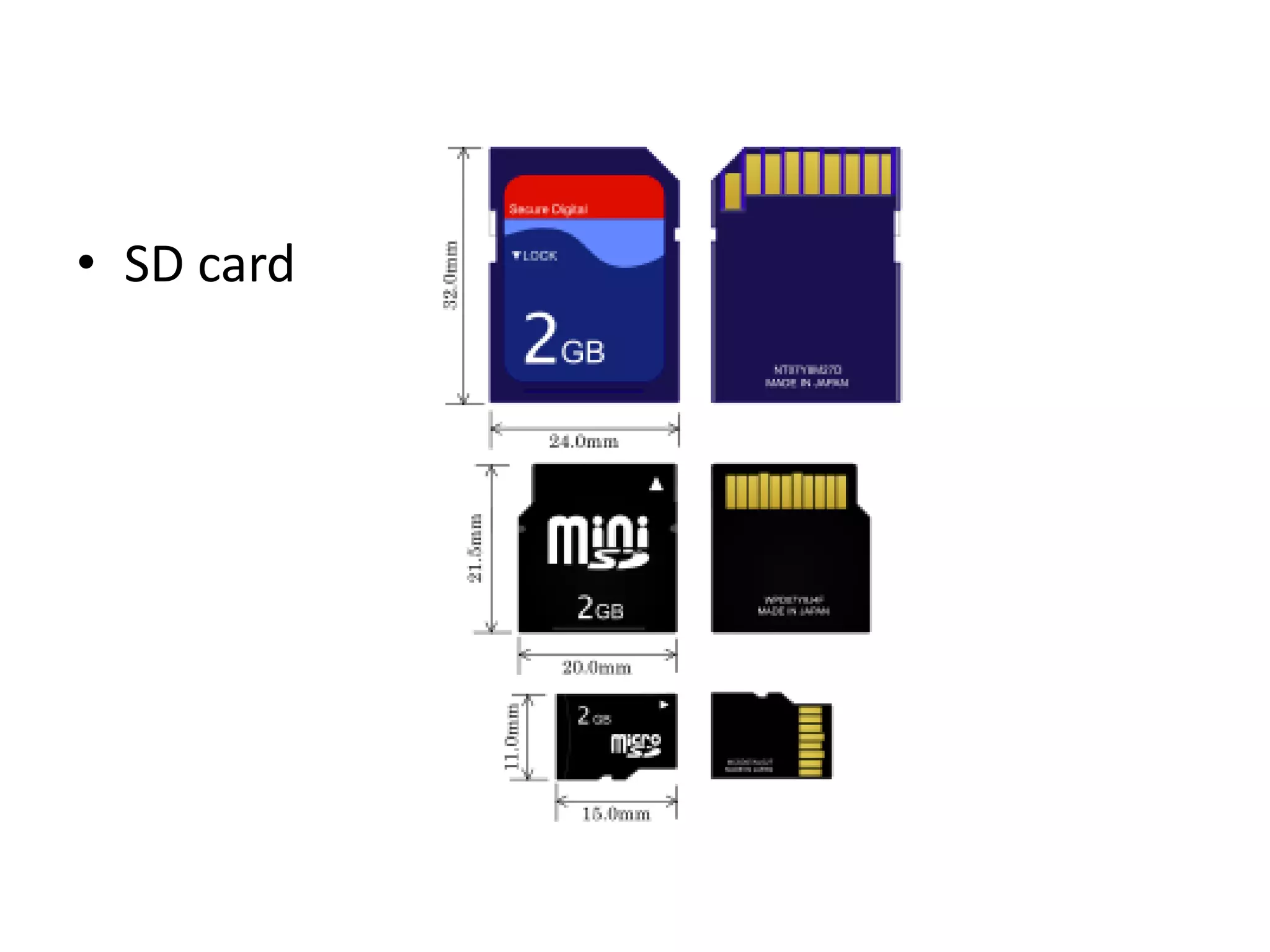
• SD card
• Secure Digital or (SD) is a non-
  volatile memory card format for use in
  portable devices, such as mobile
  phones, digital cameras, GPS navigation
  devices, and tablet computers.
• The Secure Digital standard is maintained by
  the SD Card Association (SDA).
• SD technologies have been implemented in
  more than 400 brands across dozens of
  product categories and more than 8,000
  models
• Wat’s future storage?
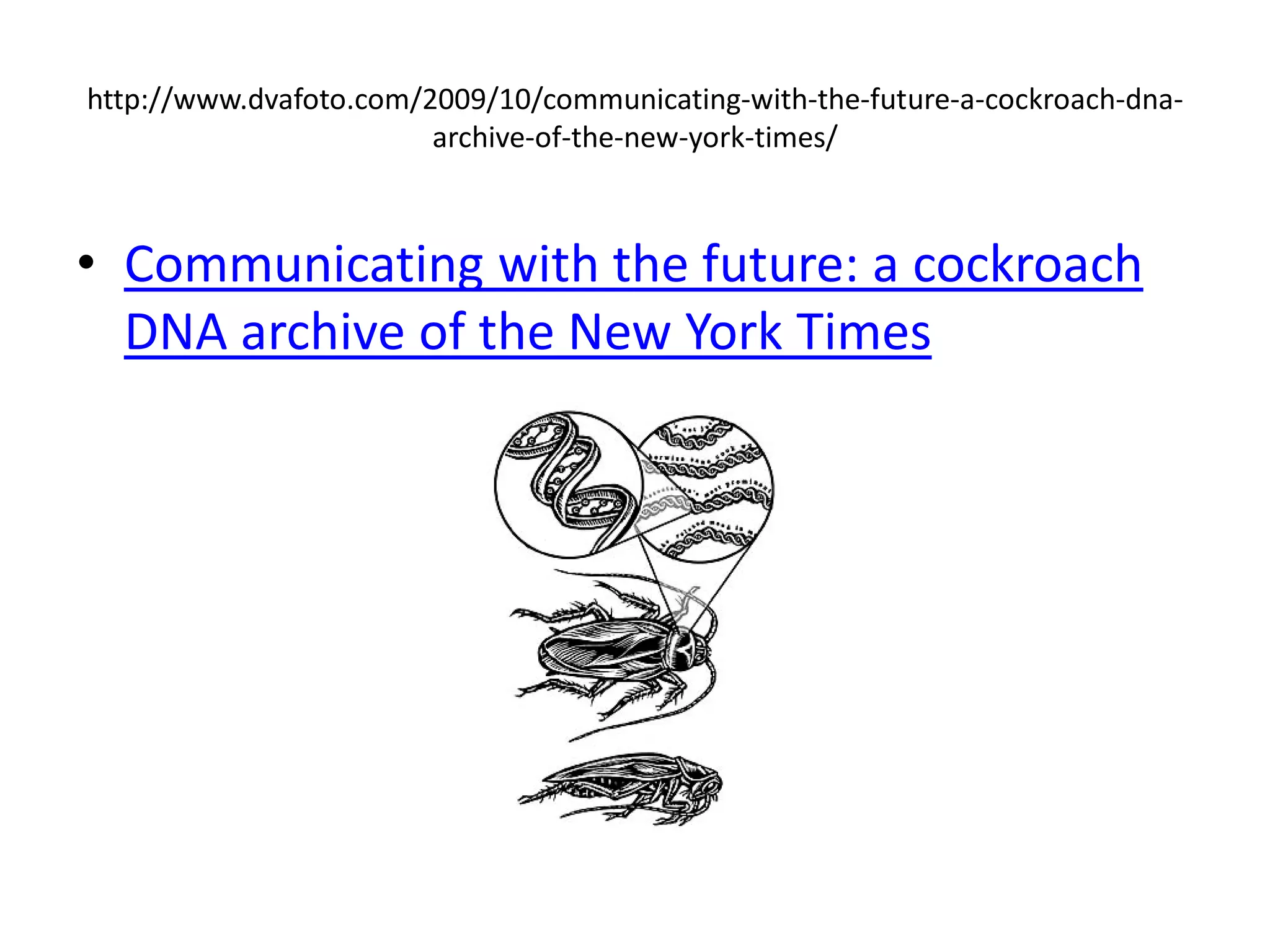
http://www.dvafoto.com/2009/10/communicating-with-the-future-a-cockroach-dna-
                        archive-of-the-new-york-times/


• Communicating with the future: a cockroach
  DNA archive of the New York Times
• In 1999, the New York Times Magazine ran a six-
  issue Millenium special, one part of which was an
  invitation to artists, scientist, and other thinkers,
  to develop a way of communicating with the
  future. Jaron Lanier, researcher and scientist,
  proposed genetically engineering a DNA-coded
  archive of a year’s worth of the New York Times
  Magazine and inserting it into the common
  cockroach’s genome (and the New York Times’
  discussion of the idea).
• Owing to the millions-of-years-long stability of
  the cockroach genome and the species
  tenacious ability to survive ice ages, floods,
  and other earth-altering natural disasters, the
  cockroach proves to be a perfect candidate.

Storage2012nov

  • 1.
    Keeping Storage… How we Keeping stuff?
  • 2.
    • Movie, cinemakiller? • Who, how, where etc…? • ?
  • 5.
    • The VideoHome System (better known by its abbreviation VHS)is a consumer-level analog recording videotape-based cassette standard developed byVictor Company of Japan (JVC).
  • 6.
    • The 1970swas a period when video recording became a major contributor to the television industry.
  • 7.
    • Like manyother technological innovations, each of several companies made an attempt to produce a television recording standard that the majority of the world would embrace.
  • 8.
    • At thepeak of it all, the home video industry was caught up in a series of videotape format wars.
  • 9.
    • Two ofthe formats, VHS andBetamax, received the most media exposure. VHS would eventually win the war of, and therefore succeed as the dominant home video format, lasting throughout the tape format period
  • 10.
    Betamax • Betamax (alsocalled Beta, and referred to as such in the logo) is a consumer-level analogvideocassette magnetic tape recording format developed by Sony, released in Japan on May 10, 1975.
  • 11.
    • The cassettescontain .50 in (12.7 mm)- wide videotape in a design similar to the earlier, professional .75 in (19 mm) wide, U- matic format.
  • 12.
    • The formatis virtually obsolete, though an updated variant of the format, Betacam, is still used by the television industry
  • 13.
  • 15.
    • A floppydisk, or diskette, is a disk storage medium composed of a disk of thin and flexiblemagnetic storage medium,
  • 16.
    • sealed ina rectangular plastic carrier lined with fabric that removes dust particles. They are read and written by a floppy disk drive (FDD).
  • 17.
    History • The earliestfloppy disks, developed in the late 1960s, were 8 inches (200 mm) in diameter; they became commercially available in 1971.
  • 18.
    • These disksand associated drives were produced and improved upon by IBM and other companies such as Memorex, Shugart Associates, and Burroughs Corporation.
  • 19.
    • The term"floppy disk" appeared in print as early as 1970, and although in 1973 IBM announced its first media as "Type 1 Diskette" the industry continued to use the terms "floppy disk" or "floppy".
  • 20.
    Zip drive • TheZip drive is a medium-capacity removable disk storage system that was introduced byIomega in late 1994. Originally, Zip disks launched with capacities of 100 MB, but later versions increased this to first 250 MB and then 750 MB.
  • 21.
    • The formatbecame the most popular of the super-floppy type products which filled a niche in the late 1990s portable storage market.
  • 22.
    • However itwas never popular enough to replace the 3.5-inch floppy disk nor could ever match the storage size available on rewritable CDs and laterrewritable DVDs.
  • 23.
    • USB flashdrives ultimately proved to be the better rewritable storage medium among the general public due to the near ubiquity of USB ports on personal computers and soon after because of the far greater storage sizes offered.
  • 24.
    • Zip drivesfell out of favor for mass portable storage during the early 2000s.
  • 25.
    • The Zipbrand later covered internal and external CD writers known as Zip-650 or Zip- CD, which had no relation to the Zip drive
  • 27.
    • The CompactDisc, or CD for short, is an optical disc used to store digital data.
  • 28.
    • It wasoriginally developed to store and play back sound recordings only,
  • 29.
    • but theformat was later adapted for storage of data (CD-ROM), write-once audio and data storage (CD-R), rewritable media (CD-RW), Video Compact Discs (VCD), Super Video Compact Discs (SVCD), PhotoCD, PictureCD, CD-i, and Enhanced CD.
  • 30.
    • Audio CDsand audio CD players have been commercially available since October 1982.
  • 31.
    • Standard CDshave a diameter of 120 millimetres (4.7 in) and can hold up to 80 minutes of uncompressed audio or 700 MB of data. The Mini CD has various diameters ranging from 60 to 80 millimetres (2.4 to 3.1 in); they are sometimes used for CD singles, storing up to 24 minutes of audio or delivering device drivers.
  • 32.
    • CD-ROMs andCD-Rs remain widely used technologies in the computer industry. The CD and its extensions are successful: in 2004, worldwide sales of CD audio, CD-ROM, and CD-R reached about 30 billion discs. By 2007, 200 billion CDs had been sold worldwide.
  • 33.
    • Compact Discsare increasingly being replaced or supplemented by other forms of digital distribution and storage, such as downloading and flash drives, with audio CD sales dropping nearly 50% from their peak in 2000
  • 35.
    • DVD isan optical disc storage format, invented and developed by Philips, Sony, Toshiba, and Panasonic in 1995. DVDs offer higher storage capacity than Compact Discs while having the same dimensions.
  • 36.
    • Pre-recorded DVDsare mass-produced using molding machines that physically stamp data onto the DVD.
  • 37.
    • Such discsare known as DVD-ROM, because data can only be read and not written nor erased. Blank recordable DVD discs (DVD- R and DVD+R) can be recorded once using a DVD recorder and then function as a DVD- ROM.
  • 38.
    • Rewritable DVDs(DVD-RW, DVD+RW, and DVD-RAM) can be recorded and erased multiple times.
  • 39.
    • DVDs areused in DVD-Video consumer digital video format and in DVD-Audio consumer digital audio format, as well as for authoringAVCHD discs.
  • 40.
    • DVDs containingother types of information may be referred to as DVD data discs.
  • 41.
    History • Before theadvent of DVD in 1995, Video CD (VCD) became the first format for distributing digitally encoded films on standard 120 mm optical discs.
  • 42.
    • (Its predecessor,CD Video, used analog video encoding.) VCD was on the market in 1993.
  • 43.
    • In thesame year, two new optical disc storage formats were being developed.
  • 44.
    • One wasthe Multimedia Compact Disc (MMCD), backed by Philips and Sony, and the other was the Super Density (SD) disc, supported by Toshiba, Time Warner, Matsushita Electric, Hitachi, Mitsubishi Electric,Pioneer, Thomson, and JVC.
  • 45.
    • DVD specificationscreated and updated by the DVD Forum are published as so-called DVD Books (e.g. DVD-ROM Book, DVD-Audio Book, DVD-Video Book, DVD-R Book, DVD-RW Book, DVD-RAM Book, DVD-AR Book, DVD-VR Book, etc.)
  • 46.
    Computer data storage •Computer data storage, often called storage or memory, is a technology consisting ofcomputer components and recording media used to retain digital data. It is a core function and fundamental component of computers.
  • 47.
    • contemporary usage,memory is usually semiconductor storage read- write random-access memory,
  • 48.
    • typically DRAM(Dynamic-RAM) or other forms of fast but temporary storage. Storageconsists of storage devices and their media not directly accessible by the CPU,
  • 49.
    • (secondary ortertiarystorage), typically hard disk drives, optical disc drives,
  • 50.
    • and otherdevices slower than RAM but are non-volatile (retaining contents when powered down)
  • 51.
    • Secondary storage(also known as external memory or auxiliary storage), differs from primary storage in that it is not directly accessible by the CPU.
  • 52.
  • 53.
  • 54.
    • Secure Digitalor (SD) is a non- volatile memory card format for use in portable devices, such as mobile phones, digital cameras, GPS navigation devices, and tablet computers.
  • 55.
    • The SecureDigital standard is maintained by the SD Card Association (SDA).
  • 56.
    • SD technologieshave been implemented in more than 400 brands across dozens of product categories and more than 8,000 models
  • 57.
  • 58.
    http://www.dvafoto.com/2009/10/communicating-with-the-future-a-cockroach-dna- archive-of-the-new-york-times/ • Communicating with the future: a cockroach DNA archive of the New York Times
  • 59.
    • In 1999,the New York Times Magazine ran a six- issue Millenium special, one part of which was an invitation to artists, scientist, and other thinkers, to develop a way of communicating with the future. Jaron Lanier, researcher and scientist, proposed genetically engineering a DNA-coded archive of a year’s worth of the New York Times Magazine and inserting it into the common cockroach’s genome (and the New York Times’ discussion of the idea).
  • 60.
    • Owing tothe millions-of-years-long stability of the cockroach genome and the species tenacious ability to survive ice ages, floods, and other earth-altering natural disasters, the cockroach proves to be a perfect candidate.