Storage
●
The environment the repository is in can have an impact on its contents
●
Archivists rarely in a position to choose location of site
●
So, how do archivists conserve and preserve under these pressures?

Site Location
●
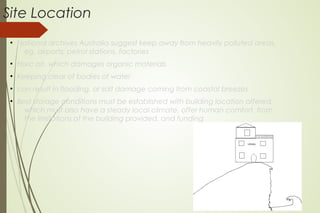
National archives Australia suggest keep away from heavily polluted areas,
eg. airports, petrol stations, factories
●
toxic air, which damages organic materials
●
Keeping clear of bodies of water
●
can result in flooding, or salt damage coming from coastal breezes
●
Best storage conditions must be established with building location offered;
which must also have a steady local climate, offer human comfort, from
the limitations of the building provided, and funding
Temperature and Humidity
●
Controlling the environment of a large site is tricky, but one way to achieve
this is to divide it into zones.
●
smaller areas can be placed at appropriate temperature and maintained
without the interference of outside temperatures, or having the cool air
stretched thinly across the site
●
outside environment would make less of an impact on smaller, more focused
environments
●

Temperature and Humidity
●
To keep the air cool, repositories should request specific
building materials
●
eg. thermal mass of limestone slows down the rate of
temperature fluctuations in tropical climates
●
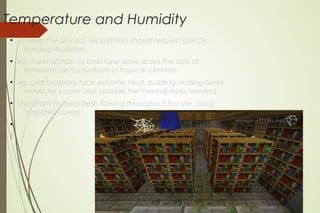
eg. arid locations face extreme heat, building underground
would be cooler and provide the thermal mass needed
●
Important to keep fresh flowing throughout the site, using
fans and louvers
●


Damaged Caused by Temperature and
Humidity
●
Maintaining temperature and humidity helps to prevent chemical decay
●
Chemical decay is a significant threat to records institutions, libraries and
archive collections because most information mediums contained in these
institutions are organic and naturally decay if the climate does not match
their needs
●
Microfilm, early sound recordings, color photographs, acid-tanned leather
and acidic papers are some of the information formats that decay at room
temperature, which takes but a few decades




Damaged Caused by Temperature and
Humidity
●
Materials stored in the found in libraries and archives respond to fluctuations
in temperature and humidity caused by the change in seasons. Here, they
absorb and release moisture causing them to expand and contract.
Changes in the object’s dimension thus leads to deterioration and physical
damage such as ‘cockling paper, flaking ink, warped covers on books,
and cracked emulsion on photographs.
●
physical damage caused by human activities, such as poor handling or
packing, is increased in hot dry conditions. Damage caused by mould and
insects are common when the environment leads to damp and warm
conditions.


Damaged Caused by Temperature and
Humidity
●
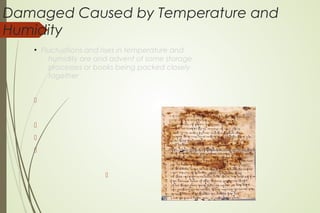
Fluctuations and rises in temperature and
humidity are and advent of some storage
processes or books being packed closely
together





Simple Steps to Protect
●
Not using ultraviolet lights
●
makes inks fade and papers yellow
●
Pollutants can be controlled simply by maintaining the site building
●
keeping the building clean and tidy
●
selecting the most suitable materials for cleaning
●
Clean air is a crucial in preserving records, ie. avoiding lingering stagnant air
●
When air gets trapped in a small area it can become hotter, more humid, like
creating its own microclimate. The condensation created can lead to
mould, which would attract other pests such as moths.


Simple Steps to Protect
●
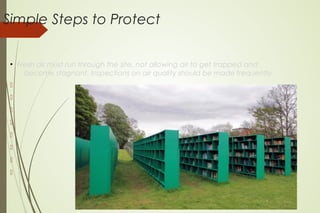
Fresh air must run through the site, not allowing air to get trapped and
become stagnant. Inspections on air quality should be made frequently.









Extreme Conditions
●
In China a massive 90% of the cities are considered undesirable or too toxic
to house archives, based on international standards - using overarching
programs for the entire site would be impossible.
●
Conservationists in China focus on controlling the spaces immediately
surrounding the object, the micro environment. For example, an archive
inside a container, within a closed cabinet that experiences clean air flow,
and still receives the benefits of air conditioning.



Disaster Plan
●
All repositories must have a disaster plan. If the facility is located in an area
where natural disaster are an issue, projections from disaster authorities
must not be taken lightly, and archives need a place to reside away from
danger.
●
In the Queensland floods of 2011 the State Library of Queensland were
warned about prior to the flooding and moved every item from the bottom
level with two days to spare. The water level was around 5 feet high,
enough to damage every artefact on that level, and left behind a layer of
sludge two feet deep.
●
Fire is also another concern. Many facilities have sprinkler systems built.


Conclusion
 To sum up, it is up to the archivists, records management teams and librarians
to preserve the physical artefacts. If they do not receive the optimum site
locations, then it is their responsibility to match the needs of the artefacts
that are faced with extreme environments. Otherwise, archives will be lost.







References
 Image of damaged paper
https://www.nottingham.ac.uk/manuscriptsandspecialcollections/
 Outdoor library
http://flavorwire.com/310440/swoon-over-this-open-air-library-in-a-
 Underground library
http://www.minecraft101.net/r/underground.html

Storage Matters

  • 1.
    Storage ● The environment therepository is in can have an impact on its contents ● Archivists rarely in a position to choose location of site ● So, how do archivists conserve and preserve under these pressures? 
  • 2.
    Site Location ● National archivesAustralia suggest keep away from heavily polluted areas, eg. airports, petrol stations, factories ● toxic air, which damages organic materials ● Keeping clear of bodies of water ● can result in flooding, or salt damage coming from coastal breezes ● Best storage conditions must be established with building location offered; which must also have a steady local climate, offer human comfort, from the limitations of the building provided, and funding
  • 3.
    Temperature and Humidity ● Controllingthe environment of a large site is tricky, but one way to achieve this is to divide it into zones. ● smaller areas can be placed at appropriate temperature and maintained without the interference of outside temperatures, or having the cool air stretched thinly across the site ● outside environment would make less of an impact on smaller, more focused environments ● 
  • 4.
    Temperature and Humidity ● Tokeep the air cool, repositories should request specific building materials ● eg. thermal mass of limestone slows down the rate of temperature fluctuations in tropical climates ● eg. arid locations face extreme heat, building underground would be cooler and provide the thermal mass needed ● Important to keep fresh flowing throughout the site, using fans and louvers ●  
  • 5.
    Damaged Caused byTemperature and Humidity ● Maintaining temperature and humidity helps to prevent chemical decay ● Chemical decay is a significant threat to records institutions, libraries and archive collections because most information mediums contained in these institutions are organic and naturally decay if the climate does not match their needs ● Microfilm, early sound recordings, color photographs, acid-tanned leather and acidic papers are some of the information formats that decay at room temperature, which takes but a few decades    
  • 6.
    Damaged Caused byTemperature and Humidity ● Materials stored in the found in libraries and archives respond to fluctuations in temperature and humidity caused by the change in seasons. Here, they absorb and release moisture causing them to expand and contract. Changes in the object’s dimension thus leads to deterioration and physical damage such as ‘cockling paper, flaking ink, warped covers on books, and cracked emulsion on photographs. ● physical damage caused by human activities, such as poor handling or packing, is increased in hot dry conditions. Damage caused by mould and insects are common when the environment leads to damp and warm conditions.  
  • 7.
    Damaged Caused byTemperature and Humidity ● Fluctuations and rises in temperature and humidity are and advent of some storage processes or books being packed closely together     
  • 8.
    Simple Steps toProtect ● Not using ultraviolet lights ● makes inks fade and papers yellow ● Pollutants can be controlled simply by maintaining the site building ● keeping the building clean and tidy ● selecting the most suitable materials for cleaning ● Clean air is a crucial in preserving records, ie. avoiding lingering stagnant air ● When air gets trapped in a small area it can become hotter, more humid, like creating its own microclimate. The condensation created can lead to mould, which would attract other pests such as moths.  
  • 9.
    Simple Steps toProtect ● Fresh air must run through the site, not allowing air to get trapped and become stagnant. Inspections on air quality should be made frequently.         
  • 10.
    Extreme Conditions ● In Chinaa massive 90% of the cities are considered undesirable or too toxic to house archives, based on international standards - using overarching programs for the entire site would be impossible. ● Conservationists in China focus on controlling the spaces immediately surrounding the object, the micro environment. For example, an archive inside a container, within a closed cabinet that experiences clean air flow, and still receives the benefits of air conditioning.   
  • 11.
    Disaster Plan ● All repositoriesmust have a disaster plan. If the facility is located in an area where natural disaster are an issue, projections from disaster authorities must not be taken lightly, and archives need a place to reside away from danger. ● In the Queensland floods of 2011 the State Library of Queensland were warned about prior to the flooding and moved every item from the bottom level with two days to spare. The water level was around 5 feet high, enough to damage every artefact on that level, and left behind a layer of sludge two feet deep. ● Fire is also another concern. Many facilities have sprinkler systems built.  
  • 12.
    Conclusion  To sumup, it is up to the archivists, records management teams and librarians to preserve the physical artefacts. If they do not receive the optimum site locations, then it is their responsibility to match the needs of the artefacts that are faced with extreme environments. Otherwise, archives will be lost.       
  • 13.
    References  Image ofdamaged paper https://www.nottingham.ac.uk/manuscriptsandspecialcollections/  Outdoor library http://flavorwire.com/310440/swoon-over-this-open-air-library-in-a-  Underground library http://www.minecraft101.net/r/underground.html