STERILIZATION OF OPERATION
THEATER & OPERATION THEATER
EQUIPMENTS
Presented by :
Dr. ANKITA MADAN
DEFINITIONS
 Antiseptic  Substance that has
antimicrobial activity & that can be safely
applied to living tissues.
 Bacteriostatic Agent which prevents
bacterial growth but doesn’t kill bacteria.
 Bioburden  The number & types of viable
organisms with which an object is
contaminated.
 Biological Indicator  It is sterilization
process monitoring device consisting of a
standardized viable population of micro-
organisms of high resistance to mode of
sterilization being monitored.
 Chemical Indicator  It is sterilization
process monitoring device designed to
respond with a characteristic chemical
change to one or more parameters of
sterilization cycle.
 Chemosterilizers  A chemical used for
destroying all forms of microbiological life
including spores.
 Decontamination  The process by which
contaminated items are rendered safe for
personnel without protective attire to handle
or render item safe for reuse.
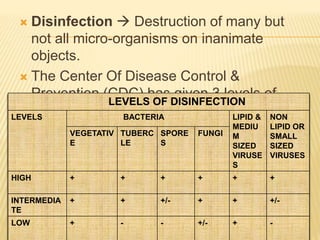
 Disinfection  Destruction of many but
not all micro-organisms on inanimate
objects.
 The Center Of Disease Control &
Prevention (CDC) has given 3 levels of
disinfection
LEVELS OF DISINFECTION
LEVELS BACTERIA LIPID &
MEDIU
M
SIZED
VIRUSE
S
NON
LIPID OR
SMALL
SIZED
VIRUSES
VEGETATIV
E
TUBERC
LE
SPORE
S
FUNGI
HIGH + + + + + +
INTERMEDIA
TE
+ + +/- + + +/-
LOW + - - +/- + -
 Disinfectants  chemical germicides
formulated to be used on inanimate objects.
The Environmental Protection Agency (EPA)
classified them as those
 With Tuberculocidal activity
 Without Tuberculocidal activity.
 Mechanical Indicators  sterilizer
components that gauge & record time,
temperature, humidity pressure during
sterilizing cycle.
 Sterilization  destruction of all form of
micro-organisms ( high temperature).
 Terminal sterilization  sterilization
process carried out after final packaging of
the item.
 Sterility Assurance Level (SAL)  the
probability of survival of micro-organisms
after a terminal sterilization process & is
predictor of efficacy of the process. A SAL of
10-6 indicates non sterile item.
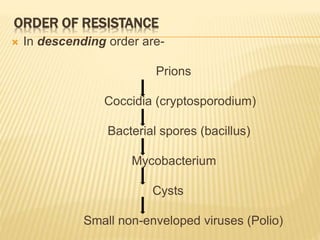
ORDER OF RESISTANCE
 In descending order are-
Prions
Coccidia (cryptosporodium)
Bacterial spores (bacillus)
Mycobacterium
Cysts
Small non-enveloped viruses (Polio)
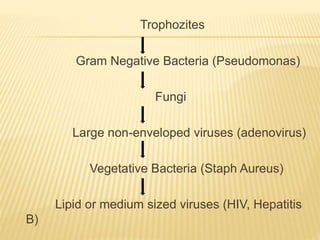
Trophozites
Gram Negative Bacteria (Pseudomonas)
Fungi
Large non-enveloped viruses (adenovirus)
Vegetative Bacteria (Staph Aureus)
Lipid or medium sized viruses (HIV, Hepatitis
B)
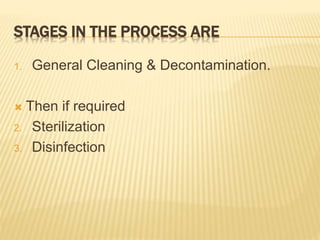
STAGES IN THE PROCESS ARE
1. General Cleaning & Decontamination.
 Then if required
2. Sterilization
3. Disinfection
CLEANING OF EQUIPMENTS
Aim 
To remove retained salt & organic soil which
can inactivate chemical germicides or
protect organisms from destruction during
disinfection.
Procedure 
Immersible items should be cleaned under
water, with or without detergent for atleast 3
min. to prevent aerosolization of organisms
& those not immersible can be cleaned with
cloth soaked in detergent & water.
Disassembly-
 Devices should be disassembeled & jointed
instruments must be opened.
Cleaning-
 Before cleaning, manufacturer`s instruction
are consulted.
 Tapes, soils, adhesive residues are dissolved
by using appropriate solvents.
 Devices must be soaked in protein
dissolving solution to prevent coagulation of
blood & then it should be scrubbed
thoroughly inside out.
 Complicated devices can be cleaned by
ultrasonic cleaning after gross soil has
been removed.
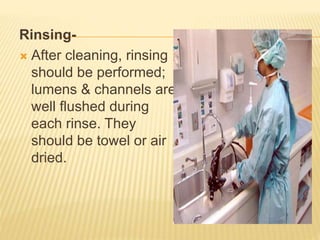
Rinsing-
 After cleaning, rinsing
should be performed;
lumens & channels are
well flushed during
each rinse. They
should be towel or air
dried.
METHODS OF STERILIZATION
PASTEURIZATION
 It’s a high level disinfectant.
 The equipment is immersed in water at an
elevated temperature of usually 80°c for
10min or 70°c for 30min.
 It can`t kill all spores & viruses. So it is
recommended for perishable & where
absolute sterility is not required.
 E.g. Breathing tubes, ETT, Reservoir
bags, Face masks, Laryngoscope blades,
ventilator bellows & any rubber goods.
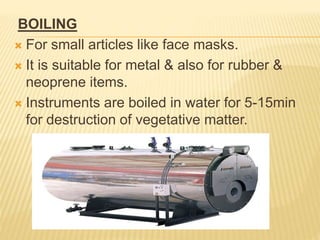
BOILING
 For small articles like face masks.
 It is suitable for metal & also for rubber &
neoprene items.
 Instruments are boiled in water for 5-15min
for destruction of vegetative matter.
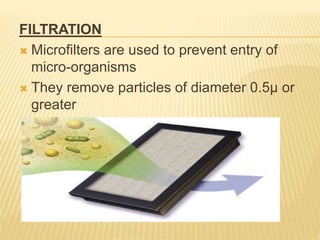
FILTRATION
 Microfilters are used to prevent entry of
micro-organisms
 They remove particles of diameter 0.5µ or
greater
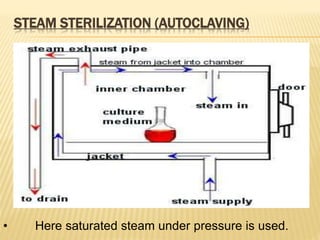
STEAM STERILIZATION (AUTOCLAVING)
• Here saturated steam under pressure is used.
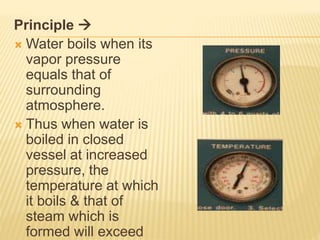
Principle 
 Water boils when its
vapor pressure
equals that of
surrounding
atmosphere.
 Thus when water is
boiled in closed
vessel at increased
pressure, the
temperature at which
it boils & that of
steam which is
formed will exceed
 When steam comes in contact with cooler
surface  condenses to water & gives up its
latent heat to that surface.
 Thus 1600ml of steam at 100°C & at
atmospheric pressure condenses into 1ml of
water at 100°C & releases 518calories of
heat.
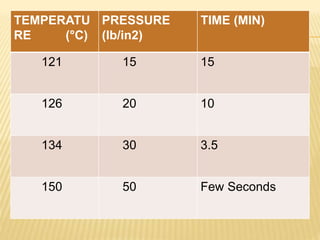
TEMPERATU
RE (°C)
PRESSURE
(lb/in2)
TIME (MIN)
121 15 15
126 20 10
134 30 3.5
150 50 Few Seconds
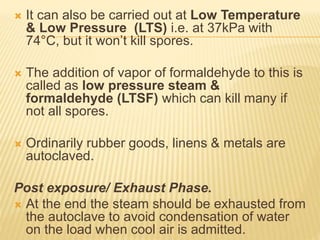
 It can also be carried out at Low Temperature
& Low Pressure (LTS) i.e. at 37kPa with
74°C, but it won’t kill spores.
 The addition of vapor of formaldehyde to this is
called as low pressure steam &
formaldehyde (LTSF) which can kill many if
not all spores.
 Ordinarily rubber goods, linens & metals are
autoclaved.
Post exposure/ Exhaust Phase.
 At the end the steam should be exhausted from
the autoclave to avoid condensation of water
on the load when cool air is admitted.
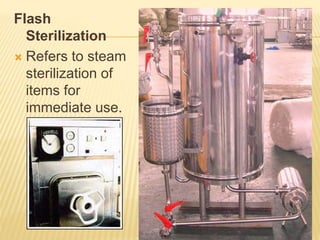
Flash
Sterilization
 Refers to steam
sterilization of
items for
immediate use.
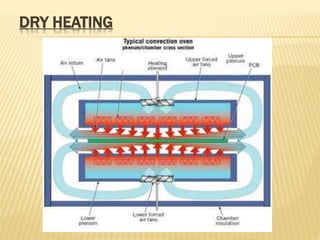
DRY HEATING
 Articles are packed in special craft papers
and then placed in a thermostatically
controlled Dry Heat Sterilizer.
 Precaution temperature is raised and
lowered slowly to prevent breakage by
uneven expansion.
 Mainly suitable for ophthalmic instruments
and glass items but not plastics or rubber.
 It is useful for sterilization of powders,
grease, oil and glass syringes.
Holding Temperature
(°C)
Time Of Sterilization
(min)
180 30
170 60
160 120
150 150
CHEMICAL (COLD) STERILIZATION
 Utilizes liquid chemical agents
 Especially useful for heat sensitive
equipment.
 Performed by soaking item in the solution.
 Kill the organisms by coagulation / alkylation
of proteins and also by enzymatic
degradation and lysis of cell membranes.
 The criteria to be satisfied in the
Chemical Methods are
1. Must be capable of killing spores.
2. Should be non-corrosive
3. Should be Non-irritant.
4. Should be Economical.
5. Should be stable
6. Should penetrate grease & fibers.
7. Should be non-toxic.
Factors Influencing Chemical Sterilization:
a) Concentration of the Chemical:
Rate of kill of bacteria varies directly with the
concentration of the disinfectant.
b) Temperature:
Designed to be used at room temperature.
c) Evaporation and light deactivation:
Volatile agents evaporate easily. Exp:
Chlorine Products. Exposure to light
adversely affects the disinfectant.
d) PH:
Alcohols work best in alkaline PH while
aldehydes work best in acidic PH.
e) Bioburden:
The effectiveness of the disinfectant depends
on the nature and number of contaminating
microorganisms
f) Characteristics of the item to be sterilized:
 A disinfectant solution will be effective only if it can
contact all the surfaces on the item.
g) Time:
 Time required for different chemical agents to
function effectively varies from seconds to hours.
h) Use Pattern, Use Life & Storage Life:
 Use Pattern refers to how many times the solution
can be used.
 Use Life indicates limited period of time during which
activated solution can be used.
 Storage life is the time period after which the unused
or inactivated product is no longer deemed effective.
FORMALDEHYDE:
 Used principally in water based solution
called formalin. Vapor can be generated
from paraformaldehyde tablets which contain
95% formaldehyde in a polymerized form.
 It is a high level disinfectant.
 It is non corrosive and is not inactivated by
organic matter.
 Widely used for sterilization of endoscopic
equipment, catheters etc.
 For better effect it needs relative humidity
of 60-80% and temperature of 37°C.
 Residual formaldehyde may affect the skin,
but it can be neutralized by ammonia.
 Limited by its pungent odor and fumes.
 Should be handled as a potent sensitizer
and probable carcinogen.
QUATERNARY AMMONIUM COMPOUNDS
(QUATS)
 Low level disinfectants
 They are bactericidal, fungicidal
& viricidal but not sporicidal.
 They are effective against gram
positive than gram negative and
marginally effective against
Pseudomonas. They inactivate
HIV but not hepatitis virus.
 They are inactivated by organic
materials.
 Side effects are allergic
reactions and contact dermatitis.
PHENOLIC COMPOUNDS
 They are intermediate to low level disinfectants.
 Derived from carbolic acid (phenol), one of the oldest
germicides.
 They are bactericidal, fungicidal and viricidal but not
sporicidal.
 They are active in the presence of organic matter.
 They are irritant to skin & mucous membranes, have bad
odour.
 They are absorbed by rubber and residual disinfectant
may cause tissue irritation.
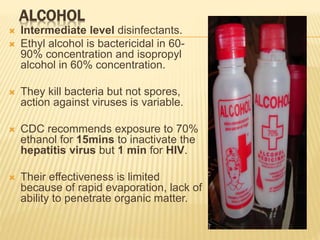
ALCOHOL
 Intermediate level disinfectants.
 Ethyl alcohol is bactericidal in 60-
90% concentration and isopropyl
alcohol in 60% concentration.
 They kill bacteria but not spores,
action against viruses is variable.
 CDC recommends exposure to 70%
ethanol for 15mins to inactivate the
hepatitis virus but 1 min for HIV.
 Their effectiveness is limited
because of rapid evaporation, lack of
ability to penetrate organic matter.
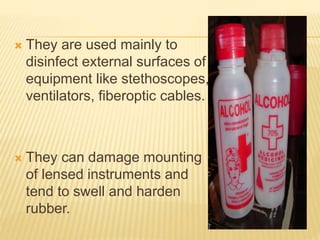
 They are used mainly to
disinfect external surfaces of
equipment like stethoscopes,
ventilators, fiberoptic cables.
 They can damage mounting
of lensed instruments and
tend to swell and harden
rubber.
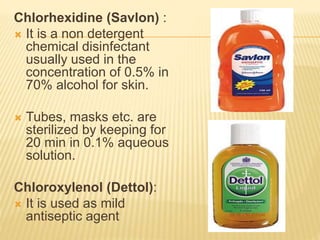
Chlorhexidine (Savlon) :
 It is a non detergent
chemical disinfectant
usually used in the
concentration of 0.5% in
70% alcohol for skin.
 Tubes, masks etc. are
sterilized by keeping for
20 min in 0.1% aqueous
solution.
Chloroxylenol (Dettol):
 It is used as mild
antiseptic agent
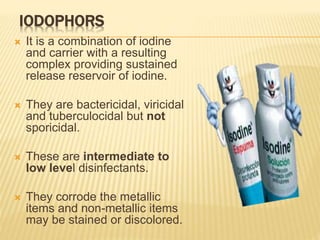
IODOPHORS
 It is a combination of iodine
and carrier with a resulting
complex providing sustained
release reservoir of iodine.
 They are bactericidal, viricidal
and tuberculocidal but not
sporicidal.
 These are intermediate to
low level disinfectants.
 They corrode the metallic
items and non-metallic items
may be stained or discolored.
PERACETIC (PEROXYACETIC) ACID
 It is acetic acid with an extra oxygen atom.
 It is bacteriocidal, sporicidal, fungicidal and
viricidal.
 They are effective in the presence of organic
matter. But it is corrosive and irritating to skin
in concentrated solution.
 It is active ingredient in the steris sterilant.
This is a single use concentrate of 35%
peracetic acid + corrosion and degradation
inhibitors.
 Used in wide variety of heat sensitive and
delicate instruments.
 Used on wet or dry items and there is no
personnel exposure. It can be situated in
the Operating room suite.
 It is useful only for totally immercible
objects and only small number instruments
can be processed in a cycle.
CHLORINE AND CHLORINE PRODUCTS
 They are intermediate level disinfectants.
 They are active against bacteria and viruses
but not spores.
 They are available both in liquid (sodium
hypochlorite) and solid (Calcium hypochlorite)
forms.
 They are most widely used, inexpensive and
fast acting.
 Highly effective against
HIV.
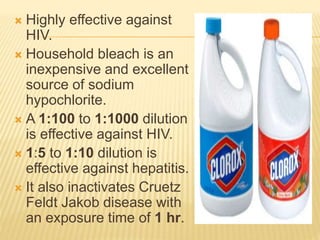
 Household bleach is an
inexpensive and excellent
source of sodium
hypochlorite.
 A 1:100 to 1:1000 dilution
is effective against HIV.
 1:5 to 1:10 dilution is
effective against hepatitis.
 It also inactivates Cruetz
Feldt Jakob disease with
an exposure time of 1 hr.
 Their use is limited by their
corrosiveness, inactivation by
organic matter and may leave
residue which causes irritation to
skin, eye and respiratory tract
 Potential hazard is the production
of carcinogen bis-chloromethyl
ether, when hypochlorite
solutions come into contact with
formaldehyde.
 A mixture of hypochlorite with
acid will cause rapid evolution of
toxic chlorine gas.
HYDROGEN PEROXIDE
 It is an effective bactericidal, fungicidal,
viricidal and sporicidal.
 It is commercially available as 3% solution
but can be used upto 25% concentration.
 It is non corrosive and not inactivated by
organic matter but irritant to skin and eyes.
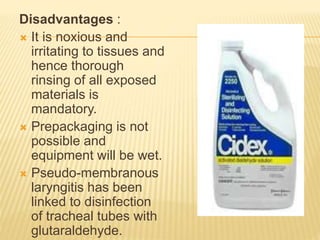
GLUTARALDEHYDE (CIDEX)
 It is a saturated dialdehyde. It is used in
1.0% concentration (but highly effective in
2% concentration).
 It is high level disinfectant. It kills spores
within 12 hrs and viruses within 10 min.
 Widely used because of their excellent
biocidal properties, activity in the presence of
organic matter, non corrosiveness and
noncoagulation of proteinaceous material.
Disadvantages :
 It is noxious and
irritating to tissues and
hence thorough
rinsing of all exposed
materials is
mandatory.
 Prepackaging is not
possible and
equipment will be wet.
 Pseudo-membranous
laryngitis has been
linked to disinfection
of tracheal tubes with
glutaraldehyde.
OZONE:
 Sterilizers use O2, water & electricity to produce
Ozone.
Advantages:
 Useful for most goods that need low temperature
sterilization.
 Process is environmentally friendly.
 Treated objects are dry.
Disadvantages:
 Not approved for flexible scopes & reactive
materials such as copper & brass.
 Unsuitable for natural gum rubber products
Advantages of Chemical Sterilization
 Technically easier.
 Suitable for equipments damaged by heat
sterilization.
 Sophisticated chemical methods like Ethylene Oxide
achieve perfect sterilization.
Disadvantages:
 Act only on exposed surfaces
 Some chemicals react with metals.
 Some impregnate with the materials such as rubber
& plastics & some agents destroy it.
 Residual chemicals may form the source of
infection.
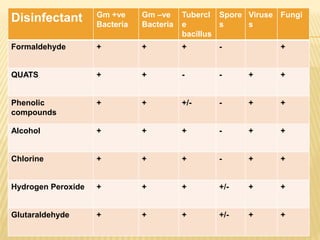
Disinfectant Gm +ve
Bacteria
Gm –ve
Bacteria
Tubercl
e
bacillus
Spore
s
Viruse
s
Fungi
Formaldehyde + + + - +
QUATS + + - - + +
Phenolic
compounds
+ + +/- - + +
Alcohol + + + - + +
Chlorine + + + - + +
Hydrogen Peroxide + + + +/- + +
Glutaraldehyde + + + +/- + +
GAS STERILIZATION
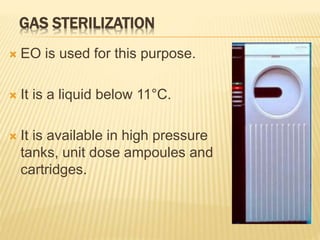
 EO is used for this purpose.
 It is a liquid below 11°C.
 It is available in high pressure
tanks, unit dose ampoules and
cartridges.
1. Preparation for ethylene oxide (EO)
sterilization (propylene oxide):
 Before packaging, items must be
disassembled, cleaned and dried to allow
the gas to penetrate throughout the whole
product.
 Caps, plugs, valves, stylets must be
removed. Hollow bore products and needles
should be open at both ends.
 They should be towel or air dried.
 A relative humidity of 35% to 70% and a
temperature of 18 to 22°C are
recommended.
 Items to be sterilized are placed in carries
that do not absorb E.O. They should be
loaded loosely to allow for uniform
penetration of gas throughout the load.
Factors affecting EO Sterilization :
 Gas concentration: The solubility of EO in
the product and the gas diffusion rate
through the product will influence the
sterilant concentration.
 Temperature: Exposure time can be
decreased by increasing the temperature.
 Humidity: Moisture hydrates microbes,
making then susceptible to destruction by
EO.
 Protective barriers: Blood and other
proteinaceous materials can act as
barriers to EO.
 Packaging: The wrapping must be
permeable to EO gas and water vapor and
allow for proper aeration.
 Exposure time: Depends on factors
mentioned above, generally range from
1.5 to 6 hrs. or many require upto 12 hrs
3. Sterilizers:
 EO sterilizers are of two types,
⁻ general purpose and
⁻ special purpose.
7. Advantages:
 It is effective against all organisms:
 Damage to most equipment is minimal.
 Items can be prepackaged.
 Used for sterilization of delicate instruments
like pump oxygenators, valves, ventilators
etc.
8. Disadvantages:
 More expensive
 Fire and explosions have been reported.
 Long duration.
 Personnel need to be highly trained and
supervised.
RADIATION STERILIZATION
 Mainly used for disposable products.
 Gamma radiation is an electromagnetic wave
produced during the disintegration of certain
radioactive elements like cobalt-60.
 All organisms including spores, viruses will be
killed. Lethal dose is 2.5 megarads(kills bacteria
by ionizing there DNA).
 The products can be prepackaged.
 As there is no temperature rise,
thermolabile materials can be sterilized.
 Equipments may be used immediately
after treatment, with no risk from retained
radioactivity.
 Disadvantage is that it is not practical for
every day use and it is expensive.
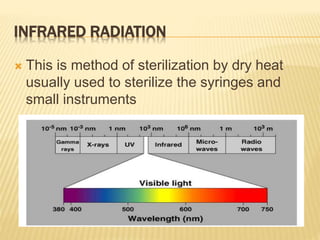
INFRARED RADIATION
 This is method of sterilization by dry heat
usually used to sterilize the syringes and
small instruments
STERILIZATION OF INDIVIDUAL
EQUIPMENT
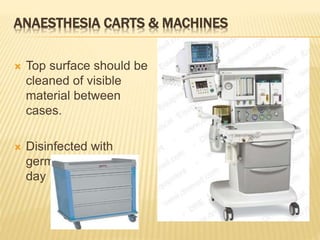
ANAESTHESIA CARTS & MACHINES
 Top surface should be
cleaned of visible
material between
cases.
 Disinfected with
germicide at end of
day
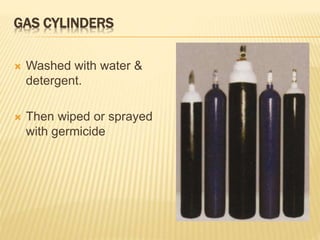
GAS CYLINDERS
 Washed with water &
detergent.
 Then wiped or sprayed
with germicide
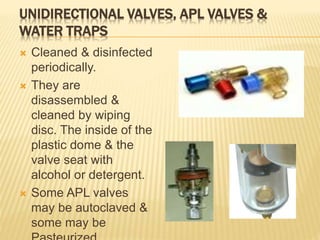
UNIDIRECTIONAL VALVES, APL VALVES &
WATER TRAPS
 Cleaned & disinfected
periodically.
 They are
disassembled &
cleaned by wiping
disc. The inside of the
plastic dome & the
valve seat with
alcohol or detergent.
 Some APL valves
may be autoclaved &
some may be
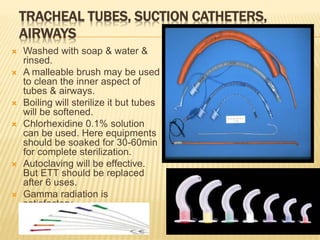
TRACHEAL TUBES, SUCTION CATHETERS,
AIRWAYS
 Washed with soap & water &
rinsed.
 A malleable brush may be used
to clean the inner aspect of
tubes & airways.
 Boiling will sterilize it but tubes
will be softened.
 Chlorhexidine 0.1% solution
can be used. Here equipments
should be soaked for 30-60min
for complete sterilization.
 Autoclaving will be effective.
But ETT should be replaced
after 6 uses.
 Gamma radiation is
satisfactory.
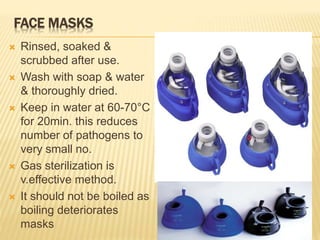
FACE MASKS
 Rinsed, soaked &
scrubbed after use.
 Wash with soap & water
& thoroughly dried.
 Keep in water at 60-70°C
for 20min. this reduces
number of pathogens to
very small no.
 Gas sterilization is
v.effective method.
 It should not be boiled as
boiling deteriorates
masks
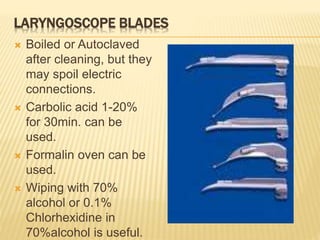
LARYNGOSCOPE BLADES
 Boiled or Autoclaved
after cleaning, but they
may spoil electric
connections.
 Carbolic acid 1-20%
for 30min. can be
used.
 Formalin oven can be
used.
 Wiping with 70%
alcohol or 0.1%
Chlorhexidine in
70%alcohol is useful.
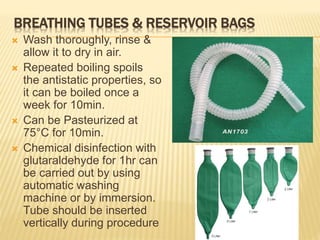
BREATHING TUBES & RESERVOIR BAGS
 Wash thoroughly, rinse &
allow it to dry in air.
 Repeated boiling spoils
the antistatic properties, so
it can be boiled once a
week for 10min.
 Can be Pasteurized at
75°C for 10min.
 Chemical disinfection with
glutaraldehyde for 1hr can
be carried out by using
automatic washing
machine or by immersion.
Tube should be inserted
vertically during procedure
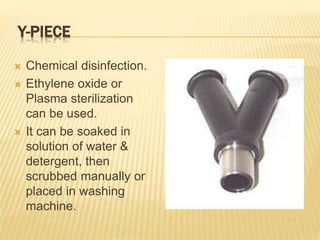
Y-PIECE
 Chemical disinfection.
 Ethylene oxide or
Plasma sterilization
can be used.
 It can be soaked in
solution of water &
detergent, then
scrubbed manually or
placed in washing
machine.
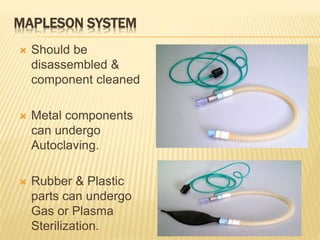
MAPLESON SYSTEM
 Should be
disassembled &
component cleaned
 Metal components
can undergo
Autoclaving.
 Rubber & Plastic
parts can undergo
Gas or Plasma
Sterilization.
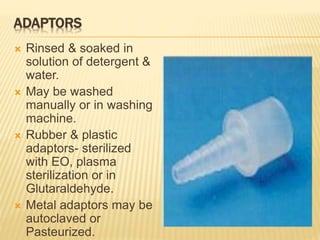
ADAPTORS
 Rinsed & soaked in
solution of detergent &
water.
 May be washed
manually or in washing
machine.
 Rubber & plastic
adaptors- sterilized
with EO, plasma
sterilization or in
Glutaraldehyde.
 Metal adaptors may be
autoclaved or
Pasteurized.
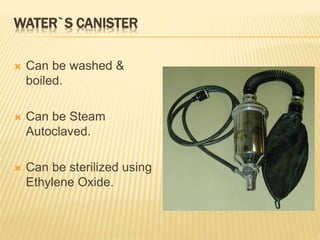
WATER`S CANISTER
 Can be washed &
boiled.
 Can be Steam
Autoclaved.
 Can be sterilized using
Ethylene Oxide.
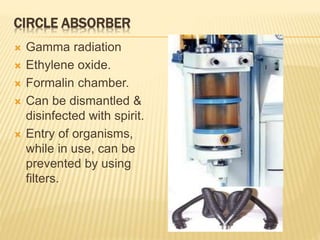
CIRCLE ABSORBER
 Gamma radiation
 Ethylene oxide.
 Formalin chamber.
 Can be dismantled &
disinfected with spirit.
 Entry of organisms,
while in use, can be
prevented by using
filters.
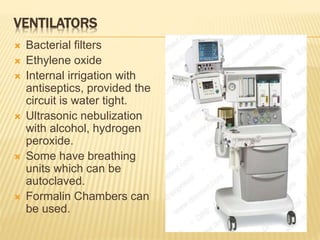
VENTILATORS
 Bacterial filters
 Ethylene oxide
 Internal irrigation with
antiseptics, provided the
circuit is water tight.
 Ultrasonic nebulization
with alcohol, hydrogen
peroxide.
 Some have breathing
units which can be
autoclaved.
 Formalin Chambers can
be used.
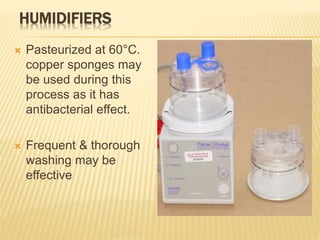
HUMIDIFIERS
 Pasteurized at 60°C.
copper sponges may
be used during this
process as it has
antibacterial effect.
 Frequent & thorough
washing may be
effective
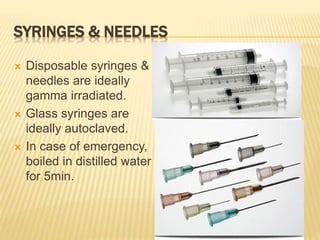
SYRINGES & NEEDLES
 Disposable syringes &
needles are ideally
gamma irradiated.
 Glass syringes are
ideally autoclaved.
 In case of emergency,
boiled in distilled water
for 5min.
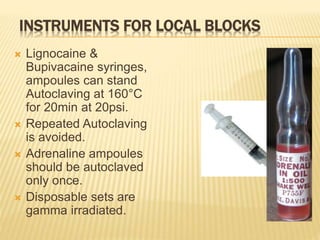
INSTRUMENTS FOR LOCAL BLOCKS
 Lignocaine &
Bupivacaine syringes,
ampoules can stand
Autoclaving at 160°C
for 20min at 20psi.
 Repeated Autoclaving
is avoided.
 Adrenaline ampoules
should be autoclaved
only once.
 Disposable sets are
gamma irradiated.
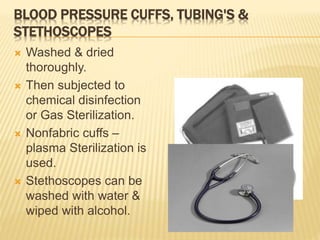
BLOOD PRESSURE CUFFS, TUBING'S &
STETHOSCOPES
 Washed & dried
thoroughly.
 Then subjected to
chemical disinfection
or Gas Sterilization.
 Nonfabric cuffs –
plasma Sterilization is
used.
 Stethoscopes can be
washed with water &
wiped with alcohol.
SPECIAL CONCERNS
SPECIAL CONCERN IN OPEN CASE OF
PULMONARY TUBERCULOSIS.
 Endotracheal tubes & suction catheters are
disposed off.
 If it is to be reused then keep in
0.1%Chlorhexidine solution for 1hr, then it
is cleaned & scraped with soap & water &
then sterilized by boiling or autoclaving.
 Boiling for 3min will kill tubercle bacilli.
 It can also be immersed in
2%Glutaraldehyde solution for 1hr.
SPECIAL CONCERN IN HEPATITIS B POSITIVE
CASES
 The virus is killed by Autoclaving & Gamma
Radiation.
 Chemical sterilization- Sodium Hypochlorite
50ppm,
 Glutaraldehyde 2% for 10 min.
 Iodophor 80ppm
 Isopropyl alcohol 70% for 15 min.
SPECIAL CONCERN IN HIV CASES
The virus is relatively unstable in environment &
can easily be inactivated by wide range of
Chemical Disinfectants like-
 Glutaraldehyde 2% for 10 min.
 Sodium Hypochlorite 50ppm.
 Hydrogen peroxide 0.3%.
 Ethyl alcohol 50%, Isopropyl alcohol 70% for 1
min.
 Phenol.
SPECIAL CONCERN IN PRION DISEASES
 It is extremely resistant to normal
Sterilization methods.
 For Critical Devices – Steam Sterilization for
30min at 132°C is recommended.
 For Non-Critical Devices- Sodium
Hypochlorite, undiluted or 1:10 dilution is
used. 1N sodium hydroxide at room
temperature for 15min can also be used.
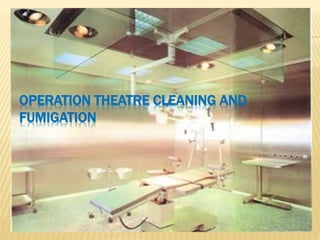
OPERATION THEATRE CLEANING AND
FUMIGATION
 Cleaning programme should be simple and
clearly laid out policy which can be adhered
to.
 Daily cleaning should be carried out after the
operating sessions are over.
 All the surfaces should be cleaned with
detergent and water and may be wiped over
with a phenol if any spills with blood / body
fluid are present.
 All the walls must be wiped down to hand
height everyday.
 The floors should be scrubbed with warm water and
detergent and dried. No disinfectant is necessary.
 The O.T. table and other non clinical equipments
must be wiped to remove all visible dirt and left to
dry.
 Weakly cleaning of all the areas inside the operating
theatre complex should be done thoroughly with
warm water and detergent and dried.
 The storage shelves must be emptied and wiped
over, allowed to dry and restacked.
Procedure for fumigation:
 The windows should be sealed and
formaldehyde should be generated either by
boiling a solution of formalin 40% or by adding
it to potassium permanganate, in a metal
vessel on the floor, since heat is also
generated. The door is than closed and scaled.
 For a 10 x 10 x 10 ft room - 150 gm potassium
permanganate and 280 ml of formalin are used
Duration:
 In case of any construction in O.T.  48
hrs
 In case of inflected cases 
24hr
 For routine clean cases  12
hrs.
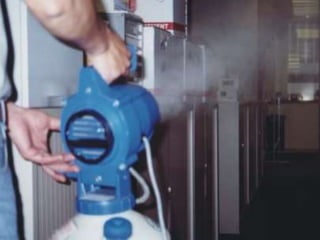
 Alternatively 250 ml of formalin and 3000 ml
of tap water are put into a machine (auto
mist) and time is set for 2 hrs. The mist is
circulated for 2hrs inside the closed room.
 Room is kept sealed for another 2 hrs for
action of vapor. Ventilate for suitable time for
vapor to dissipate. Room then can be used.
 Three swabs are taken from walls, all
equipments, floor or O.T. table at intervals.
 1st swab - 48 hrs after fumigation
 2nd swab- 24 hrs after Is' swab
 3rd swab - 12 hrs after 2"d swab
 All three consecutive swabs should come
negative.
 In some centres, Bacillocid is being used for
fumigation. It is combination of chemically
bound formaldehyde and glutaraldehyde.
 Ideally all O.T. rooms should be fumigated
once a week
REFERENCES
 Understanding Anesthesia Equipments-
Dorsch & Dorsch.
 Anaesthesia Equipments- Wards.
 Textbook of Microbiology –CP Baweja
 Google
THANK YOU

Sterilization

  • 1.
    STERILIZATION OF OPERATION THEATER& OPERATION THEATER EQUIPMENTS Presented by : Dr. ANKITA MADAN
  • 2.
    DEFINITIONS  Antiseptic Substance that has antimicrobial activity & that can be safely applied to living tissues.  Bacteriostatic Agent which prevents bacterial growth but doesn’t kill bacteria.  Bioburden  The number & types of viable organisms with which an object is contaminated.
  • 3.
     Biological Indicator It is sterilization process monitoring device consisting of a standardized viable population of micro- organisms of high resistance to mode of sterilization being monitored.  Chemical Indicator  It is sterilization process monitoring device designed to respond with a characteristic chemical change to one or more parameters of sterilization cycle.
  • 4.
     Chemosterilizers A chemical used for destroying all forms of microbiological life including spores.  Decontamination  The process by which contaminated items are rendered safe for personnel without protective attire to handle or render item safe for reuse.
  • 5.
     Disinfection Destruction of many but not all micro-organisms on inanimate objects.  The Center Of Disease Control & Prevention (CDC) has given 3 levels of disinfection LEVELS OF DISINFECTION LEVELS BACTERIA LIPID & MEDIU M SIZED VIRUSE S NON LIPID OR SMALL SIZED VIRUSES VEGETATIV E TUBERC LE SPORE S FUNGI HIGH + + + + + + INTERMEDIA TE + + +/- + + +/- LOW + - - +/- + -
  • 6.
     Disinfectants chemical germicides formulated to be used on inanimate objects. The Environmental Protection Agency (EPA) classified them as those  With Tuberculocidal activity  Without Tuberculocidal activity.  Mechanical Indicators  sterilizer components that gauge & record time, temperature, humidity pressure during sterilizing cycle.
  • 7.
     Sterilization destruction of all form of micro-organisms ( high temperature).  Terminal sterilization  sterilization process carried out after final packaging of the item.  Sterility Assurance Level (SAL)  the probability of survival of micro-organisms after a terminal sterilization process & is predictor of efficacy of the process. A SAL of 10-6 indicates non sterile item.
  • 8.
    ORDER OF RESISTANCE In descending order are- Prions Coccidia (cryptosporodium) Bacterial spores (bacillus) Mycobacterium Cysts Small non-enveloped viruses (Polio)
  • 9.
    Trophozites Gram Negative Bacteria(Pseudomonas) Fungi Large non-enveloped viruses (adenovirus) Vegetative Bacteria (Staph Aureus) Lipid or medium sized viruses (HIV, Hepatitis B)
  • 10.
    STAGES IN THEPROCESS ARE 1. General Cleaning & Decontamination.  Then if required 2. Sterilization 3. Disinfection
  • 11.
    CLEANING OF EQUIPMENTS Aim To remove retained salt & organic soil which can inactivate chemical germicides or protect organisms from destruction during disinfection. Procedure  Immersible items should be cleaned under water, with or without detergent for atleast 3 min. to prevent aerosolization of organisms & those not immersible can be cleaned with cloth soaked in detergent & water.
  • 12.
    Disassembly-  Devices shouldbe disassembeled & jointed instruments must be opened. Cleaning-  Before cleaning, manufacturer`s instruction are consulted.  Tapes, soils, adhesive residues are dissolved by using appropriate solvents.
  • 13.
     Devices mustbe soaked in protein dissolving solution to prevent coagulation of blood & then it should be scrubbed thoroughly inside out.  Complicated devices can be cleaned by ultrasonic cleaning after gross soil has been removed.
  • 14.
    Rinsing-  After cleaning,rinsing should be performed; lumens & channels are well flushed during each rinse. They should be towel or air dried.
  • 15.
    METHODS OF STERILIZATION PASTEURIZATION It’s a high level disinfectant.  The equipment is immersed in water at an elevated temperature of usually 80°c for 10min or 70°c for 30min.  It can`t kill all spores & viruses. So it is recommended for perishable & where absolute sterility is not required.  E.g. Breathing tubes, ETT, Reservoir bags, Face masks, Laryngoscope blades, ventilator bellows & any rubber goods.
  • 16.
    BOILING  For smallarticles like face masks.  It is suitable for metal & also for rubber & neoprene items.  Instruments are boiled in water for 5-15min for destruction of vegetative matter.
  • 17.
    FILTRATION  Microfilters areused to prevent entry of micro-organisms  They remove particles of diameter 0.5µ or greater
  • 18.
    STEAM STERILIZATION (AUTOCLAVING) •Here saturated steam under pressure is used.
  • 19.
    Principle   Waterboils when its vapor pressure equals that of surrounding atmosphere.  Thus when water is boiled in closed vessel at increased pressure, the temperature at which it boils & that of steam which is formed will exceed
  • 20.
     When steamcomes in contact with cooler surface  condenses to water & gives up its latent heat to that surface.  Thus 1600ml of steam at 100°C & at atmospheric pressure condenses into 1ml of water at 100°C & releases 518calories of heat.
  • 21.
    TEMPERATU RE (°C) PRESSURE (lb/in2) TIME (MIN) 12115 15 126 20 10 134 30 3.5 150 50 Few Seconds
  • 22.
     It canalso be carried out at Low Temperature & Low Pressure (LTS) i.e. at 37kPa with 74°C, but it won’t kill spores.  The addition of vapor of formaldehyde to this is called as low pressure steam & formaldehyde (LTSF) which can kill many if not all spores.  Ordinarily rubber goods, linens & metals are autoclaved. Post exposure/ Exhaust Phase.  At the end the steam should be exhausted from the autoclave to avoid condensation of water on the load when cool air is admitted.
  • 23.
    Flash Sterilization  Refers tosteam sterilization of items for immediate use.
  • 24.
  • 25.
     Articles arepacked in special craft papers and then placed in a thermostatically controlled Dry Heat Sterilizer.  Precaution temperature is raised and lowered slowly to prevent breakage by uneven expansion.  Mainly suitable for ophthalmic instruments and glass items but not plastics or rubber.  It is useful for sterilization of powders, grease, oil and glass syringes.
  • 27.
    Holding Temperature (°C) Time OfSterilization (min) 180 30 170 60 160 120 150 150
  • 28.
    CHEMICAL (COLD) STERILIZATION Utilizes liquid chemical agents  Especially useful for heat sensitive equipment.  Performed by soaking item in the solution.  Kill the organisms by coagulation / alkylation of proteins and also by enzymatic degradation and lysis of cell membranes.
  • 29.
     The criteriato be satisfied in the Chemical Methods are 1. Must be capable of killing spores. 2. Should be non-corrosive 3. Should be Non-irritant. 4. Should be Economical. 5. Should be stable 6. Should penetrate grease & fibers. 7. Should be non-toxic.
  • 30.
    Factors Influencing ChemicalSterilization: a) Concentration of the Chemical: Rate of kill of bacteria varies directly with the concentration of the disinfectant. b) Temperature: Designed to be used at room temperature.
  • 31.
    c) Evaporation andlight deactivation: Volatile agents evaporate easily. Exp: Chlorine Products. Exposure to light adversely affects the disinfectant. d) PH: Alcohols work best in alkaline PH while aldehydes work best in acidic PH. e) Bioburden: The effectiveness of the disinfectant depends on the nature and number of contaminating microorganisms
  • 32.
    f) Characteristics ofthe item to be sterilized:  A disinfectant solution will be effective only if it can contact all the surfaces on the item. g) Time:  Time required for different chemical agents to function effectively varies from seconds to hours. h) Use Pattern, Use Life & Storage Life:  Use Pattern refers to how many times the solution can be used.  Use Life indicates limited period of time during which activated solution can be used.  Storage life is the time period after which the unused or inactivated product is no longer deemed effective.
  • 33.
    FORMALDEHYDE:  Used principallyin water based solution called formalin. Vapor can be generated from paraformaldehyde tablets which contain 95% formaldehyde in a polymerized form.  It is a high level disinfectant.  It is non corrosive and is not inactivated by organic matter.  Widely used for sterilization of endoscopic equipment, catheters etc.
  • 34.
     For bettereffect it needs relative humidity of 60-80% and temperature of 37°C.  Residual formaldehyde may affect the skin, but it can be neutralized by ammonia.  Limited by its pungent odor and fumes.  Should be handled as a potent sensitizer and probable carcinogen.
  • 35.
    QUATERNARY AMMONIUM COMPOUNDS (QUATS) Low level disinfectants  They are bactericidal, fungicidal & viricidal but not sporicidal.  They are effective against gram positive than gram negative and marginally effective against Pseudomonas. They inactivate HIV but not hepatitis virus.  They are inactivated by organic materials.  Side effects are allergic reactions and contact dermatitis.
  • 36.
    PHENOLIC COMPOUNDS  Theyare intermediate to low level disinfectants.  Derived from carbolic acid (phenol), one of the oldest germicides.  They are bactericidal, fungicidal and viricidal but not sporicidal.  They are active in the presence of organic matter.  They are irritant to skin & mucous membranes, have bad odour.  They are absorbed by rubber and residual disinfectant may cause tissue irritation.
  • 37.
    ALCOHOL  Intermediate leveldisinfectants.  Ethyl alcohol is bactericidal in 60- 90% concentration and isopropyl alcohol in 60% concentration.  They kill bacteria but not spores, action against viruses is variable.  CDC recommends exposure to 70% ethanol for 15mins to inactivate the hepatitis virus but 1 min for HIV.  Their effectiveness is limited because of rapid evaporation, lack of ability to penetrate organic matter.
  • 38.
     They areused mainly to disinfect external surfaces of equipment like stethoscopes, ventilators, fiberoptic cables.  They can damage mounting of lensed instruments and tend to swell and harden rubber.
  • 39.
    Chlorhexidine (Savlon) : It is a non detergent chemical disinfectant usually used in the concentration of 0.5% in 70% alcohol for skin.  Tubes, masks etc. are sterilized by keeping for 20 min in 0.1% aqueous solution. Chloroxylenol (Dettol):  It is used as mild antiseptic agent
  • 40.
    IODOPHORS  It isa combination of iodine and carrier with a resulting complex providing sustained release reservoir of iodine.  They are bactericidal, viricidal and tuberculocidal but not sporicidal.  These are intermediate to low level disinfectants.  They corrode the metallic items and non-metallic items may be stained or discolored.
  • 41.
    PERACETIC (PEROXYACETIC) ACID It is acetic acid with an extra oxygen atom.  It is bacteriocidal, sporicidal, fungicidal and viricidal.  They are effective in the presence of organic matter. But it is corrosive and irritating to skin in concentrated solution.  It is active ingredient in the steris sterilant. This is a single use concentrate of 35% peracetic acid + corrosion and degradation inhibitors.
  • 42.
     Used inwide variety of heat sensitive and delicate instruments.  Used on wet or dry items and there is no personnel exposure. It can be situated in the Operating room suite.  It is useful only for totally immercible objects and only small number instruments can be processed in a cycle.
  • 43.
    CHLORINE AND CHLORINEPRODUCTS  They are intermediate level disinfectants.  They are active against bacteria and viruses but not spores.  They are available both in liquid (sodium hypochlorite) and solid (Calcium hypochlorite) forms.  They are most widely used, inexpensive and fast acting.
  • 44.
     Highly effectiveagainst HIV.  Household bleach is an inexpensive and excellent source of sodium hypochlorite.  A 1:100 to 1:1000 dilution is effective against HIV.  1:5 to 1:10 dilution is effective against hepatitis.  It also inactivates Cruetz Feldt Jakob disease with an exposure time of 1 hr.
  • 45.
     Their useis limited by their corrosiveness, inactivation by organic matter and may leave residue which causes irritation to skin, eye and respiratory tract  Potential hazard is the production of carcinogen bis-chloromethyl ether, when hypochlorite solutions come into contact with formaldehyde.  A mixture of hypochlorite with acid will cause rapid evolution of toxic chlorine gas.
  • 46.
    HYDROGEN PEROXIDE  Itis an effective bactericidal, fungicidal, viricidal and sporicidal.  It is commercially available as 3% solution but can be used upto 25% concentration.  It is non corrosive and not inactivated by organic matter but irritant to skin and eyes.
  • 47.
    GLUTARALDEHYDE (CIDEX)  Itis a saturated dialdehyde. It is used in 1.0% concentration (but highly effective in 2% concentration).  It is high level disinfectant. It kills spores within 12 hrs and viruses within 10 min.  Widely used because of their excellent biocidal properties, activity in the presence of organic matter, non corrosiveness and noncoagulation of proteinaceous material.
  • 48.
    Disadvantages :  Itis noxious and irritating to tissues and hence thorough rinsing of all exposed materials is mandatory.  Prepackaging is not possible and equipment will be wet.  Pseudo-membranous laryngitis has been linked to disinfection of tracheal tubes with glutaraldehyde.
  • 49.
    OZONE:  Sterilizers useO2, water & electricity to produce Ozone. Advantages:  Useful for most goods that need low temperature sterilization.  Process is environmentally friendly.  Treated objects are dry. Disadvantages:  Not approved for flexible scopes & reactive materials such as copper & brass.  Unsuitable for natural gum rubber products
  • 50.
    Advantages of ChemicalSterilization  Technically easier.  Suitable for equipments damaged by heat sterilization.  Sophisticated chemical methods like Ethylene Oxide achieve perfect sterilization. Disadvantages:  Act only on exposed surfaces  Some chemicals react with metals.  Some impregnate with the materials such as rubber & plastics & some agents destroy it.  Residual chemicals may form the source of infection.
  • 51.
    Disinfectant Gm +ve Bacteria Gm–ve Bacteria Tubercl e bacillus Spore s Viruse s Fungi Formaldehyde + + + - + QUATS + + - - + + Phenolic compounds + + +/- - + + Alcohol + + + - + + Chlorine + + + - + + Hydrogen Peroxide + + + +/- + + Glutaraldehyde + + + +/- + +
  • 52.
    GAS STERILIZATION  EOis used for this purpose.  It is a liquid below 11°C.  It is available in high pressure tanks, unit dose ampoules and cartridges.
  • 53.
    1. Preparation forethylene oxide (EO) sterilization (propylene oxide):  Before packaging, items must be disassembled, cleaned and dried to allow the gas to penetrate throughout the whole product.  Caps, plugs, valves, stylets must be removed. Hollow bore products and needles should be open at both ends.  They should be towel or air dried.
  • 54.
     A relativehumidity of 35% to 70% and a temperature of 18 to 22°C are recommended.  Items to be sterilized are placed in carries that do not absorb E.O. They should be loaded loosely to allow for uniform penetration of gas throughout the load.
  • 55.
    Factors affecting EOSterilization :  Gas concentration: The solubility of EO in the product and the gas diffusion rate through the product will influence the sterilant concentration.  Temperature: Exposure time can be decreased by increasing the temperature.  Humidity: Moisture hydrates microbes, making then susceptible to destruction by EO.
  • 56.
     Protective barriers:Blood and other proteinaceous materials can act as barriers to EO.  Packaging: The wrapping must be permeable to EO gas and water vapor and allow for proper aeration.  Exposure time: Depends on factors mentioned above, generally range from 1.5 to 6 hrs. or many require upto 12 hrs
  • 57.
    3. Sterilizers:  EOsterilizers are of two types, ⁻ general purpose and ⁻ special purpose.
  • 58.
    7. Advantages:  Itis effective against all organisms:  Damage to most equipment is minimal.  Items can be prepackaged.  Used for sterilization of delicate instruments like pump oxygenators, valves, ventilators etc. 8. Disadvantages:  More expensive  Fire and explosions have been reported.  Long duration.  Personnel need to be highly trained and supervised.
  • 59.
    RADIATION STERILIZATION  Mainlyused for disposable products.  Gamma radiation is an electromagnetic wave produced during the disintegration of certain radioactive elements like cobalt-60.  All organisms including spores, viruses will be killed. Lethal dose is 2.5 megarads(kills bacteria by ionizing there DNA).  The products can be prepackaged.
  • 60.
     As thereis no temperature rise, thermolabile materials can be sterilized.  Equipments may be used immediately after treatment, with no risk from retained radioactivity.  Disadvantage is that it is not practical for every day use and it is expensive.
  • 61.
    INFRARED RADIATION  Thisis method of sterilization by dry heat usually used to sterilize the syringes and small instruments
  • 62.
  • 63.
    ANAESTHESIA CARTS &MACHINES  Top surface should be cleaned of visible material between cases.  Disinfected with germicide at end of day
  • 64.
    GAS CYLINDERS  Washedwith water & detergent.  Then wiped or sprayed with germicide
  • 65.
    UNIDIRECTIONAL VALVES, APLVALVES & WATER TRAPS  Cleaned & disinfected periodically.  They are disassembled & cleaned by wiping disc. The inside of the plastic dome & the valve seat with alcohol or detergent.  Some APL valves may be autoclaved & some may be
  • 66.
    TRACHEAL TUBES, SUCTIONCATHETERS, AIRWAYS  Washed with soap & water & rinsed.  A malleable brush may be used to clean the inner aspect of tubes & airways.  Boiling will sterilize it but tubes will be softened.  Chlorhexidine 0.1% solution can be used. Here equipments should be soaked for 30-60min for complete sterilization.  Autoclaving will be effective. But ETT should be replaced after 6 uses.  Gamma radiation is satisfactory.
  • 67.
    FACE MASKS  Rinsed,soaked & scrubbed after use.  Wash with soap & water & thoroughly dried.  Keep in water at 60-70°C for 20min. this reduces number of pathogens to very small no.  Gas sterilization is v.effective method.  It should not be boiled as boiling deteriorates masks
  • 68.
    LARYNGOSCOPE BLADES  Boiledor Autoclaved after cleaning, but they may spoil electric connections.  Carbolic acid 1-20% for 30min. can be used.  Formalin oven can be used.  Wiping with 70% alcohol or 0.1% Chlorhexidine in 70%alcohol is useful.
  • 69.
    BREATHING TUBES &RESERVOIR BAGS  Wash thoroughly, rinse & allow it to dry in air.  Repeated boiling spoils the antistatic properties, so it can be boiled once a week for 10min.  Can be Pasteurized at 75°C for 10min.  Chemical disinfection with glutaraldehyde for 1hr can be carried out by using automatic washing machine or by immersion. Tube should be inserted vertically during procedure
  • 70.
    Y-PIECE  Chemical disinfection. Ethylene oxide or Plasma sterilization can be used.  It can be soaked in solution of water & detergent, then scrubbed manually or placed in washing machine.
  • 71.
    MAPLESON SYSTEM  Shouldbe disassembled & component cleaned  Metal components can undergo Autoclaving.  Rubber & Plastic parts can undergo Gas or Plasma Sterilization.
  • 72.
    ADAPTORS  Rinsed &soaked in solution of detergent & water.  May be washed manually or in washing machine.  Rubber & plastic adaptors- sterilized with EO, plasma sterilization or in Glutaraldehyde.  Metal adaptors may be autoclaved or Pasteurized.
  • 73.
    WATER`S CANISTER  Canbe washed & boiled.  Can be Steam Autoclaved.  Can be sterilized using Ethylene Oxide.
  • 74.
    CIRCLE ABSORBER  Gammaradiation  Ethylene oxide.  Formalin chamber.  Can be dismantled & disinfected with spirit.  Entry of organisms, while in use, can be prevented by using filters.
  • 75.
    VENTILATORS  Bacterial filters Ethylene oxide  Internal irrigation with antiseptics, provided the circuit is water tight.  Ultrasonic nebulization with alcohol, hydrogen peroxide.  Some have breathing units which can be autoclaved.  Formalin Chambers can be used.
  • 76.
    HUMIDIFIERS  Pasteurized at60°C. copper sponges may be used during this process as it has antibacterial effect.  Frequent & thorough washing may be effective
  • 77.
    SYRINGES & NEEDLES Disposable syringes & needles are ideally gamma irradiated.  Glass syringes are ideally autoclaved.  In case of emergency, boiled in distilled water for 5min.
  • 78.
    INSTRUMENTS FOR LOCALBLOCKS  Lignocaine & Bupivacaine syringes, ampoules can stand Autoclaving at 160°C for 20min at 20psi.  Repeated Autoclaving is avoided.  Adrenaline ampoules should be autoclaved only once.  Disposable sets are gamma irradiated.
  • 79.
    BLOOD PRESSURE CUFFS,TUBING'S & STETHOSCOPES  Washed & dried thoroughly.  Then subjected to chemical disinfection or Gas Sterilization.  Nonfabric cuffs – plasma Sterilization is used.  Stethoscopes can be washed with water & wiped with alcohol.
  • 80.
  • 81.
    SPECIAL CONCERN INOPEN CASE OF PULMONARY TUBERCULOSIS.  Endotracheal tubes & suction catheters are disposed off.  If it is to be reused then keep in 0.1%Chlorhexidine solution for 1hr, then it is cleaned & scraped with soap & water & then sterilized by boiling or autoclaving.  Boiling for 3min will kill tubercle bacilli.  It can also be immersed in 2%Glutaraldehyde solution for 1hr.
  • 82.
    SPECIAL CONCERN INHEPATITIS B POSITIVE CASES  The virus is killed by Autoclaving & Gamma Radiation.  Chemical sterilization- Sodium Hypochlorite 50ppm,  Glutaraldehyde 2% for 10 min.  Iodophor 80ppm  Isopropyl alcohol 70% for 15 min.
  • 83.
    SPECIAL CONCERN INHIV CASES The virus is relatively unstable in environment & can easily be inactivated by wide range of Chemical Disinfectants like-  Glutaraldehyde 2% for 10 min.  Sodium Hypochlorite 50ppm.  Hydrogen peroxide 0.3%.  Ethyl alcohol 50%, Isopropyl alcohol 70% for 1 min.  Phenol.
  • 84.
    SPECIAL CONCERN INPRION DISEASES  It is extremely resistant to normal Sterilization methods.  For Critical Devices – Steam Sterilization for 30min at 132°C is recommended.  For Non-Critical Devices- Sodium Hypochlorite, undiluted or 1:10 dilution is used. 1N sodium hydroxide at room temperature for 15min can also be used.
  • 85.
  • 86.
     Cleaning programmeshould be simple and clearly laid out policy which can be adhered to.  Daily cleaning should be carried out after the operating sessions are over.  All the surfaces should be cleaned with detergent and water and may be wiped over with a phenol if any spills with blood / body fluid are present.  All the walls must be wiped down to hand height everyday.
  • 87.
     The floorsshould be scrubbed with warm water and detergent and dried. No disinfectant is necessary.  The O.T. table and other non clinical equipments must be wiped to remove all visible dirt and left to dry.  Weakly cleaning of all the areas inside the operating theatre complex should be done thoroughly with warm water and detergent and dried.  The storage shelves must be emptied and wiped over, allowed to dry and restacked.
  • 88.
    Procedure for fumigation: The windows should be sealed and formaldehyde should be generated either by boiling a solution of formalin 40% or by adding it to potassium permanganate, in a metal vessel on the floor, since heat is also generated. The door is than closed and scaled.  For a 10 x 10 x 10 ft room - 150 gm potassium permanganate and 280 ml of formalin are used
  • 89.
    Duration:  In caseof any construction in O.T.  48 hrs  In case of inflected cases  24hr  For routine clean cases  12 hrs.  Alternatively 250 ml of formalin and 3000 ml of tap water are put into a machine (auto mist) and time is set for 2 hrs. The mist is circulated for 2hrs inside the closed room.
  • 90.
     Room iskept sealed for another 2 hrs for action of vapor. Ventilate for suitable time for vapor to dissipate. Room then can be used.  Three swabs are taken from walls, all equipments, floor or O.T. table at intervals.  1st swab - 48 hrs after fumigation  2nd swab- 24 hrs after Is' swab  3rd swab - 12 hrs after 2"d swab
  • 91.
     All threeconsecutive swabs should come negative.  In some centres, Bacillocid is being used for fumigation. It is combination of chemically bound formaldehyde and glutaraldehyde.  Ideally all O.T. rooms should be fumigated once a week

  • 93.
    REFERENCES  Understanding AnesthesiaEquipments- Dorsch & Dorsch.  Anaesthesia Equipments- Wards.  Textbook of Microbiology –CP Baweja  Google
  • 94.