Meeting the Challenges of K-12
Leadership in Technology
Operations
Memphis Public Schools
Principals Academy
June 4th and June 5th, 2009
Introduction
• Steve Muzzy – Asst. Supt. Educational
Technology
• Brevard Public Schools, Florida
• Governors Award for Organizational Excellence
• Currently Applying for MBNQA
Brevard’s Technology
Success Stories
• 80% of Classrooms meet “Sunrise Standard”
• Ubiquitous Access to Technology
• Highly Proficient Teachers who Integrate Technology
• Most “Star” Educators in the Country
• Leadership, Governance, and Community Recognition
Journey
From:
• CIO Terminated
• Low Cust. Sat.
• Masters of “NO”
• Lots of Tech Talk and
Tech Lockdowns
• Data/Information
Centralized
• Admin. Tech vs.
Instr.Tech
To:
• 95% Customer Sat
• Customer Svc. Culture
• Tech viewed as a
Strength
• Supportive Board
• High PD
• State Model of
Technology Excellence
Program
Today’s Agenda
• Sharing the BPS Journey to improve
technology
• What we have done to improve customer
service, increase capacity, and improve
effectiveness and efficiency
Goals of the Session
• Understand the importance and definition of
“Process”
• Increase your understanding of some key
process management tools
• Realize the power of the “Six Questions”
• Better understand the role of technology in
improving operations and instruction
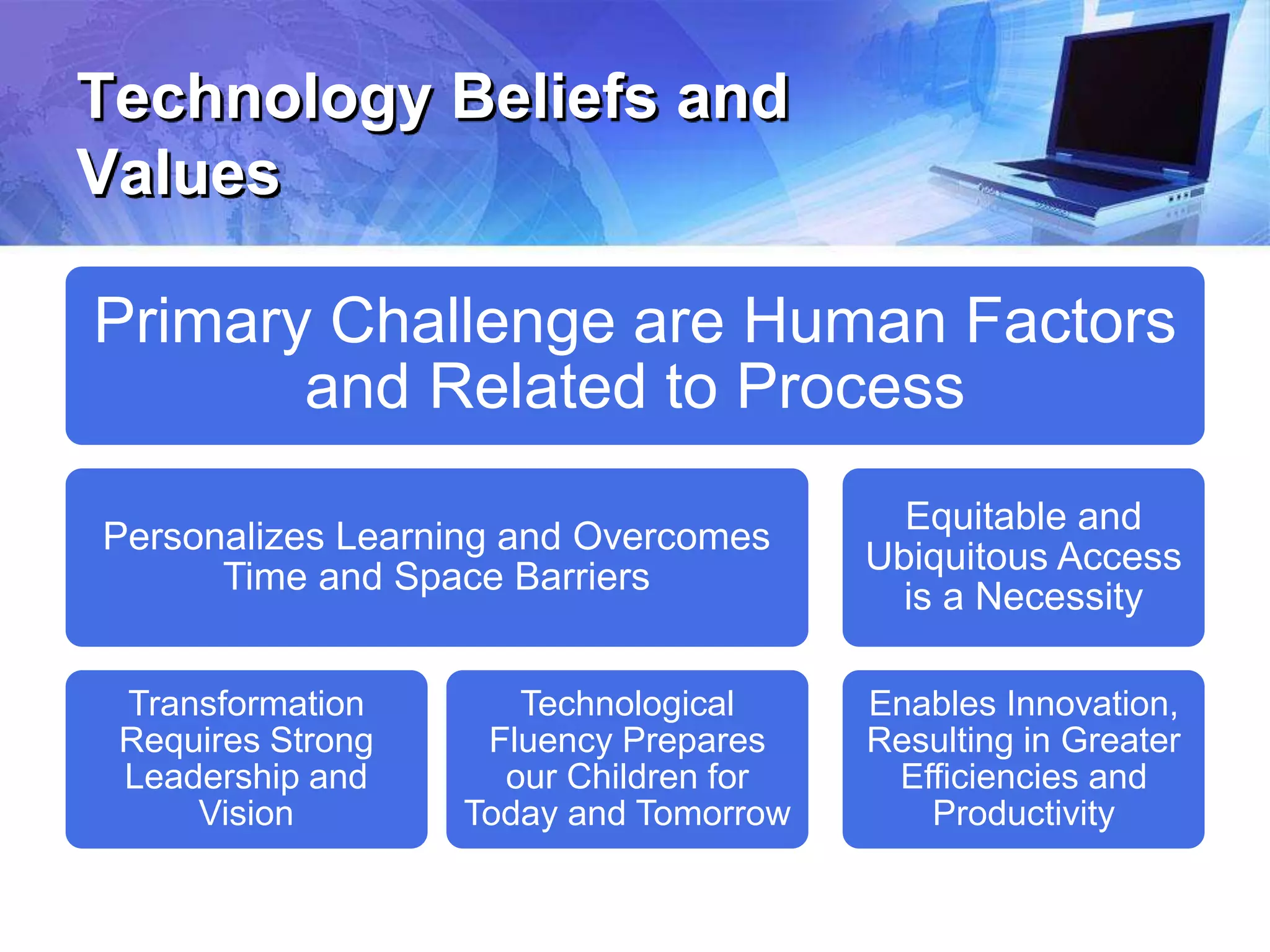
Technology Beliefs and
Values
Primary Challenge are Human Factors
and Related to Process
Personalizes Learning and Overcomes
Time and Space Barriers
Transformation
Requires Strong
Leadership and
Vision
Technological
Fluency Prepares
our Children for
Today and Tomorrow
Equitable and
Ubiquitous Access
is a Necessity
Enables Innovation,
Resulting in Greater
Efficiencies and
Productivity
K-12 TECHNOLOGY
CURRENT STATE (CoSN)
• Average Computers per Tech is 650
• Average Students per Tech is 1,943
• 85% of Leaders identify high need of Instructional
technologists, techs, and web specialists
• 55% report over 80% of time is reactionary
• 80% report budget is not enough to meet the
expectations of Board/Supt./Community
Challenges Summarized
• Growing Technology Needs or Dreams
Becoming Nightmares
• Balancing Security with Using Technology to
Tap Into Excitement of Teachers and Students
• Shrinking Staffs and Shrinking
Budgets
MEETING THE CHALLENGE
• Relentlessly Pursue the Elimination of
Waste
• Focus on Customer Requirements and
Customer Service
• Not About Getting Leaner but Increasing
Capacity with the Same Funding
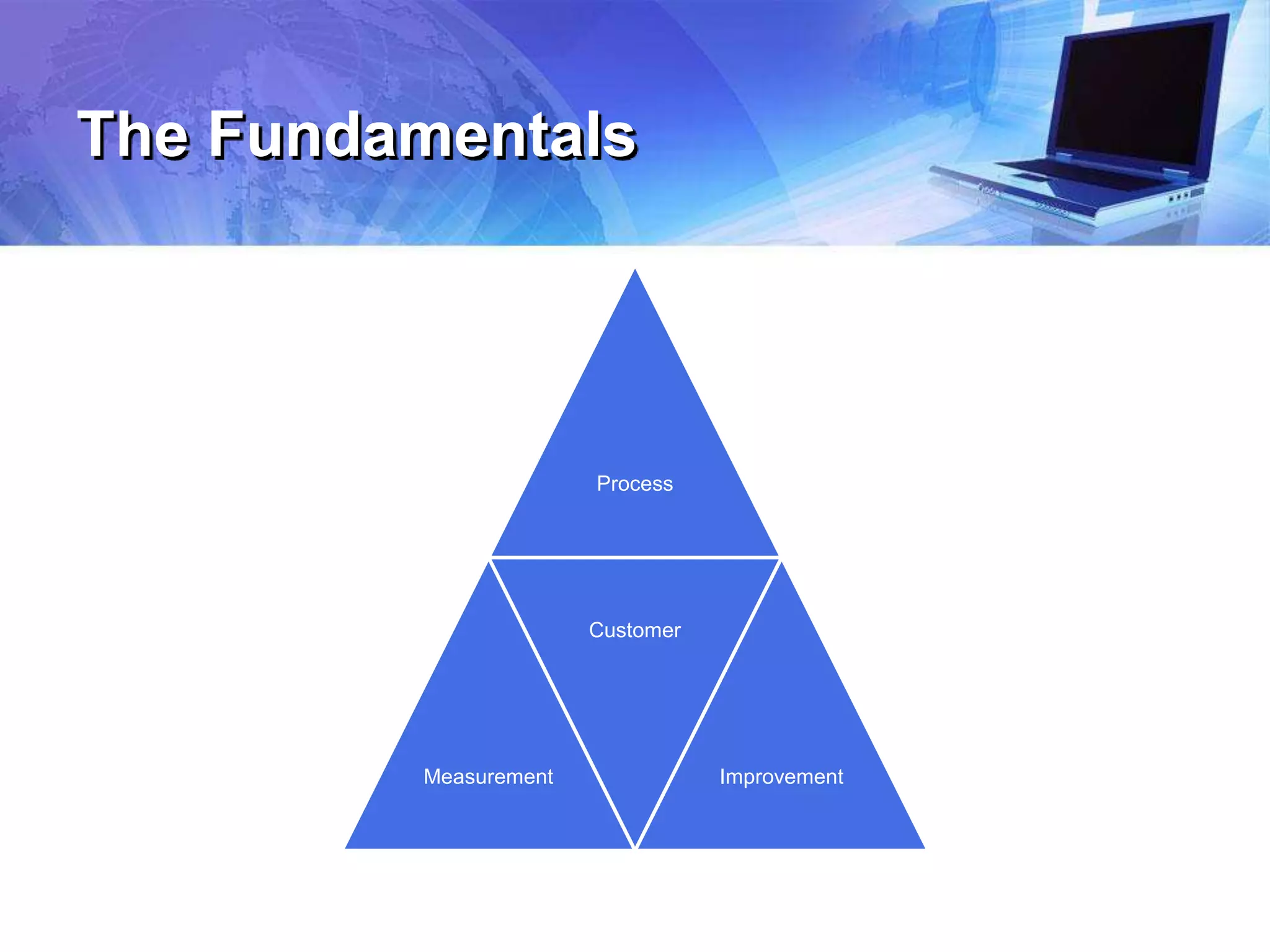
The Fundamentals
Process
Measurement
Customer
Improvement
The Labels Are Many
• Lean
• Six Sigma
• Total Quality Management
• Business Process Management
• Balanced Scorecard
• Accountability
• Many, Many, More
PROCESS MANAGEMENT AND
IMPROVEMENT
• Will Transform Your Organization
and Enable You to Build Capacity
•Technology will Accelerate Your
Improvement and Create Flexibility
“Focus on processes;
you can’t change
the outcomes
unless you change
the processes
that generate them!”
--Jack Grayson, Jr.
Process Management
Overview
Process:
• Is a designed group of related tasks that work together
to create a result of value to the customers
• A series of interrelated activities that convert inputs to
results or outputs
• …steps and decisions involved in the way work is
accomplished
Why Process Focus?
• Process focus is concerned with outcomes and results
• A shift from a task focus to a process focus is essential
to achieve desired results.
• A process is a related group of tasks that together create
a result of value to the customer
• Processes cross between traditional functions and
involve multiple people
Why Process Focus?
• A process focus requires a customer and results focus
• Much attention is paid to inputs and outputs, but less has
been given to the process or how the work gets done.
• Most problems in organizations are not task problems –
they are process problems
• A process is a related group of tasks that together create
a result of value to a customer
Can You Find Waste Your
Processes?
• Too Many Hand Offs
• Excessive Approvals
• Paper Based Data Input
• Non-Value Added Tasks
• Unnecessary Paperwork
• Focus on Task Excellence in Departments
or Silos
19
Process Management Overview
Process:
A systematic approach for achieving a desired result.
Because it is systematic, it is repeatable and can produce
results with minimal variation. All processes can be
measured in terms of quality, cost, and time.
Key Learning Point:
By improving quality or reducing time, costs will be reduced.
Principles Of Process
Management and Improvement
• Customer Focus
• Respect For People
• Manage By Fact
• Continuous Improvement
Definition of Insanity
• “Expecting Different Results and
continuing to do the same things.”
-Albert Einstein
The Six Questions
• What Do You Do?
– Description that identifies need(s) you are meeting
• How Do You Do It?
– A flow chart showing process steps, people or function involved,
and key decision points
• Who Do I Do It For?
– Identifies customer(s) and who receives the product or output of
your process
The Six Questions
• How Do You Know You Are Doing A Good Job?
– Outcome measures and In-Process measures are compared to
customer requirements and benchmarks
• How Do You Improve?
– Benchmarking, Plan-Do-Check-Act, DMAIC
• Can You Demonstrate Your Improvement System?
Key Takeaway
• By constantly focusing on the six questions, you will
begin to master The fundamentals of process,
measurement, and data
• By learning what causes things to happen in a process
and removing things that contribute little or no value to
the result will improve efficiencies…Outcomes can’t be
improved without process change
• The Improvement Fundamental is Enhanced by DMAIC,
PDCA or other problem solving methodology
26
Process and Measure Fundamentals
Important Process Management Tools:
Flow Chart - Describes the process, players, and key
decision points.
Outcome Measure – Describes the degree(s) to which the
process is successful in meeting its mission and
stakeholders’ requirements.
In-Process Measure – Describes the performance of
behavior factors which are known to have significant
influence on the outcome measure(s).
The Six Questions Template
• An Assignment for you and your staff
• Will provide you the template at the end of
the session
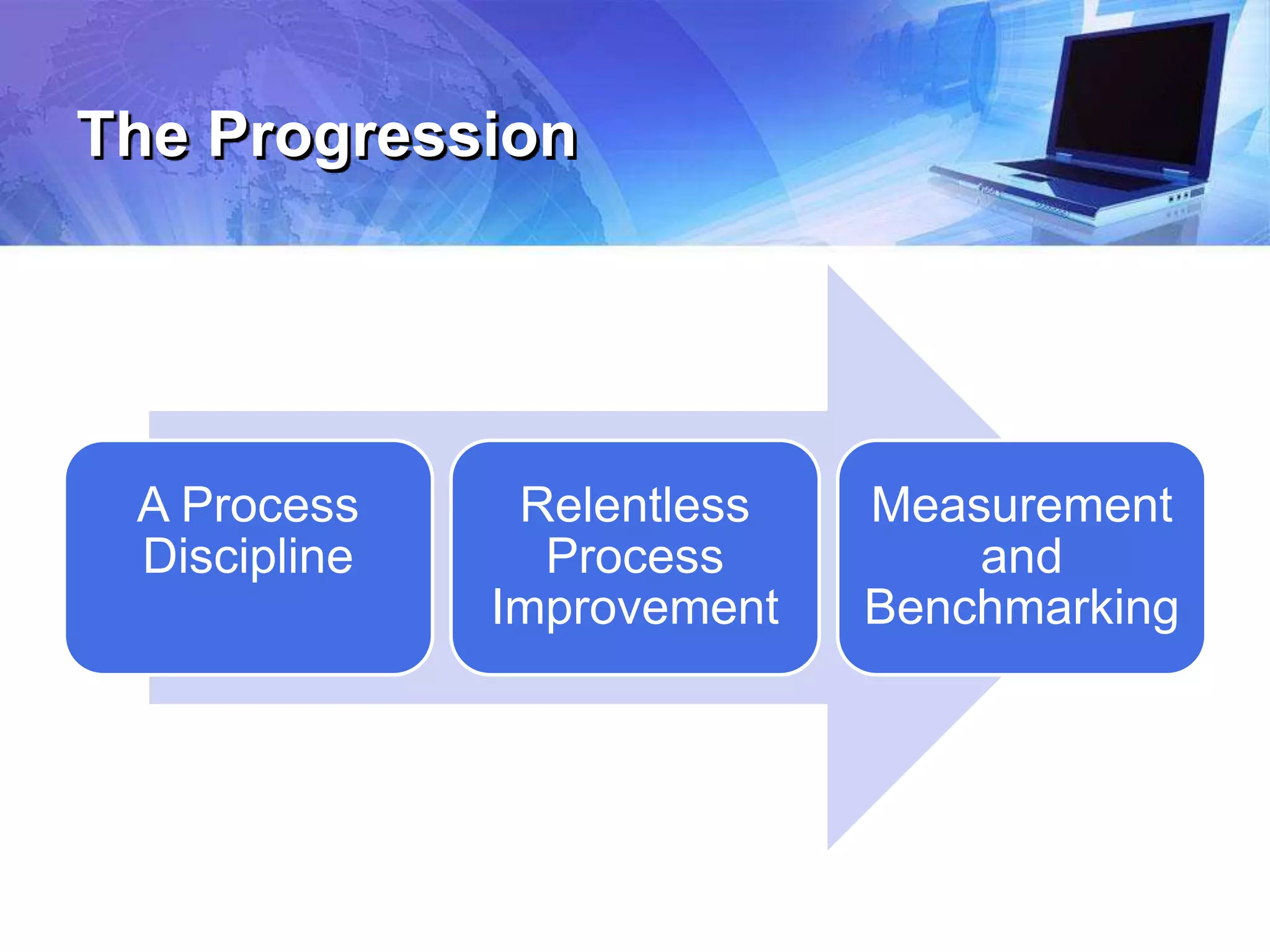
The Progression
A Process
Discipline
Relentless
Process
Improvement
Measurement
and
Benchmarking
Warning
• Embracing Process Management is HARD
WORK
• Not Doing One of the Fundamentals Will Result
in Failure
• Leaders Must Walk the Walk
• Change in Culture Does Not Happen Overnight
Focus Points
• Steps or Activities must be based around
the results or outcomes
• Focus must be on the customer, not
politics or tradition
• FIX THE PROCESS FIRST, THEN
AUTOMATE
Technology Misconceptions
• Automating Processes Will Fix My Problems
• We Need Faster Computers
• We Need Better Software
• We Need More Bandwidth
Applying Technology
• To an Improved Process Will Yield Enhanced Results
and Increased Capacity
• Better, Cheaper, and Faster
• Technology Accelerates Improvement and Enables
Flexibility
• Mastery of the Fundamentals and The Six Questions Will
Change Your Culture
Remember….
• A Bad Process Automated is a Faster Bad
Process that is More Expensive
Brevard’s Key Technology
Processes
– Manage Educational Technology
• Manage Network Operations
• Manage Internal Customer Inquiries and Problem Resolution
• Information and Data Management
• Programming and Integration Services
• Provide Customer Technology Training
• Manage IT Projects
• Ensure Continuity of IT Operations
• Manage State Reporting
• Manage External Customer Inquires and Problem Resolution
• Manage Printing and Digital Reproduction Services
• Manage Technology Support and Repair
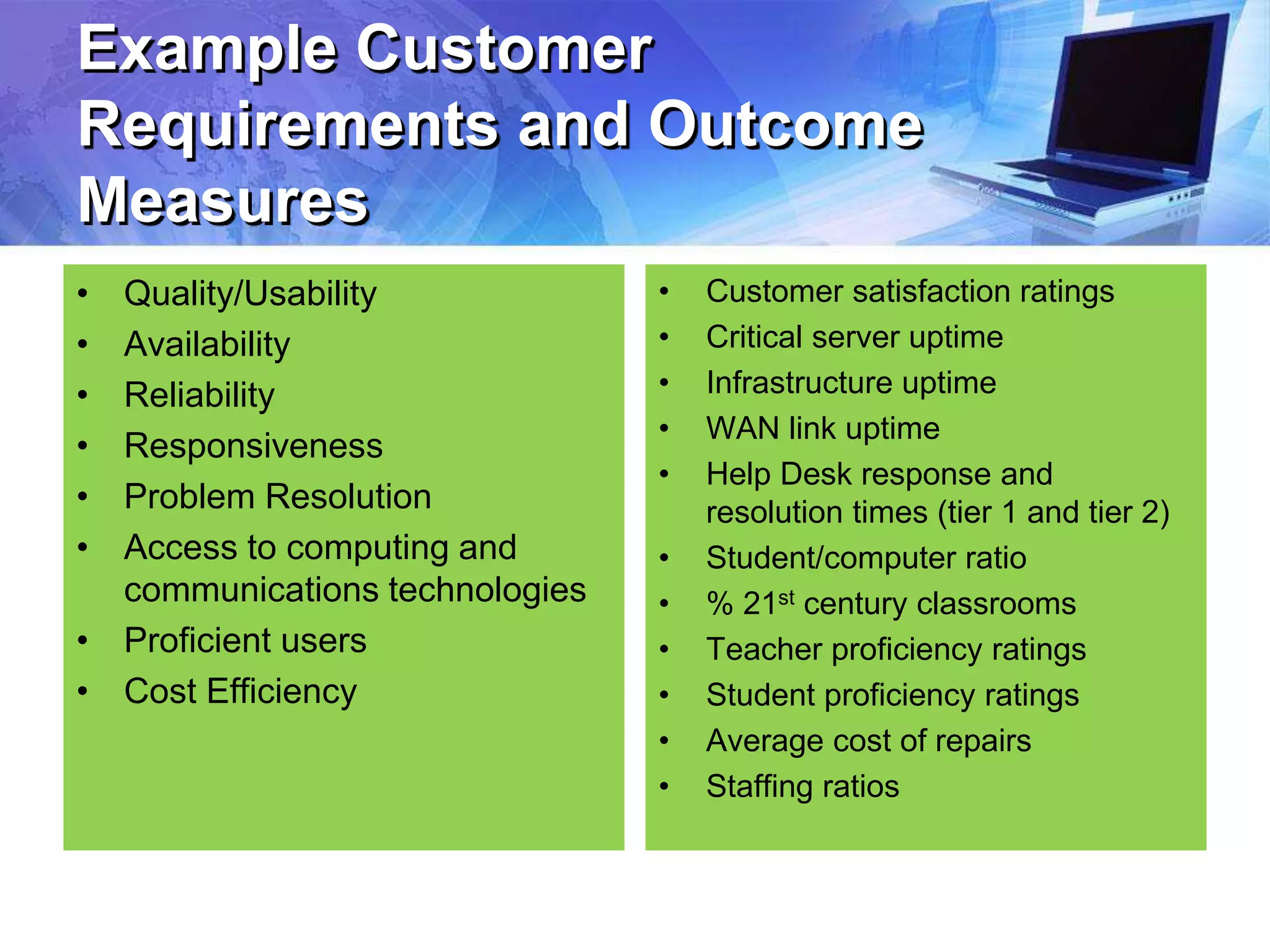
Example Customer
Requirements and Outcome
Measures
• Quality/Usability
• Availability
• Reliability
• Responsiveness
• Problem Resolution
• Access to computing and
communications technologies
• Proficient users
• Cost Efficiency
• Customer satisfaction ratings
• Critical server uptime
• Infrastructure uptime
• WAN link uptime
• Help Desk response and
resolution times (tier 1 and tier 2)
• Student/computer ratio
• % 21st century classrooms
• Teacher proficiency ratings
• Student proficiency ratings
• Average cost of repairs
• Staffing ratios
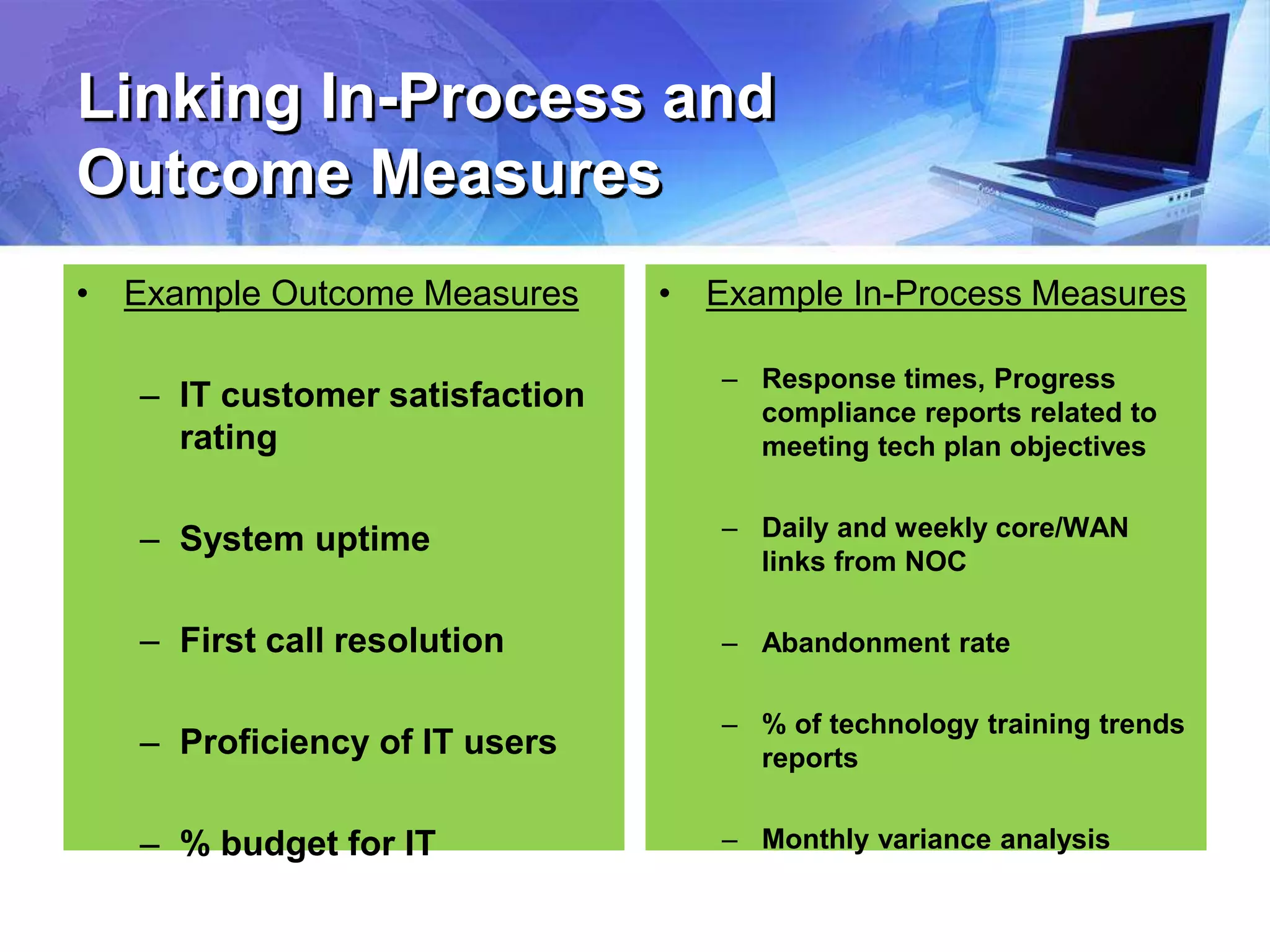
Linking In-Process and
Outcome Measures
• Example Outcome Measures
– IT customer satisfaction
rating
– System uptime
– First call resolution
– Proficiency of IT users
– % budget for IT
• Example In-Process Measures
– Response times, Progress
compliance reports related to
meeting tech plan objectives
– Daily and weekly core/WAN
links from NOC
– Abandonment rate
– % of technology training trends
reports
– Monthly variance analysis
Important Measurement
Points
• You must measure the right things
• You must set stretch goals or targets to
strive for the right measures
• What gets measured gets done!
Some Technology Examples
• First Call Resolution Improved To 65%
• Work System Savings of $1 Million Annually Due to Centralized
Procurement
• Hard Savings of $500K annually due to In-House Programming
• Cell Phone Savings of $90K Annually
• Avoided Costs of $1.8M Through Donated Computer and Parts
Surplus Utilization
Some Technology Examples
• Average Time of 2 Days “In the Box” versus 24 days
• Tier 2 Response Time Improved 60%
• Self Maintainer Program Earned 20k in First Year
• Negotiated 250K Cash for Student Enrichment Programs
• Hard Savings of 500k Annually in Printing Operations
• Customer Satisfaction Rating of all Segments at 95%
Best Practices
• Pick Project or Process of Interest to Management
• Ensure Process Participants Allotted Time to Provide Input on
Process
• Ensure Customer Requirements are Correct and Collect Baseline
Data
• Implement Feasible Countermeasures
• Document and Communicate Success Stories
A Culture of Excellence
Through Process
Management
• Occurs Incrementally
• Depends on Involvement and Empowerment of People
• Listen, Learn, and Help
• Not a Grand Slam but many Base Hits
• Common Language
• Relentless Pursuit of Excellence
42
Process Management Overview
Process Management:
Ensuring processes always achieve desired results.
Key Learning Points:
1. What do you do?
2. How do you do it?
3. Who do you do it for?
4. How do you know you’re doing a good job?
5. How do you improve?
6. Show me.
Goals of the Session
• Understand the importance and definition of
“Process”
• Increase your understanding of some key
process management tools
• Realize the power of the “Six Questions”
• Better understand the role of technology in
improving operations and instruction
Sources of Help
• Baldrige Education Criteria
• APQC – American Productivity and Quality Center
• Ets, Inc
• Brevard Public Schools Performance Excellence
Resource Manual and Baldrige/Sterling Application
• Muzzy.stephen@brevardschools.org
Some Tools to Help
• The Six Questions Template
• BPS Performance Excellence Resource
Manual

Stephen "Steve" Muzzy Memphis Schools Presentation

  • 1.
    Meeting the Challengesof K-12 Leadership in Technology Operations Memphis Public Schools Principals Academy June 4th and June 5th, 2009
  • 2.
    Introduction • Steve Muzzy– Asst. Supt. Educational Technology • Brevard Public Schools, Florida • Governors Award for Organizational Excellence • Currently Applying for MBNQA
  • 3.
    Brevard’s Technology Success Stories •80% of Classrooms meet “Sunrise Standard” • Ubiquitous Access to Technology • Highly Proficient Teachers who Integrate Technology • Most “Star” Educators in the Country • Leadership, Governance, and Community Recognition
  • 4.
    Journey From: • CIO Terminated •Low Cust. Sat. • Masters of “NO” • Lots of Tech Talk and Tech Lockdowns • Data/Information Centralized • Admin. Tech vs. Instr.Tech To: • 95% Customer Sat • Customer Svc. Culture • Tech viewed as a Strength • Supportive Board • High PD • State Model of Technology Excellence Program
  • 5.
    Today’s Agenda • Sharingthe BPS Journey to improve technology • What we have done to improve customer service, increase capacity, and improve effectiveness and efficiency
  • 6.
    Goals of theSession • Understand the importance and definition of “Process” • Increase your understanding of some key process management tools • Realize the power of the “Six Questions” • Better understand the role of technology in improving operations and instruction
  • 7.
    Technology Beliefs and Values PrimaryChallenge are Human Factors and Related to Process Personalizes Learning and Overcomes Time and Space Barriers Transformation Requires Strong Leadership and Vision Technological Fluency Prepares our Children for Today and Tomorrow Equitable and Ubiquitous Access is a Necessity Enables Innovation, Resulting in Greater Efficiencies and Productivity
  • 8.
    K-12 TECHNOLOGY CURRENT STATE(CoSN) • Average Computers per Tech is 650 • Average Students per Tech is 1,943 • 85% of Leaders identify high need of Instructional technologists, techs, and web specialists • 55% report over 80% of time is reactionary • 80% report budget is not enough to meet the expectations of Board/Supt./Community
  • 9.
    Challenges Summarized • GrowingTechnology Needs or Dreams Becoming Nightmares • Balancing Security with Using Technology to Tap Into Excitement of Teachers and Students • Shrinking Staffs and Shrinking Budgets
  • 10.
    MEETING THE CHALLENGE •Relentlessly Pursue the Elimination of Waste • Focus on Customer Requirements and Customer Service • Not About Getting Leaner but Increasing Capacity with the Same Funding
  • 11.
  • 12.
    The Labels AreMany • Lean • Six Sigma • Total Quality Management • Business Process Management • Balanced Scorecard • Accountability • Many, Many, More
  • 13.
    PROCESS MANAGEMENT AND IMPROVEMENT •Will Transform Your Organization and Enable You to Build Capacity •Technology will Accelerate Your Improvement and Create Flexibility
  • 14.
    “Focus on processes; youcan’t change the outcomes unless you change the processes that generate them!” --Jack Grayson, Jr.
  • 15.
    Process Management Overview Process: • Isa designed group of related tasks that work together to create a result of value to the customers • A series of interrelated activities that convert inputs to results or outputs • …steps and decisions involved in the way work is accomplished
  • 16.
    Why Process Focus? •Process focus is concerned with outcomes and results • A shift from a task focus to a process focus is essential to achieve desired results. • A process is a related group of tasks that together create a result of value to the customer • Processes cross between traditional functions and involve multiple people
  • 17.
    Why Process Focus? •A process focus requires a customer and results focus • Much attention is paid to inputs and outputs, but less has been given to the process or how the work gets done. • Most problems in organizations are not task problems – they are process problems • A process is a related group of tasks that together create a result of value to a customer
  • 18.
    Can You FindWaste Your Processes? • Too Many Hand Offs • Excessive Approvals • Paper Based Data Input • Non-Value Added Tasks • Unnecessary Paperwork • Focus on Task Excellence in Departments or Silos
  • 19.
    19 Process Management Overview Process: Asystematic approach for achieving a desired result. Because it is systematic, it is repeatable and can produce results with minimal variation. All processes can be measured in terms of quality, cost, and time. Key Learning Point: By improving quality or reducing time, costs will be reduced.
  • 20.
    Principles Of Process Managementand Improvement • Customer Focus • Respect For People • Manage By Fact • Continuous Improvement
  • 21.
    Definition of Insanity •“Expecting Different Results and continuing to do the same things.” -Albert Einstein
  • 22.
    The Six Questions •What Do You Do? – Description that identifies need(s) you are meeting • How Do You Do It? – A flow chart showing process steps, people or function involved, and key decision points • Who Do I Do It For? – Identifies customer(s) and who receives the product or output of your process
  • 23.
    The Six Questions •How Do You Know You Are Doing A Good Job? – Outcome measures and In-Process measures are compared to customer requirements and benchmarks • How Do You Improve? – Benchmarking, Plan-Do-Check-Act, DMAIC • Can You Demonstrate Your Improvement System?
  • 24.
    Key Takeaway • Byconstantly focusing on the six questions, you will begin to master The fundamentals of process, measurement, and data • By learning what causes things to happen in a process and removing things that contribute little or no value to the result will improve efficiencies…Outcomes can’t be improved without process change • The Improvement Fundamental is Enhanced by DMAIC, PDCA or other problem solving methodology
  • 25.
    26 Process and MeasureFundamentals Important Process Management Tools: Flow Chart - Describes the process, players, and key decision points. Outcome Measure – Describes the degree(s) to which the process is successful in meeting its mission and stakeholders’ requirements. In-Process Measure – Describes the performance of behavior factors which are known to have significant influence on the outcome measure(s).
  • 26.
    The Six QuestionsTemplate • An Assignment for you and your staff • Will provide you the template at the end of the session
  • 27.
  • 28.
    Warning • Embracing ProcessManagement is HARD WORK • Not Doing One of the Fundamentals Will Result in Failure • Leaders Must Walk the Walk • Change in Culture Does Not Happen Overnight
  • 29.
    Focus Points • Stepsor Activities must be based around the results or outcomes • Focus must be on the customer, not politics or tradition • FIX THE PROCESS FIRST, THEN AUTOMATE
  • 30.
    Technology Misconceptions • AutomatingProcesses Will Fix My Problems • We Need Faster Computers • We Need Better Software • We Need More Bandwidth
  • 31.
    Applying Technology • Toan Improved Process Will Yield Enhanced Results and Increased Capacity • Better, Cheaper, and Faster • Technology Accelerates Improvement and Enables Flexibility • Mastery of the Fundamentals and The Six Questions Will Change Your Culture
  • 32.
    Remember…. • A BadProcess Automated is a Faster Bad Process that is More Expensive
  • 33.
    Brevard’s Key Technology Processes –Manage Educational Technology • Manage Network Operations • Manage Internal Customer Inquiries and Problem Resolution • Information and Data Management • Programming and Integration Services • Provide Customer Technology Training • Manage IT Projects • Ensure Continuity of IT Operations • Manage State Reporting • Manage External Customer Inquires and Problem Resolution • Manage Printing and Digital Reproduction Services • Manage Technology Support and Repair
  • 34.
    Example Customer Requirements andOutcome Measures • Quality/Usability • Availability • Reliability • Responsiveness • Problem Resolution • Access to computing and communications technologies • Proficient users • Cost Efficiency • Customer satisfaction ratings • Critical server uptime • Infrastructure uptime • WAN link uptime • Help Desk response and resolution times (tier 1 and tier 2) • Student/computer ratio • % 21st century classrooms • Teacher proficiency ratings • Student proficiency ratings • Average cost of repairs • Staffing ratios
  • 35.
    Linking In-Process and OutcomeMeasures • Example Outcome Measures – IT customer satisfaction rating – System uptime – First call resolution – Proficiency of IT users – % budget for IT • Example In-Process Measures – Response times, Progress compliance reports related to meeting tech plan objectives – Daily and weekly core/WAN links from NOC – Abandonment rate – % of technology training trends reports – Monthly variance analysis
  • 36.
    Important Measurement Points • Youmust measure the right things • You must set stretch goals or targets to strive for the right measures • What gets measured gets done!
  • 37.
    Some Technology Examples •First Call Resolution Improved To 65% • Work System Savings of $1 Million Annually Due to Centralized Procurement • Hard Savings of $500K annually due to In-House Programming • Cell Phone Savings of $90K Annually • Avoided Costs of $1.8M Through Donated Computer and Parts Surplus Utilization
  • 38.
    Some Technology Examples •Average Time of 2 Days “In the Box” versus 24 days • Tier 2 Response Time Improved 60% • Self Maintainer Program Earned 20k in First Year • Negotiated 250K Cash for Student Enrichment Programs • Hard Savings of 500k Annually in Printing Operations • Customer Satisfaction Rating of all Segments at 95%
  • 39.
    Best Practices • PickProject or Process of Interest to Management • Ensure Process Participants Allotted Time to Provide Input on Process • Ensure Customer Requirements are Correct and Collect Baseline Data • Implement Feasible Countermeasures • Document and Communicate Success Stories
  • 40.
    A Culture ofExcellence Through Process Management • Occurs Incrementally • Depends on Involvement and Empowerment of People • Listen, Learn, and Help • Not a Grand Slam but many Base Hits • Common Language • Relentless Pursuit of Excellence
  • 41.
    42 Process Management Overview ProcessManagement: Ensuring processes always achieve desired results. Key Learning Points: 1. What do you do? 2. How do you do it? 3. Who do you do it for? 4. How do you know you’re doing a good job? 5. How do you improve? 6. Show me.
  • 42.
    Goals of theSession • Understand the importance and definition of “Process” • Increase your understanding of some key process management tools • Realize the power of the “Six Questions” • Better understand the role of technology in improving operations and instruction
  • 43.
    Sources of Help •Baldrige Education Criteria • APQC – American Productivity and Quality Center • Ets, Inc • Brevard Public Schools Performance Excellence Resource Manual and Baldrige/Sterling Application • Muzzy.stephen@brevardschools.org
  • 44.
    Some Tools toHelp • The Six Questions Template • BPS Performance Excellence Resource Manual