UNDERSTANDING STEM CELLS By- Sayee Jadhav
Presentation Overview What are stem cells? What makes a cell a stem cell? Types of stem cells Stem cell timeline Generation of stem cell lines in the laboratory Major uses of stem cells The promise of stem cells research Are the promises of stem cells realistic? Ethical and moral issues
Concept of Stem cell
What makes a cell a stem cell? Self renewing Gives rise to mature, specialized cells Long-term self renewal Unspecialized: Pleuripotent or multipotent
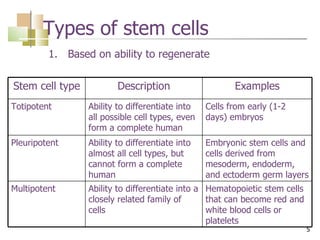
Types of stem cells Based on ability to regenerate Stem cell type Description Examples Totipotent Ability to differentiate into all possible cell types, even form a complete human Cells from early (1-2 days) embryos Pleuripotent Ability to differentiate into almost all cell types, but cannot form a complete human Embryonic stem cells and cells derived from mesoderm, endoderm, and ectoderm germ layers Multipotent Ability to differentiate into a closely related family of cells Hematopoietic stem cells that can become red and white blood cells or platelets
Types of stem cells
Types of stem cells Based on source of stem cells Source: Present in umbilical cord or  placenta of newborn Relatively easy to identify, isolate, grow, and maintain in laboratory Risk of creating teratomas (tumors)  from implanting undifferentiated stem cells Ethical concerns due to destruction of blastocyst Embryonic stem cells
Types of stem cells Adult stem cells Source: Bone marrow, spleen, peripheral blood, fat (in liposuction) Difficult to identify, isolate, grow, and maintain in laboratory Produce limited no. of cell types  No major ethical issues have been raised
Stem cell timeline 1956- First successful bone marrow transplant 1998- The first human embryonic stem cells are isolated 2002- Pancreatic cells derived from mouse embryonic stem cells cure diabetes in mice 2004- The type of nerve cell lost in Parkinson’s disease is produced from human embryonic stem cells
Generation of stem cell lines
Major use of stem cells Bone marrow transplantation Allogenic procedure Autologous procedure
Major use of stem cells Neurological  disorder
The promise of stem cell research
Are the promises of stem cells realistic? The basic research needed to develop viable therapeutic options is a lengthy process that may extend over many years and decades. Legal issues that will affect stem cell applications include how to address intellectual property concerns and how to apply and enforce diverse and sometimes conflicting state and national laws. Social issues include concerns about the destruction of embryos, the distribution of the benefits of the research, and the protection of both physical and privacy interests of egg and sperm donors and clinical research subjects.
Ethical and moral issues Is an embryo a person?  Embryonic stem cell research uses removing inner cell mass from excess blastocysts in IVF treatment. This prevents the blastocysts from continuing to develop into a human being. Some religious groups believe that life of human begins at conception, thus opposing stem cell research. Some groups believe that embryo gains a moral value of a human being only after a few weeks of development (fetus).
Ethical and moral issues Relationship of stem cell research to reproductive cloning: Nuclear transfer  “ Human reproductive cloning should not now be practiced. It is dangerous and likely to fail.” Scientists use nuclear transfer, create blastocyst, remove inner cell mass from them, which is further used to create stem cell lines. Reproductive cloning uses nuclear transfer, create blastocyst, which is then implanted into the uterus and allowed to develop fully.
Ethical and moral issues The ethics of human-animal chimera Chimeras are organisms composed of cells or tissues from more than one individual.  Chimeras considered essential in research, since no therapy can be tested on humans without first testing on animals.  Creation of chimeras morally acceptable as long as the chimera has no sense of human consciousness
Questions?
THANK YOU

Stem Cells L

  • 1.
    UNDERSTANDING STEM CELLSBy- Sayee Jadhav
  • 2.
    Presentation Overview Whatare stem cells? What makes a cell a stem cell? Types of stem cells Stem cell timeline Generation of stem cell lines in the laboratory Major uses of stem cells The promise of stem cells research Are the promises of stem cells realistic? Ethical and moral issues
  • 3.
  • 4.
    What makes acell a stem cell? Self renewing Gives rise to mature, specialized cells Long-term self renewal Unspecialized: Pleuripotent or multipotent
  • 5.
    Types of stemcells Based on ability to regenerate Stem cell type Description Examples Totipotent Ability to differentiate into all possible cell types, even form a complete human Cells from early (1-2 days) embryos Pleuripotent Ability to differentiate into almost all cell types, but cannot form a complete human Embryonic stem cells and cells derived from mesoderm, endoderm, and ectoderm germ layers Multipotent Ability to differentiate into a closely related family of cells Hematopoietic stem cells that can become red and white blood cells or platelets
  • 6.
  • 7.
    Types of stemcells Based on source of stem cells Source: Present in umbilical cord or placenta of newborn Relatively easy to identify, isolate, grow, and maintain in laboratory Risk of creating teratomas (tumors) from implanting undifferentiated stem cells Ethical concerns due to destruction of blastocyst Embryonic stem cells
  • 8.
    Types of stemcells Adult stem cells Source: Bone marrow, spleen, peripheral blood, fat (in liposuction) Difficult to identify, isolate, grow, and maintain in laboratory Produce limited no. of cell types No major ethical issues have been raised
  • 9.
    Stem cell timeline1956- First successful bone marrow transplant 1998- The first human embryonic stem cells are isolated 2002- Pancreatic cells derived from mouse embryonic stem cells cure diabetes in mice 2004- The type of nerve cell lost in Parkinson’s disease is produced from human embryonic stem cells
  • 10.
  • 11.
    Major use ofstem cells Bone marrow transplantation Allogenic procedure Autologous procedure
  • 12.
    Major use ofstem cells Neurological disorder
  • 13.
    The promise ofstem cell research
  • 14.
    Are the promisesof stem cells realistic? The basic research needed to develop viable therapeutic options is a lengthy process that may extend over many years and decades. Legal issues that will affect stem cell applications include how to address intellectual property concerns and how to apply and enforce diverse and sometimes conflicting state and national laws. Social issues include concerns about the destruction of embryos, the distribution of the benefits of the research, and the protection of both physical and privacy interests of egg and sperm donors and clinical research subjects.
  • 15.
    Ethical and moralissues Is an embryo a person? Embryonic stem cell research uses removing inner cell mass from excess blastocysts in IVF treatment. This prevents the blastocysts from continuing to develop into a human being. Some religious groups believe that life of human begins at conception, thus opposing stem cell research. Some groups believe that embryo gains a moral value of a human being only after a few weeks of development (fetus).
  • 16.
    Ethical and moralissues Relationship of stem cell research to reproductive cloning: Nuclear transfer “ Human reproductive cloning should not now be practiced. It is dangerous and likely to fail.” Scientists use nuclear transfer, create blastocyst, remove inner cell mass from them, which is further used to create stem cell lines. Reproductive cloning uses nuclear transfer, create blastocyst, which is then implanted into the uterus and allowed to develop fully.
  • 17.
    Ethical and moralissues The ethics of human-animal chimera Chimeras are organisms composed of cells or tissues from more than one individual. Chimeras considered essential in research, since no therapy can be tested on humans without first testing on animals. Creation of chimeras morally acceptable as long as the chimera has no sense of human consciousness
  • 18.
  • 19.