STEM CELL
THERAPY
Reported by: Janette S.
Sarmiento
Outline
 History of Stem Cell Research
 What are Stem Cells
 Classification of Stem Cells
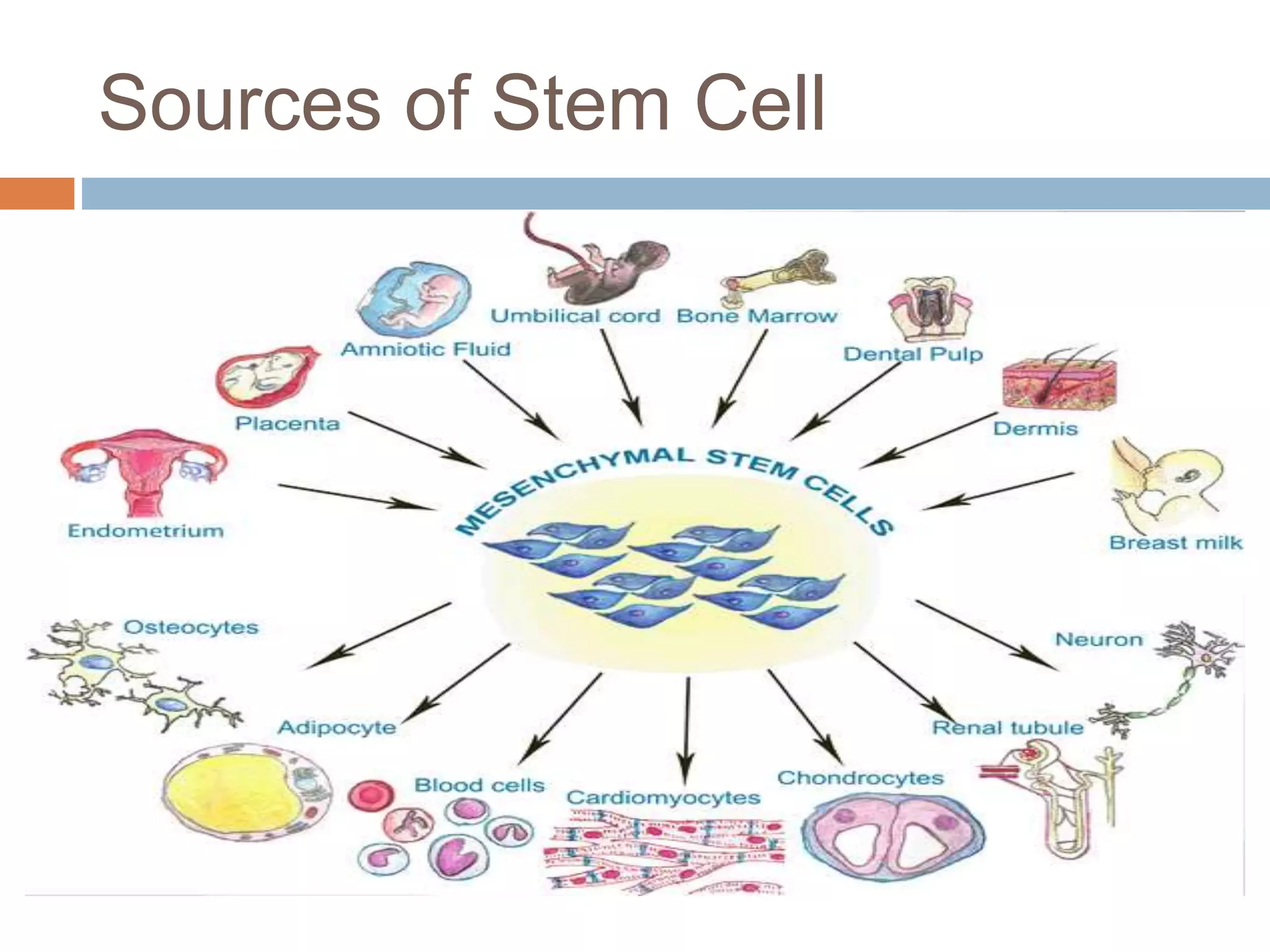
 Sources of Stem Cells
 Potential Uses
 Stem Cell Therapy
 Ethical Issues
 Conclusions
Introduction
 Today living in the 21st century, we
still do not have proper treatments for
many diseases like diabetes,
Parkinson's Disease, Alzheimer's
Disease etc.
 Some light of hope for the treatment
of these incurable diseases is - the
Stem Cells
History of Human Stem Cell
Research
 In 1968, the first bone marrow
transplant was successfully used in
treatment of Severe Combined
Immunodeficiency.
 Since the 1970s, bone marrow
transplants have been used for
treatment of immunodeficiencies and
leukemias.
History of Stem Cell
 1999 - First Successful human
transplant of insulin- making cells
from cadavers •
 2001 – First cloned human embryos
(only to six cell stage) created by
Advanced Cell Technology (USA)
 2004 - Harvard researchers grow
stem cells from embryos
History of Somatic Cell Nuclear
Transfer (Cloning)
 1952 – Briggs and King cloned
tadpoles
 1997 – The first mammal cloned
from adult cells was Dolly, the
sheep
 1998 – Mice cloned
 1998 – Cows cloned
 2000 – Pigs cloned
History of Somatic Cell Nuclear
Transfer (Cloning)
 2001 – Cats cloned
 2002 – Rabbits
cloned
 2003 – Mule cloned
 2004 – Bull cloned
 2005 – Dog cloned
Stem Cell
 Foundation for every organ and
tissue in your body.
 Self-renew (make copies of
themselves) and differentiate
(develop into more specialized cells.
 Have unique properties.
Classification of Stem Cell
Sources of Stem Cell
Potential Use
 Basic Research
 Biotechnology
 Cell Based Therapies
Stem Cell Therapy
 Stem cell therapy is introduction of new adult
stem cells into damaged tissue in order to
treat disease or injury.
 The ability of stem cells to self-renew and
give rise to different cells, that can potentially
replace diseased and damaged areas in the
body, with minimal risk of rejection and side
effects.
 A number of stem cell therapies exist, but
most are at experimental stages, costly or
What Diseases Can be Cured by
Stem Cell Therapies?
 Any disease in which there is tissue
degeneration can be a potential candidate for
stem cell therapies
Alzheimer’s disease
 Parkinson’s disease
Spinal cord injury
Heart disease
Severe burns
Diabetes
Tissue Repair
Regenerate
spinal cord,
heart tissue or
any other major
tissue in the
body.
Heart Disease
Adult bone
marrow stem cells
injected into the
hearts are
believed to
improve cardiac
function in victims
of heart failure or
heart attack
Leukemia and Cancer
• Leukemia patients
treated with stem
cells emerge free of
disease.
• Stem cells have
also reduces
pancreatic cancers
in some patients.
Rheumatoid Arthritis
Adult Stem
Cells may be
helpful in
starting repair of
eroded
cartilage.
Type I Diabetes
Embryonic
Stems Cells
might be trained
to become
pancreatic islets
cells needed to
secrete insulin.
Parkinson’s Disease
Use of stem cells
to replace
dopamine-
producing
neurons
Challenges to Stem Cell
Research
 Source - Cell lines may have mutations
 Delivery to target areas
 Prevention of rejection
 Suppressing tumors
 Stem Cell regenerated tissue viability
 Political and religious obstructions
 Inability to obtain source material due to
ethical concerns
EMBRYONIC STEM CELL
CONTROVERSY
There is wide-spread controversy
over the use of human embryonic
stem cells. This controversy primarily
targets the techniques used to derive
new embryonic stem cell lines, which
often requires the destruction of the
blastocyst.
The Ethical Debate
In favor of ESCR:
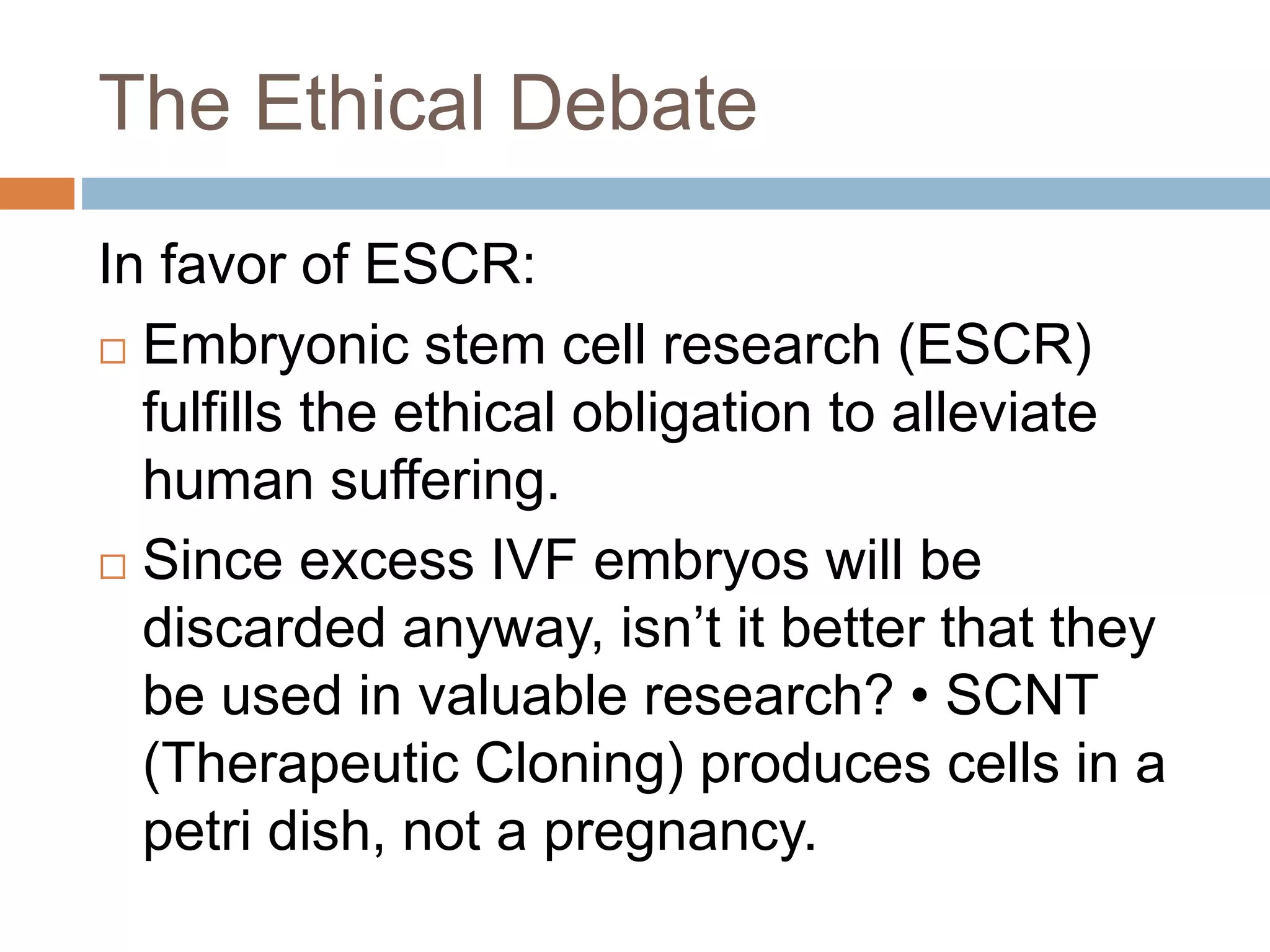
 Embryonic stem cell research (ESCR)
fulfills the ethical obligation to alleviate
human suffering.
 Since excess IVF embryos will be
discarded anyway, isn’t it better that they
be used in valuable research? • SCNT
(Therapeutic Cloning) produces cells in a
petri dish, not a pregnancy.
The Ethical Debate
Against ESCR
 In ESCR, stem cells are taken from a
human blastocyst, which is then
destroyed. This amounts to “murder.”
 There is a risk of commercial exploitation
of the human participants in ESCR.
 ESCR will lead to reproductive cloning.
Day 5-6 Blastocyst
Stem Cell Ethics
 This is an ethical issue.
 Science is designed to tell us what is
possible – what we can do.
 Science is not designed to tell us what is
right – what we should do.
 To evaluate this technology one must
employ some ethical system that comes
from outside of science.
Stem Cell Ethics
 Encourage development of sound
research and therapy.
 Prevent any misuse of human
embryos and fetuses.
 Protect patients from fraudulent
treatments in the name of stem cell
research.
Conclusions
 Stem cells show great promise for
regenerative medicine
 There is enormous potential in human
stem cell research. (Both adult and
embryonic stem cells should be studied)
 Much research needed before therapies
are realized
 Ethical concerns need to be taken into
account
Stem cell therapy

Stem cell therapy

  • 1.
    STEM CELL THERAPY Reported by:Janette S. Sarmiento
  • 2.
    Outline  History ofStem Cell Research  What are Stem Cells  Classification of Stem Cells  Sources of Stem Cells  Potential Uses  Stem Cell Therapy  Ethical Issues  Conclusions
  • 3.
    Introduction  Today livingin the 21st century, we still do not have proper treatments for many diseases like diabetes, Parkinson's Disease, Alzheimer's Disease etc.  Some light of hope for the treatment of these incurable diseases is - the Stem Cells
  • 4.
    History of HumanStem Cell Research  In 1968, the first bone marrow transplant was successfully used in treatment of Severe Combined Immunodeficiency.  Since the 1970s, bone marrow transplants have been used for treatment of immunodeficiencies and leukemias.
  • 5.
    History of StemCell  1999 - First Successful human transplant of insulin- making cells from cadavers •  2001 – First cloned human embryos (only to six cell stage) created by Advanced Cell Technology (USA)  2004 - Harvard researchers grow stem cells from embryos
  • 6.
    History of SomaticCell Nuclear Transfer (Cloning)  1952 – Briggs and King cloned tadpoles  1997 – The first mammal cloned from adult cells was Dolly, the sheep  1998 – Mice cloned  1998 – Cows cloned  2000 – Pigs cloned
  • 7.
    History of SomaticCell Nuclear Transfer (Cloning)  2001 – Cats cloned  2002 – Rabbits cloned  2003 – Mule cloned  2004 – Bull cloned  2005 – Dog cloned
  • 8.
    Stem Cell  Foundationfor every organ and tissue in your body.  Self-renew (make copies of themselves) and differentiate (develop into more specialized cells.  Have unique properties.
  • 9.
  • 10.
  • 11.
    Potential Use  BasicResearch  Biotechnology  Cell Based Therapies
  • 12.
    Stem Cell Therapy Stem cell therapy is introduction of new adult stem cells into damaged tissue in order to treat disease or injury.  The ability of stem cells to self-renew and give rise to different cells, that can potentially replace diseased and damaged areas in the body, with minimal risk of rejection and side effects.  A number of stem cell therapies exist, but most are at experimental stages, costly or
  • 13.
    What Diseases Canbe Cured by Stem Cell Therapies?  Any disease in which there is tissue degeneration can be a potential candidate for stem cell therapies Alzheimer’s disease  Parkinson’s disease Spinal cord injury Heart disease Severe burns Diabetes
  • 14.
    Tissue Repair Regenerate spinal cord, hearttissue or any other major tissue in the body.
  • 15.
    Heart Disease Adult bone marrowstem cells injected into the hearts are believed to improve cardiac function in victims of heart failure or heart attack
  • 16.
    Leukemia and Cancer •Leukemia patients treated with stem cells emerge free of disease. • Stem cells have also reduces pancreatic cancers in some patients.
  • 17.
    Rheumatoid Arthritis Adult Stem Cellsmay be helpful in starting repair of eroded cartilage.
  • 18.
    Type I Diabetes Embryonic StemsCells might be trained to become pancreatic islets cells needed to secrete insulin.
  • 19.
    Parkinson’s Disease Use ofstem cells to replace dopamine- producing neurons
  • 20.
    Challenges to StemCell Research  Source - Cell lines may have mutations  Delivery to target areas  Prevention of rejection  Suppressing tumors  Stem Cell regenerated tissue viability  Political and religious obstructions  Inability to obtain source material due to ethical concerns
  • 21.
    EMBRYONIC STEM CELL CONTROVERSY Thereis wide-spread controversy over the use of human embryonic stem cells. This controversy primarily targets the techniques used to derive new embryonic stem cell lines, which often requires the destruction of the blastocyst.
  • 22.
    The Ethical Debate Infavor of ESCR:  Embryonic stem cell research (ESCR) fulfills the ethical obligation to alleviate human suffering.  Since excess IVF embryos will be discarded anyway, isn’t it better that they be used in valuable research? • SCNT (Therapeutic Cloning) produces cells in a petri dish, not a pregnancy.
  • 23.
    The Ethical Debate AgainstESCR  In ESCR, stem cells are taken from a human blastocyst, which is then destroyed. This amounts to “murder.”  There is a risk of commercial exploitation of the human participants in ESCR.  ESCR will lead to reproductive cloning. Day 5-6 Blastocyst
  • 24.
    Stem Cell Ethics This is an ethical issue.  Science is designed to tell us what is possible – what we can do.  Science is not designed to tell us what is right – what we should do.  To evaluate this technology one must employ some ethical system that comes from outside of science.
  • 25.
    Stem Cell Ethics Encourage development of sound research and therapy.  Prevent any misuse of human embryos and fetuses.  Protect patients from fraudulent treatments in the name of stem cell research.
  • 26.
    Conclusions  Stem cellsshow great promise for regenerative medicine  There is enormous potential in human stem cell research. (Both adult and embryonic stem cells should be studied)  Much research needed before therapies are realized  Ethical concerns need to be taken into account

Editor's Notes

  • #4 Research on stem cells is advancing How an organism develops from a single cell and how healthy cells replace damaged cells in adult organisms. This promising area of science - investigates the possibility of cell-based therapies to treat disease, which is often referred to as regenerative or reparative medicine
  • #9 A cell that has the ability to continuously divide and differentiate (develop) into various other kind(s) of cells/tissues. Stem cells are capable of dividing & renewing themselves for long periods – This is unlike muscle, blood or nerve cells – which do not normally replicate themselves – These cells are capable of long-term self-renewal Unique Properties – undifferentiated/unspecialized cells. Undifferentiated cells can differentiate to yield major specialized cell types or organs. Self renewal property is to maintain and repair the tissue. Thus they have potential to replace cell tissue damaged by severe illnesses.
  • #10 Totipotent – the ability to differentiate into all types; can form any cell of the embryo as well as the placenta – Ex: morula Pluripotent – the ability to differentiate into almost all types except placental tissue – Ex: cells from inner cell mass of blastocyst Multipotent – can differentiate into multiple specialized cells of a closely related family of cells – Ex: hematopoietic stem cells Oligopotent – the ability to differentiate into a few cells – Ex: lymphoid Unipotent – these cells only produce one cell type., but have the property of self renewal which distinguishes them from the non stem cells – Ex: muscle stem cells, cardiac stem cells
  • #11 Spare embryo - Stem cells from leftover embryos stored at fertility clinics Special purpose embryos - Created via in vitro fertilization for the sole purpose of extracting stem cells Cloned embryos - Cloned in labs using somatic nucleus transfer method. (A nucleus from an adult donor cell is inserted into a recipient egg cell from which the nucleus has been removed. The resulting cell is then stimulated to divide as a zygote later forming embryo genetically identical to the adult donor cell Aborted fetuses - Stem cells from fetuses aborted at early development stage Umbilical cords - After child birth Adult tissue or organ - Obtained during surgery Cadavers - Neural post genitor cells from human post mortem tissues
  • #12 Basic research – clarification of complex events that occur during human development & understanding molecular basis of cancer (- Molecular mechanisms for gene control – Role of signals in gene expression & differentiation of the stem cell – Stem cell theory of cancer) Biotechnology(drug discovery & development) – stem cells can provide specific cell types to test new drugs (– Safety testing of new drugs on differentiated cell lines – Screening of potential drugs • Cancer cell lines are already being used to screen potential anti-tumor drugs • Availability of pluripotent stem cells would allow drug testing in a wider range of cell types & to reduce animal testing) Cell based therapies: – Regenerative therapy to treat Parkinson’s, Alzheimer’s, spinal cord injury, stroke, severe burns, heart disease, diabetes, osteoarthritis, and rheumatoid arthritis (– Stem cells in gene therapy • Stem cells as vehicles after they have been genetically manipulated – Stem cells in therapeutic cloning – Stem cells in cancer)
  • #16 VESCELL ADULT STEM CELL THERAPY FOR HEART DISEASES This method is used to treat heart diseases like Coronary Artery Disease, cardiomyopathy and congestive heart failure. The stem cells are derived from the patients own body so there is no possibility of rejection of the stem cells. This therapy helps in the reduction of dependence on nitro tablets. Vescell therapy creates new blood vessels that improve blood flow to the heart as well as generate new tissues in the heart muscle itself.
  • #17 Successful treatment for leukemia focuses on the removal of all the abnormal leukocytes in the patient allowing healthy ones to grow in their place. When chemotherapy is not possible, bone marrow transplant is done. In bone marrow transplant, the patients bone marrow stem cells are replaced with those from a healthy donor.
  • #19 This is to stop taking insulin injections as the body starts to produce insulin naturally again. young type I diabetic patients were given drugs to suppress immune system followed by transfusion of stem cells drawn from their own blood. The results showed that patients started producing their own insulin. Therefore the dependence on insulin needles was eliminated with the help of an injection of their own stem cells.
  • #20 Cell replacement therapies in which dopamine-producing stem cells are transplanted into Parkinson’s disease patients could improve motor symptoms, reducing or eliminating the need for dopaminergic medicines, a study suggests. Dead nerve cells not producing dopamine Implanted stem cells New nerve cells producing dopamine Dopamine transmit nerve signal
  • #22 At present, there are alternative sources for stem cells which have achieved considerable success when used as medical therapies. These alternatives do not require the destruction of an embryo, such as the use of umbilical cord blood, milky teeth stem cells, bone marrow stem cells or using induced pluripotent stem cells. However, non-embryonic stem cells may have limitations.