
Business statistics
abm-403
Presented by:
Hina Varshney
B.Com IV Sem
12D012
TOPIC: Statistical Error,
Enquiry, Census vs.
Sample Method Of
Investigation
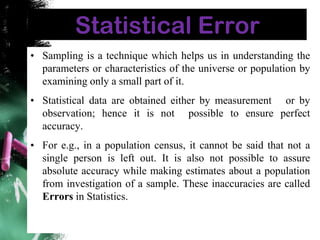
Statistical Error
• Sampling is a technique which helps us in understanding the
parameters or characteristics of the universe or population by
examining only a small part of it.
• Statistical data are obtained either by measurement or by
observation; hence it is not possible to ensure perfect
accuracy.
• For e.g., in a population census, it cannot be said that not a
single person is left out. It is also not possible to assure
absolute accuracy while making estimates about a population
from investigation of a sample. These inaccuracies are called
Errors in Statistics.
Types of Statistical Errors
• There are two types of statistical error:
 Sampling errors
 Non- sampling errors
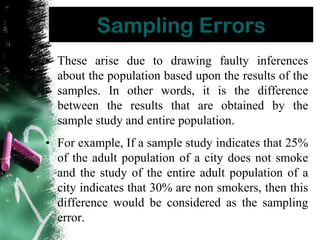
Sampling Errors
• These arise due to drawing faulty inferences
about the population based upon the results of the
samples. In other words, it is the difference
between the results that are obtained by the
sample study and entire population.
• For example, If a sample study indicates that 25%
of the adult population of a city does not smoke
and the study of the entire adult population of a
city indicates that 30% are non smokers, then this
difference would be considered as the sampling
error.
REASONS OF SAMPLING
ERRORS
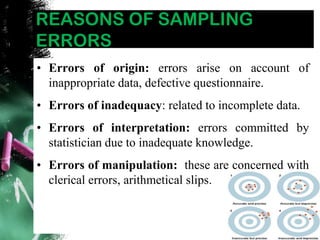
• Errors of origin: errors arise on account of
inappropriate data, defective questionnaire.
• Errors of inadequacy: related to incomplete data.
• Errors of interpretation: errors committed by
statistician due to inadequate knowledge.
• Errors of manipulation: these are concerned with
clerical errors, arithmetical slips.
Categories of sampling errors
• Biased errors: arise due to biased or prejudice
attitude of the informants, enumerator or
investigator in selecting ,estimating, or
measuring instruments.
• Unbiased errors: arise in the normal course of
investigation or enumeration on account of
chance. These errors can be avoid or removed
with proper planning of statistical
investigations.
NON SAMPLING ERRORS
• Non-sampling errors are introduced due to
technically faulty observations or during the
processing of data. These errors could also arise
due to defective methods of data collection,
incomplete coverage of the population because
some units of the population are not available
for study.
• For e.g.. Counting of illiterate person in state.
STATISTICAL ENQUIRY
• Statistical enquiry refers to search for the
collection of facts of a given problem. The
collected data are the raw material, through
which the problem is to be studied. The
relevant collection of information by any
agency to tackle a particular problem under
study is termed as surveyor enquiry.
CENSUS V/S SAMPLE
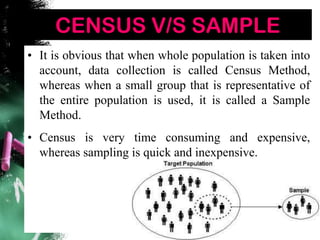
• It is obvious that when whole population is taken into
account, data collection is called Census Method,
whereas when a small group that is representative of
the entire population is used, it is called a Sample
Method.
• Census is very time consuming and expensive,
whereas sampling is quick and inexpensive.
CENSUS V/S SAMPLE
• Data from census is reliable and accurate, there is
a margin of error in data obtained from sampling.
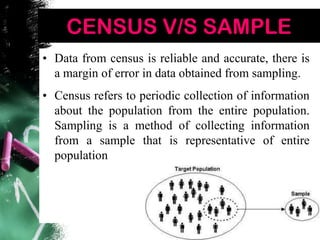
• Census refers to periodic collection of information
about the population from the entire population.
Sampling is a method of collecting information
from a sample that is representative of entire
population
References
• DEI Study Material
• http://bhanusigdel.wordpress.com/2011/11/17/c
ensus-and-sampling-method/
• JHAWAHAR PUBLICATION
• Sahitya bhawan: Statistics by B.N Gupta

statistical error, enquiry, census vs. sample

  • 1.
  • 2.
    TOPIC: Statistical Error, Enquiry,Census vs. Sample Method Of Investigation
  • 3.
    Statistical Error • Samplingis a technique which helps us in understanding the parameters or characteristics of the universe or population by examining only a small part of it. • Statistical data are obtained either by measurement or by observation; hence it is not possible to ensure perfect accuracy. • For e.g., in a population census, it cannot be said that not a single person is left out. It is also not possible to assure absolute accuracy while making estimates about a population from investigation of a sample. These inaccuracies are called Errors in Statistics.
  • 4.
    Types of StatisticalErrors • There are two types of statistical error:  Sampling errors  Non- sampling errors
  • 5.
    Sampling Errors • Thesearise due to drawing faulty inferences about the population based upon the results of the samples. In other words, it is the difference between the results that are obtained by the sample study and entire population. • For example, If a sample study indicates that 25% of the adult population of a city does not smoke and the study of the entire adult population of a city indicates that 30% are non smokers, then this difference would be considered as the sampling error.
  • 6.
    REASONS OF SAMPLING ERRORS •Errors of origin: errors arise on account of inappropriate data, defective questionnaire. • Errors of inadequacy: related to incomplete data. • Errors of interpretation: errors committed by statistician due to inadequate knowledge. • Errors of manipulation: these are concerned with clerical errors, arithmetical slips.
  • 7.
    Categories of samplingerrors • Biased errors: arise due to biased or prejudice attitude of the informants, enumerator or investigator in selecting ,estimating, or measuring instruments. • Unbiased errors: arise in the normal course of investigation or enumeration on account of chance. These errors can be avoid or removed with proper planning of statistical investigations.
  • 8.
    NON SAMPLING ERRORS •Non-sampling errors are introduced due to technically faulty observations or during the processing of data. These errors could also arise due to defective methods of data collection, incomplete coverage of the population because some units of the population are not available for study. • For e.g.. Counting of illiterate person in state.
  • 9.
    STATISTICAL ENQUIRY • Statisticalenquiry refers to search for the collection of facts of a given problem. The collected data are the raw material, through which the problem is to be studied. The relevant collection of information by any agency to tackle a particular problem under study is termed as surveyor enquiry.
  • 10.
    CENSUS V/S SAMPLE •It is obvious that when whole population is taken into account, data collection is called Census Method, whereas when a small group that is representative of the entire population is used, it is called a Sample Method. • Census is very time consuming and expensive, whereas sampling is quick and inexpensive.
  • 11.
    CENSUS V/S SAMPLE •Data from census is reliable and accurate, there is a margin of error in data obtained from sampling. • Census refers to periodic collection of information about the population from the entire population. Sampling is a method of collecting information from a sample that is representative of entire population
  • 12.
    References • DEI StudyMaterial • http://bhanusigdel.wordpress.com/2011/11/17/c ensus-and-sampling-method/ • JHAWAHAR PUBLICATION • Sahitya bhawan: Statistics by B.N Gupta