Laws of electrostatics
Principles of electrostatics
Applications of electrostatics

Laws of electrostatics
Describe experiments to show electrostatic charging by friction.

 Apparatus:
 Plastic straw
 Tissue paper &
 A4 paper.
 Procedure:
 Tear off several bits of paper about the size of a pea or
smaller and place them on a table or counter. Bring the
straw near to the paper bits. What happens?
 Rub the tissue to the straw and again bring the comb
near the bits of paper. What happens now?
Charging by Friction

 What Happened:
 The first time you brought the straw near the paper bits,
nothing happened, but when you rub the straw with a
tissue, you gave the straw a charge of static electricity
 Then, when you brought the straw near the paper bits, they
were attracted to the straw because of this charge.

 Materials Needed:
 Plastic straw
 Tissue paper
 Faucet.
 Procedure:
 Just barely open a water faucet so that you get a very
fine stream of water flowing.
 Then, rub the straw with the tissue. Slowly bring the
comb near the stream of water. What do you see?

Laws of electrostatics
Explain that charging of solids involves a movement of electrons.

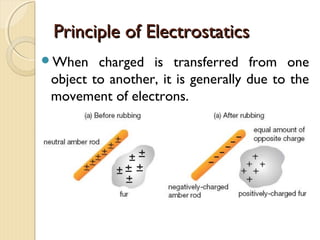
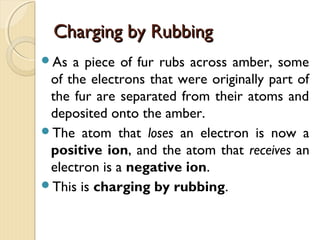
 When charged is transferred from one object to
another, it is generally due to the movement of
electrons.
Charging by Friction

Laws of electrostatics
State that there are positive and negative charges and that charge
is measured in coulombs.

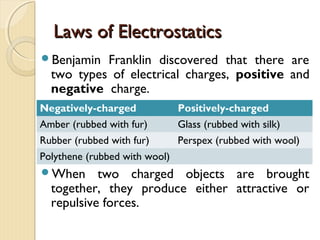
 Benjamin Franklin discovered that there are two
types of electrical charges, positive and negative
charge.
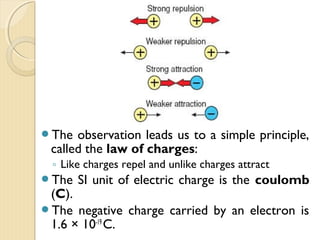
 The SI unit of electric charge is the coulomb (C).
Type of Charges

Laws of electrostatics
State that unlike charges attract and like charges repel.

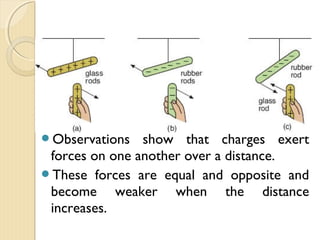
 Observations show that charges exert forces on one
another over a distance.
 These forces are equal and opposite and become
weaker when the distance increases.
 When two charged objects are brought together, they
produce either attractive or repulsive forces.
 The observation leads us to a simple principle, called
the law of charges:
 Like charges repel and unlike charges attract
Law of Charges


Laws of electrostatics
Describe an electric field as a region in which an electric charge
experiences a force.

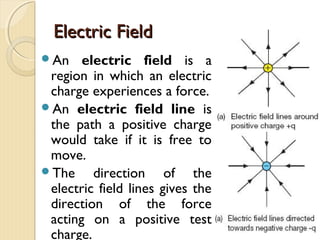
 An electric field is a region in which an electric
charge experiences a force.
 An electric field line is the path a positive charge
would take if it is free to move.
Electric Field

Laws of electrostatics
State the direction of lines of force and describe simple field
patterns.

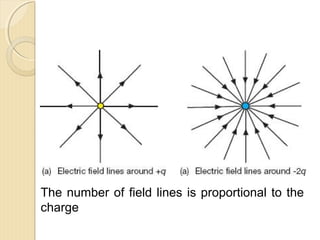
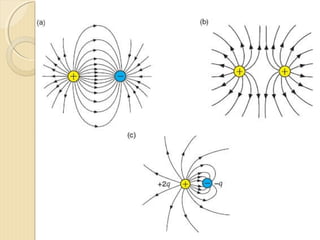
 The direction of the electric field lines gives the
direction of the force acting on a positive test charge.
 To sketch the combined electric field, the electric
lines of force are drawn by following the rules below:
 The lines must begin from positive charges and end on
negative charges.
 The number of lines drawn leaving a positive chare or
ending on a negative charge is proportional to the
magnitude of the charge.
 No two field lines can cross each other.
Electric Field Lines

The number of field lines is proportional to the charge


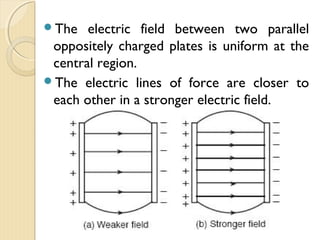
 The electric field between two parallel oppositely
charged plates is uniform at the central region.
 The electric lines of force are closer to each other in a
stronger electric field.

Principles of
Electrostatics
Describe the separation of charges by induction.

 Induction is the production of
electric charge on the surface
of a conductor under the
influence of an electric field.
 The advantage of charging by
induction is that it can be
repeated many times without
any loss of charge form the
inducing specimen like the
negatively charged rod .
Charging by Induction

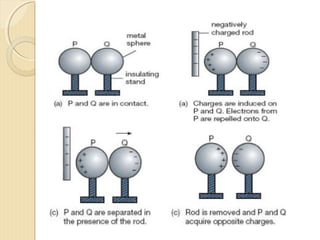
Induction
 P and Q are in contact

Induction
 Charges are induced on
P and Q.
 Electrons from P are
repelled onto Q

Induction
 P and Q are separated
on the presence of the
rod.

Induction
 Rod is removed.
 P and Q acquire
opposite charges

Principles of
Electrostatics
Discuss the differences between electrical conductors and
insulators and state examples of each.

 The behavior of an object which has been charged is
dependent upon whether the object is made of a
conductive or a nonconductive material.
 Conductors are materials which permit electrons to
flow freely from atom to atom and molecule to
molecule.
 An object made of a conducting material will permit
charge to be transferred across the entire surface of
the object.
Conductors & Insulators

 Insulators are materials which impede the free flow
of electrons from atom to atom and molecule to
molecule.
 The particles of the insulator do not permit the free
flow of electrons; subsequently charge is seldom
distributed evenly across the surface of an insulator.

Conductors Insulators
Metals Plastics
Aqueous Solution of Salts Glass
Graphite Paper
Water Rubber
Human Body Dry air

Principles of
Electrostatics
State what is meant by “earthing” a charged object.

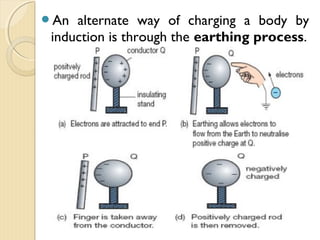
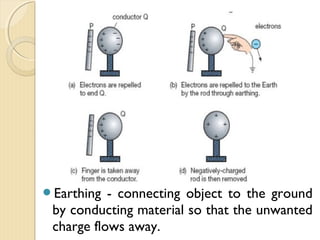
 Earthing or grounding means making objects neutral
or uncharged.
 If object is negatively charged than taking its
electrons or if it is positively charged than make it
gain electrons.
Earthing

Negatively Sphere
 When a positively
charged rod is brought
near conductor Q,
electrons are attracted
to end P.

Negatively Sphere
 Earthing allows
electrons to flow from
the Earth to neutralise
positive charge at Q

Negatively Sphere
 Earth is taken away
from the conductor

Negatively Sphere
 Positively charged rod
is then removed

Positively Sphere
 As a negatively charge
rod is brought near to
the conductor, electrons
are repelled to end Q

Positively Sphere
 Electrons are repelled
to the Earth by the rod
through earthing

Positively Sphere
 Earthing is removed
from the conductor

Positively Sphere
 Negatively-charged rod
is then removed

Applications of
Electrostatics
Describe examples where charging could be a problem, e.g.
lightning.

Electrostatic Spark
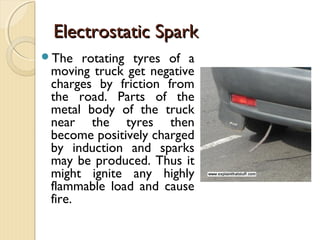
 Electric charges can accumulate on trucks due
to friction between road and tyres of truck. Sparks
may be produced when discharging happens. This
will cause any flammable materials that the trucks
are carrying to catch fire or explode.

 Connect a metal chain at the rear end of truck to the
ground to provide a discharging path for excess
charges.

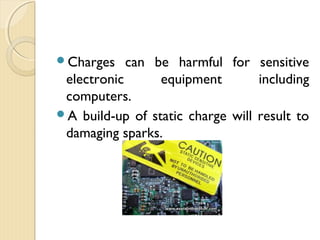
 Charges can be harmful for sensitive electronic
equipment including computers.
 A build-up of static charge will result to damaging
sparks.

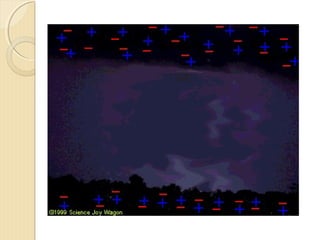
 As the negative charges collect at the bottom of the cloud
it forces the negative charges in the ground to be forced
away from the surface. This leaves the ground positive.
 A streamer of negative charges is repelled by the bottom
of the cloud and attracted by the ground.
 As this streamer of negative charges approaches the
ground, a streamer of positive charges is repelled by the
ground and attracted to the negative streamer.
 When the two streamers connect, they have created a
fairly conductive path which allows a sudden down surge
of electrons to jump to the ground. This is the lightning.
Lightning

 Lightning conductors are fitted on top of tall
buildings to provide a discharge path for excessive
electrons in the air to flow from the top of the
building into earth.


Applications of
Electrostatics
Describe examples where charging is helpful, e.g. photocopier and
electrostatic precipitator.

Electrostatic Paint
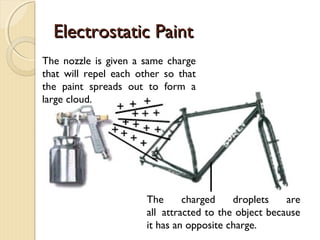
The nozzle is given a same
charge that will repel each
other so that the paint spreads
out to form a large cloud.
The charged droplets are
all attracted to the object
because it has an opposite
charge.

Photocopy Machine

Electrostatic Precipitator

1. A plastic rod is rubbed with a dry cloth and
becomes positively charged.
2. Why has the rod become positively charged?
A. It has gained electrons.
B. It has gained neutrons.
C. It has lost electrons.
D. It has lost neutrons.

2. A perspex rod can be charged positively by rubbing
it with a woollen cloth.
3. How does the rod gain its charge?
A. The rod gains electrons.
B. The rod gains protons.
C. The rod loses electrons.
D. The rod loses protons.

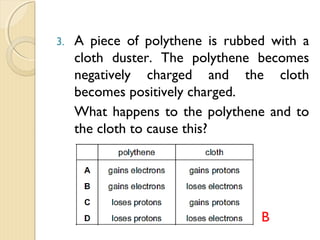
3. A piece of polythene is rubbed with a cloth duster.
The polythene becomes negatively charged and the
cloth becomes positively charged.
4. What happens to the polythene and to the cloth to
cause this?
B

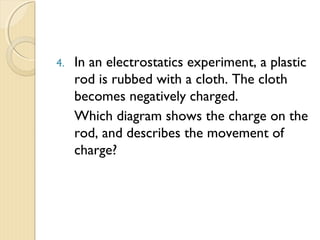
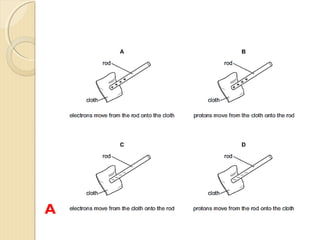
4. In an electrostatics experiment, a plastic rod is
rubbed with a cloth. The cloth becomes negatively
charged.
5. Which diagram shows the charge on the rod, and
describes the movement of charge?

A

5. When a plastic comb is placed next to a small piece
of aluminium foil hanging from a nylon thread, the
foil is repelled by the comb.
6. Why is this?
A. The comb is charged and the foil is uncharged.
B. The comb is uncharged and the foil is charged.
C. The comb and the foil have charge of opposite signs.
D. The comb and the foil have charge of the same sign.

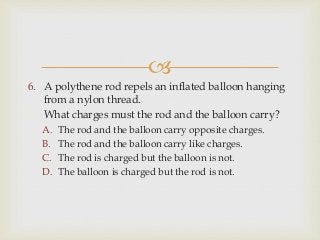
6. A polythene rod repels an inflated balloon hanging
from a nylon thread.
7. What charges must the rod and the balloon carry?
A. The rod and the balloon carry opposite charges.
B. The rod and the balloon carry like charges.
C. The rod is charged but the balloon is not.
D. The balloon is charged but the rod is not.

7. A negatively-charged balloon is brought towards a
wall.
8. Which statement explains what happens?
A. Negative charges on the balloon attract the negative
charges in the wall.
B. Negative charges on the balloon have no effect on the
charges in the wall.
C. Negative charges on the balloon repel the negative
charges in the wall.
D. Negative charges on the balloon repel the positive
charges in the wall.

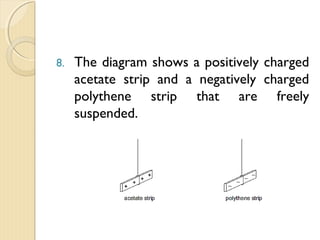
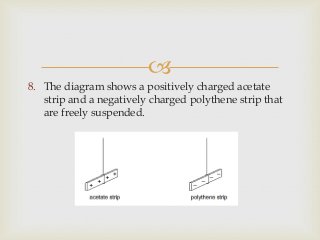
8. The diagram shows a positively charged acetate
strip and a negatively charged polythene strip that
are freely suspended.

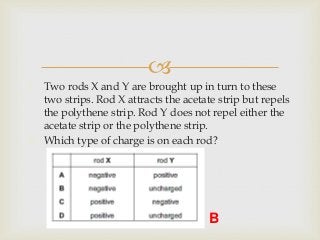
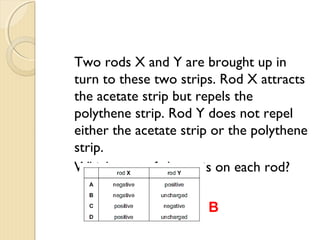
1. Two rods X and Y are brought up in turn to these
two strips. Rod X attracts the acetate strip but repels
the polythene strip. Rod Y does not repel either the
acetate strip or the polythene strip.
2. Which type of charge is on each rod?
B

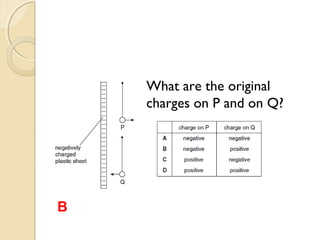
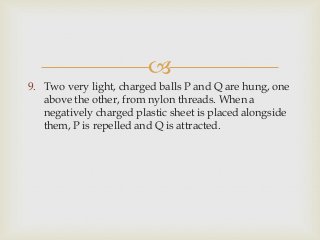
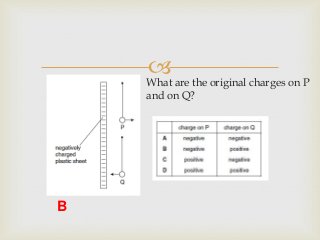
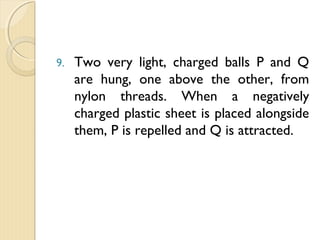
9. Two very light, charged balls P and Q are hung, one
above the other, from nylon threads. When a
negatively charged plastic sheet is placed alongside
them, P is repelled and Q is attracted.

What are the original charges on P
and on Q?
B

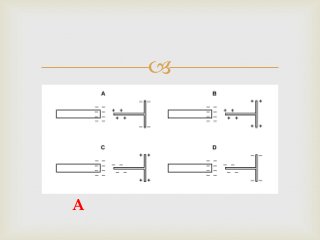
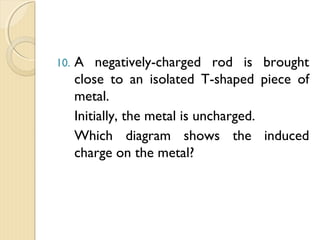
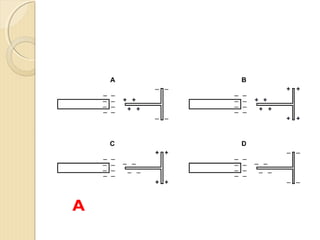
10. A negatively-charged rod is brought close to an
isolated T-shaped piece of metal.
11. Initially, the metal is uncharged.
12. Which diagram shows the induced charge on the
metal?

A

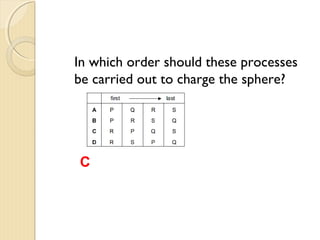
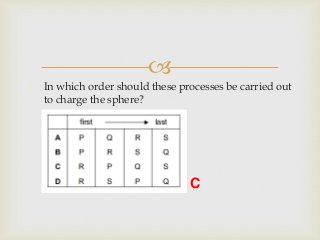
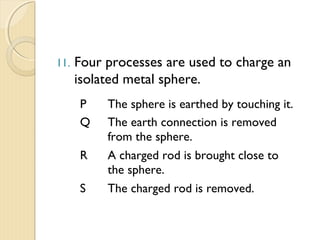
11. Four processes are used to charge an isolated metal
sphere.
P The sphere is earthed by touching it.
Q The earth connection is removed from the sphere.
R A charged rod is brought close to the sphere.
S The charged rod is removed.

1. In which order should these processes be carried out
to charge the sphere?
C

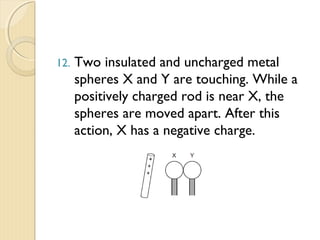
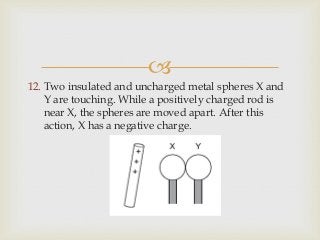
12. Two insulated and uncharged metal spheres X and
Y are touching. While a positively charged rod is
near X, the spheres are moved apart. After this
action, X has a negative charge.

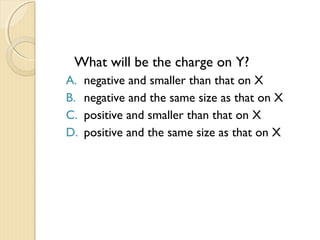
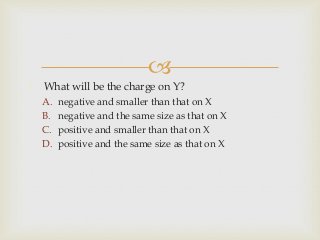
1. What will be the charge on Y?
A. negative and smaller than that on X
B. negative and the same size as that on X
C. positive and smaller than that on X
D. positive and the same size as that on X

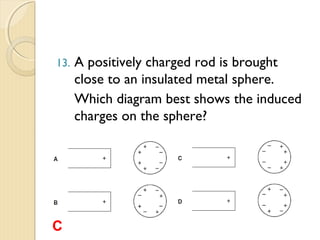
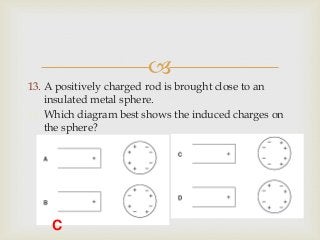
13. A positively charged rod is brought close to an
insulated metal sphere.
14. Which diagram best shows the induced charges on
the sphere?
C

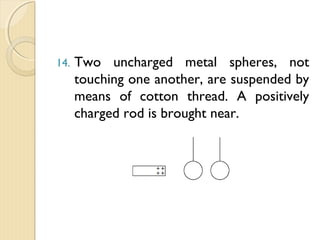
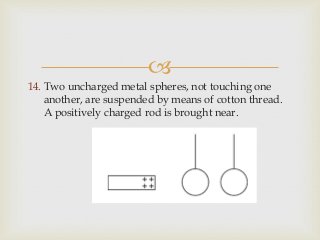
14. Two uncharged metal spheres, not touching one
another, are suspended by means of cotton thread.
A positively charged rod is brought near.

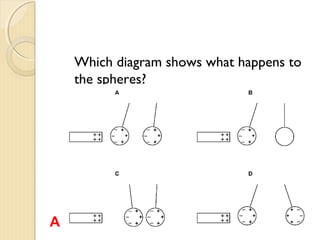
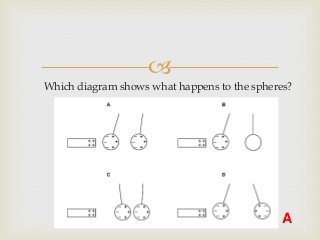
1. Which diagram shows what happens to the spheres?
A

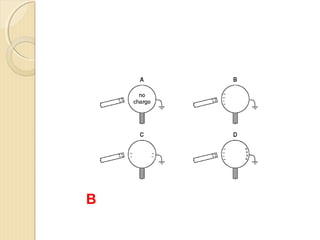
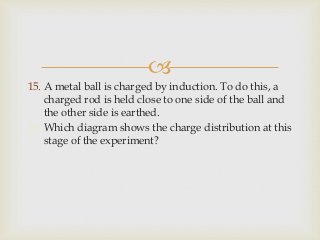
15. A metal ball is charged by induction. To do this, a
charged rod is held close to one side of the ball and
the other side is earthed.
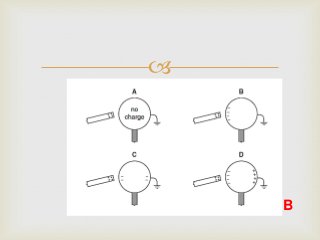
16. Which diagram shows the charge distribution at this
stage of the experiment?

B

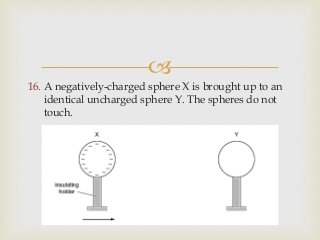
16. A negatively-charged sphere X is brought up to an
identical uncharged sphere Y. The spheres do not
touch.

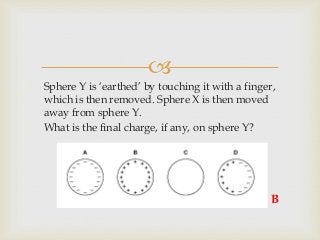
1. Sphere Y is ‘earthed’ by touching it with a finger,
which is then removed. Sphere X is then moved
away from sphere Y.
2. What is the final charge, if any, on sphere Y?
B
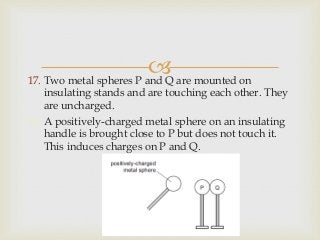
17. Two metal spheres P and Q are mounted on
insulating stands and are touching each other. They
are uncharged.
18. A positively-charged metal sphere on an insulating
handle is brought close to P but does not touch it.
This induces charges on P and Q.

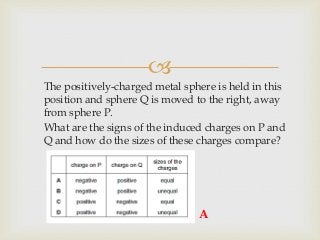
1. The positively-charged metal sphere is held in this
position and sphere Q is moved to the right, away
from sphere P.
2. What are the signs of the induced charges on P and
Q and how do the sizes of these charges compare?
A

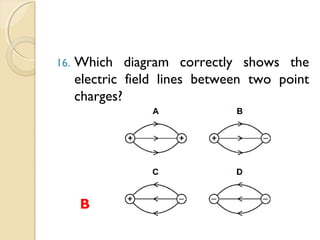
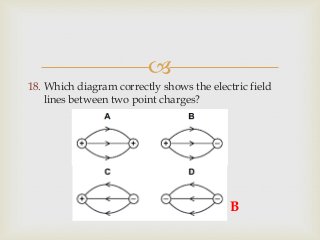
18. Which diagram correctly shows the electric field
lines between two point charges?
B

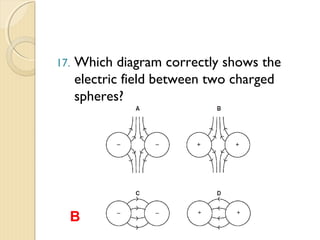
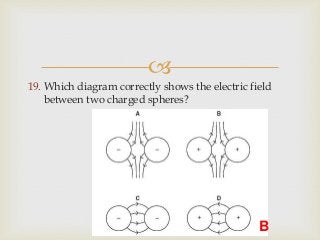
19. Which diagram correctly shows the electric field
between two charged spheres?
B

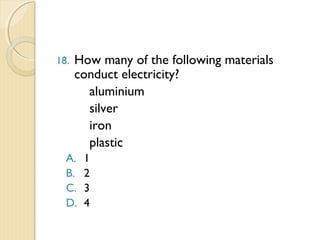
20. How many of the following materials conduct
electricity?
• aluminium
• silver
• iron
• plastic
A. 1
B. 2
C. 3
D. 4

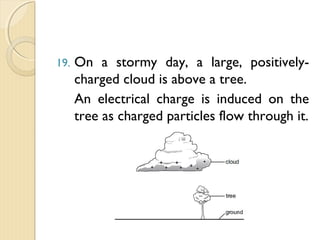
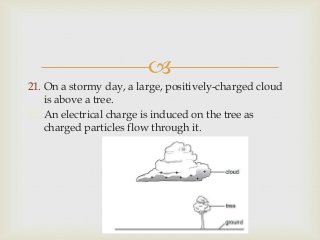
21. On a stormy day, a large, positively-charged cloud
is above a tree.
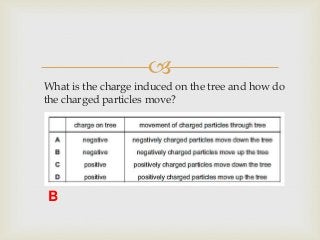
22. An electrical charge is induced on the tree as
charged particles flow through it.

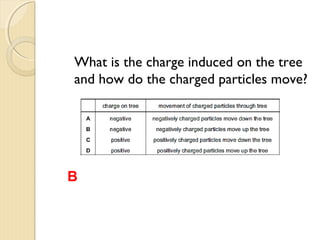
1. What is the charge induced on the tree and how do
the charged particles move?
B

Static Electricity

  • 1.
    Laws of electrostatics Principlesof electrostatics Applications of electrostatics
  • 2.
     Laws of electrostatics Describeexperiments to show electrostatic charging by friction.
  • 3.
      Apparatus:  Plasticstraw  Tissue paper &  A4 paper.  Procedure:  Tear off several bits of paper about the size of a pea or smaller and place them on a table or counter. Bring the straw near to the paper bits. What happens?  Rub the tissue to the straw and again bring the comb near the bits of paper. What happens now? Charging by Friction
  • 4.
      What Happened: The first time you brought the straw near the paper bits, nothing happened, but when you rub the straw with a tissue, you gave the straw a charge of static electricity  Then, when you brought the straw near the paper bits, they were attracted to the straw because of this charge.
  • 5.
      Materials Needed: Plastic straw  Tissue paper  Faucet.  Procedure:  Just barely open a water faucet so that you get a very fine stream of water flowing.  Then, rub the straw with the tissue. Slowly bring the comb near the stream of water. What do you see?
  • 6.
     Laws of electrostatics Explainthat charging of solids involves a movement of electrons.
  • 7.
      When chargedis transferred from one object to another, it is generally due to the movement of electrons. Charging by Friction
  • 8.
     Laws of electrostatics Statethat there are positive and negative charges and that charge is measured in coulombs.
  • 9.
      Benjamin Franklindiscovered that there are two types of electrical charges, positive and negative charge.  The SI unit of electric charge is the coulomb (C). Type of Charges
  • 10.
     Laws of electrostatics Statethat unlike charges attract and like charges repel.
  • 11.
      Observations showthat charges exert forces on one another over a distance.  These forces are equal and opposite and become weaker when the distance increases.  When two charged objects are brought together, they produce either attractive or repulsive forces.  The observation leads us to a simple principle, called the law of charges:  Like charges repel and unlike charges attract Law of Charges
  • 12.
  • 13.
     Laws of electrostatics Describean electric field as a region in which an electric charge experiences a force.
  • 14.
      An electricfield is a region in which an electric charge experiences a force.  An electric field line is the path a positive charge would take if it is free to move. Electric Field
  • 15.
     Laws of electrostatics Statethe direction of lines of force and describe simple field patterns.
  • 16.
      The directionof the electric field lines gives the direction of the force acting on a positive test charge.  To sketch the combined electric field, the electric lines of force are drawn by following the rules below:  The lines must begin from positive charges and end on negative charges.  The number of lines drawn leaving a positive chare or ending on a negative charge is proportional to the magnitude of the charge.  No two field lines can cross each other. Electric Field Lines
  • 17.
     The number offield lines is proportional to the charge
  • 18.
  • 19.
      The electricfield between two parallel oppositely charged plates is uniform at the central region.  The electric lines of force are closer to each other in a stronger electric field.
  • 20.
     Principles of Electrostatics Describe theseparation of charges by induction.
  • 21.
      Induction isthe production of electric charge on the surface of a conductor under the influence of an electric field.  The advantage of charging by induction is that it can be repeated many times without any loss of charge form the inducing specimen like the negatively charged rod . Charging by Induction
  • 22.
     Induction  P andQ are in contact
  • 23.
     Induction  Charges areinduced on P and Q.  Electrons from P are repelled onto Q
  • 24.
     Induction  P andQ are separated on the presence of the rod.
  • 25.
     Induction  Rod isremoved.  P and Q acquire opposite charges
  • 26.
     Principles of Electrostatics Discuss thedifferences between electrical conductors and insulators and state examples of each.
  • 27.
      The behaviorof an object which has been charged is dependent upon whether the object is made of a conductive or a nonconductive material.  Conductors are materials which permit electrons to flow freely from atom to atom and molecule to molecule.  An object made of a conducting material will permit charge to be transferred across the entire surface of the object. Conductors & Insulators
  • 28.
      Insulators arematerials which impede the free flow of electrons from atom to atom and molecule to molecule.  The particles of the insulator do not permit the free flow of electrons; subsequently charge is seldom distributed evenly across the surface of an insulator.
  • 29.
     Conductors Insulators Metals Plastics AqueousSolution of Salts Glass Graphite Paper Water Rubber Human Body Dry air
  • 30.
     Principles of Electrostatics State whatis meant by “earthing” a charged object.
  • 31.
      Earthing orgrounding means making objects neutral or uncharged.  If object is negatively charged than taking its electrons or if it is positively charged than make it gain electrons. Earthing
  • 32.
     Negatively Sphere  Whena positively charged rod is brought near conductor Q, electrons are attracted to end P.
  • 33.
     Negatively Sphere  Earthingallows electrons to flow from the Earth to neutralise positive charge at Q
  • 34.
     Negatively Sphere  Earthis taken away from the conductor
  • 35.
     Negatively Sphere  Positivelycharged rod is then removed
  • 36.
     Positively Sphere  Asa negatively charge rod is brought near to the conductor, electrons are repelled to end Q
  • 37.
     Positively Sphere  Electronsare repelled to the Earth by the rod through earthing
  • 38.
     Positively Sphere  Earthingis removed from the conductor
  • 39.
  • 40.
     Applications of Electrostatics Describe exampleswhere charging could be a problem, e.g. lightning.
  • 41.
     Electrostatic Spark  Electriccharges can accumulate on trucks due to friction between road and tyres of truck. Sparks may be produced when discharging happens. This will cause any flammable materials that the trucks are carrying to catch fire or explode.
  • 42.
      Connect ametal chain at the rear end of truck to the ground to provide a discharging path for excess charges.
  • 43.
      Charges canbe harmful for sensitive electronic equipment including computers.  A build-up of static charge will result to damaging sparks.
  • 44.
      As thenegative charges collect at the bottom of the cloud it forces the negative charges in the ground to be forced away from the surface. This leaves the ground positive.  A streamer of negative charges is repelled by the bottom of the cloud and attracted by the ground.  As this streamer of negative charges approaches the ground, a streamer of positive charges is repelled by the ground and attracted to the negative streamer.  When the two streamers connect, they have created a fairly conductive path which allows a sudden down surge of electrons to jump to the ground. This is the lightning. Lightning
  • 45.
      Lightning conductorsare fitted on top of tall buildings to provide a discharge path for excessive electrons in the air to flow from the top of the building into earth.
  • 46.
  • 47.
     Applications of Electrostatics Describe exampleswhere charging is helpful, e.g. photocopier and electrostatic precipitator.
  • 48.
     Electrostatic Paint The nozzleis given a same charge that will repel each other so that the paint spreads out to form a large cloud. The charged droplets are all attracted to the object because it has an opposite charge.
  • 49.
  • 50.
  • 51.
     1. A plasticrod is rubbed with a dry cloth and becomes positively charged. 2. Why has the rod become positively charged? A. It has gained electrons. B. It has gained neutrons. C. It has lost electrons. D. It has lost neutrons.
  • 52.
     2. A perspexrod can be charged positively by rubbing it with a woollen cloth. 3. How does the rod gain its charge? A. The rod gains electrons. B. The rod gains protons. C. The rod loses electrons. D. The rod loses protons.
  • 53.
     3. A pieceof polythene is rubbed with a cloth duster. The polythene becomes negatively charged and the cloth becomes positively charged. 4. What happens to the polythene and to the cloth to cause this? B
  • 54.
     4. In anelectrostatics experiment, a plastic rod is rubbed with a cloth. The cloth becomes negatively charged. 5. Which diagram shows the charge on the rod, and describes the movement of charge?
  • 55.
  • 56.
     5. When aplastic comb is placed next to a small piece of aluminium foil hanging from a nylon thread, the foil is repelled by the comb. 6. Why is this? A. The comb is charged and the foil is uncharged. B. The comb is uncharged and the foil is charged. C. The comb and the foil have charge of opposite signs. D. The comb and the foil have charge of the same sign.
  • 57.
     6. A polythenerod repels an inflated balloon hanging from a nylon thread. 7. What charges must the rod and the balloon carry? A. The rod and the balloon carry opposite charges. B. The rod and the balloon carry like charges. C. The rod is charged but the balloon is not. D. The balloon is charged but the rod is not.
  • 58.
     7. A negatively-chargedballoon is brought towards a wall. 8. Which statement explains what happens? A. Negative charges on the balloon attract the negative charges in the wall. B. Negative charges on the balloon have no effect on the charges in the wall. C. Negative charges on the balloon repel the negative charges in the wall. D. Negative charges on the balloon repel the positive charges in the wall.
  • 59.
     8. The diagramshows a positively charged acetate strip and a negatively charged polythene strip that are freely suspended.
  • 60.
     1. Two rodsX and Y are brought up in turn to these two strips. Rod X attracts the acetate strip but repels the polythene strip. Rod Y does not repel either the acetate strip or the polythene strip. 2. Which type of charge is on each rod? B
  • 61.
     9. Two verylight, charged balls P and Q are hung, one above the other, from nylon threads. When a negatively charged plastic sheet is placed alongside them, P is repelled and Q is attracted.
  • 62.
     What are theoriginal charges on P and on Q? B
  • 63.
     10. A negatively-chargedrod is brought close to an isolated T-shaped piece of metal. 11. Initially, the metal is uncharged. 12. Which diagram shows the induced charge on the metal?
  • 64.
  • 65.
     11. Four processesare used to charge an isolated metal sphere. P The sphere is earthed by touching it. Q The earth connection is removed from the sphere. R A charged rod is brought close to the sphere. S The charged rod is removed.
  • 66.
     1. In whichorder should these processes be carried out to charge the sphere? C
  • 67.
     12. Two insulatedand uncharged metal spheres X and Y are touching. While a positively charged rod is near X, the spheres are moved apart. After this action, X has a negative charge.
  • 68.
     1. What willbe the charge on Y? A. negative and smaller than that on X B. negative and the same size as that on X C. positive and smaller than that on X D. positive and the same size as that on X
  • 69.
     13. A positivelycharged rod is brought close to an insulated metal sphere. 14. Which diagram best shows the induced charges on the sphere? C
  • 70.
     14. Two unchargedmetal spheres, not touching one another, are suspended by means of cotton thread. A positively charged rod is brought near.
  • 71.
     1. Which diagramshows what happens to the spheres? A
  • 72.
     15. A metalball is charged by induction. To do this, a charged rod is held close to one side of the ball and the other side is earthed. 16. Which diagram shows the charge distribution at this stage of the experiment?
  • 73.
  • 74.
     16. A negatively-chargedsphere X is brought up to an identical uncharged sphere Y. The spheres do not touch.
  • 75.
     1. Sphere Yis ‘earthed’ by touching it with a finger, which is then removed. Sphere X is then moved away from sphere Y. 2. What is the final charge, if any, on sphere Y? B
  • 76.
    17. Two metalspheres P and Q are mounted on insulating stands and are touching each other. They are uncharged. 18. A positively-charged metal sphere on an insulating handle is brought close to P but does not touch it. This induces charges on P and Q.
  • 77.
     1. The positively-chargedmetal sphere is held in this position and sphere Q is moved to the right, away from sphere P. 2. What are the signs of the induced charges on P and Q and how do the sizes of these charges compare? A
  • 78.
     18. Which diagramcorrectly shows the electric field lines between two point charges? B
  • 79.
     19. Which diagramcorrectly shows the electric field between two charged spheres? B
  • 80.
     20. How manyof the following materials conduct electricity? • aluminium • silver • iron • plastic A. 1 B. 2 C. 3 D. 4
  • 81.
     21. On astormy day, a large, positively-charged cloud is above a tree. 22. An electrical charge is induced on the tree as charged particles flow through it.
  • 82.
     1. What isthe charge induced on the tree and how do the charged particles move? B