Startups
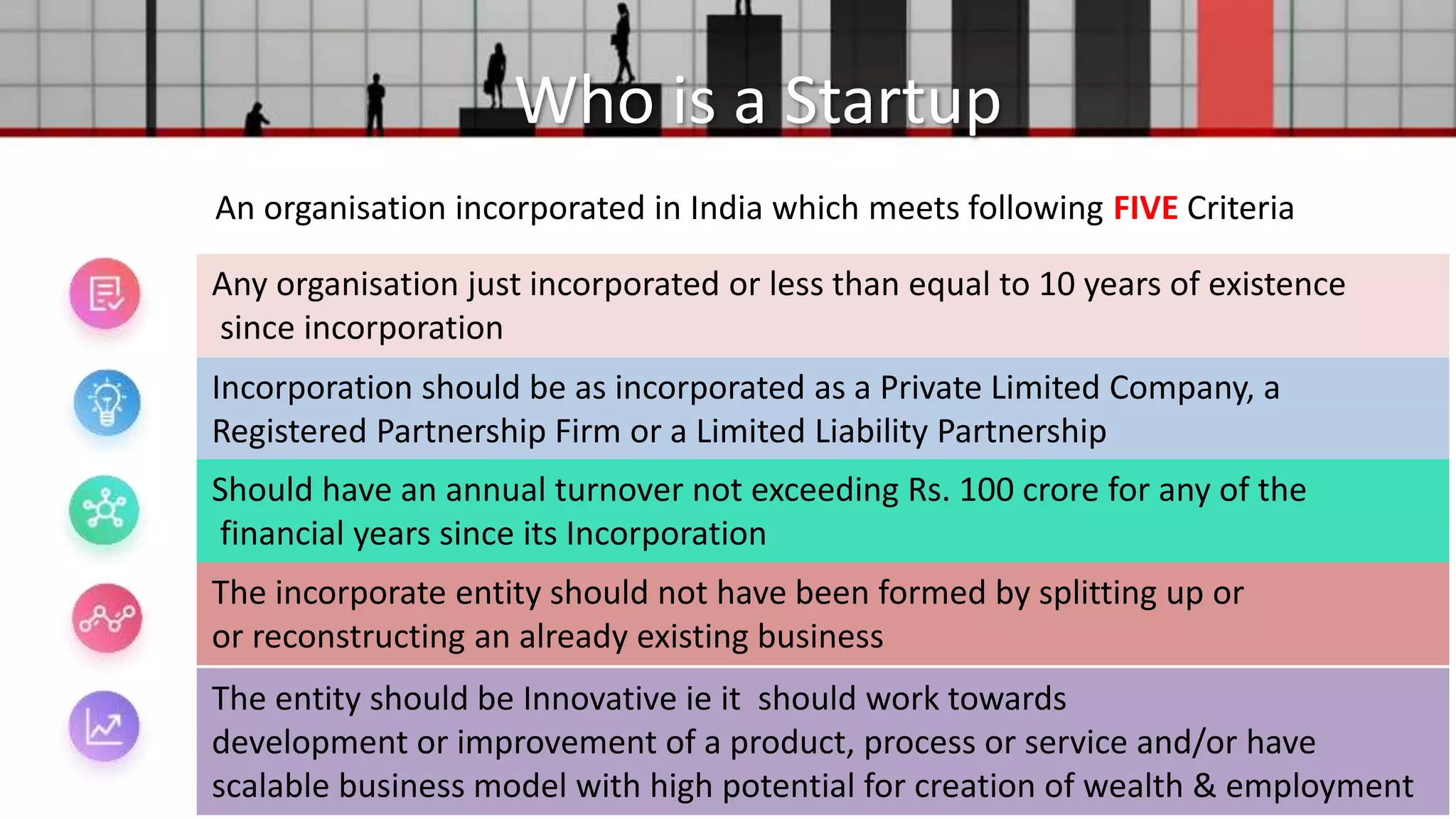
Who is a Startup
Any organisation just incorporated or less than equal to 10 years of existence
since incorporation
Incorporation should be as incorporated as a Private Limited Company, a
Registered Partnership Firm or a Limited Liability Partnership
Should have an annual turnover not exceeding Rs. 100 crore for any of the
financial years since its Incorporation
An organisation incorporated in India which meets following FIVE Criteria
The incorporate entity should not have been formed by splitting up or
or reconstructing an already existing business
The entity should be Innovative ie it should work towards
development or improvement of a product, process or service and/or have
scalable business model with high potential for creation of wealth & employment
Who has defined these criteria
Department for Promotion of Industry and
Internal Trade
DPIIT is under Ministry of Commerce and
Industry
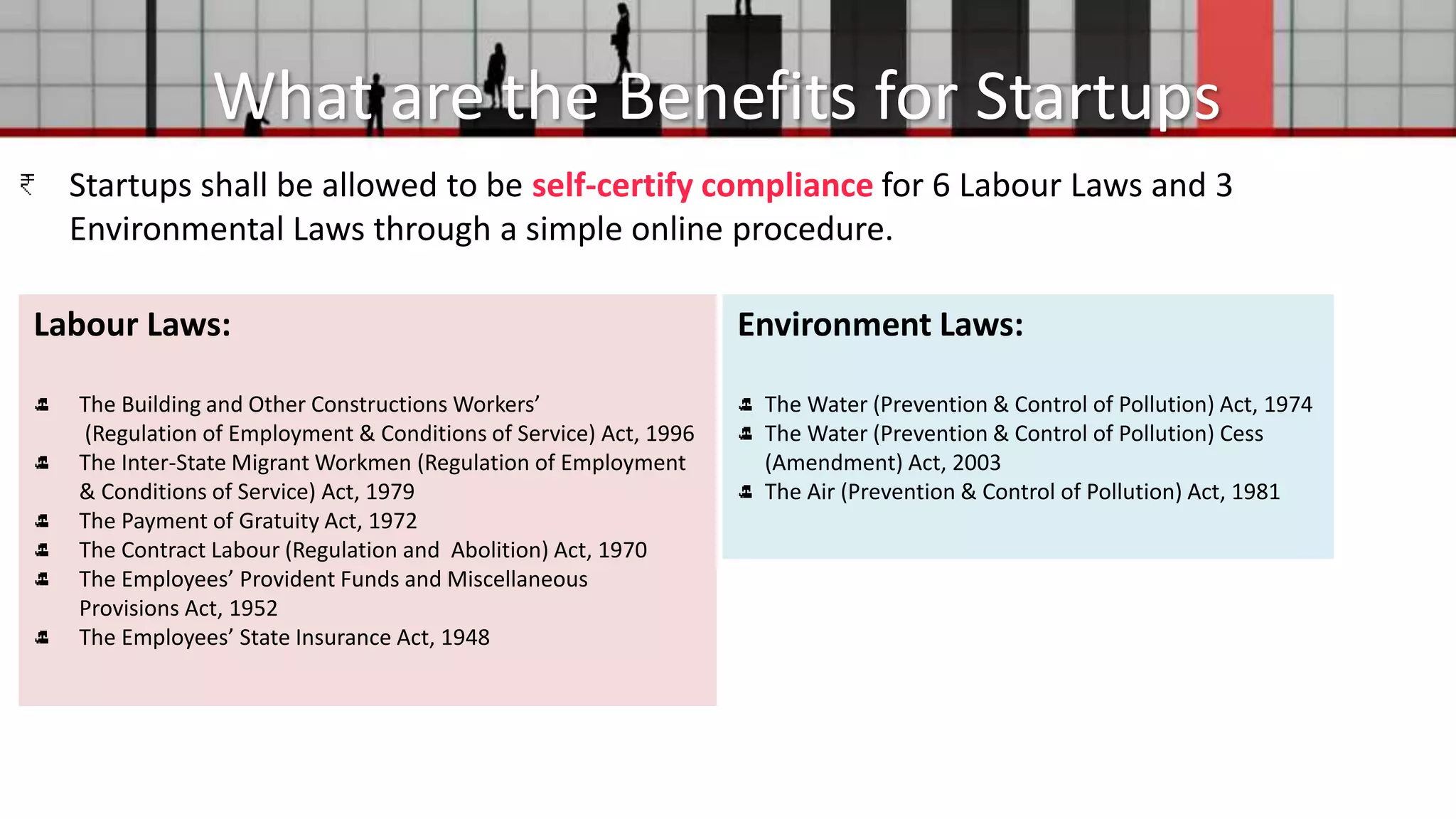
What are the Benefits for Startups
Startups shall be allowed to be self-certify compliance for 6 Labour Laws and 3
Environmental Laws through a simple online procedure.
Labour Laws:
The Building and Other Constructions Workers’
(Regulation of Employment & Conditions of Service) Act, 1996
The Inter-State Migrant Workmen (Regulation of Employment
& Conditions of Service) Act, 1979
The Payment of Gratuity Act, 1972
The Contract Labour (Regulation and Abolition) Act, 1970
The Employees’ Provident Funds and Miscellaneous
Provisions Act, 1952
The Employees’ State Insurance Act, 1948
Environment Laws:
The Water (Prevention & Control of Pollution) Act, 1974
The Water (Prevention & Control of Pollution) Cess
(Amendment) Act, 2003
The Air (Prevention & Control of Pollution) Act, 1981
What are the Other Benefits
In the case of labour laws, no inspections will be conducted for a period of 5 years. Startups
may be inspected only on receipt of credible and verifiable complaint of violation, filed in
writing and approved by at least one level senior to the inspecting officer.
In the case of environment laws, startups which fall under the ‘white category’ (as defined
by the Central Pollution Control Board (CPCB)) would be able to self-certify compliance and
only random checks would be carried out in such cases
What are the Benefits
Income Tax Exemption on profits under Section 80-IAC of Income Tax Act
DIPP recognized Startup shall be eligible to apply to the Inter-Ministerial Board for full deduction on the
profits and gains from business. Provided the following conditions are fulfilled:
- A private limited company or a limited liability partnership,
- Incorporated on or after 1st April 2016 but before 1st April 2021
Exemption under Section 56 of the Income Tax Act (Angel Tax)
Post getting recognition a Startup may apply for Angel Tax Exemption. Eligibility Criteria for Tax
Exemption under Section 56 of the Income Tax Act:
-Aggregate amount of paid up share capital and share premium of the Startup after the
proposed issue of share, if any, does not exceed INR 25 Crore.
Ease of Selling to Government on Government e-Marketplace (GeM)
- Requirement Exemptions : Startups are exempted from otherwise stringent selection criteria such as
Prior Experience, Prior Turnover and Earnest Money Deposits
What are the Benefits
Patent Application & IPR Protection
DIPP recognized Startup Can file patent on fast tract mode and can save upto 80% of cost associated
with this activity
Winding-up the company
Startups in case need to windup company can do so in 90 days time
Easy access to funds
Startups can have easy access to funds can take advantage of government specific schemes
for Startups from time to time
Harry Chadha
Director@msmeoffice.com
NOTE : This presentation is compiled on the basis of our understanding of information given primarily
on site https://www.startupindia.gov.in/, for the benefit of MSMEs.

Startup recognition & benefits

  • 1.
  • 2.
    Who is aStartup Any organisation just incorporated or less than equal to 10 years of existence since incorporation Incorporation should be as incorporated as a Private Limited Company, a Registered Partnership Firm or a Limited Liability Partnership Should have an annual turnover not exceeding Rs. 100 crore for any of the financial years since its Incorporation An organisation incorporated in India which meets following FIVE Criteria The incorporate entity should not have been formed by splitting up or or reconstructing an already existing business The entity should be Innovative ie it should work towards development or improvement of a product, process or service and/or have scalable business model with high potential for creation of wealth & employment
  • 3.
    Who has definedthese criteria Department for Promotion of Industry and Internal Trade DPIIT is under Ministry of Commerce and Industry
  • 4.
    What are theBenefits for Startups Startups shall be allowed to be self-certify compliance for 6 Labour Laws and 3 Environmental Laws through a simple online procedure. Labour Laws: The Building and Other Constructions Workers’ (Regulation of Employment & Conditions of Service) Act, 1996 The Inter-State Migrant Workmen (Regulation of Employment & Conditions of Service) Act, 1979 The Payment of Gratuity Act, 1972 The Contract Labour (Regulation and Abolition) Act, 1970 The Employees’ Provident Funds and Miscellaneous Provisions Act, 1952 The Employees’ State Insurance Act, 1948 Environment Laws: The Water (Prevention & Control of Pollution) Act, 1974 The Water (Prevention & Control of Pollution) Cess (Amendment) Act, 2003 The Air (Prevention & Control of Pollution) Act, 1981
  • 5.
    What are theOther Benefits In the case of labour laws, no inspections will be conducted for a period of 5 years. Startups may be inspected only on receipt of credible and verifiable complaint of violation, filed in writing and approved by at least one level senior to the inspecting officer. In the case of environment laws, startups which fall under the ‘white category’ (as defined by the Central Pollution Control Board (CPCB)) would be able to self-certify compliance and only random checks would be carried out in such cases
  • 6.
    What are theBenefits Income Tax Exemption on profits under Section 80-IAC of Income Tax Act DIPP recognized Startup shall be eligible to apply to the Inter-Ministerial Board for full deduction on the profits and gains from business. Provided the following conditions are fulfilled: - A private limited company or a limited liability partnership, - Incorporated on or after 1st April 2016 but before 1st April 2021 Exemption under Section 56 of the Income Tax Act (Angel Tax) Post getting recognition a Startup may apply for Angel Tax Exemption. Eligibility Criteria for Tax Exemption under Section 56 of the Income Tax Act: -Aggregate amount of paid up share capital and share premium of the Startup after the proposed issue of share, if any, does not exceed INR 25 Crore. Ease of Selling to Government on Government e-Marketplace (GeM) - Requirement Exemptions : Startups are exempted from otherwise stringent selection criteria such as Prior Experience, Prior Turnover and Earnest Money Deposits
  • 7.
    What are theBenefits Patent Application & IPR Protection DIPP recognized Startup Can file patent on fast tract mode and can save upto 80% of cost associated with this activity Winding-up the company Startups in case need to windup company can do so in 90 days time Easy access to funds Startups can have easy access to funds can take advantage of government specific schemes for Startups from time to time
  • 8.
    Harry Chadha Director@msmeoffice.com NOTE :This presentation is compiled on the basis of our understanding of information given primarily on site https://www.startupindia.gov.in/, for the benefit of MSMEs.