1


Data Analysis & Descriptive Statistical Summaries


              Christopher Mowbray

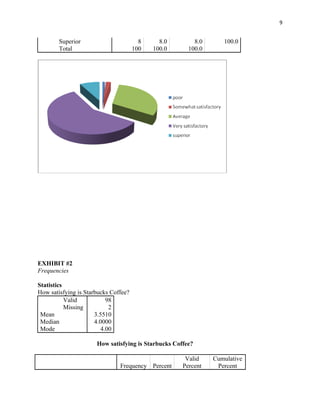
                   Yusuf Kara

                    Mike Dee

                 Philvie Daniel

               Tomas Maldonado
2


       As a marketing research team we have conducted a survey questionnaire where we were

able to gather valuable qualitative and quantitative information about Starbucks Coffee shops.

Starbucks has recently closed over 600 stores in the past few months. Our purpose for

conducting this survey was to find out the struggles that Starbucks faces to ultimately support

our insights with representative evidence. After visiting many Starbucks locations in the city of

Boston to gather our projected sample size of 100 surveyors, we have come to some interesting

findings and feel much stronger discussing the problems that Starbucks faces and the reasoning

for so many closures in the United States.


       Our team’s survey consisted of both qualitative and quantitative questions. We purposely

put in a few qualitative questions to let the customers talk about in depth any issues that they

may have with Starbucks that maybe our research team did not cover in the questionnaire. This

way we can get as much information as possible. According to the mixed answers from the

surveyors we have come to the conclusion that people living in the city are less satisfied with

Starbucks than the people who live in the suburbs. This is a huge issue especially because the

majority of Starbucks locations are found within major cities and areas with high population

density. We have come across some reasons why the employees are dissatisfied with Starbucks

and can make an inference that it has to do a great deal with the customer service from the

employees. For example, a good amount of dissatisfied people said that the employees are not

well trained, they are incompetent, and are talking to each other behind the counter, making

people wait longer than expected. A further issue that has risen from the qualitative data is the

fact that customers are unhappy with the size of Starbucks. They believe that Starbucks café’s

are becoming smaller and smaller in size. With this decrease in store size it only frustrates the

customers when it becomes crowded. Many customers said that Starbucks is supposed to be a
3


place where people pay more money to receive hedonistic feelings with the products they

purchase and the store they are hanging in.


       As a research team we decided to generate the qualitative data and interpret it first so that

we can have some insight as to what type of questions we should pay attention to. This

qualitative data is very useful although it does not provide us with powerful enough influence to

be able to describe to the population. By conducting the quantitative questions we can

specifically get data to backup certain issues in detail that were discussed above.


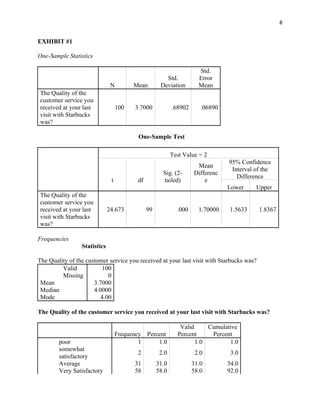
       Considering that we had multiple issues about the customer service of Starbucks we

decided to run a T-Test to determine important information such as the average quality of

customer service. Before we conducted the analysis we created our own hypothesis that thought

the average quality of customer service was less than or equal to somewhat unsatisfactory

service. When we calculated the one-sample statistics we found that the average was in fact very

satisfactory. Before we could say this was acceptable we had to look at the 95% confidence

interval and determine if the whole interval was above zero, and in fact it was. This step process

holds true for every t-test given. With this in mind we have a good idea that the test statistic falls

within the rejection region but we first need to calculate it. After calculating it we ultimately

find that our hypothesis falls within the rejection region and it is safe to say that the customer

service seems to be ok. We also created a frequency table for only the customers who were very

satisfied or felt that the service was superior. We found that 66% of people had positive feelings

about customer service, leaving 44% with undecided, poor or average answers. With this

interpretation you can see that Starbucks could in fact try to improve their customer service a bit

more. See Exhibit 1
4


       Another issue that we as a group felt may have an effect on the store closings was the

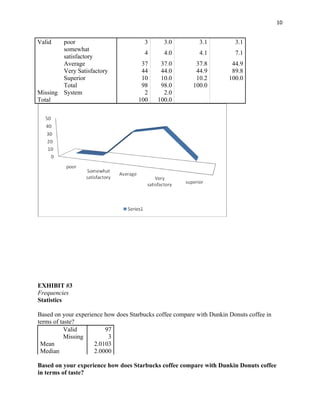
overall satisfaction of Starbucks coffee. We generated some statistics and realized that 55% of

respondents had positive feelings about their coffee, whereas 44% had neutral or negative

feelings. We were surprised with these findings because as a research group we were given the

impression that Starbucks has better quality based on the reason their prices are higher than

others. This is in fact a problem that Starbuck’s faces and they should either work on improving

their coffee satisfaction or end up lowering the price, which could switch other café’ regulars

who go to places such as Dunkin Donuts to become Starbucks customers. See Exhibit 2


       It seems overly obvious that Dunkin Donuts is Starbuck’s main competitor today. We as

a group wanted to find out if Dunkin Donuts had any impact and if so how much of an impact on

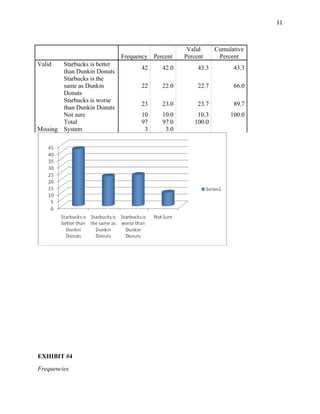
the profitability of Starbucks. To do this we created a simple frequency chart with an

accompanied histogram to answer this question once and for all. We determined that 42% of our

surveyors prefer Starbucks over Dunkin Donuts. This statistic is HUGE and most definitely

reveals to us that Dunkin Donuts has a lot to do with the downsizing of many Starbucks locations

lately. A total of 55% think that Starbucks is either the same as Dunkin Donuts, worse than

Dunkin Donuts, or they were not sure. We would like to mention that these test statistics are

reasonable and with little to no error. See Exhibit 3


       Now that we understand that Dunkin Donuts has a large effect on the profitability of

Starbucks, we wanted to get an idea of why that statistic holds true. What makes Dunkin Donuts

such a huge competitor in this market? First, we wanted to get a general frequency distribution

based on certain attributes that customers felt were important when purchasing a coffee.

Supported in our depth interviews and focus group study we realize that there are a few attributes

that make up a good coffee. These attributes are best quality, looks good and price value. We
5


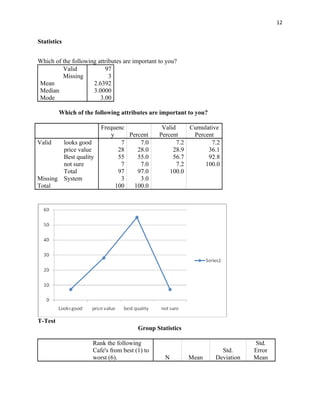
wanted to know which attribute was preferred the most in terms of importance for the customer’s

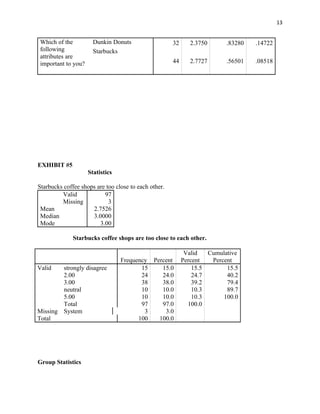
coffee. In SPSS we came to the conclusion that 55% prefer Best Quality, 28% prefer Price

Value, and 7% prefer Looks when it comes to purchasing a good coffee. See Exhibit 4


       Technically this statistic means nothing until we can group it with the customer’s

preference of either Starbucks or Dunkin Donuts. Once we have found both preferences we can

combine them and create an independent sample tests and cross tabulation to see if they are

correlated or not. For example, we created a test and found that people who prefer to go to

Dunkin Donuts also feel that price value is the most important, and for people who prefer to go

to Starbucks feel that Quality is most important when it comes to purchasing their coffee. As

you can finally see, price value of customers is very important and should be recognized by

Starbucks to try to generate lower priced products. See Exhibit 5


       We currently have processed all the factors that we thought would have some

implications or problems with Starbucks’s success, although we still feel that one more test

would suffice to ensure our recommendations. For example, our research hypothesis was that we

believed the reasoning for so many Starbucks closings is mainly because of the location density

of the café’s. We believe as a Research Group that there are too many Starbucks locations that

are too close to each other. They are only taking away from their own profits. This is called

cannibalism. We decided to conduct some analysis on several questions that were posted within

the questionnaire. For example, “How do you feel about Starbucks Location”? Is one of the

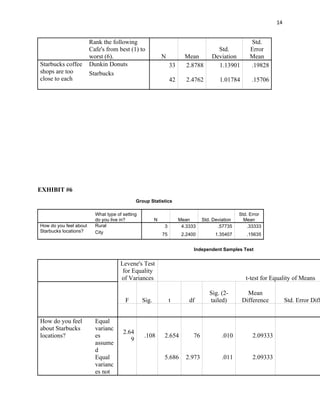
questions. We sense that determining the frequency of people who thought that Starbucks was

inconvenient would be a good start and benchmark for further studies. The statistics show that

74% of people replied with a positive answer describing that the café’s are very convenient.

Now we understand that this statistic is not false but we have to take into account the fact that
6


these people could be situated in different areas and based on the area in which they live in their

answers may vary. In lieu of these issues we decided to conduct an independent T-test to gather

group statistics. For instance, based on our studies we have customers that live in three different

areas: Rural, City, and Suburb. We wanted to obtain information about whether or not this

setting of where the person lives has any power or correlation about how they feel about the

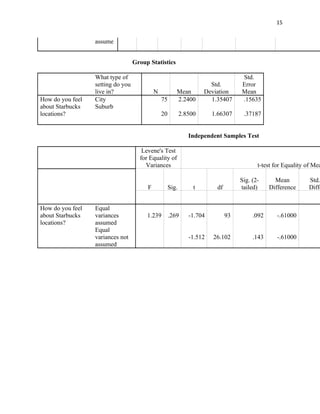
locations of Starbucks. After getting back the group statistics we found a great difference

between the different areas. For example, the average of the people living in the rural areas

believed that Starbucks locations are not very convenient, whereas the people living in the city

thought that Starbucks locations were very convenient. The average number of people living in

the suburb said that Starbucks locations were fairly neutral to somewhat convenient around their

area. This analysis tells us a great amount of information about where Starbucks should

strategically distribute their café’s and whether or not they have too many in one area. See

Exhibit 6


       All of our analysis can be found in the available exhibits on the following pages. Based

on our calculations we can safely describe the problems that Starbucks faces without a doubt and

if we were asked to show evidence we now have proof to do so. In order for Starbucks to

become a successful business and regain their status and stores they will need to improve on their

customer service a bit more and also the satisfaction of their coffee. Furthermore, today it seems

as if Dunkin Donuts is doing well in the market. Based on the studies the people who go to

Dunkin Donuts prefer price over quality when it comes to their coffee. Starbucks should realize

this and understand that price value is a very large population, especially in today’s economic

crises. It has been proven that Starbucks has an abundance of locations that are too close to each

other in the cities whereas they lack locations in rural and some suburb areas. Starbucks should
7


shut a few café’s down in the city and spread them out to areas where there are no Starbucks at

all. This may create a better name for them and also may not seem as annoying to the customers.

It is safe to say that location, customer service, price and the coffee itself is the main problem for

the shutdown of many Starbucks locations across the United States.
8


EXHIBIT #1

One-Sample Statistics

                                                                      Std.
                                                       Std.           Error
                               N         Mean        Deviation        Mean
The Quality of the
customer service you
received at your last              100   3.7000            .68902      .06890
visit with Starbucks
was?

                                          One-Sample Test

                                                           Test Value = 2
                                                                                95% Confidence
                                                                     Mean
                                                                                 Interval of the
                                                      Sig. (2-      Differenc
                                                                                   Difference
                               t          df          tailed)           e
                                                                                Lower     Upper
The Quality of the
customer service you
received at your last         24.673           99            .000     1.70000   1.5633     1.8367
visit with Starbucks
was?

Frequencies
                 Statistics

The Quality of the customer service you received at your last visit with Starbucks was?
         Valid            100
         Missing            0
 Mean                 3.7000
 Median               4.0000
 Mode                    4.00

The Quality of the customer service you received at your last visit with Starbucks was?

                                                              Valid     Cumulative
                                   Frequency Percent         Percent     Percent
        poor                               1     1.0                1.0        1.0
        somewhat
                                          2          2.0             2.0         3.0
        satisfactory
        Average                          31         31.0            31.0        34.0
        Very Satisfactory                58         58.0            58.0        92.0
9


        Superior                        8     8.0        8.0      100.0
        Total                         100   100.0      100.0


EXHIBIT #2
Frequencies

Statistics
How satisfying is Starbucks Coffee?
           Valid           98
           Missing          2
 Mean                 3.5510
 Median               4.0000
 Mode                    4.00

                      How satisfying is Starbucks Coffee?

                                                      Valid    Cumulative
                               Frequency Percent     Percent    Percent
10


Valid   poor                           3       3.0          3.1          3.1
        somewhat
                                       4       4.0          4.1          7.1
        satisfactory
        Average                       37     37.0         37.8          44.9
        Very Satisfactory             44     44.0         44.9          89.8
        Superior                      10     10.0         10.2         100.0
        Total                         98     98.0        100.0
Missing System                         2      2.0
Total                                100    100.0


EXHIBIT #3
Frequencies
Statistics

Based on your experience how does Starbucks coffee compare with Dunkin Donuts coffee in
terms of taste?
          Valid          97
          Missing         3
 Mean                2.0103
 Median              2.0000

Based on your experience how does Starbucks coffee compare with Dunkin Donuts coffee
in terms of taste?
11


                                                   Valid      Cumulative
                              Frequency Percent   Percent      Percent
Valid   Starbucks is better
                                    42     42.0        43.3         43.3
        than Dunkin Donuts
        Starbucks is the
        same as Dunkin              22     22.0        22.7         66.0
        Donuts
        Starbucks is worse
                                    23     23.0        23.7         89.7
        than Dunkin Donuts
        Not sure                    10     10.0       10.3         100.0
        Total                       97     97.0      100.0
Missing System                       3      3.0


EXHIBIT #4
Frequencies
12


Statistics


Which of the following attributes are important to you?
         Valid            97
         Missing            3
Mean                 2.6392
Median               3.0000
Mode                    3.00

         Which of the following attributes are important to you?

                         Frequenc                Valid     Cumulative
                             y     Percent      Percent     Percent
Valid   looks good               7     7.0             7.2        7.2
        price value             28    28.0           28.9        36.1
        Best quality            55    55.0           56.7        92.8
        not sure                 7     7.0             7.2      100.0
        Total                   97    97.0          100.0
Missing System                   3     3.0
Total                          100   100.0


T-Test
                                       Group Statistics

                     Rank the following                                        Std.
                     Cafe's from best (1) to                         Std.      Error
                     worst (6).                   N       Mean     Deviation   Mean
13


Which of the          Dunkin Donuts                   32      2.3750      .83280   .14722
following             Starbucks
attributes are
important to you?                                     44      2.7727      .56501   .08518


EXHIBIT #5
                    Statistics

Starbucks coffee shops are too close to each other.
         Valid            97
         Missing            3
 Mean                2.7526
 Median              3.0000
 Mode                   3.00

              Starbucks coffee shops are too close to each other.

                                                            Valid   Cumulative
                                 Frequency Percent         Percent   Percent
Valid   strongly disagree               15    15.0             15.5       15.5
        2.00                            24    24.0             24.7       40.2
        3.00                            38    38.0             39.2       79.4
        neutral                         10    10.0             10.3       89.7
        5.00                            10    10.0             10.3      100.0
        Total                           97    97.0           100.0
Missing System                           3     3.0
Total                                  100   100.0


Group Statistics
14


                        Rank the following                                                            Std.
                        Cafe's from best (1) to                                        Std.           Error
                        worst (6).                          N           Mean         Deviation        Mean
Starbucks coffee        Dunkin Donuts                            33     2.8788         1.13901        .19828
shops are too           Starbucks
close to each                                                    42      2.4762          1.01784       .15706


EXHIBIT #6
                                              Group Statistics

                          What type of setting                                                    Std. Error
                          do you live in?               N             Mean       Std. Deviation     Mean
How do you feel about     Rural                             3          4.3333           .57735        .33333
Starbucks locations?      City                              75         2.2400          1.35407       .15635


                                                                            Independent Samples Test


                                      Levene's Test
                                       for Equality
                                      of Variances                                                   t-test for Equality of Means

                                                                                    Sig. (2-         Mean
                                        F        Sig.            t        df        tailed)        Difference          Std. Error Diff


How do you feel           Equal
about Starbucks           varianc
                                       2.64
locations?                es                     .108       2.654           76            .010          2.09333
                                          9
                          assume
                          d
                          Equal                             5.686        2.973            .011          2.09333
                          varianc
                          es not
15


                  assume


                                   Group Statistics

                  What type of                                                     Std.
                  setting do you                                       Std.        Error
                  live in?                  N           Mean         Deviation     Mean
How do you feel   City                          75      2.2400         1.35407     .15635
about Starbucks   Suburb
locations?                                      20          2.8500      1.66307     .37187


                                                               Independent Samples Test

                                      Levene's Test
                                     for Equality of
                                       Variances                                          t-test for Equality of Mea

                                                                                   Sig. (2-      Mean         Std.
                                        F            Sig.        t       df        tailed)     Difference     Diffe


How do you feel   Equal
about Starbucks   variances             1.239        .269      -1.704         93        .092      -.61000
locations?        assumed
                  Equal
                  variances not                                -1.512   26.102          .143      -.61000
                  assumed

Starbucks Data Analysis

  • 1.
    1 Data Analysis &Descriptive Statistical Summaries Christopher Mowbray Yusuf Kara Mike Dee Philvie Daniel Tomas Maldonado
  • 2.
    2 As a marketing research team we have conducted a survey questionnaire where we were able to gather valuable qualitative and quantitative information about Starbucks Coffee shops. Starbucks has recently closed over 600 stores in the past few months. Our purpose for conducting this survey was to find out the struggles that Starbucks faces to ultimately support our insights with representative evidence. After visiting many Starbucks locations in the city of Boston to gather our projected sample size of 100 surveyors, we have come to some interesting findings and feel much stronger discussing the problems that Starbucks faces and the reasoning for so many closures in the United States. Our team’s survey consisted of both qualitative and quantitative questions. We purposely put in a few qualitative questions to let the customers talk about in depth any issues that they may have with Starbucks that maybe our research team did not cover in the questionnaire. This way we can get as much information as possible. According to the mixed answers from the surveyors we have come to the conclusion that people living in the city are less satisfied with Starbucks than the people who live in the suburbs. This is a huge issue especially because the majority of Starbucks locations are found within major cities and areas with high population density. We have come across some reasons why the employees are dissatisfied with Starbucks and can make an inference that it has to do a great deal with the customer service from the employees. For example, a good amount of dissatisfied people said that the employees are not well trained, they are incompetent, and are talking to each other behind the counter, making people wait longer than expected. A further issue that has risen from the qualitative data is the fact that customers are unhappy with the size of Starbucks. They believe that Starbucks café’s are becoming smaller and smaller in size. With this decrease in store size it only frustrates the customers when it becomes crowded. Many customers said that Starbucks is supposed to be a
  • 3.
    3 place where peoplepay more money to receive hedonistic feelings with the products they purchase and the store they are hanging in. As a research team we decided to generate the qualitative data and interpret it first so that we can have some insight as to what type of questions we should pay attention to. This qualitative data is very useful although it does not provide us with powerful enough influence to be able to describe to the population. By conducting the quantitative questions we can specifically get data to backup certain issues in detail that were discussed above. Considering that we had multiple issues about the customer service of Starbucks we decided to run a T-Test to determine important information such as the average quality of customer service. Before we conducted the analysis we created our own hypothesis that thought the average quality of customer service was less than or equal to somewhat unsatisfactory service. When we calculated the one-sample statistics we found that the average was in fact very satisfactory. Before we could say this was acceptable we had to look at the 95% confidence interval and determine if the whole interval was above zero, and in fact it was. This step process holds true for every t-test given. With this in mind we have a good idea that the test statistic falls within the rejection region but we first need to calculate it. After calculating it we ultimately find that our hypothesis falls within the rejection region and it is safe to say that the customer service seems to be ok. We also created a frequency table for only the customers who were very satisfied or felt that the service was superior. We found that 66% of people had positive feelings about customer service, leaving 44% with undecided, poor or average answers. With this interpretation you can see that Starbucks could in fact try to improve their customer service a bit more. See Exhibit 1
  • 4.
    4 Another issue that we as a group felt may have an effect on the store closings was the overall satisfaction of Starbucks coffee. We generated some statistics and realized that 55% of respondents had positive feelings about their coffee, whereas 44% had neutral or negative feelings. We were surprised with these findings because as a research group we were given the impression that Starbucks has better quality based on the reason their prices are higher than others. This is in fact a problem that Starbuck’s faces and they should either work on improving their coffee satisfaction or end up lowering the price, which could switch other café’ regulars who go to places such as Dunkin Donuts to become Starbucks customers. See Exhibit 2 It seems overly obvious that Dunkin Donuts is Starbuck’s main competitor today. We as a group wanted to find out if Dunkin Donuts had any impact and if so how much of an impact on the profitability of Starbucks. To do this we created a simple frequency chart with an accompanied histogram to answer this question once and for all. We determined that 42% of our surveyors prefer Starbucks over Dunkin Donuts. This statistic is HUGE and most definitely reveals to us that Dunkin Donuts has a lot to do with the downsizing of many Starbucks locations lately. A total of 55% think that Starbucks is either the same as Dunkin Donuts, worse than Dunkin Donuts, or they were not sure. We would like to mention that these test statistics are reasonable and with little to no error. See Exhibit 3 Now that we understand that Dunkin Donuts has a large effect on the profitability of Starbucks, we wanted to get an idea of why that statistic holds true. What makes Dunkin Donuts such a huge competitor in this market? First, we wanted to get a general frequency distribution based on certain attributes that customers felt were important when purchasing a coffee. Supported in our depth interviews and focus group study we realize that there are a few attributes that make up a good coffee. These attributes are best quality, looks good and price value. We
  • 5.
    5 wanted to knowwhich attribute was preferred the most in terms of importance for the customer’s coffee. In SPSS we came to the conclusion that 55% prefer Best Quality, 28% prefer Price Value, and 7% prefer Looks when it comes to purchasing a good coffee. See Exhibit 4 Technically this statistic means nothing until we can group it with the customer’s preference of either Starbucks or Dunkin Donuts. Once we have found both preferences we can combine them and create an independent sample tests and cross tabulation to see if they are correlated or not. For example, we created a test and found that people who prefer to go to Dunkin Donuts also feel that price value is the most important, and for people who prefer to go to Starbucks feel that Quality is most important when it comes to purchasing their coffee. As you can finally see, price value of customers is very important and should be recognized by Starbucks to try to generate lower priced products. See Exhibit 5 We currently have processed all the factors that we thought would have some implications or problems with Starbucks’s success, although we still feel that one more test would suffice to ensure our recommendations. For example, our research hypothesis was that we believed the reasoning for so many Starbucks closings is mainly because of the location density of the café’s. We believe as a Research Group that there are too many Starbucks locations that are too close to each other. They are only taking away from their own profits. This is called cannibalism. We decided to conduct some analysis on several questions that were posted within the questionnaire. For example, “How do you feel about Starbucks Location”? Is one of the questions. We sense that determining the frequency of people who thought that Starbucks was inconvenient would be a good start and benchmark for further studies. The statistics show that 74% of people replied with a positive answer describing that the café’s are very convenient. Now we understand that this statistic is not false but we have to take into account the fact that
  • 6.
    6 these people couldbe situated in different areas and based on the area in which they live in their answers may vary. In lieu of these issues we decided to conduct an independent T-test to gather group statistics. For instance, based on our studies we have customers that live in three different areas: Rural, City, and Suburb. We wanted to obtain information about whether or not this setting of where the person lives has any power or correlation about how they feel about the locations of Starbucks. After getting back the group statistics we found a great difference between the different areas. For example, the average of the people living in the rural areas believed that Starbucks locations are not very convenient, whereas the people living in the city thought that Starbucks locations were very convenient. The average number of people living in the suburb said that Starbucks locations were fairly neutral to somewhat convenient around their area. This analysis tells us a great amount of information about where Starbucks should strategically distribute their café’s and whether or not they have too many in one area. See Exhibit 6 All of our analysis can be found in the available exhibits on the following pages. Based on our calculations we can safely describe the problems that Starbucks faces without a doubt and if we were asked to show evidence we now have proof to do so. In order for Starbucks to become a successful business and regain their status and stores they will need to improve on their customer service a bit more and also the satisfaction of their coffee. Furthermore, today it seems as if Dunkin Donuts is doing well in the market. Based on the studies the people who go to Dunkin Donuts prefer price over quality when it comes to their coffee. Starbucks should realize this and understand that price value is a very large population, especially in today’s economic crises. It has been proven that Starbucks has an abundance of locations that are too close to each other in the cities whereas they lack locations in rural and some suburb areas. Starbucks should
  • 7.
    7 shut a fewcafé’s down in the city and spread them out to areas where there are no Starbucks at all. This may create a better name for them and also may not seem as annoying to the customers. It is safe to say that location, customer service, price and the coffee itself is the main problem for the shutdown of many Starbucks locations across the United States.
  • 8.
    8 EXHIBIT #1 One-Sample Statistics Std. Std. Error N Mean Deviation Mean The Quality of the customer service you received at your last 100 3.7000 .68902 .06890 visit with Starbucks was? One-Sample Test Test Value = 2 95% Confidence Mean Interval of the Sig. (2- Differenc Difference t df tailed) e Lower Upper The Quality of the customer service you received at your last 24.673 99 .000 1.70000 1.5633 1.8367 visit with Starbucks was? Frequencies Statistics The Quality of the customer service you received at your last visit with Starbucks was? Valid 100 Missing 0 Mean 3.7000 Median 4.0000 Mode 4.00 The Quality of the customer service you received at your last visit with Starbucks was? Valid Cumulative Frequency Percent Percent Percent poor 1 1.0 1.0 1.0 somewhat 2 2.0 2.0 3.0 satisfactory Average 31 31.0 31.0 34.0 Very Satisfactory 58 58.0 58.0 92.0
  • 9.
    9 Superior 8 8.0 8.0 100.0 Total 100 100.0 100.0 EXHIBIT #2 Frequencies Statistics How satisfying is Starbucks Coffee? Valid 98 Missing 2 Mean 3.5510 Median 4.0000 Mode 4.00 How satisfying is Starbucks Coffee? Valid Cumulative Frequency Percent Percent Percent
  • 10.
    10 Valid poor 3 3.0 3.1 3.1 somewhat 4 4.0 4.1 7.1 satisfactory Average 37 37.0 37.8 44.9 Very Satisfactory 44 44.0 44.9 89.8 Superior 10 10.0 10.2 100.0 Total 98 98.0 100.0 Missing System 2 2.0 Total 100 100.0 EXHIBIT #3 Frequencies Statistics Based on your experience how does Starbucks coffee compare with Dunkin Donuts coffee in terms of taste? Valid 97 Missing 3 Mean 2.0103 Median 2.0000 Based on your experience how does Starbucks coffee compare with Dunkin Donuts coffee in terms of taste?
  • 11.
    11 Valid Cumulative Frequency Percent Percent Percent Valid Starbucks is better 42 42.0 43.3 43.3 than Dunkin Donuts Starbucks is the same as Dunkin 22 22.0 22.7 66.0 Donuts Starbucks is worse 23 23.0 23.7 89.7 than Dunkin Donuts Not sure 10 10.0 10.3 100.0 Total 97 97.0 100.0 Missing System 3 3.0 EXHIBIT #4 Frequencies
  • 12.
    12 Statistics Which of thefollowing attributes are important to you? Valid 97 Missing 3 Mean 2.6392 Median 3.0000 Mode 3.00 Which of the following attributes are important to you? Frequenc Valid Cumulative y Percent Percent Percent Valid looks good 7 7.0 7.2 7.2 price value 28 28.0 28.9 36.1 Best quality 55 55.0 56.7 92.8 not sure 7 7.0 7.2 100.0 Total 97 97.0 100.0 Missing System 3 3.0 Total 100 100.0 T-Test Group Statistics Rank the following Std. Cafe's from best (1) to Std. Error worst (6). N Mean Deviation Mean
  • 13.
    13 Which of the Dunkin Donuts 32 2.3750 .83280 .14722 following Starbucks attributes are important to you? 44 2.7727 .56501 .08518 EXHIBIT #5 Statistics Starbucks coffee shops are too close to each other. Valid 97 Missing 3 Mean 2.7526 Median 3.0000 Mode 3.00 Starbucks coffee shops are too close to each other. Valid Cumulative Frequency Percent Percent Percent Valid strongly disagree 15 15.0 15.5 15.5 2.00 24 24.0 24.7 40.2 3.00 38 38.0 39.2 79.4 neutral 10 10.0 10.3 89.7 5.00 10 10.0 10.3 100.0 Total 97 97.0 100.0 Missing System 3 3.0 Total 100 100.0 Group Statistics
  • 14.
    14 Rank the following Std. Cafe's from best (1) to Std. Error worst (6). N Mean Deviation Mean Starbucks coffee Dunkin Donuts 33 2.8788 1.13901 .19828 shops are too Starbucks close to each 42 2.4762 1.01784 .15706 EXHIBIT #6 Group Statistics What type of setting Std. Error do you live in? N Mean Std. Deviation Mean How do you feel about Rural 3 4.3333 .57735 .33333 Starbucks locations? City 75 2.2400 1.35407 .15635 Independent Samples Test Levene's Test for Equality of Variances t-test for Equality of Means Sig. (2- Mean F Sig. t df tailed) Difference Std. Error Diff How do you feel Equal about Starbucks varianc 2.64 locations? es .108 2.654 76 .010 2.09333 9 assume d Equal 5.686 2.973 .011 2.09333 varianc es not
  • 15.
    15 assume Group Statistics What type of Std. setting do you Std. Error live in? N Mean Deviation Mean How do you feel City 75 2.2400 1.35407 .15635 about Starbucks Suburb locations? 20 2.8500 1.66307 .37187 Independent Samples Test Levene's Test for Equality of Variances t-test for Equality of Mea Sig. (2- Mean Std. F Sig. t df tailed) Difference Diffe How do you feel Equal about Starbucks variances 1.239 .269 -1.704 93 .092 -.61000 locations? assumed Equal variances not -1.512 26.102 .143 -.61000 assumed