PRESENTED BY;
A.DEEPA M.Sc(N).,B.Sc(Psychology)
NURSING TUTOR,
GOVT. MEDICAL COLLEGE,
TIRUPPUR.

There are FIVE types of standardized test.
 Intelligence test
 Aptitude test
 Interest test
 Personality test
 Achievement test
TYPES OF
STANDARDIZED TEST

Intelligence is a general capacity for
comprehension and reasoning that manifests itself
in various way. It consists of an individual’s mental
or cognitive ability which helps the person in
solving his actual life problems and leading a happy
and well-contended life.
INTELLIGENCE

Intelligence is the aggregate or global capacity of the
individual to think rationally, to act purposefully and to deal
effectively with the environment.
WECHSLER – 1944
Intelligence can be defined as a sort of mental energy in the
form of mental or cognitive abilities available with an
individual which enables him to handle his environment in
terms of adaptation to face noval situations as effectively as
possible.
MANGAL - 1993
INTELLIGENCE -
DEFINITION
Concrete
intelligence; This
is related to concrete
materials. This person
uses this intelligence
in the operation of
tools and instruments.
Eg Engineers,
mechanics.
Social
intelligence; It is
the ability of an
individual to react to
social situations in
daily life. Eg. Leaders,
ministers salesman.
Abstract
intelligent; It is the
ability to respond to
words, numbers and
letters etc. this type of
intelligence is
required by a study of
books and related
literature. Eg. Mostly
good teachers,
lawyers,
philosophers.
CLASSIFICATION OF
INTELLIGENCE



CLASSIFICATION OF INDIVIDUALS
ACCORDING TO IQ
1. Genius
2. Very superior
3. Superior
4. Above average
5. Average
6. Dull average
7. Borderline
8. Mild mental retardation
9. Moderate mental retardation
10.Severe mental retardation
11.Profound mental
retardation
140 and above
130 to 140
120 to 130
110 to 120
90 to 110
80 to 90
70 to 80
50 to 70
35 to 50
20 to 35
0 to 20x

 It helps the individual to adjust to changing situations
quickly and correctly.
 It helps to carry on the higher mental processes such as
reasoning, judging and criticizing.
 It helps to learn difficult tasks solve problems.
 It helps the individual to improve performance in any
situation.
 It helps in quick understanding of things.
 It helps the individual to apply the knowledge gained in
various subjects/situations in dealing with present
situation.
USES OF
INTELLIGENCE

 Factor theories of intelligence
two factor theory or general intelligence theory,
1927
Group factor theory or multifactor theory, 1938
 Process-oriented theory
piaget’s theory, 1970
Bruner’s theory, 1973
 Information-processing theory(Robert Sternberg,
1984)
THEORIES OF
INTELLIGENCE
FACTOR THEORY OF INTELLIGENCE
Two factor theory or general intelligence
(G-Factor) theory; 1927
oIt was advocated by Charles Spearman,
oBritish psychologist.
General
intelligence
factor (G);
universal
inborn ability
Specific
intelligence
factor(S)
learned and
acquired from
environment
s1+s2+s3…
Intelligence(A);
A=G+S1+S2+S3..
This theory was expounded by LL THURSTONE in
1938
psychological
Functional
(unity)
Mental
operations
have a
primary
factor
Mental
operations
constitute a
group factor
Verbal
factor
Spatial
factor
Numerical
factor
Memory
factor
Reasoning
factor
Perceptual
factor
Problem
solving
factor

Jean Piaget, 1970
Intelligence is an adaptive process
biological interaction with
maturation environment
evolution of cognitive process
INTELLIGENCE
Process-oriented theories
understanding the law
of nature
Principles of grammar,
Mathematics etc.

According to Bruner’s,
 Intelligence is a growing dependence on internal
representation of objects or situations.
 These growing abilities are influenced by the
environment, especially the rewards and
punishment people receive for using particular
intellectual skill in particular ways.
Bruner’s theory

Robert Sternberg, 1984
 The most recent acceptable theory of intelligence has been
put forward by the American psychologist Robert
Sternberg by adopting an information processing
approach to cognition or problem solving.
 The information processing approach is the manner in
which one proceeds to perform a mental task or solve a
problem from in hand.
 The theory propagated by Sternberg identified the
following steps in the way one processes information;
Information-processing
theory
Encoding (identifying the relevant
available information in the mind).
Mapping (drawing the necessary
inference.)
Application (applying the inferred
relationship)
Justification (justifying the
analyzed solution of the problem)
Responding ( providing the best
possible solution)

ASSESSMENT OF
INTELLIGENT
a) Individual
tests
Verbal tests
Non-verbal tests
b) Group
tests
Verbal tests
Non-verbal
tests(performance
test)
I. Intelligence tests

a) Individual verbal tests
These tests one individual at a time.
These tests make use of language.
For example
Stanford-Binet Scale.

 The complete non-verbal or non-language tests of
intelligence for testing an individual at a time fall
into this category.
 These tests involve the manipulation of objects
 Example
 Picture arrangement
 Picture completion
 Block design, etc.
with minimum use of paper and pencil.
a) Individual performance tests
Instructions are generally given by demonstrations and
Gestures.
This tests are used in
 infants,
 mentally retarded,
 Foreigners and
 Those who do not understand language in which the
tests are conducted.
Example,
Bhatia’s Battery of performance tests.
(6 letter cancellation tests)
a) individual performance tests

b) Group verbal intelligence tests
These tests use language and are applied to a group
of individual at a time
Example;
Army Alpha tests
Army general classification test.

Army alpha test
Alpha subjects
o Oral direction
o Arithmetic
o Practical judgment
o Analogies
o Disarranged sentences
o Number series
o Information.
The Army Alpha and the Army Beta tests were
designed to find the mental age of military recruits
and to assess incoming recruits for success in the US
Military by testing one's ability to understand
language, to perform reasoning with semantic and
quantitative relationships, to make practical
judgments, to infer rules and regulations, and to
recall general information.
Army beta test
 Memory
 Matching
 Picture completion
 Geometric construction.

b)Group non verbal
intelligence tests
 These tests do not necessitate the use of language and are
applicable to the group of individuals at a time.
 In these tests material does not contain words or
numerical figures.
 It contains picture, diagrams, geometrical figures, etc.
printed in a booklet.
 The subject is required to perform such activities as to fill
in some empty spaces, draw some simple figures, point
out similarities and dissimilarities, etc.
 Examples;
 Army beta tests
 Raven’s Progressive matrices tests.

comparison
Individual tests
 They test one individual at a
time.hence they are not
economical in terms of time,
labor and money.
 These are applicable both for
children and adults.
 These bring the tester and
child closer and establish a
better relationship between
the two.
Group tests
 A group of children can
be tested at the same time,
hence economical.
 These tests cannot be
administered to young
children below the age of
10 years.
 Personal contact between
the two is not possible.

 Wechsler tests
for children, adult.
 The Stanford Binet intelligence test
 Roven’s progressive matrix
 Vineland social maturity scalar
II. Intelligence tests based on
scientist
In intelligence

David Wechsler
 David Wechsler was born on January 12, 1896 to a Jewish
family in Lespedi, Romania.
 Columbia University, where he earned a master’s degree
in 1917 and a Ph.D. in experimental psychology in 1925,
studying under Robert Woodworth.
 Wechsler worked with the United States Army in 1917
during World War I as an Army Psychologist at Camp
Logan, Texas.
 In 1918, the Army sent him to London to work with Charles
Spearman and Karl Pearson, where he developed
psychological tests to screen new draftees.
Wechsler’s Intelligence Scales
Wechsler operated on the assumption that intelligence
is a person’s total ability to act purposefully, to think
rationally, and to deal effectively with his or her
environment, and
 He believed that intelligent behavior was comprised
of more than just intellectual ability.
 Thus, he disliked the current Binet IQ test, which
directly measured only intellectual ability, so he
developed his own intelligence tests in order to better
understand his patients at Bellevue.
 What he found was mind-blowing. The IQ of a person is
directly predisposed to the atmosphere in which they live.
 Biological and environmental influences can dictate a person’s
intellect. Wechsler knew that many factors affected intelligence
and cognitive ability.
 realized that one test would not accommodate all age groups,
so he developed a series that would be used for all ages.

 The first test he developed was the Wechsler-Bellevue
Intelligence Test in 1939, which was revised and renamed the
Wechsler Adult Intelligence Scale (WAIS) in 1955.
 From his first test, he developed two more tests, the
Wechsler Intelligence Scale for Children (WISC) in 1949 and
 The Wechsler Preschool and Primary Scale of Intelligence
(WPPSI) in 1967.
Dr. Wechsler dedicated his life to the study
of the brain, and generations long after are still
using his research as a diagnostic tool. He
remains just as prevalent in death as he did in
life. He passed on May 2, 1981, at the age of 85.
He is the 51st most quoted mental health
professional of the 20th century.

Wechsler
Intelligence
Scale
The Wechsler
Preschool and
Primary Scales
of Intelligence
(WPPSI)
The Wechsler
Intelligence
Scale for
Children
(WISC)
Wechsler Adult
Intelligence
Scale (WAIS
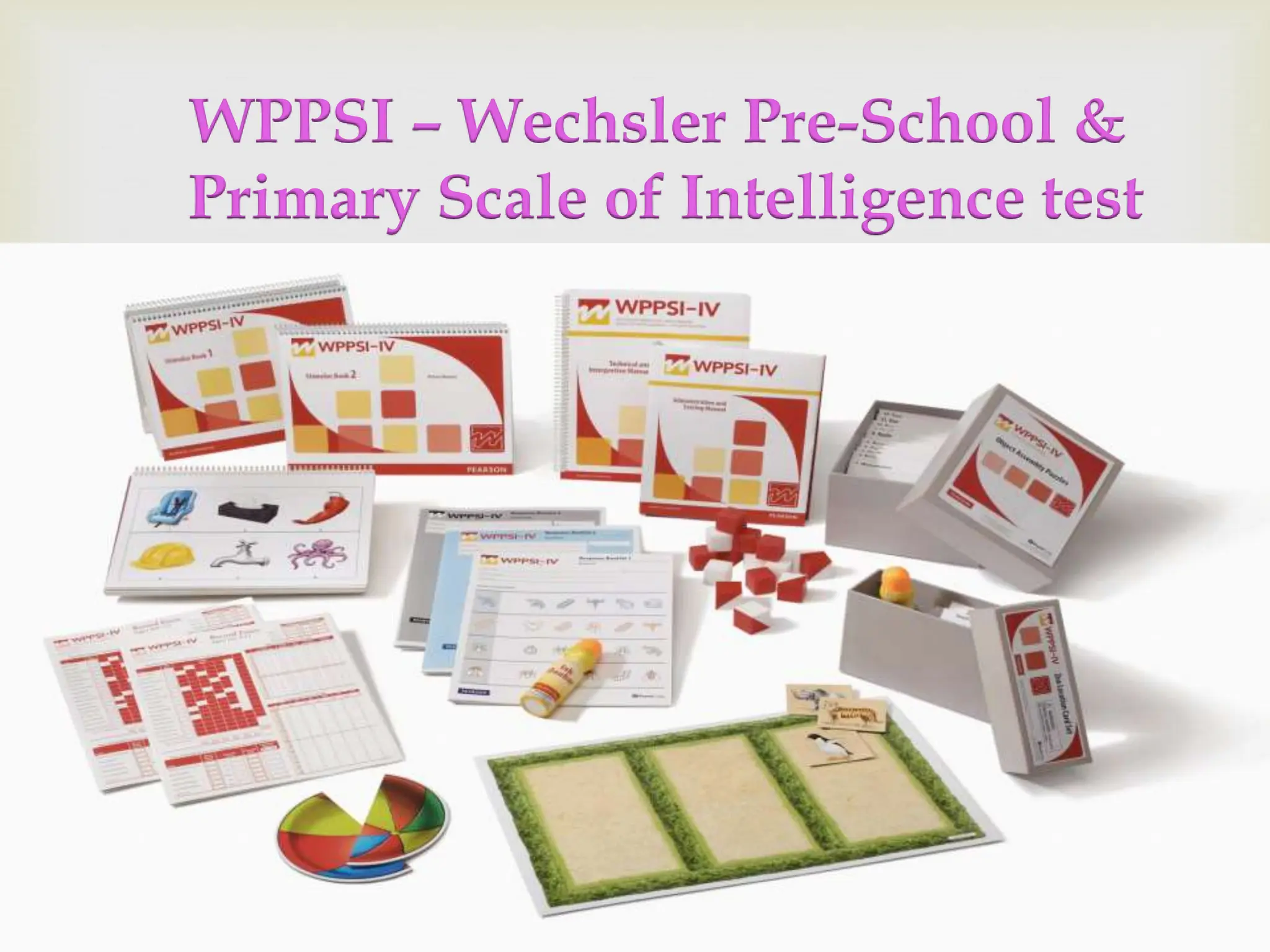
WPPSI – Wechsler Pre-School &
Primary Scale of Intelligence test
 WPPSI – Wechsler Pre-School & Primary Scale of Intelligence
– test covers children from 2 years and 6 months to 7 years and
7 months.
 The WPPSI was introduced in 1967 and originally designed
for children between 4 years and 6.5 years old before later
revisions expanded that range.
 The test is currently in its fourth revision as the WPPSI-IV and
consists of 14 subtests that are broken up into three scoring
indexes: Verbal, Performance, and Full Scale IQ.
WPPSI – Wechsler Pre-School &
Primary Scale of Intelligence test
There are 14 total subtests included in the WPPSI. Children
between the ages of 2 years and 6 months to 3 years and 11 months
take the following five subtests:
1. Block Design
2. Information
3. Object Assembly
4. Picture Naming
5. Receptive Vocabulary
Children that are between the ages of 4 and 7 years 7
months are administered the five subtests listed above and
the nine additional subtests below:
1. Coding
2. Comprehension
3. Matrix Reasoning
4. Picture Completion
5. Picture Concepts
6. Similarities
7. Symbol Search
8. Vocabulary
9. Word Reasoning
 WISC – Wechsler Intelligence Scale for Children – test covers
children from 6 to 16 years old.
 This test was introduced as an offshoot of the Wechsler-
Bellevue Intelligence Scale and was introduced in 1949.
 This test is often used to help with educational placement,
identifying gifted students, and can also be used in conjunction
with the Wechsler Individual Achievement Test to help
identify students with learning disabilities or gaps between
academic achievement and cognitive abilities.
 The most recent version of the test is the WISC-V, which was
released in 2014.
 There are five primary index scores,
1. Verbal Comprehension Index (VCI),
2. Visual Spatial Index (VSI),
3. Fluid Reasoning Index (FRI),
4. Working Memory Index (WMI), and
5. Processing Speed Index (PSI).
Two subtests must be administered to obtain each of the
primary index scores; thus, a total of 10 subtests are primary
subtests.
• The Full Scale IQ is derived from 7 of the 10 primary subtests:
Both Verbal Comprehension subtests, one Visual Spatial subtest,
two Fluid Reasoning subtests, one Working Memory subtest, and
one Processing Speed subtest.
• Verbal Comprehension and Fluid Reasoning are weighted more
heavily in the Full Scale IQ to reflect the importance of
crystallized and fluid abilities in modern intelligence models
(Wechsler, 2014).
The VCI is derived from the Similarities and Vocabulary subtests. The
Verbal Comprehension scale subtests are described below:
1. Similarities – (primary, FSIQ) asking how two words are
alike/similar.
2. Vocabulary – (primary, FSIQ) examinee is asked to define a
provided word
3. Information (secondary) – general knowledge questions.
4. Comprehension – (secondary) questions about social
situations or common concepts.
1. Verbal Comprehension Index (VCI),
2. Visual Spatial Index (VSI),
The VSI is derived from the Block Design and Visual Puzzles subtests.
These subtests are as follows:
Block Design (primary, FSIQ) – children put together red-and-
white blocks in a pattern according to a displayed model. This
is timed, and some of the more difficult puzzles award bonuses
for speed.
Visual Puzzles (primary) – children view a puzzle in a stimulus
book and choose from among pieces of which three could
construct the puzzle.
The VSI is a measure of visual spatial processing.
3. Fluid Reasoning Index (FRI),
The FRI is derived from the Matrix Reasoning and Figure Weights
subtests. The Fluid Reasoning scale subtests are described below:
Matrix Reasoning (primary, FSIQ) – children are shown an array of
pictures with one missing square, and select the picture that fits the
array from five options.
Figure Weights (primary, FSIQ) – children view a stimulus book that
pictures shapes on a scale (or scales) with one empty side and select
the choice that keeps the scale balanced.
Picture Concepts (secondary) – children are provided with a series of
pictures presented in rows (either two or three rows) and asked to
determine which pictures go together, one from each row.
Arithmetic (secondary) – orally administered arithmetic questions.
Timed.
4. Working Memory Index (WMI),
The WMI is derived from the Digit Span and Picture Span subtests. The
Working Memory scale's subtests are as follows:
 Digit Span (primary, FSIQ) – children are given sequences of
numbers orally and asked to repeat them, as heard and in reverse
order.
 Picture Span (primary) – children view pictures in a stimulus book
and select from options to indicate the pictures they saw, in order if
possible.
 Letter-Number Sequencing (secondary) – children are provided a
series of numbers and letters and asked to provide them to the
examiner in a predetermined order.
The WMI is a measure of working memory ability.
5. Processing Speed Index (PSI).
PSI is derived from the Coding and Symbol Search subtests. The
Processing Speed subtests are as follows:
 Coding (primary, FSIQ) – children under 8 mark rows of shapes
with different lines according to a code, children over 8 transcribe a
digit-symbol code. The task is time-limited with bonuses for speed.
 Symbol Search (primary) – children are given rows of symbols and
target symbols, and asked to mark whether or not the target
symbols appear in each row.
 Cancellation (secondary) – children scan random and structured
arrangements of pictures and marks specific target pictures within a
limited amount of time.
The PSI is a measure of processing speed.

 WAIS – Wechsler Adult
Intelligence Scale – test
covers teenagers from 16
years of age through
adulthood
 . The current version of the
test is the WAIS-IV which
was launched in 2008.
WAIS-IV
The current version of the test, the WAIS-IV, which was
released in 2008,
The General Ability Index (GAI) was included, which consists
of the Similarities, Vocabulary and Information subtests from the
Verbal Comprehension Index and the Block Design, Matrix
Reasoning and Visual Puzzles subtests from the Perceptual
Reasoning Index.
The GAI is clinically useful because it can be used as a
measure of cognitive abilities that are less vulnerable to
impairment.
There are four index scores representing major
components of intelligence:
1. Verbal Comprehension Index (VCI)
2. Perceptual Reasoning Index (PRI)
3. Working Memory Index (WMI)
4. Processing Speed Index (PSI)
two broad scores are also generated, which can be used to
summarize general intellectual abilities:
Full Scale IQ (FSIQ), based on the total combined
performance of the VCI, PRI, WMI, and PSI
General Ability Index (GAI), based only on the six subtests
that comprise the VCI and PRI
Subtests
1. The Verbal Comprehension Index includes four tests:
Similarities: Abstract verbal reasoning (e.g., "In what way are an
apple and a pear alike?")
Vocabulary: The degree to which one has learned, been able to
comprehend and verbally express vocabulary (e.g., "What is a
guitar?")
Information : Degree of general information acquired from culture
(e.g., "Who is the president of Russia?")
Comprehension [Supplemental]: Ability to deal with abstract social
conventions, rules and expressions (e.g., "What does Kill 2 birds with
1 stone metaphorically mean?")
2. The Perceptual Reasoning Index comprises five
tests
Block Design: Spatial perception, visual abstract processing & problem
solving
Matrix Reasoning: Nonverbal abstract problem solving, inductive
reasoning, spatial reasoning
Visual Puzzles: non-verbal reasoning
Picture Completion [Supplemental]: Ability to quickly perceive visual
details
Figure Weights [Supplemental]: quantitative and analogical reasoning
The Working Memory Index is obtained from three tests
Digit span: attention, concentration, mental control (e.g.,
Repeat the numbers 1-2-3 in reverse sequence)
Arithmetic: Concentration while manipulating mental
mathematical problems (e.g., "How many 45-cent stamps can
you buy for a dollar?")
Letter-Number Sequencing [Supplemental]: attention and
working memory (e.g., Repeat the sequence Q-1-B-3-J-2, but
place the numbers in numerical order and then the letters in
alphabetical order)
3. The Working Memory Index
The Processing Speed Index includes three tests
 Symbol Search: Visual perception, speed
 Coding: Visual-motor coordination, motor and mental speed
 Cancellation [Supplemental]: visual-perceptual speed
4. The Processing Speed Index

 Each test is comprised of two groups of subtests: Verbal and Performance.
 Verbal scales measure general knowledge, language, reasoning, and
memory skills.
 Performance measures spatial, sequencing, and problem-solving skills.
Each test is individually administered by a trained examiner and requires
a complex set of test materials.
 The Full Scale IQ score is determined by a formula that sums the Verbal
and Performance IQ scores
 . A score beyond 130 is considered superior or "gifted",
 120-129 is "very high",
 110-119 are considered "bright normal",
 and anything less than 90 is considered average to low average.
 Anything lower than a 70 signals borderline mental functionality, and
 any lower than 69 signals mental retardation.
Scoring and Administration
The subtests for each index are compiled to derive two
broader intelligence scores – Full Scale IQ and General
Ability Index.
 The Full Scale IQ is comprised of the scores from all four
indexes while the General Ability Index includes only the
six subtests related to the Verbal Comprehension Index and
the Perceptual Reasoning Index.
The Wechsler IQ test has 10 core and 5 supplemental
subtests divided into separate sections.
A score is given for each subtest, and then it is averaged
into an overall Full Scale IQ.
The table below will help show you how the scores derived
from the various subtests is used within the various index
scores.

 This test available in any language.
 It is an easy method of applying for all the age
group.
 It can administer in shorter form.
 It is easy to identify prognosis of disease condition.
 It is detect diagnosis or assist in finding out
diagnosis.
 It is useful special abilities and disabilities.
WECHSLER TEST-
ADVATAGES
Alfred binet
Intelligence test

History of IQ test
 During the early 1900s, the French government asked
Binet to help for the school student
 Attention, memory, and problem-solving skills. Using
these questions, Binet determined test scale
 Binet and the First IQ Test
This first intelligence test, referred to today as the Binet-Simon
Scale, became the basis for the intelligence tests still in use today.
 Interest in intelligence dates back thousands of years. But it
wasn't until psychologist Alfred Binet was commissioned to
identify students who needed educational assistance that the
first intelligent quotient (IQ) test was born.

History of IQ test
 Stanford University psychologist Lewis Terman took Binet's
original test and standardized it using a sample of American
participants.
 This adapted test, first published in 1916, was called the Stanford-
Binet Intelligence Scale and soon became the standard intelligence
test used in the U.S.
 The Stanford-Binet intelligence test used a single number, known
as the intelligence quotient (or IQ), to represent an individual's
score on the test
 The IQ score was calculated by dividing the test taker's mental age
by his or her chronological age and then multiplying this number
by 100.
 For example, a child with a mental age of 12 and a chronological
age of 10 would have an IQ of 120 (12/10 x 100).
Pros and Cons of IQ Testing Through History
 At the outset of World War I, U.S. Army officials were faced
with the task of screening an enormous number of recruits.
 In 1917, as chair of the Committee on the Psychological
Examination of Recruits, psychologist Robert Yerkes developed
two tests known as the Army Alpha and Beta tests.
 The Army Alpha was designed as a written test, while the Army
Beta was made up of pictures for recruits who were unable to
read or didn't speak English.
 The tests were administered to over 2 million soldiers in an
effort to help the Army determine which men were well-suited
to specific positions and leadership roles.
HISTORY CONT..
 The Wechsler Intelligence Scales
Building on the Stanford-Binet test, American psychologist David
Wechsler created a new measurement instrument.
 Much like Binet, Wechsler believed that intelligence involved different
mental abilities.
 Dissatisfied with the limitations of the Stanford-Binet, he published his
new intelligence test, known as the Wechsler Adult Intelligence Scale
(WAIS), in 1955.
 Wechsler also developed two different tests specifically for use with
children:
 the Wechsler Intelligence Scale for Children (WISC) and
 the Wechsler Preschool and Primary Scale of Intelligence (WPPSI).
 The adult version of the test has been revised since its original
publication and is now known as the WAIS-IV.
HISTORY CONT..
The Stanford-Binet Intelligence Scale is a
standardized test that measures intelligence
and cognitive abilities in children and adults,
from age two through mature adulthood.
The Stanford-Binet Intelligence Scale was originally developed
 To help place children in appropriate educational settings.
 It can help determine the level of intellectual and cognitive
functioning in preschoolers, children, adolescents and adults,
and
 To assist in the diagnosis of a learning disability, developmental
delay, mental retardation , or giftedness.
 It is used to provide educational planning and placement,
neuropsychological assessment, and research.
 The Stanford-Binet Intelligence Scale is generally administered
in a school or clinical setting.
Purpose
The Stanford-Binet Intelligence Scale has a rich
history.
 It is a descendant of the Binet-Simon scale which was
developed in 1905 and became the first intelligence
test.
 The Stanford-Binet Intelligence Scale was developed
in 1916 and was revised in 1937, 1960, and 1986. The
present edition was published in 1986.
 Administration of the Stanford-Binet Intelligence Scale typically
takes between 45 to 90 minutes, but can take as long as two hours, 30
minutes.
 The older the child and the more subtests administered, the longer
the test generally takes to complete.
 The Stanford-Binet Intelligence Scale is comprised of four cognitive
area scores which together determine the composite score and factor
scores.
These area scores include:
 Verbal Reasoning,
 Abstract/Visual Reasoning,
 Quantitative Reasoning, and
 Short-Term Memory.
• The composite score is considered to be what the
authors call the best estimate of "g" or "general
reasoning ability" and is the sum of all of subtest
scores.
• General reasoning ability or "g" is considered to
represent a person's ability to solve novel problems.
• The composite score is a global estimate of a person's
intellectual functioning.
 The test consists of 15 subtests, which are grouped into the four
area scores.
 Not all subtests are administered to each age group; but six subtests
are administered to all age levels.
 These subtests are:
1. Vocabulary,
2. Comprehension,
3. Pattern Analysis,
4. Quantitative,
5. Bead Memory, and
6. Memory for Sentences.
 The number of tests administered and general test difficulty is
adjusted based on the test taker's age and performance on the sub-
test that measures word knowledge.
 The subtest measuring word knowledge is given to all test takers
and is the first subtest administered.
 The following is a review of the specific cognitive abilities that
the four area scores measure.
 The Verbal Reasoning area score measures verbal knowledge
and understanding obtained from the school and home
learning environment and reflects the ability to apply verbal
skills to new situations.
 Examples of subtests comprising this factor measure skills
which include:
 Word knowledge,
 Social judgment and
 Awareness,
 Ability to isolate the inappropriate feature in visual material
and social intelligence, and
 The ability to differentiate essential from non-essential detail.
The Abstract/Visual Reasoning area score examines
The ability to interpret and perform mathematic
operations,
 The ability to visualize patterns, visual/motor skills, and
 Problem-solving skills through the use of reasoning.
An example of a subtest which determines the
Abstract/Visual Reasoning score is a timed test that
involves tasks such as
 completing a basic puzzle and
 replicating black and white cube designs.
The Quantitative Reasoning area score measures:
 Numerical reasoning,
 Concentration, and
 Knowledge and
Application of numerical concepts.
The Quantitative Reasoning area is combined with the
Abstract/Visual Reasoning area score to create an
Abstract/Visual Reasoning Factor Score.
The Short-Term Memory score measures
 concentration skills,
 short-term memory, and
 sequencing skills.
Subtests comprising this area score measure visual short-term
memory and auditory short term memory involving both sentences
and number sequences.
In one subtest that measures visual short-term memory, the
participant is presented with pictures of a bead design, and asked to
replicate it from memory.
 The Stanford-Binet Intelligence Scale is a standardized test, which
means that a large sample of children and adults were administered the
exam as a means of developing test norms.
 The population in the sample was representative of the population of
the United States based on age, gender, race or ethnic group,
geographic region, community size, parental education, educational
placement (normal versus special classes), etc.
 From this sample, norms were established.
 Norms are the performance of a comparison group of subjects—that
nature of the group should be specified, and this usually constitutes a
normal group so that the performance of the tested individual can be
compared to this group and thus evaluated.
 The numbers of correct responses on the given subtests are converted
to as SAS score or Standard Age Score which is based on the
chronological age of the test subject.
 This score is similar to an I.Q. score.
 Based on these norms, the Area Scores and
 Test Composite on the Stanford-Binet Intelligence Scale each have a
mean or average score of 100
 For this test, as with most measures of intelligence, a score of 100 is in
the normal or average range.
Test scores provide an estimate of the level at which a
child is functioning based on a combination of many
different subtests or measures of skills.
A trained psychologist is needed
 to evaluate and interpret the results,
 determine strengths and weaknesses, and
 make overall recommendations based on the findings
and observed behavioral observations.

J C RAVEN
STANDARDIZED PROGRESSIVE MATRIX

Raven's matrices
"Raven's matrices" are an IQ test introduced in 1938.
 Remarkably, it is language independent.
You can "read"
it upside down or sideways! I found a copy of the test
on the web (with answers!). (Web search quickly finds
you average scores by country. Smarter countries are
richer.) The Raven test has 60 questions ranging from
easy to hard. Here are four of them.
This is the first question, the easiest one. The illustration
is a puzzle missing one piece. You have six pieces to choose
from. Which piece belongs in the puzzle?
There are currently three published versions of RPMs:
(1)The original Standard Progressive Matrices (SPM)
,
(2) The Advanced Progressive Matrices (APM), which is more
difficult than SPM and designed for adults, and
(3) The Colored Progressive Matrices (CPM),
which is simpler than SPM and designed for low IQ
individuals.

 It can administrate many people at time.
 It can be given to the people with multiple
handicaps.
RPM - ADVANTAGES


 Intelligence testing is used to predict how well a person will
learn in a program of study.
 They help classify students so that the teacher knows the
capacity of each student to learn.
 They help to separate the slow learner from the gifted learner
so that the special methods can be adopted for training these
two different groups.
 They are used in selection for admission into different courses
of study and for awarding scholarship and vocational guidance.
 They are used in selection of candidates for different jobs.
 Intelligence tests are also useful in child guidance. With their
help we can discover the children’s backwardness in studies or
other educational difficulties.
USES OF
INTELLIGENCE TEST

 They can not measure intelligence with
mathematical accuracy. Nor can they predict with
absolute certainty success in school or in a
profession.
 They do not throw any light on the character,
morals, emotions or temperament of the individual,
the understanding of which is so essential in
understanding one’s personality.
LIMITATIONS OF
INTELLIGENCE TEST
Standardized tool for Intelligence test.

Standardized tool for Intelligence test.

  • 1.
    PRESENTED BY; A.DEEPA M.Sc(N).,B.Sc(Psychology) NURSINGTUTOR, GOVT. MEDICAL COLLEGE, TIRUPPUR.
  • 2.
     There are FIVEtypes of standardized test.  Intelligence test  Aptitude test  Interest test  Personality test  Achievement test TYPES OF STANDARDIZED TEST
  • 3.
     Intelligence is ageneral capacity for comprehension and reasoning that manifests itself in various way. It consists of an individual’s mental or cognitive ability which helps the person in solving his actual life problems and leading a happy and well-contended life. INTELLIGENCE
  • 4.
     Intelligence is theaggregate or global capacity of the individual to think rationally, to act purposefully and to deal effectively with the environment. WECHSLER – 1944 Intelligence can be defined as a sort of mental energy in the form of mental or cognitive abilities available with an individual which enables him to handle his environment in terms of adaptation to face noval situations as effectively as possible. MANGAL - 1993 INTELLIGENCE - DEFINITION
  • 5.
    Concrete intelligence; This is relatedto concrete materials. This person uses this intelligence in the operation of tools and instruments. Eg Engineers, mechanics. Social intelligence; It is the ability of an individual to react to social situations in daily life. Eg. Leaders, ministers salesman. Abstract intelligent; It is the ability to respond to words, numbers and letters etc. this type of intelligence is required by a study of books and related literature. Eg. Mostly good teachers, lawyers, philosophers. CLASSIFICATION OF INTELLIGENCE
  • 6.
  • 7.
  • 8.
     CLASSIFICATION OF INDIVIDUALS ACCORDINGTO IQ 1. Genius 2. Very superior 3. Superior 4. Above average 5. Average 6. Dull average 7. Borderline 8. Mild mental retardation 9. Moderate mental retardation 10.Severe mental retardation 11.Profound mental retardation 140 and above 130 to 140 120 to 130 110 to 120 90 to 110 80 to 90 70 to 80 50 to 70 35 to 50 20 to 35 0 to 20x
  • 9.
      It helpsthe individual to adjust to changing situations quickly and correctly.  It helps to carry on the higher mental processes such as reasoning, judging and criticizing.  It helps to learn difficult tasks solve problems.  It helps the individual to improve performance in any situation.  It helps in quick understanding of things.  It helps the individual to apply the knowledge gained in various subjects/situations in dealing with present situation. USES OF INTELLIGENCE
  • 10.
      Factor theoriesof intelligence two factor theory or general intelligence theory, 1927 Group factor theory or multifactor theory, 1938  Process-oriented theory piaget’s theory, 1970 Bruner’s theory, 1973  Information-processing theory(Robert Sternberg, 1984) THEORIES OF INTELLIGENCE
  • 11.
    FACTOR THEORY OFINTELLIGENCE Two factor theory or general intelligence (G-Factor) theory; 1927 oIt was advocated by Charles Spearman, oBritish psychologist. General intelligence factor (G); universal inborn ability Specific intelligence factor(S) learned and acquired from environment s1+s2+s3… Intelligence(A); A=G+S1+S2+S3..
  • 12.
    This theory wasexpounded by LL THURSTONE in 1938 psychological Functional (unity) Mental operations have a primary factor
  • 13.
  • 14.
     Jean Piaget, 1970 Intelligenceis an adaptive process biological interaction with maturation environment evolution of cognitive process INTELLIGENCE Process-oriented theories understanding the law of nature Principles of grammar, Mathematics etc.
  • 15.
     According to Bruner’s, Intelligence is a growing dependence on internal representation of objects or situations.  These growing abilities are influenced by the environment, especially the rewards and punishment people receive for using particular intellectual skill in particular ways. Bruner’s theory
  • 16.
     Robert Sternberg, 1984 The most recent acceptable theory of intelligence has been put forward by the American psychologist Robert Sternberg by adopting an information processing approach to cognition or problem solving.  The information processing approach is the manner in which one proceeds to perform a mental task or solve a problem from in hand.  The theory propagated by Sternberg identified the following steps in the way one processes information; Information-processing theory
  • 17.
    Encoding (identifying therelevant available information in the mind). Mapping (drawing the necessary inference.) Application (applying the inferred relationship) Justification (justifying the analyzed solution of the problem) Responding ( providing the best possible solution)
  • 18.
  • 19.
    a) Individual tests Verbal tests Non-verbaltests b) Group tests Verbal tests Non-verbal tests(performance test) I. Intelligence tests
  • 20.
     a) Individual verbaltests These tests one individual at a time. These tests make use of language. For example Stanford-Binet Scale.
  • 21.
      The completenon-verbal or non-language tests of intelligence for testing an individual at a time fall into this category.  These tests involve the manipulation of objects  Example  Picture arrangement  Picture completion  Block design, etc. with minimum use of paper and pencil. a) Individual performance tests
  • 22.
    Instructions are generallygiven by demonstrations and Gestures. This tests are used in  infants,  mentally retarded,  Foreigners and  Those who do not understand language in which the tests are conducted. Example, Bhatia’s Battery of performance tests. (6 letter cancellation tests) a) individual performance tests
  • 23.
     b) Group verbalintelligence tests These tests use language and are applied to a group of individual at a time Example; Army Alpha tests Army general classification test.
  • 26.
     Army alpha test Alphasubjects o Oral direction o Arithmetic o Practical judgment o Analogies o Disarranged sentences o Number series o Information.
  • 28.
    The Army Alphaand the Army Beta tests were designed to find the mental age of military recruits and to assess incoming recruits for success in the US Military by testing one's ability to understand language, to perform reasoning with semantic and quantitative relationships, to make practical judgments, to infer rules and regulations, and to recall general information. Army beta test  Memory  Matching  Picture completion  Geometric construction.
  • 29.
     b)Group non verbal intelligencetests  These tests do not necessitate the use of language and are applicable to the group of individuals at a time.  In these tests material does not contain words or numerical figures.  It contains picture, diagrams, geometrical figures, etc. printed in a booklet.  The subject is required to perform such activities as to fill in some empty spaces, draw some simple figures, point out similarities and dissimilarities, etc.  Examples;  Army beta tests  Raven’s Progressive matrices tests.
  • 30.
     comparison Individual tests  Theytest one individual at a time.hence they are not economical in terms of time, labor and money.  These are applicable both for children and adults.  These bring the tester and child closer and establish a better relationship between the two. Group tests  A group of children can be tested at the same time, hence economical.  These tests cannot be administered to young children below the age of 10 years.  Personal contact between the two is not possible.
  • 31.
      Wechsler tests forchildren, adult.  The Stanford Binet intelligence test  Roven’s progressive matrix  Vineland social maturity scalar II. Intelligence tests based on scientist
  • 32.
  • 33.
     David Wechsler  DavidWechsler was born on January 12, 1896 to a Jewish family in Lespedi, Romania.  Columbia University, where he earned a master’s degree in 1917 and a Ph.D. in experimental psychology in 1925, studying under Robert Woodworth.  Wechsler worked with the United States Army in 1917 during World War I as an Army Psychologist at Camp Logan, Texas.  In 1918, the Army sent him to London to work with Charles Spearman and Karl Pearson, where he developed psychological tests to screen new draftees.
  • 34.
    Wechsler’s Intelligence Scales Wechsleroperated on the assumption that intelligence is a person’s total ability to act purposefully, to think rationally, and to deal effectively with his or her environment, and  He believed that intelligent behavior was comprised of more than just intellectual ability.  Thus, he disliked the current Binet IQ test, which directly measured only intellectual ability, so he developed his own intelligence tests in order to better understand his patients at Bellevue.
  • 35.
     What hefound was mind-blowing. The IQ of a person is directly predisposed to the atmosphere in which they live.  Biological and environmental influences can dictate a person’s intellect. Wechsler knew that many factors affected intelligence and cognitive ability.  realized that one test would not accommodate all age groups, so he developed a series that would be used for all ages.
  • 36.
      The firsttest he developed was the Wechsler-Bellevue Intelligence Test in 1939, which was revised and renamed the Wechsler Adult Intelligence Scale (WAIS) in 1955.  From his first test, he developed two more tests, the Wechsler Intelligence Scale for Children (WISC) in 1949 and  The Wechsler Preschool and Primary Scale of Intelligence (WPPSI) in 1967.
  • 37.
    Dr. Wechsler dedicatedhis life to the study of the brain, and generations long after are still using his research as a diagnostic tool. He remains just as prevalent in death as he did in life. He passed on May 2, 1981, at the age of 85. He is the 51st most quoted mental health professional of the 20th century.
  • 38.
     Wechsler Intelligence Scale The Wechsler Preschool and PrimaryScales of Intelligence (WPPSI) The Wechsler Intelligence Scale for Children (WISC) Wechsler Adult Intelligence Scale (WAIS
  • 39.
    WPPSI – WechslerPre-School & Primary Scale of Intelligence test
  • 40.
     WPPSI –Wechsler Pre-School & Primary Scale of Intelligence – test covers children from 2 years and 6 months to 7 years and 7 months.  The WPPSI was introduced in 1967 and originally designed for children between 4 years and 6.5 years old before later revisions expanded that range.  The test is currently in its fourth revision as the WPPSI-IV and consists of 14 subtests that are broken up into three scoring indexes: Verbal, Performance, and Full Scale IQ. WPPSI – Wechsler Pre-School & Primary Scale of Intelligence test
  • 41.
    There are 14total subtests included in the WPPSI. Children between the ages of 2 years and 6 months to 3 years and 11 months take the following five subtests: 1. Block Design 2. Information 3. Object Assembly 4. Picture Naming 5. Receptive Vocabulary
  • 42.
    Children that arebetween the ages of 4 and 7 years 7 months are administered the five subtests listed above and the nine additional subtests below: 1. Coding 2. Comprehension 3. Matrix Reasoning 4. Picture Completion 5. Picture Concepts 6. Similarities 7. Symbol Search 8. Vocabulary 9. Word Reasoning
  • 46.
     WISC –Wechsler Intelligence Scale for Children – test covers children from 6 to 16 years old.  This test was introduced as an offshoot of the Wechsler- Bellevue Intelligence Scale and was introduced in 1949.  This test is often used to help with educational placement, identifying gifted students, and can also be used in conjunction with the Wechsler Individual Achievement Test to help identify students with learning disabilities or gaps between academic achievement and cognitive abilities.  The most recent version of the test is the WISC-V, which was released in 2014.
  • 47.
     There arefive primary index scores, 1. Verbal Comprehension Index (VCI), 2. Visual Spatial Index (VSI), 3. Fluid Reasoning Index (FRI), 4. Working Memory Index (WMI), and 5. Processing Speed Index (PSI). Two subtests must be administered to obtain each of the primary index scores; thus, a total of 10 subtests are primary subtests. • The Full Scale IQ is derived from 7 of the 10 primary subtests: Both Verbal Comprehension subtests, one Visual Spatial subtest, two Fluid Reasoning subtests, one Working Memory subtest, and one Processing Speed subtest. • Verbal Comprehension and Fluid Reasoning are weighted more heavily in the Full Scale IQ to reflect the importance of crystallized and fluid abilities in modern intelligence models (Wechsler, 2014).
  • 48.
    The VCI isderived from the Similarities and Vocabulary subtests. The Verbal Comprehension scale subtests are described below: 1. Similarities – (primary, FSIQ) asking how two words are alike/similar. 2. Vocabulary – (primary, FSIQ) examinee is asked to define a provided word 3. Information (secondary) – general knowledge questions. 4. Comprehension – (secondary) questions about social situations or common concepts. 1. Verbal Comprehension Index (VCI),
  • 49.
    2. Visual SpatialIndex (VSI), The VSI is derived from the Block Design and Visual Puzzles subtests. These subtests are as follows: Block Design (primary, FSIQ) – children put together red-and- white blocks in a pattern according to a displayed model. This is timed, and some of the more difficult puzzles award bonuses for speed. Visual Puzzles (primary) – children view a puzzle in a stimulus book and choose from among pieces of which three could construct the puzzle. The VSI is a measure of visual spatial processing.
  • 52.
    3. Fluid ReasoningIndex (FRI), The FRI is derived from the Matrix Reasoning and Figure Weights subtests. The Fluid Reasoning scale subtests are described below: Matrix Reasoning (primary, FSIQ) – children are shown an array of pictures with one missing square, and select the picture that fits the array from five options. Figure Weights (primary, FSIQ) – children view a stimulus book that pictures shapes on a scale (or scales) with one empty side and select the choice that keeps the scale balanced. Picture Concepts (secondary) – children are provided with a series of pictures presented in rows (either two or three rows) and asked to determine which pictures go together, one from each row. Arithmetic (secondary) – orally administered arithmetic questions. Timed.
  • 56.
    4. Working MemoryIndex (WMI), The WMI is derived from the Digit Span and Picture Span subtests. The Working Memory scale's subtests are as follows:  Digit Span (primary, FSIQ) – children are given sequences of numbers orally and asked to repeat them, as heard and in reverse order.  Picture Span (primary) – children view pictures in a stimulus book and select from options to indicate the pictures they saw, in order if possible.  Letter-Number Sequencing (secondary) – children are provided a series of numbers and letters and asked to provide them to the examiner in a predetermined order. The WMI is a measure of working memory ability.
  • 57.
    5. Processing SpeedIndex (PSI). PSI is derived from the Coding and Symbol Search subtests. The Processing Speed subtests are as follows:  Coding (primary, FSIQ) – children under 8 mark rows of shapes with different lines according to a code, children over 8 transcribe a digit-symbol code. The task is time-limited with bonuses for speed.  Symbol Search (primary) – children are given rows of symbols and target symbols, and asked to mark whether or not the target symbols appear in each row.  Cancellation (secondary) – children scan random and structured arrangements of pictures and marks specific target pictures within a limited amount of time. The PSI is a measure of processing speed.
  • 60.
      WAIS –Wechsler Adult Intelligence Scale – test covers teenagers from 16 years of age through adulthood  . The current version of the test is the WAIS-IV which was launched in 2008.
  • 61.
    WAIS-IV The current versionof the test, the WAIS-IV, which was released in 2008, The General Ability Index (GAI) was included, which consists of the Similarities, Vocabulary and Information subtests from the Verbal Comprehension Index and the Block Design, Matrix Reasoning and Visual Puzzles subtests from the Perceptual Reasoning Index. The GAI is clinically useful because it can be used as a measure of cognitive abilities that are less vulnerable to impairment.
  • 62.
    There are fourindex scores representing major components of intelligence: 1. Verbal Comprehension Index (VCI) 2. Perceptual Reasoning Index (PRI) 3. Working Memory Index (WMI) 4. Processing Speed Index (PSI) two broad scores are also generated, which can be used to summarize general intellectual abilities: Full Scale IQ (FSIQ), based on the total combined performance of the VCI, PRI, WMI, and PSI General Ability Index (GAI), based only on the six subtests that comprise the VCI and PRI
  • 63.
    Subtests 1. The VerbalComprehension Index includes four tests: Similarities: Abstract verbal reasoning (e.g., "In what way are an apple and a pear alike?") Vocabulary: The degree to which one has learned, been able to comprehend and verbally express vocabulary (e.g., "What is a guitar?") Information : Degree of general information acquired from culture (e.g., "Who is the president of Russia?") Comprehension [Supplemental]: Ability to deal with abstract social conventions, rules and expressions (e.g., "What does Kill 2 birds with 1 stone metaphorically mean?")
  • 64.
    2. The PerceptualReasoning Index comprises five tests Block Design: Spatial perception, visual abstract processing & problem solving Matrix Reasoning: Nonverbal abstract problem solving, inductive reasoning, spatial reasoning Visual Puzzles: non-verbal reasoning Picture Completion [Supplemental]: Ability to quickly perceive visual details Figure Weights [Supplemental]: quantitative and analogical reasoning
  • 65.
    The Working MemoryIndex is obtained from three tests Digit span: attention, concentration, mental control (e.g., Repeat the numbers 1-2-3 in reverse sequence) Arithmetic: Concentration while manipulating mental mathematical problems (e.g., "How many 45-cent stamps can you buy for a dollar?") Letter-Number Sequencing [Supplemental]: attention and working memory (e.g., Repeat the sequence Q-1-B-3-J-2, but place the numbers in numerical order and then the letters in alphabetical order) 3. The Working Memory Index
  • 66.
    The Processing SpeedIndex includes three tests  Symbol Search: Visual perception, speed  Coding: Visual-motor coordination, motor and mental speed  Cancellation [Supplemental]: visual-perceptual speed 4. The Processing Speed Index
  • 67.
      Each testis comprised of two groups of subtests: Verbal and Performance.  Verbal scales measure general knowledge, language, reasoning, and memory skills.  Performance measures spatial, sequencing, and problem-solving skills. Each test is individually administered by a trained examiner and requires a complex set of test materials.  The Full Scale IQ score is determined by a formula that sums the Verbal and Performance IQ scores  . A score beyond 130 is considered superior or "gifted",  120-129 is "very high",  110-119 are considered "bright normal",  and anything less than 90 is considered average to low average.  Anything lower than a 70 signals borderline mental functionality, and  any lower than 69 signals mental retardation. Scoring and Administration
  • 68.
    The subtests foreach index are compiled to derive two broader intelligence scores – Full Scale IQ and General Ability Index.  The Full Scale IQ is comprised of the scores from all four indexes while the General Ability Index includes only the six subtests related to the Verbal Comprehension Index and the Perceptual Reasoning Index. The Wechsler IQ test has 10 core and 5 supplemental subtests divided into separate sections. A score is given for each subtest, and then it is averaged into an overall Full Scale IQ. The table below will help show you how the scores derived from the various subtests is used within the various index scores.
  • 70.
      This testavailable in any language.  It is an easy method of applying for all the age group.  It can administer in shorter form.  It is easy to identify prognosis of disease condition.  It is detect diagnosis or assist in finding out diagnosis.  It is useful special abilities and disabilities. WECHSLER TEST- ADVATAGES
  • 71.
  • 72.
     History of IQtest  During the early 1900s, the French government asked Binet to help for the school student  Attention, memory, and problem-solving skills. Using these questions, Binet determined test scale  Binet and the First IQ Test This first intelligence test, referred to today as the Binet-Simon Scale, became the basis for the intelligence tests still in use today.  Interest in intelligence dates back thousands of years. But it wasn't until psychologist Alfred Binet was commissioned to identify students who needed educational assistance that the first intelligent quotient (IQ) test was born.
  • 73.
     History of IQtest  Stanford University psychologist Lewis Terman took Binet's original test and standardized it using a sample of American participants.  This adapted test, first published in 1916, was called the Stanford- Binet Intelligence Scale and soon became the standard intelligence test used in the U.S.  The Stanford-Binet intelligence test used a single number, known as the intelligence quotient (or IQ), to represent an individual's score on the test
  • 74.
     The IQscore was calculated by dividing the test taker's mental age by his or her chronological age and then multiplying this number by 100.  For example, a child with a mental age of 12 and a chronological age of 10 would have an IQ of 120 (12/10 x 100).
  • 75.
    Pros and Consof IQ Testing Through History  At the outset of World War I, U.S. Army officials were faced with the task of screening an enormous number of recruits.  In 1917, as chair of the Committee on the Psychological Examination of Recruits, psychologist Robert Yerkes developed two tests known as the Army Alpha and Beta tests.  The Army Alpha was designed as a written test, while the Army Beta was made up of pictures for recruits who were unable to read or didn't speak English.  The tests were administered to over 2 million soldiers in an effort to help the Army determine which men were well-suited to specific positions and leadership roles. HISTORY CONT..
  • 76.
     The WechslerIntelligence Scales Building on the Stanford-Binet test, American psychologist David Wechsler created a new measurement instrument.  Much like Binet, Wechsler believed that intelligence involved different mental abilities.  Dissatisfied with the limitations of the Stanford-Binet, he published his new intelligence test, known as the Wechsler Adult Intelligence Scale (WAIS), in 1955.  Wechsler also developed two different tests specifically for use with children:  the Wechsler Intelligence Scale for Children (WISC) and  the Wechsler Preschool and Primary Scale of Intelligence (WPPSI).  The adult version of the test has been revised since its original publication and is now known as the WAIS-IV. HISTORY CONT..
  • 77.
    The Stanford-Binet IntelligenceScale is a standardized test that measures intelligence and cognitive abilities in children and adults, from age two through mature adulthood.
  • 78.
    The Stanford-Binet IntelligenceScale was originally developed  To help place children in appropriate educational settings.  It can help determine the level of intellectual and cognitive functioning in preschoolers, children, adolescents and adults, and  To assist in the diagnosis of a learning disability, developmental delay, mental retardation , or giftedness.  It is used to provide educational planning and placement, neuropsychological assessment, and research.  The Stanford-Binet Intelligence Scale is generally administered in a school or clinical setting. Purpose
  • 79.
    The Stanford-Binet IntelligenceScale has a rich history.  It is a descendant of the Binet-Simon scale which was developed in 1905 and became the first intelligence test.  The Stanford-Binet Intelligence Scale was developed in 1916 and was revised in 1937, 1960, and 1986. The present edition was published in 1986.
  • 80.
     Administration ofthe Stanford-Binet Intelligence Scale typically takes between 45 to 90 minutes, but can take as long as two hours, 30 minutes.  The older the child and the more subtests administered, the longer the test generally takes to complete.  The Stanford-Binet Intelligence Scale is comprised of four cognitive area scores which together determine the composite score and factor scores. These area scores include:  Verbal Reasoning,  Abstract/Visual Reasoning,  Quantitative Reasoning, and  Short-Term Memory.
  • 81.
    • The compositescore is considered to be what the authors call the best estimate of "g" or "general reasoning ability" and is the sum of all of subtest scores. • General reasoning ability or "g" is considered to represent a person's ability to solve novel problems. • The composite score is a global estimate of a person's intellectual functioning.
  • 82.
     The testconsists of 15 subtests, which are grouped into the four area scores.  Not all subtests are administered to each age group; but six subtests are administered to all age levels.  These subtests are: 1. Vocabulary, 2. Comprehension, 3. Pattern Analysis, 4. Quantitative, 5. Bead Memory, and 6. Memory for Sentences.  The number of tests administered and general test difficulty is adjusted based on the test taker's age and performance on the sub- test that measures word knowledge.  The subtest measuring word knowledge is given to all test takers and is the first subtest administered.
  • 83.
     The followingis a review of the specific cognitive abilities that the four area scores measure.  The Verbal Reasoning area score measures verbal knowledge and understanding obtained from the school and home learning environment and reflects the ability to apply verbal skills to new situations.  Examples of subtests comprising this factor measure skills which include:  Word knowledge,  Social judgment and  Awareness,  Ability to isolate the inappropriate feature in visual material and social intelligence, and  The ability to differentiate essential from non-essential detail.
  • 84.
    The Abstract/Visual Reasoningarea score examines The ability to interpret and perform mathematic operations,  The ability to visualize patterns, visual/motor skills, and  Problem-solving skills through the use of reasoning. An example of a subtest which determines the Abstract/Visual Reasoning score is a timed test that involves tasks such as  completing a basic puzzle and  replicating black and white cube designs.
  • 85.
    The Quantitative Reasoningarea score measures:  Numerical reasoning,  Concentration, and  Knowledge and Application of numerical concepts. The Quantitative Reasoning area is combined with the Abstract/Visual Reasoning area score to create an Abstract/Visual Reasoning Factor Score.
  • 86.
    The Short-Term Memoryscore measures  concentration skills,  short-term memory, and  sequencing skills. Subtests comprising this area score measure visual short-term memory and auditory short term memory involving both sentences and number sequences. In one subtest that measures visual short-term memory, the participant is presented with pictures of a bead design, and asked to replicate it from memory.
  • 87.
     The Stanford-BinetIntelligence Scale is a standardized test, which means that a large sample of children and adults were administered the exam as a means of developing test norms.  The population in the sample was representative of the population of the United States based on age, gender, race or ethnic group, geographic region, community size, parental education, educational placement (normal versus special classes), etc.  From this sample, norms were established.  Norms are the performance of a comparison group of subjects—that nature of the group should be specified, and this usually constitutes a normal group so that the performance of the tested individual can be compared to this group and thus evaluated.
  • 88.
     The numbersof correct responses on the given subtests are converted to as SAS score or Standard Age Score which is based on the chronological age of the test subject.  This score is similar to an I.Q. score.  Based on these norms, the Area Scores and  Test Composite on the Stanford-Binet Intelligence Scale each have a mean or average score of 100  For this test, as with most measures of intelligence, a score of 100 is in the normal or average range.
  • 89.
    Test scores providean estimate of the level at which a child is functioning based on a combination of many different subtests or measures of skills. A trained psychologist is needed  to evaluate and interpret the results,  determine strengths and weaknesses, and  make overall recommendations based on the findings and observed behavioral observations.
  • 90.
  • 91.
    J C RAVEN STANDARDIZEDPROGRESSIVE MATRIX
  • 92.
     Raven's matrices "Raven's matrices"are an IQ test introduced in 1938.  Remarkably, it is language independent. You can "read" it upside down or sideways! I found a copy of the test on the web (with answers!). (Web search quickly finds you average scores by country. Smarter countries are richer.) The Raven test has 60 questions ranging from easy to hard. Here are four of them.
  • 93.
    This is thefirst question, the easiest one. The illustration is a puzzle missing one piece. You have six pieces to choose from. Which piece belongs in the puzzle? There are currently three published versions of RPMs: (1)The original Standard Progressive Matrices (SPM) , (2) The Advanced Progressive Matrices (APM), which is more difficult than SPM and designed for adults, and (3) The Colored Progressive Matrices (CPM), which is simpler than SPM and designed for low IQ individuals.
  • 95.
      It canadministrate many people at time.  It can be given to the people with multiple handicaps. RPM - ADVANTAGES
  • 96.
  • 97.
      Intelligence testingis used to predict how well a person will learn in a program of study.  They help classify students so that the teacher knows the capacity of each student to learn.  They help to separate the slow learner from the gifted learner so that the special methods can be adopted for training these two different groups.  They are used in selection for admission into different courses of study and for awarding scholarship and vocational guidance.  They are used in selection of candidates for different jobs.  Intelligence tests are also useful in child guidance. With their help we can discover the children’s backwardness in studies or other educational difficulties. USES OF INTELLIGENCE TEST
  • 98.
      They cannot measure intelligence with mathematical accuracy. Nor can they predict with absolute certainty success in school or in a profession.  They do not throw any light on the character, morals, emotions or temperament of the individual, the understanding of which is so essential in understanding one’s personality. LIMITATIONS OF INTELLIGENCE TEST