Page 1 of 102
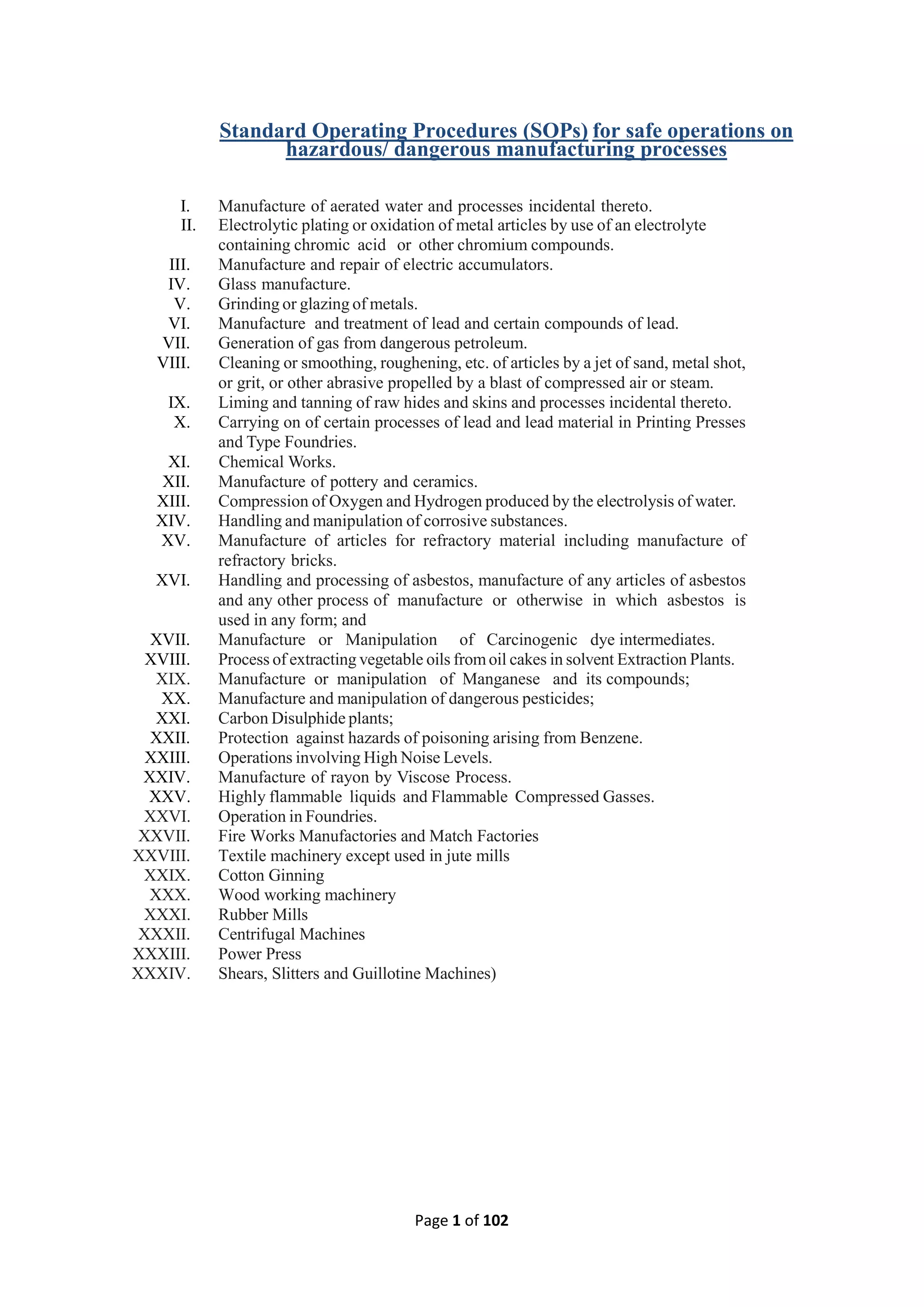
Standard Operating Procedures (SOPs) for safe operations on
hazardous/ dangerous manufacturing processes
I. Manufacture of aerated water and processes incidental thereto.
II. Electrolytic plating or oxidation of metal articles by use of an electrolyte
containing chromic acid or other chromium compounds.
III. Manufacture and repair of electric accumulators.
IV. Glass manufacture.
V. Grinding or glazing of metals.
VI. Manufacture and treatment of lead and certain compounds of lead.
VII. Generation of gas from dangerous petroleum.
VIII. Cleaning or smoothing, roughening, etc. of articles by a jet of sand, metal shot,
or grit, or other abrasive propelled by a blast of compressed air or steam.
IX. Liming and tanning of raw hides and skins and processes incidental thereto.
X. Carrying on of certain processes of lead and lead material in Printing Presses
and Type Foundries.
XI. Chemical Works.
XII. Manufacture of pottery and ceramics.
XIII. Compression of Oxygen and Hydrogen produced by the electrolysis of water.
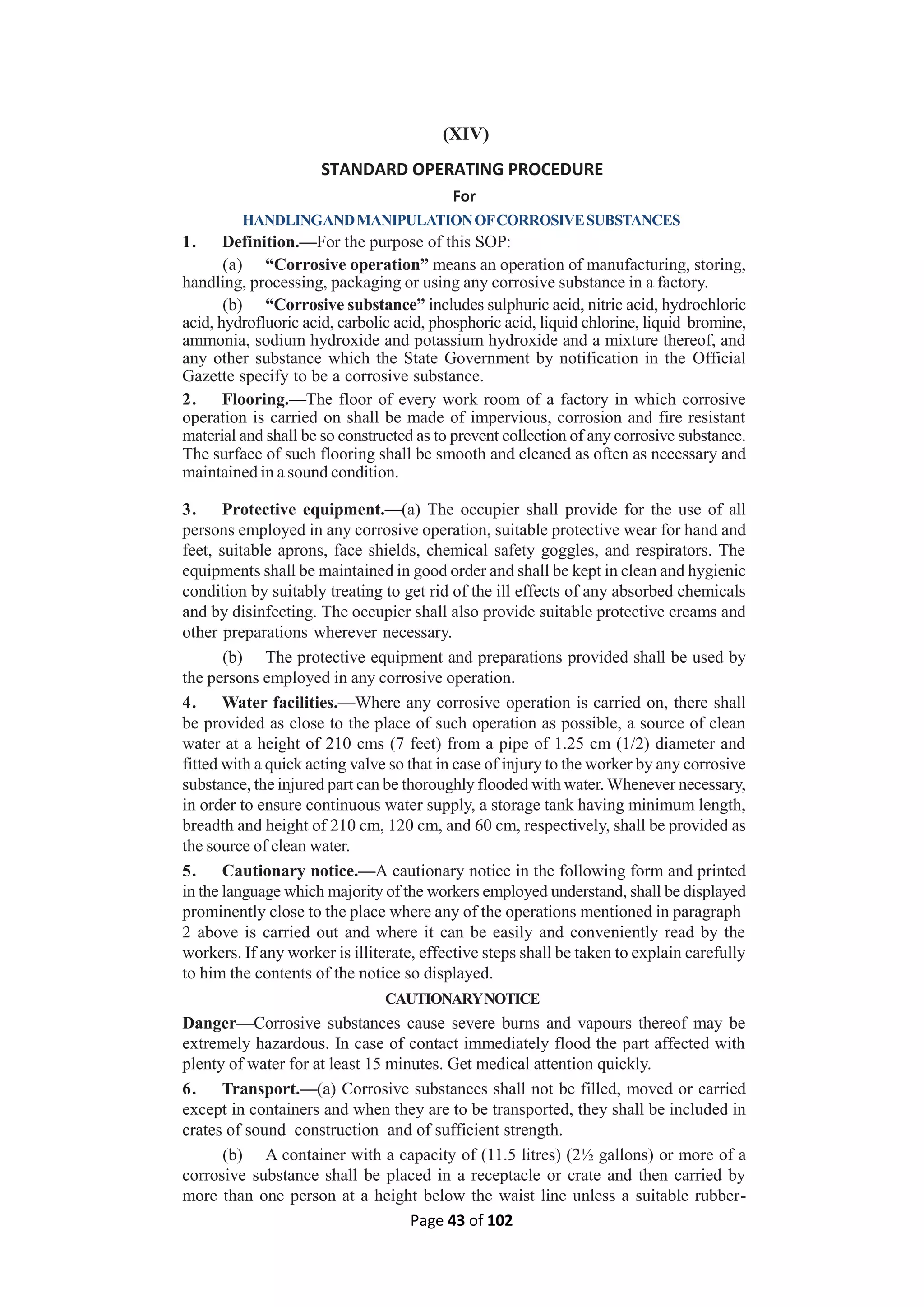
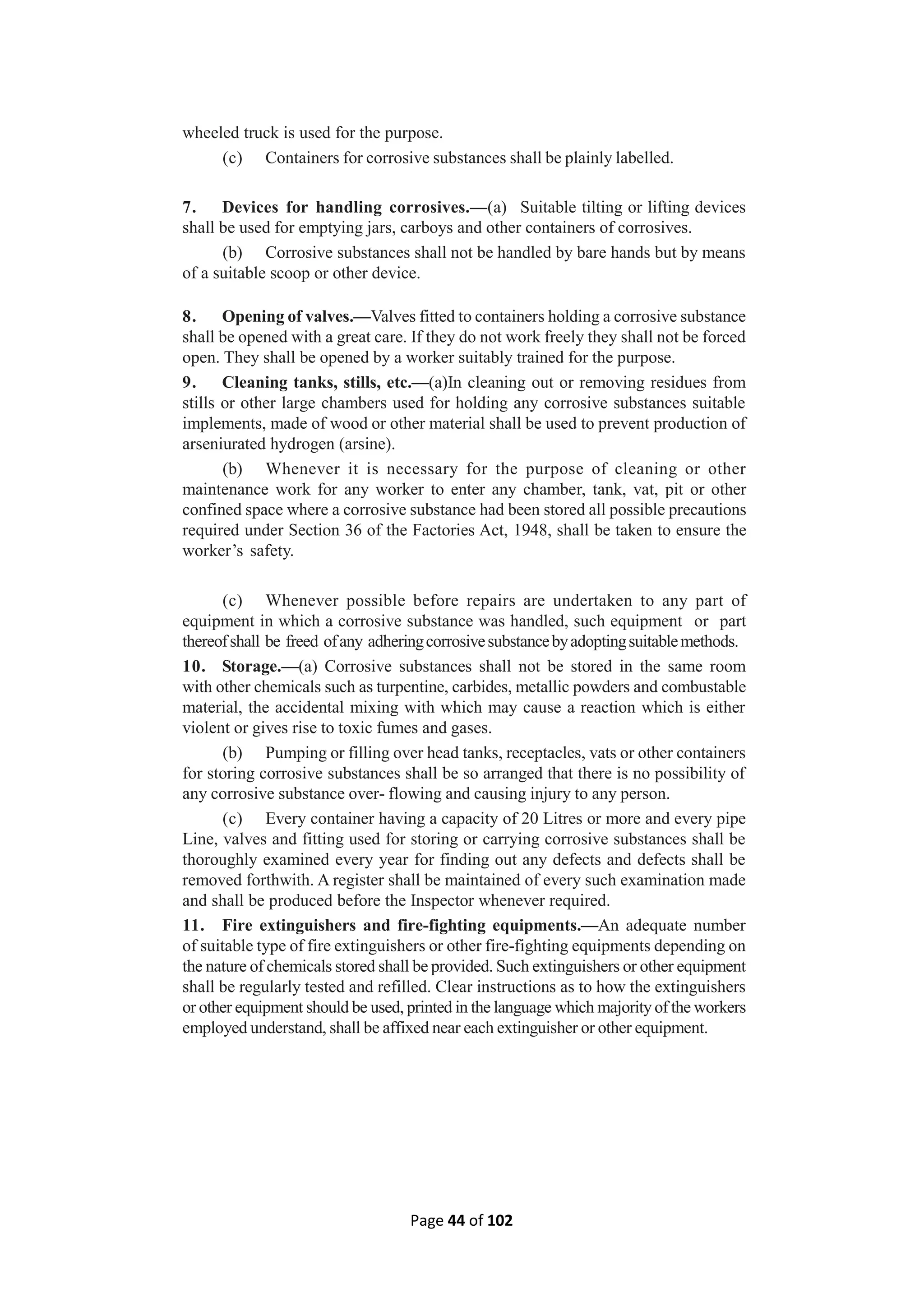
XIV. Handling and manipulation of corrosive substances.
XV. Manufacture of articles for refractory material including manufacture of
refractory bricks.
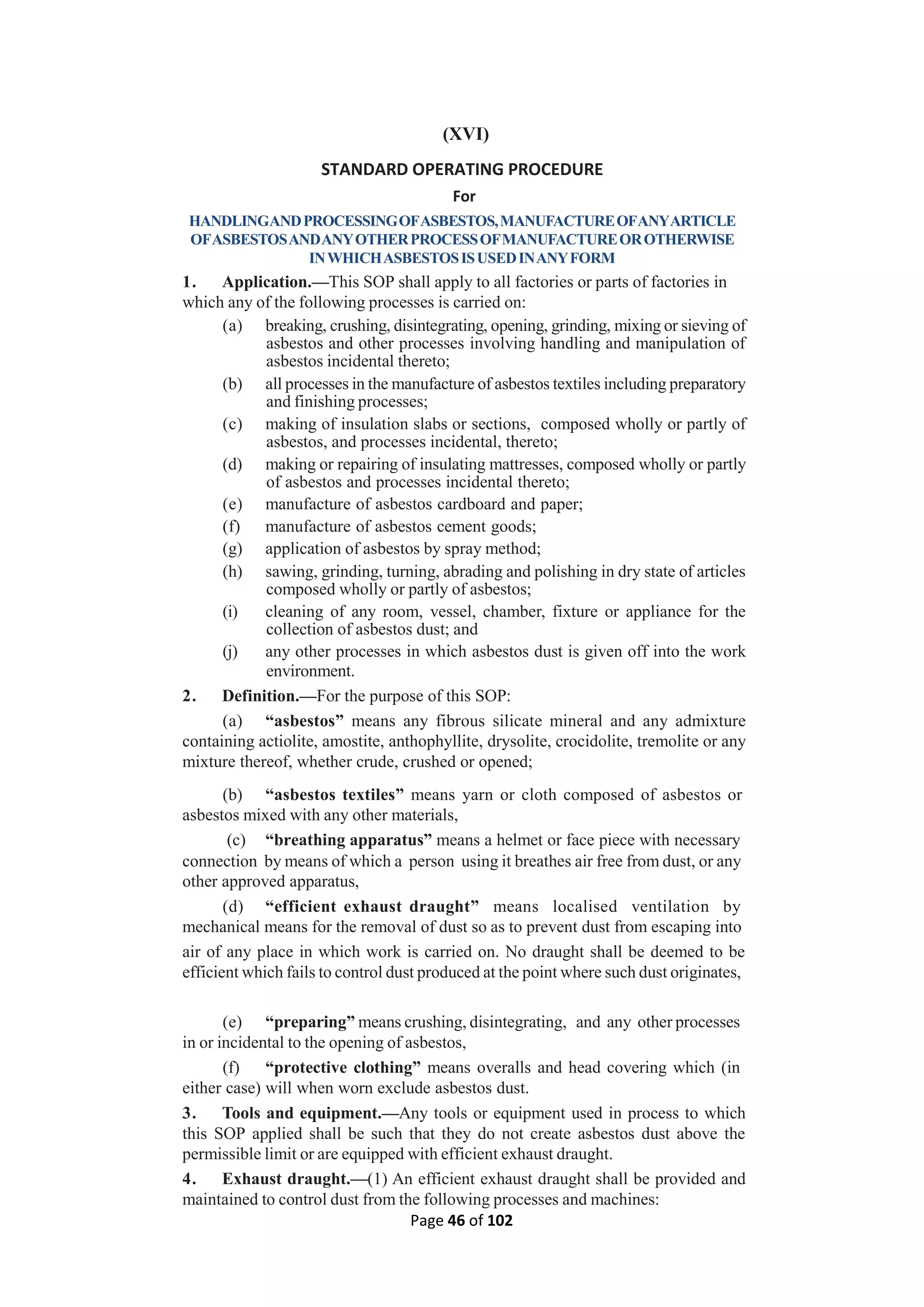
XVI. Handling and processing of asbestos, manufacture of any articles of asbestos
and any other process of manufacture or otherwise in which asbestos is
used in any form; and
XVII. Manufacture or Manipulation of Carcinogenic dye intermediates.
XVIII. Process of extracting vegetable oils fromoil cakes in solvent Extraction Plants.
XIX. Manufacture or manipulation of Manganese and its compounds;
XX. Manufacture and manipulation of dangerous pesticides;
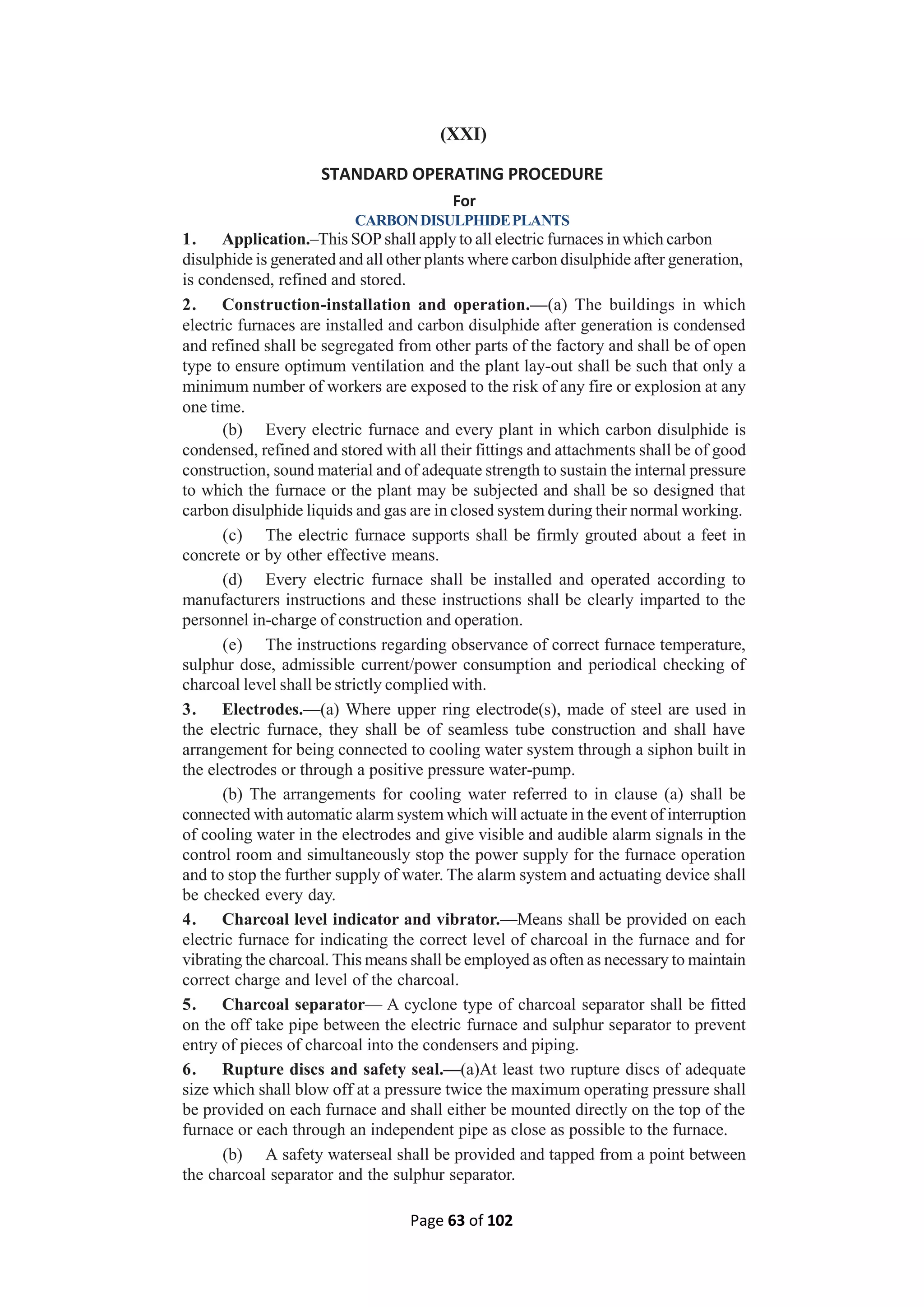
XXI. Carbon Disulphide plants;
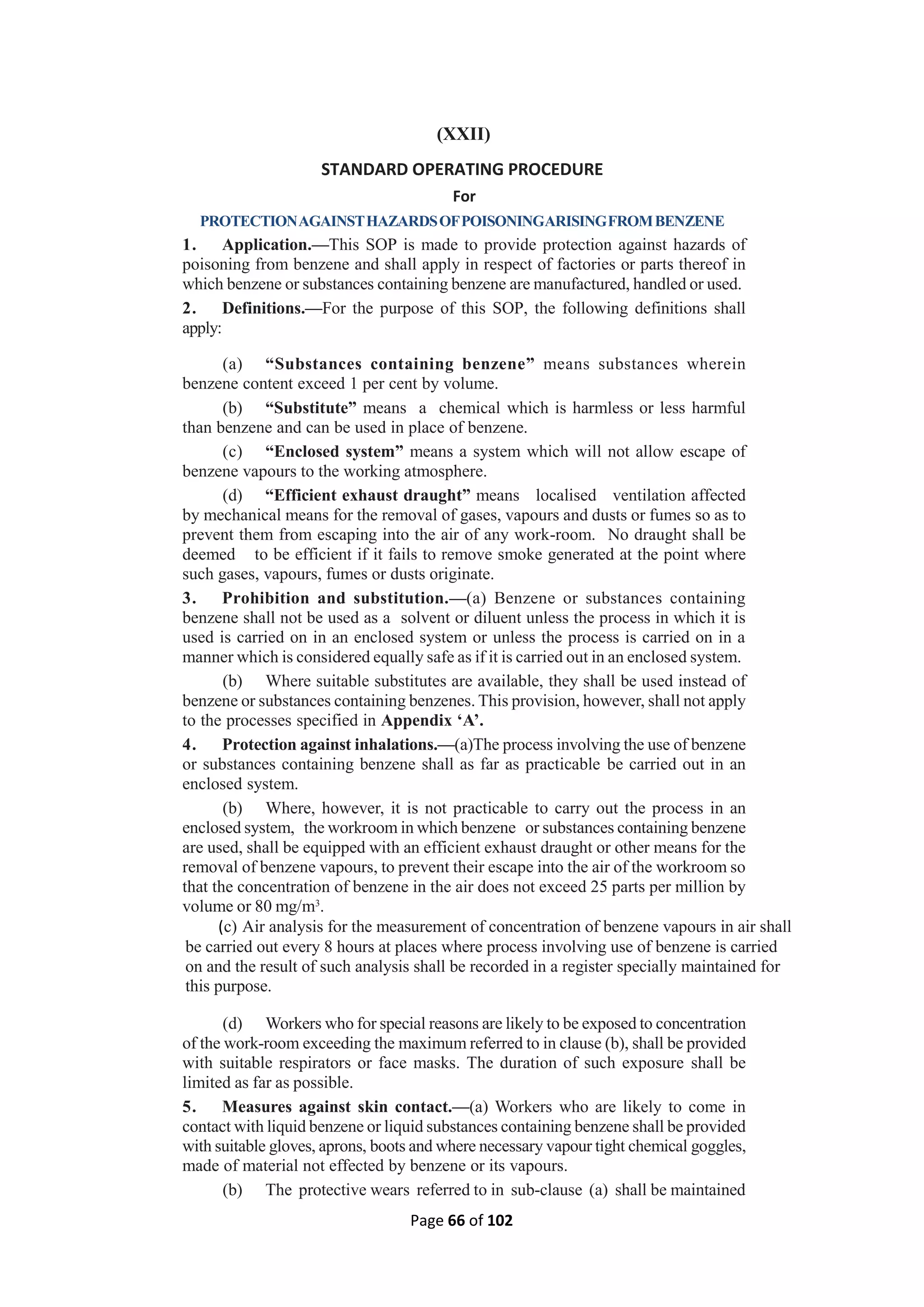
XXII. Protection against hazards of poisoning arising from Benzene.
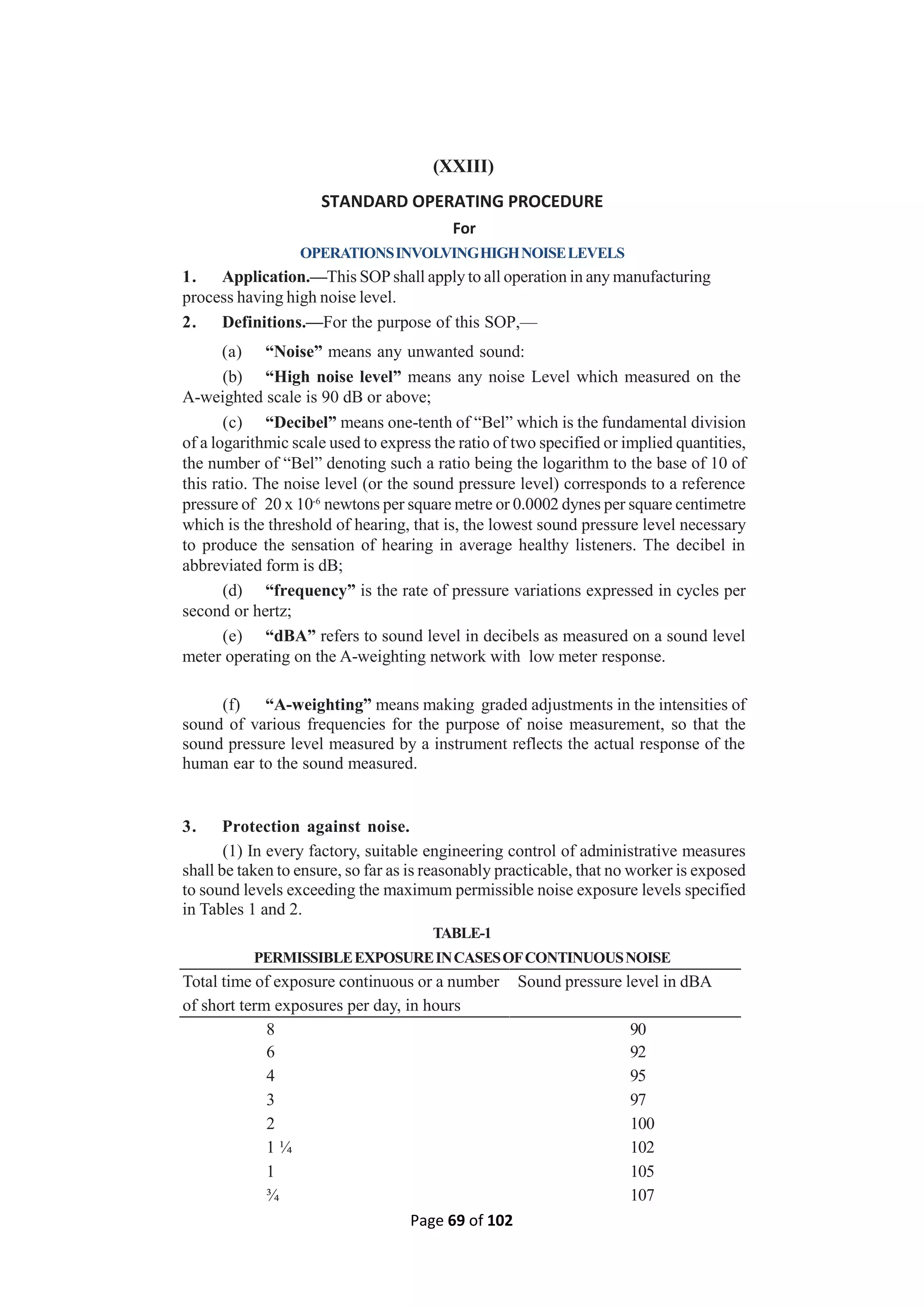
XXIII. Operations involving High Noise Levels.
XXIV. Manufacture of rayon by Viscose Process.
XXV. Highly flammable liquids and Flammable Compressed Gasses.
XXVI. Operation in Foundries.
XXVII. Fire Works Manufactories and Match Factories
XXVIII. Textile machinery except used in jute mills
XXIX. Cotton Ginning
XXX. Wood working machinery
XXXI. Rubber Mills
XXXII. Centrifugal Machines
XXXIII. Power Press
XXXIV. Shears, Slitters and Guillotine Machines)
Page 2 of 102
(I)
STANDARD OPERATING PROCEDURE
FOR
MANUFACTURE OF AERATEDWATERS AND
PROCESSES INCIDENTALTHERETO
1. Fencing of machines.—All machines for filling bottles or syphons shall be
so constructed, placed or fenced as to prevent, as far as may be practicable, 1
[any
fragment] of a bursting bottle or syphon from striking any person employed in the
factory.
2. Face-guards and gauntlets.
(1) The occupier shall provide and maintain in good condition for the use of
all persons engaged in filling bottles or syphons:—
suitable face-guard to protect the face, neck and throat, and
(a) suitable gauntlets for both arms to protect the whole hand and arms:
Provided that:—
(i) paragraph 2(1) shall not apply where bottles are filled by means of
an automatic machine so constructed that no fragment of a bursting
bottle can escape; and
(ii) where a machine is so constructed that only one arm of the bottler
at work upon it is exposed to danger, a gauntlet need not be
provided for the arm which is not exposed to danger.
(2) The occupier shall provide and maintain in good condition for the use of
all persons engaged in corking, crowning, screwing, wiring, foiling, capsuling, sighting
or, lebelling bottles or syphons:—
(a) suitable face-guard to protect the face, neck and throat and;
(b) suitable gauntlet for both arms to protect the arms and at least half of
the palm and the space between the thumb and fore-finger.
3. Wearing of face-guards and gauntlets.—All persons engaged in any of the
processes specified in paragraph 2 shall, while at work in such processes wear the
face-guards and gauntlets provided under the provisions of the said paragraph.
Page 3 of 102
(II)
STANDARD OPERATING PROCEDURE
For
Electrolytic plating or oxidation of metal articles by use of an electrolyte
containing acids, bases or salts of metals such as chromium, nickel, cadmium,
zinc, copper, silver, gold etc.
1. Definitions.—For the purposes of this SOP:
(a) “Electrolytic” means the electrolytic plating or oxidation of metal
articles by the use of an electrolyte containing acids, bases or salts of metal such as
chromium, nickel, cadmium, zinc, copper, silver, gold, etc.;
(b) “Bath”, means any vessel used for an electrolytic process or for any
subsequent process; and
(c) “Employed”, means employed in any process involving contact with
liquid from a bath.
2. Exhaust draught.—An efficient exhaust draught shall be applied to every
vessel in which an electrolytic process is carried on. Such draught shall be provided
by mechanical means and shall operate on the vapour or spray given off in the
process as near as may be at the point of origin. The exhaust draught appliances
shall be so constructed, arranged and maintained as to prevent the vapour or spray
entering into any room or place in which work is carried on.
3. Prohibition relating to women and young persons.—No woman,
adolescent or child shall be employed or permitted to work at a bath.
4. Floor of work-rooms.— The floor of every work-room containing a bath
shall be impervious to water. The floor shall be maintained in good and level condition
and shall be washed down at least once a day.
5. Protective devices.—(1) The occupier shall provide and maintain in good
and clean condition the following articles or protective devices for the use of all
persons employed on any process at which they are liable to come in contact with
liquid from a bath and such devices shall be worn by the person concerned:
(a) waterproof aprons and bibs; and
(b) for persons actually working at a bath, loose fitting rubber gloves and
rubber boots or other water-proof footwear and chemical goggles.
(2) The occupier shall provide and maintain for the use of all persons
employed suitable accommodation for the storage and drying of protective devices.
6. Washing facilities. —(1) There shall be provided and maintained in good
repairs for the use of all persons employed in electrolytic process and processes
incidental to:
(a) a wash place under cover, with either—
(i) a trough with a smooth impervious surface fitted with a waste pipe, and
of sufficient length to allow at least 60 cms. for every 5 persons employed at any
one time and having a constant supply of water from taps or jets above the trough at
intervals of not more than 60 cms. Or
(ii) at least one washbasin for every five such persons employed at any one
time fitted with a waste pipe and having a constant supply of water laid on.
(b) a sufficient supply of clean towels renewed daily and soap or other suitable
Page 4 of 102
cleaning material.
(2) In addition to the facility in sub-paragraph (1), an approved type of
emergency shower with eye fountain shall be provided and maintained in good working
order. Whenever necessary, in order to ensure continuous water supply, storage
tank of 1500 litres capacity shall be provided as a source of clean water for emergency use.
7. Cautionary placard.—A cautionary placard in the form specified below and
printed in the language of the majority of the workers employed shall be affixed in a
prominent place in the factory where it can be easily and conveniently read by the
workers.
CAUTIONARYNOTICE
ElectrolyticPlating—
1. Chemicals handled in this plant are corrosive and poisonous.
2. Smoking, chewing tobacco, eating food or drinking, in this area is prohibited.
No foodstuff or drink shall be brought in this area.
3. Someofthesechemicalsmaybeabsorbedthroughtheskinandmaycausepoisoning.
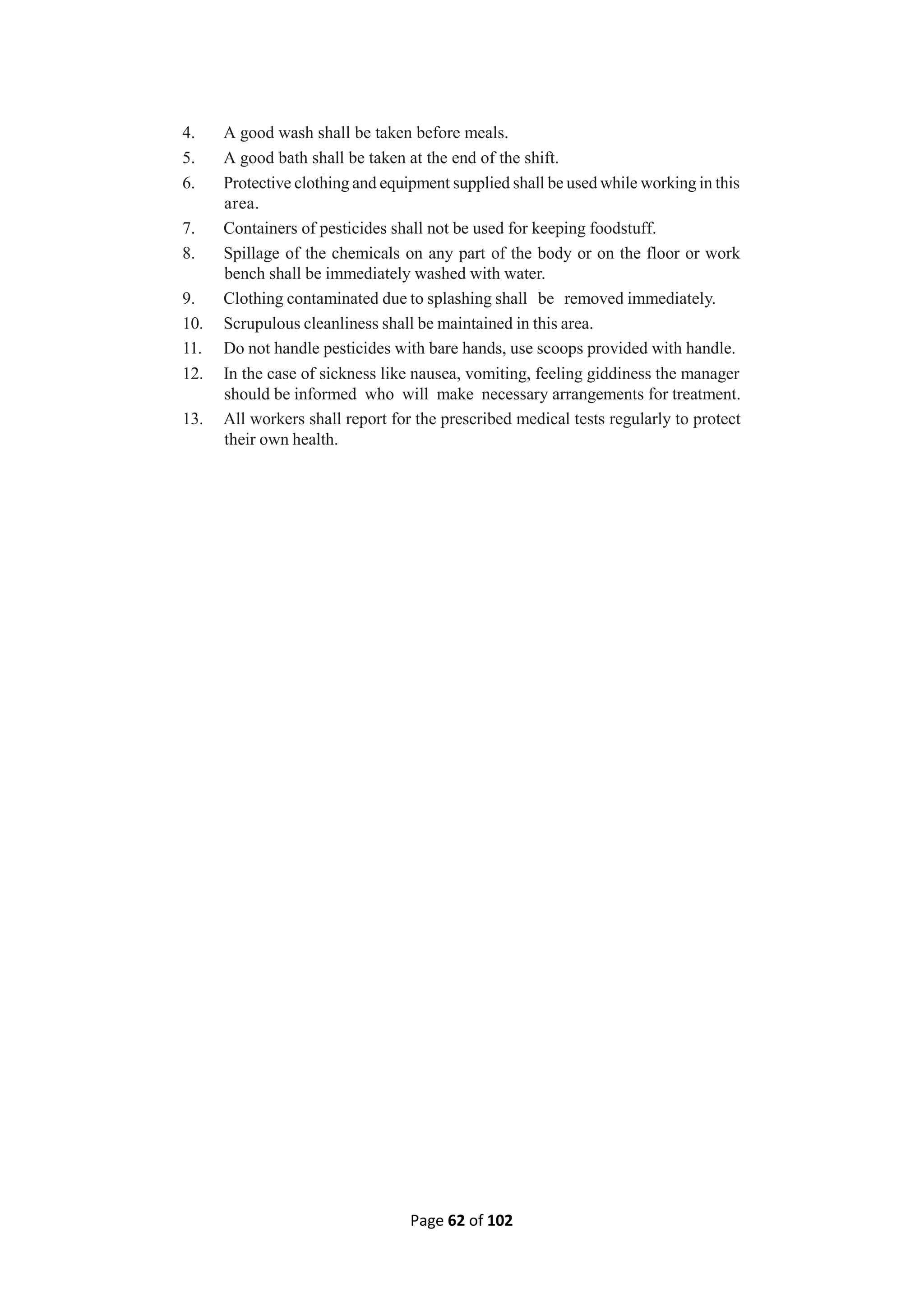
4. A good wash shall be taken before meals.
5. Protective devices supplied shall be used while working in this area.
6. Spillage of the chemicals on any part of the body or on the floor shall be
immediately washed away with water.
7. All workers shall report for the prescribed medical tests regularly to protect
their own health.
8. Medical facilities and records of examinations and tests.— The
occupier of every factory in which electrolytic processes are carried on shall
maintain a sufficient supply of suitable barrier cream, ointment and
impermeable waterproof plaster in a separate box readily accessible to the
workers and used solely for the purpose of keeping these substances. In case
cyanides are used in the bath, the box shall also contain an emergency
cyanide kit.
Page 5 of 102
(III)
STANDARD OPERATING PROCEDURE
For
MANUFACTUREANDREPAIROFELECTRIC ACCUMULATORS
1. Savings.—This SOP shall not apply to the manufacture or repair of electric
accumulators or parts thereof not containing lead or any compound of lead; or to the
repair, on the premises, of any accumulator forming part of a stationery battery.
2. Definitions.—For the purpose of this SOP:
(a) “Lead process” means the melting of lead or any material containing
lead, casting, pasting, lead burning or any other work including trimming, or any
other abrading or cutting of pasted plates, involving the use, movement or manipulation
of, or contact with, any oxide of Lead.
(b) “Manipulation of raw oxide of lead” means any lead process involving
any manipulation or movement of raw oxides of lead other than its conveyance in a
receptacle or by means of an implement from one operation to another.
3. Prohibition relating to women and young persons.—No woman or young
person shall be employed or permitted to work in any lead process or in any room in
which the manipulation of raw oxide of lead or pasting is carried on;
4. Separation of certain processes.—Each of the following processes shall
be carried on in such a manner and under such conditions as to secure effectual
separation from one another, and from any other process:
(a) Manipulation of raw oxide of Lead.
(b) Pasting.
(c) Drying of pasted plates.
(d) Formation with lead burning “tacking” necessarily carried on in
connection therewith.
(e) melting down of pasted plates.
5. Air space.—In every room in which a lead process is carried on, there shall
be at least 500 cubic feet of air space for each person employed therein, and in
computing this air space no height over 12 feet shall be taken into account.
6. Ventilation.—Every work-room shall be provided with inlets and outlets of
adequate size as to secure and maintain efficient ventilation in all parts of the room.
7. Distance between workers in pasting-room.—In every pasting room the
distance between the centre of the working position of any paster and that of the
paster working nearest to him shall not be less than five feet.
8. Floor of work-rooms.—(1) The floor of every rooms in which a lead process
is carried on shall be:—
(a) of cement or similar material so as to be smooth and impervious to
water;
(b) maintained in sound condition ;
(c) kept free from materials, plant, or other obstruction not required for, or
produced in the process carried on in the room.
(2) In all such rooms other than grid casting shops the floor shall be cleaned daily
after being thoroughly sprayed with water at a time when no other work is being
Page 6 of 102
carried on in the room,.
(3) In grid casting shops the floor shall be cleaned daily.
(4) Without prejudice to the requirement of sub-paragraphs (1), (2) and (3), where
manipulation of raw oxide of lead or pasting is carried on, the floor shall also be:
(a) kept constantly moist while work is being done;
(b) provided with suitable and adequate arrangement for drainage;
(c) thoroughly washed daily by means of a hose-pipe.
9. Work-benches.—The work-benches at which any lead process is carried
on shall:
(a) have a smooth surface and be maintained in sound condition;
(b) be kept free from all materials or plant not required for, or produced in
the process carried on thereat; and all such work- benches other than
those in grid casting shops shall:
(i) be cleaned daily either after being thoroughly damped or by means
of a suction cleaning apparatus at a time when no other work is being
carried on thereat; and all such work benches in grid casting shops;
(ii) be cleaned daily; and every work-benches used for pasting;
(iii) be covered throughout with sheet lead or other impervious material;
(iv) be provided with raised edges;
(v) be kept constantly moist while pasting is being carried on.
10. Exhaust draught:—The following processes shall not be carried on without
the use of an efficient exhaust draught:
(a) Melting of lead or materials containing lead;
(b) Manipulation of raw oxide of lead, unless done in an enclosed apparatus
so as to prevent the escape of dust into the work- room;
(c) Pasting;
(d) Trimming, brushing, filling or any other abrading or cutting of pasted
plates giving rise to dust;
(e) Lead burning, other than:
(i) “Tacking” in the formation room;
(ii) Chemical burning for the making of lead linings for cell cases
necessarily carried on in such a manner that the application of
efficient exhaust is impracticable.
Such exhaust draught shall be affected by mechanical means and shall operate
on the dust or fume given off as nearly as may be at its point of origin, so as to
prevent it entering the air of any room in which persons work.
11. Fumes and gases from melting pots.—The products of combustion
produced in the heating of any melting -pot shall not be allowed to escape into a
room in which persons work.
12. Container for dross.—A suitable receptacle with tightly fitting cover shall
be provided and used for dross as it is removed from every melting pot. Such
receptacle shall be kept covered while in the work-room except when dross is being
deposited therein.
Page 7 of 102
13. Container for lead waste.—A suitable receptacle shall be provided in every
work-room in which old plates and waste material which may give rise to dust shall
be deposited.
14. Racks or shelves in drying room.—The racks or shelves provided in any
drying room shall not be more than 8 feet from the floor nor more than 2 feet in
width; provided that as regards racks or shelves set or drawn from both sides the
total width shall not exceed 4 feet.
Such racks or selves shall be cleaned only after being thoroughly damped
unless an efficient suction cleaning apparatus is used for this purpose.
15. Protective clothing.—Protective clothing shall be provided and maintained
in good repair for all persons employed in—
(a) Manipulation of raw oxide of lead;
(b) Pastings;
(c) the formation-room; and such clothing shall be worn by the persons
concerned. The protective clothing shall consist of a water-proof apron and water-
proof foot-wear and, also as regards persons employed in the manipulation of raw
oxide of lead or in pasting head coverings, the head covering shall be washed daily.
16. Mess-room.—There shall be provided and maintained for the use of all
persons employed in a lead process and remaining on the premises during the meal
intervals a suitable mess-room, which shall be furnished with (a) sufficient tables
and benches, and (b) adequate means for warming food.
The mess-room shall be placed under charge of a responsible person, and
shall be kept clean.
17. Cloak-room.—There shall be provided and maintained for the use of all
persons employed in a lead process:—
(a) a cloak-room for clothing put off during working hours with adequate
arrangements for drying the clothing if wet. Such accommodation shall
be separate from the mess room;
(b) separate and suitable arrangements for the storage of protective clothing
provided under paragraph 16.
18. Washing facilities.—There shall be provided and maintained in a clean state
and in good repair for the use of all persons employed in a lead process:
(a) wash place under cover, with either—
(i) a trough with a smooth impervious surface fitted with a waste pipe
without plug, and of sufficient length to allow of at Least two feet
for every five such persons employed at any one time, and having a
constant supply of water from taps or jets above the trough at
intervals of not more than two feet; or
(ii) At least one wash-basin for every five such persons employed at
any one time, fitted with a waste-pipe and plug and having a constant
supply of water laid on;
(iii) a sufficient supply of clean towels made of suitable materials
renewed daily, which supply in the case of pasters and persons
employed in the manipulation of raw oxide of lead shall include a
separate marked towels for each such worker; and
(iv) a sufficient supply of soap or other suitable cleaning material and of
Page 8 of 102
nail brushes.
(b) There shall in addition be provided means of washing in close proximity
to the rooms in which manipulation of raw oxide of lead or pasting is carried on.
19. Facilities for bathing.—Sufficient bath accommodation shall be provided
for all persons engaged in the manipulation of raw oxide of lead or in pasting, and a
sufficient supply of soap and clean towels.
20. Foods, drinks, etc., prohibited in work rooms.—No food, drink, pan and
supari or tobacco shall be consumed or brought by any worker into any work-room
in which any lead process is carried on.
Page 9 of 102
(IV)
STANDARD OPERATING PROCEDURE
For
GLASS MANUFACTURE
1. Definitions.—For the purpose of this SOP:—
(a) “Efficient exhaust draught” means localized ventilation effected by
mechanical means, for the removal of gas, vapour, dust or fumes so as to prevent
them (as far as practicable under the atmospheric condition usually prevailing) from
escaping into the air of any place in which work is carried on. No draught shall be
deemed efficient which fails to remove smoke generated, at the point where such
gas, vapour, fume or dust originate.
(b) “Lead compound” means any compound of lead other than galena
which, when treated in the manner described below, yields to an aqueous solution of
hydrochloric acid, a quantity of soluble lead compound exceeding, when calculated
as lead monoxide, five per cent of the dry weight of the portion taken for analysis.
The method of treatment shall be as follows:
A weighed quantity of the material which has been dried at 100°C and thoroughly
mixed shall be continuously shaken for one hour at the common temperature with
1000 times its weight of an aqueous solution of hydrochloric acid containing 0.25 per
cent by weight of hydrogen chloride. This solution shall thereafter be allowed to
stand for one hour and then filtered. The lead salt contained in the clear filtrate shall
then be precipitated as lead sulphide and weighed as lead sulphate.
2. Exhaust draught.—The following processes shall not be carried on except
under an efficient exhaust draught:
(a) The mixing of raw materials to form a “batch”.
(b) The dry grinding, glazing and polishing of glass or any article of glass.
(c) All processes in which hydrofluoric acid fumes or ammonical vapours
are given off.
(d) All processes in the making of furnace moulds or pots (including the
grinding or crushing of used pots).
(e) All processes involving the use of a dry lead compound.
3. Prohibition relating to women and young persons.—No woman or young
person shall be employed or permitted to work in any of the operation specified in
paragraph 3 or at any place where such operations are carried on.
4. Floors and work-benches.—The floor and work-benches of every room in
which a dry compound of lead is manipulated or in which any process is carried on
giving off silica dust shall be kept moist and shall comply with the following
requirements:—
The floors shall be:—
(a) of cement or similar material so as to be smooth and impervious to
water;
(b) maintained in sound condition; and
(c) cleaned daily after being thoroughly sprayed with water at a time when
no other work is being carried on in the room.
The work-benches shall:—
Page 10 of 102
(a) have a smooth surface and be maintained in sound condition; and
(b) be cleaned daily either after being thoroughly damped or by means of a
suction cleaning apparatus at a time when no other work is being carried
on thereat.
5. Use of hydrofluoric acid.—The following provisions shall apply to room in
which glass is treated with hydrofluoric acid:—
(a) there shall be inlets and outlets of adequate size so as to secure and
maintain efficient ventilation in all parts of the room;
(b) the floor shall be covered with guttapercha and be tight and shall slope
gently down to a covered drain;
(c) the work-places shall be so enclosed in projecting hood that openings
required for bringing in the objects to be treated shall be as small as
practicable; and
(d) the efficient exhaust draughts shall be so contrived that the gases are
exhausted downwards.
6. Storage and transport of hydrofluoric acid.—Hydrofluoric acid shall not
be stored or transported except in cylinders or receptacles made of lead or rubber.
7. Blow-pipes—Every glass blower shall be provided with a separate blow-
pipe bearing the distinguishing mark of the person to whom it is issued and suitable
facilities shall be readily available to every glass-blower for sterilising his blow-pipe.
8. Food, drinks, etc., prohibited in work-rooms.—No food, drink, pan and
supari or tabacco shall be brought into or consumed by any worker in any room or
work-place wherein any process specified in paragraph 3 is carried on.
9. Protective clothing.—The occupier shall provide, maintain in good repair
and keep in clean condition for the use of all persons employed in the processes -
specified in paragraph 3 suitable protective clothing, footwear and goggles according
to the nature of the work and such clothing, foot-wear, etc., shall be worn by the
persons concerned.
10. Washing facilities.—There shall be provided and maintained in a clean state
and in good repair for the use of all persons employed in the processes specified in
paragraph 3.
(a) a wash-place with either—
(i) a trough with a smooth impervious surface fitted with a waste pipe,
without plug and of sufficient length to allow of at least two feet for
every five such persons employed at any one time, and having a
constant supply of water from taps or jets above the trough at
intervals of not more than 2 feet; or
(ii) at least one wash-basin for every five such persons employed at
any one time fitted with a waste pipe and plug and having adequate
supply of water laid on or always readily available; and
(b) a sufficient supply of clean towel made of suitable material renewed daily
with a sufficientsupplyofsuitablecleaningmaterialandofnailbrushes;and
(c) a sufficient number of stand pipes with taps.
Page 11 of 102
(V)
STANDARD OPERATING PROCEDURE
For
GRINDINGORGLAZINGOFMETALSANDPROCESSESINCIDENTALTHERETO
1. Definitions.—For the purposes of this SOP:—
(a) “Grindstone” means a grindstone composed of natural or
manufactured sandstone but does not include a metal wheel or cylinder into which
blocks of natural or manufactured sandstone are fitted.
(b) “Abrasive wheel” means a wheel manufactured of bounded emery
or similar abrasive.
(c) “Grinding” means the abrasion by aid of mechanical power, of metal
by means of a grindstone or abrasive wheel.
(d) “Glazing” means the abrading, polishing or finishing, by aid of
mechanical power of metal by means of any wheel, buff, mop or similar appliance to
which any abrading or polishing substance is attached or applied.
(e ) “Racing” means the turning up, cutting or dressing of a revolving
before it is brought into use for the first time.
(f) “Hacking” means the chipping of the surface of a grindstone by hack or
similar tool
(g) “Rodding” means the dressing of the surface of a revolving grindstone
by the application of a rod, bar or strip of metal to such surface.
2. Equipment for removal of dust.—No racing, dry grinding or glazing shall
be performed without—
(a) a hood or other appliance so constructed, arranged, placed and maintained
as substantially to intercept, the dust thrown off;
(b) a duct of adequate size, air tight and so arranged as to be capable of
carrying away the dust, which shall be kept free from obstruction and
shall be provided with proper means of access for inspection and
cleaning, and where practicable, with a connection at the end remote
from the fan to enable the Inspector to attach thereto any instrument
necessary for ascertaining the pressure of air in the said duct; and
(c) a fan or other efficient means of producing a draught sufficient to extract
the dust:
3. Glazing. — Glazing or other processes, except processes incidental to wet
grinding upon a grindstone shall not be carried on in any room in which wet grinding
upon a grindstone is done.
4. Hacking and rodding.— Hacking or rodding shall not be done unless during
the process either (a) an adequate supply of water is laid on at the upper surface of
grindstone, or (b) adequate appliances for the interception of dust are provided in
accordance with the requirements of paragraph 3.
5. Examination of dust equipment.—(a) All equipment for the extraction or
suppression of dust shall at least once in every six months be examined and tested
by a competent person, and any defect disclosed by such examination and test shall
be rectified as soon as practicable.
Page 12 of 102
(VI)
STANDARD OPERATING PROCEDURE
For
MANUFACTUREANDTREATMENTOFLEADANDCERTAINCOMPOUNDSOFLEAD
1. Definitions.—For the purpose of this SOP:—
(a) ‘Lead Compound’ means any compound of lead other than galena
which, when treated in the manner prescribed below, yields to an aqueous solution
of hydrochloric acid, a quantity or soluble lead compound exceeding, when calculated
as lead monoxide, 5 per cent of the dry weight of the portion taken for analysis. In
the case of prints and similar products and other mixture containing oil or fat the
dry weight means the ‘dry weight’ of the material remaining after the substance has
been thoroughly mixed and treated with suitable solvents to remove oil, fats varnish
or other media.
The method of treatment shall be as follows:
A weighted quantity of the material, which has been dried at 100°C and
thoroughly mixed, shall be continuously shaken for one hour, at the common
temperature with 1000 times its weight of an aqueous solution of hydrochloric acid
containing 0.25 per cent by weight of hydrogen chloride. This solution shall thereafter
be allowed to stand for one hour and then filtered. The lead salt contained in the
clear filtrate shall then be precipitated as lead sulphide and weighed as lead sulphate.
(b) Efficient Exhaust draught.— Means localised ventilation effected
by heat or mechanical means for the removal of gas, vapour, dust or fumes so as
to prevent them (as far as practicable under the atmospheric conditions usually
prevailing) from escaping into the air of any place in which work is carried on. No
draught shall be deemed efficient which fails to remove smoke generated at the
point where such gas, vapour, fumes or dust originate.
2. Application.—This SOP shall apply to all the factories or parts of factories in
which any of the following operations are carried on:
(a) Work at a furnace where the reduction or treatment of zinc or lead ores
is carried on.
(b) The manipulation, treatment or reduction of ashes containing lead, the
desilverising of lead or the melting of scrap lead or zinc.
(c) The manufacture of solder or alloys containing more than 10 per cent
of lead.
(d) The manufacture of any oxide, carbonate, sulphate, chromate, acetate,
nitrate or silicate of lead. Handling or mixing of lead tetraethyl.
(e) Any other operation involving the use of lead compound.
(f) The cleaning of work-rooms where any of the operations aforesaid are
carried on.
3. Prohibition relating to women and young persons.—No woman or young
person shall be employed or permitted to work in any of the operations specified in
paragraph 3.
4. Requirements to be observed.—No person shall be employed or permitted
to work in any process involving the use of lead compounds if the process is such
that dust or fume from a lead compound is produced therein, or the persons employed
therein are liable to be splashed with any lead compound in the course of their
Page 13 of 102
employment unless the provisions of paragraphs 6 to 14 are complied with.
5. Exhaust draught.—Where dust, fume, gas or vapour is produced in the
process, provision shall be made for removing them by means of an efficient exhaust
draught so contrived as to operate on the dust, fume, gas or vapour as closely as
possible to the point of origin.
6. Food, drinks, etc., prohibited in work-rooms.—No food, drink, pan and
supari or tabacco shall be brought into or consumed by any worker in any work-
room in which the process is carried on and no person shall remain in any such room
during intervals for meals or rest.
7. Protective clothing.—Suitable protective overalls and head coverings shall
be provided, maintained and kept clean by the factory occupier and such overalls
and head coverings shall be worn by the persons employed.
8. Cleanliness of work-rooms, tools etc.—The rooms in which the persons
are employed and all tools and apparatus used by them shall be kept in a clean state.
9. Washing facilities.—(1) The occupier shall provide and maintain for the use
of all persons employed suitable washing facilities consisting of—
(a) a trough with a smooth impervious surface fitted with a waste-pipe
without plug and of sufficient length to allow at least two feet for every
ten persons employed at any one time and having a constant supply of
clean water from taps or jets above the trough at intervals of not more
than two feet; or
(b) at least one wash-basin for every ten persons employed at one time
fitted with a waste pipe and plug and having a constant supply of clean
water; together with, in either case, a sufficient supply of nail brushes,
soap or other suitable cleaning materials and clean towels;
(2) The facilities so provided shall be placed under the charge of a
responsible person and shall be kept clean.
10. Mess-room or canteen.—The occupier shall provide and maintain for the
use of the persons -employed suitable and adequate arrangements for taking their
meals. The arrangements shall consist of the use of a room separate from any
work-room which shall be furnished with sufficient tables and benches, and unless a
canteen serving hot meals is provided, adequate means of warming food. The room
shall be adequately ventilated by the circulation of fresh air, shall be placed under
the charge of a responsible person and shall be kept clean.
11. Cloak-room.—The occupier shall provide and maintain for the use of persons
employed, suitable accommodation for clothing not worn during working hours, and
for the drying of wet clothing.
Page 14 of 102
(VII)
STANDARD OPERATING PROCEDURE
For
GENERATIONOF GAS FROM DANGEROUSPETROLEUM
1. Prohibition relating to women and young persons.—No woman or young
person shall be employed or permitted to work in or shall be allowed to enter any
building 1
[in which the generation of gas from dangerous petroleum] is carried on.
2. Flame traps.—The plant for generation of gas from dangerous petroleum
and associated piping and fittings shall be fitted with at least two efficient flame
traps so designed and maintained as to prevent a flash back from any burner to the
plant. One of these traps shall be fitted as close to the plant as possible. The plant
and all pipes and valves shall be installed and maintained free from leaks.
3. Generating building or room.—All plants for 1
[generation of petrol gas
from dangerous petroleum] erected after the coming into force of the provisions
specified in this SOP, shall be erected outside the factory building proper in a
separate well ventilated building (hereinafter referred to as the ‘generating building’).
In the case of such plant erected before the coming into force of the provisions
specified in this SOP there shall be no direct communication between the room
where such plants are erected (hereinafter referred to as the ‘generating room’)
and the remainder of the factory building. So far as practicable, all such generating
rooms shall be constructed of fire-resisting materials.
4. Fire extinguishers.—An efficient means of extinguishing petrol fires shall
be maintained in an easily accessible position near the plant for generating 187
[gas
from dangerous petroleum].
5. Escape of [dangerous petroleum]—Effective steps shall be taken to prevent
1
[dangerous petroleum] from escaping into any drain or sewer.
6. Prohibition relating to smoking etc.—No person shall smoke or carry
matches, fire or naked light or other means of producing a naked light or spark in the
generating room or building or in the vicinity thereof and warning 1
[notice in Hindi
and in the language] understood by the majority of the workers shall be posted in the
factory prohibiting smoking and the carrying of matches, fire or naked light or other
means of producing a naked light or spark into such room or building.
7. Access to [dangerous petroleum or container].—No unauthorised person
shall have access to any [dangerous petroleum] or to a vessel containing or having
actually contained 1
[dangerous petroleum].
8. Electric fittings.—All electric fitting shall be of flame-proof construction
andallelectricconductorsshalleitherbeenclosedinmetalconduitsorbeleadsheathed.
9. Construction of doors.—All doors in the generating room or building shall
be constructed to open outwards or to slide and no door shall be locked or obstructed
or fastened in such a manner that it cannot be easily and immediately opened from
the inside while gas is being generated and any person is working in the generating
roomof building.
10. Repair of containers.—No vessel that has contained 1
[dangerous petroleum]
shall be repaired in generating room or building and no repairs to any such vessel
shall be undertaken unless live steam has been blown into the vessel and until the
interior is thoroughly steamed out or other equally effective steps have been taken
to ensure that it has been rendered free from 1
[dangerous petroleum] or
inflammable vapour.
Page 15 of 102
(VIII)
STANDARD OPERATING PROCEDURE
For
Cleaning or smoothening, roughening, etc. of articles, by a jet of sand,
metal shot, or grit or other abrasive, propelled by a blast of compressed
air or steam. (Blasting Regulations)
1. Definitions.—For the purpose of this SOP: —
“Blasting” means cleaning, smoothing, roughening, or removing of any part of the
surface of any article by the use as an abrasive of a jet of sand, metal shot or grit or
other material, propelled by a blast of compressed air or steam.
“Blasting Enclosure” means a chamber, barrel, cabinet or any other enclosure
designed for the performance of blasting therein. “Blasting Chamber” means a
blasting enclosure in which any person may enter at any time in connection with
any work or otherwise.
“Cleaning of castings” where done as an incidental or supplemental process in
connection with the marking of metal castings, means the freeing of the casting
from adherent sand or other substance and includes the removal of cores and the
general smoothing of a casting, but does not include the free treatment.
2. Prohibition of sand blasting.—Sand or any other substance containing free
silica shall not be introduced as an abrasive in any blasting apparatus and shall not be
used for blasting:
Provided that this clause shall come into force two years after the coming into
operation of this SOP:
Provided further that no woman or young person shall be employed or permitted
to work at any operation of sand blasting.
3. Precautions in connection with blasting operations.—(1) Blasting to be
done in blasting enclosure and no work other than blasting and any work immediately
incidental thereto and clearing and repairing of the enclosure including the plants
and appliances situated therein, shall be performed in a blasting enclosure. Every
door, aperture and joint of blasting enclosure, shall be kept closed and airtight while
blasting is being done therein.
(2) Maintenance of blasting enclosure.—Blasting enclosure shall always
be maintained in good condition and effective measure shall be taken to prevent dust
escaping from such enclosures, and from apparatus connected therewith, into the
air of any room.
(3) Provision of separating apparatus.—There shall be provided and
maintained for and in connection with every blasting enclosure efficient
apparatus for separating, so far as practicable, abrasive which has been used for
blasting and which is to be used again as an abrasive, from dust or particles of other
materials arising from blasting; and no such abrasive shall be introduced into any
blasting apparatus and used for blasting until it has been so separated:
(4) Provision of ventilating plant.—There shall be provided and
maintained in connection with every blasting enclosure efficient ventilating plant to
extract, by exhaust draught effected by mechanical means, dust produced in the
enclosure. The dust extracted and removal shall be disposed of by such method and
in such manner that it shall not escape into the air of any room; and every other
Page 16 of 102
filtering or settling device situated in a room in which persons are employed other
than persons attending to such bag or other filtering or settling, device, shall be
completely separated from the general air of that room in an enclosure ventilated to
the open air.
(5) Operation of ventilating plant.—The ventilating plant provided
for the purpose of sub-paragraph (4) shall be kept in continuous operation whenever
the blasting enclosure is in use whether or not blasting is actually taking place therein,
and in the case of a blasting chamber, it shall be in operation even when any person
is inside the chamber for the purpose of cleaning.
4 . Inspection and examination.—
Every blasting enclosure shall be specially inspected by a competent person
at least once in every week in which it is used for blasting. Every blasting
enclosure, the apparatus connected therewith and the ventilating plant shall be
thoroughly examined and in the case of ventilating plant, tested by a competent
person at least once in every month.
5. Provision of protective helmets, gauntlets & overalls.—(1) There shall
be provided and maintained for the use of all persons who are employed in a blasting
chamber whether in blasting or in any work connected therewith or in cleaning such
chamber, protective helmets.
(2) Each protective helmets shall carry a distinguishing mark indicating the
person by whom it is intended to be used and no person shall be allowed or required
to wear a helmet not carrying his mark or which has been worn by another person
and has not since been thoroughly disinfected.
(3) Each protective helmet when in use shall be supplied with clean and not
unreasonably cold air at a rate of not less than six cubic feet per minute.
(4) Suitable gauntlets and overalls shall be provided for the use of all persons
while performing blasting or assisting at blasting and every such person shall while
so engaged wear the gauntlet and overall provided.
6. Precautions in connection with cleaning & other work.—(1)Where any
person is engaged upon cleaning of any blasting apparatus or blasting enclosure or
of any apparatus of ventilating plant connected therewith or the surroundings thereof
or upon any other work in connection with any blasting apparatus or blasting enclosure
or with any apparatus or ventilating plant connected therewith so that he is exposed
to the risk of inhaling dust which has arisen from blasting. All practical measures
shall be taken to prevent such inhalation.
(2) In connection with any cleaning operation referred to in clause 5, and
with the removal of dust from filtering or settling devices all practicable measures
shall be taken to dispose of the dust in such manner that it does not enter the air of
any rooms. Vacuum cleaners shall be provided and used wherever practicable for
such cleaning operations.
7. Storage accommodation for protective wear.
Adequate and suitable storage accommodation for the helmets, gauntlets and overalls
required to be provided by clause 5 shall be provided outside and conveniently near
to every blasting enclosure and such accommodation shall be kept clean. Helmets,
gauntlets and overalls when not in actual use shall be kept in this accommodation.
8. Maintenance and cleaning of protective wear.
All helmets, gauntlets, overalls and other protective devices or clothings provided
and worn for the purposes of this SOP, shall be kept in good condition and so far as is
Page 17 of 102
reasonably practicable shall be cleaned on every week day in which they are used.
Where dust arising from the cleaning of such protective clothing or devices is likely
to be inhaled, all practicable measures shall be taken to prevent such inhalation.
Vacuum cleaners shall, wherever practicable, be used for removing dust from such
clothing and compressed air shall not be used for removing dust from any clothing.
9. Maintenance of vacuum cleaning plant.
Vacuum cleaning plant used for the purpose of this SOP shall be properly
maintained.
10. Restrictions in employment of young persons.— (1) No person under 18
years of age shall be employed in blasting or assisting at blasting or in any blasting
chamber or the cleaning of any blasting apparatus or any blasting enclosure or any
apparatus or ventilating plant connected therewith or be employed on maintenance
or repair work at such apparatus, enclosure or plant.
(2) No person under 18 years of age shall be employed to work regularly
within 20 feet of any blasting enclosure unless the enclosure is in a room and he is
outside that room where he is effectively separated from any dust coming from the
enclosure.
Page 18 of 102
(IX)
STANDARD OPERATING PROCEDURE
For
LIMINGANDTANNINGOFRAWHIDESANDSKINS
ANDPROCESSESINCIDENTALTHERETO
1. Cautionary notices.—(1) Cautionary notices shall be affixed in
prominent place in the factory where they may be easily and conveniently read by
the persons employed.
(2) A copy of a warning notice as to anthrax shall be given to each person
employed when he is engaged and subsequently, if still employed, on the first
day of each calendar year.
(3) Cautionary notices as to the effects of chrome on the skin shall be
affixed in prominent positions in every factory in which chrome solutions are used
and such notices shall be so placed as to be easily and conveniently read by the
persons employed.
(4) Notices shall be affixed in prominent places in the factory stating the
position of the ‘First Aid’ box or cupboard and the name of the person-in-charge of
such box or cupboard.
(5) If any person employed in the factory is illiterate, effective steps shall
be taken to explain carefully to such illiterate persons the contents of the notice
specified in paragraphs 1, 2 and 4 and if chrome solutions are used in the factory, the
contents of the notice specified in sub-paragraph 3.
2. Protective clothing
The occupier shall provide and maintain in good condition the following articles of
protective clothing:
(a) Water proof footwear, leg coverings, aprons and gloves for persons
employed in processes involving contact with chrome solutions, including the
preparation of such solutions;
(b) Gloves and boots for persons employed in lime yard; and
(c) Protective footwear, aprons and gloves for persons employed in
processes involving the handling of hides or skins, other than in processes specified
in clauses (a) and (b);
Provided that:
(i) The gloves, aprons, leg coverings or boots, may be of rubber or leather,
but the gloves and boots to be provided under sub-clauses (a) and (b) shall be of
rubber;
(ii) the gloves may not be provided to persons fleshing by hand or employed
in processes in which there is no risk of contact with lime, sodium sulphide or other
caustic liquor.
3. Washing facilities, mess-room and cloak room.
There shall be provided and maintained in a clean state and in good repair for the
use of all persons employed:
(a) trough with a smooth impervious surface fitted with a waste pipe without
plug and of sufficient length to allow at least two feet for every ten persons employed
at any one time, and having a constant supply of water from taps or jets above the
trough at intervals of not more than two feet; or
Page 19 of 102
(b) at least one wash basin for every ten such persons employed at any one
time, fitted with a waste pipe and plug and having a constant supply of water, together
with, in either case, a sufficient supply of nail brushes, soap or other suitable cleaning
material, and clean towels; or
(c) a suitable mess-room, adequate for the number remaining on the premises
during the meal intervals, which shall be furnished with (1) sufficient tables and
benches, and (2) adequate means for warming food and for boiling water. The
mess-room shall (1) be separate from any room or shed in which hide or skins are
stored, treated or manipulated, (2) be separate from the cloak-room and (3) be
placed under the charge of responsible person;
1
(d) The occupier shall provide and maintain, for the use of all persons
employed, suitable accommodation for clothing put off during working hours and
another accommodation for protective clothing and shall also make adequate
arrangement for drying up the clothing in both the cases, if wet. The accommodation so
provided shall be kept clean at all times and placed under the charge of
aresponsibleperson.
4. Food, drinks, etc., prohibited in work-room.—No food, drink, pan and
supari or tobacco shall be brought into or consumed by any worker in any work-
room or shed in which hides or skins are stored, treated or manipulated.
5. First- aid arrangement.—The occupier shall (a) arrange for an inspection
of the hands of all persons coming into contact with chrome solution to be made
twice a week by a 2
[Medical Officer].
(b) Provide and maintain a sufficient supply of suitable ointment and
impermeable waterproof plaster in a box readily accessible to the worker and used
solely for the purpose of keeping the ointment and plaster.
Page 20 of 102
(X)
STANDARD OPERATING PROCEDURE
For
CARRYINGONOFCERTAINPROCESSESOFLEADANDLEADMATERIALIN
PRINTINGPRESSESANDTYPEFOUNDRIES
1. Definitions.—For the purpose of this SOP:—
(a) ‘Lead material’ means material containing not less than five per cent
of lead;
(b) ‘Lead processes’ means:
(i) the melting of lead or any lead material for casting;
(ii) the recharging of machines with used lead material; or
(iii) anyotherworkincludingremovalofdrossfrommeltingpots,cleaning
of plungers; and
(iv) manipulation, movement, or other treatment of lead material;
(c) Efficient Exhaust draught.—means localised ventilation
effected by heat or mechanical means for the removal of gas, vapour, dust or fume
so as to prevent them from escaping into the air of any place in which work is
carried on. No draught shall be deemed efficient which fails to remove gas, vapour,
fume or dust at the point where they originate.
2. Exhaust draught—(1) None of the following process shall be carried on
except with an efficient exhaust draught;
(a) melting lead material or slugs;
(b) heating lead material so that vapour containing lead is given off:
Provided that the aforesaid processes may be carried on without efficient exhaust
draught if they are carried on in such a manner as to prevent free escape of
gas, vapour, fume or dust into any place in which work is being done or is
carried on in electrically—heated and thermostatically controlled melting pots.
(2) Such exhaust draught shall be effected by mechanical means and so
contrived as to operate on the dust, fume, gas or vapour given off as closely as may
be at its point of origin.
3. Prohibition relating to women and young persons.—No woman or young
person shall be employed or permitted to work in any lead process.
4. Separation of certain processes. —Each of the following processes shall
be carried on in such a manner and under such conditions as to secure effectual
separation from one another and from any other process:
(a) melting of lead or any lead material;
(b) casting of lead ingots; and
(c) mechanical composing;
5. Container for dross.—A suitable receptacle with tightly fitting cover shall
be provided and used for dross as it is removed from every melting pot. Such
receptacle shall be kept covered while in the work-room near the machine except
when the dross is being deposited therein.
6. Floor of work-room.—The floor of every work-room where lead process is
carried on shall be:
(a) of cement or similar material so as to be smooth and
impervious to water;
(b) maintained in sound condition; and
Page 21 of 102
(c) Cleaned daily after being thoroughly damped with water at a time when
no other work is being carried on at the place.
7. Mess-room— There shall be provided and maintained, for the use of all
persons employed in a lead process and remaining on the premises during the meal
intervalsasuitablemess-roomwhichshallbefurnishedwithsufficienttablesandbenches.
8. Washing facilities.—There shall be provided and maintained in a clean state
and in good repair for the use of all persons employed in a lead process:
(a) a wash place with either:
(i) a trough with a smooth impervious surface fitted with a waste pipe
without plug, and of sufficient length to allow at least two feet for
every five such person employed at any one time and having a
constant supply of water from taps or jets above the trough at
intervals of not more than two feet; or
(ii) at least one wash-basin for every such person employed at anyone
time, fitted with a waste-pipe and plug and having an adequate
supply of water laid on or always readily available; and
(b) a sufficient supply of clean towels made of suitable material renewed
daily with a sufficient supply of soap or other suitable cleaning material.
9. Food, drinks, etc, prohibited in work-room.—No food, drink, pan and
supari or tobacco shall be consumed or brought by any worker into any work-room
in which any lead process is carried on.
10. Protective clothing.—The occupier shall provide to all persons in lead process
two full sleeve overalls every year, arrange for their weekly washing and maintain
these in a good condition. The persons employed in such a process shall wear these
overalls while engaged in such work.
Page 22 of 102
(XI)
STANDARD OPERATING PROCEDURE
For
CHEMICALWORKS
PARTI
1. Application.—This SOP shall apply to all manufacture and processes
incidental thereto carried on in chemical works.
2. Definitions.—for the purpose of this SOP:—
(a) “Chemical works” means any factory or such parts of any factory
as are listed in Appendix “A” to this SOP;
(b) “efficient exhaust draught” means localised ventilation effected
by mechanical or other means for the removal of gas, vapour, fume or dust to
prevent it from escaping into the air of any place in which work is carried on;
(c) “bleaching powder” means the bleaching powder commonly called
chloride of lime;
(d) “chlorate” means chlorate or perchlorate;
(e) “caustic” means hydroxide of potassium or sodium;
(f) “chrome process” means the manufacture of chromate or bichromate
of potassium or sodium, or the manipulation, movement or other treatment of these
substances;
(g) “nitro or amino process” means the manufacture of nitro or amino
derivatives of phenol and of benzene or its homologous, and the making of explosives
with the use of any of these substances;
(h) The term “permit to work” system means the compliances with the
procedures laid down under paragraph 20 of Part II;
(i) “toxic substances” means all those substances which when they enter
into the human body, through inhalation or ingestion or absorption through skin, in
sufficient quantities cause fatality or exert serious affliction of health, or chronic
harmful effects on the health of persons exposed to it due to its inherent chemical or
biological effects. In respect of substances whose TLV is specified in Rule 123-A
exceeding the concentration specified therein would make the substance toxic;
j) “emergency” means a situation or condition leading to a circumstances
or set of circumstances in which there is danger to the life or health of persons or
which could result in big fire or explosion or pollution to the work and outside
environment, affecting the workers or neighbourhood in a serious manner,
demanding immediate action;
(k) “dangerous chemical reactions” means high speed reactions,
run-away reactions, delayed reactions etc. and are characterised by evolution of
large quantities of heat, intense release of toxic or flammable gases or vapours,
sudden pressure build-up etc;
(I) “manipulation” means mixing, blending, filling, emptying, grinding,
sieving, drying, packing, sweeping, handling, using etc;
(m) “approved personal protective equipment” means items of personal
protective equipment conforming to the relevant ISI specifications;
(n) “appropriate personal protective equipment” means that when
the protective equipment is used by the worker, he shall have no risk to his life or
health or body and;
Page 23 of 102
(o) “confined space” means any space by reason of its construction as
well as in relation to the nature of the work carried therein and where hazards to the
persons entering into or working inside exist or are likely to develop during working.
PARTII
GENERALREQUIREMENTS
Applying to all the works inAppendix “D”.
1. House-keeping.—(1)Any spillage of materials shall be cleaned up before
further processing.
(2) Floors, platforms, stairways, passages and gangways shall be kept free
of any obstructions.
(3) There shall be provided easy means of access to all parts of the plant to
facilitate cleaning.
2. Improper use of chemicals.—No chemicals or solvents or empty containers
containing chemicals or solvents shall be permitted to be used by workers for any
purposes other than in the processes for which they are supplied.
3. Prohibition on the use of food, etc.—No food, drink, tobacco, pan or any
edible item shall be stored or heated or consumed on or near any part of the plant or
equipment.
4. Cautionary notices and instructions.—(1) Cautionary notice in a language
understood by the majority of workers shall be prominently displayed in all hazardous
areas drawing the attention of all workers about the hazards to health, hazards
involving fire and explosion and any other hazard such as consequences of testing
of material or substances used in the process or using any contaminated container
for drinking or eating, to which the workers’ attention should be drawn for ensuring
their safety and health.
(2) In addition to the above cautionary notice, arrangement shall be made
to instruct and educate all the workers including illiterate workers about the hazards
in the process including the specific hazards to which they may be exposed to, in
the normal course of their work. Such instructions and education should also deal
with the hazards involved in unauthorised and unsafe practices including the properties
of substances used in the process under normal conditions as well as abnormal
conditions and the precautions to be observed against each and every hazard. Further,
an undertaking from the workers shall be obtained within one month of their
employment and for old workers employed, within one month of coming into operation
of the SOP, to the effect that they have read the contents of the cautionary notices
and instructions, understood them and would abide by them. The training and
instructions to all workers and all supervisory personnel shall include the significance
of different types of symbols and colours used on the labels stuck or painted on the
various types of containers and pipe lines.
5. Evaluation and provision of safeguards before the commencement of
process.—(1) Before commencing any process or any experimental work, or any
new manufacture covered under Appendix ‘A’, the occupier shall take all possible
steps to ascertain definitely all the hazards involved both from the actual operations
and the chemical reaction including the dangerous chemical reactions. The properties
of the raw materials used, the final products to be made, and any by-products derived
during manufacture, shall be carefully studied and provisions shall be made for dealing
with any hazards including effects on workers which may occur during manufacture.
Page 24 of 102
(2) The design, construction, installation, operation, maintenance and disposal
of the buildings, plants and facilities shall take in consideration effective safeguards
against all the safety and health hazards/so evaluated.
(3) The requirement under the sub-paragraphs (1) to (2) shall not act in lieu
of or in derogation to, any other provisions contained in anyAct governing the work.
6. Authorised entry.—Authorised persons only shall be permitted to enter any
section of the factory or plant where any dangerous operations or processes are
being carried on or where dangerous chemical reactions are taking place or where
hazardous chemicals are stored.
7. Examination of instruments and safety devices.—(1) All instruments and
safety devices used in the process shall be tested before taking into use and after
carrying out any repair to them and examined once in a month, by a competent
person. Records of such tests and examinations shall be maintained in a register.
(2) All instruments and safety devices used in the process shall be operated
daily or as often as necessary, to ensure its effective and efficient working at all times.
8. Electrical installations.—All electrical installations used in the process
covered in Appendix ‘A’ shall be of an appropriate type to ensure safety against
the hazard prevalent in that area such as suitability against dust, dampness, corrosion,
flammability and explosivity, etc. and shall conform to the relevant ISI specifications
governing their construction and use for that area.
9. Handling and storage of chemicals.—(1) The containers for handling and
storage of chemicals shall be of adequate strength taking into consideration the
hazardous nature of the contents. They shall be provided with adequate labelling
and colour coding arrangements to enable identification of the containers and their
contents indicating the hazards and safe handling methods and shall conform to the
respective ISI standards. The instructions given in the label shall be strictly adhered
to. Damaged containers shall be handled only under supervision of a knowledgeable
and responsible person and spillage shall be rendered innocuous in a safe manner
using appropriate means.
(2) The arrangements for the storage of chemicals including charging of
chemicals in reaction vessels and containers shall be such as to prevent any risk of
fire or explosion or formation of toxic concentration of substances above the limits
specified in Rule 123-A.
(3) Without prejudice to the generality of the requirements in sub-paragraph
(2) above, the arrangements shall have suitable ventilation facilities and shall enable
the maintenance of safe levels in vessels and containers. Such arrangements shall
also take into consideration, the type of storage and the capacity of storage and the
compatibility requirements of substances with other chemicals stored nearby.
(4) Storage of chemicals and intermediate products, which are highly unstable or
reactive or explosive shall be limited to the quantities required for two months use.
(5) Standby arrangements equal to the biggest container shall always be
available to transfer the toxic substances quickly into the stand by storage facility if
any defect develops in any of the container resulting in the release of toxic substances.
(6) Any storage facility constructed using non metallic material such as
Fiberglass, Reinforced Plastics (FRP), all glass vessels etc., shall have adequate
strength to withstand the stress, if any, exerted by the contents and shall be properly
anchored working platforms, access ladders, pipe lines etc. used in such storage
facility shall not have any support on the structure of the storage facility and shall be
Page 25 of 102
independently supported.
10. Facility for isolation.—The plant and equipment shall be so constructed and
maintained as to enable quick isolation of plant or part of plant or equipment, with
appropriate indication. One copy of the lay-out plan indicating the isolation facilities
shall always be available with the security personnel, the maintenance and the health
and safety personnel and these isolation facilities shall be checked for its effectiveness
once in a month.
11. Personal protective equipment.—(1)All workers exposed to the hazards
in the processes covered by the SOP shall be provided with appropriate and
approved type of personal protective equipment. Such equipment shall be in a clean,
sterile and hygienic condition before issue.
(2) The occupier shall arrange to inform, educate and supervise all the
workers in the use of personal protective equipment while carrying out the job.
12. Alarm systems.
Suitable and effective alarm systems giving audible and visible indications, shall
be installed at the control room as well as in all strategic locations where process
control arrangements are available so as to enable corrective action to be taken
before the operational parameters exceed the predetermined safe levels or lead to
conditions conducive to an outbreak of fire or explosion to occur. Such alarm
systems shall be checked daily and tested every month at least once to ensure its
performance efficiency at all times.
13. Control of escape of substances into the work atmosphere.—(1)
Effective arrangements such as, enclosure, or by pass, or efficient exhaust draught,
maintenance of negative pressure, etc. shall be provided in all plants, containers,
vessels, sewers, drains, flues, ducts, culverts and buried pipes and equipments to
control the escape and spread of substances which are likely to give rise to fire or
explosion or toxic hazards during normal working and in the event of accident or
emergency.
(2) In the event of the failure of the arrangements for control resulting in
the escape of substances in the work atmosphere immediate steps shall be taken to
control the process in such manner, that further escape is brought down to the safe
level.
(3) The substance that would have escaped into the work atmosphere before
taking immediate steps as required in sub-paragraph (2), shall be rendered innocuous
by diluting with air or water or any other suitable agent or by suitably treating the
substances.
14. Control of dangerous chemical reactions.—Suitable provision, such as
automatic and or remote control arrangements, shall be made for controlling the
effects of ‘dangerous chemical reactions’. In the event of failure of control
arrangements automatic flooding or blanketing or other effective arrangements shall
come into operation.
15. Testing, examination and repair of plant & equipment.—(1) All parts of
plant, equipment and machinery used in the process which in the likely event of their
failure may give rise to an emergency situation shall be tested by a competent
person before commencing process and retested at an interval of two years after
carrying out repairs to it. The competent person shall identify the parts of the plant,
equipment and machinery required to be tested as aforesaid and evolve a suitable
testing procedure. In carrying out the test as mentioned above in respect of pressure
Page 26 of 102
vessels or reaction vessels the following precautions shall be observed, namely:—
(a) before the test is carried out, each vessel shall be thoroughly cleaned
and examined externally, and as far as practicable, internally also for
surface defects, corrosion and foreign matters. During the process of
cleaning and removal of sludge, if any, all precautions shall be taken
against fire or explosion, if such sludge is of pyropheric nature or
contains spontaneously combustible chemicals;
(b) as soon as the test is completed, the vessel shall be thoroughly dried
internally and shall be clearly stamped with the marks and figures
indicating the person by whom testing has been done and the date of
test; and
(c) any vessel which fails to pass the test or which for any other reason is
found to be unsafe for use shall be destroyed or rendered unusable.
(2) All parts of plant, equipment machinery which in the likely event of
failure may give rise to an emergent situation shall be examined once in a month
by the competent person.
(3) Records of testing and examination referred to in paragraphs (1) and
(2) shall be maintained as long as that part of the plant, equipment and machinery
are in use.
(4) All repair work including alteration, modification and addition to be carried
out to the plant, equipment and machinery shall be done under the supervision of a
responsible person who shall evolve a procedure to ensure safety and health of
persons doing the work. When repairs or modification is done on pipelines, and joints
are required to be welded, butt welding of joints shall be preferred. Wherever
necessary the responsible person shall regulate the aforesaid work through a “permit
to work system”.
16. Staging.—(1)All staging that is erected for the purpose of maintenance work
or repair work or for work connected with entry into confined spaces and used in
the processes included in Appendix ‘A’, shall be stable, rigid and constructed out of
substantial material of adequate strength. Such staging shall conform to the respective
Indian Standard specifications.
(2) Staging shall not be erected over a closed or open vessel unless the
vessel is so constructed and ventilated to prevent exposure of persons working on
the stages.
(3) All the staging constructed for the purpose of this paragraph shall have
appropriate access which are safe and shall be fitted with proper hand rails to a
height of one metre and the board.
17. Seating arrangements.—The seating arrangements provided for the
operating personnel working in processes covered in Appendix ‘A’ shall be located
in a safe manner as to prevent the risk of exposure to toxic, flammable and explosive
substances evolved in the work environment in the course of manufacture, or repair
or maintenance, either due to failure of plant and equipment or due to the substances
which are under pressure, escaping in the atmosphere.
18. Entry into or work in confined spaces.—(1) The occupier of every
factory to which the provisions of this SOP apply, shall ensure the observance of
the following precautions before permitting any person to enter or work inside the
confined spaces—
(a) identify all confined -spaces and the nature of hazards that are
Page 27 of 102
encountered in such spaces, normally or abnormally and arrange to
develop the most appropriate safeguards for ensuring the safety and
health of persons entering into or working inside, the confined spaces:
(b) regulate the entry or work inside the confined spaces through a
“permit to work system” which should include the safeguards so
developed as required under sub-clause (a) above;
(c) before testing the confined space for entry into or work in, the place
shall be rendered safe by washing or cleaning with neutralising agents;
or purging with steam or inert gases and making adequate forced
ventilation arrangements or such measure which will render the confined
space safe;
(d) shall arrange to carry out such tests as are necessary for the purpose
by a competent person and ensure that the confined space is safe for
the persons to enter or work. Such testing shall be carried out as often
as is necessary during the course of work to ensure its continued safety,
(e) shall arrange to educate and train the personnel who would be required
to work in confined spaces about the hazards involved in the work. He
shall also keep in readiness the appropriate and approved personal
protective equipment including arrangements for rescue, resurrection
and first aid, and shall arrange supervision of the work at all times by a
responsible and knowledgeable person.
(2) The manager shall maintain a log book of all entry into or work in,
confined spaces and such record shall contain the details of persons assigned for the
work, the location of the work and such other details that would have a bearing on
the safety and health of the persons assigned for this work.
19. Maintenance work etc.—(1) All the work connected with the maintenance
of plants and equipment including cleaning of empty containers which have held
hazardous substances used in the processes covered in this SOP, shall be carried out
under “permit to work system” employing trained personnel and under the
supervision of responsible person, having knowledge of the hazards and precautions
required to deal with them.
(2) Maintenance work shall be carried out in such a manner that there is no
risk to persons in the vicinity or to persons who pass by. If necessary, the place of
such work shall be cordoned off or the presence of unconnected persons effectively
controlled.
20. Permit to work system.—The permit to work system shall inter alia include
the observance of the following precautions while carrying out any specified work
to be subjected to the permit to work system.
(a) all work subject to the permit to work system is carried out under the
supervision of a knowledgeable and responsible person;
(b) all parts of plant or machinery or equipment on which permit to work
system is carried out, shall remain isolated from other parts throughout
the period of permit to work and the place of work including the parts of
plant, machinery shall be rendered safe by cleaning, purging,
washing, etc.
(c) all work subject to the permit to work system shall have predetermined
work procedures which integrate safety with the work. Such procedures
shall be reviewed whenever any change occurs in material or equipment
so that continued safety is ensured;
Page 28 of 102
(d) persons who are assigned to carry out the permit to work system shall
be physically fit in all respects taking into consideration the demands
and nature, of the work before entering into the confined space. Such
persons shall be adequately informed about the correct work procedures
as well as the precautions to be observed while carrying out the permit
to work system;
(e) adequate rescue arrangements wherever — considered necessary and
adequate first-aid, rescue and resurrection arrangement shall be
available in good working condition near the place of work while carrying
out the permit to work system, for use in emergency;
(f) appropriate and approved personal protective equipment shall be used
while carrying out the “permit to work system”; and
(g) after completion of work subject to the permit to work system the person
responsible shall remove all the equipment and tools and restore to the
original condition so as to prevent any danger while carrying out regular
process.
21. Safety of sampling personnel.—The occupier shall ensure the safety of
persons assigned for collection samples by instructing them on the safe procedures.
Such personnel shall be provided with proper and approved personal protective
equipment, if required.
22. Ventilation.—Adequate ventilation arrangements shall be provided and
maintained at all times in the process area where dangerous or toxic or flammable
or explosive substances could be evolved. These arrangements shall ensure that
concentrations which are either harmful or could result in explosion, are not permitted
to be built up in the work environment.
23. Procedures for meeting emergencies.—(1)The occupier of every factory
carrying out the works covered in Appendix “A” shall arrange to identity all types of
possible emergencies that could occur in the processes during the course of work or
while carrying out maintenance work or repair work. The emergencies so identified
shall be reviewed every year.
(2) The occupier shall formulate a detailed plan to meet all such
identified emergencies including arrangements for summoning outside help for rescue
and fire fighting and arrangements for making available urgent medical facilities.
(3) The occupier shall arrange to install distinctive and recognizable warning
arrangements to caution all persons inside the plant as well as the neighbouring
community, if necessary, to enable evacuation of persons and to enable the observance
of emergency procedures by the persons who are assigned emergency duties. All
concerned must be well informed about the warning arrangements and their meaning.
The arrangements must be checked for its effectiveness every month.
(4) Alternate power supply arrangements shall be made and interlocked
with the normal power supply system so as to ensure constant supply of power to
the facilities and equipment meant for compliance with requirements of paragraphs
10, 11, 12, 13, 14, 18, 22 and this paragraph of Part II, Part III, Part IV and Part V
of this SOP.
(5) The occupier shall arrange to suspend the further process work in a
place where emergency is established and shall forthwith evacuate all persons in
that area except workers who have been assigned emergency duties.
(6) All the employees of the factory be trained about the action to the taken
Page 29 of 102
by them including evacuation procedures during emergencies.
(7) All emergency procedures must be rehearsed every three months and
deficiencies, if any, in the achievement of the objections shall suitably be corrected.
(8) The occupier shall arrange to have 10 per cent of the workers trained in
the use of first aid, fire fighting appliances and in the rendering of specific first aid
measures taking into consideration the special hazards of the particular process.
(9) The occupier shall furnish immediately on request the specific chemical
identity of the hazardous substances to the treating physician when the information
is needed to administer proper emergency or first-aid treatment to exposed persons.
24. Danger due to effluents.—(1) Adequate precautions shall be taken to prevent
the mixing of effluents from different processes and operations, which may cause
dangerous or poisonous gases to be evolved.
(2) Effluents which contain or give rise in the presence of other effluents to
poisonous gases shall be provided with independent drainage systems to ensure
that they may be trapped and rendered safe.
PARTIII
FIREANDEXPLOSIONSRISKS
1. Sources of ignition including lighting installation.—(1) No internal
combustion engine and no electric motor or other electrical equipment, and fittings
and fixtures capable of generating sparks or otherwise causing combustion or any
other source of ignition or any naked light shall be installed or permitted to be used
in the process area where there could be fire and explosion hazards.
(2) All hot exhaust pipes shall be installed outside a building and other hot
pipes or hot surface or surfaces likely to become hot shall be suitably protected.
(3) The classification of work area in terms of its hazards potential and the
selection of electrical equipment or other equipment that could constitute a source
of ignition shall be in accordance with the respective Indian Standard.
(4) Where a flammable atmosphere may be prevalent or could occur, the
soles of footwear worn by workers shall have no metal on them, and the wheels of
trucks or conveyors shall be conductive type.
(5) All tools and appliances used for work in this area shall be of non-
sparking type.
(6) Smoking in process area where there are risks of fire and explosion
shall be prohibited, and warning notices in the language understood by majority
of workers shall be posted in the factory prohibiting smoking into specified areas.
2. Static electricity.—(1) All machinery and plant, particularly, pipe lines and
belt drives, on which static charge is likely to accumulate, shall be effectively earthed/
Receptacles for flammable liquids shall have metallic connections to the earthed
supply tanks to prevent static sparking. Where necessary, humidity shall be regulated.
(2) Mobile tanker wagons shall be earthed during filling and discharge and
precautions shall be taken to ensure that earthing is effective before such filling or
discharge takes place.
3. Lighting protection.—Lighting protection arrangement shall be fitted where
necessary, and shall be maintained.
4. Process heating.—The method of providing heat for a process likely to result
in fire and explosion shall be as safe as possible and where the use of naked flame
is necessary, the plant shall be so constructed as to prevent any escaping flammable
gas, vapour or dust coming into contact with the flame or exhaust gases or other
sources likely to cause ignition. Wherever possible, the heating arrangement shall be
automatically controlled at a predetermined temperature below the danger
temperature.
Page 30 of 102
5. Leakage of flammable liquids.—(1)Provision shall be made to confine by
means of bund walls, dykes, sumps etc. possible leakages from storage vessels
containing flammable Liquids.
(2) Waste material in contact with flammable substances shall be disposed
of suitably under the supervision of knowledgeable and responsible persons.
(3) Adequate and suitable fire-fighting appliances shall be installed in the
vicinity of such vessels.
6. Safety valves—Every still and every closed vessel in which gas is evolved or
into which gas is passed, and in which the pressure is liable to rise above the
atmospheric pressure, shall have attached to it a pressure gauge, and a proper safety
valve or other equally efficient means to relieve the pressure. These appliances
shall be maintained in good condition.
7. Installation of pipeline etc.—All pipelines carrying flammable or explosive
substances shall be protected from mechanical damage and shall be examined by a
responsible person once in a week to detect any deterioration or defects, or
accumulation of flammable or explosive substances, and record kept of any defects
found and repairs made.
8. Fire fighting systems.—(1) Every factory employing 500 or more persons
and carrying out processes Listed in Appendix “A” shall provide:—
(a) Trained and responsible fire fighting squad so as to effectively
handle the fire-fighting and life saving equipment in the event of fire or
other emergency. Number of persons in this squad will necessarily
depend upon the size of risk involved, but in no case shall be less than 8
such trained persons to be available at any time. The squad shall consist
of watch and ward personnel, fire pumpman and departmental supervisors
and operators trained in the operation of fire and emergency services.
(b) Squad leaders shall preferably be trained in a recognised government
institutionandtheirusefulnessenhancedbyprovidingresidenceonthepremises;
(c) Squad personnel shall be provided with clothing and equipment
including helmets, boots and belts.
(2) A muster roll showing the duties allocated to each member of the squad
shall be prepared and copies supplied to each leader as well as displayed in prominent
places so as to be easily available for reference in case of emergency.
(3) The pumpman shall be thoroughly conversant with the location of all
appliances. He shall be responsible for maintaining all fire fighting equipment in
proper working order. Any defect coming to his notice shall immediately be brought
to the notice of squad leader.
(4) As far as is practicable, the fire pump room and the main gate(s) of the
factory be connected to all manufacturing or storing areas through telephone inter
linked and placed in a convenient location near such areas.
PARTIV
RISKSOFTOXICSUBSTANCES
1. Leakage.—(1) All plants shall be so designed and constructed as to prevent
the escape of toxic substance. Where necessary, separate buildings, rooms or
protective structure shall be used for the dangerous stages of the process and the
buildings shall be so designed as to localise any escape of toxic substances.
(2) Catch pits, bund walls, dykes or other suitable safeguards shall be
provided to restrict the serious effects of such leakages. Catch pits shall be placed
below joints in pipelines where there is danger involved to maintenance and other
Page 31 of 102
workers from such leakage.
2. Drainage.—Adequate drainage shall be provided and shall lead to collection
tanks specifically provided for this purpose wherein deleterious material shall be
neutralised, treated or otherwise rendered safe before it is discharged into public
drains or sewers.
3. Covering of vessels.—(1)Every fixed vessel or structure containing any
toxic substance and not so covered as to eliminate all reasonable risk of
accidental contact of any portion of the body of a worker, shall be so constructed as
to avoid physical contact.
(2) Such vessel shall, unless its edge is at least 90 cms above the adjoining
ground or platform be securely fenced to a height of at least 90 cms above such
adjoining ground or platform.
(3) Where such vessels adjoin and the space between them clear of any
surrounding brick or other work is either less than 45 cms in width or is 45 or more
centimeters in width, but is not securely fenced on both sides to a height of atleast 90
cms a secure barriers shall be so placed as to prevent passage between them:
Provided that sub-paragraph (2) of this paragraph shall not apply to—
(a) saturators used in the manufacture of sulphate of ammonia; and
(b) that part of the sides of brine evaporating pans which require raking,
draining or filing.
4. Continuous exhaust arrangement.—(1)Any process evolving toxic vapour,
gas, fume and substance shall have efficient continuous exhaust draught. Such
arrangement shall be interlocked in the process control wherever possible.
(2) In the event of failure of continuous exhaust arrangement means shall
be provided to automatically stop the process.
5. Work-bench.—All the work-benches used in processes involving the
manipulation of toxic substance, shall be graded properly and shall be made of smooth
impervious surface which shall be washed daily after the completion of work.
6. Waste disposal.—(1)There shall be provided a suitable receptacle made of
non-absorbable material with a tightly fitting cover for depositing waste material
soiled with toxic substances and the contents of such receptacles shall be destroyed
by burning or using other suitable methods under the supervision of a responsible
person.
(2) During the course of manufacture, whenever any batch or intermediate
products having toxicity is rejected on consideration of quality, sufficient precautions
shall be taken to render them innocuous or otherwise treat them or inactivate them
before disposal.
(3) The empty containers of toxic substance shall be cleaned thoroughly
before disposal under the supervision of a responsible person.
PART-V SPECIAL
PROVISIONS
1. Special precautions for nitro or amino processes.—(1) Unless the
crystalised nitro or amino substances or any of its liquor is broken or agitated in a
completely enclosed process so as not to give rise to dust or fume, such process
shall be carried on under an efficient exhaust draught or by adopting any other
suitable means in such a manner as to prevent the escape of dust or fume in the
working atmosphere.
Page 32 of 102
(2) No part of the plant or equipment or implements, which was in contact
with nitro or amino compounds, shall be repaired, or handled unless they have been
emptied and thoroughly cleaned and decontaminated.
(3) Filling of containers with nitro or amino compounds shall be done only
by using a suitable scoop to avoid physical contact and the drying of the containers
in the stove shall be done in such a manner that the hot and contaminated air from
the stove is not drawn into the work-room.
(4) Processes involving the steaming into or around any vessel containing
nitro or amino compounds or its raw materials shall be carried out in such a manner
that the steam or vapour is effectively prevented to be blown back into the working
atmosphere.
(5) Suitable antidotes such as methylene blue injections shall always
be available at designated places of work for use during emergency involving the
poisoning with nitro or amino compounds.
2. Special precautions for chrome processes.—(1)Grinding and sieving of
raw materials in chrome processes shall be carried on in such a manner and under
such condition as to secure effective separation from any other processes and under
an efficient exhaust draught.
(2) There shall be washing facilities located very near to places where wet
chrome processes such as bleaching, acidification, sulphate settling, evaporation,
crystallisation centrifugation or packing are carried out to enable quick washing of
affected parts of body with running water.
(3) Weekly inspection of hands and feet of all persons employed in chrome
process shall be done by a qualified nurse.
(4) There shall be always available at designated places of work suitable
ointment such as glycerine, vaseline etc. and water proof plaster in a separate box
readily accessible to the workers so as to protect against perforation of nasal sputum.
3. Special precautions for processes carried out in all glass vessels.—
(1) Processes and chemical reactions such as manufacture of vinyl chloride
benzyl chloride etc. which are required to be carried out in all glass vessels shall
have suitable means like substantial wiremesh covering to protect persons working
nearby in the event of breakage of glass vessel.
(2) Any spillage or emission of vapour from the all glass vessels due to
breakage, shall be immediately inactivated or rendered innocuous by suitable
means such as dilution with water or suitable solvents so as to avoid the risks of fire
or explosion or health hazards.
4. Special precautions for processes involving chlorate manufacture.—
(1) Crystallisation grinding or packing of chlorate shall not be done in a
place used for any other purpose and such places shall have hard, smooth and
impervious surface made of non-combustible material. The place shall be thoroughly
cleaned daily.
(2) The personal protective equipment like overall etc. provided for the
chlorate workers shall not be taken fromthe place of work and they shall be thoroughly
cleaned daily.
(3) Adequate quantity of water shall be available near the place of chlorate
process for use during fire emergency.
(4) Wooden vessels shall not be used for the crystallisation of chlorate or to
contain crystallised ground chlorate.
PARTVI
Page 33 of 102
MEDICALREQUIREMENTS
1. Medical examination.—(1) Workers employed in processes covered in
Appendix ‘A’ shall be medically examined by a Factory Medical Officer in the
following manner:—
(a) Once before employment, to ascertain physical suitability of the person
to do the particular job
(b) Once in a period of 6 months, to ascertain the health status of the
workers; and
(c) The details of pre-employment and periodical medical examinations
carried out as aforesaid shall be recorded in the prescribed form.
(2) Any findings of the Factory Medical Officer revealing any abnormality
or unsuitability of any person employed in the process shall immediately be reported
to the Certifying Surgeon who shall in turn, examine the concerned workers
and communicate his findings within 30 days. If the Certifying Surgeon is of the
opinion that the person so examined is required to be suspended from the process
for health protection he will direct the occupier accordingly, who shall not employ
the said worker in the same process. However, the person so suspended from the
process shall be provided with alternate placement facilities unless he is fully
incapacitated in the opinion of the Certifying Surgeon, in which case the person
affected shall be suitably rehabilitated:
Provided that the Certifying Surgeon on his own may examine any other worker
whom he feels necessary to be examined for ascertaining the suitability of his
employment in the process covered in Appendix “A” or for ascertaining the
health status of any other worker and his opinion shall be final.
(3) No person shall be newly appointed without the Certificate of Fitness
granted by the Factory Medical Officer. If the Factory Medical Officer declares a
person unfit for being appointed to work in the process covered in Appendix “A”
such person shall have a right of appeal to the Certifying Surgeon, whose opinion
shall be final in this regard.
(4) The worker suspended from the process owing to the circumstances
covered in sub-paragraph (2) shall be employed again in the same process only after
obtaining the Fitness Certificate from the Certifying Surgeon and after making entries
to that effect in the health register.
PART-VII
DUTIES OF WORKERS.
(1)Every worker employed in the processes covered in Appendix “A” and
Appendix “B” shall not make any safety device or appliance or any guarding or
fencing arrangement, inoperative or defective and shall report the defective condition
of the aforesaid arrangements as soon as he is aware of any such defect.
(2) Before commencing any work, all workers employed in processes
covered in Appendix “A” shall check their work place as well as the machinery
equipment or appliance used in the processes and reports any mal-function or defect
immediately to the supervisor or any responsible person of the management.
(3) All workers shall co-operate in all respects with the management while
carrying out any work or any emergency duty assigned to them in pursuance of this
SOP and shall always use all the personal protective equipment issued to them in a
careful manner.
(4) All workers employed in the processes covered in Appendix “A” or
Page 34 of 102
Appendix “B” shall not smoke in the process area or storage area. If special
facilities are provided by the management only such facilities should be used.
(5) All workers employed in the processes covered in Appendix “A” shall
not remain in unauthorised place or carry out unauthorised work or improvise any
arrangements or adopt short-cut method or misuse any of the facilities provided in
pursuance of the SOP, in such a manner as to cause risk to themselves as well as
or to others employed.
(6) The workers shall notrefuse undergoing medical examination.
APPENDIX ‘A’:
Any works or that part of works in which—
(a) the manufacture, manipulation or recovery of any of the following
is carried on:
(i) sodium, potassium, iron, aluminium, cobalt, nickel, copper, arsenic,
antimony, chromium, zinc, solenium, magnesium, cadmium, mercury,
beryllium and their organic and inorganic salts, alloys, oxides and
hydroxides;
(ii) ammonia, ammonium hydroxide and salts of ammonium;
(iii) the organic and inorganic compounds of sulphurous, sulphuric, nitric,
nitrous, hydrochloric, hydroflouric, hydroiodic, hydro sulphuric,
hydrobromic, boric;
(iv) cyanogen compounds, cyanide compounds, cyanate compounds;
(v) phosphorus and its compounds other than organic phosphorus
insecticides;
(vi) chlorine.
(b) hydrogen sulphide is evolved by the decomposition of metallic sulphides,
or hydrogen sulphide is used in the production of such sulphides;
(c) bleaching powder is manufactured or chlorine gas is produced in chlor-
alkali plants;
(d) (i) gas tar or coal tar or bitumen or chale oil asphalt or any residue of
such tar is distilled or is used in any process of chemicals manufacture;
(ii) tar based synthetic colouring matters or their intermediates are
produced;
(e) nitric acid is used in the manufacture of nitro compounds;
(f) explosives are produced with the use of nitro compounds;
(g) aliphatic or aromatic compounds or their metallic and non-metallic
derivatives or substituted derivatives, such as chloroform, ethylene glycol,
formaldehyde, benzyl chloride, phenol, methyle ethyle ketone peroxide,
cobalt carbonyl, tungsten carbide etc. are manufactured or recovered.
APPENDIX ‘B’: CONCERNING SPECIAL BATHING
ACCOMMODATIONIN PURSUANCE
OF PARA4 OFPARTVII
1. Nitro or amino processes.
2. All chrome processes.
3. Processes of distilling gas or coal tar or processes of chemical manufacture in
Page 35 of 102
which tar is used.
4. Processes involving manufacture, manipulation, handling or recovery of
cyanogen compound, cyanide compound, cyanate compounds.
5. Processes involving manufacture of bleaching powder orproduction of chlorine
gas in chlor-alkali plants.
6. Manufacture, manipulation or recovery of nickel and its compounds.
7. All processes involving the manufacture, manipulation or recovery of aliphatic
or aromatic compounds or their derivatives or substituted derivatives.
APPENDIX‘C’
AMBULANCE
Ambulance should have the following equipments:—
General—
—A wheeled stretcher with folding and adjusting devices. Head of the stretcher
must be capable of being lifted upward;
—Fixed suction unit with equipments;
—Fixed oxygen supply with equipments;
—Pillow witch case;
—Sheets;
— Blankets;
— Towels;
— Emesis bag;
— Bed pan;
— urinal;
— Glass;
— Roll of aluminium foils;
— Soft roller bandage 6" x 5 yards;
—Adhesive tape in 3" roll;
— Safety pins;
— Bandage sheets;
— Burn sheet
Poisoning
—Syrup of ipecea
— Activated charcoal;—Pre-packed in doses
— Snake bite kit;
— Drinking Water
Emergency medicines:
— As per requirement (under the advice of Medical Officer only)
Safety equipment:
— Flares with life of 30 minutes:—
— Flood lights;
— Flash lights;
— Fire extinguisher dry powder type;
— Insulated gauntlet.
Emergency care equipments:—
Resuscitation:
— Portable suction unit;
— Portable oxygen unit;
— Bag-value mask hand operated artificial ventilation unit;
Page 36 of 102
— Airways;
— Mouth gags;
— Tracheotomy adaptors;
— Short spoine board;
—I.V. Fluids with administration unit;
— B.P. Manometer;
— Cugg;
— Stethoscope.
Immobilization:
— Long and short padded boards;
— Wire ladder splints;
— Triangular bandage;
—Long and short spine boards.
Dressings:
— Gauze pads— 4" x 4";
— Universal dressing 10 x 36";
Page 37 of 102
(XII)
STANDARD OPERATING PROCEDURE
For
MANUFACTUREOFPOTTERY
1. Definition—For the purposes of this SOP—
(a) “pottery” include earthen ware, stone ware, procelain, china tile and
any other article made from clay or from a mixture containing clay and other
materials such as quartz, flint, felspar and gypsum;
(b) “efficient exhaust draught” means localised ventilation effected
by mechanical or other means for the removal of dust or fume so as to prevent it
from escaping into the air of any place in which work is carried on. No draught shall
be deemed efficient which fails to remove effectively dust or fume generated at the
point where dust or fume originates;
(c) “fettling” includes scalloping, towing, sand papering, sand sticking,
brushing or any other process of cleaning of pottery ware in which dust is given off;
(d) “leadless glaze” which does not contain more than one per cent of its
dry weight of a lead compound, calculated as lead monoxide;
(e) “low solubility glaze” means a glaze which does not yield to dilute
hydrochloric acid more than five per cent of its dry weight of a soluble lead compound
calculated as lead monoxide when determined in the manner described below:
A weighed quantity of the material which has been dried at 100°C and thoroughly
mixed shall be continuously shaken for one hour, at the common temperature with
1000 times its weight of an aqueous solution of hydrochloric acid containing 0.25 per
cent by weight of hydrogen chloride. This solution shall thereafter be allowed to
stand for one hour and then filtered. The lead salt contained in the clear filterate
shall then be precipitated as lead sulphide and weighed as lead sulphate;
(f) “ground or powered flint or quart” does not include natural sands; and
(g) “potter’s shop” includes all places where pottery is formed by pressing
or by any other process and all places where shaping, fettling or other treatment of
pottery articles prior to placing for the biscuit fire is carried on.
2. Efficient exhaust draught.
The following processes shall not be carried on without the use of an efficient
exhaust draught:
(i) All processes involving the manipulation or use of a dry and unfritted
lead compound.
(ii) The fettling operations of any kind, whether on green-ware or biscuit
provided that this shall not apply to the wet fettling, and the occasional
finishing of the pottery articles without the aid of mechanical power;
(iii) The shifting of clay dust or any other material for making tiles or other
articles by pressure, except where—
(a) this is done in a machine so enclosed as to effectively prevent the
escape of dust; or
(b) the material to be shifted is so damp that no dust can be given off—
(iv) the processingof tiles fromclaydust, an exhaust openingbeingconnected
with each press. This sub-clause shall also apply to the pressing from clay dust of
articles other than tiles, unless the material is so damp that no dust is given off.
Page 38 of 102
(v) The fettling of tiles made from clay dust by pressure, except where the
fettling is done wholly on, or with damp material. This sub-clause shall also apply to
the fettling of other articles made from clay dust, unless the material is so damp that
no dust is given off.
(vi) The process of loading and unloading of saggars where handling and
manipulation of ground and powdered flint, quartz, alumina or other materials are
involved.
(vii) The brushing of earthenware biscuit, unless the process is carried on in
a room provided with efficient general mechanical ventilation or other ventilation
which is certified by the Inspector of Factories as adequate, having regard to all the
circumstances of the case.
(viii) Fettling of biscuit ware which has been fired in powdered flint or quartz
except where this is done in machines so enclosed as to effectively prevent the
escape of dust.
(ix) Ware cleaning after the application of glaze by dipping or other process.
(x) Crushing and dry grinding of materials for pottery bodies and saggars,
unless carried on in machines so enclosed as to effectively prevent the escape of
dust or is so damp that no dust can be given off.
(xi) Sieving or manipulation of powdered flint, quartz, clay grog or mixture
of these materials, unless it is so damp that no dust can be given off.
(xii) Grinding of tiles on a power driven wheel unless an efficient water
spray is used on the wheel,
(xiii) Lifting and conveying of materials by elevators and conveyers unless
they are effectively enclosed and so arranged as to prevent escape of dust into the
air in or near any place at which persons are employed.
(xiv) The preparation or weighing out of flow materials, lawning of dry colours,
colouring, dusting and colour blowing,
(xv) Mould making, unless the bins or similar receptacles used for holding
plaster of pan’s are provided with suitable covers.
(xvi) The manipulation of calcined material, unless the material has been
made and remains so wet that no dust is given off.
3. Separation of processes.—Each of the following processes shall be carried
on in such a manner and under conditions so as to secure effectual separation from
one another and from other wet processes:—
(a) Crushing and dry grinding or sieving of materials, fettling, pressing of
tiles, drying of clay and greenware loading and un- loading saggars.
(b) All processes involving the use of dry lead compound.
4. Use of glaze.—No glaze which is not a leadless glaze or a low solubility glaze
shall be used in a factory in which pottery is manufactured.
5. Restriction on employment of women and young persons.—No woman
or young person shall be employed or permitted to work in any of the operations
specified in clause 2 or at any place where such operations are carried on.
6. Potter’s wheel.—The potter’s wheel (Jolly and Jigger) shall be provided
with screens or so constructed as to prevent clay scrappings being thrown off beyond
the wheel.
7. Measures to be taken to prevent dust flowing.—(1) All practical measures
Page 39 of 102
shall be taken by damping or otherwise to prevent dust arising during cleaning of
floor.
(2) Damp saw dust or other suitable material shall be used to render the
moist method effective in preventing dust arising into the air during the cleaning
process which shall be carried out after work has ceased.
8. Cleaning of floor.—The floors of potter’s shops, slip houses, dipping houses
and ware cleaning rooms shall be hard, smooth and impervious and shall be thoroughly
cleaned daily by a moist method by an adult male.
9. Protective equipment.—(1)The occupier shall provide and maintain suitable
overalls and head coverings for all persons employed in the processes mentioned in
clause 2.
(2). The occupier shall provide and maintain suitable aprons of water proof or
similar material, which can be sponged daily for the use of the dippers, dippers’
assistants, throwers, jolly workers, casters, mould makers and filter press and pug
mill workers.
(3) Aprons provided in pursuance of sub-clause (2) shall be thoroughly
cleaned daily by the wearer by sponging or other wet process. All overalls and
head coverings shall be washed, cleaned and mended at Least once a week and
this washing, cleaning or mending shall be provided by the occupier.
(4) No person shall be allowed to work in emptying sacks of dusty materials,
weighing out and mixing of dusty materials and charging of ball mills and plungers
without wearing a suitable and efficient dust respirators.
10. Washing facilities.—The occupier shall provide and maintain in cleanly state
and in good repair for the use of all persons employed in any of the processes
specified in clause 2, a wash place under cover with either:
(a) (i) a trough with smooth impervious surface fitted with a waste
pipe, without plug, and of sufficient length to allow at least two feet
for every five such persons employed at any one time, and having a
constant supply of clean water from taps or jets above the trough at
intervals of not more than two feet; or
(ii) at least one tap or stand pipe for every five such persons
employed at any one time having a constant supply of clean water,
the tap or stand pipe being spaced not less than 4 feet apart; and
(b) a sufficient supply of clean towels made of suitable materials
changed daily with sufficient supply of nail brushes and soap.
11. Time allowed for washing.—Before each meal and before the end of the
days work at least ten minutes, in addition to the regular meal times, shall be allowed
for washing to each person employed in any of the process mentioned in clause 2.
12. Mess-room.—(1) There shall be provided and maintained for use of all
persons remaining within the premises during the rest interval, a suitable mess-room
or canteen at a distance of at least 50 feet from the main factory providing a minimum
accommodation of 10 square feet per head. The washing facilities mentioned above
shall be provided near the mess room or canteen and the mess room and canteen
shall be furnished with—
(i) a sufficient number of tables and chairs or benches with back rest;
(ii) arrangements for washing utensils;
Page 40 of 102
(iii) adequate means for warming food;
(iv) adequate quantity of drinking water.
(2) The rooms shall be adequately ventilated by the circulation of fresh air
and placed under the charge of a responsible person and shall be kept clean.
13. Food, drink, etc. prohibited in work room.—No food, drink, Pan and
Supari, or tobacco shall be brought into or consumed by any worker in any work
room in which any of the processes mentioned in clause 2 are carried on and no
person shall remain in any such room during intervals for meals or rest.
14. Cloak room etc.—There shall be provided and maintained for the use of all
persons employed in any of the processes mentioned in clause 2:
(a) a cloak room for clothing put off during working hours which shall be
separate from any mess room;
(b) separate and suitable arrangements for the storage of protective
equipment provided under clause 11.
15. Application.—The provisions contained in this SOP shall not apply to a
factory in which any of the following articles, but no other pottery are made—
(a) unglazed or salt glazed bricks and tiles; and
(b) architectural terra-cotta made from plastic clay and either unglazed or
glazed with a leadless glaze only.
Page 41 of 102
(XIII)
STANDARD OPERATING PROCEDURE
For
COMPRESSIONOFOXYGENANDHYDROGENPRODUCEDBY
THEELECTROLYSISOFWATER
1. The room in which electrolysis plant is installed shall be separate from the
plant for storing and compressing the oxygen and hydrogen and also the electric
generation room—
2. The purity of oxygen and hydrogen shall be tested by a competent person at
least once in every shift at the following points:
(i) in the electrolysis room;
(ii) at the gas holder inlet; and
(iii) at the suction end of the compressor.
The purity figures shall be entered in the register and signed by the persons carrying
out such tests:
Provided, however, that if the electrolyser plant is fitted with automatic recorder
of purity of oxygen and hydrogen with alarm lights, it shall be sufficient if the
purity of the gases is tested at the suction end of the compressor only.]
3. The oxygen and hydrogen gases shall not be compressed, if their purity as
determined under clause 2 above falls below 98 per cent at any time.
4. In addition to the limit switch in the gas holder a sensitive negative pressure
switch shall be provided in or adjacent to the suction main for hydrogen close to the
gas-holder and between the gas holder and the hydrogen compressor to switch off
the compressor motor in the event of the gas-holder being emptied to the extent as
to cause vacuum.
5. Each gasholder shall be fitted with a low level alarm and a trip switch to stop
the compression in the event of the bell of the gasholder reaching within 30 cm from
its lowest working level.
6. The water, caustic soda and caustic potash used for making Lye shall be of
the standards suitable for electrolysis.
7. Electrical connection at the electrolyser cells and at the electric generator
terminals shall be so constructed as to preclude the possibility of wrong connections
leading to the reversal of polarity and in addition an automatic device shall be provided
to cut off power in the event of reversal of polarity owing to wrong connection
either at the switch board or at the electric generator terminals.
8. Oxygen and hydrogen gas pipes shall be painted with distinguishing colours.
Whenever any hydrogen pipe is opened for repairs or any other work, on reconnection
the pipe shall be purged of all air before hydrogen is allowed to pass through that pipe.
9. All electrical wiring and apparatus in the electrolyser room shall be of flame-
proof construction or enclosed in flame proof fittings and no naked light or flame
shall be allowed to be taken either in the electrolyser room or where compression
and filling of the gases is carried on and such warning notices shall be exhibited in
prominent places.
10. No part of eletrolyser plant and the gas holders and compressor shall be
subjected to welding, brazing, soldering or cutting until steps have been taken to
remove any explosive substance from that part and render the part safe for such
operations and after the completion of such operations no explosive substance shall
be allowed to enter that part until the metal has cooled sufficiently to prevent risk
Page 42 of 102
of explosion.
11. No work of operation, repair or maintenance shall be undertaken except under
the direct supervision of a person, who by his training, experience and knowledge of
the necessary precautions against risk of explosions is competent to supervise such
work. No electric generator after erection or repairs shall be switched on to the
eletrolyser unless the same is certified by the competent person under whose
direct supervision erection or repairs are carried on to be in a safe condition and the
terminals have been checked for the polarity as required by clause 7.
12. Every part of the eletrolyser plant and the gas holder and compressors shall
have a regular SOP of overhaul and checking and every defect noticed shall be
rectified forthwith.
Page 43 of 102
(XIV)
STANDARD OPERATING PROCEDURE
For
HANDLINGANDMANIPULATIONOFCORROSIVESUBSTANCES
1. Definition.—For the purpose of this SOP:
(a) “Corrosive operation” means an operation of manufacturing, storing,
handling, processing, packaging or using any corrosive substance in a factory.
(b) “Corrosive substance” includes sulphuric acid, nitric acid, hydrochloric
acid, hydrofluoric acid, carbolic acid, phosphoric acid, liquid chlorine, liquid bromine,
ammonia, sodium hydroxide and potassium hydroxide and a mixture thereof, and
any other substance which the State Government by notification in the Official
Gazette specify to be a corrosive substance.
2. Flooring.—The floor of every work room of a factory in which corrosive
operation is carried on shall be made of impervious, corrosion and fire resistant
material and shall be so constructed as to prevent collection of any corrosive substance.
The surface of such flooring shall be smooth and cleaned as often as necessary and
maintained in a sound condition.
3. Protective equipment.—(a) The occupier shall provide for the use of all
persons employed in any corrosive operation, suitable protective wear for hand and
feet, suitable aprons, face shields, chemical safety goggles, and respirators. The
equipments shall be maintained in good order and shall be kept in clean and hygienic
condition by suitably treating to get rid of the ill effects of any absorbed chemicals
and by disinfecting. The occupier shall also provide suitable protective creams and
other preparations wherever necessary.
(b) The protective equipment and preparations provided shall be used by
the persons employed in any corrosive operation.
4. Water facilities.—Where any corrosive operation is carried on, there shall
be provided as close to the place of such operation as possible, a source of clean
water at a height of 210 cms (7 feet) from a pipe of 1.25 cm (1/2) diameter and
fitted with a quick acting valve so that in case of injury to the worker by any corrosive
substance, the injured part can be thoroughly flooded with water. Whenever necessary,
in order to ensure continuous water supply, a storage tank having minimum length,
breadth and height of 210 cm, 120 cm, and 60 cm, respectively, shall be provided as
the source of clean water.
5. Cautionary notice.—A cautionary notice in the following form and printed
in the language which majority of the workers employed understand, shall be displayed
prominently close to the place where any of the operations mentioned in paragraph
2 above is carried out and where it can be easily and conveniently read by the
workers. If any worker is illiterate, effective steps shall be taken to explain carefully
to him the contents of the notice so displayed.
CAUTIONARYNOTICE
Danger—Corrosive substances cause severe burns and vapours thereof may be
extremely hazardous. In case of contact immediately flood the part affected with
plenty of water for at least 15 minutes. Get medical attention quickly.
6. Transport.—(a) Corrosive substances shall not be filled, moved or carried
except in containers and when they are to be transported, they shall be included in
crates of sound construction and of sufficient strength.
(b) A container with a capacity of (11.5 litres) (2½ gallons) or more of a
corrosive substance shall be placed in a receptacle or crate and then carried by
more than one person at a height below the waist line unless a suitable rubber-
Page 44 of 102
wheeled truck is used for the purpose.
(c) Containers for corrosive substances shall be plainly labelled.
7. Devices for handling corrosives.—(a) Suitable tilting or lifting devices
shall be used for emptying jars, carboys and other containers of corrosives.
(b) Corrosive substances shall not be handled by bare hands but by means
of a suitable scoop or other device.
8. Opening of valves.—Valves fitted to containers holding a corrosive substance
shall be opened with a great care. If they do not work freely they shall not be forced
open. They shall be opened by a worker suitably trained for the purpose.
9. Cleaning tanks, stills, etc.—(a)In cleaning out or removing residues from
stills or other large chambers used for holding any corrosive substances suitable
implements, made of wood or other material shall be used to prevent production of
arseniurated hydrogen (arsine).
(b) Whenever it is necessary for the purpose of cleaning or other
maintenance work for any worker to enter any chamber, tank, vat, pit or other
confined space where a corrosive substance had been stored all possible precautions
required under Section 36 of the Factories Act, 1948, shall be taken to ensure the
worker’s safety.
(c) Whenever possible before repairs are undertaken to any part of
equipment in which a corrosive substance was handled, such equipment or part
thereofshall be freed ofany adheringcorrosivesubstancebyadoptingsuitablemethods.
10. Storage.—(a) Corrosive substances shall not be stored in the same room
with other chemicals such as turpentine, carbides, metallic powders and combustable
material, the accidental mixing with which may cause a reaction which is either
violent or gives rise to toxic fumes and gases.
(b) Pumping or filling over head tanks, receptacles, vats or other containers
for storing corrosive substances shall be so arranged that there is no possibility of
any corrosive substance over- flowing and causing injury to any person.
(c) Every container having a capacity of 20 Litres or more and every pipe
Line, valves and fitting used for storing or carrying corrosive substances shall be
thoroughly examined every year for finding out any defects and defects shall be
removed forthwith. A register shall be maintained of every such examination made
and shall be produced before the Inspector whenever required.
11. Fire extinguishers and fire-fighting equipments.—An adequate number
of suitable type of fire extinguishers or other fire-fighting equipments depending on
the nature of chemicals stored shall be provided. Such extinguishers or other equipment
shall be regularly tested and refilled. Clear instructions as to how the extinguishers
or other equipment should be used, printed in the language which majority of the workers
employed understand, shall be affixed near each extinguisher or other equipment.
Page 45 of 102
(XV)
STANDARD OPERATING PROCEDURE
For
MANIPULATIONOFSTONEORANYOTHERMATERIAL
CONTAININGFREESILICA
1. Application.—This SOP shall apply to all factories or parts of factories in
which manipulation of stone or anyother material containingfree silica is carried on.
2. Definitions.—
For the purpose of this SOP.
(a) “Manipulation” means crushing, breaking, chipping, dressing, grinding,
sieving, mixing, grading or handling of stone or any other material containing free
silica or any other operation involving such stone or material;
(b) “Stone or any other material containing free silica” means a stone
or any other solid material containing not less than 5% by weight of free silica.
3. Precautions in manipulations.—No manipulation shall be carried out in a
factory or part of a factory unless one or more of the following measures, namely:
(a) damping the stone or other material being processed;
(b) providing water spary;
(c) enclosing the process;
(d) isolating the process; and
(e) providing localised exhaust ventilation;
are adopted so as to effectively control the dust in any place in the factory
where any person is employed, at a level equal to or below the maximum permissible
level for silica dust as laid down in Table 2 appended to Rule 120.
Provided that such measures as above said are not necessary if the process or
operation itself is such that the level of dust created and prevailing does not
exceed the permissible level referred to.
4. Maintenance of floors.—(1) All floors or places where fine dust is likely to
settle on and whereon any person has to work or pass shall be of impervious material
and maintained in such condition that they can be thoroughly cleaned by moist method
or any other method which would prevent dust being airborne in the process of
cleaning.
(2) The surface of every floor of every work-room or place where any
work is carried out or where any person has to pass during the course of his work,
shall be cleaned of dust once at least during each shift after sprayed with water or
byanyothersuitablemethodsoastopreventdustbeingairborneintheprocessofcleaning.
5. Medical facilities and records of examinations and tests.— The
occupier of every factory to which the SOP applies, shall:
(a) employ a qualified medical officer for medical surveillance of the workers
employed therein; and
(b) provide to the said medical officer all the necessary facilities for the
purpose referred to in clause (a).
Page 46 of 102
(XVI)
STANDARD OPERATING PROCEDURE
For
HANDLINGANDPROCESSINGOFASBESTOS,MANUFACTUREOFANYARTICLE
OFASBESTOSANDANYOTHERPROCESSOFMANUFACTUREOROTHERWISE
INWHICHASBESTOSISUSEDINANYFORM
1. Application.—This SOP shall apply to all factories or parts of factories in
which any of the following processes is carried on:
(a) breaking, crushing, disintegrating, opening, grinding, mixing or sieving of
asbestos and other processes involving handling and manipulation of
asbestos incidental thereto;
(b) all processes in the manufacture of asbestos textiles including preparatory
and finishing processes;
(c) making of insulation slabs or sections, composed wholly or partly of
asbestos, and processes incidental, thereto;
(d) making or repairing of insulating mattresses, composed wholly or partly
of asbestos and processes incidental thereto;
(e) manufacture of asbestos cardboard and paper;
(f) manufacture of asbestos cement goods;
(g) application of asbestos by spray method;
(h) sawing, grinding, turning, abrading and polishing in dry state of articles
composed wholly or partly of asbestos;
(i) cleaning of any room, vessel, chamber, fixture or appliance for the
collection of asbestos dust; and
(j) any other processes in which asbestos dust is given off into the work
environment.
2. Definition.—For the purpose of this SOP:
(a) “asbestos” means any fibrous silicate mineral and any admixture
containing actiolite, amostite, anthophyllite, drysolite, crocidolite, tremolite or any
mixture thereof, whether crude, crushed or opened;
(b) “asbestos textiles” means yarn or cloth composed of asbestos or
asbestos mixed with any other materials,
(c) “breathing apparatus” means a helmet or face piece with necessary
connection by means of which a person using it breathes air free from dust, or any
other approved apparatus,
(d) “efficient exhaust draught” means localised ventilation by
mechanical means for the removal of dust so as to prevent dust from escaping into
air of any place in which work is carried on. No draught shall be deemed to be
efficient which fails to control dust produced at the point where such dust originates,
(e) “preparing” means crushing, disintegrating, and any other processes
in or incidental to the opening of asbestos,
(f) “protective clothing” means overalls and head covering which (in
either case) will when worn exclude asbestos dust.
3. Tools and equipment.—Any tools or equipment used in process to which
this SOP applied shall be such that they do not create asbestos dust above the
permissible limit or are equipped with efficient exhaust draught.
4. Exhaust draught.—(1) An efficient exhaust draught shall be provided and
maintained to control dust from the following processes and machines:
Page 47 of 102
(a) manufacture and conveying machinery, namely—
(i) preparing, grinding or dry mixing machines;
(ii) carding, card waste and ring spinning machines, and looms;
(iii) machines or other plant fed with asbestos; and
(iv) machines used for the sawing, grinding, turning, drilling, abrading or
polishing in the dry state, of articles composed wholly or partly of
asbestos;
(b) cleaning and grinding ofthecylinders orother partsof acarding machine;
(c) chambers, hopper or other structures into which loose asbestos is
delivered or passes;
(d) work-benches for asbestos waste sorting or for other manipulation of
asbestos by hand;
(e) work places at which the filling or emptying of sacks, skips or other
potable containers, weighing or other process incidental thereto which
is effected by hand, is carried on;
(f) sack cleaning machines;
(g) mixing and blending of asbestos by hand; and
(h) any other process in which dust is given off into the work environment.
(2) Exhaust ventilation equipment provided in accordance with sub-
paragraph (1) shall, while any work of maintenance of repair to the machinery,
apparatus or other plant or equipment in connection with which it is provided is being
carried on, be kept in use so as to produce an exhaust draught which prevents the
entry of asbestos dust into the air of any work places.
(3) Arrangements shall be made to prevent asbestos dust discharged from
exhaust apparatus being drawn into the air of any work room.
(4) The asbestos bearing dust removed from any work room by the exhaust
system shall be collected in suitable receptacles or filter bags which shall be isolated
from all work areas.
5. Testing and examination of ventilating systems. —(1) All ventilating
systems used for the purpose of extracting or suppressing dust as required by this
SOP shall be examined and inspected once every week by a responsible person. It
shall be thoroughly examined and tested by a competent person once in every period of
12months.Anydefectsfound bysuchexaminationortestshallberectifiedforthwith.
(2) A register containing particulars of such examination and tests and the
state of the plant and the repair or alterations (if any) found to be necessary shall be
kept and shall be available for inspection by an Inspector.
6. Segregation in case of certain process.—Mixing or blending by the hand
of asbestos, or making or repairing of insulating mattresses composed wholly or
partly of asbestos shall not be carried on in any room in which any other work is done.
7. Storage and distribution of loose asbestos—(1)All loose asbestos shall,
while not in use, be kept in suitable closed receptacles which prevent the escape of
asbestos dust therefrom.
(2) Such asbestos shall not be distributed within a factory except in such
receptacles or in a totally by enclosed system of conveyance.
8. Asbestos sacks.—(1) All sacks used as receptacles for the purpose of
transport of asbestos within the factory shall be constructed of impermeable material
Page 48 of 102
and shall be kept in good repair.
(2) A sack which has contained asbestos shall not be cleaned by hand
beating but by a machine, complying with paragraph 3.
9. Maintenance of floors and work places.—(1) In every room in which any
of the requirements of this SOP apply—
(a) the floors, work-benches, machinery and plant shall be kept in a clean
state and free from asbestos debris and suitable arrangements shall be
made for the storage of asbestos not immediately required for use; and
(b) the floors shall be kept free from any material, plant or other articles not
immediately required for the work carried on in the room, which would
obstruct the proper cleaning of the floor.
(2) The cleaning as mentioned in sub-rule (1) shall, so far as is practicable,
be carried out by means of vacuum cleaning equipment so designed and constructed
and so used that asbestos dust neither escapes nor is discharged into the air of any
work place.
(3) When the cleaning is done by any method other than that mentioned in
sub-paragraph (2), the person doing cleaning work and any other person employed
inthatroomshallbeprovidedwithrespiratoryprotectiveequipmentandprotectiveclothing.
(4) The vacuum cleaning equipment used in accordance with provisions
of sub-paragraph (2) shall be properly maintained and after each cleaning operation,
its surfaces kept in a clean state and free from asbestos waste and dust.
(5) Asbestos waste shall not be permitted to remain on the floors or other
surfaces at the work place at the end of the working shift and shall be transferred
without delay to suitable receptacles.Any spillage of asbestos waste occurring during
the course of the work at any time shall be removed and transferred to the receptacles
maintained for the purpose without delay.
10. Breathing apparatus and protective clothing.—(1) An approved breathing
apparatus and protective clothing shall be provided and maintained in good conditions
for use of every person employed :
(a) in chambers containing loose asbestos;
(b) in cleaning, dust settling or filtering chambers or apparatus;
(c) in cleaning the cylinders, including the doffer cylinders, or other parts of
a carding machine by means of hand-stickles; and
(d) in filling, beating, or levelling in the manufacture or repair of insulating
mattresses; and
(e) in any other operation or circumstances in which it is impracticable to
adopt technical means to control asbestos dust in the work environment
within, the permissible limit.
(2) Suitable accommodation in conveniently accessible position shall be
provided for the use of persons when putting on or taking off breathing apparatus
and protective clothing provided in accordance with this rule and for the storage,
of such apparatus and clothing when not in use.
(3) All breathing apparatus and protective clothing when not in use shall be
stored in the accommodation provided in accordance with sub-rule (2) above.
(4) All protective clothing in use shall be dedusted under an efficient
exhaust draught or by vacuum cleaning and shall be washed at suitable intervals.
The cleaning SOP and procedure should be such as to ensure the efficiency in
Page 49 of 102
protecting the wearer.
(5) All breathing apparatus shall be cleaned and disinfected at suitable
intervals and thoroughly inspected once every month by a responsible person.
(6) A record of cleaning and maintenance and of the condition of the
breathing apparatus shall be maintained in register provided for that purpose which
shall be readily available for inspection by an Inspector.
(7) No person shall be employed to perform any work specified in sub-
paragraph (1) for which breathing apparatus is necessary to be provided under that
sub-paragraph unless he has been fully instructed in the proper use of that equipment.
(8) No breathing apparatus provided in pursuance of sub-paragraph (1)
which has been worn by a person shall be worn by another person unless, it has
been thoroughly cleaned and disinfected since last being worn and the person has
been fully instructed in the proper use of that equipment.
11. Separate accommodation for personal clothing—A separate
accommodation shall be provided in a conveniently -accessible position for all persons
employed in operations to which -this SOPapplies for storing of personal clothing. This
should be -separated from the accommodation provided under sub-paragraph (2)
to prevent contamination of personal clothing.
12. Washing and bathing facilities.—(1)There shall be provided and maintained
in a clean state and in good repair for the use of all workers employed in the processes
covered by the SOP, adequate washing and bathing places having a constant
supply of water under cover at the rate of one such place for every 15 persons
employed.
(2) The washing places shall have stand pipe placed at intervals of not less
than one meter.
(3) Not less than one-half of the total number of washing places shall be
provided with bathrooms.
(4) Sufficientsupplyofcleantowelsmadeofsuitablematerialshallbeprovided;
Provided that such towels shall be supplied individually for each worker if so
ordered by the Inspector.
(5) Sufficient supply of soap and nail brushes shall be provided.
13. Mess room.
(1) There shall be provided and maintained for the use of all workers
employed in the factory covered by this SOP, remaining on the premises during the
rest intervals, a suitable mess room which shall be furnished with:—
(a) sufficient tables and benches with back rest, and
(b) adequate means for warming food.
(2) The mess room shall be placed under the charge of a responsible person
and shall be kept clean.
14. Prohibition of employment of young persons.—No young person shall be
employed in any of the process covered by this SOP.
15. Prohibition relating to smoking.—No person shall smoke in any area where
processes covered by this SOP are carried on. A notice in the language
understood by majority of the workers shall be pasted in the plant prohibiting smoking
at such areas.
16. Cautionary Notice.—(1) Cautionary notice shall be displayed at the
approaches and along the perimeter of every asbestos processing area to warn all
Page 50 of 102
persons regarding—
(a) hazards to health from asbestos dust;
(b) need to use appropriate protective equipment; and
(c) prohibition of entry to unauthorised persons, or authorised persons but
without protective equipment.
(2) Such notice shall be in the Language understood by the majority of the
workers.
17. Air monitoring.—To ensure the effectiveness of the control measures,
monitoring of asbestos fibre in the air shall be carried out once at least in every shift
and the record of the result so obtained shall be entered in a register specially
maintained for the purpose.
18. Medical facilities and records of medical examinations and tests.—
The occupier of every factory or part of the factory to which the SOP applies,
shall—
(a) employ a qualified medical practitioner for medical surveillance of the
workers covered by this SOP, and
(b) provide to the said medical practioner all the necessary facilities for the
purpose referred to in clause (a).
Page 51 of 102
(XVII)
STANDARD OPERATING PROCEDURE
For
MANUFACTUREORMANIPULATIONOFCARCINOGENICDYE TERMEDIATES
(1) Application.—This SOP shall apply in respect of all factories or any part
thereof, where processes in which the substances mentioned in paragraphs 3 and 4
are formed, manufactured, handled or used and the processes incidental thereto in the
course of which these substances are formed, are carried on, the processes
indicated in this paragraph shall be referred to hereinafter as “the said processes”
and such a reference shall mean any or all the processes described in this paragraph.
(2) Definition.—For the purpose of this SOP the following definitions shall
apply, unless the context otherwise requires:
(a) “controlled substances” means chemical substances mentioned in
paragraph 4 of this SOP.
(b) “first Employment” means first employment in the said
processes and also re-employment in such processes following any cessation of
employment for a continuous period exceeding three calendar months.
(c) “efficient exhaust draught” means localised ventilation effected
by mechanical means for the removal of gas, vapour, dust or fume so as to prevent
them from escaping into the air of any place in which work is carried on. No draught
shall be deemed to be efficient which fails to remove smoke generated at the point
where such gas, vapour, fume or dust originates.
(d) “prohibited Substances” means chemical substances mentioned in
paragraph 3 of the SOP.
(3) Prohibited substances.—For the purpose of this SOP, the following
chemical substances shall be classified as “prohibited substances” except when
these substances are present or are formed as a by-product of a chemical reaction
in a total concentration not exceeding one per cent:
(a) beta-naphthylamine and its salts;
(b) benzidine and its salts;
(c) 4-amino diphenyl and its salts;
(d) 4-nitrodiphenyl and its salts; and
(e) any substance containing any of these compounds.
(4) Controlled substances.—For the purpose of this SOP, the following
chemical substances shall be classified as controlled substances:
(a) alpha-naphthylamine or alpha-naphthylamine containing not more than
one per cent of beta-naphthylamine either as a by- product of chemical
reaction or otherwise, and its salts;
(b) ortho-tolodine and its salts;
(c) dianisidine and its salts;
(d) dichlorobenzidine and its salts;
(e) auramine; and
(f) Magneta.
(5) Prohibition of employment.—No person shall be employed in the said
processes in any factory in which any prohibited substance is formed, manufactured,
processed, handled.
Page 52 of 102
(6) Requirements for processing or handling controlled substances.—(a)
Wherever any of the controlled substances referred to in paragraph 4 are formed,
manufactured, processed, handled, or used, all practical steps shall be taken to prevent
inhalation, ingestion or absorption of the said controlled substances by the workers
while engaged in processing that substance, and its storage or transport within the
plant or in cleaning or maintenance of the concerned equipment, plant, machinery
and storage areas.
(b) As far as possible all operations shall be carried out in a totally enclosed
system. Wherever such enclosure is not possible, efficient exhaust draught shall
be applied at the point where the controlled substance are likely to escape into the
atmosphere during the process.
(c) The controlled substances shall be received in the factory in tightly
closed containers and shall be kept so except when these substances are in process
or in use. The controlled substances shall leave the factory only in tightly closed
containers of appropriate type. All the containers shall be plainly labelled to indicate
the contents.
(7) Personal protective equipment.—(A) The following items of personal
protective equipment shall be provided and issued to every worker employed in the
said process:
(a) long trousers and shirts or overalls with full sleaves and head coverings.
The shirt or overall shall cover the neck completely.
(b) rubber-gum-boots.
(B) The following items of personal protective equipment shall be provided
1
[to everyone separately] for use by workers employed in the said processes when
there is danger of injury during the performance of normal duties or in the event of
emergency:
(i) Rubber Hand-gloves,
(ii) Rubber aprons, and
(iii) Airline respirators or other suitable respiratory protective equipment.
(C) It shall be the responsibility of the manager to maintain all items of
personal protective equipment in a clean and hygienic condition and in good repair.
(8) Prohibition relating to employment of women and young persons.—
No woman or young person shall be employed or permitted to work in any room in
which the said processes are carried on.
(9) Floors of work room.—The floor of every work-room in which the said
processes are carried on, shall be;
(a) smooth and impervious to water provided that asphalt or tar shall not be
used in the composition of the floor,
(b) maintained in a state of good repair,
(c) with a suitable slope for easy draining and provided with gutters, and
(d) thoroughly washed daily with the drain water being led into a sewer
through a closed channel.
(10) Disposal of empty containers.—Empty containers used for holding controlled
substances shall be thoroughly cleaned of their contents and treated with an inactivating
agent before being discarded.
(11) Manual handling.—Controlled substances shall not be allowed to be mixed,
filled, emptied or handled except by means of a scoop with a handle. Such scoop
Page 53 of 102
shall be thoroughly cleaned daily.
(12) Instructions regarding risk.—Every worker on his first employment in the
said processes shall be fully instructed on the properties of the toxic chemicals to
which he is likely to be exposed to, of the dangers involved and the precaution to be
taken. Workers shall also be instructed on the measures to be taken to deal with an
emergency.
(13) Cautionary placards.—Cautionary placards in the form specified inAppendix
attached to this SOP and printed in the language of the majority of the workers
employed in the said processes, shall be affixed in prominent places frequented by
them in the factory, where the placards can be easily and conveniently read.
Arrangements shall be made by the manager to instruct periodically all such workers
regarding the precautions contained in the cautionary placards.
(14) Medical facilities.—(a) The occupier of every factory in which the said
processes are carried on shall engage a qualified medical practitioner for medical
surveillance of the workers employed in such processes.
(b) The occupier shall provide to him all the necessary facilities for the
purpose referred to in sub-paragraph (a).
(15) Obligations of the workers.—It shall be the duty of the persons employed
in the said processes to submit themselves for the medical examination including
exfoliative 1
[cytology of the urine] by the Certifying Surgeon or the qualified medical
practitioner.
(16) Washing and bathing facilities.—(a) The following washing and bathing
facilities shall be provided and maintained in a clean state and in good repair for the
use of all workers employed in the said processes:
(i) a wash place under cover having constant supply of water and
provided with clean towels, soap, and nail brushes and with at least
one stand pipe for every five such workers;
(ii) 50 per cent of the stand pipes provided under clause (i) shall be
located in bathrooms where both hot and cold water shall be made
available during the working hours of the factory and for one hour
thereafter;
(iii) the washing and bathing facilities shall be in close proximity of the
area housing the said processes;
(iv) clean towels shall be provided individually to each worker, and
(v) in addition to the taps mentioned under clause (i) one stand pipe, in
which warm water is made available, shall be provided on
each floor.
(b) Arrangements shall be made to wash factory uniforms and other clothes
every day.
(17) Food, drinks etc. prohibited in the work-room.—No worker shall
consume food, drinks, pan, supari or tobacco or shall smoke in any work-room in
which the said processes are carried on and no worker shall remain in any such
room during the intervals for meals or rest.
(18) Cloak room.—There shall be provided and maintained in a clean state and in
good repair for the use of the workers employed in the said processes: (a) a cloak-
room with lockers having two compartments one for street clothes and the other for
work clothes, and (b) a place separate from the locker room and the mess-room, for
the storage of protective equipment provided under paragraph (7). The
accommodation so provided shall be under the care of a responsible person and
shall be kept clean.
Page 54 of 102
(19) Mess room.—There shall be provided and maintained for the use of workers
employed in the said processes who remain on the premises during the meal intervals,
a mess-room which shall be furnished with tables and benches and provided with
suitable means for warming food.
(20) Time allowed for washing.—Before the end of each shift 30 minutes shall
be allowed for bathing for each worker who is employed in the said processes.
Further, at least 10 minutes shall be allowed for washing before each meal, in addition
to the regular time allowed for meals.
(21) Restriction on age of persons employed.—No worker under the age of
40 years shall be engaged in the factory in the said processes for the first time after
the date on which the SOP comes into force.
APPENDIXCAUTIONARY
PLACARD/NOTICE
1. Dye intermediates which are nitro or amino derivatives or aromatic/
hydrocarbons are toxic. You have to handle these chemicals frequently in this
factory.
2. Use the various items of protective wear to safeguard your own health.
3. Maintain scrupulous cleanliness at all times. Thoroughly wash hands and feet
before taking meals. It is essential to take a bath before leaving the factory.
4. Wash off any chemical falling on your body with soap and water. If splashed
with a solution of the chemical, remove the contaminated clothing
immediately. These chemicals are known to produce cyanosis. Contact the
medical officer or appointed doctor immediately and get his advice.
5. Handlethedyeintermediatesonlywithlonghandledscoops,neverwithbarehands.
6. Alcoholic drinks should be avoided as they enhance the risk of poisoning by
the chemicals.
7. Keep your food and drinks away from work place. Consuming food, drinks or
tobacco in any form, at the place of work is prohibited.
8. Serious effects from work with toxic chemicals, may follow after many years.
Great care must be taken to maintain absolute cleanliness of body, clothes
machinery and equipment.
Page 55 of 102
(XVIII)
STANDARD OPERATING PROCEDURE
For
PROCESSOFEXTRACTINGOILSANDFATSFROMVEGETABLES
ANDANIMALSOURCESINSOLVENTEXTRACTIONPLANTS
1. Definitions.— (a) ”Solvent Extraction Plant” means a plant in which the
process of extracting oils and fats from vegetable and animal sources by use of
solvents is carried on.
(b) “Solvent” means an inflammable liquid such as pentane, hexane and
heptane used for the recovery of vegetable oils.
(c) “Flame proof” enclosure as applied to electrical machinery or apparatus
means an enclosure that will withstand, when covers or other access doors are
properly secured, an internal explosion of flammable gas or vapour which may enter
or which may originate inside the enclosure without communicating internal
inflammation (or explosion) to the external flammable gas or vapour.
2. Location and layout.—(a) No solvent extraction plant shall be permitted to
beconstructedorextendedwithinadistanceof30metresfromthenearestresidentiallocality.
(b) A 1.5 meter high continuous wire fencing shall be provided around the
solvent extraction plant up to a minimum distance of 15 metres from the plant.
(c) No person shall be allowed to carry any match-box or an open flame or
fire inside the area bound by the fencing.
(d) Boiler houses and other buildings where open flame processes are carried
on shall be located at least 30 metres away from the solvent extraction plant.
(e) If godowns and preparatory processes are at a distance less than 30
metres from the solvent extraction plant, these shall be at least 15 metres distance
from the plant, and a continuous barrier wall of non-combustible material 1.5 metres
high shall be erected at a distance of not less than 15 metres from the solvent
extraction plant so that it extends to at least 30 metres of vapour travel around its
ends from the plant to the possible source of ignition.
3. Electrical installations.—(a) All electrical motors and wiring and other
electrical equipment installed or housed in solvent extraction plant shall be of flame-
proof construction.
(b) All metal parts of the plant and building including various tanks and
containers where solvents are stored or are present and all parts of electrical equipment
not required to be energised shall be properly bonded together and connected to
earth so as to avoid accidental rise in the electrical potential of such parts above the
earth potential.
4. Restriction on smoking—Smoking shall be strictly prohibited within 15 metres
distance from solvent extraction plant. For this purpose “No Smoking” signs shall be
permanently displayed 1
[in Hindi and English] in the area.
5. Precautions against friction.—(a) All tools and equipment including ladders,
chains and other lifting tackle required to be used in solvent extraction plant shall be
of non-sparking type.
(b) No machineryorequipmentinsolventextractionplantshallbebeltdriven.
(c) No person shall be allowed to enter and work in the solvent extraction
plant if wearing clothes made of nylon or such other fibre that can generate static
electrical charge or wearing footwear which is likely to cause sparks by friction.
6. Fire-fighting apparatus.—
(a) Adequate number of portable fire extinguishers suitable for use against
Page 56 of 102
inflammable liquid fires shall be provided in the solvent extraction plant.
(b) An automatic water spray sprinkler system on a wet pipe or open head deluge
system with sufficient supply of storage water shall be provided over solvent
extraction plant and through the building housing such plant.
7. Precautions against power failure.—Provision shall be made for the
automatic cutting off of steam in the event of power failure and also for emergency
over head water supply for feeding water by gravity to condensers which shall
come into play automatically with the power failure.
8. Magnetic separators.—Oil cake shall be fed to the extractor by a conveyor
through a hopper and a magnetic separator shall be provided to remove any piece of
iron during its transfer.
9. Venting.—(a)Tanks containing solvents shall be protected with emergency
venting to relieve excessive internal pressure in the event of fire.
(b) All emergency relief vents shall terminate at least 6 metres above the
ground and so located that vapours will not re-enter the building in which solvent
extraction plant is located.
10. Waste water.—Process waste water shall be passed through a flash evaporator
to remove any solvent before it is discharged into sump 1
[which should be located
within the fenced area, but not closer than 8 meter to the fence.]
11. Ventilation.—The solvent extraction plant shall be well ventilated and if the
plant is housed in a building, the building shall be provided with mechanical ventilation
with provision for at least six air changes per hour.
12. House keeping.—(a) Solvents shall not be stored in an area covered by
solvent extraction plant except in small quantities, which shall be stored in approved
safety cans.
(b) Waste materials such as oily rags, other wastes and absorbents used to
wipe off solvent and paints and oils shall be deposited in approved containers and
removed from the premises at least once a day.
(c) Space within the solvent extraction plant and within 15 metres from the
plant shall be kept free from any combustible materials and any spills of oil or solvent,
shall be cleaned up immediately.
13. Examination and repairs.—(a) The solvent extraction plant shall be examined
by the competent persons to determine any weakness or corrosion and wear once in
every 12 months. Report of such examination shall be supplied to the Inspector with
his observation as to whether or not the plant is in safe condition to work.
(b) No repairs shall be carried out to the machinery or plant except under
the direct supervision of the competent person.
(c) Facility shall be provided for purging the plant with inert gas before
opening for cleaning or repairs and before introducing solvent after repairs.
14. Operating personnel:—The operation of plant and machinery in the solvent
extraction plant shall be in the charge of such duly qualified and trained person as
are certified by the competent persons to be fit for the purpose and no other person
shall be allowed to operate the plant and machinery.
15. Employment of women and young persons:—No women or young persons
shall be employed in the solvent extraction plant.
16. Vapour detention:—A suitable type of flame proof and portable combustible
gas indicator shall be provided and maintained in good working order.
Page 57 of 102
(XIX)
STANDARD OPERATING PROCEDURE
For
MANUFACTUREORMANIPULATIONOFMANGANESEANDITSCOMPOUNDS
1. Definition.—For the purpose of this SOP, the following definitions shall
apply:
(a) “Manganese Process” means processing, manufacture or manipulation
of manganese or any compound of manganese or any ore or any mixture containing
manganese.
(b) “first employment” means first employment in any manganese process
and includes also re-employment in any manganese process following any cessation
in employment for a continuous period exceeding 3 calendar months.
(c) “Manipulation” means mixing, blending, filling, emptying, grinding,
sieving, drying, packing, sweeping, or otherwise handling of manganese or a compound
of manganese or an ore or mixture containing manganese.
(d) “Efficient exhaust ventilation” means localised ventilation, effected
by mechanical means for the removal of dust or fume or mist at its source of origin
so as to prevent it from escaping into the atmosphere of any place where any work
is carried on. No draught shall be deemed to be efficient which fails to remove the
dust or fume or mist at the point where it is generated and fails to prevent it from
escaping into and spreading into the atmosphere of a work place.
2. Application.—This SOP shall apply to every factory in which or in any part
of which any manganese process is carried on.
3. Isolation of a process.—Every manganese process which may give rise to
dust, vapour or mist containing manganese shall be carried on in a totally enclosed
system or otherwise effectively isolated from other processes so that other plants
and processes and other parts of the factory and persons employed on other work
or processes may not be effected by the same.
4. Ventilation of process.—No process in which any dust, vapour or mist
containing manganese is generated, shall be carried out except under an efficient exhaust
ventilation which shall be applied as near to the point of generation as practicable.
5. Personal protective equipment.—(1) The occupier of the factory shall
provide and maintain in good and clean condition suitable overalls and head coverings
for all persons employed in any manganese process and such overalls and head
coverings shall be worn by the persons while working on a manganese process.
(2) The occupier of the factory shall provide suitable respiratory protective
equipment for use by workers in emergency to prevent inhalation of dusts, fumes or
mists. Sufficient, number of complete sets of such equipment shall always be kept
near the work place and the same shall be properly maintained and kept always in a
condition to be used readily.
(3) The occupier shall provide and maintain for the use of all persons
employed, suitable accommodation for the storage and make adequate arrangements
for cleaning and maintenance of personal protective equipment.
6. Prohibition relating to women and young persons.—No woman or young
person shall be employed or permitted to work in any manganese process.
7. Food, drinks prohibited in the work-rooms.—No food, drink, pan and
supari or tobacco shall be allowed to be brought into or consumed by any worker in
any work- room in which any manganese process is carried on.
Page 58 of 102
8. Cautionary placard and instruction.—Cautionary notices in the following
form and 1
[printed in Hindi and in the language] of the majority of the workers
employed shall be affixed in prominent places in the factory where they can be
easily and conveniently read by the workers and arrangement shall be made by the
occupier to instruct periodically all workers employed in a manganese process
regarding the health hazards connected with their duties and the best preventive
measures and methods to protect themselves. The notices shall, always be maintained
in a legible condition:
CAUTIONARYNOTICE
Manganese and Manganese Compounds:—
1. Dust fumes and mists of Manganese and compounds are toxic when inhaled or
when ingested.
2. Do not consume food or drink near the work place.
3. Take a good wash before taking meals.
4. Keep the working area clean. 5. Use the protective clothing and
equipments provided.
6. When required to work in situations where dusts, fumes or mists are
likely to be inhaled, use respiratory protective equipment provided for the
purpose.
7. If you get severe headaches, prolonged sleeplessness or abnormal sensations
on the body, report to the manager who would make arrangements for your
examination and treatment.
Page 59 of 102
(XX)
STANDARD OPERATING PROCEDURE
For
MANUFACTUREANDMANIPULATIONOFDANGEROUSPESTICIDES
1. Definitions.—For the purpose of this SOP, the following definitions shall
apply:
(i) “Dangerous Pesticides” means any product proposed or used for
controlling, destroying or repelling any pest or for preventing growth or mitigating
effects of such growth including any of its formulations which is considered toxic
under and is covered by the Insecticides Act, 1968 and the rules made thereunder
and any other product, as may be notified from time to time by the State Government.
(ii) “Manipulation” includes mixing, blending, formulating, filling, emptying,
packing or otherwise handling.
(iii) “Efficient exhaust draught” means localised mechanical ventilation
for removal of smoke, gas, vapour, dust, fume or other mist so as to prevent them
from escaping in the air of any work-room in which work is carried on. No exhaust
draught shall be considered efficient if it fails to remove smoke generated at the
point where such gas, fume, dust, vapour or mist originates from the process.
(iv) “First employment” shall mean first employment in any manufacturing
process to which this SOP applies and shall also include re-employment in said
manufacturing process following any cessation of employment for a continuous
period exceeding three calendar months.
2. Application.—This SOP shall apply in respect of all factories or any
plant thereof in which the process of manufacture or manipulation of dangerous
pesticides, hereinafter referred to as the said manufacturing process, is carried on.
3. Instruction to workers.—Every worker on his first employment shall be
fully instructed on the properties including dangerous properties of the chemicals
handled in the said manufacturing process and the hazards involved. The employees
shall also be instructed in the measures to be taken to deal with any emergency.
Such instructions shall be repeated periodically.
4. Cautionary notice and placards.—Cautionary notices and placards in the
form specified in Appendix I of this SOP and 2
[printed in Hindi and in the
language] of the majority of the workers shall be displayed in all work places in
which the said manufacturing process is carried on so that they can be easily and
conveniently read by the workers. Arrangements shall be made by the occupier and
the manager of the factory to periodically instruct the workers regarding the health
hazards arising in the said manufacturing process and methods of protection. Such
notices shall include brief instructions regarding the periodical clinical tests required
to be undertaken for protecting health of the workers.
5. Prohibition relating to employment of women or young persons.—
No woman or young person shall be employed or permitted to work in any room in
which the said manufacturing process is carried on or in any room in which dangerous
pesticides are stored.
6. 1
[Food and drinks, smoking prohibited].—(i) No food, drink, tobacco,
pan and supari shall be brought in or consumed by any worker into any work room
in which the said manufacturing process is carried out.
(ii) Smoking shall be prohibited in any work room in which the said
manufacturing process is carried out.
7. Medical facilities.—(i) The occupier shall engage a qualified medical
Page 60 of 102
practitioner who shall examine and when necessary treat on the premises of the
factory, all workers who are employed in the said manufacturing process for
effects of excessive absorption of the dangerous pesticides at least once a week..
(ii) The occupier shall make necessary arrangements to ensure quick
availability of qualified medical practitioners in emergency.
(iii) The occupier shall provide medicines and antidotes and other equipments
required for treatment of excessive absorption of dangerous pesticides.
(iv) Every worker in any factory where the said manufacturing process is
carried on, shall undergo the prescribed examination, tests and treatment.
8. Protective clothing and protective equipment.—(1) Protective clothing
consisting of long pants and shirts or overall with long sleeves and head coverings
shall be provided for all workers employed in the said manufacturing process.
(2) (a) Protective equipments consisting of rubber gloves, gum boots, rubber
aprons, chemical safety goggles and respirators shall be provided for all workers
employed in the said manufacturing process.
(b) Gloves, boots, aprons shall be made from synthetic rubber where a
pesticide contains oil.
(3) Protective clothing and equipment shall be worn by the workers supplied
with such clothing and equipment.
(4) Protective clothing and equipment shall be washed daily from inside
and outside if the workers handle pesticides containing nicotine or phosphorus and
shall be washed frequently if handling other pesticides.
(5) Protective clothing and equipment shall be maintained in good repair.
9. Floor and work benches.—(1) Floors in every work-room where dangerous
pesticides are manipulated shall be of cement or other impervious material giving a
smooth surface.
(2) Floors shall be maintained in good repair provided with adequate slope
leading to a drain and thoroughly washed once a day with hose pipe.
(3) Work benches where dangerous pesticides are manipulated shall be
made of smooth, non-absorbing material preferably stainless steel and shall be cleaned
at least once daily.
10. Spillage and waste.—(1) If a dangerous pesticides during its manipulations
splashes or spills on the work bench floor or on the protective clothings worn by a
worker immediate action shall be taken for thorough decontamination of such areas
or articles.
(2) Cloth, rags, paper or other material soaked or soiled with a dangerous
pesticide shall be deposited in a suitable receptacle with tight fitting cover.
Contaminated waste shall be destroyed by burning at least once a week.
(3) Suitable deactivating agents, where available, shall be kept in readily
accessible place for use while attending to a spillage.
(4) Easy means of access shall be provided to all parts of the plant for
cleaning, maintenance and repairs.
11. Empty containers used for dangerous pesticides.—Containers used for
dangerous pesticides shall be thoroughly cleaned of their contents and treated with
an inactivating agent before being discarded or destroyed.
12. Manual handling.—(1)A dangerous pesticides shall not be required or allowed
to be manipulated by hand except by means of a long-handled scoop.
(2) Direct contact of any part of the body with a dangerous pesticides
Page 61 of 102
during its manipulation shall be avoided.
13. Ventilation.—(1) In every work room or area where a dangerous pesticides
is manipulated, adequate ventilation shall be provided at all times by the circulation
of fresh air.
(2) Unless the process is completely enclosed the following operations during
manipulation of a dangerous pesticides shall not be undertaken without an efficient
exhaust draught:
(a) emptying a container holding a dangerous pesticide;
(b) blending a dangerous pesticides;
(c) preparinga liquid or powderformulationcontainingadangerouspesticides;
(d) charging or filling a dangerous pesticides into a container tank, hopper
or machine or small sized containers.
(3) In the event of a failure of the exhaust draught provided in the above
operation, the above operations shall be stopped forthwith.
14. Time allowed for washing.—(1) Before each meal and before the end of
the day’s work at least ten minutes in addition to the regular rest interval shall be
allowed for washing to each worker engaged in the manipulation of dangerous
pesticides.
(2) Every worker engaged in the manipulation of dangerous pesticides
shall have a thorough wash before consuming any food and also at the end of the
day’s work.
15. Washing and bathing facilities.—(1)There shall be provided and
maintained in clean state and in good repair for the use of all workers employed in
the factory where the said manufacturing process is carried on, adequate washing
and bathing places having a constant supply of water under cover at the rate of one
such places for every 5 persons employed.
(2) The washing places shall have stand pipes placed 1
[at a distance] of not
less than one meter.
(3) Not less than one-half of the total number of washing places shall be
provided with bath-rooms.
(4) Sufficient supply of clean towels made of suitable material shall be
provided:
Provided that such towels shall be supplied individually for each worker if so
ordered by the Inspector.
(5) Sufficient supply of soap and nail brushes shall be provided.
APPENDIX I CAUTIONARYNOTICE(INSECTICIDESAND
PESTICIDES) [See Clause 4 ]
1. Chemicals handled in this plant are poisonous substances.
2. Smoking, eating food or drinking, chewing tobacco in this area is prohibited.
No foodstuff or drink shall be brought in this area.
3. Some of these chemicals may be absorbed through skin and may cause
poisoning.
Page 62 of 102
4. A good wash shall be taken before meals.
5. A good bath shall be taken at the end of the shift.
6. Protective clothing and equipment supplied shall be used while working in this
area.
7. Containers of pesticides shall not be used for keeping foodstuff.
8. Spillage of the chemicals on any part of the body or on the floor or work
bench shall be immediately washed with water.
9. Clothing contaminated due to splashing shall be removed immediately.
10. Scrupulous cleanliness shall be maintained in this area.
11. Do not handle pesticides with bare hands, use scoops provided with handle.
12. In the case of sickness like nausea, vomiting, feeling giddiness the manager
should be informed who will make necessary arrangements for treatment.
13. All workers shall report for the prescribed medical tests regularly to protect
their own health.
Page 63 of 102
(XXI)
STANDARD OPERATING PROCEDURE
For
CARBONDISULPHIDEPLANTS
1. Application.–This SOPshall apply to all electric furnaces in which carbon
disulphide is generated and all other plants where carbon disulphide after generation,
is condensed, refined and stored.
2. Construction-installation and operation.—(a) The buildings in which
electric furnaces are installed and carbon disulphide after generation is condensed
and refined shall be segregated from other parts of the factory and shall be of open
type to ensure optimum ventilation and the plant lay-out shall be such that only a
minimum number of workers are exposed to the risk of any fire or explosion at any
one time.
(b) Every electric furnace and every plant in which carbon disulphide is
condensed, refined and stored with all their fittings and attachments shall be of good
construction, sound material and of adequate strength to sustain the internal pressure
to which the furnace or the plant may be subjected and shall be so designed that
carbon disulphide liquids and gas are in closed system during their normal working.
(c) The electric furnace supports shall be firmly grouted about a feet in
concrete or by other effective means.
(d) Every electric furnace shall be installed and operated according to
manufacturers instructions and these instructions shall be clearly imparted to the
personnel in-charge of construction and operation.
(e) The instructions regarding observance of correct furnace temperature,
sulphur dose, admissible current/power consumption and periodical checking of
charcoal level shall be strictly complied with.
3. Electrodes.—(a) Where upper ring electrode(s), made of steel are used in
the electric furnace, they shall be of seamless tube construction and shall have
arrangement for being connected to cooling water system through a siphon built in
the electrodes or through a positive pressure water-pump.
(b) The arrangements for cooling water referred to in clause (a) shall be
connected with automatic alarm system which will actuate in the event of interruption
of cooling water in the electrodes and give visible and audible alarm signals in the
control room and simultaneously stop the power supply for the furnace operation
and to stop the further supply of water. The alarm system and actuating device shall
be checked every day.
4. Charcoal level indicator and vibrator.—Means shall be provided on each
electric furnace for indicating the correct level of charcoal in the furnace and for
vibrating the charcoal. This means shall be employed as often as necessary to maintain
correct charge and level of the charcoal.
5. Charcoal separator— A cyclone type of charcoal separator shall be fitted
on the off take pipe between the electric furnace and sulphur separator to prevent
entry of pieces of charcoal into the condensers and piping.
6. Rupture discs and safety seal.—(a)At least two rupture discs of adequate
size which shall blow off at a pressure twice the maximum operating pressure shall
be provided on each furnace and shall either be mounted directly on the top of the
furnace or each through an independent pipe as close as possible to the furnace.
(b) A safety waterseal shall be provided and tapped from a point between
the charcoal separator and the sulphur separator.
Page 64 of 102
7. Pyrometer and manometers.—(a) Each electric furnace shall be fitted with
adequate number of pyrometers to make a correct assessment of the temperature
at various points in the furnace. The dials for reading the temperatures shall
be located in the control room.
(b) Manometers shall be provided for indicating pressure:
(i) in the off take pipe before and after the sulphur separator; and
(ii) in primary and secondary condensers.
8. Check Valves. —All piping carrying carbon disulphide shall be fitted with
check valves at suitable positions so as to prevent gas from flowing back into any
electric furnace in the event of its shut down.
9. Inspection and maintenance of electric furnaces— (a) Every electric
furnace shall be inspected internally by a competent person:
(i) before being placed in service after installation;
(ii) before being placed in service after reconstruction or repairs; and
(iii) periodically every time the furnace is opened for cleaning or de-
ashing or for replacing electrodes.
(b) When an electric furnace is shut down for cleaning or de-ashing:
(i) the brick lining shall be checked for continuity and any part found
defective removed;
(ii) after removal of any part of the lining, referred to be in (i) the
condition of the shell shall be closely inspected; and
(iii) any plates forming shell found corroded to the extent that safety of
the furnace is endangered shall be replaced.
10. Maintenance of Records.—The following hourly records shall be maintained
in a log book:
(i) Manometer readings at the points specified in 7(b)(i) and (ii).
(ii) Gas temperature indicated by pyrometers and all other vital points
near the sulphur separator and primary and secondary condensers.
(iii) Water temperatures and flow of water through the siphon in the
Electrodes.
(iv) Primary and secondary voltages and current and energy consumed..
11. Electrical apparatus, wiring and fittings.—All buildings in which carbon
disulphide is refined or stored shall be provided with electrical apparatus, wiring and
fitting which shall afford adequate protection from the fire and explosion.
12. Prohibition relating to smoking.—No person shall smoke or carry matches,
fire or naked light or other means of producing a naked light or spark in buildings in
which carbon disulphide is refined or stored and a notice in 1
[Hindi in Davanagri
script] shall be pasted in the plant prohibiting smoking and carrying of matches, fire
or naked light or other means of producing naked light or spark into such rooms.
13. Means of escape.—Adequate means of escape shall be provided and
maintained to enable persons to move to a safe place as quickly as possible in case of
an emergency. At least two independent 1
[staircases or ramps of adequate width]
shall be provided in every building housing the furnaces at the reasonable intervals
at opposite ends. These shall always be kept clear of all obstructions and so designed
as to afford easy passage.
14. Warning in case of fire.—There shall be adequate arrangements for giving
Page 65 of 102
warning in case of fire or explosion which shall operate on electricity and in case of
failure of electricity by some mechanical means.
15. Fire-fighting equipment.—(a)Adequate number of suitable fire extinguishers
or other fire-fighting equipment shall be kept in constant readiness for dealing with
risks involved and depending upon the amount and nature of materials stored.
(b) Clear instructions as to how the extinguishers or other equipment should
be used printed in 1
[Hindi in Devanagri script] shall be affixed to each extinguisher
or other equipment and the personnel trained in their use.
16. Bulk sulphur.—(a) Open or semi-enclosed spaces for storage of bulk sulphur
shall be cited with due regard to the dangers which may arise from sparks given off
by nearby locomotives etc., and precautions shall be taken to see that flames, smoking
and matches and other sources of ignition do not come in contact with the clouds of
dust arising during handling of bulk sulphur.
(b) All enclosures for bulk sulphur shall be of non-combustible construction,
adequately ventilated and so designed as to provide a minimum of lodges on
which dust may lodge.
(c) The bulk sulphur in the enclosure shall be handled in such a manner as
to minimise the formation of dust clouds and no flames, smoking and matches or
other sources of ignition shall be employed during handling and non-sparking tools
shall be used whenever sulphur is shovelled or otherwise removed by hand.
(d) No repairs involving flames, heat or use of hand or power tools shall be
made in the enclosure where bulk sulphur is stored.
17. Liquid sulphur.—Open flames, electric sparks and other sources of ignition,
including -smokingand matches, shall be excluded fromthe vicinityof molten sulphur.
18. Training and supervision.—(a) All electric furnaces and all plants in which
carbon disulphide is condensed, refined or stored shall be under adequate supervision
at all times while the furnaces and plant are in operation.
(b) Workers incharge of operation and maintenance of electric furnaces
and the plants shall be properly qualified and adequately trained.
19. Washing facilities.—The occupier shall provide and maintain in a clean state
and good -repair, for the use of all persons employed, wash place under cover with
at least one tap or standpipe, having a constant supply of clean water, for every five
such persons, the taps or stand-pipes, being paced not less than 120 cms apart with
the sufficient supply of soap and clean towels provided that towels shall be
supplied individually to each worker 1
[***].
Alltheworkersemployedinthesulphurstorage,handlingandmeltingoperations
shall be provided with a nail brush.
20. Personal protective equipment.—(a) Suitable goggles and protective
clothing of overalls without pockets, gloves and footwear shall be provided for the
use of operatives:
(i) when operating valves or cocks controlling fluids, etc.
(ii) handling charcoal or sulphur.
(b) suitable respiratory protective equipment shall be provided and stored
in the appropriate place for use during abnormal conditions or in an emergency.
(c) Arrangements shall be made for the proper and efficient cleaning of all
such protective equipment.
21. Unauthorised persons.—Only maintenance and repair personnel, person
directly connected with the plant operation and those accompanied by authorised
persons shall be admitted into the plant
Page 66 of 102
(XXII)
STANDARD OPERATING PROCEDURE
For
PROTECTIONAGAINSTHAZARDSOFPOISONINGARISINGFROMBENZENE
1. Application.—This SOP is made to provide protection against hazards of
poisoning from benzene and shall apply in respect of factories or parts thereof in
which benzene or substances containing benzene are manufactured, handled or used.
2. Definitions.—For the purpose of this SOP, the following definitions shall
apply:
(a) “Substances containing benzene” means substances wherein
benzene content exceed 1 per cent by volume.
(b) “Substitute” means a chemical which is harmless or less harmful
than benzene and can be used in place of benzene.
(c) “Enclosed system” means a system which will not allow escape of
benzene vapours to the working atmosphere.
(d) “Efficient exhaust draught” means localised ventilation affected
by mechanical means for the removal of gases, vapours and dusts or fumes so as to
prevent them from escaping into the air of any work-room. No draught shall be
deemed to be efficient if it fails to remove smoke generated at the point where
such gases, vapours, fumes or dusts originate.
3. Prohibition and substitution.—(a) Benzene or substances containing
benzene shall not be used as a solvent or diluent unless the process in which it is
used is carried on in an enclosed system or unless the process is carried on in a
manner which is considered equally safe as if it is carried out in an enclosed system.
(b) Where suitable substitutes are available, they shall be used instead of
benzene or substances containing benzenes. This provision, however, shall not apply
to the processes specified in Appendix ‘A’.
4. Protection against inhalations.—(a)The process involving the use of benzene
or substances containing benzene shall as far as practicable be carried out in an
enclosed system.
(b) Where, however, it is not practicable to carry out the process in an
enclosed system, the workroom in which benzene or substances containing benzene
are used, shall be equipped with an efficient exhaust draught or other means for the
removal of benzene vapours, to prevent their escape into the air of the workroom so
that the concentration of benzene in the air does not exceed 25 parts per million by
volume or 80 mg/m3
.
(c) Air analysis for the measurement of concentration of benzene vapours in air shall
be carried out every 8 hours at places where process involving use of benzene is carried
on and the result of such analysis shall be recorded in a register specially maintained for
this purpose.
(d) Workers who for special reasons are likely to be exposed to concentration
of the work-room exceeding the maximum referred to in clause (b), shall be provided
with suitable respirators or face masks. The duration of such exposure shall be
limited as far as possible.
5. Measures against skin contact.—(a) Workers who are likely to come in
contact with liquid benzene or liquid substances containing benzene shall be provided
with suitable gloves, aprons, boots and where necessary vapour tight chemical goggles,
made of material not effected by benzene or its vapours.
(b) The protective wears referred to in sub-clause (a) shall be maintained
Page 67 of 102
in good condition and inspected regularly.
6. Prohibition relating to employment of women and young persons.—
No woman or young person shall be employed or permitted to work in any work-
room involving exposure to benzene or substances containing benzene.
7. Labelling.—Every container holding benzene or substances containing
benzene shall have the word “Benzene” and approved danger symbols clearly visible
on it and shall also display information of benzene content, warning about toxicity
and waning about inflammability of the chemical.
8. Improper use of benzene.—(a) The use of benzene or substances containing
benzene by workers for cleaning their hands or their work clothing shall be prohibited.
(b) Workers shall be instructed on the possible dangers arising from
such misuse.
9. Prohibition of consuming food, etc. in work-room.—No worker shall be
allowed to store or consume food or drink in the work-room in which benzene or
substances containing benzene are manufactured, handled or used. Smoking and
chewing tobacco or pan shall be prohibited in such work-rooms.
10. Instruction as regards risks.—Every worker on his first employment shall
be fully instructed on the properties of benzene or substances containing benzene
which he has to handle and of the dangers involved. Workers shall also be instructed
on the measures to be taken to deal with an emergency.
11. Cautionary notices.—Cautionary notices in the form specified in
Appendix B and presented in Hindi in Devanagri script shall be displayed in prominent
places in the work-rooms where benzene or substances containing benzene are
manufactured handled or used.
12. Washing facilities, cloak-room and mess-room.—In factories in which
benzene or substances containing benzene are manufactured, handled, or used, the
occupier shall provide and maintain in clean state and in good repair:
(a) washing facilities under cover of the standard of at least one tap for
every 10 persons having constant supply of water with soap and clean towel provided
individually to each worker 1
[***].
(b) a cloak-room with lockers, for each worker, having two compartments,
one for street clothing and one for work-clothing;
(c) a mess-room furnished with tables and benches with means of warming
1
[food However], where a canteen or other proper arrangements exist for the workers
to take their meals the requirements of mess-room shall be dispensed with.
APPENDIX—A
[Clause 3(b)]
PROCESSESTOWHICHTHEPROVISIONSHALLNOTAPPLYREGARDINGUSE
OFSUITABLESUBSTITUTESIFAVAILABLE,TOBEUSEDINSTEADOFBENZENE
ORSUBSTANCESCONTAININGBENZENES.
1. Production of benzene.
2. Process where benzene is used for chemical synthesis.
3. Motor spirits (used as fuel).
Page 68 of 102
APPENDIX—B
[Clause (11)]
CAUTIONARYNOTICESTOBEDISPLAYEDINPROMINENTPLACESINTHE
WORK-ROOMSWHEREBENZENEORSUBSTANCESCONTAININGBENZENEARE
MANUFACTUREDHANDLEDORUSED(ALSOINHINDIINDEVANAGRISCRIPT)
(a) The hazards:
(i) Benzene and substances containing benzene are harmful,
(ii) Prolonged or repeated breathing of benzene vapours may result in
acute or chronic poisoning,
(iii) Benzene can also be absorbed through skin which may cause skin
and other disease.
(b) The Preventive Measures to be taken:
(i) Avoid breathing of benzene vapours.
(ii) Avoid prolonged or repeated contact of benzene with the skin.
(iii) Remove benzene soaked or wet clothing promptly.
(iv) If any time you were exposed to high concentration of benzene
vapours and exhibit the sign and symptoms such as dizziness,
difficulty in breathing, excessive excitation and losing of
consciousness, immediately inform your factory manager.
(v) Keep all the containers of benzene closed.
(vi) Handle, use and process benzene and substances containing benzene
carefully in order to prevent their spillage on floor.
(vii) Maintain good house-keeping
(c) The protective equipment to be used:
(i) Use respiratory protective equipment in places where benzene
vapours are present in high concentration.
(ii) In emergency, use self-generating oxygen mask or oxygen or air-
cylinder mask.
(iii) 1
[Wear hand gloves, aprons, goggles and gum boots to avoid contact
of benzene with skin and body parts.]
(d) The first-aid measures to be taken in case of acute benzene poisoning:—
(i) Remove the clothing immediately if it is wetted with benzene.
(ii) If liquid benzene enters eyes flush thoroughly for at least 15 minutes
with clean running water and immediately secure medical attention.
(iii) In case of unusual exposure to benzene vapour, call a physician
immediately. Until he arrives do the following:—
(a) Move him to fresh air in open;
(b) Lay down without a pillow and keep him quiet and warm if the exposed
person is unconscious—
(a) lay him down preferably on the left side with the head low;
(b) remove any false teeth, chewing gum, tobacco, or other foreign
objects which may be in his mouth;
(c) provide him artificial respiration in case difficulty is being
experienced in breathing;
(d) in case of shallow breathing or cyanosis (blueness of skin, lips,
ears, finger, nail beds) he should be provided with medical oxygen,
or oxygen carbon dioxide mixture, if needed, he should be
given artificial respiration. Oxygen should be administered by a
trained person only.
Page 69 of 102
(XXIII)
STANDARD OPERATING PROCEDURE
For
OPERATIONSINVOLVINGHIGHNOISELEVELS
1. Application.—This SOPshall apply to all operation in any manufacturing
process having high noise level.
2. Definitions.—For the purpose of this SOP,—
(a) “Noise” means any unwanted sound:
(b) “High noise level” means any noise Level which measured on the
A-weighted scale is 90 dB or above;
(c) “Decibel” means one-tenth of “Bel” which is the fundamental division
of a logarithmic scale used to express the ratio of two specified or implied quantities,
the number of “Bel” denoting such a ratio being the logarithm to the base of 10 of
this ratio. The noise level (or the sound pressure level) corresponds to a reference
pressure of 20 x 10-6
newtons per square metre or 0.0002 dynes per square centimetre
which is the threshold of hearing, that is, the lowest sound pressure level necessary
to produce the sensation of hearing in average healthy listeners. The decibel in
abbreviated form is dB;
(d) “frequency” is the rate of pressure variations expressed in cycles per
second or hertz;
(e) “dBA” refers to sound level in decibels as measured on a sound level
meter operating on the A-weighting network with low meter response.
(f) “A-weighting” means making graded adjustments in the intensities of
sound of various frequencies for the purpose of noise measurement, so that the
sound pressure level measured by a instrument reflects the actual response of the
human ear to the sound measured.
3. Protection against noise.
(1) In every factory, suitable engineering control of administrative measures
shall be taken to ensure, so far as is reasonably practicable, that no worker is exposed
to sound levels exceeding the maximum permissible noise exposure levels specified
in Tables 1 and 2.
TABLE-1
PERMISSIBLEEXPOSUREINCASESOFCONTINUOUSNOISE
Total time of exposure continuous or a number
of short term exposures per day, in hours
Sound pressure level in dBA
8 90
6 92
4 95
3 97
2 100
1 ¼ 102
1 105
¾ 107
Page 70 of 102
C
T
2
2
n
n
1
1
½ 110
¼ 115
Notes:
1. No exposure in excess of 115 dBA is to be permitted.
2. For any period of exposure falling in between any figure and the next higher
or lower figure as indicated in column 1, the permissible sound pressure level is to be
determined by extrapolation on a proportionate basis.
TABLE-2
PERMISSIBLEEXPOSURELEVELSOFIMPULSIVEORIMPACTNOISE
Peak Sound pressure level in db Permitted number of impulses or impacts
per day
140 100
135 315
110 1,000
125 3,160
120 10,000
Notes:
1. No exposure in excess of 140db peak sound pressure Level is permitted.
2 (i) For any peak sound pressure level falling in between any figure and the
next higher or lower figure as indicated in column 1, the permitted number of impulses
or impacts per day is to be determined by extrapolation on a proportionate basis.
(ii) For the purposes of this SOP, if the variations in the noise level
involve maxima at intervals of one second or less, the noise is to be considered as a
continuous one and the criteria given in Table 1 would apply. In other cases, the
noiseistobeconsideredasinpulsivenoiseandthecriteriagiveninTable2wouldapply.
(iii) When the daily noise exposure is composed of two or more periods of
noise exposure at different levels their combined effect should be considered, rather
than the individual effect of each. The mixed exposure should be considered to
exceed the limit value if the sum of the fractions
+ C ……..C
+ T ……..T
exceeds unity—
Where the C3
C2
etc. indicate the total time of actual exposure at a specified
noise level and T1
T2
etc. denote the time of exposure permissible at that level.
Noise exposure of less than 90 dBA be ignored in the above calculation.
(iv) Where it is not possible to reduce the noise exposure to the levels specified
in sub-rule (1) by reasonable practicable engineering control or administrative
measures the noise exposure shall be reduced to the greatest extent feasible by the
such control measures, and each worker so exposed should be provided with suitable
ear protectors so as to reduce the exposure to noise to the levels specified in sub-
rule (1).
(v) Where the ear protectors provided in accordance with sub-paragraph (2)
and worn by a worker cannot still attenuate the noise reaching near his ear, as
determined by subtracting the attenuation value in dBA of the ear protectors
concerned from the measured sound pressure level, to a level permissible under
Table 1 or Table 2 as the case may be, the noise exposure period shall be suitably
Page 71 of 102
reducedtocorrespondtothepermissiblenoiseexposuresspecifiedinsub-paragraph(1).
(vi) (a) in all cases where the prevailing sound levels exceed the permissible
levels specified in sub-paragraph (1) there shall be administered an effective hearing
conservation programme which shall include among other hearing conservation
measures, pre-employment and periodical auditory surveys conducted on workers
exposed to noise exceeding the permissible levels, and rehabilitation of such workers
either by reducing the exposure to the noise levels or by transferring them to places
where noise levels are relatively less or by any other suitable means.
(b) Every worker employed in areas where the noise exceeds the maximum
permissible exposure levels specified in sub-paragraph shall be auditory examined
at the time of His/her employment and further auditory examination will be done
once in every 12 months.
Page 72 of 102
(XXIV)
STANDARD OPERATING PROCEDURE
For
MANUFACTUREOFRAYONBYVISCOSEPROCESS
1. Definition.—For the purpose of this SOP:—
(a) “breathing apparatus” means a helmet or face piece with necessary
connections by means of which the person using it in a poisonous, asphyxiating or
irritant atmosphere breaths unpolluted air; or any other approved apparatus;
(b) “churn” means the vessels in which alkali cellulose pulp is treated with
carbon disulphide;
(c) “dumping”meanstransferofcellulosexenthatefromadrychurntoadissolver;
(d) “efficient exhaust draught” means localised ventilation by
mechanical means for the removal of any gas or vapour, so as to prevent it from
escaping into the air of any place in which work is carried on, No drought shall be
deemed to be efficient if it
fails to control effectively any gas or vapour generated at the point where such gas
or fume originates;
(e) “fume process” means any process in which carbon disulphide or
hydrogen sulphide is produced, used or given off;
(f) “life belt” means belt made of leather or other suitable length of rope
attached to it, each of which is sufficiently strong to sustain the weight of a man;
(g) “protective equipment” means apron, goggles, face shields, foot wear,
gloves and overalls made of suitable materials;
2. Ventilation:—(1) In all work-rooms where a fume process is carried on
adequate ventilation by natural or mechanical means shall be provided so as to
control, in association with other control measures, the concentration of carbon-
disulphide and hydrogen sulphide in the air of every work environment within the
permissible limits.
(2) Notwithstanding the requirement in sub-paragraph (1) an efficient
exhaust draught shall be provided and maintained to control the concentration of
carbon-disulphide and hydrogen sulphide in the air at the following locations:
(a) a dumping hoppers of dry churns;
(b) spinning machines;
(c) trio rollers and cutters used in staple fibre spinning
(d) hydro-extractors for yarn-cakes;
(e) after treatment processes; and
(f) spin baths.
(3) In so far as the spinning machines and triollers and cutters used in
staple fibre spinning are concerned they shall be, for the purpose of ensuring the
effectiveness of the exhaust draft to be provided as required in sub-paragraph (1),
enclosed as fully as practicable and provided with suitable shutters in sections to
enable the required operations to be carried out without giving rise to undue quantities
of carbon disulphide and hydrogen sulphide escaping into the work environment.
(4) No Dry Churn shall be opened after completion of reaction without
initially exhausting the residual vapours of carbon disulphide by operation of a
Page 73 of 102
suitable and efficient arrangement for exhausting the vapours which shall be continued
to be operated as long as the churn is kept open.
(5) Whenever any ventilation apparatus normally required for the purpose
of meeting the requirements in sub-paragraphs (2), (3) and (4) is ineffective, fails
or is stopped for any purpose whatever, all persons shall be required to leave the
work areas
where the equipment of processes specified in the above said sub-paragraphs are in
use, as soon as possible, and in any case not later than 15 minutes after such an
occurrence.
(6) All ventilating systems provided for the purposes as required in
sub-paragraphs (2), (3) and (4) shall be examined and inspected once every week
by a responsible person. It shall be thoroughly examined and tested by a competent
person once in every period of 12 months. Any defects found by such examinations
or tests shall be rectified forthwith.
3. Waste from spinning machines.—Waste yarn from the spinning machines
shall be deposited in suitable containers provided with close fitting covers. Such
waste shall be disposed of as quickly as possible after decontamination.
4. Lining of dry churns.—The inside surface of all dry churns shall be coated
with a non-sticky paints so that cellulose xanthate will not stick to the surface of the
churn. Such coating shall be maintained in good condition.
5. Air monitoring.—To ensure the effectiveness of the control measures,
monitoring of carbon-disulphide and hydrogen sulphide in air shall be carried out
once at least in every shift and the record of the results so obtained shall be entered
in a register specially maintained for the purpose.
6. Prohibition to remain in fume process room.—No person during his
intervals for meal or rest shall remain in any roomwherein fume process is carried on.
7. Prohibition relating to employment of young persons.—No young person
shall be employed or permitted to work in any fume process or in any room in which
any such process is carried on.
8. Protective equipment.—(1) The occupier shall provide and maintain in good
condition protective equipments as specified in the Table for use of persons employed
in the processes referred to therein.
TABLE
*
PROTECTIVE EQUIPMENTS FOR USE OF PERSONS EMPLOYED IN THE PROCESSES
PROCESS PROTECTIVEEQUIPMENT
1. Dumping Overalls, face-shields, gloves and footwear all
made of suitable material.
2. Spinning Suitable aprons, gloves and Footwear.
3. Process involving or likely Suitable gloves and footwear.
to involve contact with viscose solution
4. Handling of sulphur Suitablechemical goggles.
(2) A suitable room, rooms or lockers shall be provided exclusively for the
storage of all the protective equipment supplied to workers and no such equipment
shall be stored at any place other than the room, rooms or lockers so provided.
9. Breathing apparatus:—(1) There shall be provided in every factory where
Page 74 of 102
fume process is carried on, sufficient supply of—
(a) breathing apparatus,
(b) oxygen and a suitable appliances for its administration, and
(c) life belts.
(2) (i) The breathing apparatus and other appliances referred to in sub-
paragraph (1) shall be maintained in good conditions and kept in appropriate locations
so as to be readily available.
(ii) The breathing apparatus and other appliances referred to in clauses (a)
and (b) of sub-paragraph (1) shall be cleaned and disinfected at suitable intervals
and thoroughly inspected once every month by a responsible person.
(iii) A record of the maintenance or the condition of the breathing apparatus
and other appliances referred to sub-clause (1) shall be entered in a register provided
for that purpose which shall be readily available for inspection by an Inspector.
(3) Sufficient number of workers shall be trained and periodically retrained
in the use of breathing apparatus and administering artificial respiration so that at
least two such trained persons would be available during all the working hours in
each room in which fume process is carried on
(4) Breathing apparatus shall be kept properly labelled in clean dry, light-
proof cabinets and if liable to be effected by fumes, shall be protected by placing
them in suitable containers.
(5) No person shall be employed to perform any work specified in sub-
paragraph (1) for which breathing apparatus is necessary to be provided under that
sub-paragraph unless he has been fully instructed in the proper use of that equipment.
(6) No breathing apparatus provided in pursuance of sub-paragraph (l)
which has been worn by a person shall be worn by another person unless it has been
thoroughly cleaned and disinfected since last being worn and the person has been
fully instructed in the proper use of that equipment.
10. Electric fittings.—All electric fittings in any room where carbon-disulphide
is produced, used or given off or is likely to be given off into the work environment
other than a spinning room, shall be of flame-proof construction and all conductors
shall either be enclosed in metal conduits or be lead-sheathed.
11. Prohibition relating to smoking etc.—No person shall smoke or carry
matches, fire or naked light or other means of producing a naked light or spark in a
room in which fume process is carried on. A notice in the language understood by
the majorityof the workers shall be pasted in prominent locationsin the plant prohibiting
smoking and carrying of matches, fire or naked light or other means of producing
naked light or spark into such rooms:
Provided that fire, naked light or other means of producing a naked light or
spark may be carried on in such room only when required for the purpose of
the process itself under the direction of a responsible person.
12. Washing and bathing facilities.—(1) There shall be provided and maintained
in a clean state and in good repair for the use of all workers employed in the processes
covered by the SOP, adequate washing and bathing places having a constant
supply of water under cover at the rate of one such place for every 25 persons
employed.
(2) The washing places shall have stand-pipes placed at intervals of not
less than one meter.
(3) Not less than one-half of the total number of washing places shall be
provided with bathrooms.
Page 75 of 102
(4) Sufficient supply of clean towels made of suitable material shall be
provided:
Provided that such towels shall be supplied individually to each worker if so
ordered by the Inspector.
(5) Sufficient supply of soap and nail brushes shall be provided.
13. Rest room:—(1) A rest-room shall be provided for the workers engaged in
doing operations of filament yarn spinning process.
(2) Such rest-roomshall be provided with fresh-air supply and adequate seating
arrangement.
14. Cautionary notice and instruction—(1) The following cautionary notice
shall be prominently displayed in each fume process room.
“CAUTIONARYNOTICE”
1. Carbon disulphide (CS2 ) and Hydrogen Sulphide (H2S) which may be
present in this room are hazardous to health.
2. Follow safety instructions.
3. Use protective equipment and breathing apparatus as and when required.
4. Smoking is strictly prohibited in this area.
(1) This notice shall be in a language understand by the majority of the
workers and displayed where it can be easily and conveniently read. If any
worker is illiterate, effective steps shall be taken to explain carefully to him the
contents of the notice so displayed.
(2) Arrangements shall be made to instruct each worker employed in any
room in which a fume process is carried on regarding the health hazards connected
with their work and the preventive measures and methods to protect themselves.
Such instructions shall be given on his first employment and repeated periodically.
(3) Simple and special instructions shall be framed to ensure that effective
measures will be carried out in case of emergency involving escape of carbon
disulphide and hydrogen sulphide. Those instructions shall be displayed in the concerned
areas and workers shall be instructed and trained in the actions to be taken in such
emergencies.
15. Medical facilities and records of examinations and tests.— (1) The
occupier of each factory to which this SOP applies, shall:
(a) employ a qualified medical officer for medical surveillance of the workers
employed in the fume process; and
(b) provide to the said medical officer all the necessary facilities for the
purpose referred to in clause (a).
(2) The record of medical examination and appropriate tests carried out by
the said medical officer shall be maintained in a separate register.
Page 76 of 102
(XXV)
STANDARD OPERATING PROCEDURE
For
HIGHLYFLAMMABLELIQUIDSANDFLAMMABLECOMPRESSEDGASES
1. Application.—This SOP will be applicable to all factories where highly flammable
liquids or flammable compressed gases are manufactured, stored, handled or used.
2. Definition.—For the purpose of this sop: (a)”Highly flammable liquid”
means any liquid including its solution, emulsion or suspension which when tested
in a manner specified by Sections 14 and 15 of the PetroleumAct, 1934 (30 of 1934)
gives off flammable vapours at a temperature less than 32°C;
(b) “Flammable compressed gas” means flammable compressed gas
as defined in Section 2 of the Static and Mobile Pressure Vessels (Unfired) Rules,
1981 framed under the Explosives Act, 1884.
3. Storage.—(1)Every flammable liquid or flammable compressed gas used in
every factory shall be stored in suitable fixed storage tank, or in suitable closed
vessel located in a safe position under the ground, in the open or in a store room of
adequate fire-resistant construction.
(2) Except as necessary for use, operation or maintenance, every vessel or
tank which contains or had contained a highly flammable Liquid or flammable
compressed gas shall be always kept closed and all reasonable practicable steps
shall be taken to contain or immediately drain off to a suitable container any spill or
leak that may occur.
(3) Every container, vessel, tank, cylinder, or store room used for storing
highly flammable liquid or flammable compressed gas shall be clearly and in bold
letters marked “Danger—Highly Flammable Liquid” or “Danger—Flammable
Compressed Gas”.
4. Enclosed systems for conveying highly flammable liquids.—Wherever
it is reasonably practicable, highly flammable liquids shall be conveyed within a
factory in totally enclosed systems consisting of pipe lines, pumps and similar
appliances from the storage tank or vessel to the point of use. Such enclosed systems
shall be so designed, installed, operated and maintained as to avoid leakage or the
risk of spilling.
5. Preventing formation of flammable mixture with air.—Wherever there
is a possibility of leakage or spills of highly flammable liquid or flammable compressed
gas from an equipment, pipe line, valve, joint or other part of a system, all practicable
measures shall be taken to contain, drain off or dilute such spills or leakage as to
prevent formation of flammable mixture with air.
6. Prevention of ignition.—(1) In every room work-place or other location
where highly flammable liquid or flammable combustible gas is stored, conveyed,
handled or used or where there is danger of fire or explosion from accumulation of
highly flammable liquid or flammable compressed gas in air, all practicable measures
shall be taken to exclude the sources of ignition. Such precautions shall include the
following:
(a) all electrical apparatus shall either be excluded from the area of risk or
they shall be of such construction and so installed and maintained as to
prevent the danger of their being a source of ignition;
(b) effective measures shall be adopted for prevention of accumulation of
static charges to a dangerous extent;
Page 77 of 102
(c) no person shall wear or be allowed to wear any foot wear having iron
or steel nails or any other exposed ferrous materials which is likely to
cause sparks by friction;
(d) smoking, lighting or carrying of matches, lighters or smoking materials
shall be prohibited;
(e) transmission belts with iron fasteners shall not be used;
(f) and all other precautions, as are reasonably practicable, shall be taken
to prevent initiation of ignition from all other possible sources such as
open flame, frictional sparks, overheated surfaces of machinery or plant,
chemical or physical-chemical reaction and radiant heat.
7. Prohibition of smoking:—No person shall smoke in any place where highly
flammable liquid or flammable compressed gas is present in circumstances that
smoking would give rise to riskof fire. The occupier shall take all practicable measures
to ensure compliance with this requirement including display of a bold notice indicating
prohibition of smoking at every place where this requirement applies.
8. Fire fighting:—In every factory where highly flammable liquid or flammable
compressed gas manufactured, stored, handled or used, appropriate and adequate
means of fighting a fire shall be provided. The adequacy and suitability of such
means which expression includes the fixed and portable fire-extinguishing systems,
extinguishing material, procedures and the process of fire fighting, shall be to the
standards and levels prescribed by the Indian Standards applicable.
Page 78 of 102
(XXVI)
STANDARD OPERATING PROCEDURE
For
OPERATIONINFOUNDRIES
1. Application.—Provision of this SOP shall apply to all parts of factories
where any of the following operations or processes are carried on:—
(a) the production of iron castings or, as the case may be, steel castings by
casting in moulds made of sand, loam, moulding composition or other
mixture of materials, or by shell moulding, or by centrifugal casting and
any process incidental to such production;
(b) the production of non-ferrous castings by casting metal in moulds
made of sand, loam, metal moulding, composition or other material or
mixture of materials, or by shell mouldings, die-casting (including pressure
die-casting), centrifugal casting or continuous casting and any process
incidental to such production; and
(c) the melting and casting of non-ferrous metal for the production of ingots,
billets, slabs or other similar products, and the stripping thereof; but
shall not apply with respect to—
(a) any process with respect to the smelting and manufacture of lead and
the electric accumulators;
(b) any process for the purposes of a printing works; or
(c) any smelting process in which metal is obtained by a reducing operation
or any process incidental to such operation; or
(d) the production of steel in the form of ingots; or
(e) any process in the course of the manufacture of solder or any process
incidental to such manufacture; or
(f) the melting and casting of lead or any lead-based alloy for the production
of ingots, billets, slabs or other similar products or the stripping thereof,
or any process incidental to such melting, casting or stripping.
2. Definition.— For the purpose of this sop—
(a) “cupola or furnace” ‘includes a receiver associated therewith;
(b) “dressing or fettling operations” includes stripping and other removal
of adherent sand, cores, runners, risers, flash and other surplus metal from a casting
and the production of reasonably clean and smooth surface, but does not include (a)
the removal of metal from a casting when performed incidentally in connection with
machining or assembling of castings after they have been dressed or fettled, or (b)
any operation which is knock-out operation within the meaning of this SOP;
(c) “foundry” means those parts of a factory in which the production of
iron or steel or non-ferrous castings (not being the production of pig iron or the
production of steel in the form of ingots) is carried on by casting in moulds made of
sand, loam, moulding composition or other mixture of materials, or by shell moulding
or by centrifugal casting in metal moulds lined with sand, or die-casting including
pressure die-castings, together with any part of the factory in which any of the
following processes are carried on as incidental processes in connection with and in
the course of, such production, namely the preparation and mixing of materials used
in foundry process, the preparation of moulds and cores, knock-out operations and
dressing or fettling operations;
Page 79 of 102
(d) “knock-out operations” means all methods of removing castings from
moulds and the following operations, when done in connection therewith, namely,
stripping, carrying-out and the removal of runners and risers;
(e) “pouring aisle” means an aisle leading from a main gangway or directly
from a cupola or furnace to where metal is poured into moulds.
3. Prohibition of use of certain materials as parting materials.—(1) A
material shall not be used as a parting material if it is a material containing compounds
of silicon calculated as silica to the extent more than 5 per cent by weight of the dry
material:
Provided that this prohibition shall not prevent the following being used as a
parting material if the material does not contain an admixture of any other silica:
(a) Zirconium silicate (zircon)
(b) Calcined china clay
(c) Calcined aluminous fire clay
(d) Silimanite
(e) Clacined or fused alumina
(f) Olivile
(g) Natural sand
(2) Dust or other matter deposited from a fettling or blasting process shall
not be used as a parting material or as a constituent in a parting material.
4. Arrangement and storage.—For the purposes of promoting safety and
cleanliness in work-rooms the following requirements shall be observed:
(a) moulding boxes, loam plates, ladles, patterns, pattern plates, frames,
boards, box weights, and other heavy articles shall be so arranged and
placed as to enable work to be carried on without unnecessary risk;
(b) suitable and conveniently accessible racks, bins or other receptacles
shall be provided and used for the storage of other gear and tools;
(c) where there is bulk storage of sand, fuel, metal scrap or other materials
or residues, suitable bins, bunkers or other receptacles shall be provided
for the purpose of such storage.
5. Construction of floors.—(1)Floors of indoor work places in which the
processes are carried on, other than parts which are of sand, shall have an even
surface of hard material.
(2) No part of the floor of any such indoor work place shall be of sand
except where this is necessary by reason of the work done.
(3) All parts of the surface of the floor of any such indoor work place
which are of sand shall, so far as practicable, be maintained in an even and firm
condition.
6. Cleanliness of indoor workplaces.—(1) All accessible parts of the walls
of every indoor work place in which the processes are carried on and of everything
affixed to those walls shall be effectively cleaned by a suitable method to a height of
not less than 7.2 metres from the floor at least once in every period of fourteen
months. A record of the carrying out of every such effective cleaning in pursuance
of this paragraph including the date (which shall be not less than five months or not
more than nine months after the last immediately preceding washing, cleaning or
other treatment).
(2) Effective cleaning by a suitable method shall be carried out at least
Page 80 of 102
once every working day of all accessible parts of the floor of every indoor work
place in which the processes are carried on, other than parts which are of sand; and
the parts of which are of sand shall be kept in good order.
7. Manual operations involving molten metal.—(1) There shall be provided
and properly maintained for all persons employed on manual operations involving
molten metal with which they are liable to be splashed, a working space for that
operation:
(a) which is adequate for the safe performance of the work; and
(b) which, so far as reasonably practicable, is kept free from obstruction.
(2) Any operation involving the carrying by hand of a container holding
molten metal shall be performed on a floor all parts of which where any person
walks while engaged in the operation shall be on the same level.
Provided that, where necessary to enable the operation to be performed without
undue risk, nothing in this paragraph shall prevent the occasional or
exceptional use of a working space on a different level from the floor, being a
space provided with a safe means of access from the floor for any person
engaged in the operation.
8. Gangways and pouring aisles.—(1) In every work-room to which this
paragraph applies constructed or reconstructed or converted for use as such after
the making of this SOP and so far as reasonably practicable, in every other work-
room to which this paragraph applies, sufficient and clearly defined main
gangway shall be provided and properly maintained which:
(a) shall have an even surface of hard material and shall, in particular, not
be of sand or have on them more sand than is necessary to avoid risk of
flying metal from accidental spillage;
(b) shall be kept, so far as reasonable practicable, free from obstruction;
(c) if not used for carrying molten metal, shall be at least 920 mm in width;
(d) if used for carrying molten metal shall be:
(i) where truck ladles are used exclusively, at least 600 mm wider than
the overall width of the Ladle;
(ii) where hand shanks are carried by not more than two men, at least
920 millimetres in width;
(iii) where hand shanks are carried by more than two men, at least 1.2
metres in width; and
(iv) where used for simultaneous travel in both directions by men
carrying hand shanks, at least 1.8 metres in width.
(2) In work-room to which this paragraph applies constructed, reconstructed
or converted for use as such after the making of this SOP, sufficient and clearly
defined pouring aisles shall be provided and properly maintained which:
(a) shall have an even surface of hard material and shall, in particular, not
be of sand or have on them more sand than is necessary to avoid risk
of flying metal from accidental spillage;
(b) shall be kept so far as reasonably practicable free from obstruction;
(c) if molten metal is carried in hand ladles by not more than two men per
ladle, shall be at least 460 millimetres wide, but where any moulds
alongside the aisle are more than 510 millimetres above the floor of the
Page 81 of 102
aisle, the aisle shall be not less than 600 millimetres wide;
(d) if molten metal is carried in hand ladles or bulk ladles by more than two
men per ladle, shall be at least 760 millimetres wide; and
(e) if molten metal is carried in crane, trolley or truck ladles, shall be of a
width, adequate for the same performance of the work.
(3) Requirements of sub-paragraphs (1) and (2) shall not apply to any work-
room or part of a work-room if, by reason of the nature of the work done therein, the
floor of that work-room or, as the case may be, that part of a work-room has
to be of sand.
(4) In this paragraph “work-room to which this paragraph applies”
means a part of a ferrous or non-ferrous foundry in which molten metal is transported
or used, and a work-room to which this paragraph applies shall be deemed for the
purposes of this paragraph to have been constructed, reconstructed or converted
for use as such after the making of this SOP if the construction, reconstruction or
conversion thereof was begun after the making of this SOP.
9. Work near cupolas and furnaces.—No person shall carry out any work
within a distance of 4 metres from a vertical line passing through the delivery end of
any spout of a cupola or furnace being a spout used for delivering molten metal, or
within a distance of 2.4 metres from a vertical line passing through the nearest part
of any ladle which is in position at the end of such a spout, except, in either case,
where it is necessary for the proper use of maintenance of a cupola or furnace that
work should be carried out within that distance of that work is being carried out at
such a time and under such conditions that there is no danger to the person carrying
it out form molten metal which is being obtained from the cupola or furnace or is in
a ladle in position at the end of the spout.
10. Dust and fumes.—(1) Open coal, coke or wood fires shall not be used
for heating or drying ladles inside a work-room unless adequate measures are taken
to prevent, so far as practicable, fumes or other impurities from entering into or
remaining in the atmosphere of the work- room.
(2) No open coal, coke or wood fires shall be used for drying moulds except
in circumstances in which the use of such fires is unavoidable.
(3) Mould stoves, core stoves and annealing furnaces shall be so designed,
constructed, maintained and worked as to prevent, so far as practicable, offensive
or injurious, fumes from entering into any work-room during any period when a
person is employed therein.
(4) All knock-out operations shall be carried out—(a) in a separate part of
the foundry suitably partitioned off, being a room or part in which, so far as reasonably
practicable, effective and suitable local exhaust ventilation and a high standard of
general ventilation are provided; or
(b) in an area of the foundry in which, so far as reasonably practicable,
effective and suitable local exhaust ventilation is provided or where compliance with
this requirement is not reasonably practicable, a high standard of general ventilation
is provided.
(5) All dressing or fettling operations shall be carried out—
(a) in a separate room or in a separate part of the foundry suitably partitioned
off; or
(b) in an area of the foundry set apart for the purpose and shall, so far as
reasonably practicable, be carried out with effective and suitable
Page 82 of 102
local exhaust ventilation or other equally effective means of suppressing
dust, operating as near as possible to the point of origin of the dust.
11. Maintenance and examination of exhaust plant.—(1)All ventilating plants
used for the purpose of extracting, suppressing or controlling dust or fumes shall
be properly maintained.
(2) All ventilating plants used for the purpose of extracting; suppressing or
controlling dust or fumes shall be examined and inspected once every week by a
responsible person. It shall be thoroughly examined and tested by a competent person
at least once in every period of twelve months.
12. Protective equipments.—(1) The occupier shall provide and maintain suitable
protective equipments specified for the protection of workers:
(a) suitable gloves or other protection for the hands for workers engaged in
handling any hot material likely to cause damage to the hands by burn, scald or scar,
or in handling the pig iron, rough castings or other articles likely to cause damage to
hands by cut or abrasion;
(b) approved respirators for workers carrying out any operations creating
a heavy dust concentration which cannot be dispelled quickly and effectively by the
existing ventilation arrangements.
(2) No respirator provided for the purposes of clause l (b) which has been
worn by a person shall be worn by another person if it has not since been thoroughly
cleaned and disinfected.
(3) Persons who for any of their time—
(a) work at a spout or attend to a cupola or furnace in such circumstances
that material therefrom may come into contact with the body, being
material at such a temperature that its contact with the body would
cause a burn; or
(b) are engaged in, or in assisting with, the pouring of molten metal; or
(c) carry by hand or move by manual power any ladle or mould containing
molten metal; or
(d) are engaged in knocking-out operations involving material at such a
temperature that its contact with the body would cause a burn; shall be
provided with suitable footwear and gaiters which worn by them prevent,
so far as reasonably practicable, risk of burns of his feet and ankles.
(4) Where appropriate, suitable screens shall be provided for protection
against flying materials (including splashes of molten metal and sparks and chips
thrown off in the course of any process).
(5) The occupier shall provide and maintain suitable accommodation for
the storage and make adequate arrangements for cleaning and maintaining of the
protective equipment supplied in pursuance of this paragraph.
(6) Every person shall make full and proper use of the equipment provided
for his protection in pursuance of sub-paragraphs (1) and (4) and shall without delay
report to the occupier, manager or other appropriate person any defect in, or loss of,
the same.
13. Washing and bathing facilities.—(1)There shall be provided and maintained
in clean state and good repair for the use of all workers employed in the foundry:
(a) a wash place under cover with either:
(i) a trough with impervious surface fitted with a waste pipe without
Page 83 of 102
plug, and of sufficient length to allow at least 60 centimetres for
every 10 such persons employed at any one time and having a
constant supply of clean water from taps or jets above the
trough at intervals of not more than 60 centimetres; or
(ii) at least one tap or stand pipe for every 10 such persons employed
at any one time and having a constant supply of clean water, the tap
or stand pipe being spaced not less than 1.2 metres apart; and
(b) not less than one half of the total number of washing places provided
under clause (a) shall be in the form of bath rooms;
(c) a sufficient supply of clean towels made of suitable material changed
daily, with sufficient supply of nail brushes and soap.
(2) The facilities provided for the purposes of sub-paragraph—(1) shall be
placed in charge of a responsible person or persons and maintained in a clean and
orderly condition.
14. Disposal of dross and skimmings.—Dross and skimmings removed from
molten metal or taken froma furnace shall be placed forthwith in suitable receptacles.
15. Disposal of waste.—Appropriate measures shall be taken for the disposal of
all waste products from shell moulding (including waste burnt sand) as soon as
reasonably practicable after the castings have been knocked-out.
16. Material and equipment left out of doors.—All materials and equipment
left out of doors (including material,) and equipment so left only temporarily or
occasionally shall be so arranged and placed as to avoid unnecessary risk. There
shall be safe means of access to all such material and equipment and, so far as
reasonably practicable, such access shall be by roadways or pathways which shall
be properly maintained. Such roadways or pathways shall have a firm and even
surface and shall so far as reasonably practicable be kept free from obstruction.
17. Medical facilities and records of examinations and tests—(1) The
occupier of every factory to which the SOP applies, shall:
(a) employ a qualified medical practitioner for medical surveillance of the
workers employed therein; and
(b) provide to the said medical practitioner all the necessary facilities for
the purpose referred to in clause (a).
(2) The record of medical examinations and appropriate tests carried out
by the said medical practitioner shall be maintained in a separate register.
Page 84 of 102
(XXVII)
STANDARD OPERATING PROCEDURE
For
FIREWORKSMANUFACTORIESANDMATCHFACTORIES.
(1) Application—The provision of this SOP shall apply to all manufactories and
process incidental thereto carried on in any fire works manufactory or a match
works and shall be in addition to and not in derogation of any provisions of the
Factories Act 1948 and these rules or of any other Act or rules that are applicable to
fire works manufactories and match factories.
(2) Definitions.—
(a) “fire works manufactory” means any factory or such parts of any
factory wherein the following chemicals or combination of chemicals and material
are being used for the manufacture of crackers, sparklers, caps, fuses, blasting
powder and rue works:
Saltpeter
Pyrotechnic aluminium powder
Barium Nitrate
Charcoal
Potassium Chloride
Red Phosphorus
Gum
Dextrine Strontium
Nitrate Magnesium
Powder Copper Coated
Wires Steelfillings or iron
fillings Galvanised Iron
wires
Gun Powder(Black Powder)
(b) “match works” means any establishment which manufactures safety
matches or colour matches by the use of chemicals mentioned in clause(a) ;
(c) “breathing apparatus” means a device covering mouth or nose with
necessary connections by means of which a person using it in a poisonous asphyxiating
or irritant atmosphere breathes ordinary air or any other suitable apparatus.
(3) Buildings:— (a) The building of any fire works manufactory or match factory
shall conform to the standards prescribed under the Explosives Act, 1884
(Central Act 4 of 1884), and the height of such buildings shall at no time be less than
three meters.
(b) No building inside a fire works manufactory shall have a first floor at
any time.
(c) In match works, provided with a first floor, there shall be two staircases
leading from the first floor to the ground floor irrespective of the number of persons
employed in the first floor and one of the stair cases shall be of masonry construction
of non- Inflammable materials.
(d) All doors shall open outwards and all the doorways shall be kept free
from obstructions.
(e) All doors of workrooms shall not be less than 1.2 meters in width or less
than 2 meters in height
(f) The floors of all work rooms including mixing sheds shall be completely
Page 85 of 102
covered by a rubber sheet having a smooth surface and having a thickness of at
least 3 millimeter. If the floor cannot be covered by a single rubber sheet, more than
one rubber sheet may be used, so that each sheet is overlapped by the other atleast
150 millimeter; and Mixing sheds shall be 30.5 meters away from all other sheds and
be separated by baffle walls opposite each exit of the mixing shed.
(4) House-Keeping.—(a) Every part of ways, works, machinery and plant shall
be maintained in a clean and tidy conditions.
(b) Any spillage of materials shall be cleaned without delay.
(c) Close platforms, passages and gangways shall be kept free of temporary
obstructions.
(5) Electrical Equipment.—(a)If at any time use of electricity is allowed in the
factory, all
leads, etc, shall be in conduits with flame-proof junctions.
(b) Electrical supply shall never be through a lamp even with a non
conducting handle.
(6) Protective Clothing.—(a) Under no circumstances clothes made of artificial
fiber like terelene, etc. be allowed inside the factory.
(b) All workers shall be supplied with asbestos aprons especially to cover
the chest, gonads and thighs.
(c) Breathing apparatus shall be used in mixing sheds to avoid workers
inhaling poisonous fumes in the event of an untoward reaction.
(d) In mixing sheds where aluminium and magnesium powders are used
“antistat” foot-wear to combat static electricity shall be supplied.
(e) All protective equipments shall be maintained in an efficient, clean and
hygienic conditions.
(7) Match Factories.—(i) the residue of the head composition shall not in any
way be mixed with the residue of the friction composition;
(ii) the rooms comprising the two mixing departments, namely:-
“(a) head composition; and
(b) friction composition; shall be entirely separated from each other
and the drains from these two departments shall be kept entirely
separate;
(iii) rubbish containing the resinous of the head composition and friction
composition shall be kept and burnt separately;
(iv) department in which completed matches (matches with heads on) are
stored shall be separated from all other department by means of fire proof walls and
doors providing adequate means of escape in case of fire;
(v) Splints, veneers and other materials in excess of the quantity required
for the day manufacture, shall be kept in separate room of the factory where no
manufacturing process is carried on. No manufactured material shall be stored
anywhere in the factory compound for more than five days after the manufacture
except in the storage godowns; Provided that nothing contained in this clause, shall
apply to splints and veneers in case stored in peeling and box making departments.
(vi) store rooms for matches shall be entirely separated by fireproof walls
from the buildings used for manufacture;
(vii) the racks in the dipped splints room shall have sides top and the rear
part provided with non flammable materials:
Page 86 of 102
(viii) the process of packing shall be done in an area away from the place of
manufacturer to the satisfaction of the Inspector; and
(ix) no child shall be employed or permitted to work directly connected with
the manufacturing process up to final production of match sticks.
(8) Precaution to be taken in connection with manufacture of fuses in
crackers, etc.—(a) Bundles of fuses shall be handled by carrying and not dragging
them on the floor.
(b) Drying of fuses after wrapping shall be carried out on platforms
away from workrooms.
(c) Cutting shall be done by experienced workers employed only for this
Purpose and under proper supervision.
(d) Cutting shall be done on a large masonry platform covered with a
tarpaulin and kept free/from grit and pebbles.
(e) Cutting shall be done on a raised platform so that workers can work
while standing, cutting must be done by placing the fuse on wooden sleepers kept
over blocks of wood. Bricks shall not be used beneath the wooden reapers.
(f) Workers, while on dangerous operations shall not wear clothing sewn
with ferrous or steel buttons buckles or attachments. They shall not carry on their
persons, iron knives, keys etc.
(9) Employment of women and children.—Women workers and young persons
shall not be employed on operation where chemicals are mixed and where fuses are
cut, children shall not be employed or permitted to work in the manufacturing process
of any work operation or process connected therewith or incidental thereto in
fireworks manufactory.
(10) General.—(a) No person other than a factory worker and/or an inspecting
officer or others connected with the manufacturing process shall be allowed to
enter the working area.
(b) Cardboard containers and trays without steel nails shall be used for
storage and day to day working purposes.
(c) During the manufacture of fuses only brass or non –ferrous knives
shall be used and drying of fuses shall be away from all workrooms.
(d) Door-mat shall be provided outside the workroom and near all drying
platforms and where fuses are cut for the workers to clean their feet.
(e) At no time, mixing materials shall exceed the quantity that is required
for the manufacture of mixing for half an hour operation only.
(f) For filling up chemicals in the inner tube of crackers, only aluminium or
plastic rings shall be used and not galvanized iron rings.
(g) Buckets, container, hoops, locks, nails, screws, bolts, nuts, knives, scissors,
etc. made of iron shall not be used within the factory premises.
(h) Wooden racks without iron nails shall be used for drying paper cap
sheets, in process factories.
(i) Wooden racks used for drying paper cap sheets shall be provided with
asbestos or other fire resistant sheets on the three sides leaving the front side open.
(j) Dried paper cap sheets shall be carried in wooden trays with four
compartments (partitions), each compartment (partition) carrying a single sheet.
(k) Each manufacturing shed of a fire works shall have at least two doors
Page 87 of 102
facing each other. The door provided to the work sheds of adjacent row shall not
face each other.
(l) Not more than four persons shall be employed or allowed at anyone
time in anyone building in which explosive is being manufactured.
(11) Display of notices.—The following notices in the local language understood
by the majority of workers shall be displayed at a conspicuous place in the factory:
(a) smoking is strictly prohibited.
(b) No one shall carry matches or other igniting materials into the factory.
(c) No worker shall be in a workroom or area where work has been
assigned to him.
(d) If anything untoward happens in any shed, all workers shall dash to the
gates, which serve as out gates of the factory and in no circumstances
be curious to see what has happened in the affected shed.
(e) Any spillage of materials should be cleaned without any delay.
(f) Wearing of clothes made of artificial fiber like terrene, terelene, etc.
is prohibited. Clothing sewn with ferrous or steel buttons or buckles or
attachments should not be worn.
(g) Foot wears with iron nails should not be used.
(h) Workers should not carry with themselves iron knives and iron keys
etc.
(12) First-aid boxes.—(a) The materials required under sub rule (5) of this
SOP shall be kept in the first aid box. In addition, four stretchers shall be available for
every twenty persons employed in the premises.
(b) Adequate amount of burn dressings and 24 ounces of coconut oil to
be used if as the first remedy for burns shall be kept in the first aid box.
(c) Persons who are in charge of first aid boxes shall be those who possess
the certificate granted by the Saint John’s Ambulance Associated for rendering
first aid.
Page 88 of 102
(XXVIII)
STANDARD OPERATING PROCEDURE
For
TEXTILEMACHINERYEXCEPTUSEDINJUTEMILLS
(1) APPLICATION.—The requirements of this SOPshall applyto machinery
in factories engaged in the manufacture or processing of textiles other than jute
textile. The sop would not apply to machinery in factories engaged exclusively in
the manufacture of synthetic fibers.
(2) DEFINITION.—For the purpose of this SOP:
(a) “Calender” means set of heavy rollers mounted on vertical side frames
and arranged to pass cloth between them. Calender may have two to ten rollers of
bowls, some of which can be heated;
(b) “Embossing Calender” means a calender with two or more rolls,
one of which is engraved for producing figure effects of various kinds on a fabric;
(c) “Card” means a machine consisting of cylinders of various sizes and
in certain cases flats covered with card clothing and set in relation to each other so
that fibres in staple form may be separated into individual relationship. The speed of
the cylinders and their direction of rotation varies. The finished product is delivered
as a silver. Cards of different types are the revolving flat card, the roller and clearer
card, etc;
(d) “Card clothing” means the material with which the surfaces of the
cylinder, doffer, flats, etc. of a card are covered and consists of a thick foundation
material made of, either textile fabrics through which are pressed fine closely spaced,
specially bent wires, or mounted saw toothed wire;
(e) “Comber” means a machine for combing fibres of cotton, wool, etc.
The essential parts are device for feeding forward a fringe of fibres at regular
intervals and an arrangement of combs or pins, which, at the right time, pass through
the fringe.All
tangled fibres, short fibres and nips are removed and the long fibres, laid parallel;
(f) “Combing machinery” means a general classification of machinery
includingcombers,silverlapmachines,ribbonlapmachinesandgillboxesbutexcluding
cards;
(g) “Rotary staple cutter” means a machine consisting of one or more
rotary blades used for the purpose of cutting textile fibres into staple lengths;
(h) “Garnett machine” means any of a number of types of machines for
opening hard twisted wool, cotton, silk, etc. Essentially, such machines consist of a
licker-in; one or more cylinders, each having a complement worker and stripper roll;
and a fancy roll and doffer. The action of such machines is somewhat like that of a.
wool card, but it is much more severe in that the various rolls are covered with
Garnett wire instead of card clothing;
(i) “Gill box” means a machine used in the worsted system of
manufacturing yarns. Its function is to arrange fibres in parallel order. Essentially, it
consists of a pair of feed rolls and a series of followers where the followers move at
a faster surface speed and perform a combing action;
(j) “In-running rolls” means any pair of rolls or drums between which
there is a nip;
(k) “Interlocking arrangement” means a device that prevents the setting
Page 89 of 102
in motion of a dangerous part of a machine or the machine itself while the guard,
cover or door provided to safeguard against danger is open or unlocked, and which
will also hold the guard, cover or door closed and locked while the machine or the
dangerous part is in motion;
(l) “Kier” means a large metal vat usually a pressure type, in which fabrics
may be boiled out, bleached, etc.;
(m) “Ribbon tapper” means a machine or a part of a machine used to
prepare laps for feeding a cotton comb; its purpose is to provide a uniform lap in
which the fibres have been straightened as much as possible;
(n) “Slivers tapper” means a machine or a part of a machine in which a
number of parallel card slivers are drafted slightly, side laid by side in a compact
sheet and wound into a cylindrical package;
(o) “Loom” means a machine for effecting the interlocking of two series
of yarns crossing one another at right angles. The wrap yarns are wound on a wrap
beam and pass through needles and reeds. The filling is shot across in a shuttle and
settled in place by reeds and slay and the fabric is wound on a cloth beam;
(p) “Starch mangle” means a mangle that is used specifically for starching
cotton goods. It commonly consists of two large rolls and a shallow open vat with
several immersion rolls. The vat contains the starch solution;
(q) “Water mangle” means a calender having two or more rolls used for
squeezing water from fabrics before drying. Water mangles also may be used in
other ways during the finishing of various fabrics;
(r) “Mule” means a type of spinning frame having a head stock and a
carriage as its two main sections. The head stock is stationery. The carriage is
moveable and it carries the spindles which draft the spin and roving the yarn. The
carriage extends over the whole width of the machine and moves slowly towards
and away from the head stock during the spinning operation;
(s) “Nip” is the danger zone between two rolls or drums which by virtue
of their positioning and movement create nipping hazards;
(t) “Openers and pickers” means a general classification of machinery
which includes breaker pickers, intermediate pickers, finishers pickers, single process
pickers, multiple process pickers, willow machines, care and pickers waste cleaners,
thread extractors, shredding machines, roving waster openers, shoddy pickers bale
breakers, feeders, vertical openers, lattice cleaners, horizontal cleaners and any
similar machinery equipped with either cylinder screen section, calender section,
rolls or beaters used for preparation of stock for further processing;
(u) “Paddler” means a trough for a solution and two or more squeeze
rollers between which cloth passes after being passed through a mordant or a
dye bath;
(v) “Platting machine” means a machine used to lay cloth into folds of
required length for convenience of subsequent process or use;
(w) “Roller printing machine” means a machine consisting of a large
cylinder, or pressure bowl, around the lower part of the perimeter of which is placed
a series of engraved color rollers (each having a color through) a furnisher roller,
doctor blades, etc. The machine is used for printing of fabrics;
(x) “Continuous bleaching range” means a machine for bleaching of
cloth in rope or open width form with the following arrangement. The cloth, after
wetting out, pass through a squeeze roll into a saturator containing a solution of
caustic soda and then to an enclosed J-Box. A V-shaped arrangement is attached to
Page 90 of 102
the front part of the J-Box. for uniform and rapid saturation of the cloth with steam
before it is racked down in the J-Box. The cloth in a single strand rope form passes
over a guide roll down the first arm of the “V” and up the second. Steam is injected
in to the “V” at the upper end of the second arm so that the cloth is rapidly saturated
with steam at this point. The J-Box capacity is such that cloth will remain hot for a
sufficient time to complete the scouring action. It then passes a series of washers
with a squeeze roll in between. The cloth then passes through a second set of saturator,
J-Box, and washer, where it is treated with the peroxide solution. By slight modification
of the form of the unit, the same process can be applied to open-width cloth;
(y) “Mercerizing range” means a 3 bowl mangle, a tender frame, and a
number of boxes for washing and scouring. The whole set up is in a straight line and
all parts operate continuously. The combination is used to saturate the cloth with the
sodium hydroxide, stretch it while saturated, and washing out most of the caustic
before releasing tension;
(z) “Sanforizing machine” means a machine consisting of a large steam
heated cylinder, and endless, thick, woollen felt blanket which in close contact with
the cylinder for most of its perimeter, and an electrically heated shoe which presses
the cloth against the blanket while the latter is in a stretched condition as it curves
around feed in roll;
(aa) “Shearing machine” means, a machine used for shearing cloth. Cutting
action is provided by a number of steel blades spirally mounted on a roller. The roller
rotates in close contact with a fixed ladger blade. There may be from one to six such
rollers on a machine;
(bb) “Singeing machine” means a machine which comprises of a heated
roller, plate, or an open gas flame. The cloth or yarn is rapidly passed over the roller
or the plate or through the open gas flame, to remove fuzz or hairiness by burning;
(cc) “Slasher” means a machine used for applying a size mixture to warp
yarns. Essentially, it consists of a stand for holding section beams, a size box, one or
more cylindrical dryers or an enclosed hot air dryer and a beaming end for winding
the yarns on the Loom beams;
(dd) “Tenter frame” means a machine for drying cloth under tension. It
essentially consists of a pair of endless travelling chains fitted with clips of fine pins
and carried on tracks. The cloth is firmly held at the selvages by the two chains which
diverge as they move forward so that the cloth is brought to the desired width; and
(ee) “Warper” means a machine for preparing and arranging the yarns
intended for the warp of a fabric, specifically a beam warper.
(3) GENERAL SAFETY REQUIREMENT.—(i) Every textile machine
shall be provided with individual mechanical or electrical means for starting and
stopping such machines. Belt shifter on machines driven by belts and shafting should
be provided with a belt shifter lock or an equivalent positive locking device.
(ii) Stopping and starting handles or other controls shall be of such a design
and so positioned as to prevent the operator’s hand or fingers from striking against
any moving part or any other part of the machine;
(iii) All belts, pulleys, gears, chains, sprocket wheels, and other dangerous
moving parts of machinery which either form part of the machinery or are used in
association with it, shall be securely guarded.
(4) OPENERS AND PICKERS.— (i) In all openers or picker machinery,
beaters and other dangerous parts shall be securely fenced by suitable guards so as
to prevent contact with them. Such guards and doors or covers of opening giving
Page 91 of 102
access to any dangerous part of the machinery shall be provided with interlocking
arrangements:
Provided that in the case of doors or covers or opening giving access to any
dangerous part other than beater covers, instead of the inter-locking
arrangement, such opening may be so fenced by guard which prevent access
to any such dangerous part and which is either kept positively locked in position
or fixed in such a manner that it cannot be removed without the use of hand tools;
(ii) The feed rolls on all openers and pickers machinery shall be covered
with a guard designed to prevent the operator from reaching the nip while the
machinery is in operation.
(iii) The lap forming rollers shall be fitted with a guard or cover which shall
prevent access to the nip at the intake of the lap roller and fluted roller as Long as
the weighted rack is down. The guard or cover shall be so locked that it cannot be
raised until the machine is stopped and the machine cannot be started until the cover
or guard is closed:
Provided that the foregoing provision shall not apply to the machines equipped
with automatic lap forming devices:
Provided further that any such machine equipped with an automatic lap forming
device shall not be used unless the automatic lap forming device is in efficient
working order.
(5) COTTON CARDS.—(i)All cylinder doors shall be secured by an interlocking
arrangement which shall prevent the door being opened until the cylinder has ceased
to revolve and shall render it impossible to restart the machine until the door has
been closed:
Provided that the later requirement in respect of automatic locking device shall
not apply while stripping or grinding operations are carried out:
Provided further that stripping or grinding operations shall be carried out
only by specially trained adult workers wearing tight fitting clothing whose
names have been recorded in the register as required in sub-section (1) of
Section 22;
(ii) The licker in shall be guarded so as to prevent access to the dangerous
parts;
(iii) Every card shall be equipped with an arrangement that would enable
the card cylinder to be driven by power during stripping/grinding operation without
having to either shift the main belt to the fast pulley of the machine or dismantle the
interlocking mechanism. Such an arrangement shall be used only for stripping or
grinding operations.
(6) GARNETT MACHINES.—(i) Garnett lickerins shall be closed;
(ii) Garnett fancy rolls shall be enclosed by guards. These shall be installed
in a way that keeps workers rolls reasonably accessible for removal or adjustment;
(iii) The underside of the garnett shall be guarded by a screen mesh or
other form of enclosures to prevent access.
(7) GILL BOXES.— (i) The feed end shall be guarded so as to prevent fingers
being caught in the pines of the intersecting fallers; (ii) All nips of in-running rolls
shall be guarded by suitable nip guards conforming to following specification—
Any opening which the guard may permit when fitted in position shall be so
restricted with respect to the distance of the opening from any nip point through that
opening and in any circumstances, the maximum width of the opening shall not
exceed the following :
Page 92 of 102
Distance of opening from nip point Maximum width of openings
8 to 38 mm 6 mm
39 to 63 mm 10 mm
64 to 88 mm 13 mm
89 to 140 mm 15 mm
141 to 165 mm 19 mm
166 to 190 mm 22 mm
191 to 215 mm 32 mm
(8) SLIVERS AND RIBBON LAPPERS (COTTON).—The calender drums
and the lap spool shall be provided with a guard to prevent access to the nip between
the in-running rolls.
(9) SPREAD FRAMES.—Jack box wheels at the headstock shall be guarded
and the guard shall have interlocking arrangements.
(10) SPINNING MULES.—Wheels on spinning mule carriages shall be provided
with substantial wheel guards extending to within 6 mm of the rails.
(11) WARPERS.—Swiveled double-bar gates shall be installed on all warpers
operating in excess of 410 metres/min. These gates shall have interlocking
arrangement, except for the purpose of inching or jogging:
Provided that the top and bottom bars of the gates shall be at least 1.05 and
0.53 metres high from the floor or working platform, and the gate shall be
located 38 mm from the vertical tengement to the beam head.
(12) SLASHERS.— (i) Cylinder dryer:
(a) All open nipsofin-runningrolls shall be guarded bynip guards conforming
to the requirements in paragraph 7.
(b) When slashers are operated by control levers, these levers shall be
connected to a horizontal bar on treadle located not more than 170 cm above the
floor to control the operation from any point;
(c) Slashers operated by push button control shall have stop and start buttons
located at each end of the machine and additional buttons located on both sides of
the machine at the size box and the delivery end. If calender rolls are used, additional
buttons shall be provided at both sides of the machine at points near the nips, except
when slashers are equipped with an enclosed dryer as in paragraph (b);
(ii) Enclosed hot air dryer—(a) All open nips of the top sequeezing rollers
shall be guarded by nip guards conforming to the requirements in paragraph 7(2);
(b) When slashers are operated by control levers, these levers shall be
connected to a horizontal bar or treadle located not more than 170 cm above the
floor to control the operation from any point;
(c) Slashers operated by push-button control shall have stop and start button
located at each end of the machine and additional stop and start button located on both
sides of the machines at intervals spaced not more than 8.83 metres from centres.
(13) LOOMS.—Each loom shall be equipped with suitable guards designed to
minimise the danger from flying shuttles.
(14) VALVES OF KIERS, TANKS AND OTHER CONTAINERS.—(i) Each
valve controlling the flow of steam, injurious gases or liquids into a kier or any other
tank or container into which a person is likely to enter in connection with a process
operation, maintenance or for any other purpose shall be provided with a suitable
locking arrangement to enable the said person to lock the valve securely in the
Page 93 of 102
closed position and retain the key with him before entering the kier tank or container;
(ii) Wherever boiling tanks, caustic tanks and any other containers from
which liquids which are hot, corrosive or toxic may overflow or splash, are Located
that the operator cannot see the contents from the floor or working area, emergency
shut off valves which can be controlled from a position not subject to danger of
splash shall be provided to prevent danger.
(15) SHEARING MACHINE.—All revolving blades on shearing machines shall
be guarded so that the opening between the cloth surface and the bottom of the
guard do not exceed 10 mm.
(16) CONTINUOUS BLEACHING RANGE (COTTON AND RAYON).—
The nip of all in-running rolls on open width bleaching machine roll shall be protected
with a guard to prevent the worker, from being caught at the nip. The guard shall
extend across the entire length of the nip.
(17) MERCERIZING RANGE.—(i) A stopping device shall be provided at each
end of the machine;
(ii) A guard shall be provided at each end of the frame between the in-
running chain and clip opener;
(iii) A nip guard shall be provided for the in-running rolls of the mangle and
washers and the guard shall conform to the requirements in paragraph 7(2).
(18) TENTER FRAMES.—(i) A stopping device shall be provided at each end
of the machine;
(ii) A guard shall be provided at each end of the machine frame at the in-
running chain and clip opener.
(19) PADDLERS.—Suitable nip guard conforming to the requirement in paragraph
7(2) shall be provided to all dangerous in-running rolls.
(20) CENTRIFUGAL EXTRACTORS.—(i) Each extractor shall be provided
with a guard for the basket and the guard shall have interlocking arrangement;
(ii) Each extractor shall be equipped with a mechanically or electrically
operated brake to quickly stop the basket when the power driving the basket is
shut off.
(21). SQUEEZER OR WRINGER EXTRACTOR, WATER MANGLE,
STARCH MANGLE, BACK WASHER (WORSTED YARN) CRABBING
MACHINES AND DECATING MACHINES.—All in-running mils shall be
guarded with nip guards conforming to the requirements in paragraph 7(2).
(22). SANFORIZING AND PALMER MACHINE.—(i) Nip guards shall be
provided on all accessible in-running rolls and these shall conform to the requirements
in paragraph 7(2);
(ii) Access from the sides to the nips of in-running rolls should be fenced
by suitable side guards;
(iii) A safety trip rod, cable or wire centre card shall be provided across the
front and back of all palmer cylinders extending the length of the face of the cylinders.
It shall operate readily whether pushed or pulled, the safely trip shall not be
more than 170 cm above the Level at which the operator stands and shall be
readily accessible.
(23). ROPE WASHERS.—(i) Splash guards shall be installed on all rope washers
unless the machine is so designed as to prevent the water or liquid from splashing
the operator, the floor, or working surface;
(ii) A safety trip rod, cable or wire centre cord shall be provided across the
front and back of all rope washers extending the length of the face of the washer. It
shall operate readily whether pushed or pulled. This safety trip shall not be more
Page 94 of 102
than 170 cm above the level on which the operator stands and shall be readily
accessible.
(24). LAUNDARY WASHER TUMBLER OR SHAKER.—(i) Each drying
tumbler, each double cylinder shaker or clothes tumbler, and each washing machine
shall be equipped with an interlocking arrangement which will prevent the power
operation of the inside cylinder when the outer door on the case or shell is open and
which will also prevent the outer door on the case or shell from being opened without
shutting off the power and the cylinder coming to a stop. This should not prevent the
movement of the inner cylinder by means of a hand operated mechanism of an
inching device;
(ii) Each closed barrel shall also be equipped with adequate means for
holding open the doors or covers of the inner and outer cylinders or shells while it is
being loaded or unloaded.
(25). PRINTING MACHINE (ROLLER TYPE).—(i) All in-running rolls shall
be guarded by nip guards conforming to the requirements in paragraph 7(2).
(ii) The engraved roller, gears and the large crown wheel shall be guarded.
(26). CALENDERS. —The nip at the in-running side of the rolls shall be provided
with a guard extending across the entire length of the nip and arranged to prevent
the fingers of the workers from being pulled in between the rolls or between the
guard and the rolls, and so constructed that the cloth can be fed into the rolls safely.
(27). ROTARY STAPLE CUTTERS—The cutter shall be protected by a guard
to prevent hands reaching the cutting zone.
(28). PLATTING MACHINE.—Access to the trap between the knife and card
bar shall be prevented by a guard.
(29). HAND BAILING MACHINE. —An angle iron handle stop guard shall be
installed at right angle to the frame of the machine. The stop guard shall be so
designed and so located that it will prevent the handle from travelling beyond the
vertical position should the handle slip from the operator’s hand when the pawl has
been released from the teeth of the take-up gear.
(30). FLAT-WORK IRONER. —Each flat-work or roller iron shall be equipped
with a safety bar guard across the entire front of the feed or first pressure rolls, so
arranged that the striking of the bar or guard by the hand of the operator or other
person will stop the machine. The guard shall be such that the operator or other
person cannot reach into the rolls without removing the guards. This may be either
a vertical guard on all sides or a complete cover. If a vertical guard is used, the
distance from the floor or working platform to the top of the guard shall not be less
than 1.13 metres.
Page 95 of 102
(XXIX)
STANDARD OPERATING PROCEDURE
For
(COTTONGINNING)
Line shaft.—The line shaft or second motion in cotton ginning factory, when below
floor level, shall be completely enclosed by a continuous wall or unclimbable fencing
with only so many openings as are necessary for access to the shaft for removing
cottonseed, cleaning and oiling, and such openings shall be provided with gates or
doors which shall be kept closed and locked.
(XXX)
STANDARD OPERATING PROCEDURE
For
WOODWORKINGMACHINERY
1. DEFINITIONS.—For the purpose of this SOP:—
(a) “Woodworking machine” means a circular saw, band saw,
planning machine, chain mortising machine or vertical spindle moulding machine,
operating on wood or cork.
(b) “Circular saw means” a circular saw working in a bench
(including a rack bench) but does not include a pendulum or similar saw which is
moved towards the wood for the purpose of cutting operation.
(c) “Band saw” means a band saw, the cutting portion of which runs in
vertical direction but does not include a log saw or band resawing machine.
(d) “Planning machine” means a machine for overhand planning or
thickenessing or for both operations
2. STOPPING AND STARTING DEVICE.—An efficient stopping and
starting device shall be provided on every woodworking machine. The control of
this device shall be in such a position as to be readily and conveniently operated by
the person in-charge of the machine.
3. SPACE AROUND MACHINE.—The space surrounding every
woodworking machine in motion shall be kept free from obstruction.
4. FLOORS.—The floor surrounding every woodworking machine shall be
maintained in good and level condition, and shall not be allowed to become slippery,
and as far as practicable shall be kept free from chips or other loose material.
5. TRAINING AND SUPERVISION.—(1) No person shall be employed at a
woodworking machine unless he has been sufficiently trained to work that class of
machine or unless he works under the adequate supervision of a person who has a
thorough knowledge of the working of the machine.
(2) A person who is being trained [to work at a woodworking machine]
shall be fully and carefully instructed as to the dangers of the machine and the
precautions to be observed to secure safe working of the machine.
6. CIRCULAR SAWS.—Every circular saw shall be fenced as follows:—
(a) Behind and in direct line with the saw there shall be a riving knife,
which shall have a smooth surface, shall be strong rigid and easily adjustable, and
shall also conform to the following conditions:
Page 96 of 102
(i) The edge of the knife nearer the saw shall form an arc of a circle
havingaradiusnotexceedingtheradiusofthelargestsawusedonthebench.
(ii) The knife shall be maintained as close as practicable to the saw, having
regard to the nature of the work being done at the time and at the level
of the bench table the distance between the front edge of the knife and
the teeth of the saw shall not exceed half of an inch.
(iii) For a saw of a diametre of less than 24 inches, the knife extend upwards
from the bench table to within one inch of the top of the saw, and for a
saw of diametre of 24 inches or over shall extend upwards from the
bench table to a height of at least nine inches.
(b) The top of the saw shall be covered by a strong and easily adjustable
guard with a flange at the side of the saw farthest from the fence. The guard shall
be kept so adjusted that the said flange shall extend below the roots of the teeth of
the saw. The guard shall extend from the top of the riving knife to a point as low as
practicable at the cutting edge of the saw.
(c) The part of the saw below the bench table shall be protected by two
plates of metal or other suitable material one on each side of the saw; such plates
shall not be more than six inches apart, and shall extend from the axis of the saw
outwards to a distance of not less than two inches beyond the teeth of the saw
Metal plates, if not headed, shall be of a thickness of at least 1/10 inch, or if headed
be of a thickness of at least 1/20 inch.
7. PUSH STICKS..—A push stick or other suitable appliance shall be provided
for use at every circular saw and at every vertical spindle moulding machine to
enable the work to be done without unnecessary risk.
8. BAND SAWS.—Every band saw shall be guarded as follows:—
(a) Both sides of the bottom pully shall be completely encased by sheet or
expanded metal or other suitable material.
(b) The front of the top pulley shall be covered with sheet or expanded
metal or other suitable material.
(c) All portions of the blade shall be enclosed or otherwise securely guarded
except the portion of the blade between the bench table and the top guide.
9. PLANNING MACHINES.—(1) A planning machine (other than a planning
machine which is mechanically fed) shall not be used for overhand planning unless
it is fitted with a cylindrical cutter block.
(2) Every planning machine used for overhand planning shall be provided
with a “bridge” guard capable of covering the full length and breadth of the cutting
slot in the bench, and so constructed as to be easily adjusted both in a vertical and
horizontal direction.
(3) The feed roller of every planning machine used for thickenessing except
the combined machine for overhand planning and thickenessing shall be provided
with an efficient guard.
10. VERTICAL SPINDLE MOULDING MACHINES.—(1) The cutter of
every vertical spindle moulding machine shall be guarded by the most efficient guard
having regard to the nature of the work being performed.
(2) The wood being moulded at vertical spindle moulding shall, if practicable
be held in a jig or holder of such constructions as to reduce as far as possible the risk
of accident to the workers
11. CHAIN MORTISING MACHINES.—The chain of every chain mortising
Page 97 of 102
machine shall be provided with a guard, which shall enclose the cutters as far as
practicable.
12. ADJUSTMENT AND MAINTENANCE OF GUARD.—The guards and
other appliances required under this sop shall be:—
(a) maintained in an efficient state;
(b) constantly kept in position while the machinery is in motion; and
(c) so adjusted as to enable the work to be done without unnecessary risk.
(XXXI)
STANDARD OPERATING PROCEDURE
For
(RUBBERMILLS)
1. INSTALLATION OF MACHINES.—Mills for breaking down, cracking,
grating, mixing refining and -warming rubber or rubber compounds shall be so
installed that the top of the front roll is not less than 46 inches above the floor or
workinglevel:
Provided that in existing installations where the top of the front roll is below
this height a strong rigid distance bar shall be fitted across the front of the
machine in such position that the operator cannot reach the nip of the rolls.
2. SAFETY DEVICES.—
(1) Rubber mills shall be equipped with:—
(a) hoppers so constructed or guarded that it is impossible for the operators
to come into contact in any manner with the nip of the rolls;
(b) horizontal safety trip rods or tight wire cables across both front and
rear, which will, when pushed or pulled, operate instantly to disconnect the power
and apply the brakes, or to reverse the rolls.
(2) Safety trip rods or tight wire cables on rubber mills shall extend across
the entire length of the face of the rolls and shall be located not more than 69 inches
above the floor or working level.
(3) Safety trip rods or tight wire cables on all rubber mills shall be examined
and tested daily in the presence of the manager or other responsible person and if
any defect is disclosed by such examination and test the mill shall not be used until
such defect has been remedied.
(XXXII)
STANDARD OPERATING PROCEDURE
For
(CENTRIFUGALMACHINES)
1. DEFINITION.—”Centrifugal Machines” include centrifugal extractors,
separators and driers.
2. EVERY PART OF CENTRIFUGAL MACHINES SHALL BE.
(a) of good design and construction and of adequate strength;
(b) properly maintained; and
(c) examined thoroughly by a competent person at regular interval.
3. INTERLOCKING GUARD FOR DRUM OR BASKET.
(1) The cage housing, the rotating drum or basket of every centrifugal machine
shall be provided with a strong lid. The design and construction of the cage as well
asthelidshallbesuchthatnoaccessispossibletothedrumorbasketwhenthelidisclosed.
Page 98 of 102
(2) Every centrifugal machine shall be provided with an efficient interlocking
device that will effectively prevent the lid referred to in sub-paragraph (1) from
being opened while drum or basket is in motion and prevent the drum or basket
being set in motion while the lid is in the open position.
4. BRAKING ARRANGEMENT.—Every centrifugal machine shall be
provided with an effective braking arrangement capable of bringing the drum or
basket to rest within as short a period of time as reasonably practicable after the
power is cut off.
5. OPERATING SPEED.—No centrifugal machine shall be operated at a speed
in excess of the manufacturers rating which shall be legibly stamped at easily visible
places both on the inside of the basket and on the outside of the machine casing.
(XXXIII)
STANDARD OPERATING PROCEDURE
For
(POWERPRESS)
1. APPLICATION.—The sop shall apply to all types of power presses
including press brakes, except when used for working hot metal.
2. DEFINITION.—For the purpose of this SOP—
(a) “Fixed fencing” means fencing provided for the tools of a power
press being fencing which has no moving part associated with or dependent upon
the mechanism of a power and includes that part of a closed tool which acts as a
guard;
(b) “Power press” means a machine used in metal or other industries
for moulding, pressing, blanking, raising, drawing and similar purposes;
(c) “Safety device” means the fencing and any other safeguard provided
for the tools of a power press.
3. STARTINGAND STOPPING MECHANISM.—The starting and stopping
mechanism shall be provided with a safety stop so as to prevent over running of the
press or descent of the ram during tool setting, etc.
4. PROTECTION OF TOOL AND DIE.—(1) Each press shall be provided
withafixedguardwithaslipplateontheundersideenclosingthefrontandallsidesofthetool.
(2) Each die shall be provided with a fixed guard surrounding its front and
sides and extending to the back in the form of a tunnel through which the pressed
article falls to the rear of the press.
(3) The design construction and mutual position of the guard referred to
in sub-clauses (1) and (2) shall be such as to preclude the possibility of the worker’s
hand or fingers reaching the danger zone.
(4) The machine shall be fed through a small aperture at the bottom of the
die guard but a wider aperture may be permitted for second or subsequent operations
if feeding is done through a chute.
(5) Notwithstanding anything contained in sub-clauses (1) and (2) an
automatic or an inter-locked guard may be used in place of a fixed guard but where
such guards are used they shall be maintained in an efficient working condition and
if any guard develops a defect, the power press shall not be operated unless the
defect of the guard is removed.
5. APPOINTMENT OF PERSONS TO PREPARE POWER PRESSES
FOR USE.—(1) Except as provided in sub-paragraph (4) of paragraph 4, no person
shall set, re-set, adjust or try out the tools on a power press or install or adjust any
Page 99 of 102
safety device thereon, being installation or adjustment preparatory to production of die
proving, or carry out an inspection and test of any safety device thereon required by
paragraph 8 unless he—
(a) has attained the age of eighteen;
(b) has been trained in accordance with the sub-paragraph (2); and
(c) has been appointed by the occupier of the factory to carry out these
duties in respect of the class or description of power press or the class or description of
safety device to which the power press or the safety device as the case may be belongs
and the name of every such person shall be entered in a register in Form 9.
(2) The training shall include suitable and sufficient practical instruction in the
matters in relation to each type of power press and safety device in respect of which it is
proposed to appoint the person being trained.
6. EXAMINATION AND TESTING OF POWER PRESSES AND
SAFETY DEVICES.—(1) No power press or safety device shall be taken into use in
any factory for the first time in that factory or in case of a safety device for the first time
on any press power, unless it has been thoroughly examined and tested, in the case of a
power press, after installation in the factory, or in the case of a safety device, when in
position on the power press in connection with which it is to be used.
(2) No power press shall be used unless it has been thoroughly examined and
testedbya competentperson within theimmediatelyprecedingperiodof12months.
(3) No power press shall be used unless every safety device other than fixed
fencing thereon as within the immediately preceding period of six months when in
position on that power press, been thoroughly examined and tested by a competent
person.
(4) The competent person carrying out an examination and test under the
foregoing provisions shall make a report of the examination and test containing the
following particulars and every such report shall be kept readily available for
inspection:
(a) name of the occupier of the factory; (b)
address of the factory;
(c) identification number of mark sufficient to identify the power press or the
safety device;
(d) date on which the power press or the safety device was first taken into use
in the factory;
(f) the date of each periodical thorough examination carried out as per
requirements of sub-paragraph (2) above; particulars of any defects
effecting the safe working of the power press or the safety device found at
any such thorough examination and steps taken to remedy such defects.
7. DEFECTS DISCLOSED DURING A THOROUGH EXAMINATION AND
TESTS.—(1) Where any defect is disclosed in any power press or in any safety device
by any examination and test under paragraph 6 and in the opinion of the competent
person carrying out the examination and test, either—
(a) the said defect is a cause of danger to workers and in consequence the
power press or safety device (as the case may be) ought not to be used until
the said defect has been remedied; or
(b) the said defect may become a cause of danger to workers and in
consequence the power press or safety device (as the case may be) ought
Page 100 of 102
not to be used after the expiration of a specified period unless the said defect
has been remedied.
Such defect shall, as soon as possible after the completion of the examination and
test, be notified in writing by the competent person to the occupier of the factory and,
in the case of a defect falling within clause (1) of this sub-paragraph such notification
shall include the period within which, in the opinion of the competent person, the
defect ought to be remedied.
(2) In every case where notification has been given under this paragraph, a
copy of the report made under paragraph 6(4) shall be sent by the competent person to
the inspector for the area within 14 days of the completion of the examination and test.
(3) Where any such defect is notified to the occupier in accordance with the
foregoing provisions of this paragraph the power press or safety device (as the case
may be) having the said defect shall not be used—
(a) in the case of a defect falling within clause (a) of sub-paragraph (1)
until the said defect has been remedied; and
(b) in the case of a defect falling within clause (b) of sub- paragraph (1) after
the expiration of a specified period unless the said defect has been
remedied.
(4) As soon as is practicable after any defect of which notification has been given under
sub-paragraph (1) has been remedied, a record shall be made by or on behalf of the
occupier stating the measures by which and the date on which the defect was
remedied.
8. INSPECTION AND TEST OF SAFETY DEVICES.—(1) No power press shall
be used after the setting, re-setting or adjustment of the tools thereon unless a person
appointed or authorised for the purpose under paragraph 5 has inspected and tested every
safety device thereon while it is in position on the said power press:
Provided that an inspection, test and certificate as aforesaid shall not be required
where any adjustment of the tools has not caused or resulted in any alteration to or
disturbance of any safety device on the power press and if, after the adjustment of
the tools, the safety devices remain, in the opinion of such a person aforesaid, in
efficient working order.
(2) Every power press and every safe device thereon while it is in position on
the said power press shall be inspected and tested by a trained person every day.
9. DEFECTS DISCLOSED DURING AN INSPECTION AND TEST.— (1)
Where it appears to any person as a result of any inspection and test carried out by him
under paragraph 8 that any necessary safety device is not in position or is not properly in
position on a power press or that any safety device which is in position on a power press
is not in his opinion suitable, he shall notify the manager fourthwith.
(2) Except as provided in sub-paragraph (3) where any defect is disclosed in a
safety device by any inspection and test under paragraph 8, the person carrying out the
inspection and test shall notify the manager forthwith.
(3) Where any defect in a safety device is the subject of a notification in
writing under paragraph 7 by virtue of which the use of the safety device may be
continued during a specified period without the said defect having been remedied, the
requirement in sub-paragraph (2) of this paragraph shall not apply to the said defect
Page 101 of 102
until the said period has expired.
10. IDENTIFICATION OF POWER PRESSES AND SAFETY DEVICES.— For
the purpose of identification every power press and every safety device provided for the
same shall be distinctively and plainly marked.
11. TRAINING AND INSTRUCTIONS TO OPERATORS.—The operators shall
be trained and instructed in the safe method of work before starting work on any power
press.
(XXXIV)
STANDARD OPERATING PROCEDURE
For
(SHEARS,SLITTERSANDGUILLOTINEMACHINES)
l. DEFINITION.—For the purpose of this SOP—
(a) “Guillotine” means a machine ordinarily equipped with straight, bevel
edged blade operating vertically against a stationery resisting edge and used for
cutting metallic or non-metallic substances;
(b) “Shears” or “shearing machine” means a machine ordinarily
equipped with straight, bevel edged blades operating vertically against resisting edges, or
with rotary, overlapping cutting wheels, and used for shearing metals or non- metallic
substances:
(c) “Slitter” or “slitting machine” means a machine ordinarily equipped with
circular disc type knives and used for trimming or cutting into metal or non- metallic
substances or for slitting them into narrow strips: for the purpose of this sop, this term
includes bread or other food slicers equipped with rotary knives or cutting discs.
2. GUILLOTINE AND SHEARS.—(1) Where practicable, a barrier metal
guard of adequate strength shall be provided at the front of the knife, fastened to the
machine frame and shall be so fixed as would prevent any part of the operator’s body to
reach the descending blade from above, below or through the barrier guard or from the
sides:
Provided that in case of machines used in the paper printing and allied industries
where a fixed barrier metal guard is not suitable on account of the height and volume
of the material being fed, there shall be provided suitable starting devices which
require simultaneous action of both the hands of the operator or an automatic
device which will remove both the hands of the operator from the danger zone at
every descent of the blade.
(2) At the back end of such machines, an inclined guard shall be provided over
which the slit pieces would slide and be collected at a safe distance in a manner as would
prevent a person at the back from reaching the descending blade.
(3) Power driven guillotine cutters, except continuous feed trimmers shall be
equipped with:
(a) starting devices which require the simultaneous action of both hands to start
the cutting motion and of at least one hand on a control during the complete
stroke of the knife; or
(b) an automatic guard which will remove the hands of the operator from the
danger zone at every descent of the blade, used in conjunction with one hand
Page 102 of 102
starting devices which require two distinct movements of the devices to start
the cutting motion, and so designed as to return positively to the non-starting
position after each complete cycle of the knife.
(4) Where two or more workers are employed at the same time on the same
power-driven guillotine cutter equipped with two hand control, the device shall be so
arranged that each worker shall be required to use both hands simultaneously on the
safety trip to start the cutting motion, and at least one hand on a control to complete the
cut.
(5) Power driven guillotine cutters, other than continuous trimmer, shall be
provided, in addition to the brake or other stopping mechanism, with an emergency
device which will prevent the machine from operating in the event of failure of the brake
when the starting mechanism is in the non-starting position.
3. SLITTING MACHINE.—(1) Circular disc type knives or machines for
cutting metal and leather, paper, rubber, textiles or other non-matallic substances shall,
if within reach of operators standing on the floor or working level, be provided with
guards enclosing the knife edges at all times as near as practicable to the surface of the
material, and which may either:
(a) automatically adjust themselves to the thickness of the material; or
(b) be fixed or manually adjusted so that the space between the bottom of the
guard and the material will not exceed 6 mm (1/4 in.) at any time.
(2) Portions of blades underneath the tables or benches of slitting machines shall
be covered by guards.
4. INDEX CUTTERS AND VERTICAL PAPERS SLOTTERS.—Index
cutters and other machines for cutting strips from the ends of books, and for similar
operations, shall be provided with fixed guards, so arranged that the fingers of the
operators cannot come between the blades and the tables.
5. CORNER CUTTERS.—Corner cutters used in the manufacture of paper
boxes, shall be equipped with other guards equally efficient for the protection of the
fingers of the workers.
6. BAND KNIVES.—Band wheels on band knives, and all portions of the blades
except the working side between the sliding guide and the table on vertical machines or
between the wheels guards on horizontal machines, shall be completely enclosed with
hinged guards of sheet metal not less than 1 mm (0.04 in.) in thickness or of other
material of equal strength.
**********

Standard Operating Procedures (SOPs) for safe operations on hazardous and dangerous manufacturing processes.pdf

  • 1.
    Page 1 of102 Standard Operating Procedures (SOPs) for safe operations on hazardous/ dangerous manufacturing processes I. Manufacture of aerated water and processes incidental thereto. II. Electrolytic plating or oxidation of metal articles by use of an electrolyte containing chromic acid or other chromium compounds. III. Manufacture and repair of electric accumulators. IV. Glass manufacture. V. Grinding or glazing of metals. VI. Manufacture and treatment of lead and certain compounds of lead. VII. Generation of gas from dangerous petroleum. VIII. Cleaning or smoothing, roughening, etc. of articles by a jet of sand, metal shot, or grit, or other abrasive propelled by a blast of compressed air or steam. IX. Liming and tanning of raw hides and skins and processes incidental thereto. X. Carrying on of certain processes of lead and lead material in Printing Presses and Type Foundries. XI. Chemical Works. XII. Manufacture of pottery and ceramics. XIII. Compression of Oxygen and Hydrogen produced by the electrolysis of water. XIV. Handling and manipulation of corrosive substances. XV. Manufacture of articles for refractory material including manufacture of refractory bricks. XVI. Handling and processing of asbestos, manufacture of any articles of asbestos and any other process of manufacture or otherwise in which asbestos is used in any form; and XVII. Manufacture or Manipulation of Carcinogenic dye intermediates. XVIII. Process of extracting vegetable oils fromoil cakes in solvent Extraction Plants. XIX. Manufacture or manipulation of Manganese and its compounds; XX. Manufacture and manipulation of dangerous pesticides; XXI. Carbon Disulphide plants; XXII. Protection against hazards of poisoning arising from Benzene. XXIII. Operations involving High Noise Levels. XXIV. Manufacture of rayon by Viscose Process. XXV. Highly flammable liquids and Flammable Compressed Gasses. XXVI. Operation in Foundries. XXVII. Fire Works Manufactories and Match Factories XXVIII. Textile machinery except used in jute mills XXIX. Cotton Ginning XXX. Wood working machinery XXXI. Rubber Mills XXXII. Centrifugal Machines XXXIII. Power Press XXXIV. Shears, Slitters and Guillotine Machines)
  • 2.
    Page 2 of102 (I) STANDARD OPERATING PROCEDURE FOR MANUFACTURE OF AERATEDWATERS AND PROCESSES INCIDENTALTHERETO 1. Fencing of machines.—All machines for filling bottles or syphons shall be so constructed, placed or fenced as to prevent, as far as may be practicable, 1 [any fragment] of a bursting bottle or syphon from striking any person employed in the factory. 2. Face-guards and gauntlets. (1) The occupier shall provide and maintain in good condition for the use of all persons engaged in filling bottles or syphons:— suitable face-guard to protect the face, neck and throat, and (a) suitable gauntlets for both arms to protect the whole hand and arms: Provided that:— (i) paragraph 2(1) shall not apply where bottles are filled by means of an automatic machine so constructed that no fragment of a bursting bottle can escape; and (ii) where a machine is so constructed that only one arm of the bottler at work upon it is exposed to danger, a gauntlet need not be provided for the arm which is not exposed to danger. (2) The occupier shall provide and maintain in good condition for the use of all persons engaged in corking, crowning, screwing, wiring, foiling, capsuling, sighting or, lebelling bottles or syphons:— (a) suitable face-guard to protect the face, neck and throat and; (b) suitable gauntlet for both arms to protect the arms and at least half of the palm and the space between the thumb and fore-finger. 3. Wearing of face-guards and gauntlets.—All persons engaged in any of the processes specified in paragraph 2 shall, while at work in such processes wear the face-guards and gauntlets provided under the provisions of the said paragraph.
  • 3.
    Page 3 of102 (II) STANDARD OPERATING PROCEDURE For Electrolytic plating or oxidation of metal articles by use of an electrolyte containing acids, bases or salts of metals such as chromium, nickel, cadmium, zinc, copper, silver, gold etc. 1. Definitions.—For the purposes of this SOP: (a) “Electrolytic” means the electrolytic plating or oxidation of metal articles by the use of an electrolyte containing acids, bases or salts of metal such as chromium, nickel, cadmium, zinc, copper, silver, gold, etc.; (b) “Bath”, means any vessel used for an electrolytic process or for any subsequent process; and (c) “Employed”, means employed in any process involving contact with liquid from a bath. 2. Exhaust draught.—An efficient exhaust draught shall be applied to every vessel in which an electrolytic process is carried on. Such draught shall be provided by mechanical means and shall operate on the vapour or spray given off in the process as near as may be at the point of origin. The exhaust draught appliances shall be so constructed, arranged and maintained as to prevent the vapour or spray entering into any room or place in which work is carried on. 3. Prohibition relating to women and young persons.—No woman, adolescent or child shall be employed or permitted to work at a bath. 4. Floor of work-rooms.— The floor of every work-room containing a bath shall be impervious to water. The floor shall be maintained in good and level condition and shall be washed down at least once a day. 5. Protective devices.—(1) The occupier shall provide and maintain in good and clean condition the following articles or protective devices for the use of all persons employed on any process at which they are liable to come in contact with liquid from a bath and such devices shall be worn by the person concerned: (a) waterproof aprons and bibs; and (b) for persons actually working at a bath, loose fitting rubber gloves and rubber boots or other water-proof footwear and chemical goggles. (2) The occupier shall provide and maintain for the use of all persons employed suitable accommodation for the storage and drying of protective devices. 6. Washing facilities. —(1) There shall be provided and maintained in good repairs for the use of all persons employed in electrolytic process and processes incidental to: (a) a wash place under cover, with either— (i) a trough with a smooth impervious surface fitted with a waste pipe, and of sufficient length to allow at least 60 cms. for every 5 persons employed at any one time and having a constant supply of water from taps or jets above the trough at intervals of not more than 60 cms. Or (ii) at least one washbasin for every five such persons employed at any one time fitted with a waste pipe and having a constant supply of water laid on. (b) a sufficient supply of clean towels renewed daily and soap or other suitable
  • 4.
    Page 4 of102 cleaning material. (2) In addition to the facility in sub-paragraph (1), an approved type of emergency shower with eye fountain shall be provided and maintained in good working order. Whenever necessary, in order to ensure continuous water supply, storage tank of 1500 litres capacity shall be provided as a source of clean water for emergency use. 7. Cautionary placard.—A cautionary placard in the form specified below and printed in the language of the majority of the workers employed shall be affixed in a prominent place in the factory where it can be easily and conveniently read by the workers. CAUTIONARYNOTICE ElectrolyticPlating— 1. Chemicals handled in this plant are corrosive and poisonous. 2. Smoking, chewing tobacco, eating food or drinking, in this area is prohibited. No foodstuff or drink shall be brought in this area. 3. Someofthesechemicalsmaybeabsorbedthroughtheskinandmaycausepoisoning. 4. A good wash shall be taken before meals. 5. Protective devices supplied shall be used while working in this area. 6. Spillage of the chemicals on any part of the body or on the floor shall be immediately washed away with water. 7. All workers shall report for the prescribed medical tests regularly to protect their own health. 8. Medical facilities and records of examinations and tests.— The occupier of every factory in which electrolytic processes are carried on shall maintain a sufficient supply of suitable barrier cream, ointment and impermeable waterproof plaster in a separate box readily accessible to the workers and used solely for the purpose of keeping these substances. In case cyanides are used in the bath, the box shall also contain an emergency cyanide kit.
  • 5.
    Page 5 of102 (III) STANDARD OPERATING PROCEDURE For MANUFACTUREANDREPAIROFELECTRIC ACCUMULATORS 1. Savings.—This SOP shall not apply to the manufacture or repair of electric accumulators or parts thereof not containing lead or any compound of lead; or to the repair, on the premises, of any accumulator forming part of a stationery battery. 2. Definitions.—For the purpose of this SOP: (a) “Lead process” means the melting of lead or any material containing lead, casting, pasting, lead burning or any other work including trimming, or any other abrading or cutting of pasted plates, involving the use, movement or manipulation of, or contact with, any oxide of Lead. (b) “Manipulation of raw oxide of lead” means any lead process involving any manipulation or movement of raw oxides of lead other than its conveyance in a receptacle or by means of an implement from one operation to another. 3. Prohibition relating to women and young persons.—No woman or young person shall be employed or permitted to work in any lead process or in any room in which the manipulation of raw oxide of lead or pasting is carried on; 4. Separation of certain processes.—Each of the following processes shall be carried on in such a manner and under such conditions as to secure effectual separation from one another, and from any other process: (a) Manipulation of raw oxide of Lead. (b) Pasting. (c) Drying of pasted plates. (d) Formation with lead burning “tacking” necessarily carried on in connection therewith. (e) melting down of pasted plates. 5. Air space.—In every room in which a lead process is carried on, there shall be at least 500 cubic feet of air space for each person employed therein, and in computing this air space no height over 12 feet shall be taken into account. 6. Ventilation.—Every work-room shall be provided with inlets and outlets of adequate size as to secure and maintain efficient ventilation in all parts of the room. 7. Distance between workers in pasting-room.—In every pasting room the distance between the centre of the working position of any paster and that of the paster working nearest to him shall not be less than five feet. 8. Floor of work-rooms.—(1) The floor of every rooms in which a lead process is carried on shall be:— (a) of cement or similar material so as to be smooth and impervious to water; (b) maintained in sound condition ; (c) kept free from materials, plant, or other obstruction not required for, or produced in the process carried on in the room. (2) In all such rooms other than grid casting shops the floor shall be cleaned daily after being thoroughly sprayed with water at a time when no other work is being
  • 6.
    Page 6 of102 carried on in the room,. (3) In grid casting shops the floor shall be cleaned daily. (4) Without prejudice to the requirement of sub-paragraphs (1), (2) and (3), where manipulation of raw oxide of lead or pasting is carried on, the floor shall also be: (a) kept constantly moist while work is being done; (b) provided with suitable and adequate arrangement for drainage; (c) thoroughly washed daily by means of a hose-pipe. 9. Work-benches.—The work-benches at which any lead process is carried on shall: (a) have a smooth surface and be maintained in sound condition; (b) be kept free from all materials or plant not required for, or produced in the process carried on thereat; and all such work- benches other than those in grid casting shops shall: (i) be cleaned daily either after being thoroughly damped or by means of a suction cleaning apparatus at a time when no other work is being carried on thereat; and all such work benches in grid casting shops; (ii) be cleaned daily; and every work-benches used for pasting; (iii) be covered throughout with sheet lead or other impervious material; (iv) be provided with raised edges; (v) be kept constantly moist while pasting is being carried on. 10. Exhaust draught:—The following processes shall not be carried on without the use of an efficient exhaust draught: (a) Melting of lead or materials containing lead; (b) Manipulation of raw oxide of lead, unless done in an enclosed apparatus so as to prevent the escape of dust into the work- room; (c) Pasting; (d) Trimming, brushing, filling or any other abrading or cutting of pasted plates giving rise to dust; (e) Lead burning, other than: (i) “Tacking” in the formation room; (ii) Chemical burning for the making of lead linings for cell cases necessarily carried on in such a manner that the application of efficient exhaust is impracticable. Such exhaust draught shall be affected by mechanical means and shall operate on the dust or fume given off as nearly as may be at its point of origin, so as to prevent it entering the air of any room in which persons work. 11. Fumes and gases from melting pots.—The products of combustion produced in the heating of any melting -pot shall not be allowed to escape into a room in which persons work. 12. Container for dross.—A suitable receptacle with tightly fitting cover shall be provided and used for dross as it is removed from every melting pot. Such receptacle shall be kept covered while in the work-room except when dross is being deposited therein.
  • 7.
    Page 7 of102 13. Container for lead waste.—A suitable receptacle shall be provided in every work-room in which old plates and waste material which may give rise to dust shall be deposited. 14. Racks or shelves in drying room.—The racks or shelves provided in any drying room shall not be more than 8 feet from the floor nor more than 2 feet in width; provided that as regards racks or shelves set or drawn from both sides the total width shall not exceed 4 feet. Such racks or selves shall be cleaned only after being thoroughly damped unless an efficient suction cleaning apparatus is used for this purpose. 15. Protective clothing.—Protective clothing shall be provided and maintained in good repair for all persons employed in— (a) Manipulation of raw oxide of lead; (b) Pastings; (c) the formation-room; and such clothing shall be worn by the persons concerned. The protective clothing shall consist of a water-proof apron and water- proof foot-wear and, also as regards persons employed in the manipulation of raw oxide of lead or in pasting head coverings, the head covering shall be washed daily. 16. Mess-room.—There shall be provided and maintained for the use of all persons employed in a lead process and remaining on the premises during the meal intervals a suitable mess-room, which shall be furnished with (a) sufficient tables and benches, and (b) adequate means for warming food. The mess-room shall be placed under charge of a responsible person, and shall be kept clean. 17. Cloak-room.—There shall be provided and maintained for the use of all persons employed in a lead process:— (a) a cloak-room for clothing put off during working hours with adequate arrangements for drying the clothing if wet. Such accommodation shall be separate from the mess room; (b) separate and suitable arrangements for the storage of protective clothing provided under paragraph 16. 18. Washing facilities.—There shall be provided and maintained in a clean state and in good repair for the use of all persons employed in a lead process: (a) wash place under cover, with either— (i) a trough with a smooth impervious surface fitted with a waste pipe without plug, and of sufficient length to allow of at Least two feet for every five such persons employed at any one time, and having a constant supply of water from taps or jets above the trough at intervals of not more than two feet; or (ii) At least one wash-basin for every five such persons employed at any one time, fitted with a waste-pipe and plug and having a constant supply of water laid on; (iii) a sufficient supply of clean towels made of suitable materials renewed daily, which supply in the case of pasters and persons employed in the manipulation of raw oxide of lead shall include a separate marked towels for each such worker; and (iv) a sufficient supply of soap or other suitable cleaning material and of
  • 8.
    Page 8 of102 nail brushes. (b) There shall in addition be provided means of washing in close proximity to the rooms in which manipulation of raw oxide of lead or pasting is carried on. 19. Facilities for bathing.—Sufficient bath accommodation shall be provided for all persons engaged in the manipulation of raw oxide of lead or in pasting, and a sufficient supply of soap and clean towels. 20. Foods, drinks, etc., prohibited in work rooms.—No food, drink, pan and supari or tobacco shall be consumed or brought by any worker into any work-room in which any lead process is carried on.
  • 9.
    Page 9 of102 (IV) STANDARD OPERATING PROCEDURE For GLASS MANUFACTURE 1. Definitions.—For the purpose of this SOP:— (a) “Efficient exhaust draught” means localized ventilation effected by mechanical means, for the removal of gas, vapour, dust or fumes so as to prevent them (as far as practicable under the atmospheric condition usually prevailing) from escaping into the air of any place in which work is carried on. No draught shall be deemed efficient which fails to remove smoke generated, at the point where such gas, vapour, fume or dust originate. (b) “Lead compound” means any compound of lead other than galena which, when treated in the manner described below, yields to an aqueous solution of hydrochloric acid, a quantity of soluble lead compound exceeding, when calculated as lead monoxide, five per cent of the dry weight of the portion taken for analysis. The method of treatment shall be as follows: A weighed quantity of the material which has been dried at 100°C and thoroughly mixed shall be continuously shaken for one hour at the common temperature with 1000 times its weight of an aqueous solution of hydrochloric acid containing 0.25 per cent by weight of hydrogen chloride. This solution shall thereafter be allowed to stand for one hour and then filtered. The lead salt contained in the clear filtrate shall then be precipitated as lead sulphide and weighed as lead sulphate. 2. Exhaust draught.—The following processes shall not be carried on except under an efficient exhaust draught: (a) The mixing of raw materials to form a “batch”. (b) The dry grinding, glazing and polishing of glass or any article of glass. (c) All processes in which hydrofluoric acid fumes or ammonical vapours are given off. (d) All processes in the making of furnace moulds or pots (including the grinding or crushing of used pots). (e) All processes involving the use of a dry lead compound. 3. Prohibition relating to women and young persons.—No woman or young person shall be employed or permitted to work in any of the operation specified in paragraph 3 or at any place where such operations are carried on. 4. Floors and work-benches.—The floor and work-benches of every room in which a dry compound of lead is manipulated or in which any process is carried on giving off silica dust shall be kept moist and shall comply with the following requirements:— The floors shall be:— (a) of cement or similar material so as to be smooth and impervious to water; (b) maintained in sound condition; and (c) cleaned daily after being thoroughly sprayed with water at a time when no other work is being carried on in the room. The work-benches shall:—
  • 10.
    Page 10 of102 (a) have a smooth surface and be maintained in sound condition; and (b) be cleaned daily either after being thoroughly damped or by means of a suction cleaning apparatus at a time when no other work is being carried on thereat. 5. Use of hydrofluoric acid.—The following provisions shall apply to room in which glass is treated with hydrofluoric acid:— (a) there shall be inlets and outlets of adequate size so as to secure and maintain efficient ventilation in all parts of the room; (b) the floor shall be covered with guttapercha and be tight and shall slope gently down to a covered drain; (c) the work-places shall be so enclosed in projecting hood that openings required for bringing in the objects to be treated shall be as small as practicable; and (d) the efficient exhaust draughts shall be so contrived that the gases are exhausted downwards. 6. Storage and transport of hydrofluoric acid.—Hydrofluoric acid shall not be stored or transported except in cylinders or receptacles made of lead or rubber. 7. Blow-pipes—Every glass blower shall be provided with a separate blow- pipe bearing the distinguishing mark of the person to whom it is issued and suitable facilities shall be readily available to every glass-blower for sterilising his blow-pipe. 8. Food, drinks, etc., prohibited in work-rooms.—No food, drink, pan and supari or tabacco shall be brought into or consumed by any worker in any room or work-place wherein any process specified in paragraph 3 is carried on. 9. Protective clothing.—The occupier shall provide, maintain in good repair and keep in clean condition for the use of all persons employed in the processes - specified in paragraph 3 suitable protective clothing, footwear and goggles according to the nature of the work and such clothing, foot-wear, etc., shall be worn by the persons concerned. 10. Washing facilities.—There shall be provided and maintained in a clean state and in good repair for the use of all persons employed in the processes specified in paragraph 3. (a) a wash-place with either— (i) a trough with a smooth impervious surface fitted with a waste pipe, without plug and of sufficient length to allow of at least two feet for every five such persons employed at any one time, and having a constant supply of water from taps or jets above the trough at intervals of not more than 2 feet; or (ii) at least one wash-basin for every five such persons employed at any one time fitted with a waste pipe and plug and having adequate supply of water laid on or always readily available; and (b) a sufficient supply of clean towel made of suitable material renewed daily with a sufficientsupplyofsuitablecleaningmaterialandofnailbrushes;and (c) a sufficient number of stand pipes with taps.
  • 11.
    Page 11 of102 (V) STANDARD OPERATING PROCEDURE For GRINDINGORGLAZINGOFMETALSANDPROCESSESINCIDENTALTHERETO 1. Definitions.—For the purposes of this SOP:— (a) “Grindstone” means a grindstone composed of natural or manufactured sandstone but does not include a metal wheel or cylinder into which blocks of natural or manufactured sandstone are fitted. (b) “Abrasive wheel” means a wheel manufactured of bounded emery or similar abrasive. (c) “Grinding” means the abrasion by aid of mechanical power, of metal by means of a grindstone or abrasive wheel. (d) “Glazing” means the abrading, polishing or finishing, by aid of mechanical power of metal by means of any wheel, buff, mop or similar appliance to which any abrading or polishing substance is attached or applied. (e ) “Racing” means the turning up, cutting or dressing of a revolving before it is brought into use for the first time. (f) “Hacking” means the chipping of the surface of a grindstone by hack or similar tool (g) “Rodding” means the dressing of the surface of a revolving grindstone by the application of a rod, bar or strip of metal to such surface. 2. Equipment for removal of dust.—No racing, dry grinding or glazing shall be performed without— (a) a hood or other appliance so constructed, arranged, placed and maintained as substantially to intercept, the dust thrown off; (b) a duct of adequate size, air tight and so arranged as to be capable of carrying away the dust, which shall be kept free from obstruction and shall be provided with proper means of access for inspection and cleaning, and where practicable, with a connection at the end remote from the fan to enable the Inspector to attach thereto any instrument necessary for ascertaining the pressure of air in the said duct; and (c) a fan or other efficient means of producing a draught sufficient to extract the dust: 3. Glazing. — Glazing or other processes, except processes incidental to wet grinding upon a grindstone shall not be carried on in any room in which wet grinding upon a grindstone is done. 4. Hacking and rodding.— Hacking or rodding shall not be done unless during the process either (a) an adequate supply of water is laid on at the upper surface of grindstone, or (b) adequate appliances for the interception of dust are provided in accordance with the requirements of paragraph 3. 5. Examination of dust equipment.—(a) All equipment for the extraction or suppression of dust shall at least once in every six months be examined and tested by a competent person, and any defect disclosed by such examination and test shall be rectified as soon as practicable.
  • 12.
    Page 12 of102 (VI) STANDARD OPERATING PROCEDURE For MANUFACTUREANDTREATMENTOFLEADANDCERTAINCOMPOUNDSOFLEAD 1. Definitions.—For the purpose of this SOP:— (a) ‘Lead Compound’ means any compound of lead other than galena which, when treated in the manner prescribed below, yields to an aqueous solution of hydrochloric acid, a quantity or soluble lead compound exceeding, when calculated as lead monoxide, 5 per cent of the dry weight of the portion taken for analysis. In the case of prints and similar products and other mixture containing oil or fat the dry weight means the ‘dry weight’ of the material remaining after the substance has been thoroughly mixed and treated with suitable solvents to remove oil, fats varnish or other media. The method of treatment shall be as follows: A weighted quantity of the material, which has been dried at 100°C and thoroughly mixed, shall be continuously shaken for one hour, at the common temperature with 1000 times its weight of an aqueous solution of hydrochloric acid containing 0.25 per cent by weight of hydrogen chloride. This solution shall thereafter be allowed to stand for one hour and then filtered. The lead salt contained in the clear filtrate shall then be precipitated as lead sulphide and weighed as lead sulphate. (b) Efficient Exhaust draught.— Means localised ventilation effected by heat or mechanical means for the removal of gas, vapour, dust or fumes so as to prevent them (as far as practicable under the atmospheric conditions usually prevailing) from escaping into the air of any place in which work is carried on. No draught shall be deemed efficient which fails to remove smoke generated at the point where such gas, vapour, fumes or dust originate. 2. Application.—This SOP shall apply to all the factories or parts of factories in which any of the following operations are carried on: (a) Work at a furnace where the reduction or treatment of zinc or lead ores is carried on. (b) The manipulation, treatment or reduction of ashes containing lead, the desilverising of lead or the melting of scrap lead or zinc. (c) The manufacture of solder or alloys containing more than 10 per cent of lead. (d) The manufacture of any oxide, carbonate, sulphate, chromate, acetate, nitrate or silicate of lead. Handling or mixing of lead tetraethyl. (e) Any other operation involving the use of lead compound. (f) The cleaning of work-rooms where any of the operations aforesaid are carried on. 3. Prohibition relating to women and young persons.—No woman or young person shall be employed or permitted to work in any of the operations specified in paragraph 3. 4. Requirements to be observed.—No person shall be employed or permitted to work in any process involving the use of lead compounds if the process is such that dust or fume from a lead compound is produced therein, or the persons employed therein are liable to be splashed with any lead compound in the course of their
  • 13.
    Page 13 of102 employment unless the provisions of paragraphs 6 to 14 are complied with. 5. Exhaust draught.—Where dust, fume, gas or vapour is produced in the process, provision shall be made for removing them by means of an efficient exhaust draught so contrived as to operate on the dust, fume, gas or vapour as closely as possible to the point of origin. 6. Food, drinks, etc., prohibited in work-rooms.—No food, drink, pan and supari or tabacco shall be brought into or consumed by any worker in any work- room in which the process is carried on and no person shall remain in any such room during intervals for meals or rest. 7. Protective clothing.—Suitable protective overalls and head coverings shall be provided, maintained and kept clean by the factory occupier and such overalls and head coverings shall be worn by the persons employed. 8. Cleanliness of work-rooms, tools etc.—The rooms in which the persons are employed and all tools and apparatus used by them shall be kept in a clean state. 9. Washing facilities.—(1) The occupier shall provide and maintain for the use of all persons employed suitable washing facilities consisting of— (a) a trough with a smooth impervious surface fitted with a waste-pipe without plug and of sufficient length to allow at least two feet for every ten persons employed at any one time and having a constant supply of clean water from taps or jets above the trough at intervals of not more than two feet; or (b) at least one wash-basin for every ten persons employed at one time fitted with a waste pipe and plug and having a constant supply of clean water; together with, in either case, a sufficient supply of nail brushes, soap or other suitable cleaning materials and clean towels; (2) The facilities so provided shall be placed under the charge of a responsible person and shall be kept clean. 10. Mess-room or canteen.—The occupier shall provide and maintain for the use of the persons -employed suitable and adequate arrangements for taking their meals. The arrangements shall consist of the use of a room separate from any work-room which shall be furnished with sufficient tables and benches, and unless a canteen serving hot meals is provided, adequate means of warming food. The room shall be adequately ventilated by the circulation of fresh air, shall be placed under the charge of a responsible person and shall be kept clean. 11. Cloak-room.—The occupier shall provide and maintain for the use of persons employed, suitable accommodation for clothing not worn during working hours, and for the drying of wet clothing.
  • 14.
    Page 14 of102 (VII) STANDARD OPERATING PROCEDURE For GENERATIONOF GAS FROM DANGEROUSPETROLEUM 1. Prohibition relating to women and young persons.—No woman or young person shall be employed or permitted to work in or shall be allowed to enter any building 1 [in which the generation of gas from dangerous petroleum] is carried on. 2. Flame traps.—The plant for generation of gas from dangerous petroleum and associated piping and fittings shall be fitted with at least two efficient flame traps so designed and maintained as to prevent a flash back from any burner to the plant. One of these traps shall be fitted as close to the plant as possible. The plant and all pipes and valves shall be installed and maintained free from leaks. 3. Generating building or room.—All plants for 1 [generation of petrol gas from dangerous petroleum] erected after the coming into force of the provisions specified in this SOP, shall be erected outside the factory building proper in a separate well ventilated building (hereinafter referred to as the ‘generating building’). In the case of such plant erected before the coming into force of the provisions specified in this SOP there shall be no direct communication between the room where such plants are erected (hereinafter referred to as the ‘generating room’) and the remainder of the factory building. So far as practicable, all such generating rooms shall be constructed of fire-resisting materials. 4. Fire extinguishers.—An efficient means of extinguishing petrol fires shall be maintained in an easily accessible position near the plant for generating 187 [gas from dangerous petroleum]. 5. Escape of [dangerous petroleum]—Effective steps shall be taken to prevent 1 [dangerous petroleum] from escaping into any drain or sewer. 6. Prohibition relating to smoking etc.—No person shall smoke or carry matches, fire or naked light or other means of producing a naked light or spark in the generating room or building or in the vicinity thereof and warning 1 [notice in Hindi and in the language] understood by the majority of the workers shall be posted in the factory prohibiting smoking and the carrying of matches, fire or naked light or other means of producing a naked light or spark into such room or building. 7. Access to [dangerous petroleum or container].—No unauthorised person shall have access to any [dangerous petroleum] or to a vessel containing or having actually contained 1 [dangerous petroleum]. 8. Electric fittings.—All electric fitting shall be of flame-proof construction andallelectricconductorsshalleitherbeenclosedinmetalconduitsorbeleadsheathed. 9. Construction of doors.—All doors in the generating room or building shall be constructed to open outwards or to slide and no door shall be locked or obstructed or fastened in such a manner that it cannot be easily and immediately opened from the inside while gas is being generated and any person is working in the generating roomof building. 10. Repair of containers.—No vessel that has contained 1 [dangerous petroleum] shall be repaired in generating room or building and no repairs to any such vessel shall be undertaken unless live steam has been blown into the vessel and until the interior is thoroughly steamed out or other equally effective steps have been taken to ensure that it has been rendered free from 1 [dangerous petroleum] or inflammable vapour.
  • 15.
    Page 15 of102 (VIII) STANDARD OPERATING PROCEDURE For Cleaning or smoothening, roughening, etc. of articles, by a jet of sand, metal shot, or grit or other abrasive, propelled by a blast of compressed air or steam. (Blasting Regulations) 1. Definitions.—For the purpose of this SOP: — “Blasting” means cleaning, smoothing, roughening, or removing of any part of the surface of any article by the use as an abrasive of a jet of sand, metal shot or grit or other material, propelled by a blast of compressed air or steam. “Blasting Enclosure” means a chamber, barrel, cabinet or any other enclosure designed for the performance of blasting therein. “Blasting Chamber” means a blasting enclosure in which any person may enter at any time in connection with any work or otherwise. “Cleaning of castings” where done as an incidental or supplemental process in connection with the marking of metal castings, means the freeing of the casting from adherent sand or other substance and includes the removal of cores and the general smoothing of a casting, but does not include the free treatment. 2. Prohibition of sand blasting.—Sand or any other substance containing free silica shall not be introduced as an abrasive in any blasting apparatus and shall not be used for blasting: Provided that this clause shall come into force two years after the coming into operation of this SOP: Provided further that no woman or young person shall be employed or permitted to work at any operation of sand blasting. 3. Precautions in connection with blasting operations.—(1) Blasting to be done in blasting enclosure and no work other than blasting and any work immediately incidental thereto and clearing and repairing of the enclosure including the plants and appliances situated therein, shall be performed in a blasting enclosure. Every door, aperture and joint of blasting enclosure, shall be kept closed and airtight while blasting is being done therein. (2) Maintenance of blasting enclosure.—Blasting enclosure shall always be maintained in good condition and effective measure shall be taken to prevent dust escaping from such enclosures, and from apparatus connected therewith, into the air of any room. (3) Provision of separating apparatus.—There shall be provided and maintained for and in connection with every blasting enclosure efficient apparatus for separating, so far as practicable, abrasive which has been used for blasting and which is to be used again as an abrasive, from dust or particles of other materials arising from blasting; and no such abrasive shall be introduced into any blasting apparatus and used for blasting until it has been so separated: (4) Provision of ventilating plant.—There shall be provided and maintained in connection with every blasting enclosure efficient ventilating plant to extract, by exhaust draught effected by mechanical means, dust produced in the enclosure. The dust extracted and removal shall be disposed of by such method and in such manner that it shall not escape into the air of any room; and every other
  • 16.
    Page 16 of102 filtering or settling device situated in a room in which persons are employed other than persons attending to such bag or other filtering or settling, device, shall be completely separated from the general air of that room in an enclosure ventilated to the open air. (5) Operation of ventilating plant.—The ventilating plant provided for the purpose of sub-paragraph (4) shall be kept in continuous operation whenever the blasting enclosure is in use whether or not blasting is actually taking place therein, and in the case of a blasting chamber, it shall be in operation even when any person is inside the chamber for the purpose of cleaning. 4 . Inspection and examination.— Every blasting enclosure shall be specially inspected by a competent person at least once in every week in which it is used for blasting. Every blasting enclosure, the apparatus connected therewith and the ventilating plant shall be thoroughly examined and in the case of ventilating plant, tested by a competent person at least once in every month. 5. Provision of protective helmets, gauntlets & overalls.—(1) There shall be provided and maintained for the use of all persons who are employed in a blasting chamber whether in blasting or in any work connected therewith or in cleaning such chamber, protective helmets. (2) Each protective helmets shall carry a distinguishing mark indicating the person by whom it is intended to be used and no person shall be allowed or required to wear a helmet not carrying his mark or which has been worn by another person and has not since been thoroughly disinfected. (3) Each protective helmet when in use shall be supplied with clean and not unreasonably cold air at a rate of not less than six cubic feet per minute. (4) Suitable gauntlets and overalls shall be provided for the use of all persons while performing blasting or assisting at blasting and every such person shall while so engaged wear the gauntlet and overall provided. 6. Precautions in connection with cleaning & other work.—(1)Where any person is engaged upon cleaning of any blasting apparatus or blasting enclosure or of any apparatus of ventilating plant connected therewith or the surroundings thereof or upon any other work in connection with any blasting apparatus or blasting enclosure or with any apparatus or ventilating plant connected therewith so that he is exposed to the risk of inhaling dust which has arisen from blasting. All practical measures shall be taken to prevent such inhalation. (2) In connection with any cleaning operation referred to in clause 5, and with the removal of dust from filtering or settling devices all practicable measures shall be taken to dispose of the dust in such manner that it does not enter the air of any rooms. Vacuum cleaners shall be provided and used wherever practicable for such cleaning operations. 7. Storage accommodation for protective wear. Adequate and suitable storage accommodation for the helmets, gauntlets and overalls required to be provided by clause 5 shall be provided outside and conveniently near to every blasting enclosure and such accommodation shall be kept clean. Helmets, gauntlets and overalls when not in actual use shall be kept in this accommodation. 8. Maintenance and cleaning of protective wear. All helmets, gauntlets, overalls and other protective devices or clothings provided and worn for the purposes of this SOP, shall be kept in good condition and so far as is
  • 17.
    Page 17 of102 reasonably practicable shall be cleaned on every week day in which they are used. Where dust arising from the cleaning of such protective clothing or devices is likely to be inhaled, all practicable measures shall be taken to prevent such inhalation. Vacuum cleaners shall, wherever practicable, be used for removing dust from such clothing and compressed air shall not be used for removing dust from any clothing. 9. Maintenance of vacuum cleaning plant. Vacuum cleaning plant used for the purpose of this SOP shall be properly maintained. 10. Restrictions in employment of young persons.— (1) No person under 18 years of age shall be employed in blasting or assisting at blasting or in any blasting chamber or the cleaning of any blasting apparatus or any blasting enclosure or any apparatus or ventilating plant connected therewith or be employed on maintenance or repair work at such apparatus, enclosure or plant. (2) No person under 18 years of age shall be employed to work regularly within 20 feet of any blasting enclosure unless the enclosure is in a room and he is outside that room where he is effectively separated from any dust coming from the enclosure.
  • 18.
    Page 18 of102 (IX) STANDARD OPERATING PROCEDURE For LIMINGANDTANNINGOFRAWHIDESANDSKINS ANDPROCESSESINCIDENTALTHERETO 1. Cautionary notices.—(1) Cautionary notices shall be affixed in prominent place in the factory where they may be easily and conveniently read by the persons employed. (2) A copy of a warning notice as to anthrax shall be given to each person employed when he is engaged and subsequently, if still employed, on the first day of each calendar year. (3) Cautionary notices as to the effects of chrome on the skin shall be affixed in prominent positions in every factory in which chrome solutions are used and such notices shall be so placed as to be easily and conveniently read by the persons employed. (4) Notices shall be affixed in prominent places in the factory stating the position of the ‘First Aid’ box or cupboard and the name of the person-in-charge of such box or cupboard. (5) If any person employed in the factory is illiterate, effective steps shall be taken to explain carefully to such illiterate persons the contents of the notice specified in paragraphs 1, 2 and 4 and if chrome solutions are used in the factory, the contents of the notice specified in sub-paragraph 3. 2. Protective clothing The occupier shall provide and maintain in good condition the following articles of protective clothing: (a) Water proof footwear, leg coverings, aprons and gloves for persons employed in processes involving contact with chrome solutions, including the preparation of such solutions; (b) Gloves and boots for persons employed in lime yard; and (c) Protective footwear, aprons and gloves for persons employed in processes involving the handling of hides or skins, other than in processes specified in clauses (a) and (b); Provided that: (i) The gloves, aprons, leg coverings or boots, may be of rubber or leather, but the gloves and boots to be provided under sub-clauses (a) and (b) shall be of rubber; (ii) the gloves may not be provided to persons fleshing by hand or employed in processes in which there is no risk of contact with lime, sodium sulphide or other caustic liquor. 3. Washing facilities, mess-room and cloak room. There shall be provided and maintained in a clean state and in good repair for the use of all persons employed: (a) trough with a smooth impervious surface fitted with a waste pipe without plug and of sufficient length to allow at least two feet for every ten persons employed at any one time, and having a constant supply of water from taps or jets above the trough at intervals of not more than two feet; or
  • 19.
    Page 19 of102 (b) at least one wash basin for every ten such persons employed at any one time, fitted with a waste pipe and plug and having a constant supply of water, together with, in either case, a sufficient supply of nail brushes, soap or other suitable cleaning material, and clean towels; or (c) a suitable mess-room, adequate for the number remaining on the premises during the meal intervals, which shall be furnished with (1) sufficient tables and benches, and (2) adequate means for warming food and for boiling water. The mess-room shall (1) be separate from any room or shed in which hide or skins are stored, treated or manipulated, (2) be separate from the cloak-room and (3) be placed under the charge of responsible person; 1 (d) The occupier shall provide and maintain, for the use of all persons employed, suitable accommodation for clothing put off during working hours and another accommodation for protective clothing and shall also make adequate arrangement for drying up the clothing in both the cases, if wet. The accommodation so provided shall be kept clean at all times and placed under the charge of aresponsibleperson. 4. Food, drinks, etc., prohibited in work-room.—No food, drink, pan and supari or tobacco shall be brought into or consumed by any worker in any work- room or shed in which hides or skins are stored, treated or manipulated. 5. First- aid arrangement.—The occupier shall (a) arrange for an inspection of the hands of all persons coming into contact with chrome solution to be made twice a week by a 2 [Medical Officer]. (b) Provide and maintain a sufficient supply of suitable ointment and impermeable waterproof plaster in a box readily accessible to the worker and used solely for the purpose of keeping the ointment and plaster.
  • 20.
    Page 20 of102 (X) STANDARD OPERATING PROCEDURE For CARRYINGONOFCERTAINPROCESSESOFLEADANDLEADMATERIALIN PRINTINGPRESSESANDTYPEFOUNDRIES 1. Definitions.—For the purpose of this SOP:— (a) ‘Lead material’ means material containing not less than five per cent of lead; (b) ‘Lead processes’ means: (i) the melting of lead or any lead material for casting; (ii) the recharging of machines with used lead material; or (iii) anyotherworkincludingremovalofdrossfrommeltingpots,cleaning of plungers; and (iv) manipulation, movement, or other treatment of lead material; (c) Efficient Exhaust draught.—means localised ventilation effected by heat or mechanical means for the removal of gas, vapour, dust or fume so as to prevent them from escaping into the air of any place in which work is carried on. No draught shall be deemed efficient which fails to remove gas, vapour, fume or dust at the point where they originate. 2. Exhaust draught—(1) None of the following process shall be carried on except with an efficient exhaust draught; (a) melting lead material or slugs; (b) heating lead material so that vapour containing lead is given off: Provided that the aforesaid processes may be carried on without efficient exhaust draught if they are carried on in such a manner as to prevent free escape of gas, vapour, fume or dust into any place in which work is being done or is carried on in electrically—heated and thermostatically controlled melting pots. (2) Such exhaust draught shall be effected by mechanical means and so contrived as to operate on the dust, fume, gas or vapour given off as closely as may be at its point of origin. 3. Prohibition relating to women and young persons.—No woman or young person shall be employed or permitted to work in any lead process. 4. Separation of certain processes. —Each of the following processes shall be carried on in such a manner and under such conditions as to secure effectual separation from one another and from any other process: (a) melting of lead or any lead material; (b) casting of lead ingots; and (c) mechanical composing; 5. Container for dross.—A suitable receptacle with tightly fitting cover shall be provided and used for dross as it is removed from every melting pot. Such receptacle shall be kept covered while in the work-room near the machine except when the dross is being deposited therein. 6. Floor of work-room.—The floor of every work-room where lead process is carried on shall be: (a) of cement or similar material so as to be smooth and impervious to water; (b) maintained in sound condition; and
  • 21.
    Page 21 of102 (c) Cleaned daily after being thoroughly damped with water at a time when no other work is being carried on at the place. 7. Mess-room— There shall be provided and maintained, for the use of all persons employed in a lead process and remaining on the premises during the meal intervalsasuitablemess-roomwhichshallbefurnishedwithsufficienttablesandbenches. 8. Washing facilities.—There shall be provided and maintained in a clean state and in good repair for the use of all persons employed in a lead process: (a) a wash place with either: (i) a trough with a smooth impervious surface fitted with a waste pipe without plug, and of sufficient length to allow at least two feet for every five such person employed at any one time and having a constant supply of water from taps or jets above the trough at intervals of not more than two feet; or (ii) at least one wash-basin for every such person employed at anyone time, fitted with a waste-pipe and plug and having an adequate supply of water laid on or always readily available; and (b) a sufficient supply of clean towels made of suitable material renewed daily with a sufficient supply of soap or other suitable cleaning material. 9. Food, drinks, etc, prohibited in work-room.—No food, drink, pan and supari or tobacco shall be consumed or brought by any worker into any work-room in which any lead process is carried on. 10. Protective clothing.—The occupier shall provide to all persons in lead process two full sleeve overalls every year, arrange for their weekly washing and maintain these in a good condition. The persons employed in such a process shall wear these overalls while engaged in such work.
  • 22.
    Page 22 of102 (XI) STANDARD OPERATING PROCEDURE For CHEMICALWORKS PARTI 1. Application.—This SOP shall apply to all manufacture and processes incidental thereto carried on in chemical works. 2. Definitions.—for the purpose of this SOP:— (a) “Chemical works” means any factory or such parts of any factory as are listed in Appendix “A” to this SOP; (b) “efficient exhaust draught” means localised ventilation effected by mechanical or other means for the removal of gas, vapour, fume or dust to prevent it from escaping into the air of any place in which work is carried on; (c) “bleaching powder” means the bleaching powder commonly called chloride of lime; (d) “chlorate” means chlorate or perchlorate; (e) “caustic” means hydroxide of potassium or sodium; (f) “chrome process” means the manufacture of chromate or bichromate of potassium or sodium, or the manipulation, movement or other treatment of these substances; (g) “nitro or amino process” means the manufacture of nitro or amino derivatives of phenol and of benzene or its homologous, and the making of explosives with the use of any of these substances; (h) The term “permit to work” system means the compliances with the procedures laid down under paragraph 20 of Part II; (i) “toxic substances” means all those substances which when they enter into the human body, through inhalation or ingestion or absorption through skin, in sufficient quantities cause fatality or exert serious affliction of health, or chronic harmful effects on the health of persons exposed to it due to its inherent chemical or biological effects. In respect of substances whose TLV is specified in Rule 123-A exceeding the concentration specified therein would make the substance toxic; j) “emergency” means a situation or condition leading to a circumstances or set of circumstances in which there is danger to the life or health of persons or which could result in big fire or explosion or pollution to the work and outside environment, affecting the workers or neighbourhood in a serious manner, demanding immediate action; (k) “dangerous chemical reactions” means high speed reactions, run-away reactions, delayed reactions etc. and are characterised by evolution of large quantities of heat, intense release of toxic or flammable gases or vapours, sudden pressure build-up etc; (I) “manipulation” means mixing, blending, filling, emptying, grinding, sieving, drying, packing, sweeping, handling, using etc; (m) “approved personal protective equipment” means items of personal protective equipment conforming to the relevant ISI specifications; (n) “appropriate personal protective equipment” means that when the protective equipment is used by the worker, he shall have no risk to his life or health or body and;
  • 23.
    Page 23 of102 (o) “confined space” means any space by reason of its construction as well as in relation to the nature of the work carried therein and where hazards to the persons entering into or working inside exist or are likely to develop during working. PARTII GENERALREQUIREMENTS Applying to all the works inAppendix “D”. 1. House-keeping.—(1)Any spillage of materials shall be cleaned up before further processing. (2) Floors, platforms, stairways, passages and gangways shall be kept free of any obstructions. (3) There shall be provided easy means of access to all parts of the plant to facilitate cleaning. 2. Improper use of chemicals.—No chemicals or solvents or empty containers containing chemicals or solvents shall be permitted to be used by workers for any purposes other than in the processes for which they are supplied. 3. Prohibition on the use of food, etc.—No food, drink, tobacco, pan or any edible item shall be stored or heated or consumed on or near any part of the plant or equipment. 4. Cautionary notices and instructions.—(1) Cautionary notice in a language understood by the majority of workers shall be prominently displayed in all hazardous areas drawing the attention of all workers about the hazards to health, hazards involving fire and explosion and any other hazard such as consequences of testing of material or substances used in the process or using any contaminated container for drinking or eating, to which the workers’ attention should be drawn for ensuring their safety and health. (2) In addition to the above cautionary notice, arrangement shall be made to instruct and educate all the workers including illiterate workers about the hazards in the process including the specific hazards to which they may be exposed to, in the normal course of their work. Such instructions and education should also deal with the hazards involved in unauthorised and unsafe practices including the properties of substances used in the process under normal conditions as well as abnormal conditions and the precautions to be observed against each and every hazard. Further, an undertaking from the workers shall be obtained within one month of their employment and for old workers employed, within one month of coming into operation of the SOP, to the effect that they have read the contents of the cautionary notices and instructions, understood them and would abide by them. The training and instructions to all workers and all supervisory personnel shall include the significance of different types of symbols and colours used on the labels stuck or painted on the various types of containers and pipe lines. 5. Evaluation and provision of safeguards before the commencement of process.—(1) Before commencing any process or any experimental work, or any new manufacture covered under Appendix ‘A’, the occupier shall take all possible steps to ascertain definitely all the hazards involved both from the actual operations and the chemical reaction including the dangerous chemical reactions. The properties of the raw materials used, the final products to be made, and any by-products derived during manufacture, shall be carefully studied and provisions shall be made for dealing with any hazards including effects on workers which may occur during manufacture.
  • 24.
    Page 24 of102 (2) The design, construction, installation, operation, maintenance and disposal of the buildings, plants and facilities shall take in consideration effective safeguards against all the safety and health hazards/so evaluated. (3) The requirement under the sub-paragraphs (1) to (2) shall not act in lieu of or in derogation to, any other provisions contained in anyAct governing the work. 6. Authorised entry.—Authorised persons only shall be permitted to enter any section of the factory or plant where any dangerous operations or processes are being carried on or where dangerous chemical reactions are taking place or where hazardous chemicals are stored. 7. Examination of instruments and safety devices.—(1) All instruments and safety devices used in the process shall be tested before taking into use and after carrying out any repair to them and examined once in a month, by a competent person. Records of such tests and examinations shall be maintained in a register. (2) All instruments and safety devices used in the process shall be operated daily or as often as necessary, to ensure its effective and efficient working at all times. 8. Electrical installations.—All electrical installations used in the process covered in Appendix ‘A’ shall be of an appropriate type to ensure safety against the hazard prevalent in that area such as suitability against dust, dampness, corrosion, flammability and explosivity, etc. and shall conform to the relevant ISI specifications governing their construction and use for that area. 9. Handling and storage of chemicals.—(1) The containers for handling and storage of chemicals shall be of adequate strength taking into consideration the hazardous nature of the contents. They shall be provided with adequate labelling and colour coding arrangements to enable identification of the containers and their contents indicating the hazards and safe handling methods and shall conform to the respective ISI standards. The instructions given in the label shall be strictly adhered to. Damaged containers shall be handled only under supervision of a knowledgeable and responsible person and spillage shall be rendered innocuous in a safe manner using appropriate means. (2) The arrangements for the storage of chemicals including charging of chemicals in reaction vessels and containers shall be such as to prevent any risk of fire or explosion or formation of toxic concentration of substances above the limits specified in Rule 123-A. (3) Without prejudice to the generality of the requirements in sub-paragraph (2) above, the arrangements shall have suitable ventilation facilities and shall enable the maintenance of safe levels in vessels and containers. Such arrangements shall also take into consideration, the type of storage and the capacity of storage and the compatibility requirements of substances with other chemicals stored nearby. (4) Storage of chemicals and intermediate products, which are highly unstable or reactive or explosive shall be limited to the quantities required for two months use. (5) Standby arrangements equal to the biggest container shall always be available to transfer the toxic substances quickly into the stand by storage facility if any defect develops in any of the container resulting in the release of toxic substances. (6) Any storage facility constructed using non metallic material such as Fiberglass, Reinforced Plastics (FRP), all glass vessels etc., shall have adequate strength to withstand the stress, if any, exerted by the contents and shall be properly anchored working platforms, access ladders, pipe lines etc. used in such storage facility shall not have any support on the structure of the storage facility and shall be
  • 25.
    Page 25 of102 independently supported. 10. Facility for isolation.—The plant and equipment shall be so constructed and maintained as to enable quick isolation of plant or part of plant or equipment, with appropriate indication. One copy of the lay-out plan indicating the isolation facilities shall always be available with the security personnel, the maintenance and the health and safety personnel and these isolation facilities shall be checked for its effectiveness once in a month. 11. Personal protective equipment.—(1)All workers exposed to the hazards in the processes covered by the SOP shall be provided with appropriate and approved type of personal protective equipment. Such equipment shall be in a clean, sterile and hygienic condition before issue. (2) The occupier shall arrange to inform, educate and supervise all the workers in the use of personal protective equipment while carrying out the job. 12. Alarm systems. Suitable and effective alarm systems giving audible and visible indications, shall be installed at the control room as well as in all strategic locations where process control arrangements are available so as to enable corrective action to be taken before the operational parameters exceed the predetermined safe levels or lead to conditions conducive to an outbreak of fire or explosion to occur. Such alarm systems shall be checked daily and tested every month at least once to ensure its performance efficiency at all times. 13. Control of escape of substances into the work atmosphere.—(1) Effective arrangements such as, enclosure, or by pass, or efficient exhaust draught, maintenance of negative pressure, etc. shall be provided in all plants, containers, vessels, sewers, drains, flues, ducts, culverts and buried pipes and equipments to control the escape and spread of substances which are likely to give rise to fire or explosion or toxic hazards during normal working and in the event of accident or emergency. (2) In the event of the failure of the arrangements for control resulting in the escape of substances in the work atmosphere immediate steps shall be taken to control the process in such manner, that further escape is brought down to the safe level. (3) The substance that would have escaped into the work atmosphere before taking immediate steps as required in sub-paragraph (2), shall be rendered innocuous by diluting with air or water or any other suitable agent or by suitably treating the substances. 14. Control of dangerous chemical reactions.—Suitable provision, such as automatic and or remote control arrangements, shall be made for controlling the effects of ‘dangerous chemical reactions’. In the event of failure of control arrangements automatic flooding or blanketing or other effective arrangements shall come into operation. 15. Testing, examination and repair of plant & equipment.—(1) All parts of plant, equipment and machinery used in the process which in the likely event of their failure may give rise to an emergency situation shall be tested by a competent person before commencing process and retested at an interval of two years after carrying out repairs to it. The competent person shall identify the parts of the plant, equipment and machinery required to be tested as aforesaid and evolve a suitable testing procedure. In carrying out the test as mentioned above in respect of pressure
  • 26.
    Page 26 of102 vessels or reaction vessels the following precautions shall be observed, namely:— (a) before the test is carried out, each vessel shall be thoroughly cleaned and examined externally, and as far as practicable, internally also for surface defects, corrosion and foreign matters. During the process of cleaning and removal of sludge, if any, all precautions shall be taken against fire or explosion, if such sludge is of pyropheric nature or contains spontaneously combustible chemicals; (b) as soon as the test is completed, the vessel shall be thoroughly dried internally and shall be clearly stamped with the marks and figures indicating the person by whom testing has been done and the date of test; and (c) any vessel which fails to pass the test or which for any other reason is found to be unsafe for use shall be destroyed or rendered unusable. (2) All parts of plant, equipment machinery which in the likely event of failure may give rise to an emergent situation shall be examined once in a month by the competent person. (3) Records of testing and examination referred to in paragraphs (1) and (2) shall be maintained as long as that part of the plant, equipment and machinery are in use. (4) All repair work including alteration, modification and addition to be carried out to the plant, equipment and machinery shall be done under the supervision of a responsible person who shall evolve a procedure to ensure safety and health of persons doing the work. When repairs or modification is done on pipelines, and joints are required to be welded, butt welding of joints shall be preferred. Wherever necessary the responsible person shall regulate the aforesaid work through a “permit to work system”. 16. Staging.—(1)All staging that is erected for the purpose of maintenance work or repair work or for work connected with entry into confined spaces and used in the processes included in Appendix ‘A’, shall be stable, rigid and constructed out of substantial material of adequate strength. Such staging shall conform to the respective Indian Standard specifications. (2) Staging shall not be erected over a closed or open vessel unless the vessel is so constructed and ventilated to prevent exposure of persons working on the stages. (3) All the staging constructed for the purpose of this paragraph shall have appropriate access which are safe and shall be fitted with proper hand rails to a height of one metre and the board. 17. Seating arrangements.—The seating arrangements provided for the operating personnel working in processes covered in Appendix ‘A’ shall be located in a safe manner as to prevent the risk of exposure to toxic, flammable and explosive substances evolved in the work environment in the course of manufacture, or repair or maintenance, either due to failure of plant and equipment or due to the substances which are under pressure, escaping in the atmosphere. 18. Entry into or work in confined spaces.—(1) The occupier of every factory to which the provisions of this SOP apply, shall ensure the observance of the following precautions before permitting any person to enter or work inside the confined spaces— (a) identify all confined -spaces and the nature of hazards that are
  • 27.
    Page 27 of102 encountered in such spaces, normally or abnormally and arrange to develop the most appropriate safeguards for ensuring the safety and health of persons entering into or working inside, the confined spaces: (b) regulate the entry or work inside the confined spaces through a “permit to work system” which should include the safeguards so developed as required under sub-clause (a) above; (c) before testing the confined space for entry into or work in, the place shall be rendered safe by washing or cleaning with neutralising agents; or purging with steam or inert gases and making adequate forced ventilation arrangements or such measure which will render the confined space safe; (d) shall arrange to carry out such tests as are necessary for the purpose by a competent person and ensure that the confined space is safe for the persons to enter or work. Such testing shall be carried out as often as is necessary during the course of work to ensure its continued safety, (e) shall arrange to educate and train the personnel who would be required to work in confined spaces about the hazards involved in the work. He shall also keep in readiness the appropriate and approved personal protective equipment including arrangements for rescue, resurrection and first aid, and shall arrange supervision of the work at all times by a responsible and knowledgeable person. (2) The manager shall maintain a log book of all entry into or work in, confined spaces and such record shall contain the details of persons assigned for the work, the location of the work and such other details that would have a bearing on the safety and health of the persons assigned for this work. 19. Maintenance work etc.—(1) All the work connected with the maintenance of plants and equipment including cleaning of empty containers which have held hazardous substances used in the processes covered in this SOP, shall be carried out under “permit to work system” employing trained personnel and under the supervision of responsible person, having knowledge of the hazards and precautions required to deal with them. (2) Maintenance work shall be carried out in such a manner that there is no risk to persons in the vicinity or to persons who pass by. If necessary, the place of such work shall be cordoned off or the presence of unconnected persons effectively controlled. 20. Permit to work system.—The permit to work system shall inter alia include the observance of the following precautions while carrying out any specified work to be subjected to the permit to work system. (a) all work subject to the permit to work system is carried out under the supervision of a knowledgeable and responsible person; (b) all parts of plant or machinery or equipment on which permit to work system is carried out, shall remain isolated from other parts throughout the period of permit to work and the place of work including the parts of plant, machinery shall be rendered safe by cleaning, purging, washing, etc. (c) all work subject to the permit to work system shall have predetermined work procedures which integrate safety with the work. Such procedures shall be reviewed whenever any change occurs in material or equipment so that continued safety is ensured;
  • 28.
    Page 28 of102 (d) persons who are assigned to carry out the permit to work system shall be physically fit in all respects taking into consideration the demands and nature, of the work before entering into the confined space. Such persons shall be adequately informed about the correct work procedures as well as the precautions to be observed while carrying out the permit to work system; (e) adequate rescue arrangements wherever — considered necessary and adequate first-aid, rescue and resurrection arrangement shall be available in good working condition near the place of work while carrying out the permit to work system, for use in emergency; (f) appropriate and approved personal protective equipment shall be used while carrying out the “permit to work system”; and (g) after completion of work subject to the permit to work system the person responsible shall remove all the equipment and tools and restore to the original condition so as to prevent any danger while carrying out regular process. 21. Safety of sampling personnel.—The occupier shall ensure the safety of persons assigned for collection samples by instructing them on the safe procedures. Such personnel shall be provided with proper and approved personal protective equipment, if required. 22. Ventilation.—Adequate ventilation arrangements shall be provided and maintained at all times in the process area where dangerous or toxic or flammable or explosive substances could be evolved. These arrangements shall ensure that concentrations which are either harmful or could result in explosion, are not permitted to be built up in the work environment. 23. Procedures for meeting emergencies.—(1)The occupier of every factory carrying out the works covered in Appendix “A” shall arrange to identity all types of possible emergencies that could occur in the processes during the course of work or while carrying out maintenance work or repair work. The emergencies so identified shall be reviewed every year. (2) The occupier shall formulate a detailed plan to meet all such identified emergencies including arrangements for summoning outside help for rescue and fire fighting and arrangements for making available urgent medical facilities. (3) The occupier shall arrange to install distinctive and recognizable warning arrangements to caution all persons inside the plant as well as the neighbouring community, if necessary, to enable evacuation of persons and to enable the observance of emergency procedures by the persons who are assigned emergency duties. All concerned must be well informed about the warning arrangements and their meaning. The arrangements must be checked for its effectiveness every month. (4) Alternate power supply arrangements shall be made and interlocked with the normal power supply system so as to ensure constant supply of power to the facilities and equipment meant for compliance with requirements of paragraphs 10, 11, 12, 13, 14, 18, 22 and this paragraph of Part II, Part III, Part IV and Part V of this SOP. (5) The occupier shall arrange to suspend the further process work in a place where emergency is established and shall forthwith evacuate all persons in that area except workers who have been assigned emergency duties. (6) All the employees of the factory be trained about the action to the taken
  • 29.
    Page 29 of102 by them including evacuation procedures during emergencies. (7) All emergency procedures must be rehearsed every three months and deficiencies, if any, in the achievement of the objections shall suitably be corrected. (8) The occupier shall arrange to have 10 per cent of the workers trained in the use of first aid, fire fighting appliances and in the rendering of specific first aid measures taking into consideration the special hazards of the particular process. (9) The occupier shall furnish immediately on request the specific chemical identity of the hazardous substances to the treating physician when the information is needed to administer proper emergency or first-aid treatment to exposed persons. 24. Danger due to effluents.—(1) Adequate precautions shall be taken to prevent the mixing of effluents from different processes and operations, which may cause dangerous or poisonous gases to be evolved. (2) Effluents which contain or give rise in the presence of other effluents to poisonous gases shall be provided with independent drainage systems to ensure that they may be trapped and rendered safe. PARTIII FIREANDEXPLOSIONSRISKS 1. Sources of ignition including lighting installation.—(1) No internal combustion engine and no electric motor or other electrical equipment, and fittings and fixtures capable of generating sparks or otherwise causing combustion or any other source of ignition or any naked light shall be installed or permitted to be used in the process area where there could be fire and explosion hazards. (2) All hot exhaust pipes shall be installed outside a building and other hot pipes or hot surface or surfaces likely to become hot shall be suitably protected. (3) The classification of work area in terms of its hazards potential and the selection of electrical equipment or other equipment that could constitute a source of ignition shall be in accordance with the respective Indian Standard. (4) Where a flammable atmosphere may be prevalent or could occur, the soles of footwear worn by workers shall have no metal on them, and the wheels of trucks or conveyors shall be conductive type. (5) All tools and appliances used for work in this area shall be of non- sparking type. (6) Smoking in process area where there are risks of fire and explosion shall be prohibited, and warning notices in the language understood by majority of workers shall be posted in the factory prohibiting smoking into specified areas. 2. Static electricity.—(1) All machinery and plant, particularly, pipe lines and belt drives, on which static charge is likely to accumulate, shall be effectively earthed/ Receptacles for flammable liquids shall have metallic connections to the earthed supply tanks to prevent static sparking. Where necessary, humidity shall be regulated. (2) Mobile tanker wagons shall be earthed during filling and discharge and precautions shall be taken to ensure that earthing is effective before such filling or discharge takes place. 3. Lighting protection.—Lighting protection arrangement shall be fitted where necessary, and shall be maintained. 4. Process heating.—The method of providing heat for a process likely to result in fire and explosion shall be as safe as possible and where the use of naked flame is necessary, the plant shall be so constructed as to prevent any escaping flammable gas, vapour or dust coming into contact with the flame or exhaust gases or other sources likely to cause ignition. Wherever possible, the heating arrangement shall be automatically controlled at a predetermined temperature below the danger temperature.
  • 30.
    Page 30 of102 5. Leakage of flammable liquids.—(1)Provision shall be made to confine by means of bund walls, dykes, sumps etc. possible leakages from storage vessels containing flammable Liquids. (2) Waste material in contact with flammable substances shall be disposed of suitably under the supervision of knowledgeable and responsible persons. (3) Adequate and suitable fire-fighting appliances shall be installed in the vicinity of such vessels. 6. Safety valves—Every still and every closed vessel in which gas is evolved or into which gas is passed, and in which the pressure is liable to rise above the atmospheric pressure, shall have attached to it a pressure gauge, and a proper safety valve or other equally efficient means to relieve the pressure. These appliances shall be maintained in good condition. 7. Installation of pipeline etc.—All pipelines carrying flammable or explosive substances shall be protected from mechanical damage and shall be examined by a responsible person once in a week to detect any deterioration or defects, or accumulation of flammable or explosive substances, and record kept of any defects found and repairs made. 8. Fire fighting systems.—(1) Every factory employing 500 or more persons and carrying out processes Listed in Appendix “A” shall provide:— (a) Trained and responsible fire fighting squad so as to effectively handle the fire-fighting and life saving equipment in the event of fire or other emergency. Number of persons in this squad will necessarily depend upon the size of risk involved, but in no case shall be less than 8 such trained persons to be available at any time. The squad shall consist of watch and ward personnel, fire pumpman and departmental supervisors and operators trained in the operation of fire and emergency services. (b) Squad leaders shall preferably be trained in a recognised government institutionandtheirusefulnessenhancedbyprovidingresidenceonthepremises; (c) Squad personnel shall be provided with clothing and equipment including helmets, boots and belts. (2) A muster roll showing the duties allocated to each member of the squad shall be prepared and copies supplied to each leader as well as displayed in prominent places so as to be easily available for reference in case of emergency. (3) The pumpman shall be thoroughly conversant with the location of all appliances. He shall be responsible for maintaining all fire fighting equipment in proper working order. Any defect coming to his notice shall immediately be brought to the notice of squad leader. (4) As far as is practicable, the fire pump room and the main gate(s) of the factory be connected to all manufacturing or storing areas through telephone inter linked and placed in a convenient location near such areas. PARTIV RISKSOFTOXICSUBSTANCES 1. Leakage.—(1) All plants shall be so designed and constructed as to prevent the escape of toxic substance. Where necessary, separate buildings, rooms or protective structure shall be used for the dangerous stages of the process and the buildings shall be so designed as to localise any escape of toxic substances. (2) Catch pits, bund walls, dykes or other suitable safeguards shall be provided to restrict the serious effects of such leakages. Catch pits shall be placed below joints in pipelines where there is danger involved to maintenance and other
  • 31.
    Page 31 of102 workers from such leakage. 2. Drainage.—Adequate drainage shall be provided and shall lead to collection tanks specifically provided for this purpose wherein deleterious material shall be neutralised, treated or otherwise rendered safe before it is discharged into public drains or sewers. 3. Covering of vessels.—(1)Every fixed vessel or structure containing any toxic substance and not so covered as to eliminate all reasonable risk of accidental contact of any portion of the body of a worker, shall be so constructed as to avoid physical contact. (2) Such vessel shall, unless its edge is at least 90 cms above the adjoining ground or platform be securely fenced to a height of at least 90 cms above such adjoining ground or platform. (3) Where such vessels adjoin and the space between them clear of any surrounding brick or other work is either less than 45 cms in width or is 45 or more centimeters in width, but is not securely fenced on both sides to a height of atleast 90 cms a secure barriers shall be so placed as to prevent passage between them: Provided that sub-paragraph (2) of this paragraph shall not apply to— (a) saturators used in the manufacture of sulphate of ammonia; and (b) that part of the sides of brine evaporating pans which require raking, draining or filing. 4. Continuous exhaust arrangement.—(1)Any process evolving toxic vapour, gas, fume and substance shall have efficient continuous exhaust draught. Such arrangement shall be interlocked in the process control wherever possible. (2) In the event of failure of continuous exhaust arrangement means shall be provided to automatically stop the process. 5. Work-bench.—All the work-benches used in processes involving the manipulation of toxic substance, shall be graded properly and shall be made of smooth impervious surface which shall be washed daily after the completion of work. 6. Waste disposal.—(1)There shall be provided a suitable receptacle made of non-absorbable material with a tightly fitting cover for depositing waste material soiled with toxic substances and the contents of such receptacles shall be destroyed by burning or using other suitable methods under the supervision of a responsible person. (2) During the course of manufacture, whenever any batch or intermediate products having toxicity is rejected on consideration of quality, sufficient precautions shall be taken to render them innocuous or otherwise treat them or inactivate them before disposal. (3) The empty containers of toxic substance shall be cleaned thoroughly before disposal under the supervision of a responsible person. PART-V SPECIAL PROVISIONS 1. Special precautions for nitro or amino processes.—(1) Unless the crystalised nitro or amino substances or any of its liquor is broken or agitated in a completely enclosed process so as not to give rise to dust or fume, such process shall be carried on under an efficient exhaust draught or by adopting any other suitable means in such a manner as to prevent the escape of dust or fume in the working atmosphere.
  • 32.
    Page 32 of102 (2) No part of the plant or equipment or implements, which was in contact with nitro or amino compounds, shall be repaired, or handled unless they have been emptied and thoroughly cleaned and decontaminated. (3) Filling of containers with nitro or amino compounds shall be done only by using a suitable scoop to avoid physical contact and the drying of the containers in the stove shall be done in such a manner that the hot and contaminated air from the stove is not drawn into the work-room. (4) Processes involving the steaming into or around any vessel containing nitro or amino compounds or its raw materials shall be carried out in such a manner that the steam or vapour is effectively prevented to be blown back into the working atmosphere. (5) Suitable antidotes such as methylene blue injections shall always be available at designated places of work for use during emergency involving the poisoning with nitro or amino compounds. 2. Special precautions for chrome processes.—(1)Grinding and sieving of raw materials in chrome processes shall be carried on in such a manner and under such condition as to secure effective separation from any other processes and under an efficient exhaust draught. (2) There shall be washing facilities located very near to places where wet chrome processes such as bleaching, acidification, sulphate settling, evaporation, crystallisation centrifugation or packing are carried out to enable quick washing of affected parts of body with running water. (3) Weekly inspection of hands and feet of all persons employed in chrome process shall be done by a qualified nurse. (4) There shall be always available at designated places of work suitable ointment such as glycerine, vaseline etc. and water proof plaster in a separate box readily accessible to the workers so as to protect against perforation of nasal sputum. 3. Special precautions for processes carried out in all glass vessels.— (1) Processes and chemical reactions such as manufacture of vinyl chloride benzyl chloride etc. which are required to be carried out in all glass vessels shall have suitable means like substantial wiremesh covering to protect persons working nearby in the event of breakage of glass vessel. (2) Any spillage or emission of vapour from the all glass vessels due to breakage, shall be immediately inactivated or rendered innocuous by suitable means such as dilution with water or suitable solvents so as to avoid the risks of fire or explosion or health hazards. 4. Special precautions for processes involving chlorate manufacture.— (1) Crystallisation grinding or packing of chlorate shall not be done in a place used for any other purpose and such places shall have hard, smooth and impervious surface made of non-combustible material. The place shall be thoroughly cleaned daily. (2) The personal protective equipment like overall etc. provided for the chlorate workers shall not be taken fromthe place of work and they shall be thoroughly cleaned daily. (3) Adequate quantity of water shall be available near the place of chlorate process for use during fire emergency. (4) Wooden vessels shall not be used for the crystallisation of chlorate or to contain crystallised ground chlorate. PARTVI
  • 33.
    Page 33 of102 MEDICALREQUIREMENTS 1. Medical examination.—(1) Workers employed in processes covered in Appendix ‘A’ shall be medically examined by a Factory Medical Officer in the following manner:— (a) Once before employment, to ascertain physical suitability of the person to do the particular job (b) Once in a period of 6 months, to ascertain the health status of the workers; and (c) The details of pre-employment and periodical medical examinations carried out as aforesaid shall be recorded in the prescribed form. (2) Any findings of the Factory Medical Officer revealing any abnormality or unsuitability of any person employed in the process shall immediately be reported to the Certifying Surgeon who shall in turn, examine the concerned workers and communicate his findings within 30 days. If the Certifying Surgeon is of the opinion that the person so examined is required to be suspended from the process for health protection he will direct the occupier accordingly, who shall not employ the said worker in the same process. However, the person so suspended from the process shall be provided with alternate placement facilities unless he is fully incapacitated in the opinion of the Certifying Surgeon, in which case the person affected shall be suitably rehabilitated: Provided that the Certifying Surgeon on his own may examine any other worker whom he feels necessary to be examined for ascertaining the suitability of his employment in the process covered in Appendix “A” or for ascertaining the health status of any other worker and his opinion shall be final. (3) No person shall be newly appointed without the Certificate of Fitness granted by the Factory Medical Officer. If the Factory Medical Officer declares a person unfit for being appointed to work in the process covered in Appendix “A” such person shall have a right of appeal to the Certifying Surgeon, whose opinion shall be final in this regard. (4) The worker suspended from the process owing to the circumstances covered in sub-paragraph (2) shall be employed again in the same process only after obtaining the Fitness Certificate from the Certifying Surgeon and after making entries to that effect in the health register. PART-VII DUTIES OF WORKERS. (1)Every worker employed in the processes covered in Appendix “A” and Appendix “B” shall not make any safety device or appliance or any guarding or fencing arrangement, inoperative or defective and shall report the defective condition of the aforesaid arrangements as soon as he is aware of any such defect. (2) Before commencing any work, all workers employed in processes covered in Appendix “A” shall check their work place as well as the machinery equipment or appliance used in the processes and reports any mal-function or defect immediately to the supervisor or any responsible person of the management. (3) All workers shall co-operate in all respects with the management while carrying out any work or any emergency duty assigned to them in pursuance of this SOP and shall always use all the personal protective equipment issued to them in a careful manner. (4) All workers employed in the processes covered in Appendix “A” or
  • 34.
    Page 34 of102 Appendix “B” shall not smoke in the process area or storage area. If special facilities are provided by the management only such facilities should be used. (5) All workers employed in the processes covered in Appendix “A” shall not remain in unauthorised place or carry out unauthorised work or improvise any arrangements or adopt short-cut method or misuse any of the facilities provided in pursuance of the SOP, in such a manner as to cause risk to themselves as well as or to others employed. (6) The workers shall notrefuse undergoing medical examination. APPENDIX ‘A’: Any works or that part of works in which— (a) the manufacture, manipulation or recovery of any of the following is carried on: (i) sodium, potassium, iron, aluminium, cobalt, nickel, copper, arsenic, antimony, chromium, zinc, solenium, magnesium, cadmium, mercury, beryllium and their organic and inorganic salts, alloys, oxides and hydroxides; (ii) ammonia, ammonium hydroxide and salts of ammonium; (iii) the organic and inorganic compounds of sulphurous, sulphuric, nitric, nitrous, hydrochloric, hydroflouric, hydroiodic, hydro sulphuric, hydrobromic, boric; (iv) cyanogen compounds, cyanide compounds, cyanate compounds; (v) phosphorus and its compounds other than organic phosphorus insecticides; (vi) chlorine. (b) hydrogen sulphide is evolved by the decomposition of metallic sulphides, or hydrogen sulphide is used in the production of such sulphides; (c) bleaching powder is manufactured or chlorine gas is produced in chlor- alkali plants; (d) (i) gas tar or coal tar or bitumen or chale oil asphalt or any residue of such tar is distilled or is used in any process of chemicals manufacture; (ii) tar based synthetic colouring matters or their intermediates are produced; (e) nitric acid is used in the manufacture of nitro compounds; (f) explosives are produced with the use of nitro compounds; (g) aliphatic or aromatic compounds or their metallic and non-metallic derivatives or substituted derivatives, such as chloroform, ethylene glycol, formaldehyde, benzyl chloride, phenol, methyle ethyle ketone peroxide, cobalt carbonyl, tungsten carbide etc. are manufactured or recovered. APPENDIX ‘B’: CONCERNING SPECIAL BATHING ACCOMMODATIONIN PURSUANCE OF PARA4 OFPARTVII 1. Nitro or amino processes. 2. All chrome processes. 3. Processes of distilling gas or coal tar or processes of chemical manufacture in
  • 35.
    Page 35 of102 which tar is used. 4. Processes involving manufacture, manipulation, handling or recovery of cyanogen compound, cyanide compound, cyanate compounds. 5. Processes involving manufacture of bleaching powder orproduction of chlorine gas in chlor-alkali plants. 6. Manufacture, manipulation or recovery of nickel and its compounds. 7. All processes involving the manufacture, manipulation or recovery of aliphatic or aromatic compounds or their derivatives or substituted derivatives. APPENDIX‘C’ AMBULANCE Ambulance should have the following equipments:— General— —A wheeled stretcher with folding and adjusting devices. Head of the stretcher must be capable of being lifted upward; —Fixed suction unit with equipments; —Fixed oxygen supply with equipments; —Pillow witch case; —Sheets; — Blankets; — Towels; — Emesis bag; — Bed pan; — urinal; — Glass; — Roll of aluminium foils; — Soft roller bandage 6" x 5 yards; —Adhesive tape in 3" roll; — Safety pins; — Bandage sheets; — Burn sheet Poisoning —Syrup of ipecea — Activated charcoal;—Pre-packed in doses — Snake bite kit; — Drinking Water Emergency medicines: — As per requirement (under the advice of Medical Officer only) Safety equipment: — Flares with life of 30 minutes:— — Flood lights; — Flash lights; — Fire extinguisher dry powder type; — Insulated gauntlet. Emergency care equipments:— Resuscitation: — Portable suction unit; — Portable oxygen unit; — Bag-value mask hand operated artificial ventilation unit;
  • 36.
    Page 36 of102 — Airways; — Mouth gags; — Tracheotomy adaptors; — Short spoine board; —I.V. Fluids with administration unit; — B.P. Manometer; — Cugg; — Stethoscope. Immobilization: — Long and short padded boards; — Wire ladder splints; — Triangular bandage; —Long and short spine boards. Dressings: — Gauze pads— 4" x 4"; — Universal dressing 10 x 36";
  • 37.
    Page 37 of102 (XII) STANDARD OPERATING PROCEDURE For MANUFACTUREOFPOTTERY 1. Definition—For the purposes of this SOP— (a) “pottery” include earthen ware, stone ware, procelain, china tile and any other article made from clay or from a mixture containing clay and other materials such as quartz, flint, felspar and gypsum; (b) “efficient exhaust draught” means localised ventilation effected by mechanical or other means for the removal of dust or fume so as to prevent it from escaping into the air of any place in which work is carried on. No draught shall be deemed efficient which fails to remove effectively dust or fume generated at the point where dust or fume originates; (c) “fettling” includes scalloping, towing, sand papering, sand sticking, brushing or any other process of cleaning of pottery ware in which dust is given off; (d) “leadless glaze” which does not contain more than one per cent of its dry weight of a lead compound, calculated as lead monoxide; (e) “low solubility glaze” means a glaze which does not yield to dilute hydrochloric acid more than five per cent of its dry weight of a soluble lead compound calculated as lead monoxide when determined in the manner described below: A weighed quantity of the material which has been dried at 100°C and thoroughly mixed shall be continuously shaken for one hour, at the common temperature with 1000 times its weight of an aqueous solution of hydrochloric acid containing 0.25 per cent by weight of hydrogen chloride. This solution shall thereafter be allowed to stand for one hour and then filtered. The lead salt contained in the clear filterate shall then be precipitated as lead sulphide and weighed as lead sulphate; (f) “ground or powered flint or quart” does not include natural sands; and (g) “potter’s shop” includes all places where pottery is formed by pressing or by any other process and all places where shaping, fettling or other treatment of pottery articles prior to placing for the biscuit fire is carried on. 2. Efficient exhaust draught. The following processes shall not be carried on without the use of an efficient exhaust draught: (i) All processes involving the manipulation or use of a dry and unfritted lead compound. (ii) The fettling operations of any kind, whether on green-ware or biscuit provided that this shall not apply to the wet fettling, and the occasional finishing of the pottery articles without the aid of mechanical power; (iii) The shifting of clay dust or any other material for making tiles or other articles by pressure, except where— (a) this is done in a machine so enclosed as to effectively prevent the escape of dust; or (b) the material to be shifted is so damp that no dust can be given off— (iv) the processingof tiles fromclaydust, an exhaust openingbeingconnected with each press. This sub-clause shall also apply to the pressing from clay dust of articles other than tiles, unless the material is so damp that no dust is given off.
  • 38.
    Page 38 of102 (v) The fettling of tiles made from clay dust by pressure, except where the fettling is done wholly on, or with damp material. This sub-clause shall also apply to the fettling of other articles made from clay dust, unless the material is so damp that no dust is given off. (vi) The process of loading and unloading of saggars where handling and manipulation of ground and powdered flint, quartz, alumina or other materials are involved. (vii) The brushing of earthenware biscuit, unless the process is carried on in a room provided with efficient general mechanical ventilation or other ventilation which is certified by the Inspector of Factories as adequate, having regard to all the circumstances of the case. (viii) Fettling of biscuit ware which has been fired in powdered flint or quartz except where this is done in machines so enclosed as to effectively prevent the escape of dust. (ix) Ware cleaning after the application of glaze by dipping or other process. (x) Crushing and dry grinding of materials for pottery bodies and saggars, unless carried on in machines so enclosed as to effectively prevent the escape of dust or is so damp that no dust can be given off. (xi) Sieving or manipulation of powdered flint, quartz, clay grog or mixture of these materials, unless it is so damp that no dust can be given off. (xii) Grinding of tiles on a power driven wheel unless an efficient water spray is used on the wheel, (xiii) Lifting and conveying of materials by elevators and conveyers unless they are effectively enclosed and so arranged as to prevent escape of dust into the air in or near any place at which persons are employed. (xiv) The preparation or weighing out of flow materials, lawning of dry colours, colouring, dusting and colour blowing, (xv) Mould making, unless the bins or similar receptacles used for holding plaster of pan’s are provided with suitable covers. (xvi) The manipulation of calcined material, unless the material has been made and remains so wet that no dust is given off. 3. Separation of processes.—Each of the following processes shall be carried on in such a manner and under conditions so as to secure effectual separation from one another and from other wet processes:— (a) Crushing and dry grinding or sieving of materials, fettling, pressing of tiles, drying of clay and greenware loading and un- loading saggars. (b) All processes involving the use of dry lead compound. 4. Use of glaze.—No glaze which is not a leadless glaze or a low solubility glaze shall be used in a factory in which pottery is manufactured. 5. Restriction on employment of women and young persons.—No woman or young person shall be employed or permitted to work in any of the operations specified in clause 2 or at any place where such operations are carried on. 6. Potter’s wheel.—The potter’s wheel (Jolly and Jigger) shall be provided with screens or so constructed as to prevent clay scrappings being thrown off beyond the wheel. 7. Measures to be taken to prevent dust flowing.—(1) All practical measures
  • 39.
    Page 39 of102 shall be taken by damping or otherwise to prevent dust arising during cleaning of floor. (2) Damp saw dust or other suitable material shall be used to render the moist method effective in preventing dust arising into the air during the cleaning process which shall be carried out after work has ceased. 8. Cleaning of floor.—The floors of potter’s shops, slip houses, dipping houses and ware cleaning rooms shall be hard, smooth and impervious and shall be thoroughly cleaned daily by a moist method by an adult male. 9. Protective equipment.—(1)The occupier shall provide and maintain suitable overalls and head coverings for all persons employed in the processes mentioned in clause 2. (2). The occupier shall provide and maintain suitable aprons of water proof or similar material, which can be sponged daily for the use of the dippers, dippers’ assistants, throwers, jolly workers, casters, mould makers and filter press and pug mill workers. (3) Aprons provided in pursuance of sub-clause (2) shall be thoroughly cleaned daily by the wearer by sponging or other wet process. All overalls and head coverings shall be washed, cleaned and mended at Least once a week and this washing, cleaning or mending shall be provided by the occupier. (4) No person shall be allowed to work in emptying sacks of dusty materials, weighing out and mixing of dusty materials and charging of ball mills and plungers without wearing a suitable and efficient dust respirators. 10. Washing facilities.—The occupier shall provide and maintain in cleanly state and in good repair for the use of all persons employed in any of the processes specified in clause 2, a wash place under cover with either: (a) (i) a trough with smooth impervious surface fitted with a waste pipe, without plug, and of sufficient length to allow at least two feet for every five such persons employed at any one time, and having a constant supply of clean water from taps or jets above the trough at intervals of not more than two feet; or (ii) at least one tap or stand pipe for every five such persons employed at any one time having a constant supply of clean water, the tap or stand pipe being spaced not less than 4 feet apart; and (b) a sufficient supply of clean towels made of suitable materials changed daily with sufficient supply of nail brushes and soap. 11. Time allowed for washing.—Before each meal and before the end of the days work at least ten minutes, in addition to the regular meal times, shall be allowed for washing to each person employed in any of the process mentioned in clause 2. 12. Mess-room.—(1) There shall be provided and maintained for use of all persons remaining within the premises during the rest interval, a suitable mess-room or canteen at a distance of at least 50 feet from the main factory providing a minimum accommodation of 10 square feet per head. The washing facilities mentioned above shall be provided near the mess room or canteen and the mess room and canteen shall be furnished with— (i) a sufficient number of tables and chairs or benches with back rest; (ii) arrangements for washing utensils;
  • 40.
    Page 40 of102 (iii) adequate means for warming food; (iv) adequate quantity of drinking water. (2) The rooms shall be adequately ventilated by the circulation of fresh air and placed under the charge of a responsible person and shall be kept clean. 13. Food, drink, etc. prohibited in work room.—No food, drink, Pan and Supari, or tobacco shall be brought into or consumed by any worker in any work room in which any of the processes mentioned in clause 2 are carried on and no person shall remain in any such room during intervals for meals or rest. 14. Cloak room etc.—There shall be provided and maintained for the use of all persons employed in any of the processes mentioned in clause 2: (a) a cloak room for clothing put off during working hours which shall be separate from any mess room; (b) separate and suitable arrangements for the storage of protective equipment provided under clause 11. 15. Application.—The provisions contained in this SOP shall not apply to a factory in which any of the following articles, but no other pottery are made— (a) unglazed or salt glazed bricks and tiles; and (b) architectural terra-cotta made from plastic clay and either unglazed or glazed with a leadless glaze only.
  • 41.
    Page 41 of102 (XIII) STANDARD OPERATING PROCEDURE For COMPRESSIONOFOXYGENANDHYDROGENPRODUCEDBY THEELECTROLYSISOFWATER 1. The room in which electrolysis plant is installed shall be separate from the plant for storing and compressing the oxygen and hydrogen and also the electric generation room— 2. The purity of oxygen and hydrogen shall be tested by a competent person at least once in every shift at the following points: (i) in the electrolysis room; (ii) at the gas holder inlet; and (iii) at the suction end of the compressor. The purity figures shall be entered in the register and signed by the persons carrying out such tests: Provided, however, that if the electrolyser plant is fitted with automatic recorder of purity of oxygen and hydrogen with alarm lights, it shall be sufficient if the purity of the gases is tested at the suction end of the compressor only.] 3. The oxygen and hydrogen gases shall not be compressed, if their purity as determined under clause 2 above falls below 98 per cent at any time. 4. In addition to the limit switch in the gas holder a sensitive negative pressure switch shall be provided in or adjacent to the suction main for hydrogen close to the gas-holder and between the gas holder and the hydrogen compressor to switch off the compressor motor in the event of the gas-holder being emptied to the extent as to cause vacuum. 5. Each gasholder shall be fitted with a low level alarm and a trip switch to stop the compression in the event of the bell of the gasholder reaching within 30 cm from its lowest working level. 6. The water, caustic soda and caustic potash used for making Lye shall be of the standards suitable for electrolysis. 7. Electrical connection at the electrolyser cells and at the electric generator terminals shall be so constructed as to preclude the possibility of wrong connections leading to the reversal of polarity and in addition an automatic device shall be provided to cut off power in the event of reversal of polarity owing to wrong connection either at the switch board or at the electric generator terminals. 8. Oxygen and hydrogen gas pipes shall be painted with distinguishing colours. Whenever any hydrogen pipe is opened for repairs or any other work, on reconnection the pipe shall be purged of all air before hydrogen is allowed to pass through that pipe. 9. All electrical wiring and apparatus in the electrolyser room shall be of flame- proof construction or enclosed in flame proof fittings and no naked light or flame shall be allowed to be taken either in the electrolyser room or where compression and filling of the gases is carried on and such warning notices shall be exhibited in prominent places. 10. No part of eletrolyser plant and the gas holders and compressor shall be subjected to welding, brazing, soldering or cutting until steps have been taken to remove any explosive substance from that part and render the part safe for such operations and after the completion of such operations no explosive substance shall be allowed to enter that part until the metal has cooled sufficiently to prevent risk
  • 42.
    Page 42 of102 of explosion. 11. No work of operation, repair or maintenance shall be undertaken except under the direct supervision of a person, who by his training, experience and knowledge of the necessary precautions against risk of explosions is competent to supervise such work. No electric generator after erection or repairs shall be switched on to the eletrolyser unless the same is certified by the competent person under whose direct supervision erection or repairs are carried on to be in a safe condition and the terminals have been checked for the polarity as required by clause 7. 12. Every part of the eletrolyser plant and the gas holder and compressors shall have a regular SOP of overhaul and checking and every defect noticed shall be rectified forthwith.
  • 43.
    Page 43 of102 (XIV) STANDARD OPERATING PROCEDURE For HANDLINGANDMANIPULATIONOFCORROSIVESUBSTANCES 1. Definition.—For the purpose of this SOP: (a) “Corrosive operation” means an operation of manufacturing, storing, handling, processing, packaging or using any corrosive substance in a factory. (b) “Corrosive substance” includes sulphuric acid, nitric acid, hydrochloric acid, hydrofluoric acid, carbolic acid, phosphoric acid, liquid chlorine, liquid bromine, ammonia, sodium hydroxide and potassium hydroxide and a mixture thereof, and any other substance which the State Government by notification in the Official Gazette specify to be a corrosive substance. 2. Flooring.—The floor of every work room of a factory in which corrosive operation is carried on shall be made of impervious, corrosion and fire resistant material and shall be so constructed as to prevent collection of any corrosive substance. The surface of such flooring shall be smooth and cleaned as often as necessary and maintained in a sound condition. 3. Protective equipment.—(a) The occupier shall provide for the use of all persons employed in any corrosive operation, suitable protective wear for hand and feet, suitable aprons, face shields, chemical safety goggles, and respirators. The equipments shall be maintained in good order and shall be kept in clean and hygienic condition by suitably treating to get rid of the ill effects of any absorbed chemicals and by disinfecting. The occupier shall also provide suitable protective creams and other preparations wherever necessary. (b) The protective equipment and preparations provided shall be used by the persons employed in any corrosive operation. 4. Water facilities.—Where any corrosive operation is carried on, there shall be provided as close to the place of such operation as possible, a source of clean water at a height of 210 cms (7 feet) from a pipe of 1.25 cm (1/2) diameter and fitted with a quick acting valve so that in case of injury to the worker by any corrosive substance, the injured part can be thoroughly flooded with water. Whenever necessary, in order to ensure continuous water supply, a storage tank having minimum length, breadth and height of 210 cm, 120 cm, and 60 cm, respectively, shall be provided as the source of clean water. 5. Cautionary notice.—A cautionary notice in the following form and printed in the language which majority of the workers employed understand, shall be displayed prominently close to the place where any of the operations mentioned in paragraph 2 above is carried out and where it can be easily and conveniently read by the workers. If any worker is illiterate, effective steps shall be taken to explain carefully to him the contents of the notice so displayed. CAUTIONARYNOTICE Danger—Corrosive substances cause severe burns and vapours thereof may be extremely hazardous. In case of contact immediately flood the part affected with plenty of water for at least 15 minutes. Get medical attention quickly. 6. Transport.—(a) Corrosive substances shall not be filled, moved or carried except in containers and when they are to be transported, they shall be included in crates of sound construction and of sufficient strength. (b) A container with a capacity of (11.5 litres) (2½ gallons) or more of a corrosive substance shall be placed in a receptacle or crate and then carried by more than one person at a height below the waist line unless a suitable rubber-
  • 44.
    Page 44 of102 wheeled truck is used for the purpose. (c) Containers for corrosive substances shall be plainly labelled. 7. Devices for handling corrosives.—(a) Suitable tilting or lifting devices shall be used for emptying jars, carboys and other containers of corrosives. (b) Corrosive substances shall not be handled by bare hands but by means of a suitable scoop or other device. 8. Opening of valves.—Valves fitted to containers holding a corrosive substance shall be opened with a great care. If they do not work freely they shall not be forced open. They shall be opened by a worker suitably trained for the purpose. 9. Cleaning tanks, stills, etc.—(a)In cleaning out or removing residues from stills or other large chambers used for holding any corrosive substances suitable implements, made of wood or other material shall be used to prevent production of arseniurated hydrogen (arsine). (b) Whenever it is necessary for the purpose of cleaning or other maintenance work for any worker to enter any chamber, tank, vat, pit or other confined space where a corrosive substance had been stored all possible precautions required under Section 36 of the Factories Act, 1948, shall be taken to ensure the worker’s safety. (c) Whenever possible before repairs are undertaken to any part of equipment in which a corrosive substance was handled, such equipment or part thereofshall be freed ofany adheringcorrosivesubstancebyadoptingsuitablemethods. 10. Storage.—(a) Corrosive substances shall not be stored in the same room with other chemicals such as turpentine, carbides, metallic powders and combustable material, the accidental mixing with which may cause a reaction which is either violent or gives rise to toxic fumes and gases. (b) Pumping or filling over head tanks, receptacles, vats or other containers for storing corrosive substances shall be so arranged that there is no possibility of any corrosive substance over- flowing and causing injury to any person. (c) Every container having a capacity of 20 Litres or more and every pipe Line, valves and fitting used for storing or carrying corrosive substances shall be thoroughly examined every year for finding out any defects and defects shall be removed forthwith. A register shall be maintained of every such examination made and shall be produced before the Inspector whenever required. 11. Fire extinguishers and fire-fighting equipments.—An adequate number of suitable type of fire extinguishers or other fire-fighting equipments depending on the nature of chemicals stored shall be provided. Such extinguishers or other equipment shall be regularly tested and refilled. Clear instructions as to how the extinguishers or other equipment should be used, printed in the language which majority of the workers employed understand, shall be affixed near each extinguisher or other equipment.
  • 45.
    Page 45 of102 (XV) STANDARD OPERATING PROCEDURE For MANIPULATIONOFSTONEORANYOTHERMATERIAL CONTAININGFREESILICA 1. Application.—This SOP shall apply to all factories or parts of factories in which manipulation of stone or anyother material containingfree silica is carried on. 2. Definitions.— For the purpose of this SOP. (a) “Manipulation” means crushing, breaking, chipping, dressing, grinding, sieving, mixing, grading or handling of stone or any other material containing free silica or any other operation involving such stone or material; (b) “Stone or any other material containing free silica” means a stone or any other solid material containing not less than 5% by weight of free silica. 3. Precautions in manipulations.—No manipulation shall be carried out in a factory or part of a factory unless one or more of the following measures, namely: (a) damping the stone or other material being processed; (b) providing water spary; (c) enclosing the process; (d) isolating the process; and (e) providing localised exhaust ventilation; are adopted so as to effectively control the dust in any place in the factory where any person is employed, at a level equal to or below the maximum permissible level for silica dust as laid down in Table 2 appended to Rule 120. Provided that such measures as above said are not necessary if the process or operation itself is such that the level of dust created and prevailing does not exceed the permissible level referred to. 4. Maintenance of floors.—(1) All floors or places where fine dust is likely to settle on and whereon any person has to work or pass shall be of impervious material and maintained in such condition that they can be thoroughly cleaned by moist method or any other method which would prevent dust being airborne in the process of cleaning. (2) The surface of every floor of every work-room or place where any work is carried out or where any person has to pass during the course of his work, shall be cleaned of dust once at least during each shift after sprayed with water or byanyothersuitablemethodsoastopreventdustbeingairborneintheprocessofcleaning. 5. Medical facilities and records of examinations and tests.— The occupier of every factory to which the SOP applies, shall: (a) employ a qualified medical officer for medical surveillance of the workers employed therein; and (b) provide to the said medical officer all the necessary facilities for the purpose referred to in clause (a).
  • 46.
    Page 46 of102 (XVI) STANDARD OPERATING PROCEDURE For HANDLINGANDPROCESSINGOFASBESTOS,MANUFACTUREOFANYARTICLE OFASBESTOSANDANYOTHERPROCESSOFMANUFACTUREOROTHERWISE INWHICHASBESTOSISUSEDINANYFORM 1. Application.—This SOP shall apply to all factories or parts of factories in which any of the following processes is carried on: (a) breaking, crushing, disintegrating, opening, grinding, mixing or sieving of asbestos and other processes involving handling and manipulation of asbestos incidental thereto; (b) all processes in the manufacture of asbestos textiles including preparatory and finishing processes; (c) making of insulation slabs or sections, composed wholly or partly of asbestos, and processes incidental, thereto; (d) making or repairing of insulating mattresses, composed wholly or partly of asbestos and processes incidental thereto; (e) manufacture of asbestos cardboard and paper; (f) manufacture of asbestos cement goods; (g) application of asbestos by spray method; (h) sawing, grinding, turning, abrading and polishing in dry state of articles composed wholly or partly of asbestos; (i) cleaning of any room, vessel, chamber, fixture or appliance for the collection of asbestos dust; and (j) any other processes in which asbestos dust is given off into the work environment. 2. Definition.—For the purpose of this SOP: (a) “asbestos” means any fibrous silicate mineral and any admixture containing actiolite, amostite, anthophyllite, drysolite, crocidolite, tremolite or any mixture thereof, whether crude, crushed or opened; (b) “asbestos textiles” means yarn or cloth composed of asbestos or asbestos mixed with any other materials, (c) “breathing apparatus” means a helmet or face piece with necessary connection by means of which a person using it breathes air free from dust, or any other approved apparatus, (d) “efficient exhaust draught” means localised ventilation by mechanical means for the removal of dust so as to prevent dust from escaping into air of any place in which work is carried on. No draught shall be deemed to be efficient which fails to control dust produced at the point where such dust originates, (e) “preparing” means crushing, disintegrating, and any other processes in or incidental to the opening of asbestos, (f) “protective clothing” means overalls and head covering which (in either case) will when worn exclude asbestos dust. 3. Tools and equipment.—Any tools or equipment used in process to which this SOP applied shall be such that they do not create asbestos dust above the permissible limit or are equipped with efficient exhaust draught. 4. Exhaust draught.—(1) An efficient exhaust draught shall be provided and maintained to control dust from the following processes and machines:
  • 47.
    Page 47 of102 (a) manufacture and conveying machinery, namely— (i) preparing, grinding or dry mixing machines; (ii) carding, card waste and ring spinning machines, and looms; (iii) machines or other plant fed with asbestos; and (iv) machines used for the sawing, grinding, turning, drilling, abrading or polishing in the dry state, of articles composed wholly or partly of asbestos; (b) cleaning and grinding ofthecylinders orother partsof acarding machine; (c) chambers, hopper or other structures into which loose asbestos is delivered or passes; (d) work-benches for asbestos waste sorting or for other manipulation of asbestos by hand; (e) work places at which the filling or emptying of sacks, skips or other potable containers, weighing or other process incidental thereto which is effected by hand, is carried on; (f) sack cleaning machines; (g) mixing and blending of asbestos by hand; and (h) any other process in which dust is given off into the work environment. (2) Exhaust ventilation equipment provided in accordance with sub- paragraph (1) shall, while any work of maintenance of repair to the machinery, apparatus or other plant or equipment in connection with which it is provided is being carried on, be kept in use so as to produce an exhaust draught which prevents the entry of asbestos dust into the air of any work places. (3) Arrangements shall be made to prevent asbestos dust discharged from exhaust apparatus being drawn into the air of any work room. (4) The asbestos bearing dust removed from any work room by the exhaust system shall be collected in suitable receptacles or filter bags which shall be isolated from all work areas. 5. Testing and examination of ventilating systems. —(1) All ventilating systems used for the purpose of extracting or suppressing dust as required by this SOP shall be examined and inspected once every week by a responsible person. It shall be thoroughly examined and tested by a competent person once in every period of 12months.Anydefectsfound bysuchexaminationortestshallberectifiedforthwith. (2) A register containing particulars of such examination and tests and the state of the plant and the repair or alterations (if any) found to be necessary shall be kept and shall be available for inspection by an Inspector. 6. Segregation in case of certain process.—Mixing or blending by the hand of asbestos, or making or repairing of insulating mattresses composed wholly or partly of asbestos shall not be carried on in any room in which any other work is done. 7. Storage and distribution of loose asbestos—(1)All loose asbestos shall, while not in use, be kept in suitable closed receptacles which prevent the escape of asbestos dust therefrom. (2) Such asbestos shall not be distributed within a factory except in such receptacles or in a totally by enclosed system of conveyance. 8. Asbestos sacks.—(1) All sacks used as receptacles for the purpose of transport of asbestos within the factory shall be constructed of impermeable material
  • 48.
    Page 48 of102 and shall be kept in good repair. (2) A sack which has contained asbestos shall not be cleaned by hand beating but by a machine, complying with paragraph 3. 9. Maintenance of floors and work places.—(1) In every room in which any of the requirements of this SOP apply— (a) the floors, work-benches, machinery and plant shall be kept in a clean state and free from asbestos debris and suitable arrangements shall be made for the storage of asbestos not immediately required for use; and (b) the floors shall be kept free from any material, plant or other articles not immediately required for the work carried on in the room, which would obstruct the proper cleaning of the floor. (2) The cleaning as mentioned in sub-rule (1) shall, so far as is practicable, be carried out by means of vacuum cleaning equipment so designed and constructed and so used that asbestos dust neither escapes nor is discharged into the air of any work place. (3) When the cleaning is done by any method other than that mentioned in sub-paragraph (2), the person doing cleaning work and any other person employed inthatroomshallbeprovidedwithrespiratoryprotectiveequipmentandprotectiveclothing. (4) The vacuum cleaning equipment used in accordance with provisions of sub-paragraph (2) shall be properly maintained and after each cleaning operation, its surfaces kept in a clean state and free from asbestos waste and dust. (5) Asbestos waste shall not be permitted to remain on the floors or other surfaces at the work place at the end of the working shift and shall be transferred without delay to suitable receptacles.Any spillage of asbestos waste occurring during the course of the work at any time shall be removed and transferred to the receptacles maintained for the purpose without delay. 10. Breathing apparatus and protective clothing.—(1) An approved breathing apparatus and protective clothing shall be provided and maintained in good conditions for use of every person employed : (a) in chambers containing loose asbestos; (b) in cleaning, dust settling or filtering chambers or apparatus; (c) in cleaning the cylinders, including the doffer cylinders, or other parts of a carding machine by means of hand-stickles; and (d) in filling, beating, or levelling in the manufacture or repair of insulating mattresses; and (e) in any other operation or circumstances in which it is impracticable to adopt technical means to control asbestos dust in the work environment within, the permissible limit. (2) Suitable accommodation in conveniently accessible position shall be provided for the use of persons when putting on or taking off breathing apparatus and protective clothing provided in accordance with this rule and for the storage, of such apparatus and clothing when not in use. (3) All breathing apparatus and protective clothing when not in use shall be stored in the accommodation provided in accordance with sub-rule (2) above. (4) All protective clothing in use shall be dedusted under an efficient exhaust draught or by vacuum cleaning and shall be washed at suitable intervals. The cleaning SOP and procedure should be such as to ensure the efficiency in
  • 49.
    Page 49 of102 protecting the wearer. (5) All breathing apparatus shall be cleaned and disinfected at suitable intervals and thoroughly inspected once every month by a responsible person. (6) A record of cleaning and maintenance and of the condition of the breathing apparatus shall be maintained in register provided for that purpose which shall be readily available for inspection by an Inspector. (7) No person shall be employed to perform any work specified in sub- paragraph (1) for which breathing apparatus is necessary to be provided under that sub-paragraph unless he has been fully instructed in the proper use of that equipment. (8) No breathing apparatus provided in pursuance of sub-paragraph (1) which has been worn by a person shall be worn by another person unless, it has been thoroughly cleaned and disinfected since last being worn and the person has been fully instructed in the proper use of that equipment. 11. Separate accommodation for personal clothing—A separate accommodation shall be provided in a conveniently -accessible position for all persons employed in operations to which -this SOPapplies for storing of personal clothing. This should be -separated from the accommodation provided under sub-paragraph (2) to prevent contamination of personal clothing. 12. Washing and bathing facilities.—(1)There shall be provided and maintained in a clean state and in good repair for the use of all workers employed in the processes covered by the SOP, adequate washing and bathing places having a constant supply of water under cover at the rate of one such place for every 15 persons employed. (2) The washing places shall have stand pipe placed at intervals of not less than one meter. (3) Not less than one-half of the total number of washing places shall be provided with bathrooms. (4) Sufficientsupplyofcleantowelsmadeofsuitablematerialshallbeprovided; Provided that such towels shall be supplied individually for each worker if so ordered by the Inspector. (5) Sufficient supply of soap and nail brushes shall be provided. 13. Mess room. (1) There shall be provided and maintained for the use of all workers employed in the factory covered by this SOP, remaining on the premises during the rest intervals, a suitable mess room which shall be furnished with:— (a) sufficient tables and benches with back rest, and (b) adequate means for warming food. (2) The mess room shall be placed under the charge of a responsible person and shall be kept clean. 14. Prohibition of employment of young persons.—No young person shall be employed in any of the process covered by this SOP. 15. Prohibition relating to smoking.—No person shall smoke in any area where processes covered by this SOP are carried on. A notice in the language understood by majority of the workers shall be pasted in the plant prohibiting smoking at such areas. 16. Cautionary Notice.—(1) Cautionary notice shall be displayed at the approaches and along the perimeter of every asbestos processing area to warn all
  • 50.
    Page 50 of102 persons regarding— (a) hazards to health from asbestos dust; (b) need to use appropriate protective equipment; and (c) prohibition of entry to unauthorised persons, or authorised persons but without protective equipment. (2) Such notice shall be in the Language understood by the majority of the workers. 17. Air monitoring.—To ensure the effectiveness of the control measures, monitoring of asbestos fibre in the air shall be carried out once at least in every shift and the record of the result so obtained shall be entered in a register specially maintained for the purpose. 18. Medical facilities and records of medical examinations and tests.— The occupier of every factory or part of the factory to which the SOP applies, shall— (a) employ a qualified medical practitioner for medical surveillance of the workers covered by this SOP, and (b) provide to the said medical practioner all the necessary facilities for the purpose referred to in clause (a).
  • 51.
    Page 51 of102 (XVII) STANDARD OPERATING PROCEDURE For MANUFACTUREORMANIPULATIONOFCARCINOGENICDYE TERMEDIATES (1) Application.—This SOP shall apply in respect of all factories or any part thereof, where processes in which the substances mentioned in paragraphs 3 and 4 are formed, manufactured, handled or used and the processes incidental thereto in the course of which these substances are formed, are carried on, the processes indicated in this paragraph shall be referred to hereinafter as “the said processes” and such a reference shall mean any or all the processes described in this paragraph. (2) Definition.—For the purpose of this SOP the following definitions shall apply, unless the context otherwise requires: (a) “controlled substances” means chemical substances mentioned in paragraph 4 of this SOP. (b) “first Employment” means first employment in the said processes and also re-employment in such processes following any cessation of employment for a continuous period exceeding three calendar months. (c) “efficient exhaust draught” means localised ventilation effected by mechanical means for the removal of gas, vapour, dust or fume so as to prevent them from escaping into the air of any place in which work is carried on. No draught shall be deemed to be efficient which fails to remove smoke generated at the point where such gas, vapour, fume or dust originates. (d) “prohibited Substances” means chemical substances mentioned in paragraph 3 of the SOP. (3) Prohibited substances.—For the purpose of this SOP, the following chemical substances shall be classified as “prohibited substances” except when these substances are present or are formed as a by-product of a chemical reaction in a total concentration not exceeding one per cent: (a) beta-naphthylamine and its salts; (b) benzidine and its salts; (c) 4-amino diphenyl and its salts; (d) 4-nitrodiphenyl and its salts; and (e) any substance containing any of these compounds. (4) Controlled substances.—For the purpose of this SOP, the following chemical substances shall be classified as controlled substances: (a) alpha-naphthylamine or alpha-naphthylamine containing not more than one per cent of beta-naphthylamine either as a by- product of chemical reaction or otherwise, and its salts; (b) ortho-tolodine and its salts; (c) dianisidine and its salts; (d) dichlorobenzidine and its salts; (e) auramine; and (f) Magneta. (5) Prohibition of employment.—No person shall be employed in the said processes in any factory in which any prohibited substance is formed, manufactured, processed, handled.
  • 52.
    Page 52 of102 (6) Requirements for processing or handling controlled substances.—(a) Wherever any of the controlled substances referred to in paragraph 4 are formed, manufactured, processed, handled, or used, all practical steps shall be taken to prevent inhalation, ingestion or absorption of the said controlled substances by the workers while engaged in processing that substance, and its storage or transport within the plant or in cleaning or maintenance of the concerned equipment, plant, machinery and storage areas. (b) As far as possible all operations shall be carried out in a totally enclosed system. Wherever such enclosure is not possible, efficient exhaust draught shall be applied at the point where the controlled substance are likely to escape into the atmosphere during the process. (c) The controlled substances shall be received in the factory in tightly closed containers and shall be kept so except when these substances are in process or in use. The controlled substances shall leave the factory only in tightly closed containers of appropriate type. All the containers shall be plainly labelled to indicate the contents. (7) Personal protective equipment.—(A) The following items of personal protective equipment shall be provided and issued to every worker employed in the said process: (a) long trousers and shirts or overalls with full sleaves and head coverings. The shirt or overall shall cover the neck completely. (b) rubber-gum-boots. (B) The following items of personal protective equipment shall be provided 1 [to everyone separately] for use by workers employed in the said processes when there is danger of injury during the performance of normal duties or in the event of emergency: (i) Rubber Hand-gloves, (ii) Rubber aprons, and (iii) Airline respirators or other suitable respiratory protective equipment. (C) It shall be the responsibility of the manager to maintain all items of personal protective equipment in a clean and hygienic condition and in good repair. (8) Prohibition relating to employment of women and young persons.— No woman or young person shall be employed or permitted to work in any room in which the said processes are carried on. (9) Floors of work room.—The floor of every work-room in which the said processes are carried on, shall be; (a) smooth and impervious to water provided that asphalt or tar shall not be used in the composition of the floor, (b) maintained in a state of good repair, (c) with a suitable slope for easy draining and provided with gutters, and (d) thoroughly washed daily with the drain water being led into a sewer through a closed channel. (10) Disposal of empty containers.—Empty containers used for holding controlled substances shall be thoroughly cleaned of their contents and treated with an inactivating agent before being discarded. (11) Manual handling.—Controlled substances shall not be allowed to be mixed, filled, emptied or handled except by means of a scoop with a handle. Such scoop
  • 53.
    Page 53 of102 shall be thoroughly cleaned daily. (12) Instructions regarding risk.—Every worker on his first employment in the said processes shall be fully instructed on the properties of the toxic chemicals to which he is likely to be exposed to, of the dangers involved and the precaution to be taken. Workers shall also be instructed on the measures to be taken to deal with an emergency. (13) Cautionary placards.—Cautionary placards in the form specified inAppendix attached to this SOP and printed in the language of the majority of the workers employed in the said processes, shall be affixed in prominent places frequented by them in the factory, where the placards can be easily and conveniently read. Arrangements shall be made by the manager to instruct periodically all such workers regarding the precautions contained in the cautionary placards. (14) Medical facilities.—(a) The occupier of every factory in which the said processes are carried on shall engage a qualified medical practitioner for medical surveillance of the workers employed in such processes. (b) The occupier shall provide to him all the necessary facilities for the purpose referred to in sub-paragraph (a). (15) Obligations of the workers.—It shall be the duty of the persons employed in the said processes to submit themselves for the medical examination including exfoliative 1 [cytology of the urine] by the Certifying Surgeon or the qualified medical practitioner. (16) Washing and bathing facilities.—(a) The following washing and bathing facilities shall be provided and maintained in a clean state and in good repair for the use of all workers employed in the said processes: (i) a wash place under cover having constant supply of water and provided with clean towels, soap, and nail brushes and with at least one stand pipe for every five such workers; (ii) 50 per cent of the stand pipes provided under clause (i) shall be located in bathrooms where both hot and cold water shall be made available during the working hours of the factory and for one hour thereafter; (iii) the washing and bathing facilities shall be in close proximity of the area housing the said processes; (iv) clean towels shall be provided individually to each worker, and (v) in addition to the taps mentioned under clause (i) one stand pipe, in which warm water is made available, shall be provided on each floor. (b) Arrangements shall be made to wash factory uniforms and other clothes every day. (17) Food, drinks etc. prohibited in the work-room.—No worker shall consume food, drinks, pan, supari or tobacco or shall smoke in any work-room in which the said processes are carried on and no worker shall remain in any such room during the intervals for meals or rest. (18) Cloak room.—There shall be provided and maintained in a clean state and in good repair for the use of the workers employed in the said processes: (a) a cloak- room with lockers having two compartments one for street clothes and the other for work clothes, and (b) a place separate from the locker room and the mess-room, for the storage of protective equipment provided under paragraph (7). The accommodation so provided shall be under the care of a responsible person and shall be kept clean.
  • 54.
    Page 54 of102 (19) Mess room.—There shall be provided and maintained for the use of workers employed in the said processes who remain on the premises during the meal intervals, a mess-room which shall be furnished with tables and benches and provided with suitable means for warming food. (20) Time allowed for washing.—Before the end of each shift 30 minutes shall be allowed for bathing for each worker who is employed in the said processes. Further, at least 10 minutes shall be allowed for washing before each meal, in addition to the regular time allowed for meals. (21) Restriction on age of persons employed.—No worker under the age of 40 years shall be engaged in the factory in the said processes for the first time after the date on which the SOP comes into force. APPENDIXCAUTIONARY PLACARD/NOTICE 1. Dye intermediates which are nitro or amino derivatives or aromatic/ hydrocarbons are toxic. You have to handle these chemicals frequently in this factory. 2. Use the various items of protective wear to safeguard your own health. 3. Maintain scrupulous cleanliness at all times. Thoroughly wash hands and feet before taking meals. It is essential to take a bath before leaving the factory. 4. Wash off any chemical falling on your body with soap and water. If splashed with a solution of the chemical, remove the contaminated clothing immediately. These chemicals are known to produce cyanosis. Contact the medical officer or appointed doctor immediately and get his advice. 5. Handlethedyeintermediatesonlywithlonghandledscoops,neverwithbarehands. 6. Alcoholic drinks should be avoided as they enhance the risk of poisoning by the chemicals. 7. Keep your food and drinks away from work place. Consuming food, drinks or tobacco in any form, at the place of work is prohibited. 8. Serious effects from work with toxic chemicals, may follow after many years. Great care must be taken to maintain absolute cleanliness of body, clothes machinery and equipment.
  • 55.
    Page 55 of102 (XVIII) STANDARD OPERATING PROCEDURE For PROCESSOFEXTRACTINGOILSANDFATSFROMVEGETABLES ANDANIMALSOURCESINSOLVENTEXTRACTIONPLANTS 1. Definitions.— (a) ”Solvent Extraction Plant” means a plant in which the process of extracting oils and fats from vegetable and animal sources by use of solvents is carried on. (b) “Solvent” means an inflammable liquid such as pentane, hexane and heptane used for the recovery of vegetable oils. (c) “Flame proof” enclosure as applied to electrical machinery or apparatus means an enclosure that will withstand, when covers or other access doors are properly secured, an internal explosion of flammable gas or vapour which may enter or which may originate inside the enclosure without communicating internal inflammation (or explosion) to the external flammable gas or vapour. 2. Location and layout.—(a) No solvent extraction plant shall be permitted to beconstructedorextendedwithinadistanceof30metresfromthenearestresidentiallocality. (b) A 1.5 meter high continuous wire fencing shall be provided around the solvent extraction plant up to a minimum distance of 15 metres from the plant. (c) No person shall be allowed to carry any match-box or an open flame or fire inside the area bound by the fencing. (d) Boiler houses and other buildings where open flame processes are carried on shall be located at least 30 metres away from the solvent extraction plant. (e) If godowns and preparatory processes are at a distance less than 30 metres from the solvent extraction plant, these shall be at least 15 metres distance from the plant, and a continuous barrier wall of non-combustible material 1.5 metres high shall be erected at a distance of not less than 15 metres from the solvent extraction plant so that it extends to at least 30 metres of vapour travel around its ends from the plant to the possible source of ignition. 3. Electrical installations.—(a) All electrical motors and wiring and other electrical equipment installed or housed in solvent extraction plant shall be of flame- proof construction. (b) All metal parts of the plant and building including various tanks and containers where solvents are stored or are present and all parts of electrical equipment not required to be energised shall be properly bonded together and connected to earth so as to avoid accidental rise in the electrical potential of such parts above the earth potential. 4. Restriction on smoking—Smoking shall be strictly prohibited within 15 metres distance from solvent extraction plant. For this purpose “No Smoking” signs shall be permanently displayed 1 [in Hindi and English] in the area. 5. Precautions against friction.—(a) All tools and equipment including ladders, chains and other lifting tackle required to be used in solvent extraction plant shall be of non-sparking type. (b) No machineryorequipmentinsolventextractionplantshallbebeltdriven. (c) No person shall be allowed to enter and work in the solvent extraction plant if wearing clothes made of nylon or such other fibre that can generate static electrical charge or wearing footwear which is likely to cause sparks by friction. 6. Fire-fighting apparatus.— (a) Adequate number of portable fire extinguishers suitable for use against
  • 56.
    Page 56 of102 inflammable liquid fires shall be provided in the solvent extraction plant. (b) An automatic water spray sprinkler system on a wet pipe or open head deluge system with sufficient supply of storage water shall be provided over solvent extraction plant and through the building housing such plant. 7. Precautions against power failure.—Provision shall be made for the automatic cutting off of steam in the event of power failure and also for emergency over head water supply for feeding water by gravity to condensers which shall come into play automatically with the power failure. 8. Magnetic separators.—Oil cake shall be fed to the extractor by a conveyor through a hopper and a magnetic separator shall be provided to remove any piece of iron during its transfer. 9. Venting.—(a)Tanks containing solvents shall be protected with emergency venting to relieve excessive internal pressure in the event of fire. (b) All emergency relief vents shall terminate at least 6 metres above the ground and so located that vapours will not re-enter the building in which solvent extraction plant is located. 10. Waste water.—Process waste water shall be passed through a flash evaporator to remove any solvent before it is discharged into sump 1 [which should be located within the fenced area, but not closer than 8 meter to the fence.] 11. Ventilation.—The solvent extraction plant shall be well ventilated and if the plant is housed in a building, the building shall be provided with mechanical ventilation with provision for at least six air changes per hour. 12. House keeping.—(a) Solvents shall not be stored in an area covered by solvent extraction plant except in small quantities, which shall be stored in approved safety cans. (b) Waste materials such as oily rags, other wastes and absorbents used to wipe off solvent and paints and oils shall be deposited in approved containers and removed from the premises at least once a day. (c) Space within the solvent extraction plant and within 15 metres from the plant shall be kept free from any combustible materials and any spills of oil or solvent, shall be cleaned up immediately. 13. Examination and repairs.—(a) The solvent extraction plant shall be examined by the competent persons to determine any weakness or corrosion and wear once in every 12 months. Report of such examination shall be supplied to the Inspector with his observation as to whether or not the plant is in safe condition to work. (b) No repairs shall be carried out to the machinery or plant except under the direct supervision of the competent person. (c) Facility shall be provided for purging the plant with inert gas before opening for cleaning or repairs and before introducing solvent after repairs. 14. Operating personnel:—The operation of plant and machinery in the solvent extraction plant shall be in the charge of such duly qualified and trained person as are certified by the competent persons to be fit for the purpose and no other person shall be allowed to operate the plant and machinery. 15. Employment of women and young persons:—No women or young persons shall be employed in the solvent extraction plant. 16. Vapour detention:—A suitable type of flame proof and portable combustible gas indicator shall be provided and maintained in good working order.
  • 57.
    Page 57 of102 (XIX) STANDARD OPERATING PROCEDURE For MANUFACTUREORMANIPULATIONOFMANGANESEANDITSCOMPOUNDS 1. Definition.—For the purpose of this SOP, the following definitions shall apply: (a) “Manganese Process” means processing, manufacture or manipulation of manganese or any compound of manganese or any ore or any mixture containing manganese. (b) “first employment” means first employment in any manganese process and includes also re-employment in any manganese process following any cessation in employment for a continuous period exceeding 3 calendar months. (c) “Manipulation” means mixing, blending, filling, emptying, grinding, sieving, drying, packing, sweeping, or otherwise handling of manganese or a compound of manganese or an ore or mixture containing manganese. (d) “Efficient exhaust ventilation” means localised ventilation, effected by mechanical means for the removal of dust or fume or mist at its source of origin so as to prevent it from escaping into the atmosphere of any place where any work is carried on. No draught shall be deemed to be efficient which fails to remove the dust or fume or mist at the point where it is generated and fails to prevent it from escaping into and spreading into the atmosphere of a work place. 2. Application.—This SOP shall apply to every factory in which or in any part of which any manganese process is carried on. 3. Isolation of a process.—Every manganese process which may give rise to dust, vapour or mist containing manganese shall be carried on in a totally enclosed system or otherwise effectively isolated from other processes so that other plants and processes and other parts of the factory and persons employed on other work or processes may not be effected by the same. 4. Ventilation of process.—No process in which any dust, vapour or mist containing manganese is generated, shall be carried out except under an efficient exhaust ventilation which shall be applied as near to the point of generation as practicable. 5. Personal protective equipment.—(1) The occupier of the factory shall provide and maintain in good and clean condition suitable overalls and head coverings for all persons employed in any manganese process and such overalls and head coverings shall be worn by the persons while working on a manganese process. (2) The occupier of the factory shall provide suitable respiratory protective equipment for use by workers in emergency to prevent inhalation of dusts, fumes or mists. Sufficient, number of complete sets of such equipment shall always be kept near the work place and the same shall be properly maintained and kept always in a condition to be used readily. (3) The occupier shall provide and maintain for the use of all persons employed, suitable accommodation for the storage and make adequate arrangements for cleaning and maintenance of personal protective equipment. 6. Prohibition relating to women and young persons.—No woman or young person shall be employed or permitted to work in any manganese process. 7. Food, drinks prohibited in the work-rooms.—No food, drink, pan and supari or tobacco shall be allowed to be brought into or consumed by any worker in any work- room in which any manganese process is carried on.
  • 58.
    Page 58 of102 8. Cautionary placard and instruction.—Cautionary notices in the following form and 1 [printed in Hindi and in the language] of the majority of the workers employed shall be affixed in prominent places in the factory where they can be easily and conveniently read by the workers and arrangement shall be made by the occupier to instruct periodically all workers employed in a manganese process regarding the health hazards connected with their duties and the best preventive measures and methods to protect themselves. The notices shall, always be maintained in a legible condition: CAUTIONARYNOTICE Manganese and Manganese Compounds:— 1. Dust fumes and mists of Manganese and compounds are toxic when inhaled or when ingested. 2. Do not consume food or drink near the work place. 3. Take a good wash before taking meals. 4. Keep the working area clean. 5. Use the protective clothing and equipments provided. 6. When required to work in situations where dusts, fumes or mists are likely to be inhaled, use respiratory protective equipment provided for the purpose. 7. If you get severe headaches, prolonged sleeplessness or abnormal sensations on the body, report to the manager who would make arrangements for your examination and treatment.
  • 59.
    Page 59 of102 (XX) STANDARD OPERATING PROCEDURE For MANUFACTUREANDMANIPULATIONOFDANGEROUSPESTICIDES 1. Definitions.—For the purpose of this SOP, the following definitions shall apply: (i) “Dangerous Pesticides” means any product proposed or used for controlling, destroying or repelling any pest or for preventing growth or mitigating effects of such growth including any of its formulations which is considered toxic under and is covered by the Insecticides Act, 1968 and the rules made thereunder and any other product, as may be notified from time to time by the State Government. (ii) “Manipulation” includes mixing, blending, formulating, filling, emptying, packing or otherwise handling. (iii) “Efficient exhaust draught” means localised mechanical ventilation for removal of smoke, gas, vapour, dust, fume or other mist so as to prevent them from escaping in the air of any work-room in which work is carried on. No exhaust draught shall be considered efficient if it fails to remove smoke generated at the point where such gas, fume, dust, vapour or mist originates from the process. (iv) “First employment” shall mean first employment in any manufacturing process to which this SOP applies and shall also include re-employment in said manufacturing process following any cessation of employment for a continuous period exceeding three calendar months. 2. Application.—This SOP shall apply in respect of all factories or any plant thereof in which the process of manufacture or manipulation of dangerous pesticides, hereinafter referred to as the said manufacturing process, is carried on. 3. Instruction to workers.—Every worker on his first employment shall be fully instructed on the properties including dangerous properties of the chemicals handled in the said manufacturing process and the hazards involved. The employees shall also be instructed in the measures to be taken to deal with any emergency. Such instructions shall be repeated periodically. 4. Cautionary notice and placards.—Cautionary notices and placards in the form specified in Appendix I of this SOP and 2 [printed in Hindi and in the language] of the majority of the workers shall be displayed in all work places in which the said manufacturing process is carried on so that they can be easily and conveniently read by the workers. Arrangements shall be made by the occupier and the manager of the factory to periodically instruct the workers regarding the health hazards arising in the said manufacturing process and methods of protection. Such notices shall include brief instructions regarding the periodical clinical tests required to be undertaken for protecting health of the workers. 5. Prohibition relating to employment of women or young persons.— No woman or young person shall be employed or permitted to work in any room in which the said manufacturing process is carried on or in any room in which dangerous pesticides are stored. 6. 1 [Food and drinks, smoking prohibited].—(i) No food, drink, tobacco, pan and supari shall be brought in or consumed by any worker into any work room in which the said manufacturing process is carried out. (ii) Smoking shall be prohibited in any work room in which the said manufacturing process is carried out. 7. Medical facilities.—(i) The occupier shall engage a qualified medical
  • 60.
    Page 60 of102 practitioner who shall examine and when necessary treat on the premises of the factory, all workers who are employed in the said manufacturing process for effects of excessive absorption of the dangerous pesticides at least once a week.. (ii) The occupier shall make necessary arrangements to ensure quick availability of qualified medical practitioners in emergency. (iii) The occupier shall provide medicines and antidotes and other equipments required for treatment of excessive absorption of dangerous pesticides. (iv) Every worker in any factory where the said manufacturing process is carried on, shall undergo the prescribed examination, tests and treatment. 8. Protective clothing and protective equipment.—(1) Protective clothing consisting of long pants and shirts or overall with long sleeves and head coverings shall be provided for all workers employed in the said manufacturing process. (2) (a) Protective equipments consisting of rubber gloves, gum boots, rubber aprons, chemical safety goggles and respirators shall be provided for all workers employed in the said manufacturing process. (b) Gloves, boots, aprons shall be made from synthetic rubber where a pesticide contains oil. (3) Protective clothing and equipment shall be worn by the workers supplied with such clothing and equipment. (4) Protective clothing and equipment shall be washed daily from inside and outside if the workers handle pesticides containing nicotine or phosphorus and shall be washed frequently if handling other pesticides. (5) Protective clothing and equipment shall be maintained in good repair. 9. Floor and work benches.—(1) Floors in every work-room where dangerous pesticides are manipulated shall be of cement or other impervious material giving a smooth surface. (2) Floors shall be maintained in good repair provided with adequate slope leading to a drain and thoroughly washed once a day with hose pipe. (3) Work benches where dangerous pesticides are manipulated shall be made of smooth, non-absorbing material preferably stainless steel and shall be cleaned at least once daily. 10. Spillage and waste.—(1) If a dangerous pesticides during its manipulations splashes or spills on the work bench floor or on the protective clothings worn by a worker immediate action shall be taken for thorough decontamination of such areas or articles. (2) Cloth, rags, paper or other material soaked or soiled with a dangerous pesticide shall be deposited in a suitable receptacle with tight fitting cover. Contaminated waste shall be destroyed by burning at least once a week. (3) Suitable deactivating agents, where available, shall be kept in readily accessible place for use while attending to a spillage. (4) Easy means of access shall be provided to all parts of the plant for cleaning, maintenance and repairs. 11. Empty containers used for dangerous pesticides.—Containers used for dangerous pesticides shall be thoroughly cleaned of their contents and treated with an inactivating agent before being discarded or destroyed. 12. Manual handling.—(1)A dangerous pesticides shall not be required or allowed to be manipulated by hand except by means of a long-handled scoop. (2) Direct contact of any part of the body with a dangerous pesticides
  • 61.
    Page 61 of102 during its manipulation shall be avoided. 13. Ventilation.—(1) In every work room or area where a dangerous pesticides is manipulated, adequate ventilation shall be provided at all times by the circulation of fresh air. (2) Unless the process is completely enclosed the following operations during manipulation of a dangerous pesticides shall not be undertaken without an efficient exhaust draught: (a) emptying a container holding a dangerous pesticide; (b) blending a dangerous pesticides; (c) preparinga liquid or powderformulationcontainingadangerouspesticides; (d) charging or filling a dangerous pesticides into a container tank, hopper or machine or small sized containers. (3) In the event of a failure of the exhaust draught provided in the above operation, the above operations shall be stopped forthwith. 14. Time allowed for washing.—(1) Before each meal and before the end of the day’s work at least ten minutes in addition to the regular rest interval shall be allowed for washing to each worker engaged in the manipulation of dangerous pesticides. (2) Every worker engaged in the manipulation of dangerous pesticides shall have a thorough wash before consuming any food and also at the end of the day’s work. 15. Washing and bathing facilities.—(1)There shall be provided and maintained in clean state and in good repair for the use of all workers employed in the factory where the said manufacturing process is carried on, adequate washing and bathing places having a constant supply of water under cover at the rate of one such places for every 5 persons employed. (2) The washing places shall have stand pipes placed 1 [at a distance] of not less than one meter. (3) Not less than one-half of the total number of washing places shall be provided with bath-rooms. (4) Sufficient supply of clean towels made of suitable material shall be provided: Provided that such towels shall be supplied individually for each worker if so ordered by the Inspector. (5) Sufficient supply of soap and nail brushes shall be provided. APPENDIX I CAUTIONARYNOTICE(INSECTICIDESAND PESTICIDES) [See Clause 4 ] 1. Chemicals handled in this plant are poisonous substances. 2. Smoking, eating food or drinking, chewing tobacco in this area is prohibited. No foodstuff or drink shall be brought in this area. 3. Some of these chemicals may be absorbed through skin and may cause poisoning.
  • 62.
    Page 62 of102 4. A good wash shall be taken before meals. 5. A good bath shall be taken at the end of the shift. 6. Protective clothing and equipment supplied shall be used while working in this area. 7. Containers of pesticides shall not be used for keeping foodstuff. 8. Spillage of the chemicals on any part of the body or on the floor or work bench shall be immediately washed with water. 9. Clothing contaminated due to splashing shall be removed immediately. 10. Scrupulous cleanliness shall be maintained in this area. 11. Do not handle pesticides with bare hands, use scoops provided with handle. 12. In the case of sickness like nausea, vomiting, feeling giddiness the manager should be informed who will make necessary arrangements for treatment. 13. All workers shall report for the prescribed medical tests regularly to protect their own health.
  • 63.
    Page 63 of102 (XXI) STANDARD OPERATING PROCEDURE For CARBONDISULPHIDEPLANTS 1. Application.–This SOPshall apply to all electric furnaces in which carbon disulphide is generated and all other plants where carbon disulphide after generation, is condensed, refined and stored. 2. Construction-installation and operation.—(a) The buildings in which electric furnaces are installed and carbon disulphide after generation is condensed and refined shall be segregated from other parts of the factory and shall be of open type to ensure optimum ventilation and the plant lay-out shall be such that only a minimum number of workers are exposed to the risk of any fire or explosion at any one time. (b) Every electric furnace and every plant in which carbon disulphide is condensed, refined and stored with all their fittings and attachments shall be of good construction, sound material and of adequate strength to sustain the internal pressure to which the furnace or the plant may be subjected and shall be so designed that carbon disulphide liquids and gas are in closed system during their normal working. (c) The electric furnace supports shall be firmly grouted about a feet in concrete or by other effective means. (d) Every electric furnace shall be installed and operated according to manufacturers instructions and these instructions shall be clearly imparted to the personnel in-charge of construction and operation. (e) The instructions regarding observance of correct furnace temperature, sulphur dose, admissible current/power consumption and periodical checking of charcoal level shall be strictly complied with. 3. Electrodes.—(a) Where upper ring electrode(s), made of steel are used in the electric furnace, they shall be of seamless tube construction and shall have arrangement for being connected to cooling water system through a siphon built in the electrodes or through a positive pressure water-pump. (b) The arrangements for cooling water referred to in clause (a) shall be connected with automatic alarm system which will actuate in the event of interruption of cooling water in the electrodes and give visible and audible alarm signals in the control room and simultaneously stop the power supply for the furnace operation and to stop the further supply of water. The alarm system and actuating device shall be checked every day. 4. Charcoal level indicator and vibrator.—Means shall be provided on each electric furnace for indicating the correct level of charcoal in the furnace and for vibrating the charcoal. This means shall be employed as often as necessary to maintain correct charge and level of the charcoal. 5. Charcoal separator— A cyclone type of charcoal separator shall be fitted on the off take pipe between the electric furnace and sulphur separator to prevent entry of pieces of charcoal into the condensers and piping. 6. Rupture discs and safety seal.—(a)At least two rupture discs of adequate size which shall blow off at a pressure twice the maximum operating pressure shall be provided on each furnace and shall either be mounted directly on the top of the furnace or each through an independent pipe as close as possible to the furnace. (b) A safety waterseal shall be provided and tapped from a point between the charcoal separator and the sulphur separator.
  • 64.
    Page 64 of102 7. Pyrometer and manometers.—(a) Each electric furnace shall be fitted with adequate number of pyrometers to make a correct assessment of the temperature at various points in the furnace. The dials for reading the temperatures shall be located in the control room. (b) Manometers shall be provided for indicating pressure: (i) in the off take pipe before and after the sulphur separator; and (ii) in primary and secondary condensers. 8. Check Valves. —All piping carrying carbon disulphide shall be fitted with check valves at suitable positions so as to prevent gas from flowing back into any electric furnace in the event of its shut down. 9. Inspection and maintenance of electric furnaces— (a) Every electric furnace shall be inspected internally by a competent person: (i) before being placed in service after installation; (ii) before being placed in service after reconstruction or repairs; and (iii) periodically every time the furnace is opened for cleaning or de- ashing or for replacing electrodes. (b) When an electric furnace is shut down for cleaning or de-ashing: (i) the brick lining shall be checked for continuity and any part found defective removed; (ii) after removal of any part of the lining, referred to be in (i) the condition of the shell shall be closely inspected; and (iii) any plates forming shell found corroded to the extent that safety of the furnace is endangered shall be replaced. 10. Maintenance of Records.—The following hourly records shall be maintained in a log book: (i) Manometer readings at the points specified in 7(b)(i) and (ii). (ii) Gas temperature indicated by pyrometers and all other vital points near the sulphur separator and primary and secondary condensers. (iii) Water temperatures and flow of water through the siphon in the Electrodes. (iv) Primary and secondary voltages and current and energy consumed.. 11. Electrical apparatus, wiring and fittings.—All buildings in which carbon disulphide is refined or stored shall be provided with electrical apparatus, wiring and fitting which shall afford adequate protection from the fire and explosion. 12. Prohibition relating to smoking.—No person shall smoke or carry matches, fire or naked light or other means of producing a naked light or spark in buildings in which carbon disulphide is refined or stored and a notice in 1 [Hindi in Davanagri script] shall be pasted in the plant prohibiting smoking and carrying of matches, fire or naked light or other means of producing naked light or spark into such rooms. 13. Means of escape.—Adequate means of escape shall be provided and maintained to enable persons to move to a safe place as quickly as possible in case of an emergency. At least two independent 1 [staircases or ramps of adequate width] shall be provided in every building housing the furnaces at the reasonable intervals at opposite ends. These shall always be kept clear of all obstructions and so designed as to afford easy passage. 14. Warning in case of fire.—There shall be adequate arrangements for giving
  • 65.
    Page 65 of102 warning in case of fire or explosion which shall operate on electricity and in case of failure of electricity by some mechanical means. 15. Fire-fighting equipment.—(a)Adequate number of suitable fire extinguishers or other fire-fighting equipment shall be kept in constant readiness for dealing with risks involved and depending upon the amount and nature of materials stored. (b) Clear instructions as to how the extinguishers or other equipment should be used printed in 1 [Hindi in Devanagri script] shall be affixed to each extinguisher or other equipment and the personnel trained in their use. 16. Bulk sulphur.—(a) Open or semi-enclosed spaces for storage of bulk sulphur shall be cited with due regard to the dangers which may arise from sparks given off by nearby locomotives etc., and precautions shall be taken to see that flames, smoking and matches and other sources of ignition do not come in contact with the clouds of dust arising during handling of bulk sulphur. (b) All enclosures for bulk sulphur shall be of non-combustible construction, adequately ventilated and so designed as to provide a minimum of lodges on which dust may lodge. (c) The bulk sulphur in the enclosure shall be handled in such a manner as to minimise the formation of dust clouds and no flames, smoking and matches or other sources of ignition shall be employed during handling and non-sparking tools shall be used whenever sulphur is shovelled or otherwise removed by hand. (d) No repairs involving flames, heat or use of hand or power tools shall be made in the enclosure where bulk sulphur is stored. 17. Liquid sulphur.—Open flames, electric sparks and other sources of ignition, including -smokingand matches, shall be excluded fromthe vicinityof molten sulphur. 18. Training and supervision.—(a) All electric furnaces and all plants in which carbon disulphide is condensed, refined or stored shall be under adequate supervision at all times while the furnaces and plant are in operation. (b) Workers incharge of operation and maintenance of electric furnaces and the plants shall be properly qualified and adequately trained. 19. Washing facilities.—The occupier shall provide and maintain in a clean state and good -repair, for the use of all persons employed, wash place under cover with at least one tap or standpipe, having a constant supply of clean water, for every five such persons, the taps or stand-pipes, being paced not less than 120 cms apart with the sufficient supply of soap and clean towels provided that towels shall be supplied individually to each worker 1 [***]. Alltheworkersemployedinthesulphurstorage,handlingandmeltingoperations shall be provided with a nail brush. 20. Personal protective equipment.—(a) Suitable goggles and protective clothing of overalls without pockets, gloves and footwear shall be provided for the use of operatives: (i) when operating valves or cocks controlling fluids, etc. (ii) handling charcoal or sulphur. (b) suitable respiratory protective equipment shall be provided and stored in the appropriate place for use during abnormal conditions or in an emergency. (c) Arrangements shall be made for the proper and efficient cleaning of all such protective equipment. 21. Unauthorised persons.—Only maintenance and repair personnel, person directly connected with the plant operation and those accompanied by authorised persons shall be admitted into the plant
  • 66.
    Page 66 of102 (XXII) STANDARD OPERATING PROCEDURE For PROTECTIONAGAINSTHAZARDSOFPOISONINGARISINGFROMBENZENE 1. Application.—This SOP is made to provide protection against hazards of poisoning from benzene and shall apply in respect of factories or parts thereof in which benzene or substances containing benzene are manufactured, handled or used. 2. Definitions.—For the purpose of this SOP, the following definitions shall apply: (a) “Substances containing benzene” means substances wherein benzene content exceed 1 per cent by volume. (b) “Substitute” means a chemical which is harmless or less harmful than benzene and can be used in place of benzene. (c) “Enclosed system” means a system which will not allow escape of benzene vapours to the working atmosphere. (d) “Efficient exhaust draught” means localised ventilation affected by mechanical means for the removal of gases, vapours and dusts or fumes so as to prevent them from escaping into the air of any work-room. No draught shall be deemed to be efficient if it fails to remove smoke generated at the point where such gases, vapours, fumes or dusts originate. 3. Prohibition and substitution.—(a) Benzene or substances containing benzene shall not be used as a solvent or diluent unless the process in which it is used is carried on in an enclosed system or unless the process is carried on in a manner which is considered equally safe as if it is carried out in an enclosed system. (b) Where suitable substitutes are available, they shall be used instead of benzene or substances containing benzenes. This provision, however, shall not apply to the processes specified in Appendix ‘A’. 4. Protection against inhalations.—(a)The process involving the use of benzene or substances containing benzene shall as far as practicable be carried out in an enclosed system. (b) Where, however, it is not practicable to carry out the process in an enclosed system, the workroom in which benzene or substances containing benzene are used, shall be equipped with an efficient exhaust draught or other means for the removal of benzene vapours, to prevent their escape into the air of the workroom so that the concentration of benzene in the air does not exceed 25 parts per million by volume or 80 mg/m3 . (c) Air analysis for the measurement of concentration of benzene vapours in air shall be carried out every 8 hours at places where process involving use of benzene is carried on and the result of such analysis shall be recorded in a register specially maintained for this purpose. (d) Workers who for special reasons are likely to be exposed to concentration of the work-room exceeding the maximum referred to in clause (b), shall be provided with suitable respirators or face masks. The duration of such exposure shall be limited as far as possible. 5. Measures against skin contact.—(a) Workers who are likely to come in contact with liquid benzene or liquid substances containing benzene shall be provided with suitable gloves, aprons, boots and where necessary vapour tight chemical goggles, made of material not effected by benzene or its vapours. (b) The protective wears referred to in sub-clause (a) shall be maintained
  • 67.
    Page 67 of102 in good condition and inspected regularly. 6. Prohibition relating to employment of women and young persons.— No woman or young person shall be employed or permitted to work in any work- room involving exposure to benzene or substances containing benzene. 7. Labelling.—Every container holding benzene or substances containing benzene shall have the word “Benzene” and approved danger symbols clearly visible on it and shall also display information of benzene content, warning about toxicity and waning about inflammability of the chemical. 8. Improper use of benzene.—(a) The use of benzene or substances containing benzene by workers for cleaning their hands or their work clothing shall be prohibited. (b) Workers shall be instructed on the possible dangers arising from such misuse. 9. Prohibition of consuming food, etc. in work-room.—No worker shall be allowed to store or consume food or drink in the work-room in which benzene or substances containing benzene are manufactured, handled or used. Smoking and chewing tobacco or pan shall be prohibited in such work-rooms. 10. Instruction as regards risks.—Every worker on his first employment shall be fully instructed on the properties of benzene or substances containing benzene which he has to handle and of the dangers involved. Workers shall also be instructed on the measures to be taken to deal with an emergency. 11. Cautionary notices.—Cautionary notices in the form specified in Appendix B and presented in Hindi in Devanagri script shall be displayed in prominent places in the work-rooms where benzene or substances containing benzene are manufactured handled or used. 12. Washing facilities, cloak-room and mess-room.—In factories in which benzene or substances containing benzene are manufactured, handled, or used, the occupier shall provide and maintain in clean state and in good repair: (a) washing facilities under cover of the standard of at least one tap for every 10 persons having constant supply of water with soap and clean towel provided individually to each worker 1 [***]. (b) a cloak-room with lockers, for each worker, having two compartments, one for street clothing and one for work-clothing; (c) a mess-room furnished with tables and benches with means of warming 1 [food However], where a canteen or other proper arrangements exist for the workers to take their meals the requirements of mess-room shall be dispensed with. APPENDIX—A [Clause 3(b)] PROCESSESTOWHICHTHEPROVISIONSHALLNOTAPPLYREGARDINGUSE OFSUITABLESUBSTITUTESIFAVAILABLE,TOBEUSEDINSTEADOFBENZENE ORSUBSTANCESCONTAININGBENZENES. 1. Production of benzene. 2. Process where benzene is used for chemical synthesis. 3. Motor spirits (used as fuel).
  • 68.
    Page 68 of102 APPENDIX—B [Clause (11)] CAUTIONARYNOTICESTOBEDISPLAYEDINPROMINENTPLACESINTHE WORK-ROOMSWHEREBENZENEORSUBSTANCESCONTAININGBENZENEARE MANUFACTUREDHANDLEDORUSED(ALSOINHINDIINDEVANAGRISCRIPT) (a) The hazards: (i) Benzene and substances containing benzene are harmful, (ii) Prolonged or repeated breathing of benzene vapours may result in acute or chronic poisoning, (iii) Benzene can also be absorbed through skin which may cause skin and other disease. (b) The Preventive Measures to be taken: (i) Avoid breathing of benzene vapours. (ii) Avoid prolonged or repeated contact of benzene with the skin. (iii) Remove benzene soaked or wet clothing promptly. (iv) If any time you were exposed to high concentration of benzene vapours and exhibit the sign and symptoms such as dizziness, difficulty in breathing, excessive excitation and losing of consciousness, immediately inform your factory manager. (v) Keep all the containers of benzene closed. (vi) Handle, use and process benzene and substances containing benzene carefully in order to prevent their spillage on floor. (vii) Maintain good house-keeping (c) The protective equipment to be used: (i) Use respiratory protective equipment in places where benzene vapours are present in high concentration. (ii) In emergency, use self-generating oxygen mask or oxygen or air- cylinder mask. (iii) 1 [Wear hand gloves, aprons, goggles and gum boots to avoid contact of benzene with skin and body parts.] (d) The first-aid measures to be taken in case of acute benzene poisoning:— (i) Remove the clothing immediately if it is wetted with benzene. (ii) If liquid benzene enters eyes flush thoroughly for at least 15 minutes with clean running water and immediately secure medical attention. (iii) In case of unusual exposure to benzene vapour, call a physician immediately. Until he arrives do the following:— (a) Move him to fresh air in open; (b) Lay down without a pillow and keep him quiet and warm if the exposed person is unconscious— (a) lay him down preferably on the left side with the head low; (b) remove any false teeth, chewing gum, tobacco, or other foreign objects which may be in his mouth; (c) provide him artificial respiration in case difficulty is being experienced in breathing; (d) in case of shallow breathing or cyanosis (blueness of skin, lips, ears, finger, nail beds) he should be provided with medical oxygen, or oxygen carbon dioxide mixture, if needed, he should be given artificial respiration. Oxygen should be administered by a trained person only.
  • 69.
    Page 69 of102 (XXIII) STANDARD OPERATING PROCEDURE For OPERATIONSINVOLVINGHIGHNOISELEVELS 1. Application.—This SOPshall apply to all operation in any manufacturing process having high noise level. 2. Definitions.—For the purpose of this SOP,— (a) “Noise” means any unwanted sound: (b) “High noise level” means any noise Level which measured on the A-weighted scale is 90 dB or above; (c) “Decibel” means one-tenth of “Bel” which is the fundamental division of a logarithmic scale used to express the ratio of two specified or implied quantities, the number of “Bel” denoting such a ratio being the logarithm to the base of 10 of this ratio. The noise level (or the sound pressure level) corresponds to a reference pressure of 20 x 10-6 newtons per square metre or 0.0002 dynes per square centimetre which is the threshold of hearing, that is, the lowest sound pressure level necessary to produce the sensation of hearing in average healthy listeners. The decibel in abbreviated form is dB; (d) “frequency” is the rate of pressure variations expressed in cycles per second or hertz; (e) “dBA” refers to sound level in decibels as measured on a sound level meter operating on the A-weighting network with low meter response. (f) “A-weighting” means making graded adjustments in the intensities of sound of various frequencies for the purpose of noise measurement, so that the sound pressure level measured by a instrument reflects the actual response of the human ear to the sound measured. 3. Protection against noise. (1) In every factory, suitable engineering control of administrative measures shall be taken to ensure, so far as is reasonably practicable, that no worker is exposed to sound levels exceeding the maximum permissible noise exposure levels specified in Tables 1 and 2. TABLE-1 PERMISSIBLEEXPOSUREINCASESOFCONTINUOUSNOISE Total time of exposure continuous or a number of short term exposures per day, in hours Sound pressure level in dBA 8 90 6 92 4 95 3 97 2 100 1 ¼ 102 1 105 ¾ 107
  • 70.
    Page 70 of102 C T 2 2 n n 1 1 ½ 110 ¼ 115 Notes: 1. No exposure in excess of 115 dBA is to be permitted. 2. For any period of exposure falling in between any figure and the next higher or lower figure as indicated in column 1, the permissible sound pressure level is to be determined by extrapolation on a proportionate basis. TABLE-2 PERMISSIBLEEXPOSURELEVELSOFIMPULSIVEORIMPACTNOISE Peak Sound pressure level in db Permitted number of impulses or impacts per day 140 100 135 315 110 1,000 125 3,160 120 10,000 Notes: 1. No exposure in excess of 140db peak sound pressure Level is permitted. 2 (i) For any peak sound pressure level falling in between any figure and the next higher or lower figure as indicated in column 1, the permitted number of impulses or impacts per day is to be determined by extrapolation on a proportionate basis. (ii) For the purposes of this SOP, if the variations in the noise level involve maxima at intervals of one second or less, the noise is to be considered as a continuous one and the criteria given in Table 1 would apply. In other cases, the noiseistobeconsideredasinpulsivenoiseandthecriteriagiveninTable2wouldapply. (iii) When the daily noise exposure is composed of two or more periods of noise exposure at different levels their combined effect should be considered, rather than the individual effect of each. The mixed exposure should be considered to exceed the limit value if the sum of the fractions + C ……..C + T ……..T exceeds unity— Where the C3 C2 etc. indicate the total time of actual exposure at a specified noise level and T1 T2 etc. denote the time of exposure permissible at that level. Noise exposure of less than 90 dBA be ignored in the above calculation. (iv) Where it is not possible to reduce the noise exposure to the levels specified in sub-rule (1) by reasonable practicable engineering control or administrative measures the noise exposure shall be reduced to the greatest extent feasible by the such control measures, and each worker so exposed should be provided with suitable ear protectors so as to reduce the exposure to noise to the levels specified in sub- rule (1). (v) Where the ear protectors provided in accordance with sub-paragraph (2) and worn by a worker cannot still attenuate the noise reaching near his ear, as determined by subtracting the attenuation value in dBA of the ear protectors concerned from the measured sound pressure level, to a level permissible under Table 1 or Table 2 as the case may be, the noise exposure period shall be suitably
  • 71.
    Page 71 of102 reducedtocorrespondtothepermissiblenoiseexposuresspecifiedinsub-paragraph(1). (vi) (a) in all cases where the prevailing sound levels exceed the permissible levels specified in sub-paragraph (1) there shall be administered an effective hearing conservation programme which shall include among other hearing conservation measures, pre-employment and periodical auditory surveys conducted on workers exposed to noise exceeding the permissible levels, and rehabilitation of such workers either by reducing the exposure to the noise levels or by transferring them to places where noise levels are relatively less or by any other suitable means. (b) Every worker employed in areas where the noise exceeds the maximum permissible exposure levels specified in sub-paragraph shall be auditory examined at the time of His/her employment and further auditory examination will be done once in every 12 months.
  • 72.
    Page 72 of102 (XXIV) STANDARD OPERATING PROCEDURE For MANUFACTUREOFRAYONBYVISCOSEPROCESS 1. Definition.—For the purpose of this SOP:— (a) “breathing apparatus” means a helmet or face piece with necessary connections by means of which the person using it in a poisonous, asphyxiating or irritant atmosphere breaths unpolluted air; or any other approved apparatus; (b) “churn” means the vessels in which alkali cellulose pulp is treated with carbon disulphide; (c) “dumping”meanstransferofcellulosexenthatefromadrychurntoadissolver; (d) “efficient exhaust draught” means localised ventilation by mechanical means for the removal of any gas or vapour, so as to prevent it from escaping into the air of any place in which work is carried on, No drought shall be deemed to be efficient if it fails to control effectively any gas or vapour generated at the point where such gas or fume originates; (e) “fume process” means any process in which carbon disulphide or hydrogen sulphide is produced, used or given off; (f) “life belt” means belt made of leather or other suitable length of rope attached to it, each of which is sufficiently strong to sustain the weight of a man; (g) “protective equipment” means apron, goggles, face shields, foot wear, gloves and overalls made of suitable materials; 2. Ventilation:—(1) In all work-rooms where a fume process is carried on adequate ventilation by natural or mechanical means shall be provided so as to control, in association with other control measures, the concentration of carbon- disulphide and hydrogen sulphide in the air of every work environment within the permissible limits. (2) Notwithstanding the requirement in sub-paragraph (1) an efficient exhaust draught shall be provided and maintained to control the concentration of carbon-disulphide and hydrogen sulphide in the air at the following locations: (a) a dumping hoppers of dry churns; (b) spinning machines; (c) trio rollers and cutters used in staple fibre spinning (d) hydro-extractors for yarn-cakes; (e) after treatment processes; and (f) spin baths. (3) In so far as the spinning machines and triollers and cutters used in staple fibre spinning are concerned they shall be, for the purpose of ensuring the effectiveness of the exhaust draft to be provided as required in sub-paragraph (1), enclosed as fully as practicable and provided with suitable shutters in sections to enable the required operations to be carried out without giving rise to undue quantities of carbon disulphide and hydrogen sulphide escaping into the work environment. (4) No Dry Churn shall be opened after completion of reaction without initially exhausting the residual vapours of carbon disulphide by operation of a
  • 73.
    Page 73 of102 suitable and efficient arrangement for exhausting the vapours which shall be continued to be operated as long as the churn is kept open. (5) Whenever any ventilation apparatus normally required for the purpose of meeting the requirements in sub-paragraphs (2), (3) and (4) is ineffective, fails or is stopped for any purpose whatever, all persons shall be required to leave the work areas where the equipment of processes specified in the above said sub-paragraphs are in use, as soon as possible, and in any case not later than 15 minutes after such an occurrence. (6) All ventilating systems provided for the purposes as required in sub-paragraphs (2), (3) and (4) shall be examined and inspected once every week by a responsible person. It shall be thoroughly examined and tested by a competent person once in every period of 12 months. Any defects found by such examinations or tests shall be rectified forthwith. 3. Waste from spinning machines.—Waste yarn from the spinning machines shall be deposited in suitable containers provided with close fitting covers. Such waste shall be disposed of as quickly as possible after decontamination. 4. Lining of dry churns.—The inside surface of all dry churns shall be coated with a non-sticky paints so that cellulose xanthate will not stick to the surface of the churn. Such coating shall be maintained in good condition. 5. Air monitoring.—To ensure the effectiveness of the control measures, monitoring of carbon-disulphide and hydrogen sulphide in air shall be carried out once at least in every shift and the record of the results so obtained shall be entered in a register specially maintained for the purpose. 6. Prohibition to remain in fume process room.—No person during his intervals for meal or rest shall remain in any roomwherein fume process is carried on. 7. Prohibition relating to employment of young persons.—No young person shall be employed or permitted to work in any fume process or in any room in which any such process is carried on. 8. Protective equipment.—(1) The occupier shall provide and maintain in good condition protective equipments as specified in the Table for use of persons employed in the processes referred to therein. TABLE * PROTECTIVE EQUIPMENTS FOR USE OF PERSONS EMPLOYED IN THE PROCESSES PROCESS PROTECTIVEEQUIPMENT 1. Dumping Overalls, face-shields, gloves and footwear all made of suitable material. 2. Spinning Suitable aprons, gloves and Footwear. 3. Process involving or likely Suitable gloves and footwear. to involve contact with viscose solution 4. Handling of sulphur Suitablechemical goggles. (2) A suitable room, rooms or lockers shall be provided exclusively for the storage of all the protective equipment supplied to workers and no such equipment shall be stored at any place other than the room, rooms or lockers so provided. 9. Breathing apparatus:—(1) There shall be provided in every factory where
  • 74.
    Page 74 of102 fume process is carried on, sufficient supply of— (a) breathing apparatus, (b) oxygen and a suitable appliances for its administration, and (c) life belts. (2) (i) The breathing apparatus and other appliances referred to in sub- paragraph (1) shall be maintained in good conditions and kept in appropriate locations so as to be readily available. (ii) The breathing apparatus and other appliances referred to in clauses (a) and (b) of sub-paragraph (1) shall be cleaned and disinfected at suitable intervals and thoroughly inspected once every month by a responsible person. (iii) A record of the maintenance or the condition of the breathing apparatus and other appliances referred to sub-clause (1) shall be entered in a register provided for that purpose which shall be readily available for inspection by an Inspector. (3) Sufficient number of workers shall be trained and periodically retrained in the use of breathing apparatus and administering artificial respiration so that at least two such trained persons would be available during all the working hours in each room in which fume process is carried on (4) Breathing apparatus shall be kept properly labelled in clean dry, light- proof cabinets and if liable to be effected by fumes, shall be protected by placing them in suitable containers. (5) No person shall be employed to perform any work specified in sub- paragraph (1) for which breathing apparatus is necessary to be provided under that sub-paragraph unless he has been fully instructed in the proper use of that equipment. (6) No breathing apparatus provided in pursuance of sub-paragraph (l) which has been worn by a person shall be worn by another person unless it has been thoroughly cleaned and disinfected since last being worn and the person has been fully instructed in the proper use of that equipment. 10. Electric fittings.—All electric fittings in any room where carbon-disulphide is produced, used or given off or is likely to be given off into the work environment other than a spinning room, shall be of flame-proof construction and all conductors shall either be enclosed in metal conduits or be lead-sheathed. 11. Prohibition relating to smoking etc.—No person shall smoke or carry matches, fire or naked light or other means of producing a naked light or spark in a room in which fume process is carried on. A notice in the language understood by the majorityof the workers shall be pasted in prominent locationsin the plant prohibiting smoking and carrying of matches, fire or naked light or other means of producing naked light or spark into such rooms: Provided that fire, naked light or other means of producing a naked light or spark may be carried on in such room only when required for the purpose of the process itself under the direction of a responsible person. 12. Washing and bathing facilities.—(1) There shall be provided and maintained in a clean state and in good repair for the use of all workers employed in the processes covered by the SOP, adequate washing and bathing places having a constant supply of water under cover at the rate of one such place for every 25 persons employed. (2) The washing places shall have stand-pipes placed at intervals of not less than one meter. (3) Not less than one-half of the total number of washing places shall be provided with bathrooms.
  • 75.
    Page 75 of102 (4) Sufficient supply of clean towels made of suitable material shall be provided: Provided that such towels shall be supplied individually to each worker if so ordered by the Inspector. (5) Sufficient supply of soap and nail brushes shall be provided. 13. Rest room:—(1) A rest-room shall be provided for the workers engaged in doing operations of filament yarn spinning process. (2) Such rest-roomshall be provided with fresh-air supply and adequate seating arrangement. 14. Cautionary notice and instruction—(1) The following cautionary notice shall be prominently displayed in each fume process room. “CAUTIONARYNOTICE” 1. Carbon disulphide (CS2 ) and Hydrogen Sulphide (H2S) which may be present in this room are hazardous to health. 2. Follow safety instructions. 3. Use protective equipment and breathing apparatus as and when required. 4. Smoking is strictly prohibited in this area. (1) This notice shall be in a language understand by the majority of the workers and displayed where it can be easily and conveniently read. If any worker is illiterate, effective steps shall be taken to explain carefully to him the contents of the notice so displayed. (2) Arrangements shall be made to instruct each worker employed in any room in which a fume process is carried on regarding the health hazards connected with their work and the preventive measures and methods to protect themselves. Such instructions shall be given on his first employment and repeated periodically. (3) Simple and special instructions shall be framed to ensure that effective measures will be carried out in case of emergency involving escape of carbon disulphide and hydrogen sulphide. Those instructions shall be displayed in the concerned areas and workers shall be instructed and trained in the actions to be taken in such emergencies. 15. Medical facilities and records of examinations and tests.— (1) The occupier of each factory to which this SOP applies, shall: (a) employ a qualified medical officer for medical surveillance of the workers employed in the fume process; and (b) provide to the said medical officer all the necessary facilities for the purpose referred to in clause (a). (2) The record of medical examination and appropriate tests carried out by the said medical officer shall be maintained in a separate register.
  • 76.
    Page 76 of102 (XXV) STANDARD OPERATING PROCEDURE For HIGHLYFLAMMABLELIQUIDSANDFLAMMABLECOMPRESSEDGASES 1. Application.—This SOP will be applicable to all factories where highly flammable liquids or flammable compressed gases are manufactured, stored, handled or used. 2. Definition.—For the purpose of this sop: (a)”Highly flammable liquid” means any liquid including its solution, emulsion or suspension which when tested in a manner specified by Sections 14 and 15 of the PetroleumAct, 1934 (30 of 1934) gives off flammable vapours at a temperature less than 32°C; (b) “Flammable compressed gas” means flammable compressed gas as defined in Section 2 of the Static and Mobile Pressure Vessels (Unfired) Rules, 1981 framed under the Explosives Act, 1884. 3. Storage.—(1)Every flammable liquid or flammable compressed gas used in every factory shall be stored in suitable fixed storage tank, or in suitable closed vessel located in a safe position under the ground, in the open or in a store room of adequate fire-resistant construction. (2) Except as necessary for use, operation or maintenance, every vessel or tank which contains or had contained a highly flammable Liquid or flammable compressed gas shall be always kept closed and all reasonable practicable steps shall be taken to contain or immediately drain off to a suitable container any spill or leak that may occur. (3) Every container, vessel, tank, cylinder, or store room used for storing highly flammable liquid or flammable compressed gas shall be clearly and in bold letters marked “Danger—Highly Flammable Liquid” or “Danger—Flammable Compressed Gas”. 4. Enclosed systems for conveying highly flammable liquids.—Wherever it is reasonably practicable, highly flammable liquids shall be conveyed within a factory in totally enclosed systems consisting of pipe lines, pumps and similar appliances from the storage tank or vessel to the point of use. Such enclosed systems shall be so designed, installed, operated and maintained as to avoid leakage or the risk of spilling. 5. Preventing formation of flammable mixture with air.—Wherever there is a possibility of leakage or spills of highly flammable liquid or flammable compressed gas from an equipment, pipe line, valve, joint or other part of a system, all practicable measures shall be taken to contain, drain off or dilute such spills or leakage as to prevent formation of flammable mixture with air. 6. Prevention of ignition.—(1) In every room work-place or other location where highly flammable liquid or flammable combustible gas is stored, conveyed, handled or used or where there is danger of fire or explosion from accumulation of highly flammable liquid or flammable compressed gas in air, all practicable measures shall be taken to exclude the sources of ignition. Such precautions shall include the following: (a) all electrical apparatus shall either be excluded from the area of risk or they shall be of such construction and so installed and maintained as to prevent the danger of their being a source of ignition; (b) effective measures shall be adopted for prevention of accumulation of static charges to a dangerous extent;
  • 77.
    Page 77 of102 (c) no person shall wear or be allowed to wear any foot wear having iron or steel nails or any other exposed ferrous materials which is likely to cause sparks by friction; (d) smoking, lighting or carrying of matches, lighters or smoking materials shall be prohibited; (e) transmission belts with iron fasteners shall not be used; (f) and all other precautions, as are reasonably practicable, shall be taken to prevent initiation of ignition from all other possible sources such as open flame, frictional sparks, overheated surfaces of machinery or plant, chemical or physical-chemical reaction and radiant heat. 7. Prohibition of smoking:—No person shall smoke in any place where highly flammable liquid or flammable compressed gas is present in circumstances that smoking would give rise to riskof fire. The occupier shall take all practicable measures to ensure compliance with this requirement including display of a bold notice indicating prohibition of smoking at every place where this requirement applies. 8. Fire fighting:—In every factory where highly flammable liquid or flammable compressed gas manufactured, stored, handled or used, appropriate and adequate means of fighting a fire shall be provided. The adequacy and suitability of such means which expression includes the fixed and portable fire-extinguishing systems, extinguishing material, procedures and the process of fire fighting, shall be to the standards and levels prescribed by the Indian Standards applicable.
  • 78.
    Page 78 of102 (XXVI) STANDARD OPERATING PROCEDURE For OPERATIONINFOUNDRIES 1. Application.—Provision of this SOP shall apply to all parts of factories where any of the following operations or processes are carried on:— (a) the production of iron castings or, as the case may be, steel castings by casting in moulds made of sand, loam, moulding composition or other mixture of materials, or by shell moulding, or by centrifugal casting and any process incidental to such production; (b) the production of non-ferrous castings by casting metal in moulds made of sand, loam, metal moulding, composition or other material or mixture of materials, or by shell mouldings, die-casting (including pressure die-casting), centrifugal casting or continuous casting and any process incidental to such production; and (c) the melting and casting of non-ferrous metal for the production of ingots, billets, slabs or other similar products, and the stripping thereof; but shall not apply with respect to— (a) any process with respect to the smelting and manufacture of lead and the electric accumulators; (b) any process for the purposes of a printing works; or (c) any smelting process in which metal is obtained by a reducing operation or any process incidental to such operation; or (d) the production of steel in the form of ingots; or (e) any process in the course of the manufacture of solder or any process incidental to such manufacture; or (f) the melting and casting of lead or any lead-based alloy for the production of ingots, billets, slabs or other similar products or the stripping thereof, or any process incidental to such melting, casting or stripping. 2. Definition.— For the purpose of this sop— (a) “cupola or furnace” ‘includes a receiver associated therewith; (b) “dressing or fettling operations” includes stripping and other removal of adherent sand, cores, runners, risers, flash and other surplus metal from a casting and the production of reasonably clean and smooth surface, but does not include (a) the removal of metal from a casting when performed incidentally in connection with machining or assembling of castings after they have been dressed or fettled, or (b) any operation which is knock-out operation within the meaning of this SOP; (c) “foundry” means those parts of a factory in which the production of iron or steel or non-ferrous castings (not being the production of pig iron or the production of steel in the form of ingots) is carried on by casting in moulds made of sand, loam, moulding composition or other mixture of materials, or by shell moulding or by centrifugal casting in metal moulds lined with sand, or die-casting including pressure die-castings, together with any part of the factory in which any of the following processes are carried on as incidental processes in connection with and in the course of, such production, namely the preparation and mixing of materials used in foundry process, the preparation of moulds and cores, knock-out operations and dressing or fettling operations;
  • 79.
    Page 79 of102 (d) “knock-out operations” means all methods of removing castings from moulds and the following operations, when done in connection therewith, namely, stripping, carrying-out and the removal of runners and risers; (e) “pouring aisle” means an aisle leading from a main gangway or directly from a cupola or furnace to where metal is poured into moulds. 3. Prohibition of use of certain materials as parting materials.—(1) A material shall not be used as a parting material if it is a material containing compounds of silicon calculated as silica to the extent more than 5 per cent by weight of the dry material: Provided that this prohibition shall not prevent the following being used as a parting material if the material does not contain an admixture of any other silica: (a) Zirconium silicate (zircon) (b) Calcined china clay (c) Calcined aluminous fire clay (d) Silimanite (e) Clacined or fused alumina (f) Olivile (g) Natural sand (2) Dust or other matter deposited from a fettling or blasting process shall not be used as a parting material or as a constituent in a parting material. 4. Arrangement and storage.—For the purposes of promoting safety and cleanliness in work-rooms the following requirements shall be observed: (a) moulding boxes, loam plates, ladles, patterns, pattern plates, frames, boards, box weights, and other heavy articles shall be so arranged and placed as to enable work to be carried on without unnecessary risk; (b) suitable and conveniently accessible racks, bins or other receptacles shall be provided and used for the storage of other gear and tools; (c) where there is bulk storage of sand, fuel, metal scrap or other materials or residues, suitable bins, bunkers or other receptacles shall be provided for the purpose of such storage. 5. Construction of floors.—(1)Floors of indoor work places in which the processes are carried on, other than parts which are of sand, shall have an even surface of hard material. (2) No part of the floor of any such indoor work place shall be of sand except where this is necessary by reason of the work done. (3) All parts of the surface of the floor of any such indoor work place which are of sand shall, so far as practicable, be maintained in an even and firm condition. 6. Cleanliness of indoor workplaces.—(1) All accessible parts of the walls of every indoor work place in which the processes are carried on and of everything affixed to those walls shall be effectively cleaned by a suitable method to a height of not less than 7.2 metres from the floor at least once in every period of fourteen months. A record of the carrying out of every such effective cleaning in pursuance of this paragraph including the date (which shall be not less than five months or not more than nine months after the last immediately preceding washing, cleaning or other treatment). (2) Effective cleaning by a suitable method shall be carried out at least
  • 80.
    Page 80 of102 once every working day of all accessible parts of the floor of every indoor work place in which the processes are carried on, other than parts which are of sand; and the parts of which are of sand shall be kept in good order. 7. Manual operations involving molten metal.—(1) There shall be provided and properly maintained for all persons employed on manual operations involving molten metal with which they are liable to be splashed, a working space for that operation: (a) which is adequate for the safe performance of the work; and (b) which, so far as reasonably practicable, is kept free from obstruction. (2) Any operation involving the carrying by hand of a container holding molten metal shall be performed on a floor all parts of which where any person walks while engaged in the operation shall be on the same level. Provided that, where necessary to enable the operation to be performed without undue risk, nothing in this paragraph shall prevent the occasional or exceptional use of a working space on a different level from the floor, being a space provided with a safe means of access from the floor for any person engaged in the operation. 8. Gangways and pouring aisles.—(1) In every work-room to which this paragraph applies constructed or reconstructed or converted for use as such after the making of this SOP and so far as reasonably practicable, in every other work- room to which this paragraph applies, sufficient and clearly defined main gangway shall be provided and properly maintained which: (a) shall have an even surface of hard material and shall, in particular, not be of sand or have on them more sand than is necessary to avoid risk of flying metal from accidental spillage; (b) shall be kept, so far as reasonable practicable, free from obstruction; (c) if not used for carrying molten metal, shall be at least 920 mm in width; (d) if used for carrying molten metal shall be: (i) where truck ladles are used exclusively, at least 600 mm wider than the overall width of the Ladle; (ii) where hand shanks are carried by not more than two men, at least 920 millimetres in width; (iii) where hand shanks are carried by more than two men, at least 1.2 metres in width; and (iv) where used for simultaneous travel in both directions by men carrying hand shanks, at least 1.8 metres in width. (2) In work-room to which this paragraph applies constructed, reconstructed or converted for use as such after the making of this SOP, sufficient and clearly defined pouring aisles shall be provided and properly maintained which: (a) shall have an even surface of hard material and shall, in particular, not be of sand or have on them more sand than is necessary to avoid risk of flying metal from accidental spillage; (b) shall be kept so far as reasonably practicable free from obstruction; (c) if molten metal is carried in hand ladles by not more than two men per ladle, shall be at least 460 millimetres wide, but where any moulds alongside the aisle are more than 510 millimetres above the floor of the
  • 81.
    Page 81 of102 aisle, the aisle shall be not less than 600 millimetres wide; (d) if molten metal is carried in hand ladles or bulk ladles by more than two men per ladle, shall be at least 760 millimetres wide; and (e) if molten metal is carried in crane, trolley or truck ladles, shall be of a width, adequate for the same performance of the work. (3) Requirements of sub-paragraphs (1) and (2) shall not apply to any work- room or part of a work-room if, by reason of the nature of the work done therein, the floor of that work-room or, as the case may be, that part of a work-room has to be of sand. (4) In this paragraph “work-room to which this paragraph applies” means a part of a ferrous or non-ferrous foundry in which molten metal is transported or used, and a work-room to which this paragraph applies shall be deemed for the purposes of this paragraph to have been constructed, reconstructed or converted for use as such after the making of this SOP if the construction, reconstruction or conversion thereof was begun after the making of this SOP. 9. Work near cupolas and furnaces.—No person shall carry out any work within a distance of 4 metres from a vertical line passing through the delivery end of any spout of a cupola or furnace being a spout used for delivering molten metal, or within a distance of 2.4 metres from a vertical line passing through the nearest part of any ladle which is in position at the end of such a spout, except, in either case, where it is necessary for the proper use of maintenance of a cupola or furnace that work should be carried out within that distance of that work is being carried out at such a time and under such conditions that there is no danger to the person carrying it out form molten metal which is being obtained from the cupola or furnace or is in a ladle in position at the end of the spout. 10. Dust and fumes.—(1) Open coal, coke or wood fires shall not be used for heating or drying ladles inside a work-room unless adequate measures are taken to prevent, so far as practicable, fumes or other impurities from entering into or remaining in the atmosphere of the work- room. (2) No open coal, coke or wood fires shall be used for drying moulds except in circumstances in which the use of such fires is unavoidable. (3) Mould stoves, core stoves and annealing furnaces shall be so designed, constructed, maintained and worked as to prevent, so far as practicable, offensive or injurious, fumes from entering into any work-room during any period when a person is employed therein. (4) All knock-out operations shall be carried out—(a) in a separate part of the foundry suitably partitioned off, being a room or part in which, so far as reasonably practicable, effective and suitable local exhaust ventilation and a high standard of general ventilation are provided; or (b) in an area of the foundry in which, so far as reasonably practicable, effective and suitable local exhaust ventilation is provided or where compliance with this requirement is not reasonably practicable, a high standard of general ventilation is provided. (5) All dressing or fettling operations shall be carried out— (a) in a separate room or in a separate part of the foundry suitably partitioned off; or (b) in an area of the foundry set apart for the purpose and shall, so far as reasonably practicable, be carried out with effective and suitable
  • 82.
    Page 82 of102 local exhaust ventilation or other equally effective means of suppressing dust, operating as near as possible to the point of origin of the dust. 11. Maintenance and examination of exhaust plant.—(1)All ventilating plants used for the purpose of extracting, suppressing or controlling dust or fumes shall be properly maintained. (2) All ventilating plants used for the purpose of extracting; suppressing or controlling dust or fumes shall be examined and inspected once every week by a responsible person. It shall be thoroughly examined and tested by a competent person at least once in every period of twelve months. 12. Protective equipments.—(1) The occupier shall provide and maintain suitable protective equipments specified for the protection of workers: (a) suitable gloves or other protection for the hands for workers engaged in handling any hot material likely to cause damage to the hands by burn, scald or scar, or in handling the pig iron, rough castings or other articles likely to cause damage to hands by cut or abrasion; (b) approved respirators for workers carrying out any operations creating a heavy dust concentration which cannot be dispelled quickly and effectively by the existing ventilation arrangements. (2) No respirator provided for the purposes of clause l (b) which has been worn by a person shall be worn by another person if it has not since been thoroughly cleaned and disinfected. (3) Persons who for any of their time— (a) work at a spout or attend to a cupola or furnace in such circumstances that material therefrom may come into contact with the body, being material at such a temperature that its contact with the body would cause a burn; or (b) are engaged in, or in assisting with, the pouring of molten metal; or (c) carry by hand or move by manual power any ladle or mould containing molten metal; or (d) are engaged in knocking-out operations involving material at such a temperature that its contact with the body would cause a burn; shall be provided with suitable footwear and gaiters which worn by them prevent, so far as reasonably practicable, risk of burns of his feet and ankles. (4) Where appropriate, suitable screens shall be provided for protection against flying materials (including splashes of molten metal and sparks and chips thrown off in the course of any process). (5) The occupier shall provide and maintain suitable accommodation for the storage and make adequate arrangements for cleaning and maintaining of the protective equipment supplied in pursuance of this paragraph. (6) Every person shall make full and proper use of the equipment provided for his protection in pursuance of sub-paragraphs (1) and (4) and shall without delay report to the occupier, manager or other appropriate person any defect in, or loss of, the same. 13. Washing and bathing facilities.—(1)There shall be provided and maintained in clean state and good repair for the use of all workers employed in the foundry: (a) a wash place under cover with either: (i) a trough with impervious surface fitted with a waste pipe without
  • 83.
    Page 83 of102 plug, and of sufficient length to allow at least 60 centimetres for every 10 such persons employed at any one time and having a constant supply of clean water from taps or jets above the trough at intervals of not more than 60 centimetres; or (ii) at least one tap or stand pipe for every 10 such persons employed at any one time and having a constant supply of clean water, the tap or stand pipe being spaced not less than 1.2 metres apart; and (b) not less than one half of the total number of washing places provided under clause (a) shall be in the form of bath rooms; (c) a sufficient supply of clean towels made of suitable material changed daily, with sufficient supply of nail brushes and soap. (2) The facilities provided for the purposes of sub-paragraph—(1) shall be placed in charge of a responsible person or persons and maintained in a clean and orderly condition. 14. Disposal of dross and skimmings.—Dross and skimmings removed from molten metal or taken froma furnace shall be placed forthwith in suitable receptacles. 15. Disposal of waste.—Appropriate measures shall be taken for the disposal of all waste products from shell moulding (including waste burnt sand) as soon as reasonably practicable after the castings have been knocked-out. 16. Material and equipment left out of doors.—All materials and equipment left out of doors (including material,) and equipment so left only temporarily or occasionally shall be so arranged and placed as to avoid unnecessary risk. There shall be safe means of access to all such material and equipment and, so far as reasonably practicable, such access shall be by roadways or pathways which shall be properly maintained. Such roadways or pathways shall have a firm and even surface and shall so far as reasonably practicable be kept free from obstruction. 17. Medical facilities and records of examinations and tests—(1) The occupier of every factory to which the SOP applies, shall: (a) employ a qualified medical practitioner for medical surveillance of the workers employed therein; and (b) provide to the said medical practitioner all the necessary facilities for the purpose referred to in clause (a). (2) The record of medical examinations and appropriate tests carried out by the said medical practitioner shall be maintained in a separate register.
  • 84.
    Page 84 of102 (XXVII) STANDARD OPERATING PROCEDURE For FIREWORKSMANUFACTORIESANDMATCHFACTORIES. (1) Application—The provision of this SOP shall apply to all manufactories and process incidental thereto carried on in any fire works manufactory or a match works and shall be in addition to and not in derogation of any provisions of the Factories Act 1948 and these rules or of any other Act or rules that are applicable to fire works manufactories and match factories. (2) Definitions.— (a) “fire works manufactory” means any factory or such parts of any factory wherein the following chemicals or combination of chemicals and material are being used for the manufacture of crackers, sparklers, caps, fuses, blasting powder and rue works: Saltpeter Pyrotechnic aluminium powder Barium Nitrate Charcoal Potassium Chloride Red Phosphorus Gum Dextrine Strontium Nitrate Magnesium Powder Copper Coated Wires Steelfillings or iron fillings Galvanised Iron wires Gun Powder(Black Powder) (b) “match works” means any establishment which manufactures safety matches or colour matches by the use of chemicals mentioned in clause(a) ; (c) “breathing apparatus” means a device covering mouth or nose with necessary connections by means of which a person using it in a poisonous asphyxiating or irritant atmosphere breathes ordinary air or any other suitable apparatus. (3) Buildings:— (a) The building of any fire works manufactory or match factory shall conform to the standards prescribed under the Explosives Act, 1884 (Central Act 4 of 1884), and the height of such buildings shall at no time be less than three meters. (b) No building inside a fire works manufactory shall have a first floor at any time. (c) In match works, provided with a first floor, there shall be two staircases leading from the first floor to the ground floor irrespective of the number of persons employed in the first floor and one of the stair cases shall be of masonry construction of non- Inflammable materials. (d) All doors shall open outwards and all the doorways shall be kept free from obstructions. (e) All doors of workrooms shall not be less than 1.2 meters in width or less than 2 meters in height (f) The floors of all work rooms including mixing sheds shall be completely
  • 85.
    Page 85 of102 covered by a rubber sheet having a smooth surface and having a thickness of at least 3 millimeter. If the floor cannot be covered by a single rubber sheet, more than one rubber sheet may be used, so that each sheet is overlapped by the other atleast 150 millimeter; and Mixing sheds shall be 30.5 meters away from all other sheds and be separated by baffle walls opposite each exit of the mixing shed. (4) House-Keeping.—(a) Every part of ways, works, machinery and plant shall be maintained in a clean and tidy conditions. (b) Any spillage of materials shall be cleaned without delay. (c) Close platforms, passages and gangways shall be kept free of temporary obstructions. (5) Electrical Equipment.—(a)If at any time use of electricity is allowed in the factory, all leads, etc, shall be in conduits with flame-proof junctions. (b) Electrical supply shall never be through a lamp even with a non conducting handle. (6) Protective Clothing.—(a) Under no circumstances clothes made of artificial fiber like terelene, etc. be allowed inside the factory. (b) All workers shall be supplied with asbestos aprons especially to cover the chest, gonads and thighs. (c) Breathing apparatus shall be used in mixing sheds to avoid workers inhaling poisonous fumes in the event of an untoward reaction. (d) In mixing sheds where aluminium and magnesium powders are used “antistat” foot-wear to combat static electricity shall be supplied. (e) All protective equipments shall be maintained in an efficient, clean and hygienic conditions. (7) Match Factories.—(i) the residue of the head composition shall not in any way be mixed with the residue of the friction composition; (ii) the rooms comprising the two mixing departments, namely:- “(a) head composition; and (b) friction composition; shall be entirely separated from each other and the drains from these two departments shall be kept entirely separate; (iii) rubbish containing the resinous of the head composition and friction composition shall be kept and burnt separately; (iv) department in which completed matches (matches with heads on) are stored shall be separated from all other department by means of fire proof walls and doors providing adequate means of escape in case of fire; (v) Splints, veneers and other materials in excess of the quantity required for the day manufacture, shall be kept in separate room of the factory where no manufacturing process is carried on. No manufactured material shall be stored anywhere in the factory compound for more than five days after the manufacture except in the storage godowns; Provided that nothing contained in this clause, shall apply to splints and veneers in case stored in peeling and box making departments. (vi) store rooms for matches shall be entirely separated by fireproof walls from the buildings used for manufacture; (vii) the racks in the dipped splints room shall have sides top and the rear part provided with non flammable materials:
  • 86.
    Page 86 of102 (viii) the process of packing shall be done in an area away from the place of manufacturer to the satisfaction of the Inspector; and (ix) no child shall be employed or permitted to work directly connected with the manufacturing process up to final production of match sticks. (8) Precaution to be taken in connection with manufacture of fuses in crackers, etc.—(a) Bundles of fuses shall be handled by carrying and not dragging them on the floor. (b) Drying of fuses after wrapping shall be carried out on platforms away from workrooms. (c) Cutting shall be done by experienced workers employed only for this Purpose and under proper supervision. (d) Cutting shall be done on a large masonry platform covered with a tarpaulin and kept free/from grit and pebbles. (e) Cutting shall be done on a raised platform so that workers can work while standing, cutting must be done by placing the fuse on wooden sleepers kept over blocks of wood. Bricks shall not be used beneath the wooden reapers. (f) Workers, while on dangerous operations shall not wear clothing sewn with ferrous or steel buttons buckles or attachments. They shall not carry on their persons, iron knives, keys etc. (9) Employment of women and children.—Women workers and young persons shall not be employed on operation where chemicals are mixed and where fuses are cut, children shall not be employed or permitted to work in the manufacturing process of any work operation or process connected therewith or incidental thereto in fireworks manufactory. (10) General.—(a) No person other than a factory worker and/or an inspecting officer or others connected with the manufacturing process shall be allowed to enter the working area. (b) Cardboard containers and trays without steel nails shall be used for storage and day to day working purposes. (c) During the manufacture of fuses only brass or non –ferrous knives shall be used and drying of fuses shall be away from all workrooms. (d) Door-mat shall be provided outside the workroom and near all drying platforms and where fuses are cut for the workers to clean their feet. (e) At no time, mixing materials shall exceed the quantity that is required for the manufacture of mixing for half an hour operation only. (f) For filling up chemicals in the inner tube of crackers, only aluminium or plastic rings shall be used and not galvanized iron rings. (g) Buckets, container, hoops, locks, nails, screws, bolts, nuts, knives, scissors, etc. made of iron shall not be used within the factory premises. (h) Wooden racks without iron nails shall be used for drying paper cap sheets, in process factories. (i) Wooden racks used for drying paper cap sheets shall be provided with asbestos or other fire resistant sheets on the three sides leaving the front side open. (j) Dried paper cap sheets shall be carried in wooden trays with four compartments (partitions), each compartment (partition) carrying a single sheet. (k) Each manufacturing shed of a fire works shall have at least two doors
  • 87.
    Page 87 of102 facing each other. The door provided to the work sheds of adjacent row shall not face each other. (l) Not more than four persons shall be employed or allowed at anyone time in anyone building in which explosive is being manufactured. (11) Display of notices.—The following notices in the local language understood by the majority of workers shall be displayed at a conspicuous place in the factory: (a) smoking is strictly prohibited. (b) No one shall carry matches or other igniting materials into the factory. (c) No worker shall be in a workroom or area where work has been assigned to him. (d) If anything untoward happens in any shed, all workers shall dash to the gates, which serve as out gates of the factory and in no circumstances be curious to see what has happened in the affected shed. (e) Any spillage of materials should be cleaned without any delay. (f) Wearing of clothes made of artificial fiber like terrene, terelene, etc. is prohibited. Clothing sewn with ferrous or steel buttons or buckles or attachments should not be worn. (g) Foot wears with iron nails should not be used. (h) Workers should not carry with themselves iron knives and iron keys etc. (12) First-aid boxes.—(a) The materials required under sub rule (5) of this SOP shall be kept in the first aid box. In addition, four stretchers shall be available for every twenty persons employed in the premises. (b) Adequate amount of burn dressings and 24 ounces of coconut oil to be used if as the first remedy for burns shall be kept in the first aid box. (c) Persons who are in charge of first aid boxes shall be those who possess the certificate granted by the Saint John’s Ambulance Associated for rendering first aid.
  • 88.
    Page 88 of102 (XXVIII) STANDARD OPERATING PROCEDURE For TEXTILEMACHINERYEXCEPTUSEDINJUTEMILLS (1) APPLICATION.—The requirements of this SOPshall applyto machinery in factories engaged in the manufacture or processing of textiles other than jute textile. The sop would not apply to machinery in factories engaged exclusively in the manufacture of synthetic fibers. (2) DEFINITION.—For the purpose of this SOP: (a) “Calender” means set of heavy rollers mounted on vertical side frames and arranged to pass cloth between them. Calender may have two to ten rollers of bowls, some of which can be heated; (b) “Embossing Calender” means a calender with two or more rolls, one of which is engraved for producing figure effects of various kinds on a fabric; (c) “Card” means a machine consisting of cylinders of various sizes and in certain cases flats covered with card clothing and set in relation to each other so that fibres in staple form may be separated into individual relationship. The speed of the cylinders and their direction of rotation varies. The finished product is delivered as a silver. Cards of different types are the revolving flat card, the roller and clearer card, etc; (d) “Card clothing” means the material with which the surfaces of the cylinder, doffer, flats, etc. of a card are covered and consists of a thick foundation material made of, either textile fabrics through which are pressed fine closely spaced, specially bent wires, or mounted saw toothed wire; (e) “Comber” means a machine for combing fibres of cotton, wool, etc. The essential parts are device for feeding forward a fringe of fibres at regular intervals and an arrangement of combs or pins, which, at the right time, pass through the fringe.All tangled fibres, short fibres and nips are removed and the long fibres, laid parallel; (f) “Combing machinery” means a general classification of machinery includingcombers,silverlapmachines,ribbonlapmachinesandgillboxesbutexcluding cards; (g) “Rotary staple cutter” means a machine consisting of one or more rotary blades used for the purpose of cutting textile fibres into staple lengths; (h) “Garnett machine” means any of a number of types of machines for opening hard twisted wool, cotton, silk, etc. Essentially, such machines consist of a licker-in; one or more cylinders, each having a complement worker and stripper roll; and a fancy roll and doffer. The action of such machines is somewhat like that of a. wool card, but it is much more severe in that the various rolls are covered with Garnett wire instead of card clothing; (i) “Gill box” means a machine used in the worsted system of manufacturing yarns. Its function is to arrange fibres in parallel order. Essentially, it consists of a pair of feed rolls and a series of followers where the followers move at a faster surface speed and perform a combing action; (j) “In-running rolls” means any pair of rolls or drums between which there is a nip; (k) “Interlocking arrangement” means a device that prevents the setting
  • 89.
    Page 89 of102 in motion of a dangerous part of a machine or the machine itself while the guard, cover or door provided to safeguard against danger is open or unlocked, and which will also hold the guard, cover or door closed and locked while the machine or the dangerous part is in motion; (l) “Kier” means a large metal vat usually a pressure type, in which fabrics may be boiled out, bleached, etc.; (m) “Ribbon tapper” means a machine or a part of a machine used to prepare laps for feeding a cotton comb; its purpose is to provide a uniform lap in which the fibres have been straightened as much as possible; (n) “Slivers tapper” means a machine or a part of a machine in which a number of parallel card slivers are drafted slightly, side laid by side in a compact sheet and wound into a cylindrical package; (o) “Loom” means a machine for effecting the interlocking of two series of yarns crossing one another at right angles. The wrap yarns are wound on a wrap beam and pass through needles and reeds. The filling is shot across in a shuttle and settled in place by reeds and slay and the fabric is wound on a cloth beam; (p) “Starch mangle” means a mangle that is used specifically for starching cotton goods. It commonly consists of two large rolls and a shallow open vat with several immersion rolls. The vat contains the starch solution; (q) “Water mangle” means a calender having two or more rolls used for squeezing water from fabrics before drying. Water mangles also may be used in other ways during the finishing of various fabrics; (r) “Mule” means a type of spinning frame having a head stock and a carriage as its two main sections. The head stock is stationery. The carriage is moveable and it carries the spindles which draft the spin and roving the yarn. The carriage extends over the whole width of the machine and moves slowly towards and away from the head stock during the spinning operation; (s) “Nip” is the danger zone between two rolls or drums which by virtue of their positioning and movement create nipping hazards; (t) “Openers and pickers” means a general classification of machinery which includes breaker pickers, intermediate pickers, finishers pickers, single process pickers, multiple process pickers, willow machines, care and pickers waste cleaners, thread extractors, shredding machines, roving waster openers, shoddy pickers bale breakers, feeders, vertical openers, lattice cleaners, horizontal cleaners and any similar machinery equipped with either cylinder screen section, calender section, rolls or beaters used for preparation of stock for further processing; (u) “Paddler” means a trough for a solution and two or more squeeze rollers between which cloth passes after being passed through a mordant or a dye bath; (v) “Platting machine” means a machine used to lay cloth into folds of required length for convenience of subsequent process or use; (w) “Roller printing machine” means a machine consisting of a large cylinder, or pressure bowl, around the lower part of the perimeter of which is placed a series of engraved color rollers (each having a color through) a furnisher roller, doctor blades, etc. The machine is used for printing of fabrics; (x) “Continuous bleaching range” means a machine for bleaching of cloth in rope or open width form with the following arrangement. The cloth, after wetting out, pass through a squeeze roll into a saturator containing a solution of caustic soda and then to an enclosed J-Box. A V-shaped arrangement is attached to
  • 90.
    Page 90 of102 the front part of the J-Box. for uniform and rapid saturation of the cloth with steam before it is racked down in the J-Box. The cloth in a single strand rope form passes over a guide roll down the first arm of the “V” and up the second. Steam is injected in to the “V” at the upper end of the second arm so that the cloth is rapidly saturated with steam at this point. The J-Box capacity is such that cloth will remain hot for a sufficient time to complete the scouring action. It then passes a series of washers with a squeeze roll in between. The cloth then passes through a second set of saturator, J-Box, and washer, where it is treated with the peroxide solution. By slight modification of the form of the unit, the same process can be applied to open-width cloth; (y) “Mercerizing range” means a 3 bowl mangle, a tender frame, and a number of boxes for washing and scouring. The whole set up is in a straight line and all parts operate continuously. The combination is used to saturate the cloth with the sodium hydroxide, stretch it while saturated, and washing out most of the caustic before releasing tension; (z) “Sanforizing machine” means a machine consisting of a large steam heated cylinder, and endless, thick, woollen felt blanket which in close contact with the cylinder for most of its perimeter, and an electrically heated shoe which presses the cloth against the blanket while the latter is in a stretched condition as it curves around feed in roll; (aa) “Shearing machine” means, a machine used for shearing cloth. Cutting action is provided by a number of steel blades spirally mounted on a roller. The roller rotates in close contact with a fixed ladger blade. There may be from one to six such rollers on a machine; (bb) “Singeing machine” means a machine which comprises of a heated roller, plate, or an open gas flame. The cloth or yarn is rapidly passed over the roller or the plate or through the open gas flame, to remove fuzz or hairiness by burning; (cc) “Slasher” means a machine used for applying a size mixture to warp yarns. Essentially, it consists of a stand for holding section beams, a size box, one or more cylindrical dryers or an enclosed hot air dryer and a beaming end for winding the yarns on the Loom beams; (dd) “Tenter frame” means a machine for drying cloth under tension. It essentially consists of a pair of endless travelling chains fitted with clips of fine pins and carried on tracks. The cloth is firmly held at the selvages by the two chains which diverge as they move forward so that the cloth is brought to the desired width; and (ee) “Warper” means a machine for preparing and arranging the yarns intended for the warp of a fabric, specifically a beam warper. (3) GENERAL SAFETY REQUIREMENT.—(i) Every textile machine shall be provided with individual mechanical or electrical means for starting and stopping such machines. Belt shifter on machines driven by belts and shafting should be provided with a belt shifter lock or an equivalent positive locking device. (ii) Stopping and starting handles or other controls shall be of such a design and so positioned as to prevent the operator’s hand or fingers from striking against any moving part or any other part of the machine; (iii) All belts, pulleys, gears, chains, sprocket wheels, and other dangerous moving parts of machinery which either form part of the machinery or are used in association with it, shall be securely guarded. (4) OPENERS AND PICKERS.— (i) In all openers or picker machinery, beaters and other dangerous parts shall be securely fenced by suitable guards so as to prevent contact with them. Such guards and doors or covers of opening giving
  • 91.
    Page 91 of102 access to any dangerous part of the machinery shall be provided with interlocking arrangements: Provided that in the case of doors or covers or opening giving access to any dangerous part other than beater covers, instead of the inter-locking arrangement, such opening may be so fenced by guard which prevent access to any such dangerous part and which is either kept positively locked in position or fixed in such a manner that it cannot be removed without the use of hand tools; (ii) The feed rolls on all openers and pickers machinery shall be covered with a guard designed to prevent the operator from reaching the nip while the machinery is in operation. (iii) The lap forming rollers shall be fitted with a guard or cover which shall prevent access to the nip at the intake of the lap roller and fluted roller as Long as the weighted rack is down. The guard or cover shall be so locked that it cannot be raised until the machine is stopped and the machine cannot be started until the cover or guard is closed: Provided that the foregoing provision shall not apply to the machines equipped with automatic lap forming devices: Provided further that any such machine equipped with an automatic lap forming device shall not be used unless the automatic lap forming device is in efficient working order. (5) COTTON CARDS.—(i)All cylinder doors shall be secured by an interlocking arrangement which shall prevent the door being opened until the cylinder has ceased to revolve and shall render it impossible to restart the machine until the door has been closed: Provided that the later requirement in respect of automatic locking device shall not apply while stripping or grinding operations are carried out: Provided further that stripping or grinding operations shall be carried out only by specially trained adult workers wearing tight fitting clothing whose names have been recorded in the register as required in sub-section (1) of Section 22; (ii) The licker in shall be guarded so as to prevent access to the dangerous parts; (iii) Every card shall be equipped with an arrangement that would enable the card cylinder to be driven by power during stripping/grinding operation without having to either shift the main belt to the fast pulley of the machine or dismantle the interlocking mechanism. Such an arrangement shall be used only for stripping or grinding operations. (6) GARNETT MACHINES.—(i) Garnett lickerins shall be closed; (ii) Garnett fancy rolls shall be enclosed by guards. These shall be installed in a way that keeps workers rolls reasonably accessible for removal or adjustment; (iii) The underside of the garnett shall be guarded by a screen mesh or other form of enclosures to prevent access. (7) GILL BOXES.— (i) The feed end shall be guarded so as to prevent fingers being caught in the pines of the intersecting fallers; (ii) All nips of in-running rolls shall be guarded by suitable nip guards conforming to following specification— Any opening which the guard may permit when fitted in position shall be so restricted with respect to the distance of the opening from any nip point through that opening and in any circumstances, the maximum width of the opening shall not exceed the following :
  • 92.
    Page 92 of102 Distance of opening from nip point Maximum width of openings 8 to 38 mm 6 mm 39 to 63 mm 10 mm 64 to 88 mm 13 mm 89 to 140 mm 15 mm 141 to 165 mm 19 mm 166 to 190 mm 22 mm 191 to 215 mm 32 mm (8) SLIVERS AND RIBBON LAPPERS (COTTON).—The calender drums and the lap spool shall be provided with a guard to prevent access to the nip between the in-running rolls. (9) SPREAD FRAMES.—Jack box wheels at the headstock shall be guarded and the guard shall have interlocking arrangements. (10) SPINNING MULES.—Wheels on spinning mule carriages shall be provided with substantial wheel guards extending to within 6 mm of the rails. (11) WARPERS.—Swiveled double-bar gates shall be installed on all warpers operating in excess of 410 metres/min. These gates shall have interlocking arrangement, except for the purpose of inching or jogging: Provided that the top and bottom bars of the gates shall be at least 1.05 and 0.53 metres high from the floor or working platform, and the gate shall be located 38 mm from the vertical tengement to the beam head. (12) SLASHERS.— (i) Cylinder dryer: (a) All open nipsofin-runningrolls shall be guarded bynip guards conforming to the requirements in paragraph 7. (b) When slashers are operated by control levers, these levers shall be connected to a horizontal bar on treadle located not more than 170 cm above the floor to control the operation from any point; (c) Slashers operated by push button control shall have stop and start buttons located at each end of the machine and additional buttons located on both sides of the machine at the size box and the delivery end. If calender rolls are used, additional buttons shall be provided at both sides of the machine at points near the nips, except when slashers are equipped with an enclosed dryer as in paragraph (b); (ii) Enclosed hot air dryer—(a) All open nips of the top sequeezing rollers shall be guarded by nip guards conforming to the requirements in paragraph 7(2); (b) When slashers are operated by control levers, these levers shall be connected to a horizontal bar or treadle located not more than 170 cm above the floor to control the operation from any point; (c) Slashers operated by push-button control shall have stop and start button located at each end of the machine and additional stop and start button located on both sides of the machines at intervals spaced not more than 8.83 metres from centres. (13) LOOMS.—Each loom shall be equipped with suitable guards designed to minimise the danger from flying shuttles. (14) VALVES OF KIERS, TANKS AND OTHER CONTAINERS.—(i) Each valve controlling the flow of steam, injurious gases or liquids into a kier or any other tank or container into which a person is likely to enter in connection with a process operation, maintenance or for any other purpose shall be provided with a suitable locking arrangement to enable the said person to lock the valve securely in the
  • 93.
    Page 93 of102 closed position and retain the key with him before entering the kier tank or container; (ii) Wherever boiling tanks, caustic tanks and any other containers from which liquids which are hot, corrosive or toxic may overflow or splash, are Located that the operator cannot see the contents from the floor or working area, emergency shut off valves which can be controlled from a position not subject to danger of splash shall be provided to prevent danger. (15) SHEARING MACHINE.—All revolving blades on shearing machines shall be guarded so that the opening between the cloth surface and the bottom of the guard do not exceed 10 mm. (16) CONTINUOUS BLEACHING RANGE (COTTON AND RAYON).— The nip of all in-running rolls on open width bleaching machine roll shall be protected with a guard to prevent the worker, from being caught at the nip. The guard shall extend across the entire length of the nip. (17) MERCERIZING RANGE.—(i) A stopping device shall be provided at each end of the machine; (ii) A guard shall be provided at each end of the frame between the in- running chain and clip opener; (iii) A nip guard shall be provided for the in-running rolls of the mangle and washers and the guard shall conform to the requirements in paragraph 7(2). (18) TENTER FRAMES.—(i) A stopping device shall be provided at each end of the machine; (ii) A guard shall be provided at each end of the machine frame at the in- running chain and clip opener. (19) PADDLERS.—Suitable nip guard conforming to the requirement in paragraph 7(2) shall be provided to all dangerous in-running rolls. (20) CENTRIFUGAL EXTRACTORS.—(i) Each extractor shall be provided with a guard for the basket and the guard shall have interlocking arrangement; (ii) Each extractor shall be equipped with a mechanically or electrically operated brake to quickly stop the basket when the power driving the basket is shut off. (21). SQUEEZER OR WRINGER EXTRACTOR, WATER MANGLE, STARCH MANGLE, BACK WASHER (WORSTED YARN) CRABBING MACHINES AND DECATING MACHINES.—All in-running mils shall be guarded with nip guards conforming to the requirements in paragraph 7(2). (22). SANFORIZING AND PALMER MACHINE.—(i) Nip guards shall be provided on all accessible in-running rolls and these shall conform to the requirements in paragraph 7(2); (ii) Access from the sides to the nips of in-running rolls should be fenced by suitable side guards; (iii) A safety trip rod, cable or wire centre card shall be provided across the front and back of all palmer cylinders extending the length of the face of the cylinders. It shall operate readily whether pushed or pulled, the safely trip shall not be more than 170 cm above the Level at which the operator stands and shall be readily accessible. (23). ROPE WASHERS.—(i) Splash guards shall be installed on all rope washers unless the machine is so designed as to prevent the water or liquid from splashing the operator, the floor, or working surface; (ii) A safety trip rod, cable or wire centre cord shall be provided across the front and back of all rope washers extending the length of the face of the washer. It shall operate readily whether pushed or pulled. This safety trip shall not be more
  • 94.
    Page 94 of102 than 170 cm above the level on which the operator stands and shall be readily accessible. (24). LAUNDARY WASHER TUMBLER OR SHAKER.—(i) Each drying tumbler, each double cylinder shaker or clothes tumbler, and each washing machine shall be equipped with an interlocking arrangement which will prevent the power operation of the inside cylinder when the outer door on the case or shell is open and which will also prevent the outer door on the case or shell from being opened without shutting off the power and the cylinder coming to a stop. This should not prevent the movement of the inner cylinder by means of a hand operated mechanism of an inching device; (ii) Each closed barrel shall also be equipped with adequate means for holding open the doors or covers of the inner and outer cylinders or shells while it is being loaded or unloaded. (25). PRINTING MACHINE (ROLLER TYPE).—(i) All in-running rolls shall be guarded by nip guards conforming to the requirements in paragraph 7(2). (ii) The engraved roller, gears and the large crown wheel shall be guarded. (26). CALENDERS. —The nip at the in-running side of the rolls shall be provided with a guard extending across the entire length of the nip and arranged to prevent the fingers of the workers from being pulled in between the rolls or between the guard and the rolls, and so constructed that the cloth can be fed into the rolls safely. (27). ROTARY STAPLE CUTTERS—The cutter shall be protected by a guard to prevent hands reaching the cutting zone. (28). PLATTING MACHINE.—Access to the trap between the knife and card bar shall be prevented by a guard. (29). HAND BAILING MACHINE. —An angle iron handle stop guard shall be installed at right angle to the frame of the machine. The stop guard shall be so designed and so located that it will prevent the handle from travelling beyond the vertical position should the handle slip from the operator’s hand when the pawl has been released from the teeth of the take-up gear. (30). FLAT-WORK IRONER. —Each flat-work or roller iron shall be equipped with a safety bar guard across the entire front of the feed or first pressure rolls, so arranged that the striking of the bar or guard by the hand of the operator or other person will stop the machine. The guard shall be such that the operator or other person cannot reach into the rolls without removing the guards. This may be either a vertical guard on all sides or a complete cover. If a vertical guard is used, the distance from the floor or working platform to the top of the guard shall not be less than 1.13 metres.
  • 95.
    Page 95 of102 (XXIX) STANDARD OPERATING PROCEDURE For (COTTONGINNING) Line shaft.—The line shaft or second motion in cotton ginning factory, when below floor level, shall be completely enclosed by a continuous wall or unclimbable fencing with only so many openings as are necessary for access to the shaft for removing cottonseed, cleaning and oiling, and such openings shall be provided with gates or doors which shall be kept closed and locked. (XXX) STANDARD OPERATING PROCEDURE For WOODWORKINGMACHINERY 1. DEFINITIONS.—For the purpose of this SOP:— (a) “Woodworking machine” means a circular saw, band saw, planning machine, chain mortising machine or vertical spindle moulding machine, operating on wood or cork. (b) “Circular saw means” a circular saw working in a bench (including a rack bench) but does not include a pendulum or similar saw which is moved towards the wood for the purpose of cutting operation. (c) “Band saw” means a band saw, the cutting portion of which runs in vertical direction but does not include a log saw or band resawing machine. (d) “Planning machine” means a machine for overhand planning or thickenessing or for both operations 2. STOPPING AND STARTING DEVICE.—An efficient stopping and starting device shall be provided on every woodworking machine. The control of this device shall be in such a position as to be readily and conveniently operated by the person in-charge of the machine. 3. SPACE AROUND MACHINE.—The space surrounding every woodworking machine in motion shall be kept free from obstruction. 4. FLOORS.—The floor surrounding every woodworking machine shall be maintained in good and level condition, and shall not be allowed to become slippery, and as far as practicable shall be kept free from chips or other loose material. 5. TRAINING AND SUPERVISION.—(1) No person shall be employed at a woodworking machine unless he has been sufficiently trained to work that class of machine or unless he works under the adequate supervision of a person who has a thorough knowledge of the working of the machine. (2) A person who is being trained [to work at a woodworking machine] shall be fully and carefully instructed as to the dangers of the machine and the precautions to be observed to secure safe working of the machine. 6. CIRCULAR SAWS.—Every circular saw shall be fenced as follows:— (a) Behind and in direct line with the saw there shall be a riving knife, which shall have a smooth surface, shall be strong rigid and easily adjustable, and shall also conform to the following conditions:
  • 96.
    Page 96 of102 (i) The edge of the knife nearer the saw shall form an arc of a circle havingaradiusnotexceedingtheradiusofthelargestsawusedonthebench. (ii) The knife shall be maintained as close as practicable to the saw, having regard to the nature of the work being done at the time and at the level of the bench table the distance between the front edge of the knife and the teeth of the saw shall not exceed half of an inch. (iii) For a saw of a diametre of less than 24 inches, the knife extend upwards from the bench table to within one inch of the top of the saw, and for a saw of diametre of 24 inches or over shall extend upwards from the bench table to a height of at least nine inches. (b) The top of the saw shall be covered by a strong and easily adjustable guard with a flange at the side of the saw farthest from the fence. The guard shall be kept so adjusted that the said flange shall extend below the roots of the teeth of the saw. The guard shall extend from the top of the riving knife to a point as low as practicable at the cutting edge of the saw. (c) The part of the saw below the bench table shall be protected by two plates of metal or other suitable material one on each side of the saw; such plates shall not be more than six inches apart, and shall extend from the axis of the saw outwards to a distance of not less than two inches beyond the teeth of the saw Metal plates, if not headed, shall be of a thickness of at least 1/10 inch, or if headed be of a thickness of at least 1/20 inch. 7. PUSH STICKS..—A push stick or other suitable appliance shall be provided for use at every circular saw and at every vertical spindle moulding machine to enable the work to be done without unnecessary risk. 8. BAND SAWS.—Every band saw shall be guarded as follows:— (a) Both sides of the bottom pully shall be completely encased by sheet or expanded metal or other suitable material. (b) The front of the top pulley shall be covered with sheet or expanded metal or other suitable material. (c) All portions of the blade shall be enclosed or otherwise securely guarded except the portion of the blade between the bench table and the top guide. 9. PLANNING MACHINES.—(1) A planning machine (other than a planning machine which is mechanically fed) shall not be used for overhand planning unless it is fitted with a cylindrical cutter block. (2) Every planning machine used for overhand planning shall be provided with a “bridge” guard capable of covering the full length and breadth of the cutting slot in the bench, and so constructed as to be easily adjusted both in a vertical and horizontal direction. (3) The feed roller of every planning machine used for thickenessing except the combined machine for overhand planning and thickenessing shall be provided with an efficient guard. 10. VERTICAL SPINDLE MOULDING MACHINES.—(1) The cutter of every vertical spindle moulding machine shall be guarded by the most efficient guard having regard to the nature of the work being performed. (2) The wood being moulded at vertical spindle moulding shall, if practicable be held in a jig or holder of such constructions as to reduce as far as possible the risk of accident to the workers 11. CHAIN MORTISING MACHINES.—The chain of every chain mortising
  • 97.
    Page 97 of102 machine shall be provided with a guard, which shall enclose the cutters as far as practicable. 12. ADJUSTMENT AND MAINTENANCE OF GUARD.—The guards and other appliances required under this sop shall be:— (a) maintained in an efficient state; (b) constantly kept in position while the machinery is in motion; and (c) so adjusted as to enable the work to be done without unnecessary risk. (XXXI) STANDARD OPERATING PROCEDURE For (RUBBERMILLS) 1. INSTALLATION OF MACHINES.—Mills for breaking down, cracking, grating, mixing refining and -warming rubber or rubber compounds shall be so installed that the top of the front roll is not less than 46 inches above the floor or workinglevel: Provided that in existing installations where the top of the front roll is below this height a strong rigid distance bar shall be fitted across the front of the machine in such position that the operator cannot reach the nip of the rolls. 2. SAFETY DEVICES.— (1) Rubber mills shall be equipped with:— (a) hoppers so constructed or guarded that it is impossible for the operators to come into contact in any manner with the nip of the rolls; (b) horizontal safety trip rods or tight wire cables across both front and rear, which will, when pushed or pulled, operate instantly to disconnect the power and apply the brakes, or to reverse the rolls. (2) Safety trip rods or tight wire cables on rubber mills shall extend across the entire length of the face of the rolls and shall be located not more than 69 inches above the floor or working level. (3) Safety trip rods or tight wire cables on all rubber mills shall be examined and tested daily in the presence of the manager or other responsible person and if any defect is disclosed by such examination and test the mill shall not be used until such defect has been remedied. (XXXII) STANDARD OPERATING PROCEDURE For (CENTRIFUGALMACHINES) 1. DEFINITION.—”Centrifugal Machines” include centrifugal extractors, separators and driers. 2. EVERY PART OF CENTRIFUGAL MACHINES SHALL BE. (a) of good design and construction and of adequate strength; (b) properly maintained; and (c) examined thoroughly by a competent person at regular interval. 3. INTERLOCKING GUARD FOR DRUM OR BASKET. (1) The cage housing, the rotating drum or basket of every centrifugal machine shall be provided with a strong lid. The design and construction of the cage as well asthelidshallbesuchthatnoaccessispossibletothedrumorbasketwhenthelidisclosed.
  • 98.
    Page 98 of102 (2) Every centrifugal machine shall be provided with an efficient interlocking device that will effectively prevent the lid referred to in sub-paragraph (1) from being opened while drum or basket is in motion and prevent the drum or basket being set in motion while the lid is in the open position. 4. BRAKING ARRANGEMENT.—Every centrifugal machine shall be provided with an effective braking arrangement capable of bringing the drum or basket to rest within as short a period of time as reasonably practicable after the power is cut off. 5. OPERATING SPEED.—No centrifugal machine shall be operated at a speed in excess of the manufacturers rating which shall be legibly stamped at easily visible places both on the inside of the basket and on the outside of the machine casing. (XXXIII) STANDARD OPERATING PROCEDURE For (POWERPRESS) 1. APPLICATION.—The sop shall apply to all types of power presses including press brakes, except when used for working hot metal. 2. DEFINITION.—For the purpose of this SOP— (a) “Fixed fencing” means fencing provided for the tools of a power press being fencing which has no moving part associated with or dependent upon the mechanism of a power and includes that part of a closed tool which acts as a guard; (b) “Power press” means a machine used in metal or other industries for moulding, pressing, blanking, raising, drawing and similar purposes; (c) “Safety device” means the fencing and any other safeguard provided for the tools of a power press. 3. STARTINGAND STOPPING MECHANISM.—The starting and stopping mechanism shall be provided with a safety stop so as to prevent over running of the press or descent of the ram during tool setting, etc. 4. PROTECTION OF TOOL AND DIE.—(1) Each press shall be provided withafixedguardwithaslipplateontheundersideenclosingthefrontandallsidesofthetool. (2) Each die shall be provided with a fixed guard surrounding its front and sides and extending to the back in the form of a tunnel through which the pressed article falls to the rear of the press. (3) The design construction and mutual position of the guard referred to in sub-clauses (1) and (2) shall be such as to preclude the possibility of the worker’s hand or fingers reaching the danger zone. (4) The machine shall be fed through a small aperture at the bottom of the die guard but a wider aperture may be permitted for second or subsequent operations if feeding is done through a chute. (5) Notwithstanding anything contained in sub-clauses (1) and (2) an automatic or an inter-locked guard may be used in place of a fixed guard but where such guards are used they shall be maintained in an efficient working condition and if any guard develops a defect, the power press shall not be operated unless the defect of the guard is removed. 5. APPOINTMENT OF PERSONS TO PREPARE POWER PRESSES FOR USE.—(1) Except as provided in sub-paragraph (4) of paragraph 4, no person shall set, re-set, adjust or try out the tools on a power press or install or adjust any
  • 99.
    Page 99 of102 safety device thereon, being installation or adjustment preparatory to production of die proving, or carry out an inspection and test of any safety device thereon required by paragraph 8 unless he— (a) has attained the age of eighteen; (b) has been trained in accordance with the sub-paragraph (2); and (c) has been appointed by the occupier of the factory to carry out these duties in respect of the class or description of power press or the class or description of safety device to which the power press or the safety device as the case may be belongs and the name of every such person shall be entered in a register in Form 9. (2) The training shall include suitable and sufficient practical instruction in the matters in relation to each type of power press and safety device in respect of which it is proposed to appoint the person being trained. 6. EXAMINATION AND TESTING OF POWER PRESSES AND SAFETY DEVICES.—(1) No power press or safety device shall be taken into use in any factory for the first time in that factory or in case of a safety device for the first time on any press power, unless it has been thoroughly examined and tested, in the case of a power press, after installation in the factory, or in the case of a safety device, when in position on the power press in connection with which it is to be used. (2) No power press shall be used unless it has been thoroughly examined and testedbya competentperson within theimmediatelyprecedingperiodof12months. (3) No power press shall be used unless every safety device other than fixed fencing thereon as within the immediately preceding period of six months when in position on that power press, been thoroughly examined and tested by a competent person. (4) The competent person carrying out an examination and test under the foregoing provisions shall make a report of the examination and test containing the following particulars and every such report shall be kept readily available for inspection: (a) name of the occupier of the factory; (b) address of the factory; (c) identification number of mark sufficient to identify the power press or the safety device; (d) date on which the power press or the safety device was first taken into use in the factory; (f) the date of each periodical thorough examination carried out as per requirements of sub-paragraph (2) above; particulars of any defects effecting the safe working of the power press or the safety device found at any such thorough examination and steps taken to remedy such defects. 7. DEFECTS DISCLOSED DURING A THOROUGH EXAMINATION AND TESTS.—(1) Where any defect is disclosed in any power press or in any safety device by any examination and test under paragraph 6 and in the opinion of the competent person carrying out the examination and test, either— (a) the said defect is a cause of danger to workers and in consequence the power press or safety device (as the case may be) ought not to be used until the said defect has been remedied; or (b) the said defect may become a cause of danger to workers and in consequence the power press or safety device (as the case may be) ought
  • 100.
    Page 100 of102 not to be used after the expiration of a specified period unless the said defect has been remedied. Such defect shall, as soon as possible after the completion of the examination and test, be notified in writing by the competent person to the occupier of the factory and, in the case of a defect falling within clause (1) of this sub-paragraph such notification shall include the period within which, in the opinion of the competent person, the defect ought to be remedied. (2) In every case where notification has been given under this paragraph, a copy of the report made under paragraph 6(4) shall be sent by the competent person to the inspector for the area within 14 days of the completion of the examination and test. (3) Where any such defect is notified to the occupier in accordance with the foregoing provisions of this paragraph the power press or safety device (as the case may be) having the said defect shall not be used— (a) in the case of a defect falling within clause (a) of sub-paragraph (1) until the said defect has been remedied; and (b) in the case of a defect falling within clause (b) of sub- paragraph (1) after the expiration of a specified period unless the said defect has been remedied. (4) As soon as is practicable after any defect of which notification has been given under sub-paragraph (1) has been remedied, a record shall be made by or on behalf of the occupier stating the measures by which and the date on which the defect was remedied. 8. INSPECTION AND TEST OF SAFETY DEVICES.—(1) No power press shall be used after the setting, re-setting or adjustment of the tools thereon unless a person appointed or authorised for the purpose under paragraph 5 has inspected and tested every safety device thereon while it is in position on the said power press: Provided that an inspection, test and certificate as aforesaid shall not be required where any adjustment of the tools has not caused or resulted in any alteration to or disturbance of any safety device on the power press and if, after the adjustment of the tools, the safety devices remain, in the opinion of such a person aforesaid, in efficient working order. (2) Every power press and every safe device thereon while it is in position on the said power press shall be inspected and tested by a trained person every day. 9. DEFECTS DISCLOSED DURING AN INSPECTION AND TEST.— (1) Where it appears to any person as a result of any inspection and test carried out by him under paragraph 8 that any necessary safety device is not in position or is not properly in position on a power press or that any safety device which is in position on a power press is not in his opinion suitable, he shall notify the manager fourthwith. (2) Except as provided in sub-paragraph (3) where any defect is disclosed in a safety device by any inspection and test under paragraph 8, the person carrying out the inspection and test shall notify the manager forthwith. (3) Where any defect in a safety device is the subject of a notification in writing under paragraph 7 by virtue of which the use of the safety device may be continued during a specified period without the said defect having been remedied, the requirement in sub-paragraph (2) of this paragraph shall not apply to the said defect
  • 101.
    Page 101 of102 until the said period has expired. 10. IDENTIFICATION OF POWER PRESSES AND SAFETY DEVICES.— For the purpose of identification every power press and every safety device provided for the same shall be distinctively and plainly marked. 11. TRAINING AND INSTRUCTIONS TO OPERATORS.—The operators shall be trained and instructed in the safe method of work before starting work on any power press. (XXXIV) STANDARD OPERATING PROCEDURE For (SHEARS,SLITTERSANDGUILLOTINEMACHINES) l. DEFINITION.—For the purpose of this SOP— (a) “Guillotine” means a machine ordinarily equipped with straight, bevel edged blade operating vertically against a stationery resisting edge and used for cutting metallic or non-metallic substances; (b) “Shears” or “shearing machine” means a machine ordinarily equipped with straight, bevel edged blades operating vertically against resisting edges, or with rotary, overlapping cutting wheels, and used for shearing metals or non- metallic substances: (c) “Slitter” or “slitting machine” means a machine ordinarily equipped with circular disc type knives and used for trimming or cutting into metal or non- metallic substances or for slitting them into narrow strips: for the purpose of this sop, this term includes bread or other food slicers equipped with rotary knives or cutting discs. 2. GUILLOTINE AND SHEARS.—(1) Where practicable, a barrier metal guard of adequate strength shall be provided at the front of the knife, fastened to the machine frame and shall be so fixed as would prevent any part of the operator’s body to reach the descending blade from above, below or through the barrier guard or from the sides: Provided that in case of machines used in the paper printing and allied industries where a fixed barrier metal guard is not suitable on account of the height and volume of the material being fed, there shall be provided suitable starting devices which require simultaneous action of both the hands of the operator or an automatic device which will remove both the hands of the operator from the danger zone at every descent of the blade. (2) At the back end of such machines, an inclined guard shall be provided over which the slit pieces would slide and be collected at a safe distance in a manner as would prevent a person at the back from reaching the descending blade. (3) Power driven guillotine cutters, except continuous feed trimmers shall be equipped with: (a) starting devices which require the simultaneous action of both hands to start the cutting motion and of at least one hand on a control during the complete stroke of the knife; or (b) an automatic guard which will remove the hands of the operator from the danger zone at every descent of the blade, used in conjunction with one hand
  • 102.
    Page 102 of102 starting devices which require two distinct movements of the devices to start the cutting motion, and so designed as to return positively to the non-starting position after each complete cycle of the knife. (4) Where two or more workers are employed at the same time on the same power-driven guillotine cutter equipped with two hand control, the device shall be so arranged that each worker shall be required to use both hands simultaneously on the safety trip to start the cutting motion, and at least one hand on a control to complete the cut. (5) Power driven guillotine cutters, other than continuous trimmer, shall be provided, in addition to the brake or other stopping mechanism, with an emergency device which will prevent the machine from operating in the event of failure of the brake when the starting mechanism is in the non-starting position. 3. SLITTING MACHINE.—(1) Circular disc type knives or machines for cutting metal and leather, paper, rubber, textiles or other non-matallic substances shall, if within reach of operators standing on the floor or working level, be provided with guards enclosing the knife edges at all times as near as practicable to the surface of the material, and which may either: (a) automatically adjust themselves to the thickness of the material; or (b) be fixed or manually adjusted so that the space between the bottom of the guard and the material will not exceed 6 mm (1/4 in.) at any time. (2) Portions of blades underneath the tables or benches of slitting machines shall be covered by guards. 4. INDEX CUTTERS AND VERTICAL PAPERS SLOTTERS.—Index cutters and other machines for cutting strips from the ends of books, and for similar operations, shall be provided with fixed guards, so arranged that the fingers of the operators cannot come between the blades and the tables. 5. CORNER CUTTERS.—Corner cutters used in the manufacture of paper boxes, shall be equipped with other guards equally efficient for the protection of the fingers of the workers. 6. BAND KNIVES.—Band wheels on band knives, and all portions of the blades except the working side between the sliding guide and the table on vertical machines or between the wheels guards on horizontal machines, shall be completely enclosed with hinged guards of sheet metal not less than 1 mm (0.04 in.) in thickness or of other material of equal strength. **********