“STAFF
DEVELOPMENT
PROGRAMME”
INTRODUCTION:
 For any organization to be effective we need 5M’s
 It is more of men duly qualified than any other
factors which determine the quality and quantity
of performance
 The staff is the key to the development and
success of organization
CONCEPT & MEANING OF
STAFF DEVELOPMENT:
 Staff development is the process that assist
individuals in an agency or organization in attaining
new skills and knowledge, gaining increasing levels of
competence, and growing professionally
 The process includes,
- orientation
- in service education
- continuing education
IMPORTANCE & NEED OF
STAFF DEVELOPMENT:
‘Let us never consider ourselves finished nurses’
- “Florence Nightingale”
 To keep pace with the rapid expansion and advancement of
medical technology, nurse should be trained and skilled.
 To fill the gap between capabilities of staff and scientific
bases for practice and to assist the staff to work towards
clinical improvement
 To fulfill the demand of nurse administrators
Needs cont.,
 To assist the staff to be research oriented
 To improve morale and job satisfaction
 To increase the efficiency of organization
 To emphasize quality rather than quantity
 For successful operation
PHILOSOPHY OF STAFF
DEVELOPMENT
It should be in consistent with the primary goal of
the health care organization hat is to achieve a
high quality of nursing care
All the programs should be directed to have the
impact on the learners, system and the patient
and his family
GOAL:
“To see measurable improvements in the staff
performance and overall productivity in the
medium to long term period”.
OBJECTIVES OF STAFF
DEVELOPMENT:
 To ensure that the organization is well staffed
 To ensure obtaining maximum potential
 To ensure the elements of modernization
 To address nurse employee aspiration
OBJECTIVES CONT;
 To formalize the role of nurse
 To address the training needs of nurse
 To develop a congenial organization climate
 To identify management potential
 To achieve the nursing organizational goals
ADVANTAGES OF STAFF
DEVELOPMENT:
– To improve knowledge, skill and attitude of
nurses
– To broaden the outlook of the nurse
administrators
– To develop further nurse managers
ADVANTAGES CONT;
– To change the attitude of nursing personnel
– More scope for delegation of authority
– Quick and smooth take over by new nursing staff
– To keep up to date
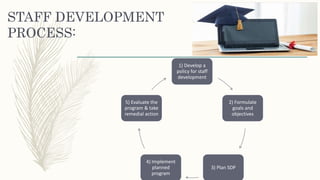
STAFF DEVELOPMENT
PROCESS:
1) Develop a
policy for staff
development
2) Formulate
goals and
objectives
3) Plan SDP
4) Implement
planned
program
5) Evaluate the
program & take
remedial action
JOURNAL INFORMATION:
STAFF DEVELOPMENT MODELS:
1) The RPTIM Model
2) Iowa model
3) Dennis spark model
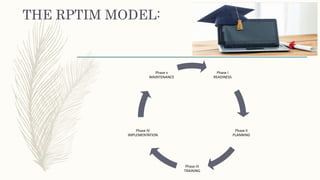
THE RPTIM MODEL:
Phase I
READINESS
Phase II
PLANNING
Phase III
TRAINING
Phase IV
IMPLEMENTATION
Phase v
MAINTENANCE
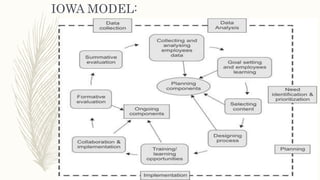
IOWA MODEL:
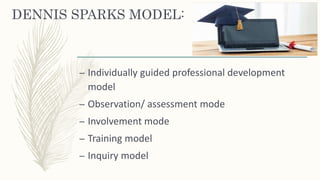
DENNIS SPARKS MODEL:
– Individually guided professional development
model
– Observation/ assessment mode
– Involvement mode
– Training model
– Inquiry model
STAFF DEVELOPMENT
METHODS:
– On the job
– Off the job
STAFF DEVELOPMENT
ACTIVITIES:
– Induction training
– Orientation
– In service education
– Continuing education
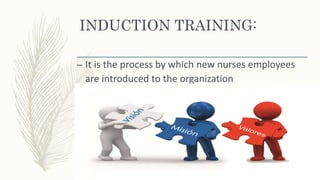
INDUCTION TRAINING:
– It is the process by which new nurses employees
are introduced to the organization
ORIENTATION:
– It is the activity that
introduces new nurse
employees to the
organization, their
tasks, their superiors,
and their work groups.
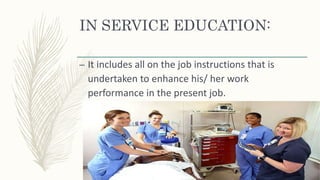
IN SERVICE EDUCATION:
– It includes all on the job instructions that is
undertaken to enhance his/ her work
performance in the present job.
CONTINUING EDUCATION:
– It is defined as the training that an individual
undertaken after the end of basic professional
education to improve competence as a
practitioners and not with a view to gain a new
diploma or license.
OBJECTIVES AND AREAS OF
TRAINING PROGRAMME:
– To provide qualitative nursing services to the
patients
– To improve their communication skills are
essentials for interaction with
the patients
PLANNING OF EDUCATION
TRAINING PROGRAMMES:
– Assessment
– Design
– Implementation
– Evaluation and follow up
ASSESSMENT:
– Needs are determined
– Performance deficit areas are identified
– Information is gathered through organizational
analysis and interview
– Organizational analysis is done to identify where
is training is required
DESIGN:
– Behavioural approach
– Cognitive approach
– Humanistic approach
IMPLEMENTATION:
– Completion of task analysis
– Specification of entry level skills
– Developmental of instructional objectives
– Identification of media and materials
– Review the objectives of the program
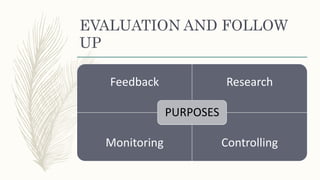
EVALUATION AND FOLLOW
UP
Feedback Research
Monitoring Controlling
PURPOSES
EVALUATION CONT;
– Formative evaluation
– Process evaluation
– Summative evaluation
CONCLUSION:
Staff development programme

Staff development programme

  • 1.
  • 2.
    INTRODUCTION:  For anyorganization to be effective we need 5M’s  It is more of men duly qualified than any other factors which determine the quality and quantity of performance  The staff is the key to the development and success of organization
  • 3.
    CONCEPT & MEANINGOF STAFF DEVELOPMENT:  Staff development is the process that assist individuals in an agency or organization in attaining new skills and knowledge, gaining increasing levels of competence, and growing professionally  The process includes, - orientation - in service education - continuing education
  • 4.
    IMPORTANCE & NEEDOF STAFF DEVELOPMENT: ‘Let us never consider ourselves finished nurses’ - “Florence Nightingale”  To keep pace with the rapid expansion and advancement of medical technology, nurse should be trained and skilled.  To fill the gap between capabilities of staff and scientific bases for practice and to assist the staff to work towards clinical improvement  To fulfill the demand of nurse administrators
  • 5.
    Needs cont.,  Toassist the staff to be research oriented  To improve morale and job satisfaction  To increase the efficiency of organization  To emphasize quality rather than quantity  For successful operation
  • 6.
    PHILOSOPHY OF STAFF DEVELOPMENT Itshould be in consistent with the primary goal of the health care organization hat is to achieve a high quality of nursing care All the programs should be directed to have the impact on the learners, system and the patient and his family
  • 7.
    GOAL: “To see measurableimprovements in the staff performance and overall productivity in the medium to long term period”.
  • 8.
    OBJECTIVES OF STAFF DEVELOPMENT: To ensure that the organization is well staffed  To ensure obtaining maximum potential  To ensure the elements of modernization  To address nurse employee aspiration
  • 9.
    OBJECTIVES CONT;  Toformalize the role of nurse  To address the training needs of nurse  To develop a congenial organization climate  To identify management potential  To achieve the nursing organizational goals
  • 10.
    ADVANTAGES OF STAFF DEVELOPMENT: –To improve knowledge, skill and attitude of nurses – To broaden the outlook of the nurse administrators – To develop further nurse managers
  • 11.
    ADVANTAGES CONT; – Tochange the attitude of nursing personnel – More scope for delegation of authority – Quick and smooth take over by new nursing staff – To keep up to date
  • 12.
    STAFF DEVELOPMENT PROCESS: 1) Developa policy for staff development 2) Formulate goals and objectives 3) Plan SDP 4) Implement planned program 5) Evaluate the program & take remedial action
  • 13.
  • 14.
    STAFF DEVELOPMENT MODELS: 1)The RPTIM Model 2) Iowa model 3) Dennis spark model
  • 15.
    THE RPTIM MODEL: PhaseI READINESS Phase II PLANNING Phase III TRAINING Phase IV IMPLEMENTATION Phase v MAINTENANCE
  • 16.
  • 17.
    DENNIS SPARKS MODEL: –Individually guided professional development model – Observation/ assessment mode – Involvement mode – Training model – Inquiry model
  • 18.
    STAFF DEVELOPMENT METHODS: – Onthe job – Off the job
  • 19.
    STAFF DEVELOPMENT ACTIVITIES: – Inductiontraining – Orientation – In service education – Continuing education
  • 20.
    INDUCTION TRAINING: – Itis the process by which new nurses employees are introduced to the organization
  • 21.
    ORIENTATION: – It isthe activity that introduces new nurse employees to the organization, their tasks, their superiors, and their work groups.
  • 22.
    IN SERVICE EDUCATION: –It includes all on the job instructions that is undertaken to enhance his/ her work performance in the present job.
  • 23.
    CONTINUING EDUCATION: – Itis defined as the training that an individual undertaken after the end of basic professional education to improve competence as a practitioners and not with a view to gain a new diploma or license.
  • 24.
    OBJECTIVES AND AREASOF TRAINING PROGRAMME: – To provide qualitative nursing services to the patients – To improve their communication skills are essentials for interaction with the patients
  • 25.
    PLANNING OF EDUCATION TRAININGPROGRAMMES: – Assessment – Design – Implementation – Evaluation and follow up
  • 26.
    ASSESSMENT: – Needs aredetermined – Performance deficit areas are identified – Information is gathered through organizational analysis and interview – Organizational analysis is done to identify where is training is required
  • 27.
    DESIGN: – Behavioural approach –Cognitive approach – Humanistic approach
  • 28.
    IMPLEMENTATION: – Completion oftask analysis – Specification of entry level skills – Developmental of instructional objectives – Identification of media and materials – Review the objectives of the program
  • 29.
    EVALUATION AND FOLLOW UP FeedbackResearch Monitoring Controlling PURPOSES
  • 30.
    EVALUATION CONT; – Formativeevaluation – Process evaluation – Summative evaluation
  • 31.