STAFF DEVELOPMENT
IN NURSING
By;
Mr. MANULAL. V.S
FACULTY
CACEE, University of Kerala,
Thiruvananthapuram.
STAFF DEVELOPMENT – Definition.
Staff development refers to all training and
education provided by an employer to improve
the occupational and personal knowledge, skills
and attitudes of vested employees .
i.e, Staff development is the process directed
towards the personal and professional growth of
Nurses and other personnel, while they are
employed by a health care agency .
PHILOSOPHY OF STAFF DEVELPMENT
• The primary goal of health care agency is the
achievement of a high quality health care for
the people who use the agency’s service.
• The focus of the department of continuing
education is in the development of all
employees including all nurses employed by
the health care agency and the nursing
community at large for the enhancement of
nursing care given to its clients.
NEED FOR STAFF DEVELOPMENT.
• To update improved nursing knowledge, skill
and response capabilities to deal with the
social changes and scientific advancements.
• To acquire and implement the knowledge and
skills for the maintenance of high quality
nursing care.
COMPONENTS OF STAFF
DEVELOPMENT .
• NEED.
• INTEREST.
• LEARNING.
• TRAINING.
• COMPETENCE.
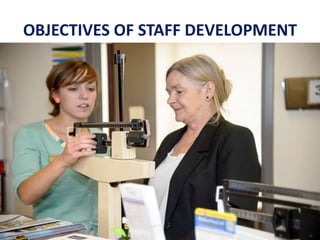
OBJECTIVES OF STAFF DEVELOPMENT
• Maximize the potentials of the employee.
• Utilization of resources cost effectively.
• Improvisation with changes.
• Maximum utilization of available resources.
• Anticipate the problems in the organization.
• Providing solutions for the organization.
• Identify the leadership skills.
OBJECTIVES OF STAFF
DEVELOPMENT…Cont….
• To get organizational stability and good
organizational climate.
• To provide complete comprehensive nursing
care to the client effectively.
• To get professional and personal identity
through enhanced knowledge status .
• To minimize errors.
• For quality assurance.
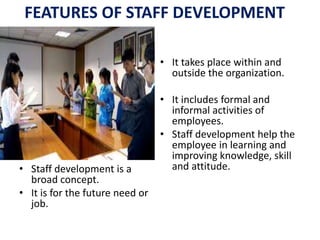
FEATURES OF STAFF DEVELOPMENT
• Staff development is a
broad concept.
• It is for the future need or
job.
• It takes place within and
outside the organization.
• It includes formal and
informal activities of
employees.
• Staff development help the
employee in learning and
improving knowledge, skill
and attitude.
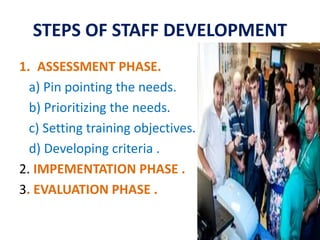
STEPS OF STAFF DEVELOPMENT
1. ASSESSMENT PHASE.
a) Pin pointing the needs.
b) Prioritizing the needs.
c) Setting training objectives.
d) Developing criteria .
2. IMPEMENTATION PHASE .
3. EVALUATION PHASE .
TYPES OF STAFF DEVELOPMENT
1. INDUCTION TRAINING.
2. JOB ORIENTATION.
3. INSERVICE EDUCATION.
4. CONTINUING EDUCATION.
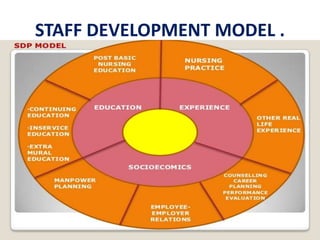
STAFF DEVELOPMENT MODEL .
BENEFITS OF STAFF DEVELOPMENT.
• It benefits the organization and keeps the
nursing staff enthusiastic in their learning .
• Helps in decision making.
• Helps to develop skills like public relation,
interpersonal and human relations.
• Promotes job satisfaction among employees.
• Creates opportunities for growth and
communication.
• Helps the employees to adjust according to the
need.
• Develops sense of responsibility among
employees .
Role of nurse administrators in Staff
Development .
• It is important that those responsible for
educating and training be identified and given the
authority to carry out the programs .
• If staff development activities are to be successful
, it is necessary to delineate and communicate
the authority and responsibility for all
components of education and training.
• We must ensure that all parties involved in the
indoctrination, education , and training of nursing
staff understand and carry out their
responsibilities in that process .
Role of nurse administrators in Staff
Development .
• If the non-nursing administrator is responsible for the
staff development department , there must be input
from the nursing department in formulating staff
development policies and delineating duties .
• An education advisory committee should be formed
with representatives from top-middle, and first level
management ; staff development ; and the human
resource department .
• Accountability for various parts of the staff
development program must be clearly communicated.
• Some methods of cost and benefits of various
programs should be used .

Staff development.

  • 1.
    STAFF DEVELOPMENT IN NURSING By; Mr.MANULAL. V.S FACULTY CACEE, University of Kerala, Thiruvananthapuram.
  • 2.
    STAFF DEVELOPMENT –Definition. Staff development refers to all training and education provided by an employer to improve the occupational and personal knowledge, skills and attitudes of vested employees . i.e, Staff development is the process directed towards the personal and professional growth of Nurses and other personnel, while they are employed by a health care agency .
  • 3.
    PHILOSOPHY OF STAFFDEVELPMENT • The primary goal of health care agency is the achievement of a high quality health care for the people who use the agency’s service. • The focus of the department of continuing education is in the development of all employees including all nurses employed by the health care agency and the nursing community at large for the enhancement of nursing care given to its clients.
  • 4.
    NEED FOR STAFFDEVELOPMENT. • To update improved nursing knowledge, skill and response capabilities to deal with the social changes and scientific advancements. • To acquire and implement the knowledge and skills for the maintenance of high quality nursing care.
  • 5.
    COMPONENTS OF STAFF DEVELOPMENT. • NEED. • INTEREST. • LEARNING. • TRAINING. • COMPETENCE.
  • 6.
  • 7.
    OBJECTIVES OF STAFFDEVELOPMENT • Maximize the potentials of the employee. • Utilization of resources cost effectively. • Improvisation with changes. • Maximum utilization of available resources. • Anticipate the problems in the organization. • Providing solutions for the organization. • Identify the leadership skills.
  • 8.
    OBJECTIVES OF STAFF DEVELOPMENT…Cont…. •To get organizational stability and good organizational climate. • To provide complete comprehensive nursing care to the client effectively. • To get professional and personal identity through enhanced knowledge status . • To minimize errors. • For quality assurance.
  • 9.
    FEATURES OF STAFFDEVELOPMENT • Staff development is a broad concept. • It is for the future need or job. • It takes place within and outside the organization. • It includes formal and informal activities of employees. • Staff development help the employee in learning and improving knowledge, skill and attitude.
  • 10.
    STEPS OF STAFFDEVELOPMENT 1. ASSESSMENT PHASE. a) Pin pointing the needs. b) Prioritizing the needs. c) Setting training objectives. d) Developing criteria . 2. IMPEMENTATION PHASE . 3. EVALUATION PHASE .
  • 11.
    TYPES OF STAFFDEVELOPMENT 1. INDUCTION TRAINING. 2. JOB ORIENTATION. 3. INSERVICE EDUCATION. 4. CONTINUING EDUCATION.
  • 12.
  • 13.
    BENEFITS OF STAFFDEVELOPMENT.
  • 14.
    BENEFITS OF STAFFDEVELOPMENT. • It benefits the organization and keeps the nursing staff enthusiastic in their learning . • Helps in decision making. • Helps to develop skills like public relation, interpersonal and human relations. • Promotes job satisfaction among employees. • Creates opportunities for growth and communication. • Helps the employees to adjust according to the need. • Develops sense of responsibility among employees .
  • 15.
    Role of nurseadministrators in Staff Development . • It is important that those responsible for educating and training be identified and given the authority to carry out the programs . • If staff development activities are to be successful , it is necessary to delineate and communicate the authority and responsibility for all components of education and training. • We must ensure that all parties involved in the indoctrination, education , and training of nursing staff understand and carry out their responsibilities in that process .
  • 16.
    Role of nurseadministrators in Staff Development . • If the non-nursing administrator is responsible for the staff development department , there must be input from the nursing department in formulating staff development policies and delineating duties . • An education advisory committee should be formed with representatives from top-middle, and first level management ; staff development ; and the human resource department . • Accountability for various parts of the staff development program must be clearly communicated. • Some methods of cost and benefits of various programs should be used .