LAND
MOBILITY
MARKET
OVERVIEW
The Drive for Greater Connectivity
Land Mobility refers to a range of land-based vehicles and markets that need connectivity on the move to maximize utility. Markets
from defense to agriculture to transportation now have vehicles enabled with new levels of intelligence that can generate large
amounts of data and interact with both the people and the environment around them. On board these moving vehicles, applications
bring information and entertainment to passengers, sensors track the health of engine components or goods in transport, critical
software updates keep vehicles operating safely, and system automation increases operational efficiencies and simplifies complex
operations. As these technologies advance, so does the importance of connectivity to the future of Land Mobility.
Meeting New Land Mobility Requirements
With New Satellite Technologies
Among the many markets contained in Land Mobility, the “connected car” has uniquely captured the imagination of consumers, and so
it tends to get most of the media coverage. But despite what the headlines say, connected car is only one part of Land Mobility, which
encompasses many different markets beyond automotive, each with unique requirements that rely on a variety of communication
technologies such as cellular, Wi-Fi and satellite.
Satellite has historically been regarded as a technology of last resort (beyond the giant dishes known for the broadcasting industry
where it has been the primary transmitter for decades). Its unique capabilities have usually not outweighed its higher total cost of
ownership and other limitations. Today, Land Mobility markets are beginning to rely on new developments in satellite technology as
part of their overall connectivity strategy to enable business and process improvements. Very small aperture terminal, or VSAT, satellite
technology is steadily gaining momentum to meet this higher demand for connectivity across mobility markets including land sectors.
Satellites Serving A Widening
Range of Market Use Cases
Major satellite industry shifts are making satellites a viable and cost-effective prospect for Land Mobility use. First, VSAT’s latest terminals
are more suitable for size, weight and power requirements of vehicular mounts, that is, they are smaller and lighter than ever. Flat panel
antennas that are form fitted for lower profile uses are steadily becoming mainstream, and even more sophisticated electronically
steered antenna technology looks very promising to Land Mobility in the near-term future. These hardware advances along with
incredible waveform developments are the ground segment response to the enormous growth in capacity and performance of high
throughput satellites (HTS). The power of these HTS beams allows considerably smaller antennas to do a better job than their larger
counterparts. The industry is currently experiencing another technology step change as an entirely new class of constellations come
online offering additional capacity, performance, and flexibility.
Across Land Mobility markets, some common requirements are forming. At the top of the list for enterprises, these requirements include
business intelligence and automation to increase performance, growing use of sensor data analytics, and simplifying processes. The
operational efficiency gained through these real-time applications promises enormous value that far outweighs the initial investment.
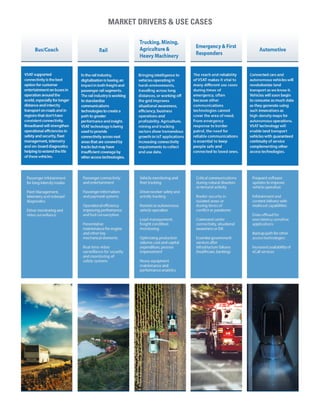
MARKET DRIVERS & USE CASES
The ST Engineering iDirect Solution
ST Engineering iDirect is the leader in satellite ground
infrastructure and platforms with over 20 years of experience in
mobility, offering a diverse range of boards, modems and
terminal solutions that span a variety of use cases.
Leading satellite operators and service providers around the
world rely on our multiservice platforms to deliver exceptional
performance, efficiency and service capabilities with the scale
and flexibility necessary to meet global connectivity
requirements. Our platforms are designed to provide the
highest quality of service (QoS) across a full spectrum of
network sizes and bandwidth requirements while minimizing
capital and operational expense. This becomes even more
important when supporting large segments in land mobility
where service providers require a VSAT platform that can scale
to meet demand and seamlessly integrate into a hybrid
networking environment.
At ST Engineering iDirect we offer market-leading platforms
with unique attributes that help our customers choose the best
option for their service offerings.
The Velocity platform is designed for satellite operators who
provide managed services for large HTS networks that require
massive scale. Velocity’s bandwidth management capabilities
make it easier for satellite operators to offer unique packages
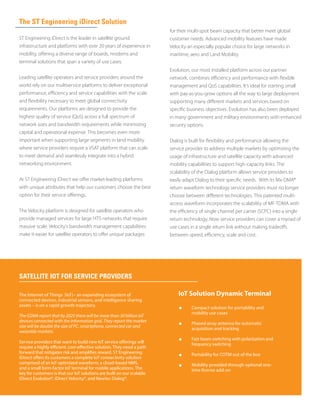
SATELLITE IOT FOR SERVICE PROVIDERS
The Internet of Things (IoT)– an expanding ecosystem of
connected devices, industrial sensors, and intelligence sharing
assets – is on a rapid growth trajectory.
The GSMA report that by 2025 there will be more than 30 billion IoT
devices connected with the information grid. They report the market
size will be double the size of PC, smartphone, connected car and
wearable markets.
Service providers that want to build new IoT service offerings will
require a highly efficient, cost-effective solution. They need a path
forward that mitigates risk and amplifies reward. ST Engineering
iDirect offers its customers a complete IoT connectivity solution
comprised of an IoT optimized waveform, a cloud-based NMS,
and a small form-factor IoT terminal for mobile applications. The
key for customers is that our IoT solutions are built on our scalable
iDirect Evolution®, iDirect Velocity®, and Newtec Dialog®.
Compact solution for portability and
mobility use cases
Phased array antenna for automatic
acquisition and tracking
Fast beam switching with polarization and
frequency switching
Portability for COTM out of the box
Mobility provided through optional one-
time license add-on
IoT Solution Dynamic Terminal
•
•
•
•
•
for their multi-spot beam capacity that better meet global
customer needs. Advanced mobility features have made
Velocity an especially popular choice for large networks in
maritime, aero and Land Mobility.
Evolution, our most installed platform across our partner
network, combines efficiency and performance with flexible
management and QoS capabilities. It’s ideal for starting small
with pay-as-you-grow options all the way to large deployment
supporting many different markets and services based on
specific business objectives. Evolution has also been deployed
in many government and military environments with enhanced
security options.
Dialog is built for flexibility and performance allowing the
service provider to address multiple markets by optimizing the
usage of infrastructure and satellite capacity with advanced
mobility capabilities to support high-capacity links. The
scalability of the Dialog platform allows service providers to
easily adapt Dialog to their specific needs. With its Mx-DMA®
return waveform technology service providers must no longer
choose between different technologies. This patented multi-
access waveform incorporates the scalability of MF-TDMA with
the efficiency of single channel per carrier (SCPC) into a single
return technology. Now service providers can cover a myriad of
use cases in a single return link without making tradeoffs
between speed, efficiency, scale and cost.
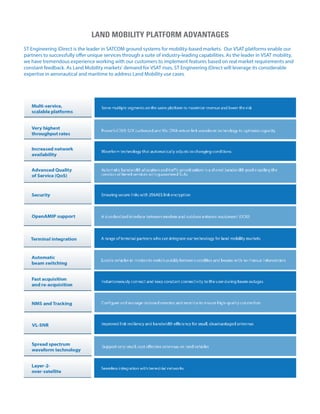
ST Engineering iDirect is the leader in SATCOM ground systems for mobility-based markets. Our VSAT platforms enable our
partners to successfully offer unique services through a suite of industry-leading capabilities. As the leader in VSAT mobility,
we have tremendous experience working with our customers to implement features based on real market requirements and
constant feedback. As Land Mobility markets’ demand for VSAT rises, ST Engineering iDirect will leverage its considerable
expertise in aeronautical and maritime to address Land Mobility use cases.
LAND MOBILITY PLATFORM ADVANTAGES
Next-generation Satellites
The expansion of capacity by non-geostationary (NGSO)
satellites in low- and medium-earth orbits will have a dramatic
effect on the quality of satellite service once such constellations
are in full operational service. Leveraging the inherent
characteristics of each orbit will help drive down costs, allow for
further reduction in terminal size, increase performance
capabilities, and result in a wider range of solutions. Satellites in
every orbit are becoming more flexible through software-
defined capabilities that allow for satellite reconfiguration on
orbit. Ground infrastructure is responding with its own
innovations to meet new demands and achieve greater scale
associated with expected growth. Ultimately, service providers
will switch between beams, satellites, constellations and other
access technologies to provide the coverage and availability
that is needed in Land Mobility environments.
5G Impact
The proliferation of 5G technology is enabling a broader
communications structure to be established. But realizing the
full promise of 5G requires the implementation of industry
standards for all access technologies, so ST Engineering iDirect
is aligning our platforms with the 3GPP and MEF standards. For
a communications provider, such standards make it possible to
set up, provision, configure and manage traffic across networks
with high levels of automation and to route traffic between the
various access technologies.
As 5G rolls out, we are moving into an environment of
decoupled software and hardware. Software-defined satellites
and software-defined networking solutions deliver much
greater speed, flexibility and power. Shifting customization to
the software side has significant cost savings. This is good news
for Land Mobility service providers because in a virtualized
environment, operators can quickly adapt their network to
optimize capacity and services in real time.
Hybridization
It’s true that cellular connectivity is the best option in urban areas
where the coverage, density, availability and speed of the network
surpass other technologies. But the quality and reliability of a
cellular network can vary greatly outside of metropolitan areas
where satellite often has great coverage and availability. So
attaining a seamless experience of connectivity as cellular
coverage dwindles requires a hybrid solution. As powerful as
cellular is, it can’t stand alone as the single access technology.
Only a truly hybrid ecosystem can adeptly support “always-on”
access for Land Mobility users and move data seamlessly across
terrestrial, wireless and satellite networks. Communication
service providers know this, and they are increasingly
developing hybrid solutions that provide high-quality, high-
availability services and offer customers access to the latest
applications. These emerging hybrid networks require the
interoperability of 4G LTE, IoT, satellite, and the imminent
ubiquity of 5G, which reinforces the necessity of standardization
across all of these access technologies. Taken together, these
advancements in satellite, cellular and networking are bringing a
more cohesive telecommunications fabric to fruition.
Bringing It Together
Land Mobility sectors are prioritizing connectivity. End customers want communications solutions that allow them to be more
productive, more efficient, and more intelligent across a fleet. ST Engineering iDirect Land Mobility technology is committed to
bringing the value of satellite solutions to customers in concert with the broader telecommunications ecosystem. Our platforms
enable service providers the advanced mobility features necessary to offer customized satellite or hybrid services to the full
gamut of Land Mobility customers.

ST Engineering iDirect: Solution Overview: Land Mobility Market

  • 1.
  • 2.
    The Drive forGreater Connectivity Land Mobility refers to a range of land-based vehicles and markets that need connectivity on the move to maximize utility. Markets from defense to agriculture to transportation now have vehicles enabled with new levels of intelligence that can generate large amounts of data and interact with both the people and the environment around them. On board these moving vehicles, applications bring information and entertainment to passengers, sensors track the health of engine components or goods in transport, critical software updates keep vehicles operating safely, and system automation increases operational efficiencies and simplifies complex operations. As these technologies advance, so does the importance of connectivity to the future of Land Mobility. Meeting New Land Mobility Requirements With New Satellite Technologies Among the many markets contained in Land Mobility, the “connected car” has uniquely captured the imagination of consumers, and so it tends to get most of the media coverage. But despite what the headlines say, connected car is only one part of Land Mobility, which encompasses many different markets beyond automotive, each with unique requirements that rely on a variety of communication technologies such as cellular, Wi-Fi and satellite. Satellite has historically been regarded as a technology of last resort (beyond the giant dishes known for the broadcasting industry where it has been the primary transmitter for decades). Its unique capabilities have usually not outweighed its higher total cost of ownership and other limitations. Today, Land Mobility markets are beginning to rely on new developments in satellite technology as part of their overall connectivity strategy to enable business and process improvements. Very small aperture terminal, or VSAT, satellite technology is steadily gaining momentum to meet this higher demand for connectivity across mobility markets including land sectors. Satellites Serving A Widening Range of Market Use Cases Major satellite industry shifts are making satellites a viable and cost-effective prospect for Land Mobility use. First, VSAT’s latest terminals are more suitable for size, weight and power requirements of vehicular mounts, that is, they are smaller and lighter than ever. Flat panel antennas that are form fitted for lower profile uses are steadily becoming mainstream, and even more sophisticated electronically steered antenna technology looks very promising to Land Mobility in the near-term future. These hardware advances along with incredible waveform developments are the ground segment response to the enormous growth in capacity and performance of high throughput satellites (HTS). The power of these HTS beams allows considerably smaller antennas to do a better job than their larger counterparts. The industry is currently experiencing another technology step change as an entirely new class of constellations come online offering additional capacity, performance, and flexibility. Across Land Mobility markets, some common requirements are forming. At the top of the list for enterprises, these requirements include business intelligence and automation to increase performance, growing use of sensor data analytics, and simplifying processes. The operational efficiency gained through these real-time applications promises enormous value that far outweighs the initial investment.
  • 3.
  • 4.
    The ST EngineeringiDirect Solution ST Engineering iDirect is the leader in satellite ground infrastructure and platforms with over 20 years of experience in mobility, offering a diverse range of boards, modems and terminal solutions that span a variety of use cases. Leading satellite operators and service providers around the world rely on our multiservice platforms to deliver exceptional performance, efficiency and service capabilities with the scale and flexibility necessary to meet global connectivity requirements. Our platforms are designed to provide the highest quality of service (QoS) across a full spectrum of network sizes and bandwidth requirements while minimizing capital and operational expense. This becomes even more important when supporting large segments in land mobility where service providers require a VSAT platform that can scale to meet demand and seamlessly integrate into a hybrid networking environment. At ST Engineering iDirect we offer market-leading platforms with unique attributes that help our customers choose the best option for their service offerings. The Velocity platform is designed for satellite operators who provide managed services for large HTS networks that require massive scale. Velocity’s bandwidth management capabilities make it easier for satellite operators to offer unique packages SATELLITE IOT FOR SERVICE PROVIDERS The Internet of Things (IoT)– an expanding ecosystem of connected devices, industrial sensors, and intelligence sharing assets – is on a rapid growth trajectory. The GSMA report that by 2025 there will be more than 30 billion IoT devices connected with the information grid. They report the market size will be double the size of PC, smartphone, connected car and wearable markets. Service providers that want to build new IoT service offerings will require a highly efficient, cost-effective solution. They need a path forward that mitigates risk and amplifies reward. ST Engineering iDirect offers its customers a complete IoT connectivity solution comprised of an IoT optimized waveform, a cloud-based NMS, and a small form-factor IoT terminal for mobile applications. The key for customers is that our IoT solutions are built on our scalable iDirect Evolution®, iDirect Velocity®, and Newtec Dialog®. Compact solution for portability and mobility use cases Phased array antenna for automatic acquisition and tracking Fast beam switching with polarization and frequency switching Portability for COTM out of the box Mobility provided through optional one- time license add-on IoT Solution Dynamic Terminal • • • • • for their multi-spot beam capacity that better meet global customer needs. Advanced mobility features have made Velocity an especially popular choice for large networks in maritime, aero and Land Mobility. Evolution, our most installed platform across our partner network, combines efficiency and performance with flexible management and QoS capabilities. It’s ideal for starting small with pay-as-you-grow options all the way to large deployment supporting many different markets and services based on specific business objectives. Evolution has also been deployed in many government and military environments with enhanced security options. Dialog is built for flexibility and performance allowing the service provider to address multiple markets by optimizing the usage of infrastructure and satellite capacity with advanced mobility capabilities to support high-capacity links. The scalability of the Dialog platform allows service providers to easily adapt Dialog to their specific needs. With its Mx-DMA® return waveform technology service providers must no longer choose between different technologies. This patented multi- access waveform incorporates the scalability of MF-TDMA with the efficiency of single channel per carrier (SCPC) into a single return technology. Now service providers can cover a myriad of use cases in a single return link without making tradeoffs between speed, efficiency, scale and cost.
  • 5.
    ST Engineering iDirectis the leader in SATCOM ground systems for mobility-based markets. Our VSAT platforms enable our partners to successfully offer unique services through a suite of industry-leading capabilities. As the leader in VSAT mobility, we have tremendous experience working with our customers to implement features based on real market requirements and constant feedback. As Land Mobility markets’ demand for VSAT rises, ST Engineering iDirect will leverage its considerable expertise in aeronautical and maritime to address Land Mobility use cases. LAND MOBILITY PLATFORM ADVANTAGES
  • 6.
    Next-generation Satellites The expansionof capacity by non-geostationary (NGSO) satellites in low- and medium-earth orbits will have a dramatic effect on the quality of satellite service once such constellations are in full operational service. Leveraging the inherent characteristics of each orbit will help drive down costs, allow for further reduction in terminal size, increase performance capabilities, and result in a wider range of solutions. Satellites in every orbit are becoming more flexible through software- defined capabilities that allow for satellite reconfiguration on orbit. Ground infrastructure is responding with its own innovations to meet new demands and achieve greater scale associated with expected growth. Ultimately, service providers will switch between beams, satellites, constellations and other access technologies to provide the coverage and availability that is needed in Land Mobility environments. 5G Impact The proliferation of 5G technology is enabling a broader communications structure to be established. But realizing the full promise of 5G requires the implementation of industry standards for all access technologies, so ST Engineering iDirect is aligning our platforms with the 3GPP and MEF standards. For a communications provider, such standards make it possible to set up, provision, configure and manage traffic across networks with high levels of automation and to route traffic between the various access technologies. As 5G rolls out, we are moving into an environment of decoupled software and hardware. Software-defined satellites and software-defined networking solutions deliver much greater speed, flexibility and power. Shifting customization to the software side has significant cost savings. This is good news for Land Mobility service providers because in a virtualized environment, operators can quickly adapt their network to optimize capacity and services in real time. Hybridization It’s true that cellular connectivity is the best option in urban areas where the coverage, density, availability and speed of the network surpass other technologies. But the quality and reliability of a cellular network can vary greatly outside of metropolitan areas where satellite often has great coverage and availability. So attaining a seamless experience of connectivity as cellular coverage dwindles requires a hybrid solution. As powerful as cellular is, it can’t stand alone as the single access technology. Only a truly hybrid ecosystem can adeptly support “always-on” access for Land Mobility users and move data seamlessly across terrestrial, wireless and satellite networks. Communication service providers know this, and they are increasingly developing hybrid solutions that provide high-quality, high- availability services and offer customers access to the latest applications. These emerging hybrid networks require the interoperability of 4G LTE, IoT, satellite, and the imminent ubiquity of 5G, which reinforces the necessity of standardization across all of these access technologies. Taken together, these advancements in satellite, cellular and networking are bringing a more cohesive telecommunications fabric to fruition.
  • 7.
    Bringing It Together LandMobility sectors are prioritizing connectivity. End customers want communications solutions that allow them to be more productive, more efficient, and more intelligent across a fleet. ST Engineering iDirect Land Mobility technology is committed to bringing the value of satellite solutions to customers in concert with the broader telecommunications ecosystem. Our platforms enable service providers the advanced mobility features necessary to offer customized satellite or hybrid services to the full gamut of Land Mobility customers.