4/21/2023 1
SSH – The ‘Secure’ Shell
Presented by
Karthik Sadasivam
Course: CSCI 5931 Web Security
Instructor : Dr.Yang
4/21/2023 2
Secure What.. ?
 ‘Secure shell is a de facto standard for remote logins and
encrypted file transfers.’ [SSH communications inc.]
 Founded in 1995 by Tatu Ylonen, a researcher at Helsinki
University of Technology, Finland
 It provides authentication and encryption for business critical
applications to work securely over the internet.
 Originally introduced for UNIX terminals as a replacement for the
insecure remote access “Berkeley services" , viz. rsh, rlogin, rcp,
telnet, etc.
 It can also be used for port forwarding of arbitrary TCP/IP or X11
connections (interactive terminals)
 It is a layer over TCP/IP and runs on the port 22.
4/21/2023 3
Why SSH?
 The three core security requirements for a remote access
technology – confidentiality, integrity and authentication
 Most of the earlier technologies lack confidentiality and integrity.
For e.g Telnet and FTP transmit username and passwords in
cleartext.
 They are vulnerable to attacks such as IP spoofing, DoS, MITM
and eavesdropping.
 Secure shell satisfies all the three requirements by using:
 Data Encryption to provide confidentiality
 Host-based and (or) client-based authentication
 Data integrity using MACs and hashes
4/21/2023 4
Flavors of SSH
 There are two incompatible versions of the SSH protocol: SSH-1
and SSH-2
 SSH-2 was introduced in order to fix several bugs in SSH-1 and also
includes several new features
 Both versions have technical glitches and are vulnerable to known
attacks (discussed later)
 SSH-1 is more popular nowadays due to licensing issues with
SSH-2
 OpenSSH is a free version of the SSH with open source code
development. It supports both the versions and mainly used in UNIX
environment.
4/21/2023 5
The SSH-1 protocol exchange
Client Server
Opens a TCP connection to port 22
SSH protocol version exchange
e.g ASCII :” SSH-1.5-1.2.27”
Server identification {H+S+list of ciphers and
authentication methods+cookie} + session
parameters
Selected data cipher +encrypted session
key K(H,S) +cookie
Server acknowledgement encrypted
with K
Secure connection established!
Server authenticated
H – host key ; S- Server Key ; cookie- sequence of 8 random bytes; K- session key
4/21/2023 6
The SSH-1 protocol exchange (contd.)
 Once secure connection is established, client attempts to
authenticate itself to server.
 Some of the authentication methods used are:
 Kerberos
 RHosts and RHostsRSA
 Public key
 Password based authentication (OTP)
 Integrity checking is provided by means of a weak CRC -32
 Compression is provided using the “deflate” algorithm of GNU gzip
utility. It is beneficial for file transfer utilities such as ftp, scp, etc.
4/21/2023 7
The SSH-2 protocol
 SSH-1 is monolithic, encompassing multiple functions into a single
protocol whereas SSH-2 has been separated into modules and
consists of 3 protocols:
 SSH Transport layer protocol (SSH-TRANS) : Provides the
initial connection, packet protocol, server authentication and
basic encryption and integrity services.
 SSH Authentication protocol (SSH-AUTH) : Verifies the
client’s identity at the beginning of an SSH-2 session, by three
authentication methods: Public key, host based and password.
 SSH Connection protocol (SSH-CONN) : It permits a number
of different services to exchange data through the secure
channel provided by SSH-TRANS.
 A fourth protocol SSH protocol architecture (SSH-ARCH) describes
the overall architecture.
 All the protocols are still in the draft stage.
4/21/2023 8
The SSH-2 protocol (contd.)
TCP/IP
SSH-TRANS
Binary Packet Protocol
Negotiated Encryption Protocol
Negotiated Compression Protocol
SSH-CONN
Connection Protocol
X11
TCP Port
Forwarding
SSH-USERAUTH
Authentication Protocol
Layering of SSH-2 Protocols
SSH Version
Identification
Pseudo-
Terminal
Algorithm
Negotiation
(compression,
encryption)
Key Exchange
(eg. Diffie-
Hellman)
Challenge-
Response
Pass-
word
Public-
key
Keyboard-
Interactive
Password
[Source: ‘Analysis of Secure shell vulnerability’ – white paper ]
4/21/2023 9
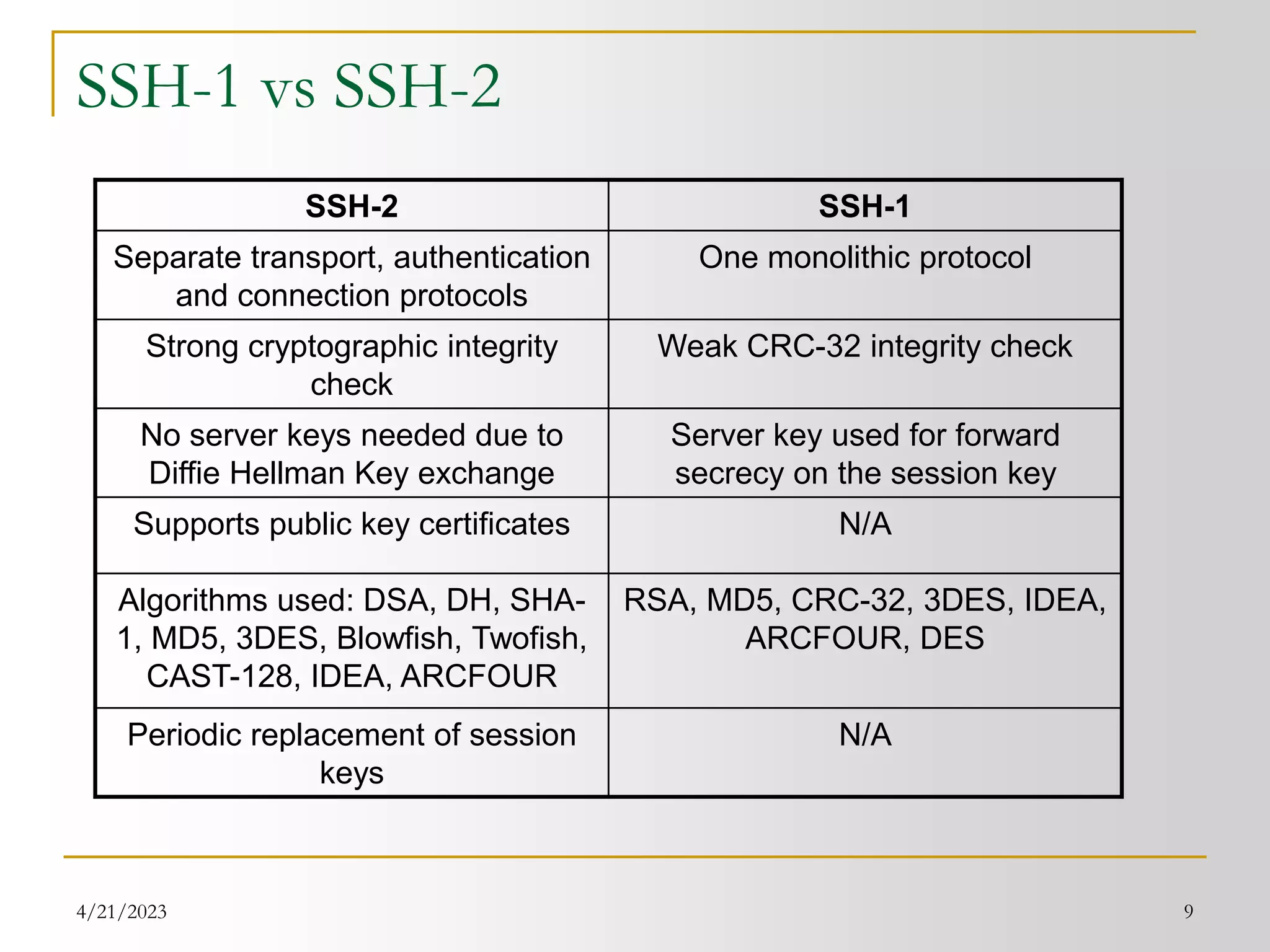
SSH-1 vs SSH-2
SSH-2 SSH-1
Separate transport, authentication
and connection protocols
One monolithic protocol
Strong cryptographic integrity
check
Weak CRC-32 integrity check
No server keys needed due to
Diffie Hellman Key exchange
Server key used for forward
secrecy on the session key
Supports public key certificates N/A
Algorithms used: DSA, DH, SHA-
1, MD5, 3DES, Blowfish, Twofish,
CAST-128, IDEA, ARCFOUR
RSA, MD5, CRC-32, 3DES, IDEA,
ARCFOUR, DES
Periodic replacement of session
keys
N/A
4/21/2023 10
Is SSH really secure?
 Secure shell does counter certain types of attacks such as:
 Eavesdropping
 Name service and IP spoofing
 Connection hijacking
 MITM
 Insertion attack
 However it fails against these attacks:
 Password cracking
 IP and TCP attacks
 SYN flooding
 TCP RST, bogus ICMP
 TCP desynchronization and hijacking
 Traffic analysis
 Covert channels
4/21/2023 11
Some known vulnerabilities in SSH
 OpenSSH Challenge-Response Authentication Buffer Overflow: A hostile
modification to the SSH client floods the server with authentication
responses and causes a buffer overflow. [SSH-2]
 Passive analysis of SSH traffic: It lets the attacker obtain sensitive
information by passively monitoring encrypted SSH sessions. The
information can later be used to speed up brute-force attacks on passwords,
including the initial login password and other passwords appearing in
interactive SSH sessions. [SSH-1 & SSH-2]
 Key recovery in SSH protocol 1.5 : This vulnerability may lead to the
compromise of the session key. Once the session key is determined, the
attacker can proceed to decrypt the stored session using any
implementation of the crypto algorithm used. This will reveal all information
in an unencrypted form. [SSH-1]
 CRC-32 integrity check vulnerability : It is based on the weakness of the
CRC-32 integrity that becomes exploitable due to CBC and CFB feedback
modes [SSH-1]
4/21/2023 12
Case study : The ‘GOBBLES’ exploit
 This exploits the weakness in the challenge-response authentication
mechanism of OpenSSH.
 SSH_MSG_USERAUTH_REQUEST,
SSH_MSG_USERAUTH_INFO_REQUEST ,
SSH_MSG_USERAUTH_INFO_RESPONSE
4/21/2023 13
Case study : The ‘GOBBLES’ exploit
(contd.)
 Instead of sending the requested number of responses, the client sends a large
integer
 The server allocates memory for these response strings
4/21/2023 14
Case study : The ‘GOBBLES’ exploit
(contd.)
4/21/2023 15
Case study : The ‘GOBBLES’ exploit
(contd.)
4/21/2023 16
Case study : The ‘GOBBLES’ exploit
(contd.)
4/21/2023 17
Case study : The ‘GOBBLES’ exploit
(contd.)
4/21/2023 18
SSH tools
 There are several commercial and freeware SSH tools for UNIX and
windows platforms
 Windows –
 PuTTY
 TeraTerm
 SecureCRT
 UNIX –
 The RedHat Linux package and OpenBSD come alongwith tools such as
ssh, sshd(daemon), scp(secure copy), sftp(secure ftp), etc.
 OpenSSH
4/21/2023 19
Bibiliography
[1] ‘Securing remote connections with SSH’ – a white paper by SSH
communications Security corp.
[2] Red Hat tutorials – Chapter 10 SSH :
http://www.redhat.com/docs/manuals/linux/RHL-7.3-Manual/ref-
guide/ch-ssh.html
[3] SSH tools - http://bach.dynet.com/sshtools/
[4] ’Firewalling a Secure Shell Service’ – a white paper
http://www.esat.kuleuven.ac.be/~joclaess/pub/ceci2001.pdf
[5] Cisco Security Advisory: Multiple SSH Vulnerabilities –
http://www.cisco.com/warp/public/707/SSH-multiple- pub.html
[6] SSH -The Secure Shell :The definitive guide Daniel Barrett &
Richard E. Silvermann (O’Reilly publications)
[7] ‘Analysis of a Secure Shell vulnerability’ - James M. Mike Anthis
A white paper

SSH.ppt

  • 1.
    4/21/2023 1 SSH –The ‘Secure’ Shell Presented by Karthik Sadasivam Course: CSCI 5931 Web Security Instructor : Dr.Yang
  • 2.
    4/21/2023 2 Secure What..?  ‘Secure shell is a de facto standard for remote logins and encrypted file transfers.’ [SSH communications inc.]  Founded in 1995 by Tatu Ylonen, a researcher at Helsinki University of Technology, Finland  It provides authentication and encryption for business critical applications to work securely over the internet.  Originally introduced for UNIX terminals as a replacement for the insecure remote access “Berkeley services" , viz. rsh, rlogin, rcp, telnet, etc.  It can also be used for port forwarding of arbitrary TCP/IP or X11 connections (interactive terminals)  It is a layer over TCP/IP and runs on the port 22.
  • 3.
    4/21/2023 3 Why SSH? The three core security requirements for a remote access technology – confidentiality, integrity and authentication  Most of the earlier technologies lack confidentiality and integrity. For e.g Telnet and FTP transmit username and passwords in cleartext.  They are vulnerable to attacks such as IP spoofing, DoS, MITM and eavesdropping.  Secure shell satisfies all the three requirements by using:  Data Encryption to provide confidentiality  Host-based and (or) client-based authentication  Data integrity using MACs and hashes
  • 4.
    4/21/2023 4 Flavors ofSSH  There are two incompatible versions of the SSH protocol: SSH-1 and SSH-2  SSH-2 was introduced in order to fix several bugs in SSH-1 and also includes several new features  Both versions have technical glitches and are vulnerable to known attacks (discussed later)  SSH-1 is more popular nowadays due to licensing issues with SSH-2  OpenSSH is a free version of the SSH with open source code development. It supports both the versions and mainly used in UNIX environment.
  • 5.
    4/21/2023 5 The SSH-1protocol exchange Client Server Opens a TCP connection to port 22 SSH protocol version exchange e.g ASCII :” SSH-1.5-1.2.27” Server identification {H+S+list of ciphers and authentication methods+cookie} + session parameters Selected data cipher +encrypted session key K(H,S) +cookie Server acknowledgement encrypted with K Secure connection established! Server authenticated H – host key ; S- Server Key ; cookie- sequence of 8 random bytes; K- session key
  • 6.
    4/21/2023 6 The SSH-1protocol exchange (contd.)  Once secure connection is established, client attempts to authenticate itself to server.  Some of the authentication methods used are:  Kerberos  RHosts and RHostsRSA  Public key  Password based authentication (OTP)  Integrity checking is provided by means of a weak CRC -32  Compression is provided using the “deflate” algorithm of GNU gzip utility. It is beneficial for file transfer utilities such as ftp, scp, etc.
  • 7.
    4/21/2023 7 The SSH-2protocol  SSH-1 is monolithic, encompassing multiple functions into a single protocol whereas SSH-2 has been separated into modules and consists of 3 protocols:  SSH Transport layer protocol (SSH-TRANS) : Provides the initial connection, packet protocol, server authentication and basic encryption and integrity services.  SSH Authentication protocol (SSH-AUTH) : Verifies the client’s identity at the beginning of an SSH-2 session, by three authentication methods: Public key, host based and password.  SSH Connection protocol (SSH-CONN) : It permits a number of different services to exchange data through the secure channel provided by SSH-TRANS.  A fourth protocol SSH protocol architecture (SSH-ARCH) describes the overall architecture.  All the protocols are still in the draft stage.
  • 8.
    4/21/2023 8 The SSH-2protocol (contd.) TCP/IP SSH-TRANS Binary Packet Protocol Negotiated Encryption Protocol Negotiated Compression Protocol SSH-CONN Connection Protocol X11 TCP Port Forwarding SSH-USERAUTH Authentication Protocol Layering of SSH-2 Protocols SSH Version Identification Pseudo- Terminal Algorithm Negotiation (compression, encryption) Key Exchange (eg. Diffie- Hellman) Challenge- Response Pass- word Public- key Keyboard- Interactive Password [Source: ‘Analysis of Secure shell vulnerability’ – white paper ]
  • 9.
    4/21/2023 9 SSH-1 vsSSH-2 SSH-2 SSH-1 Separate transport, authentication and connection protocols One monolithic protocol Strong cryptographic integrity check Weak CRC-32 integrity check No server keys needed due to Diffie Hellman Key exchange Server key used for forward secrecy on the session key Supports public key certificates N/A Algorithms used: DSA, DH, SHA- 1, MD5, 3DES, Blowfish, Twofish, CAST-128, IDEA, ARCFOUR RSA, MD5, CRC-32, 3DES, IDEA, ARCFOUR, DES Periodic replacement of session keys N/A
  • 10.
    4/21/2023 10 Is SSHreally secure?  Secure shell does counter certain types of attacks such as:  Eavesdropping  Name service and IP spoofing  Connection hijacking  MITM  Insertion attack  However it fails against these attacks:  Password cracking  IP and TCP attacks  SYN flooding  TCP RST, bogus ICMP  TCP desynchronization and hijacking  Traffic analysis  Covert channels
  • 11.
    4/21/2023 11 Some knownvulnerabilities in SSH  OpenSSH Challenge-Response Authentication Buffer Overflow: A hostile modification to the SSH client floods the server with authentication responses and causes a buffer overflow. [SSH-2]  Passive analysis of SSH traffic: It lets the attacker obtain sensitive information by passively monitoring encrypted SSH sessions. The information can later be used to speed up brute-force attacks on passwords, including the initial login password and other passwords appearing in interactive SSH sessions. [SSH-1 & SSH-2]  Key recovery in SSH protocol 1.5 : This vulnerability may lead to the compromise of the session key. Once the session key is determined, the attacker can proceed to decrypt the stored session using any implementation of the crypto algorithm used. This will reveal all information in an unencrypted form. [SSH-1]  CRC-32 integrity check vulnerability : It is based on the weakness of the CRC-32 integrity that becomes exploitable due to CBC and CFB feedback modes [SSH-1]
  • 12.
    4/21/2023 12 Case study: The ‘GOBBLES’ exploit  This exploits the weakness in the challenge-response authentication mechanism of OpenSSH.  SSH_MSG_USERAUTH_REQUEST, SSH_MSG_USERAUTH_INFO_REQUEST , SSH_MSG_USERAUTH_INFO_RESPONSE
  • 13.
    4/21/2023 13 Case study: The ‘GOBBLES’ exploit (contd.)  Instead of sending the requested number of responses, the client sends a large integer  The server allocates memory for these response strings
  • 14.
    4/21/2023 14 Case study: The ‘GOBBLES’ exploit (contd.)
  • 15.
    4/21/2023 15 Case study: The ‘GOBBLES’ exploit (contd.)
  • 16.
    4/21/2023 16 Case study: The ‘GOBBLES’ exploit (contd.)
  • 17.
    4/21/2023 17 Case study: The ‘GOBBLES’ exploit (contd.)
  • 18.
    4/21/2023 18 SSH tools There are several commercial and freeware SSH tools for UNIX and windows platforms  Windows –  PuTTY  TeraTerm  SecureCRT  UNIX –  The RedHat Linux package and OpenBSD come alongwith tools such as ssh, sshd(daemon), scp(secure copy), sftp(secure ftp), etc.  OpenSSH
  • 19.
    4/21/2023 19 Bibiliography [1] ‘Securingremote connections with SSH’ – a white paper by SSH communications Security corp. [2] Red Hat tutorials – Chapter 10 SSH : http://www.redhat.com/docs/manuals/linux/RHL-7.3-Manual/ref- guide/ch-ssh.html [3] SSH tools - http://bach.dynet.com/sshtools/ [4] ’Firewalling a Secure Shell Service’ – a white paper http://www.esat.kuleuven.ac.be/~joclaess/pub/ceci2001.pdf [5] Cisco Security Advisory: Multiple SSH Vulnerabilities – http://www.cisco.com/warp/public/707/SSH-multiple- pub.html [6] SSH -The Secure Shell :The definitive guide Daniel Barrett & Richard E. Silvermann (O’Reilly publications) [7] ‘Analysis of a Secure Shell vulnerability’ - James M. Mike Anthis A white paper