Happy Accidents
When we make a mistake, often our first instinct is to say “Oh no!” and to feel
regret and maybe even embarrassment at our failure. But mistakes and accidents
are not always a bad thing. In fact, they sometimes give rise to extraordinary
ideas. In 1492, Christopher Columbus set out to discover a new route to Asia. He
did not reach Asia, but this failure resulted in his discovering the New World!
        There are many stories of such happy accidents throughout modern histo ry.
For example, one of the greatest medical discoveries of the 20 th century was
antibiotics, a kind of medication used to kill bacteria that cause disease. Since the
discovery, antibiotics may have saved millions of lives. Yet, the discovery of the
first antibiotic happened by accident.
In 1928, a Scottish scientist named Alexander Fleming was res earching a kind of
bacteria called “Staphylococcus”. He conducted experiment with the bacteria in
dishes. Fleming was brilliant, but he was messy and absent-minded. When he left
his laboratory to go on vacation, instead of cleaning up, he left
the bacteria in dishes. When he returned, he noticed that mold
had grown in the dishes while he was gone. He could have just
thrown the dishes away. Fortunately, instead, he looked them
under a microscope. Fleming found that the area
around the mole was free of bacteria. He realized that the
dangerous bacteria must have been dissolved by the mole.
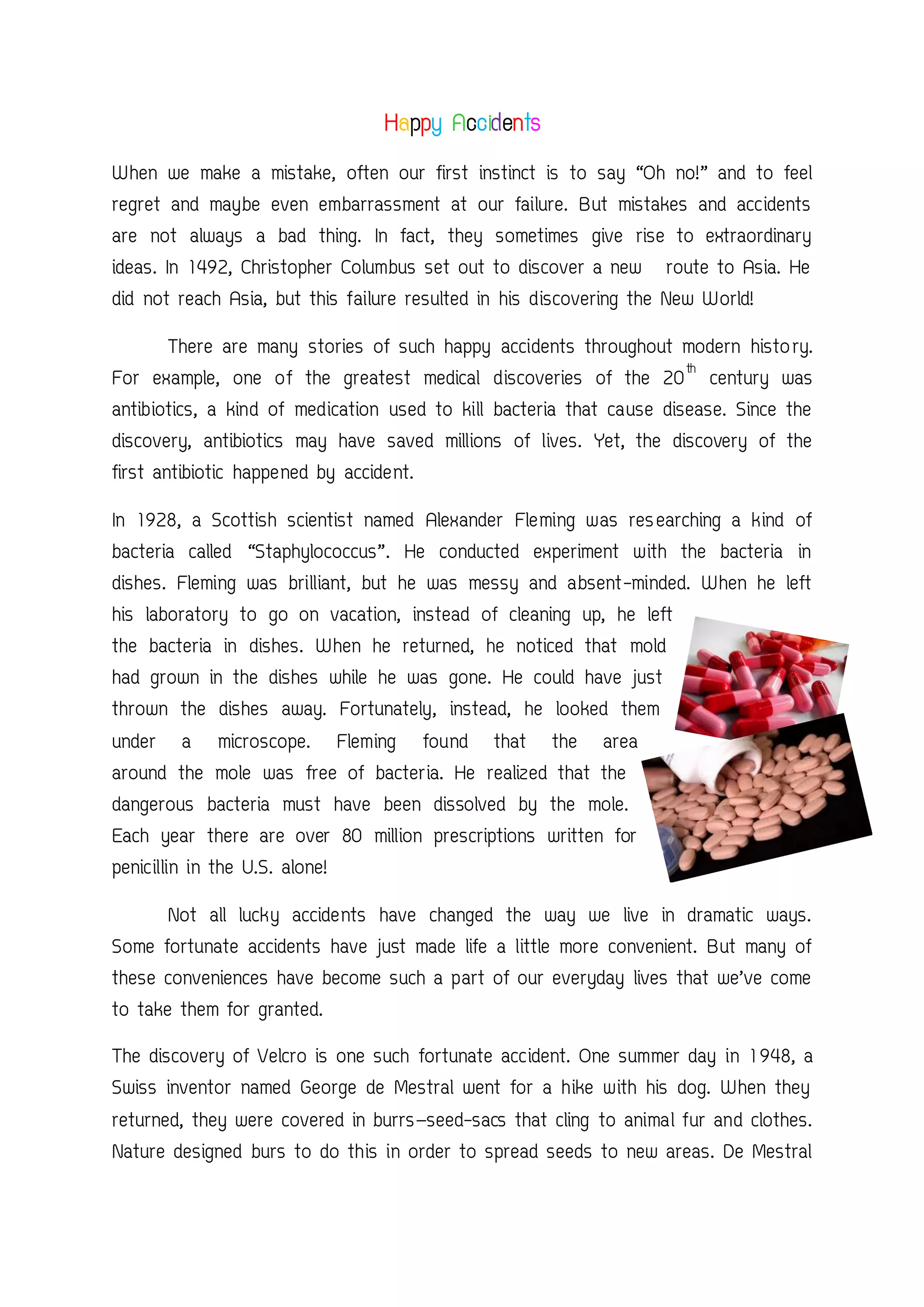
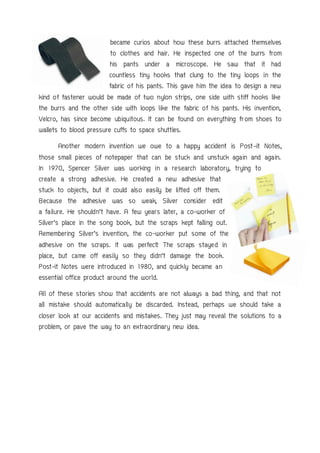
Each year there are over 80 million prescriptions written for
penicillin in the U.S. alone!
       Not all lucky accidents have changed the way we live in dramatic ways.
Some fortunate accidents have just made life a little more convenient. But many of
these conveniences have become such a part of our everyday lives that we’ve come
to take them for granted.
The discovery of Velcro is one such fortunate accident. One summer day in 1948, a
Swiss inventor named George de Mestral went for a hike with his dog. When they
returned, they were covered in burrs—seed-sacs that cling to animal fur and clothes.
Nature designed burs to do this in order to spread seeds to new areas. De Mestral
became curios about how these burrs attached themselves
                         to clothes and hair. He inspected one of the burrs from
                         his pants under a microscope. He saw that it had
                        countless tiny hooks that clung to the tiny loops in the
                        fabric of his pants. This gave him the idea to design a new
kind of fastener would be made of two nylon strips, one side with stiff hooks like
the burrs and the other side with loops like the fabric of his pants. His invention,
Velcro, has since become ubiquitous. It can be found on everything fr om shoes to
wallets to blood pressure cuffs to space shuttles.
        Another modern invention we owe to a happy accident is Post-it Notes,
those small pieces of notepaper that can be stuck and unstuck again and again.
In 1970, Spencer Silver was working in a research laboratory, trying to
create a strong adhesive. He created a new adhesive that
stuck to objects, but it could also easily be lifted off them.
Because the adhesive was so weak, Silver consider edit
a failure. He shouldn’t have. A few years later, a co-worker of
Silver’s place in the song book, but the scraps kept falling out.
Remembering Silver’s invention, the co-worker put some of the
adhesive on the scraps. It was perfect! The scraps stayed in
place, but came off easily so they didn’t damage the book.
Post-it Notes were introduced in 1980, and quickly became an
essential office product around the world.
All of these stories show that accidents are not always a bad thing, and that not
all mistake should automatically be discarded. Instead, perhaps we should take a
closer look at our accidents and mistakes. They just may reveal the solutions to a
problem, or pave the way to an extraordinary new idea.

งานอังกฤษ

  • 1.
    Happy Accidents When wemake a mistake, often our first instinct is to say “Oh no!” and to feel regret and maybe even embarrassment at our failure. But mistakes and accidents are not always a bad thing. In fact, they sometimes give rise to extraordinary ideas. In 1492, Christopher Columbus set out to discover a new route to Asia. He did not reach Asia, but this failure resulted in his discovering the New World! There are many stories of such happy accidents throughout modern histo ry. For example, one of the greatest medical discoveries of the 20 th century was antibiotics, a kind of medication used to kill bacteria that cause disease. Since the discovery, antibiotics may have saved millions of lives. Yet, the discovery of the first antibiotic happened by accident. In 1928, a Scottish scientist named Alexander Fleming was res earching a kind of bacteria called “Staphylococcus”. He conducted experiment with the bacteria in dishes. Fleming was brilliant, but he was messy and absent-minded. When he left his laboratory to go on vacation, instead of cleaning up, he left the bacteria in dishes. When he returned, he noticed that mold had grown in the dishes while he was gone. He could have just thrown the dishes away. Fortunately, instead, he looked them under a microscope. Fleming found that the area around the mole was free of bacteria. He realized that the dangerous bacteria must have been dissolved by the mole. Each year there are over 80 million prescriptions written for penicillin in the U.S. alone! Not all lucky accidents have changed the way we live in dramatic ways. Some fortunate accidents have just made life a little more convenient. But many of these conveniences have become such a part of our everyday lives that we’ve come to take them for granted. The discovery of Velcro is one such fortunate accident. One summer day in 1948, a Swiss inventor named George de Mestral went for a hike with his dog. When they returned, they were covered in burrs—seed-sacs that cling to animal fur and clothes. Nature designed burs to do this in order to spread seeds to new areas. De Mestral
  • 2.
    became curios abouthow these burrs attached themselves to clothes and hair. He inspected one of the burrs from his pants under a microscope. He saw that it had countless tiny hooks that clung to the tiny loops in the fabric of his pants. This gave him the idea to design a new kind of fastener would be made of two nylon strips, one side with stiff hooks like the burrs and the other side with loops like the fabric of his pants. His invention, Velcro, has since become ubiquitous. It can be found on everything fr om shoes to wallets to blood pressure cuffs to space shuttles. Another modern invention we owe to a happy accident is Post-it Notes, those small pieces of notepaper that can be stuck and unstuck again and again. In 1970, Spencer Silver was working in a research laboratory, trying to create a strong adhesive. He created a new adhesive that stuck to objects, but it could also easily be lifted off them. Because the adhesive was so weak, Silver consider edit a failure. He shouldn’t have. A few years later, a co-worker of Silver’s place in the song book, but the scraps kept falling out. Remembering Silver’s invention, the co-worker put some of the adhesive on the scraps. It was perfect! The scraps stayed in place, but came off easily so they didn’t damage the book. Post-it Notes were introduced in 1980, and quickly became an essential office product around the world. All of these stories show that accidents are not always a bad thing, and that not all mistake should automatically be discarded. Instead, perhaps we should take a closer look at our accidents and mistakes. They just may reveal the solutions to a problem, or pave the way to an extraordinary new idea.