Service and Relationship Marketing Module:2 Applying the 4p’s of Marketing to Service
Developing   Service Products :     Core and Supplementary  Elements Planning and Creating Services The Flower of Service Branding Service Products and Experiences New Service Development SRM/M2/SS
Planning and Creating  Service Products SRM/M2/SS
Service Products A service product  comprises of all elements of service performance , both tangible and intangible, that create value for customers.  Service products consist of: Core Product    central component that supplies the principal, problem-solving benefits customers seek Supplementary Services    augments the core product, facilitating its use and enhancing its value and appeal Delivery Processes     used to deliver both the core product and each of the supplementary services SRM/M2/SS
Designing a Service Concept Service concept design must address the following issues: How the different service components are delivered to the customer The nature of the customer’s role in those processes How long delivery lasts The recommended level and style of service to be offered SRM/M2/SS
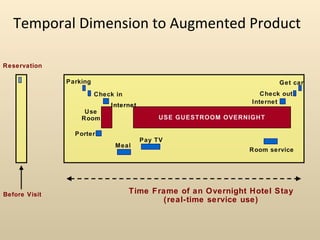
Documenting Delivery Sequence Over Time Must address sequence in which customers will use each core and supplementary service Determine approximate length of time required for each step Information should reflect good understanding of customers, especially their:  needs habits expectations SRM/M2/SS
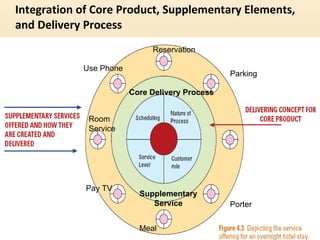
Integration of Core Product, Supplementary Elements, and Delivery Process SRM/M2/SS Parking Reservation Use Phone Room Service Pay TV Meal Porter Supplementary Service Core Delivery Process
Temporal Dimension to Augmented Product Before Visit Reservation internet Parking Get car Check in Porter Use Room Meal Pay TV Room service Internet Check out Time Frame of an Overnight Hotel Stay (real-time service use) USE GUESTROOM OVERNIGHT Internet
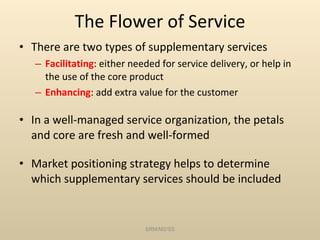
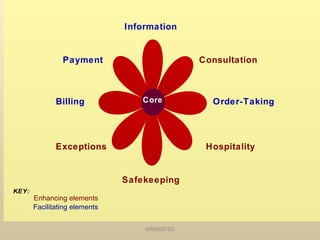
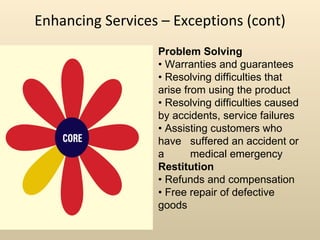
The Flower of Service There are two types of supplementary services Facilitating : either needed for service delivery, or help in the use of the core product Enhancing : add extra value for the customer In a well-managed service organization, the petals and core are fresh and well-formed Market positioning strategy helps to determine which supplementary services should be included  SRM/M2/SS
SRM/M2/SS Core Information Consultation Order-Taking Hospitality Payment Billing Exceptions Safekeeping Enhancing elements Facilitating elements KEY :
Facilitating Services – Information SRM/M2/SS •  Directions to service site •  Schedules/service hours •  Prices •  Reminders •  Warnings •  Conditions of sale/service •  Notification of changes •  Documentation •  Confirmation of reservations •  Summaries of account  activities •  Receipts and tickets
Facilitating Services – Order-Taking SRM/M2/SS Applications •  Memberships in clubs/programs •  Subscription services  (e.g., utilities) •  Prerequisite based services  (e.g., financial credit,  college enrollment) Order Entry •  On-site order fulfillment •  Mail/telephone/e-mail/web order Reservations and Check-in •  Seats/tables/rooms •  Vehicles or equipment rental •  Professional appointments
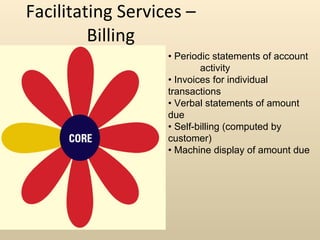
Facilitating Services – Billing •  Periodic statements of account  activity •  Invoices for individual  transactions •  Verbal statements of amount due •  Self-billing (computed by  customer) •  Machine display of amount due
Facilitating Services – Payment Self-Service •  Insert card, cash or token into machine •  Electronic funds transfer •  Mail a check •  Enter credit card number online Direct to Payee or Intermediary •  Cash handling or change giving •  Check handling •  Credit/charge/debit card handling •  Coupon redemption Automatic Deduction from Financial Deposits •  Automated systems (e.g., machine- readable tickets that operate  entry gate) •  Human systems (e.g., toll collectors)
Enhancing Services – Consultation •  Customized advice •  Personal counseling •  Tutoring/training in product use •  Management or technical  consulting
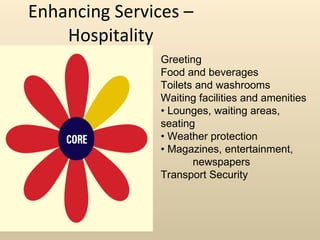
Enhancing Services – Hospitality Greeting Food and beverages Toilets and washrooms Waiting facilities and amenities •  Lounges, waiting areas, seating •  Weather protection •  Magazines, entertainment,  newspapers Transport Security
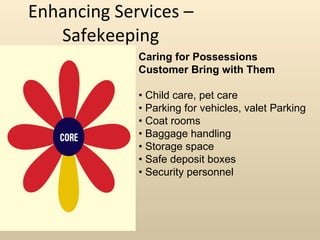
Enhancing Services – Safekeeping Caring for Possessions Customer Bring with Them •  Child care, pet care •  Parking for vehicles, valet Parking •  Coat rooms •  Baggage handling •  Storage space •  Safe deposit boxes •  Security personnel
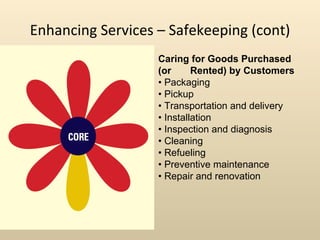
Enhancing Services – Safekeeping (cont) Caring for Goods Purchased (or  Rented) by Customers •  Packaging •  Pickup •  Transportation and delivery •  Installation •  Inspection and diagnosis •  Cleaning •  Refueling •  Preventive maintenance •  Repair and renovation
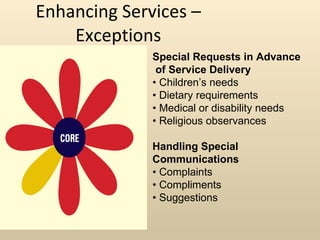
Enhancing Services – Exceptions Special Requests in Advance of Service Delivery •  Children’s needs •  Dietary requirements •  Medical or disability needs •  Religious observances Handling Special Communications •  Complaints •  Compliments •  Suggestions
Enhancing Services – Exceptions (cont) Problem Solving •  Warranties and guarantees •  Resolving difficulties that arise from using the product •  Resolving difficulties caused by accidents, service failures •  Assisting customers who have  suffered an accident or a  medical emergency Restitution •  Refunds and compensation •  Free repair of defective goods
Managerial Implications Core products do not have to have supplementary elements Nature of product helps determine supplementary services offered to enhance value People-processing and high contact services have more supplementary services Different levels of service can add extra supplementary services for each upgrade in service level Low-cost, no-frills basis firms needs fewer supplementary elements
Branding Service  Products and Experiences
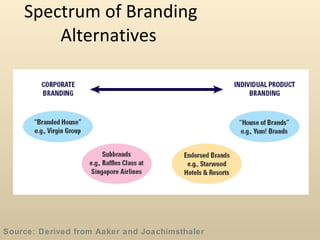
Service Products, Product Lines, and Brands Service Product : A defined and consistent  “bundle of output”  Supported by supplementary services (assembly of elements that are built around the core product) Differentiated by bundle of output Product Line :  Most service organizations offer a  line of products  rather than just a single product.  There are three broad alternatives for product lines: Single brand to cover all products and services A separate, stand-alone brand for each offering Some combination of these two extremes
Spectrum of Branding Alternatives  Source: Derived from Aaker and Joachimsthaler
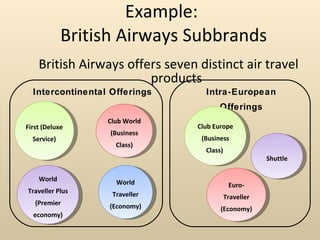
Example:  British Airways Subbrands British Airways offers seven distinct air travel products Intercontinental Offerings Intra-European Offerings First (Deluxe Service) Club World (Business Class) World Traveller Plus (Premier economy) World Traveller (Economy) Club Europe (Business Class)  Euro-Traveller (Economy) Shuttle
Offering a Branded Experience Branding can be employed at corporate and product levels Corporate brand: Easily recognized, Holds meaning to customers, Stands for a particular way of doing business Product brand: Helps firm communicate  distinctive experiences  and benefits associated with  a specific service concept
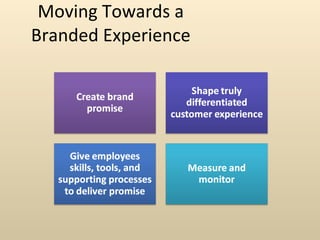
Moving Towards a Branded Experience
Offering A Branded Experience “ The brand promise or value proposition is not a tag line, an icon, or a color or a graphic element, although all of these may contribute.  It is, instead,  the heart and soul of the brand .” Don Schultz
New Service Development
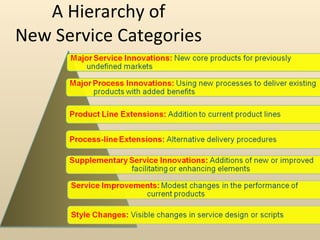
A Hierarchy of  New Service Categories
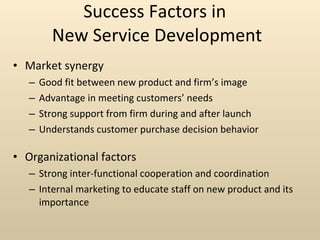
Success Factors in  New Service Development Market synergy Good fit between new product and firm’s image Advantage in meeting customers’ needs Strong support from firm during and after launch Understands customer purchase decision behavior Organizational factors Strong inter-functional cooperation and coordination Internal marketing to educate staff on new product and its importance

Srm m2-product

  • 1.
    Service and RelationshipMarketing Module:2 Applying the 4p’s of Marketing to Service
  • 2.
    Developing Service Products : Core and Supplementary Elements Planning and Creating Services The Flower of Service Branding Service Products and Experiences New Service Development SRM/M2/SS
  • 3.
    Planning and Creating Service Products SRM/M2/SS
  • 4.
    Service Products Aservice product comprises of all elements of service performance , both tangible and intangible, that create value for customers. Service products consist of: Core Product  central component that supplies the principal, problem-solving benefits customers seek Supplementary Services  augments the core product, facilitating its use and enhancing its value and appeal Delivery Processes  used to deliver both the core product and each of the supplementary services SRM/M2/SS
  • 5.
    Designing a ServiceConcept Service concept design must address the following issues: How the different service components are delivered to the customer The nature of the customer’s role in those processes How long delivery lasts The recommended level and style of service to be offered SRM/M2/SS
  • 6.
    Documenting Delivery SequenceOver Time Must address sequence in which customers will use each core and supplementary service Determine approximate length of time required for each step Information should reflect good understanding of customers, especially their: needs habits expectations SRM/M2/SS
  • 7.
    Integration of CoreProduct, Supplementary Elements, and Delivery Process SRM/M2/SS Parking Reservation Use Phone Room Service Pay TV Meal Porter Supplementary Service Core Delivery Process
  • 8.
    Temporal Dimension toAugmented Product Before Visit Reservation internet Parking Get car Check in Porter Use Room Meal Pay TV Room service Internet Check out Time Frame of an Overnight Hotel Stay (real-time service use) USE GUESTROOM OVERNIGHT Internet
  • 9.
    The Flower ofService There are two types of supplementary services Facilitating : either needed for service delivery, or help in the use of the core product Enhancing : add extra value for the customer In a well-managed service organization, the petals and core are fresh and well-formed Market positioning strategy helps to determine which supplementary services should be included SRM/M2/SS
  • 10.
    SRM/M2/SS Core InformationConsultation Order-Taking Hospitality Payment Billing Exceptions Safekeeping Enhancing elements Facilitating elements KEY :
  • 11.
    Facilitating Services –Information SRM/M2/SS • Directions to service site • Schedules/service hours • Prices • Reminders • Warnings • Conditions of sale/service • Notification of changes • Documentation • Confirmation of reservations • Summaries of account activities • Receipts and tickets
  • 12.
    Facilitating Services –Order-Taking SRM/M2/SS Applications • Memberships in clubs/programs • Subscription services (e.g., utilities) • Prerequisite based services (e.g., financial credit, college enrollment) Order Entry • On-site order fulfillment • Mail/telephone/e-mail/web order Reservations and Check-in • Seats/tables/rooms • Vehicles or equipment rental • Professional appointments
  • 13.
    Facilitating Services –Billing • Periodic statements of account activity • Invoices for individual transactions • Verbal statements of amount due • Self-billing (computed by customer) • Machine display of amount due
  • 14.
    Facilitating Services –Payment Self-Service • Insert card, cash or token into machine • Electronic funds transfer • Mail a check • Enter credit card number online Direct to Payee or Intermediary • Cash handling or change giving • Check handling • Credit/charge/debit card handling • Coupon redemption Automatic Deduction from Financial Deposits • Automated systems (e.g., machine- readable tickets that operate entry gate) • Human systems (e.g., toll collectors)
  • 15.
    Enhancing Services –Consultation • Customized advice • Personal counseling • Tutoring/training in product use • Management or technical consulting
  • 16.
    Enhancing Services –Hospitality Greeting Food and beverages Toilets and washrooms Waiting facilities and amenities • Lounges, waiting areas, seating • Weather protection • Magazines, entertainment, newspapers Transport Security
  • 17.
    Enhancing Services –Safekeeping Caring for Possessions Customer Bring with Them • Child care, pet care • Parking for vehicles, valet Parking • Coat rooms • Baggage handling • Storage space • Safe deposit boxes • Security personnel
  • 18.
    Enhancing Services –Safekeeping (cont) Caring for Goods Purchased (or Rented) by Customers • Packaging • Pickup • Transportation and delivery • Installation • Inspection and diagnosis • Cleaning • Refueling • Preventive maintenance • Repair and renovation
  • 19.
    Enhancing Services –Exceptions Special Requests in Advance of Service Delivery • Children’s needs • Dietary requirements • Medical or disability needs • Religious observances Handling Special Communications • Complaints • Compliments • Suggestions
  • 20.
    Enhancing Services –Exceptions (cont) Problem Solving • Warranties and guarantees • Resolving difficulties that arise from using the product • Resolving difficulties caused by accidents, service failures • Assisting customers who have suffered an accident or a medical emergency Restitution • Refunds and compensation • Free repair of defective goods
  • 21.
    Managerial Implications Coreproducts do not have to have supplementary elements Nature of product helps determine supplementary services offered to enhance value People-processing and high contact services have more supplementary services Different levels of service can add extra supplementary services for each upgrade in service level Low-cost, no-frills basis firms needs fewer supplementary elements
  • 22.
    Branding Service Products and Experiences
  • 23.
    Service Products, ProductLines, and Brands Service Product : A defined and consistent “bundle of output” Supported by supplementary services (assembly of elements that are built around the core product) Differentiated by bundle of output Product Line : Most service organizations offer a line of products rather than just a single product. There are three broad alternatives for product lines: Single brand to cover all products and services A separate, stand-alone brand for each offering Some combination of these two extremes
  • 24.
    Spectrum of BrandingAlternatives Source: Derived from Aaker and Joachimsthaler
  • 25.
    Example: BritishAirways Subbrands British Airways offers seven distinct air travel products Intercontinental Offerings Intra-European Offerings First (Deluxe Service) Club World (Business Class) World Traveller Plus (Premier economy) World Traveller (Economy) Club Europe (Business Class) Euro-Traveller (Economy) Shuttle
  • 26.
    Offering a BrandedExperience Branding can be employed at corporate and product levels Corporate brand: Easily recognized, Holds meaning to customers, Stands for a particular way of doing business Product brand: Helps firm communicate distinctive experiences and benefits associated with a specific service concept
  • 27.
    Moving Towards aBranded Experience
  • 28.
    Offering A BrandedExperience “ The brand promise or value proposition is not a tag line, an icon, or a color or a graphic element, although all of these may contribute. It is, instead, the heart and soul of the brand .” Don Schultz
  • 29.
  • 30.
    A Hierarchy of New Service Categories
  • 31.
    Success Factors in New Service Development Market synergy Good fit between new product and firm’s image Advantage in meeting customers’ needs Strong support from firm during and after launch Understands customer purchase decision behavior Organizational factors Strong inter-functional cooperation and coordination Internal marketing to educate staff on new product and its importance

Editor's Notes

  • #2 Service and Relationship Marketing