






SQL Server on Linux
Fabricio Catae
Technical Evangelist MVP Open Connection 2017
SQL vNext on Linux
Deep Dive
Agenda
SQL Operating System
Projeto MSR: Drawbridge
Docker Containers
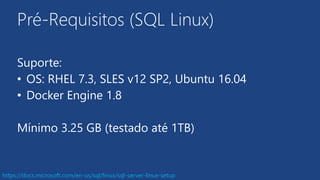
Pré-Requisitos (SQL Linux)
Suporte:
• OS: RHEL 7.3, SLES v12 SP2, Ubuntu 16.04
• Docker Engine 1.8
Mínimo 3.25 GB (testado até 1TB)
https://docs.microsoft.com/en-us/sql/linux/sql-server-linux-setup
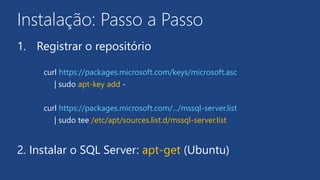
Instalação: Passo a Passo
1. Registrar o repositório
curl https://packages.microsoft.com/keys/microsoft.asc
| sudo apt-key add -
curl https://packages.microsoft.com/.../mssql-server.list
| sudo tee /etc/apt/sources.list.d/mssql-server.list
2. Instalar o SQL Server: apt-get (Ubuntu)
Demo
SQL OS
SQL knows better...
Escalabilidade Negativa
1
2
4
8
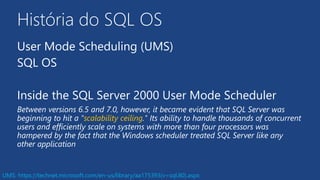
História do SQL OS
User Mode Scheduling (UMS)
SQL OS
Inside the SQL Server 2000 User Mode Scheduler
Between versions 6.5 and 7.0, however, it became evident that SQL Server was
beginning to hit a "scalability ceiling." Its ability to handle thousands of concurrent
users and efficiently scale on systems with more than four processors was
hampered by the fact that the Windows scheduler treated SQL Server like any
other application
UMS: https://technet.microsoft.com/en-us/library/aa175393(v=sql.80).aspx
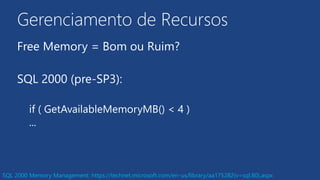
Gerenciamento de Recursos
Free Memory = Bom ou Ruim?
SQL 2000 (pre-SP3):
if ( GetAvailableMemoryMB() < 4 )
...
SQL 2000 Memory Management: https://technet.microsoft.com/en-us/library/aa175282(v=sql.80).aspx
Evolução do SQLOS
Onipresente: Atua como um Sistema Operacional
Processamento Cooperativo e Preemptivo
Dynamic Management Views
- Materizalição das informações em memória
- Semelhante ao /proc do Linux
Estratégia de Migração
Exemplos:
• Core CLR
https://github.com/dotnet/coreclr
• ChakraCore
https://github.com/Microsoft/ChakraCore
Background
Se você fosse o Líder Técnico...
Cenário de 2015
SQL Server é um produto consolidado
Escrito em C++
40 milhões de linhas
Ferramenta de build e teste
Complexidade de projeto
Grandes Desafios
Duração do projeto (3 anos?)
Manter diferentes branches
Incorporar novas funcionalidades
Legado: MSDTC, .NET, COM
Drawbridge
Projeto Microsoft Research
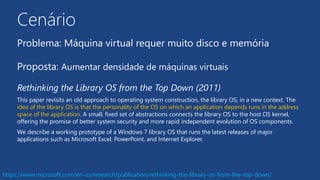
Cenário
Problema: Máquina virtual requer muito disco e memória
Proposta: Aumentar densidade de máquinas virtuais
Rethinking the Library OS from the Top Down (2011)
This paper revisits an old approach to operating system construction, the library OS, in a new context. The
idea of the library OS is that the personality of the OS on which an application depends runs in the address
space of the application. A small, fixed set of abstractions connects the library OS to the host OS kernel,
offering the promise of better system security and more rapid independent evolution of OS components.
We describe a working prototype of a Windows 7 library OS that runs the latest releases of major
applications such as Microsoft Excel, PowerPoint, and Internet Explorer.
https://www.microsoft.com/en-us/research/publication/rethinking-the-library-os-from-the-top-down/
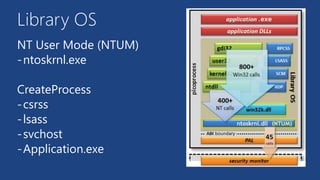
Library OS
NT User Mode (NTUM)
-ntoskrnl.exe
CreateProcess
-csrss
-lsass
-svchost
-Application.exe
Objetivo Inicial
Sandbox de Aplicação
Leveraging legacy code to deploy desktop applications
on the Web (2008)
John (JD) Douceur, Jeremy Elson, Jon Howell, Jay Lorch, in
Proceedings of the 8th USENIX Symposium on Operating Systems
Design and Implementation (OSDI), USENIX, December 1, 2008
https://www.microsoft.com/en-us/research/publication/leveraging-legacy-code-to-deploy-desktop-
applications-on-the-web/
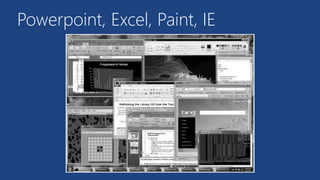
Powerpoint, Excel, Paint, IE
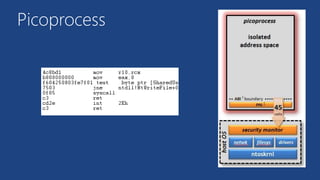
Picoprocess
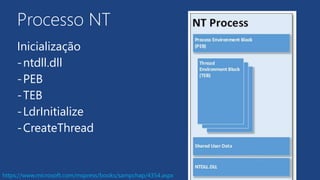
Processo NT
Inicialização
-ntdll.dll
-PEB
-TEB
-LdrInitialize
-CreateThread
https://www.microsoft.com/mspress/books/sampchap/4354.aspx
Demo
SQLPAL
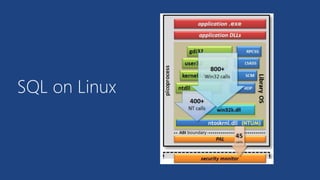
Plataform Abstraction Layer (PAL)
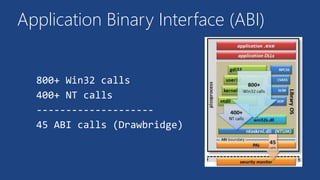
Application Binary Interface (ABI)
800+ Win32 calls
400+ NT calls
--------------------
45 ABI calls (Drawbridge)
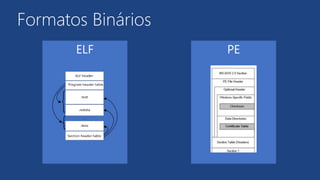
Formatos Binários
ELF PE
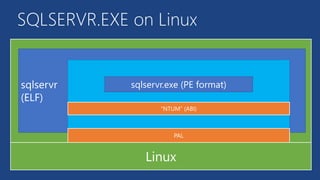
SQLSERVR.EXE on Linux
Binário ELF
Linux
sqlservr
(ELF)
“NTUM” (ABI)
sqlservr.exe (PE format)
PAL
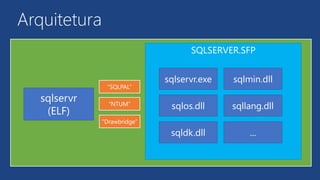
SQLSERVER.SFP
Arquitetura
sqlservr
(ELF)
sqlservr.exe
sqlos.dll
sqldk.dll
sqlmin.dll
sqllang.dll
...
“SQLPAL”
“NTUM”
“Drawbridge”
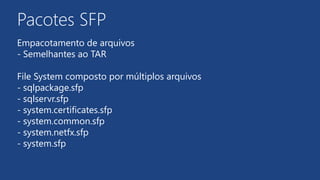
Pacotes SFP
Empacotamento de arquivos
- Semelhantes ao TAR
File System composto por múltiplos arquivos
- sqlpackage.sfp
- sqlservr.sfp
- system.certificates.sfp
- system.common.sfp
- system.netfx.sfp
- system.sfp
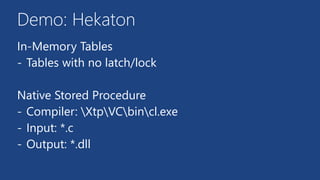
Demo: Hekaton
In-Memory Tables
- Tables with no latch/lock
Native Stored Procedure
- Compiler: XtpVCbincl.exe
- Input: *.c
- Output: *.dll
Demo
Docker Containers
Comparando Drawbridge e Docker
Containers
Sandbox (Segurança)
Densidade de containers
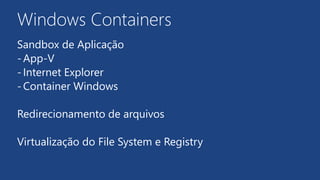
Windows Containers
Sandbox de Aplicação
-App-V
-Internet Explorer
-Container Windows
Redirecionamento de arquivos
Virtualização do File System e Registry
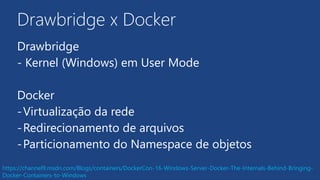
Drawbridge x Docker
Drawbridge
- Kernel (Windows) em User Mode
Docker
-Virtualização da rede
-Redirecionamento de arquivos
-Particionamento do Namespace de objetos
https://channel9.msdn.com/Blogs/containers/DockerCon-16-Windows-Server-Docker-The-Internals-Behind-Bringing-
Docker-Containers-to-Windows
SQL on Linux
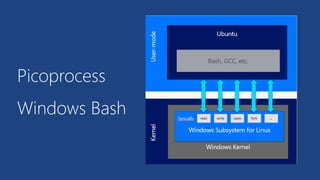
Picoprocess
Windows Bash
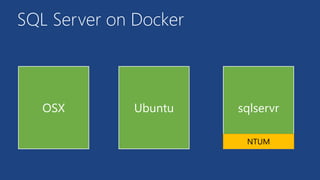
SQL Server on Docker
OSX Ubuntu sqlservr
NTUM
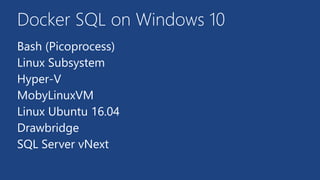
Docker SQL on Windows 10
Bash (Picoprocess)
Linux Subsystem
Hyper-V
MobyLinuxVM
Linux Ubuntu 16.04
Drawbridge
SQL Server vNext
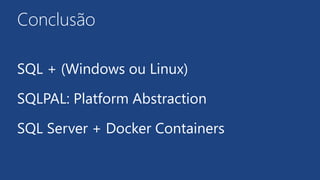
Conclusão
SQL + (Windows ou Linux)
SQLPAL: Platform Abstraction
SQL Server + Docker Containers

SQL Server on Linux

Editor's Notes

  • #35 use master go create database db1 go alter database db1 add filegroup db1_mod contains memory_optimized_data go -- adapt filename as needed alter database db1 add file (name='db1_mod', filename='C:\var\opt\mssql\data\db1_mod') to filegroup db1_mod go use db1 go create table dbo.t1 (c1 int not null primary key nonclustered, c2 INT) with (memory_optimized=on) go -- retrieve the path of the DLL for table t1 select name, description FROM sys.dm_os_loaded_modules where name like '%xtp_t_' + cast(db_id() as varchar(10)) + '_' + cast(object_id('dbo.t1') as varchar(10)) + '.dll' go create procedure dbo.native_sp with native_compilation, schemabinding, execute as owner as begin atomic with (transaction isolation level=snapshot, language=N'us_english') declare @i int = 1000000 while @i > 0 begin insert dbo.t1 values (@i, @i+1) set @i -= 1 end end go exec dbo.native_sp