SQL Server and Change Data Capture
In the modern data-driven business ecosystem, the focus of
organizations is primarily on ensuring data security and safety
from any sources. This is where Change Data Capture (CDC) has
an important role to play by storing data in a way where its
values are not compromised. Attempts have been made in the
past to achieve this goal through complex queries, triggers,
timestamps, and even data auditing, but none of them met the
desired results.
It was only when Microsoft launched its
SQL Server Change Data Capture software in 2005 that some
success in this niche was achieved. It had the capability to
capture data with “after update”, “after insert”, and “after
delete” values.
However, this form of CDC was found to be too complex, and
acting on this feedback, Microsoft launched a revised version in
2008 that is still in use today. Here, users can capture and archive
data without going through additional programming tasks.
The Form of SQL Server Change Data Capture
In SQL Server Change Data Capture, the software pattern CDC uses SQL
Server to apply change activities like insert, update, and delete to a table.
These changes are available to users in a simple relational format. Required
outputs necessary to capture the changes to a target environment, like
column information and metadata, are captured for the modified rows.
This change data is then stored in tables that reflect the column structure of
the tracked stored tables, access to which is strictly controlled through
table-valued functions.
Ideally, source tables located within a data warehouse must mirror changes
in them, but a technology that has to continually refresh a replica of the
source is complex to use. In its stead, a more appropriate technology would
enable a steady stream of change data structured to help consumers apply it
to divergent target representations of the data. This is what is provided by
SQL Server Change Data Capture.
The Functioning of SQL Server Change Data Capture
The technology behind the Change Data Capture feature is not complex.
It tracks and monitors any changes that are made in tables created by
the user, which are then stored in relational tables that can be easily
accessed for retrieval of the data with T-SQL. A replica of the tracked
table is created whenever the features of the CDDC technology are
applied to a database table.
The column structure of the replicated table has additional columns of
metadata that check the type of changes made in the database row.
Apart from this aspect, the two - replicated table and the source tables -
are similar in all respects. The new audit tables can be used by the SQL
Server Change Data Capture to track the logged tables and other
activities that have occurred.
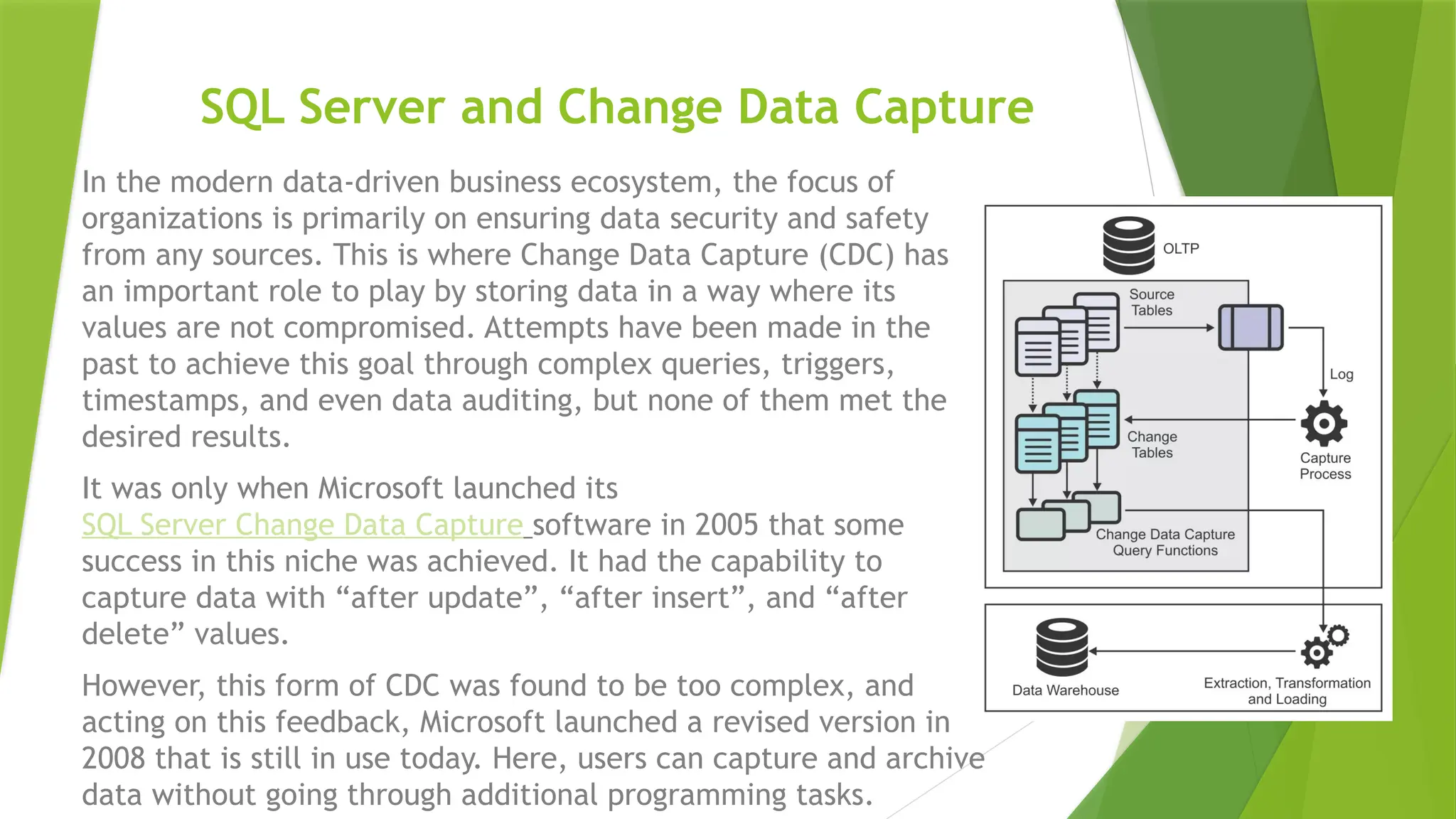
The transaction log in the SQL Server CDC shows the source of change in
CDC and reads all descriptions of the changes linked to the change table
part of the original table.

SQL Server and Change Data Capture .pptx

  • 1.
    SQL Server andChange Data Capture In the modern data-driven business ecosystem, the focus of organizations is primarily on ensuring data security and safety from any sources. This is where Change Data Capture (CDC) has an important role to play by storing data in a way where its values are not compromised. Attempts have been made in the past to achieve this goal through complex queries, triggers, timestamps, and even data auditing, but none of them met the desired results. It was only when Microsoft launched its SQL Server Change Data Capture software in 2005 that some success in this niche was achieved. It had the capability to capture data with “after update”, “after insert”, and “after delete” values. However, this form of CDC was found to be too complex, and acting on this feedback, Microsoft launched a revised version in 2008 that is still in use today. Here, users can capture and archive data without going through additional programming tasks.
  • 2.
    The Form ofSQL Server Change Data Capture In SQL Server Change Data Capture, the software pattern CDC uses SQL Server to apply change activities like insert, update, and delete to a table. These changes are available to users in a simple relational format. Required outputs necessary to capture the changes to a target environment, like column information and metadata, are captured for the modified rows. This change data is then stored in tables that reflect the column structure of the tracked stored tables, access to which is strictly controlled through table-valued functions. Ideally, source tables located within a data warehouse must mirror changes in them, but a technology that has to continually refresh a replica of the source is complex to use. In its stead, a more appropriate technology would enable a steady stream of change data structured to help consumers apply it to divergent target representations of the data. This is what is provided by SQL Server Change Data Capture.
  • 3.
    The Functioning ofSQL Server Change Data Capture The technology behind the Change Data Capture feature is not complex. It tracks and monitors any changes that are made in tables created by the user, which are then stored in relational tables that can be easily accessed for retrieval of the data with T-SQL. A replica of the tracked table is created whenever the features of the CDDC technology are applied to a database table. The column structure of the replicated table has additional columns of metadata that check the type of changes made in the database row. Apart from this aspect, the two - replicated table and the source tables - are similar in all respects. The new audit tables can be used by the SQL Server Change Data Capture to track the logged tables and other activities that have occurred. The transaction log in the SQL Server CDC shows the source of change in CDC and reads all descriptions of the changes linked to the change table part of the original table.