ANOOP.T
• Introduction
• Attack Intent
• Real World Examples
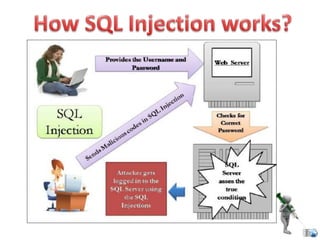
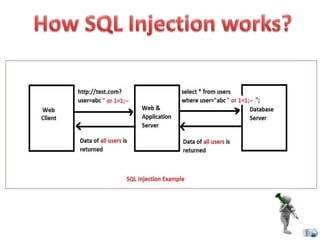
• How SQL Injection works?
• Video
• Impact of SQL injection
• Types of attacks
• Hack a website
• Defence Against SQL Injection
• Other Injection Types
• SQL Injection tools
• Conclusion
• SQL injection is a code injection technique,
used to attack data-driven applications, in
which malicious SQLstatements are inserted
into an entry field for execution
• This is a method to attack web applications
that have a data repository.
• The attacker would send a specially
crafted SQL statement that is designed to
cause some malicious action.
• Determining database schema
• Extracting data
• Adding or modifying data
• Bypassing authentication
• On August 17, 2009, the United States Justice
Department charged an American citizen
Albert Gonzalez and two Russians with the
theft of 130 million credit card numbers using
an SQL injection attack.
• In 2008 a sweep of attacks began exploiting
the SQL injection vulnerabilities of Microsoft's
IIS web server and SQL database server. Over
500,000 sites were exploited.
• The ability to inject SQL commands into the
database engine through an existing
application
• SQL injection is the use of publicly available
fields to gain entry to your database.
• This is done by entering SQL commands into
your form fields instead of the expected data.
• Improperly coded forms will allow a hacker to
use them as an entry point to your database
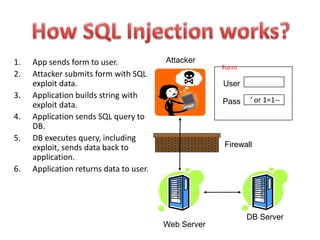
1. App sends form to user.
2. Attacker submits form with SQL
exploit data.
3. Application builds string with
exploit data.
4. Application sends SQL query to
DB.
5. DB executes query, including
exploit, sends data back to
application.
6. Application returns data to user.
Web Server
Attacker
DB Server
Firewall
User
Pass ‘ or 1=1--
Form
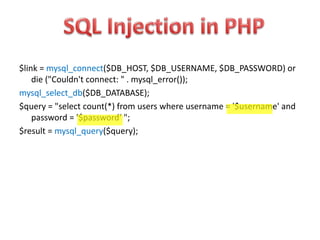
$link = mysql_connect($DB_HOST, $DB_USERNAME, $DB_PASSWORD) or
die ("Couldn't connect: " . mysql_error());
mysql_select_db($DB_DATABASE);
$query = "select count(*) from users where username = '$username' and
password = '$password‘ ";
$result = mysql_query($query);
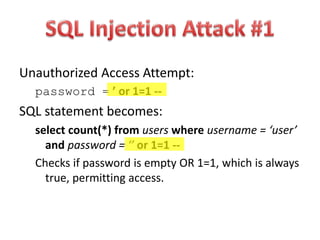
Unauthorized Access Attempt:
password = ’ or 1=1 --
SQL statement becomes:
select count(*) from users where username = ‘user’
and password = ‘’ or 1=1 --
Checks if password is empty OR 1=1, which is always
true, permitting access.
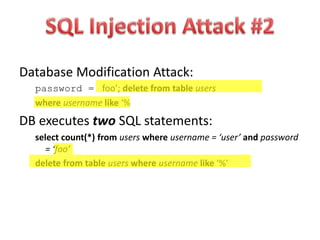
Database Modification Attack:
password = foo’; delete from table users
where username like ‘%
DB executes two SQL statements:
select count(*) from users where username = ‘user’ and password
= ‘foo’
delete from table users where username like ‘%’
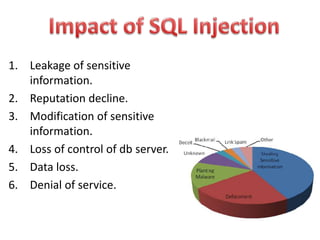
1. Leakage of sensitive
information.
2. Reputation decline.
3. Modification of sensitive
information.
4. Loss of control of db server.
5. Data loss.
6. Denial of service.
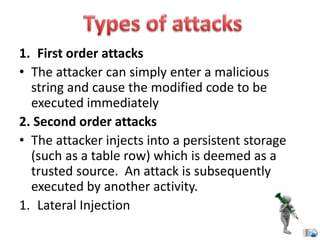
1. First order attacks
• The attacker can simply enter a malicious
string and cause the modified code to be
executed immediately
2. Second order attacks
• The attacker injects into a persistent storage
(such as a table row) which is deemed as a
trusted source. An attack is subsequently
executed by another activity.
1. Lateral Injection
3. Lateral Injection
The attacker can manipulate the implicit
function To_Char() by changing the values of the
environment
• Injection through user input
• Injection through cookies
• Injection through server variables
First order
injection
• Shell injection.
• Websites require constant access to the
database.
• Firewalls provide little or no defense against
SQL injection attacks.
• Your website is public and firewalls must be
set to allow every site visitor access to your
database, usually over port 80/443.
• Antivirus programs are equally ineffective at
blocking SQL injection attacks.
1. Comprehensive data sanitization
• Web sites must filter all user input
• For example, e-mail addresses should be
filtered to allow only the characters allowed in
an e-mail address.
• Its SQL injection defenses can catch most
attempts to sneak SQL through web channels.
2. Use a web application firewall
• A popular example is the free, open source
module ModSecurity.
• ModSecurity provides a sophisticated and
ever-evolving set of rules to filter potentially
dangerous web requests.
3. Limit database privileges by context
• Create multiple database user accounts with
the minimum levels of privilege for their usage
environment.
• For example, the code behind a login page
should query the database using an account
limited only to the relevent credentials table.
• This way, a breach through this channel
cannot be leveraged to compromise the entire
database.
4. Avoid constructing SQL queries with user
input
• Even data sanitization routines can be flawed.
• Using SQL variable binding with prepared
statements or stored procedures is much safer
than constructing full queries.
• Shell injection.
• Scripting language injection.
• File inclusion.
• XML injection.
• XPath injection.
• LDAP injection.
• SMTP injection.
• BSQL Hacker
• SQLmap
• SQLninja
• Safe3 SQL Injector
• SQLSus
• Mole
• Havij
• SQL injection is technique for exploiting
applications that use relational databases as
their back end.
• Applications compose SQL statements and
send to database.
• SQL injection use the fact that many of these
applications concatenate the fixed part of SQL
statement with user-supplied data that forms
WHERE predicates or additional sub-queries.
• The technique is based on malformed user-
supplied data
• Transform the innocent SQL calls to a malicious
call
• Cause unauthorized access, deletion of data, or
theft of information
• All databases can be a target of SQL injection and
all are vulnerable to this technique.
• The vulnerability is in the application layer
outside of the database, and the moment that
the application has a connection into the
database.
• www.google.com
• www.youtube.com
• www.slideshare.net
• www.beyondsecurity.com
• www.wikipedia.org
• www.breakthesecurity.cysecurity.org
• http://www.esecurityplanet.com/
• http://resources.infosecinstitute.com/best-free-and-open-source-sql-
injection-tools/
SQL INJECTION
SQL INJECTION

SQL INJECTION

  • 1.
  • 2.
    • Introduction • AttackIntent • Real World Examples • How SQL Injection works? • Video • Impact of SQL injection • Types of attacks • Hack a website • Defence Against SQL Injection • Other Injection Types • SQL Injection tools • Conclusion
  • 3.
    • SQL injectionis a code injection technique, used to attack data-driven applications, in which malicious SQLstatements are inserted into an entry field for execution • This is a method to attack web applications that have a data repository. • The attacker would send a specially crafted SQL statement that is designed to cause some malicious action.
  • 4.
    • Determining databaseschema • Extracting data • Adding or modifying data • Bypassing authentication
  • 5.
    • On August17, 2009, the United States Justice Department charged an American citizen Albert Gonzalez and two Russians with the theft of 130 million credit card numbers using an SQL injection attack. • In 2008 a sweep of attacks began exploiting the SQL injection vulnerabilities of Microsoft's IIS web server and SQL database server. Over 500,000 sites were exploited.
  • 6.
    • The abilityto inject SQL commands into the database engine through an existing application • SQL injection is the use of publicly available fields to gain entry to your database. • This is done by entering SQL commands into your form fields instead of the expected data. • Improperly coded forms will allow a hacker to use them as an entry point to your database
  • 8.
    1. App sendsform to user. 2. Attacker submits form with SQL exploit data. 3. Application builds string with exploit data. 4. Application sends SQL query to DB. 5. DB executes query, including exploit, sends data back to application. 6. Application returns data to user. Web Server Attacker DB Server Firewall User Pass ‘ or 1=1-- Form
  • 11.
    $link = mysql_connect($DB_HOST,$DB_USERNAME, $DB_PASSWORD) or die ("Couldn't connect: " . mysql_error()); mysql_select_db($DB_DATABASE); $query = "select count(*) from users where username = '$username' and password = '$password‘ "; $result = mysql_query($query);
  • 12.
    Unauthorized Access Attempt: password= ’ or 1=1 -- SQL statement becomes: select count(*) from users where username = ‘user’ and password = ‘’ or 1=1 -- Checks if password is empty OR 1=1, which is always true, permitting access.
  • 13.
    Database Modification Attack: password= foo’; delete from table users where username like ‘% DB executes two SQL statements: select count(*) from users where username = ‘user’ and password = ‘foo’ delete from table users where username like ‘%’
  • 14.
    1. Leakage ofsensitive information. 2. Reputation decline. 3. Modification of sensitive information. 4. Loss of control of db server. 5. Data loss. 6. Denial of service.
  • 15.
    1. First orderattacks • The attacker can simply enter a malicious string and cause the modified code to be executed immediately 2. Second order attacks • The attacker injects into a persistent storage (such as a table row) which is deemed as a trusted source. An attack is subsequently executed by another activity. 1. Lateral Injection
  • 16.
    3. Lateral Injection Theattacker can manipulate the implicit function To_Char() by changing the values of the environment
  • 17.
    • Injection throughuser input • Injection through cookies • Injection through server variables First order injection
  • 18.
  • 19.
    • Websites requireconstant access to the database. • Firewalls provide little or no defense against SQL injection attacks. • Your website is public and firewalls must be set to allow every site visitor access to your database, usually over port 80/443. • Antivirus programs are equally ineffective at blocking SQL injection attacks.
  • 20.
    1. Comprehensive datasanitization • Web sites must filter all user input • For example, e-mail addresses should be filtered to allow only the characters allowed in an e-mail address. • Its SQL injection defenses can catch most attempts to sneak SQL through web channels.
  • 21.
    2. Use aweb application firewall • A popular example is the free, open source module ModSecurity. • ModSecurity provides a sophisticated and ever-evolving set of rules to filter potentially dangerous web requests.
  • 22.
    3. Limit databaseprivileges by context • Create multiple database user accounts with the minimum levels of privilege for their usage environment. • For example, the code behind a login page should query the database using an account limited only to the relevent credentials table. • This way, a breach through this channel cannot be leveraged to compromise the entire database.
  • 23.
    4. Avoid constructingSQL queries with user input • Even data sanitization routines can be flawed. • Using SQL variable binding with prepared statements or stored procedures is much safer than constructing full queries.
  • 24.
    • Shell injection. •Scripting language injection. • File inclusion. • XML injection. • XPath injection. • LDAP injection. • SMTP injection.
  • 25.
    • BSQL Hacker •SQLmap • SQLninja • Safe3 SQL Injector • SQLSus • Mole • Havij
  • 26.
    • SQL injectionis technique for exploiting applications that use relational databases as their back end. • Applications compose SQL statements and send to database. • SQL injection use the fact that many of these applications concatenate the fixed part of SQL statement with user-supplied data that forms WHERE predicates or additional sub-queries.
  • 27.
    • The techniqueis based on malformed user- supplied data • Transform the innocent SQL calls to a malicious call • Cause unauthorized access, deletion of data, or theft of information • All databases can be a target of SQL injection and all are vulnerable to this technique. • The vulnerability is in the application layer outside of the database, and the moment that the application has a connection into the database.
  • 28.
    • www.google.com • www.youtube.com •www.slideshare.net • www.beyondsecurity.com • www.wikipedia.org • www.breakthesecurity.cysecurity.org • http://www.esecurityplanet.com/ • http://resources.infosecinstitute.com/best-free-and-open-source-sql- injection-tools/