Spark + Parquet in Depth
Robbie Strickland
VP, Engines & Pipelines, Watson Data Platform
@rs_atl
Emily May Curtin
Software Engineer, IBM Spark Technology Center
@emilymaycurtin
Atlanta…
Atlanta!!!!
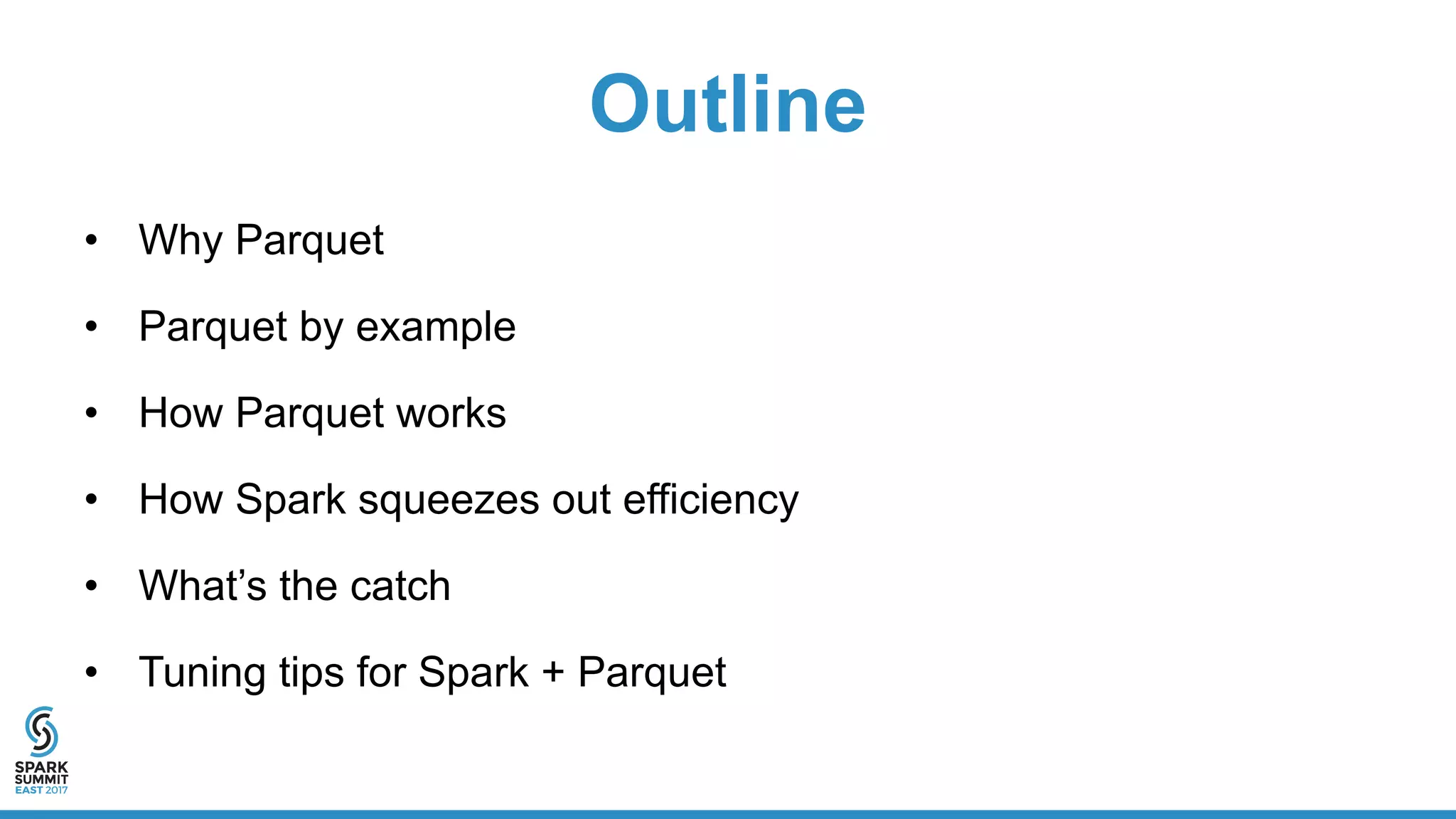
Outline
• Why Parquet
• Parquet by example
• How Parquet works
• How Spark squeezes out efficiency
• What’s the catch
• Tuning tips for Spark + Parquet
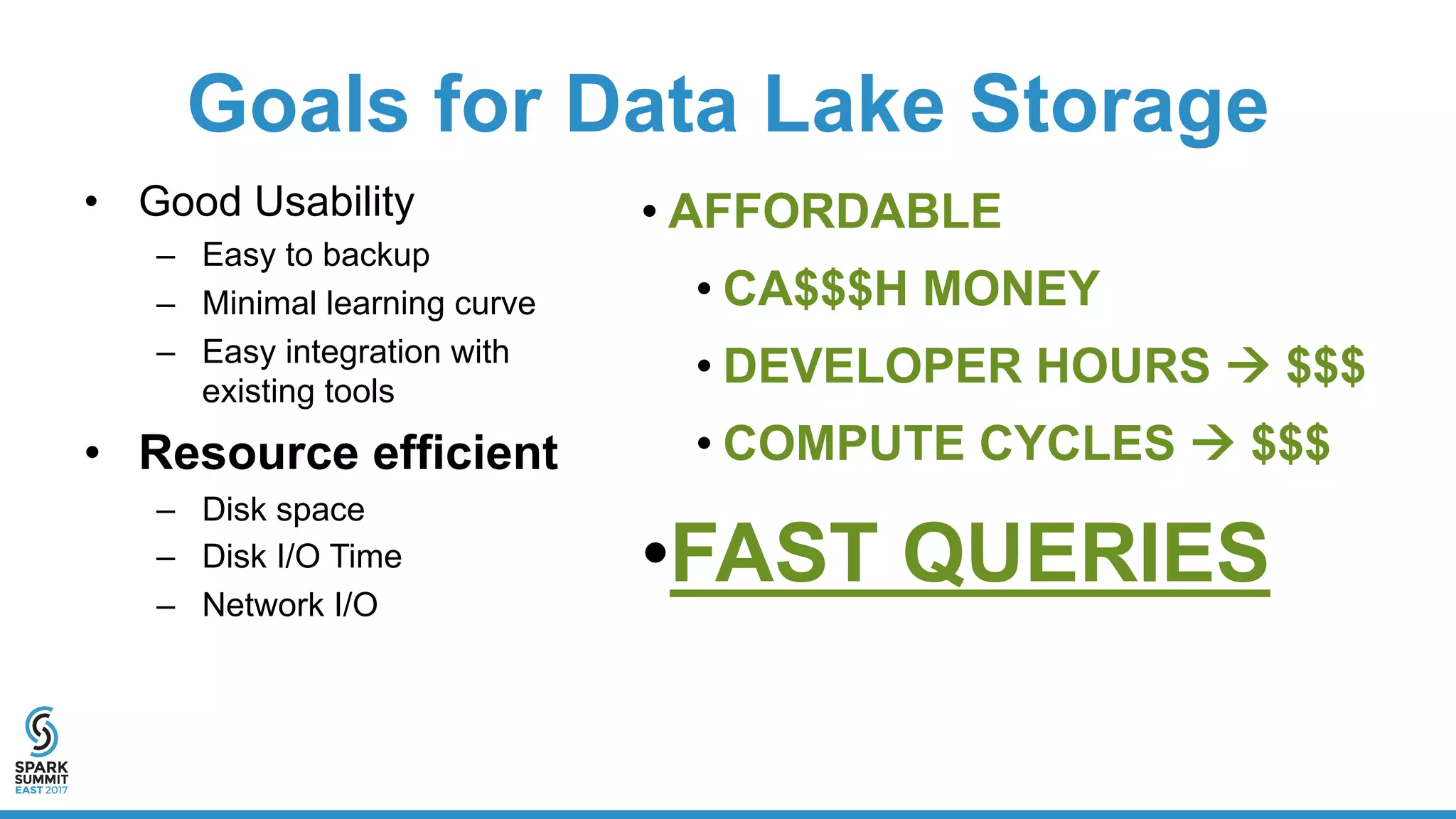
Goals for Data Lake Storage
• Good Usability
– Easy to backup
– Minimal learning curve
– Easy integration with
existing tools
• Resource efficient
– Disk space
– Disk I/O Time
– Network I/O
• AFFORDABLE
• CA$$$H MONEY
• DEVELOPER HOURS à $$$
• COMPUTE CYCLES à $$$
•FAST QUERIES
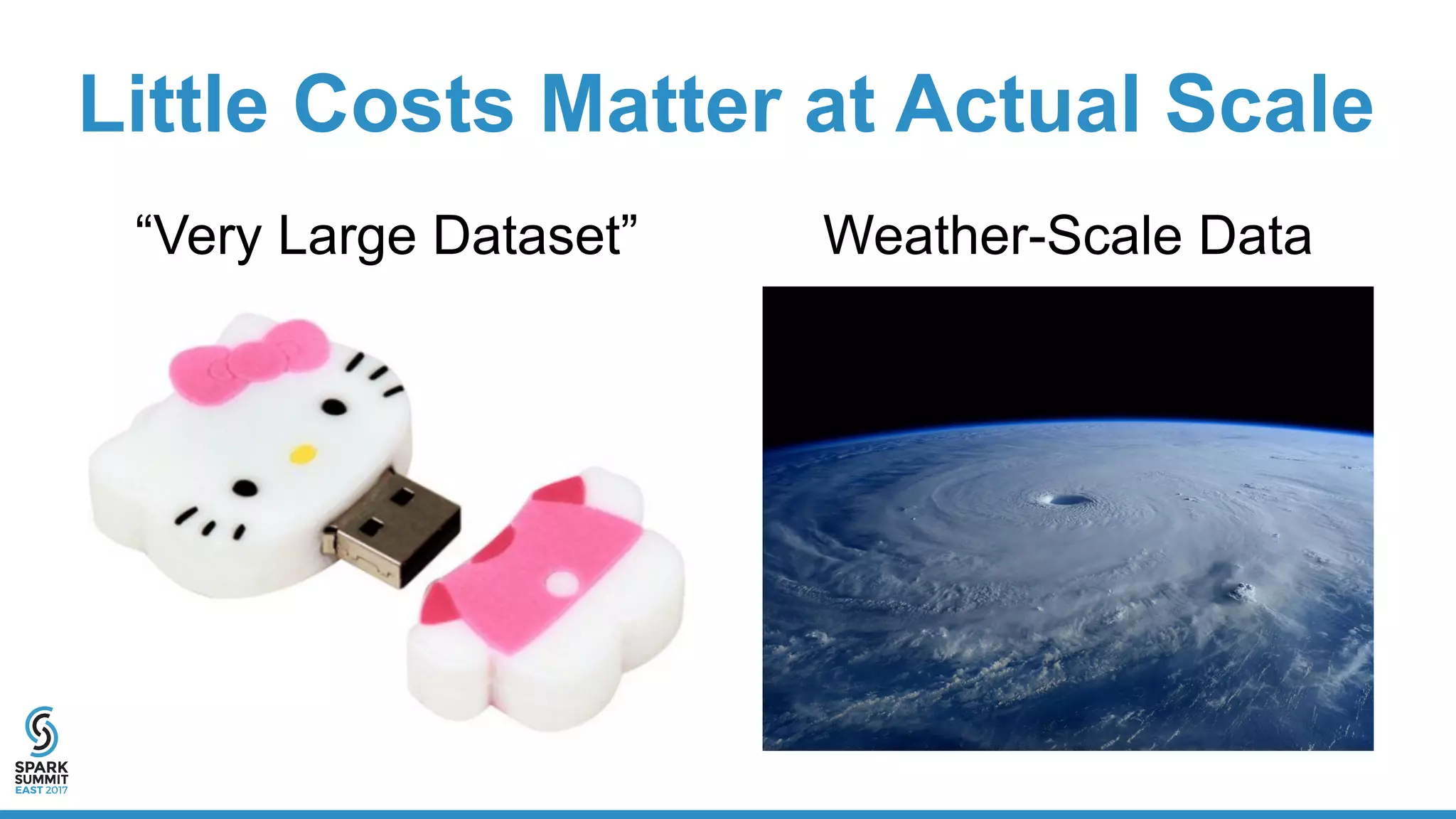
Little Costs Matter at Actual Scale
“Very Large Dataset” Weather-Scale Data
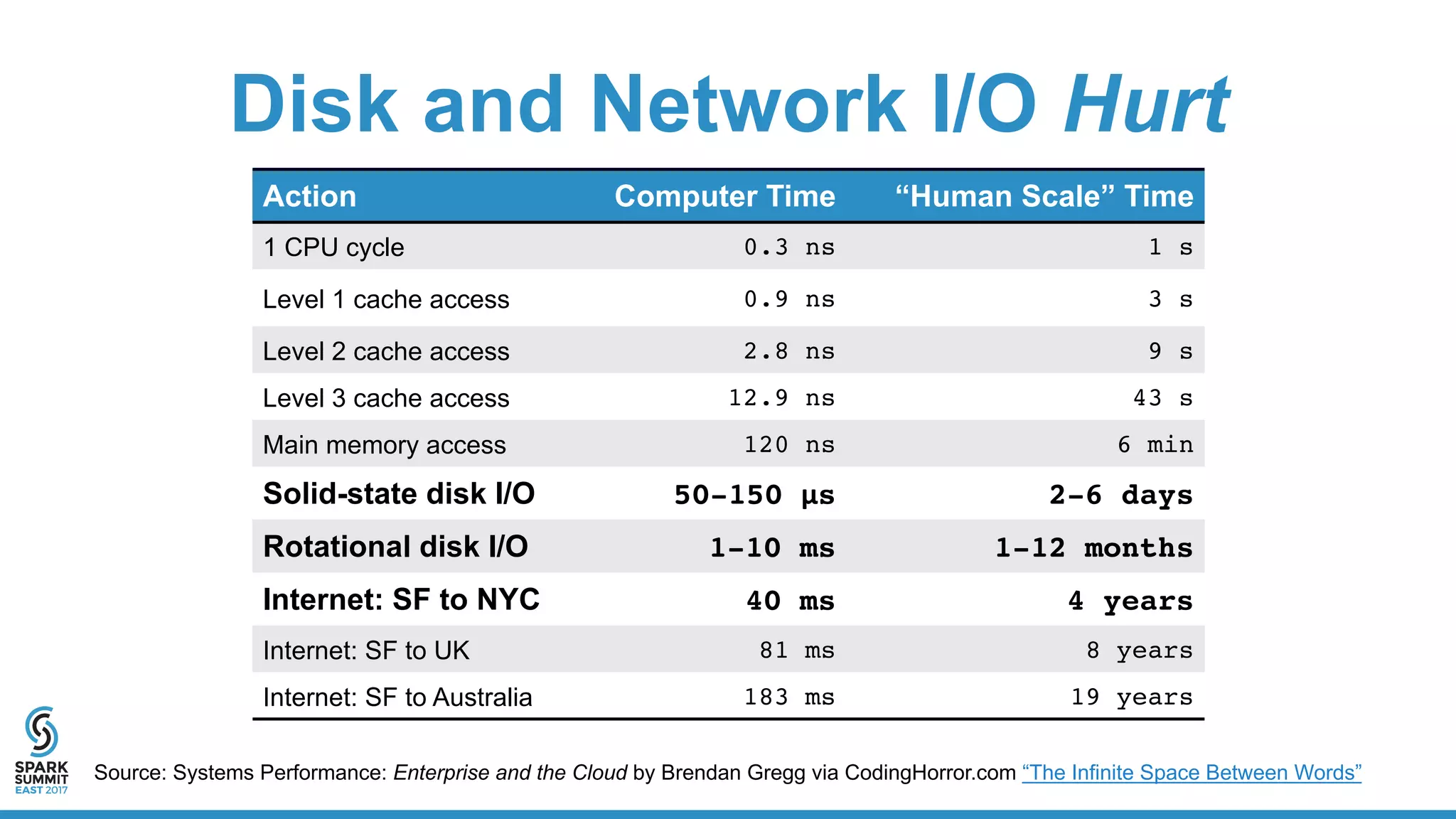
Disk and Network I/O Hurt
Action Computer Time “Human Scale” Time
1 CPU cycle 0.3 ns 1 s
Level 1 cache access 0.9 ns 3 s
Level 2 cache access 2.8 ns 9 s
Level 3 cache access 12.9 ns 43 s
Main memory access 120 ns 6 min
Solid-state disk I/O 50-150 μs 2-6 days
Rotational disk I/O 1-10 ms 1-12 months
Internet: SF to NYC 40 ms 4 years
Internet: SF to UK 81 ms 8 years
Internet: SF to Australia 183 ms 19 years
Source: Systems Performance: Enterprise and the Cloud by Brendan Gregg via CodingHorror.com “The Infinite Space Between Words”
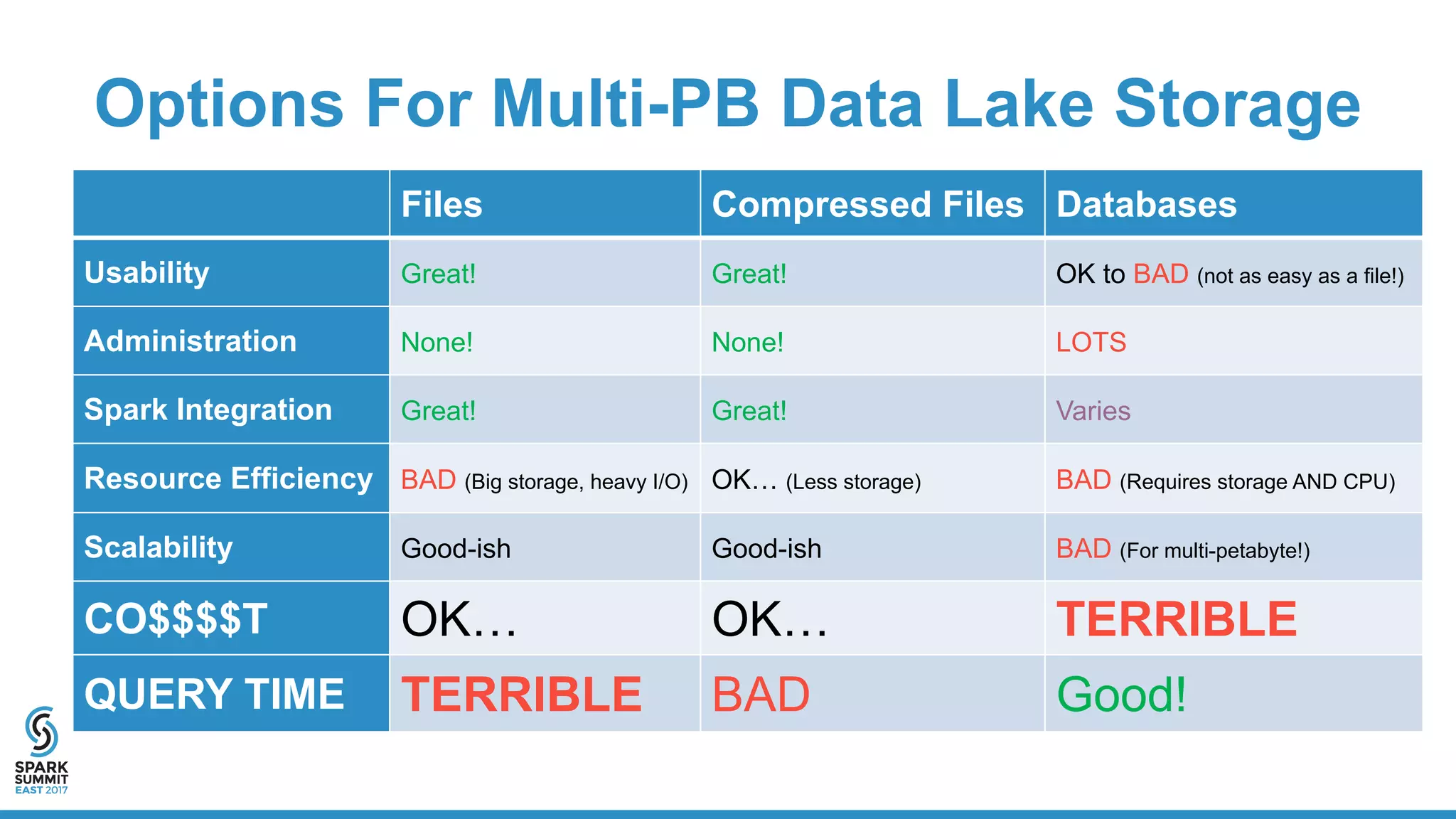
Options For Multi-PB Data Lake Storage
Files Compressed Files Databases
Usability Great! Great! OK to BAD (not as easy as a file!)
Administration None! None! LOTS
Spark Integration Great! Great! Varies
Resource Efficiency BAD (Big storage, heavy I/O) OK… (Less storage) BAD (Requires storage AND CPU)
Scalability Good-ish Good-ish BAD (For multi-petabyte!)
CO$$$$T OK… OK… TERRIBLE
QUERY TIME TERRIBLE BAD Good!
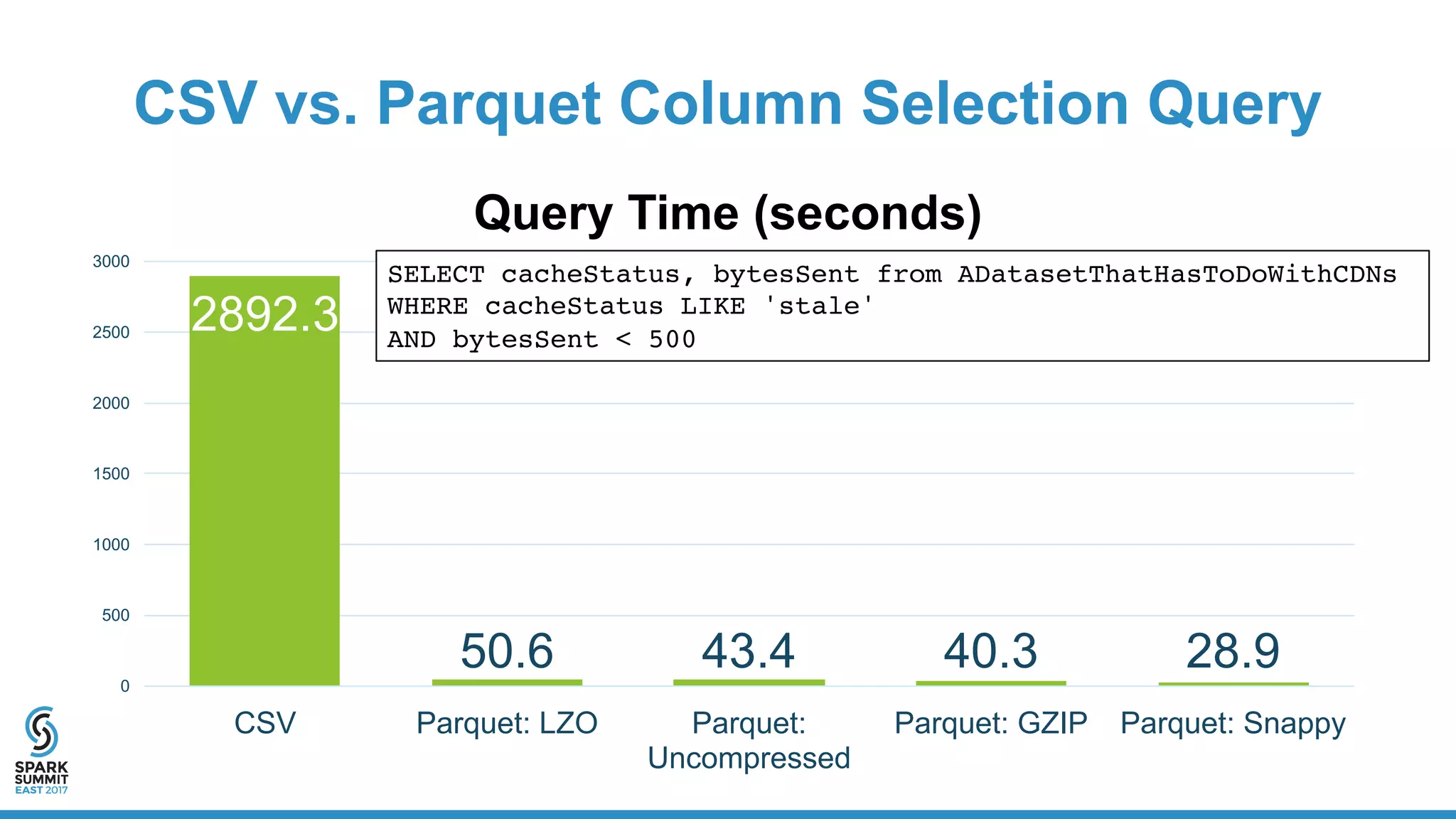
CSV vs. Parquet Column Selection Query
2892.3
50.6 43.4 40.3 28.90
500
1000
1500
2000
2500
3000
CSV Parquet: LZO Parquet:
Uncompressed
Parquet: GZIP Parquet: Snappy
Query Time (seconds)
SELECT cacheStatus, bytesSent from ADatasetThatHasToDoWithCDNs
WHERE cacheStatus LIKE 'stale'
AND bytesSent < 500
CSV vs. Parquet Table Scan Query
2059
50 49.1 44.2 39.60
500
1000
1500
2000
CSV Parquet: LZO Parquet: Snappy Parquet:
Uncompressed
Parquet: GZIP
Query Time (seconds)
SELECT * from ADatasetThatHasToDoWithCDNs
WHERE cacheStatus LIKE 'stale'
AND bytesSent < 500
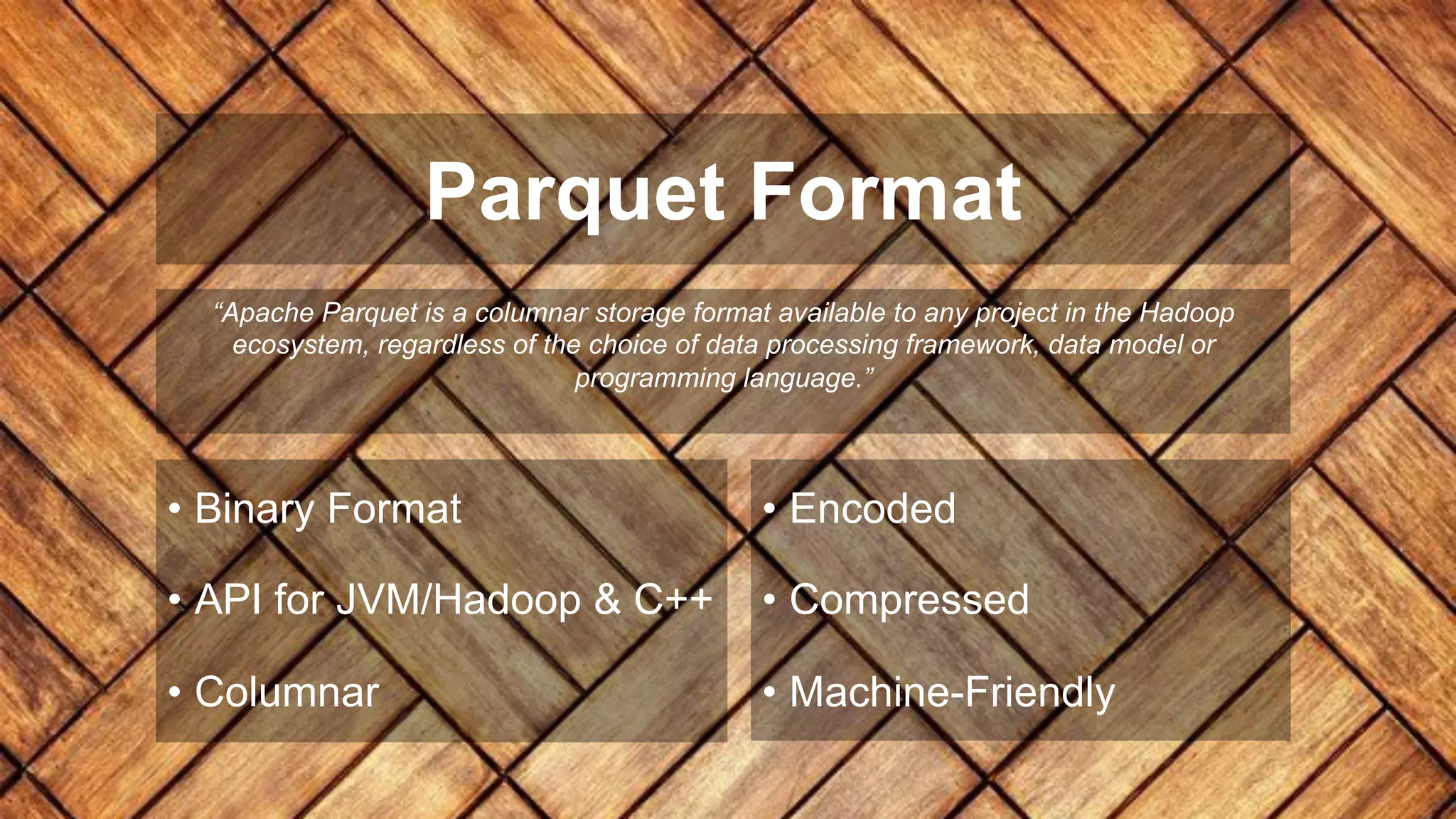
Parquet Format
“Apache Parquet is a columnar storage format available to any project in the Hadoop
ecosystem, regardless of the choice of data processing framework, data model or
programming language.”
• Binary Format
• API for JVM/Hadoop & C++
• Columnar
• Encoded
• Compressed
• Machine-Friendly
Parquet By Example
Introducing the Dataset
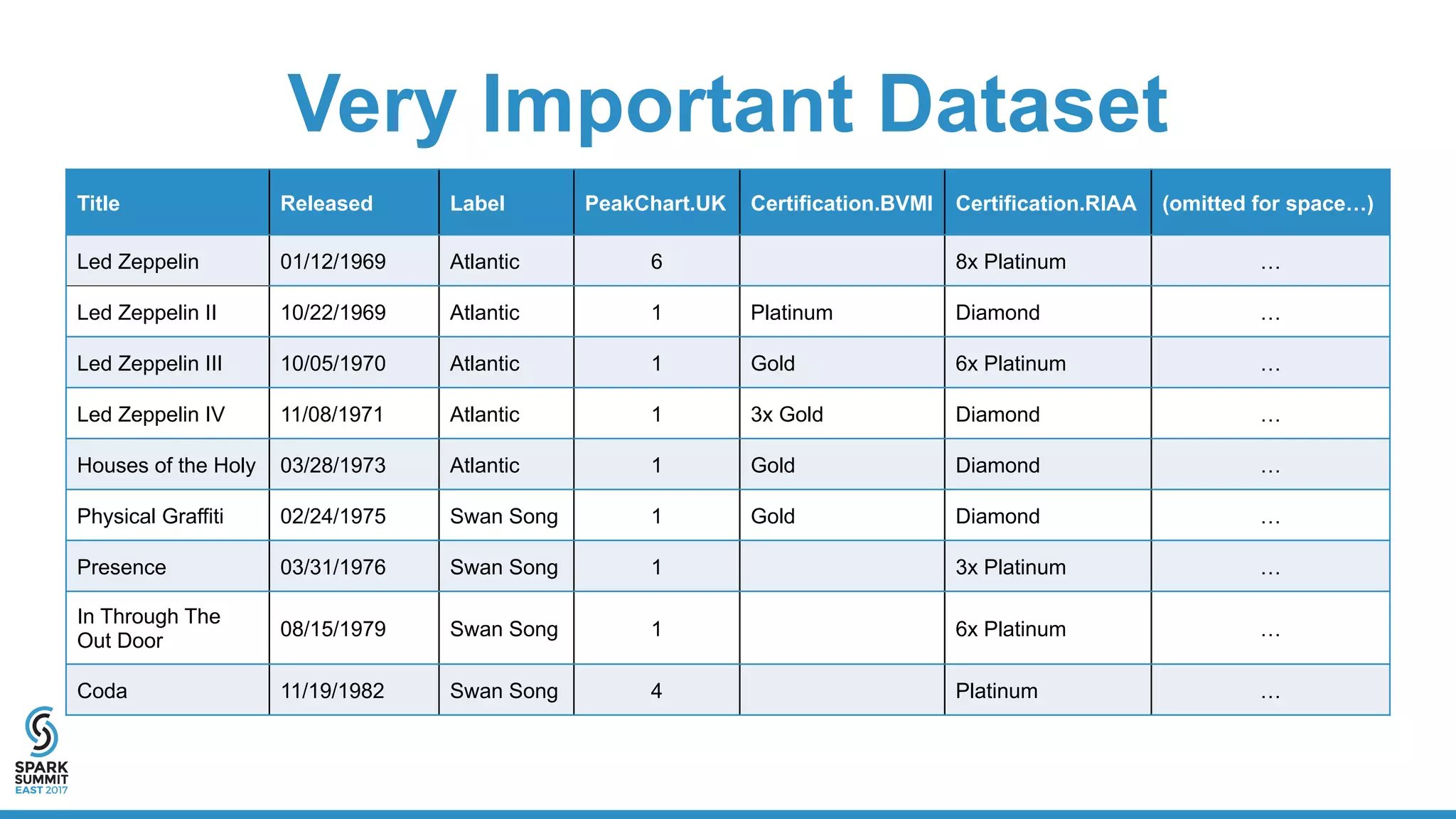
Very Important Dataset
Title Released Label PeakChart.UK Certification.BVMI Certification.RIAA (omitted for space…)
Led Zeppelin 01/12/1969 Atlantic 6 8x Platinum …
Led Zeppelin II 10/22/1969 Atlantic 1 Platinum Diamond …
Led Zeppelin III 10/05/1970 Atlantic 1 Gold 6x Platinum …
Led Zeppelin IV 11/08/1971 Atlantic 1 3x Gold Diamond …
Houses of the Holy 03/28/1973 Atlantic 1 Gold Diamond …
Physical Graffiti 02/24/1975 Swan Song 1 Gold Diamond …
Presence 03/31/1976 Swan Song 1 3x Platinum …
In Through The
Out Door
08/15/1979 Swan Song 1 6x Platinum …
Coda 11/19/1982 Swan Song 4 Platinum …
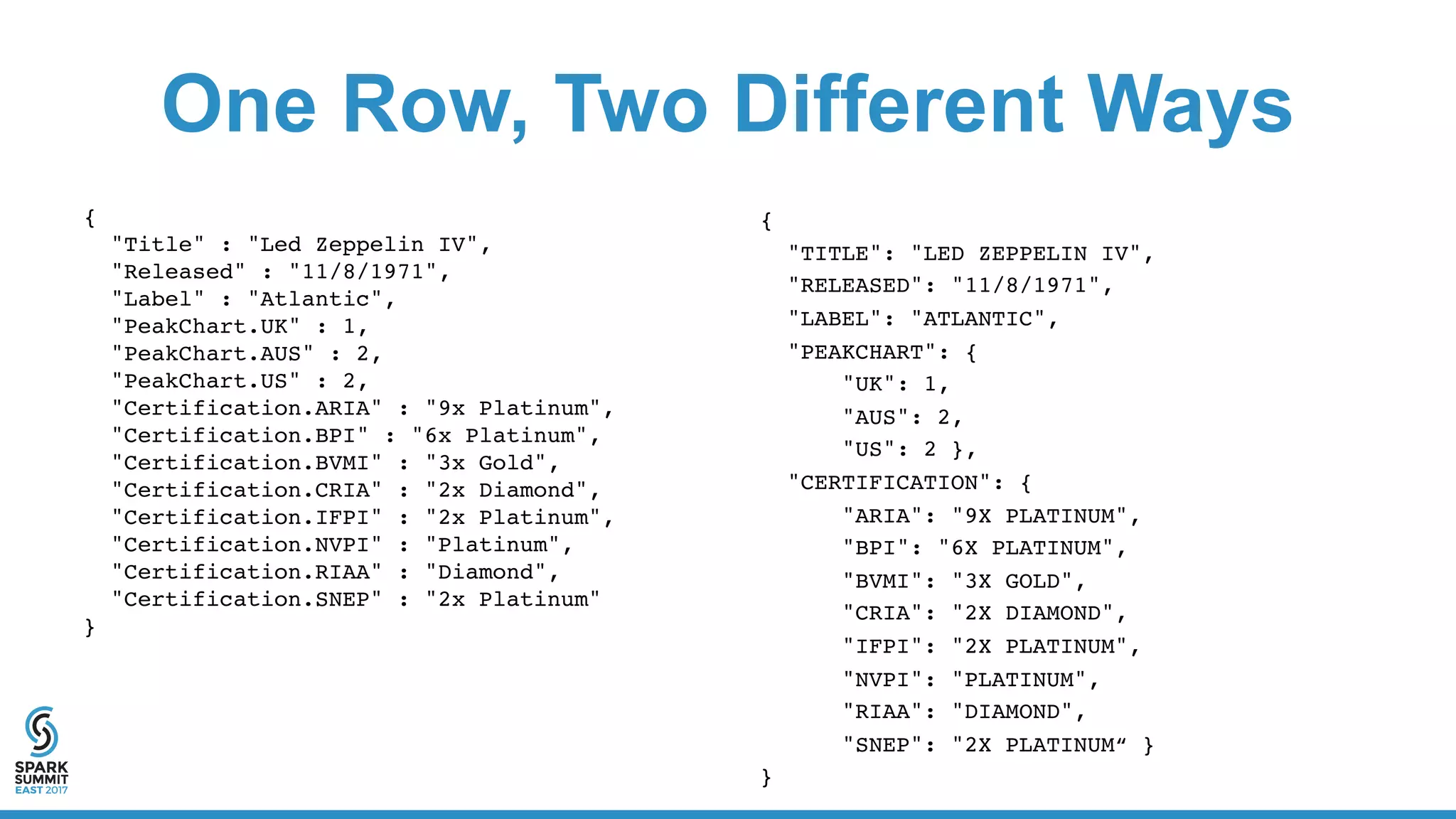
One Row, Two Different Ways
{
"Title" : "Led Zeppelin IV",
"Released" : "11/8/1971",
"Label" : "Atlantic",
"PeakChart.UK" : 1,
"PeakChart.AUS" : 2,
"PeakChart.US" : 2,
"Certification.ARIA" : "9x Platinum",
"Certification.BPI" : "6x Platinum",
"Certification.BVMI" : "3x Gold",
"Certification.CRIA" : "2x Diamond",
"Certification.IFPI" : "2x Platinum",
"Certification.NVPI" : "Platinum",
"Certification.RIAA" : "Diamond",
"Certification.SNEP" : "2x Platinum"
}
{
"TITLE": "LED ZEPPELIN IV",
"RELEASED": "11/8/1971",
"LABEL": "ATLANTIC",
"PEAKCHART": {
"UK": 1,
"AUS": 2,
"US": 2 },
"CERTIFICATION": {
"ARIA": "9X PLATINUM",
"BPI": "6X PLATINUM",
"BVMI": "3X GOLD",
"CRIA": "2X DIAMOND",
"IFPI": "2X PLATINUM",
"NVPI": "PLATINUM",
"RIAA": "DIAMOND",
"SNEP": "2X PLATINUM“ }
}
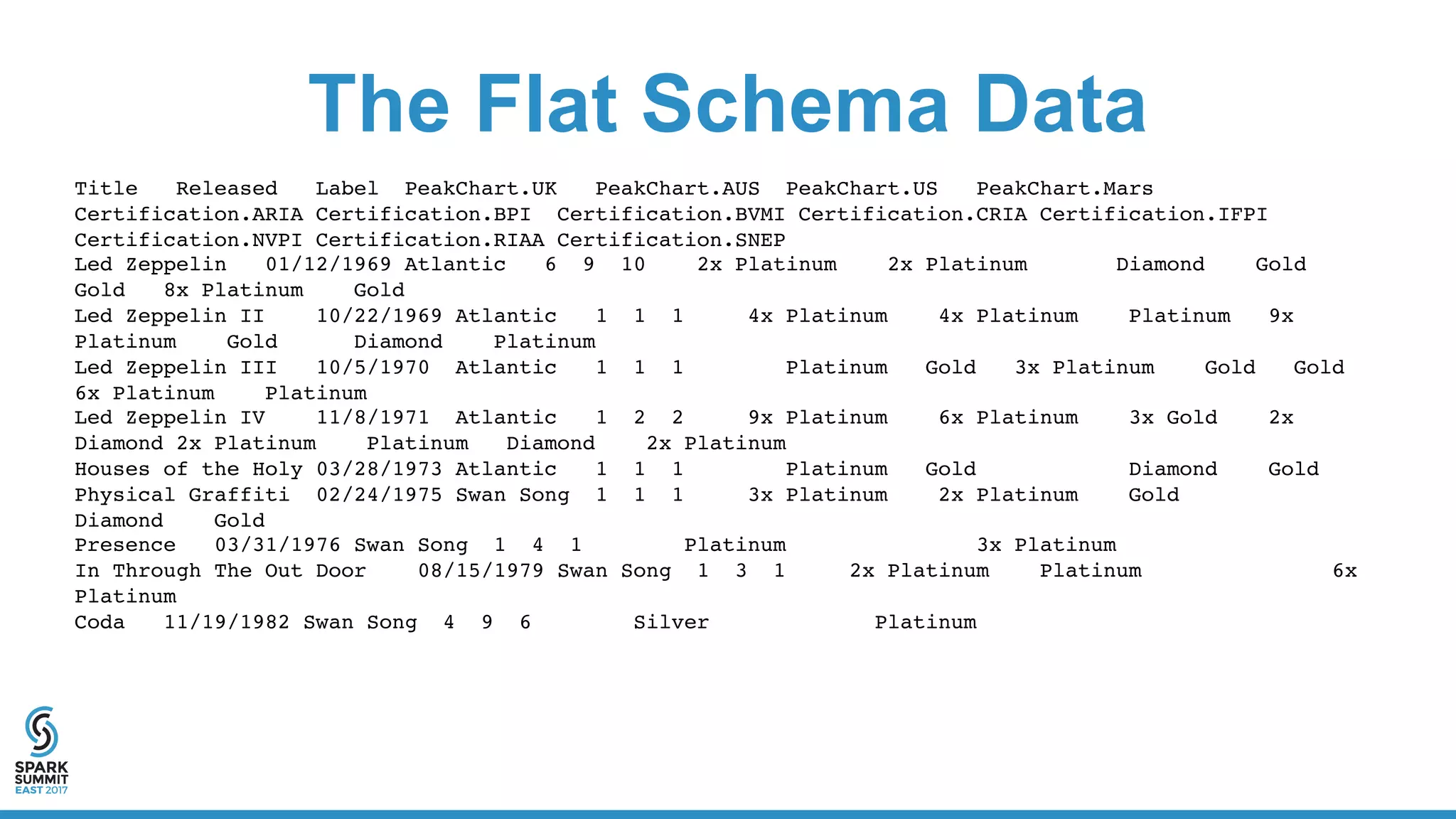
The Flat Schema Data
Title Released Label PeakChart.UK PeakChart.AUS PeakChart.US PeakChart.Mars
Certification.ARIA Certification.BPI Certification.BVMI Certification.CRIA Certification.IFPI
Certification.NVPI Certification.RIAA Certification.SNEP
Led Zeppelin 01/12/1969 Atlantic 6 9 10 2x Platinum 2x Platinum Diamond Gold
Gold 8x Platinum Gold
Led Zeppelin II 10/22/1969 Atlantic 1 1 1 4x Platinum 4x Platinum Platinum 9x
Platinum Gold Diamond Platinum
Led Zeppelin III 10/5/1970 Atlantic 1 1 1 Platinum Gold 3x Platinum Gold Gold
6x Platinum Platinum
Led Zeppelin IV 11/8/1971 Atlantic 1 2 2 9x Platinum 6x Platinum 3x Gold 2x
Diamond 2x Platinum Platinum Diamond 2x Platinum
Houses of the Holy 03/28/1973 Atlantic 1 1 1 Platinum Gold Diamond Gold
Physical Graffiti 02/24/1975 Swan Song 1 1 1 3x Platinum 2x Platinum Gold
Diamond Gold
Presence 03/31/1976 Swan Song 1 4 1 Platinum 3x Platinum
In Through The Out Door 08/15/1979 Swan Song 1 3 1 2x Platinum Platinum 6x
Platinum
Coda 11/19/1982 Swan Song 4 9 6 Silver Platinum
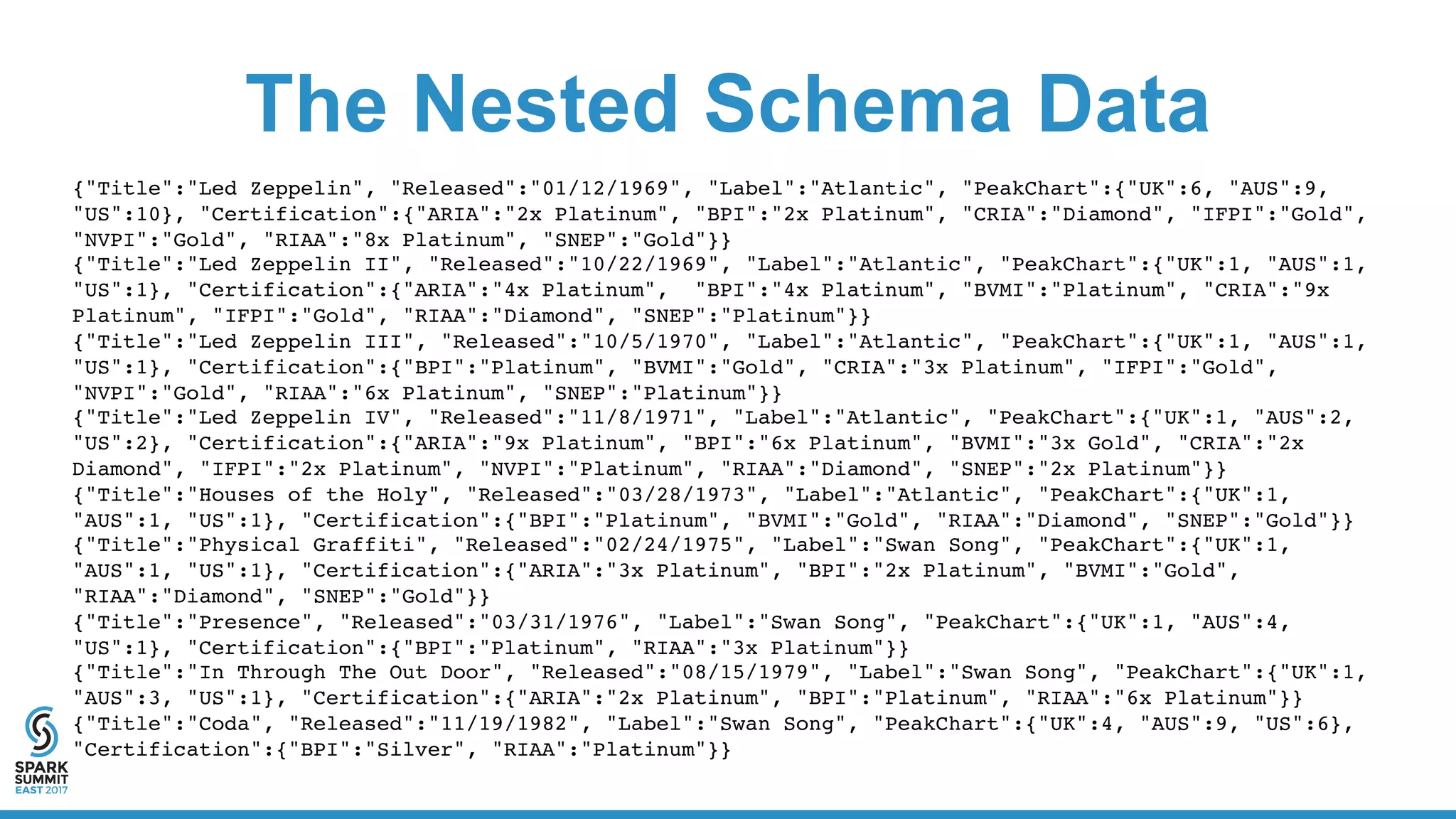
The Nested Schema Data
{"Title":"Led Zeppelin", "Released":"01/12/1969", "Label":"Atlantic", "PeakChart":{"UK":6, "AUS":9,
"US":10}, "Certification":{"ARIA":"2x Platinum", "BPI":"2x Platinum", "CRIA":"Diamond", "IFPI":"Gold",
"NVPI":"Gold", "RIAA":"8x Platinum", "SNEP":"Gold"}}
{"Title":"Led Zeppelin II", "Released":"10/22/1969", "Label":"Atlantic", "PeakChart":{"UK":1, "AUS":1,
"US":1}, "Certification":{"ARIA":"4x Platinum", "BPI":"4x Platinum", "BVMI":"Platinum", "CRIA":"9x
Platinum", "IFPI":"Gold", "RIAA":"Diamond", "SNEP":"Platinum"}}
{"Title":"Led Zeppelin III", "Released":"10/5/1970", "Label":"Atlantic", "PeakChart":{"UK":1, "AUS":1,
"US":1}, "Certification":{"BPI":"Platinum", "BVMI":"Gold", "CRIA":"3x Platinum", "IFPI":"Gold",
"NVPI":"Gold", "RIAA":"6x Platinum", "SNEP":"Platinum"}}
{"Title":"Led Zeppelin IV", "Released":"11/8/1971", "Label":"Atlantic", "PeakChart":{"UK":1, "AUS":2,
"US":2}, "Certification":{"ARIA":"9x Platinum", "BPI":"6x Platinum", "BVMI":"3x Gold", "CRIA":"2x
Diamond", "IFPI":"2x Platinum", "NVPI":"Platinum", "RIAA":"Diamond", "SNEP":"2x Platinum"}}
{"Title":"Houses of the Holy", "Released":"03/28/1973", "Label":"Atlantic", "PeakChart":{"UK":1,
"AUS":1, "US":1}, "Certification":{"BPI":"Platinum", "BVMI":"Gold", "RIAA":"Diamond", "SNEP":"Gold"}}
{"Title":"Physical Graffiti", "Released":"02/24/1975", "Label":"Swan Song", "PeakChart":{"UK":1,
"AUS":1, "US":1}, "Certification":{"ARIA":"3x Platinum", "BPI":"2x Platinum", "BVMI":"Gold",
"RIAA":"Diamond", "SNEP":"Gold"}}
{"Title":"Presence", "Released":"03/31/1976", "Label":"Swan Song", "PeakChart":{"UK":1, "AUS":4,
"US":1}, "Certification":{"BPI":"Platinum", "RIAA":"3x Platinum"}}
{"Title":"In Through The Out Door", "Released":"08/15/1979", "Label":"Swan Song", "PeakChart":{"UK":1,
"AUS":3, "US":1}, "Certification":{"ARIA":"2x Platinum", "BPI":"Platinum", "RIAA":"6x Platinum"}}
{"Title":"Coda", "Released":"11/19/1982", "Label":"Swan Song", "PeakChart":{"UK":4, "AUS":9, "US":6},
"Certification":{"BPI":"Silver", "RIAA":"Platinum"}}
Parquet By Example
Writing Parquet Using Spark
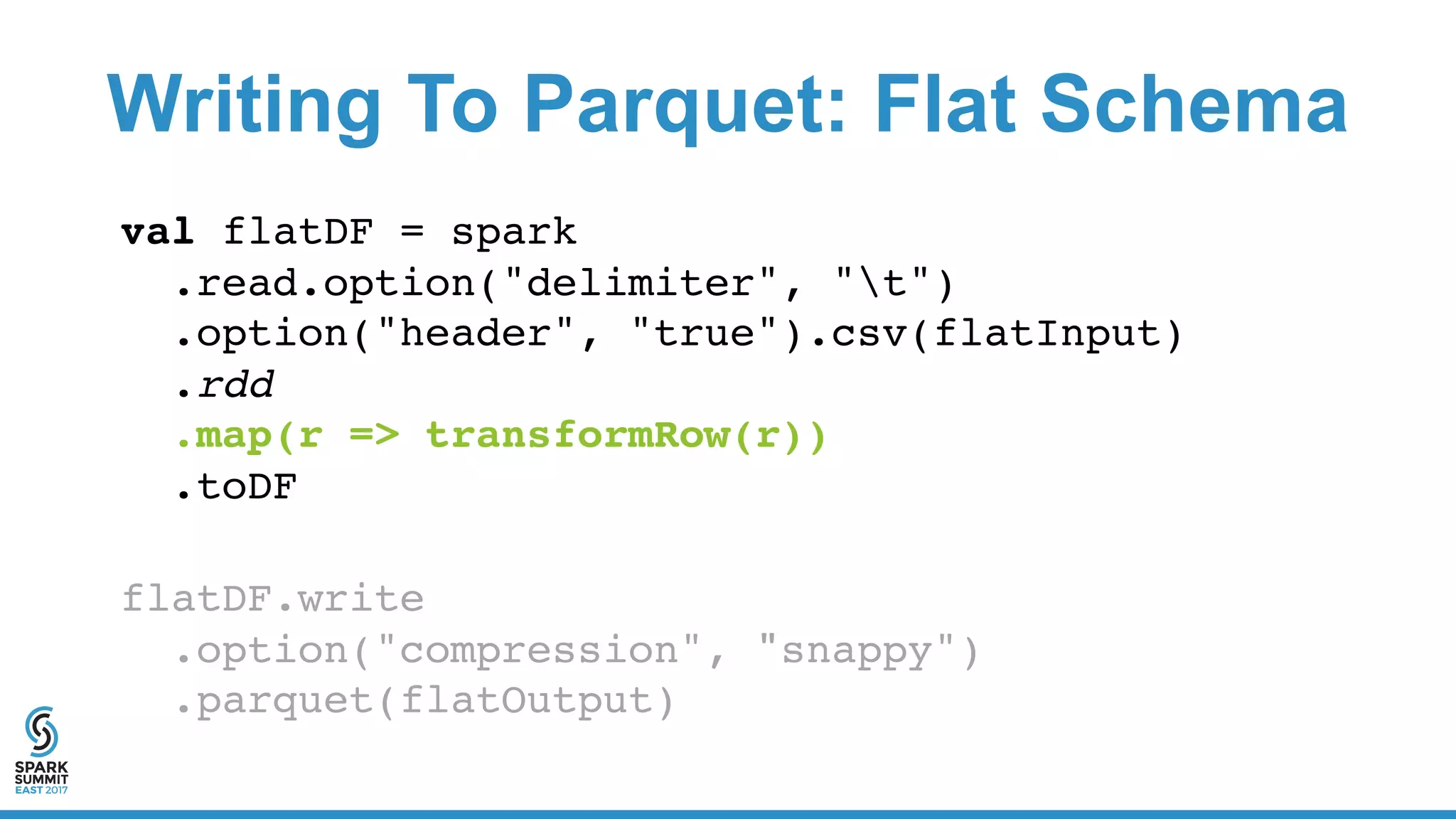
Writing To Parquet: Flat Schema
val flatDF = spark
.read.option("delimiter", "t")
.option("header", "true").csv(flatInput)
.rdd
.map(r => transformRow(r))
.toDF
flatDF.write
.option("compression", "snappy")
.parquet(flatOutput)
Writing To Parquet: Flat Schema
/*Oh crap, the Ints are gonna get pulled in as Strings unless we transform*/
case class LedZeppelinFlat(
Title: Option[String],
Released: Option[String],
Label: Option[String],
UK: Option[Int],
AUS: Option[Int],
US: Option[Int],
ARIA: Option[String],
BPI: Option[String],
BVMI: Option[String],
CRIA: Option[String],
IFPI: Option[String],
NVPI: Option[String],
RIAA: Option[String],
SNEP: Option[String]
)
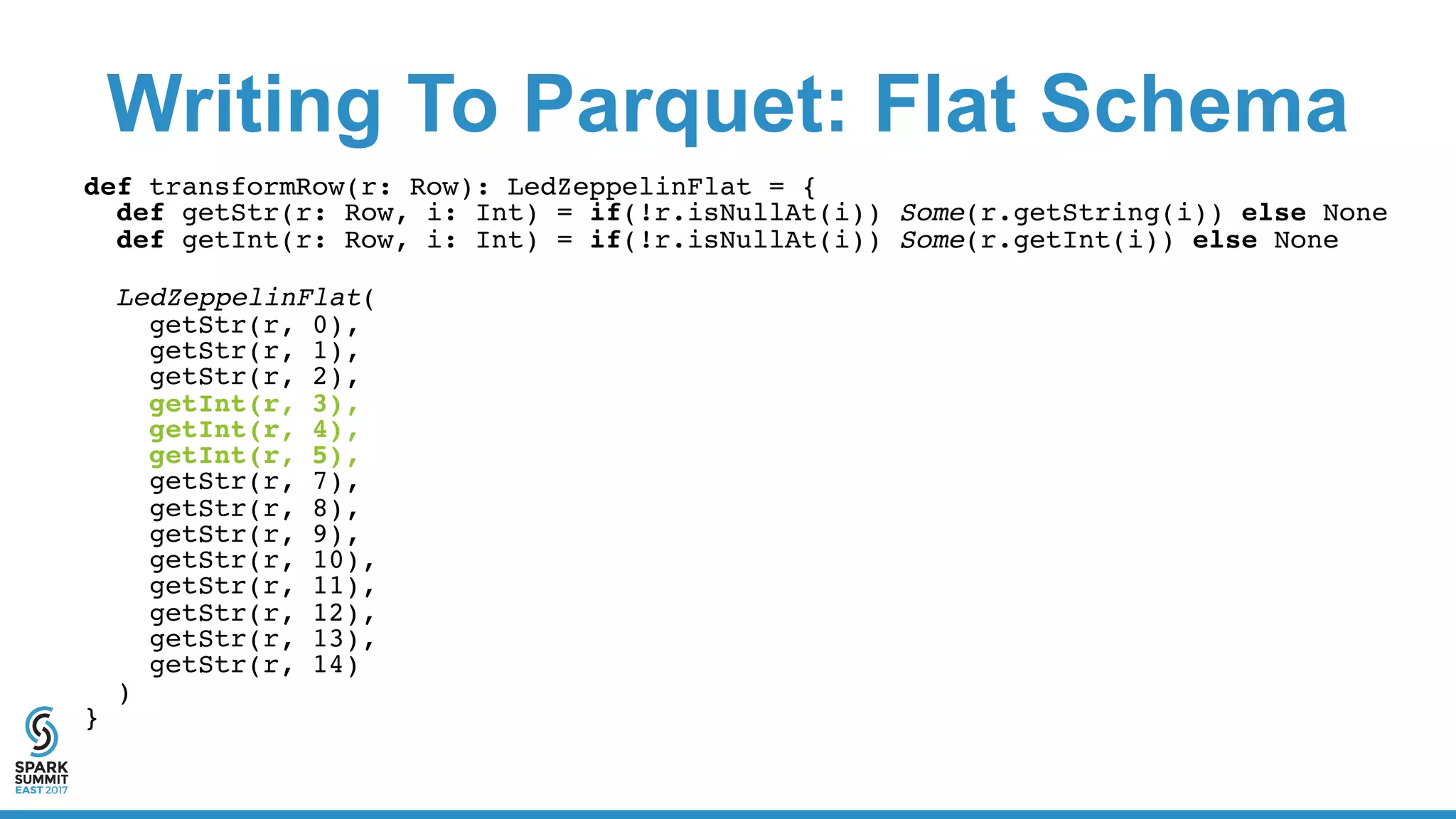
Writing To Parquet: Flat Schema
def transformRow(r: Row): LedZeppelinFlat = {
def getStr(r: Row, i: Int) = if(!r.isNullAt(i)) Some(r.getString(i)) else None
def getInt(r: Row, i: Int) = if(!r.isNullAt(i)) Some(r.getInt(i)) else None
LedZeppelinFlat(
getStr(r, 0),
getStr(r, 1),
getStr(r, 2),
getInt(r, 3),
getInt(r, 4),
getInt(r, 5),
getStr(r, 7),
getStr(r, 8),
getStr(r, 9),
getStr(r, 10),
getStr(r, 11),
getStr(r, 12),
getStr(r, 13),
getStr(r, 14)
)
}
Writing To Parquet: Flat Schema
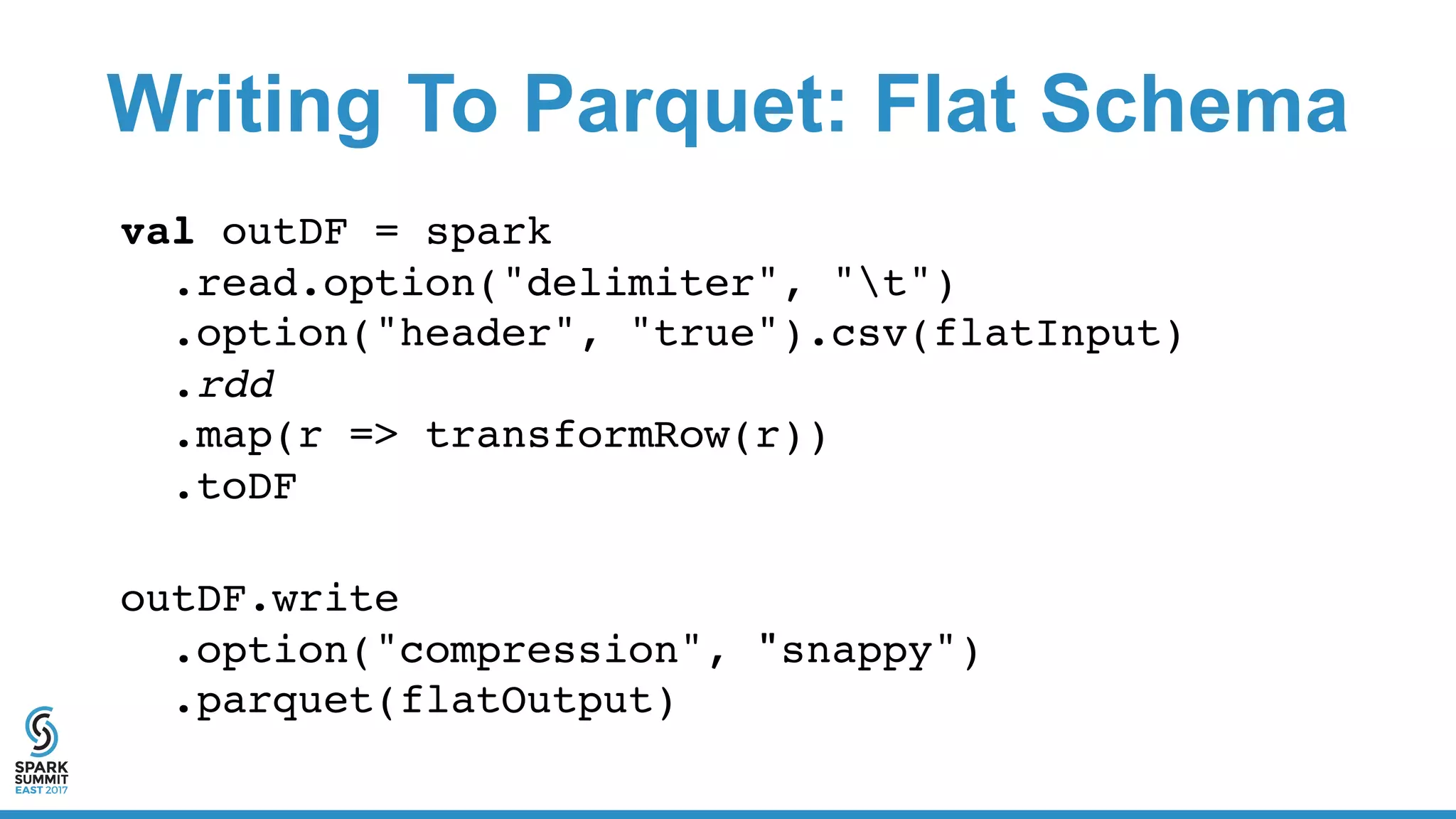
val outDF = spark
.read.option("delimiter", "t")
.option("header", "true").csv(flatInput)
.rdd
.map(r => transformRow(r))
.toDF
outDF.write
.option("compression", "snappy")
.parquet(flatOutput)
Writing To Parquet: Flat Schema
Writing To Parquet: Flat Schema…
In Java
Writing To Parquet: Flat Schema…
With MapReduce
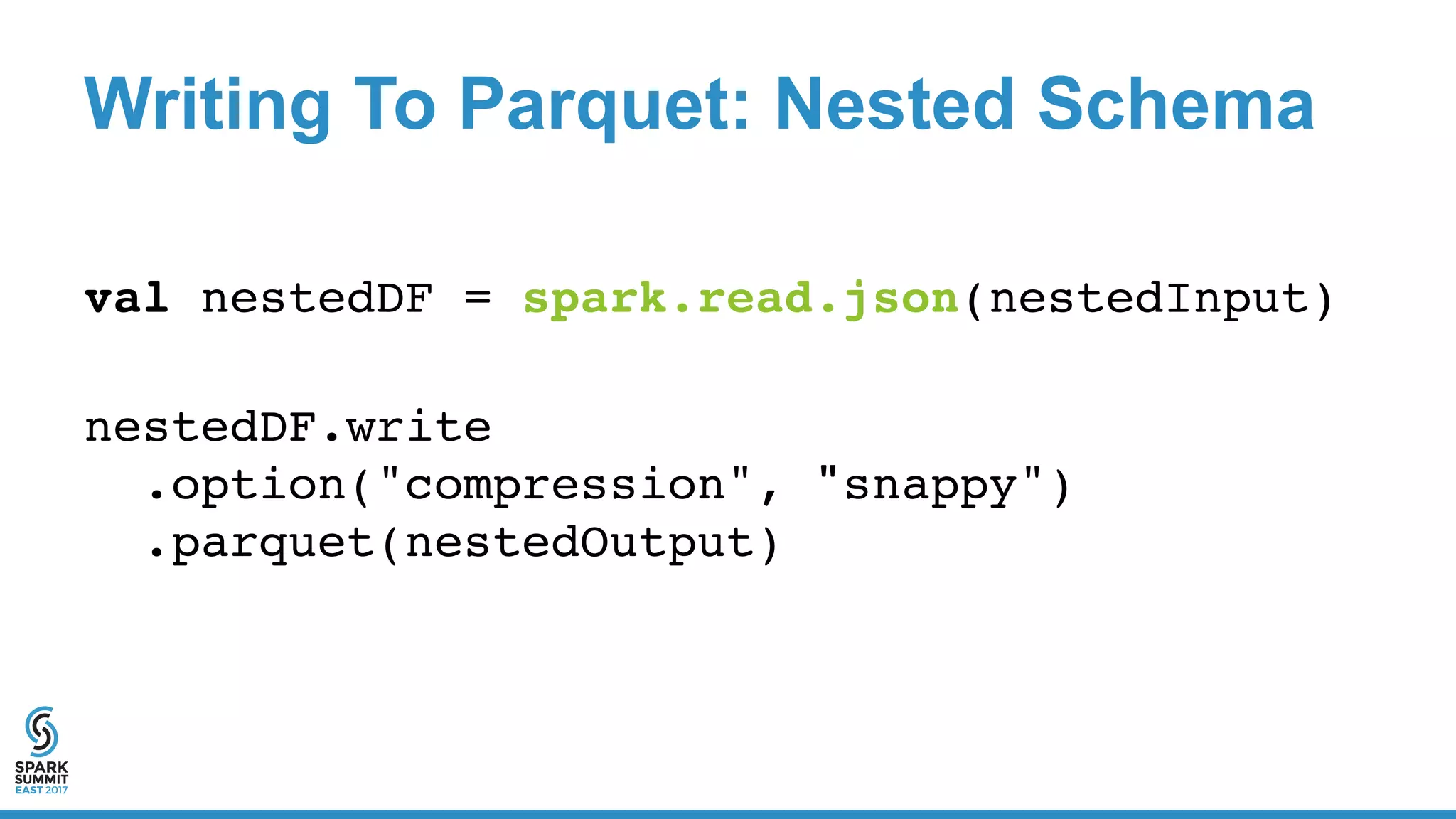
Writing To Parquet: Nested Schema
val nestedDF = spark.read.json(nestedInput)
nestedDF.write
.option("compression", "snappy")
.parquet(nestedOutput)
Writing To Parquet: Nested Schema
Parquet By Example
Let’s See An Example!
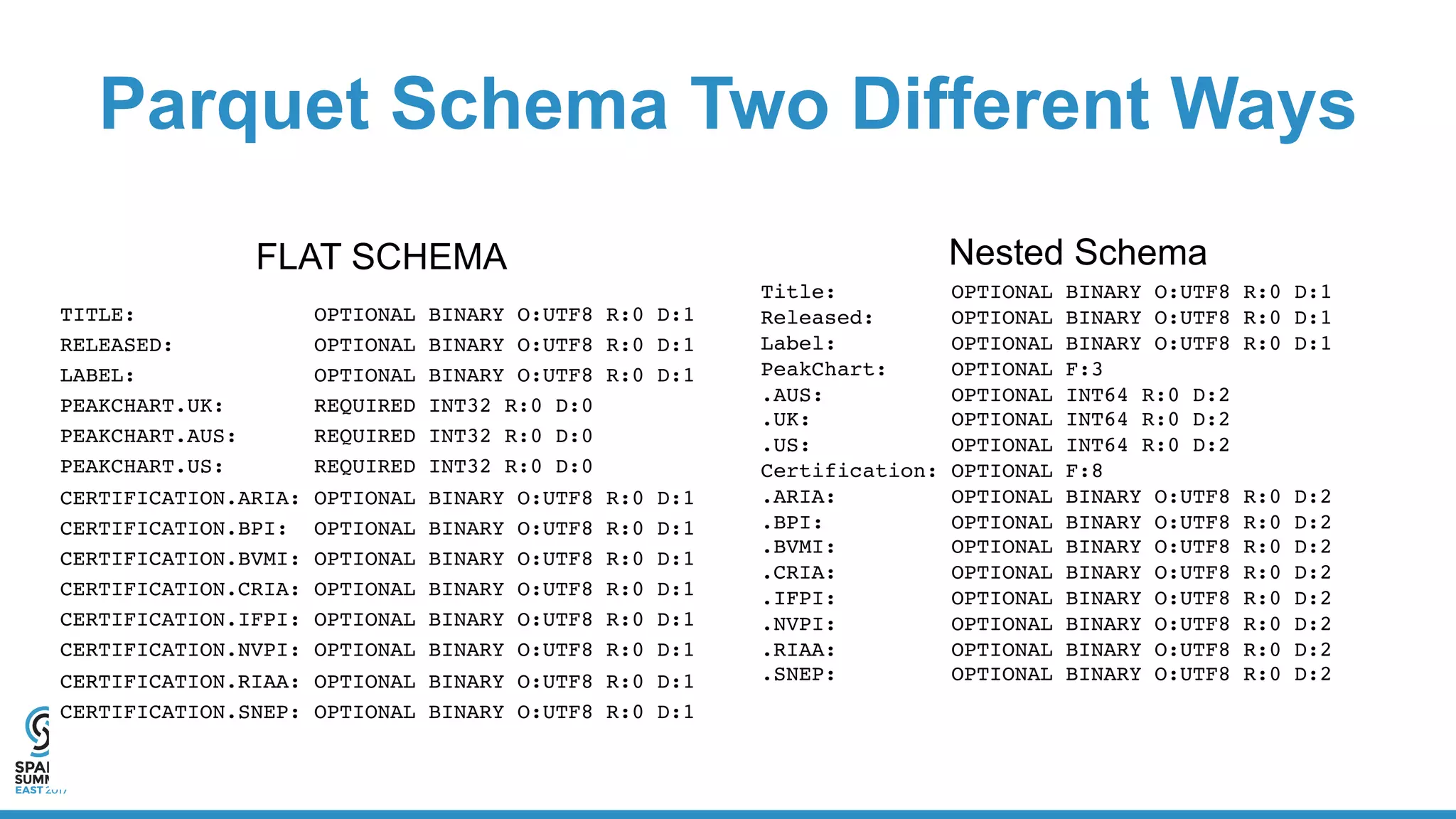
Parquet Schema Two Different Ways
Nested Schema
Title: OPTIONAL BINARY O:UTF8 R:0 D:1
Released: OPTIONAL BINARY O:UTF8 R:0 D:1
Label: OPTIONAL BINARY O:UTF8 R:0 D:1
PeakChart: OPTIONAL F:3
.AUS: OPTIONAL INT64 R:0 D:2
.UK: OPTIONAL INT64 R:0 D:2
.US: OPTIONAL INT64 R:0 D:2
Certification: OPTIONAL F:8
.ARIA: OPTIONAL BINARY O:UTF8 R:0 D:2
.BPI: OPTIONAL BINARY O:UTF8 R:0 D:2
.BVMI: OPTIONAL BINARY O:UTF8 R:0 D:2
.CRIA: OPTIONAL BINARY O:UTF8 R:0 D:2
.IFPI: OPTIONAL BINARY O:UTF8 R:0 D:2
.NVPI: OPTIONAL BINARY O:UTF8 R:0 D:2
.RIAA: OPTIONAL BINARY O:UTF8 R:0 D:2
.SNEP: OPTIONAL BINARY O:UTF8 R:0 D:2
FLAT SCHEMA
TITLE: OPTIONAL BINARY O:UTF8 R:0 D:1
RELEASED: OPTIONAL BINARY O:UTF8 R:0 D:1
LABEL: OPTIONAL BINARY O:UTF8 R:0 D:1
PEAKCHART.UK: REQUIRED INT32 R:0 D:0
PEAKCHART.AUS: REQUIRED INT32 R:0 D:0
PEAKCHART.US: REQUIRED INT32 R:0 D:0
CERTIFICATION.ARIA: OPTIONAL BINARY O:UTF8 R:0 D:1
CERTIFICATION.BPI: OPTIONAL BINARY O:UTF8 R:0 D:1
CERTIFICATION.BVMI: OPTIONAL BINARY O:UTF8 R:0 D:1
CERTIFICATION.CRIA: OPTIONAL BINARY O:UTF8 R:0 D:1
CERTIFICATION.IFPI: OPTIONAL BINARY O:UTF8 R:0 D:1
CERTIFICATION.NVPI: OPTIONAL BINARY O:UTF8 R:0 D:1
CERTIFICATION.RIAA: OPTIONAL BINARY O:UTF8 R:0 D:1
CERTIFICATION.SNEP: OPTIONAL BINARY O:UTF8 R:0 D:1
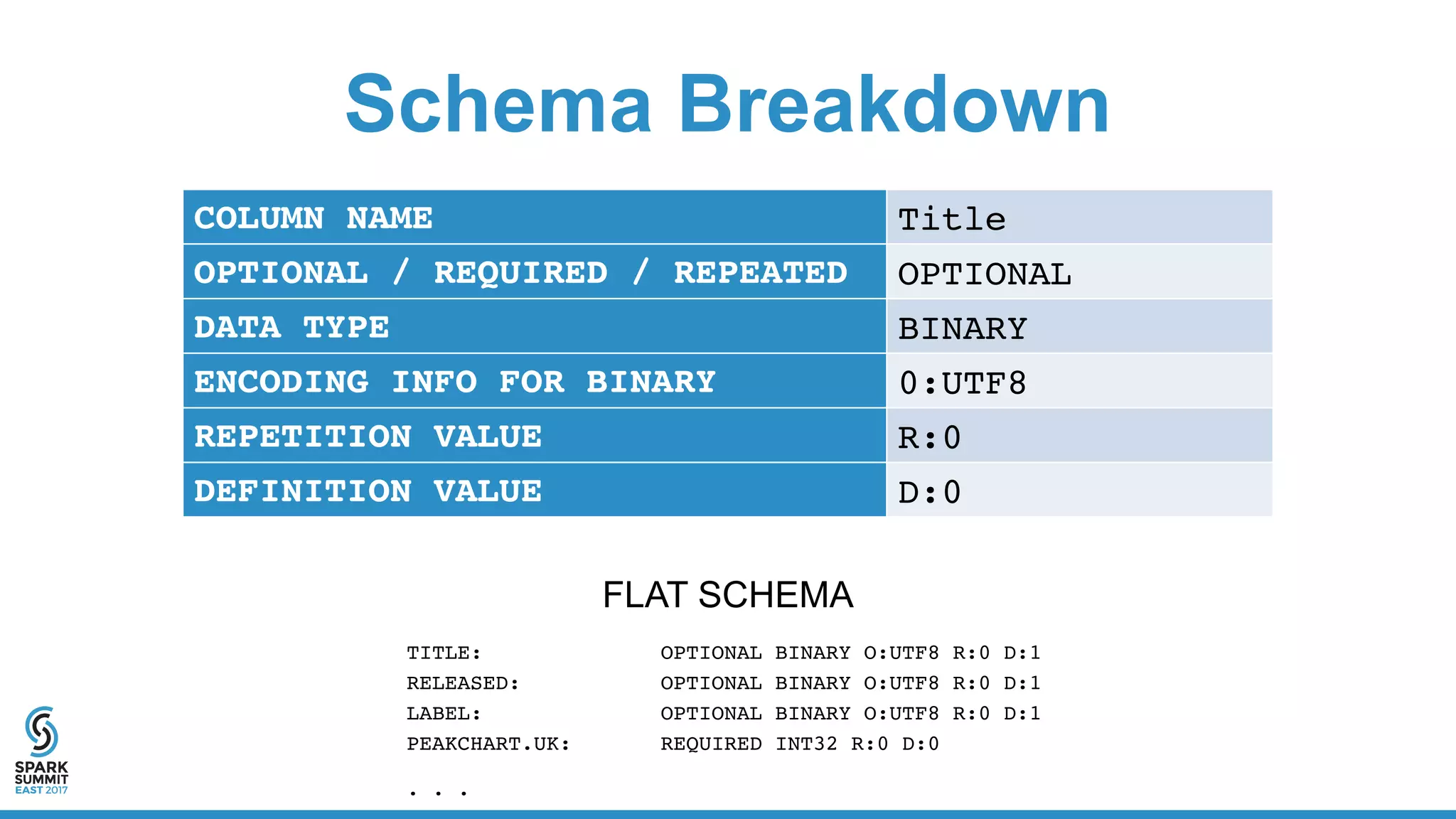
Schema Breakdown
COLUMN NAME Title
OPTIONAL / REQUIRED / REPEATED OPTIONAL
DATA TYPE BINARY
ENCODING INFO FOR BINARY 0:UTF8
REPETITION VALUE R:0
DEFINITION VALUE D:0
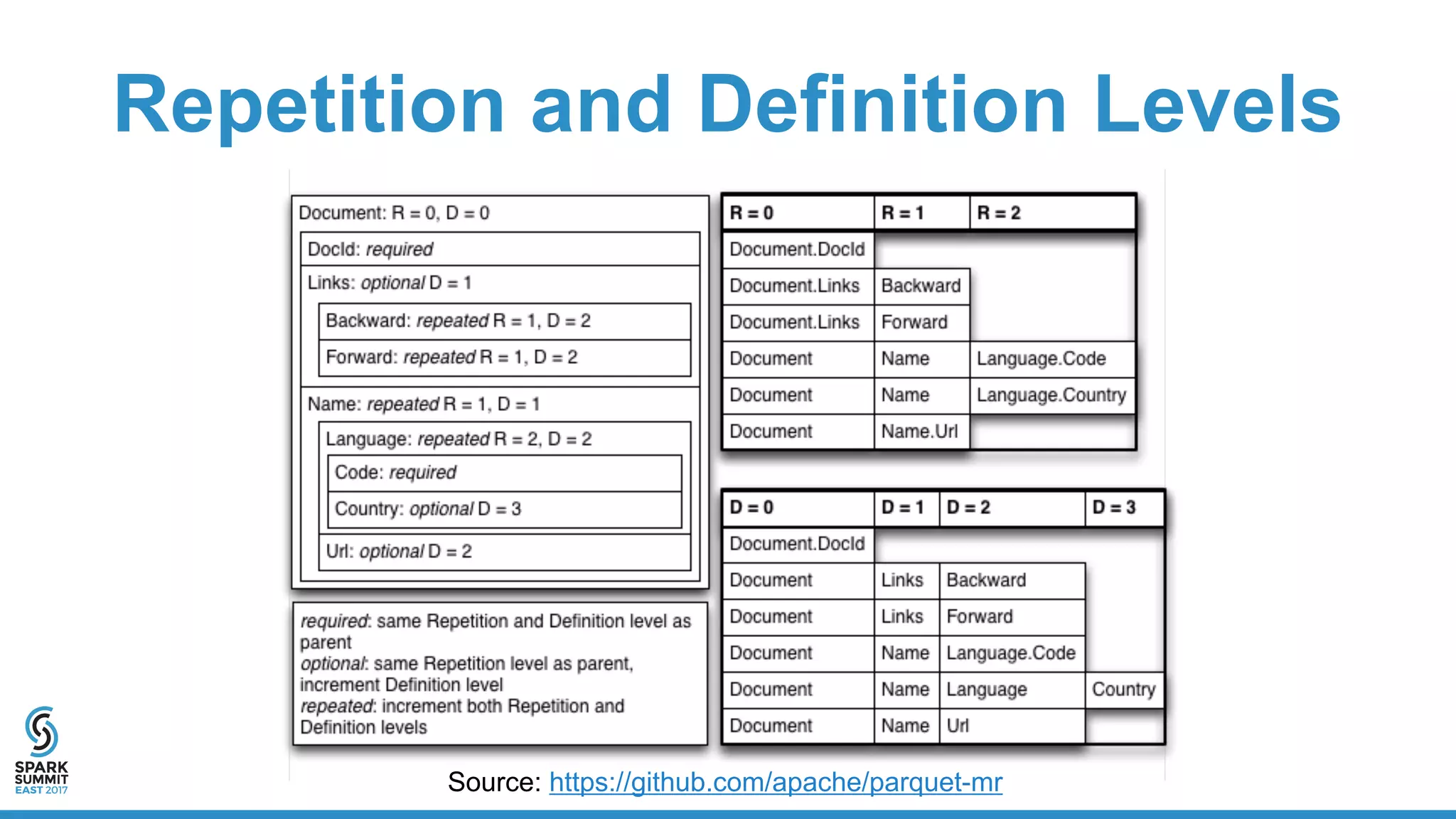
FLAT SCHEMA
TITLE: OPTIONAL BINARY O:UTF8 R:0 D:1
RELEASED: OPTIONAL BINARY O:UTF8 R:0 D:1
LABEL: OPTIONAL BINARY O:UTF8 R:0 D:1
PEAKCHART.UK: REQUIRED INT32 R:0 D:0
. . .
Repetition and Definition Levels
Source: https://github.com/apache/parquet-mr
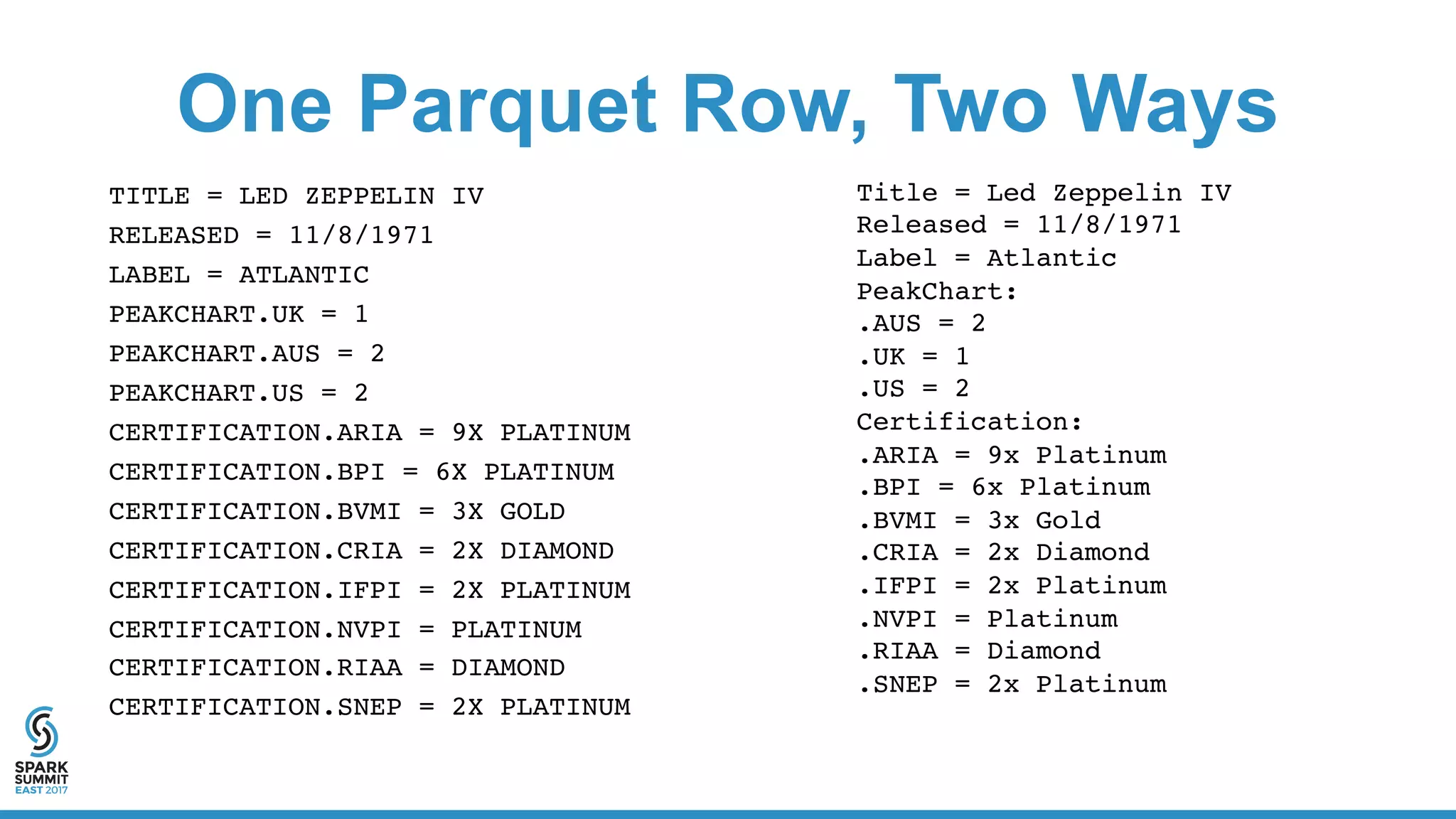
One Parquet Row, Two Ways
Title = Led Zeppelin IV
Released = 11/8/1971
Label = Atlantic
PeakChart:
.AUS = 2
.UK = 1
.US = 2
Certification:
.ARIA = 9x Platinum
.BPI = 6x Platinum
.BVMI = 3x Gold
.CRIA = 2x Diamond
.IFPI = 2x Platinum
.NVPI = Platinum
.RIAA = Diamond
.SNEP = 2x Platinum
TITLE = LED ZEPPELIN IV
RELEASED = 11/8/1971
LABEL = ATLANTIC
PEAKCHART.UK = 1
PEAKCHART.AUS = 2
PEAKCHART.US = 2
CERTIFICATION.ARIA = 9X PLATINUM
CERTIFICATION.BPI = 6X PLATINUM
CERTIFICATION.BVMI = 3X GOLD
CERTIFICATION.CRIA = 2X DIAMOND
CERTIFICATION.IFPI = 2X PLATINUM
CERTIFICATION.NVPI = PLATINUM
CERTIFICATION.RIAA = DIAMOND
CERTIFICATION.SNEP = 2X PLATINUM
Parquet By Example
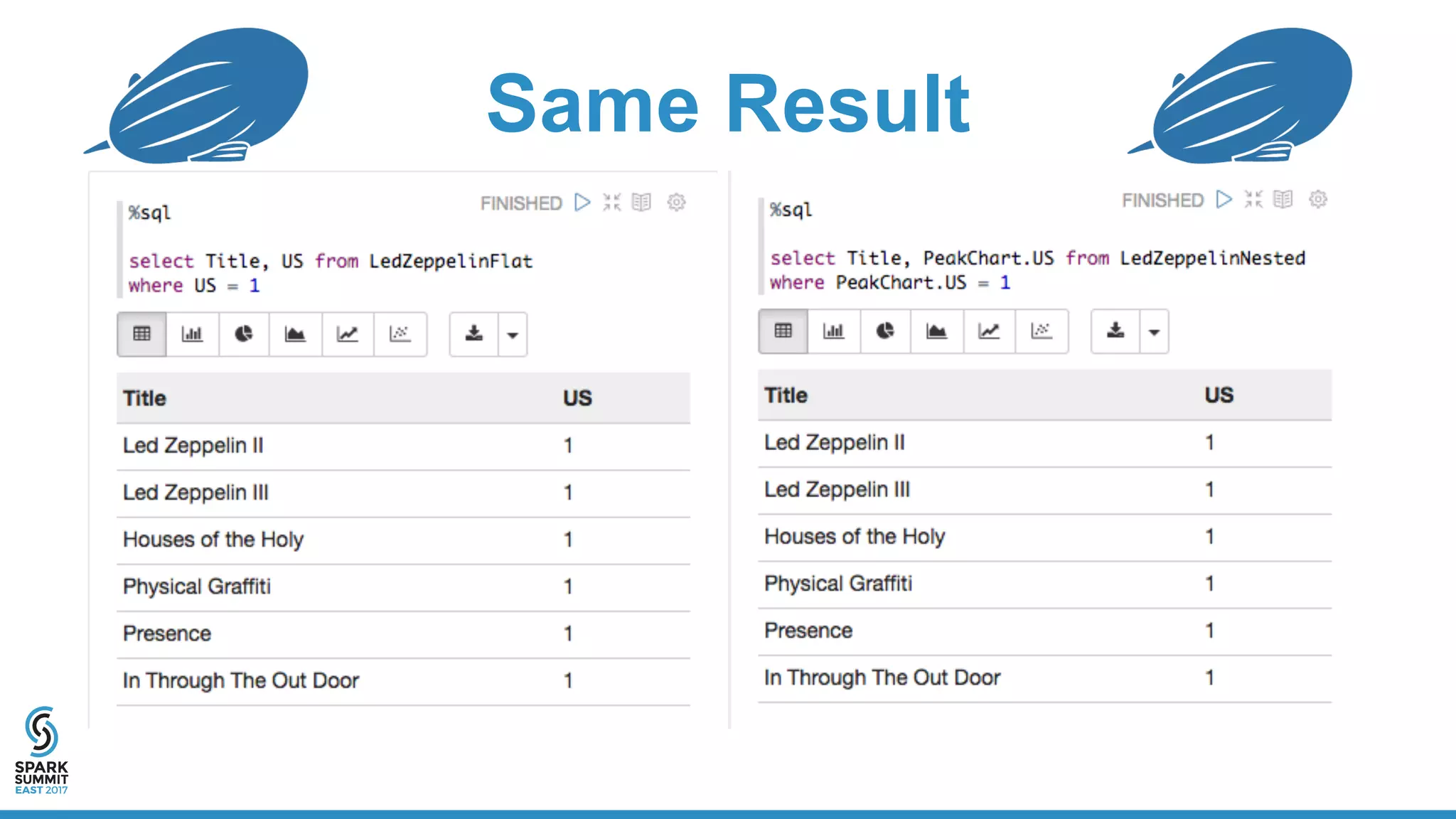
Reading and Querying Using Spark
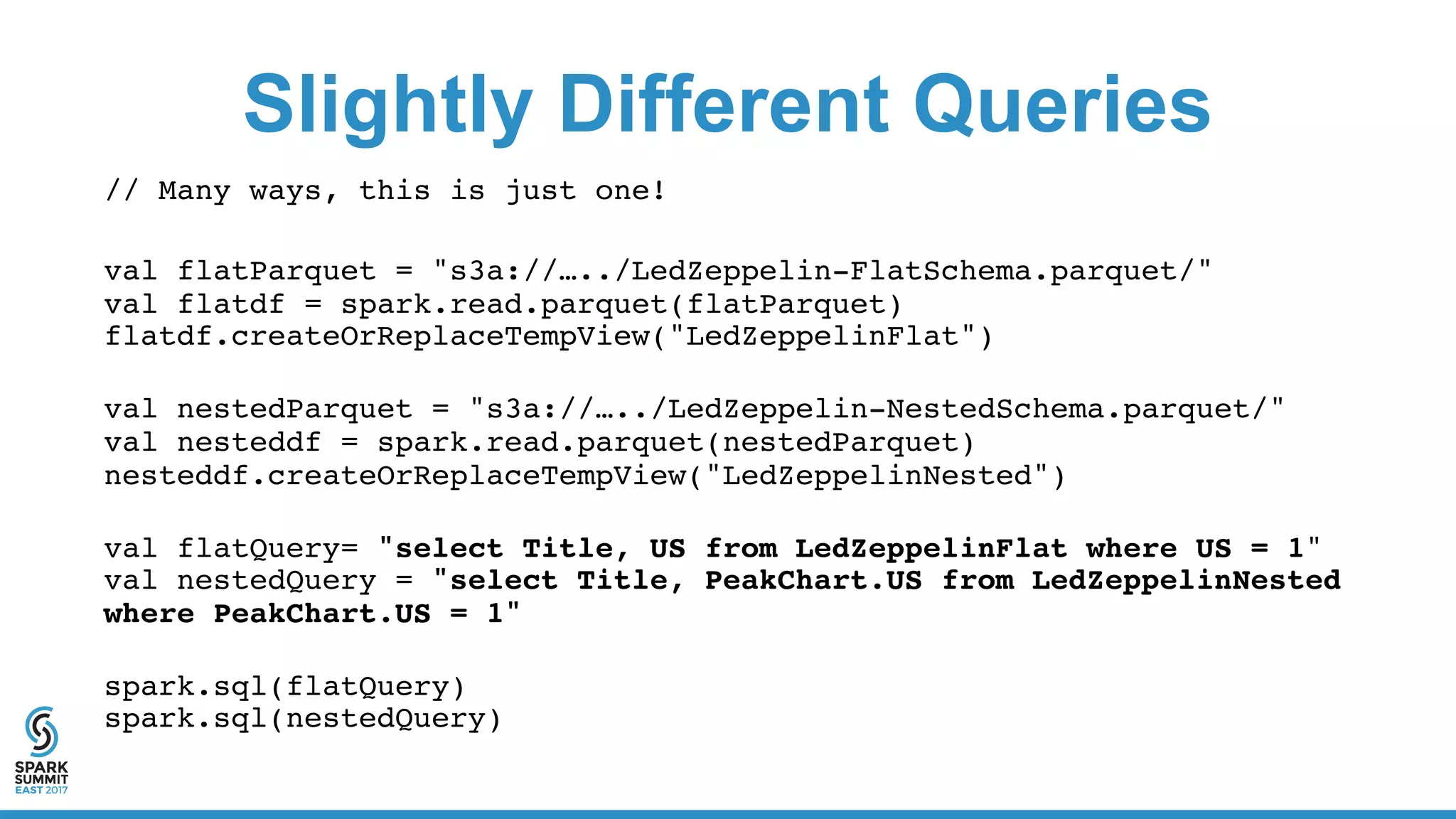
Slightly Different Queries
// Many ways, this is just one!
val flatParquet = "s3a://…../LedZeppelin-FlatSchema.parquet/"
val flatdf = spark.read.parquet(flatParquet)
flatdf.createOrReplaceTempView("LedZeppelinFlat")
val nestedParquet = "s3a://…../LedZeppelin-NestedSchema.parquet/"
val nesteddf = spark.read.parquet(nestedParquet)
nesteddf.createOrReplaceTempView("LedZeppelinNested")
val flatQuery= "select Title, US from LedZeppelinFlat where US = 1"
val nestedQuery = "select Title, PeakChart.US from LedZeppelinNested
where PeakChart.US = 1"
spark.sql(flatQuery)
spark.sql(nestedQuery)
Same Result
How Parquet Works
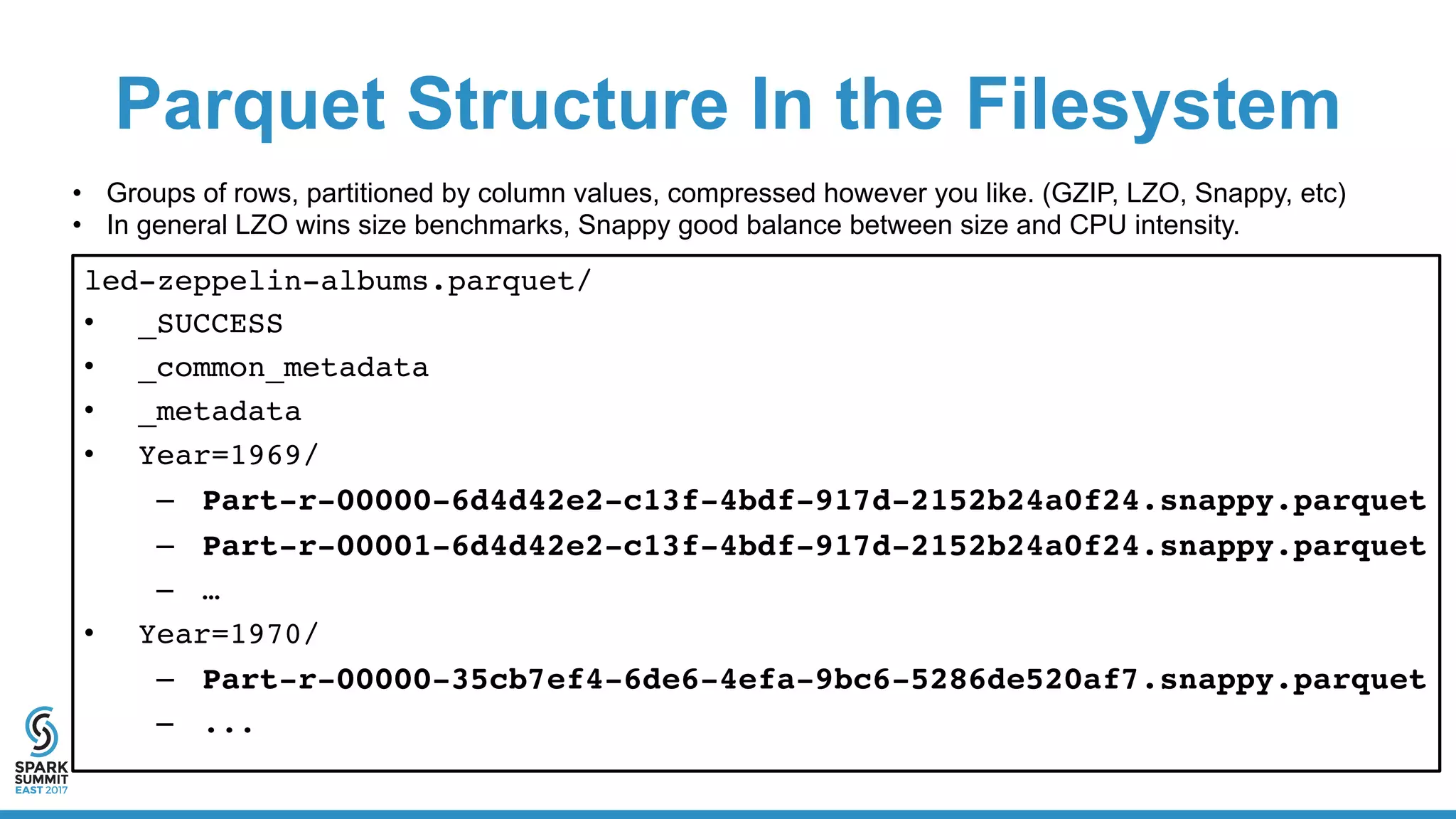
Parquet Structure In the Filesystem
led-zeppelin-albums.parquet/
• _SUCCESS
• _common_metadata
• _metadata
• Year=1969/
– Part-r-00000-6d4d42e2-c13f-4bdf-917d-2152b24a0f24.snappy.parquet
– Part-r-00001-6d4d42e2-c13f-4bdf-917d-2152b24a0f24.snappy.parquet
– …
• Year=1970/
– Part-r-00000-35cb7ef4-6de6-4efa-9bc6-5286de520af7.snappy.parquet
– ...
• Groups of rows, partitioned by column values, compressed however you like. (GZIP, LZO, Snappy, etc)
• In general LZO wins size benchmarks, Snappy good balance between size and CPU intensity.
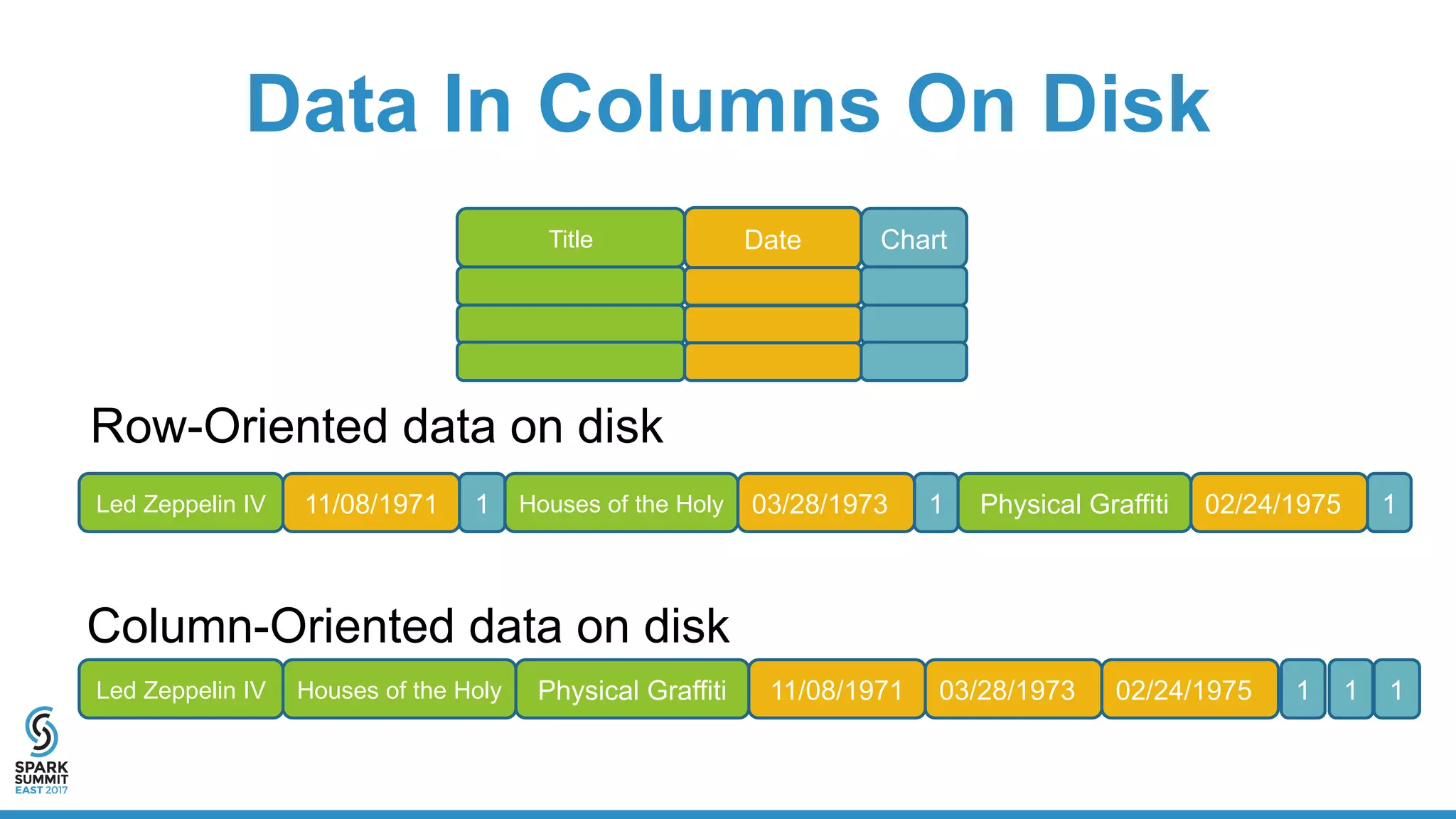
Data In Columns On Disk
Led Zeppelin IV 11/08/1971 1 Houses of the Holy 03/28/1973 1 Physical Graffiti 02/24/1975 1
Led Zeppelin IV 11/08/1971 1Houses of the Holy 03/28/1973 1Physical Graffiti 02/24/1975 1
Row-Oriented data on disk
Column-Oriented data on disk
Title Date Chart
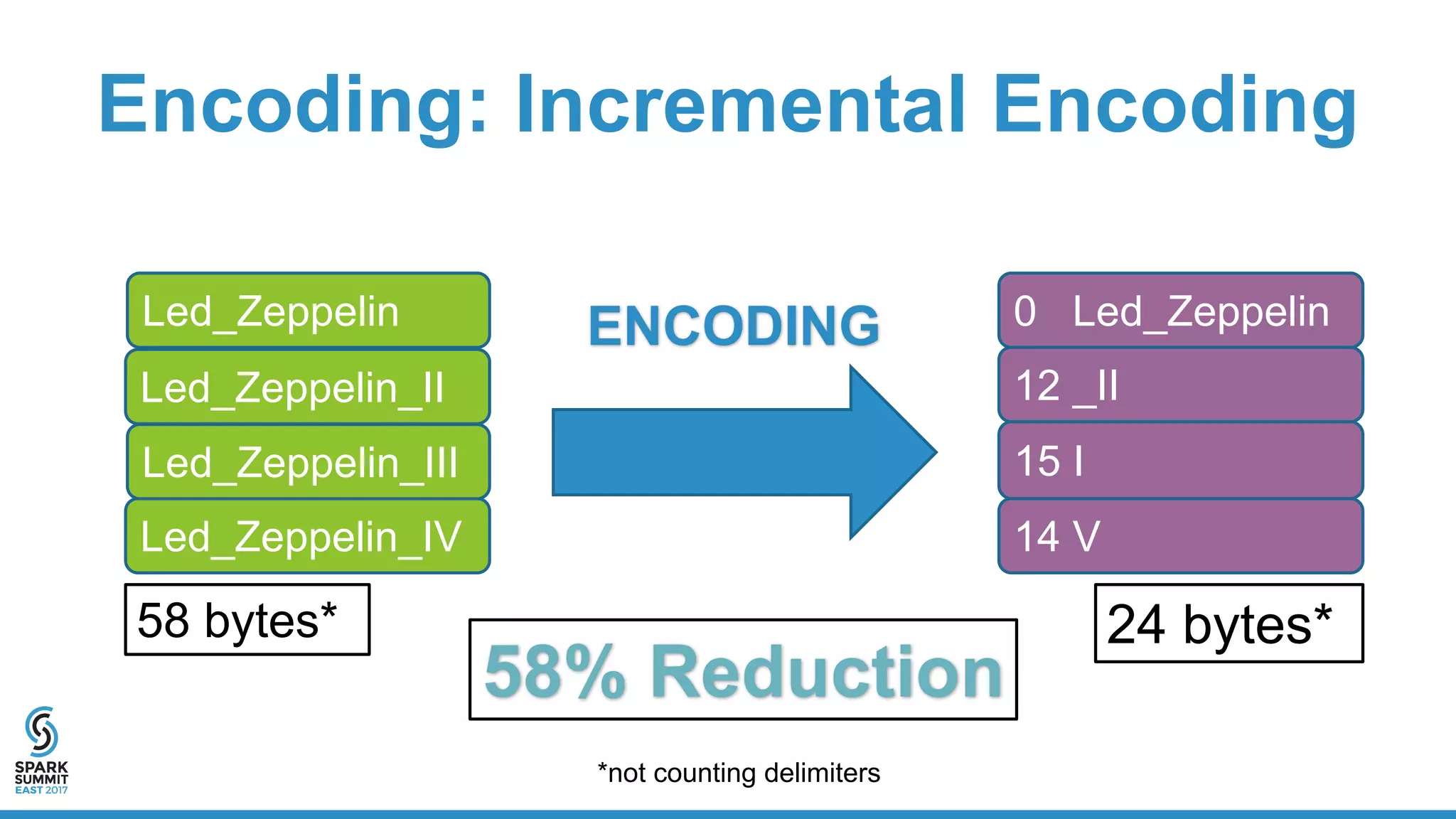
Encoding: Incremental Encoding
Led_Zeppelin_IV
Led_Zeppelin_III
Led_Zeppelin_II
Led_Zeppelin 0 Led_Zeppelin
12 _II
15 I
14 V
58 bytes* 24 bytes*
*not counting delimiters
ENCODING
58% Reduction
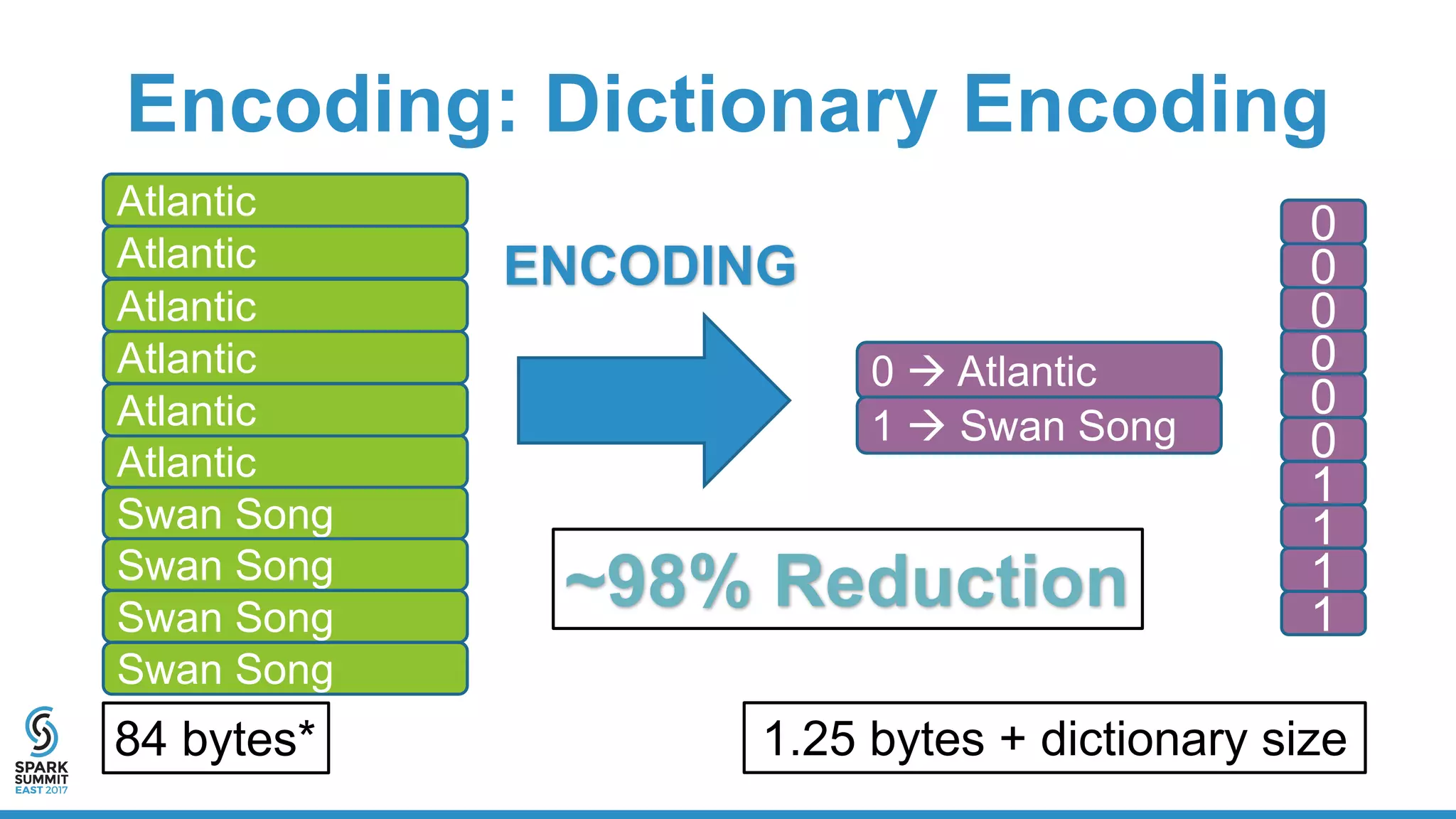
Encoding: Dictionary Encoding
ENCODING
Atlantic
Swan Song
Atlantic
Atlantic
Atlantic
Atlantic
Atlantic
Swan Song
Swan Song
Swan Song
84 bytes*
0
1
0
0
0
0
0
1
1
1
0 à Atlantic
1 à Swan Song
1.25 bytes + dictionary size
~98% Reduction
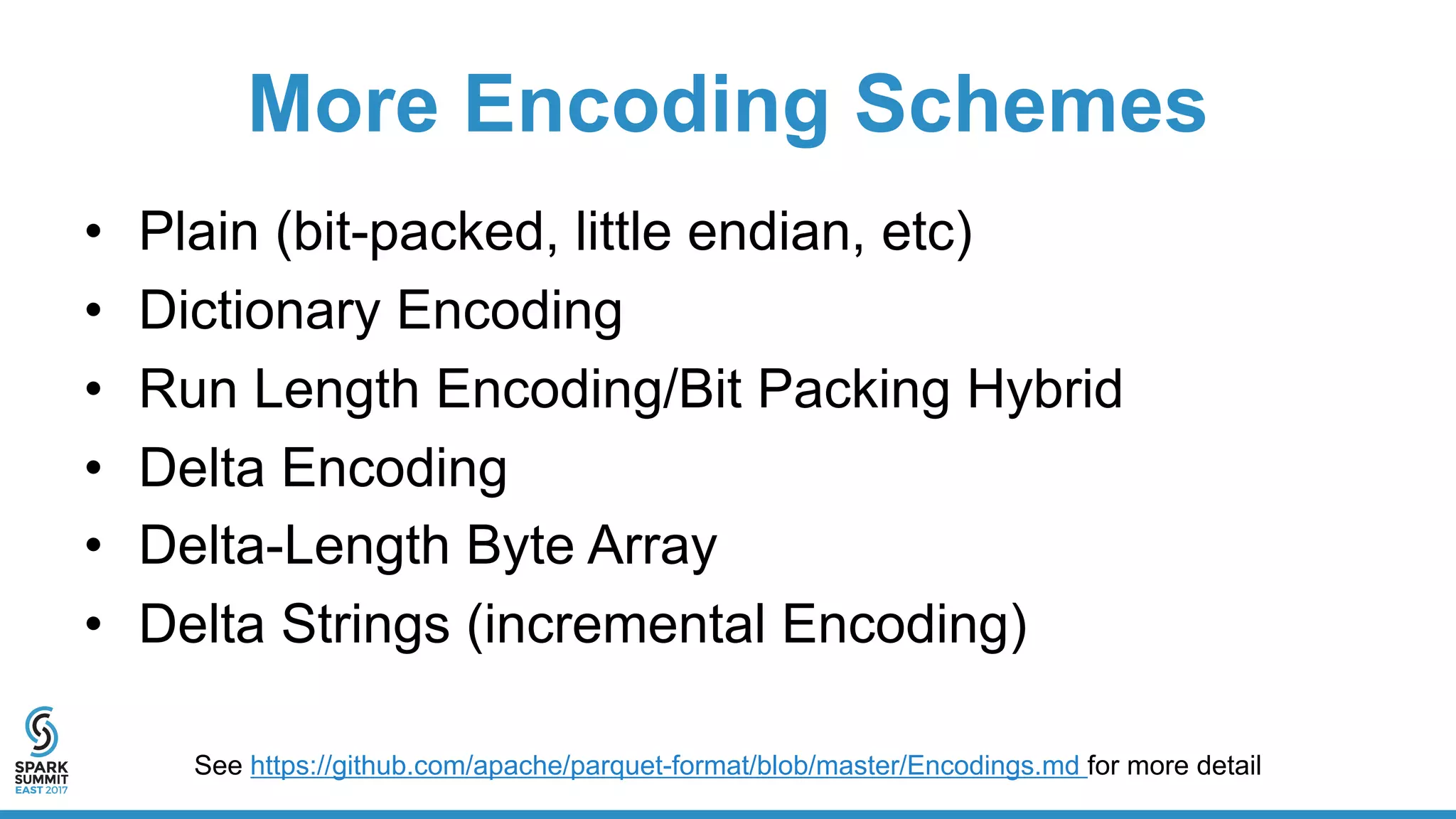
More Encoding Schemes
• Plain (bit-packed, little endian, etc)
• Dictionary Encoding
• Run Length Encoding/Bit Packing Hybrid
• Delta Encoding
• Delta-Length Byte Array
• Delta Strings (incremental Encoding)
See https://github.com/apache/parquet-format/blob/master/Encodings.md for more detail
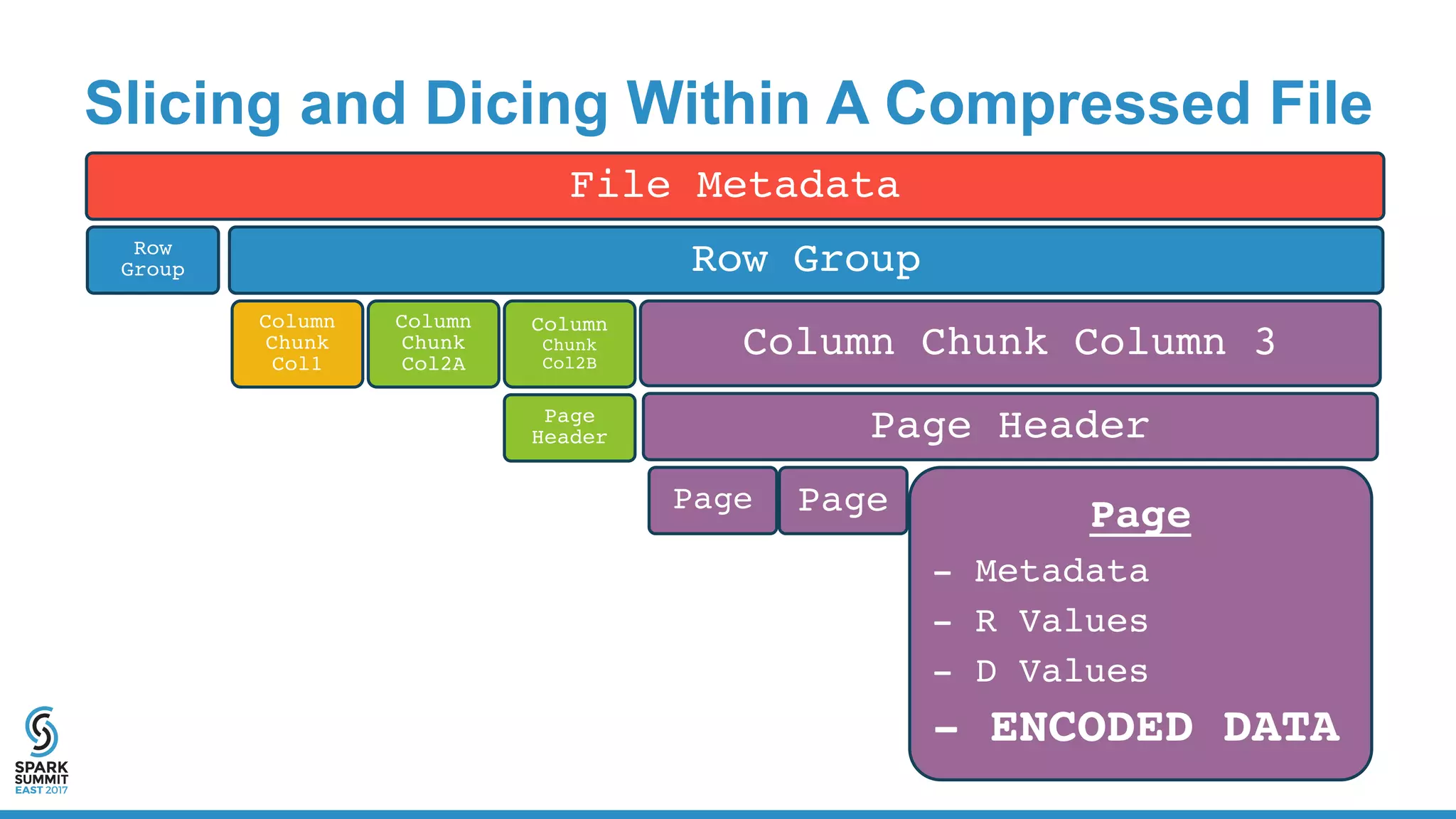
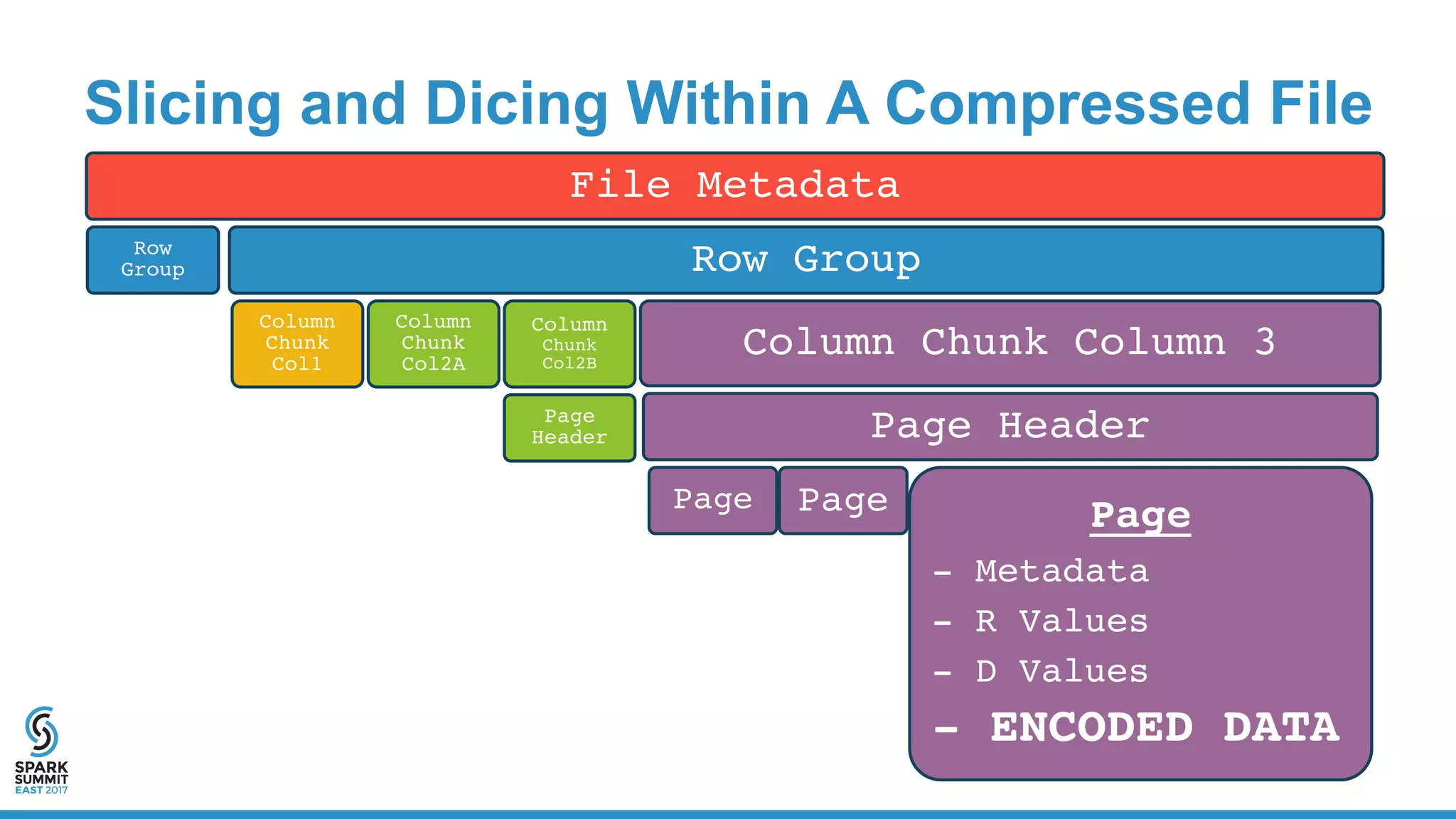
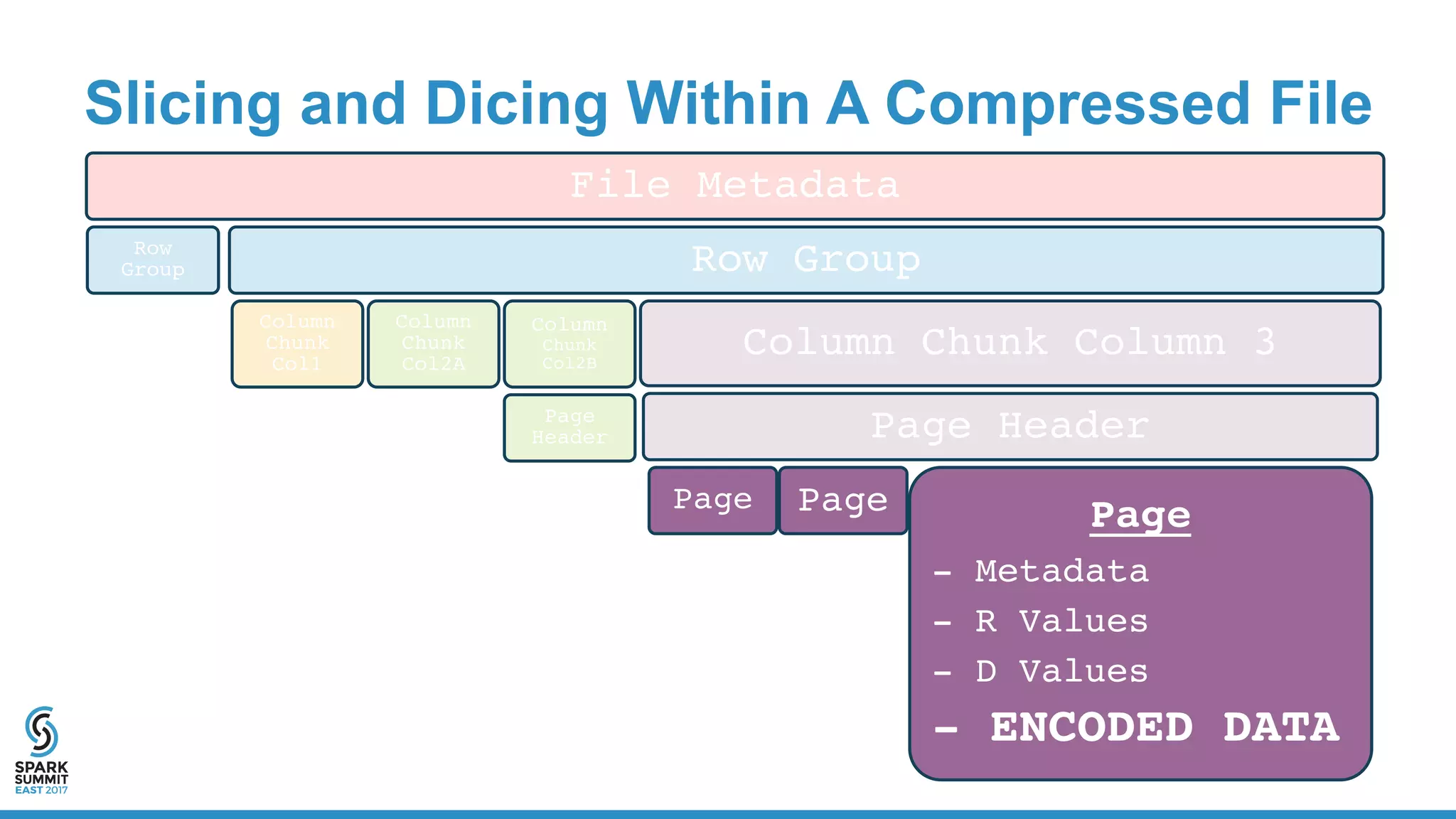
Slicing and Dicing Within A Compressed File
File Metadata
Row
Group Row Group
Column
Chunk
Col1
Column
Chunk
Col2A
Column
Chunk
Col2B
Page
Header
Column Chunk Column 3
Page Header
Page Page Page
- Metadata
- R Values
- D Values
- ENCODED DATA
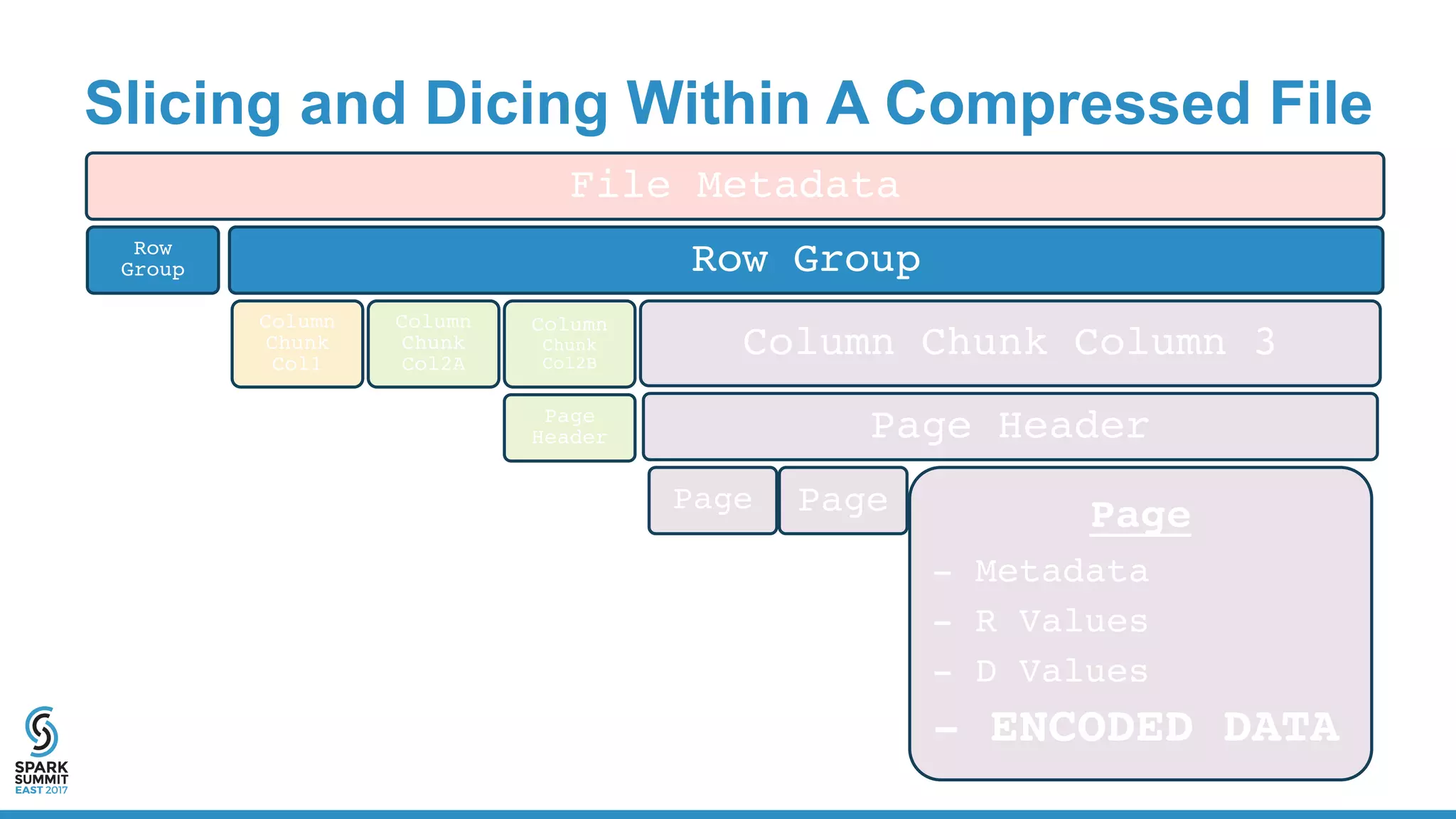
Slicing and Dicing Within A Compressed File
File Metadata
Row
Group Row Group
Column
Chunk
Col1
Column
Chunk
Col2A
Column
Chunk
Col2B
Page
Header
Column Chunk Column 3
Page Header
Page Page Page
- Metadata
- R Values
- D Values
- ENCODED DATA
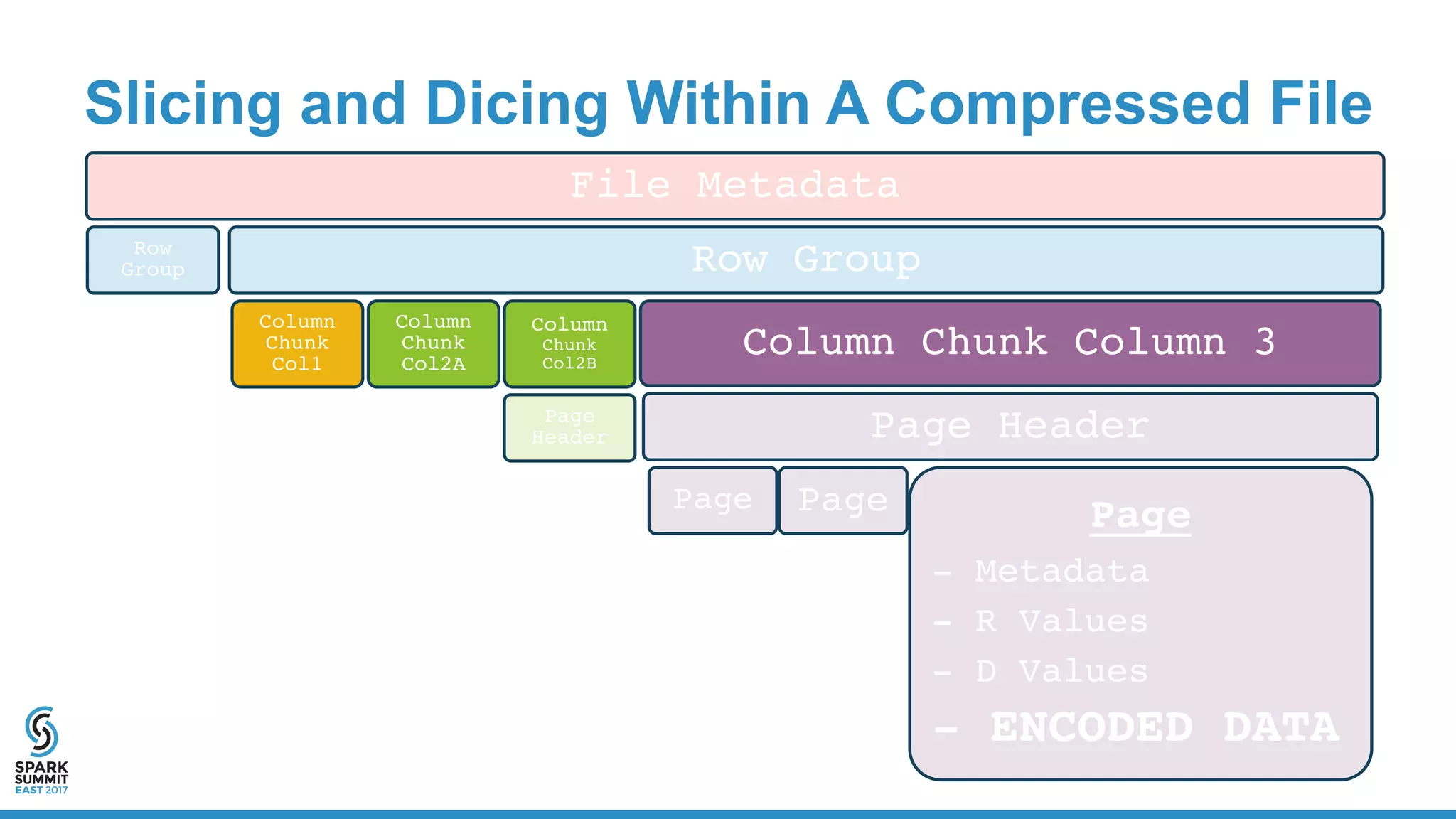
Slicing and Dicing Within A Compressed File
File Metadata
Row
Group Row Group
Column
Chunk
Col1
Column
Chunk
Col2A
Column
Chunk
Col2B
Page
Header
Column Chunk Column 3
Page Header
Page Page Page
- Metadata
- R Values
- D Values
- ENCODED DATA
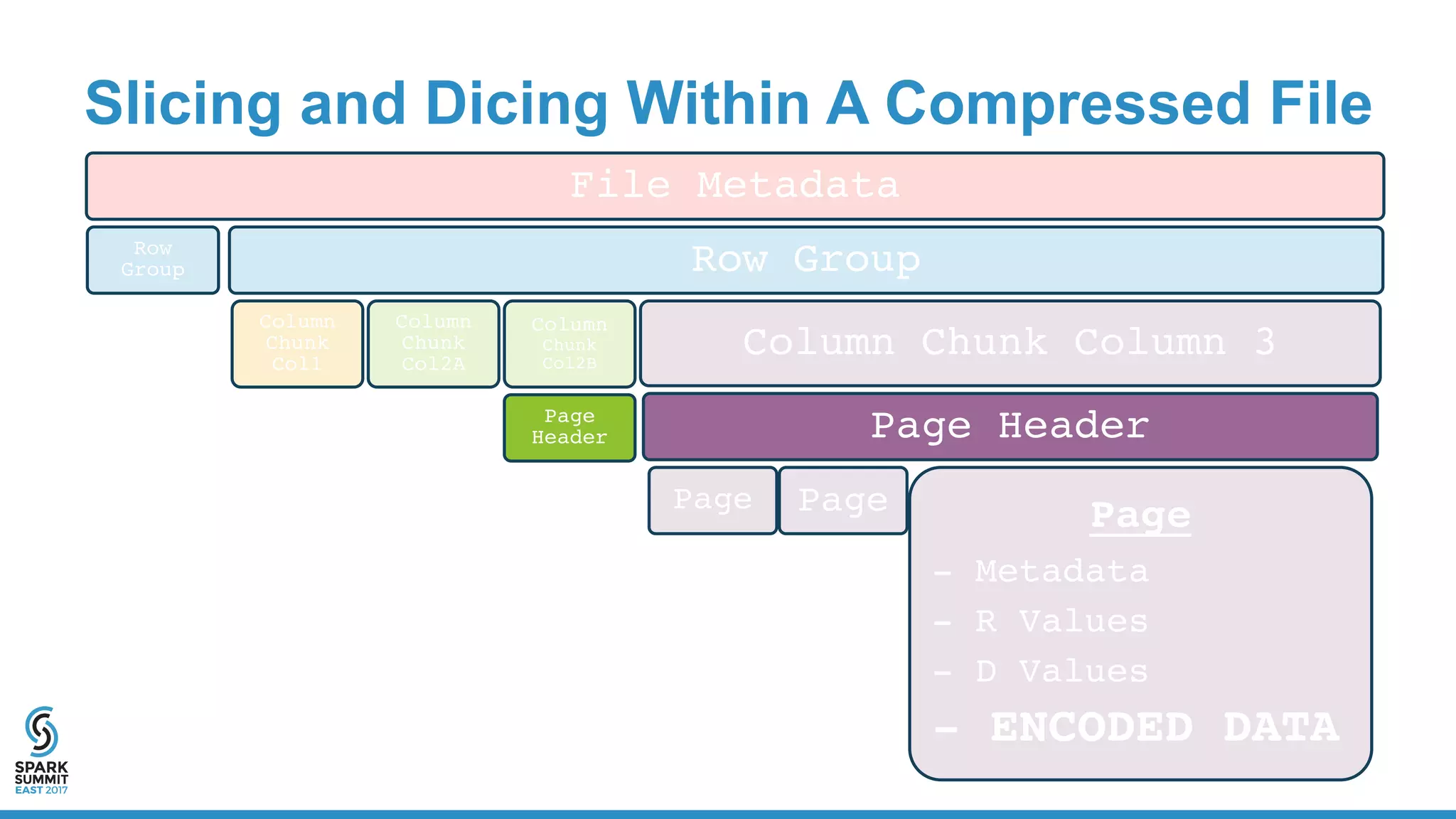
Slicing and Dicing Within A Compressed File
File Metadata
Row
Group Row Group
Column
Chunk
Col1
Column
Chunk
Col2A
Column
Chunk
Col2B
Page
Header
Column Chunk Column 3
Page Header
Page Page Page
- Metadata
- R Values
- D Values
- ENCODED DATA
Slicing and Dicing Within A Compressed File
File Metadata
Row
Group Row Group
Column
Chunk
Col1
Column
Chunk
Col2A
Column
Chunk
Col2B
Page
Header
Column Chunk Column 3
Page Header
Page Page Page
- Metadata
- R Values
- D Values
- ENCODED DATA
Slicing and Dicing Within A Compressed File
File Metadata
Row
Group Row Group
Column
Chunk
Col1
Column
Chunk
Col2A
Column
Chunk
Col2B
Page
Header
Column Chunk Column 3
Page Header
Page Page Page
- Metadata
- R Values
- D Values
- ENCODED DATA
Slicing and Dicing Within A Compressed File
File Metadata
Row
Group Row Group
Column
Chunk
Col1
Column
Chunk
Col2A
Column
Chunk
Col2B
Page
Header
Column Chunk Column 3
Page Header
Page Page Page
- Metadata
- R Values
- D Values
- ENCODED DATA
Slicing and Dicing Within A Compressed File
File Metadata
Row
Group Row Group
Column
Chunk
Col1
Column
Chunk
Col2A
Column
Chunk
Col2B
Page
Header
Column Chunk Column 3
Page Header
Page Page Page
- Metadata
- R Values
- D Values
- ENCODED DATA
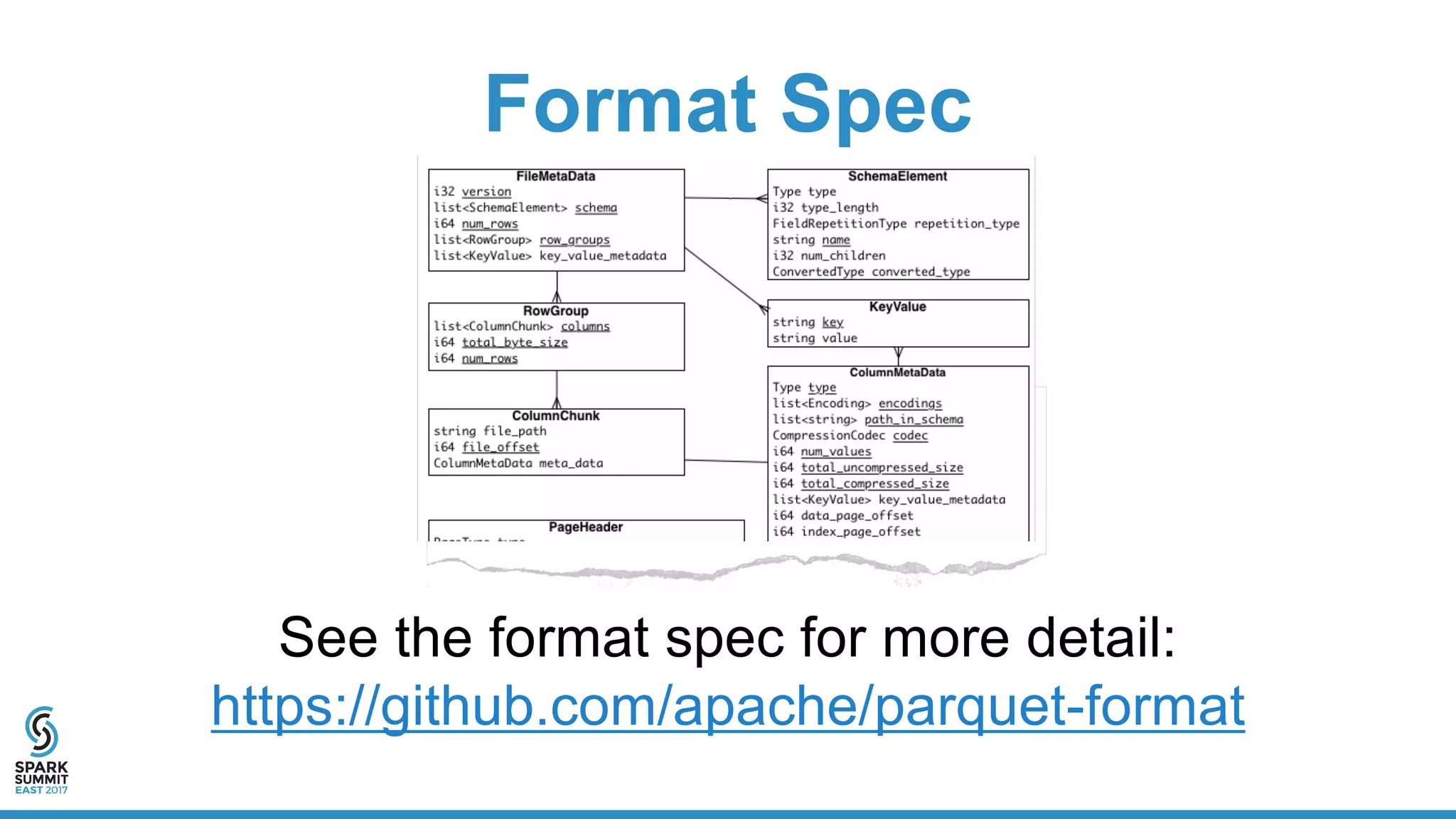
Format Spec
See the format spec for more detail:
https://github.com/apache/parquet-format
Getting Efficiency With Spark
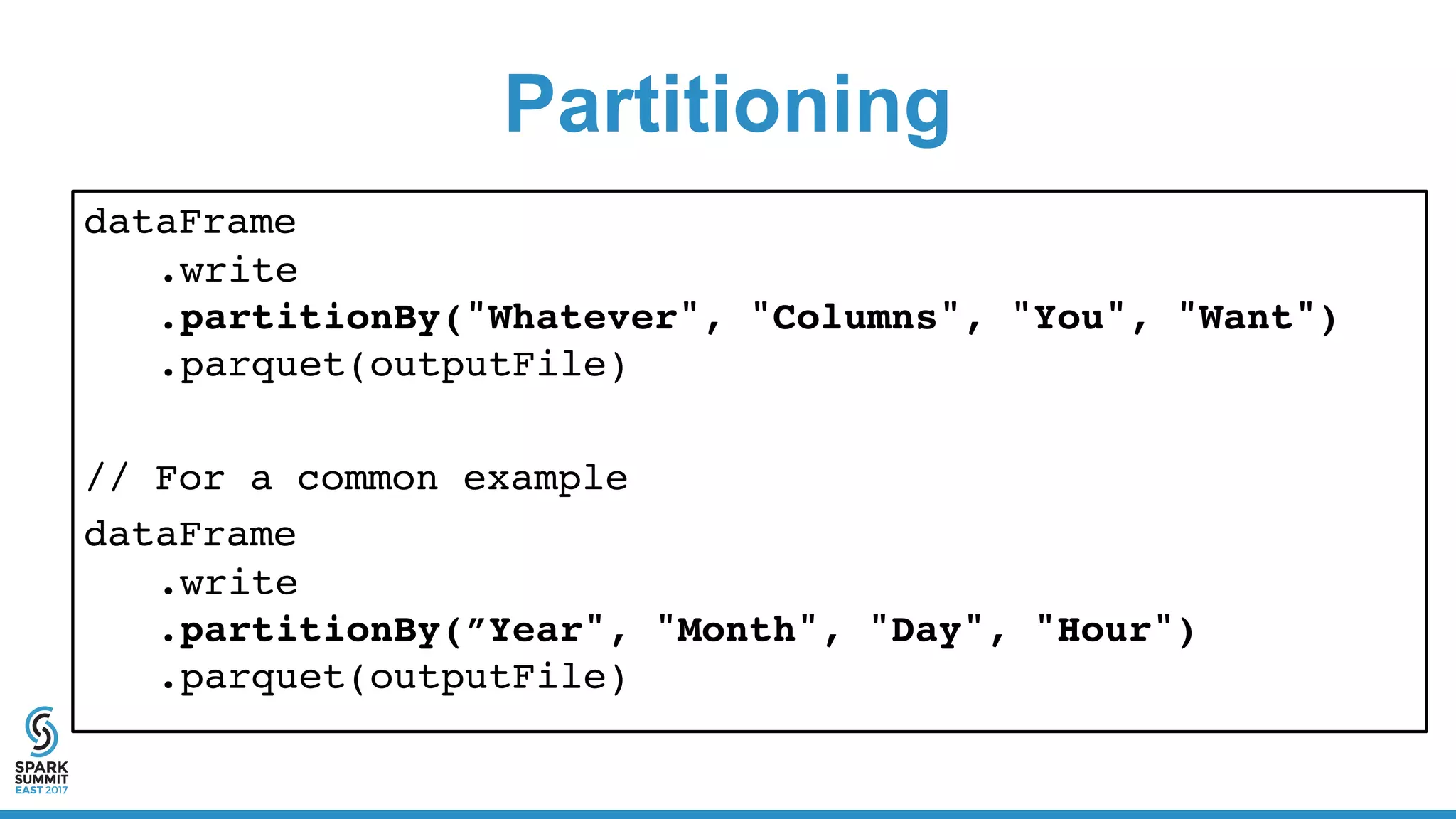
Partitioning
dataFrame
.write
.partitionBy("Whatever", "Columns", "You", "Want")
.parquet(outputFile)
// For a common example
dataFrame
.write
.partitionBy(”Year", "Month", "Day", "Hour")
.parquet(outputFile)
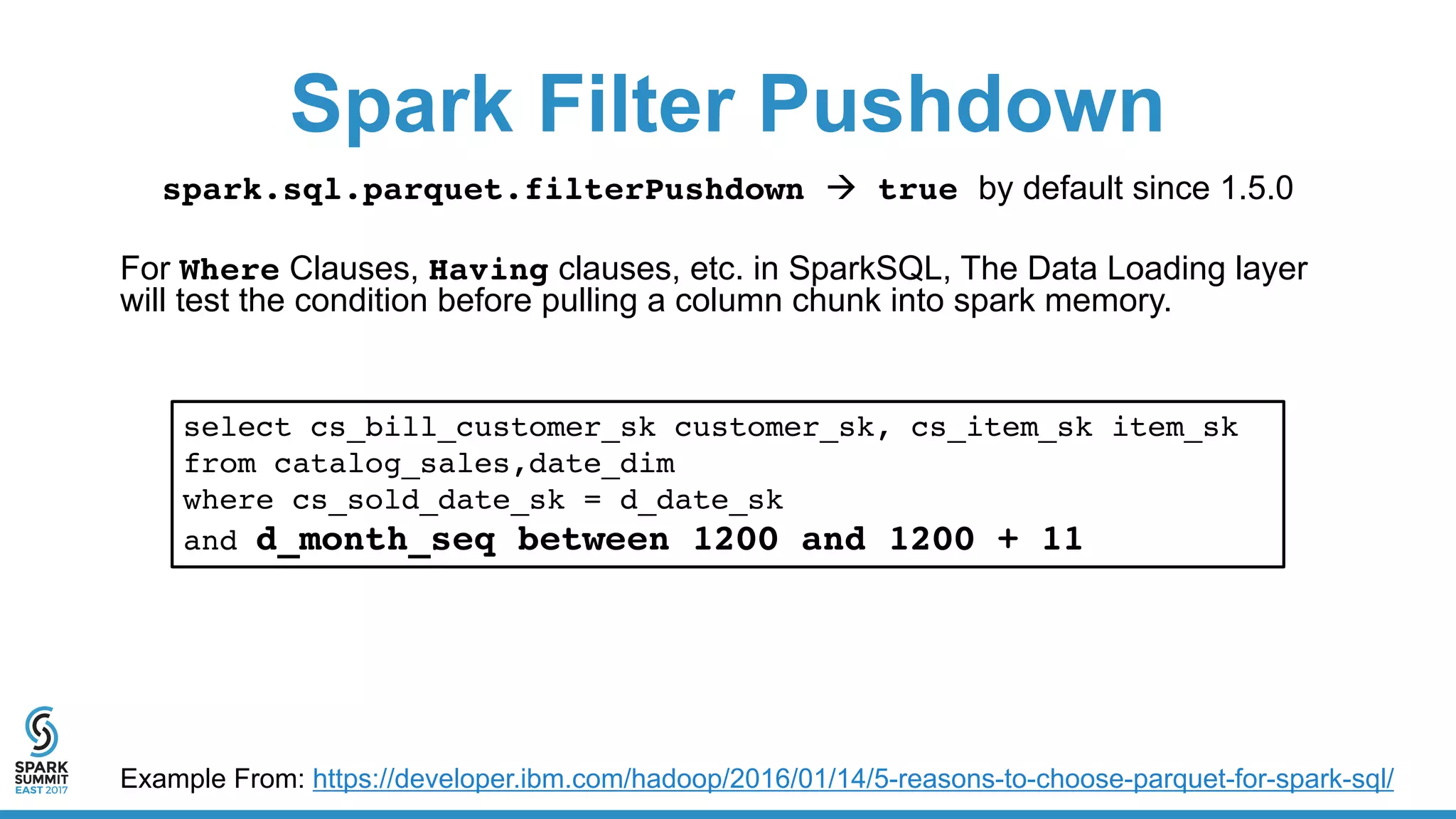
Spark Filter Pushdown
spark.sql.parquet.filterPushdown à true by default since 1.5.0
For Where Clauses, Having clauses, etc. in SparkSQL, The Data Loading layer
will test the condition before pulling a column chunk into spark memory.
select cs_bill_customer_sk customer_sk, cs_item_sk item_sk
from catalog_sales,date_dim
where cs_sold_date_sk = d_date_sk
and d_month_seq between 1200 and 1200 + 11
Example From: https://developer.ibm.com/hadoop/2016/01/14/5-reasons-to-choose-parquet-for-spark-sql/
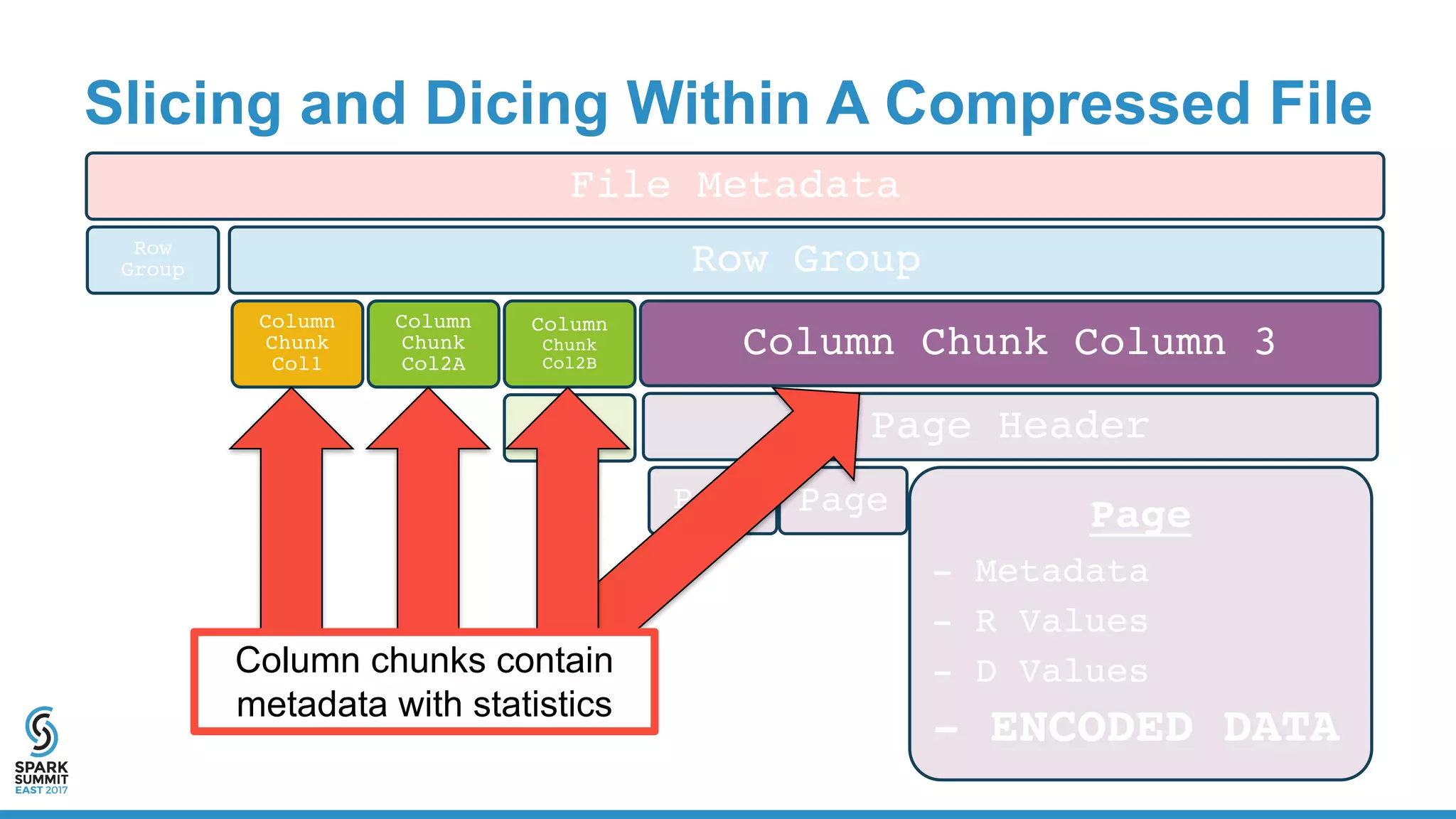
Slicing and Dicing Within A Compressed File
File Metadata
Row
Group Row Group
Column
Chunk
Col1
Column
Chunk
Col2A
Column
Chunk
Col2B
Page
Header
Column Chunk Column 3
Page Header
Page Page Page
- Metadata
- R Values
- D Values
- ENCODED DATA
Column chunks contain
metadata with statistics
Physical Plan for Reading CSV
[ Scan
CsvRelation(hdfs://rhel10.cisco.com/user/spark/hadoopds1000g/date_dim/*,false,|,",null,PERMISS
IVE,COMMONS,false,false,StructType(StructField(d_date_sk,IntegerType,false),
StructField(d_date_id,StringType,false), StructField(d_date,StringType,true),
StructField(d_month_seq,LongType,true), StructField(d_week_seq,LongType,true),
StructField(d_quarter_seq,LongType,true), StructField(d_year,LongType,true),
StructField(d_dow,LongType,true), StructField(d_moy,LongType,true),
StructField(d_dom,LongType,true), StructField(d_qoy,LongType,true),
StructField(d_fy_year,LongType,true), StructField(d_fy_quarter_seq,LongType,true),
StructField(d_fy_week_seq,LongType,true), StructField(d_day_name,StringType,true),
StructField(d_quarter_name,StringType,true), StructField(d_holiday,StringType,true),
StructField(d_weekend,StringType,true), StructField(d_following_holiday,StringType,true),
StructField(d_first_dom,LongType,true), StructField(d_last_dom,LongType,true),
StructField(d_same_day_ly,LongType,true), StructField(d_same_day_lq,LongType,true),
StructField(d_current_day,StringType,true), StructField(d_current_week,StringType,true),
StructField(d_current_month,StringType,true), StructField(d_current_quarter,StringType,true),
StructField(d_current_year,StringType,true)))[d_date_sk#141,d_date_id#142,d_date#143,d_month_s
eq#144L,d_week_seq#145L,d_quarter_seq#146L,d_year#147L,d_dow#148L,d_moy#149L,d_dom#150L,d_qoy#
151L,d_fy_year#152L,d_fy_quarter_seq#153L,d_fy_week_seq#154L,d_day_name#155,d_quarter_name#156
,d_holiday#157,d_weekend#158,d_following_holiday#159,d_first_dom#160L,d_last_dom#161L,d_same_d
ay_ly#162L,d_same_day_lq#163L,d_current_day#164,d_current_week#165,d_current_month#166,d_curre
nt_quarter#167,d_current_year#168]]
Example From: https://developer.ibm.com/hadoop/2016/01/14/5-reasons-to-choose-parquet-for-spark-sql/
Physical Plan For Reading Parquet
+- Scan ParquetRelation[d_date_sk#141,d_month_seq#144L] InputPaths:
hdfs://rhel10.cisco.com/user/spark/hadoopds1tbparquet/date_dim/_SUCCESS,
hdfs://rhel10.cisco.com/user/spark/hadoopds1tbparquet/date_dim/_common_metadata
, hdfs://rhel10.cisco.com/user/spark/hadoopds1tbparquet/date_dim/_metadata,
hdfs://rhel10.cisco.com/user/spark/hadoopds1tbparquet/date_dim/part-r-00000-
4d205b7e-b21d-4e8b-81ac-d2a1f3dd3246.gz.parquet,
hdfs://rhel10.cisco.com/user/spark/hadoopds1tbparquet/date_dim/part-r-00001-
4d205b7e-b21d-4e8b-81ac-d2a1f3dd3246.gz.parquet, PushedFilters:
[GreaterThanOrEqual(d_month_seq,1200),
LessThanOrEqual(d_month_seq,1211)]]
Example From: https://developer.ibm.com/hadoop/2016/01/14/5-reasons-to-choose-parquet-for-spark-sql/
Get JUST the Data You Need
• Get just the partitions you need
• Get just the columns you need
• Get just the chunks of the columns that fit your
filter conditions
What’s the Catch?
Limitations, Write Speed, Immutability
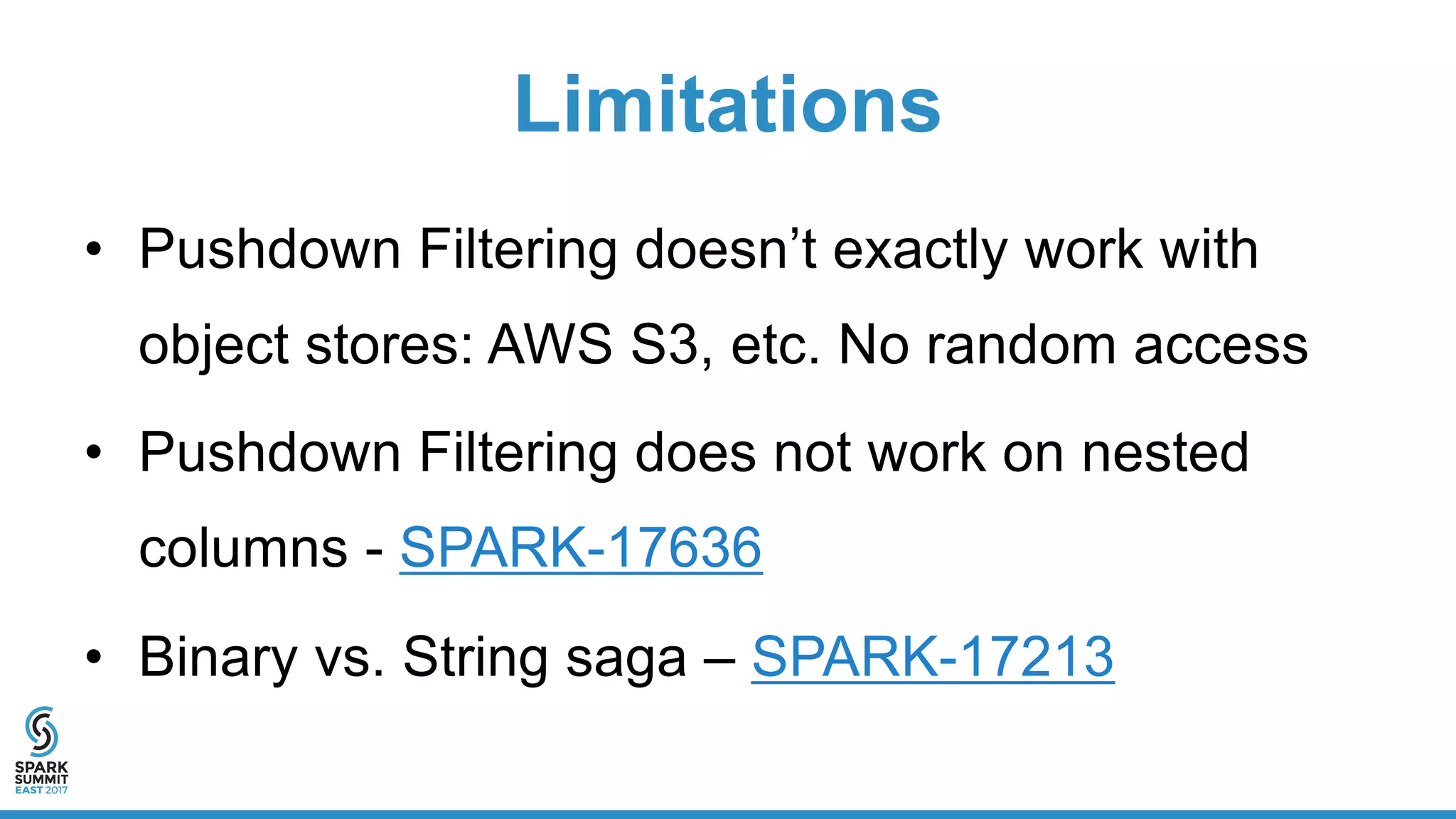
Limitations
• Pushdown Filtering doesn’t exactly work with
object stores: AWS S3, etc. No random access
• Pushdown Filtering does not work on nested
columns - SPARK-17636
• Binary vs. String saga – SPARK-17213
Write Speed à Who Cares!!
(In Most Cases)
Write Once
Read Forever
Which case will you optimize for?
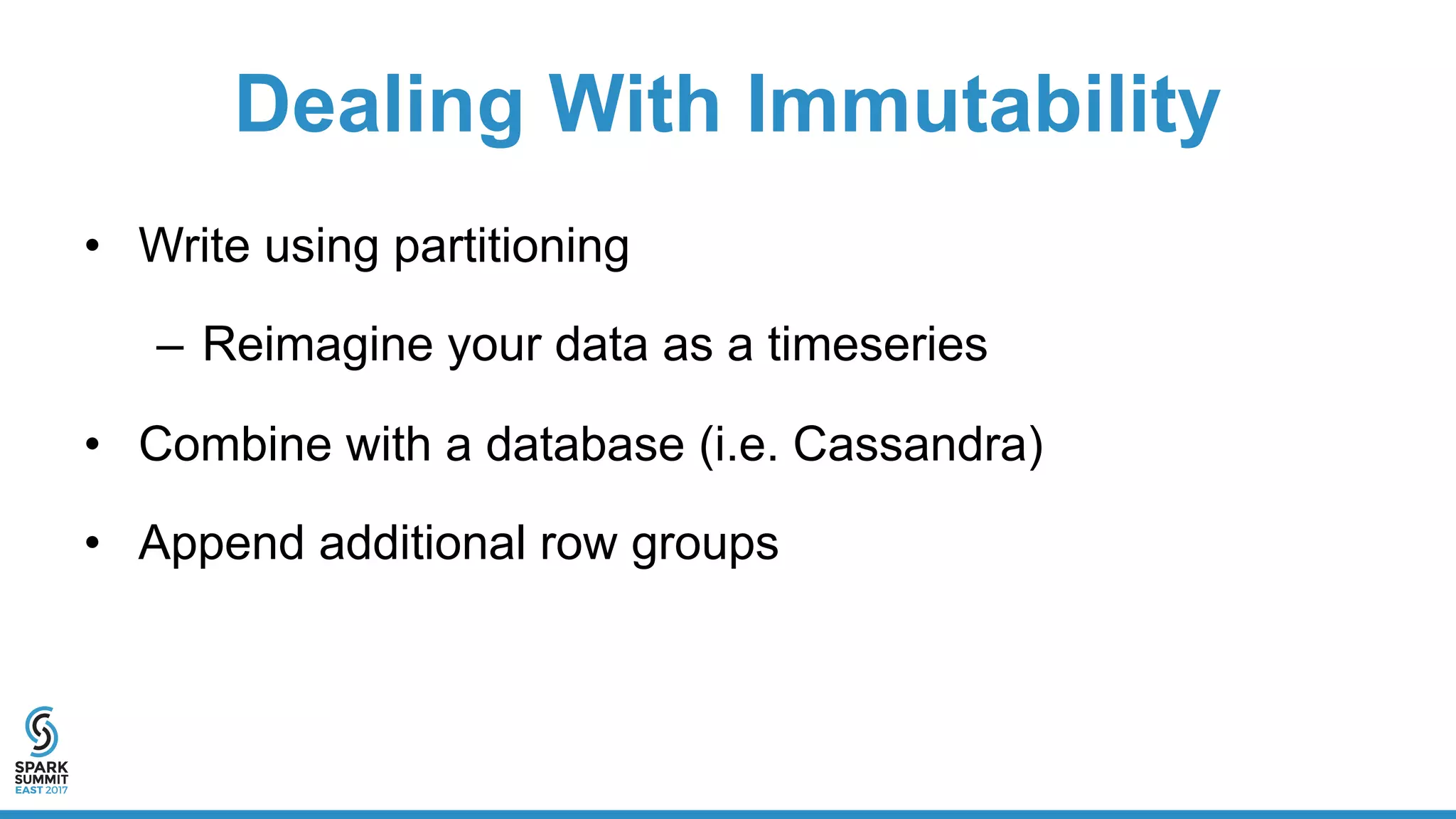
Dealing With Immutability
• Write using partitioning
– Reimagine your data as a timeseries
• Combine with a database (i.e. Cassandra)
• Append additional row groups
Parquet in a Streaming Context
Ongoing project In the Watson Data Platform
• Collect until watermark condition is met (time, size, number of
rows, etc.)
• Groom collection
• Write groomed rows to parquet
• Append to existing as additional compressed files
Tuning and Tips for Spark + Parquet
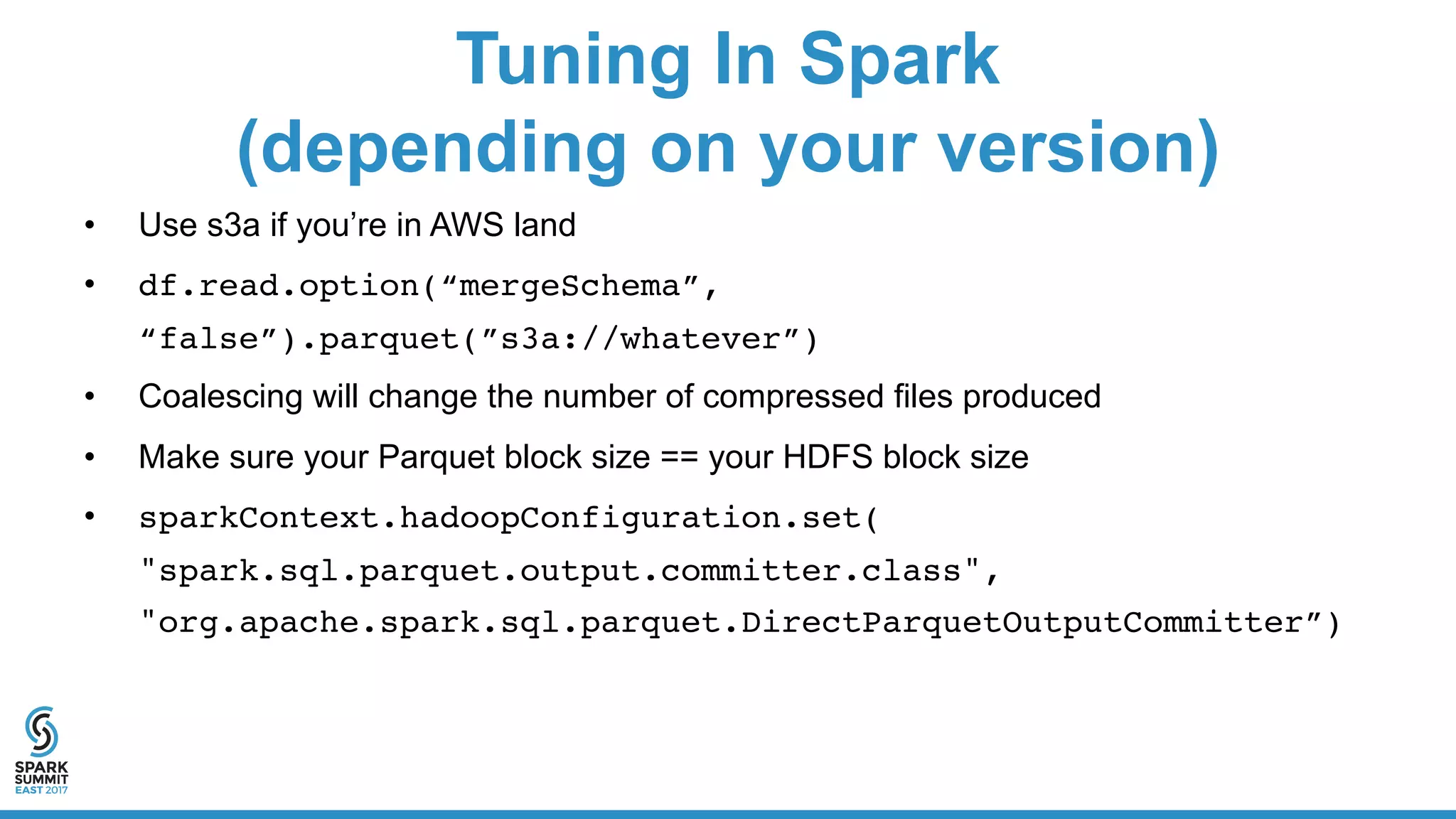
Tuning In Spark
(depending on your version)
• Use s3a if you’re in AWS land
• df.read.option(“mergeSchema”,
“false”).parquet(”s3a://whatever”)
• Coalescing will change the number of compressed files produced
• Make sure your Parquet block size == your HDFS block size
• sparkContext.hadoopConfiguration.set(
"spark.sql.parquet.output.committer.class",
"org.apache.spark.sql.parquet.DirectParquetOutputCommitter”)
Let’s Summarize!
In Summary
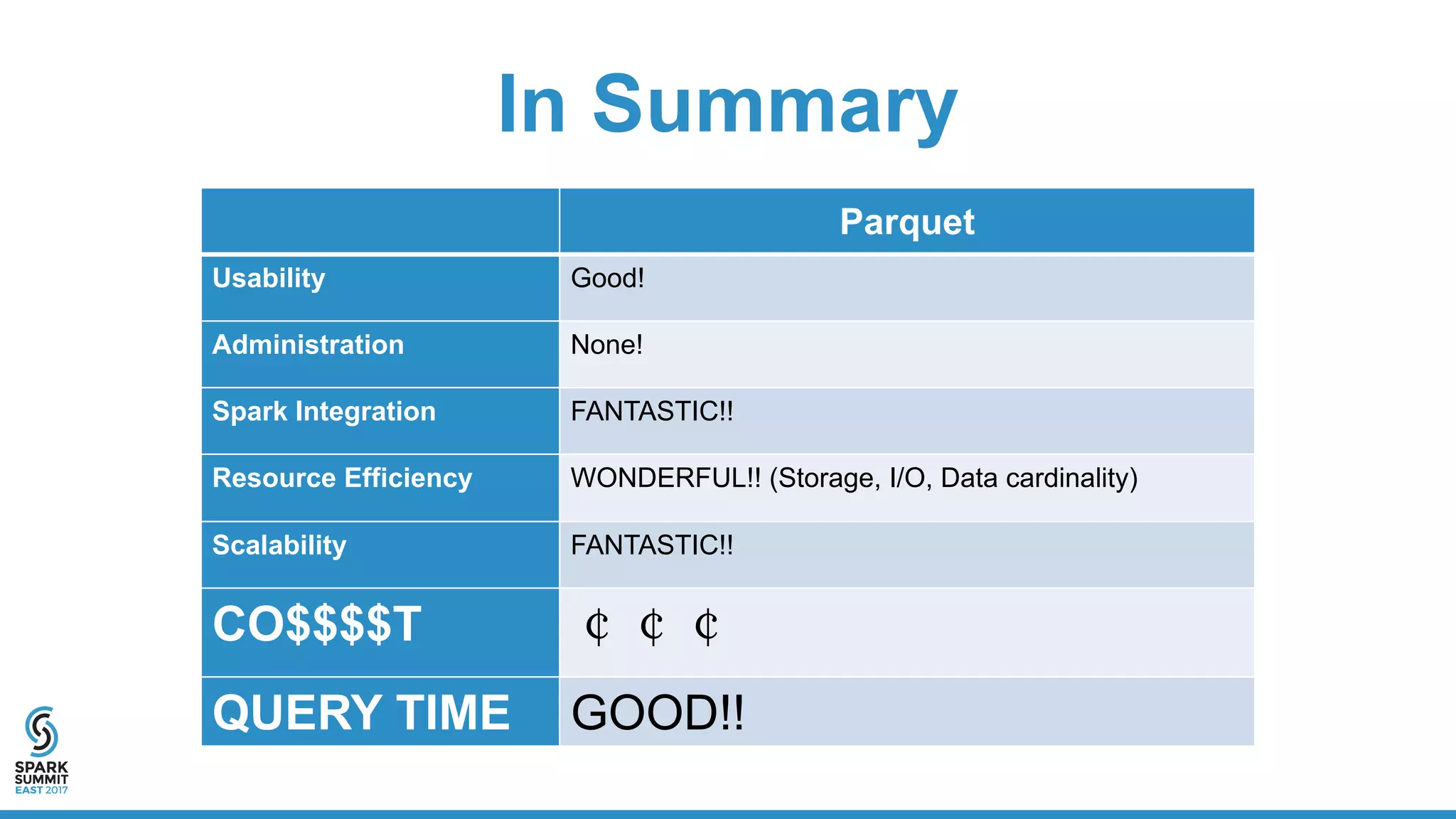
Parquet
Usability Good!
Administration None!
Spark Integration FANTASTIC!!
Resource Efficiency WONDERFUL!! (Storage, I/O, Data cardinality)
Scalability FANTASTIC!!
CO$$$$T ¢¢¢
QUERY TIME GOOD!!
In Summary
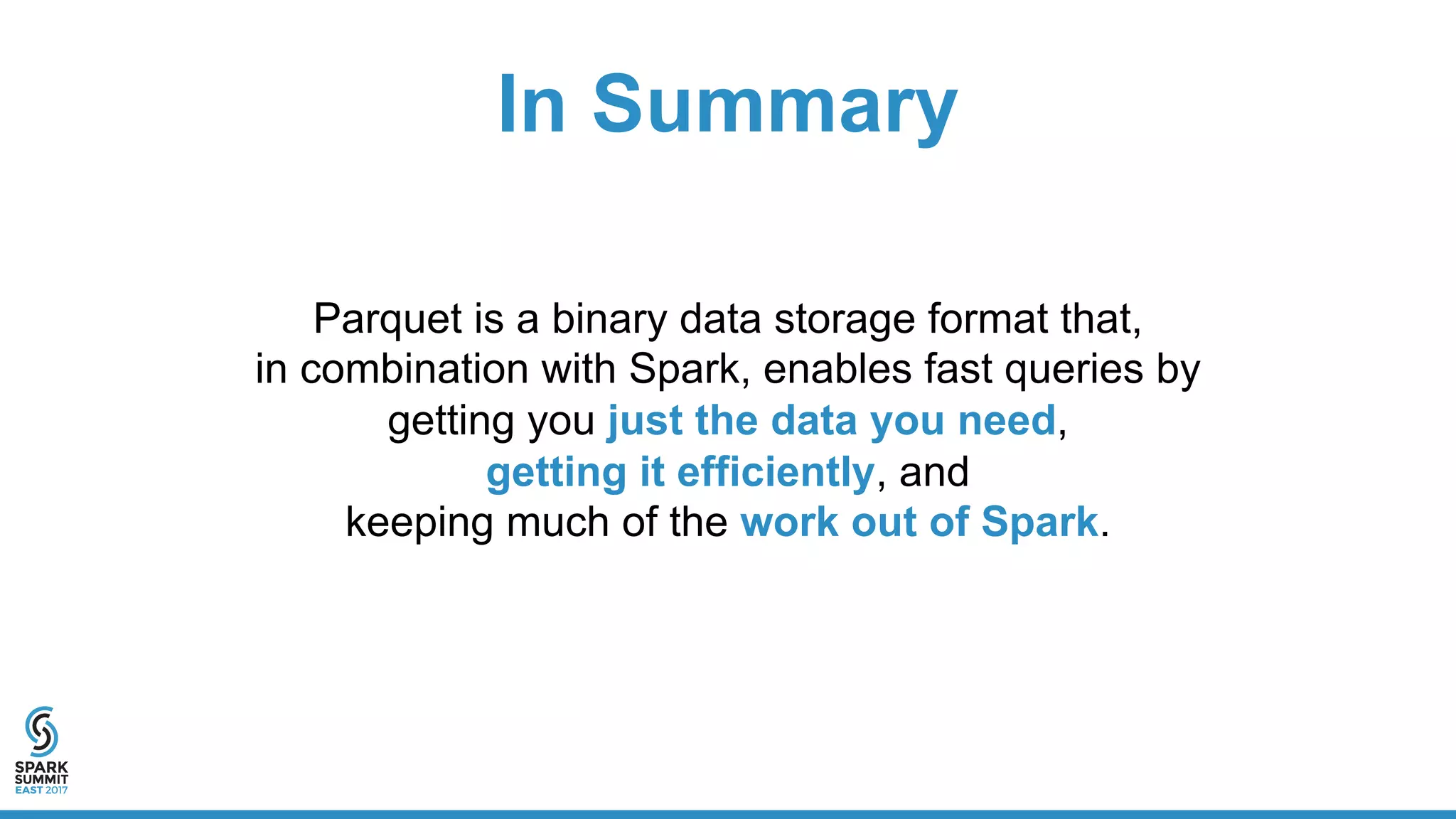
Parquet is a binary data storage format that,
in combination with Spark, enables fast queries by
getting you just the data you need,
getting it efficiently, and
keeping much of the work out of Spark.
The Extra Slides
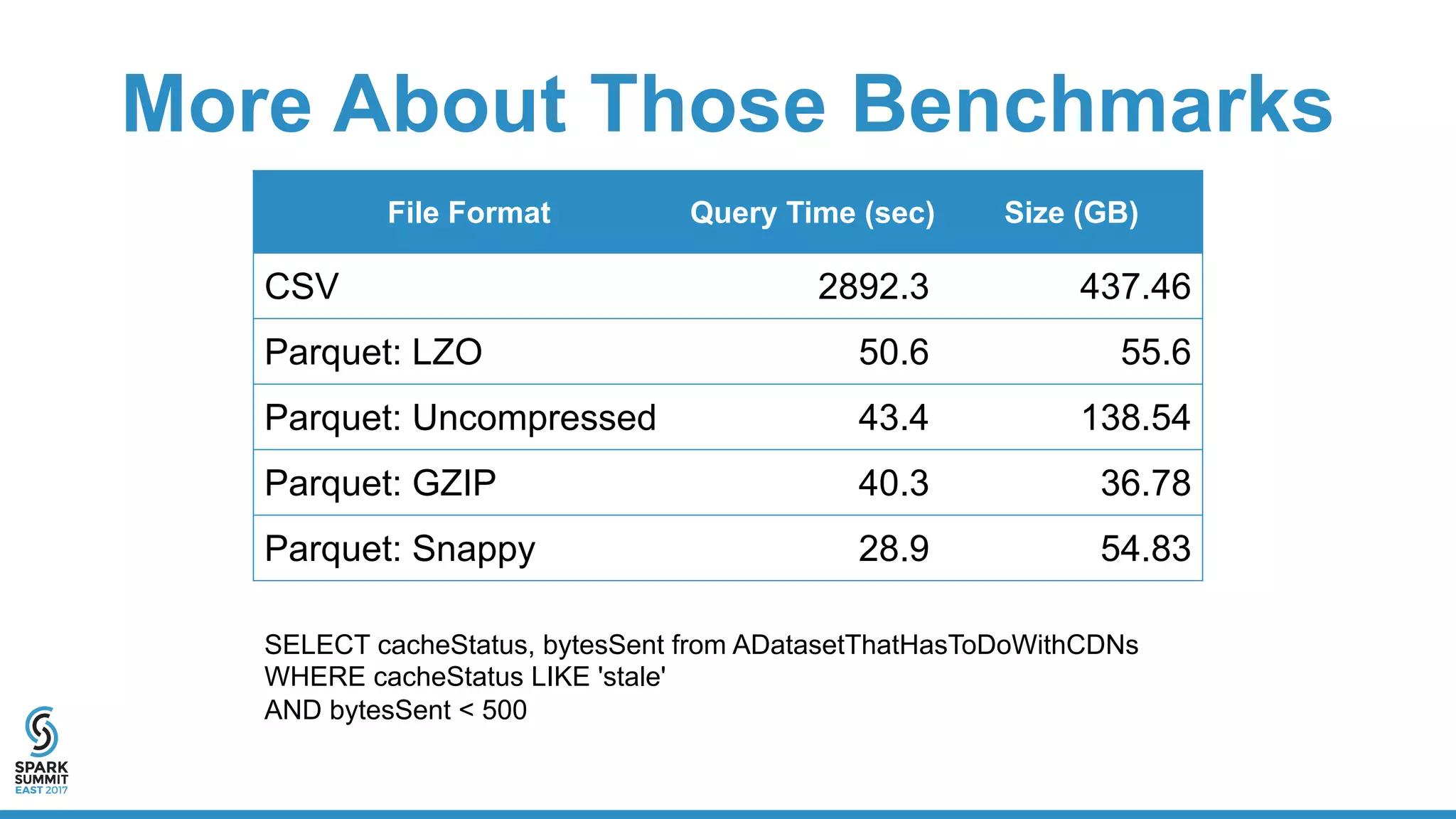
More About Those Benchmarks
File Format Query Time (sec) Size (GB)
CSV 2892.3 437.46
Parquet: LZO 50.6 55.6
Parquet: Uncompressed 43.4 138.54
Parquet: GZIP 40.3 36.78
Parquet: Snappy 28.9 54.83
SELECT cacheStatus, bytesSent from ADatasetThatHasToDoWithCDNs
WHERE cacheStatus LIKE 'stale'
AND bytesSent < 500
More About Those Benchmarks
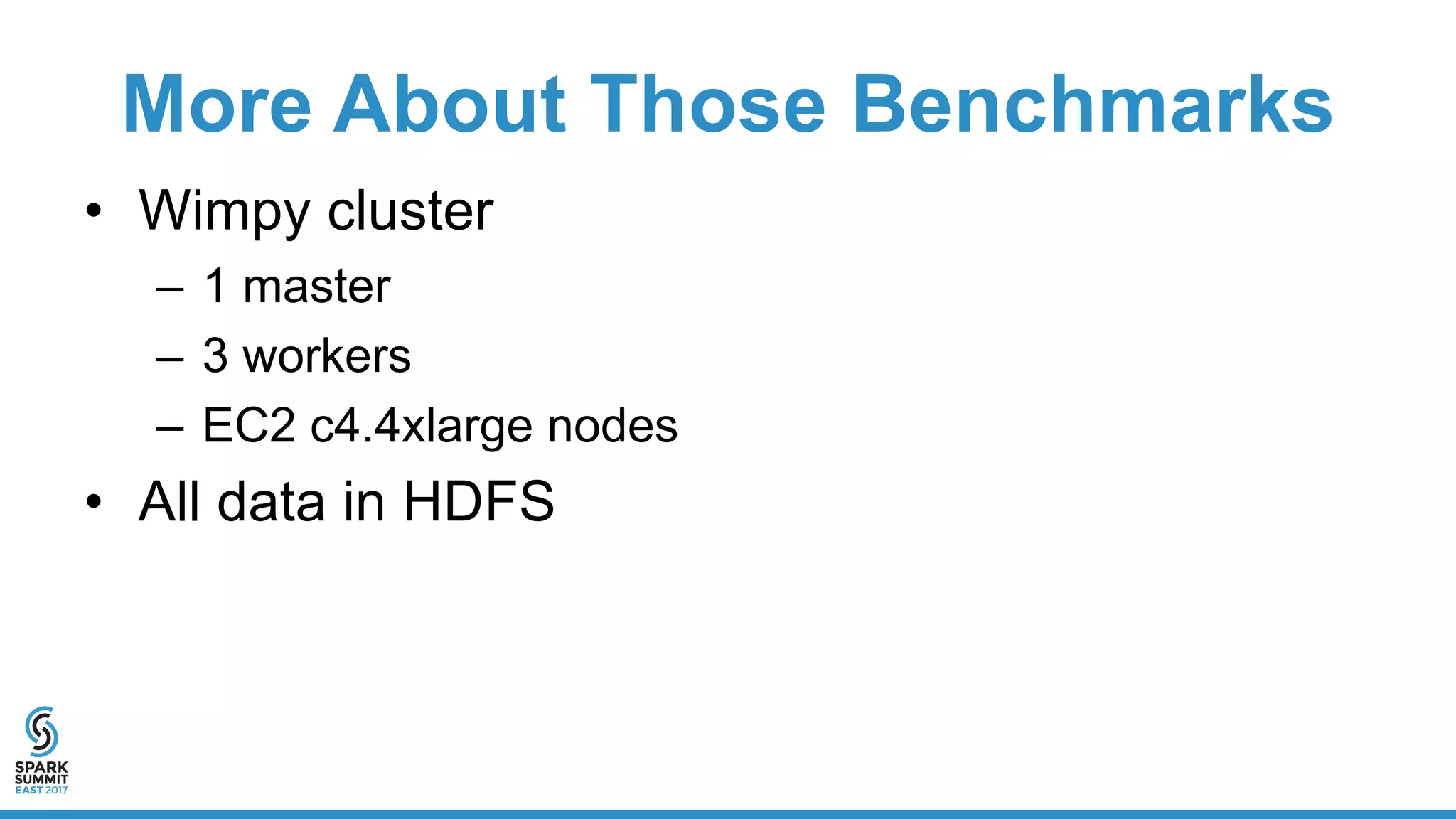
• Wimpy cluster
– 1 master
– 3 workers
– EC2 c4.4xlarge nodes
• All data in HDFS
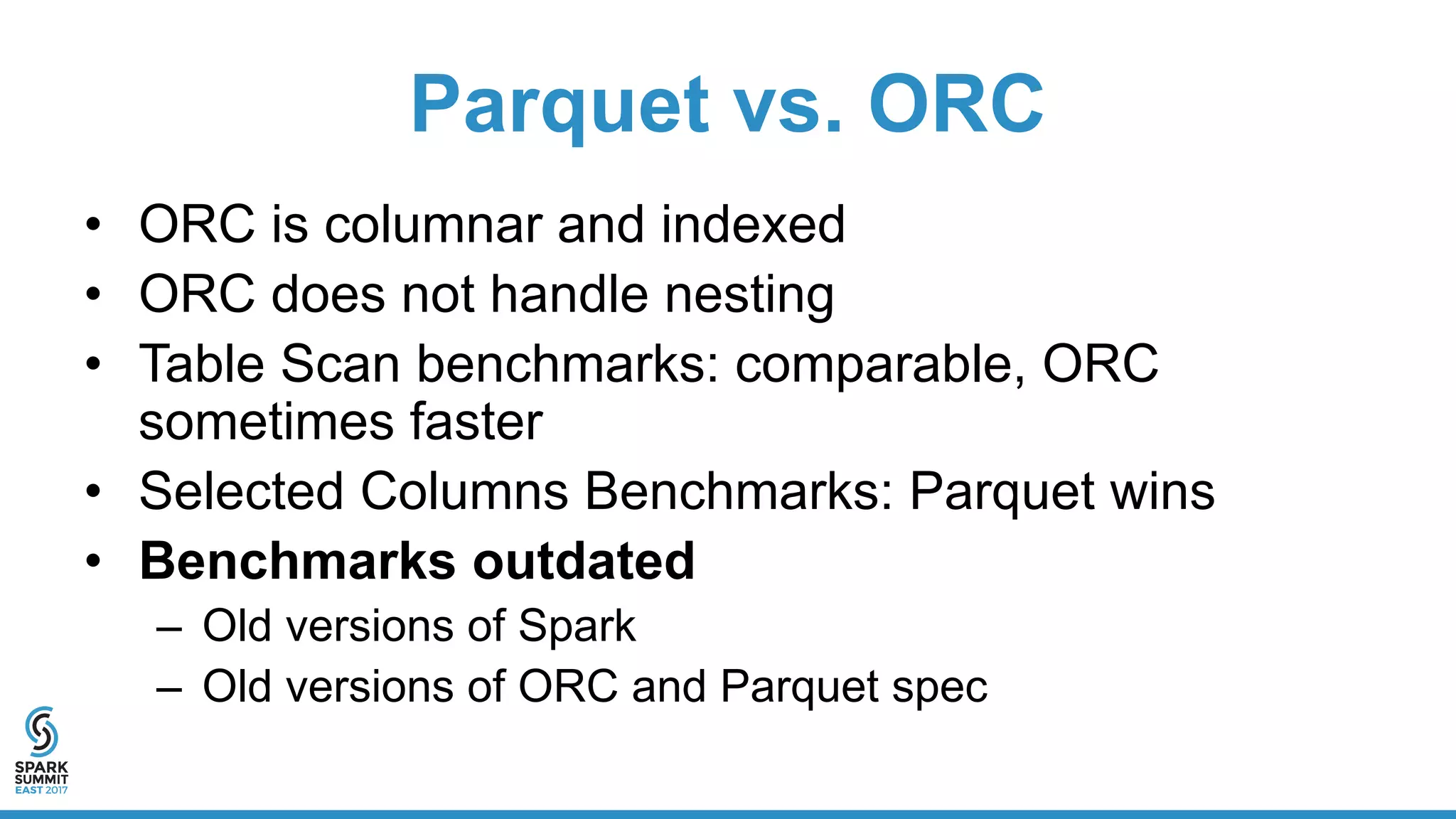
Parquet vs. ORC
• ORC is columnar and indexed
• ORC does not handle nesting
• Table Scan benchmarks: comparable, ORC
sometimes faster
• Selected Columns Benchmarks: Parquet wins
• Benchmarks outdated
– Old versions of Spark
– Old versions of ORC and Parquet spec
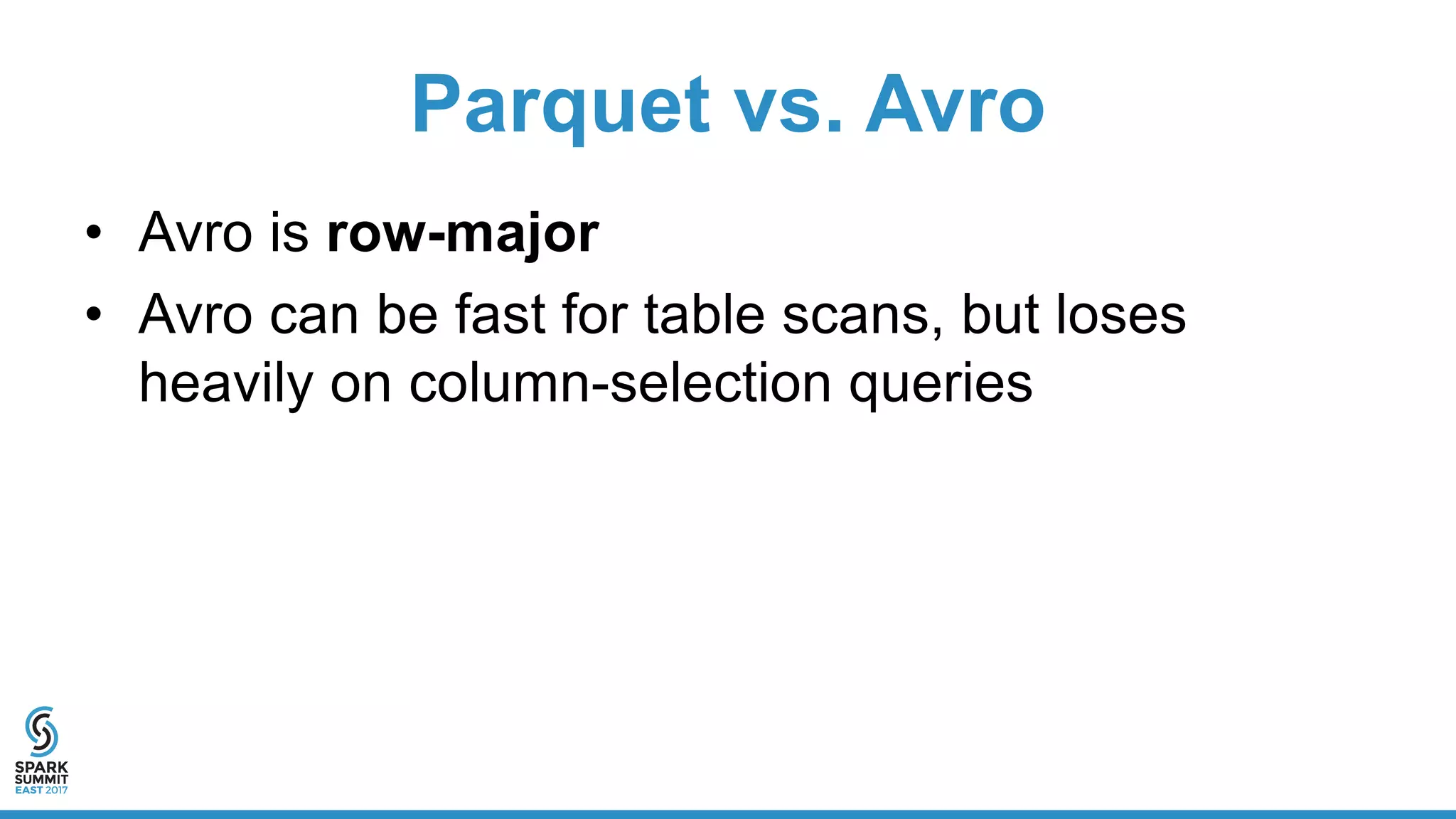
Parquet vs. Avro
• Avro is row-major
• Avro can be fast for table scans, but loses
heavily on column-selection queries
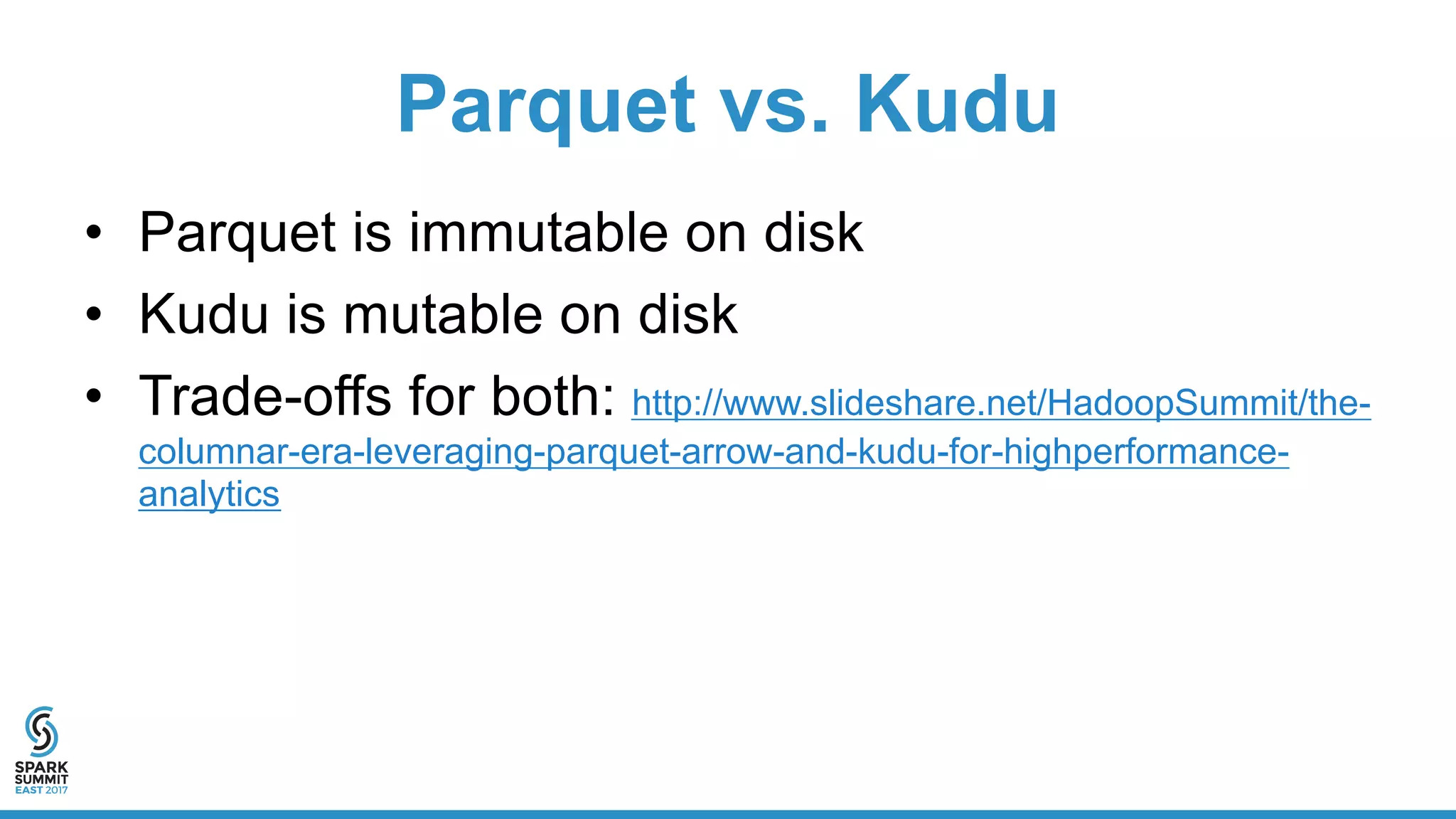
Parquet vs. Kudu
• Parquet is immutable on disk
• Kudu is mutable on disk
• Trade-offs for both: http://www.slideshare.net/HadoopSummit/the-
columnar-era-leveraging-parquet-arrow-and-kudu-for-highperformance-
analytics
Robbie Strickland
VP, Engines & Pipelines, Watson Data Platform
Emily May Curtin
Software Engineer, IBM Spark Technology Center East

Spark + Parquet In Depth: Spark Summit East Talk by Emily Curtin and Robbie Strickland

  • 1.
    Spark + Parquetin Depth Robbie Strickland VP, Engines & Pipelines, Watson Data Platform @rs_atl Emily May Curtin Software Engineer, IBM Spark Technology Center @emilymaycurtin
  • 2.
  • 3.
  • 4.
    Outline • Why Parquet •Parquet by example • How Parquet works • How Spark squeezes out efficiency • What’s the catch • Tuning tips for Spark + Parquet
  • 7.
    Goals for DataLake Storage • Good Usability – Easy to backup – Minimal learning curve – Easy integration with existing tools • Resource efficient – Disk space – Disk I/O Time – Network I/O • AFFORDABLE • CA$$$H MONEY • DEVELOPER HOURS à $$$ • COMPUTE CYCLES à $$$ •FAST QUERIES
  • 8.
    Little Costs Matterat Actual Scale “Very Large Dataset” Weather-Scale Data
  • 9.
    Disk and NetworkI/O Hurt Action Computer Time “Human Scale” Time 1 CPU cycle 0.3 ns 1 s Level 1 cache access 0.9 ns 3 s Level 2 cache access 2.8 ns 9 s Level 3 cache access 12.9 ns 43 s Main memory access 120 ns 6 min Solid-state disk I/O 50-150 μs 2-6 days Rotational disk I/O 1-10 ms 1-12 months Internet: SF to NYC 40 ms 4 years Internet: SF to UK 81 ms 8 years Internet: SF to Australia 183 ms 19 years Source: Systems Performance: Enterprise and the Cloud by Brendan Gregg via CodingHorror.com “The Infinite Space Between Words”
  • 10.
    Options For Multi-PBData Lake Storage Files Compressed Files Databases Usability Great! Great! OK to BAD (not as easy as a file!) Administration None! None! LOTS Spark Integration Great! Great! Varies Resource Efficiency BAD (Big storage, heavy I/O) OK… (Less storage) BAD (Requires storage AND CPU) Scalability Good-ish Good-ish BAD (For multi-petabyte!) CO$$$$T OK… OK… TERRIBLE QUERY TIME TERRIBLE BAD Good!
  • 11.
    CSV vs. ParquetColumn Selection Query 2892.3 50.6 43.4 40.3 28.90 500 1000 1500 2000 2500 3000 CSV Parquet: LZO Parquet: Uncompressed Parquet: GZIP Parquet: Snappy Query Time (seconds) SELECT cacheStatus, bytesSent from ADatasetThatHasToDoWithCDNs WHERE cacheStatus LIKE 'stale' AND bytesSent < 500
  • 12.
    CSV vs. ParquetTable Scan Query 2059 50 49.1 44.2 39.60 500 1000 1500 2000 CSV Parquet: LZO Parquet: Snappy Parquet: Uncompressed Parquet: GZIP Query Time (seconds) SELECT * from ADatasetThatHasToDoWithCDNs WHERE cacheStatus LIKE 'stale' AND bytesSent < 500
  • 13.
    Parquet Format “Apache Parquetis a columnar storage format available to any project in the Hadoop ecosystem, regardless of the choice of data processing framework, data model or programming language.” • Binary Format • API for JVM/Hadoop & C++ • Columnar • Encoded • Compressed • Machine-Friendly
  • 14.
  • 15.
    Very Important Dataset TitleReleased Label PeakChart.UK Certification.BVMI Certification.RIAA (omitted for space…) Led Zeppelin 01/12/1969 Atlantic 6 8x Platinum … Led Zeppelin II 10/22/1969 Atlantic 1 Platinum Diamond … Led Zeppelin III 10/05/1970 Atlantic 1 Gold 6x Platinum … Led Zeppelin IV 11/08/1971 Atlantic 1 3x Gold Diamond … Houses of the Holy 03/28/1973 Atlantic 1 Gold Diamond … Physical Graffiti 02/24/1975 Swan Song 1 Gold Diamond … Presence 03/31/1976 Swan Song 1 3x Platinum … In Through The Out Door 08/15/1979 Swan Song 1 6x Platinum … Coda 11/19/1982 Swan Song 4 Platinum …
  • 16.
    One Row, TwoDifferent Ways { "Title" : "Led Zeppelin IV", "Released" : "11/8/1971", "Label" : "Atlantic", "PeakChart.UK" : 1, "PeakChart.AUS" : 2, "PeakChart.US" : 2, "Certification.ARIA" : "9x Platinum", "Certification.BPI" : "6x Platinum", "Certification.BVMI" : "3x Gold", "Certification.CRIA" : "2x Diamond", "Certification.IFPI" : "2x Platinum", "Certification.NVPI" : "Platinum", "Certification.RIAA" : "Diamond", "Certification.SNEP" : "2x Platinum" } { "TITLE": "LED ZEPPELIN IV", "RELEASED": "11/8/1971", "LABEL": "ATLANTIC", "PEAKCHART": { "UK": 1, "AUS": 2, "US": 2 }, "CERTIFICATION": { "ARIA": "9X PLATINUM", "BPI": "6X PLATINUM", "BVMI": "3X GOLD", "CRIA": "2X DIAMOND", "IFPI": "2X PLATINUM", "NVPI": "PLATINUM", "RIAA": "DIAMOND", "SNEP": "2X PLATINUM“ } }
  • 17.
    The Flat SchemaData Title Released Label PeakChart.UK PeakChart.AUS PeakChart.US PeakChart.Mars Certification.ARIA Certification.BPI Certification.BVMI Certification.CRIA Certification.IFPI Certification.NVPI Certification.RIAA Certification.SNEP Led Zeppelin 01/12/1969 Atlantic 6 9 10 2x Platinum 2x Platinum Diamond Gold Gold 8x Platinum Gold Led Zeppelin II 10/22/1969 Atlantic 1 1 1 4x Platinum 4x Platinum Platinum 9x Platinum Gold Diamond Platinum Led Zeppelin III 10/5/1970 Atlantic 1 1 1 Platinum Gold 3x Platinum Gold Gold 6x Platinum Platinum Led Zeppelin IV 11/8/1971 Atlantic 1 2 2 9x Platinum 6x Platinum 3x Gold 2x Diamond 2x Platinum Platinum Diamond 2x Platinum Houses of the Holy 03/28/1973 Atlantic 1 1 1 Platinum Gold Diamond Gold Physical Graffiti 02/24/1975 Swan Song 1 1 1 3x Platinum 2x Platinum Gold Diamond Gold Presence 03/31/1976 Swan Song 1 4 1 Platinum 3x Platinum In Through The Out Door 08/15/1979 Swan Song 1 3 1 2x Platinum Platinum 6x Platinum Coda 11/19/1982 Swan Song 4 9 6 Silver Platinum
  • 18.
    The Nested SchemaData {"Title":"Led Zeppelin", "Released":"01/12/1969", "Label":"Atlantic", "PeakChart":{"UK":6, "AUS":9, "US":10}, "Certification":{"ARIA":"2x Platinum", "BPI":"2x Platinum", "CRIA":"Diamond", "IFPI":"Gold", "NVPI":"Gold", "RIAA":"8x Platinum", "SNEP":"Gold"}} {"Title":"Led Zeppelin II", "Released":"10/22/1969", "Label":"Atlantic", "PeakChart":{"UK":1, "AUS":1, "US":1}, "Certification":{"ARIA":"4x Platinum", "BPI":"4x Platinum", "BVMI":"Platinum", "CRIA":"9x Platinum", "IFPI":"Gold", "RIAA":"Diamond", "SNEP":"Platinum"}} {"Title":"Led Zeppelin III", "Released":"10/5/1970", "Label":"Atlantic", "PeakChart":{"UK":1, "AUS":1, "US":1}, "Certification":{"BPI":"Platinum", "BVMI":"Gold", "CRIA":"3x Platinum", "IFPI":"Gold", "NVPI":"Gold", "RIAA":"6x Platinum", "SNEP":"Platinum"}} {"Title":"Led Zeppelin IV", "Released":"11/8/1971", "Label":"Atlantic", "PeakChart":{"UK":1, "AUS":2, "US":2}, "Certification":{"ARIA":"9x Platinum", "BPI":"6x Platinum", "BVMI":"3x Gold", "CRIA":"2x Diamond", "IFPI":"2x Platinum", "NVPI":"Platinum", "RIAA":"Diamond", "SNEP":"2x Platinum"}} {"Title":"Houses of the Holy", "Released":"03/28/1973", "Label":"Atlantic", "PeakChart":{"UK":1, "AUS":1, "US":1}, "Certification":{"BPI":"Platinum", "BVMI":"Gold", "RIAA":"Diamond", "SNEP":"Gold"}} {"Title":"Physical Graffiti", "Released":"02/24/1975", "Label":"Swan Song", "PeakChart":{"UK":1, "AUS":1, "US":1}, "Certification":{"ARIA":"3x Platinum", "BPI":"2x Platinum", "BVMI":"Gold", "RIAA":"Diamond", "SNEP":"Gold"}} {"Title":"Presence", "Released":"03/31/1976", "Label":"Swan Song", "PeakChart":{"UK":1, "AUS":4, "US":1}, "Certification":{"BPI":"Platinum", "RIAA":"3x Platinum"}} {"Title":"In Through The Out Door", "Released":"08/15/1979", "Label":"Swan Song", "PeakChart":{"UK":1, "AUS":3, "US":1}, "Certification":{"ARIA":"2x Platinum", "BPI":"Platinum", "RIAA":"6x Platinum"}} {"Title":"Coda", "Released":"11/19/1982", "Label":"Swan Song", "PeakChart":{"UK":4, "AUS":9, "US":6}, "Certification":{"BPI":"Silver", "RIAA":"Platinum"}}
  • 19.
    Parquet By Example WritingParquet Using Spark
  • 20.
    Writing To Parquet:Flat Schema val flatDF = spark .read.option("delimiter", "t") .option("header", "true").csv(flatInput) .rdd .map(r => transformRow(r)) .toDF flatDF.write .option("compression", "snappy") .parquet(flatOutput)
  • 21.
    Writing To Parquet:Flat Schema /*Oh crap, the Ints are gonna get pulled in as Strings unless we transform*/ case class LedZeppelinFlat( Title: Option[String], Released: Option[String], Label: Option[String], UK: Option[Int], AUS: Option[Int], US: Option[Int], ARIA: Option[String], BPI: Option[String], BVMI: Option[String], CRIA: Option[String], IFPI: Option[String], NVPI: Option[String], RIAA: Option[String], SNEP: Option[String] )
  • 22.
    Writing To Parquet:Flat Schema def transformRow(r: Row): LedZeppelinFlat = { def getStr(r: Row, i: Int) = if(!r.isNullAt(i)) Some(r.getString(i)) else None def getInt(r: Row, i: Int) = if(!r.isNullAt(i)) Some(r.getInt(i)) else None LedZeppelinFlat( getStr(r, 0), getStr(r, 1), getStr(r, 2), getInt(r, 3), getInt(r, 4), getInt(r, 5), getStr(r, 7), getStr(r, 8), getStr(r, 9), getStr(r, 10), getStr(r, 11), getStr(r, 12), getStr(r, 13), getStr(r, 14) ) }
  • 23.
    Writing To Parquet:Flat Schema val outDF = spark .read.option("delimiter", "t") .option("header", "true").csv(flatInput) .rdd .map(r => transformRow(r)) .toDF outDF.write .option("compression", "snappy") .parquet(flatOutput)
  • 24.
  • 25.
    Writing To Parquet:Flat Schema… In Java
  • 26.
    Writing To Parquet:Flat Schema… With MapReduce
  • 27.
    Writing To Parquet:Nested Schema val nestedDF = spark.read.json(nestedInput) nestedDF.write .option("compression", "snappy") .parquet(nestedOutput)
  • 28.
    Writing To Parquet:Nested Schema
  • 29.
  • 30.
    Parquet Schema TwoDifferent Ways Nested Schema Title: OPTIONAL BINARY O:UTF8 R:0 D:1 Released: OPTIONAL BINARY O:UTF8 R:0 D:1 Label: OPTIONAL BINARY O:UTF8 R:0 D:1 PeakChart: OPTIONAL F:3 .AUS: OPTIONAL INT64 R:0 D:2 .UK: OPTIONAL INT64 R:0 D:2 .US: OPTIONAL INT64 R:0 D:2 Certification: OPTIONAL F:8 .ARIA: OPTIONAL BINARY O:UTF8 R:0 D:2 .BPI: OPTIONAL BINARY O:UTF8 R:0 D:2 .BVMI: OPTIONAL BINARY O:UTF8 R:0 D:2 .CRIA: OPTIONAL BINARY O:UTF8 R:0 D:2 .IFPI: OPTIONAL BINARY O:UTF8 R:0 D:2 .NVPI: OPTIONAL BINARY O:UTF8 R:0 D:2 .RIAA: OPTIONAL BINARY O:UTF8 R:0 D:2 .SNEP: OPTIONAL BINARY O:UTF8 R:0 D:2 FLAT SCHEMA TITLE: OPTIONAL BINARY O:UTF8 R:0 D:1 RELEASED: OPTIONAL BINARY O:UTF8 R:0 D:1 LABEL: OPTIONAL BINARY O:UTF8 R:0 D:1 PEAKCHART.UK: REQUIRED INT32 R:0 D:0 PEAKCHART.AUS: REQUIRED INT32 R:0 D:0 PEAKCHART.US: REQUIRED INT32 R:0 D:0 CERTIFICATION.ARIA: OPTIONAL BINARY O:UTF8 R:0 D:1 CERTIFICATION.BPI: OPTIONAL BINARY O:UTF8 R:0 D:1 CERTIFICATION.BVMI: OPTIONAL BINARY O:UTF8 R:0 D:1 CERTIFICATION.CRIA: OPTIONAL BINARY O:UTF8 R:0 D:1 CERTIFICATION.IFPI: OPTIONAL BINARY O:UTF8 R:0 D:1 CERTIFICATION.NVPI: OPTIONAL BINARY O:UTF8 R:0 D:1 CERTIFICATION.RIAA: OPTIONAL BINARY O:UTF8 R:0 D:1 CERTIFICATION.SNEP: OPTIONAL BINARY O:UTF8 R:0 D:1
  • 31.
    Schema Breakdown COLUMN NAMETitle OPTIONAL / REQUIRED / REPEATED OPTIONAL DATA TYPE BINARY ENCODING INFO FOR BINARY 0:UTF8 REPETITION VALUE R:0 DEFINITION VALUE D:0 FLAT SCHEMA TITLE: OPTIONAL BINARY O:UTF8 R:0 D:1 RELEASED: OPTIONAL BINARY O:UTF8 R:0 D:1 LABEL: OPTIONAL BINARY O:UTF8 R:0 D:1 PEAKCHART.UK: REQUIRED INT32 R:0 D:0 . . .
  • 32.
    Repetition and DefinitionLevels Source: https://github.com/apache/parquet-mr
  • 33.
    One Parquet Row,Two Ways Title = Led Zeppelin IV Released = 11/8/1971 Label = Atlantic PeakChart: .AUS = 2 .UK = 1 .US = 2 Certification: .ARIA = 9x Platinum .BPI = 6x Platinum .BVMI = 3x Gold .CRIA = 2x Diamond .IFPI = 2x Platinum .NVPI = Platinum .RIAA = Diamond .SNEP = 2x Platinum TITLE = LED ZEPPELIN IV RELEASED = 11/8/1971 LABEL = ATLANTIC PEAKCHART.UK = 1 PEAKCHART.AUS = 2 PEAKCHART.US = 2 CERTIFICATION.ARIA = 9X PLATINUM CERTIFICATION.BPI = 6X PLATINUM CERTIFICATION.BVMI = 3X GOLD CERTIFICATION.CRIA = 2X DIAMOND CERTIFICATION.IFPI = 2X PLATINUM CERTIFICATION.NVPI = PLATINUM CERTIFICATION.RIAA = DIAMOND CERTIFICATION.SNEP = 2X PLATINUM
  • 34.
    Parquet By Example Readingand Querying Using Spark
  • 35.
    Slightly Different Queries //Many ways, this is just one! val flatParquet = "s3a://…../LedZeppelin-FlatSchema.parquet/" val flatdf = spark.read.parquet(flatParquet) flatdf.createOrReplaceTempView("LedZeppelinFlat") val nestedParquet = "s3a://…../LedZeppelin-NestedSchema.parquet/" val nesteddf = spark.read.parquet(nestedParquet) nesteddf.createOrReplaceTempView("LedZeppelinNested") val flatQuery= "select Title, US from LedZeppelinFlat where US = 1" val nestedQuery = "select Title, PeakChart.US from LedZeppelinNested where PeakChart.US = 1" spark.sql(flatQuery) spark.sql(nestedQuery)
  • 36.
  • 37.
  • 38.
    Parquet Structure Inthe Filesystem led-zeppelin-albums.parquet/ • _SUCCESS • _common_metadata • _metadata • Year=1969/ – Part-r-00000-6d4d42e2-c13f-4bdf-917d-2152b24a0f24.snappy.parquet – Part-r-00001-6d4d42e2-c13f-4bdf-917d-2152b24a0f24.snappy.parquet – … • Year=1970/ – Part-r-00000-35cb7ef4-6de6-4efa-9bc6-5286de520af7.snappy.parquet – ... • Groups of rows, partitioned by column values, compressed however you like. (GZIP, LZO, Snappy, etc) • In general LZO wins size benchmarks, Snappy good balance between size and CPU intensity.
  • 39.
    Data In ColumnsOn Disk Led Zeppelin IV 11/08/1971 1 Houses of the Holy 03/28/1973 1 Physical Graffiti 02/24/1975 1 Led Zeppelin IV 11/08/1971 1Houses of the Holy 03/28/1973 1Physical Graffiti 02/24/1975 1 Row-Oriented data on disk Column-Oriented data on disk Title Date Chart
  • 40.
    Encoding: Incremental Encoding Led_Zeppelin_IV Led_Zeppelin_III Led_Zeppelin_II Led_Zeppelin0 Led_Zeppelin 12 _II 15 I 14 V 58 bytes* 24 bytes* *not counting delimiters ENCODING 58% Reduction
  • 41.
    Encoding: Dictionary Encoding ENCODING Atlantic SwanSong Atlantic Atlantic Atlantic Atlantic Atlantic Swan Song Swan Song Swan Song 84 bytes* 0 1 0 0 0 0 0 1 1 1 0 à Atlantic 1 à Swan Song 1.25 bytes + dictionary size ~98% Reduction
  • 42.
    More Encoding Schemes •Plain (bit-packed, little endian, etc) • Dictionary Encoding • Run Length Encoding/Bit Packing Hybrid • Delta Encoding • Delta-Length Byte Array • Delta Strings (incremental Encoding) See https://github.com/apache/parquet-format/blob/master/Encodings.md for more detail
  • 43.
    Slicing and DicingWithin A Compressed File File Metadata Row Group Row Group Column Chunk Col1 Column Chunk Col2A Column Chunk Col2B Page Header Column Chunk Column 3 Page Header Page Page Page - Metadata - R Values - D Values - ENCODED DATA
  • 44.
    Slicing and DicingWithin A Compressed File File Metadata Row Group Row Group Column Chunk Col1 Column Chunk Col2A Column Chunk Col2B Page Header Column Chunk Column 3 Page Header Page Page Page - Metadata - R Values - D Values - ENCODED DATA
  • 45.
    Slicing and DicingWithin A Compressed File File Metadata Row Group Row Group Column Chunk Col1 Column Chunk Col2A Column Chunk Col2B Page Header Column Chunk Column 3 Page Header Page Page Page - Metadata - R Values - D Values - ENCODED DATA
  • 46.
    Slicing and DicingWithin A Compressed File File Metadata Row Group Row Group Column Chunk Col1 Column Chunk Col2A Column Chunk Col2B Page Header Column Chunk Column 3 Page Header Page Page Page - Metadata - R Values - D Values - ENCODED DATA
  • 47.
    Slicing and DicingWithin A Compressed File File Metadata Row Group Row Group Column Chunk Col1 Column Chunk Col2A Column Chunk Col2B Page Header Column Chunk Column 3 Page Header Page Page Page - Metadata - R Values - D Values - ENCODED DATA
  • 48.
    Slicing and DicingWithin A Compressed File File Metadata Row Group Row Group Column Chunk Col1 Column Chunk Col2A Column Chunk Col2B Page Header Column Chunk Column 3 Page Header Page Page Page - Metadata - R Values - D Values - ENCODED DATA
  • 49.
    Slicing and DicingWithin A Compressed File File Metadata Row Group Row Group Column Chunk Col1 Column Chunk Col2A Column Chunk Col2B Page Header Column Chunk Column 3 Page Header Page Page Page - Metadata - R Values - D Values - ENCODED DATA
  • 50.
    Slicing and DicingWithin A Compressed File File Metadata Row Group Row Group Column Chunk Col1 Column Chunk Col2A Column Chunk Col2B Page Header Column Chunk Column 3 Page Header Page Page Page - Metadata - R Values - D Values - ENCODED DATA
  • 51.
    Format Spec See theformat spec for more detail: https://github.com/apache/parquet-format
  • 52.
  • 53.
    Partitioning dataFrame .write .partitionBy("Whatever", "Columns", "You","Want") .parquet(outputFile) // For a common example dataFrame .write .partitionBy(”Year", "Month", "Day", "Hour") .parquet(outputFile)
  • 54.
    Spark Filter Pushdown spark.sql.parquet.filterPushdownà true by default since 1.5.0 For Where Clauses, Having clauses, etc. in SparkSQL, The Data Loading layer will test the condition before pulling a column chunk into spark memory. select cs_bill_customer_sk customer_sk, cs_item_sk item_sk from catalog_sales,date_dim where cs_sold_date_sk = d_date_sk and d_month_seq between 1200 and 1200 + 11 Example From: https://developer.ibm.com/hadoop/2016/01/14/5-reasons-to-choose-parquet-for-spark-sql/
  • 55.
    Slicing and DicingWithin A Compressed File File Metadata Row Group Row Group Column Chunk Col1 Column Chunk Col2A Column Chunk Col2B Page Header Column Chunk Column 3 Page Header Page Page Page - Metadata - R Values - D Values - ENCODED DATA Column chunks contain metadata with statistics
  • 56.
    Physical Plan forReading CSV [ Scan CsvRelation(hdfs://rhel10.cisco.com/user/spark/hadoopds1000g/date_dim/*,false,|,",null,PERMISS IVE,COMMONS,false,false,StructType(StructField(d_date_sk,IntegerType,false), StructField(d_date_id,StringType,false), StructField(d_date,StringType,true), StructField(d_month_seq,LongType,true), StructField(d_week_seq,LongType,true), StructField(d_quarter_seq,LongType,true), StructField(d_year,LongType,true), StructField(d_dow,LongType,true), StructField(d_moy,LongType,true), StructField(d_dom,LongType,true), StructField(d_qoy,LongType,true), StructField(d_fy_year,LongType,true), StructField(d_fy_quarter_seq,LongType,true), StructField(d_fy_week_seq,LongType,true), StructField(d_day_name,StringType,true), StructField(d_quarter_name,StringType,true), StructField(d_holiday,StringType,true), StructField(d_weekend,StringType,true), StructField(d_following_holiday,StringType,true), StructField(d_first_dom,LongType,true), StructField(d_last_dom,LongType,true), StructField(d_same_day_ly,LongType,true), StructField(d_same_day_lq,LongType,true), StructField(d_current_day,StringType,true), StructField(d_current_week,StringType,true), StructField(d_current_month,StringType,true), StructField(d_current_quarter,StringType,true), StructField(d_current_year,StringType,true)))[d_date_sk#141,d_date_id#142,d_date#143,d_month_s eq#144L,d_week_seq#145L,d_quarter_seq#146L,d_year#147L,d_dow#148L,d_moy#149L,d_dom#150L,d_qoy# 151L,d_fy_year#152L,d_fy_quarter_seq#153L,d_fy_week_seq#154L,d_day_name#155,d_quarter_name#156 ,d_holiday#157,d_weekend#158,d_following_holiday#159,d_first_dom#160L,d_last_dom#161L,d_same_d ay_ly#162L,d_same_day_lq#163L,d_current_day#164,d_current_week#165,d_current_month#166,d_curre nt_quarter#167,d_current_year#168]] Example From: https://developer.ibm.com/hadoop/2016/01/14/5-reasons-to-choose-parquet-for-spark-sql/
  • 57.
    Physical Plan ForReading Parquet +- Scan ParquetRelation[d_date_sk#141,d_month_seq#144L] InputPaths: hdfs://rhel10.cisco.com/user/spark/hadoopds1tbparquet/date_dim/_SUCCESS, hdfs://rhel10.cisco.com/user/spark/hadoopds1tbparquet/date_dim/_common_metadata , hdfs://rhel10.cisco.com/user/spark/hadoopds1tbparquet/date_dim/_metadata, hdfs://rhel10.cisco.com/user/spark/hadoopds1tbparquet/date_dim/part-r-00000- 4d205b7e-b21d-4e8b-81ac-d2a1f3dd3246.gz.parquet, hdfs://rhel10.cisco.com/user/spark/hadoopds1tbparquet/date_dim/part-r-00001- 4d205b7e-b21d-4e8b-81ac-d2a1f3dd3246.gz.parquet, PushedFilters: [GreaterThanOrEqual(d_month_seq,1200), LessThanOrEqual(d_month_seq,1211)]] Example From: https://developer.ibm.com/hadoop/2016/01/14/5-reasons-to-choose-parquet-for-spark-sql/
  • 58.
    Get JUST theData You Need • Get just the partitions you need • Get just the columns you need • Get just the chunks of the columns that fit your filter conditions
  • 59.
    What’s the Catch? Limitations,Write Speed, Immutability
  • 60.
    Limitations • Pushdown Filteringdoesn’t exactly work with object stores: AWS S3, etc. No random access • Pushdown Filtering does not work on nested columns - SPARK-17636 • Binary vs. String saga – SPARK-17213
  • 61.
    Write Speed àWho Cares!! (In Most Cases) Write Once Read Forever Which case will you optimize for?
  • 62.
    Dealing With Immutability •Write using partitioning – Reimagine your data as a timeseries • Combine with a database (i.e. Cassandra) • Append additional row groups
  • 63.
    Parquet in aStreaming Context Ongoing project In the Watson Data Platform • Collect until watermark condition is met (time, size, number of rows, etc.) • Groom collection • Write groomed rows to parquet • Append to existing as additional compressed files
  • 64.
    Tuning and Tipsfor Spark + Parquet
  • 65.
    Tuning In Spark (dependingon your version) • Use s3a if you’re in AWS land • df.read.option(“mergeSchema”, “false”).parquet(”s3a://whatever”) • Coalescing will change the number of compressed files produced • Make sure your Parquet block size == your HDFS block size • sparkContext.hadoopConfiguration.set( "spark.sql.parquet.output.committer.class", "org.apache.spark.sql.parquet.DirectParquetOutputCommitter”)
  • 66.
  • 67.
    In Summary Parquet Usability Good! AdministrationNone! Spark Integration FANTASTIC!! Resource Efficiency WONDERFUL!! (Storage, I/O, Data cardinality) Scalability FANTASTIC!! CO$$$$T ¢¢¢ QUERY TIME GOOD!!
  • 68.
    In Summary Parquet isa binary data storage format that, in combination with Spark, enables fast queries by getting you just the data you need, getting it efficiently, and keeping much of the work out of Spark.
  • 70.
  • 71.
    More About ThoseBenchmarks File Format Query Time (sec) Size (GB) CSV 2892.3 437.46 Parquet: LZO 50.6 55.6 Parquet: Uncompressed 43.4 138.54 Parquet: GZIP 40.3 36.78 Parquet: Snappy 28.9 54.83 SELECT cacheStatus, bytesSent from ADatasetThatHasToDoWithCDNs WHERE cacheStatus LIKE 'stale' AND bytesSent < 500
  • 72.
    More About ThoseBenchmarks • Wimpy cluster – 1 master – 3 workers – EC2 c4.4xlarge nodes • All data in HDFS
  • 73.
    Parquet vs. ORC •ORC is columnar and indexed • ORC does not handle nesting • Table Scan benchmarks: comparable, ORC sometimes faster • Selected Columns Benchmarks: Parquet wins • Benchmarks outdated – Old versions of Spark – Old versions of ORC and Parquet spec
  • 74.
    Parquet vs. Avro •Avro is row-major • Avro can be fast for table scans, but loses heavily on column-selection queries
  • 75.
    Parquet vs. Kudu •Parquet is immutable on disk • Kudu is mutable on disk • Trade-offs for both: http://www.slideshare.net/HadoopSummit/the- columnar-era-leveraging-parquet-arrow-and-kudu-for-highperformance- analytics
  • 76.
    Robbie Strickland VP, Engines& Pipelines, Watson Data Platform Emily May Curtin Software Engineer, IBM Spark Technology Center East