
William Shakespeare
Collected and compiled
by Nazneen Sultana
Shall I compare thee to a
summer's day?
Shakespeare’s sonnets were composed
between 1593 and 1601, though not
published until 1609. The Sonnets of
Shakespeare, consists of 154 sonnets,
all written in the form of three
quatrains and a couplet that is now
recognized as Shakespearean. Nearly all
of Shakespeare’s sonnets examine the
inevitable decay of time, and the
immortalization of beauty and love in
poetry.
Why are we studying this poem?
Seldom we read about Shakespeare’s sonnet. By reading “Shall I Compare
Thee to a Summer’s Day?” we can appreciate his literature style very much.
In this poem he used a lot of poetic techniques which made the poem
interesting. Shakespeare presented love in a completely new way, giving us a
different understanding about love. In the end, we think this poem is sweet
and romantic.
Shall I compare thee to a summer's day?
Thou art more lovely and more temperate:
Rough winds do shake the darling buds of May,
And summer's lease hath all too short a date:
Sometime too hot the eye of heaven shines,
And often is his gold complexion dimmed,
And every fair from fair sometime declines,
By chance, or nature's changing course untrimmed:
But thy eternal summer shall not fade,
Nor lose possession of that fair thou ow'st,
Nor shall death brag thou wander'st in his shade,
When in eternal lines to time thou grow'st,
So long as men can breathe, or eyes can see,
So long lives this, and this gives life to thee.
This sonnet is divided into four distinct parts. It starts off with three
quatrains and ends with a rhyming couplet.
Quatrain 1:
Compared to a summer’s day, the beloved is better than a summer’s
day because the beloved is more lovely and temperate. In lines 3
4 Shakespeare compares how summer eventually ends but his love
her and her beauty never will.
Quatrain 2:
Shakespeare compares the ever-changing seasons with his lover’s
unchanging beauty.
Quatrain 3:
Shakespeare says his lover’s beauty will never fade, his lover for her is
eternal.
Couplet:
He sums up the poem, stating his love will live forever, as long as this
poem exists
Shall I compare thee to a summer's day?
A rhetorical question has been asked.
This question is flattering in itself. Although a
summer’s day is often associated with
beauty, the poet is confused whether he
wants to compare his beloved to the
summer’s day or not.
In the next lines, he will justify his point of
view.
Metaphor:
“Shall I compare thee to a
summer’s day?”
Thou art more lovely and more temperate:
Shakespeare, however, explains that his
love’s beauty exceeds that of the summer
and does not have its tendency towards
unpleasant extremes.
Theme: Beauty
Rough winds do shake the darling buds of May,
And summer's lease hath all too short a date:
In the above quote, Shakespeare describes the
fragility and short duration of summer’s beauty.
Summer is a season of extremes and
disappointments.
The use of the word ‘lease’ reminds us of the
fact that everything beautiful remains for a
limited time only and after a while its beauty will
be forcibly taken away.
• “The darling buds of May” –
the beautiful, much loved
buds of the early summer
Figures of Speech-
Themes-
Personification, Imagery
Time
END OF QUATRAIN 1
WHAT HE JUSTIFIED?
Quatrain 1:
Compared to a summer’s day, the beloved is better than a summer’s
day because the beloved is more lovely and temperate. In lines 3
4 Shakespeare compares how summer eventually ends but his love
her and her beauty never will.
Sometime too hot the eye of heaven shines,
And often is his gold complexion dimmed,
Sometimes the sun shines too hot, and often its
golden face is darkened by clouds.
Shakespeare states that the sun, which he
personifies and refers to as ‘the eye of heaven’
is worse than his ‘more temperate’ love.
Figures of Speech-
Themes-
Personification
Natural World
And every fair from fair sometime declines,
By chance, or nature's changing course untrimmed:
And everything beautiful stops being beautiful.
The repetition of the word ‘fair’ highlights the
fact that this fate is inescapable for everything
that possesses beauty.
Themes-
Love and Beauty
END OF QUATRAIN 2
WHAT HE JUSTIFIED?
Quatrain 2:
Shakespeare compares the ever-changing seasons with his lover’s
unchanging beauty.
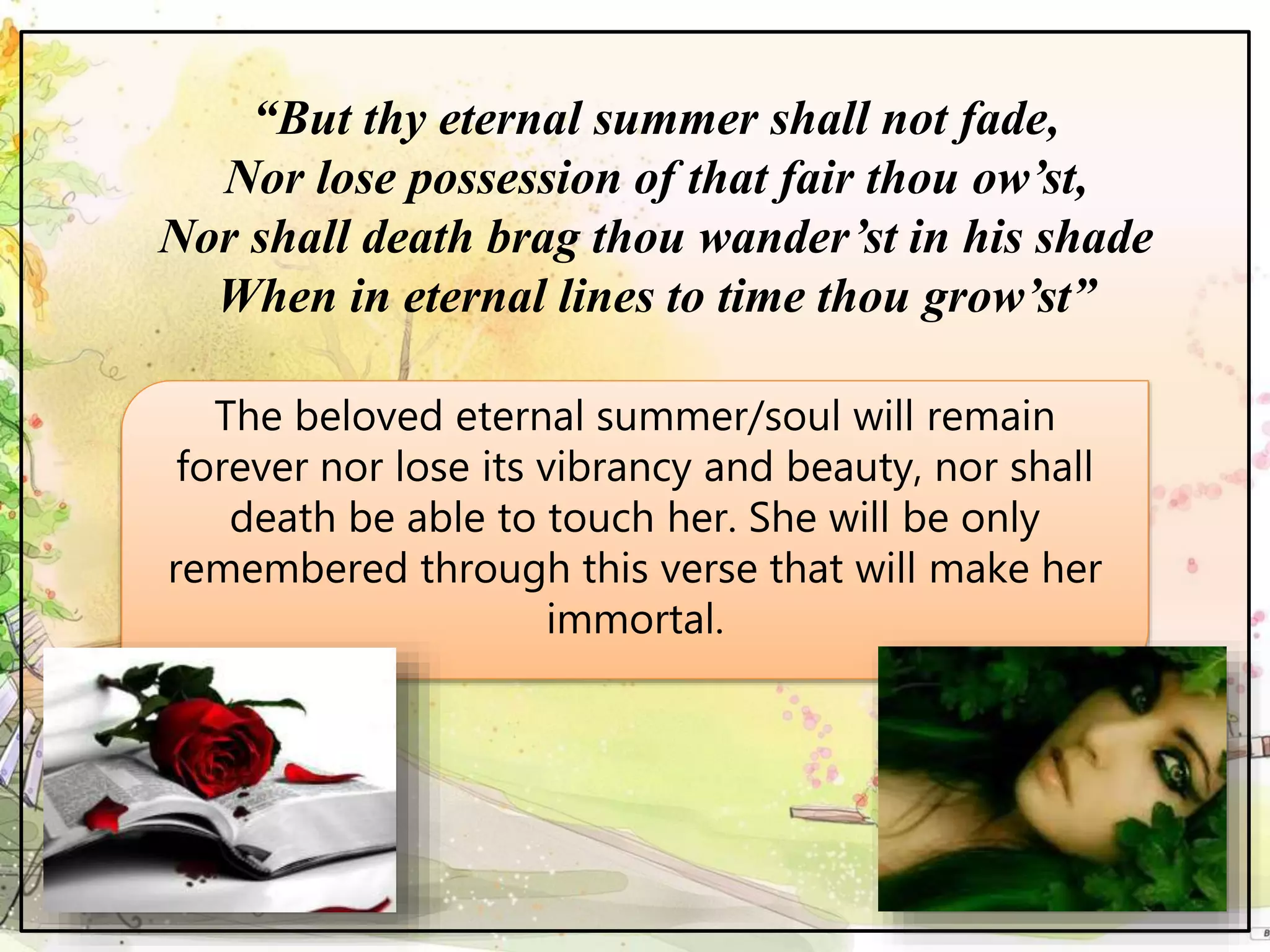
“But thy eternal summer shall not fade,
Nor lose possession of that fair thou ow’st,
Nor shall death brag thou wander’st in his shade
When in eternal lines to time thou grow’st”
The beloved eternal summer/soul will remain
forever nor lose its vibrancy and beauty, nor shall
death be able to touch her. She will be only
remembered through this verse that will make her
immortal.
Personification:
“Nor shall death brag thou
wander’st in his shade”
IMMORTALITY
TIME
LOVE & BEAUTY
TRANSCENDENTALISM
LITERATURE
END OF QUATRAIN 3
WHAT HE JUSTIFIED?
Quatrain 3:
Shakespeare says his lover’s beauty will never fade, his lover for her is
eternal.
So long as men can breathe, or eyes can see,
So long lives this, and this gives life to thee.
(As long as there are humans alive on this
planet Your life and beauty will live on through
this sonnet)
Shakespeare’s self-assured claim makes it
possible to argue that the purpose of the poem
was not actually to pay a beloved person a
compliment but rather to praise oneself for
poetic skill.
END OF COUPLET
WHAT HE JUSTIFIED?
Couplet:
He sums up the poem, stating his love will live forever, as long as this
poem exists
Anaphora:
“So long as men can breathe, or
eyes can see,
So long lives this, and this gives
life to thee.”
Love &
Beauty
Literature
and Writing
Time Immortality
Iambic pentameter
the most common metrical pattern in poetry
written in English, alternates weak unstressed
and strong stressed syllables to make a ten-
syllable line (weak strong/weak strong/weak
strong/weak strong/weak strong).
Speaker:
The Author
Addressee:
The young
man/woman
Tone:
Endearing, deep
devotion for a lover
Metaphor:
“Shall I compare thee to a
summer’s day?”
• “The darling buds of May” –
the beautiful, much loved
buds of the early summer
Metaphor:
“Shall I compare thee to a
summer’s day?”
Metaphor:
"Thou art more lovely and more
temperate”
Personification:
“Rough winds do shake the
darling buds of May”
“Sometime too hot the eye of
heaven shines“
Personification:
“Nor shall death brag thou
wander’st in his shade”
Anaphora:
“So long as men can breathe, or
eyes can see,
So long lives this, and this gives
life to thee.”
• Rough winds do shake the darling buds of May
(line 3)
– This line provides a good image (sight) of petite buds
swaying in wild wind.
• Sometime too hot the eye of heaven shines (line
5)
– This line provides a good image (sight) of hot summer
sun, shinning in the glorious sky.
 Love & Beauty
 Literature and Writing
 Time
Immortality
 Man and the Natural World

Sonnet18--Shakespeare

  • 1.
    William Shakespeare Collected andcompiled by Nazneen Sultana
  • 2.
    Shall I comparethee to a summer's day?
  • 3.
    Shakespeare’s sonnets werecomposed between 1593 and 1601, though not published until 1609. The Sonnets of Shakespeare, consists of 154 sonnets, all written in the form of three quatrains and a couplet that is now recognized as Shakespearean. Nearly all of Shakespeare’s sonnets examine the inevitable decay of time, and the immortalization of beauty and love in poetry.
  • 4.
    Why are westudying this poem? Seldom we read about Shakespeare’s sonnet. By reading “Shall I Compare Thee to a Summer’s Day?” we can appreciate his literature style very much. In this poem he used a lot of poetic techniques which made the poem interesting. Shakespeare presented love in a completely new way, giving us a different understanding about love. In the end, we think this poem is sweet and romantic.
  • 5.
    Shall I comparethee to a summer's day? Thou art more lovely and more temperate: Rough winds do shake the darling buds of May, And summer's lease hath all too short a date: Sometime too hot the eye of heaven shines, And often is his gold complexion dimmed, And every fair from fair sometime declines, By chance, or nature's changing course untrimmed: But thy eternal summer shall not fade, Nor lose possession of that fair thou ow'st, Nor shall death brag thou wander'st in his shade, When in eternal lines to time thou grow'st, So long as men can breathe, or eyes can see, So long lives this, and this gives life to thee.
  • 6.
    This sonnet isdivided into four distinct parts. It starts off with three quatrains and ends with a rhyming couplet. Quatrain 1: Compared to a summer’s day, the beloved is better than a summer’s day because the beloved is more lovely and temperate. In lines 3 4 Shakespeare compares how summer eventually ends but his love her and her beauty never will. Quatrain 2: Shakespeare compares the ever-changing seasons with his lover’s unchanging beauty. Quatrain 3: Shakespeare says his lover’s beauty will never fade, his lover for her is eternal. Couplet: He sums up the poem, stating his love will live forever, as long as this poem exists
  • 8.
    Shall I comparethee to a summer's day? A rhetorical question has been asked. This question is flattering in itself. Although a summer’s day is often associated with beauty, the poet is confused whether he wants to compare his beloved to the summer’s day or not. In the next lines, he will justify his point of view.
  • 9.
    Metaphor: “Shall I comparethee to a summer’s day?”
  • 10.
    Thou art morelovely and more temperate: Shakespeare, however, explains that his love’s beauty exceeds that of the summer and does not have its tendency towards unpleasant extremes. Theme: Beauty
  • 11.
    Rough winds doshake the darling buds of May, And summer's lease hath all too short a date: In the above quote, Shakespeare describes the fragility and short duration of summer’s beauty. Summer is a season of extremes and disappointments. The use of the word ‘lease’ reminds us of the fact that everything beautiful remains for a limited time only and after a while its beauty will be forcibly taken away.
  • 12.
    • “The darlingbuds of May” – the beautiful, much loved buds of the early summer
  • 13.
  • 14.
    END OF QUATRAIN1 WHAT HE JUSTIFIED?
  • 15.
    Quatrain 1: Compared toa summer’s day, the beloved is better than a summer’s day because the beloved is more lovely and temperate. In lines 3 4 Shakespeare compares how summer eventually ends but his love her and her beauty never will.
  • 16.
    Sometime too hotthe eye of heaven shines, And often is his gold complexion dimmed, Sometimes the sun shines too hot, and often its golden face is darkened by clouds. Shakespeare states that the sun, which he personifies and refers to as ‘the eye of heaven’ is worse than his ‘more temperate’ love.
  • 17.
  • 18.
    And every fairfrom fair sometime declines, By chance, or nature's changing course untrimmed: And everything beautiful stops being beautiful. The repetition of the word ‘fair’ highlights the fact that this fate is inescapable for everything that possesses beauty.
  • 19.
  • 20.
    END OF QUATRAIN2 WHAT HE JUSTIFIED?
  • 21.
    Quatrain 2: Shakespeare comparesthe ever-changing seasons with his lover’s unchanging beauty.
  • 22.
    “But thy eternalsummer shall not fade, Nor lose possession of that fair thou ow’st, Nor shall death brag thou wander’st in his shade When in eternal lines to time thou grow’st” The beloved eternal summer/soul will remain forever nor lose its vibrancy and beauty, nor shall death be able to touch her. She will be only remembered through this verse that will make her immortal.
  • 23.
    Personification: “Nor shall deathbrag thou wander’st in his shade”
  • 24.
  • 25.
    END OF QUATRAIN3 WHAT HE JUSTIFIED?
  • 26.
    Quatrain 3: Shakespeare sayshis lover’s beauty will never fade, his lover for her is eternal.
  • 27.
    So long asmen can breathe, or eyes can see, So long lives this, and this gives life to thee. (As long as there are humans alive on this planet Your life and beauty will live on through this sonnet) Shakespeare’s self-assured claim makes it possible to argue that the purpose of the poem was not actually to pay a beloved person a compliment but rather to praise oneself for poetic skill.
  • 28.
    END OF COUPLET WHATHE JUSTIFIED?
  • 29.
    Couplet: He sums upthe poem, stating his love will live forever, as long as this poem exists
  • 30.
    Anaphora: “So long asmen can breathe, or eyes can see, So long lives this, and this gives life to thee.”
  • 31.
  • 32.
    Iambic pentameter the mostcommon metrical pattern in poetry written in English, alternates weak unstressed and strong stressed syllables to make a ten- syllable line (weak strong/weak strong/weak strong/weak strong/weak strong).
  • 33.
  • 34.
  • 35.
  • 36.
    Metaphor: “Shall I comparethee to a summer’s day?”
  • 37.
    • “The darlingbuds of May” – the beautiful, much loved buds of the early summer
  • 38.
    Metaphor: “Shall I comparethee to a summer’s day?”
  • 39.
    Metaphor: "Thou art morelovely and more temperate”
  • 40.
    Personification: “Rough winds doshake the darling buds of May” “Sometime too hot the eye of heaven shines“
  • 41.
    Personification: “Nor shall deathbrag thou wander’st in his shade”
  • 42.
    Anaphora: “So long asmen can breathe, or eyes can see, So long lives this, and this gives life to thee.”
  • 43.
    • Rough windsdo shake the darling buds of May (line 3) – This line provides a good image (sight) of petite buds swaying in wild wind. • Sometime too hot the eye of heaven shines (line 5) – This line provides a good image (sight) of hot summer sun, shinning in the glorious sky.
  • 44.
     Love &Beauty  Literature and Writing  Time Immortality  Man and the Natural World