Structure: The Prelude and The Recluse
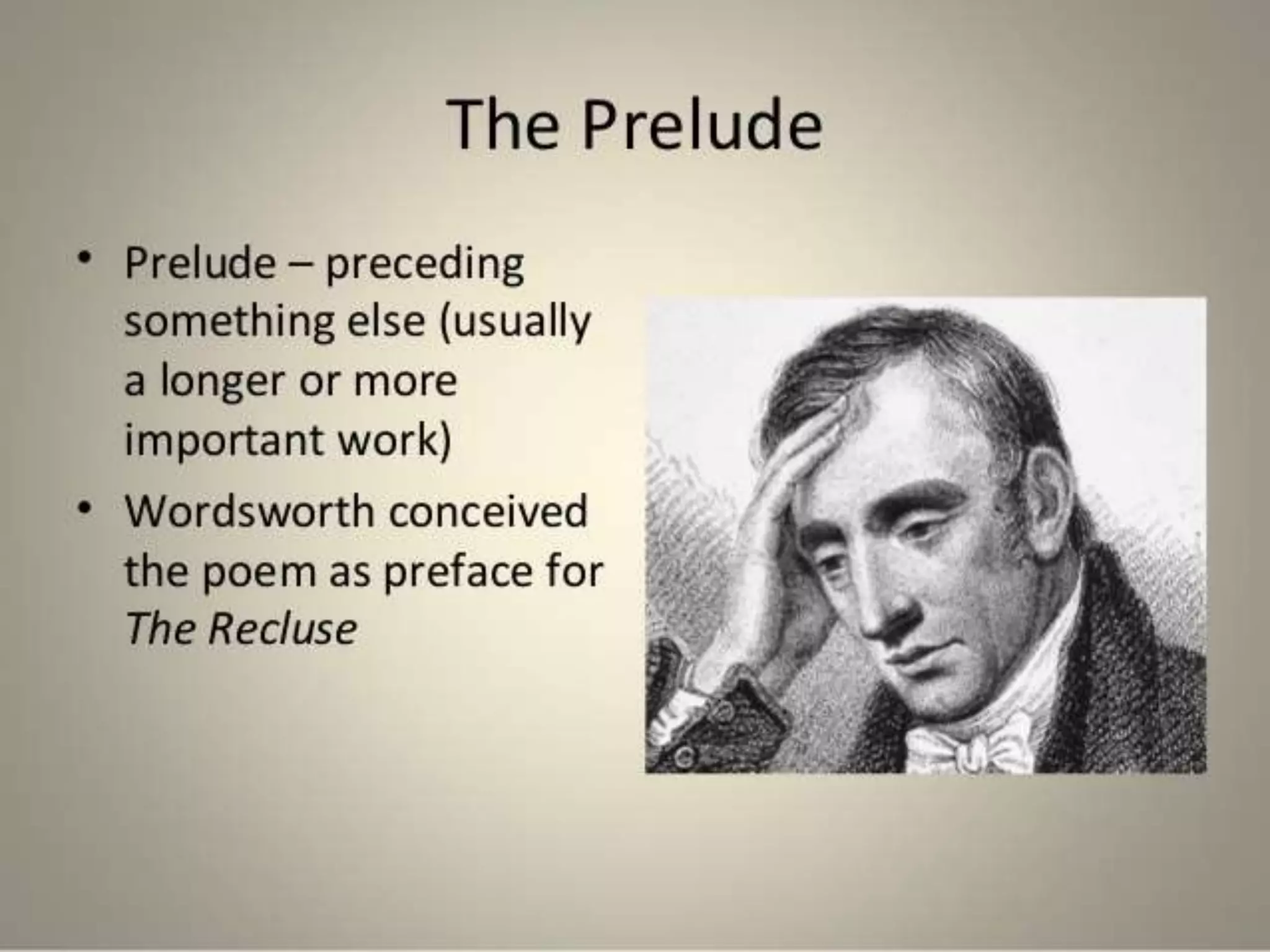
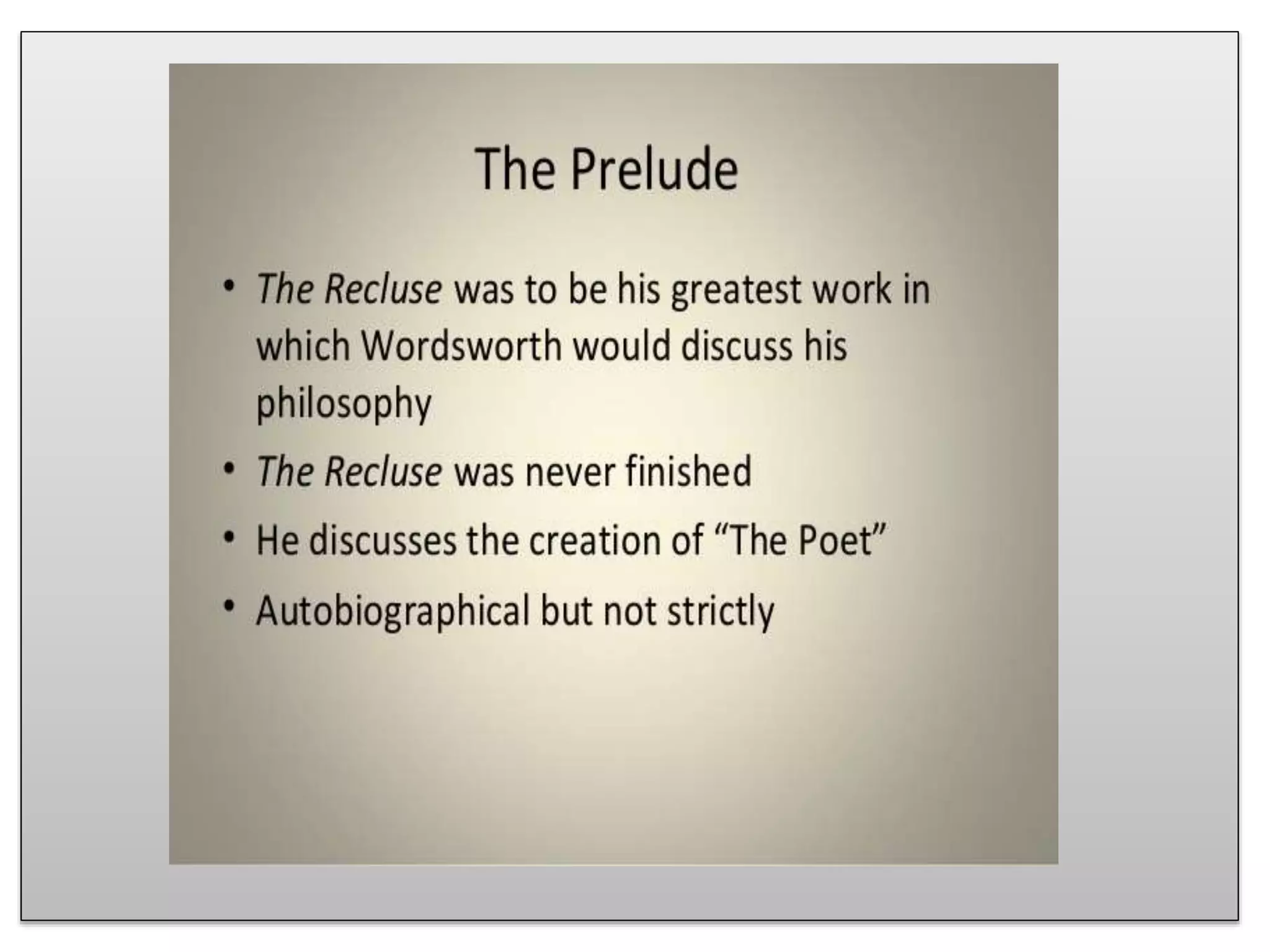
The poem was intended as the prologue to a long three-part epic and philosophical poem, The
Recluse.
Wordsworth planned to write this work together with Samuel Taylor Coleridge, they collaborated
to surpass John Milton's Paradise Lost (Table Talk II.70–71; IG3). Had The Recluse been completed,
it would have been approximately three times longer than Paradise Lost . Quite often, in his letters
Wordsworth commented that he was plagued with agony because he failed to finish the work. In
the 1850 introduction, Wordsworth explains what the original idea, inspired by his "dear friend"
Coleridge, was: "to compose a philosophical Poem, containing views of Man, Nature, and Society,
and to be entitled the Recluse.
Coleridge's inspiration and interest is evidenced in his letters. For instance, in 1799 he writes to
Wordsworth: "I am anxiously eager to have you steadily employed on 'The Recluse'... I wish you
would write a poem, in blank verse, addressed to those who, in consequence of the complete
failure of the French Revolution, have thrown up all hopes of amelioration of mankind, and are
sinking into an almost Epicurean selfishness, disguising the same under the soft titles of domestic
attachment and contempt for visionary philosophies. It would do great good, and might form a Part
of 'The Recluse'." (STC to WW, Sept. 1799).
In the 1850 edition, Wordsworth pays a glowing tribute to Coleridge in his introduction, saying that
the "work is addressed to a dear friend, most distinguished for his knowledge and genius, and to
whom the author's intellect is deeply indebted."
The Prelude is considered to be the finest work of
Wordsworth’s great creative period. Wordsworth
conceived the idea of writing a history of the growth
of his own mind, and the various texts of the poem
deals with a very long period in the poet’s life.
During the course of this time, his style and opinion
both have been changed to a great extent.
Indeed, Prelude is the first long autobiographical poem written
in a process of self- exploration. Wordsworth worked his way
towards modern psychological understanding of his own
nature and more largely of human nature. By doing so, he
places poetry at the centre of human experience.
Though this introspective account of his own development
was completed in 1805 yet after substantial revision it was
published posthumously in 1850. Many critics rank it as
Wordsworth’s greatest work. The Prelude begins with an
account of the poet’s childhood in the English Lake Country.
The Prelude is a modern poem . In a way, it is a self-
reflective poem. By this we mean a poem that has a
part of its subject the writing of the poem itself. The
Prelude is a poem that incorporates the discovery of
its ‘ars poetica’. Both the beginning and the end of the
poem deals with a quest, the voyage of self-
exploration and the effort to articulate the experience
which inculcate the earliest moments of moral and
spiritual awareness and they are usually associated
with intensely felt responses to the nature even when
he was a child.
“Poetry is the spontaneous overflow of powerful feelings: it takes its origins from
emotion recollected in tranquillity: the emotion is contemplated till by a species of
reaction the tranquillity gradually disappears, and an emotion, kindred to that which
was before the subject of contemplation, is gradually produced, and does itself
actually exist in the mind”.
Awakening of the self-consciousness
The subject considered as object turns out to be a source which is probably the ultimate
source of the sublime. At any cost, the abyss that the self-conscious mind enters within itself
evokes a response equivalent to any other types of sublimity that can provoke. Thus,
Wordsworth describes the awakening self-consciousness of his college years.
As if awaken’d, summon’d,rous’d,constrain’d,
I look’d for universal things; perused
The common countenance of earth and heaven;
Pore’d, watch’d,expected, listen’d; spread my thoughts
And spread them with a wider creeping; felt
incumbences mere awful,visitings
of the upholder of the tranquil soul,
Which underneath all passion lives secure
a steadfast life [ Prel 111: 109-118]
The movement is again from arousal to tranquility. The energized search for “universal
things” reaches within. Self-dissection creates a sense of the interpretation of subject and
object, as the mind spreads in the vacuum of itself. From this diffusion of thought comes a
sense of sublime visitation, and awful incumbences press down upon the poet. The visitings
of the upholder is not a transcendental being but something from within which emerges in
sublime and self-conscious moments. The force of such awful incumbence of being lost at
the edges of the mind, is to uphold that sense of inner tranquility so vital for Wordsworth.
The Prelude is a poem rooted in the past. It is a
culmination of many traditions of thought and culture and
at the same time it is treated as the first great modern
poem. In it Wordsworth is essentially concerned with
human nature, with aspects of consciousness and being
that are still relevant to our modern interest and
predicaments. The Prelude presents the poet in the search
for his identity. It shows that Wordsworth is trying to seek
a point of stability within himself. It is an attempt to
establish a principle of continuity and equilibrium within
change. He said, “The vacancy between me (present) and
those days which yet have such self presence in my mind
is so great that sometimes when I think of them I see two
consciousnesses, the consciousness of myself and that of
some other being in me”.
Psychological sublime leads to calm
Prelude II
A tranquillizing spirit presses now
On my corporeal frame: so wide appears
The vacancy between me and those days,
Which yet have such self-presence in my mind
That sometimes, when I think of them, I seem
Two consciousnesses, conscious of myself
And of some being [II. 27-33]
The image of pressing down recalls the incumbence of the mind turning in upon itself
whereas the “tranquillizing spirit” comes from a slightly different source. The space
which is opened up is not that of the mind contemplating itself but the abyss of
“Tintern Abbey” of time and the two selves. The contemplation of the lost self provides
not only nostalgic excitement but also a deep awareness of the obscurity of all identity.
By hypothesizing “two consciousnesses”, Wordsworth casts the solidity of the present
self, and out of this contemplation comes the energy that calls forth the tranquillizing
spirit.
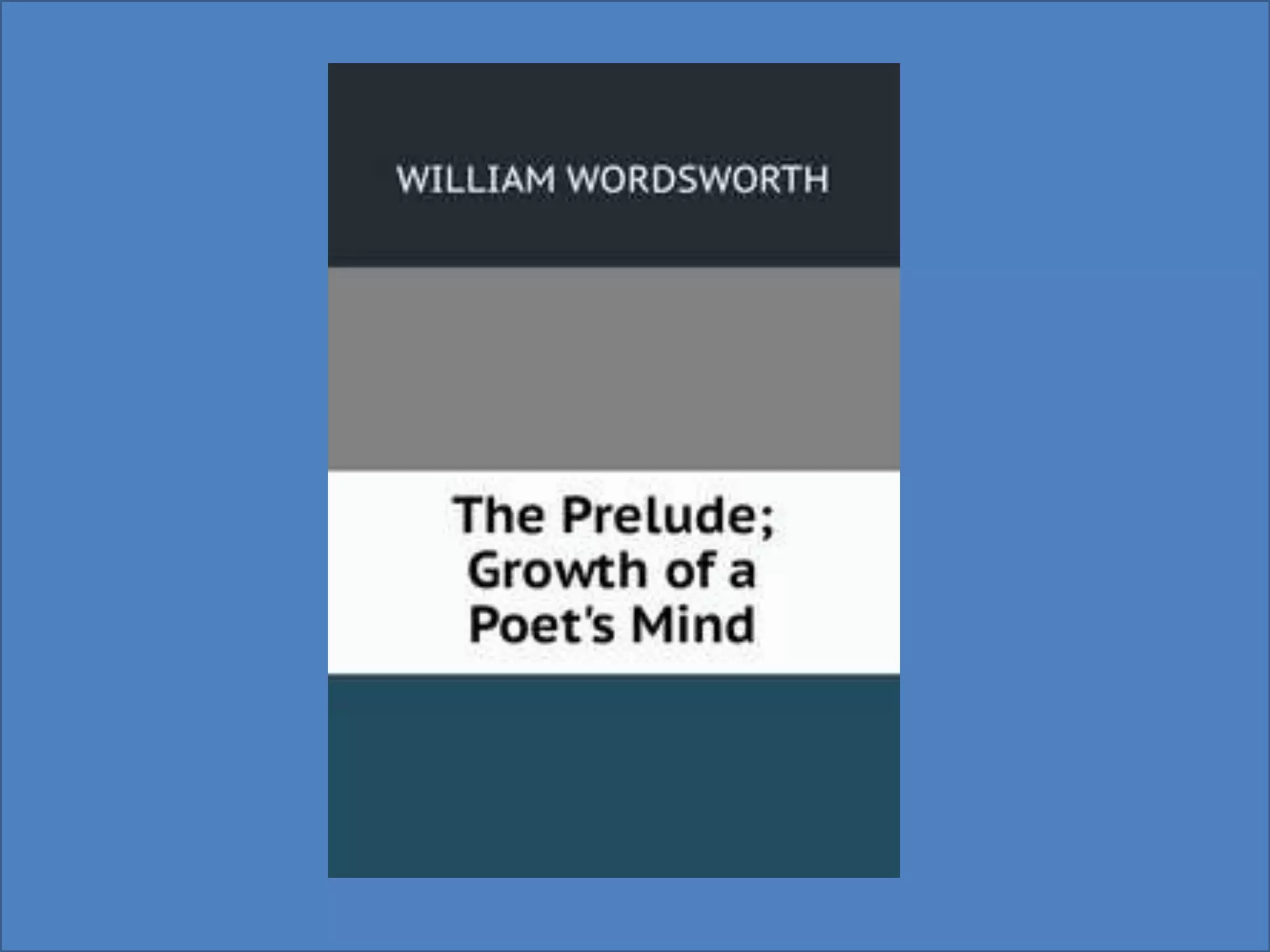
Prelude is Wordsworth’s master piece, the most original poem and considered to be one of
the greatest work after Paradise Lost. It is a personal anecdote with such a narrative design
but not a prototype of classical or a Christian epic ; it turns on a mental crisis and a
recovery into a spiritual autobiography of crisis.
The recurrent metaphor is that of a journey whose destination is to arrive where we started
and know the place for the first time. The journey catches a glimpse of poet’s personal
history while carrying the symbolic meaning of his inner self. In fact, it is the quest for his
lost former self and an appropriate spiritual sanctuary. The poem assesses his growth from
infancy to manhood. The poem presents the view of the development of human
consciousness under the sway of an imagination in alignment with the grandeur of nature.
Growth of a poet’s mind
Autobiographical elements and
influence of nature
The prelude is treated to be a great poem tracing back Wordsworth’s development as a
poet. It is a recollection of the most important experiences of childhood, and mainly
concentrates on the role of nature in shaping and stimulating his growing imagination.
Though the poem is an apparent biography yet it is important to remember that the
poet was more concerned with his moral and spiritual growth. In the sense The
Prelude can only be called a subjective autobiography. Although the poet reminicises
many of his childhood experiences in his poem, only those which are concerned with
nature and which modified his sensibilities find a place in the poem.
Contd..
The poet feels that nature itself had determined that he ought to be a poet. The poet recalls the experience
that he had in a river when he was five years old. The physical pleasure offered by nature led him to drench
himself in it:
Basked in the sun and plunged and basked again…..
Over the sandy fields, leaping through groves.
This bathing was a kind of baptism, a baptism into a life of nature’s influences. But the poets soul was to
develop through a series of these stages into an awareness of nature’s pantheistic power.
If in the first stage nature was only the back drop for his glad ‘boyish movements’ and if in the second he
would be haunted by the mysterious beauty of nature, then he would realize the vital formative influence of
nature:
Fair sad time my soul and I grew up
Fostered alike by beauty and by fear……
The third occasion on which he realizes the conscious and brooding presence of nature over all human
errors is when he tries to steal a boat. Although at first he feels exhilarated, his action also brings him a
feeling of nausea. The ‘act of stealth’ was to result in an illusion which Wordsworth would assume to be
fostered by nature itself,
……………… a huge cliff,
As if with voluntary power instinct,
Uprear’d its head. Contd…..
The spectacle fills him with “grave and serious thoughts.” For the first time he looks
on nature as the mere back drop for the glad animal movements of his boyish days
and neither it is a source of youthful appreciation of exquisite beauty.
Hence, The Prelude is obviously an autobiography. Wordsworth himself admitted
that “it was a thing unprecedented in literary history that a man should talk so
much about himself.” Nevertheless, he points out that this autobiographical
account results not from “self conceit” but from “real humility”. The Prelude
remains a rare poetic autobiography uniting nature, poetry and Man.
Critical analysis
According to a critic, The Prelude is the greatest long poem in our language after Paradise Lost. In
comparison with the great seventeenth-century epic since Milton, it is indeed Wordsworth's
greatest idol. The Prelude may be termed as somewhat loosely as an epic even while not satisfying
all the traditional qualifications of that genre. The Prelude takes its unity from the fact that the
central "hero" is its author. Wordsworth uses metaphors to define his inordinate excitement.
The poem is written in blank verse, unrhymed lines of iambic pentameter. It has certain permissible
substitutions of trochees and anapests which relieves the monotony of the iambic foot with the
dejection of stanza form. In the middle of the eighteenth century, there was an eclipse of interest in
the rhymed heroic couplet. A revival of interest in Milton led to the establishment of Miltonic blank
verse as the standard medium for lengthy philosophical or didactic poetical works. The resulting
form came to be called the "literary" epic which stands in opposition to heroic and folk epics.
Wordsworth brought his unconventional ideas of diction, a natural and conversational tone to this
type. The Prelude records an experience from the poet's past and then to examine its philosophical
and psychological significance and relate it to nature and society at large. Unfortunately, this results
in a certain definite unevenness in the development of the narrative. At times, particularly in the
latter half of the work, the narrative dries up altogether, and the reader must pick his way through a
welter of disconnected disquisitions. Only a mere fraction of the whole poem may be said to be
great, but it is this fraction that has continued to secure it a place high in English literature. Another
drawback of the verse is its blatant repetition. Wordsworth describes an intellectual experience
again and again with only minor variations. Much of this repetition may be due to the poet's
episodic efforts to show his shifting point of view in connection with certain basic ideas…contd
The imagery and diction, reflects the natural environment of the English countryside, and captures much of the
wildness and beauty of that terrain. The influence of the English character may be traced in many of the ideas
behind the poem. Artistically and religiously, he found youthful inspiration in the hills and vales of the Lake
District; he responded to them with his simple ballads and a joyous mysticism. In maturity, it was the high
Anglican Church tradition to which he turned, for a personal faith which eventually became a source for many of
his later poetical ideas. Of course, we do not witness the entire variety in The Prelude. The poem is basically
democratic in spirit. Only at the very end we feel the impending onset of conservatism.
The poem employs symbols in a somewhat unsophisticated way so that language and feeling tend to be
indistinguishable. When Wordsworth puts aside his tendency to pamphleteer, mood and form tend to merge in
highest harmony; the words perfectly evoke feeling. An outstanding virtue of The Prelude is its imaginative
interpretation of nature. For Wordsworth, nature forms a cosmic order of which the material world is one
manifestation and the moral world is another. From the fanciful, mechanistic interpretation of nature in his youth,
he moved in maturity to a vitalist view in which mind transcended the physical world where a universal spirit
provided the ultimate motivation for all things. This is as close as he comes to building a philosophical system
and it is simply this tedious and painful transition that is related in The Prelude. What Wordsworth offers is not a
great philosophical system but the portrayal of an attitude of liberation towards life and towards art. He
constantly examines experience. Nothing in the world is so insignificant that it cannot be a stimulus for the mind.
No thought, no matter how contemptuous may seem to us must be excluded from the realm of poetry.
1.www.bachelorandmaster.com
2. www.google.com
3. Wikipedia
4. www.ardhendublogpsot.in
5. www.cliffnotes.com
6. Wordsworth and the Human Suffering by James H. Averill

The prelude an autobiographical poem

  • 4.
    Structure: The Preludeand The Recluse The poem was intended as the prologue to a long three-part epic and philosophical poem, The Recluse. Wordsworth planned to write this work together with Samuel Taylor Coleridge, they collaborated to surpass John Milton's Paradise Lost (Table Talk II.70–71; IG3). Had The Recluse been completed, it would have been approximately three times longer than Paradise Lost . Quite often, in his letters Wordsworth commented that he was plagued with agony because he failed to finish the work. In the 1850 introduction, Wordsworth explains what the original idea, inspired by his "dear friend" Coleridge, was: "to compose a philosophical Poem, containing views of Man, Nature, and Society, and to be entitled the Recluse. Coleridge's inspiration and interest is evidenced in his letters. For instance, in 1799 he writes to Wordsworth: "I am anxiously eager to have you steadily employed on 'The Recluse'... I wish you would write a poem, in blank verse, addressed to those who, in consequence of the complete failure of the French Revolution, have thrown up all hopes of amelioration of mankind, and are sinking into an almost Epicurean selfishness, disguising the same under the soft titles of domestic attachment and contempt for visionary philosophies. It would do great good, and might form a Part of 'The Recluse'." (STC to WW, Sept. 1799). In the 1850 edition, Wordsworth pays a glowing tribute to Coleridge in his introduction, saying that the "work is addressed to a dear friend, most distinguished for his knowledge and genius, and to whom the author's intellect is deeply indebted."
  • 8.
    The Prelude isconsidered to be the finest work of Wordsworth’s great creative period. Wordsworth conceived the idea of writing a history of the growth of his own mind, and the various texts of the poem deals with a very long period in the poet’s life. During the course of this time, his style and opinion both have been changed to a great extent.
  • 9.
    Indeed, Prelude isthe first long autobiographical poem written in a process of self- exploration. Wordsworth worked his way towards modern psychological understanding of his own nature and more largely of human nature. By doing so, he places poetry at the centre of human experience. Though this introspective account of his own development was completed in 1805 yet after substantial revision it was published posthumously in 1850. Many critics rank it as Wordsworth’s greatest work. The Prelude begins with an account of the poet’s childhood in the English Lake Country.
  • 10.
    The Prelude isa modern poem . In a way, it is a self- reflective poem. By this we mean a poem that has a part of its subject the writing of the poem itself. The Prelude is a poem that incorporates the discovery of its ‘ars poetica’. Both the beginning and the end of the poem deals with a quest, the voyage of self- exploration and the effort to articulate the experience which inculcate the earliest moments of moral and spiritual awareness and they are usually associated with intensely felt responses to the nature even when he was a child.
  • 11.
    “Poetry is thespontaneous overflow of powerful feelings: it takes its origins from emotion recollected in tranquillity: the emotion is contemplated till by a species of reaction the tranquillity gradually disappears, and an emotion, kindred to that which was before the subject of contemplation, is gradually produced, and does itself actually exist in the mind”.
  • 12.
    Awakening of theself-consciousness The subject considered as object turns out to be a source which is probably the ultimate source of the sublime. At any cost, the abyss that the self-conscious mind enters within itself evokes a response equivalent to any other types of sublimity that can provoke. Thus, Wordsworth describes the awakening self-consciousness of his college years. As if awaken’d, summon’d,rous’d,constrain’d, I look’d for universal things; perused The common countenance of earth and heaven; Pore’d, watch’d,expected, listen’d; spread my thoughts And spread them with a wider creeping; felt incumbences mere awful,visitings of the upholder of the tranquil soul, Which underneath all passion lives secure a steadfast life [ Prel 111: 109-118] The movement is again from arousal to tranquility. The energized search for “universal things” reaches within. Self-dissection creates a sense of the interpretation of subject and object, as the mind spreads in the vacuum of itself. From this diffusion of thought comes a sense of sublime visitation, and awful incumbences press down upon the poet. The visitings of the upholder is not a transcendental being but something from within which emerges in sublime and self-conscious moments. The force of such awful incumbence of being lost at the edges of the mind, is to uphold that sense of inner tranquility so vital for Wordsworth.
  • 13.
    The Prelude isa poem rooted in the past. It is a culmination of many traditions of thought and culture and at the same time it is treated as the first great modern poem. In it Wordsworth is essentially concerned with human nature, with aspects of consciousness and being that are still relevant to our modern interest and predicaments. The Prelude presents the poet in the search for his identity. It shows that Wordsworth is trying to seek a point of stability within himself. It is an attempt to establish a principle of continuity and equilibrium within change. He said, “The vacancy between me (present) and those days which yet have such self presence in my mind is so great that sometimes when I think of them I see two consciousnesses, the consciousness of myself and that of some other being in me”.
  • 14.
    Psychological sublime leadsto calm Prelude II A tranquillizing spirit presses now On my corporeal frame: so wide appears The vacancy between me and those days, Which yet have such self-presence in my mind That sometimes, when I think of them, I seem Two consciousnesses, conscious of myself And of some being [II. 27-33] The image of pressing down recalls the incumbence of the mind turning in upon itself whereas the “tranquillizing spirit” comes from a slightly different source. The space which is opened up is not that of the mind contemplating itself but the abyss of “Tintern Abbey” of time and the two selves. The contemplation of the lost self provides not only nostalgic excitement but also a deep awareness of the obscurity of all identity. By hypothesizing “two consciousnesses”, Wordsworth casts the solidity of the present self, and out of this contemplation comes the energy that calls forth the tranquillizing spirit.
  • 15.
    Prelude is Wordsworth’smaster piece, the most original poem and considered to be one of the greatest work after Paradise Lost. It is a personal anecdote with such a narrative design but not a prototype of classical or a Christian epic ; it turns on a mental crisis and a recovery into a spiritual autobiography of crisis. The recurrent metaphor is that of a journey whose destination is to arrive where we started and know the place for the first time. The journey catches a glimpse of poet’s personal history while carrying the symbolic meaning of his inner self. In fact, it is the quest for his lost former self and an appropriate spiritual sanctuary. The poem assesses his growth from infancy to manhood. The poem presents the view of the development of human consciousness under the sway of an imagination in alignment with the grandeur of nature. Growth of a poet’s mind
  • 16.
    Autobiographical elements and influenceof nature The prelude is treated to be a great poem tracing back Wordsworth’s development as a poet. It is a recollection of the most important experiences of childhood, and mainly concentrates on the role of nature in shaping and stimulating his growing imagination. Though the poem is an apparent biography yet it is important to remember that the poet was more concerned with his moral and spiritual growth. In the sense The Prelude can only be called a subjective autobiography. Although the poet reminicises many of his childhood experiences in his poem, only those which are concerned with nature and which modified his sensibilities find a place in the poem. Contd..
  • 17.
    The poet feelsthat nature itself had determined that he ought to be a poet. The poet recalls the experience that he had in a river when he was five years old. The physical pleasure offered by nature led him to drench himself in it: Basked in the sun and plunged and basked again….. Over the sandy fields, leaping through groves. This bathing was a kind of baptism, a baptism into a life of nature’s influences. But the poets soul was to develop through a series of these stages into an awareness of nature’s pantheistic power. If in the first stage nature was only the back drop for his glad ‘boyish movements’ and if in the second he would be haunted by the mysterious beauty of nature, then he would realize the vital formative influence of nature: Fair sad time my soul and I grew up Fostered alike by beauty and by fear…… The third occasion on which he realizes the conscious and brooding presence of nature over all human errors is when he tries to steal a boat. Although at first he feels exhilarated, his action also brings him a feeling of nausea. The ‘act of stealth’ was to result in an illusion which Wordsworth would assume to be fostered by nature itself, ……………… a huge cliff, As if with voluntary power instinct, Uprear’d its head. Contd…..
  • 18.
    The spectacle fillshim with “grave and serious thoughts.” For the first time he looks on nature as the mere back drop for the glad animal movements of his boyish days and neither it is a source of youthful appreciation of exquisite beauty. Hence, The Prelude is obviously an autobiography. Wordsworth himself admitted that “it was a thing unprecedented in literary history that a man should talk so much about himself.” Nevertheless, he points out that this autobiographical account results not from “self conceit” but from “real humility”. The Prelude remains a rare poetic autobiography uniting nature, poetry and Man.
  • 19.
    Critical analysis According toa critic, The Prelude is the greatest long poem in our language after Paradise Lost. In comparison with the great seventeenth-century epic since Milton, it is indeed Wordsworth's greatest idol. The Prelude may be termed as somewhat loosely as an epic even while not satisfying all the traditional qualifications of that genre. The Prelude takes its unity from the fact that the central "hero" is its author. Wordsworth uses metaphors to define his inordinate excitement. The poem is written in blank verse, unrhymed lines of iambic pentameter. It has certain permissible substitutions of trochees and anapests which relieves the monotony of the iambic foot with the dejection of stanza form. In the middle of the eighteenth century, there was an eclipse of interest in the rhymed heroic couplet. A revival of interest in Milton led to the establishment of Miltonic blank verse as the standard medium for lengthy philosophical or didactic poetical works. The resulting form came to be called the "literary" epic which stands in opposition to heroic and folk epics. Wordsworth brought his unconventional ideas of diction, a natural and conversational tone to this type. The Prelude records an experience from the poet's past and then to examine its philosophical and psychological significance and relate it to nature and society at large. Unfortunately, this results in a certain definite unevenness in the development of the narrative. At times, particularly in the latter half of the work, the narrative dries up altogether, and the reader must pick his way through a welter of disconnected disquisitions. Only a mere fraction of the whole poem may be said to be great, but it is this fraction that has continued to secure it a place high in English literature. Another drawback of the verse is its blatant repetition. Wordsworth describes an intellectual experience again and again with only minor variations. Much of this repetition may be due to the poet's episodic efforts to show his shifting point of view in connection with certain basic ideas…contd
  • 20.
    The imagery anddiction, reflects the natural environment of the English countryside, and captures much of the wildness and beauty of that terrain. The influence of the English character may be traced in many of the ideas behind the poem. Artistically and religiously, he found youthful inspiration in the hills and vales of the Lake District; he responded to them with his simple ballads and a joyous mysticism. In maturity, it was the high Anglican Church tradition to which he turned, for a personal faith which eventually became a source for many of his later poetical ideas. Of course, we do not witness the entire variety in The Prelude. The poem is basically democratic in spirit. Only at the very end we feel the impending onset of conservatism. The poem employs symbols in a somewhat unsophisticated way so that language and feeling tend to be indistinguishable. When Wordsworth puts aside his tendency to pamphleteer, mood and form tend to merge in highest harmony; the words perfectly evoke feeling. An outstanding virtue of The Prelude is its imaginative interpretation of nature. For Wordsworth, nature forms a cosmic order of which the material world is one manifestation and the moral world is another. From the fanciful, mechanistic interpretation of nature in his youth, he moved in maturity to a vitalist view in which mind transcended the physical world where a universal spirit provided the ultimate motivation for all things. This is as close as he comes to building a philosophical system and it is simply this tedious and painful transition that is related in The Prelude. What Wordsworth offers is not a great philosophical system but the portrayal of an attitude of liberation towards life and towards art. He constantly examines experience. Nothing in the world is so insignificant that it cannot be a stimulus for the mind. No thought, no matter how contemptuous may seem to us must be excluded from the realm of poetry.
  • 21.
    1.www.bachelorandmaster.com 2. www.google.com 3. Wikipedia 4.www.ardhendublogpsot.in 5. www.cliffnotes.com 6. Wordsworth and the Human Suffering by James H. Averill