Solving Disciplines: AI and Service Science
Jim Spohrer
Director, IBM Cognitive OpenTech
February 7, 2020
Presentations online at: http://slideshare.net/spohrer
Today’s Talk
• Thank-you for contributing to service
science
• AI – machines that solve tasks
• Disciplines & Professions
• Are these tasks? Yes.
• Service Science
• Original goal: A new discipline and profession
• Revised goal: Wisdom for rebuilding our
world
• Family as the oldest and most enduring service
system
2/7/2020 (c) IBM 2017, Cognitive Opentech Group 2
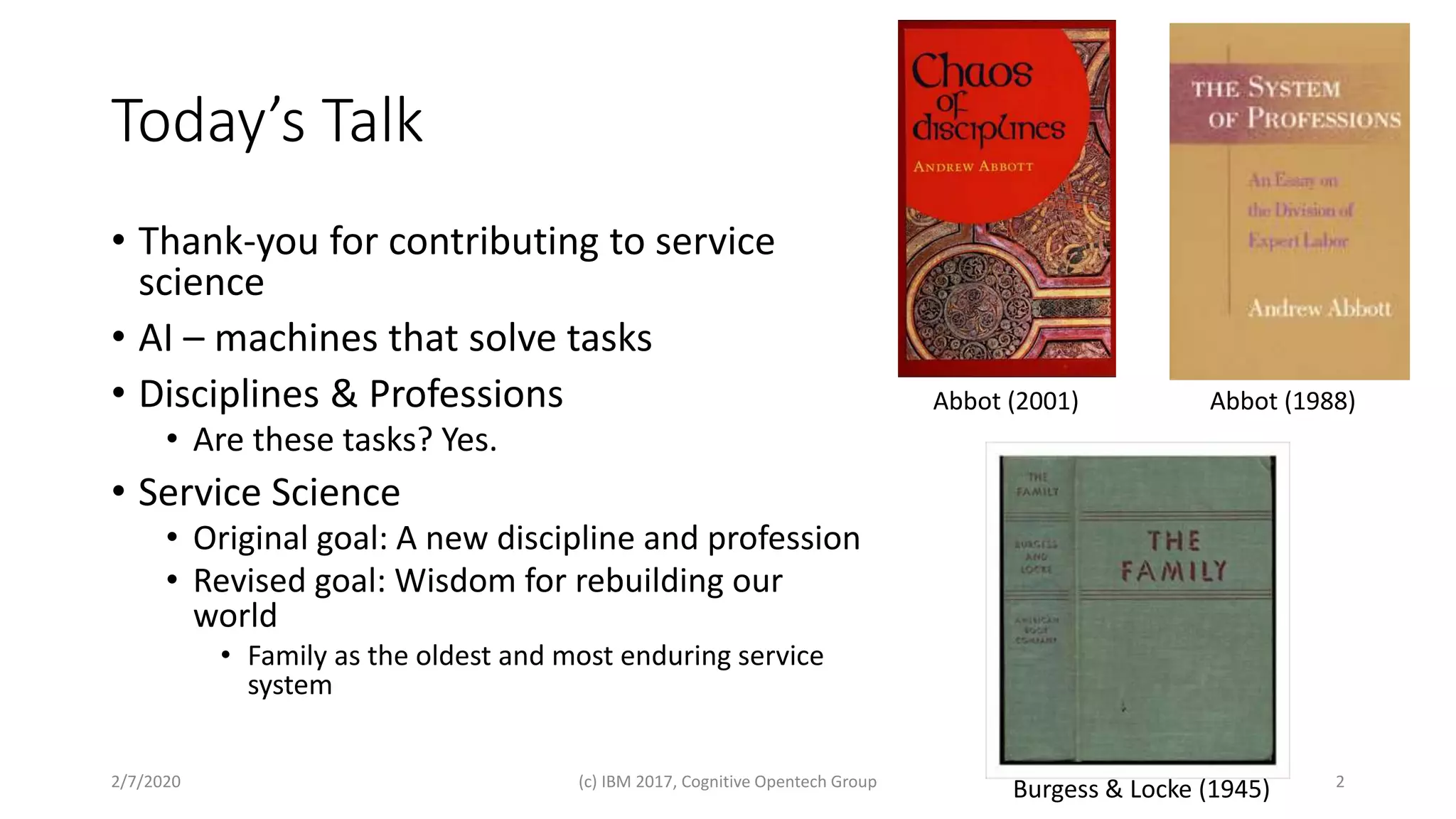
Abbot (2001) Abbot (1988)
Burgess & Locke (1945)
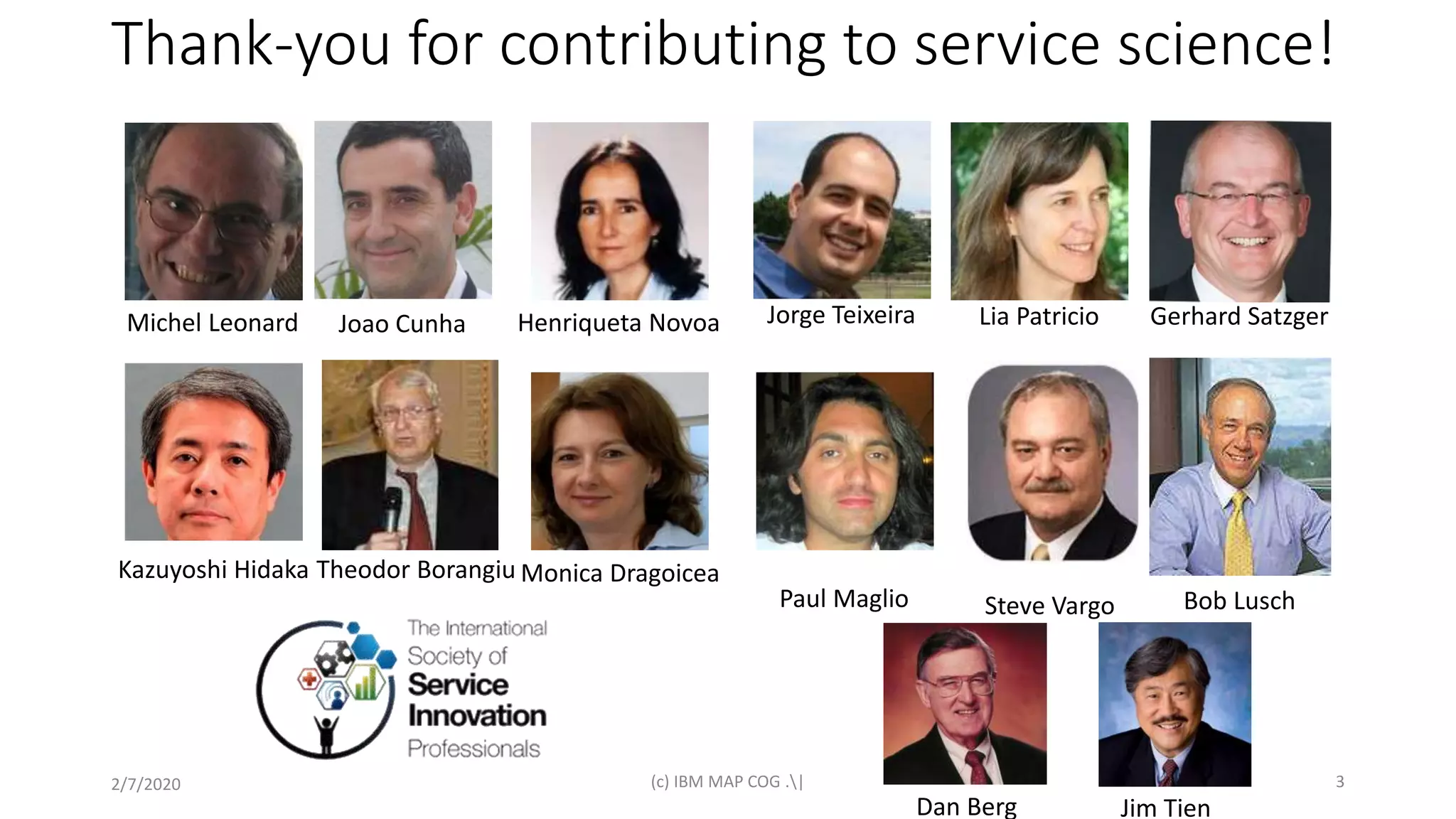
Thank-you for contributing to service science!
2/7/2020 (c) IBM MAP COG .| 3
Michel Leonard Joao Cunha Henriqueta Novoa Jorge Teixeira Lia Patricio Gerhard Satzger
Bob LuschSteve VargoPaul Maglio
Kazuyoshi Hidaka Monica DragoiceaTheodor Borangiu
Dan Berg Jim Tien
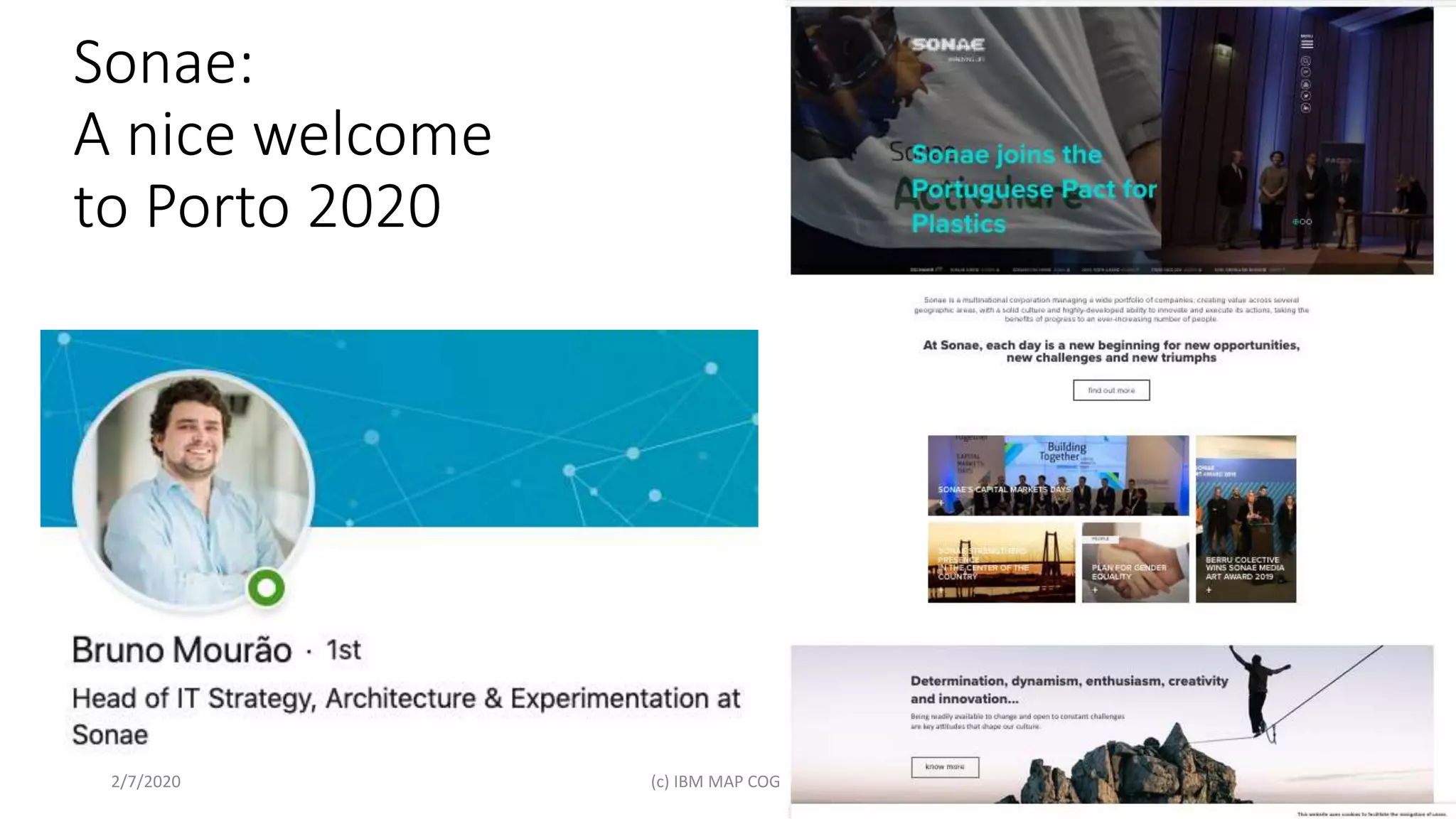
Sonae:
A nice welcome
to Porto 2020
2/7/2020 (c) IBM MAP COG .| 4
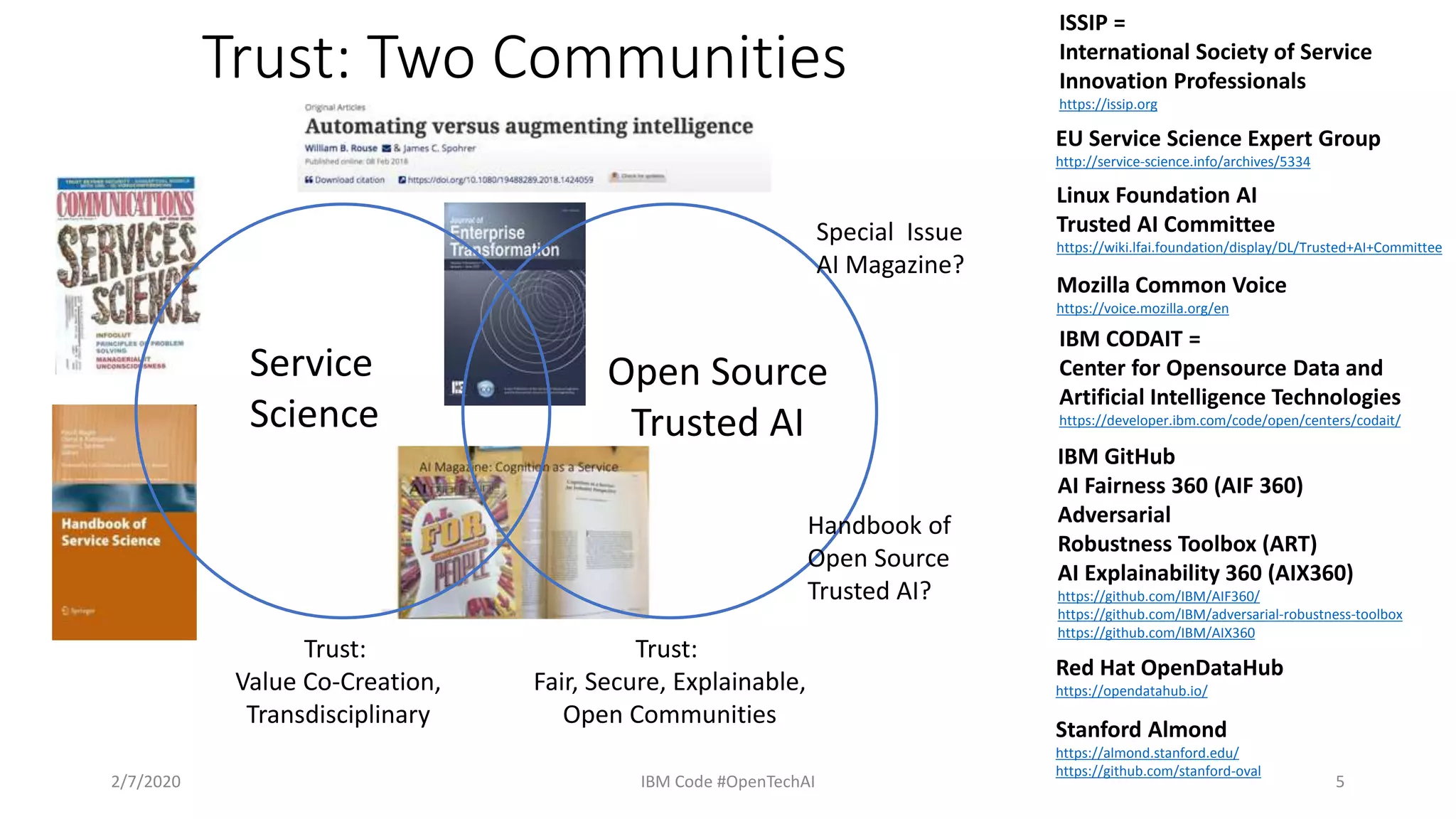
Trust: Two Communities
2/7/2020 IBM Code #OpenTechAI 5
Service
Science
Open Source
Trusted AI
Trust:
Value Co-Creation,
Transdisciplinary
Trust:
Fair, Secure, Explainable,
Open Communities
Special Issue
AI Magazine?
Handbook of
Open Source
Trusted AI?
Linux Foundation AI
Trusted AI Committee
https://wiki.lfai.foundation/display/DL/Trusted+AI+Committee
IBM CODAIT =
Center for Opensource Data and
Artificial Intelligence Technologies
https://developer.ibm.com/code/open/centers/codait/
ISSIP =
International Society of Service
Innovation Professionals
https://issip.org
IBM GitHub
AI Fairness 360 (AIF 360)
Adversarial
Robustness Toolbox (ART)
AI Explainability 360 (AIX360)
https://github.com/IBM/AIF360/
https://github.com/IBM/adversarial-robustness-toolbox
https://github.com/IBM/AIX360
Stanford Almond
https://almond.stanford.edu/
https://github.com/stanford-oval
Red Hat OpenDataHub
https://opendatahub.io/
Mozilla Common Voice
https://voice.mozilla.org/en
EU Service Science Expert Group
http://service-science.info/archives/5334
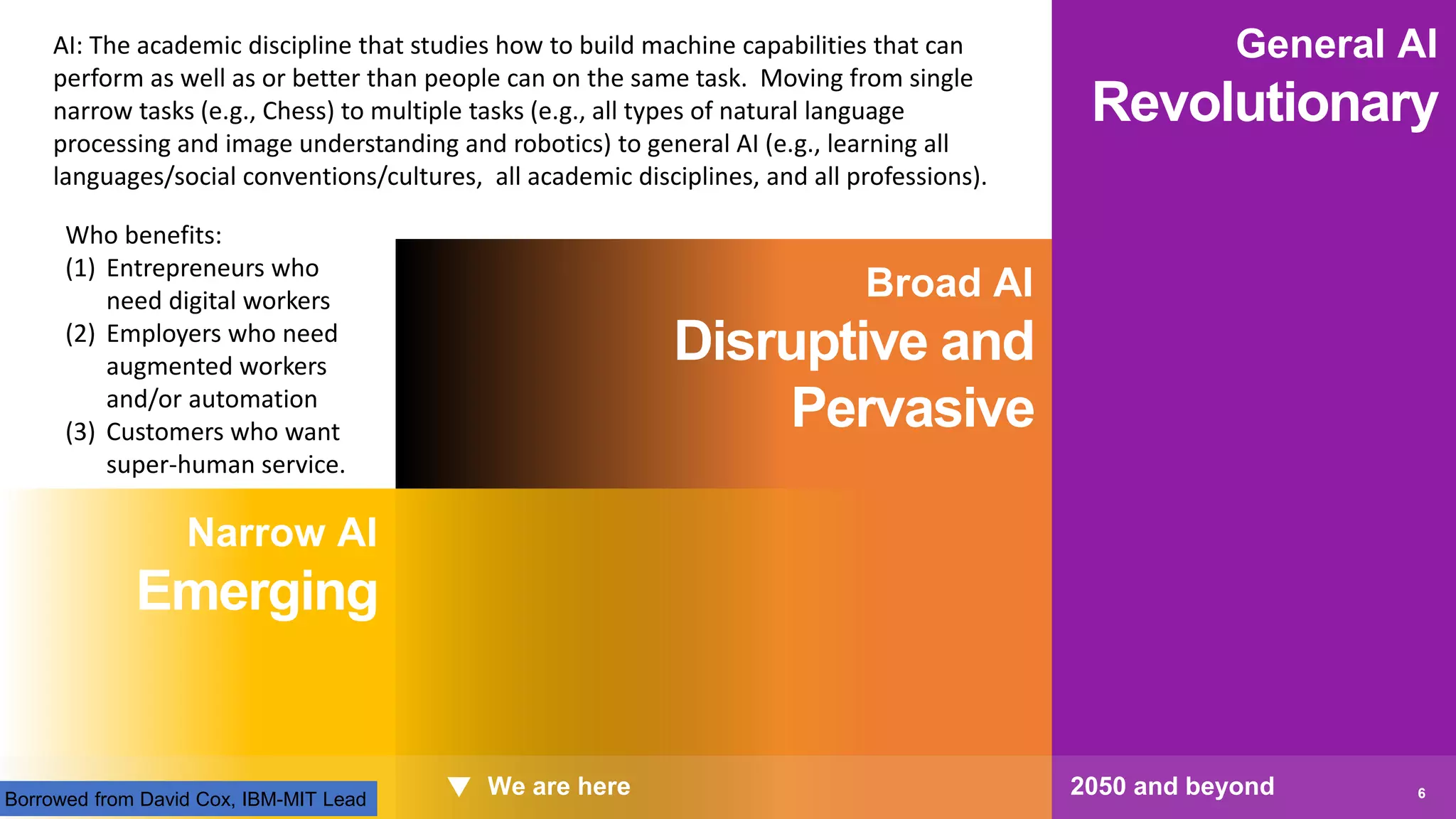
Narrow AI
Emerging
Broad AI
Disruptive and
Pervasive
General AI
Revolutionary
▼ We are here 2050 and beyond 6IBM Research AI © 2018 IBM Corporation
The evolution of AI
Borrowed from David Cox, IBM-MIT Lead
AI: The academic discipline that studies how to build machine capabilities that can
perform as well as or better than people can on the same task. Moving from single
narrow tasks (e.g., Chess) to multiple tasks (e.g., all types of natural language
processing and image understanding and robotics) to general AI (e.g., learning all
languages/social conventions/cultures, all academic disciplines, and all professions).
Who benefits:
(1) Entrepreneurs who
need digital workers
(2) Employers who need
augmented workers
and/or automation
(3) Customers who want
super-human service.
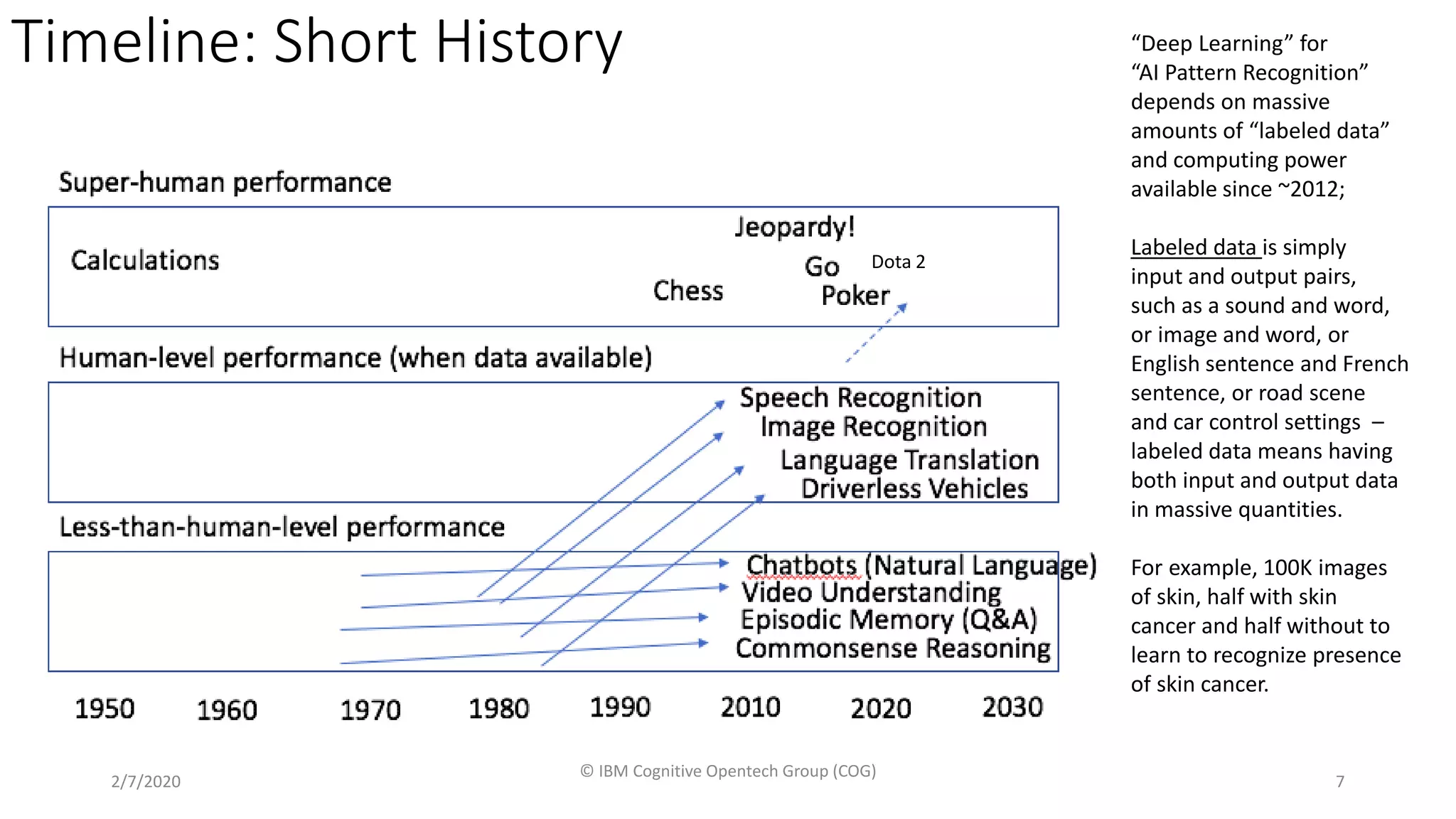
Timeline: Short History
2/7/2020
© IBM Cognitive Opentech Group (COG)
7
Dota 2
“Deep Learning” for
“AI Pattern Recognition”
depends on massive
amounts of “labeled data”
and computing power
available since ~2012;
Labeled data is simply
input and output pairs,
such as a sound and word,
or image and word, or
English sentence and French
sentence, or road scene
and car control settings –
labeled data means having
both input and output data
in massive quantities.
For example, 100K images
of skin, half with skin
cancer and half without to
learn to recognize presence
of skin cancer.
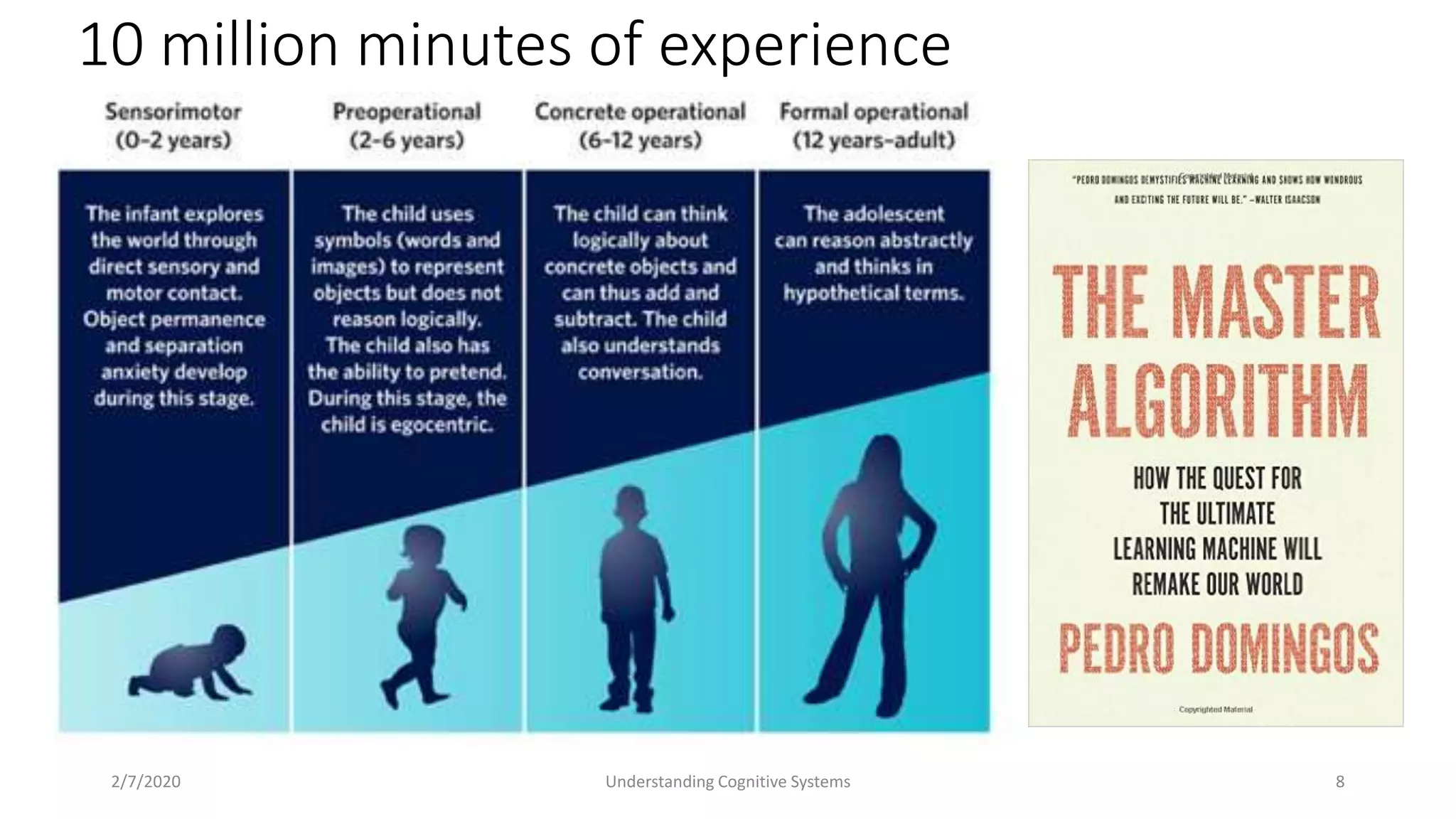
10 million minutes of experience
2/7/2020 Understanding Cognitive Systems 8
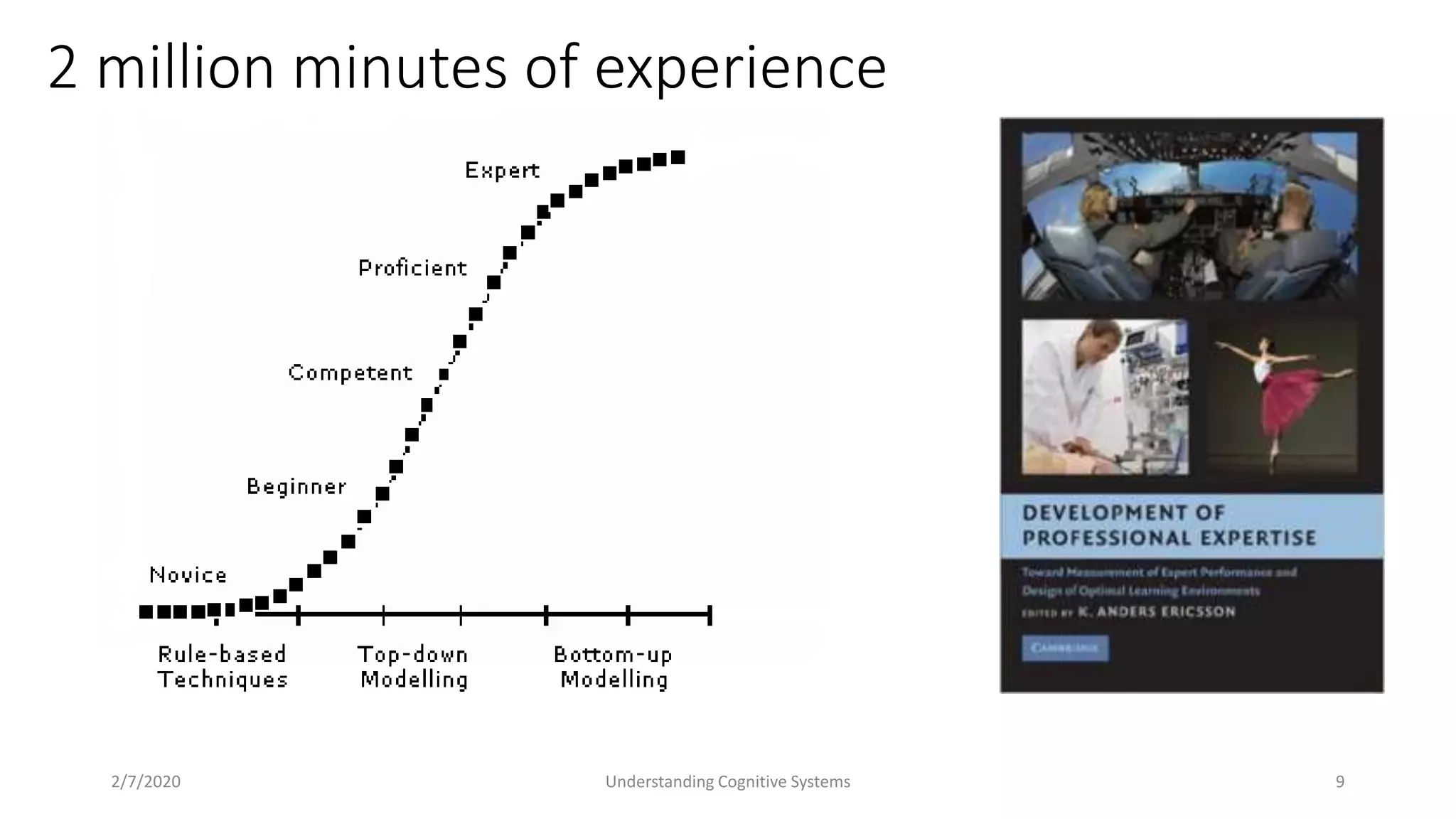
2 million minutes of experience
2/7/2020 Understanding Cognitive Systems 9
10September 2018 / © 2018 IBM Corporation
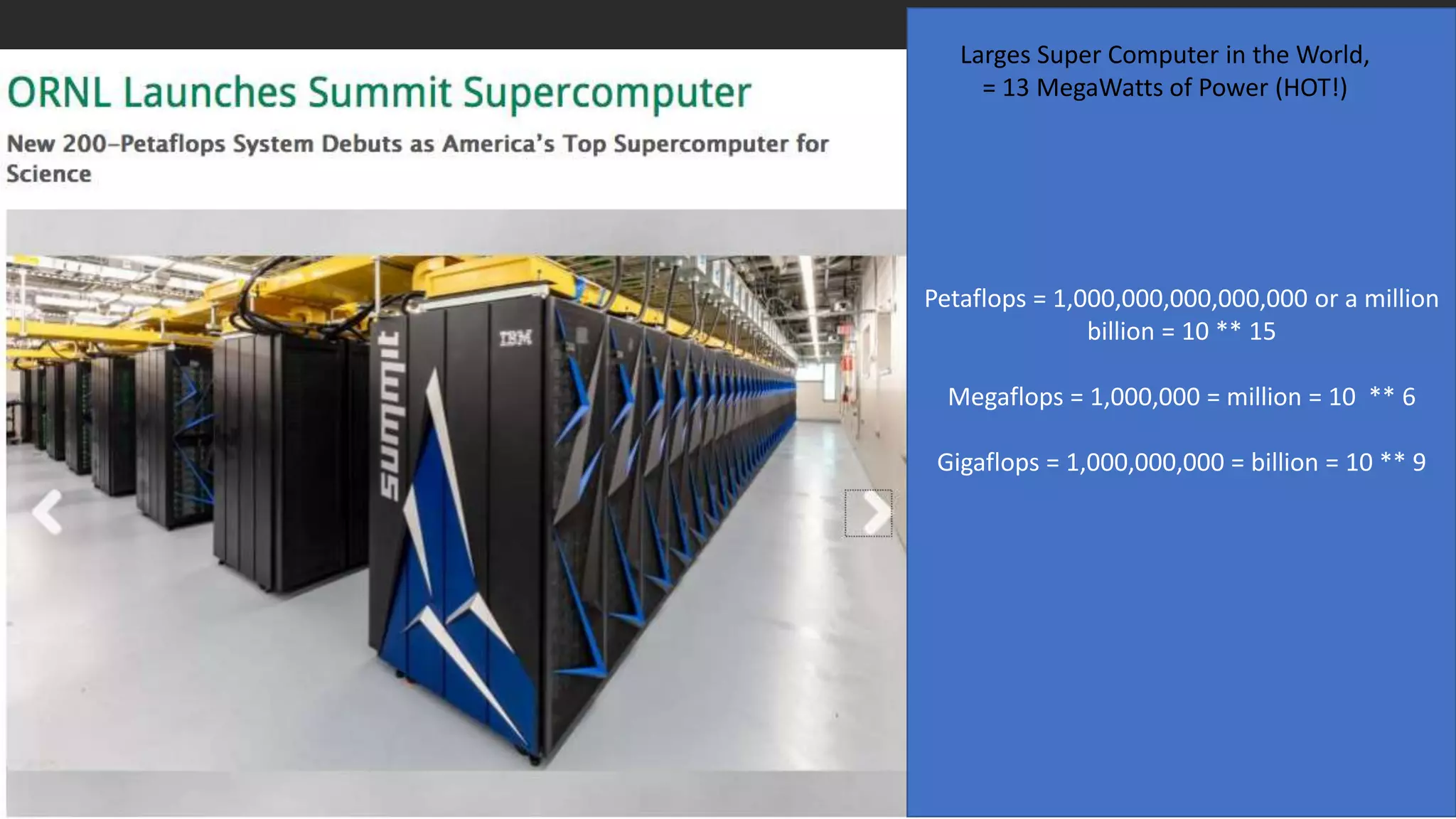
Petaflops = 1,000,000,000,000,000 or a million
billion = 10 ** 15
Megaflops = 1,000,000 = million = 10 ** 6
Gigaflops = 1,000,000,000 = billion = 10 ** 9
Larges Super Computer in the World,
= 13 MegaWatts of Power (HOT!)
11September 2018 / © 2018 IBM Corporation
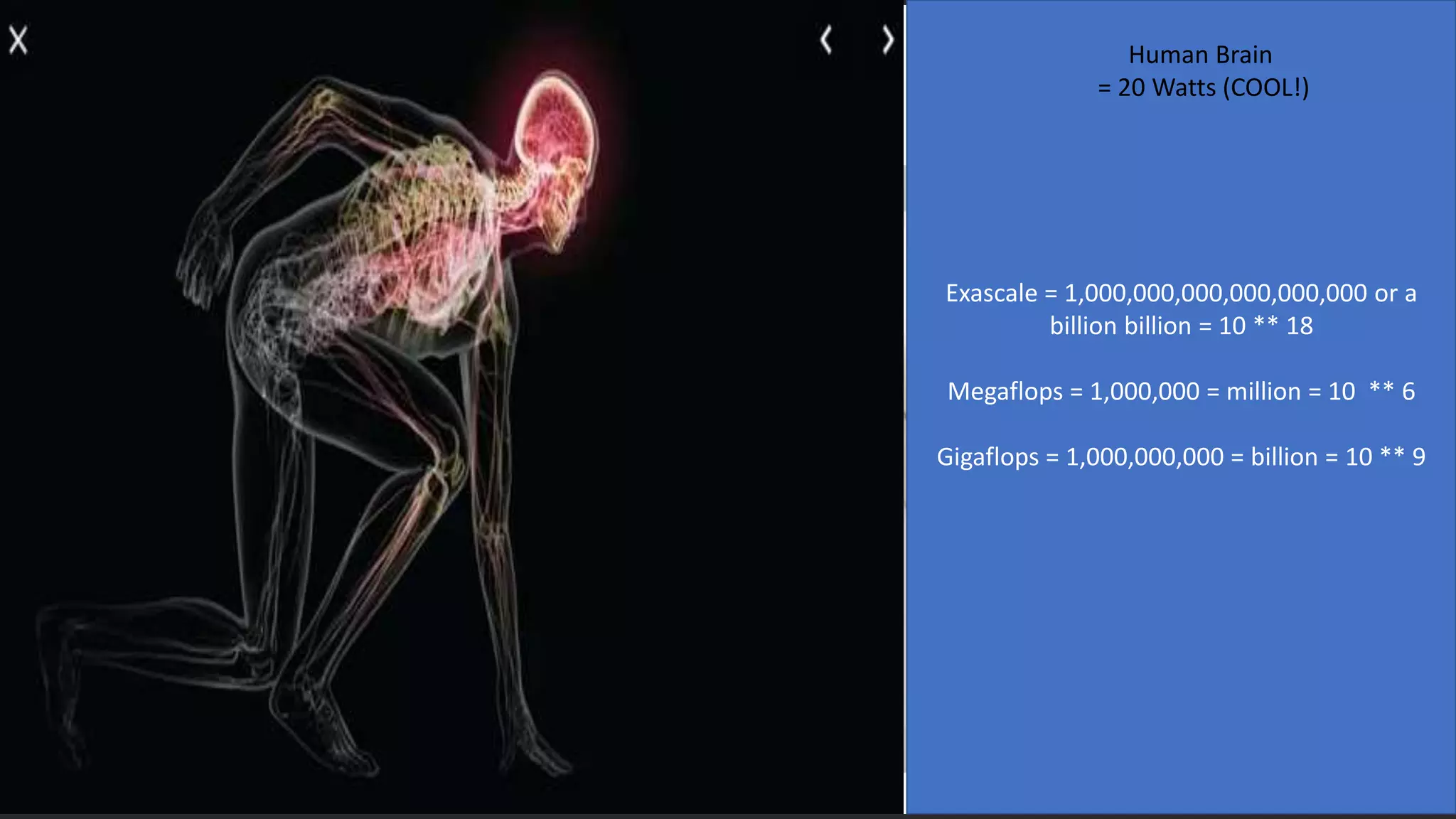
Exascale = 1,000,000,000,000,000,000 or a
billion billion = 10 ** 18
Megaflops = 1,000,000 = million = 10 ** 6
Gigaflops = 1,000,000,000 = billion = 10 ** 9
Human Brain
= 20 Watts (COOL!)
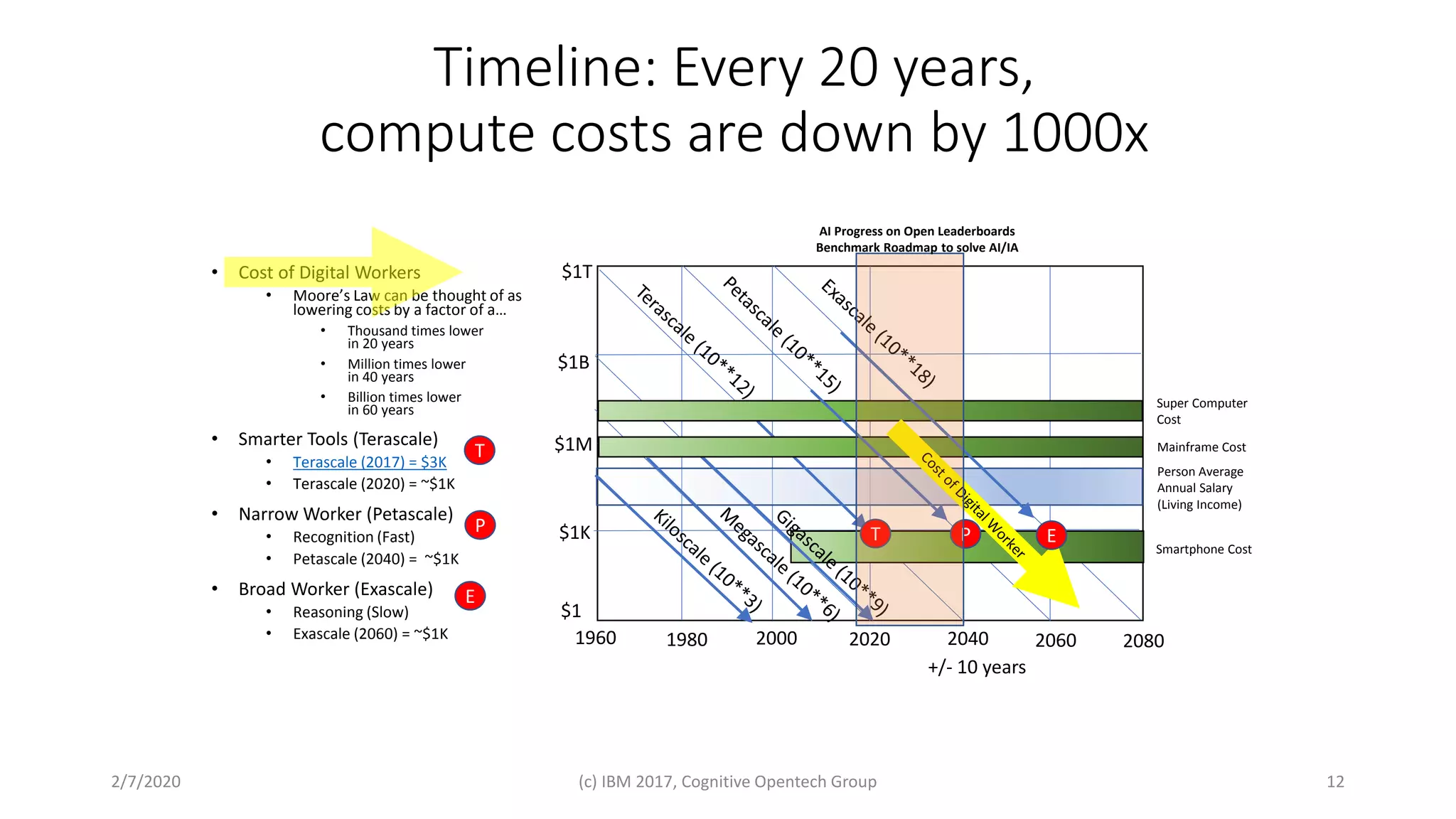
Timeline: Every 20 years,
compute costs are down by 1000x
• Cost of Digital Workers
• Moore’s Law can be thought of as
lowering costs by a factor of a…
• Thousand times lower
in 20 years
• Million times lower
in 40 years
• Billion times lower
in 60 years
• Smarter Tools (Terascale)
• Terascale (2017) = $3K
• Terascale (2020) = ~$1K
• Narrow Worker (Petascale)
• Recognition (Fast)
• Petascale (2040) = ~$1K
• Broad Worker (Exascale)
• Reasoning (Slow)
• Exascale (2060) = ~$1K
122/7/2020 (c) IBM 2017, Cognitive Opentech Group
2080204020001960
$1K
$1M
$1B
$1T
206020201980
+/- 10 years
$1
Person Average
Annual Salary
(Living Income)
Super Computer
Cost
Mainframe Cost
Smartphone Cost
T
P
E
T P E
AI Progress on Open Leaderboards
Benchmark Roadmap to solve AI/IA
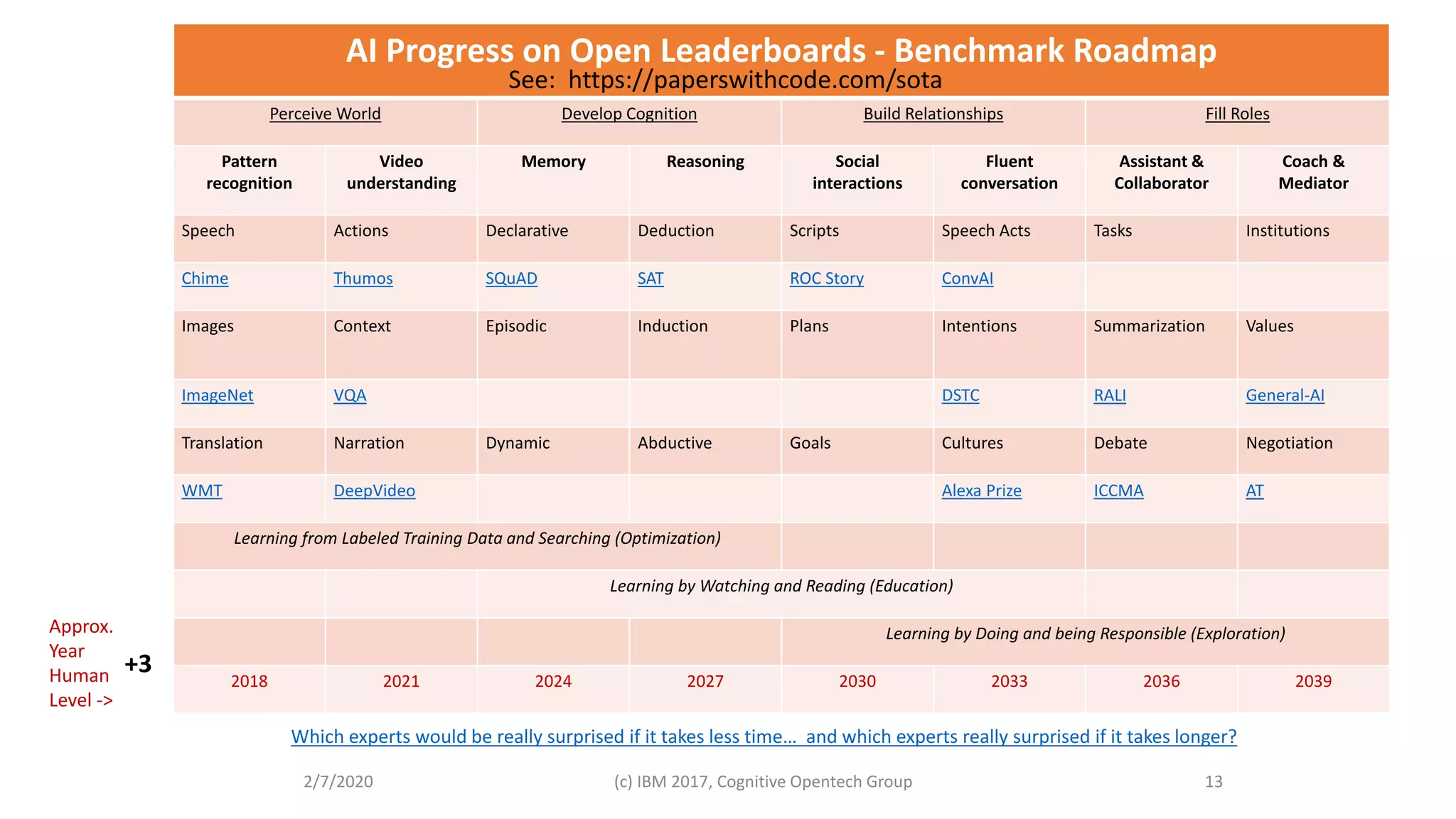
Timeline: Leaderboards FrameworkAI Progress on Open Leaderboards - Benchmark Roadmap
Perceive World Develop Cognition Build Relationships Fill Roles
Pattern
recognition
Video
understanding
Memory Reasoning Social
interactions
Fluent
conversation
Assistant &
Collaborator
Coach &
Mediator
Speech Actions Declarative Deduction Scripts Speech Acts Tasks Institutions
Chime Thumos SQuAD SAT ROC Story ConvAI
Images Context Episodic Induction Plans Intentions Summarization Values
ImageNet VQA DSTC RALI General-AI
Translation Narration Dynamic Abductive Goals Cultures Debate Negotiation
WMT DeepVideo Alexa Prize ICCMA AT
Learning from Labeled Training Data and Searching (Optimization)
Learning by Watching and Reading (Education)
Learning by Doing and being Responsible (Exploration)
2018 2021 2024 2027 2030 2033 2036 2039
2/7/2020 (c) IBM 2017, Cognitive Opentech Group 13
Which experts would be really surprised if it takes less time… and which experts really surprised if it takes longer?
Approx.
Year
Human
Level ->
+3
See: https://paperswithcode.com/sota
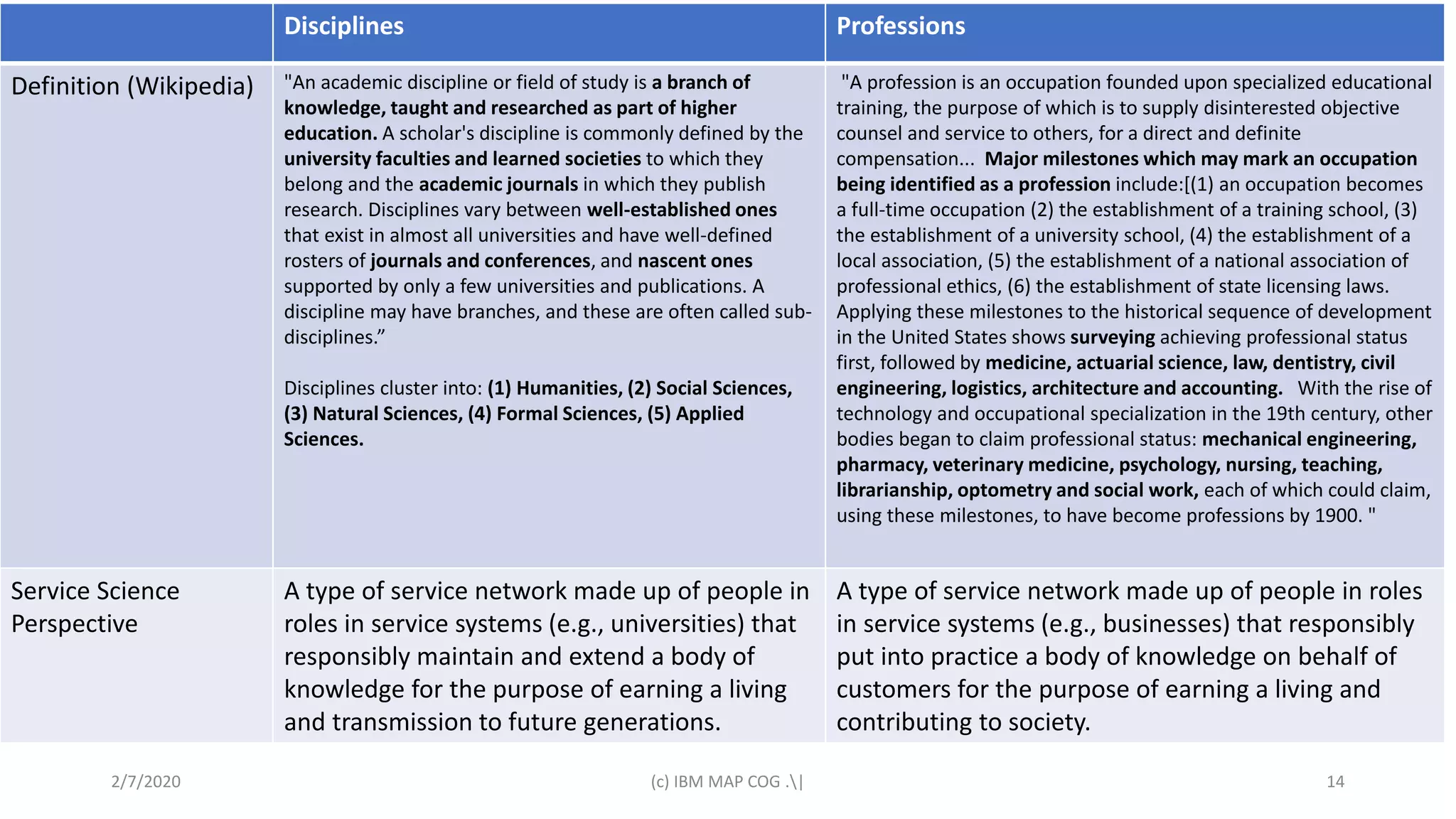
Disciplines and Professions
Disciplines Professions
Definition (Wikipedia) "An academic discipline or field of study is a branch of
knowledge, taught and researched as part of higher
education. A scholar's discipline is commonly defined by the
university faculties and learned societies to which they
belong and the academic journals in which they publish
research. Disciplines vary between well-established ones
that exist in almost all universities and have well-defined
rosters of journals and conferences, and nascent ones
supported by only a few universities and publications. A
discipline may have branches, and these are often called sub-
disciplines.”
Disciplines cluster into: (1) Humanities, (2) Social Sciences,
(3) Natural Sciences, (4) Formal Sciences, (5) Applied
Sciences.
"A profession is an occupation founded upon specialized educational
training, the purpose of which is to supply disinterested objective
counsel and service to others, for a direct and definite
compensation... Major milestones which may mark an occupation
being identified as a profession include:[(1) an occupation becomes
a full-time occupation (2) the establishment of a training school, (3)
the establishment of a university school, (4) the establishment of a
local association, (5) the establishment of a national association of
professional ethics, (6) the establishment of state licensing laws.
Applying these milestones to the historical sequence of development
in the United States shows surveying achieving professional status
first, followed by medicine, actuarial science, law, dentistry, civil
engineering, logistics, architecture and accounting. With the rise of
technology and occupational specialization in the 19th century, other
bodies began to claim professional status: mechanical engineering,
pharmacy, veterinary medicine, psychology, nursing, teaching,
librarianship, optometry and social work, each of which could claim,
using these milestones, to have become professions by 1900. "
Service Science
Perspective
A type of service network made up of people in
roles in service systems (e.g., universities) that
responsibly maintain and extend a body of
knowledge for the purpose of earning a living
and transmission to future generations.
A type of service network made up of people in roles
in service systems (e.g., businesses) that responsibly
put into practice a body of knowledge on behalf of
customers for the purpose of earning a living and
contributing to society.
2/7/2020 (c) IBM MAP COG .| 14
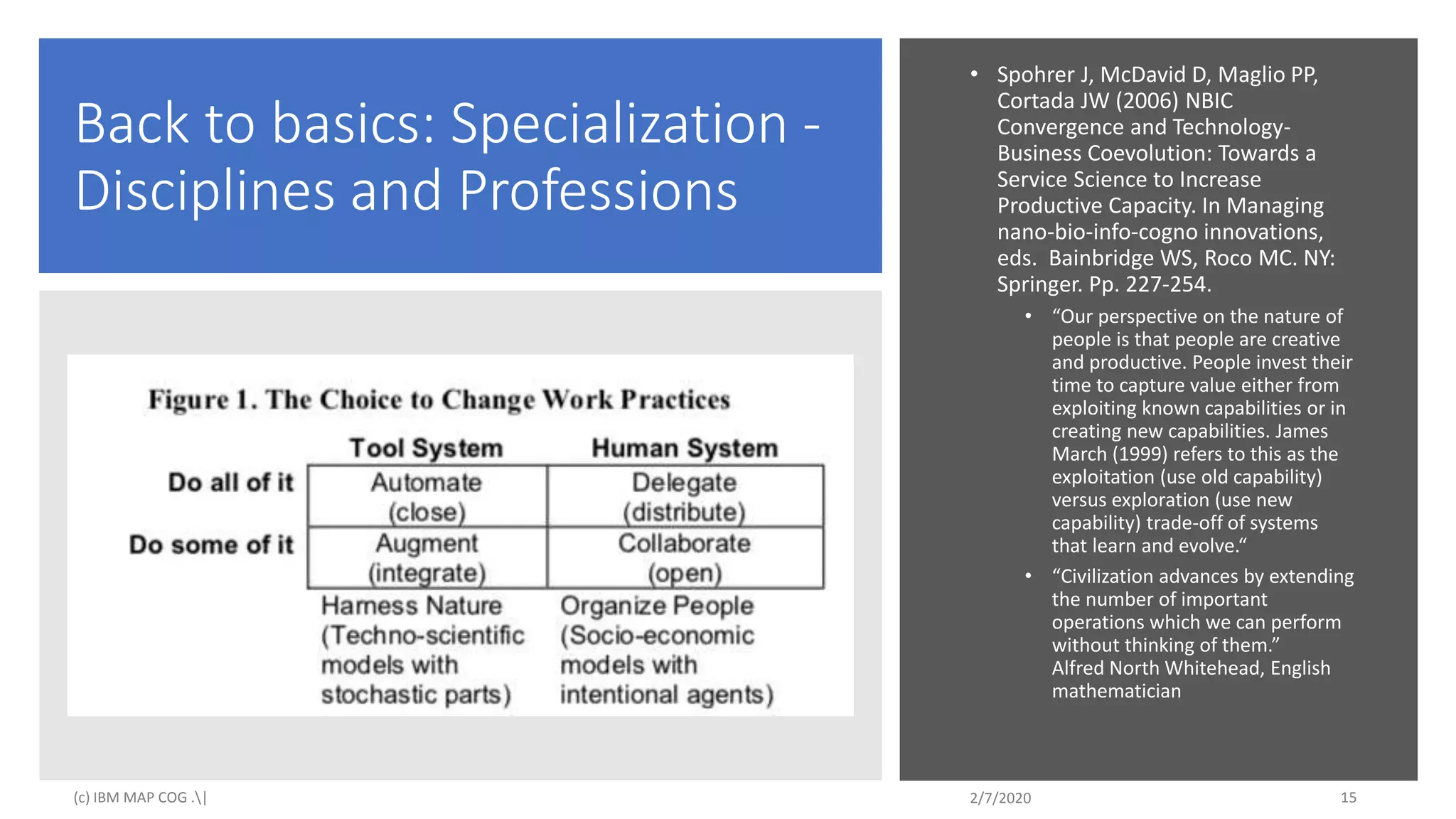
Back to basics: Specialization -
Disciplines and Professions
(c) IBM MAP COG .|
• Spohrer J, McDavid D, Maglio PP,
Cortada JW (2006) NBIC
Convergence and Technology-
Business Coevolution: Towards a
Service Science to Increase
Productive Capacity. In Managing
nano-bio-info-cogno innovations,
eds. Bainbridge WS, Roco MC. NY:
Springer. Pp. 227-254.
• “Our perspective on the nature of
people is that people are creative
and productive. People invest their
time to capture value either from
exploiting known capabilities or in
creating new capabilities. James
March (1999) refers to this as the
exploitation (use old capability)
versus exploration (use new
capability) trade-off of systems
that learn and evolve.“
• “Civilization advances by extending
the number of important
operations which we can perform
without thinking of them.”
Alfred North Whitehead, English
mathematician
2/7/2020 15
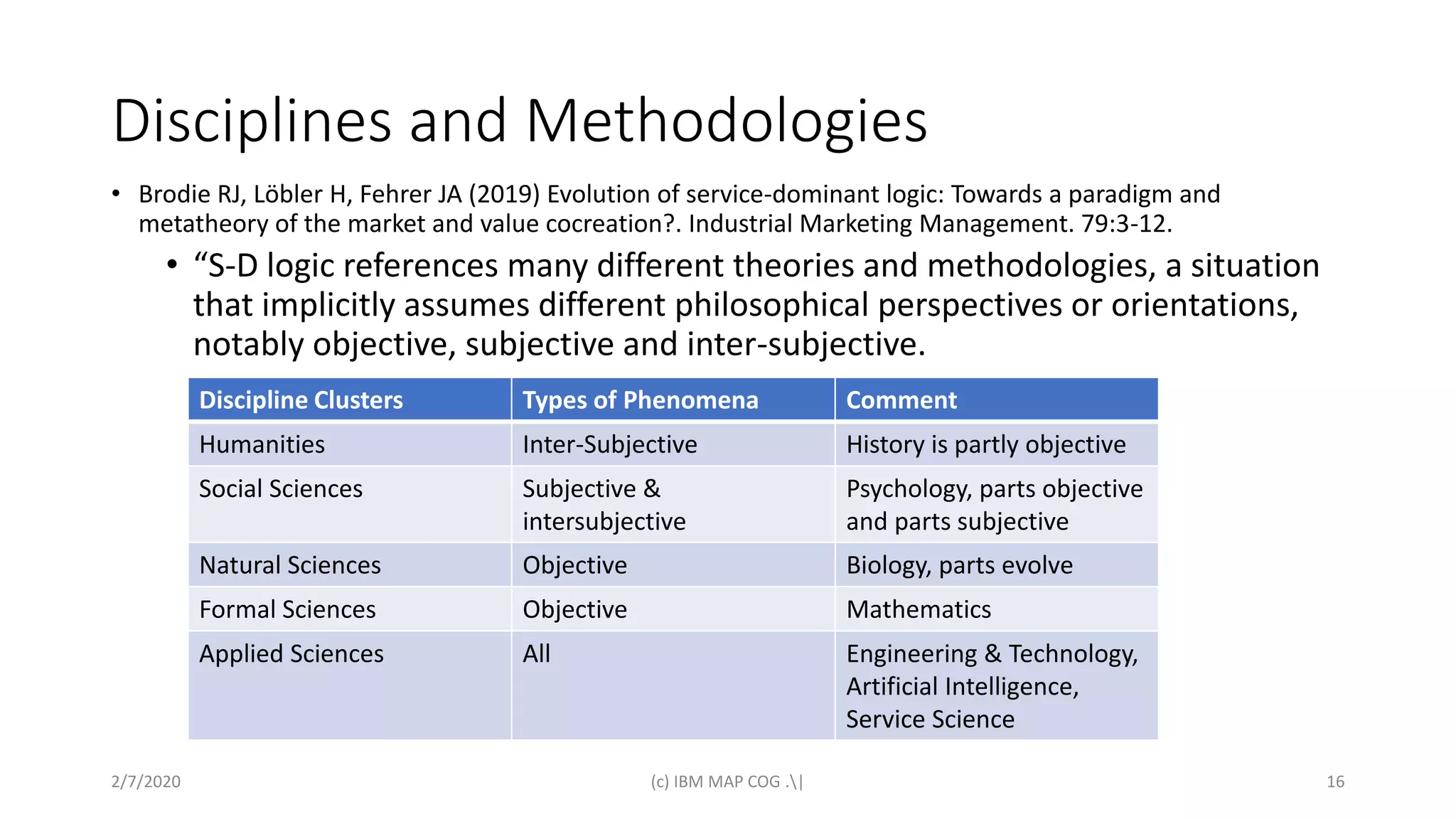
Disciplines and Methodologies
• Brodie RJ, Löbler H, Fehrer JA (2019) Evolution of service-dominant logic: Towards a paradigm and
metatheory of the market and value cocreation?. Industrial Marketing Management. 79:3-12.
• “S-D logic references many different theories and methodologies, a situation
that implicitly assumes different philosophical perspectives or orientations,
notably objective, subjective and inter-subjective.
2/7/2020 (c) IBM MAP COG .| 16
Discipline Clusters Types of Phenomena Comment
Humanities Inter-Subjective History is partly objective
Social Sciences Subjective &
intersubjective
Psychology, parts objective
and parts subjective
Natural Sciences Objective Biology, parts evolve
Formal Sciences Objective Mathematics
Applied Sciences All Engineering & Technology,
Artificial Intelligence,
Service Science
SSME: Service Science, Management, and Engineering
IBM Research © 2006 IBM Corporation17
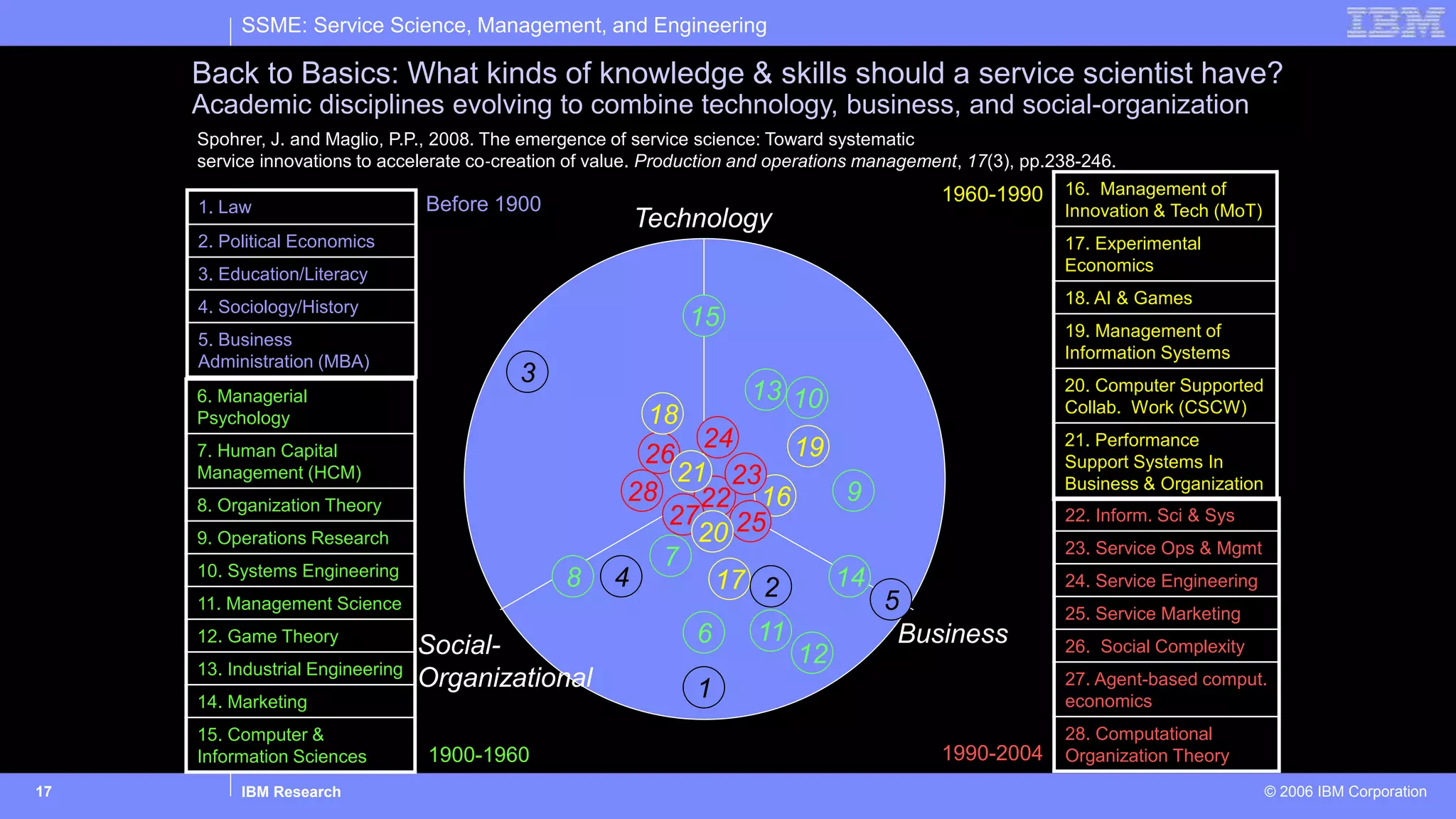
Back to Basics: What kinds of knowledge & skills should a service scientist have?
Academic disciplines evolving to combine technology, business, and social-organization
Technology
BusinessSocial-
Organizational
26
22
17 24
15
3
18
1
5
16
25 22. Inform. Sci & Sys
23. Service Ops & Mgmt
24. Service Engineering
25. Service Marketing
26. Social Complexity
27. Agent-based comput.
economics
28. Computational
Organization Theory
6. Managerial
Psychology
7. Human Capital
Management (HCM)
8. Organization Theory
9. Operations Research
10. Systems Engineering
11. Management Science
12. Game Theory
13. Industrial Engineering
14. Marketing
15. Computer &
Information Sciences
23
24
27
28
19
20
21
7
8
9
10
11
12
13
14
6
1990-2004
1960-1990
1900-1960
Before 1900
16. Management of
Innovation & Tech (MoT)
17. Experimental
Economics
18. AI & Games
19. Management of
Information Systems
20. Computer Supported
Collab. Work (CSCW)
21. Performance
Support Systems In
Business & Organization
1. Law
2. Political Economics
3. Education/Literacy
4. Sociology/History
5. Business
Administration (MBA)
Spohrer, J. and Maglio, P.P., 2008. The emergence of service science: Toward systematic
service innovations to accelerate co‐creation of value. Production and operations management, 17(3), pp.238-246.
SSME: Service Science, Management, and Engineering
IBM Research © 2006 IBM Corporation18
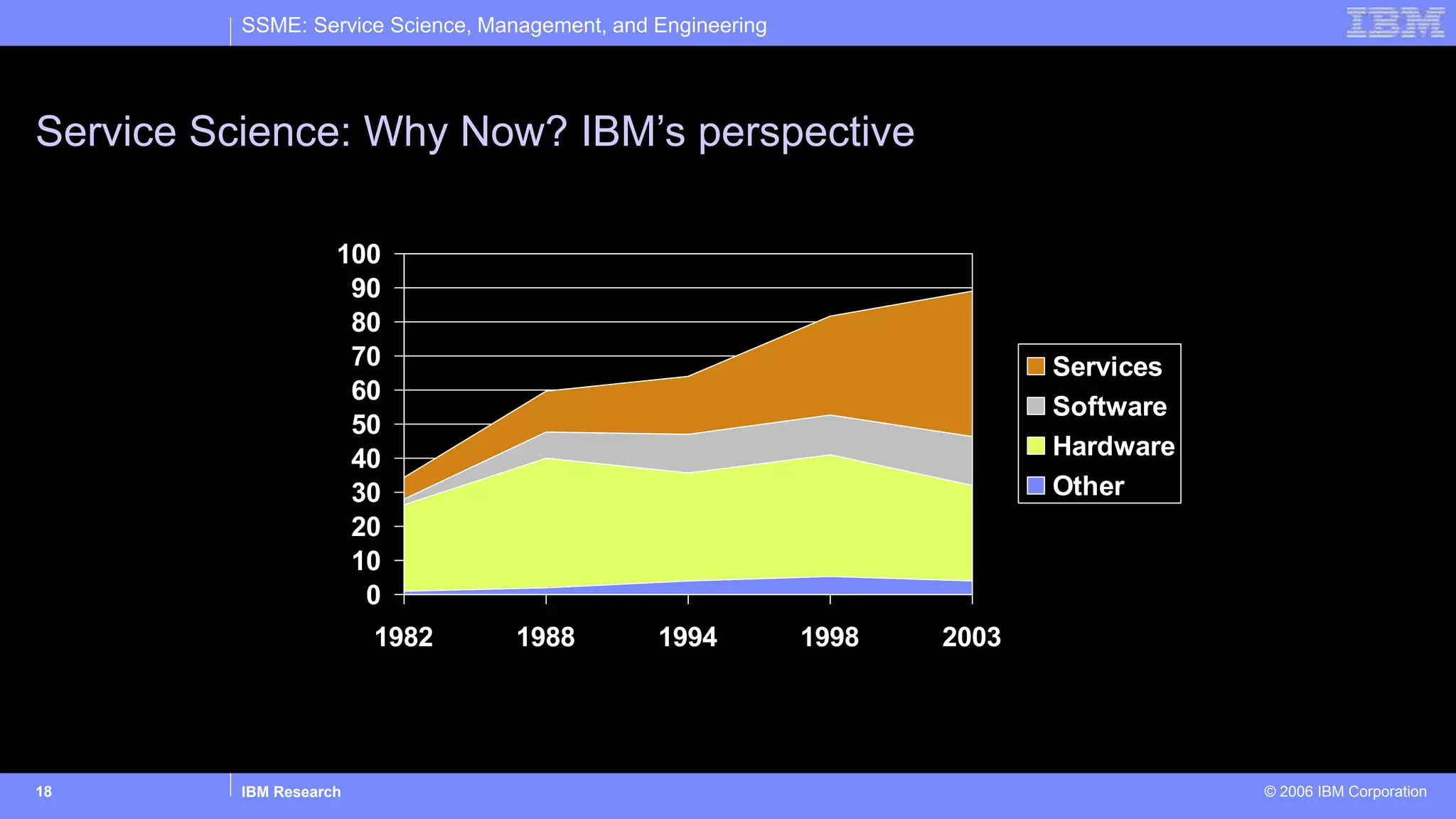
Service Science: Why Now? IBM’s perspective
0
10
20
30
40
50
60
70
80
90
100
1982 1988 1994 1998 2003
Services
Software
Hardware
Other
SSME: Service Science, Management, and Engineering
IBM Research © 2006 IBM Corporation19
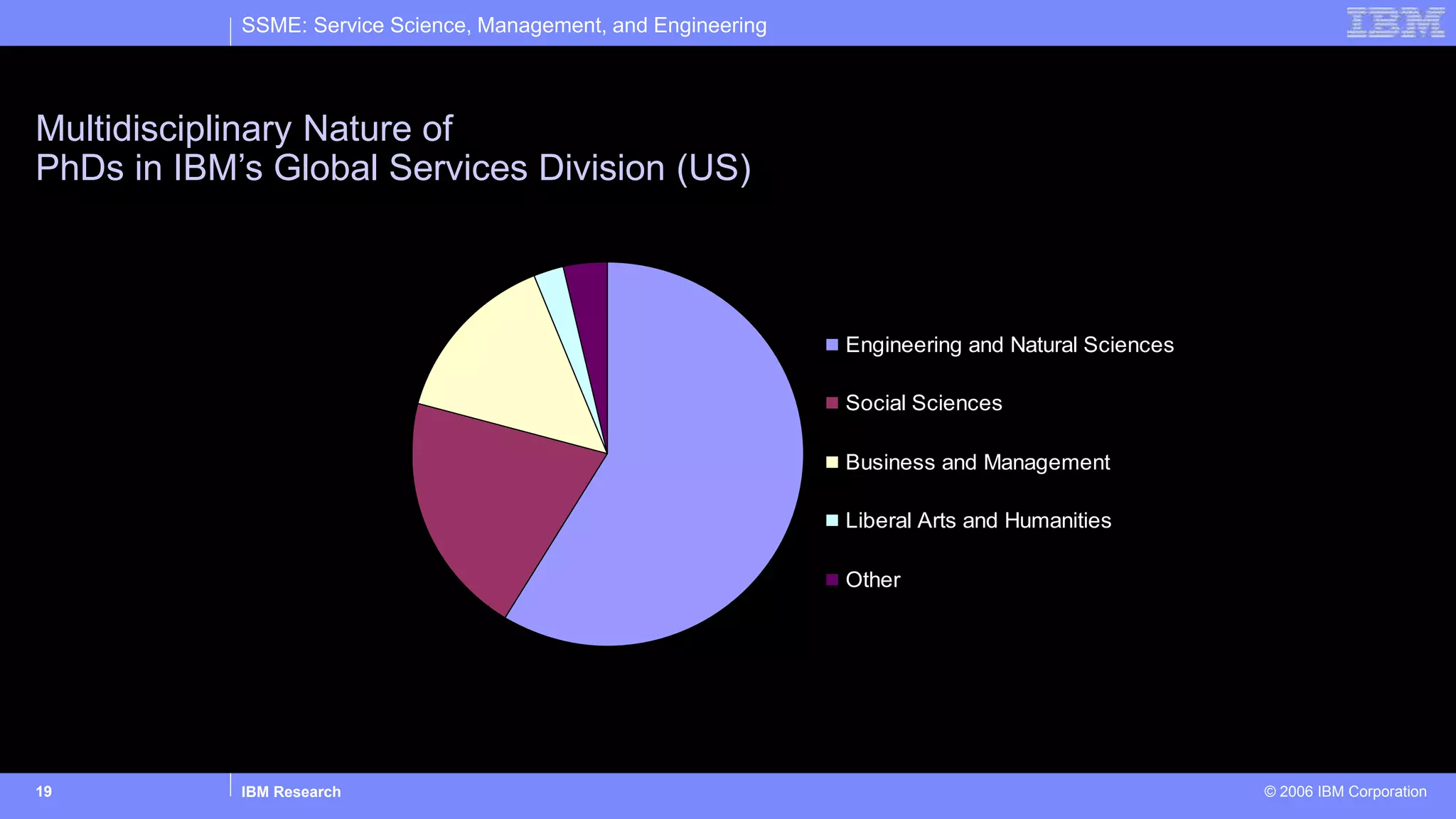
Multidisciplinary Nature of
PhDs in IBM’s Global Services Division (US)
Engineering and Natural Sciences
Social Sciences
Business and Management
Liberal Arts and Humanities
Other
SSME: Service Science, Management, and Engineering
IBM Research © 2006 IBM Corporation20
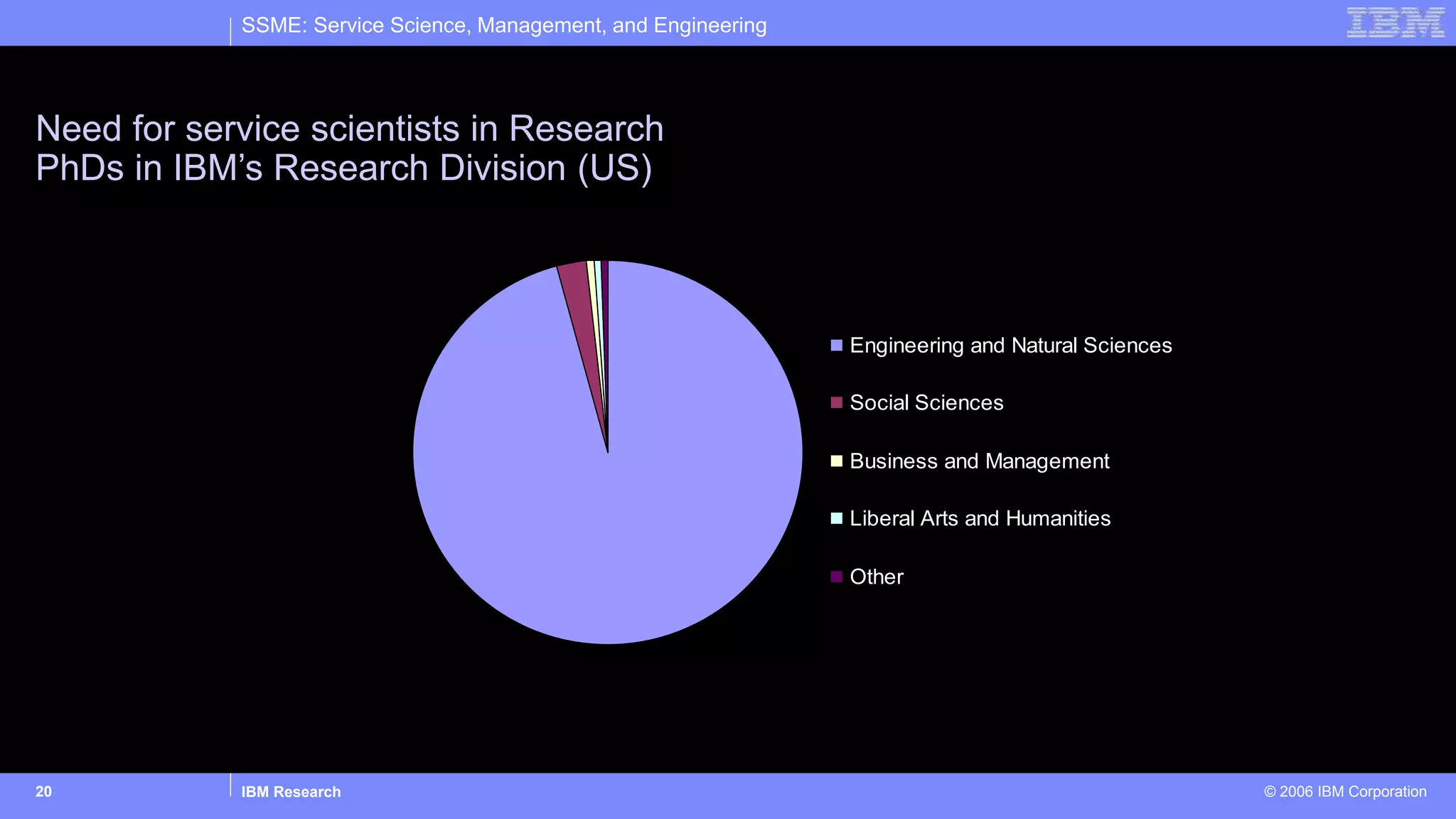
Need for service scientists in Research
PhDs in IBM’s Research Division (US)
Engineering and Natural Sciences
Social Sciences
Business and Management
Liberal Arts and Humanities
Other
SSME: Service Science, Management, and Engineering
IBM Research © 2006 IBM Corporation21
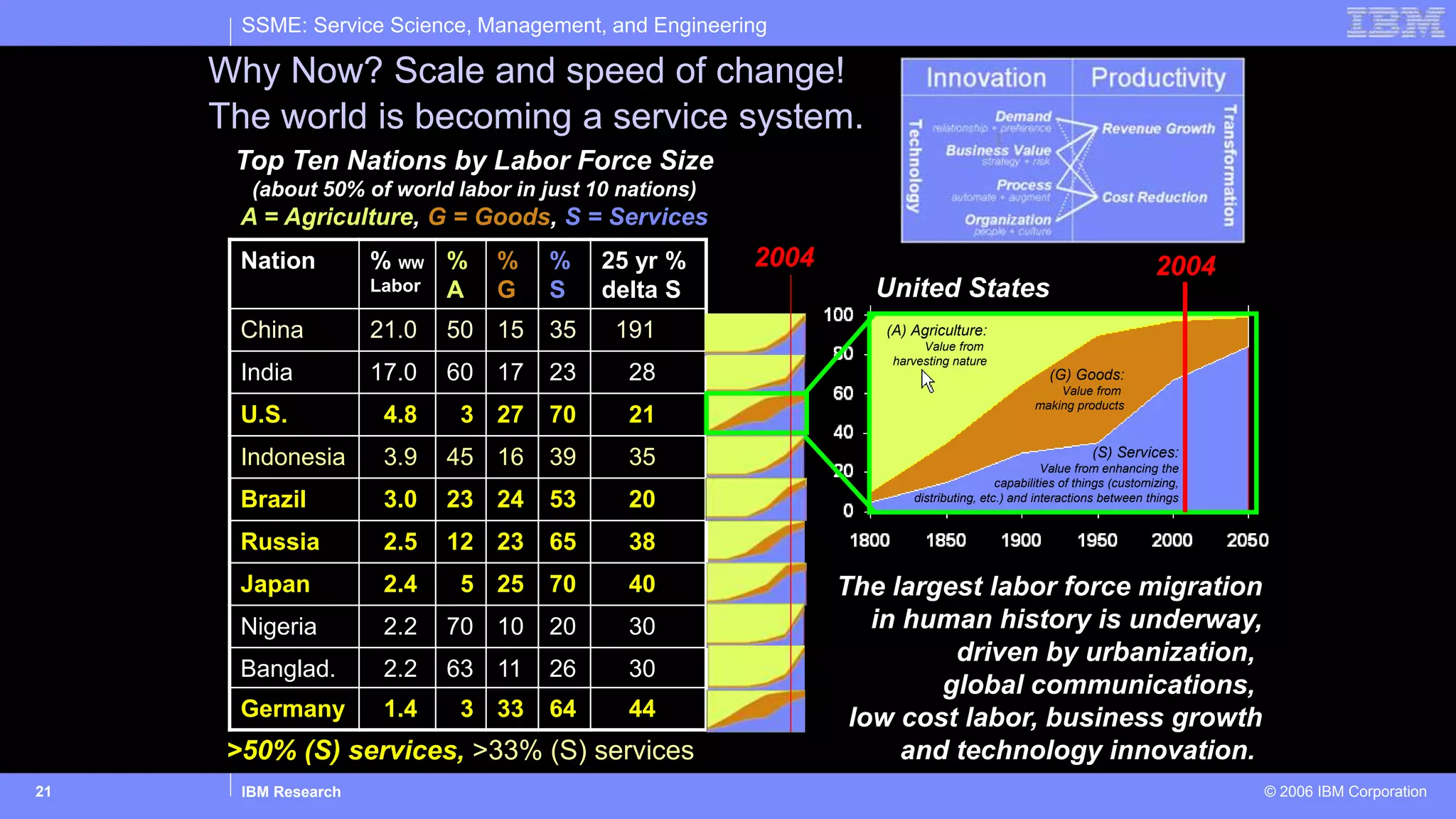
Nation % WW
Labor
%
A
%
G
%
S
25 yr %
delta S
China 21.0 50 15 35 191
India 17.0 60 17 23 28
U.S. 4.8 3 27 70 21
Indonesia 3.9 45 16 39 35
Brazil 3.0 23 24 53 20
Russia 2.5 12 23 65 38
Japan 2.4 5 25 70 40
Nigeria 2.2 70 10 20 30
Banglad. 2.2 63 11 26 30
Germany 1.4 3 33 64 44
Top Ten Nations by Labor Force Size
(about 50% of world labor in just 10 nations)
A = Agriculture, G = Goods, S = Services
>50% (S) services, >33% (S) services
2004 2004
United States
The largest labor force migration
in human history is underway,
driven by urbanization,
global communications,
low cost labor, business growth
and technology innovation.
(A) Agriculture:
Value from
harvesting nature
(G) Goods:
Value from
making products
(S) Services:
Value from enhancing the
capabilities of things (customizing,
distributing, etc.) and interactions between things
The world is becoming a service system.
Why Now? Scale and speed of change!
SSME: Service Science, Management, and Engineering
IBM Research © 2006 IBM Corporation22
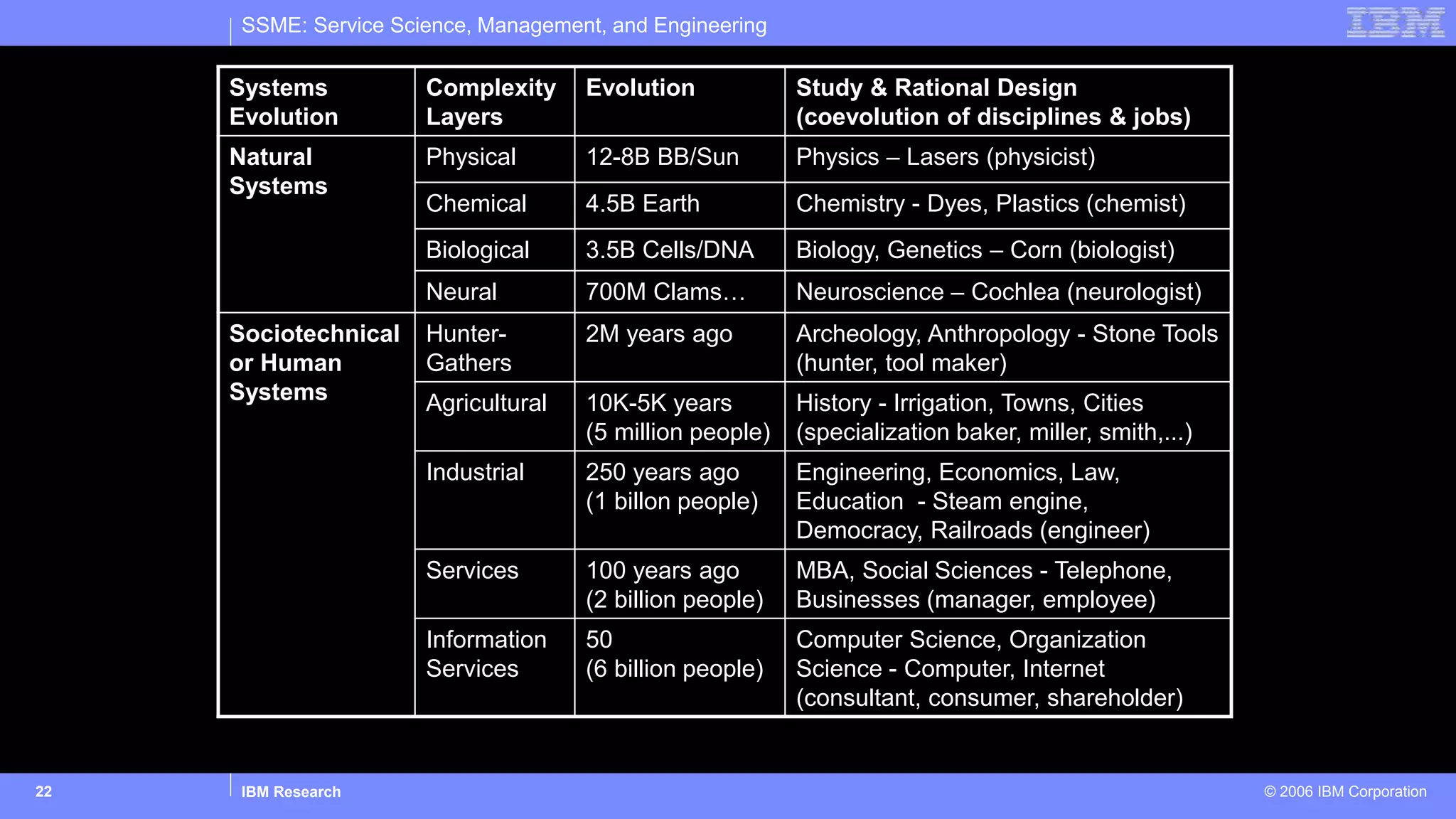
Systems
Evolution
Complexity
Layers
Evolution Study & Rational Design
(coevolution of disciplines & jobs)
Natural
Systems
Physical 12-8B BB/Sun Physics – Lasers (physicist)
Chemical 4.5B Earth Chemistry - Dyes, Plastics (chemist)
Biological 3.5B Cells/DNA Biology, Genetics – Corn (biologist)
Neural 700M Clams… Neuroscience – Cochlea (neurologist)
Sociotechnical
or Human
Systems
Hunter-
Gathers
2M years ago Archeology, Anthropology - Stone Tools
(hunter, tool maker)
Agricultural 10K-5K years
(5 million people)
History - Irrigation, Towns, Cities
(specialization baker, miller, smith,...)
Industrial 250 years ago
(1 billon people)
Engineering, Economics, Law,
Education - Steam engine,
Democracy, Railroads (engineer)
Services 100 years ago
(2 billion people)
MBA, Social Sciences - Telephone,
Businesses (manager, employee)
Information
Services
50
(6 billion people)
Computer Science, Organization
Science - Computer, Internet
(consultant, consumer, shareholder)
SSME: Service Science, Management, and Engineering
IBM Research © 2006 IBM Corporation
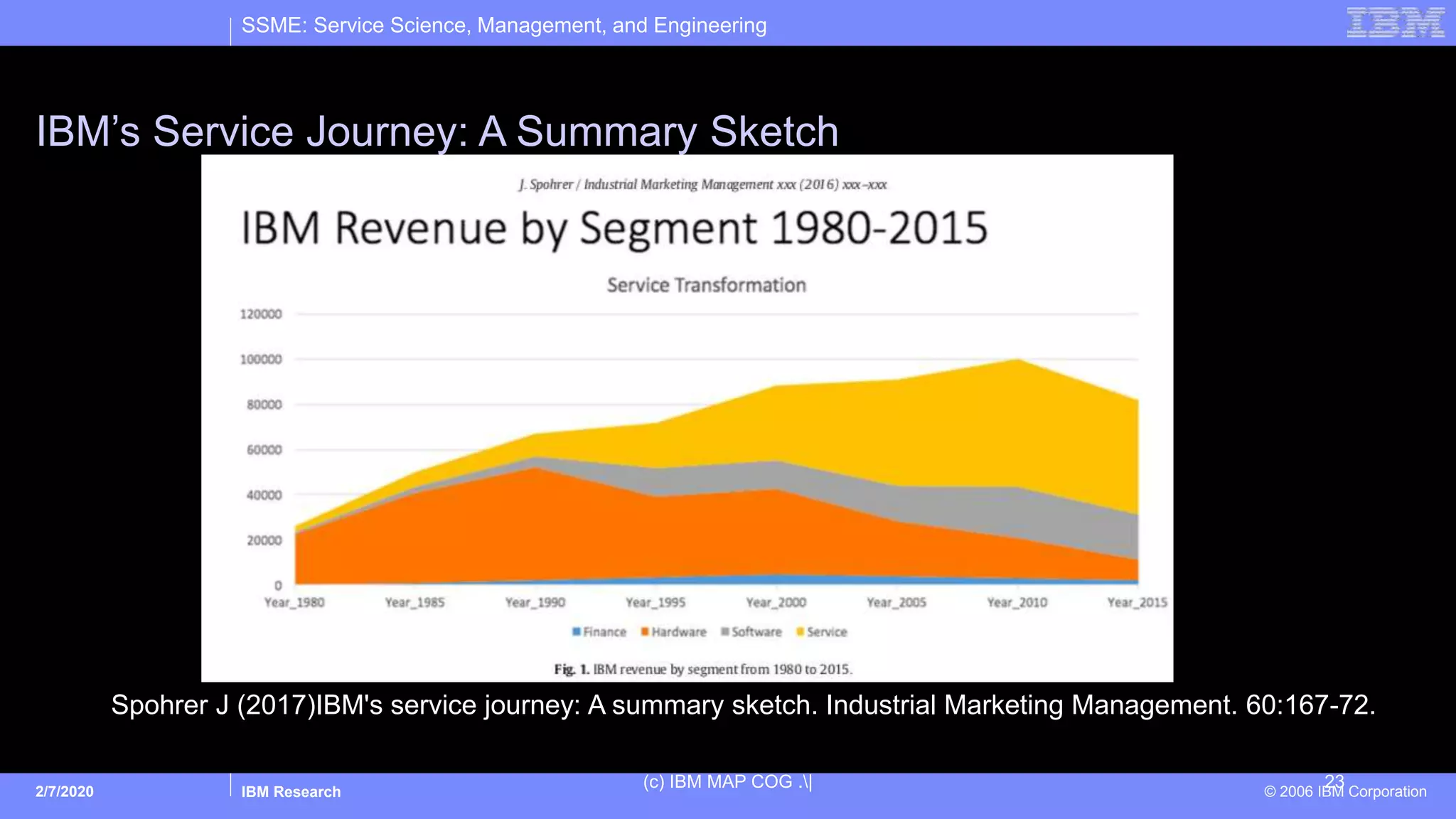
IBM’s Service Journey: A Summary Sketch
2/7/2020
(c) IBM MAP COG .| 23
Spohrer J (2017)IBM's service journey: A summary sketch. Industrial Marketing Management. 60:167-72.
Computer Science
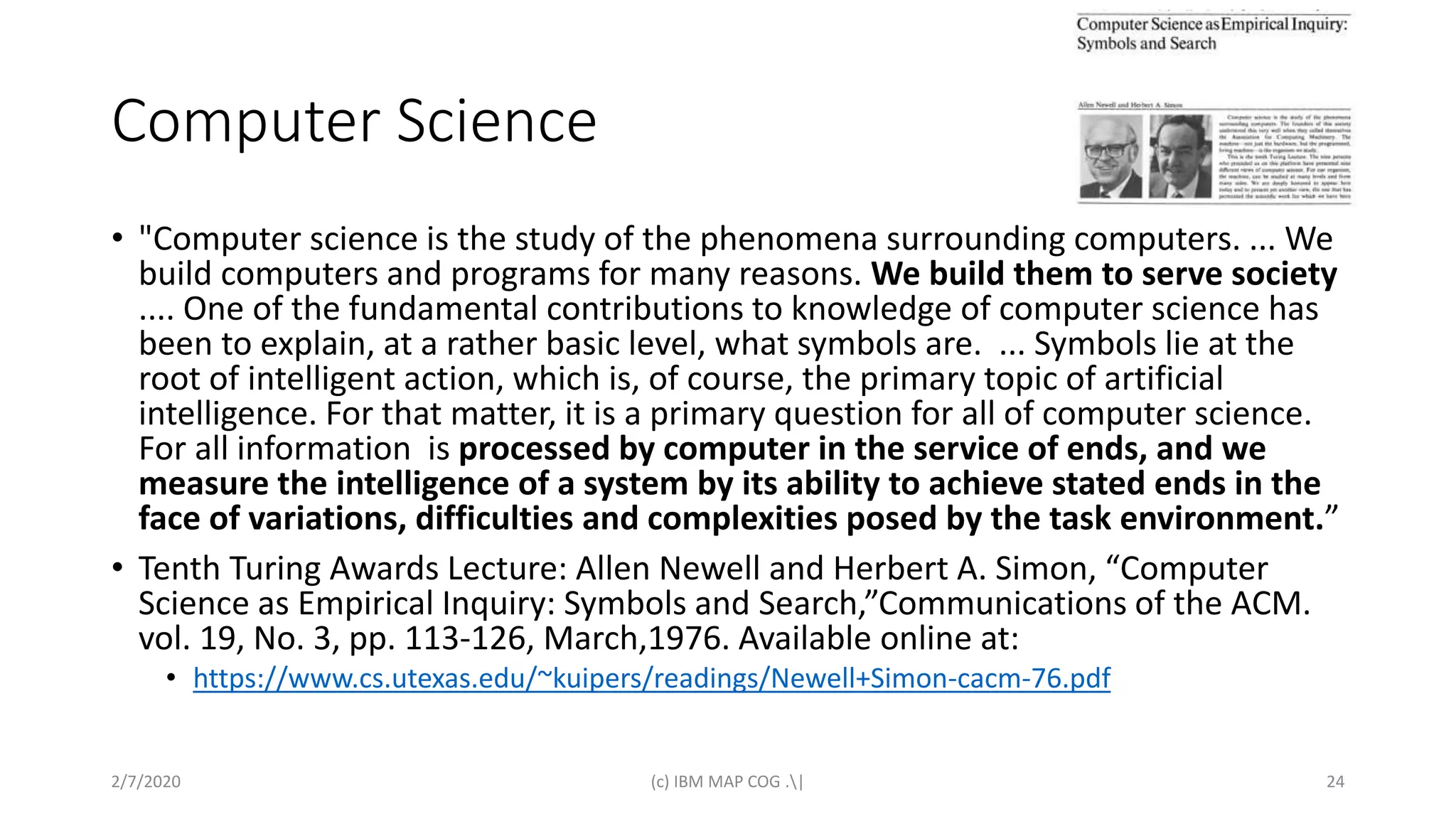
• "Computer science is the study of the phenomena surrounding computers. ... We
build computers and programs for many reasons. We build them to serve society
.... One of the fundamental contributions to knowledge of computer science has
been to explain, at a rather basic level, what symbols are. ... Symbols lie at the
root of intelligent action, which is, of course, the primary topic of artificial
intelligence. For that matter, it is a primary question for all of computer science.
For all information is processed by computer in the service of ends, and we
measure the intelligence of a system by its ability to achieve stated ends in the
face of variations, difficulties and complexities posed by the task environment.”
• Tenth Turing Awards Lecture: Allen Newell and Herbert A. Simon, “Computer
Science as Empirical Inquiry: Symbols and Search,”Communications of the ACM.
vol. 19, No. 3, pp. 113-126, March,1976. Available online at:
• https://www.cs.utexas.edu/~kuipers/readings/Newell+Simon-cacm-76.pdf
2/7/2020 (c) IBM MAP COG .| 24
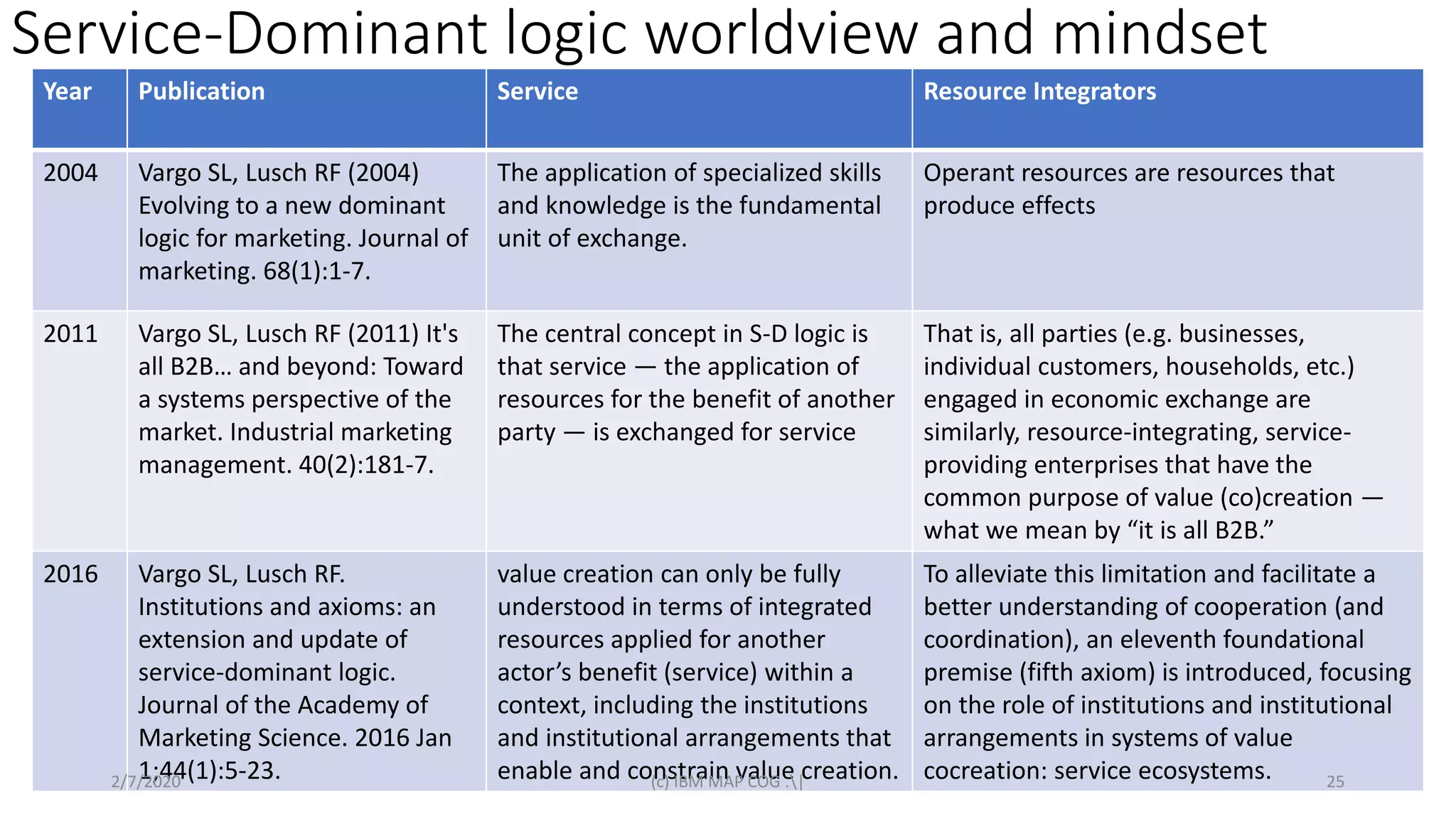
Service-Dominant logic worldview and mindset
Year Publication Service Resource Integrators
2004 Vargo SL, Lusch RF (2004)
Evolving to a new dominant
logic for marketing. Journal of
marketing. 68(1):1-7.
The application of specialized skills
and knowledge is the fundamental
unit of exchange.
Operant resources are resources that
produce effects
2011 Vargo SL, Lusch RF (2011) It's
all B2B… and beyond: Toward
a systems perspective of the
market. Industrial marketing
management. 40(2):181-7.
The central concept in S-D logic is
that service — the application of
resources for the benefit of another
party — is exchanged for service
That is, all parties (e.g. businesses,
individual customers, households, etc.)
engaged in economic exchange are
similarly, resource-integrating, service-
providing enterprises that have the
common purpose of value (co)creation —
what we mean by “it is all B2B.”
2016 Vargo SL, Lusch RF.
Institutions and axioms: an
extension and update of
service-dominant logic.
Journal of the Academy of
Marketing Science. 2016 Jan
1;44(1):5-23.
value creation can only be fully
understood in terms of integrated
resources applied for another
actor’s benefit (service) within a
context, including the institutions
and institutional arrangements that
enable and constrain value creation.
To alleviate this limitation and facilitate a
better understanding of cooperation (and
coordination), an eleventh foundational
premise (fifth axiom) is introduced, focusing
on the role of institutions and institutional
arrangements in systems of value
cocreation: service ecosystems.2/7/2020 (c) IBM MAP COG .| 25
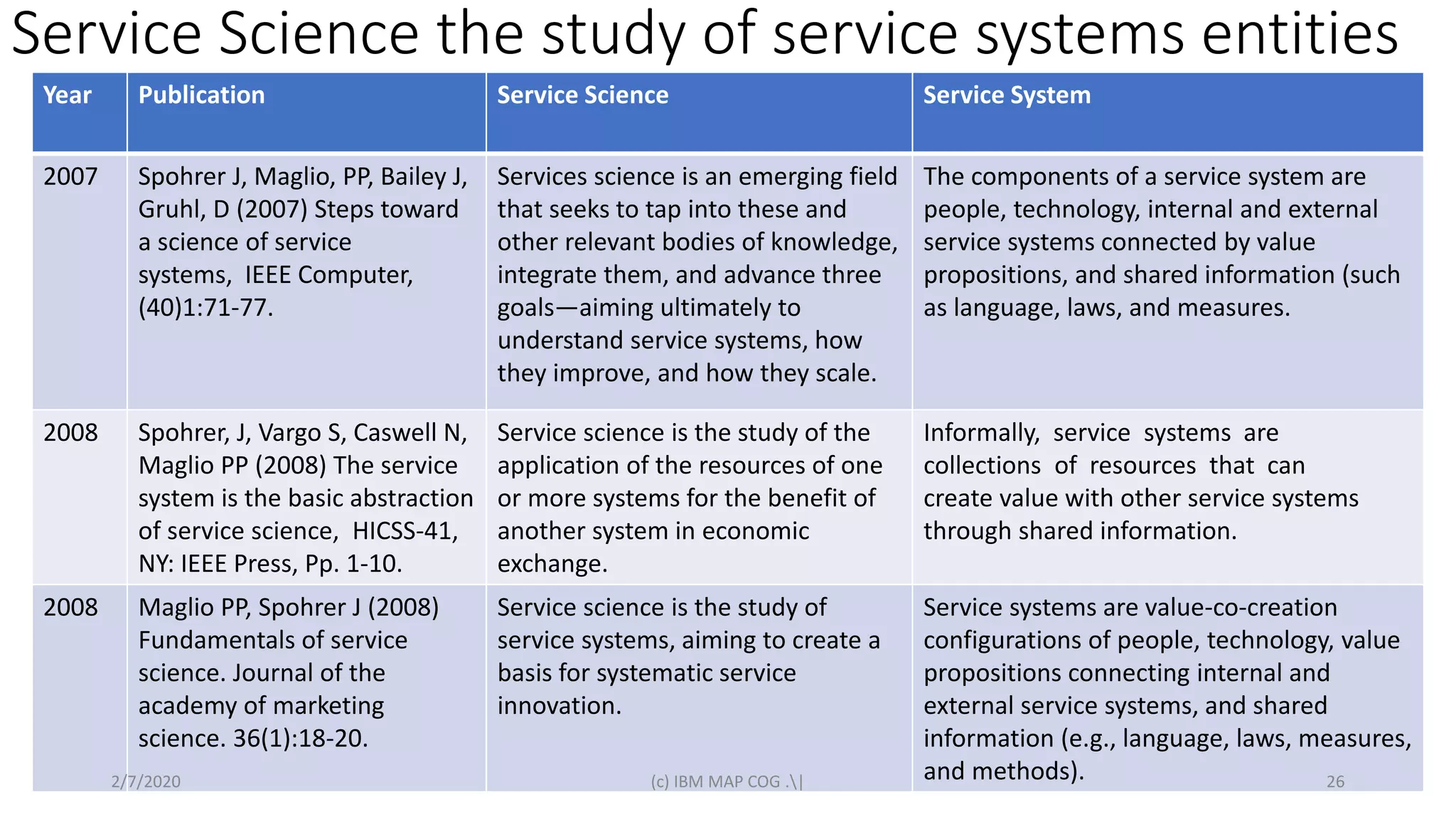
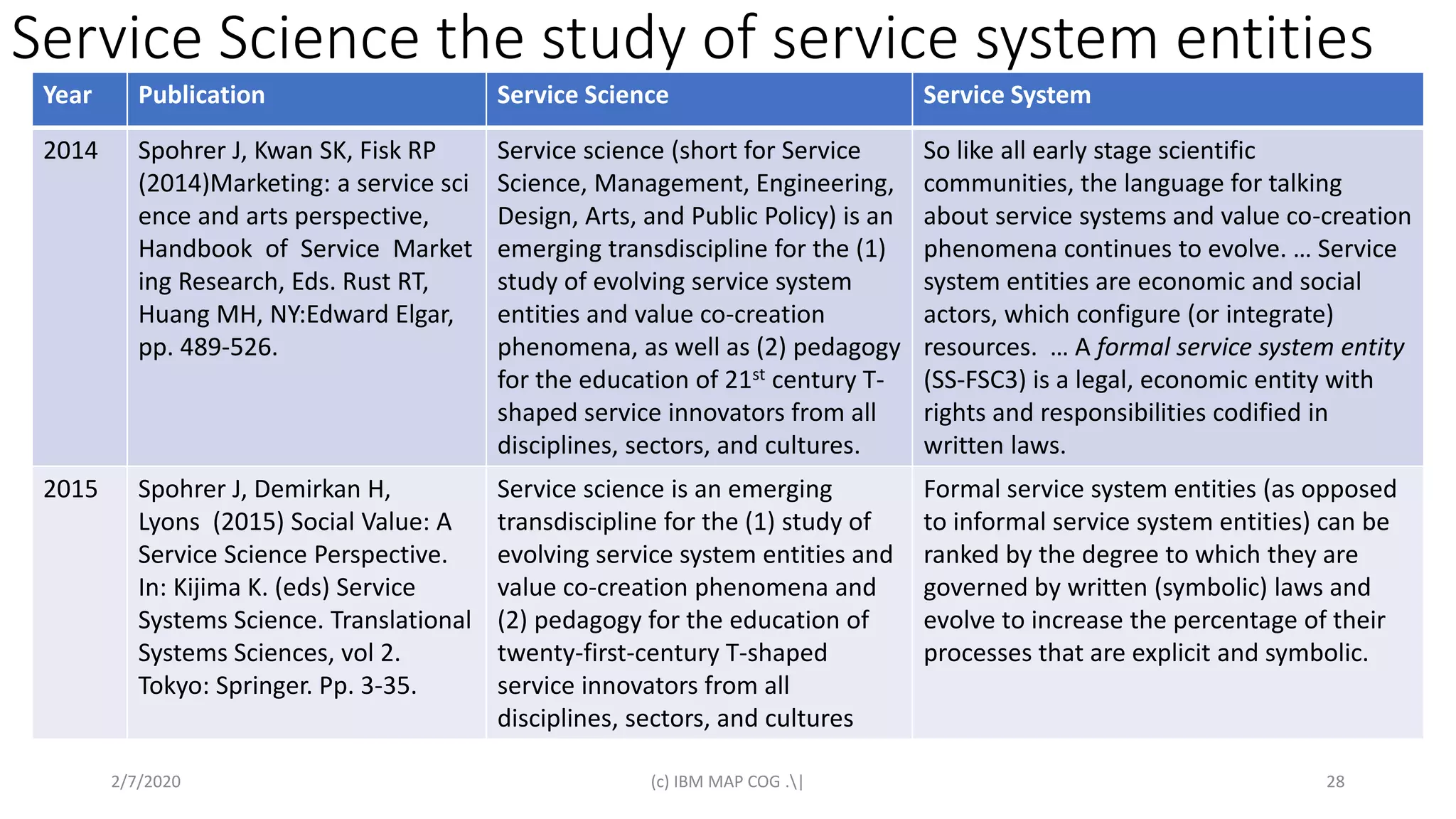
Service Science the study of service systems entities
Year Publication Service Science Service System
2007 Spohrer J, Maglio, PP, Bailey J,
Gruhl, D (2007) Steps toward
a science of service
systems, IEEE Computer,
(40)1:71-77.
Services science is an emerging field
that seeks to tap into these and
other relevant bodies of knowledge,
integrate them, and advance three
goals—aiming ultimately to
understand service systems, how
they improve, and how they scale.
The components of a service system are
people, technology, internal and external
service systems connected by value
propositions, and shared information (such
as language, laws, and measures.
2008 Spohrer, J, Vargo S, Caswell N,
Maglio PP (2008) The service
system is the basic abstraction
of service science, HICSS-41,
NY: IEEE Press, Pp. 1-10.
Service science is the study of the
application of the resources of one
or more systems for the benefit of
another system in economic
exchange.
Informally, service systems are
collections of resources that can
create value with other service systems
through shared information.
2008 Maglio PP, Spohrer J (2008)
Fundamentals of service
science. Journal of the
academy of marketing
science. 36(1):18-20.
Service science is the study of
service systems, aiming to create a
basis for systematic service
innovation.
Service systems are value-co-creation
configurations of people, technology, value
propositions connecting internal and
external service systems, and shared
information (e.g., language, laws, measures,
and methods).2/7/2020 (c) IBM MAP COG .| 26
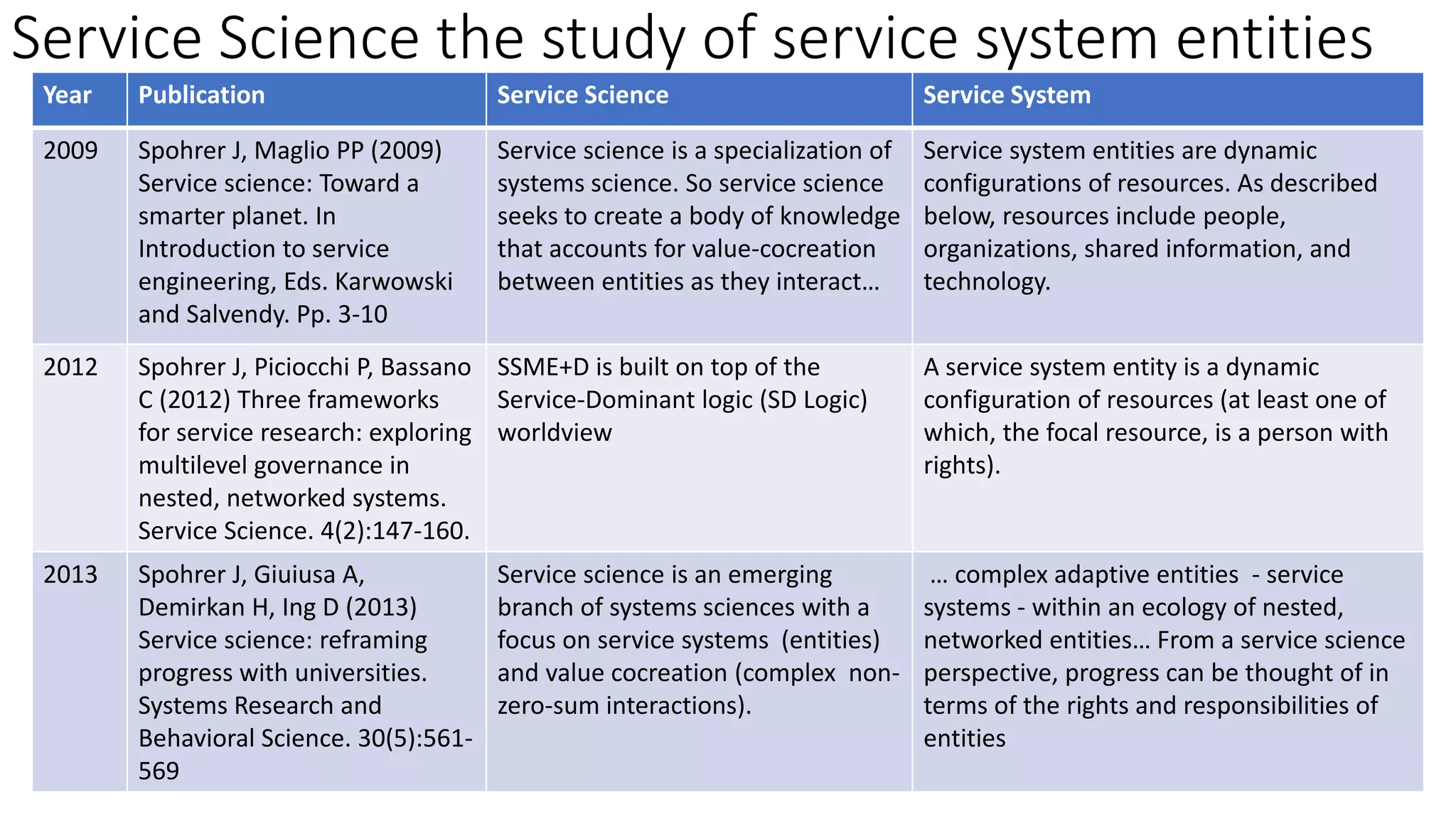
Service Science the study of service system entities
2/7/2020 (c) IBM MAP COG .| 27
Year Publication Service Science Service System
2009 Spohrer J, Maglio PP (2009)
Service science: Toward a
smarter planet. In
Introduction to service
engineering, Eds. Karwowski
and Salvendy. Pp. 3-10
Service science is a specialization of
systems science. So service science
seeks to create a body of knowledge
that accounts for value-cocreation
between entities as they interact…
Service system entities are dynamic
configurations of resources. As described
below, resources include people,
organizations, shared information, and
technology.
2012 Spohrer J, Piciocchi P, Bassano
C (2012) Three frameworks
for service research: exploring
multilevel governance in
nested, networked systems.
Service Science. 4(2):147-160.
SSME+D is built on top of the
Service-Dominant logic (SD Logic)
worldview
A service system entity is a dynamic
configuration of resources (at least one of
which, the focal resource, is a person with
rights).
2013 Spohrer J, Giuiusa A,
Demirkan H, Ing D (2013)
Service science: reframing
progress with universities.
Systems Research and
Behavioral Science. 30(5):561-
569
Service science is an emerging
branch of systems sciences with a
focus on service systems (entities)
and value cocreation (complex non-
zero-sum interactions).
… complex adaptive entities - service
systems - within an ecology of nested,
networked entities… From a service science
perspective, progress can be thought of in
terms of the rights and responsibilities of
entities
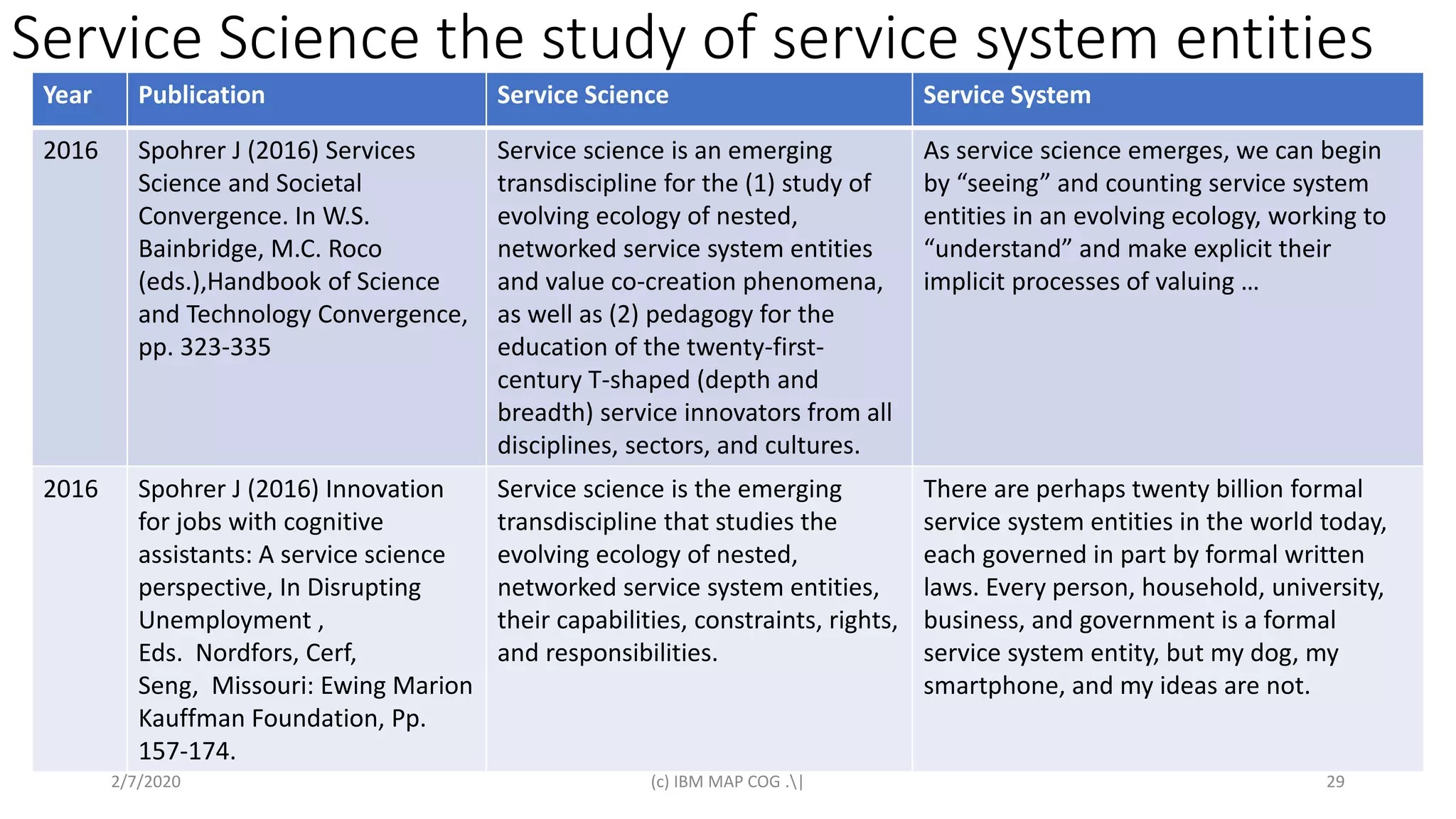
Service Science the study of service system entities
2/7/2020 (c) IBM MAP COG .| 28
Year Publication Service Science Service System
2014 Spohrer J, Kwan SK, Fisk RP
(2014)Marketing: a service sci
ence and arts perspective,
Handbook of Service Market
ing Research, Eds. Rust RT,
Huang MH, NY:Edward Elgar,
pp. 489-526.
Service science (short for Service
Science, Management, Engineering,
Design, Arts, and Public Policy) is an
emerging transdiscipline for the (1)
study of evolving service system
entities and value co-creation
phenomena, as well as (2) pedagogy
for the education of 21st century T-
shaped service innovators from all
disciplines, sectors, and cultures.
So like all early stage scientific
communities, the language for talking
about service systems and value co-creation
phenomena continues to evolve. … Service
system entities are economic and social
actors, which configure (or integrate)
resources. … A formal service system entity
(SS-FSC3) is a legal, economic entity with
rights and responsibilities codified in
written laws.
2015 Spohrer J, Demirkan H,
Lyons (2015) Social Value: A
Service Science Perspective.
In: Kijima K. (eds) Service
Systems Science. Translational
Systems Sciences, vol 2.
Tokyo: Springer. Pp. 3-35.
Service science is an emerging
transdiscipline for the (1) study of
evolving service system entities and
value co-creation phenomena and
(2) pedagogy for the education of
twenty-first-century T-shaped
service innovators from all
disciplines, sectors, and cultures
Formal service system entities (as opposed
to informal service system entities) can be
ranked by the degree to which they are
governed by written (symbolic) laws and
evolve to increase the percentage of their
processes that are explicit and symbolic.
Service Science the study of service system entities
2/7/2020 (c) IBM MAP COG .| 29
Year Publication Service Science Service System
2016 Spohrer J (2016) Services
Science and Societal
Convergence. In W.S.
Bainbridge, M.C. Roco
(eds.),Handbook of Science
and Technology Convergence,
pp. 323-335
Service science is an emerging
transdiscipline for the (1) study of
evolving ecology of nested,
networked service system entities
and value co-creation phenomena,
as well as (2) pedagogy for the
education of the twenty-first-
century T-shaped (depth and
breadth) service innovators from all
disciplines, sectors, and cultures.
As service science emerges, we can begin
by “seeing” and counting service system
entities in an evolving ecology, working to
“understand” and make explicit their
implicit processes of valuing …
2016 Spohrer J (2016) Innovation
for jobs with cognitive
assistants: A service science
perspective, In Disrupting
Unemployment ,
Eds. Nordfors, Cerf,
Seng, Missouri: Ewing Marion
Kauffman Foundation, Pp.
157-174.
Service science is the emerging
transdiscipline that studies the
evolving ecology of nested,
networked service system entities,
their capabilities, constraints, rights,
and responsibilities.
There are perhaps twenty billion formal
service system entities in the world today,
each governed in part by formal written
laws. Every person, household, university,
business, and government is a formal
service system entity, but my dog, my
smartphone, and my ideas are not.
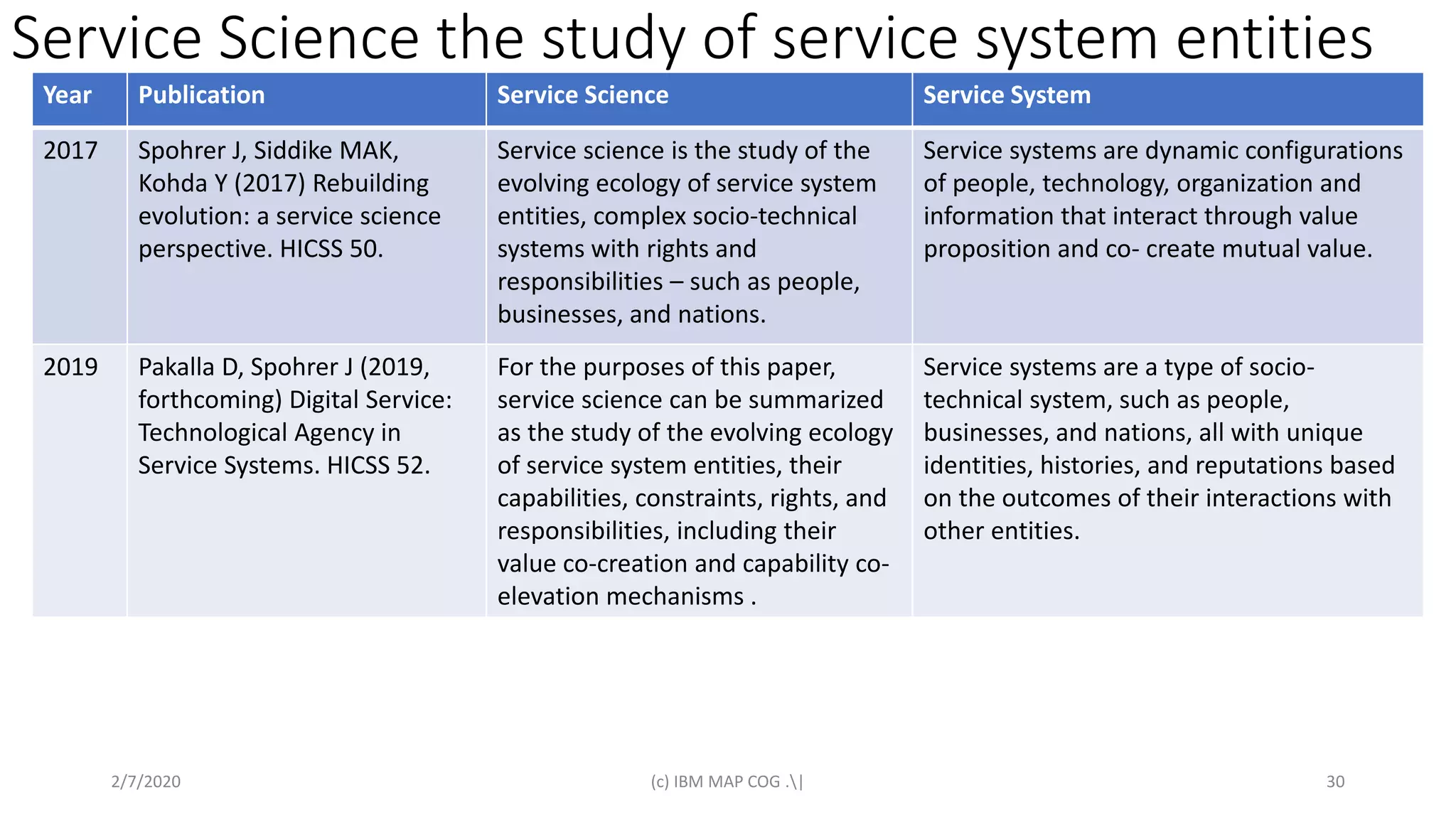
Service Science the study of service system entities
2/7/2020 (c) IBM MAP COG .| 30
Year Publication Service Science Service System
2017 Spohrer J, Siddike MAK,
Kohda Y (2017) Rebuilding
evolution: a service science
perspective. HICSS 50.
Service science is the study of the
evolving ecology of service system
entities, complex socio-technical
systems with rights and
responsibilities – such as people,
businesses, and nations.
Service systems are dynamic configurations
of people, technology, organization and
information that interact through value
proposition and co- create mutual value.
2019 Pakalla D, Spohrer J (2019,
forthcoming) Digital Service:
Technological Agency in
Service Systems. HICSS 52.
For the purposes of this paper,
service science can be summarized
as the study of the evolving ecology
of service system entities, their
capabilities, constraints, rights, and
responsibilities, including their
value co-creation and capability co-
elevation mechanisms .
Service systems are a type of socio-
technical system, such as people,
businesses, and nations, all with unique
identities, histories, and reputations based
on the outcomes of their interactions with
other entities.
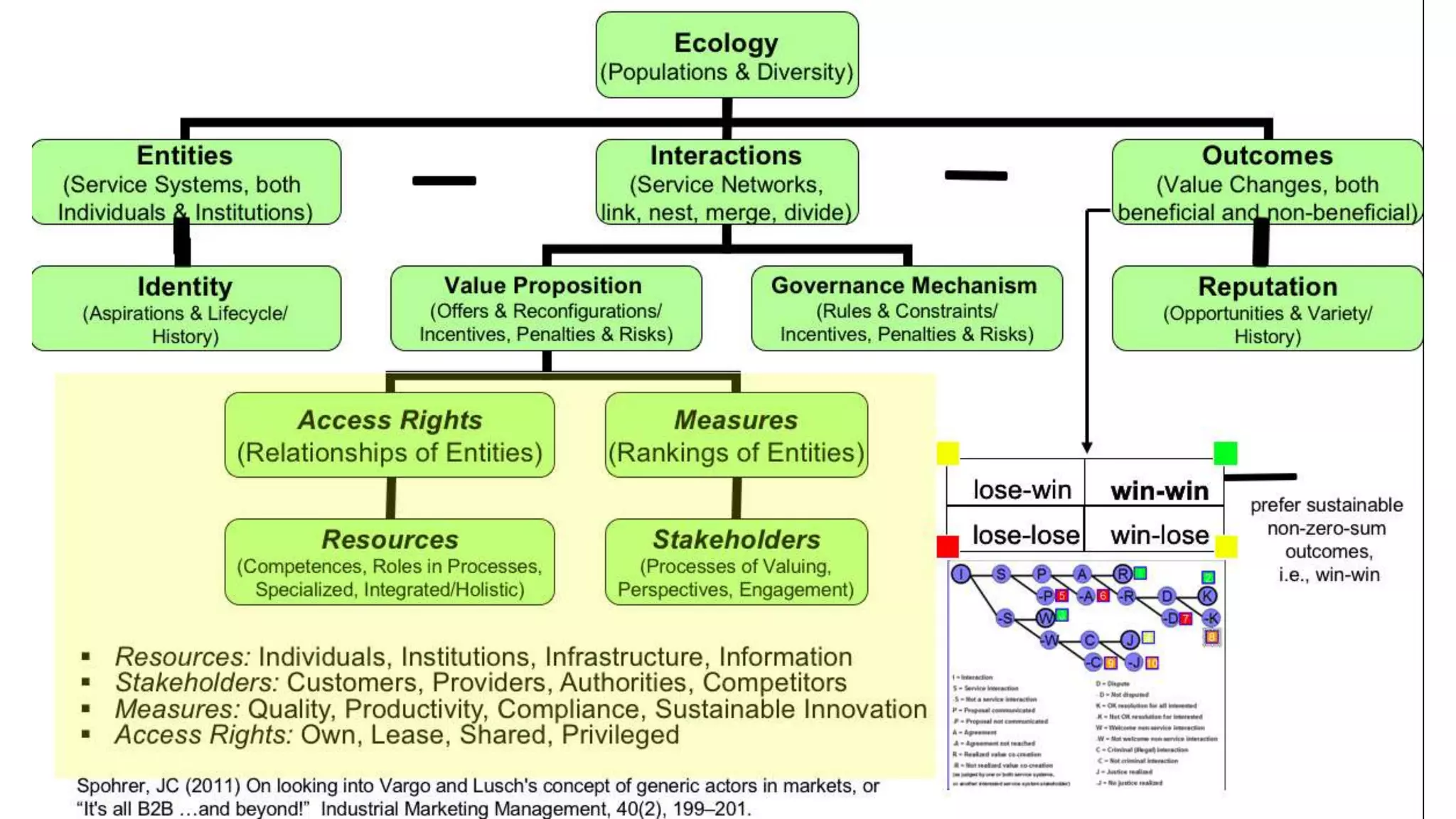
Service Science: Conceptual Framework
2/7/2020 (c) IBM MAP COG .| 31
32
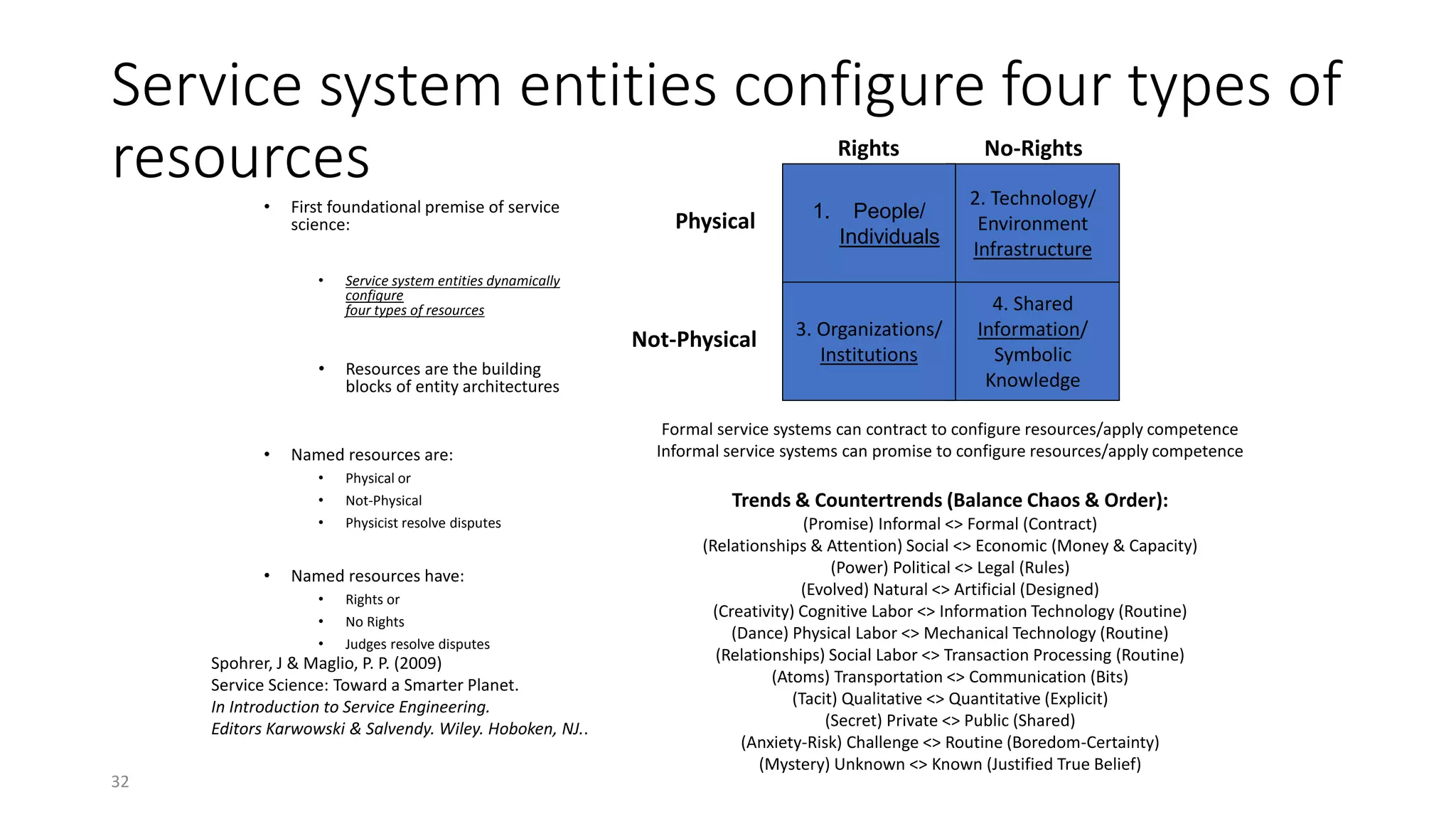
Service system entities configure four types of
resources
• First foundational premise of service
science:
• Service system entities dynamically
configure
four types of resources
• Resources are the building
blocks of entity architectures
• Named resources are:
• Physical or
• Not-Physical
• Physicist resolve disputes
• Named resources have:
• Rights or
• No Rights
• Judges resolve disputes
Spohrer, J & Maglio, P. P. (2009)
Service Science: Toward a Smarter Planet.
In Introduction to Service Engineering.
Editors Karwowski & Salvendy. Wiley. Hoboken, NJ..
Physical
Not-Physical
Rights No-Rights
2. Technology/
Environment
Infrastructure
4. Shared
Information/
Symbolic
Knowledge
1. People/
Individuals
3. Organizations/
Institutions
Formal service systems can contract to configure resources/apply competence
Informal service systems can promise to configure resources/apply competence
Trends & Countertrends (Balance Chaos & Order):
(Promise) Informal <> Formal (Contract)
(Relationships & Attention) Social <> Economic (Money & Capacity)
(Power) Political <> Legal (Rules)
(Evolved) Natural <> Artificial (Designed)
(Creativity) Cognitive Labor <> Information Technology (Routine)
(Dance) Physical Labor <> Mechanical Technology (Routine)
(Relationships) Social Labor <> Transaction Processing (Routine)
(Atoms) Transportation <> Communication (Bits)
(Tacit) Qualitative <> Quantitative (Explicit)
(Secret) Private <> Public (Shared)
(Anxiety-Risk) Challenge <> Routine (Boredom-Certainty)
(Mystery) Unknown <> Known (Justified True Belief)
33
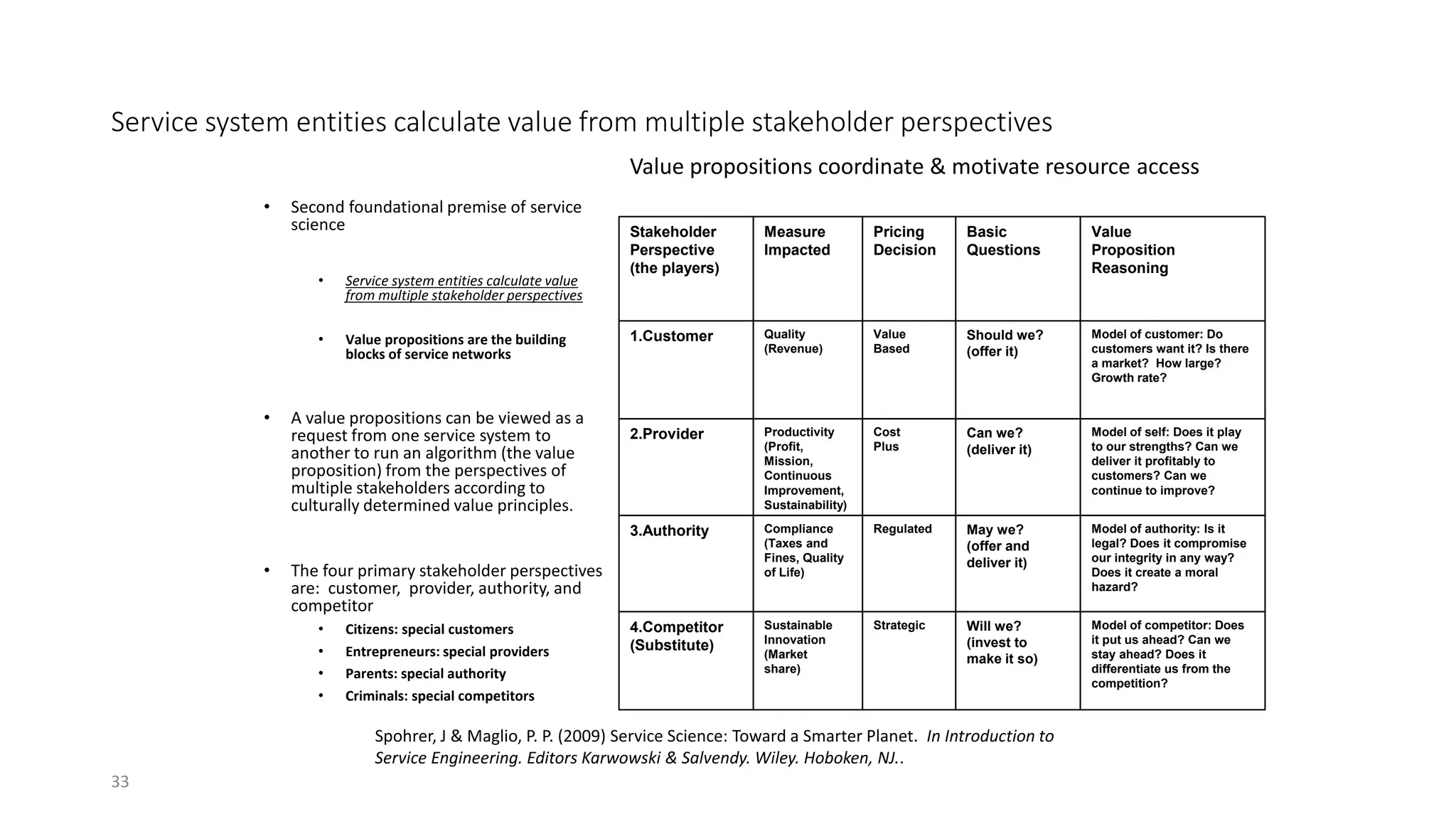
Service system entities calculate value from multiple stakeholder perspectives
• Second foundational premise of service
science
• Service system entities calculate value
from multiple stakeholder perspectives
• Value propositions are the building
blocks of service networks
• A value propositions can be viewed as a
request from one service system to
another to run an algorithm (the value
proposition) from the perspectives of
multiple stakeholders according to
culturally determined value principles.
• The four primary stakeholder perspectives
are: customer, provider, authority, and
competitor
• Citizens: special customers
• Entrepreneurs: special providers
• Parents: special authority
• Criminals: special competitors
Spohrer, J & Maglio, P. P. (2009) Service Science: Toward a Smarter Planet. In Introduction to
Service Engineering. Editors Karwowski & Salvendy. Wiley. Hoboken, NJ..
Model of competitor: Does
it put us ahead? Can we
stay ahead? Does it
differentiate us from the
competition?
Will we?
(invest to
make it so)
StrategicSustainable
Innovation
(Market
share)
4.Competitor
(Substitute)
Model of authority: Is it
legal? Does it compromise
our integrity in any way?
Does it create a moral
hazard?
May we?
(offer and
deliver it)
RegulatedCompliance
(Taxes and
Fines, Quality
of Life)
3.Authority
Model of self: Does it play
to our strengths? Can we
deliver it profitably to
customers? Can we
continue to improve?
Can we?
(deliver it)
Cost
Plus
Productivity
(Profit,
Mission,
Continuous
Improvement,
Sustainability)
2.Provider
Model of customer: Do
customers want it? Is there
a market? How large?
Growth rate?
Should we?
(offer it)
Value
Based
Quality
(Revenue)
1.Customer
Value
Proposition
Reasoning
Basic
Questions
Pricing
Decision
Measure
Impacted
Stakeholder
Perspective
(the players)
Value propositions coordinate & motivate resource access
34
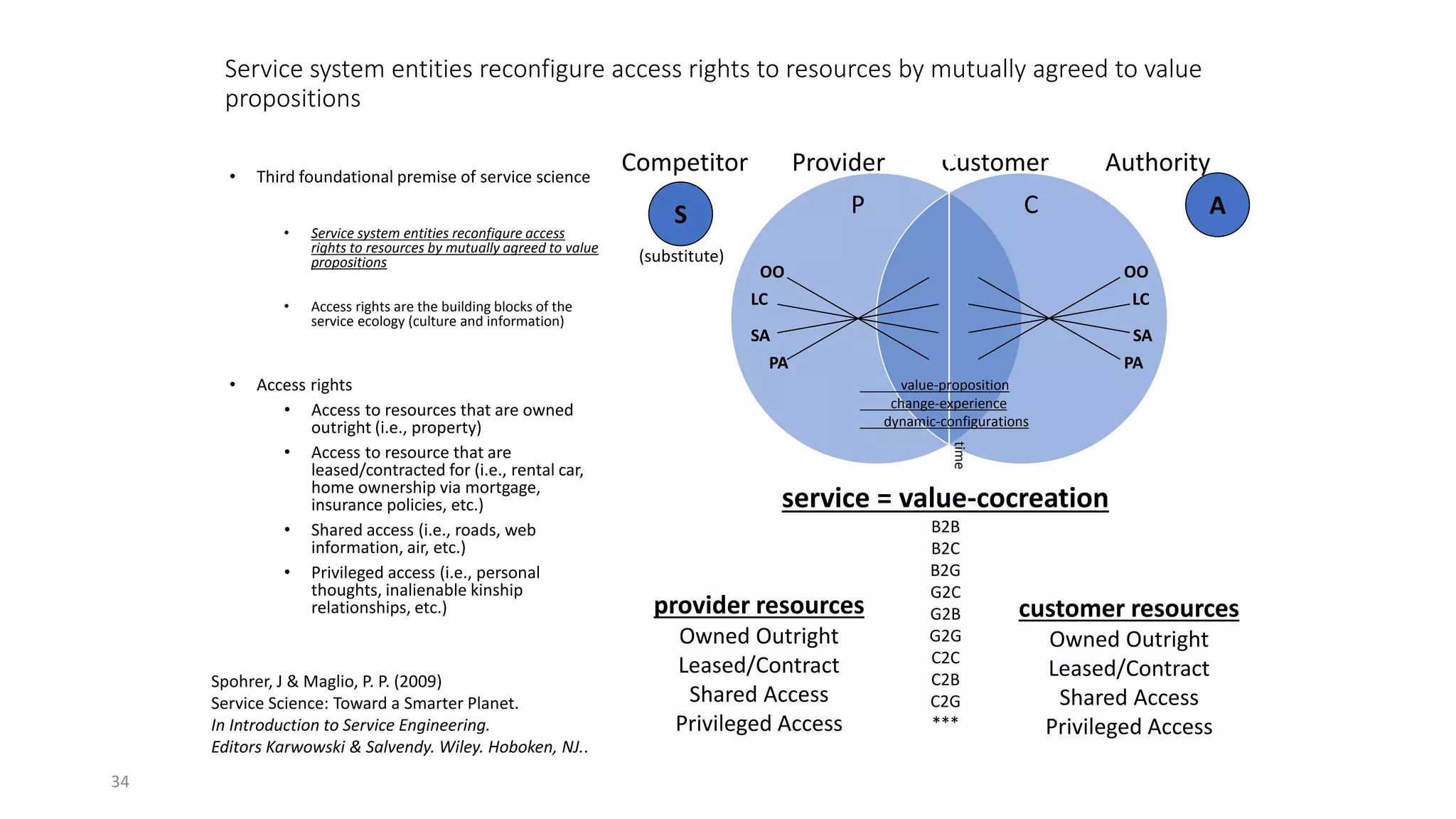
Service system entities reconfigure access rights to resources by mutually agreed to value
propositions
• Third foundational premise of service science
• Service system entities reconfigure access
rights to resources by mutually agreed to value
propositions
• Access rights are the building blocks of the
service ecology (culture and information)
• Access rights
• Access to resources that are owned
outright (i.e., property)
• Access to resource that are
leased/contracted for (i.e., rental car,
home ownership via mortgage,
insurance policies, etc.)
• Shared access (i.e., roads, web
information, air, etc.)
• Privileged access (i.e., personal
thoughts, inalienable kinship
relationships, etc.)
service = value-cocreation
B2B
B2C
B2G
G2C
G2B
G2G
C2C
C2B
C2G
***
provider resources
Owned Outright
Leased/Contract
Shared Access
Privileged Access
customer resources
Owned Outright
Leased/Contract
Shared Access
Privileged Access
OO
SA
PA
LC
OO
LC
SA
PA
S AP C
Competitor Provider Customer Authority
value-proposition
change-experience
dynamic-configurations
(substitute)
time
Spohrer, J & Maglio, P. P. (2009)
Service Science: Toward a Smarter Planet.
In Introduction to Service Engineering.
Editors Karwowski & Salvendy. Wiley. Hoboken, NJ..
35
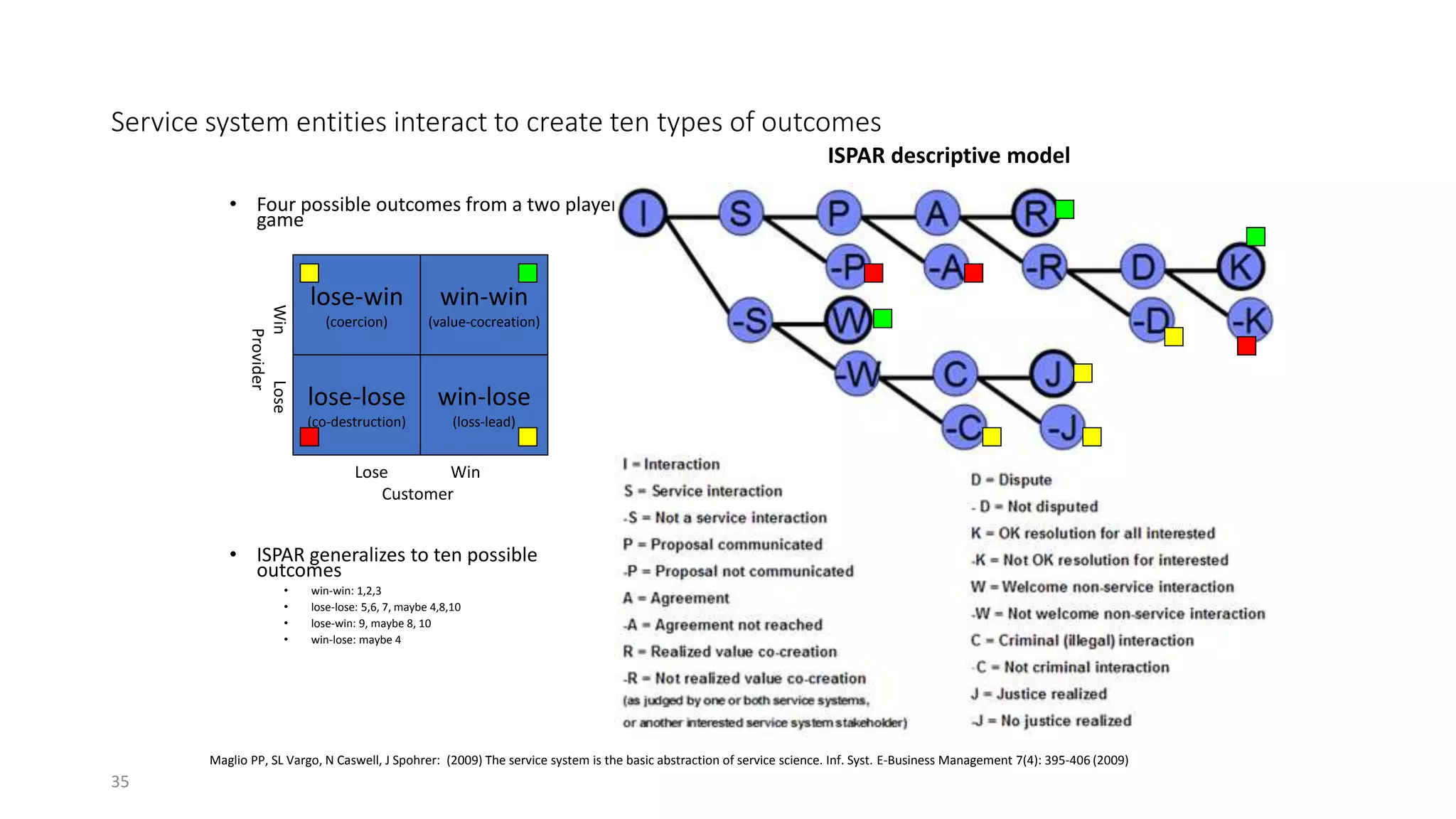
Service system entities interact to create ten types of outcomes
• Four possible outcomes from a two player
game
• ISPAR generalizes to ten possible
outcomes
• win-win: 1,2,3
• lose-lose: 5,6, 7, maybe 4,8,10
• lose-win: 9, maybe 8, 10
• win-lose: maybe 4
lose-win
(coercion)
win-win
(value-cocreation)
lose-lose
(co-destruction)
win-lose
(loss-lead)
WinLose
Provider
Lose Win
Customer
ISPAR descriptive model
Maglio PP, SL Vargo, N Caswell, J Spohrer: (2009) The service system is the basic abstraction of service science. Inf. Syst. E-Business Management 7(4): 395-406 (2009)
36
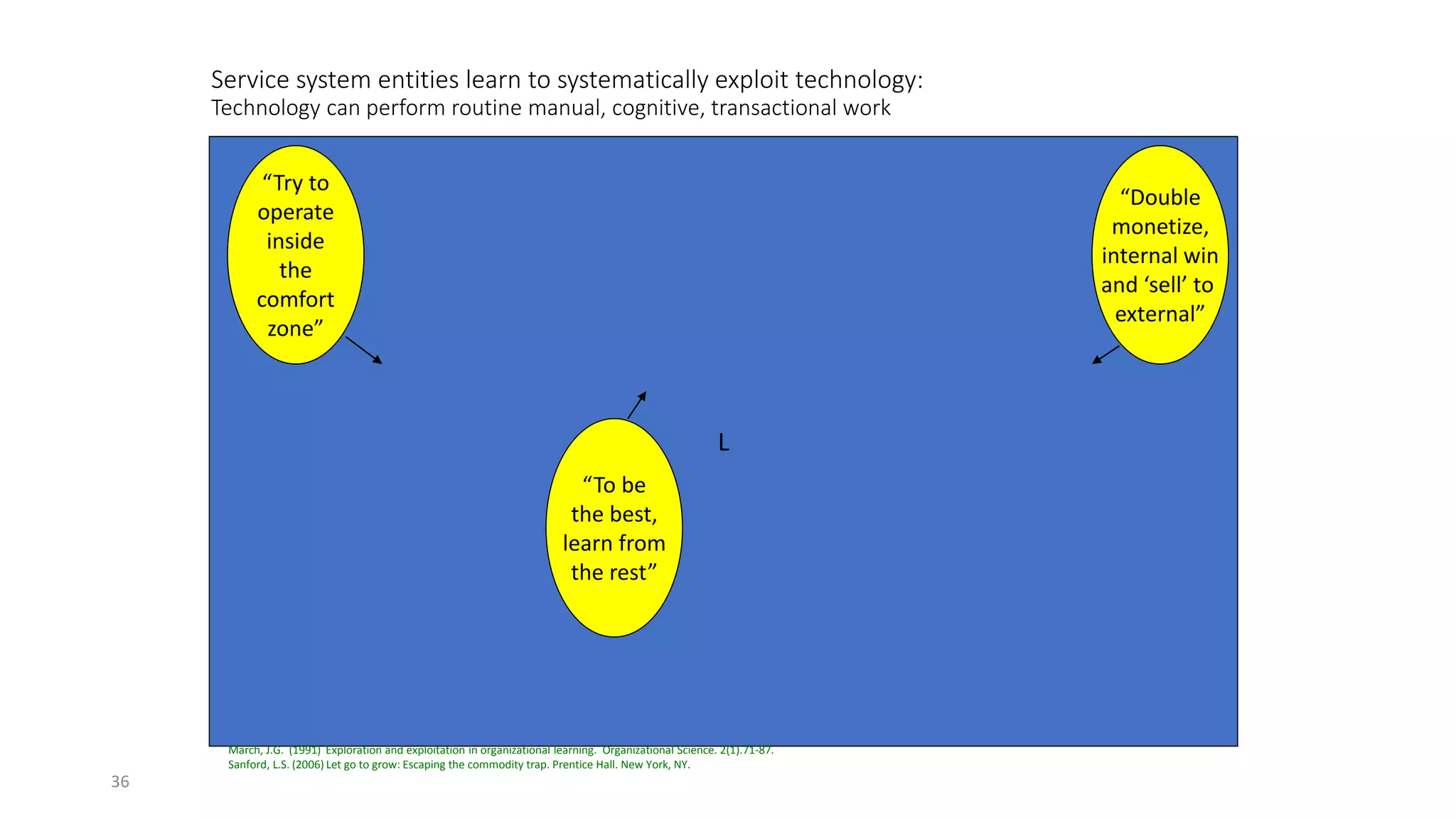
Service system entities learn to systematically exploit technology:
Technology can perform routine manual, cognitive, transactional work
L
“To be
the best,
learn from
the rest”
“Double
monetize,
internal win
and ‘sell’ to
external”
“Try to
operate
inside
the
comfort
zone”
March, J.G. (1991) Exploration and exploitation in organizational learning. Organizational Science. 2(1).71-87.
Sanford, L.S. (2006) Let go to grow: Escaping the commodity trap. Prentice Hall. New York, NY.
37
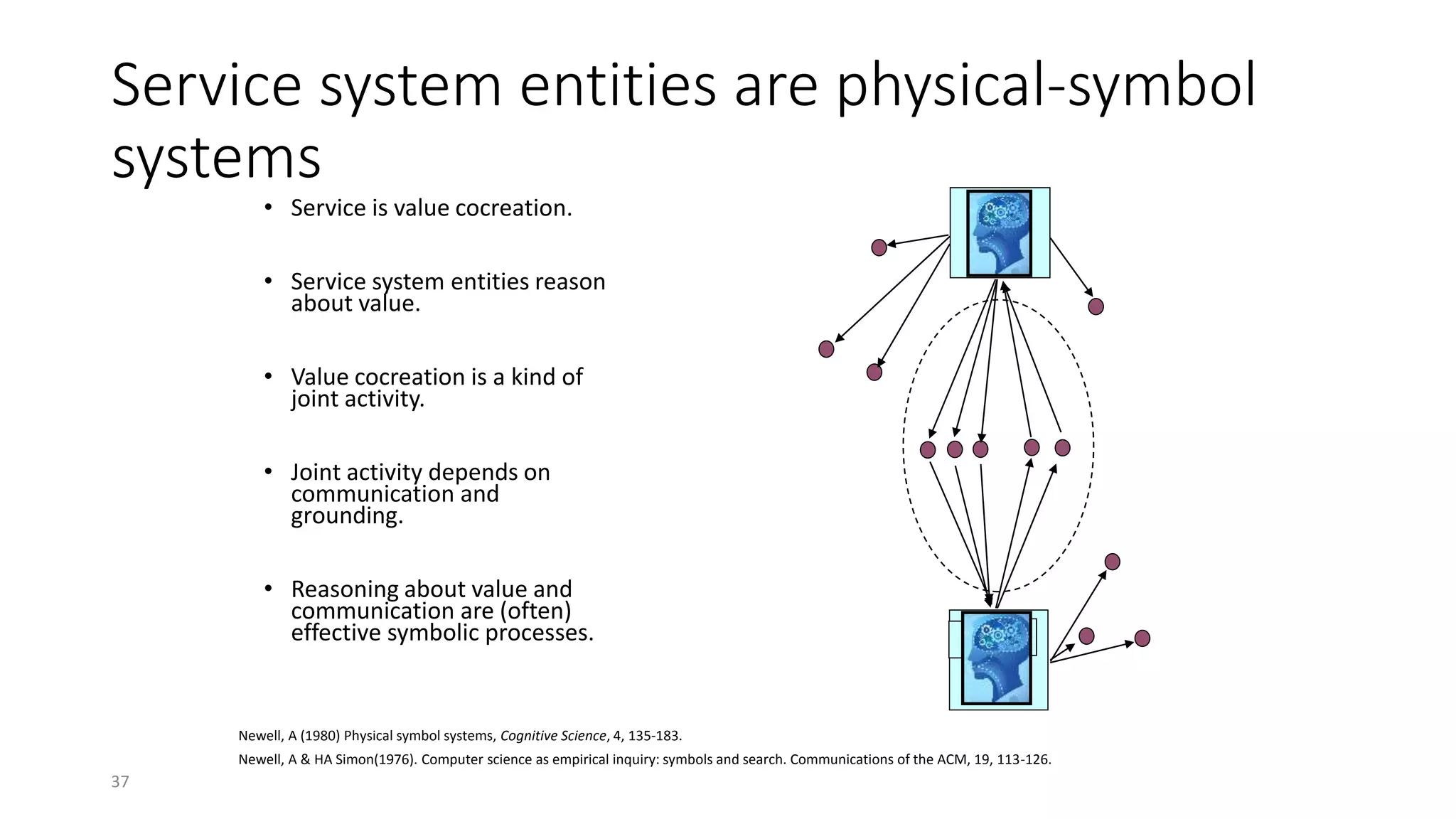
Service system entities are physical-symbol
systems
• Service is value cocreation.
• Service system entities reason
about value.
• Value cocreation is a kind of
joint activity.
• Joint activity depends on
communication and
grounding.
• Reasoning about value and
communication are (often)
effective symbolic processes.
Newell, A (1980) Physical symbol systems, Cognitive Science, 4, 135-183.
Newell, A & HA Simon(1976). Computer science as empirical inquiry: symbols and search. Communications of the ACM, 19, 113-126.
38
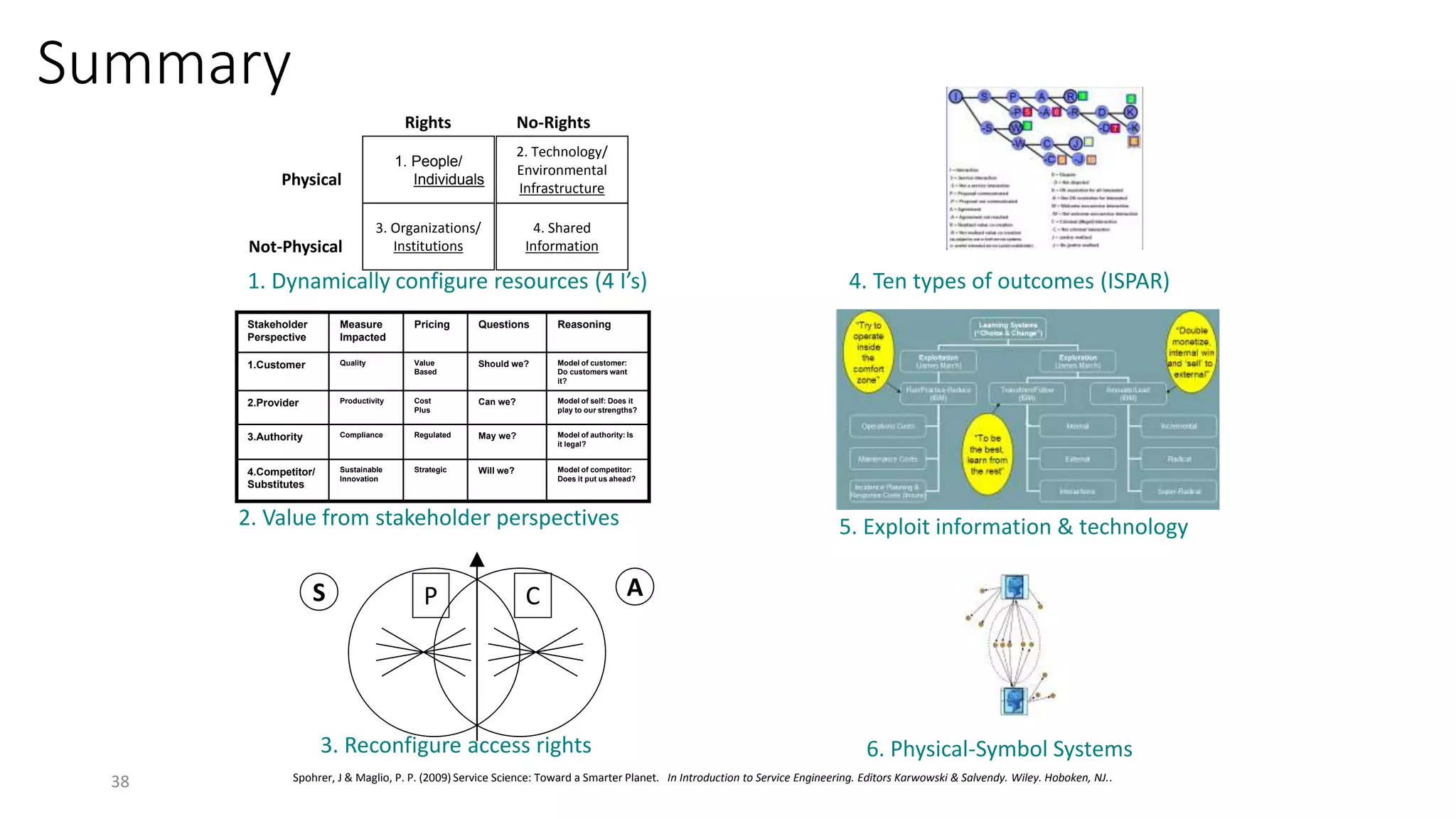
Summary
Spohrer, J & Maglio, P. P. (2009) Service Science: Toward a Smarter Planet. In Introduction to Service Engineering. Editors Karwowski & Salvendy. Wiley. Hoboken, NJ..
Physical
Not-Physical
Rights No-Rights
2. Technology/
Environmental
Infrastructure
4. Shared
Information
1. People/
Individuals
3. Organizations/
Institutions
1. Dynamically configure resources (4 I’s)
Model of competitor:
Does it put us ahead?
Will we?StrategicSustainable
Innovation
4.Competitor/
Substitutes
Model of authority: Is
it legal?
May we?RegulatedCompliance3.Authority
Model of self: Does it
play to our strengths?
Can we?Cost
Plus
Productivity2.Provider
Model of customer:
Do customers want
it?
Should we?Value
Based
Quality1.Customer
ReasoningQuestionsPricingMeasure
Impacted
Stakeholder
Perspective
2. Value from stakeholder perspectives
S AP C
3. Reconfigure access rights
4. Ten types of outcomes (ISPAR)
5. Exploit information & technology
6. Physical-Symbol Systems
39
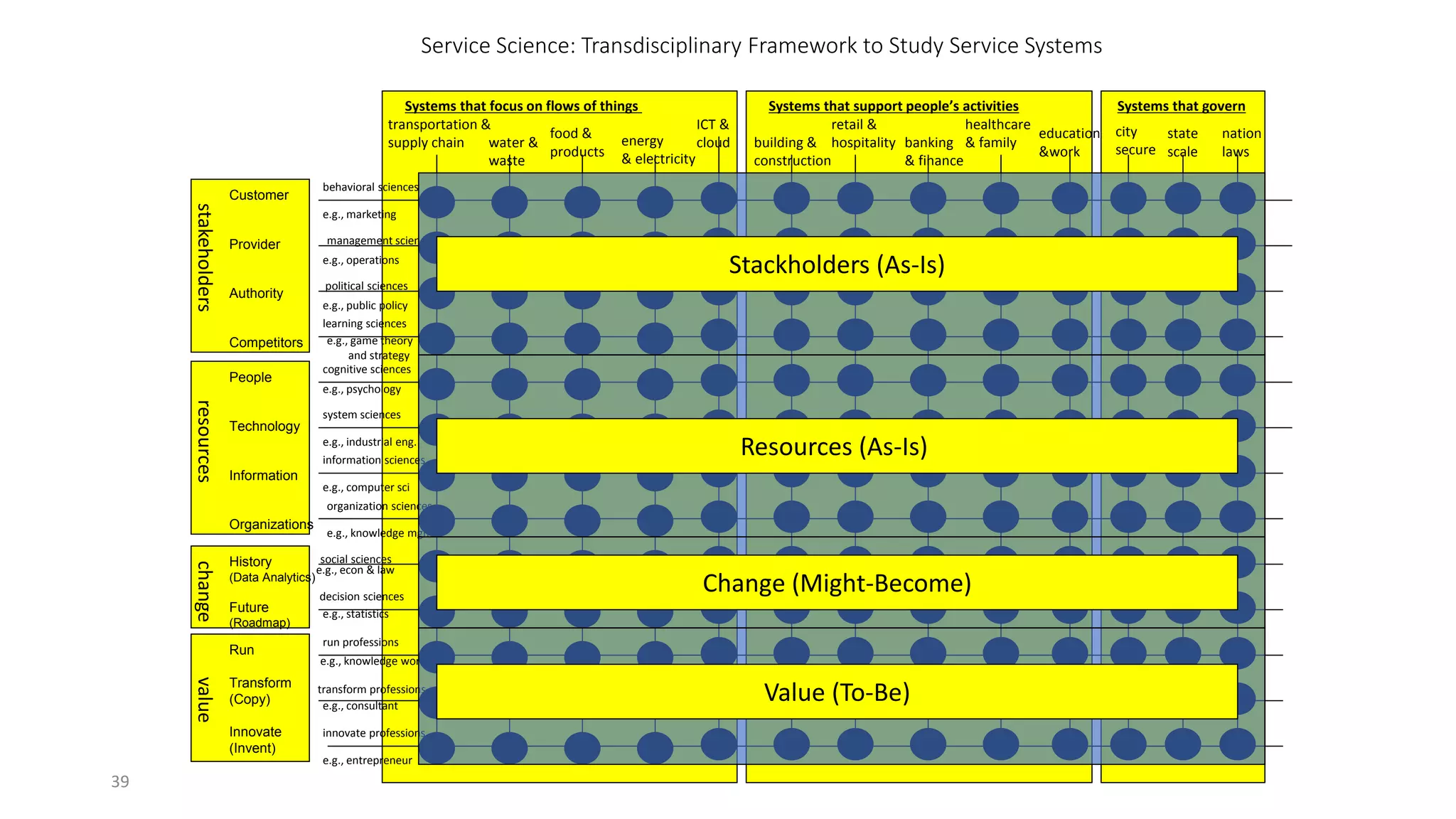
Service Science: Transdisciplinary Framework to Study Service Systems
Systems that focus on flows of things Systems that governSystems that support people’s activities
transportation &
supply chain water &
waste
food &
products
energy
& electricity
building &
construction
healthcare
& family
retail &
hospitality banking
& finance
ICT &
cloud
education
&work
city
secure
state
scale
nation
laws
social sciences
behavioral sciences
management sciences
political sciences
learning sciences
cognitive sciences
system sciences
information sciences
organization sciences
decision sciences
run professions
transform professions
innovate professions
e.g., econ & law
e.g., marketing
e.g., operations
e.g., public policy
e.g., game theory
and strategy
e.g., psychology
e.g., industrial eng.
e.g., computer sci
e.g., knowledge mgmt
e.g., statistics
e.g., knowledge worker
e.g., consultant
e.g., entrepreneur
stakeholders Customer
Provider
Authority
Competitors
resources
People
Technology
Information
Organizations
change
History
(Data Analytics)
Future
(Roadmap)
value
Run
Transform
(Copy)
Innovate
(Invent)
Stackholders (As-Is)
Resources (As-Is)
Change (Might-Become)
Value (To-Be)
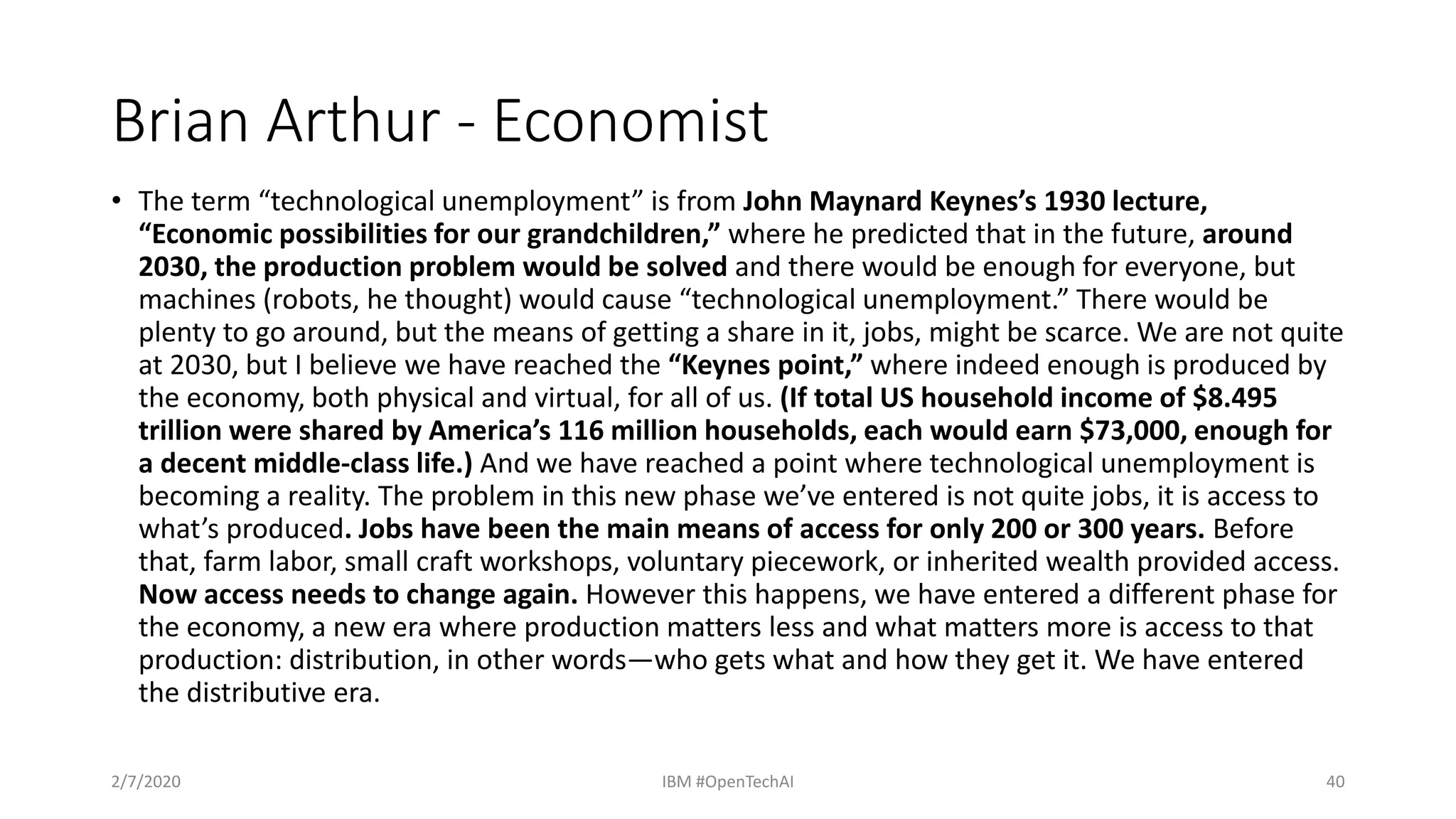
Brian Arthur - Economist
• The term “technological unemployment” is from John Maynard Keynes’s 1930 lecture,
“Economic possibilities for our grandchildren,” where he predicted that in the future, around
2030, the production problem would be solved and there would be enough for everyone, but
machines (robots, he thought) would cause “technological unemployment.” There would be
plenty to go around, but the means of getting a share in it, jobs, might be scarce. We are not quite
at 2030, but I believe we have reached the “Keynes point,” where indeed enough is produced by
the economy, both physical and virtual, for all of us. (If total US household income of $8.495
trillion were shared by America’s 116 million households, each would earn $73,000, enough for
a decent middle-class life.) And we have reached a point where technological unemployment is
becoming a reality. The problem in this new phase we’ve entered is not quite jobs, it is access to
what’s produced. Jobs have been the main means of access for only 200 or 300 years. Before
that, farm labor, small craft workshops, voluntary piecework, or inherited wealth provided access.
Now access needs to change again. However this happens, we have entered a different phase for
the economy, a new era where production matters less and what matters more is access to that
production: distribution, in other words—who gets what and how they get it. We have entered
the distributive era.
2/7/2020 IBM #OpenTechAI 40
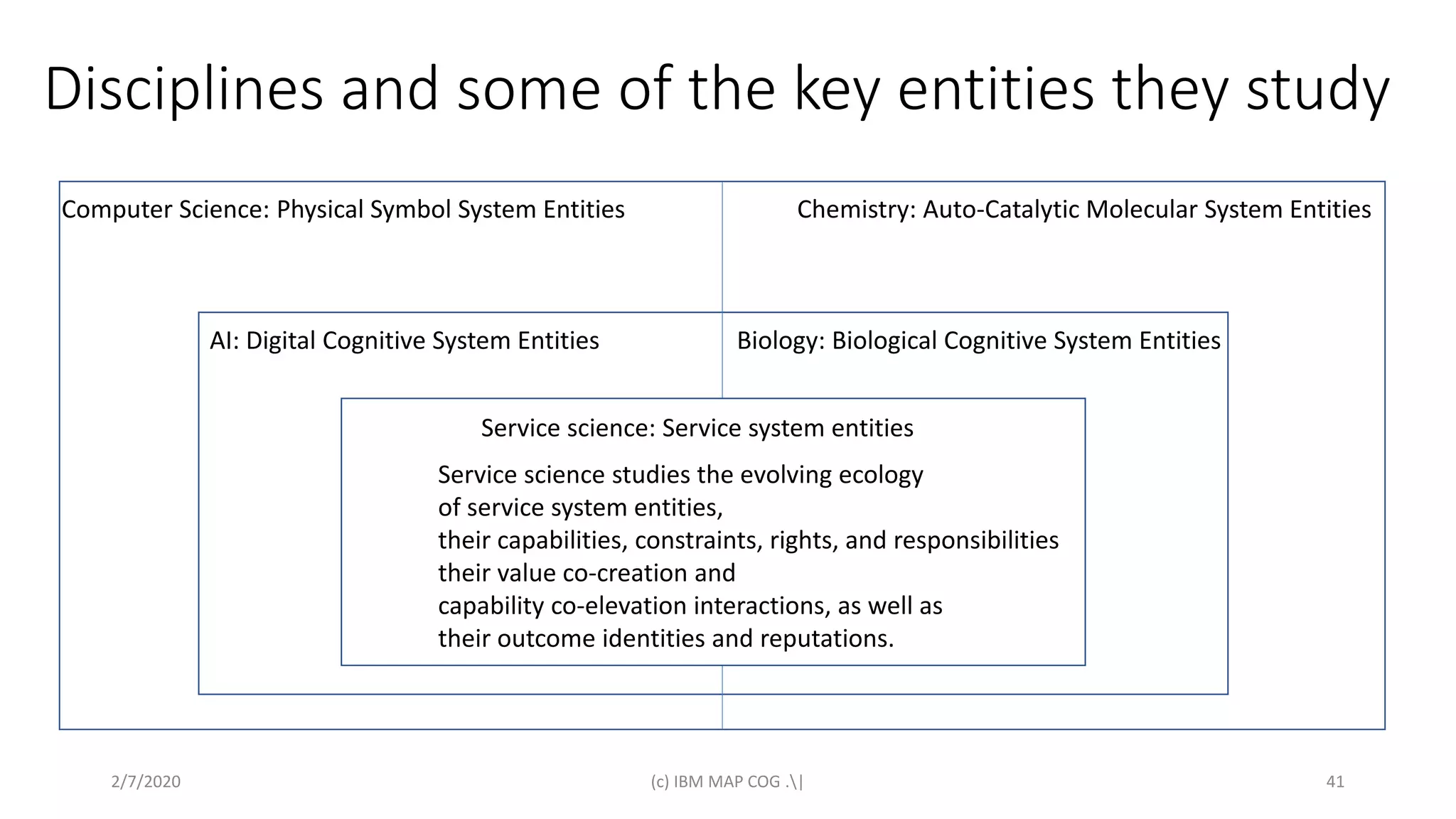
Disciplines and some of the key entities they study
2/7/2020 (c) IBM MAP COG .| 41
Computer Science: Physical Symbol System Entities
AI: Digital Cognitive System Entities
Chemistry: Auto-Catalytic Molecular System Entities
Biology: Biological Cognitive System Entities
Service science: Service system entities
Service science studies the evolving ecology
of service system entities,
their capabilities, constraints, rights, and responsibilities
their value co-creation and
capability co-elevation interactions, as well as
their outcome identities and reputations.
Service Research
• Artificial Intelligence in Service
• "The theory specifies four intelligences required for service tasks—mechanical,
analytical, intuitive, and empathetic—and lays out the way firms should decide
between humans and machines for accomplishing those tasks.”
• Huang MH and Rust RT (2018) Artificial Intelligence in Service. Journal of
Service Research. 21(2):155–172.
• Customer Acceptance of AI in Service Encounters: Understanding
Antecedents and Consequences
• "expand the relevant set of antecedents beyond the established constructs and
theories to include variables that are particularly relevant for AI applications
such as privacy concerns, trust, and perceptions of “creepiness.”
• Ostrom AL, Foheringham D, Bitner MJ (2018, forthcoming) Customer
Acceptance of AI in Service Encounters: Understanding Antecedents and
Consequences. In Handbook of Service Science, Volume 2, Eds, Maglio,
Kieliszewski,Spohrer,Lyons,Patricio,Sawatani. New York: Springer. Pp. x-y.
2/7/2020 (c) IBM MAP COG .| 42
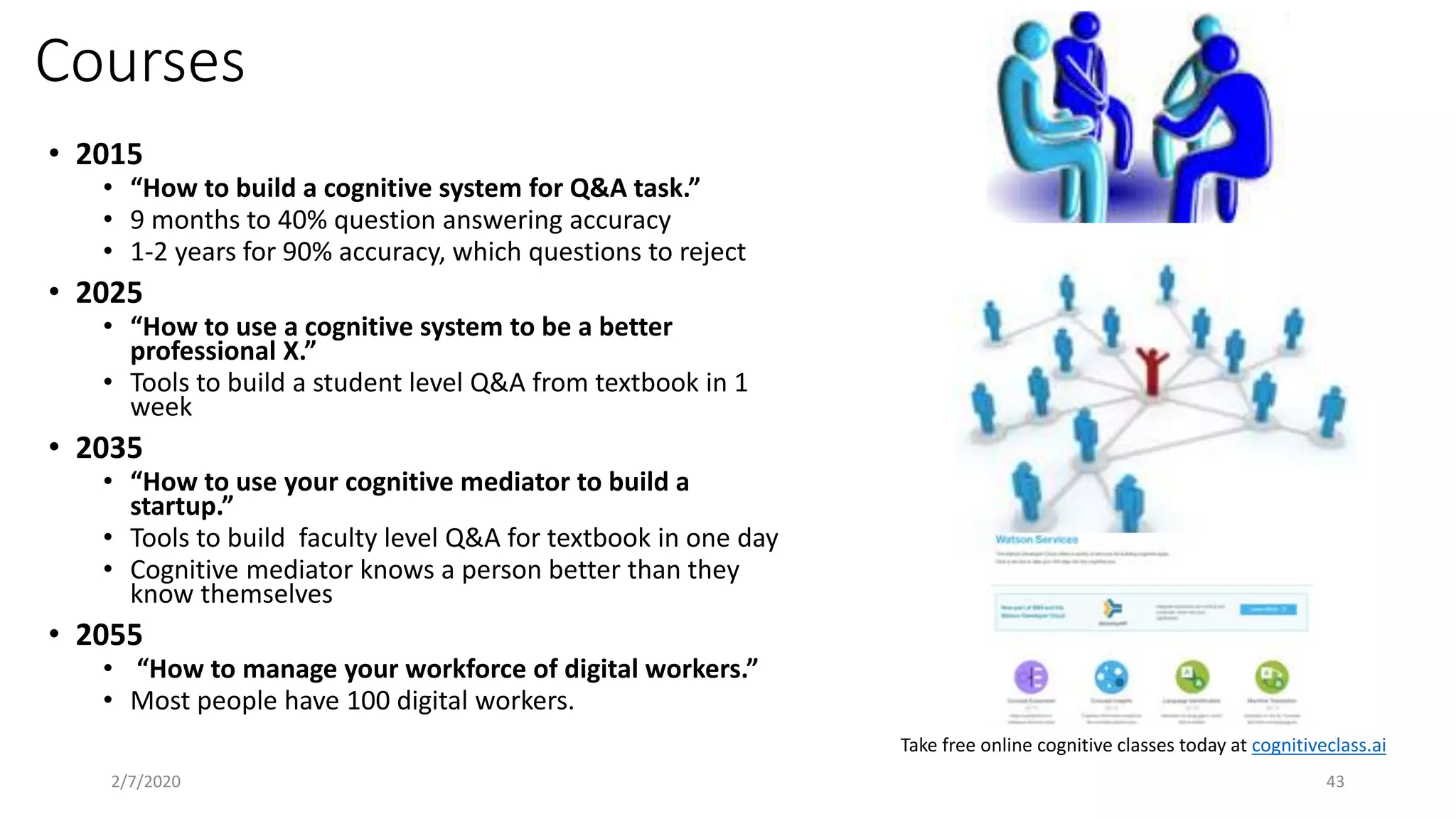
Courses
• 2015
• “How to build a cognitive system for Q&A task.”
• 9 months to 40% question answering accuracy
• 1-2 years for 90% accuracy, which questions to reject
• 2025
• “How to use a cognitive system to be a better
professional X.”
• Tools to build a student level Q&A from textbook in 1
week
• 2035
• “How to use your cognitive mediator to build a
startup.”
• Tools to build faculty level Q&A for textbook in one day
• Cognitive mediator knows a person better than they
know themselves
• 2055
• “How to manage your workforce of digital workers.”
• Most people have 100 digital workers.
2/7/2020 43
Take free online cognitive classes today at cognitiveclass.ai
2/7/2020
© IBM 2015, IBM Upward University Programs Worldwide
accelerating regional development
44
I have…
Have you noticed how the building blocks just
keep getting better?
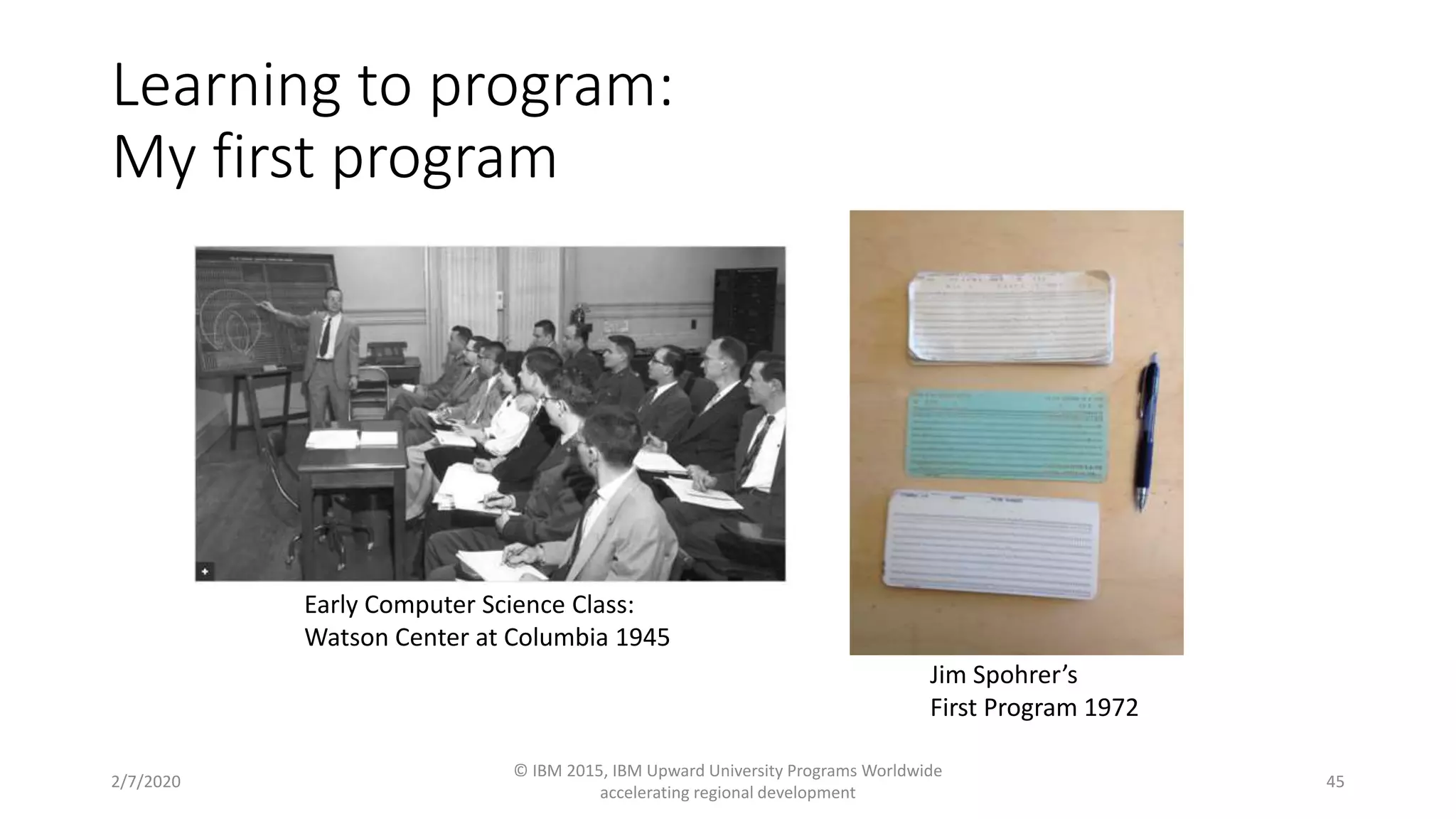
Learning to program:
My first program
2/7/2020
© IBM 2015, IBM Upward University Programs Worldwide
accelerating regional development
45
Early Computer Science Class:
Watson Center at Columbia 1945
Jim Spohrer’s
First Program 1972
2/7/2020
© IBM UPWard 2016
46
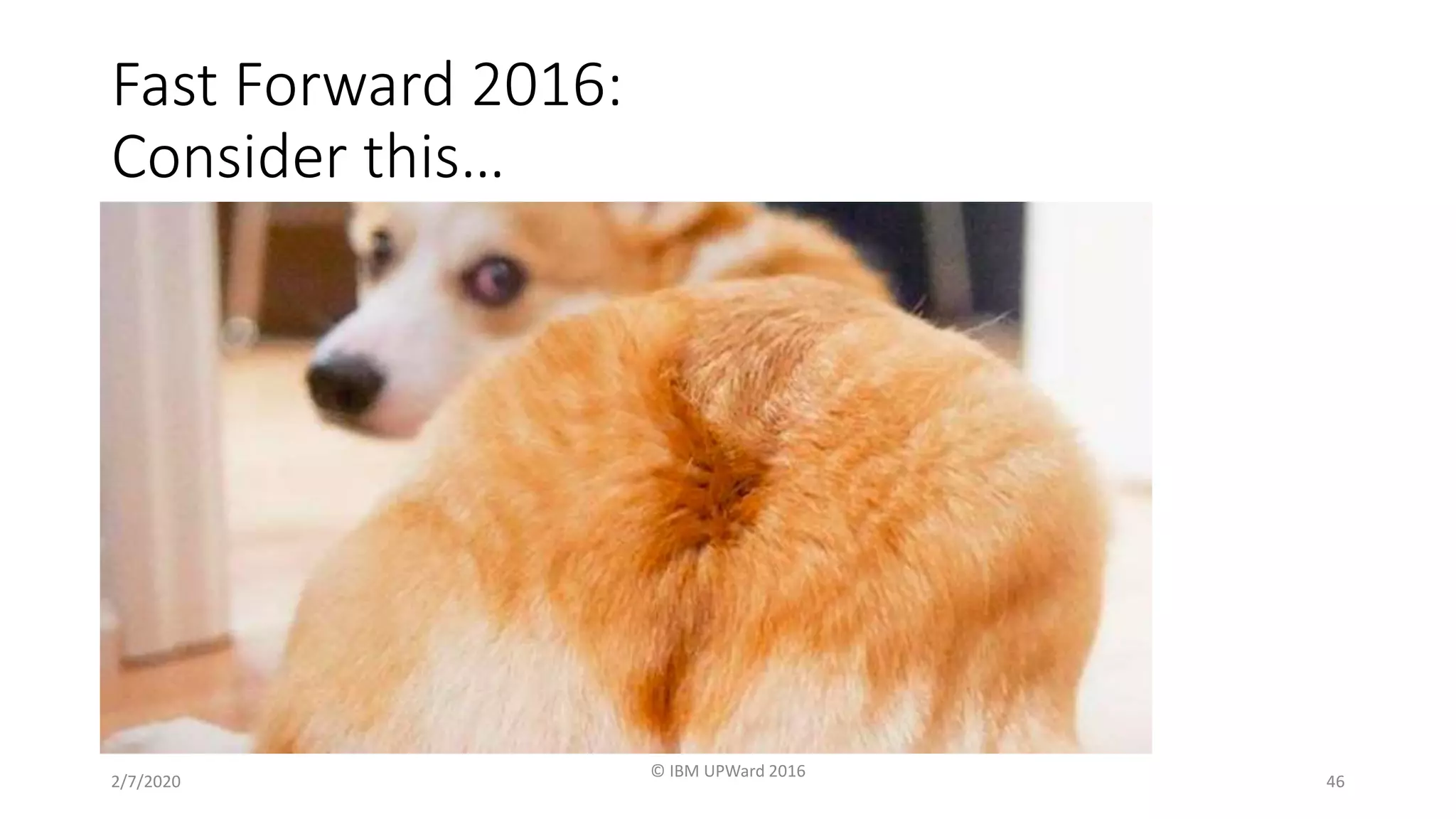
Fast Forward 2016:
Consider this…
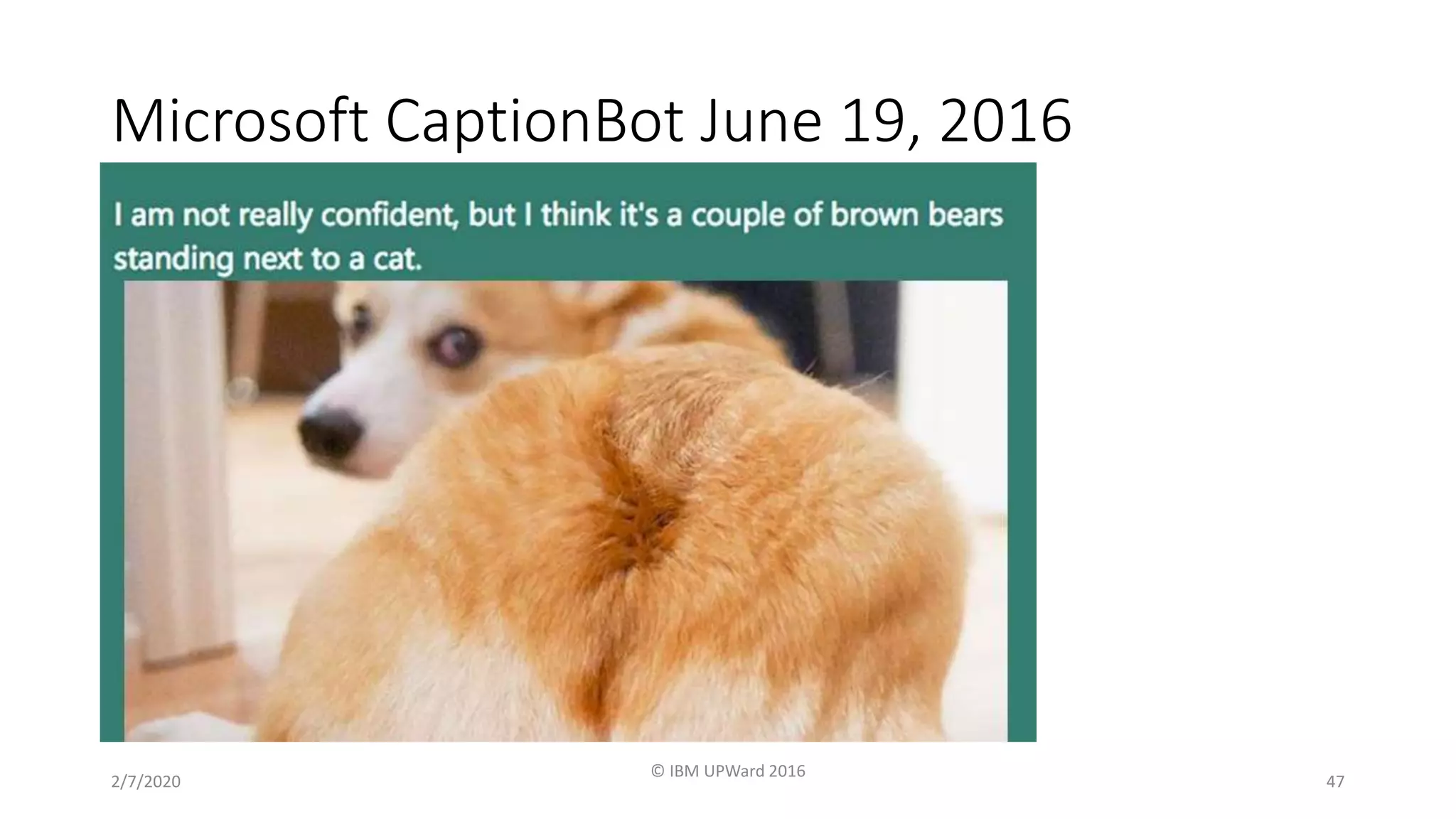
Microsoft CaptionBot June 19, 2016
2/7/2020
© IBM UPWard 2016
47
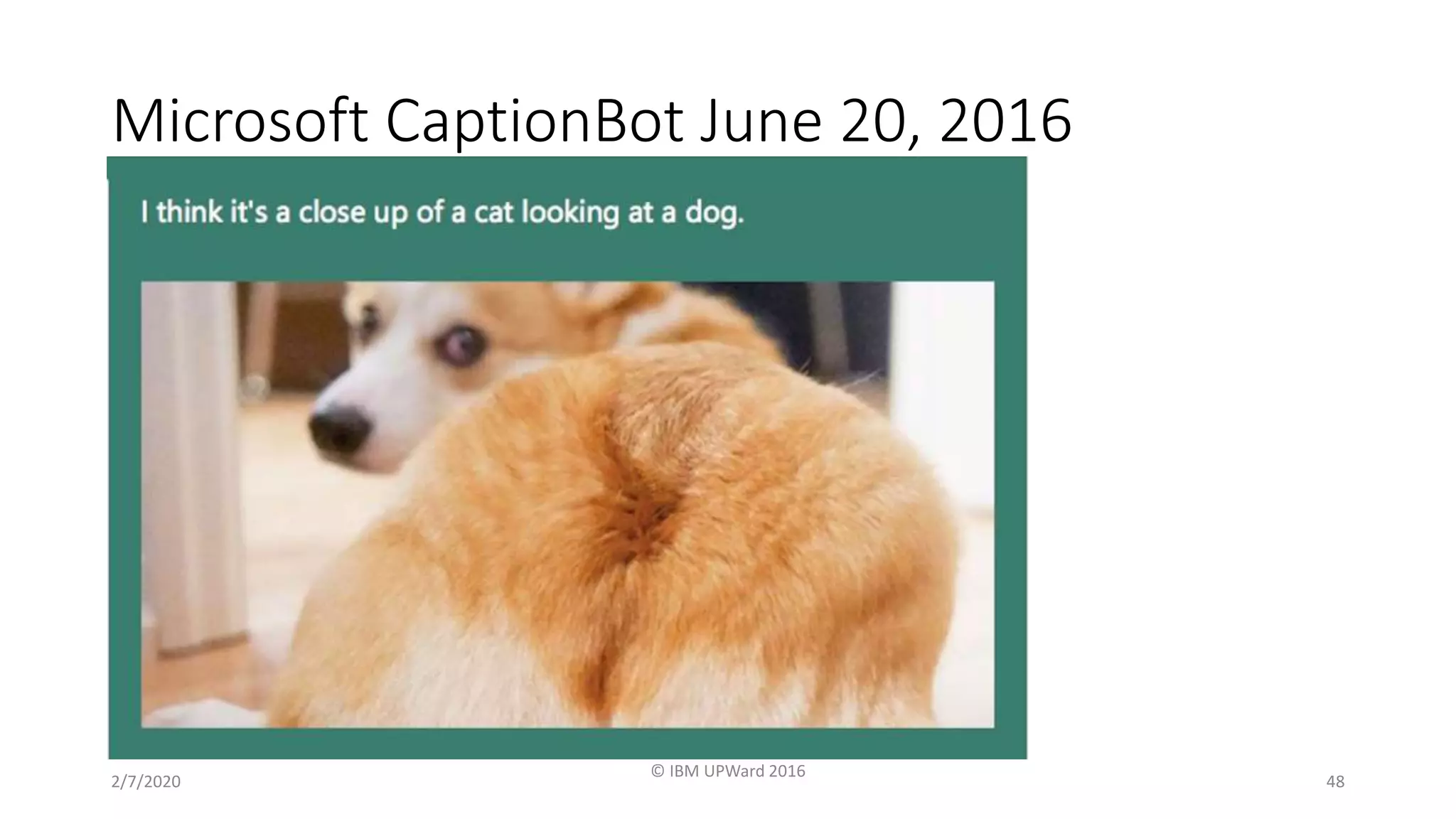
Microsoft CaptionBot June 20, 2016
2/7/2020
© IBM UPWard 2016
48
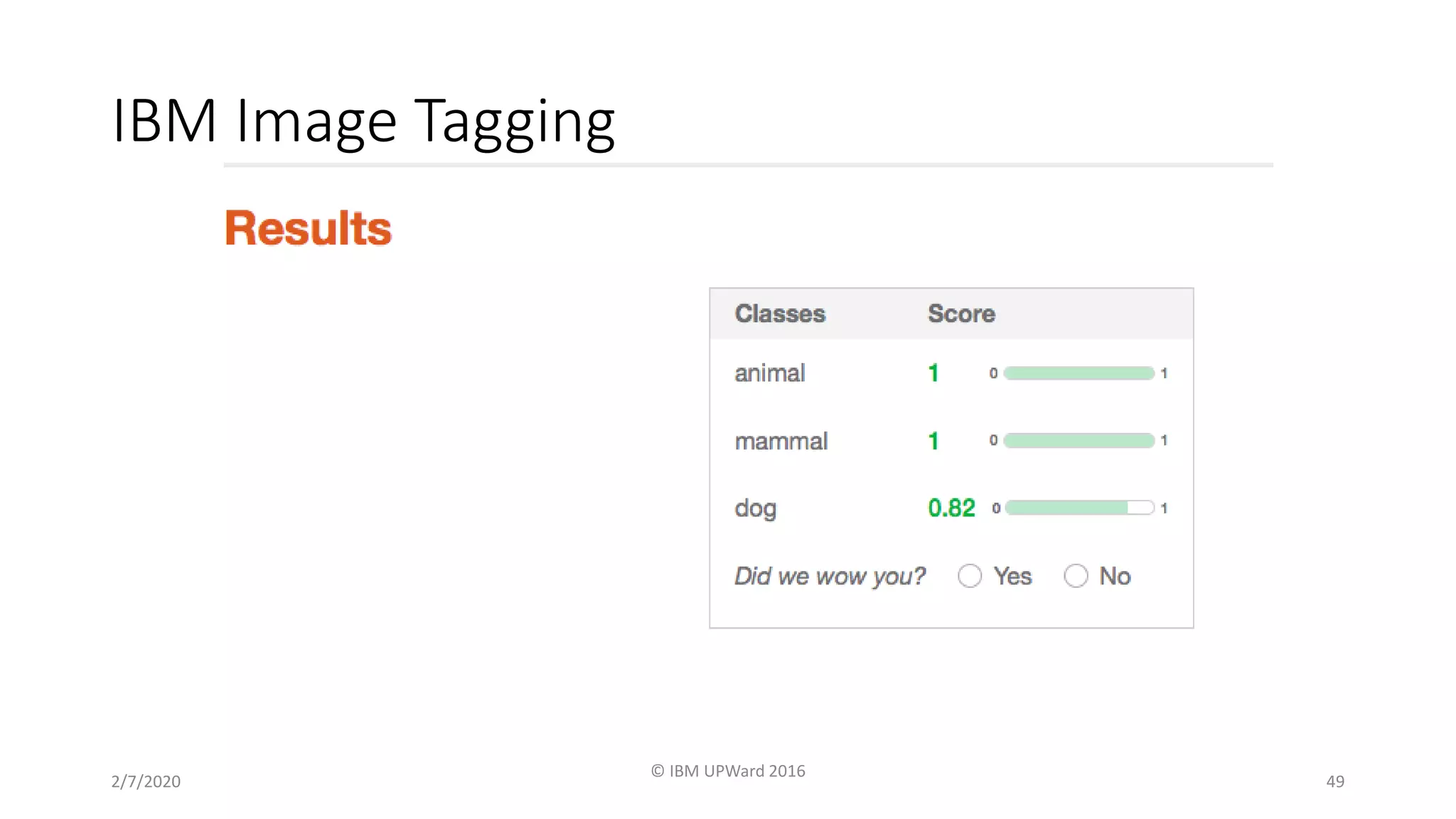
IBM Image Tagging
2/7/2020
© IBM UPWard 2016
49
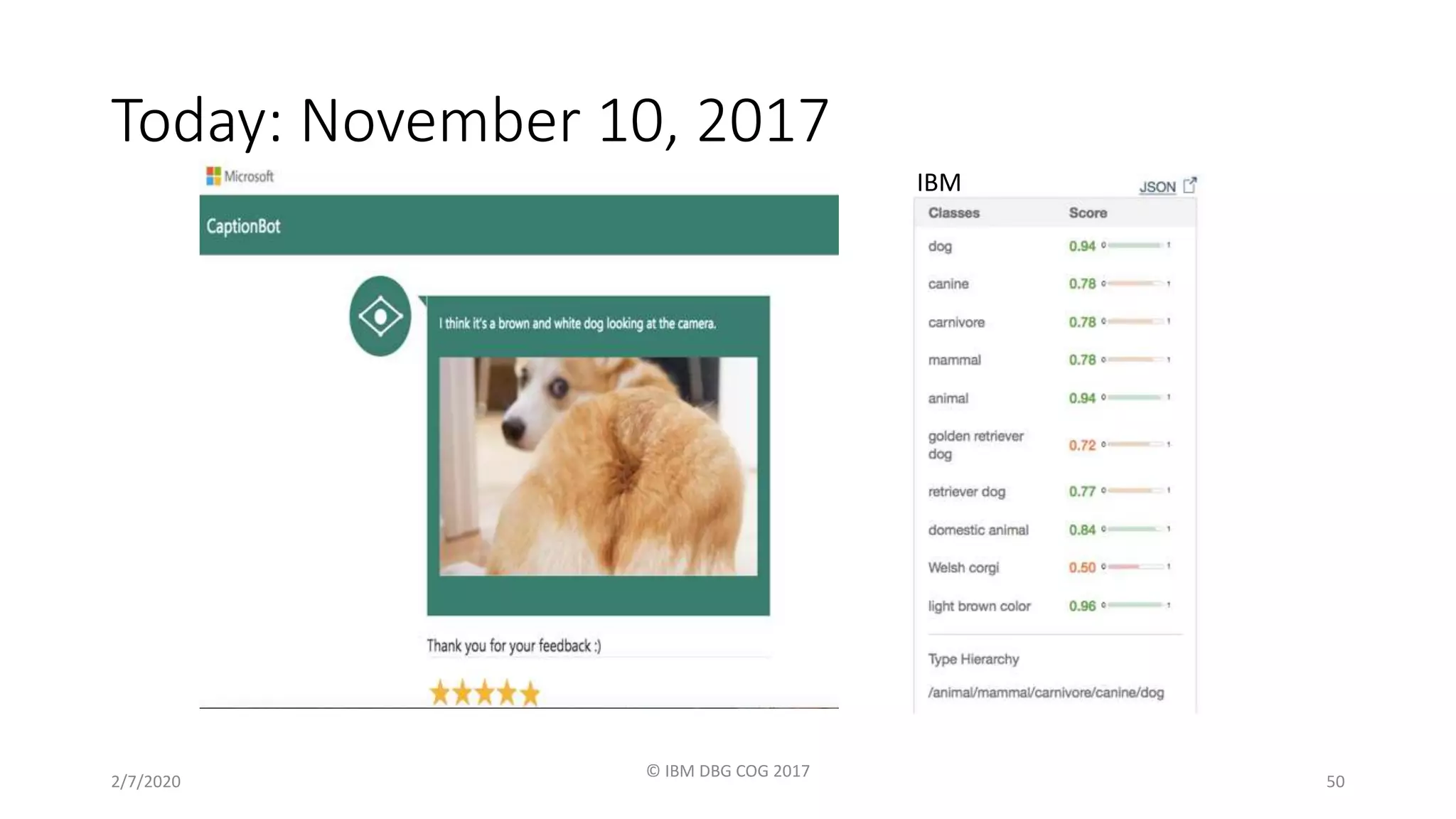
Today: November 10, 2017
2/7/2020
© IBM DBG COG 2017
50
IBM
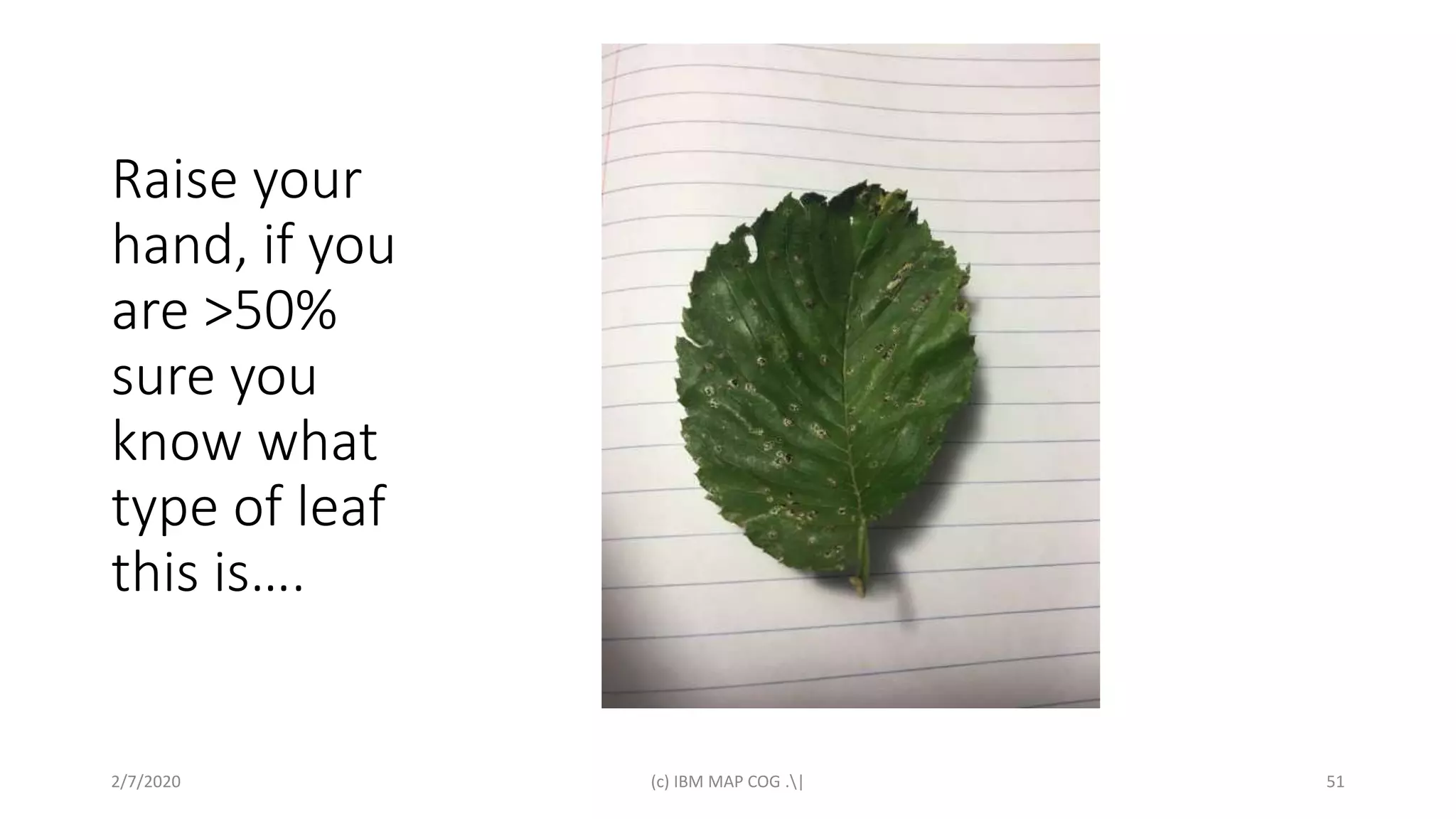
Raise your
hand, if you
are >50%
sure you
know what
type of leaf
this is….
2/7/2020 (c) IBM MAP COG .| 51
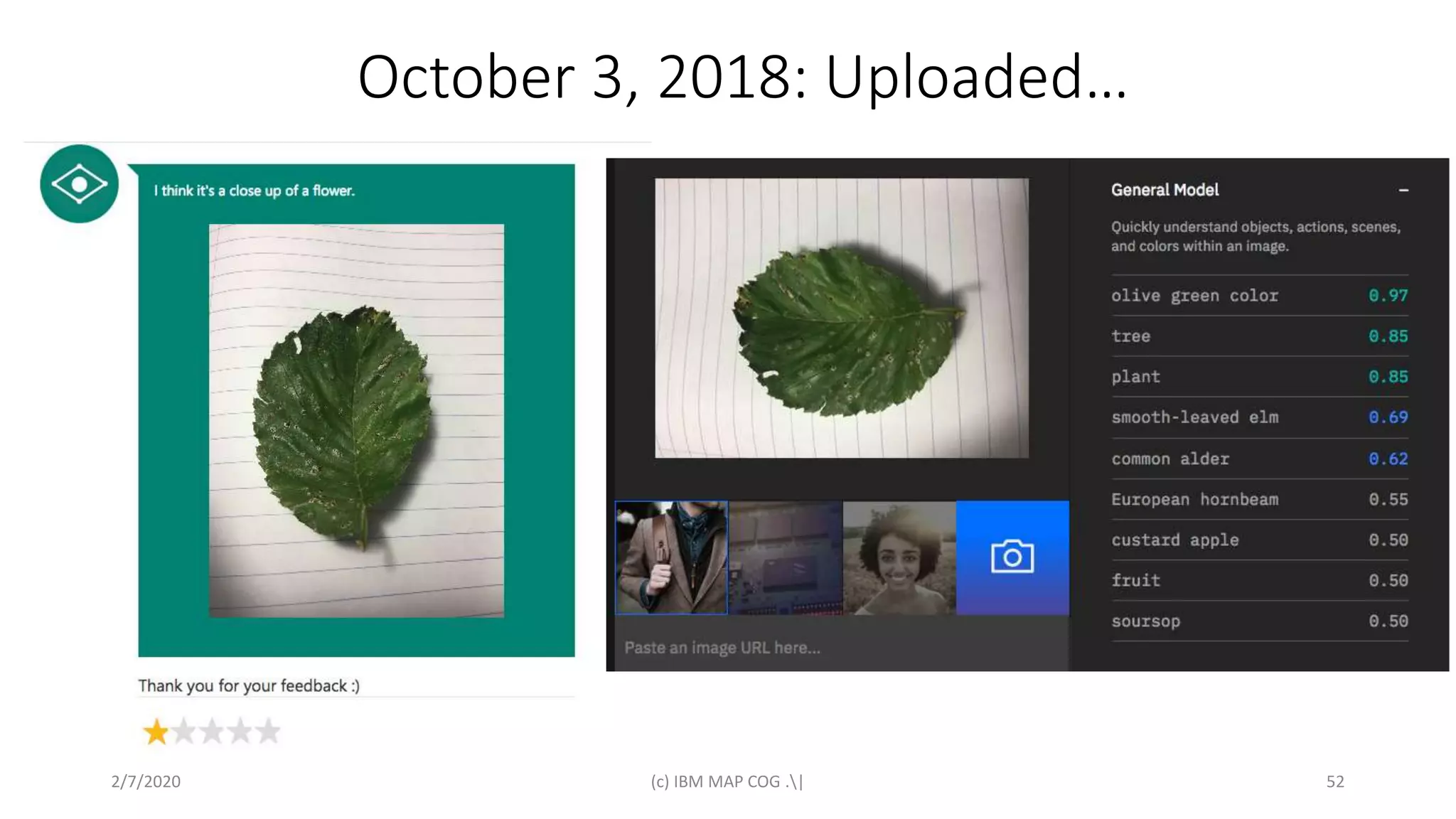
October 3, 2018: Uploaded…
2/7/2020 (c) IBM MAP COG .| 52
2/7/2020
© IBM 2015, IBM Upward University Programs Worldwide
accelerating regional development
53
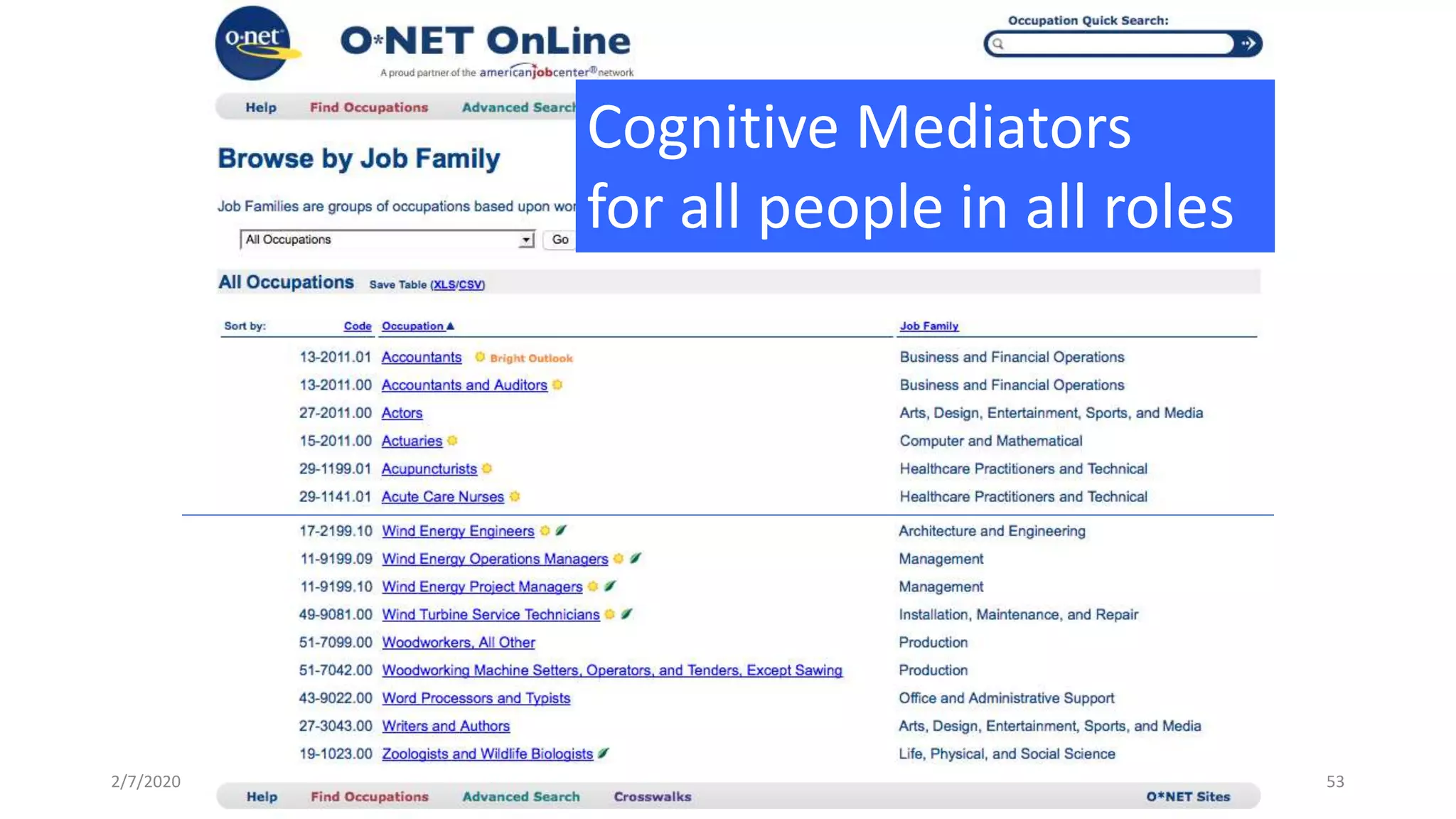
Cognitive Mediators
for all people in all roles
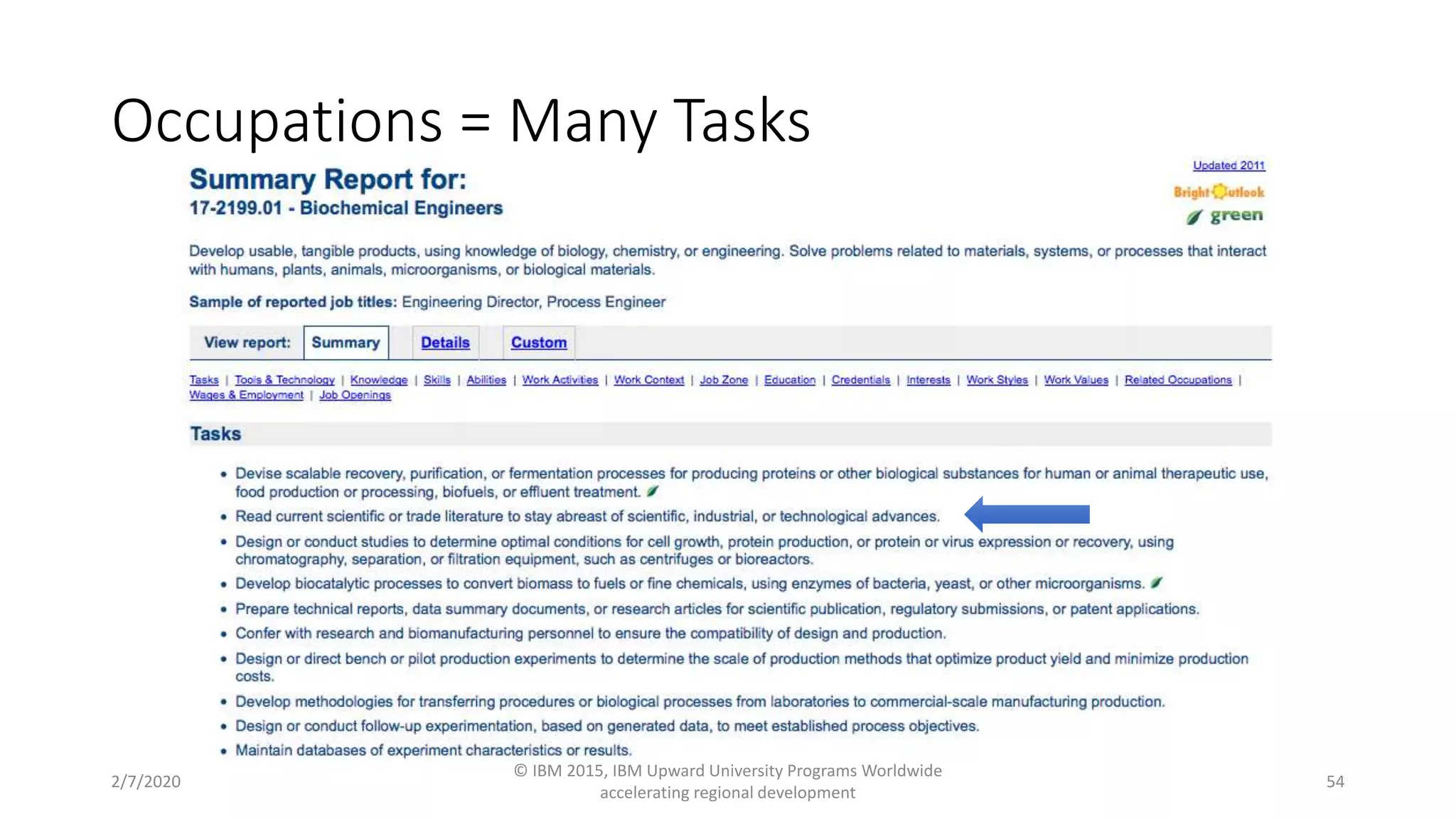
Occupations = Many Tasks
2/7/2020
© IBM 2015, IBM Upward University Programs Worldwide
accelerating regional development
54
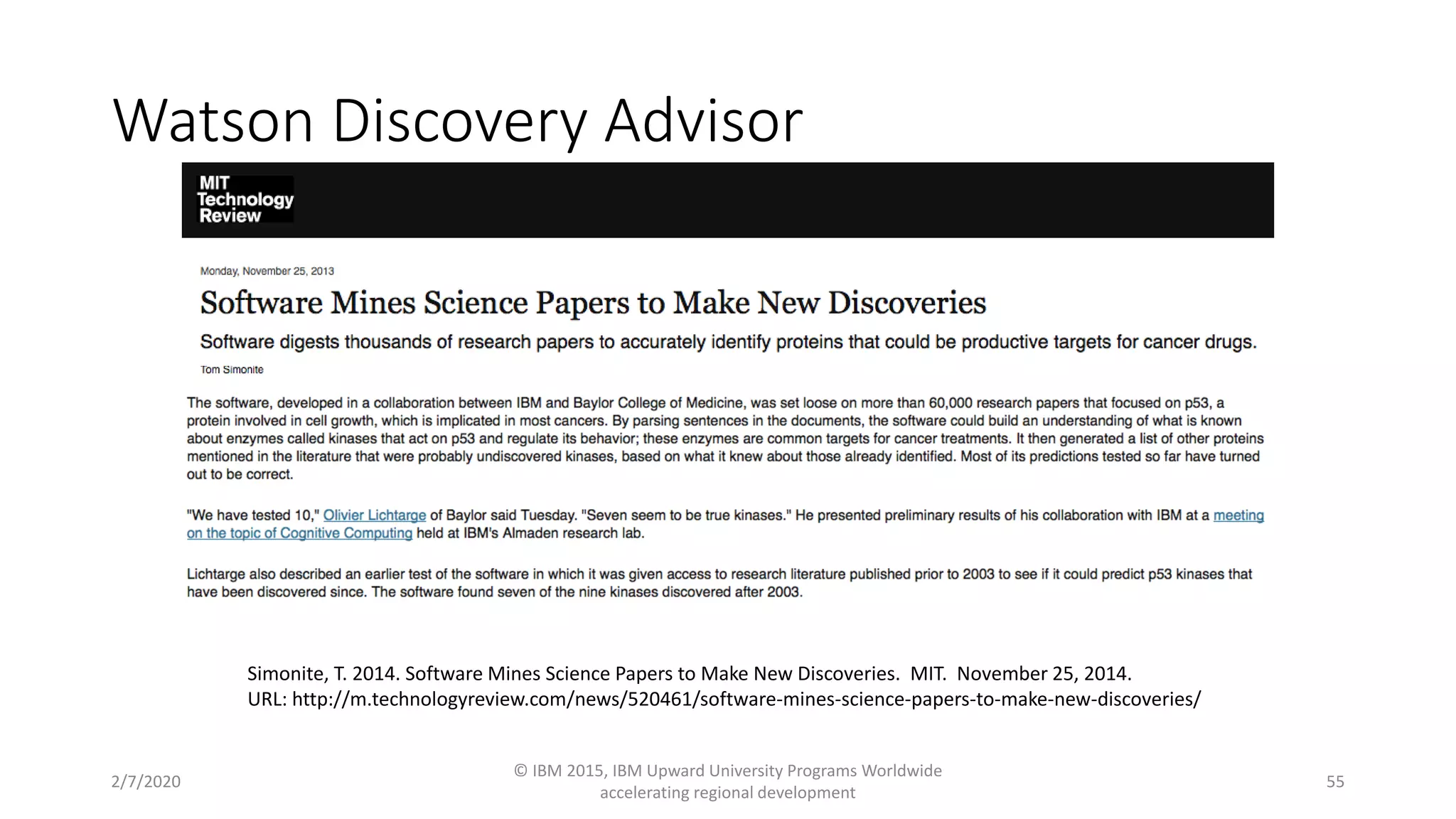
Watson Discovery Advisor
2/7/2020
© IBM 2015, IBM Upward University Programs Worldwide
accelerating regional development
55
Simonite, T. 2014. Software Mines Science Papers to Make New Discoveries. MIT. November 25, 2014.
URL: http://m.technologyreview.com/news/520461/software-mines-science-papers-to-make-new-discoveries/
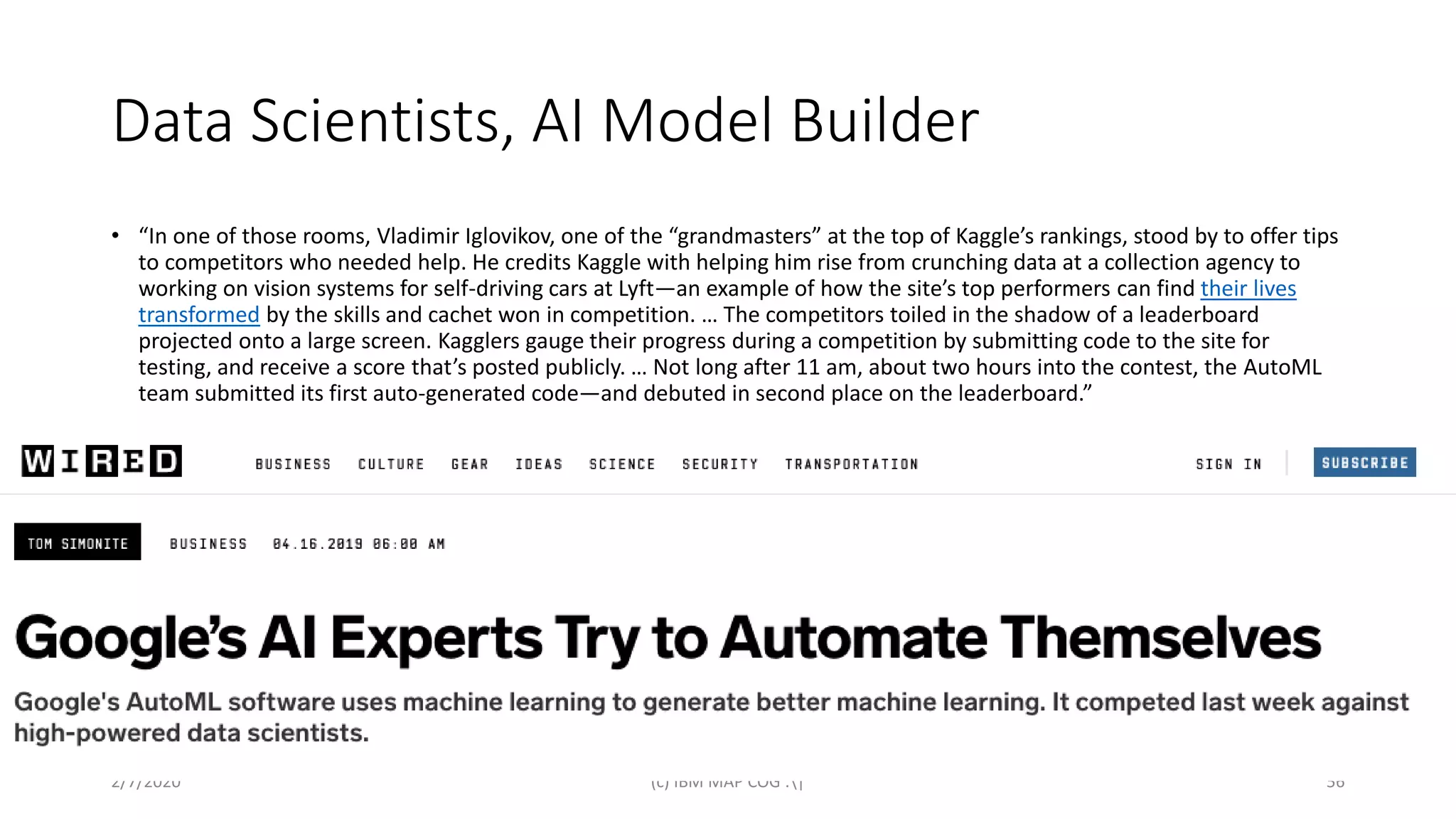
Data Scientists, AI Model Builder
• “In one of those rooms, Vladimir Iglovikov, one of the “grandmasters” at the top of Kaggle’s rankings, stood by to offer tips
to competitors who needed help. He credits Kaggle with helping him rise from crunching data at a collection agency to
working on vision systems for self-driving cars at Lyft—an example of how the site’s top performers can find their lives
transformed by the skills and cachet won in competition. … The competitors toiled in the shadow of a leaderboard
projected onto a large screen. Kagglers gauge their progress during a competition by submitting code to the site for
testing, and receive a score that’s posted publicly. … Not long after 11 am, about two hours into the contest, the AutoML
team submitted its first auto-generated code—and debuted in second place on the leaderboard.”
2/7/2020 (c) IBM MAP COG .| 56
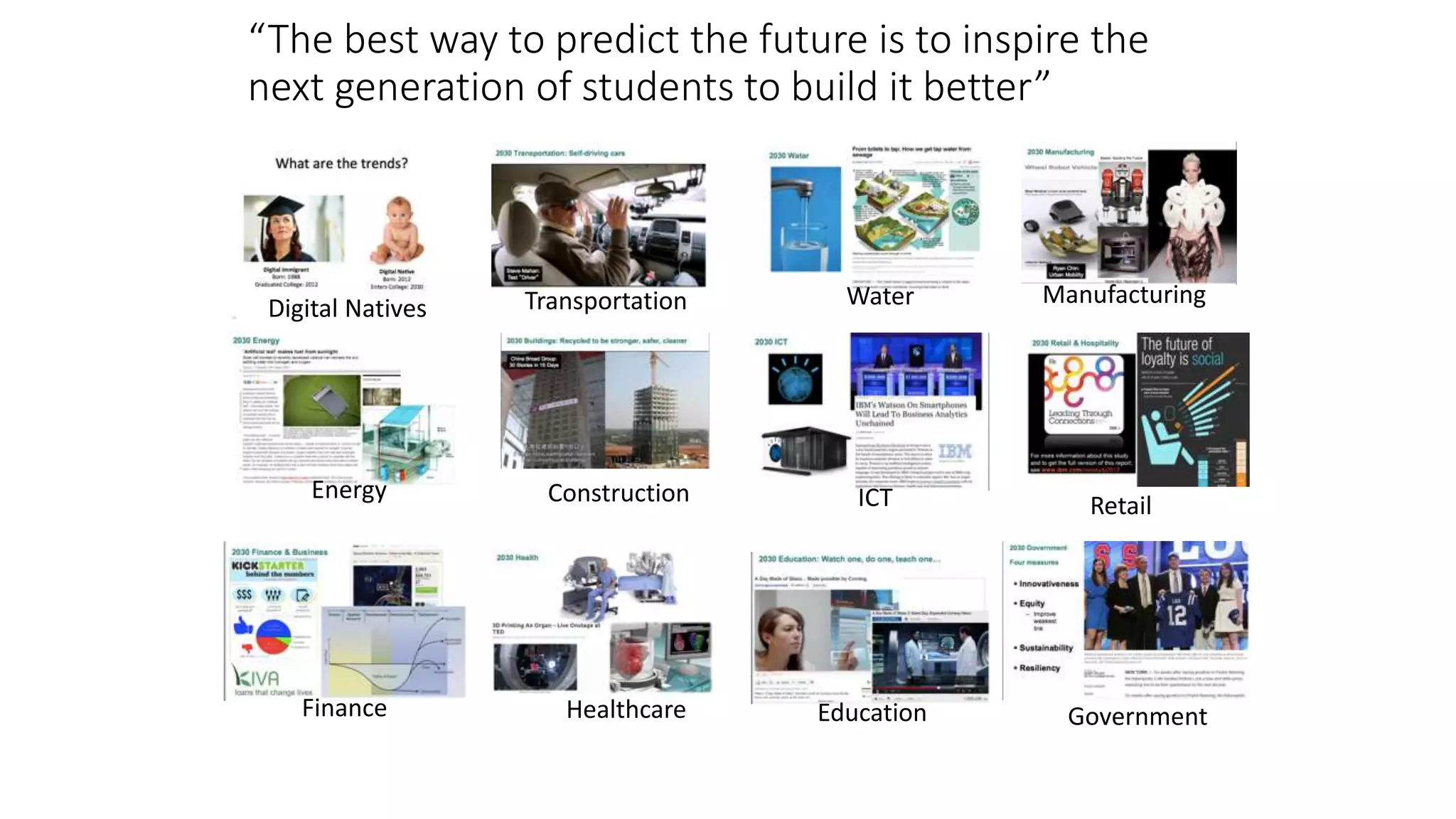
“The best way to predict the future is to inspire the
next generation of students to build it better”
Digital Natives Transportation Water Manufacturing
Energy Construction ICT Retail
Finance Healthcare Education Government
2/7/2020 58
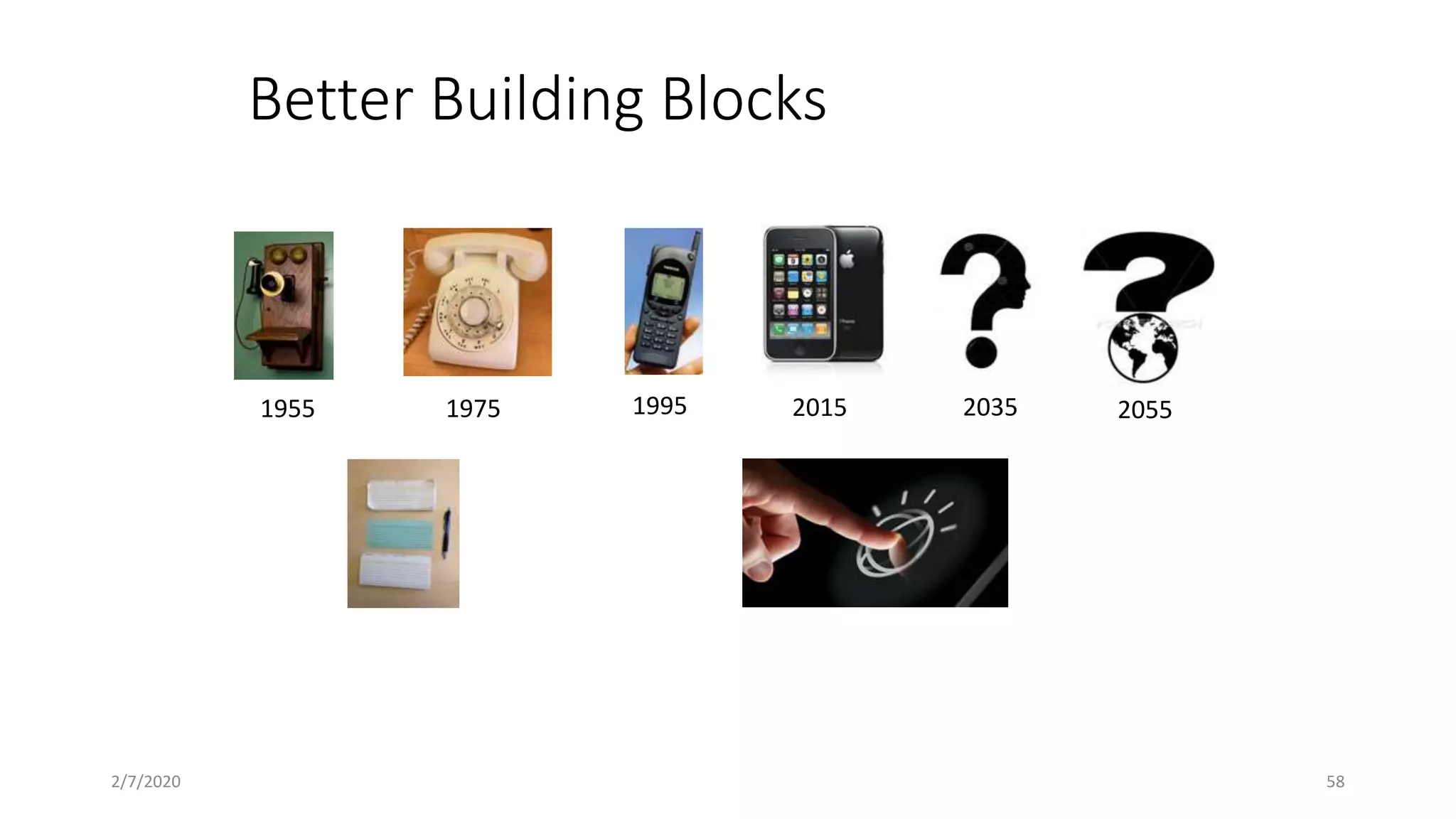
1955 1975 1995 2015 2035 2055
Better Building Blocks
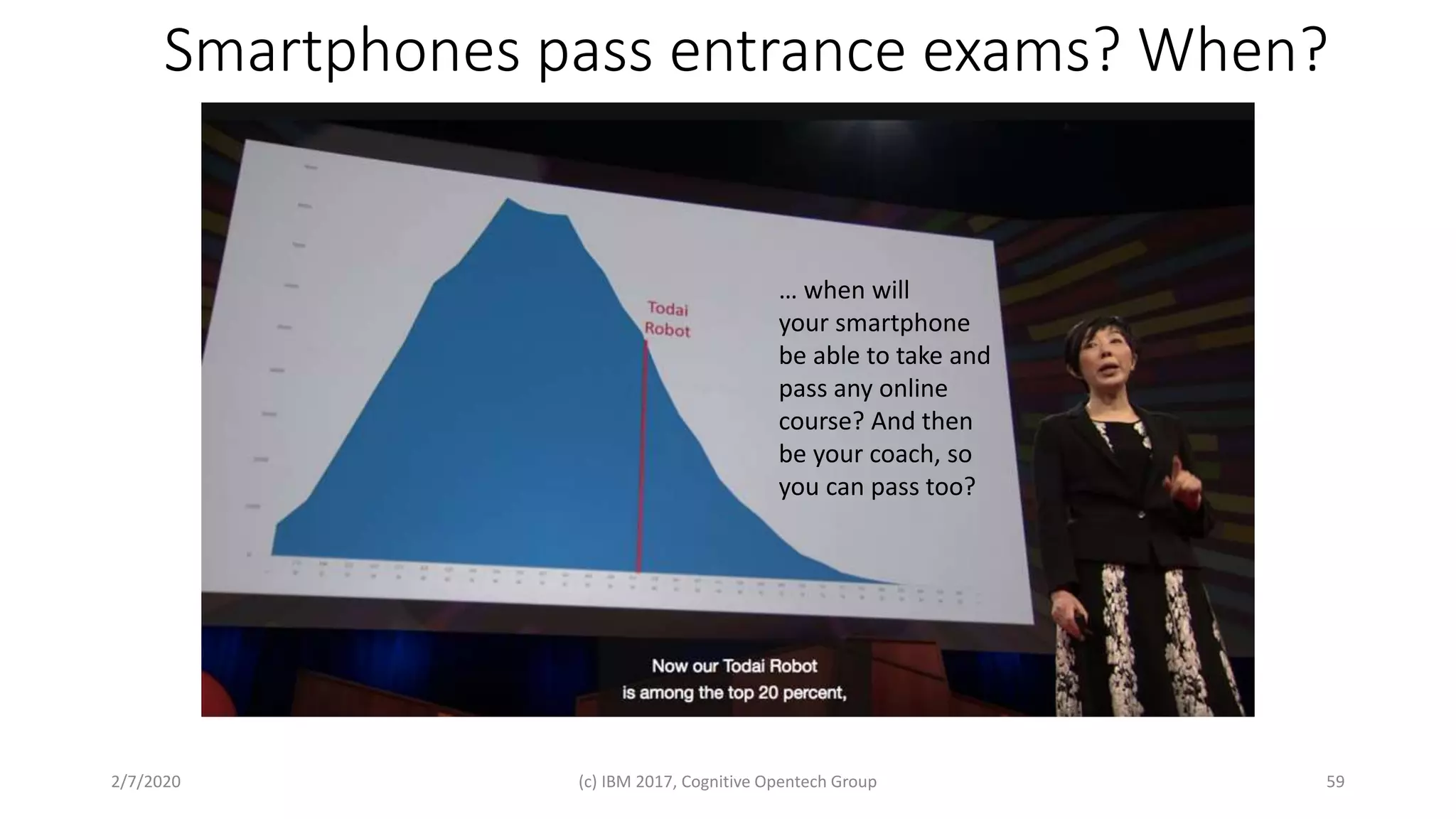
Smartphones pass entrance exams? When?
2/7/2020 (c) IBM 2017, Cognitive Opentech Group 59
… when will
your smartphone
be able to take and
pass any online
course? And then
be your coach, so
you can pass too?
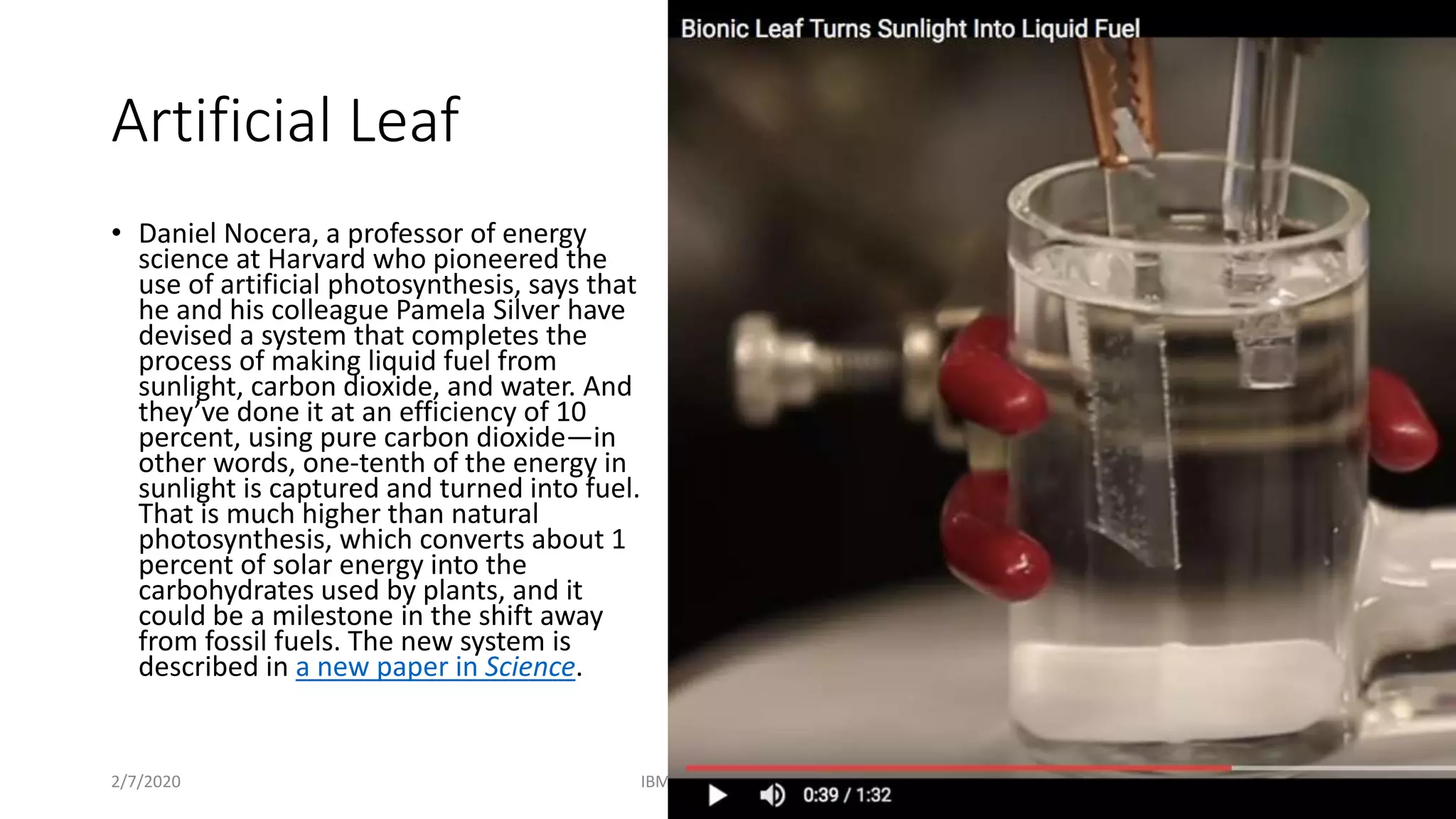
Artificial Leaf
• Daniel Nocera, a professor of energy
science at Harvard who pioneered the
use of artificial photosynthesis, says that
he and his colleague Pamela Silver have
devised a system that completes the
process of making liquid fuel from
sunlight, carbon dioxide, and water. And
they’ve done it at an efficiency of 10
percent, using pure carbon dioxide—in
other words, one-tenth of the energy in
sunlight is captured and turned into fuel.
That is much higher than natural
photosynthesis, which converts about 1
percent of solar energy into the
carbohydrates used by plants, and it
could be a milestone in the shift away
from fossil fuels. The new system is
described in a new paper in Science.
2/7/2020 IBM Code #OpenTechAI 60
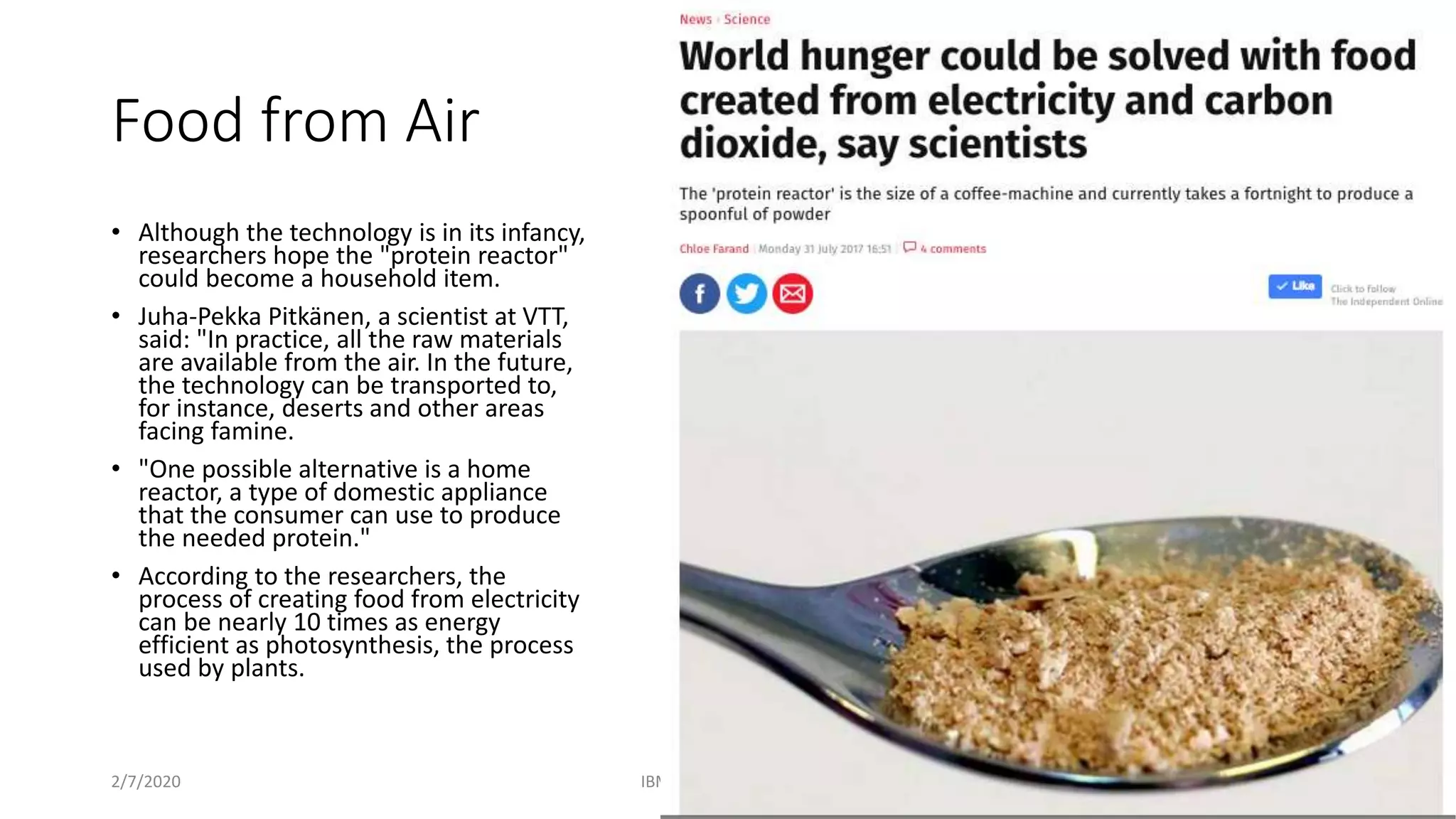
Food from Air
• Although the technology is in its infancy,
researchers hope the "protein reactor"
could become a household item.
• Juha-Pekka Pitkänen, a scientist at VTT,
said: "In practice, all the raw materials
are available from the air. In the future,
the technology can be transported to,
for instance, deserts and other areas
facing famine.
• "One possible alternative is a home
reactor, a type of domestic appliance
that the consumer can use to produce
the needed protein."
• According to the researchers, the
process of creating food from electricity
can be nearly 10 times as energy
efficient as photosynthesis, the process
used by plants.
2/7/2020 IBM Code #OpenTechAI 61
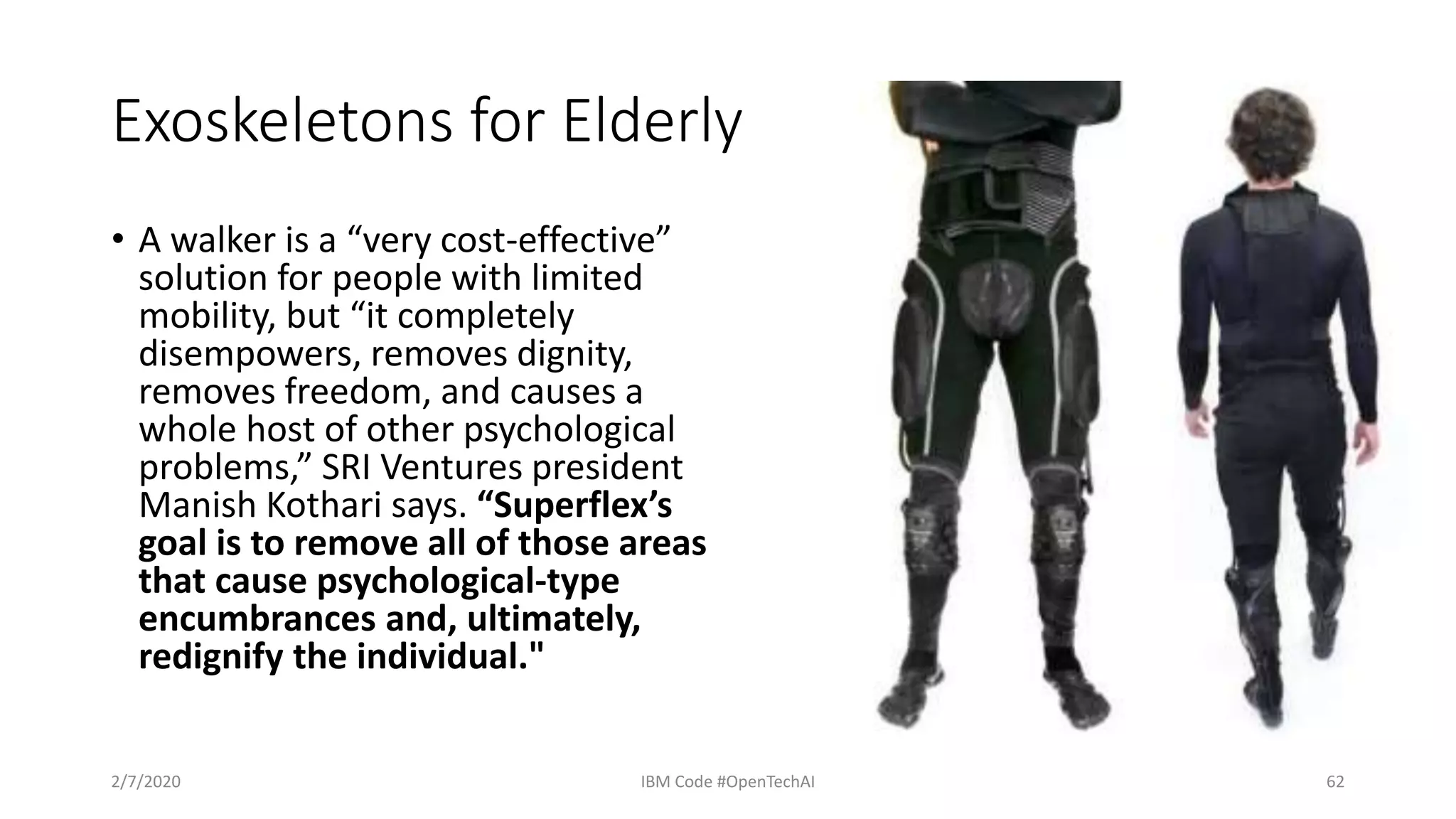
Exoskeletons for Elderly
• A walker is a “very cost-effective”
solution for people with limited
mobility, but “it completely
disempowers, removes dignity,
removes freedom, and causes a
whole host of other psychological
problems,” SRI Ventures president
Manish Kothari says. “Superflex’s
goal is to remove all of those areas
that cause psychological-type
encumbrances and, ultimately,
redignify the individual."
2/7/2020 IBM Code #OpenTechAI 62
Question: How would you rebuild your
discipline from scratch?
• Some disciplines renew themselves [Tuure Tuunanen]
2/7/2020 (c) IBM MAP COG .| 63
2/7/2020
© IBM 2015, IBM Upward University Programs Worldwide
accelerating regional development
64
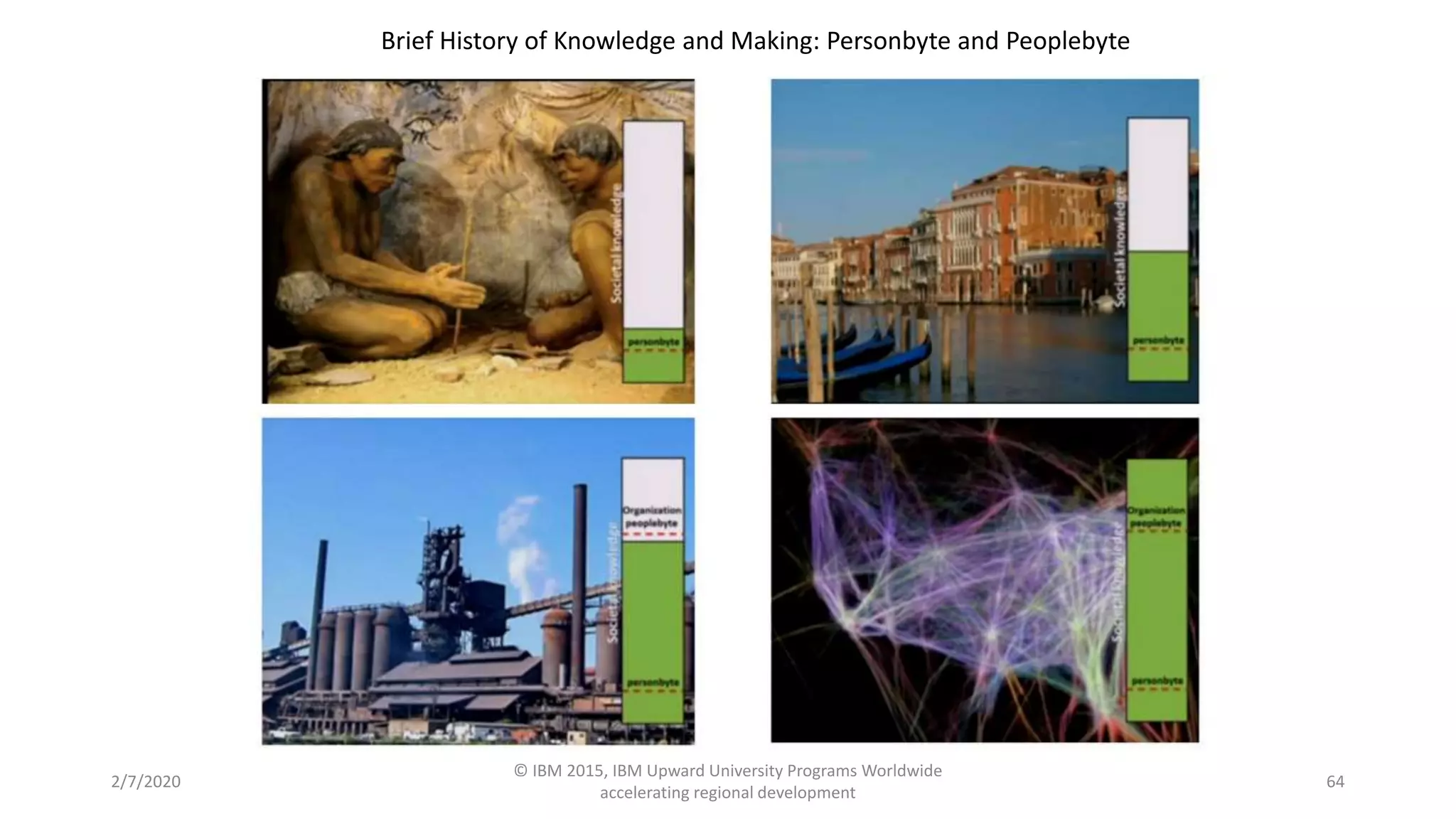
Brief History of Knowledge and Making: Personbyte and Peoplebyte
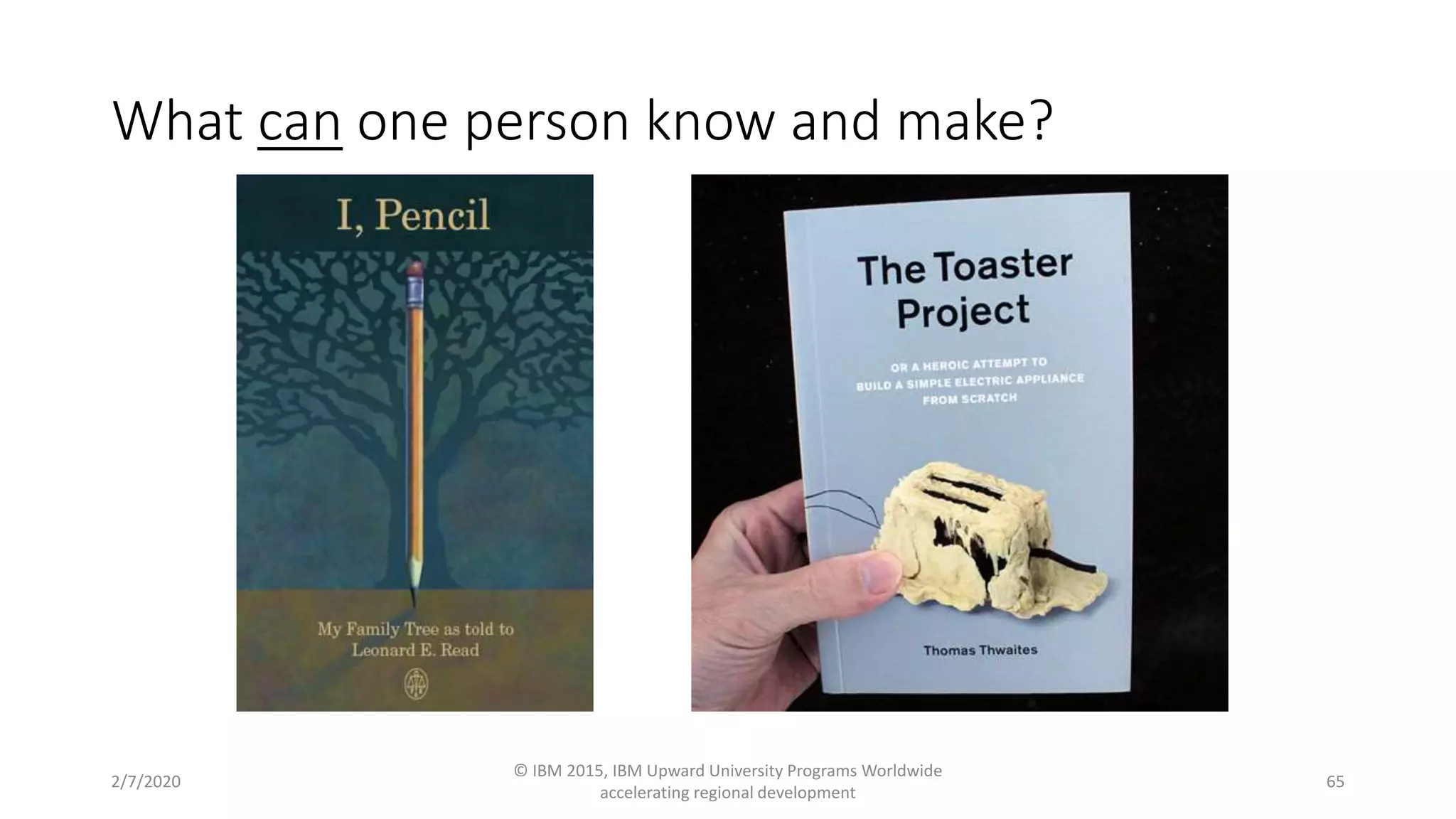
What can one person know and make?
2/7/2020
© IBM 2015, IBM Upward University Programs Worldwide
accelerating regional development
65
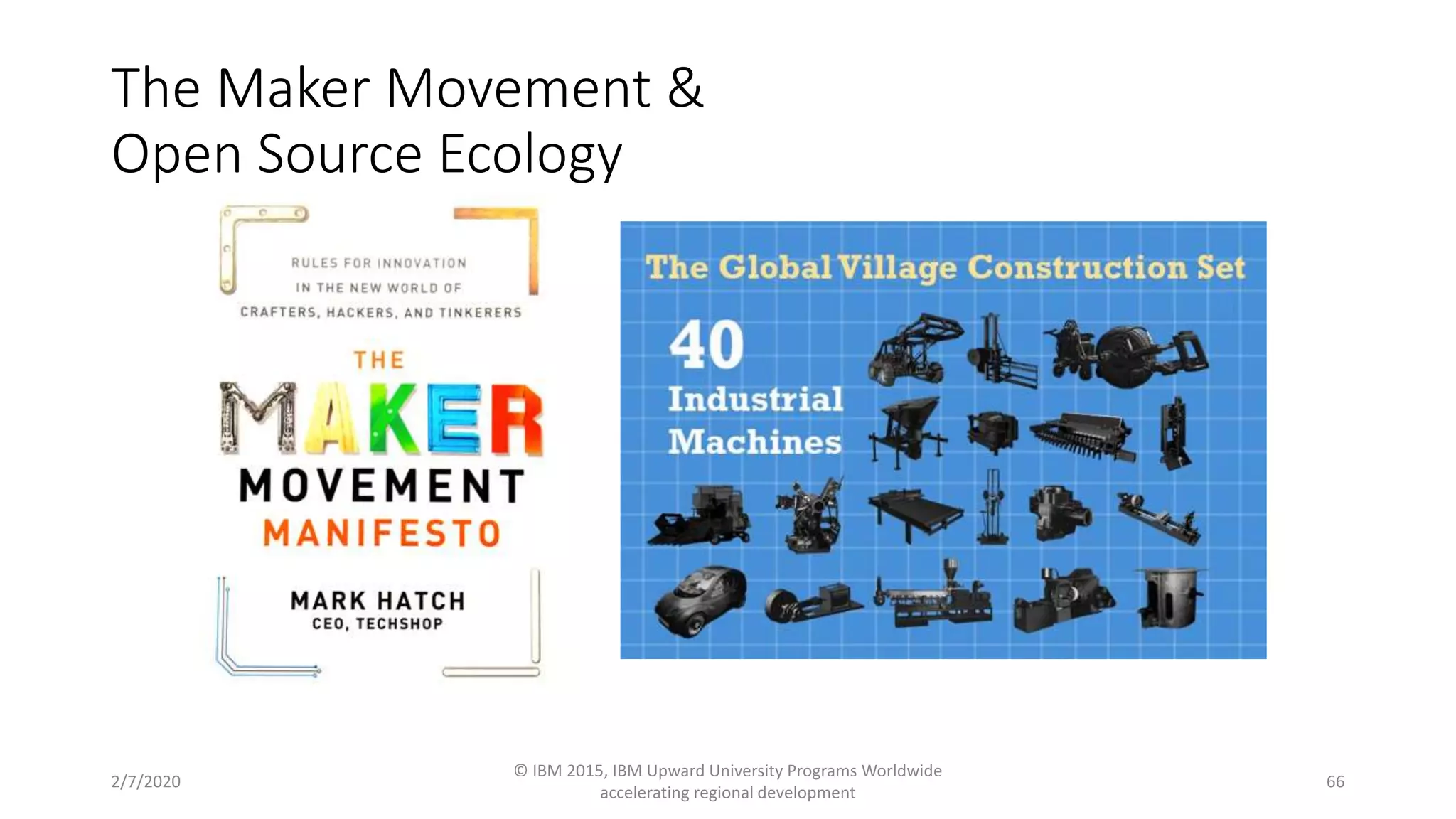
The Maker Movement &
Open Source Ecology
2/7/2020
© IBM 2015, IBM Upward University Programs Worldwide
accelerating regional development
66
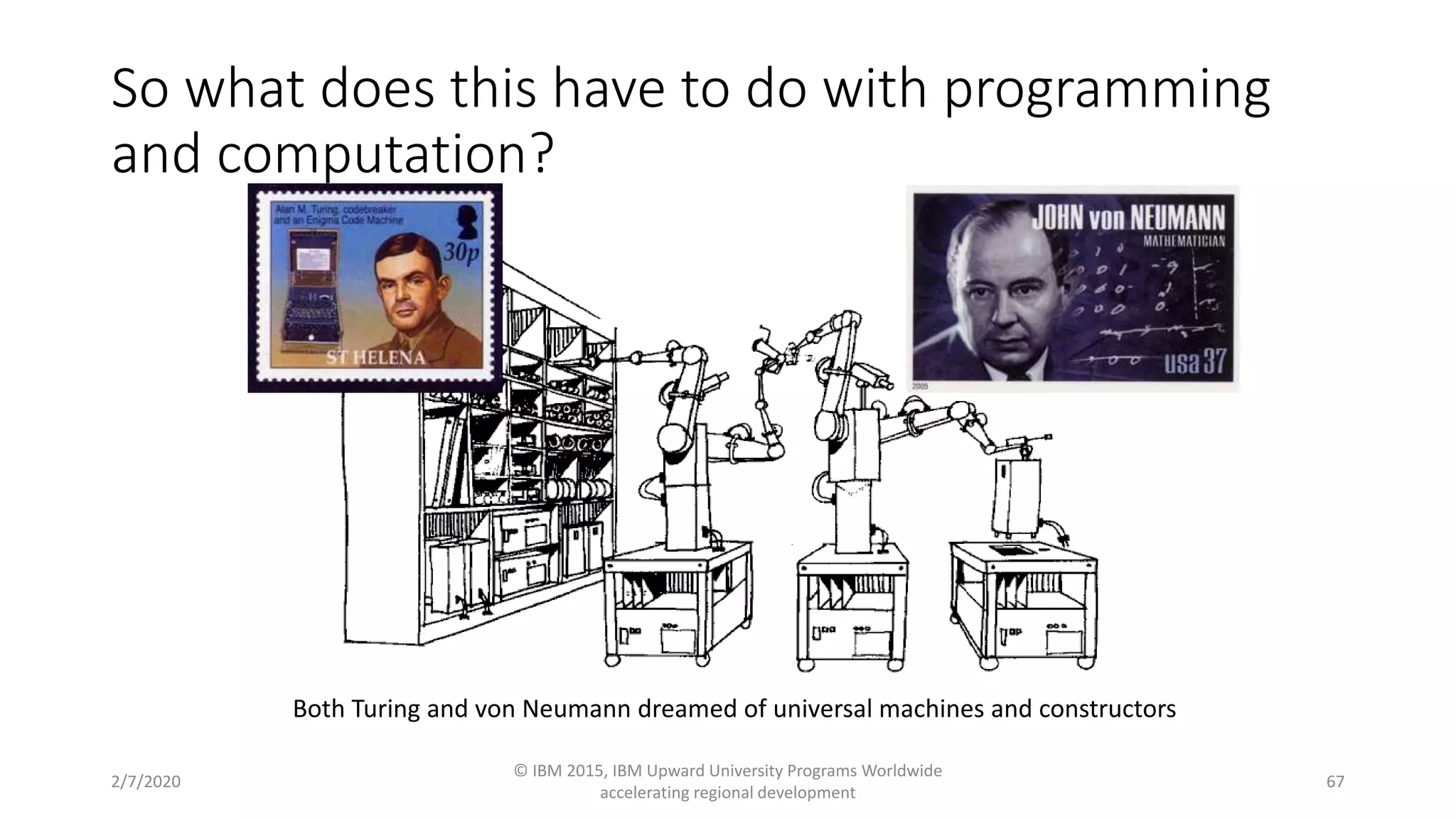
So what does this have to do with programming
and computation?
2/7/2020
© IBM 2015, IBM Upward University Programs Worldwide
accelerating regional development
67
Both Turing and von Neumann dreamed of universal machines and constructors
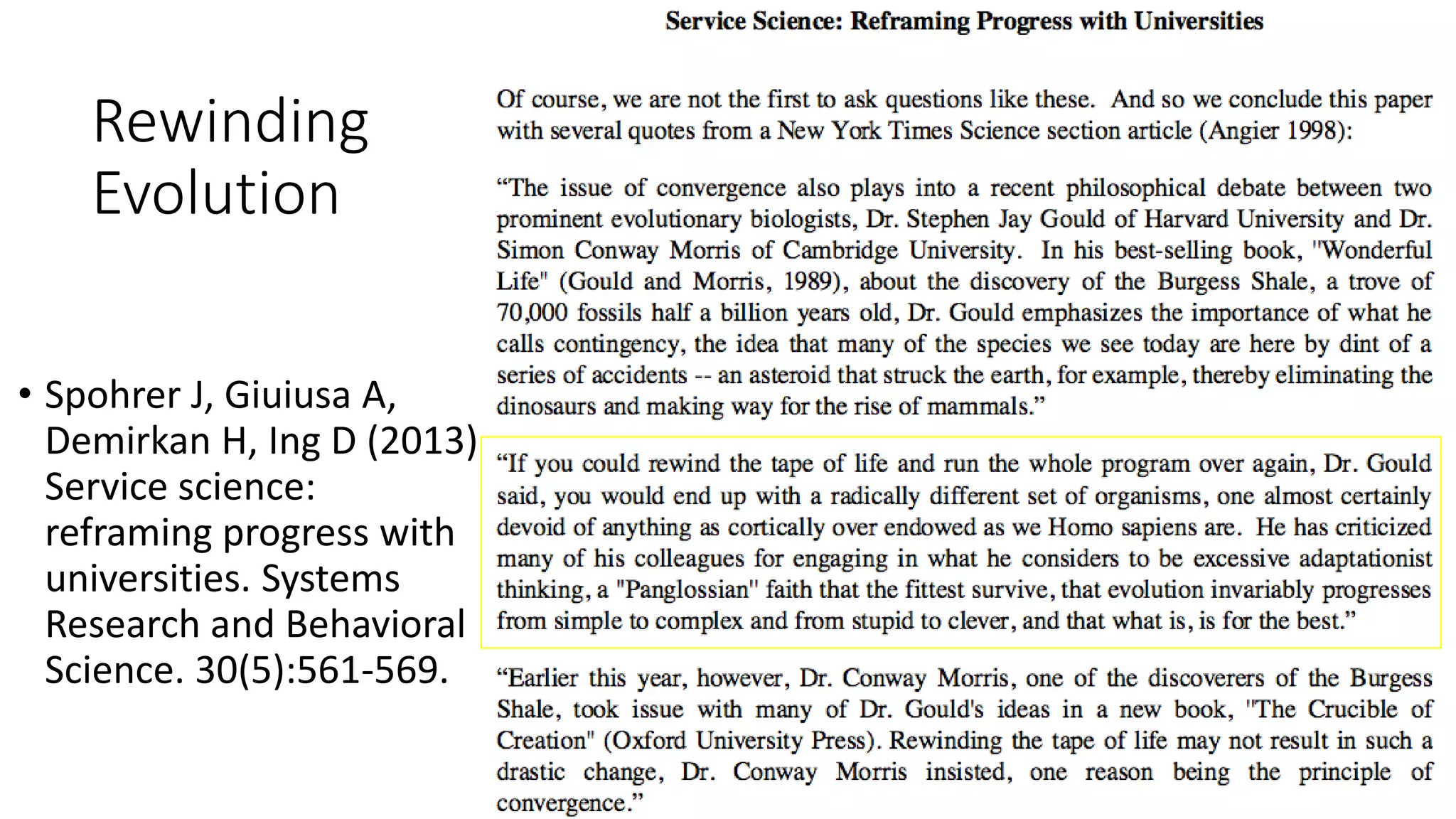
Rewinding
Evolution
• Spohrer J, Giuiusa A,
Demirkan H, Ing D (2013)
Service science:
reframing progress with
universities. Systems
Research and Behavioral
Science. 30(5):561-569.
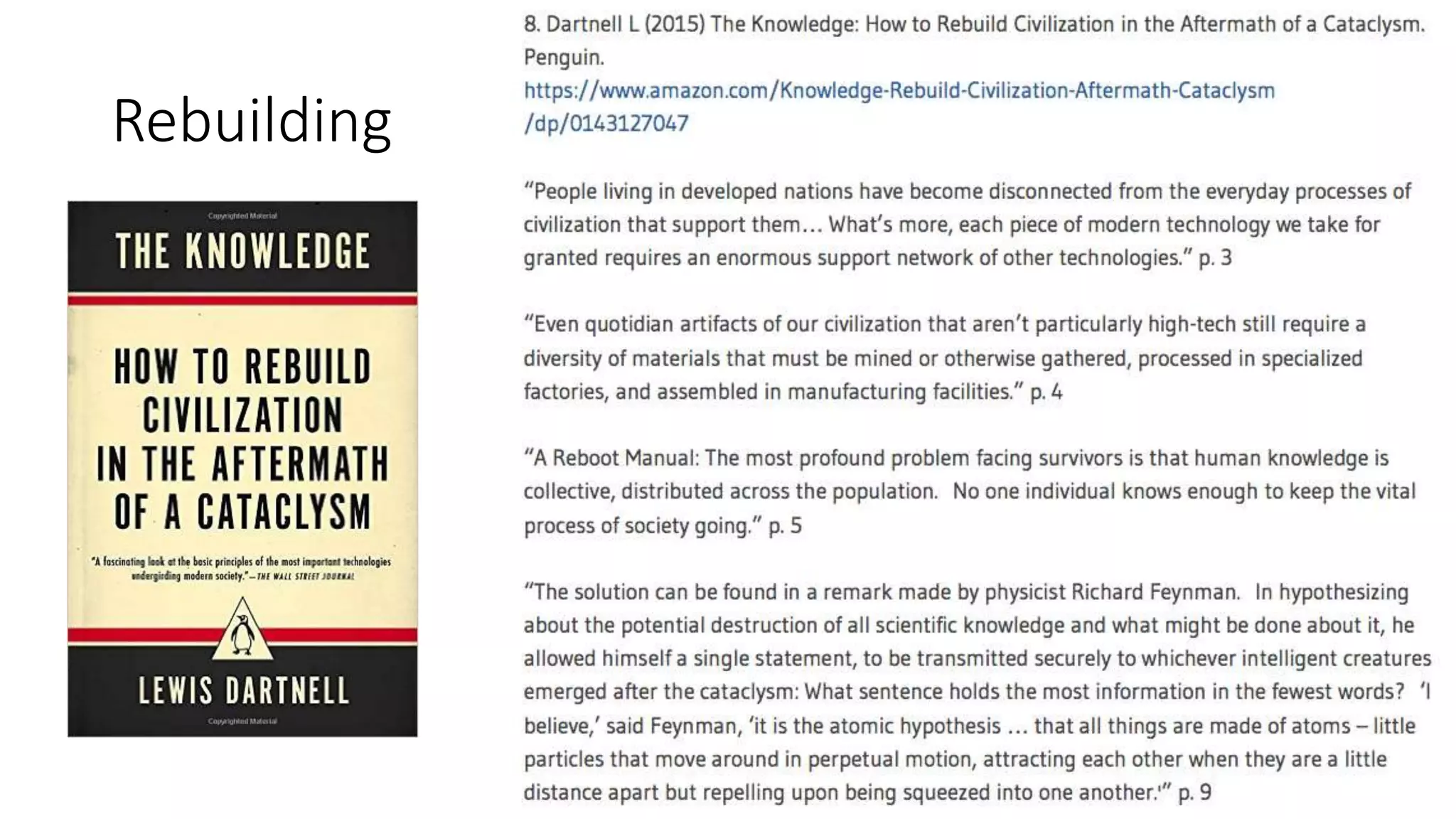
Rebuilding
Why rebuilding evolution? Better Education
• If there be an order in which
the human race has mastered
its various kinds of
knowledge, there will arise in
every child an aptitude to
acquire these kinds of
knowledge in the same
order.... Education is a
repetition of civilization in
little.[28]
• — Herbert Spencer
http://www.slideshare.net/spohrer/spohrer-icer-20150810-v1
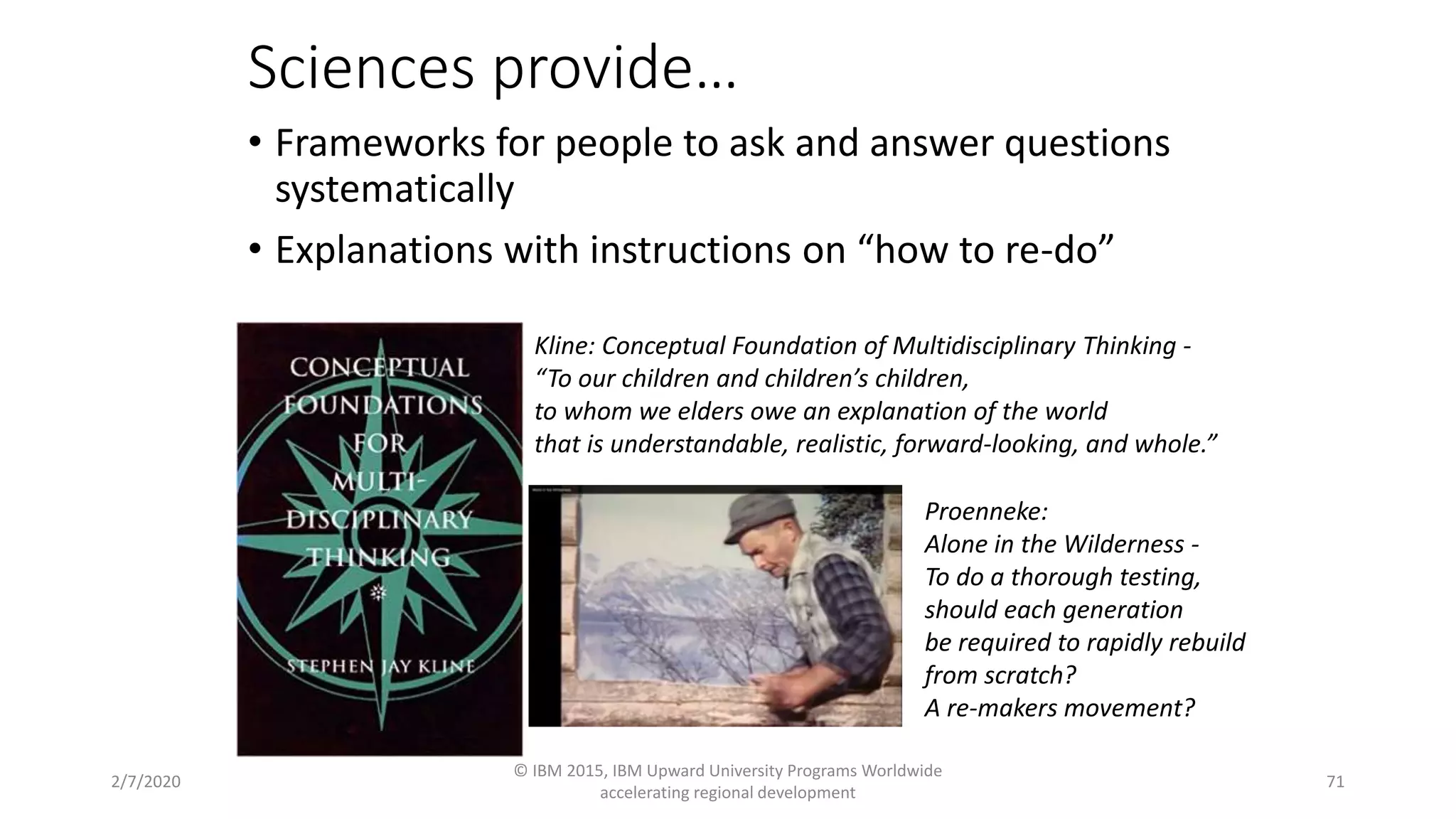
Sciences provide…
• Frameworks for people to ask and answer questions
systematically
• Explanations with instructions on “how to re-do”
2/7/2020
© IBM 2015, IBM Upward University Programs Worldwide
accelerating regional development
71
Kline: Conceptual Foundation of Multidisciplinary Thinking -
“To our children and children’s children,
to whom we elders owe an explanation of the world
that is understandable, realistic, forward-looking, and whole.”
Proenneke:
Alone in the Wilderness -
To do a thorough testing,
should each generation
be required to rapidly rebuild
from scratch?
A re-makers movement?
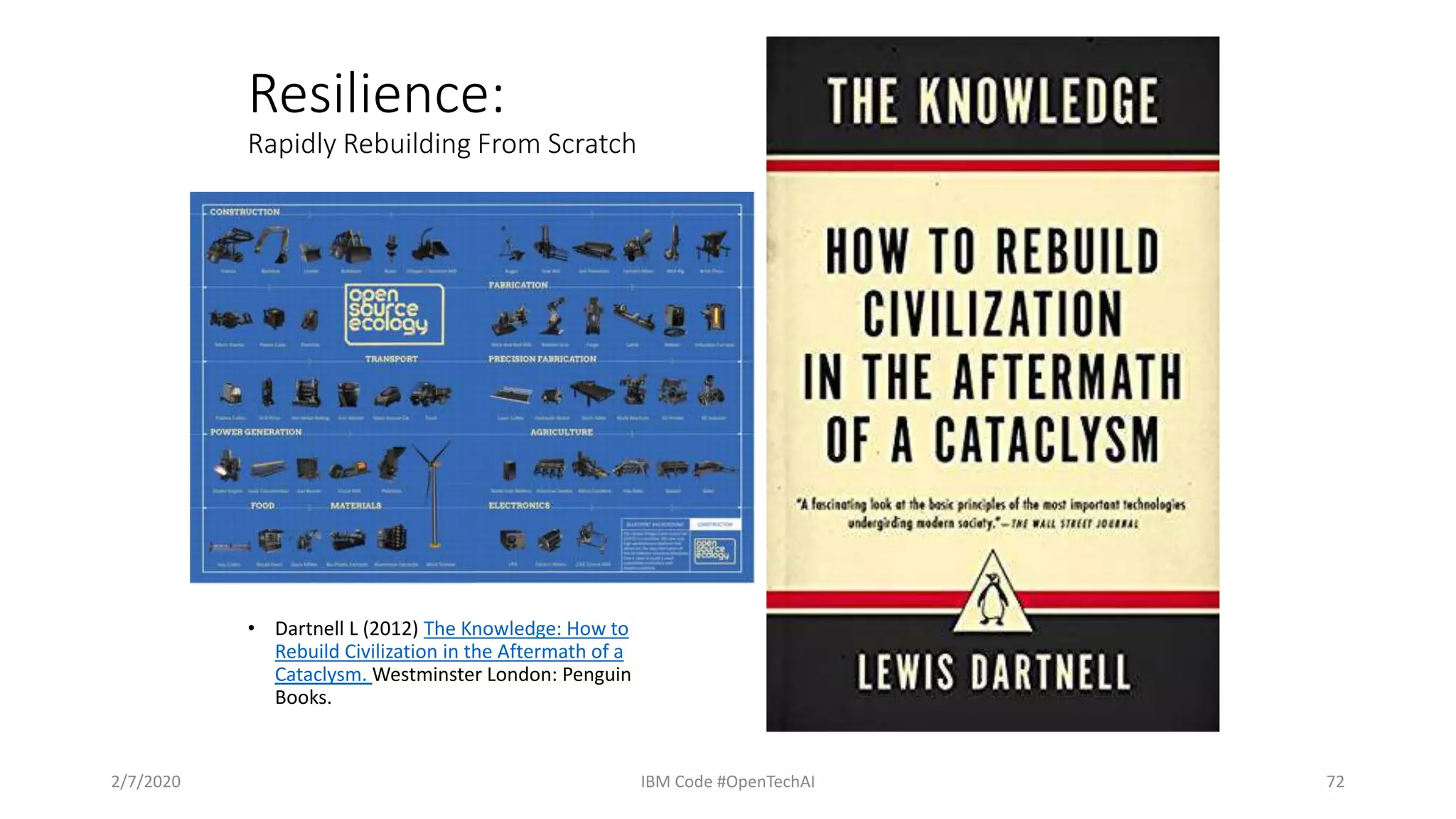
Resilience:
Rapidly Rebuilding From Scratch
• Dartnell L (2012) The Knowledge: How to
Rebuild Civilization in the Aftermath of a
Cataclysm. Westminster London: Penguin
Books.
2/7/2020 IBM Code #OpenTechAI 72
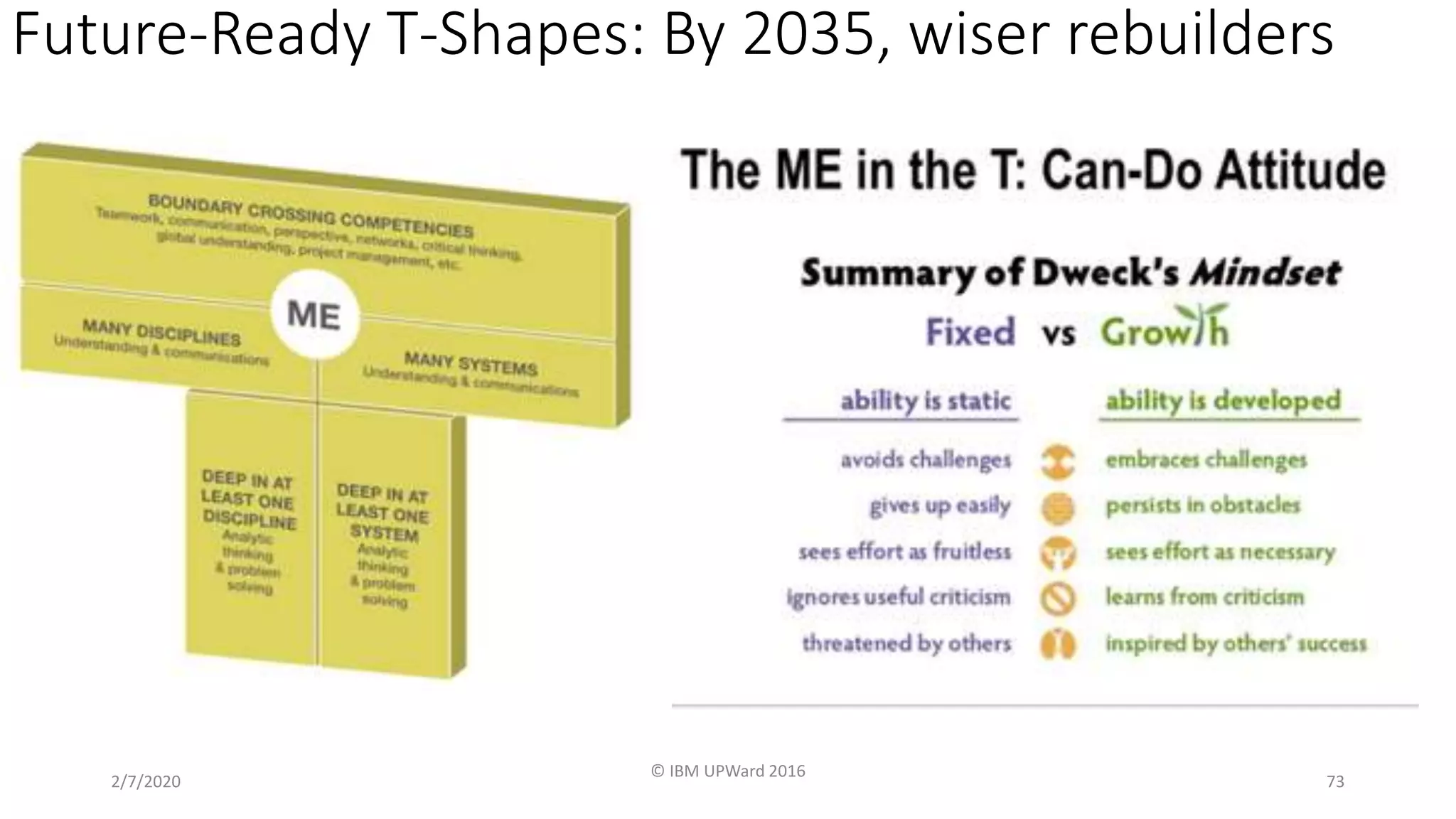
Future-Ready T-Shapes: By 2035, wiser rebuilders
2/7/2020
© IBM UPWard 2016
73
2/7/2020
© IBM 2015, IBM Upward University Programs Worldwide
accelerating regional development
74
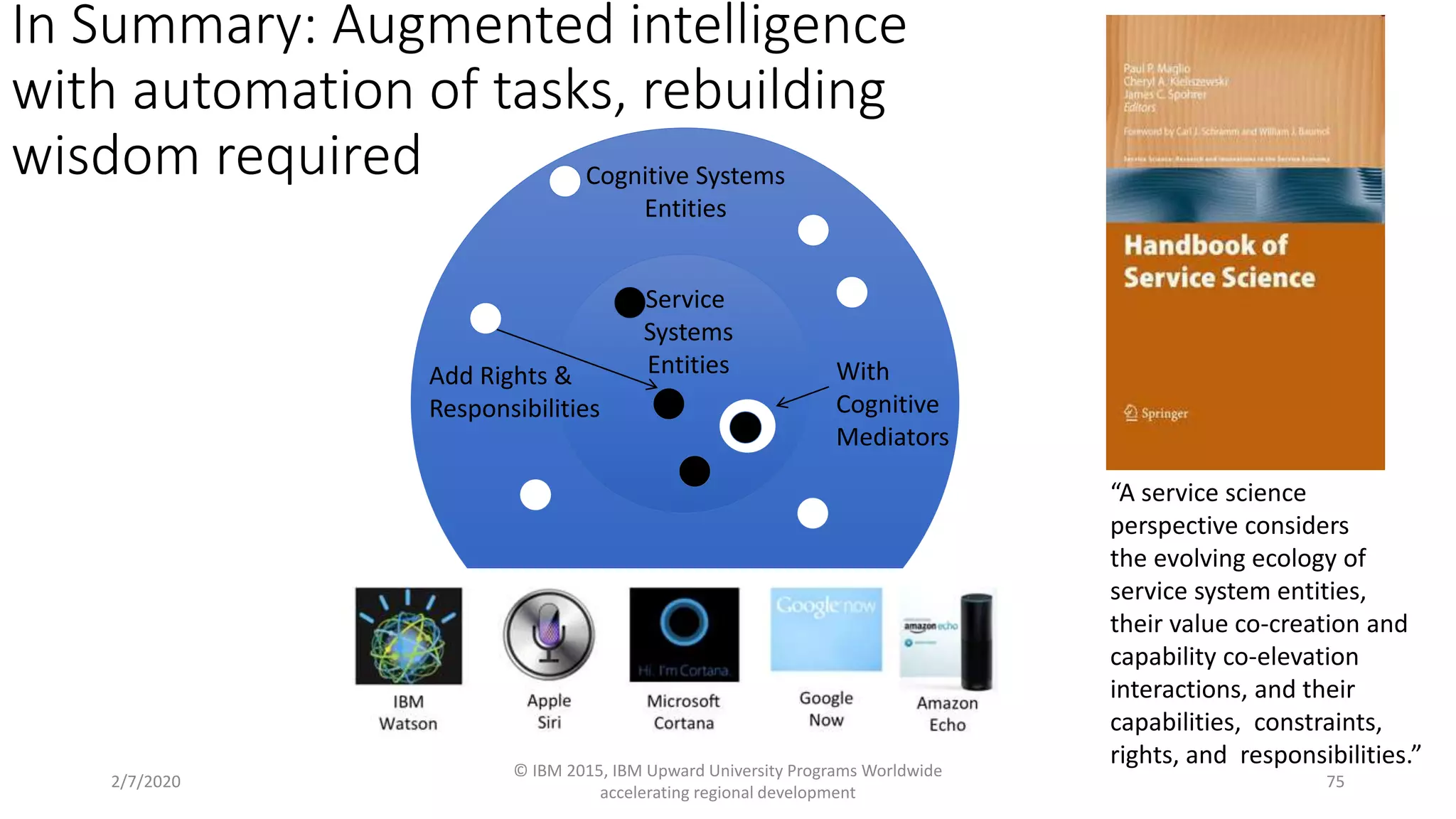
In Summary: Augmented intelligence
with automation of tasks, rebuilding
wisdom required
2/7/2020
© IBM 2015, IBM Upward University Programs Worldwide
accelerating regional development
75
“A service science
perspective considers
the evolving ecology of
service system entities,
their value co-creation and
capability co-elevation
interactions, and their
capabilities, constraints,
rights, and responsibilities.”
Cognitive Systems
Entities
Service
Systems
Entities With
Cognitive
Mediators
Add Rights &
Responsibilities
2/7/2020
© IBM 2015, IBM Upward University Programs Worldwide
accelerating regional development
76
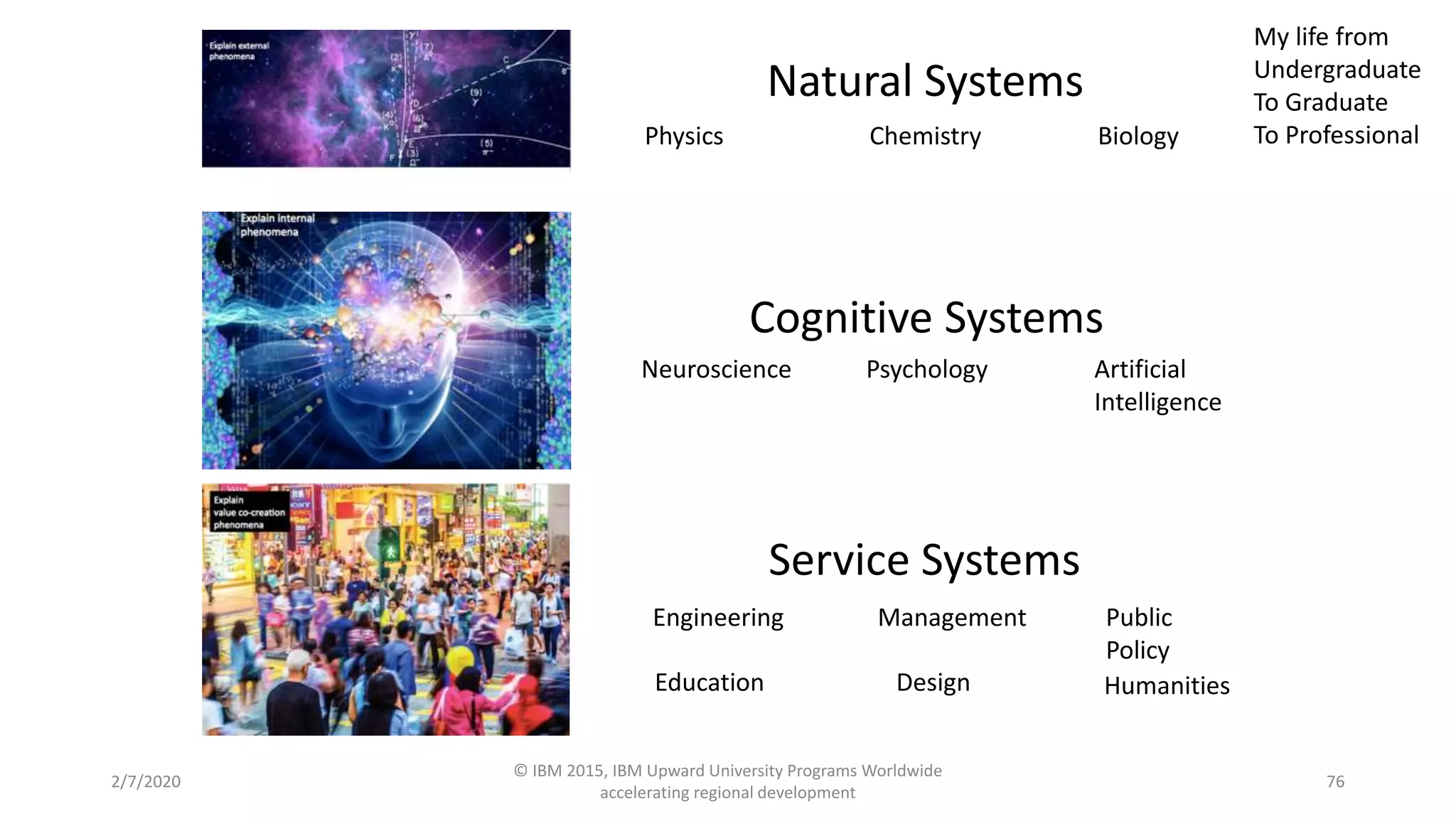
Physics Chemistry Biology
Neuroscience Psychology Artificial
Intelligence
Engineering Management Public
Policy
Education Design Humanities
Natural Systems
Cognitive Systems
Service Systems
My life from
Undergraduate
To Graduate
To Professional
2/7/2020 (c) IBM MAP COG .| 77
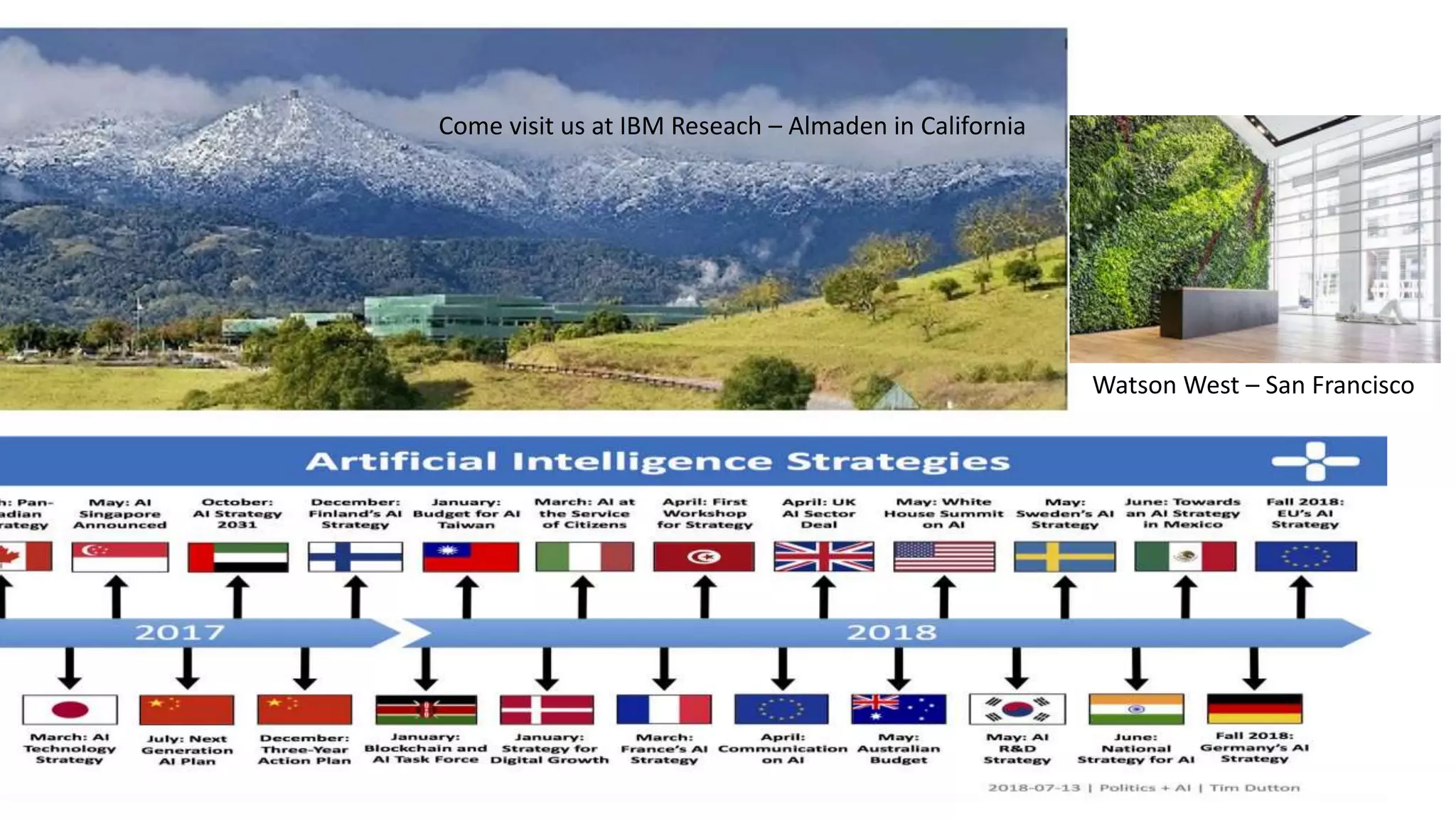
Come visit us at IBM Reseach – Almaden in California
Watson West – San Francisco

Solving disciplines 20200207 v2

  • 1.
    Solving Disciplines: AIand Service Science Jim Spohrer Director, IBM Cognitive OpenTech February 7, 2020 Presentations online at: http://slideshare.net/spohrer
  • 2.
    Today’s Talk • Thank-youfor contributing to service science • AI – machines that solve tasks • Disciplines & Professions • Are these tasks? Yes. • Service Science • Original goal: A new discipline and profession • Revised goal: Wisdom for rebuilding our world • Family as the oldest and most enduring service system 2/7/2020 (c) IBM 2017, Cognitive Opentech Group 2 Abbot (2001) Abbot (1988) Burgess & Locke (1945)
  • 3.
    Thank-you for contributingto service science! 2/7/2020 (c) IBM MAP COG .| 3 Michel Leonard Joao Cunha Henriqueta Novoa Jorge Teixeira Lia Patricio Gerhard Satzger Bob LuschSteve VargoPaul Maglio Kazuyoshi Hidaka Monica DragoiceaTheodor Borangiu Dan Berg Jim Tien
  • 4.
    Sonae: A nice welcome toPorto 2020 2/7/2020 (c) IBM MAP COG .| 4
  • 5.
    Trust: Two Communities 2/7/2020IBM Code #OpenTechAI 5 Service Science Open Source Trusted AI Trust: Value Co-Creation, Transdisciplinary Trust: Fair, Secure, Explainable, Open Communities Special Issue AI Magazine? Handbook of Open Source Trusted AI? Linux Foundation AI Trusted AI Committee https://wiki.lfai.foundation/display/DL/Trusted+AI+Committee IBM CODAIT = Center for Opensource Data and Artificial Intelligence Technologies https://developer.ibm.com/code/open/centers/codait/ ISSIP = International Society of Service Innovation Professionals https://issip.org IBM GitHub AI Fairness 360 (AIF 360) Adversarial Robustness Toolbox (ART) AI Explainability 360 (AIX360) https://github.com/IBM/AIF360/ https://github.com/IBM/adversarial-robustness-toolbox https://github.com/IBM/AIX360 Stanford Almond https://almond.stanford.edu/ https://github.com/stanford-oval Red Hat OpenDataHub https://opendatahub.io/ Mozilla Common Voice https://voice.mozilla.org/en EU Service Science Expert Group http://service-science.info/archives/5334
  • 6.
    Narrow AI Emerging Broad AI Disruptiveand Pervasive General AI Revolutionary ▼ We are here 2050 and beyond 6IBM Research AI © 2018 IBM Corporation The evolution of AI Borrowed from David Cox, IBM-MIT Lead AI: The academic discipline that studies how to build machine capabilities that can perform as well as or better than people can on the same task. Moving from single narrow tasks (e.g., Chess) to multiple tasks (e.g., all types of natural language processing and image understanding and robotics) to general AI (e.g., learning all languages/social conventions/cultures, all academic disciplines, and all professions). Who benefits: (1) Entrepreneurs who need digital workers (2) Employers who need augmented workers and/or automation (3) Customers who want super-human service.
  • 7.
    Timeline: Short History 2/7/2020 ©IBM Cognitive Opentech Group (COG) 7 Dota 2 “Deep Learning” for “AI Pattern Recognition” depends on massive amounts of “labeled data” and computing power available since ~2012; Labeled data is simply input and output pairs, such as a sound and word, or image and word, or English sentence and French sentence, or road scene and car control settings – labeled data means having both input and output data in massive quantities. For example, 100K images of skin, half with skin cancer and half without to learn to recognize presence of skin cancer.
  • 8.
    10 million minutesof experience 2/7/2020 Understanding Cognitive Systems 8
  • 9.
    2 million minutesof experience 2/7/2020 Understanding Cognitive Systems 9
  • 10.
    10September 2018 /© 2018 IBM Corporation Petaflops = 1,000,000,000,000,000 or a million billion = 10 ** 15 Megaflops = 1,000,000 = million = 10 ** 6 Gigaflops = 1,000,000,000 = billion = 10 ** 9 Larges Super Computer in the World, = 13 MegaWatts of Power (HOT!)
  • 11.
    11September 2018 /© 2018 IBM Corporation Exascale = 1,000,000,000,000,000,000 or a billion billion = 10 ** 18 Megaflops = 1,000,000 = million = 10 ** 6 Gigaflops = 1,000,000,000 = billion = 10 ** 9 Human Brain = 20 Watts (COOL!)
  • 12.
    Timeline: Every 20years, compute costs are down by 1000x • Cost of Digital Workers • Moore’s Law can be thought of as lowering costs by a factor of a… • Thousand times lower in 20 years • Million times lower in 40 years • Billion times lower in 60 years • Smarter Tools (Terascale) • Terascale (2017) = $3K • Terascale (2020) = ~$1K • Narrow Worker (Petascale) • Recognition (Fast) • Petascale (2040) = ~$1K • Broad Worker (Exascale) • Reasoning (Slow) • Exascale (2060) = ~$1K 122/7/2020 (c) IBM 2017, Cognitive Opentech Group 2080204020001960 $1K $1M $1B $1T 206020201980 +/- 10 years $1 Person Average Annual Salary (Living Income) Super Computer Cost Mainframe Cost Smartphone Cost T P E T P E AI Progress on Open Leaderboards Benchmark Roadmap to solve AI/IA
  • 13.
    Timeline: Leaderboards FrameworkAIProgress on Open Leaderboards - Benchmark Roadmap Perceive World Develop Cognition Build Relationships Fill Roles Pattern recognition Video understanding Memory Reasoning Social interactions Fluent conversation Assistant & Collaborator Coach & Mediator Speech Actions Declarative Deduction Scripts Speech Acts Tasks Institutions Chime Thumos SQuAD SAT ROC Story ConvAI Images Context Episodic Induction Plans Intentions Summarization Values ImageNet VQA DSTC RALI General-AI Translation Narration Dynamic Abductive Goals Cultures Debate Negotiation WMT DeepVideo Alexa Prize ICCMA AT Learning from Labeled Training Data and Searching (Optimization) Learning by Watching and Reading (Education) Learning by Doing and being Responsible (Exploration) 2018 2021 2024 2027 2030 2033 2036 2039 2/7/2020 (c) IBM 2017, Cognitive Opentech Group 13 Which experts would be really surprised if it takes less time… and which experts really surprised if it takes longer? Approx. Year Human Level -> +3 See: https://paperswithcode.com/sota
  • 14.
    Disciplines and Professions DisciplinesProfessions Definition (Wikipedia) "An academic discipline or field of study is a branch of knowledge, taught and researched as part of higher education. A scholar's discipline is commonly defined by the university faculties and learned societies to which they belong and the academic journals in which they publish research. Disciplines vary between well-established ones that exist in almost all universities and have well-defined rosters of journals and conferences, and nascent ones supported by only a few universities and publications. A discipline may have branches, and these are often called sub- disciplines.” Disciplines cluster into: (1) Humanities, (2) Social Sciences, (3) Natural Sciences, (4) Formal Sciences, (5) Applied Sciences. "A profession is an occupation founded upon specialized educational training, the purpose of which is to supply disinterested objective counsel and service to others, for a direct and definite compensation... Major milestones which may mark an occupation being identified as a profession include:[(1) an occupation becomes a full-time occupation (2) the establishment of a training school, (3) the establishment of a university school, (4) the establishment of a local association, (5) the establishment of a national association of professional ethics, (6) the establishment of state licensing laws. Applying these milestones to the historical sequence of development in the United States shows surveying achieving professional status first, followed by medicine, actuarial science, law, dentistry, civil engineering, logistics, architecture and accounting. With the rise of technology and occupational specialization in the 19th century, other bodies began to claim professional status: mechanical engineering, pharmacy, veterinary medicine, psychology, nursing, teaching, librarianship, optometry and social work, each of which could claim, using these milestones, to have become professions by 1900. " Service Science Perspective A type of service network made up of people in roles in service systems (e.g., universities) that responsibly maintain and extend a body of knowledge for the purpose of earning a living and transmission to future generations. A type of service network made up of people in roles in service systems (e.g., businesses) that responsibly put into practice a body of knowledge on behalf of customers for the purpose of earning a living and contributing to society. 2/7/2020 (c) IBM MAP COG .| 14
  • 15.
    Back to basics:Specialization - Disciplines and Professions (c) IBM MAP COG .| • Spohrer J, McDavid D, Maglio PP, Cortada JW (2006) NBIC Convergence and Technology- Business Coevolution: Towards a Service Science to Increase Productive Capacity. In Managing nano-bio-info-cogno innovations, eds. Bainbridge WS, Roco MC. NY: Springer. Pp. 227-254. • “Our perspective on the nature of people is that people are creative and productive. People invest their time to capture value either from exploiting known capabilities or in creating new capabilities. James March (1999) refers to this as the exploitation (use old capability) versus exploration (use new capability) trade-off of systems that learn and evolve.“ • “Civilization advances by extending the number of important operations which we can perform without thinking of them.” Alfred North Whitehead, English mathematician 2/7/2020 15
  • 16.
    Disciplines and Methodologies •Brodie RJ, Löbler H, Fehrer JA (2019) Evolution of service-dominant logic: Towards a paradigm and metatheory of the market and value cocreation?. Industrial Marketing Management. 79:3-12. • “S-D logic references many different theories and methodologies, a situation that implicitly assumes different philosophical perspectives or orientations, notably objective, subjective and inter-subjective. 2/7/2020 (c) IBM MAP COG .| 16 Discipline Clusters Types of Phenomena Comment Humanities Inter-Subjective History is partly objective Social Sciences Subjective & intersubjective Psychology, parts objective and parts subjective Natural Sciences Objective Biology, parts evolve Formal Sciences Objective Mathematics Applied Sciences All Engineering & Technology, Artificial Intelligence, Service Science
  • 17.
    SSME: Service Science,Management, and Engineering IBM Research © 2006 IBM Corporation17 Back to Basics: What kinds of knowledge & skills should a service scientist have? Academic disciplines evolving to combine technology, business, and social-organization Technology BusinessSocial- Organizational 26 22 17 24 15 3 18 1 5 16 25 22. Inform. Sci & Sys 23. Service Ops & Mgmt 24. Service Engineering 25. Service Marketing 26. Social Complexity 27. Agent-based comput. economics 28. Computational Organization Theory 6. Managerial Psychology 7. Human Capital Management (HCM) 8. Organization Theory 9. Operations Research 10. Systems Engineering 11. Management Science 12. Game Theory 13. Industrial Engineering 14. Marketing 15. Computer & Information Sciences 23 24 27 28 19 20 21 7 8 9 10 11 12 13 14 6 1990-2004 1960-1990 1900-1960 Before 1900 16. Management of Innovation & Tech (MoT) 17. Experimental Economics 18. AI & Games 19. Management of Information Systems 20. Computer Supported Collab. Work (CSCW) 21. Performance Support Systems In Business & Organization 1. Law 2. Political Economics 3. Education/Literacy 4. Sociology/History 5. Business Administration (MBA) Spohrer, J. and Maglio, P.P., 2008. The emergence of service science: Toward systematic service innovations to accelerate co‐creation of value. Production and operations management, 17(3), pp.238-246.
  • 18.
    SSME: Service Science,Management, and Engineering IBM Research © 2006 IBM Corporation18 Service Science: Why Now? IBM’s perspective 0 10 20 30 40 50 60 70 80 90 100 1982 1988 1994 1998 2003 Services Software Hardware Other
  • 19.
    SSME: Service Science,Management, and Engineering IBM Research © 2006 IBM Corporation19 Multidisciplinary Nature of PhDs in IBM’s Global Services Division (US) Engineering and Natural Sciences Social Sciences Business and Management Liberal Arts and Humanities Other
  • 20.
    SSME: Service Science,Management, and Engineering IBM Research © 2006 IBM Corporation20 Need for service scientists in Research PhDs in IBM’s Research Division (US) Engineering and Natural Sciences Social Sciences Business and Management Liberal Arts and Humanities Other
  • 21.
    SSME: Service Science,Management, and Engineering IBM Research © 2006 IBM Corporation21 Nation % WW Labor % A % G % S 25 yr % delta S China 21.0 50 15 35 191 India 17.0 60 17 23 28 U.S. 4.8 3 27 70 21 Indonesia 3.9 45 16 39 35 Brazil 3.0 23 24 53 20 Russia 2.5 12 23 65 38 Japan 2.4 5 25 70 40 Nigeria 2.2 70 10 20 30 Banglad. 2.2 63 11 26 30 Germany 1.4 3 33 64 44 Top Ten Nations by Labor Force Size (about 50% of world labor in just 10 nations) A = Agriculture, G = Goods, S = Services >50% (S) services, >33% (S) services 2004 2004 United States The largest labor force migration in human history is underway, driven by urbanization, global communications, low cost labor, business growth and technology innovation. (A) Agriculture: Value from harvesting nature (G) Goods: Value from making products (S) Services: Value from enhancing the capabilities of things (customizing, distributing, etc.) and interactions between things The world is becoming a service system. Why Now? Scale and speed of change!
  • 22.
    SSME: Service Science,Management, and Engineering IBM Research © 2006 IBM Corporation22 Systems Evolution Complexity Layers Evolution Study & Rational Design (coevolution of disciplines & jobs) Natural Systems Physical 12-8B BB/Sun Physics – Lasers (physicist) Chemical 4.5B Earth Chemistry - Dyes, Plastics (chemist) Biological 3.5B Cells/DNA Biology, Genetics – Corn (biologist) Neural 700M Clams… Neuroscience – Cochlea (neurologist) Sociotechnical or Human Systems Hunter- Gathers 2M years ago Archeology, Anthropology - Stone Tools (hunter, tool maker) Agricultural 10K-5K years (5 million people) History - Irrigation, Towns, Cities (specialization baker, miller, smith,...) Industrial 250 years ago (1 billon people) Engineering, Economics, Law, Education - Steam engine, Democracy, Railroads (engineer) Services 100 years ago (2 billion people) MBA, Social Sciences - Telephone, Businesses (manager, employee) Information Services 50 (6 billion people) Computer Science, Organization Science - Computer, Internet (consultant, consumer, shareholder)
  • 23.
    SSME: Service Science,Management, and Engineering IBM Research © 2006 IBM Corporation IBM’s Service Journey: A Summary Sketch 2/7/2020 (c) IBM MAP COG .| 23 Spohrer J (2017)IBM's service journey: A summary sketch. Industrial Marketing Management. 60:167-72.
  • 24.
    Computer Science • "Computerscience is the study of the phenomena surrounding computers. ... We build computers and programs for many reasons. We build them to serve society .... One of the fundamental contributions to knowledge of computer science has been to explain, at a rather basic level, what symbols are. ... Symbols lie at the root of intelligent action, which is, of course, the primary topic of artificial intelligence. For that matter, it is a primary question for all of computer science. For all information is processed by computer in the service of ends, and we measure the intelligence of a system by its ability to achieve stated ends in the face of variations, difficulties and complexities posed by the task environment.” • Tenth Turing Awards Lecture: Allen Newell and Herbert A. Simon, “Computer Science as Empirical Inquiry: Symbols and Search,”Communications of the ACM. vol. 19, No. 3, pp. 113-126, March,1976. Available online at: • https://www.cs.utexas.edu/~kuipers/readings/Newell+Simon-cacm-76.pdf 2/7/2020 (c) IBM MAP COG .| 24
  • 25.
    Service-Dominant logic worldviewand mindset Year Publication Service Resource Integrators 2004 Vargo SL, Lusch RF (2004) Evolving to a new dominant logic for marketing. Journal of marketing. 68(1):1-7. The application of specialized skills and knowledge is the fundamental unit of exchange. Operant resources are resources that produce effects 2011 Vargo SL, Lusch RF (2011) It's all B2B… and beyond: Toward a systems perspective of the market. Industrial marketing management. 40(2):181-7. The central concept in S-D logic is that service — the application of resources for the benefit of another party — is exchanged for service That is, all parties (e.g. businesses, individual customers, households, etc.) engaged in economic exchange are similarly, resource-integrating, service- providing enterprises that have the common purpose of value (co)creation — what we mean by “it is all B2B.” 2016 Vargo SL, Lusch RF. Institutions and axioms: an extension and update of service-dominant logic. Journal of the Academy of Marketing Science. 2016 Jan 1;44(1):5-23. value creation can only be fully understood in terms of integrated resources applied for another actor’s benefit (service) within a context, including the institutions and institutional arrangements that enable and constrain value creation. To alleviate this limitation and facilitate a better understanding of cooperation (and coordination), an eleventh foundational premise (fifth axiom) is introduced, focusing on the role of institutions and institutional arrangements in systems of value cocreation: service ecosystems.2/7/2020 (c) IBM MAP COG .| 25
  • 26.
    Service Science thestudy of service systems entities Year Publication Service Science Service System 2007 Spohrer J, Maglio, PP, Bailey J, Gruhl, D (2007) Steps toward a science of service systems, IEEE Computer, (40)1:71-77. Services science is an emerging field that seeks to tap into these and other relevant bodies of knowledge, integrate them, and advance three goals—aiming ultimately to understand service systems, how they improve, and how they scale. The components of a service system are people, technology, internal and external service systems connected by value propositions, and shared information (such as language, laws, and measures. 2008 Spohrer, J, Vargo S, Caswell N, Maglio PP (2008) The service system is the basic abstraction of service science, HICSS-41, NY: IEEE Press, Pp. 1-10. Service science is the study of the application of the resources of one or more systems for the benefit of another system in economic exchange. Informally, service systems are collections of resources that can create value with other service systems through shared information. 2008 Maglio PP, Spohrer J (2008) Fundamentals of service science. Journal of the academy of marketing science. 36(1):18-20. Service science is the study of service systems, aiming to create a basis for systematic service innovation. Service systems are value-co-creation configurations of people, technology, value propositions connecting internal and external service systems, and shared information (e.g., language, laws, measures, and methods).2/7/2020 (c) IBM MAP COG .| 26
  • 27.
    Service Science thestudy of service system entities 2/7/2020 (c) IBM MAP COG .| 27 Year Publication Service Science Service System 2009 Spohrer J, Maglio PP (2009) Service science: Toward a smarter planet. In Introduction to service engineering, Eds. Karwowski and Salvendy. Pp. 3-10 Service science is a specialization of systems science. So service science seeks to create a body of knowledge that accounts for value-cocreation between entities as they interact… Service system entities are dynamic configurations of resources. As described below, resources include people, organizations, shared information, and technology. 2012 Spohrer J, Piciocchi P, Bassano C (2012) Three frameworks for service research: exploring multilevel governance in nested, networked systems. Service Science. 4(2):147-160. SSME+D is built on top of the Service-Dominant logic (SD Logic) worldview A service system entity is a dynamic configuration of resources (at least one of which, the focal resource, is a person with rights). 2013 Spohrer J, Giuiusa A, Demirkan H, Ing D (2013) Service science: reframing progress with universities. Systems Research and Behavioral Science. 30(5):561- 569 Service science is an emerging branch of systems sciences with a focus on service systems (entities) and value cocreation (complex non- zero-sum interactions). … complex adaptive entities - service systems - within an ecology of nested, networked entities… From a service science perspective, progress can be thought of in terms of the rights and responsibilities of entities
  • 28.
    Service Science thestudy of service system entities 2/7/2020 (c) IBM MAP COG .| 28 Year Publication Service Science Service System 2014 Spohrer J, Kwan SK, Fisk RP (2014)Marketing: a service sci ence and arts perspective, Handbook of Service Market ing Research, Eds. Rust RT, Huang MH, NY:Edward Elgar, pp. 489-526. Service science (short for Service Science, Management, Engineering, Design, Arts, and Public Policy) is an emerging transdiscipline for the (1) study of evolving service system entities and value co-creation phenomena, as well as (2) pedagogy for the education of 21st century T- shaped service innovators from all disciplines, sectors, and cultures. So like all early stage scientific communities, the language for talking about service systems and value co-creation phenomena continues to evolve. … Service system entities are economic and social actors, which configure (or integrate) resources. … A formal service system entity (SS-FSC3) is a legal, economic entity with rights and responsibilities codified in written laws. 2015 Spohrer J, Demirkan H, Lyons (2015) Social Value: A Service Science Perspective. In: Kijima K. (eds) Service Systems Science. Translational Systems Sciences, vol 2. Tokyo: Springer. Pp. 3-35. Service science is an emerging transdiscipline for the (1) study of evolving service system entities and value co-creation phenomena and (2) pedagogy for the education of twenty-first-century T-shaped service innovators from all disciplines, sectors, and cultures Formal service system entities (as opposed to informal service system entities) can be ranked by the degree to which they are governed by written (symbolic) laws and evolve to increase the percentage of their processes that are explicit and symbolic.
  • 29.
    Service Science thestudy of service system entities 2/7/2020 (c) IBM MAP COG .| 29 Year Publication Service Science Service System 2016 Spohrer J (2016) Services Science and Societal Convergence. In W.S. Bainbridge, M.C. Roco (eds.),Handbook of Science and Technology Convergence, pp. 323-335 Service science is an emerging transdiscipline for the (1) study of evolving ecology of nested, networked service system entities and value co-creation phenomena, as well as (2) pedagogy for the education of the twenty-first- century T-shaped (depth and breadth) service innovators from all disciplines, sectors, and cultures. As service science emerges, we can begin by “seeing” and counting service system entities in an evolving ecology, working to “understand” and make explicit their implicit processes of valuing … 2016 Spohrer J (2016) Innovation for jobs with cognitive assistants: A service science perspective, In Disrupting Unemployment , Eds. Nordfors, Cerf, Seng, Missouri: Ewing Marion Kauffman Foundation, Pp. 157-174. Service science is the emerging transdiscipline that studies the evolving ecology of nested, networked service system entities, their capabilities, constraints, rights, and responsibilities. There are perhaps twenty billion formal service system entities in the world today, each governed in part by formal written laws. Every person, household, university, business, and government is a formal service system entity, but my dog, my smartphone, and my ideas are not.
  • 30.
    Service Science thestudy of service system entities 2/7/2020 (c) IBM MAP COG .| 30 Year Publication Service Science Service System 2017 Spohrer J, Siddike MAK, Kohda Y (2017) Rebuilding evolution: a service science perspective. HICSS 50. Service science is the study of the evolving ecology of service system entities, complex socio-technical systems with rights and responsibilities – such as people, businesses, and nations. Service systems are dynamic configurations of people, technology, organization and information that interact through value proposition and co- create mutual value. 2019 Pakalla D, Spohrer J (2019, forthcoming) Digital Service: Technological Agency in Service Systems. HICSS 52. For the purposes of this paper, service science can be summarized as the study of the evolving ecology of service system entities, their capabilities, constraints, rights, and responsibilities, including their value co-creation and capability co- elevation mechanisms . Service systems are a type of socio- technical system, such as people, businesses, and nations, all with unique identities, histories, and reputations based on the outcomes of their interactions with other entities.
  • 31.
    Service Science: ConceptualFramework 2/7/2020 (c) IBM MAP COG .| 31
  • 32.
    32 Service system entitiesconfigure four types of resources • First foundational premise of service science: • Service system entities dynamically configure four types of resources • Resources are the building blocks of entity architectures • Named resources are: • Physical or • Not-Physical • Physicist resolve disputes • Named resources have: • Rights or • No Rights • Judges resolve disputes Spohrer, J & Maglio, P. P. (2009) Service Science: Toward a Smarter Planet. In Introduction to Service Engineering. Editors Karwowski & Salvendy. Wiley. Hoboken, NJ.. Physical Not-Physical Rights No-Rights 2. Technology/ Environment Infrastructure 4. Shared Information/ Symbolic Knowledge 1. People/ Individuals 3. Organizations/ Institutions Formal service systems can contract to configure resources/apply competence Informal service systems can promise to configure resources/apply competence Trends & Countertrends (Balance Chaos & Order): (Promise) Informal <> Formal (Contract) (Relationships & Attention) Social <> Economic (Money & Capacity) (Power) Political <> Legal (Rules) (Evolved) Natural <> Artificial (Designed) (Creativity) Cognitive Labor <> Information Technology (Routine) (Dance) Physical Labor <> Mechanical Technology (Routine) (Relationships) Social Labor <> Transaction Processing (Routine) (Atoms) Transportation <> Communication (Bits) (Tacit) Qualitative <> Quantitative (Explicit) (Secret) Private <> Public (Shared) (Anxiety-Risk) Challenge <> Routine (Boredom-Certainty) (Mystery) Unknown <> Known (Justified True Belief)
  • 33.
    33 Service system entitiescalculate value from multiple stakeholder perspectives • Second foundational premise of service science • Service system entities calculate value from multiple stakeholder perspectives • Value propositions are the building blocks of service networks • A value propositions can be viewed as a request from one service system to another to run an algorithm (the value proposition) from the perspectives of multiple stakeholders according to culturally determined value principles. • The four primary stakeholder perspectives are: customer, provider, authority, and competitor • Citizens: special customers • Entrepreneurs: special providers • Parents: special authority • Criminals: special competitors Spohrer, J & Maglio, P. P. (2009) Service Science: Toward a Smarter Planet. In Introduction to Service Engineering. Editors Karwowski & Salvendy. Wiley. Hoboken, NJ.. Model of competitor: Does it put us ahead? Can we stay ahead? Does it differentiate us from the competition? Will we? (invest to make it so) StrategicSustainable Innovation (Market share) 4.Competitor (Substitute) Model of authority: Is it legal? Does it compromise our integrity in any way? Does it create a moral hazard? May we? (offer and deliver it) RegulatedCompliance (Taxes and Fines, Quality of Life) 3.Authority Model of self: Does it play to our strengths? Can we deliver it profitably to customers? Can we continue to improve? Can we? (deliver it) Cost Plus Productivity (Profit, Mission, Continuous Improvement, Sustainability) 2.Provider Model of customer: Do customers want it? Is there a market? How large? Growth rate? Should we? (offer it) Value Based Quality (Revenue) 1.Customer Value Proposition Reasoning Basic Questions Pricing Decision Measure Impacted Stakeholder Perspective (the players) Value propositions coordinate & motivate resource access
  • 34.
    34 Service system entitiesreconfigure access rights to resources by mutually agreed to value propositions • Third foundational premise of service science • Service system entities reconfigure access rights to resources by mutually agreed to value propositions • Access rights are the building blocks of the service ecology (culture and information) • Access rights • Access to resources that are owned outright (i.e., property) • Access to resource that are leased/contracted for (i.e., rental car, home ownership via mortgage, insurance policies, etc.) • Shared access (i.e., roads, web information, air, etc.) • Privileged access (i.e., personal thoughts, inalienable kinship relationships, etc.) service = value-cocreation B2B B2C B2G G2C G2B G2G C2C C2B C2G *** provider resources Owned Outright Leased/Contract Shared Access Privileged Access customer resources Owned Outright Leased/Contract Shared Access Privileged Access OO SA PA LC OO LC SA PA S AP C Competitor Provider Customer Authority value-proposition change-experience dynamic-configurations (substitute) time Spohrer, J & Maglio, P. P. (2009) Service Science: Toward a Smarter Planet. In Introduction to Service Engineering. Editors Karwowski & Salvendy. Wiley. Hoboken, NJ..
  • 35.
    35 Service system entitiesinteract to create ten types of outcomes • Four possible outcomes from a two player game • ISPAR generalizes to ten possible outcomes • win-win: 1,2,3 • lose-lose: 5,6, 7, maybe 4,8,10 • lose-win: 9, maybe 8, 10 • win-lose: maybe 4 lose-win (coercion) win-win (value-cocreation) lose-lose (co-destruction) win-lose (loss-lead) WinLose Provider Lose Win Customer ISPAR descriptive model Maglio PP, SL Vargo, N Caswell, J Spohrer: (2009) The service system is the basic abstraction of service science. Inf. Syst. E-Business Management 7(4): 395-406 (2009)
  • 36.
    36 Service system entitieslearn to systematically exploit technology: Technology can perform routine manual, cognitive, transactional work L “To be the best, learn from the rest” “Double monetize, internal win and ‘sell’ to external” “Try to operate inside the comfort zone” March, J.G. (1991) Exploration and exploitation in organizational learning. Organizational Science. 2(1).71-87. Sanford, L.S. (2006) Let go to grow: Escaping the commodity trap. Prentice Hall. New York, NY.
  • 37.
    37 Service system entitiesare physical-symbol systems • Service is value cocreation. • Service system entities reason about value. • Value cocreation is a kind of joint activity. • Joint activity depends on communication and grounding. • Reasoning about value and communication are (often) effective symbolic processes. Newell, A (1980) Physical symbol systems, Cognitive Science, 4, 135-183. Newell, A & HA Simon(1976). Computer science as empirical inquiry: symbols and search. Communications of the ACM, 19, 113-126.
  • 38.
    38 Summary Spohrer, J &Maglio, P. P. (2009) Service Science: Toward a Smarter Planet. In Introduction to Service Engineering. Editors Karwowski & Salvendy. Wiley. Hoboken, NJ.. Physical Not-Physical Rights No-Rights 2. Technology/ Environmental Infrastructure 4. Shared Information 1. People/ Individuals 3. Organizations/ Institutions 1. Dynamically configure resources (4 I’s) Model of competitor: Does it put us ahead? Will we?StrategicSustainable Innovation 4.Competitor/ Substitutes Model of authority: Is it legal? May we?RegulatedCompliance3.Authority Model of self: Does it play to our strengths? Can we?Cost Plus Productivity2.Provider Model of customer: Do customers want it? Should we?Value Based Quality1.Customer ReasoningQuestionsPricingMeasure Impacted Stakeholder Perspective 2. Value from stakeholder perspectives S AP C 3. Reconfigure access rights 4. Ten types of outcomes (ISPAR) 5. Exploit information & technology 6. Physical-Symbol Systems
  • 39.
    39 Service Science: TransdisciplinaryFramework to Study Service Systems Systems that focus on flows of things Systems that governSystems that support people’s activities transportation & supply chain water & waste food & products energy & electricity building & construction healthcare & family retail & hospitality banking & finance ICT & cloud education &work city secure state scale nation laws social sciences behavioral sciences management sciences political sciences learning sciences cognitive sciences system sciences information sciences organization sciences decision sciences run professions transform professions innovate professions e.g., econ & law e.g., marketing e.g., operations e.g., public policy e.g., game theory and strategy e.g., psychology e.g., industrial eng. e.g., computer sci e.g., knowledge mgmt e.g., statistics e.g., knowledge worker e.g., consultant e.g., entrepreneur stakeholders Customer Provider Authority Competitors resources People Technology Information Organizations change History (Data Analytics) Future (Roadmap) value Run Transform (Copy) Innovate (Invent) Stackholders (As-Is) Resources (As-Is) Change (Might-Become) Value (To-Be)
  • 40.
    Brian Arthur -Economist • The term “technological unemployment” is from John Maynard Keynes’s 1930 lecture, “Economic possibilities for our grandchildren,” where he predicted that in the future, around 2030, the production problem would be solved and there would be enough for everyone, but machines (robots, he thought) would cause “technological unemployment.” There would be plenty to go around, but the means of getting a share in it, jobs, might be scarce. We are not quite at 2030, but I believe we have reached the “Keynes point,” where indeed enough is produced by the economy, both physical and virtual, for all of us. (If total US household income of $8.495 trillion were shared by America’s 116 million households, each would earn $73,000, enough for a decent middle-class life.) And we have reached a point where technological unemployment is becoming a reality. The problem in this new phase we’ve entered is not quite jobs, it is access to what’s produced. Jobs have been the main means of access for only 200 or 300 years. Before that, farm labor, small craft workshops, voluntary piecework, or inherited wealth provided access. Now access needs to change again. However this happens, we have entered a different phase for the economy, a new era where production matters less and what matters more is access to that production: distribution, in other words—who gets what and how they get it. We have entered the distributive era. 2/7/2020 IBM #OpenTechAI 40
  • 41.
    Disciplines and someof the key entities they study 2/7/2020 (c) IBM MAP COG .| 41 Computer Science: Physical Symbol System Entities AI: Digital Cognitive System Entities Chemistry: Auto-Catalytic Molecular System Entities Biology: Biological Cognitive System Entities Service science: Service system entities Service science studies the evolving ecology of service system entities, their capabilities, constraints, rights, and responsibilities their value co-creation and capability co-elevation interactions, as well as their outcome identities and reputations.
  • 42.
    Service Research • ArtificialIntelligence in Service • "The theory specifies four intelligences required for service tasks—mechanical, analytical, intuitive, and empathetic—and lays out the way firms should decide between humans and machines for accomplishing those tasks.” • Huang MH and Rust RT (2018) Artificial Intelligence in Service. Journal of Service Research. 21(2):155–172. • Customer Acceptance of AI in Service Encounters: Understanding Antecedents and Consequences • "expand the relevant set of antecedents beyond the established constructs and theories to include variables that are particularly relevant for AI applications such as privacy concerns, trust, and perceptions of “creepiness.” • Ostrom AL, Foheringham D, Bitner MJ (2018, forthcoming) Customer Acceptance of AI in Service Encounters: Understanding Antecedents and Consequences. In Handbook of Service Science, Volume 2, Eds, Maglio, Kieliszewski,Spohrer,Lyons,Patricio,Sawatani. New York: Springer. Pp. x-y. 2/7/2020 (c) IBM MAP COG .| 42
  • 43.
    Courses • 2015 • “Howto build a cognitive system for Q&A task.” • 9 months to 40% question answering accuracy • 1-2 years for 90% accuracy, which questions to reject • 2025 • “How to use a cognitive system to be a better professional X.” • Tools to build a student level Q&A from textbook in 1 week • 2035 • “How to use your cognitive mediator to build a startup.” • Tools to build faculty level Q&A for textbook in one day • Cognitive mediator knows a person better than they know themselves • 2055 • “How to manage your workforce of digital workers.” • Most people have 100 digital workers. 2/7/2020 43 Take free online cognitive classes today at cognitiveclass.ai
  • 44.
    2/7/2020 © IBM 2015,IBM Upward University Programs Worldwide accelerating regional development 44 I have… Have you noticed how the building blocks just keep getting better?
  • 45.
    Learning to program: Myfirst program 2/7/2020 © IBM 2015, IBM Upward University Programs Worldwide accelerating regional development 45 Early Computer Science Class: Watson Center at Columbia 1945 Jim Spohrer’s First Program 1972
  • 46.
    2/7/2020 © IBM UPWard2016 46 Fast Forward 2016: Consider this…
  • 47.
    Microsoft CaptionBot June19, 2016 2/7/2020 © IBM UPWard 2016 47
  • 48.
    Microsoft CaptionBot June20, 2016 2/7/2020 © IBM UPWard 2016 48
  • 49.
  • 50.
    Today: November 10,2017 2/7/2020 © IBM DBG COG 2017 50 IBM
  • 51.
    Raise your hand, ifyou are >50% sure you know what type of leaf this is…. 2/7/2020 (c) IBM MAP COG .| 51
  • 52.
    October 3, 2018:Uploaded… 2/7/2020 (c) IBM MAP COG .| 52
  • 53.
    2/7/2020 © IBM 2015,IBM Upward University Programs Worldwide accelerating regional development 53 Cognitive Mediators for all people in all roles
  • 54.
    Occupations = ManyTasks 2/7/2020 © IBM 2015, IBM Upward University Programs Worldwide accelerating regional development 54
  • 55.
    Watson Discovery Advisor 2/7/2020 ©IBM 2015, IBM Upward University Programs Worldwide accelerating regional development 55 Simonite, T. 2014. Software Mines Science Papers to Make New Discoveries. MIT. November 25, 2014. URL: http://m.technologyreview.com/news/520461/software-mines-science-papers-to-make-new-discoveries/
  • 56.
    Data Scientists, AIModel Builder • “In one of those rooms, Vladimir Iglovikov, one of the “grandmasters” at the top of Kaggle’s rankings, stood by to offer tips to competitors who needed help. He credits Kaggle with helping him rise from crunching data at a collection agency to working on vision systems for self-driving cars at Lyft—an example of how the site’s top performers can find their lives transformed by the skills and cachet won in competition. … The competitors toiled in the shadow of a leaderboard projected onto a large screen. Kagglers gauge their progress during a competition by submitting code to the site for testing, and receive a score that’s posted publicly. … Not long after 11 am, about two hours into the contest, the AutoML team submitted its first auto-generated code—and debuted in second place on the leaderboard.” 2/7/2020 (c) IBM MAP COG .| 56
  • 57.
    “The best wayto predict the future is to inspire the next generation of students to build it better” Digital Natives Transportation Water Manufacturing Energy Construction ICT Retail Finance Healthcare Education Government
  • 58.
    2/7/2020 58 1955 19751995 2015 2035 2055 Better Building Blocks
  • 59.
    Smartphones pass entranceexams? When? 2/7/2020 (c) IBM 2017, Cognitive Opentech Group 59 … when will your smartphone be able to take and pass any online course? And then be your coach, so you can pass too?
  • 60.
    Artificial Leaf • DanielNocera, a professor of energy science at Harvard who pioneered the use of artificial photosynthesis, says that he and his colleague Pamela Silver have devised a system that completes the process of making liquid fuel from sunlight, carbon dioxide, and water. And they’ve done it at an efficiency of 10 percent, using pure carbon dioxide—in other words, one-tenth of the energy in sunlight is captured and turned into fuel. That is much higher than natural photosynthesis, which converts about 1 percent of solar energy into the carbohydrates used by plants, and it could be a milestone in the shift away from fossil fuels. The new system is described in a new paper in Science. 2/7/2020 IBM Code #OpenTechAI 60
  • 61.
    Food from Air •Although the technology is in its infancy, researchers hope the "protein reactor" could become a household item. • Juha-Pekka Pitkänen, a scientist at VTT, said: "In practice, all the raw materials are available from the air. In the future, the technology can be transported to, for instance, deserts and other areas facing famine. • "One possible alternative is a home reactor, a type of domestic appliance that the consumer can use to produce the needed protein." • According to the researchers, the process of creating food from electricity can be nearly 10 times as energy efficient as photosynthesis, the process used by plants. 2/7/2020 IBM Code #OpenTechAI 61
  • 62.
    Exoskeletons for Elderly •A walker is a “very cost-effective” solution for people with limited mobility, but “it completely disempowers, removes dignity, removes freedom, and causes a whole host of other psychological problems,” SRI Ventures president Manish Kothari says. “Superflex’s goal is to remove all of those areas that cause psychological-type encumbrances and, ultimately, redignify the individual." 2/7/2020 IBM Code #OpenTechAI 62
  • 63.
    Question: How wouldyou rebuild your discipline from scratch? • Some disciplines renew themselves [Tuure Tuunanen] 2/7/2020 (c) IBM MAP COG .| 63
  • 64.
    2/7/2020 © IBM 2015,IBM Upward University Programs Worldwide accelerating regional development 64 Brief History of Knowledge and Making: Personbyte and Peoplebyte
  • 65.
    What can oneperson know and make? 2/7/2020 © IBM 2015, IBM Upward University Programs Worldwide accelerating regional development 65
  • 66.
    The Maker Movement& Open Source Ecology 2/7/2020 © IBM 2015, IBM Upward University Programs Worldwide accelerating regional development 66
  • 67.
    So what doesthis have to do with programming and computation? 2/7/2020 © IBM 2015, IBM Upward University Programs Worldwide accelerating regional development 67 Both Turing and von Neumann dreamed of universal machines and constructors
  • 68.
    Rewinding Evolution • Spohrer J,Giuiusa A, Demirkan H, Ing D (2013) Service science: reframing progress with universities. Systems Research and Behavioral Science. 30(5):561-569.
  • 69.
  • 70.
    Why rebuilding evolution?Better Education • If there be an order in which the human race has mastered its various kinds of knowledge, there will arise in every child an aptitude to acquire these kinds of knowledge in the same order.... Education is a repetition of civilization in little.[28] • — Herbert Spencer http://www.slideshare.net/spohrer/spohrer-icer-20150810-v1
  • 71.
    Sciences provide… • Frameworksfor people to ask and answer questions systematically • Explanations with instructions on “how to re-do” 2/7/2020 © IBM 2015, IBM Upward University Programs Worldwide accelerating regional development 71 Kline: Conceptual Foundation of Multidisciplinary Thinking - “To our children and children’s children, to whom we elders owe an explanation of the world that is understandable, realistic, forward-looking, and whole.” Proenneke: Alone in the Wilderness - To do a thorough testing, should each generation be required to rapidly rebuild from scratch? A re-makers movement?
  • 72.
    Resilience: Rapidly Rebuilding FromScratch • Dartnell L (2012) The Knowledge: How to Rebuild Civilization in the Aftermath of a Cataclysm. Westminster London: Penguin Books. 2/7/2020 IBM Code #OpenTechAI 72
  • 73.
    Future-Ready T-Shapes: By2035, wiser rebuilders 2/7/2020 © IBM UPWard 2016 73
  • 74.
    2/7/2020 © IBM 2015,IBM Upward University Programs Worldwide accelerating regional development 74
  • 75.
    In Summary: Augmentedintelligence with automation of tasks, rebuilding wisdom required 2/7/2020 © IBM 2015, IBM Upward University Programs Worldwide accelerating regional development 75 “A service science perspective considers the evolving ecology of service system entities, their value co-creation and capability co-elevation interactions, and their capabilities, constraints, rights, and responsibilities.” Cognitive Systems Entities Service Systems Entities With Cognitive Mediators Add Rights & Responsibilities
  • 76.
    2/7/2020 © IBM 2015,IBM Upward University Programs Worldwide accelerating regional development 76 Physics Chemistry Biology Neuroscience Psychology Artificial Intelligence Engineering Management Public Policy Education Design Humanities Natural Systems Cognitive Systems Service Systems My life from Undergraduate To Graduate To Professional
  • 77.
    2/7/2020 (c) IBMMAP COG .| 77 Come visit us at IBM Reseach – Almaden in California Watson West – San Francisco