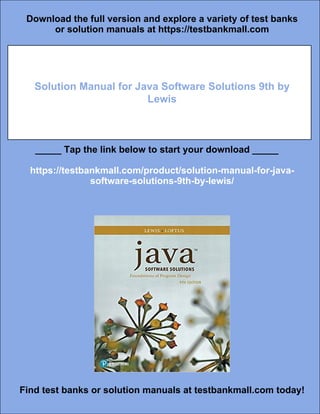
Solution Manual for Java Software Solutions 9th by Lewis
Solution Manual for Java Software Solutions 9th by Lewis
Solution Manual for Java Software Solutions 9th by Lewis
Solution Manual for Java Software Solutions 9th by Lewis
Solution Manual for Java Software Solutions 9th by Lewis
1.
Download the fullversion and explore a variety of test banks
or solution manuals at https://testbankmall.com
Solution Manual for Java Software Solutions 9th by
Lewis
_____ Tap the link below to start your download _____
https://testbankmall.com/product/solution-manual-for-java-
software-solutions-9th-by-lewis/
Find test banks or solution manuals at testbankmall.com today!
2.
We believe theseproducts will be a great fit for you. Click
the link to download now, or visit testbankmall.com
to discover even more!
Test Bank for Java Software Solutions, 9th Edition John
Lewis
https://testbankmall.com/product/test-bank-for-java-software-
solutions-9th-edition-john-lewis/
Test Bank for Java Software Solutions, 9th Edition John
Lewis William Loftus
https://testbankmall.com/product/test-bank-for-java-software-
solutions-9th-edition-john-lewis-william-loftus/
Test Bank for Java Software Solutions 7th Edition
(International Edition). John Lewis / William Loftus
https://testbankmall.com/product/test-bank-for-java-software-
solutions-7th-edition-international-edition-john-lewis-william-loftus/
Test Bank for Chemistry in Context 8th Edition American
Chemical Society Download
https://testbankmall.com/product/test-bank-for-chemistry-in-
context-8th-edition-american-chemical-society-download/
3.
Test Bank forIntermediate Accounting, Vol. 2 Kin Lo,
George Fisher
https://testbankmall.com/product/test-bank-for-intermediate-
accounting-vol-2-kin-lo-george-fisher/
Test Bank for Microeconomics, 22nd Edition, Campbell
McConnell, Stanley Brue, Sean Flynn
https://testbankmall.com/product/test-bank-for-microeconomics-22nd-
edition-campbell-mcconnell-stanley-brue-sean-flynn/
Psychology Ciccarelli 3rd Edition Test Bank
https://testbankmall.com/product/psychology-ciccarelli-3rd-edition-
test-bank/
Test Bank for Money Banking and Financial Markets 2nd
Edition by Ball
https://testbankmall.com/product/test-bank-for-money-banking-and-
financial-markets-2nd-edition-by-ball/
Test Bank for Introductory Statistics for the Behavioral
Sciences, 7th Edition, Joan Welkowitz, Barry H. Cohen, R.
Brooke Lea, ISBN: 978-0-470-90776-4, ISBN: 9780470907764
https://testbankmall.com/product/test-bank-for-introductory-
statistics-for-the-behavioral-sciences-7th-edition-joan-welkowitz-
barry-h-cohen-r-brooke-lea-isbn-978-0-470-90776-4-isbn-9780470907764/
4.
Principles of Taxationfor Business and Investment
Planning, 2014 Edition Jones 17th Edition Test Bank
https://testbankmall.com/product/principles-of-taxation-for-business-
and-investment-planning-2014-edition-jones-17th-edition-test-bank/
5.
Empowers students towrite useful, object-oriented programs
Java Software Solutions establishes a strong foundation of
programming techniques to foster well-designed object-oriented
software. Heralded for its integration of small and large real-world
examples, the worldwide best-selling text emphasizes problem-
solving and design skills and introduces students to the process
of constructing high-quality software systems. The 9th
Edition features a sweeping overhaul of Graphics Track
coverage, to fully embrace the JavaFX API. This fresh approach
enriches programmers’ understandings of core object-oriented
principles. The text uses a natural progression of concepts,
focusing on the use of objects before teaching how to write
them—equipping students with the knowledge and skill they need
to design true object-oriented solutions.
Table of Contents
1. Introduction
o 1.1 Computer Processing
o 1.2 Hardware Components
o 1.3 Networks
o 1.4 The Java Programming Language
o 1.5 Programming Development
o 1.6 Object-Oriented Programming
2. Data and Expressions
o 2.1 Character Strings
o 2.2 Variables and Assignment
o 2.3 Primitive Data Types
o 2.4 Expressions
o 2.5 Data Conversion
o Software Failure: NASA Mars Climate Orbiter and Polar Lander
3. Using Classes and Objects
o 3.1 Creating Objects
o 3.2 The String Class
o 3.3 Packages
o 3.4 The Random Class
6.
o 3.5 TheMath Class
o 3.6 Formatting Output
o 3.7 Enumerated Types
o 3.8 Wrapper Classes
o 3.9 Introduction to JavaFX
o 3.10 Basic Shapes
o 3.11 Representing Colors
4. Writing Classes
o 4.1 Classes and Objects Revisited
o 4.2 Anatomy of a Class
o 4.3 Encapsulation
o 4.4 Anatomy of a Method
o 4.5 Constructors Revisited
o 4.6 Arcs
o 4.7 Images
o 4.8 Graphical User Interfaces
o 4.9 Text Fields
o Software Failure: Denver Airport Baggage Handling System
5. Conditionals and Loops
o 5.1 Boolean Expressions
o 5.2 The If Statement
o 5.3 Comparing Data
o 5.4 The While Statement
o 5.5 Iterators
o 5.6 The ArrayList Class
o 5.7 Determining Event Sources
o 5.8 Managing Fonts
o 5.9 Checkboxes
o 5.10 Radio Buttons
o Software Failure: Therac-25
6. More Conditionals and Loops
o 6.1 The Switch Statement
o 6.2 The Conditional Operator
o 6.3 The Do Statement
o 6.4 The For Statement
o 6.5 Using Loops and Conditionals with Graphics
o 6.6 Graphic Transformations
7. Object-Oriented Design
o 7.1 Software Development Activities
o 7.2 Identifying Classes and Objects
7.
o 7.3. StaticClass Members
o 7.4 Class Relationships
o 7.5 Interfaces
o 7.6 Enumerated Types Revisited
o 7.7 Method Design
o 7.8 Method Overloading
o 7.9 Testing
o 7.10 GUI Design
o 7.11 Key Events
o Software Failure: 2003 Northeast Blackout
8. Arrays
o 8.1 Array Elements
o 8.2 Declaring and Using Arrays
o 8.3 Arrays of Objects
o 8.4 Command-Line Arguments
o 8.5 Variable Length Parameter Lists
o 8.6 Two-Dimensional Arrays
o 8.7 Polygons and Polylines
o 8.8 An Array of Color Objects
o 8.9 Choice Boxes
o Software Failure: LA Air Traffic Control
9. Inheritance
o 9.1 Creating Subclasses
o 9.2 Overriding Methods
o 9.3 Class Hierarchies
o 9.4 Visibility
o 9.5 Designing for Inheritance
o 9.6 Inheritance in JavaFX
o 9.7 Color and Date Pickers
o 9.8 Dialog Boxes
o Software Failure: Ariane 5 Flight
10.Polymorphism
o 10.1 Late Binding
o 10.2 Polymorphism via Inheritance
o 10.3 Polymorphism vis Interfaces
o 10.4 Sorting
o 10.5 Searching
o 10.6 Designing for Polymorphism
o 10.7 Properties
o 10.8 Sliders
8.
o 10.9 Spinners
11.Exceptions
o11.1 Exception Handling
o 11.2 Uncaught Exceptions
o 11.3 The Try-Catch Statement
o 11.4 Exception Propagation
o 11.5 The Exception Class Hierarchy
o 11.6 I/O Exceptions
o 11.7 Tool Tips and Disabling Controls
o 11.8 Scroll Panes
o 11.9 Split Panes and List Views
12.Recursion
o 12.1 Recursive Thinking
o 12.2 Recursive Programming
o 12.3 Using Recursion
o 12.4 Tiled Images
o 12.5 Fractals
13.Collections
o 13.1 Collections and Data Structures
o 13.2 Dynamic Representations
o 13.3 Linear Collections
o 13.4 Non-Linear Data Structures
o 13.5 The Java Collections API
Appendix A: Glossary
Appendix B: Number Systems
Appendix C: The Unicode Character Set
Appendix D: Java Operators
Appendix E: Java Modifiers
Appendix F: Java Coding Guidelines
Appendix G: JavaFX Layout Panes
Appendix H: JavaFX Scene Builder
Appendix I: Regular Expressions
Appendix J: Javadoc Documentation Generator
Appendix K: Java Syntax
Appendix L: Answers to Self-Review Questions
Index
sworn inveterate enemyto every principle and policy which
favors republicanism. No bishop, no priest, and no member of
the Papal Church ever has been or ever can be a loyal subject
of a free government. Every pretence or profession or act which
they avow to the contrary is the necessary outgrowth of wilful
deception, hypocrisy, and falsehood. Among the masses of her
members an oath of loyalty may be the result of ignorance; and
it may be permitted to remain of binding authority so long as it
does not conflict with their first and paramount obligations with
their church. But with the bishops, the priests, and the Jesuitical
hordes of their hierarchy, an oath of loyalty or of testimony is of
no value as a test of truthfulness. Nay, it is often taken as a
means of deception, to accomplish some concealed purpose.
Their fundamental doctrines of mental reservation and
universal subordination to Rome necessarily exclude from
their virtues that of true patriotism. That this hierarchy has for
some years past been collecting, arranging, and concentrating
the elements of her strength in and around the cities of the
United States, is evident to any one who has watched its
progress. Her power is abundantly manifest in the influence
which she has exerted in the legislation of our cities and our
states, in the appointments of many of our highest offices of
trust and power, in the disposition and distribution of our public
charities, and in the control of our popular system of education;
and that the time has come, in their judgment, when she can,
with safety to herself, openly assert her power, can be seen in
the popular tracts, now numbering some thirty-one, of her
religious press, in the public discussions of her periodicals, in
her politico-religious organizations, as well as in her open and
defiant Sabbath parades, and other desecrations of that blessed
day. Let her have full scope to her power and freedom as a
church, in a legitimate way. Let her seek to build up her
cause as a system of religion, the same as Protestant churches
in our country. But let her not attempt to ride rough-shod upon
the rights of Protestants by her noisy parades, with drum and
fife and boisterous shouts in front of our churches upon the
12.
Sabbath—by her insolentand brutal outrages upon unoffending
Protestants when peaceably pursuing their avocations. Let her
no longer refuse to listen to the respectful remonstrances of
American citizens against such encroachments. Public religious
services and the administration of the Lord's Supper in some of
our churches were almost entirely prevented by the noise and
confusion of the Papal parade on a late Sabbath. This nuisance
has been repeated in New York and Brooklyn in opposition to
the respectful but earnest petition of Protestant laymen and
clergy. On these occasions, several of our largest streets were
piled up with city passenger-cars, that were forced to stop
running on account of the procession. And what was all this
confusion, all this violation of law and order, upon the Christian
Sabbath for? Why, simply that a single Papal congregation might
lay the corner-stone of the church of the 'Immaculate
Conception.' Hundreds of quiet and orderly churches must be
interrupted in their worship, the rights of large corporations
must be trampled under foot, and the stillness of the Sabbath
be invaded by the drum and fife and shout of a drunken
rabble, for the sake of a single Papal congregation! Such
occasions are not without a purpose. They afford the priesthood
a fine opportunity of testing the strength of numbers, of trying
the patience of the Protestant community, of gradually
corrupting their respect for the Christian Sabbath, and of
intimidating politicians with a show of power. Their design is a
political one. There is no religion about it. Her power is broken
upon the 'Seven Hills' of Italy, and she is trying now to re-
establish it in the metropolis of America. But who dare array
himself against her avowed determination to subordinate all
things to her purpose? What politician, what party, or what
partisan newspaper dare oppose the political system of Papal
hierarchy? It remains for the Protestant clergy of our evangelical
denominations to take up the cause of religious liberty. No one
will dare to speak out if they remain silent. The eyes of all are
toward them. They must take the lead in the conflict with 'the
man of sin.' God has thrown the responsibility upon them. They
13.
can, if theywill, sway both the religious and political destinies of
our nation. Let no one talk about the danger or the fanaticism
of introducing politics into our pulpits. The days of such
cowardly conservatism are past. Let politicians as well as
Papists, at whose feet the former bow, be made to feel that
patriotism is a Christian virtue, and that its sacred fire is kept
alive and pure only in the breasts of those who swear by an
open Bible and a free conscience. If our Protestant ministers will
do their duty, the masses of our people will see the danger
which threatens us. They will unite their strength in a successful
issue with the powers of darkness, and our politicians, seeing
the strength of such a combination, will withhold their sympathy
and patronage from a system which, in the garb of religion,
aims its death-blow at the very root of our civil liberty.
C."
The following is a specimen of the "lively and effective" style:
Catholicism.
A Reply To J. G. Parton's Article In The Atlantic Monthly.
This little treatise is respectfully presented to J. G. Parton and
all our Catholic brethren, by their brother and friend, Charles W.
Gilbert.
"And Jesus came and spake unto them, saying. All power is
given unto me in heaven and in earth."—Matthew xxviii. 18.
"This is the stone which was set at naught of you builders,
which is become the head of the corner. Neither is there
salvation in any other: for there is none other name under
heaven given among men, whereby we must be saved."—
Acts iv. 11, 12.
"It behooved him to be made like unto his brethren, that he
14.
might be amerciful and faithful high-priest in things pertaining
to God, to make reconciliation for the sins of the people. For in
that he himself hath suffered being tempted, he is able to
succor them that are tempted."—Hebrews ii. 17, 18.
Galesburg, June 22, 1868.
Mr. J. G. Parton: Dear Sir: I flatter myself you will excuse me for
the liberty I have taken in addressing you this letter. It has been
called for by reading a communication in The Atlantic
Monthly, in April last, respecting our Catholic brethren.
I have neither time nor space to write half I want to, only to
mention a few points: And first, you say there is a difference
between Catholics and Protestants in the mode of praying; you
say a Protestant hides his face in his hands, but Catholics do
not, though they kneel, but the body is upright. Dear sir, do you
not know the reason? Our Catholic brethren worship images,
which God has forbidden. Turn to the second commandment:
"Thou shalt not make unto thee any graven image, or any
likeness of anything that is in heaven above, or that is in the
earth beneath," etc. "Thou shalt not bow down thyself to them,
nor serve them: for I the Lord thy God am a jealous God,
visiting the iniquity of the fathers upon the children unto the
third and fourth generation of them that hate me; and showing
mercy unto thousands of them that love me, and keep my
commandments. Thou shalt not take the name of the Lord thy
God in vain: for the Lord will not hold him guiltless that taketh
his name in vain. Remember the Sabbath-day, to keep it holy.
Six days shalt thou labor, and do all thy work," etc. Take your
Bible and read all the commandments.
Dear sir, can you find one of our Roman Catholic brethren that
keeps the commandments? Turn to the First Epistle general of
John, second chapter, fourth verse, "He that saith, I know him,
15.
and keepeth nothis commandments, is a liar, and the truth is
not in him."
You speak of their communion. Do they drink the wine and eat
the bread, as Christ has commanded? No, no! A little wafer is
put on the tongue. Please turn to the seventeenth chapter of
Revelation, fourth verse.
The next topic is the Catholic Sabbath-school. Sir, what is a
Sabbath-school without the Bible to direct us how to teach
little children the way of life and salvation? Do you not know
that the priests do not allow the Bible to be read in a Sabbath-
school nor in a day-school? This is the reason they will not send
their children to the Protestant schools.
What said St. Paul to Timothy? "And that from a child thou
hast known the Holy Scriptures, which are able to make thee
wise unto salvation through faith which is in Christ Jesus."—2
Timothy iii. 15, We read also, in the sixteenth verse, "All
Scripture is given by inspiration of God, and is profitable for
doctrine, for reproof, for correction, for instruction in
righteousness."
What said Jesus? "Search the Scriptures; for in them ye think ye
have eternal life: and they are they which testify of me."—
John v. 39.
You say the children in the Sabbath-school sing to the Virgin
Mary the following stanza, "O Mary! Mother," etc. Dear sir, who
is this Mother Mary? Let Christ answer. Turn to Matthew xii. 50:
"For whosoever shall do the will of my Father which is in
heaven, the same is my brother, and sister, and mother." Read
also in Mark iii. 35; also Luke viii, 21.
You quote the prayer that the superintendent uttered, in Latin.
How edifying that must have been to the children, especially
16.
when he usedthe word immaculate Host! Could the children
have understood that word, they would have blushed.
You give us a glowing description of the different cathedrals,
and how they are occupied. Now, my dear sir, let me tell you,
the best prayer-meeting that I ever enjoyed was in a log-
cabin. Read St. John iv. 23, 24. Jesus told the woman of
Samaria that the hour had now come "when the true
worshippers shall worship the Father in spirit and in truth; for
the Father seeketh such to worship him. God is a Spirit: and
they that worship him must worship him in spirit and in truth."
Christ told the woman of Samaria she need not go up into the
mountains nor to Jerusalem to worship the Father, but
anywhere, in the log-cabin or in your house, if you worship God
in spirit.
The next topic is, you say: "Our Catholic brethren are very
candid, and are as truly and entirely convinced of the truth of
their religion as any Protestant."
I am now almost seventy-three years of age, and have labored
among our Catholic brethren more than forty years. I have seen
many of them happily converted, born again; as Christ told
Nicodemus, told him repeatedly, "Except a man be born again,
he could not enter heaven."—John iii. Yes, I have seen them
put off the old man with all his deeds and put on Christ; yes,
his very countenance was changed; yes, he will not visit the
Dutch gardens or saloons on the Sabbath. Said a converted
Roman Catholic lady to me, the other day: "I have perfect
peace now. When I belonged to the Roman Catholic Church, I
was in constant misery."
Said a converted Catholic man, aged sixty-six years: "I never
took any comfort before." I asked him if he was ready to die.
He said, "Yes." I asked him how he knew. Putting his hand on
his breast, he said, "Spirit tell me so." So Christ says his Spirit
17.
shall enlighten everyman that cometh into the world.
In all my conversation with our Catholic brethren, I have never
found the first one that could say with St. Paul: "I long to be
absent from the body that I might be present with the Lord,
that I might be clothed upon with another body like unto his."
Our Catholic brethren are taught that there is a purgatory. I
wonder if St. Paul had to go there first. I have often asked our
Catholic brethren where the penitent thief went to, that was
crucified with Christ, when Christ said to him, "To-day shalt thou
be with me in paradise."
If there is a purgatory where we have to go to atone for our
sins, Christ must have suffered in vain, though he cried on the
cross, "It is finished."
I have seen Catholics die in despair. I had one in my employ as
a sailor on the North River. He caught a severe cold; it ran him
into a quick consumption. I asked him if he would like to have
me read the Bible to him. He said, No; he said the priest had
forbidden him to read the Bible or hear it read. As he was
failing very fast, I went in again and asked him if he wished me
to read to him in the Bible. He said, No, but wished I would go
and call the priest. I did so, and after the priest went away, I
went into his room and asked him if he was happy. He
answered, No, and cried bitterly, and said, "I am going to
hell! I am going to hell!" and died in a few minutes.
You next speak of young men that were studying for the
ministry; you say they study Latin, Greek, and theology. Dear
sir, what is theology? If I understand it, it is a Science of God.
How can they study theology without the Bible, the word of
God? They are not allowed the Bible, so a converted Roman
Catholic priest published to the world, at least he said that there
was not more than one in twenty that ever saw a Bible.
18.
You say theCatholic Church is getting very rich, I do not doubt
it. Oh! how I pity the poor Catholic brethren. See how they toil
and work to support the priest and the nunneries, and to build
meeting-houses to please the eye and charm the weak minded.
And what do they get for all this? Let echo answer. Look at
our poor-houses. Every winter thousands have to go to our
poor-houses to be taken care of by our Protestant churches.
Here in our city many would have perished this last winter, had
not our poor-master fed them.
You next give us a history of a wonderful miracle that was
performed in Washington in 1824. Dear sir, do you think any
Protestant with one eye, and that half-open, can be made to
believe such nonsense? If you wish to see miracles wrought
in the nineteenth century, just give the Bible to our Catholic
brethren, then you may see greater miracles performed than
you speak of; for to see a man that is dead in sin changed to
a spiritual man, made alive in Christ, is a miracle.
Our Catholic brethren are taught that their church was the first
church. Let me inform you that there was no Roman Catholic
church on the earth for three hundred years after the death of
the apostles. Permit me to quote a few passages from the word
of God. 2 Thessalonians ii. 3, 4: "Let no man deceive you by
any means: for that day shall not come, except there come a
falling away first, and that man of sin be revealed, the son of
perdition; who opposeth and exalteth himself above all that is
called God, or that is worshipped; so that he as God sitteth in
the temple of God, showing himself that he is God." Could an
angel from heaven portray the character of the pope in any
plainer language?
I Timothy iv. 1-5: "Now the Spirit speaketh expressly, that in the
latter times some shall depart from the faith, giving heed to
seducing spirits, and doctrines of devils; speaking lies in
19.
hypocrisy; having theirconscience seared with a hot iron;
forbidding to marry, and commanding to abstain from meats,
which God hath created to be received with thanksgiving of
them which believe and know the truth. For every creature of
God is good, and nothing to be refused, if it be received with
thanksgiving: for it is sanctified by the word of God and prayer."
Paul speaks of visiting the churches; that is to say, little bands
of Christians. We read in the Acts of the Apostles xv. 3: "And
being brought on our way by the church;" that is to say, a few
Christians. Read, also, xvi. 5: "Likewise greet the church that is
in their house," etc.
You will now turn to Revelation xiii. 16-18: "And he causeth all,
both small and great, rich and poor, free and bond, to receive
a mark in their right hand, or in their foreheads." Now, every
true Catholic receives the sign of the cross in his forehead every
Ash-Wednesday; every priest, when he is ordained for the
ministry, receives the mark of the cross in his right hand.
A converted Roman Catholic priest, going through one of the
streets in a Southern city, picked up the thirteenth chapter of
Revelation, and, reading it, he was convinced that he was one
of those that had received the mark in his right hand, and was
led by the Spirit to see his error and was happily converted,
and became a Baptist minister.
Give the Bible to all our Roman Catholic priests and brethren in
America, and in less than five years there would not be a
Roman Catholic church in existence. Rev. Mr. Hyacinthe, a
Roman Catholic priest, in Paris, France, has come out in favor
of reading the Bible. He is now preaching in the Notre Dame
cathedral to audiences of three thousand. He presses upon
the people, in the most eloquent words, the study of the Bible.
The news from Italy is very interesting. Thousands of our
20.
Catholic brethren areinquiring and receiving the Bible, that they
may learn the way to Christ. In less than five years there
cannot be found a Roman Catholic in all that vast kingdom,
except in Rome, where the Catholic religion has to be protected
by an army. That is a curious religion that has to be protected
by the SWORD. Shame! shame!
That great city is soon to be destroyed, according to God's
word. See Revelation xiv. 20: "And the wine-press was trodden
without the city, and blood came out of the wine-press, even
unto the horses' bridles, by the space of a thousand and six
hundred furlongs. "You are aware, I suppose, that the pope
claims two hundred miles square around Rome. The above
number of furlongs make just that number of miles. Let
Bonaparte send ALL his armies to Rome, and he could not
prevent this prophecy from being fulfilled when the time
comes.
Dear sir, you have a great deal to say about our Catholic
brethren exercising greet faith. Paul says, "Faith without works
is dead." What are the works that God requires? Let me tell
you. It is not only to clothe the naked and feed the hungry; but
it is to go out into the highways and hedges, and invite the
sinner, the wayward—yes, the poor drunkard—to become
reconciled to God; to put off the old man with all his deeds,
and put on the new man which is after Christ. Did you ever
learn of one of our Catholic brethren doing the like?
You speak of children being confirmed. What does that mean?
Why, made Christians. Dear sir, who can change the heart of
a child or a man? No one but God. What saith the Bible,
speaking of those that were Christ's? "Which were born, not of
blood, nor of the will of the flesh, nor of the will of man, but of
God."—John i. 13.
You tell us that in this easy and pleasant way our Catholic
21.
brethren join thechurch. Dear sir, does joining a church make a
man Christ-like? Christ says: "If ye have my spirit, ye are mine;
if ye have not my spirit, ye are none of mine."—Romans viii. 9.
Read the whole chapter; it contains the whole plan of salvation.
Our Catholic brethren are taught that the Virgin Mary was born
immaculate! What blasphemy! And also that the church is
infallible! When Christ asked Peter and the disciples, "Whom
say ye that I am?" Peter answered and said, "Thou art the
Christ, the Son of the living God." Upon this acknowledgment or
confession of Peter, that Christ was the son of the living God,
Christ said, "I will build my church"—not upon Peter, as the
pope claims.
You say our Catholic brethren are not ashamed to be found
praying. Please turn to the sixth chapter of Matthew, and read
the sixth verse, which is as follows: "But thou, when thou
prayest, enter into thy closet, and when thou hast shut thy
door, pray to thy Father which is in secret; and thy Father
which seeth in secret shall reward thee openly."
You say the superintendent of the Catholic Sabbath-school you
visited told you that he had visited many of the Protestant
Sabbath-schools and had copied after them. I wonder where he
found a Protestant Sabbath-school without the Bible!
You say that the Catholics expect to rule in this country, and
that all Protestant children will be in their Sabbath-schools. Let
me say, "Let God be true, but every man a liar."—Romans iii. 4.
St. Paul has prophesied that the time shall soon come when the
Sword of the Spirit SHALL destroy the Man of Sin.
There are thousands of our Catholic brethren in America that
are sick of the Catholic religion, and will soon leave it. When I
was engaged in teaching a Sabbath-school of Catholic children,
a father and mother called on me and wanted to put their
22.
children in myschool. I said, "Your priest will not allow you to
do so." They said they did not care anything about their priest;
they had been brought up in ignorance; they did not want
their children brought up so.
You cannot tell us of a Sabbath-school in all Italy, or in any
other country where the Roman Catholics rule, except those
that have been established by Protestants.
You tell us about Roman Catholic benevolent societies. Where,
oh! where is there an asylum for the blind and deaf and dumb,
that they may learn to read the word of God, and get a
knowledge of our Saviour Christ Jesus, and learn the way to
heaven? You cannot show one in any Catholic country.
Permit me to give you another graphic picture from the Bible,
giving a picture of the priests' dresses. Please turn to Revelation
xvii. 4, 5; "And the woman was arrayed in purple and scarlet
color, and decked with gold and precious stones and pearls,
having a golden cup in her hand," etc.
Now, all this I have seen in the great cathedral in Montreal. I
have seen our Catholic priests and brethren bowing down to
graven images for several minutes.
Mr. J. G. Parton, dear sir, I sincerely pray that you will, after
reading this communication, repent, (not do penance,) and turn
to the Lord, and not be under the necessity of calling upon the
rocks and mountains to fall on you and hide you from the face
of the Lamb. (Revelation vi. 16.) Do read, also, verse 17: "For
the great day of his wrath is come; and who shall be able to
stand?" Do read this communication carefully, and pray that it
may be blessed to your salvation.
No more at present, and I remain your friend in Christ,
23.
Charles W. Gilbert.
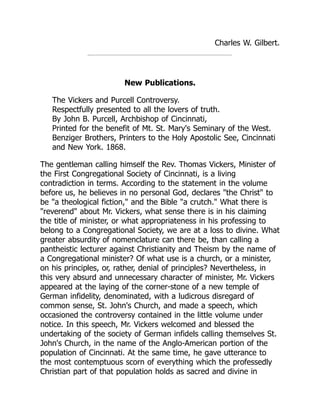
NewPublications.
The Vickers and Purcell Controversy.
Respectfully presented to all the lovers of truth.
By John B. Purcell, Archbishop of Cincinnati,
Printed for the benefit of Mt. St. Mary's Seminary of the West.
Benziger Brothers, Printers to the Holy Apostolic See, Cincinnati
and New York. 1868.
The gentleman calling himself the Rev. Thomas Vickers, Minister of
the First Congregational Society of Cincinnati, is a living
contradiction in terms. According to the statement in the volume
before us, he believes in no personal God, declares "the Christ" to
be "a theological fiction," and the Bible "a crutch." What there is
"reverend" about Mr. Vickers, what sense there is in his claiming
the title of minister, or what appropriateness in his professing to
belong to a Congregational Society, we are at a loss to divine. What
greater absurdity of nomenclature can there be, than calling a
pantheistic lecturer against Christianity and Theism by the name of
a Congregational minister? Of what use is a church, or a minister,
on his principles, or, rather, denial of principles? Nevertheless, in
this very absurd and unnecessary character of minister, Mr. Vickers
appeared at the laying of the corner-stone of a new temple of
German infidelity, denominated, with a ludicrous disregard of
common sense, St. John's Church, and made a speech, which
occasioned the controversy contained in the little volume under
notice. In this speech, Mr. Vickers welcomed and blessed the
undertaking of the society of German infidels calling themselves St.
John's Church, in the name of the Anglo-American portion of the
population of Cincinnati. At the same time, he gave utterance to
the most contemptuous scorn of everything which the professedly
Christian part of that population holds as sacred and divine in
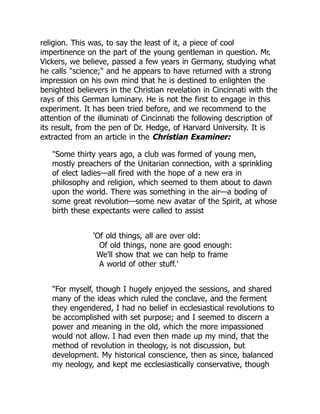
24.
religion. This was,to say the least of it, a piece of cool
impertinence on the part of the young gentleman in question. Mr.
Vickers, we believe, passed a few years in Germany, studying what
he calls "science;" and he appears to have returned with a strong
impression on his own mind that he is destined to enlighten the
benighted believers in the Christian revelation in Cincinnati with the
rays of this German luminary. He is not the first to engage in this
experiment. It has been tried before, and we recommend to the
attention of the illuminati of Cincinnati the following description of
its result, from the pen of Dr. Hedge, of Harvard University. It is
extracted from an article in the Christian Examiner:
"Some thirty years ago, a club was formed of young men,
mostly preachers of the Unitarian connection, with a sprinkling
of elect ladies—all fired with the hope of a new era in
philosophy and religion, which seemed to them about to dawn
upon the world. There was something in the air—a boding of
some great revolution—some new avatar of the Spirit, at whose
birth these expectants were called to assist
'Of old things, all are over old:
Of old things, none are good enough:
We'll show that we can help to frame
A world of other stuff.'
"For myself, though I hugely enjoyed the sessions, and shared
many of the ideas which ruled the conclave, and the ferment
they engendered, I had no belief in ecclesiastical revolutions to
be accomplished with set purpose; and I seemed to discern a
power and meaning in the old, which the more impassioned
would not allow. I had even then made up my mind, that the
method of revolution in theology, is not discussion, but
development. My historical conscience, then as since, balanced
my neology, and kept me ecclesiastically conservative, though
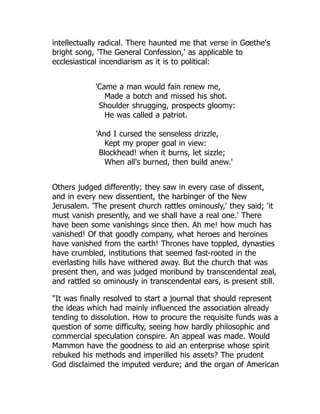
25.
intellectually radical. Therehaunted me that verse in Goethe's
bright song, 'The General Confession,' as applicable to
ecclesiastical incendiarism as it is to political:
'Came a man would fain renew me,
Made a botch and missed his shot.
Shoulder shrugging, prospects gloomy:
He was called a patriot.
'And I cursed the senseless drizzle,
Kept my proper goal in view:
Blockhead! when it burns, let sizzle;
When all's burned, then build anew.'
Others judged differently; they saw in every case of dissent,
and in every new dissentient, the harbinger of the New
Jerusalem. 'The present church rattles ominously,' they said; 'it
must vanish presently, and we shall have a real one.' There
have been some vanishings since then. Ah me! how much has
vanished! Of that goodly company, what heroes and heroines
have vanished from the earth! Thrones have toppled, dynasties
have crumbled, institutions that seemed fast-rooted in the
everlasting hills have withered away. But the church that was
present then, and was judged moribund by transcendental zeal,
and rattled so ominously in transcendental ears, is present still.
"It was finally resolved to start a journal that should represent
the ideas which had mainly influenced the association already
tending to dissolution. How to procure the requisite funds was a
question of some difficulty, seeing how hardly philosophic and
commercial speculation conspire. An appeal was made. Would
Mammon have the goodness to aid an enterprise whose spirit
rebuked his methods and imperilled his assets? The prudent
God disclaimed the imputed verdure; and the organ of American
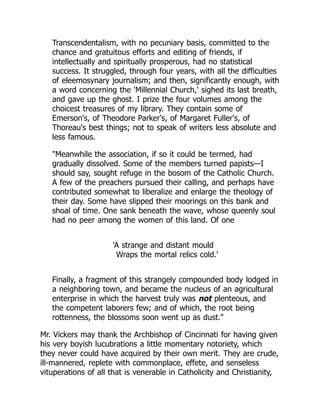
26.
Transcendentalism, with nopecuniary basis, committed to the
chance and gratuitous efforts and editing of friends, if
intellectually and spiritually prosperous, had no statistical
success. It struggled, through four years, with all the difficulties
of eleemosynary journalism; and then, significantly enough, with
a word concerning the 'Millennial Church,' sighed its last breath,
and gave up the ghost. I prize the four volumes among the
choicest treasures of my library. They contain some of
Emerson's, of Theodore Parker's, of Margaret Fuller's, of
Thoreau's best things; not to speak of writers less absolute and
less famous.
"Meanwhile the association, if so it could be termed, had
gradually dissolved. Some of the members turned papists—I
should say, sought refuge in the bosom of the Catholic Church.
A few of the preachers pursued their calling, and perhaps have
contributed somewhat to liberalize and enlarge the theology of
their day. Some have slipped their moorings on this bank and
shoal of time. One sank beneath the wave, whose queenly soul
had no peer among the women of this land. Of one
'A strange and distant mould
Wraps the mortal relics cold.'
Finally, a fragment of this strangely compounded body lodged in
a neighboring town, and became the nucleus of an agricultural
enterprise in which the harvest truly was not plenteous, and
the competent laborers few; and of which, the root being
rottenness, the blossoms soon went up as dust."
Mr. Vickers may thank the Archbishop of Cincinnati for having given
his very boyish lucubrations a little momentary notoriety, which
they never could have acquired by their own merit. They are crude,
ill-mannered, replete with commonplace, effete, and senseless
vituperations of all that is venerable in Catholicity and Christianity,
27.
and betray anignorance of the subjects treated of which makes
them unworthy of any serious attention. The point which the
discussion chiefly turns upon is "freedom of thought." If Mr. Vickers
is a disciple of the German pantheistic school, as we suppose him
to be, he is not in a condition to maintain that there is any such
thing as thought or freedom. We intend to give abundant proof of
this assertion, in a series of articles, to be published in our
Magazine, on Pantheism, in which we shall show, to the satisfaction
of any person capable of metaphysical reasoning, that pantheism
destroys the possibility of thought, in the true sense of the word,
as the intellection of real, objective truth. Pantheism destroys, also,
all possibility of freedom by reducing all phenomena to a fatal,
invincible necessity. A pantheist is bound to accept all the
persecutions of the middle ages, all the definitions of the church,
and the encyclical of the pope, as manifestations of God. Our
godlike friends are too much like the wife of the Connecticut
corporal, who replied to the query of her innocent offspring, "O ma!
are we all corporals now?" with the haughty rejoinder, "No, indeed!
only your pa and I." Mr. Vickers and the members of the free-
thinking coterie are not the only participators in the universal
deity. If Mr. Vickers's brilliant exposition of the doctrine of the
immaculate conception was a divine inspiration, Archbishop Purcell
was equally moved by divine inspiration to the paternal castigation
which he administers to his young and somewhat forward fellow-
celestial. In fact, Mr. Vickers, the archbishop, the book containing
their controversy, The Catholic World, ourselves, our readers, St.
Thomas, Torquemada, Luther, Heidelberg University, and the
Jesuits, are all one thing, or one nothing; a Seyn, or a Werden,
or a Nichtseyn; all bubbles on the fathomless ocean of infinite—
nonsense. It is a wonder that Mr. Vickers lays so much to heart,
and makes such a serious business out of that which has no reality.
A nephew of the great German philosopher, Hegel, who was also a
favorite pupil of Feuerbach, and who is now a devout Catholic, told
us, some time ago, that he asked Feuerbach why philosophy was
making no progress, but seemed to be at a stand-still. The latter
replied, that they had already proved by philosophy the
28.
nothingness of everything,and it was, therefore, useless to push
philosophy any further, adding, that it was time to go back to
common sense. Such is the end of that lawless, intellectual activity
which Mr. Vickers calls "free thought." It is like a head of steam
that bursts its boiler, and is then dispersed in the circumambient
atmosphere.
Memoirs and Letters of Jennie C. White—Del Bal.
By her mother, Rhoda E. White,
1 vol. royal 8vo, pp. 363. Boston: Patrick Donahoe. 1868.
We must presage our notice of this interesting book, by saying we
have a dislike to memoirs written by fond and partial friends. Lives
of the saints we love to read, but our digestion was early impaired
by the memoirs of good children (who all died young) with which
we were fed for Sunday food, and we have latterly been in the bad
habit of turning away from a book labelled, Memoirs of, etc.
However, we read Jennie's life with interest; and it is a beautiful
story, giving to the reader a delightful insight into a truly Catholic
family, where the breath of piety permeates the daily walk of every
member, mingling with and heightening the light-hearted pleasures
peculiar to the seasons of childhood and youth. The tale of her
courtship and marriage is told with a sweet and winning grace,
which charms us by its naturalness. Quite unlike the prevailing spirit
and sentiment of "Young America" is the history of the prompt
obedience to the mandate of parental authority, in giving up their
engagement. The accepted lover, a resident of Santiago, New
Granada, had promised his aged father not to forsake his own
country, and Jennie's father could not give his consent to the taking
of his first-born to that far-off foreign land. After a struggle, they
parted with aching hearts, released from their engagement; but the
influence of the true woman in the mother reunited that broken
bond.
29.
Contrary to thefate of many American girls who go to foreign
homes, Jennie's marriage was an exceedingly happy one. The
secret is very plain—they were both earnest Catholics. Oneness in
faith, and earnest-heartedness in that faith, are the best securities
for happiness in married life. The sight of this happy young
creature, leaving so fond a circle of friends, and such a home as
Jennie left behind in New York, to go to a comparatively unknown
land—a country distracted by revolutions, with churches closed and
priests exiled—gives us a glowing picture of the self-sacrificing spirit
of true love. Her journeys by land and by sea, before she reached
her destination, were perilous indeed; and we could not but ask,
Yankee-like, why such a refined and cultivated and intelligent
people as those among whom her lot was cast should never have
provided some more comfortable way of reaching their country. She
was the first American lady there, and attracted much attention and
admiration by her brave, active spirit, as well as by her large
Catholic heart. Her letters to her home friends are lovely from their
childlike simplicity and truthfulness; giving us glimpses of many
homesick heartaches, even when she was decking herself for the
dance. Sometimes there appears a little excess in her efforts to be
gay, when she writes, "I danced every piece but one till five in the
morning." Mrs. Del Bal went to New Granada at a time when the
so-called "Liberals," under Mosquera, were in the ascendant,
proclaiming a pretended religious liberty, of which some of the first
acts were the disbanding of all religious communities, turning the
sisters upon the world, shutting up the churches, banishing the
priests, unless they took an oath whereby they would cease to be
Catholics; in fact, Mosquera made himself pope. Professing to
establish a government in which there should be no connection
between church and state, the government framed this article for
the twenty-third of their Constitution:
"In order to sustain the national sovereignty and to maintain public
peace and security, the national government, and in some cases
the state government, shall exercise the right of supreme inspection
over all religious worships, as the law shall determine."
30.
This is alaw of liberty very like those the English Catholics enjoyed
under Queen Elizabeth.
Mrs. Del Bal exerted herself to give the press at the North the true
state of the case with regard to this matter, since the public papers
have loudly lauded Mosquera and his government. How far she
succeeded in influencing minds that swallow eagerly anything called
"liberal," we are not told. Our friend Jennie was loyal to her heart's
core, and never ceased to call herself and her husband American
citizens; and her thorough celebration of the "glorious Fourth" was
a complete success. American thrift and industry carried her
through what would have been impossible to a New Granadian.
But it is Jennie's almost superhuman efforts to revive the faith in
the land of her adoption which excite our wonder and admiration,
even more than the tender breathings of her woman's heart,
separated for ever from the earliest loved. She had everything to
struggle against in her work; "deplorable ignorance among the
lower classes, and the falling away from faith and duty in the
educated;" and this in a land once hallowed by the daily sacrifice.
Well might she call the country "God forsaken," when those who
should have cared for the sheep became themselves grievous
wolves devouring God's heritage. The secret of the country's
desolation we may read in this sentence:
"It is a well-known fact to Protestant travellers and a wound in
the heart of the Catholic world, that the Catholic priesthood in
this part of the world and in the West India Islands, scandalize
the faithful. Why are they permitted to remain in the church? is
asked often by Protestant and Catholic. Because they are
sustained by a government which will not acknowledge papal
authority; and if the archbishop were to remove them to-
morrow, if need be, they would be reinstated by the bayonet.
Hence these scandals."
31.
But we turnfrom this sad picture to our young friend. Working with
all the ardor of a soul given to God, filled with the love of Christ,
her prayers and labors brought forth abundant and immediate
fruits; but not till that day when the Great Master shall make up his
jewels will it be known how many were brought back to faith and
duty by her efforts. The missionary spirit pervaded all her life, and
we may believe that love for souls, in part, led her to give her
consent to so sad and final a parting from her early home; for she
laid her plans for these poor, neglected people before she left her
father's roof. She found some pious, devoted women in Santiago,
(where are they not found?) and she gave them work to do.
Everything prospered in her hands: Sunday-schools, altar societies,
associations of the Sacred Heart; and at last, through her
instrumentality, the laws were repealed that closed the churches,
the Te Deum was sung, the sanctuary lamp was relighted, and 'la
nina Jennie' was acknowledged, by the grateful people, as a public
blessing God sent.
It is extremely touching to mark how, amid the constant terror of
revolution, the wearing care of churches, hospitals, Sunday-schools,
altar societies, plantations, and housekeeping, with a retinue of
easy-going, lazy servants, she turns to entertain a dear friend with
tales of her beloved parents, recalling the happy and united life at
home, and then runs to console these absent ones by telling them,
in her letters, with the artlessness of a child, that her husband
must be good, since she is so happy with him, away from all she
loved before! Only four years was she permitted to cheer the heart
of her fond husband—only four years to lead the life of a devoted
missionary in that desolate vineyard. The snapping of the chain by
death that bound that household; the departure of her noble father
—we may well believe— coming upon a heart filled with care for
the souls about her, lying in worse than heathen darkness,
hastened her own death.
As we close the volume, we can not mourn for her nor for her dear
family; it is a blessed privilege to have such a friend in heaven.
32.
"Life is onlybright when it proceedeth
Toward a truer, deeper life above:
Human love is sweetest when it leadeth
To a more divine and perfect love."
No, we mourn for Santiago, and pray our dear Lord to
compassionate a country so piteously torn by revolutions, and
abandoned by those who should be first to hear the cry that comes
over the land to all Catholics, "Send us priests who have an
apostolic spirit, good judgment, and tact!"
The publisher's portion of the work is well done. It is well printed
on fine paper, and the binding is in keeping with the rest of the
book. It is, in fact, the handsomest book Mr. Donahoe ever
published, and we are glad to see so great an improvement in his
book-making.
The Woman Blessed by all Generations; or,
Mary the Object of Veneration, Confidence, and Imitation to all
Christians.
By the Rev. Raphael Melia, D.D.
London: Longmans, Green & Co. 1868.
For sale at The Catholic Publication House, New York.
Dr. Melia is an Italian priest, residing in London; a man of solid
learning, great zeal for the conversion of Protestants, and
possessing a competent knowledge of the English language. His
work is a comprehensive treatise on the dignity and office of the
Blessed Virgin, and the reasons for the veneration and invocation of
Mary practised in the church; to which is added a devotional
treatise on the imitation of her virtues. The author goes thoroughly
into the arguments from Scripture, tradition, reason, theology, and
antiquities. His style is lively, popular, and somewhat diffuse, so that
his learning is brought to the level of the understanding of ordinary
33.
readers, and hisarguments made plain by ample and minute
explanations. The book is also illustrated by fac-similes from
ancient works of art. It is a treasury of knowledge on the charming
and delightful subject of which it treats, and both Catholics and
Protestants who wish to gain thorough, solid information respecting
the Catholic devotion to Mary, with ease and pleasure to
themselves, will find this book to be the very one they are in need
of. The author is entitled to the thanks of all English-speaking
Catholics for this labor of love, and we trust that his excellent work
may be the means of increasing and diffusing, both in England and
America, that solid and fervent devotion to the Blessed Mother of
God which is both the poetry and an integral part of the practical
piety of our religion.
We have just received from Messrs. Murphy & Co., Baltimore, The
Acts and Decrees of the Second Plenary Council of
Baltimore. The Catholic World, for August, contained an
elaborate article on this work, written from an advance copy kindly
furnished by Mr. Murphy. It is unnecessary to say anything more
with regard to its contents, except to reiterate what was then said
as to its external appearance. It is a handsome volume, finely
printed on good paper, and bound in various styles and in the best
manner known to the art of binding, and is a credit to the
publisher. It is for sale at the Catholic Publication House, New York.
34.
*** END OFTHE PROJECT GUTENBERG EBOOK THE CATHOLIC
WORLD, VOL. 07, APRIL 1868 TO SEPTEMBER, 1868 ***
Updated editions will replace the previous one—the old editions will
be renamed.
Creating the works from print editions not protected by U.S.
copyright law means that no one owns a United States copyright in
these works, so the Foundation (and you!) can copy and distribute it
in the United States without permission and without paying
copyright royalties. Special rules, set forth in the General Terms of
Use part of this license, apply to copying and distributing Project
Gutenberg™ electronic works to protect the PROJECT GUTENBERG™
concept and trademark. Project Gutenberg is a registered trademark,
and may not be used if you charge for an eBook, except by following
the terms of the trademark license, including paying royalties for use
of the Project Gutenberg trademark. If you do not charge anything
for copies of this eBook, complying with the trademark license is
very easy. You may use this eBook for nearly any purpose such as
creation of derivative works, reports, performances and research.
Project Gutenberg eBooks may be modified and printed and given
away—you may do practically ANYTHING in the United States with
eBooks not protected by U.S. copyright law. Redistribution is subject
to the trademark license, especially commercial redistribution.
START: FULL LICENSE
PLEASE READ THISBEFORE YOU DISTRIBUTE OR USE THIS WORK
To protect the Project Gutenberg™ mission of promoting the free
distribution of electronic works, by using or distributing this work (or
any other work associated in any way with the phrase “Project
Gutenberg”), you agree to comply with all the terms of the Full
Project Gutenberg™ License available with this file or online at
www.gutenberg.org/license.
Section 1. General Terms of Use and
Redistributing Project Gutenberg™
electronic works
1.A. By reading or using any part of this Project Gutenberg™
electronic work, you indicate that you have read, understand, agree
to and accept all the terms of this license and intellectual property
(trademark/copyright) agreement. If you do not agree to abide by all
the terms of this agreement, you must cease using and return or
destroy all copies of Project Gutenberg™ electronic works in your
possession. If you paid a fee for obtaining a copy of or access to a
Project Gutenberg™ electronic work and you do not agree to be
bound by the terms of this agreement, you may obtain a refund
from the person or entity to whom you paid the fee as set forth in
paragraph 1.E.8.
1.B. “Project Gutenberg” is a registered trademark. It may only be
used on or associated in any way with an electronic work by people
who agree to be bound by the terms of this agreement. There are a
few things that you can do with most Project Gutenberg™ electronic
works even without complying with the full terms of this agreement.
See paragraph 1.C below. There are a lot of things you can do with
Project Gutenberg™ electronic works if you follow the terms of this
agreement and help preserve free future access to Project
Gutenberg™ electronic works. See paragraph 1.E below.
37.
1.C. The ProjectGutenberg Literary Archive Foundation (“the
Foundation” or PGLAF), owns a compilation copyright in the
collection of Project Gutenberg™ electronic works. Nearly all the
individual works in the collection are in the public domain in the
United States. If an individual work is unprotected by copyright law
in the United States and you are located in the United States, we do
not claim a right to prevent you from copying, distributing,
performing, displaying or creating derivative works based on the
work as long as all references to Project Gutenberg are removed. Of
course, we hope that you will support the Project Gutenberg™
mission of promoting free access to electronic works by freely
sharing Project Gutenberg™ works in compliance with the terms of
this agreement for keeping the Project Gutenberg™ name associated
with the work. You can easily comply with the terms of this
agreement by keeping this work in the same format with its attached
full Project Gutenberg™ License when you share it without charge
with others.
1.D. The copyright laws of the place where you are located also
govern what you can do with this work. Copyright laws in most
countries are in a constant state of change. If you are outside the
United States, check the laws of your country in addition to the
terms of this agreement before downloading, copying, displaying,
performing, distributing or creating derivative works based on this
work or any other Project Gutenberg™ work. The Foundation makes
no representations concerning the copyright status of any work in
any country other than the United States.
1.E. Unless you have removed all references to Project Gutenberg:
1.E.1. The following sentence, with active links to, or other
immediate access to, the full Project Gutenberg™ License must
appear prominently whenever any copy of a Project Gutenberg™
work (any work on which the phrase “Project Gutenberg” appears,
or with which the phrase “Project Gutenberg” is associated) is
accessed, displayed, performed, viewed, copied or distributed:
38.
This eBook isfor the use of anyone anywhere in the United
States and most other parts of the world at no cost and with
almost no restrictions whatsoever. You may copy it, give it away
or re-use it under the terms of the Project Gutenberg License
included with this eBook or online at www.gutenberg.org. If you
are not located in the United States, you will have to check the
laws of the country where you are located before using this
eBook.
1.E.2. If an individual Project Gutenberg™ electronic work is derived
from texts not protected by U.S. copyright law (does not contain a
notice indicating that it is posted with permission of the copyright
holder), the work can be copied and distributed to anyone in the
United States without paying any fees or charges. If you are
redistributing or providing access to a work with the phrase “Project
Gutenberg” associated with or appearing on the work, you must
comply either with the requirements of paragraphs 1.E.1 through
1.E.7 or obtain permission for the use of the work and the Project
Gutenberg™ trademark as set forth in paragraphs 1.E.8 or 1.E.9.
1.E.3. If an individual Project Gutenberg™ electronic work is posted
with the permission of the copyright holder, your use and distribution
must comply with both paragraphs 1.E.1 through 1.E.7 and any
additional terms imposed by the copyright holder. Additional terms
will be linked to the Project Gutenberg™ License for all works posted
with the permission of the copyright holder found at the beginning
of this work.
1.E.4. Do not unlink or detach or remove the full Project
Gutenberg™ License terms from this work, or any files containing a
part of this work or any other work associated with Project
Gutenberg™.
1.E.5. Do not copy, display, perform, distribute or redistribute this
electronic work, or any part of this electronic work, without
prominently displaying the sentence set forth in paragraph 1.E.1
39.
with active linksor immediate access to the full terms of the Project
Gutenberg™ License.
1.E.6. You may convert to and distribute this work in any binary,
compressed, marked up, nonproprietary or proprietary form,
including any word processing or hypertext form. However, if you
provide access to or distribute copies of a Project Gutenberg™ work
in a format other than “Plain Vanilla ASCII” or other format used in
the official version posted on the official Project Gutenberg™ website
(www.gutenberg.org), you must, at no additional cost, fee or
expense to the user, provide a copy, a means of exporting a copy, or
a means of obtaining a copy upon request, of the work in its original
“Plain Vanilla ASCII” or other form. Any alternate format must
include the full Project Gutenberg™ License as specified in
paragraph 1.E.1.
1.E.7. Do not charge a fee for access to, viewing, displaying,
performing, copying or distributing any Project Gutenberg™ works
unless you comply with paragraph 1.E.8 or 1.E.9.
1.E.8. You may charge a reasonable fee for copies of or providing
access to or distributing Project Gutenberg™ electronic works
provided that:
• You pay a royalty fee of 20% of the gross profits you derive
from the use of Project Gutenberg™ works calculated using the
method you already use to calculate your applicable taxes. The
fee is owed to the owner of the Project Gutenberg™ trademark,
but he has agreed to donate royalties under this paragraph to
the Project Gutenberg Literary Archive Foundation. Royalty
payments must be paid within 60 days following each date on
which you prepare (or are legally required to prepare) your
periodic tax returns. Royalty payments should be clearly marked
as such and sent to the Project Gutenberg Literary Archive
Foundation at the address specified in Section 4, “Information
40.
about donations tothe Project Gutenberg Literary Archive
Foundation.”
• You provide a full refund of any money paid by a user who
notifies you in writing (or by e-mail) within 30 days of receipt
that s/he does not agree to the terms of the full Project
Gutenberg™ License. You must require such a user to return or
destroy all copies of the works possessed in a physical medium
and discontinue all use of and all access to other copies of
Project Gutenberg™ works.
• You provide, in accordance with paragraph 1.F.3, a full refund of
any money paid for a work or a replacement copy, if a defect in
the electronic work is discovered and reported to you within 90
days of receipt of the work.
• You comply with all other terms of this agreement for free
distribution of Project Gutenberg™ works.
1.E.9. If you wish to charge a fee or distribute a Project Gutenberg™
electronic work or group of works on different terms than are set
forth in this agreement, you must obtain permission in writing from
the Project Gutenberg Literary Archive Foundation, the manager of
the Project Gutenberg™ trademark. Contact the Foundation as set
forth in Section 3 below.
1.F.
1.F.1. Project Gutenberg volunteers and employees expend
considerable effort to identify, do copyright research on, transcribe
and proofread works not protected by U.S. copyright law in creating
the Project Gutenberg™ collection. Despite these efforts, Project
Gutenberg™ electronic works, and the medium on which they may
be stored, may contain “Defects,” such as, but not limited to,
incomplete, inaccurate or corrupt data, transcription errors, a
copyright or other intellectual property infringement, a defective or
41.
damaged disk orother medium, a computer virus, or computer
codes that damage or cannot be read by your equipment.
1.F.2. LIMITED WARRANTY, DISCLAIMER OF DAMAGES - Except for
the “Right of Replacement or Refund” described in paragraph 1.F.3,
the Project Gutenberg Literary Archive Foundation, the owner of the
Project Gutenberg™ trademark, and any other party distributing a
Project Gutenberg™ electronic work under this agreement, disclaim
all liability to you for damages, costs and expenses, including legal
fees. YOU AGREE THAT YOU HAVE NO REMEDIES FOR
NEGLIGENCE, STRICT LIABILITY, BREACH OF WARRANTY OR
BREACH OF CONTRACT EXCEPT THOSE PROVIDED IN PARAGRAPH
1.F.3. YOU AGREE THAT THE FOUNDATION, THE TRADEMARK
OWNER, AND ANY DISTRIBUTOR UNDER THIS AGREEMENT WILL
NOT BE LIABLE TO YOU FOR ACTUAL, DIRECT, INDIRECT,
CONSEQUENTIAL, PUNITIVE OR INCIDENTAL DAMAGES EVEN IF
YOU GIVE NOTICE OF THE POSSIBILITY OF SUCH DAMAGE.
1.F.3. LIMITED RIGHT OF REPLACEMENT OR REFUND - If you
discover a defect in this electronic work within 90 days of receiving
it, you can receive a refund of the money (if any) you paid for it by
sending a written explanation to the person you received the work
from. If you received the work on a physical medium, you must
return the medium with your written explanation. The person or
entity that provided you with the defective work may elect to provide
a replacement copy in lieu of a refund. If you received the work
electronically, the person or entity providing it to you may choose to
give you a second opportunity to receive the work electronically in
lieu of a refund. If the second copy is also defective, you may
demand a refund in writing without further opportunities to fix the
problem.
1.F.4. Except for the limited right of replacement or refund set forth
in paragraph 1.F.3, this work is provided to you ‘AS-IS’, WITH NO
OTHER WARRANTIES OF ANY KIND, EXPRESS OR IMPLIED,
42.
Welcome to ourwebsite – the perfect destination for book lovers and
knowledge seekers. We believe that every book holds a new world,
offering opportunities for learning, discovery, and personal growth.
That’s why we are dedicated to bringing you a diverse collection of
books, ranging from classic literature and specialized publications to
self-development guides and children's books.
More than just a book-buying platform, we strive to be a bridge
connecting you with timeless cultural and intellectual values. With an
elegant, user-friendly interface and a smart search system, you can
quickly find the books that best suit your interests. Additionally,
our special promotions and home delivery services help you save time
and fully enjoy the joy of reading.
Join us on a journey of knowledge exploration, passion nurturing, and
personal growth every day!
testbankmall.com













![JDK Mission Control: Where We Are, Where We Are Going [Code One 2019]](https://cdn.slidesharecdn.com/ss_thumbnails/oco19jmc-191015115052-thumbnail.jpg?width=640&height=640&fit=bounds)


