3R Good Practices in Sri Lanka
3R GOOD PRACTICES IMPLEMENTED BY NGOS/
NGO /CBO Lanka Jathika Sarvodaya Shramadana Sangamaya 
Activity
Solid waste management programme implemented 
through 25 schools and 5 communities 
OUTLINE OF 3R GOOD PRACTICES
Keywords Municipal Solid waste management, schools, SriLanka 
Country Sri Lanka  
Area Implemented
Panadura, Moratuwa, Piliyandala , Gampaha & 
Kotikawatte / Mulleriyawa in the Western Province   
SriLanka 
Address
98, Sarvodaya HQ, Rawathawatte Road Moratuwa Sri 
Lanka. 
Phone 00940115524752 (Direct), 0094 0112647159 (general) 
Fax 00940112656512 
E-mail
dedtp@sarvodaya.org 
uaadissanayake@gmail.com 
Contact Person
Mrs. Udani  Mendis (Phone: 0094773867054 ) 
Deputy Executive Director,  
Sarvodaya 
Waste Sector Municipal Solid Waste 
3R Practice
Solid waste managemen, education on SW 
management and recycling  
Website / Data Source www.sarvodaya.org 
OVERVIEW OF PRACTICES
Introduction  
Sarvodaya  is  an  organization  a  broadly  embedded  peopleʹs  organization,  with  a 
network covering 15,000 villages, 345 divisional units, 34 district offices, 10 specialist 
Development  Education  Institutes;  over  100,000  youth.  Lanka  Jathika  Sarvodaya 
Shramadana Sangamaya is an organization founded in 1958 as a national NGO. 
One of the main aims of Sarvodaya is creating an eco‐friendly society and protecting 
environment  by  minimizing  damages  to  global  environment  and  humanity  from 
solid waste disposal problems and burning of other waste in selected 25 schools and 
5 communities. 
 
3R Good Practice 
  
This  organization  helped  in  identifying  issues  related  to  solid  waste  management 
system in various places of Sri Lanka. Six towns in western province was identified 
to have  facing  the major  problem  of  solid  waste  disposal  due to  urbanization  and 
due to lack of proper solid waste management system functioning those areas.  
Awareness  programmes  on  solid  waste  management  was  conducted  to  educate 
schoolchildren  in  25  schools  and  for  5  communities  in  Colombo  suburbs.  School 
Children were educated on separation of solid waste and efforts were taken to make 
them  understand  the  problem  associated  to  unmanaged  solid  waste  and  through 
them  to  motivate  their  elders  to  follow  proper  solid  waste  disposal  methods. 
Community programmes were conducted for Elders and the Women in villages, in 
five  communities,  and  arrange  them  to  practice  solid  waste  management  by 
introducing composting, recycling and reusing.  
The activities involve, conducting meetings with local government authorities in 5 
towns  and  schools  administrations,  implementing    school  awareness  program, 
supplying of garbage bins for collection of waste, educating communities and school 
children on separation and  storing of organic waste to make compost and  
to prepare fertilizer and encourage bio‐home gardening. In addition, it conducts Art 
Competitions and Dramas for children to present their ideas on available practices 
of environment and solid waste disposal and indirectly creating awareness among 
the elders through the children. 
 
Outcome of the activity  
• The five communities in five towns implementing these activities become the 
representative  model  for  other  villages  in  their  towns,  to  follow  and  is 
expected to expand this programme throughout the country. 
• Increasing support from the town and village administration and from the 
educational sectors in five towns including school principals and teachers in 
creating awareness on the solid waste issues in the area.  
These  activities  have  largely  reduced  the  burden  of  local  authority  burden  on 
disposal of solid waste in these areas. 
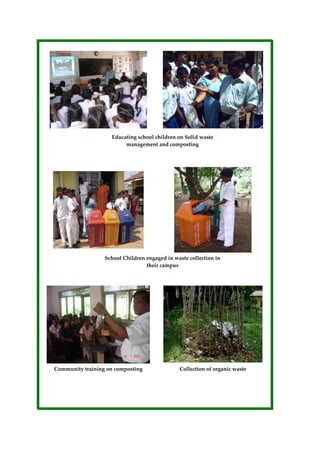
Collection of organic waste Community training on composting
School Children engaged in waste collection in 
their campus   
Educating school children on Solid waste 
management and composting  

Solid Waste Management Prog

  • 1.
    3R Good Practicesin Sri Lanka 3R GOOD PRACTICES IMPLEMENTED BY NGOS/ NGO /CBO Lanka Jathika Sarvodaya Shramadana Sangamaya  Activity Solid waste management programme implemented  through 25 schools and 5 communities  OUTLINE OF 3R GOOD PRACTICES Keywords Municipal Solid waste management, schools, SriLanka  Country Sri Lanka   Area Implemented Panadura, Moratuwa, Piliyandala , Gampaha &  Kotikawatte / Mulleriyawa in the Western Province    SriLanka  Address 98, Sarvodaya HQ, Rawathawatte Road Moratuwa Sri  Lanka.  Phone 00940115524752 (Direct), 0094 0112647159 (general)  Fax 00940112656512  E-mail dedtp@sarvodaya.org  uaadissanayake@gmail.com  Contact Person Mrs. Udani  Mendis (Phone: 0094773867054 )  Deputy Executive Director,   Sarvodaya  Waste Sector Municipal Solid Waste  3R Practice Solid waste managemen, education on SW  management and recycling   Website / Data Source www.sarvodaya.org 
  • 2.
    OVERVIEW OF PRACTICES Introduction   Sarvodaya is  an  organization  a  broadly  embedded  peopleʹs  organization,  with  a  network covering 15,000 villages, 345 divisional units, 34 district offices, 10 specialist  Development  Education  Institutes;  over  100,000  youth.  Lanka  Jathika  Sarvodaya  Shramadana Sangamaya is an organization founded in 1958 as a national NGO.  One of the main aims of Sarvodaya is creating an eco‐friendly society and protecting  environment  by  minimizing  damages  to  global  environment  and  humanity  from  solid waste disposal problems and burning of other waste in selected 25 schools and  5 communities.    3R Good Practice     This  organization  helped  in  identifying  issues  related  to  solid  waste  management  system in various places of Sri Lanka. Six towns in western province was identified  to have  facing  the major  problem  of  solid  waste  disposal  due to  urbanization  and  due to lack of proper solid waste management system functioning those areas.   Awareness  programmes  on  solid  waste  management  was  conducted  to  educate  schoolchildren  in  25  schools  and  for  5  communities  in  Colombo  suburbs.  School  Children were educated on separation of solid waste and efforts were taken to make  them  understand  the  problem  associated  to  unmanaged  solid  waste  and  through  them  to  motivate  their  elders  to  follow  proper  solid  waste  disposal  methods.  Community programmes were conducted for Elders and the Women in villages, in  five  communities,  and  arrange  them  to  practice  solid  waste  management  by  introducing composting, recycling and reusing.   The activities involve, conducting meetings with local government authorities in 5  towns  and  schools  administrations,  implementing    school  awareness  program,  supplying of garbage bins for collection of waste, educating communities and school  children on separation and  storing of organic waste to make compost and   to prepare fertilizer and encourage bio‐home gardening. In addition, it conducts Art  Competitions and Dramas for children to present their ideas on available practices  of environment and solid waste disposal and indirectly creating awareness among  the elders through the children.    Outcome of the activity   • The five communities in five towns implementing these activities become the  representative  model  for  other  villages  in  their  towns,  to  follow  and  is  expected to expand this programme throughout the country.  • Increasing support from the town and village administration and from the  educational sectors in five towns including school principals and teachers in  creating awareness on the solid waste issues in the area.   These  activities  have  largely  reduced  the  burden  of  local  authority  burden  on  disposal of solid waste in these areas. 
  • 3.