Chapter 1
SOLID STATE
SRINIDHI G
1
CONTENTS
• INTRODUCTION
• TYPES OF SOLID
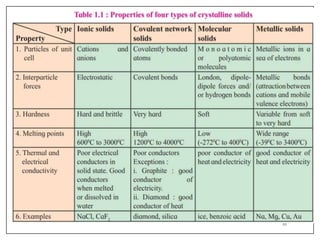
• TYPES OF CRYSTALLINE SOLIDS AND ITS PROPERTIES
• CRYSTAL STRUCTURE
• STRUCTURAL UNIT OF A CRYSTAL STRUCTURE
• CRYSTAL SYSTEMS
• PACKING OF PARTICLES IN CRYSTAL LATTICE
• CRYSTAL DEFECTS
• BOND THEORY
• ELECTRICAL AND MAGNETIC PROPERTIES OF SOLIDS 2
2
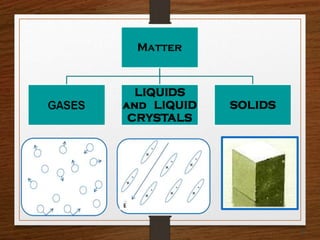
WHAT IS ASOLID?
• Closely packed structure
• Definite shape and volume
• Highly incompressible
• Rigid structure
• Strong intermolecular forces of attraction
• Fixed position of constituent particles
3
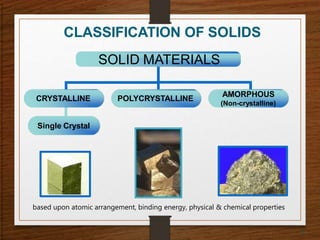
SOLID MATERIALS
CRYSTALLINE POLYCRYSTALLINE
AMORPHOUS
(Non-crystalline)
Single Crystal
CLASSIFICATION OF SOLIDS
based upon atomic arrangement, binding energy, physical & chemical properties
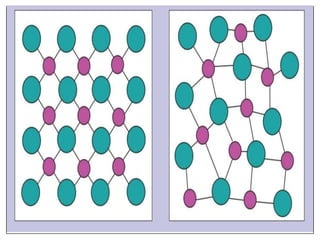
CRYSTALLINE SOLIDS
• The building constituents arrange themselves in
regular manner
• Definite geometrical shape, with flat faces and sharp
edges.
• Incompressible orderly arranged units.
• Definite sharp melting point.
• Anisotropy.
• Give x-ray diffraction bands.
• Examples: NaCl, CsCl, etc.
AMORPHOUS SOLIDS
• Derived from Greek word ‘Omorphe’ meaning shapeless.
• No regular but haphazard arrangement of atoms or molecule
• Also considered as non-crystalline solids or super- cooled
liquids.
• No sharp Melting point
• Isotropic.
• No definite geometrical shape.
• Do not give x-ray diffraction bands.
• Examples: glass, rubber, plastics.
8
TYPES OFCRYSTALSTRUCTURES
• Ionic crystals
• Covalent crystals
• Molecular crystals
• Metallic crystals
10
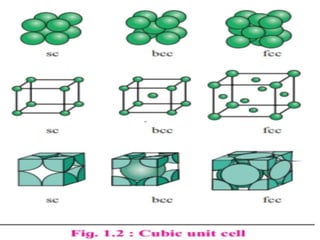
TYPES OF CUBIC CRYSTALS
Four types:
1.Simple or primitive type
2. Body-centered
3. Face-centered
4. End face-centered
12
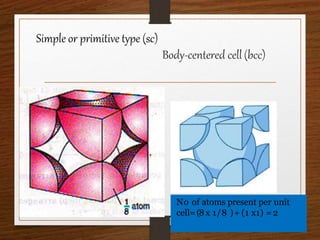
Simple or primitive type (sc)
Body-centered cell(bcc)
No of atoms present per unit
cell=(8x 1/8 )+ (1 x1) =2
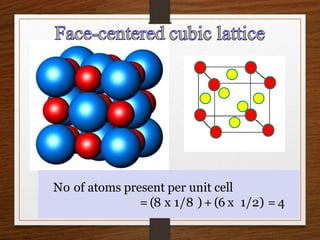
No of atoms present per unit cell
= (8 x 1/8 ) + (6 x 1/2) = 4
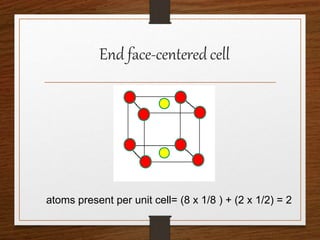
End face-centered cell
atoms present per unit cell= (8 x 1/8 ) + (2 x 1/2) = 2
LATTICES
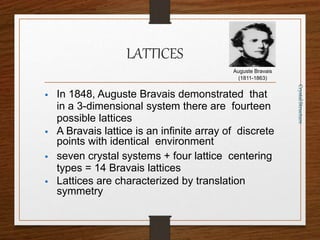
 In 1848, Auguste Bravais demonstrated that
in a 3-dimensional system there are fourteen
possible lattices
 A Bravais lattice is an infinite array of discrete
points with identical environment
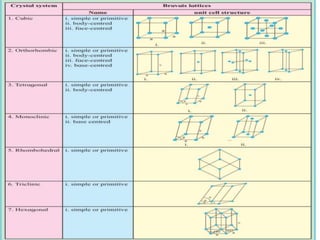
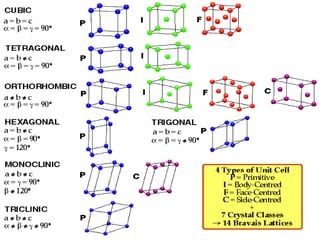
 seven crystal systems + four lattice centering
types = 14 Bravais lattices
 Lattices are characterized by translation
symmetry
Crystal
Structure
Auguste Bravais
(1811-1863)
17
18
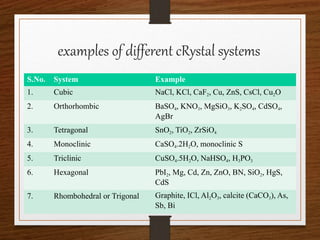
examples of different cRystal systems
S.No. System Example
1. Cubic NaCl, KCl, CaF2, Cu, ZnS, CsCl, Cu2O
2. Orthorhombic BaSO4, KNO3, MgSiO3, K2SO4, CdSO4,
AgBr
3. Tetragonal SnO2, TiO2, ZrSiO4
4. Monoclinic CaSO4.2H2O, monoclinic S
5. Triclinic CuSO4.5H2O, NaHSO4, H3PO3
6. Hexagonal PbI2, Mg, Cd, Zn, ZnO, BN, SiO2, HgS,
CdS
7. Rhombohedral or Trigonal Graphite, ICl, Al2O3, calcite (CaCO3), As,
Sb, Bi
20
21
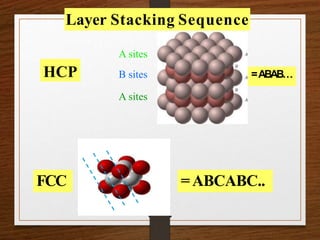
A sites
B sites
A sites
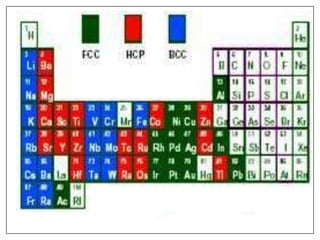
HCP
FCC
Layer Stacking Sequence
=ABCABC..
=ABAB…
23
24
25
26
27
Crystal defects or imperfections
• The real, naturally occurring crystalline substances do
not have perfect crystal structures. They have some
disorders or irregularities in the stacking of atoms.
• The imperfections are more if the crystallization occurs
at a faster rate. It means that the defects can be
minimized by carrying out crystallization at a slower
rate.
• Crystals with no imperfections are possible only at the
absolute zero of temperature.
POINT DEFECT AND ITS TYPES
These defects are irregularities produced in the
arrangement of basis at lattice points in crystalline solids
.
Stoichiometric point defects
Impurity defects
Nonstoichiometric point defects
Stoichiometric point defects
 Chemical formula of a compound shows fixed ratio of number of
atoms or number of cations and anions.
 The ratio of number of atoms or number of cations and anions of
compound remains the same as represented by its chemical
formula.
 There are four types of stoichiometric point defects
1.Vacancy defect 3. Schottky defect
2.Self interstitial defect 4. Frenkel defect
Vacancy defect
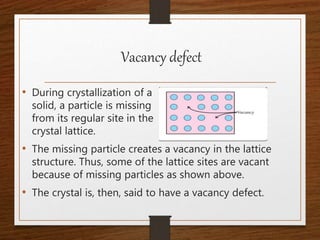
• During crystallization of a
solid, a particle is missing
from its regular site in the
crystal lattice.
• The missing particle creates a vacancy in the lattice
structure. Thus, some of the lattice sites are vacant
because of missing particles as shown above.
• The crystal is, then, said to have a vacancy defect.
Self interstitial defect
in elemental solid
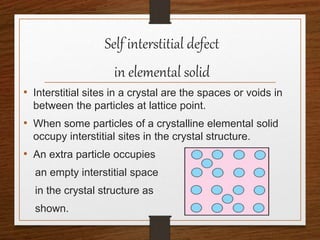
• Interstitial sites in a crystal are the spaces or voids in
between the particles at lattice point.
• When some particles of a crystalline elemental solid
occupy interstitial sites in the crystal structure.
• An extra particle occupies
an empty interstitial space
in the crystal structure as
shown.
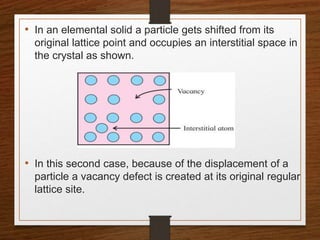
• In an elemental solid a particle gets shifted from its
original lattice point and occupies an interstitial space in
the crystal as shown.
• In this second case, because of the displacement of a
particle a vacancy defect is created at its original regular
lattice site.
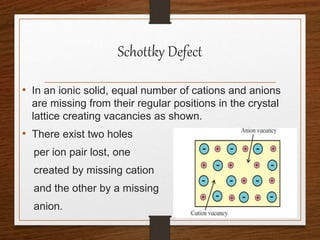
Schottky Defect
• In an ionic solid, equal number of cations and anions
are missing from their regular positions in the crystal
lattice creating vacancies as shown.
• There exist two holes
per ion pair lost, one
created by missing cation
and the other by a missing
anion.
Schottky defect is found in ionic compounds with the
following
High degree of ionic character
High coordination number of anion
Small difference between size of cation and anion. The
ratio rcation/ranion is not far below unity.
Consequences of Schottky defect
• As the number of ions decreases, mass decreases.
However, volume remains unchanged. Hence, the
density of a substance decreases
Frenkel defect
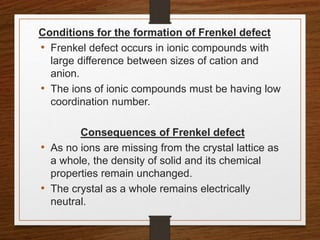
Frenkel defect arises when an ion of an ionic compound is
missing from its regular lattice site and occupies
interstitial position between lattice points as shown.
Conditions for the formation of Frenkel defect
• Frenkel defect occurs in ionic compounds with
large difference between sizes of cation and
anion.
• The ions of ionic compounds must be having low
coordination number.
Consequences of Frenkel defect
• As no ions are missing from the crystal lattice as
a whole, the density of solid and its chemical
properties remain unchanged.
• The crystal as a whole remains electrically
neutral.
Impurity defect
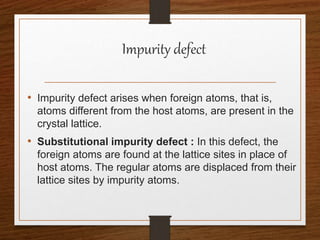
• Impurity defect arises when foreign atoms, that is,
atoms different from the host atoms, are present in the
crystal lattice.
• Substitutional impurity defect : In this defect, the
foreign atoms are found at the lattice sites in place of
host atoms. The regular atoms are displaced from their
lattice sites by impurity atoms.
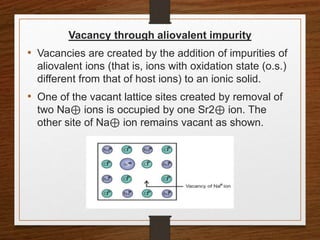
Vacancy through aliovalent impurity
• Vacancies are created by the addition of impurities of
aliovalent ions (that is, ions with oxidation state (o.s.)
different from that of host ions) to an ionic solid.
• One of the vacant lattice sites created by removal of
two Na⊕ ions is occupied by one Sr2⊕ ion. The
other site of Na⊕ ion remains vacant as shown.
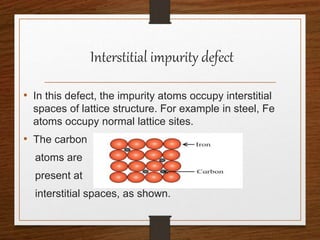
Interstitial impurity defect
• In this defect, the impurity atoms occupy interstitial
spaces of lattice structure. For example in steel, Fe
atoms occupy normal lattice sites.
• The carbon
atoms are
present at
interstitial spaces, as shown.
Nonstoichiometric defects
• Nonstoichiometric defect arises when the ratio of
number of atoms of one kind to that of other kind or
the ratio of number of cations to anions becomes
different from that indicated by its chemical formula.
• It is important to note that the change in stoichiometry
does not cause any change in the crystal structure.
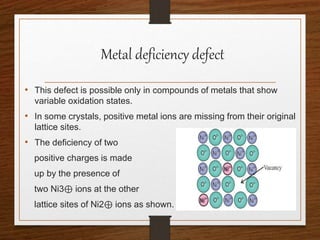
Metal deficiency defect
• This defect is possible only in compounds of metals that show
variable oxidation states.
• In some crystals, positive metal ions are missing from their original
lattice sites.
• The deficiency of two
positive charges is made
up by the presence of
two Ni3⊕ ions at the other
lattice sites of Ni2⊕ ions as shown.
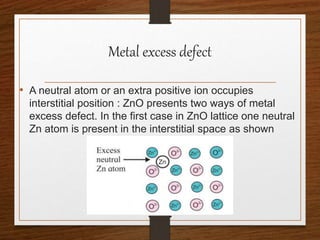
Metal excess defect
• A neutral atom or an extra positive ion occupies
interstitial position : ZnO presents two ways of metal
excess defect. In the first case in ZnO lattice one neutral
Zn atom is present in the interstitial space as shown
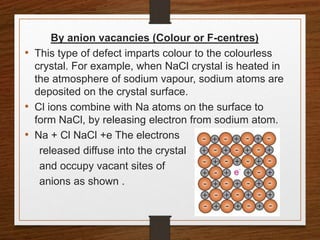
By anion vacancies (Colour or F-centres)
• This type of defect imparts colour to the colourless
crystal. For example, when NaCl crystal is heated in
the atmosphere of sodium vapour, sodium atoms are
deposited on the crystal surface.
• Cl ions combine with Na atoms on the surface to
form NaCl, by releasing electron from sodium atom.
• Na + Cl NaCl +e The electrons
released diffuse into the crystal
and occupy vacant sites of
anions as shown .
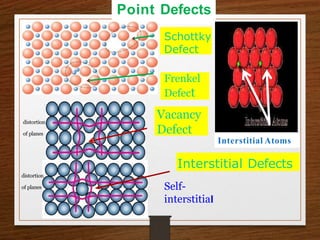
Schottky
Defect
Frenkel
Defect
Vacancy
Defect
distortion
of planes
Self-
interstitial
distortion
of planes
Interstitial Atoms
Interstitial Defects
Point Defects
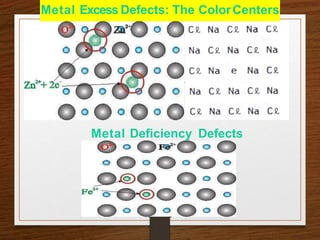
Metal Deficiency Defects
Metal Excess Defects: The ColorCenters
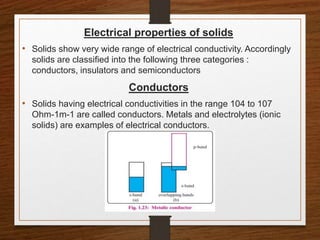
Electrical properties of solids
• Solids show very wide range of electrical conductivity. Accordingly
solids are classified into the following three categories :
conductors, insulators and semiconductors
Conductors
• Solids having electrical conductivities in the range 104 to 107
Ohm-1m-1 are called conductors. Metals and electrolytes (ionic
solids) are examples of electrical conductors.
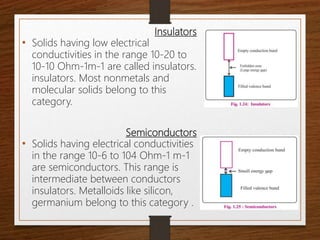
Insulators
• Solids having low electrical
conductivities in the range 10-20 to
10-10 Ohm-1m-1 are called insulators.
insulators. Most nonmetals and
molecular solids belong to this
category.
Semiconductors
• Solids having electrical conductivities
in the range 10-6 to 104 Ohm-1 m-1
are semiconductors. This range is
intermediate between conductors
insulators. Metalloids like silicon,
germanium belong to this category .
Band theory
• Electrical conductivities of solid metals, nonmetals and
metalloids are explained in terms of band theory. A band is
made of closely spaced electronic energy levels.
• According to MO theory interaction of atomic orbitals of
combining atoms results in formation of equal number of MOs
which spread over the entire molecule.
Conduction band
• The highest energy band containing electrons is the conduction
band. It is formed by interaction of the outermost energy levels
of closely spaced atoms in solids.
Valence band
• The band having lower energy than conduction band is the
valence band.
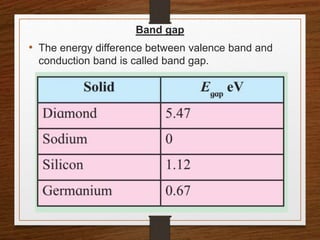
Band gap
• The energy difference between valence band and
conduction band is called band gap.
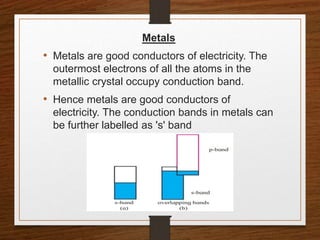
Metals
• Metals are good conductors of electricity. The
outermost electrons of all the atoms in the
metallic crystal occupy conduction band.
• Hence metals are good conductors of
electricity. The conduction bands in metals can
be further labelled as 's' band
• Band formation in metallic conductors, thus,
results in delocalization of the outermost
electrons of all the metal atoms leaving behind
metal ions.
• The cations of metal atoms occupying lattice
sites vibrate about their mean positions. At
higher temperatures, metal cations undergo
increased vibrational motion about their lattice
sites. The flow of electrons is interrupted by
increased vibrational motion.
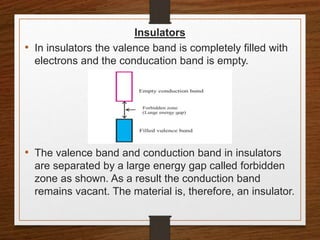
Insulators
• In insulators the valence band is completely filled with
electrons and the conducation band is empty.
• The valence band and conduction band in insulators
are separated by a large energy gap called forbidden
zone as shown. As a result the conduction band
remains vacant. The material is, therefore, an insulator.
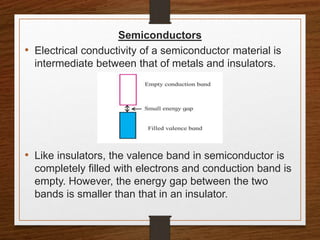
Semiconductors
• Electrical conductivity of a semiconductor material is
intermediate between that of metals and insulators.
• Like insulators, the valence band in semiconductor is
completely filled with electrons and conduction band is
empty. However, the energy gap between the two
bands is smaller than that in an insulator.
• At a temperature above absolute zero a few
electrons in the valence band have enough
thermal energy to jump through the small
band gap and occupy higher energy
conduction band.
• When electric potential is applied to a
semiconductor, it conducts a small amount of
electricity.
• Such a pure semiconductor material which
has a very low but finite electrical conductivity
is called intrinsic semiconductor.
Extrinsic semiconductors and doping
• The conductivity of a semiconductor can be increased
by doping. The process of addition of minute quantity of
impurities to a semiconductor to increase its
conductivity is called doping. The added impurity is
called dopant.
• There are two types of extrinsic semiconductors,
namely, n-type and p-type semiconductors.
n-type semiconductor
• n-type semiconductor contains increased number of electrons in
the conduction bond.
• An n-type semiconductor is obtained by adding group 15 element to
intrinsic semiconductor which belongs to group 14.
• Si has a crystal structure in which each Si atom is linked
tetrahedrally to four other Si atoms. When small quantity of 24
phosphorous is added to pure Si, the P atoms occupy some vacant
sites in the lattice in place of Si atoms, as shown
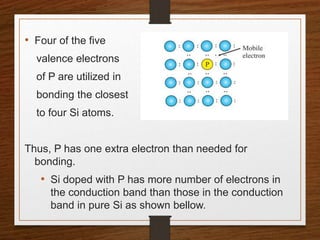
• Four of the five
valence electrons
of P are utilized in
bonding the closest
to four Si atoms.
Thus, P has one extra electron than needed for
bonding.
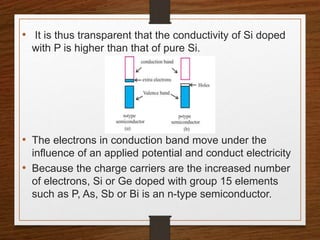
• Si doped with P has more number of electrons in
the conduction band than those in the conduction
band in pure Si as shown bellow.
• It is thus transparent that the conductivity of Si doped
with P is higher than that of pure Si.
• The electrons in conduction band move under the
influence of an applied potential and conduct electricity
• Because the charge carriers are the increased number
of electrons, Si or Ge doped with group 15 elements
such as P, As, Sb or Bi is an n-type semiconductor.
p-type semiconductor
• A p-type semiconductor is produced by doping a pure
semiconductor material (Si or Ge) with an impurity of group 13
elements.
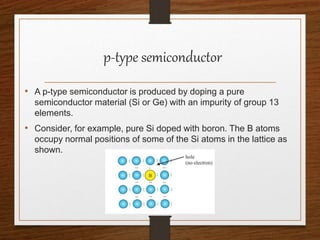
• Consider, for example, pure Si doped with boron. The B atoms
occupy normal positions of some of the Si atoms in the lattice as
shown.
• Boron atom has only three valence electrons. It does
not have enough electrons to form bonds with its
four Si neighbours .
• B atom forms bonds with three Si atoms only. The
missing fourth electron creates an electron vacancy.
It is called a hole.
• A hole has a tendency to accept electron from its
close vicinity. Thus, a hole behaves as if it has a
positive charge. The electrons in partially filled
valence band move under the influence of an
applied potential.
Magnetic properties of solids
• Magnetic properties of solids can be understood easily
in terms of classical picture of electron. The electrons
spin about their own axis. The spinning electrons act
like tiny magnets because their spinning action
generates induced magnetic field.
• On the basis of magnetic properties solids are
classified into three major classes : diamagnetic,
paramagnetic and ferromagnetic.
Diamagnetic solids
• The substances with all electrons paired, are weakly
repelled by magnetic fields. These substances are said
to be diamagnetic.
• Pairing of electrons balances the spins and hence,
cancels their magnetic moments. N2 , F2 , NaCl, H2 O
and benzene are some examples of diamagnetic
substances.
Paramagnetic solids
• The substances with unpaired electrons are weakly
attracted by magnetic field. These substances are called
paramagnetic substances.
• The spinning of unpaired electron gives rise to a
magnetic moment. The substance is attracted by
magnetic field because of magnetic moment.
• They lose magnetism when the external magnetic field is
removed.(e.g) Oxygen, Cu2⊕, Fe3⊕, Cr3⊕
Ferromagnetism
• The substances containing large number of unpaired
electrons are attracted strongly by magnetic field. These
substances are said to be ferromagnetic.
• These substances can be permanently magnetised.
They retain magnetism even after the removal of
external magnetic field
(e.g) Fe, Co, Ni, Gd, CrO2
THANK YOU
67
https://forms.gle/wJyBJ9x9EgmVRpqM8

solid state 12th

  • 1.
  • 2.
    CONTENTS • INTRODUCTION • TYPESOF SOLID • TYPES OF CRYSTALLINE SOLIDS AND ITS PROPERTIES • CRYSTAL STRUCTURE • STRUCTURAL UNIT OF A CRYSTAL STRUCTURE • CRYSTAL SYSTEMS • PACKING OF PARTICLES IN CRYSTAL LATTICE • CRYSTAL DEFECTS • BOND THEORY • ELECTRICAL AND MAGNETIC PROPERTIES OF SOLIDS 2
  • 3.
  • 4.
    WHAT IS ASOLID? •Closely packed structure • Definite shape and volume • Highly incompressible • Rigid structure • Strong intermolecular forces of attraction • Fixed position of constituent particles
  • 5.
    3 SOLID MATERIALS CRYSTALLINE POLYCRYSTALLINE AMORPHOUS (Non-crystalline) SingleCrystal CLASSIFICATION OF SOLIDS based upon atomic arrangement, binding energy, physical & chemical properties
  • 6.
    CRYSTALLINE SOLIDS • Thebuilding constituents arrange themselves in regular manner • Definite geometrical shape, with flat faces and sharp edges. • Incompressible orderly arranged units. • Definite sharp melting point. • Anisotropy. • Give x-ray diffraction bands. • Examples: NaCl, CsCl, etc.
  • 7.
    AMORPHOUS SOLIDS • Derivedfrom Greek word ‘Omorphe’ meaning shapeless. • No regular but haphazard arrangement of atoms or molecule • Also considered as non-crystalline solids or super- cooled liquids. • No sharp Melting point • Isotropic. • No definite geometrical shape. • Do not give x-ray diffraction bands. • Examples: glass, rubber, plastics.
  • 8.
  • 9.
    TYPES OFCRYSTALSTRUCTURES • Ioniccrystals • Covalent crystals • Molecular crystals • Metallic crystals
  • 10.
  • 11.
    TYPES OF CUBICCRYSTALS Four types: 1.Simple or primitive type 2. Body-centered 3. Face-centered 4. End face-centered
  • 12.
  • 13.
    Simple or primitivetype (sc) Body-centered cell(bcc) No of atoms present per unit cell=(8x 1/8 )+ (1 x1) =2
  • 14.
    No of atomspresent per unit cell = (8 x 1/8 ) + (6 x 1/2) = 4
  • 15.
    End face-centered cell atomspresent per unit cell= (8 x 1/8 ) + (2 x 1/2) = 2
  • 16.
    LATTICES  In 1848,Auguste Bravais demonstrated that in a 3-dimensional system there are fourteen possible lattices  A Bravais lattice is an infinite array of discrete points with identical environment  seven crystal systems + four lattice centering types = 14 Bravais lattices  Lattices are characterized by translation symmetry Crystal Structure Auguste Bravais (1811-1863)
  • 17.
  • 18.
  • 19.
    examples of differentcRystal systems S.No. System Example 1. Cubic NaCl, KCl, CaF2, Cu, ZnS, CsCl, Cu2O 2. Orthorhombic BaSO4, KNO3, MgSiO3, K2SO4, CdSO4, AgBr 3. Tetragonal SnO2, TiO2, ZrSiO4 4. Monoclinic CaSO4.2H2O, monoclinic S 5. Triclinic CuSO4.5H2O, NaHSO4, H3PO3 6. Hexagonal PbI2, Mg, Cd, Zn, ZnO, BN, SiO2, HgS, CdS 7. Rhombohedral or Trigonal Graphite, ICl, Al2O3, calcite (CaCO3), As, Sb, Bi
  • 20.
  • 21.
  • 22.
    A sites B sites Asites HCP FCC Layer Stacking Sequence =ABCABC.. =ABAB…
  • 23.
  • 24.
  • 25.
  • 26.
  • 27.
  • 29.
    Crystal defects orimperfections • The real, naturally occurring crystalline substances do not have perfect crystal structures. They have some disorders or irregularities in the stacking of atoms. • The imperfections are more if the crystallization occurs at a faster rate. It means that the defects can be minimized by carrying out crystallization at a slower rate. • Crystals with no imperfections are possible only at the absolute zero of temperature.
  • 30.
    POINT DEFECT ANDITS TYPES These defects are irregularities produced in the arrangement of basis at lattice points in crystalline solids . Stoichiometric point defects Impurity defects Nonstoichiometric point defects
  • 31.
    Stoichiometric point defects Chemical formula of a compound shows fixed ratio of number of atoms or number of cations and anions.  The ratio of number of atoms or number of cations and anions of compound remains the same as represented by its chemical formula.  There are four types of stoichiometric point defects 1.Vacancy defect 3. Schottky defect 2.Self interstitial defect 4. Frenkel defect
  • 32.
    Vacancy defect • Duringcrystallization of a solid, a particle is missing from its regular site in the crystal lattice. • The missing particle creates a vacancy in the lattice structure. Thus, some of the lattice sites are vacant because of missing particles as shown above. • The crystal is, then, said to have a vacancy defect.
  • 33.
    Self interstitial defect inelemental solid • Interstitial sites in a crystal are the spaces or voids in between the particles at lattice point. • When some particles of a crystalline elemental solid occupy interstitial sites in the crystal structure. • An extra particle occupies an empty interstitial space in the crystal structure as shown.
  • 34.
    • In anelemental solid a particle gets shifted from its original lattice point and occupies an interstitial space in the crystal as shown. • In this second case, because of the displacement of a particle a vacancy defect is created at its original regular lattice site.
  • 35.
    Schottky Defect • Inan ionic solid, equal number of cations and anions are missing from their regular positions in the crystal lattice creating vacancies as shown. • There exist two holes per ion pair lost, one created by missing cation and the other by a missing anion.
  • 36.
    Schottky defect isfound in ionic compounds with the following High degree of ionic character High coordination number of anion Small difference between size of cation and anion. The ratio rcation/ranion is not far below unity. Consequences of Schottky defect • As the number of ions decreases, mass decreases. However, volume remains unchanged. Hence, the density of a substance decreases
  • 37.
    Frenkel defect Frenkel defectarises when an ion of an ionic compound is missing from its regular lattice site and occupies interstitial position between lattice points as shown.
  • 38.
    Conditions for theformation of Frenkel defect • Frenkel defect occurs in ionic compounds with large difference between sizes of cation and anion. • The ions of ionic compounds must be having low coordination number. Consequences of Frenkel defect • As no ions are missing from the crystal lattice as a whole, the density of solid and its chemical properties remain unchanged. • The crystal as a whole remains electrically neutral.
  • 39.
    Impurity defect • Impuritydefect arises when foreign atoms, that is, atoms different from the host atoms, are present in the crystal lattice. • Substitutional impurity defect : In this defect, the foreign atoms are found at the lattice sites in place of host atoms. The regular atoms are displaced from their lattice sites by impurity atoms.
  • 40.
    Vacancy through aliovalentimpurity • Vacancies are created by the addition of impurities of aliovalent ions (that is, ions with oxidation state (o.s.) different from that of host ions) to an ionic solid. • One of the vacant lattice sites created by removal of two Na⊕ ions is occupied by one Sr2⊕ ion. The other site of Na⊕ ion remains vacant as shown.
  • 41.
    Interstitial impurity defect •In this defect, the impurity atoms occupy interstitial spaces of lattice structure. For example in steel, Fe atoms occupy normal lattice sites. • The carbon atoms are present at interstitial spaces, as shown.
  • 42.
    Nonstoichiometric defects • Nonstoichiometricdefect arises when the ratio of number of atoms of one kind to that of other kind or the ratio of number of cations to anions becomes different from that indicated by its chemical formula. • It is important to note that the change in stoichiometry does not cause any change in the crystal structure.
  • 43.
    Metal deficiency defect •This defect is possible only in compounds of metals that show variable oxidation states. • In some crystals, positive metal ions are missing from their original lattice sites. • The deficiency of two positive charges is made up by the presence of two Ni3⊕ ions at the other lattice sites of Ni2⊕ ions as shown.
  • 44.
    Metal excess defect •A neutral atom or an extra positive ion occupies interstitial position : ZnO presents two ways of metal excess defect. In the first case in ZnO lattice one neutral Zn atom is present in the interstitial space as shown
  • 45.
    By anion vacancies(Colour or F-centres) • This type of defect imparts colour to the colourless crystal. For example, when NaCl crystal is heated in the atmosphere of sodium vapour, sodium atoms are deposited on the crystal surface. • Cl ions combine with Na atoms on the surface to form NaCl, by releasing electron from sodium atom. • Na + Cl NaCl +e The electrons released diffuse into the crystal and occupy vacant sites of anions as shown .
  • 46.
  • 47.
    Metal Deficiency Defects MetalExcess Defects: The ColorCenters
  • 48.
    Electrical properties ofsolids • Solids show very wide range of electrical conductivity. Accordingly solids are classified into the following three categories : conductors, insulators and semiconductors Conductors • Solids having electrical conductivities in the range 104 to 107 Ohm-1m-1 are called conductors. Metals and electrolytes (ionic solids) are examples of electrical conductors.
  • 49.
    Insulators • Solids havinglow electrical conductivities in the range 10-20 to 10-10 Ohm-1m-1 are called insulators. insulators. Most nonmetals and molecular solids belong to this category. Semiconductors • Solids having electrical conductivities in the range 10-6 to 104 Ohm-1 m-1 are semiconductors. This range is intermediate between conductors insulators. Metalloids like silicon, germanium belong to this category .
  • 50.
    Band theory • Electricalconductivities of solid metals, nonmetals and metalloids are explained in terms of band theory. A band is made of closely spaced electronic energy levels. • According to MO theory interaction of atomic orbitals of combining atoms results in formation of equal number of MOs which spread over the entire molecule. Conduction band • The highest energy band containing electrons is the conduction band. It is formed by interaction of the outermost energy levels of closely spaced atoms in solids. Valence band • The band having lower energy than conduction band is the valence band.
  • 51.
    Band gap • Theenergy difference between valence band and conduction band is called band gap.
  • 52.
    Metals • Metals aregood conductors of electricity. The outermost electrons of all the atoms in the metallic crystal occupy conduction band. • Hence metals are good conductors of electricity. The conduction bands in metals can be further labelled as 's' band
  • 53.
    • Band formationin metallic conductors, thus, results in delocalization of the outermost electrons of all the metal atoms leaving behind metal ions. • The cations of metal atoms occupying lattice sites vibrate about their mean positions. At higher temperatures, metal cations undergo increased vibrational motion about their lattice sites. The flow of electrons is interrupted by increased vibrational motion.
  • 54.
    Insulators • In insulatorsthe valence band is completely filled with electrons and the conducation band is empty. • The valence band and conduction band in insulators are separated by a large energy gap called forbidden zone as shown. As a result the conduction band remains vacant. The material is, therefore, an insulator.
  • 55.
    Semiconductors • Electrical conductivityof a semiconductor material is intermediate between that of metals and insulators. • Like insulators, the valence band in semiconductor is completely filled with electrons and conduction band is empty. However, the energy gap between the two bands is smaller than that in an insulator.
  • 56.
    • At atemperature above absolute zero a few electrons in the valence band have enough thermal energy to jump through the small band gap and occupy higher energy conduction band. • When electric potential is applied to a semiconductor, it conducts a small amount of electricity. • Such a pure semiconductor material which has a very low but finite electrical conductivity is called intrinsic semiconductor.
  • 57.
    Extrinsic semiconductors anddoping • The conductivity of a semiconductor can be increased by doping. The process of addition of minute quantity of impurities to a semiconductor to increase its conductivity is called doping. The added impurity is called dopant. • There are two types of extrinsic semiconductors, namely, n-type and p-type semiconductors.
  • 58.
    n-type semiconductor • n-typesemiconductor contains increased number of electrons in the conduction bond. • An n-type semiconductor is obtained by adding group 15 element to intrinsic semiconductor which belongs to group 14. • Si has a crystal structure in which each Si atom is linked tetrahedrally to four other Si atoms. When small quantity of 24 phosphorous is added to pure Si, the P atoms occupy some vacant sites in the lattice in place of Si atoms, as shown
  • 59.
    • Four ofthe five valence electrons of P are utilized in bonding the closest to four Si atoms. Thus, P has one extra electron than needed for bonding. • Si doped with P has more number of electrons in the conduction band than those in the conduction band in pure Si as shown bellow.
  • 60.
    • It isthus transparent that the conductivity of Si doped with P is higher than that of pure Si. • The electrons in conduction band move under the influence of an applied potential and conduct electricity • Because the charge carriers are the increased number of electrons, Si or Ge doped with group 15 elements such as P, As, Sb or Bi is an n-type semiconductor.
  • 61.
    p-type semiconductor • Ap-type semiconductor is produced by doping a pure semiconductor material (Si or Ge) with an impurity of group 13 elements. • Consider, for example, pure Si doped with boron. The B atoms occupy normal positions of some of the Si atoms in the lattice as shown.
  • 62.
    • Boron atomhas only three valence electrons. It does not have enough electrons to form bonds with its four Si neighbours . • B atom forms bonds with three Si atoms only. The missing fourth electron creates an electron vacancy. It is called a hole. • A hole has a tendency to accept electron from its close vicinity. Thus, a hole behaves as if it has a positive charge. The electrons in partially filled valence band move under the influence of an applied potential.
  • 63.
    Magnetic properties ofsolids • Magnetic properties of solids can be understood easily in terms of classical picture of electron. The electrons spin about their own axis. The spinning electrons act like tiny magnets because their spinning action generates induced magnetic field. • On the basis of magnetic properties solids are classified into three major classes : diamagnetic, paramagnetic and ferromagnetic.
  • 64.
    Diamagnetic solids • Thesubstances with all electrons paired, are weakly repelled by magnetic fields. These substances are said to be diamagnetic. • Pairing of electrons balances the spins and hence, cancels their magnetic moments. N2 , F2 , NaCl, H2 O and benzene are some examples of diamagnetic substances.
  • 65.
    Paramagnetic solids • Thesubstances with unpaired electrons are weakly attracted by magnetic field. These substances are called paramagnetic substances. • The spinning of unpaired electron gives rise to a magnetic moment. The substance is attracted by magnetic field because of magnetic moment. • They lose magnetism when the external magnetic field is removed.(e.g) Oxygen, Cu2⊕, Fe3⊕, Cr3⊕
  • 66.
    Ferromagnetism • The substancescontaining large number of unpaired electrons are attracted strongly by magnetic field. These substances are said to be ferromagnetic. • These substances can be permanently magnetised. They retain magnetism even after the removal of external magnetic field (e.g) Fe, Co, Ni, Gd, CrO2
  • 67.