2
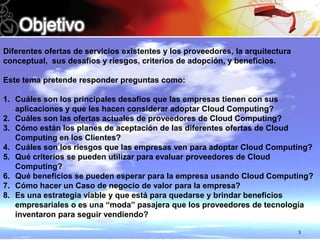
Diferentes ofertas de servicios existentes y los proveedores, la arquitectura
conceptual, sus desafíos y riesgos, criterios de adopción, y beneficios.

Este tema pretende responder preguntas como:

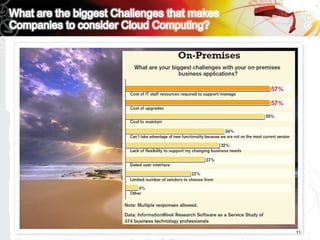
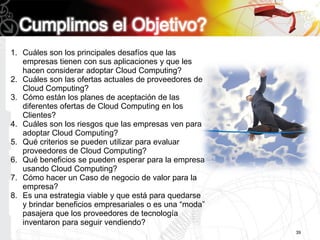
1. Cuáles son los principales desafíos que las empresas tienen con sus
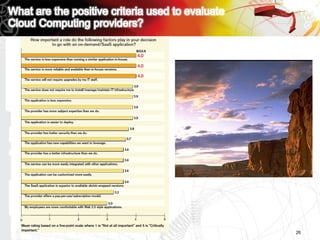
   aplicaciones y que les hacen considerar adoptar Cloud Computing?
2. Cuáles son las ofertas actuales de proveedores de Cloud Computing?
3. Cómo están los planes de aceptación de las diferentes ofertas de Cloud
   Computing en los Clientes?
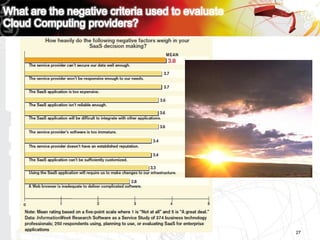
4. Cuáles son los riesgos que las empresas ven para adoptar Cloud Computing?
5. Qué criterios se pueden utilizar para evaluar proveedores de Cloud
   Computing?
6. Qué beneficios se pueden esperar para la empresa usando Cloud Computing?
7. Cómo hacer un Caso de negocio de valor para la empresa?
8. Es una estrategia viable y que está para quedarse y brindar beneficios
   empresariales o es una “moda” pasajera que los proveedores de tecnología
   inventaron para seguir vendiendo?

                                                                                3
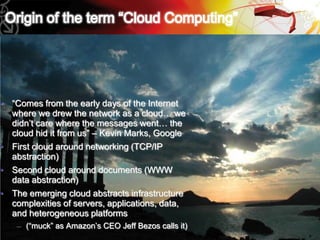
• “Comes from the early days of the Internet
  where we drew the network as a cloud… we
  didn’t care where the messages went… the
  cloud hid it from us” – Kevin Marks, Google
• First cloud around networking (TCP/IP
  abstraction)
• Second cloud around documents (WWW
  data abstraction)
• The emerging cloud abstracts infrastructure
  complexities of servers, applications, data,
  and heterogeneous platforms
    – (“muck” as Amazon’s CEO Jeff Bezos calls it)
                                                     4
Cloud Computing = an emerging IT development, deployment and
delivery model, enabling real-time delivery of products, services and
solutions over the Internet (i.e., enabling cloud services)
                                      IDC, 2008

Cloud Computing = computing as a style of computing in which
scalable and elastic (massively scalable) IT-enabled capabilities are
delivered as a service to external customers using Internet
technologies.
                                     Gartner Group, 2009 (updated)
Cloud computing = a pool of abstracted, highly scalable, and
managed compute infrastructure capable of hosting end-customer
applications and billed by consumption.
                                    Forrester, 2009

Cloud computing is a model for enabling convenient, on-demand
network access to a shared pool of configurable computing
resources (e.g., networks, servers, storage, applications, and
services) that can be rapidly provisioned and released with minimal
management effort or service provider interaction.
                    NIST Cloud Research Team, 2009


                                                                        5
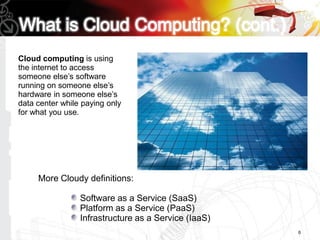
Cloud computing is using
the internet to access
someone else’s software
running on someone else’s
hardware in someone else’s
data center while paying only
for what you use.


     More Cloudy definitions:

                 Software as a Service (SaaS)
                 Platform as a Service (PaaS)
                 Infrastructure as a Service (IaaS)
                                                      6
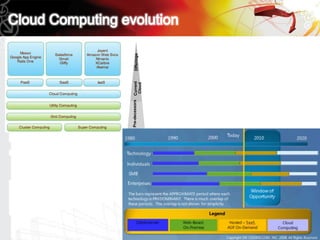
Pre-decessors   Current   Offerings
                     Cloud


7
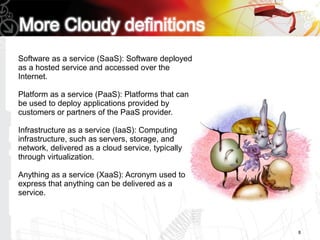
Software as a service (SaaS): Software deployed
as a hosted service and accessed over the
Internet.
Platform as a service (PaaS): Platforms that can
be used to deploy applications provided by
customers or partners of the PaaS provider.
Infrastructure as a service (IaaS): Computing
infrastructure, such as servers, storage, and
network, delivered as a cloud service, typically
through virtualization.

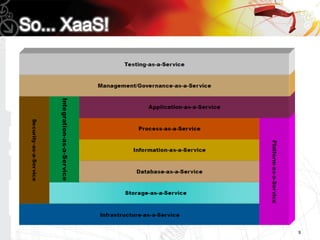
Anything as a service (XaaS): Acronym used to
express that anything can be delivered as a
service.


                                                   8
9
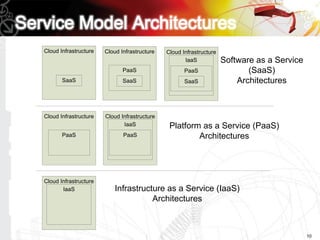
Cloud Infrastructure   Cloud Infrastructure   Cloud Infrastructure
                                                     IaaS            Software as a Service
                              PaaS                   PaaS                   (SaaS)
       SaaS                   SaaS                   SaaS                Architectures


Cloud Infrastructure   Cloud Infrastructure
                              IaaS             Platform as a Service (PaaS)
       PaaS                   PaaS                     Architectures


Cloud Infrastructure
       IaaS                Infrastructure as a Service (IaaS)
                                      Architectures


                                                                                             10
11
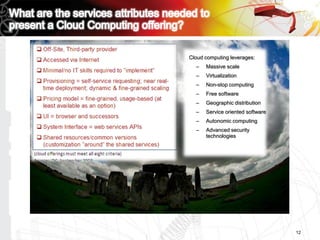
Cloud computing leverages:
  –   Massive scale
  –   Virtualization
  –   Non-stop computing
  –   Free software
  –   Geographic distribution
  –   Service oriented software
  –   Autonomic computing
  –   Advanced security
      technologies


                                  12
13
14
15
16
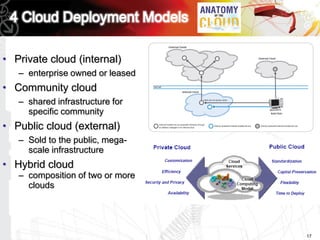
• Private cloud (internal)
   – enterprise owned or leased
• Community cloud
   – shared infrastructure for
     specific community
• Public cloud (external)
   – Sold to the public, mega-
     scale infrastructure
• Hybrid cloud
   – composition of two or more
     clouds


                                  17
18
19
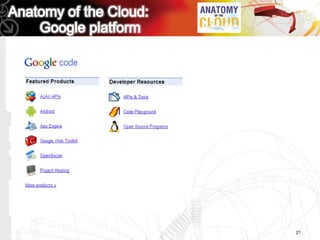
Core Services
• Hosting
• Data Access (BigTable)
• Google Data Services


                           20
21
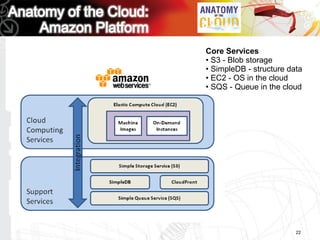
Core Services
• S3 - Blob storage
• SimpleDB - structure data
• EC2 - OS in the cloud
• SQS - Queue in the cloud


                         22
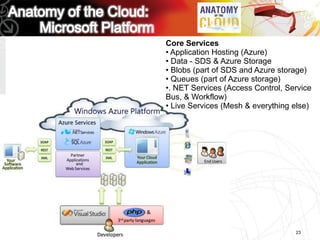
Core Services
• Application Hosting (Azure)
• Data - SDS & Azure Storage
• Blobs (part of SDS and Azure storage)
• Queues (part of Azure storage)
•. NET Services (Access Control, Service
Bus, & Workflow)
• Live Services (Mesh & everything else)


                                   23
24
25
26
27
28
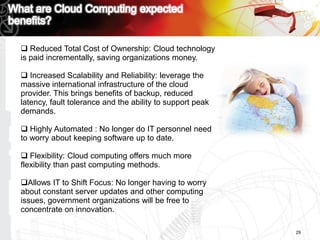
 Reduced Total Cost of Ownership: Cloud technology
is paid incrementally, saving organizations money.

 Increased Scalability and Reliability: leverage the
massive international infrastructure of the cloud
provider. This brings benefits of backup, reduced
latency, fault tolerance and the ability to support peak
demands.

 Highly Automated : No longer do IT personnel need
to worry about keeping software up to date.

 Flexibility: Cloud computing offers much more
flexibility than past computing methods.

Allows IT to Shift Focus: No longer having to worry
about constant server updates and other computing
issues, government organizations will be free to
concentrate on innovation.

                                                           29
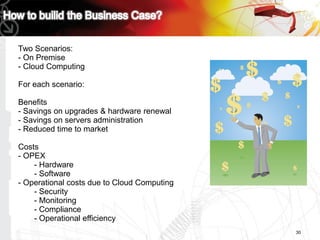
Two Scenarios:
- On Premise
- Cloud Computing

For each scenario:

Benefits
- Savings on upgrades & hardware renewal
- Savings on servers administration
- Reduced time to market

Costs
- OPEX
    - Hardware
    - Software
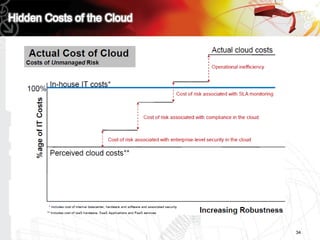
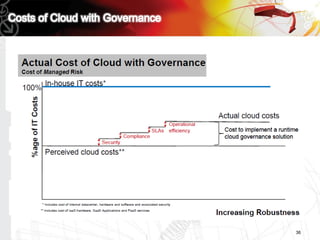
- Operational costs due to Cloud Computing
    - Security
    - Monitoring
    - Compliance
    - Operational efficiency
                                             30
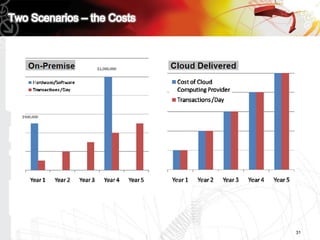
31
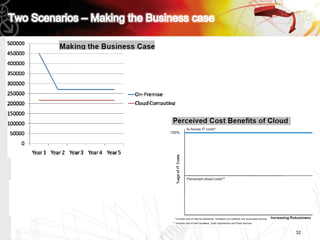
32
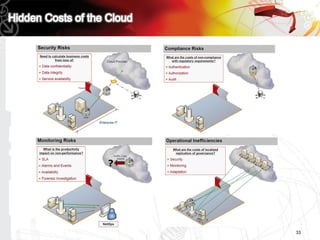
33
34
35
36
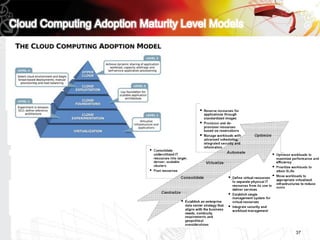
37
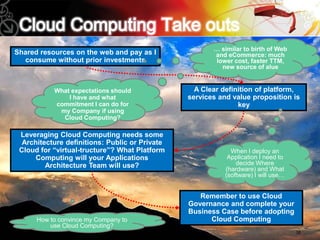
… similar to birth of Web
Shared resources on the web and pay as I               and eCommerce: much
  consume without prior investments                    lower cost, faster TTM,
                                                         new source of alue


           What expectations should               A Clear definition of platform,
               I have and what                  services and value proposition is
           commitment I can do for                             key
            my Company if using
             Cloud Computing?

 Leveraging Cloud Computing needs some
  Architecture definitions: Public or Private
 Cloud for “virtual-tructure”? What Platform                 When I deploy an
      Computing will your Applications                      Application I need to
         Architecture Team will use?                           decide Where
                                                           (hardware) and What
                                                           (software) I will use…


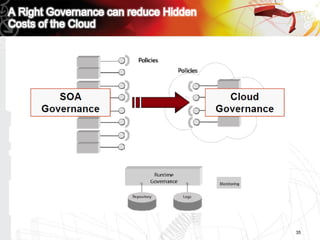
                                                   Remember to use Cloud
                                                Governance and complete your
                                                Business Case before adopting
      How to convince my Company to                   Cloud Computing
          use Cloud Computing?
                                                                                    38
1. Cuáles son los principales desafíos que las
   empresas tienen con sus aplicaciones y que les
   hacen considerar adoptar Cloud Computing?
2. Cuáles son las ofertas actuales de proveedores de
   Cloud Computing?
3. Cómo están los planes de aceptación de las
   diferentes ofertas de Cloud Computing en los
   Clientes?
4. Cuáles son los riesgos que las empresas ven para
   adoptar Cloud Computing?
5. Qué criterios se pueden utilizar para evaluar
   proveedores de Cloud Computing?
6. Qué beneficios se pueden esperar para la empresa
   usando Cloud Computing?
7. Cómo hacer un Caso de negocio de valor para la
   empresa?
8. Es una estrategia viable y que está para quedarse
   y brindar beneficios empresariales o es una “moda”
   pasajera que los proveedores de tecnología
   inventaron para seguir vendiendo?
                                                        39
SoftwareGuru 2009 - Cloud Computing

SoftwareGuru 2009 - Cloud Computing

  • 2.
  • 3.
    Diferentes ofertas deservicios existentes y los proveedores, la arquitectura conceptual, sus desafíos y riesgos, criterios de adopción, y beneficios. Este tema pretende responder preguntas como: 1. Cuáles son los principales desafíos que las empresas tienen con sus aplicaciones y que les hacen considerar adoptar Cloud Computing? 2. Cuáles son las ofertas actuales de proveedores de Cloud Computing? 3. Cómo están los planes de aceptación de las diferentes ofertas de Cloud Computing en los Clientes? 4. Cuáles son los riesgos que las empresas ven para adoptar Cloud Computing? 5. Qué criterios se pueden utilizar para evaluar proveedores de Cloud Computing? 6. Qué beneficios se pueden esperar para la empresa usando Cloud Computing? 7. Cómo hacer un Caso de negocio de valor para la empresa? 8. Es una estrategia viable y que está para quedarse y brindar beneficios empresariales o es una “moda” pasajera que los proveedores de tecnología inventaron para seguir vendiendo? 3
  • 4.
    • “Comes fromthe early days of the Internet where we drew the network as a cloud… we didn’t care where the messages went… the cloud hid it from us” – Kevin Marks, Google • First cloud around networking (TCP/IP abstraction) • Second cloud around documents (WWW data abstraction) • The emerging cloud abstracts infrastructure complexities of servers, applications, data, and heterogeneous platforms – (“muck” as Amazon’s CEO Jeff Bezos calls it) 4
  • 5.
    Cloud Computing =an emerging IT development, deployment and delivery model, enabling real-time delivery of products, services and solutions over the Internet (i.e., enabling cloud services) IDC, 2008 Cloud Computing = computing as a style of computing in which scalable and elastic (massively scalable) IT-enabled capabilities are delivered as a service to external customers using Internet technologies. Gartner Group, 2009 (updated) Cloud computing = a pool of abstracted, highly scalable, and managed compute infrastructure capable of hosting end-customer applications and billed by consumption. Forrester, 2009 Cloud computing is a model for enabling convenient, on-demand network access to a shared pool of configurable computing resources (e.g., networks, servers, storage, applications, and services) that can be rapidly provisioned and released with minimal management effort or service provider interaction. NIST Cloud Research Team, 2009 5
  • 6.
    Cloud computing isusing the internet to access someone else’s software running on someone else’s hardware in someone else’s data center while paying only for what you use. More Cloudy definitions: Software as a Service (SaaS) Platform as a Service (PaaS) Infrastructure as a Service (IaaS) 6
  • 7.
    Pre-decessors Current Offerings Cloud 7
  • 8.
    Software as aservice (SaaS): Software deployed as a hosted service and accessed over the Internet. Platform as a service (PaaS): Platforms that can be used to deploy applications provided by customers or partners of the PaaS provider. Infrastructure as a service (IaaS): Computing infrastructure, such as servers, storage, and network, delivered as a cloud service, typically through virtualization. Anything as a service (XaaS): Acronym used to express that anything can be delivered as a service. 8
  • 9.
  • 10.
    Cloud Infrastructure Cloud Infrastructure Cloud Infrastructure IaaS Software as a Service PaaS PaaS (SaaS) SaaS SaaS SaaS Architectures Cloud Infrastructure Cloud Infrastructure IaaS Platform as a Service (PaaS) PaaS PaaS Architectures Cloud Infrastructure IaaS Infrastructure as a Service (IaaS) Architectures 10
  • 11.
  • 12.
    Cloud computing leverages: – Massive scale – Virtualization – Non-stop computing – Free software – Geographic distribution – Service oriented software – Autonomic computing – Advanced security technologies 12
  • 13.
  • 14.
  • 15.
  • 16.
  • 17.
    • Private cloud(internal) – enterprise owned or leased • Community cloud – shared infrastructure for specific community • Public cloud (external) – Sold to the public, mega- scale infrastructure • Hybrid cloud – composition of two or more clouds 17
  • 18.
  • 19.
  • 20.
    Core Services • Hosting •Data Access (BigTable) • Google Data Services 20
  • 21.
  • 22.
    Core Services • S3- Blob storage • SimpleDB - structure data • EC2 - OS in the cloud • SQS - Queue in the cloud 22
  • 23.
    Core Services • ApplicationHosting (Azure) • Data - SDS & Azure Storage • Blobs (part of SDS and Azure storage) • Queues (part of Azure storage) •. NET Services (Access Control, Service Bus, & Workflow) • Live Services (Mesh & everything else) 23
  • 24.
  • 25.
  • 26.
  • 27.
  • 28.
  • 29.
     Reduced TotalCost of Ownership: Cloud technology is paid incrementally, saving organizations money.  Increased Scalability and Reliability: leverage the massive international infrastructure of the cloud provider. This brings benefits of backup, reduced latency, fault tolerance and the ability to support peak demands.  Highly Automated : No longer do IT personnel need to worry about keeping software up to date.  Flexibility: Cloud computing offers much more flexibility than past computing methods. Allows IT to Shift Focus: No longer having to worry about constant server updates and other computing issues, government organizations will be free to concentrate on innovation. 29
  • 30.
    Two Scenarios: - OnPremise - Cloud Computing For each scenario: Benefits - Savings on upgrades & hardware renewal - Savings on servers administration - Reduced time to market Costs - OPEX - Hardware - Software - Operational costs due to Cloud Computing - Security - Monitoring - Compliance - Operational efficiency 30
  • 31.
  • 32.
  • 33.
  • 34.
  • 35.
  • 36.
  • 37.
  • 38.
    … similar tobirth of Web Shared resources on the web and pay as I and eCommerce: much consume without prior investments lower cost, faster TTM, new source of alue What expectations should A Clear definition of platform, I have and what services and value proposition is commitment I can do for key my Company if using Cloud Computing? Leveraging Cloud Computing needs some Architecture definitions: Public or Private Cloud for “virtual-tructure”? What Platform When I deploy an Computing will your Applications Application I need to Architecture Team will use? decide Where (hardware) and What (software) I will use… Remember to use Cloud Governance and complete your Business Case before adopting How to convince my Company to Cloud Computing use Cloud Computing? 38
  • 39.
    1. Cuáles sonlos principales desafíos que las empresas tienen con sus aplicaciones y que les hacen considerar adoptar Cloud Computing? 2. Cuáles son las ofertas actuales de proveedores de Cloud Computing? 3. Cómo están los planes de aceptación de las diferentes ofertas de Cloud Computing en los Clientes? 4. Cuáles son los riesgos que las empresas ven para adoptar Cloud Computing? 5. Qué criterios se pueden utilizar para evaluar proveedores de Cloud Computing? 6. Qué beneficios se pueden esperar para la empresa usando Cloud Computing? 7. Cómo hacer un Caso de negocio de valor para la empresa? 8. Es una estrategia viable y que está para quedarse y brindar beneficios empresariales o es una “moda” pasajera que los proveedores de tecnología inventaron para seguir vendiendo? 39