Software Security December 2014
Roman Oliynykov
Professor at
Information Technologies Security Department
Kharkov National University of Radioelectronics
Head of Scientific Research Department
JSC “Institute of Information Technologies”
Ukraine
Visiting professor at
Samsung Advanced Technology Training Institute
Korea
ROliynykov@gmail.com
Lectures outline
 A few words about myself
 Importance of secure solutions
 Buffer overflow vulnerability and
countermeasures
 Heap overruns and integer overflows,
recommendations for avoiding
 Format string vulnerabilities and security
recommendations
For these lectures
I suppose you are familiar
 for general understanding of discussing
problems:
 C and C++ programming languages (basic level)
 it will be discussed, but would be an advantage if
you already familiar with
 operation system architecture (process, address
space, stack, heap, etc.)
 x86 assembler language source code (preferably
AT&T notation)
 basics of Linux (command line) and computer
networking
About myself (I)
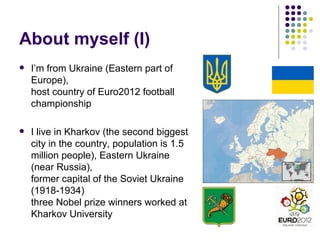
 I’m from Ukraine (Eastern part of
Europe),
host country of Euro2012 football
championship
 I live in Kharkov (the second biggest
city in the country, population is 1.5
million people), Eastern Ukraine
(near Russia),
former capital of the Soviet Ukraine
(1918-1934)
three Nobel prize winners worked at
Kharkov University
About myself (II)
 Professor of Information Technologies
Security Department at Kharkov
National University of Radioelectronics
 courses on computer networks and
operation system security, special
mathematics for cryptographic applications
 Head of Scientific Research
Department at JSC “Institute of
Information Technologies”
 Scientific interests: symmetric
cryptographic primitives synthesis and
cryptanalysis
A few words about importance
of secure solutions
Modern malware
 functions of different categories: viruses,
worms and Trojan horses
 belongs to network of bot programs (botnet)
 executes commands received from the
botnet control center
 has stealth/polymorphysm/armoring
functions against antivirus software
Consequences of cyberattacks
for the society
[Norton/Symantec cybercrime report, 2013]
Consequences of cyberattacks
for the society
[Norton/Symantec cybercrime report, 2013]
Consequences of cyberattacks
for the society
[Norton/Symantec cybercrime report, 2013]
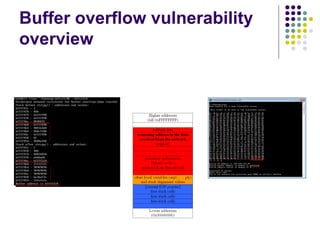
Buffer overflow vulnerability
overview
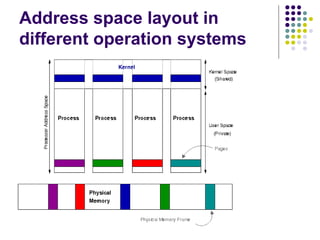
Address space layout in
different operation systems
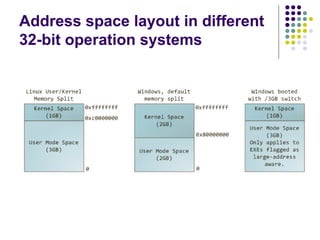
Address space layout in different
32-bit operation systems
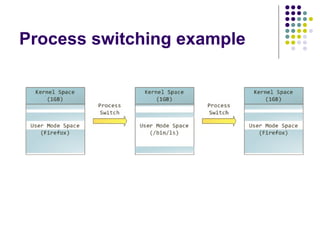
Process switching example
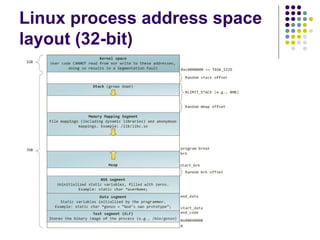
Linux process address space
layout (32-bit)
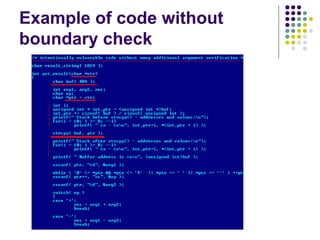
Example of code without
boundary check
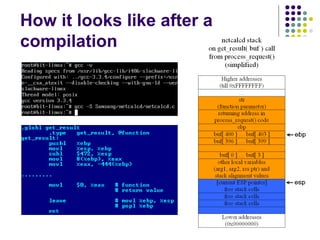
How it looks like after a
compilation
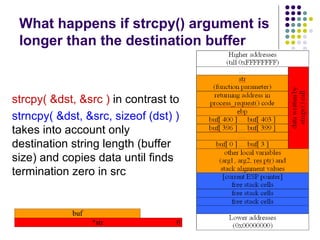
What happens if strcpy() argument is
longer than the destination buffer
strcpy( &dst, &src ) in contrast to
strncpy( &dst, &src, sizeof (dst) )
takes into account only
destination string length (buffer
size) and copies data until finds
termination zero in src
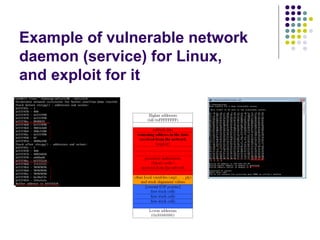
Example of vulnerable network
daemon (service) for Linux,
and exploit for it
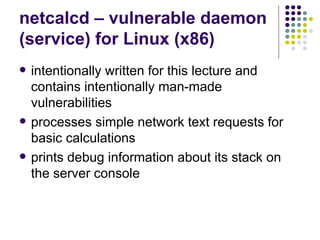
netcalcd – vulnerable daemon
(service) for Linux (x86)
 intentionally written for this lecture and
contains intentionally man-made
vulnerabilities
 processes simple network text requests for
basic calculations
 prints debug information about its stack on
the server console
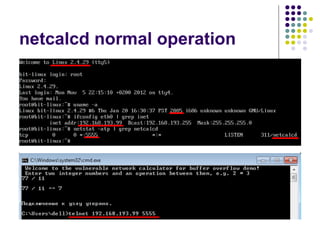
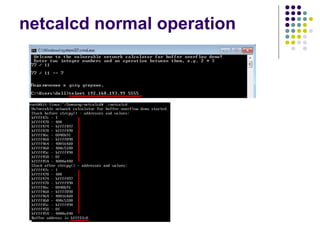
netcalcd normal operation
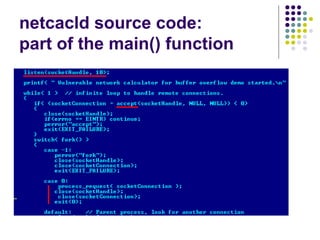
netcacld source code:
part of the main() function
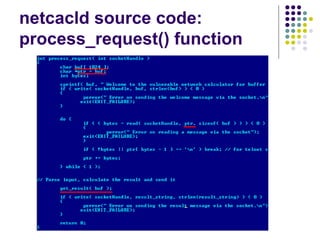
netcacld source code:
process_request() function
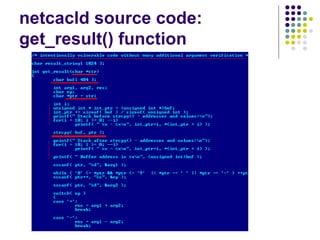
netcacld source code:
get_result() function
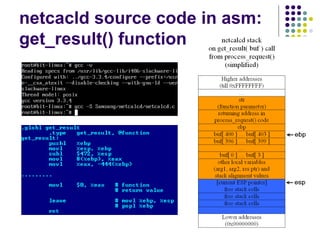
netcacld source code in asm:
get_result() function
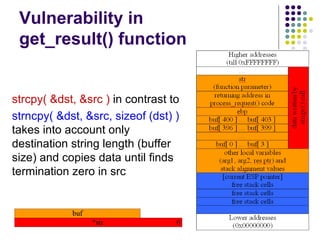
Vulnerability in
get_result() function
strcpy( &dst, &src ) in contrast to
strncpy( &dst, &src, sizeof (dst) )
takes into account only
destination string length (buffer
size) and copies data until finds
termination zero in src
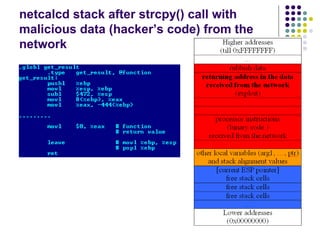
netcalcd stack after strcpy() call with
malicious data (hacker’s code) from the
network
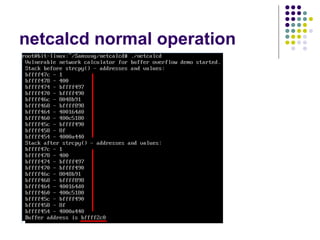
netcalcd normal operation
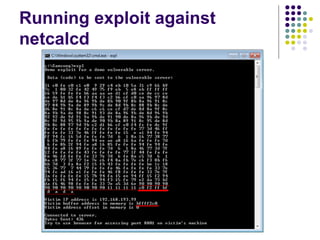
Running exploit against
netcalcd
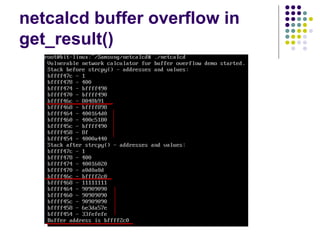
netcalcd buffer overflow in
get_result()
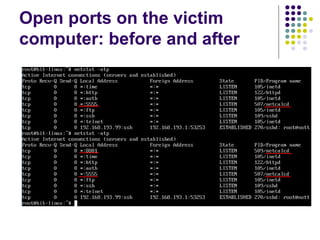
Open ports on the victim
computer: before and after
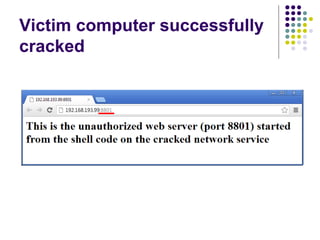
Victim computer successfully
cracked
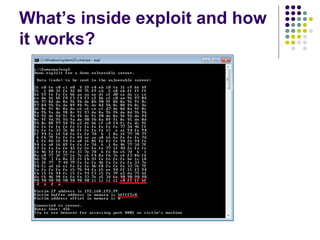
What’s inside exploit and how
it works?
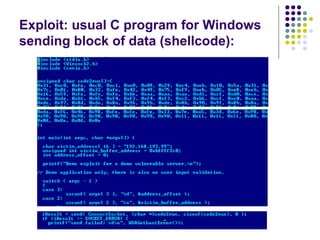
Exploit: usual C program for Windows
sending block of data (shellcode):
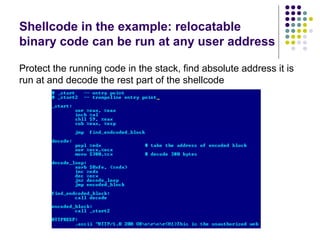
Shellcode in the example: relocatable
binary code can be run at any user address
Protect the running code in the stack, find absolute address it is
run at and decode the rest part of the shellcode
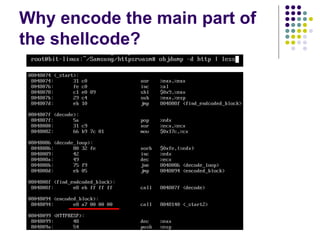
Why encode the main part of
the shellcode?
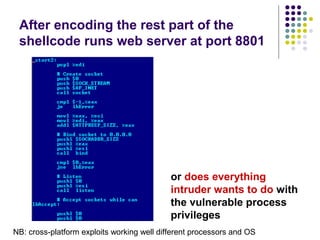
After encoding the rest part of the
shellcode runs web server at port 8801
or does everything
intruder wants to do with
the vulnerable process
privileges
NB: cross-platform exploits working well different processors and OS
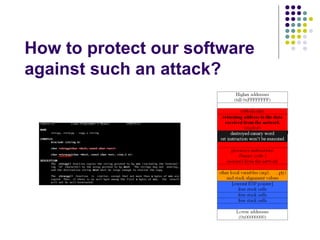
How to protect our software
against such an attack?
Possible countermeasures
against buffer overflow
 write secure code based on secure functions calls
and all necessary user input verification (the most
important recommendation)
 make your operation system to use Address Space
Layout Randomization (ASLR)
 make your operation system use processor NX bit
(on x86 platform)
 keep on canary words in your compiler
 run the code with the least necessary privileges
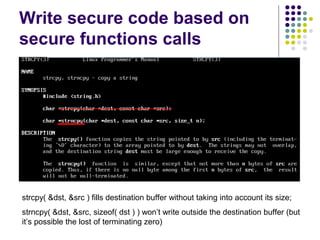
Write secure code based on
secure functions calls
strcpy( &dst, &src ) fills destination buffer without taking into account its size;
strncpy( &dst, &src, sizeof( dst ) ) won’t write outside the destination buffer (but
it’s possible the lost of terminating zero)
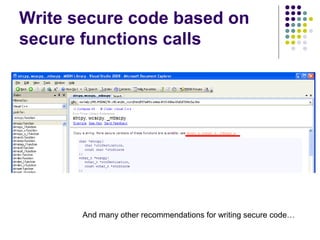
Write secure code based on
secure functions calls
And many other recommendations for writing secure code…
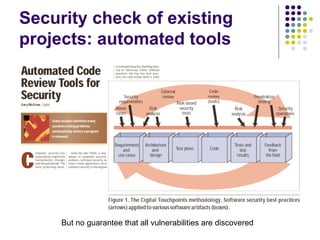
Security check of existing
projects: automated tools
But no guarantee that all vulnerabilities are discovered
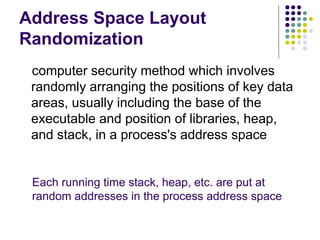
Address Space Layout
Randomization
computer security method which involves
randomly arranging the positions of key data
areas, usually including the base of the
executable and position of libraries, heap,
and stack, in a process's address space
Each running time stack, heap, etc. are put at
random addresses in the process address space
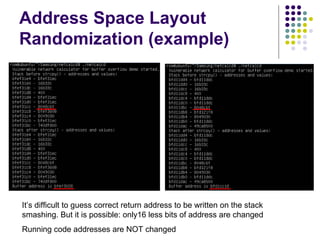
Address Space Layout
Randomization (example)
It’s difficult to guess correct return address to be written on the stack
smashing. But it is possible: only16 less bits of address are changed
Running code addresses are NOT changed
ASLR appeared:
 Linux kernel support: 2.6.12 (released June
2005)
 Microsoft's Windows Vista (released January
2007), Windows Server 2008, Windows 7,
and later have ASLR enabled by default
 Android 4.0 Ice Cream Sandwich provides
ASLR
 …
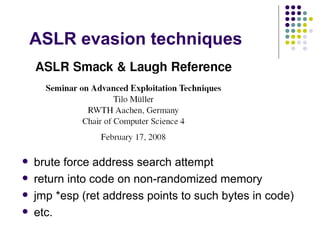
ASLR evasion techniques
 brute force address search attempt
 return into code on non-randomized memory
 jmp *esp (ret address points to such bytes in code)
 etc.
x86 calling conventions
 cdecl (C declaration)
 arguments are pushed to the stack in the reverse
order (the last one has the higher address)
 calling function cleans stack (allows arbitrary
number of arguments after program compilation)
 stdcall (standard call)
 arguments are pushed to the stack in the reverse
order (like in cdecl)
 called function cleans stack
x86 calling conventions (cont.)
 pascal
 arguments are pushed to the stack in the direct order (the
last one has the lower address)
 called function cleans stack
 fastcall
 first two arguments are passed via registers, the rest (if
any) are pushed to the stack in the reverse order (like in
cdecl)
 called function cleans stack
 thiscall (for OOP non-static member functions)
 this pointer (to object *this) is an additional parameter
 for gcc: calling function cleans stack; for MS Visual C++: it
depends on fixed (called) or variable (calling) number of
arguments
x86_64 calling conventions
 the single calling conversion:
 first 4 arguments are passed via registers rcx, rdx,
r8, r9, the rest (if any) are pushed to the stack in
the reverse order (like in cdecl)
 calling function cleans stack (like in cdecl)
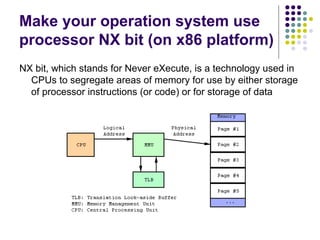
Make your operation system use
processor NX bit (on x86 platform)
NX bit, which stands for Never eXecute, is a technology used in
CPUs to segregate areas of memory for use by either storage
of processor instructions (or code) or for storage of data
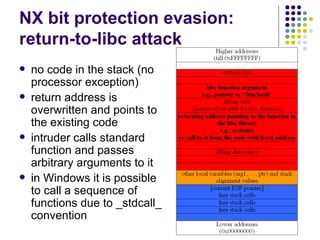
NX bit protection evasion:
return-to-libc attack
 no code in the stack (no
processor exception)
 return address is
overwritten and points to
the existing code
 intruder calls standard
function and passes
arbitrary arguments to it
 in Windows it is possible
to call a sequence of
functions due to _stdcall_
convention
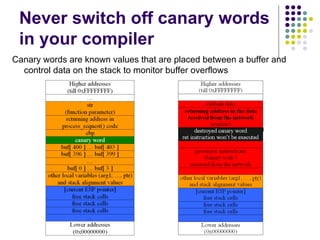
Never switch off canary words
in your compiler
Canary words are known values that are placed between a buffer and
control data on the stack to monitor buffer overflows
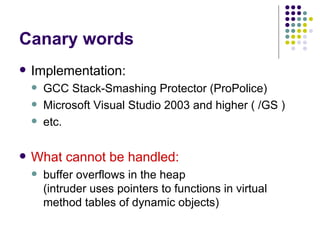
Canary words
 Implementation:
 GCC Stack-Smashing Protector (ProPolice)
 Microsoft Visual Studio 2003 and higher ( /GS )
 etc.
 What cannot be handled:
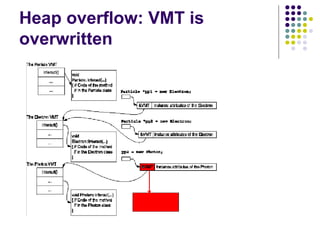
 buffer overflows in the heap
(intruder uses pointers to functions in virtual
method tables of dynamic objects)
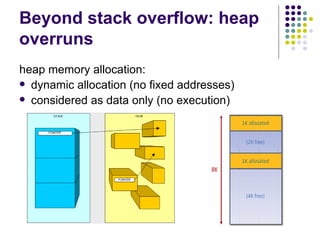
Beyond stack overflow: heap
overruns
heap memory allocation:
 dynamic allocation (no fixed addresses)
 considered as data only (no execution)
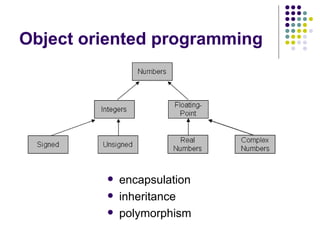
Object oriented programming
 encapsulation
 inheritance
 polymorphism
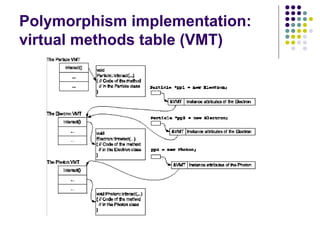
Polymorphism implementation:
virtual methods table (VMT)
Heap overflow: VMT is
overwritten
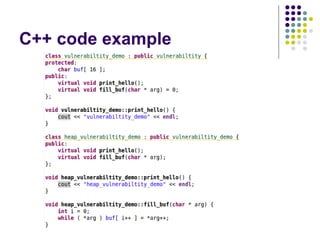
C++ code example
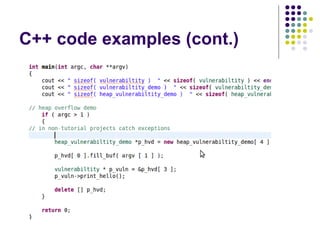
C++ code examples (cont.)
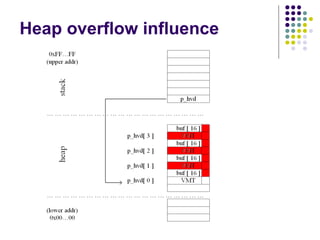
Heap overflow influence
Threats for heap overflow
beyond OOP
 function pointers
 indexes for arrays (will be discussed with
integer overflows)
 other data structures located at heap may
have influence to program execution
cf: Heap Spraying methods used by intruders
Heap overflow
 NX bit does NOT protect
 no canary words
 ASLR evasion techniques work well
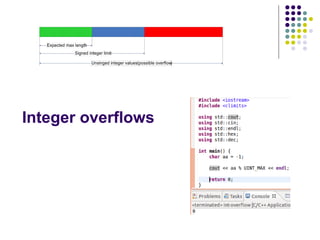
Integer overflows
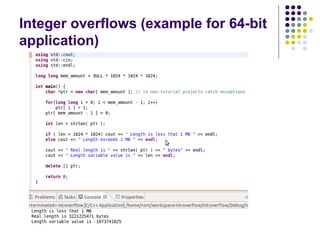
Integer overflows (example for 64-bit
application)
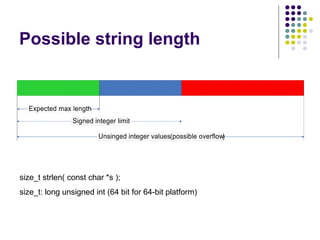
Possible string length
size_t strlen( const char *s );
size_t: long unsigned int (64 bit for 64-bit platform)
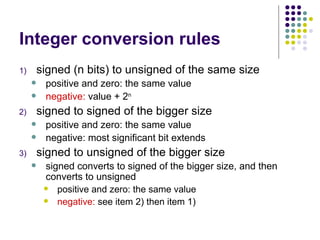
Integer conversion rules
1) signed (n bits) to unsigned of the same size
 positive and zero: the same value
 negative: value + 2n
2) signed to signed of the bigger size
 positive and zero: the same value
 negative: most significant bit extends
3) signed to unsigned of the bigger size
 signed converts to signed of the bigger size, and then
converts to unsigned
 positive and zero: the same value
 negative: see item 2) then item 1)
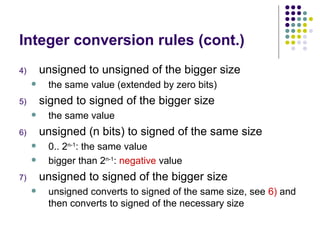
Integer conversion rules (cont.)
4) unsigned to unsigned of the bigger size
 the same value (extended by zero bits)
5) signed to signed of the bigger size
 the same value
6) unsigned (n bits) to signed of the same size
 0.. 2n-1
: the same value
 bigger than 2n-1
: negative value
7) unsigned to signed of the bigger size
 unsigned converts to signed of the same size, see 6) and
then converts to signed of the necessary size
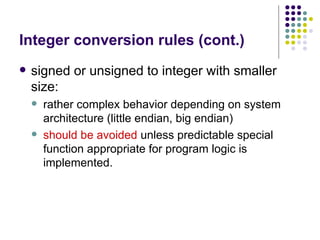
Integer conversion rules (cont.)
 signed or unsigned to integer with smaller
size:
 rather complex behavior depending on system
architecture (little endian, big endian)
 should be avoided unless predictable special
function appropriate for program logic is
implemented.
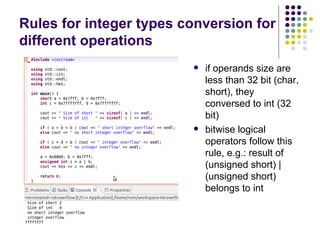
Rules for integer types conversion for
different operations
 if operands size are
less than 32 bit (char,
short), they
conversed to int (32
bit)
 bitwise logical
operators follow this
rule, e.g.: result of
(unsigned short) |
(unsigned short)
belongs to int
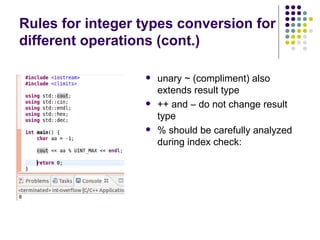
Rules for integer types conversion for
different operations (cont.)
 unary ~ (compliment) also
extends result type
 ++ and – do not change result
type
 % should be carefully analyzed
during index check:
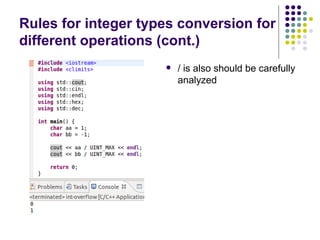
Rules for integer types conversion for
different operations (cont.)
 / is also should be carefully
analyzed
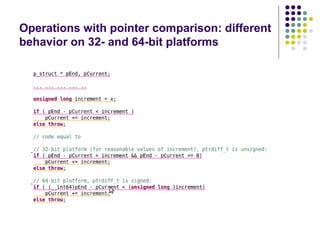
Operations with pointer comparison: different
behavior on 32- and 64-bit platforms
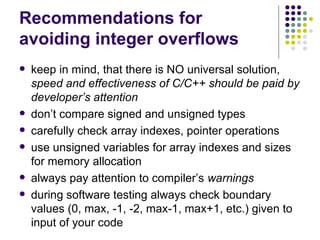
Recommendations for
avoiding integer overflows
 keep in mind, that there is NO universal solution,
speed and effectiveness of C/C++ should be paid by
developer’s attention
 don’t compare signed and unsigned types
 carefully check array indexes, pointer operations
 use unsigned variables for array indexes and sizes
for memory allocation
 always pay attention to compiler’s warnings
 during software testing always check boundary
values (0, max, -1, -2, max-1, max+1, etc.) given to
input of your code
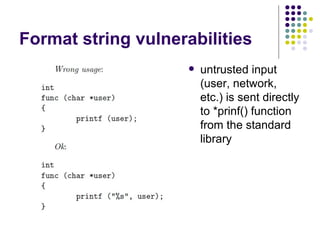
Format string vulnerabilities
 untrusted input
(user, network,
etc.) is sent directly
to *prinf() function
from the standard
library
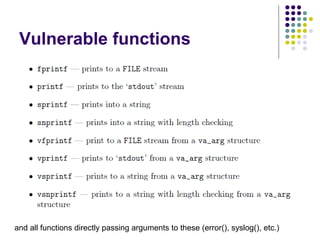
Vulnerable functions
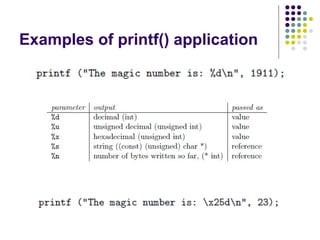
and all functions directly passing arguments to these (error(), syslog(), etc.)
Examples of printf() application
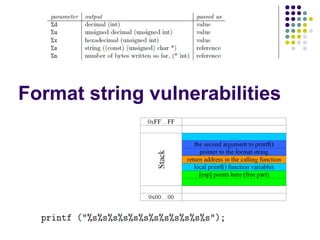
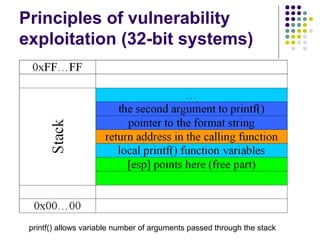
Principles of vulnerability
exploitation (32-bit systems)
printf() allows variable number of arguments passed through the stack
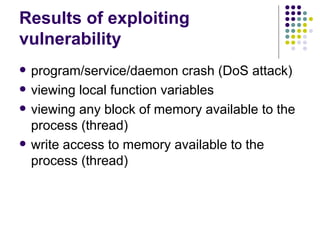
Results of exploiting
vulnerability
 program/service/daemon crash (DoS attack)
 viewing local function variables
 viewing any block of memory available to the
process (thread)
 write access to memory available to the
process (thread)
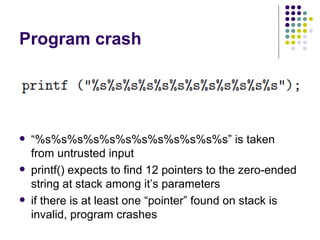
Program crash
 “%s%s%s%s%s%s%s%s%s%s%s%s” is taken
from untrusted input
 printf() expects to find 12 pointers to the zero-ended
string at stack among it’s parameters
 if there is at least one “pointer” found on stack is
invalid, program crashes
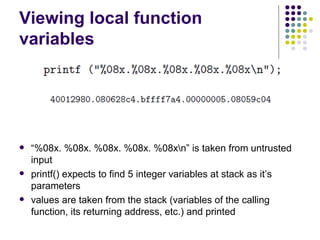
Viewing local function
variables
 “%08x. %08x. %08x. %08x. %08xn” is taken from untrusted
input
 printf() expects to find 5 integer variables at stack as it’s
parameters
 values are taken from the stack (variables of the calling
function, its returning address, etc.) and printed
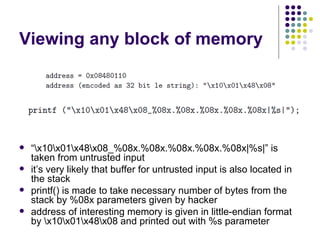
Viewing any block of memory
 “x10x01x48x08_%08x.%08x.%08x.%08x.%08x|%s|” is
taken from untrusted input
 it’s very likely that buffer for untrusted input is also located in
the stack
 printf() is made to take necessary number of bytes from the
stack by %08x parameters given by hacker
 address of interesting memory is given in little-endian format
by x10x01x48x08 and printed out with %s parameter
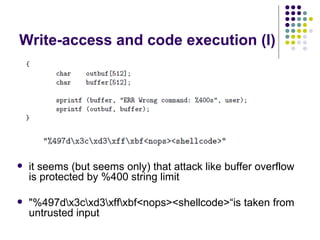
Write-access and code execution (I)
 it seems (but seems only) that attack like buffer overflow
is protected by %400 string limit
 "%497dx3cxd3xffxbf<nops><shellcode>“is taken from
untrusted input
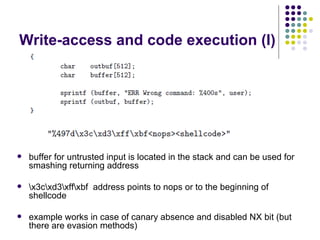
Write-access and code execution (I)
 buffer for untrusted input is located in the stack and can be used for
smashing returning address
 x3cxd3xffxbf address points to nops or to the beginning of
shellcode
 example works in case of canary absence and disabled NX bit (but
there are evasion methods)
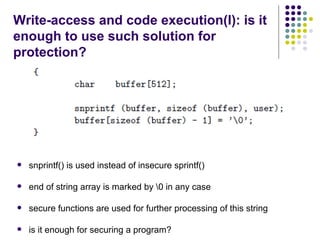
Write-access and code execution(I): is it
enough to use such solution for
protection?
 snprintf() is used instead of insecure sprintf()
 end of string array is marked by 0 in any case
 secure functions are used for further processing of this string
 is it enough for securing a program?
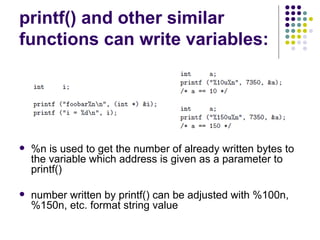
printf() and other similar
functions can write variables:
 %n is used to get the number of already written bytes to
the variable which address is given as a parameter to
printf()
 number written by printf() can be adjusted with %100n,
%150n, etc. format string value
Write-access to process memory (II):
tasks for exploiters
 find format-string vulnerability
 find a block of code putting parameter to the
stack
 write a basic sequence for format string
 find an offset in stack for taking parameters
and addresses
 in case of code execution (not only memory
read/write): ASLR, canary and NX bit evasion
[beyond this attack]
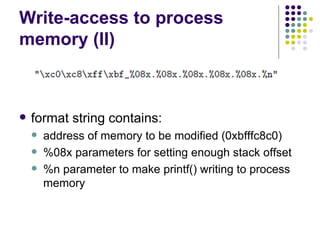
Write-access to process
memory (II)
 format string contains:
 address of memory to be modified (0xbfffc8c0)
 %08x parameters for setting enough stack offset
 %n parameter to make printf() writing to process
memory
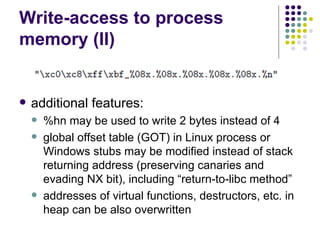
Write-access to process
memory (II)
 additional features:
 %hn may be used to write 2 bytes instead of 4
 global offset table (GOT) in Linux process or
Windows stubs may be modified instead of stack
returning address (preserving canaries and
evading NX bit), including “return-to-libc method”
 addresses of virtual functions, destructors, etc. in
heap can be also overwritten
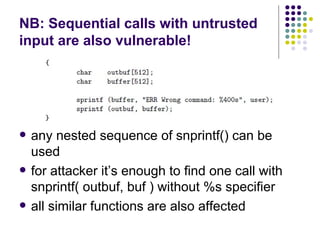
NB: Sequential calls with untrusted
input are also vulnerable!
 any nested sequence of snprintf() can be
used
 for attacker it’s enough to find one call with
snprintf( outbuf, buf ) without %s specifier
 all similar functions are also affected
Recommendations for
functions taking format string:
 use snprintf( outbuf, “%s”, buf ) in all cases; remember
that snprintf( outbuf, buf ) vulnerable in any nested call if
some part of buf is taken from untrusted input
 use only secure functions (snprintf() instead of sprintf(),
etc., as pointed out in man pages and msdn)
 mark the end of string array by 0 end in any case
 keep in mind, that there is NO universal solution, speed
and effectiveness of C/C++ should be paid by
developer’s attention
 don’t believe that this is only C/C++ problem: Java virtual
machines (JVM), Perl, etc. are written in C/C++ and may
cause this vulnerability even to script languages
Recommended books:
further reading
 24 Deadly Sins of Software Security: Programming
Flaws and How to Fix Them (Michael Howard, David
LeBlanc, John Viega)
 Writing Secure Code (Michael Howard)
 Software Security: Building Security In (Gary McGraw)
 The Security Development Lifecycle (Michael Howard,
Steve Lipner)
 Secure Coding: Principles and Practices (Mark G. Graff,
Kenneth R. van Wyk)
 Scott Meyers. Effective C++: 55 Specific Ways to
Improve Your Programs and Designs (3rd Edition)

Software Security

  • 1.
    Software Security December2014 Roman Oliynykov Professor at Information Technologies Security Department Kharkov National University of Radioelectronics Head of Scientific Research Department JSC “Institute of Information Technologies” Ukraine Visiting professor at Samsung Advanced Technology Training Institute Korea ROliynykov@gmail.com
  • 2.
    Lectures outline  Afew words about myself  Importance of secure solutions  Buffer overflow vulnerability and countermeasures  Heap overruns and integer overflows, recommendations for avoiding  Format string vulnerabilities and security recommendations
  • 3.
    For these lectures Isuppose you are familiar  for general understanding of discussing problems:  C and C++ programming languages (basic level)  it will be discussed, but would be an advantage if you already familiar with  operation system architecture (process, address space, stack, heap, etc.)  x86 assembler language source code (preferably AT&T notation)  basics of Linux (command line) and computer networking
  • 4.
    About myself (I) I’m from Ukraine (Eastern part of Europe), host country of Euro2012 football championship  I live in Kharkov (the second biggest city in the country, population is 1.5 million people), Eastern Ukraine (near Russia), former capital of the Soviet Ukraine (1918-1934) three Nobel prize winners worked at Kharkov University
  • 5.
    About myself (II) Professor of Information Technologies Security Department at Kharkov National University of Radioelectronics  courses on computer networks and operation system security, special mathematics for cryptographic applications  Head of Scientific Research Department at JSC “Institute of Information Technologies”  Scientific interests: symmetric cryptographic primitives synthesis and cryptanalysis
  • 6.
    A few wordsabout importance of secure solutions
  • 7.
    Modern malware  functionsof different categories: viruses, worms and Trojan horses  belongs to network of bot programs (botnet)  executes commands received from the botnet control center  has stealth/polymorphysm/armoring functions against antivirus software
  • 8.
    Consequences of cyberattacks forthe society [Norton/Symantec cybercrime report, 2013]
  • 9.
    Consequences of cyberattacks forthe society [Norton/Symantec cybercrime report, 2013]
  • 10.
    Consequences of cyberattacks forthe society [Norton/Symantec cybercrime report, 2013]
  • 11.
  • 12.
    Address space layoutin different operation systems
  • 13.
    Address space layoutin different 32-bit operation systems
  • 14.
  • 15.
    Linux process addressspace layout (32-bit)
  • 16.
    Example of codewithout boundary check
  • 17.
    How it lookslike after a compilation
  • 18.
    What happens ifstrcpy() argument is longer than the destination buffer strcpy( &dst, &src ) in contrast to strncpy( &dst, &src, sizeof (dst) ) takes into account only destination string length (buffer size) and copies data until finds termination zero in src
  • 19.
    Example of vulnerablenetwork daemon (service) for Linux, and exploit for it
  • 20.
    netcalcd – vulnerabledaemon (service) for Linux (x86)  intentionally written for this lecture and contains intentionally man-made vulnerabilities  processes simple network text requests for basic calculations  prints debug information about its stack on the server console
  • 21.
  • 22.
  • 23.
    netcacld source code: partof the main() function
  • 24.
  • 25.
  • 26.
    netcacld source codein asm: get_result() function
  • 27.
    Vulnerability in get_result() function strcpy(&dst, &src ) in contrast to strncpy( &dst, &src, sizeof (dst) ) takes into account only destination string length (buffer size) and copies data until finds termination zero in src
  • 28.
    netcalcd stack afterstrcpy() call with malicious data (hacker’s code) from the network
  • 29.
  • 30.
  • 31.
    netcalcd buffer overflowin get_result()
  • 32.
    Open ports onthe victim computer: before and after
  • 33.
  • 34.
    What’s inside exploitand how it works?
  • 35.
    Exploit: usual Cprogram for Windows sending block of data (shellcode):
  • 36.
    Shellcode in theexample: relocatable binary code can be run at any user address Protect the running code in the stack, find absolute address it is run at and decode the rest part of the shellcode
  • 37.
    Why encode themain part of the shellcode?
  • 38.
    After encoding therest part of the shellcode runs web server at port 8801 or does everything intruder wants to do with the vulnerable process privileges NB: cross-platform exploits working well different processors and OS
  • 39.
    How to protectour software against such an attack?
  • 40.
    Possible countermeasures against bufferoverflow  write secure code based on secure functions calls and all necessary user input verification (the most important recommendation)  make your operation system to use Address Space Layout Randomization (ASLR)  make your operation system use processor NX bit (on x86 platform)  keep on canary words in your compiler  run the code with the least necessary privileges
  • 41.
    Write secure codebased on secure functions calls strcpy( &dst, &src ) fills destination buffer without taking into account its size; strncpy( &dst, &src, sizeof( dst ) ) won’t write outside the destination buffer (but it’s possible the lost of terminating zero)
  • 42.
    Write secure codebased on secure functions calls And many other recommendations for writing secure code…
  • 43.
    Security check ofexisting projects: automated tools But no guarantee that all vulnerabilities are discovered
  • 44.
    Address Space Layout Randomization computersecurity method which involves randomly arranging the positions of key data areas, usually including the base of the executable and position of libraries, heap, and stack, in a process's address space Each running time stack, heap, etc. are put at random addresses in the process address space
  • 45.
    Address Space Layout Randomization(example) It’s difficult to guess correct return address to be written on the stack smashing. But it is possible: only16 less bits of address are changed Running code addresses are NOT changed
  • 46.
    ASLR appeared:  Linuxkernel support: 2.6.12 (released June 2005)  Microsoft's Windows Vista (released January 2007), Windows Server 2008, Windows 7, and later have ASLR enabled by default  Android 4.0 Ice Cream Sandwich provides ASLR  …
  • 47.
    ASLR evasion techniques brute force address search attempt  return into code on non-randomized memory  jmp *esp (ret address points to such bytes in code)  etc.
  • 48.
    x86 calling conventions cdecl (C declaration)  arguments are pushed to the stack in the reverse order (the last one has the higher address)  calling function cleans stack (allows arbitrary number of arguments after program compilation)  stdcall (standard call)  arguments are pushed to the stack in the reverse order (like in cdecl)  called function cleans stack
  • 49.
    x86 calling conventions(cont.)  pascal  arguments are pushed to the stack in the direct order (the last one has the lower address)  called function cleans stack  fastcall  first two arguments are passed via registers, the rest (if any) are pushed to the stack in the reverse order (like in cdecl)  called function cleans stack  thiscall (for OOP non-static member functions)  this pointer (to object *this) is an additional parameter  for gcc: calling function cleans stack; for MS Visual C++: it depends on fixed (called) or variable (calling) number of arguments
  • 50.
    x86_64 calling conventions the single calling conversion:  first 4 arguments are passed via registers rcx, rdx, r8, r9, the rest (if any) are pushed to the stack in the reverse order (like in cdecl)  calling function cleans stack (like in cdecl)
  • 51.
    Make your operationsystem use processor NX bit (on x86 platform) NX bit, which stands for Never eXecute, is a technology used in CPUs to segregate areas of memory for use by either storage of processor instructions (or code) or for storage of data
  • 52.
    NX bit protectionevasion: return-to-libc attack  no code in the stack (no processor exception)  return address is overwritten and points to the existing code  intruder calls standard function and passes arbitrary arguments to it  in Windows it is possible to call a sequence of functions due to _stdcall_ convention
  • 53.
    Never switch offcanary words in your compiler Canary words are known values that are placed between a buffer and control data on the stack to monitor buffer overflows
  • 54.
    Canary words  Implementation: GCC Stack-Smashing Protector (ProPolice)  Microsoft Visual Studio 2003 and higher ( /GS )  etc.  What cannot be handled:  buffer overflows in the heap (intruder uses pointers to functions in virtual method tables of dynamic objects)
  • 55.
    Beyond stack overflow:heap overruns heap memory allocation:  dynamic allocation (no fixed addresses)  considered as data only (no execution)
  • 56.
    Object oriented programming encapsulation  inheritance  polymorphism
  • 57.
  • 58.
    Heap overflow: VMTis overwritten
  • 59.
  • 60.
  • 61.
  • 62.
    Threats for heapoverflow beyond OOP  function pointers  indexes for arrays (will be discussed with integer overflows)  other data structures located at heap may have influence to program execution cf: Heap Spraying methods used by intruders
  • 63.
    Heap overflow  NXbit does NOT protect  no canary words  ASLR evasion techniques work well
  • 64.
  • 65.
    Integer overflows (examplefor 64-bit application)
  • 66.
    Possible string length size_tstrlen( const char *s ); size_t: long unsigned int (64 bit for 64-bit platform)
  • 67.
    Integer conversion rules 1)signed (n bits) to unsigned of the same size  positive and zero: the same value  negative: value + 2n 2) signed to signed of the bigger size  positive and zero: the same value  negative: most significant bit extends 3) signed to unsigned of the bigger size  signed converts to signed of the bigger size, and then converts to unsigned  positive and zero: the same value  negative: see item 2) then item 1)
  • 68.
    Integer conversion rules(cont.) 4) unsigned to unsigned of the bigger size  the same value (extended by zero bits) 5) signed to signed of the bigger size  the same value 6) unsigned (n bits) to signed of the same size  0.. 2n-1 : the same value  bigger than 2n-1 : negative value 7) unsigned to signed of the bigger size  unsigned converts to signed of the same size, see 6) and then converts to signed of the necessary size
  • 69.
    Integer conversion rules(cont.)  signed or unsigned to integer with smaller size:  rather complex behavior depending on system architecture (little endian, big endian)  should be avoided unless predictable special function appropriate for program logic is implemented.
  • 70.
    Rules for integertypes conversion for different operations  if operands size are less than 32 bit (char, short), they conversed to int (32 bit)  bitwise logical operators follow this rule, e.g.: result of (unsigned short) | (unsigned short) belongs to int
  • 71.
    Rules for integertypes conversion for different operations (cont.)  unary ~ (compliment) also extends result type  ++ and – do not change result type  % should be carefully analyzed during index check:
  • 72.
    Rules for integertypes conversion for different operations (cont.)  / is also should be carefully analyzed
  • 73.
    Operations with pointercomparison: different behavior on 32- and 64-bit platforms
  • 74.
    Recommendations for avoiding integeroverflows  keep in mind, that there is NO universal solution, speed and effectiveness of C/C++ should be paid by developer’s attention  don’t compare signed and unsigned types  carefully check array indexes, pointer operations  use unsigned variables for array indexes and sizes for memory allocation  always pay attention to compiler’s warnings  during software testing always check boundary values (0, max, -1, -2, max-1, max+1, etc.) given to input of your code
  • 75.
  • 76.
    Format string vulnerabilities untrusted input (user, network, etc.) is sent directly to *prinf() function from the standard library
  • 77.
    Vulnerable functions and allfunctions directly passing arguments to these (error(), syslog(), etc.)
  • 78.
  • 79.
    Principles of vulnerability exploitation(32-bit systems) printf() allows variable number of arguments passed through the stack
  • 80.
    Results of exploiting vulnerability program/service/daemon crash (DoS attack)  viewing local function variables  viewing any block of memory available to the process (thread)  write access to memory available to the process (thread)
  • 81.
    Program crash  “%s%s%s%s%s%s%s%s%s%s%s%s”is taken from untrusted input  printf() expects to find 12 pointers to the zero-ended string at stack among it’s parameters  if there is at least one “pointer” found on stack is invalid, program crashes
  • 82.
    Viewing local function variables “%08x. %08x. %08x. %08x. %08xn” is taken from untrusted input  printf() expects to find 5 integer variables at stack as it’s parameters  values are taken from the stack (variables of the calling function, its returning address, etc.) and printed
  • 83.
    Viewing any blockof memory  “x10x01x48x08_%08x.%08x.%08x.%08x.%08x|%s|” is taken from untrusted input  it’s very likely that buffer for untrusted input is also located in the stack  printf() is made to take necessary number of bytes from the stack by %08x parameters given by hacker  address of interesting memory is given in little-endian format by x10x01x48x08 and printed out with %s parameter
  • 84.
    Write-access and codeexecution (I)  it seems (but seems only) that attack like buffer overflow is protected by %400 string limit  "%497dx3cxd3xffxbf<nops><shellcode>“is taken from untrusted input
  • 85.
    Write-access and codeexecution (I)  buffer for untrusted input is located in the stack and can be used for smashing returning address  x3cxd3xffxbf address points to nops or to the beginning of shellcode  example works in case of canary absence and disabled NX bit (but there are evasion methods)
  • 86.
    Write-access and codeexecution(I): is it enough to use such solution for protection?  snprintf() is used instead of insecure sprintf()  end of string array is marked by 0 in any case  secure functions are used for further processing of this string  is it enough for securing a program?
  • 87.
    printf() and othersimilar functions can write variables:  %n is used to get the number of already written bytes to the variable which address is given as a parameter to printf()  number written by printf() can be adjusted with %100n, %150n, etc. format string value
  • 88.
    Write-access to processmemory (II): tasks for exploiters  find format-string vulnerability  find a block of code putting parameter to the stack  write a basic sequence for format string  find an offset in stack for taking parameters and addresses  in case of code execution (not only memory read/write): ASLR, canary and NX bit evasion [beyond this attack]
  • 89.
    Write-access to process memory(II)  format string contains:  address of memory to be modified (0xbfffc8c0)  %08x parameters for setting enough stack offset  %n parameter to make printf() writing to process memory
  • 90.
    Write-access to process memory(II)  additional features:  %hn may be used to write 2 bytes instead of 4  global offset table (GOT) in Linux process or Windows stubs may be modified instead of stack returning address (preserving canaries and evading NX bit), including “return-to-libc method”  addresses of virtual functions, destructors, etc. in heap can be also overwritten
  • 91.
    NB: Sequential callswith untrusted input are also vulnerable!  any nested sequence of snprintf() can be used  for attacker it’s enough to find one call with snprintf( outbuf, buf ) without %s specifier  all similar functions are also affected
  • 92.
    Recommendations for functions takingformat string:  use snprintf( outbuf, “%s”, buf ) in all cases; remember that snprintf( outbuf, buf ) vulnerable in any nested call if some part of buf is taken from untrusted input  use only secure functions (snprintf() instead of sprintf(), etc., as pointed out in man pages and msdn)  mark the end of string array by 0 end in any case  keep in mind, that there is NO universal solution, speed and effectiveness of C/C++ should be paid by developer’s attention  don’t believe that this is only C/C++ problem: Java virtual machines (JVM), Perl, etc. are written in C/C++ and may cause this vulnerability even to script languages
  • 93.
    Recommended books: further reading 24 Deadly Sins of Software Security: Programming Flaws and How to Fix Them (Michael Howard, David LeBlanc, John Viega)  Writing Secure Code (Michael Howard)  Software Security: Building Security In (Gary McGraw)  The Security Development Lifecycle (Michael Howard, Steve Lipner)  Secure Coding: Principles and Practices (Mark G. Graff, Kenneth R. van Wyk)  Scott Meyers. Effective C++: 55 Specific Ways to Improve Your Programs and Designs (3rd Edition)