Software requirements and its types, Requirements Engineering process, Requirement Elicitation, System Modeling – Requirements Specification and Requirement Validation, Requirements Elicitation techniques, Requirements management in Agile.
Software requirements and its types, Requirements Engineering process, Requirement
Elicitation, System Modeling – Requirements Specification and Requirement Validation,
Requirements Elicitation techniques, Requirements management in Agile.
Similar to Software requirements and its types, Requirements Engineering process, Requirement Elicitation, System Modeling – Requirements Specification and Requirement Validation, Requirements Elicitation techniques, Requirements management in Agile.
Software requirements and its types, Requirements Engineering process, Requirement Elicitation, System Modeling – Requirements Specification and Requirement Validation, Requirements Elicitation techniques, Requirements management in Agile.
Modelling Requirements
Software requirementsand its types, Requirements Engineering
process, Requirement Elicitation, System Modeling – Requirements
Specification and Requirement Validation, Requirements Elicitation
techniques, Requirements management in Agile.
3.
Software requirements andits types
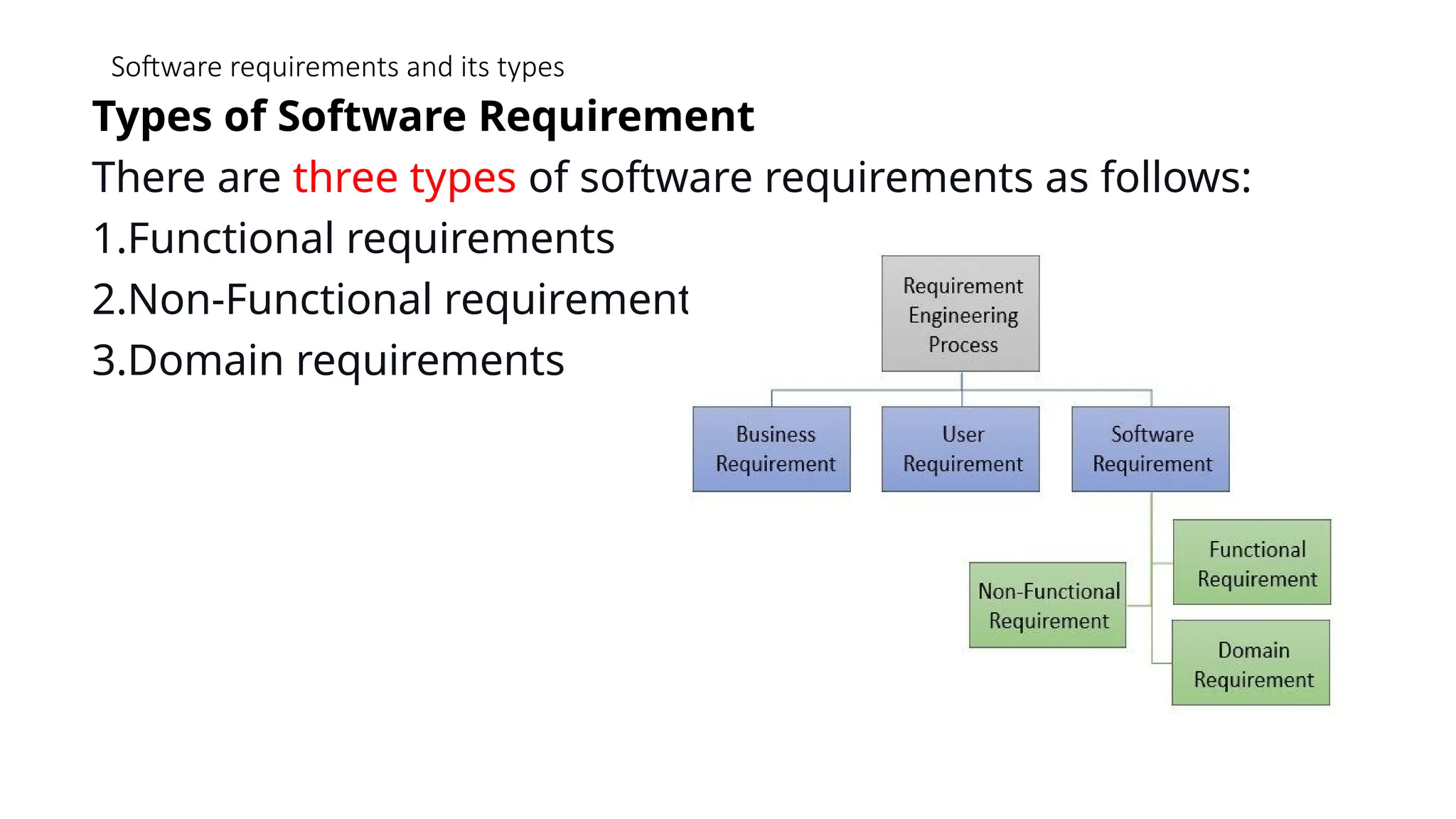
Types of Software Requirement
There are three types of software requirements as follows:
1.Functional requirements
2.Non-Functional requirements
3.Domain requirements
4.
Functional Requirements
• Functionalrequirements are such software requirements that are
demanded explicitly as basic facilities of the system by the end-
users. So, these requirements for functionalities should be
necessarily incorporated into the system as a part of the contract.
• They describe system behavior under specific conditions. In other
words, they are the functions that one can see directly in the final
product, and it was the requirements of the users as well. It
describes a software system or its components.
• These are represented as inputs to the software system, its
behavior, and its output. It can be a calculation, data
manipulation, business process, user interaction, or any other
specific functionality which defines what function a system is likely
to perform.
5.
Functional software requirementshelp us to capture the intended
behavior of the system.
Functional requirements can be incorporated into the system in
many ways as
1. Natural language
2. A structured or formatted language with no rigorous syntax and
formal specification language with proper syntax.
Examples of functional requirements
1. Whenever a user logs into the system, their authentication is
done.
2. In case of a cyber attack, the whole system is shut down
3. Whenever a user registers on some software system the first
time, a verification email is sent to the user.
6.
Non-functional Requirements(NFRs)
• Theserequirements are defined as the quality constraints that
the system must satisfy to complete the project contract.
Non-functional requirements are more abstract. They deal with
issues like-
• Performance
• Reusability
• Flexibility
• Reliability
• Maintainability
• Security
• Portability
7.
Non-Functional Requirements areclassified into many
types. Some of them are as:
• Interface Constraints
• Economic Constraints
• Operating Constraints
• Performance constraints: storage space, response time,
security, etc.
• Life Cycle constraints: portability, maintainability, etc.
8.
Domain Requirements
• Domainrequirements are the requirements related to a
particular category like software, purpose or industry, or
other domain of projects. Domain requirements can be
functional or non-functional. These are essential functions
that a system of specific domains must necessarily exhibit.
• The common factor for domain requirements is that they
meet established standards or widely accepted feature sets
for that category of the software project. Domain
requirements typically arise in military, medical, and
financial industry sectors. They are identified from that
specific domain and are not user-specific.
9.
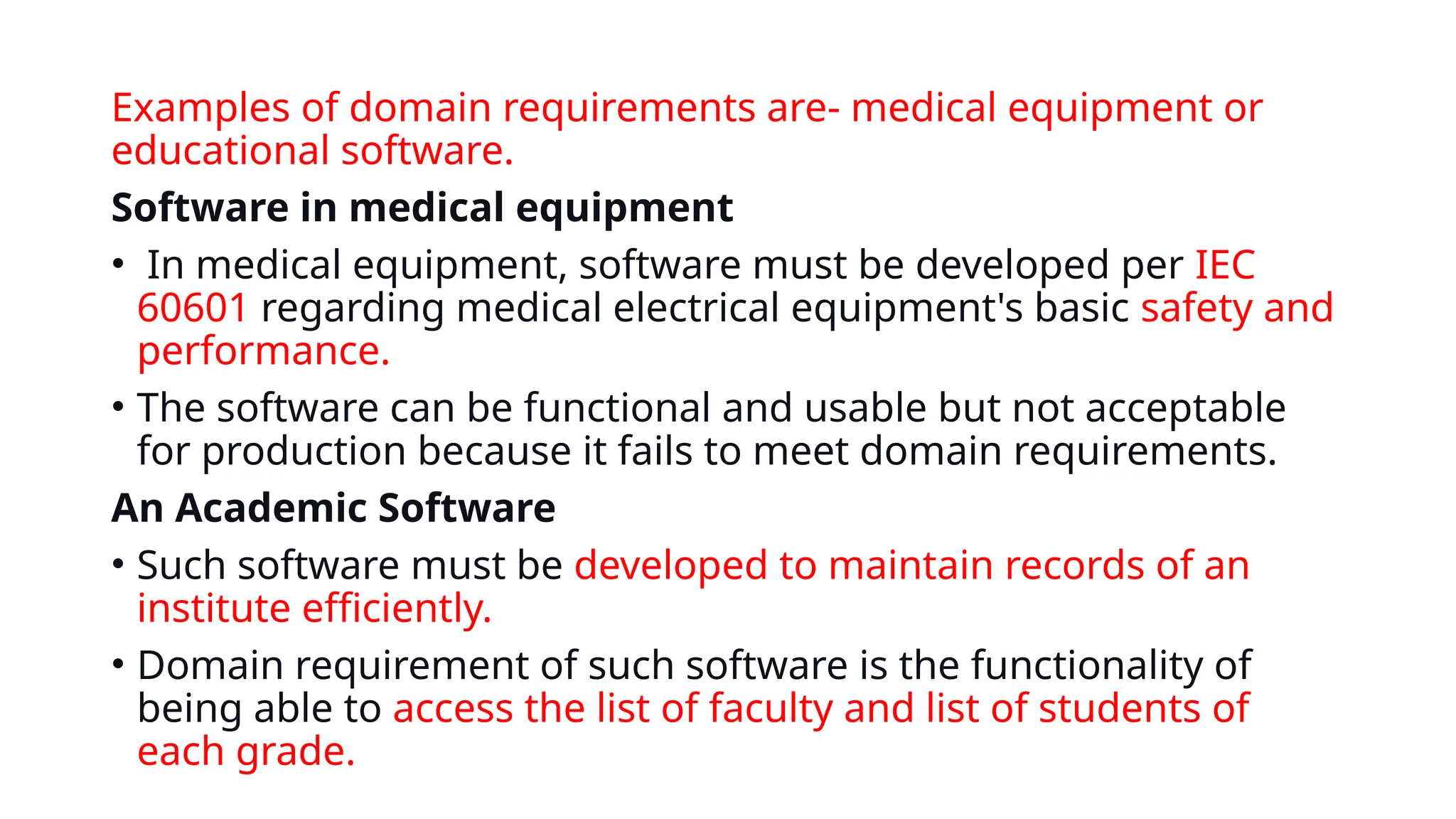
Examples of domainrequirements are- medical equipment or
educational software.
Software in medical equipment
• In medical equipment, software must be developed per IEC
60601 regarding medical electrical equipment's basic safety and
performance.
• The software can be functional and usable but not acceptable
for production because it fails to meet domain requirements.
An Academic Software
• Such software must be developed to maintain records of an
institute efficiently.
• Domain requirement of such software is the functionality of
being able to access the list of faculty and list of students of
each grade.
10.
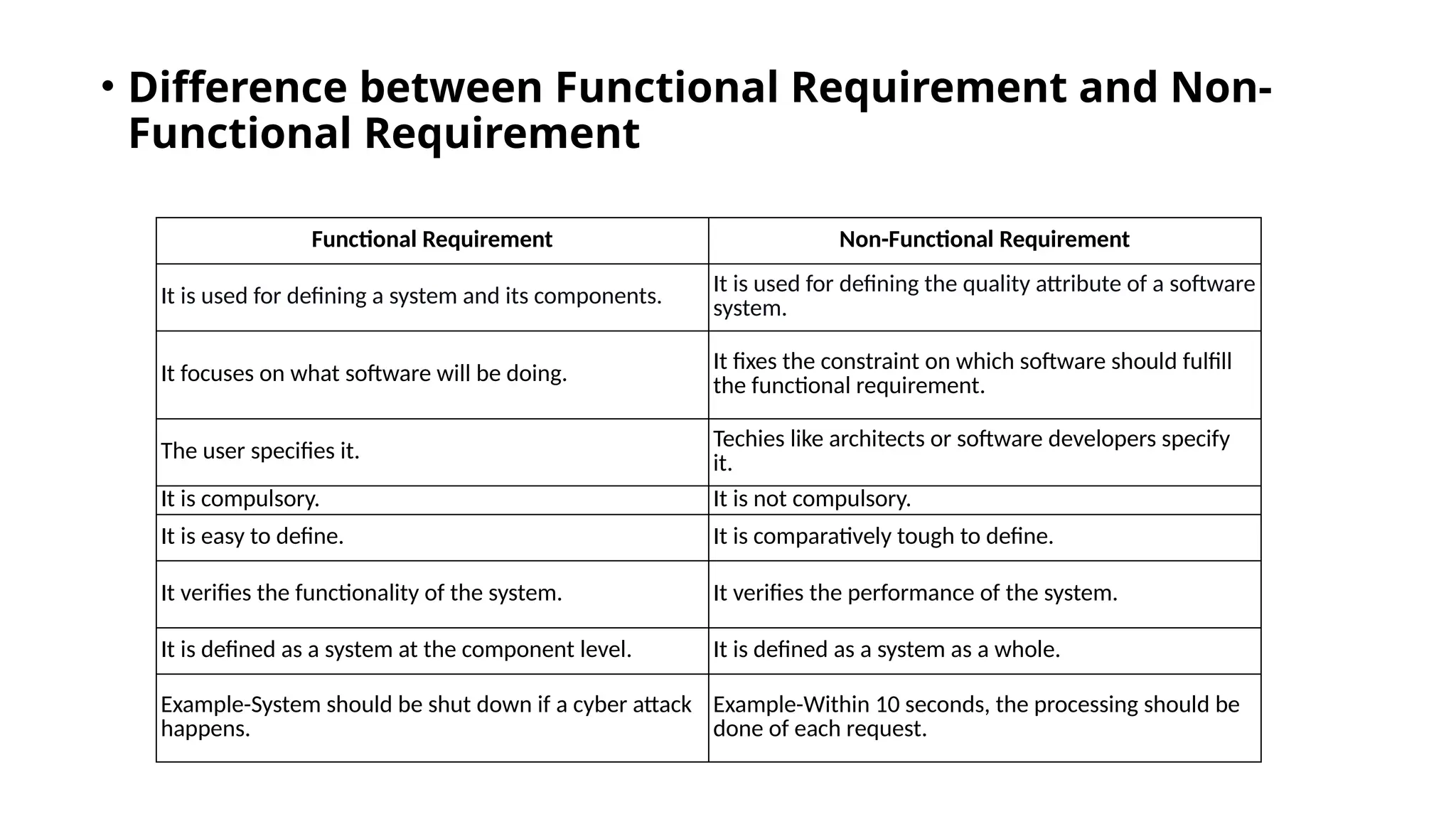
• Difference betweenFunctional Requirement and Non-
Functional Requirement
Functional Requirement Non-Functional Requirement
It is used for defining a system and its components.
It is used for defining the quality attribute of a software
system.
It focuses on what software will be doing. It fixes the constraint on which software should fulfill
the functional requirement.
The user specifies it.
Techies like architects or software developers specify
it.
It is compulsory. It is not compulsory.
It is easy to define. It is comparatively tough to define.
It verifies the functionality of the system. It verifies the performance of the system.
It is defined as a system at the component level. It is defined as a system as a whole.
Example-System should be shut down if a cyber attack
happens.
Example-Within 10 seconds, the processing should be
done of each request.
11.
Requirements Engineering process
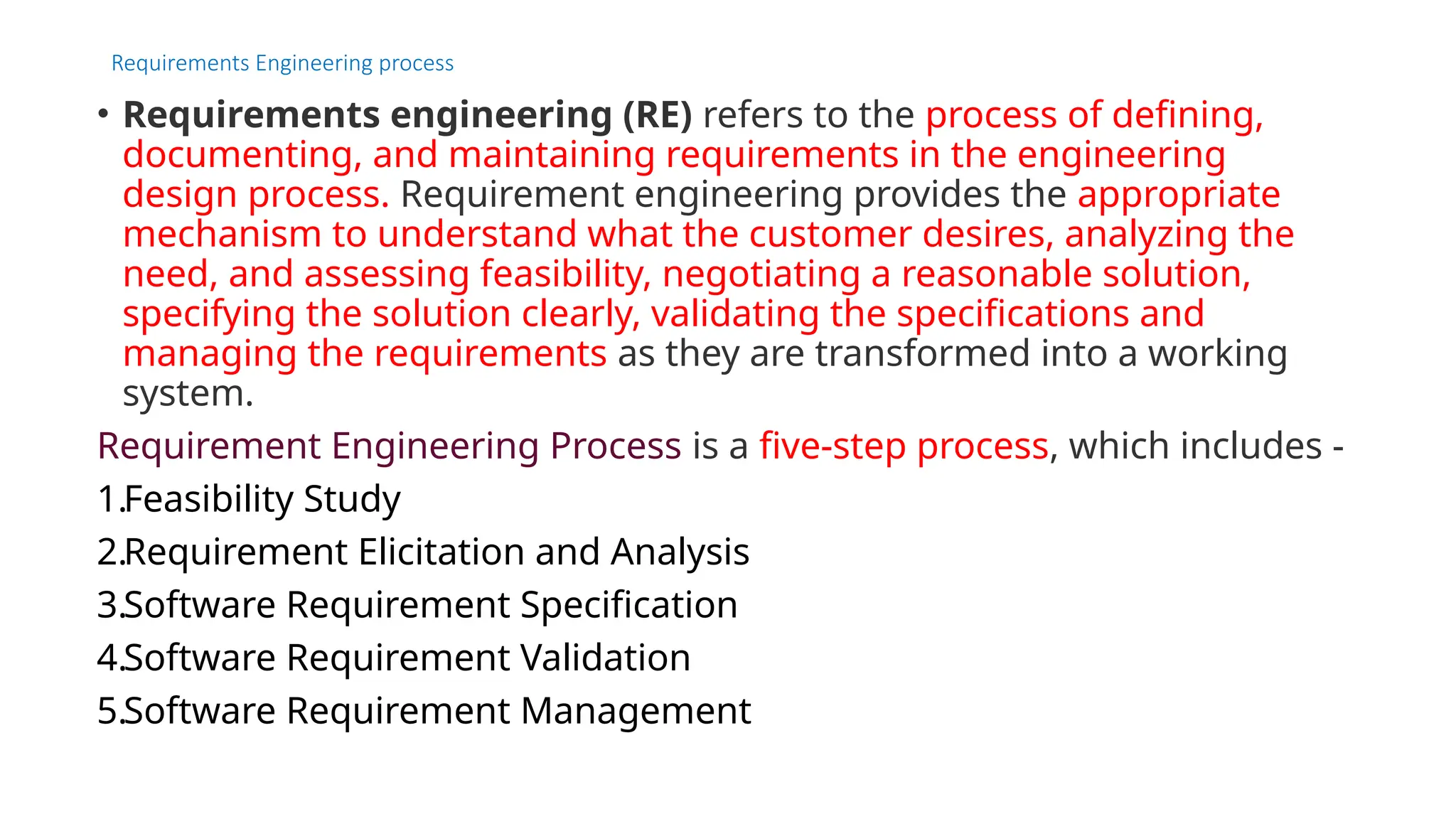
•Requirements engineering (RE) refers to the process of defining,
documenting, and maintaining requirements in the engineering
design process. Requirement engineering provides the appropriate
mechanism to understand what the customer desires, analyzing the
need, and assessing feasibility, negotiating a reasonable solution,
specifying the solution clearly, validating the specifications and
managing the requirements as they are transformed into a working
system.
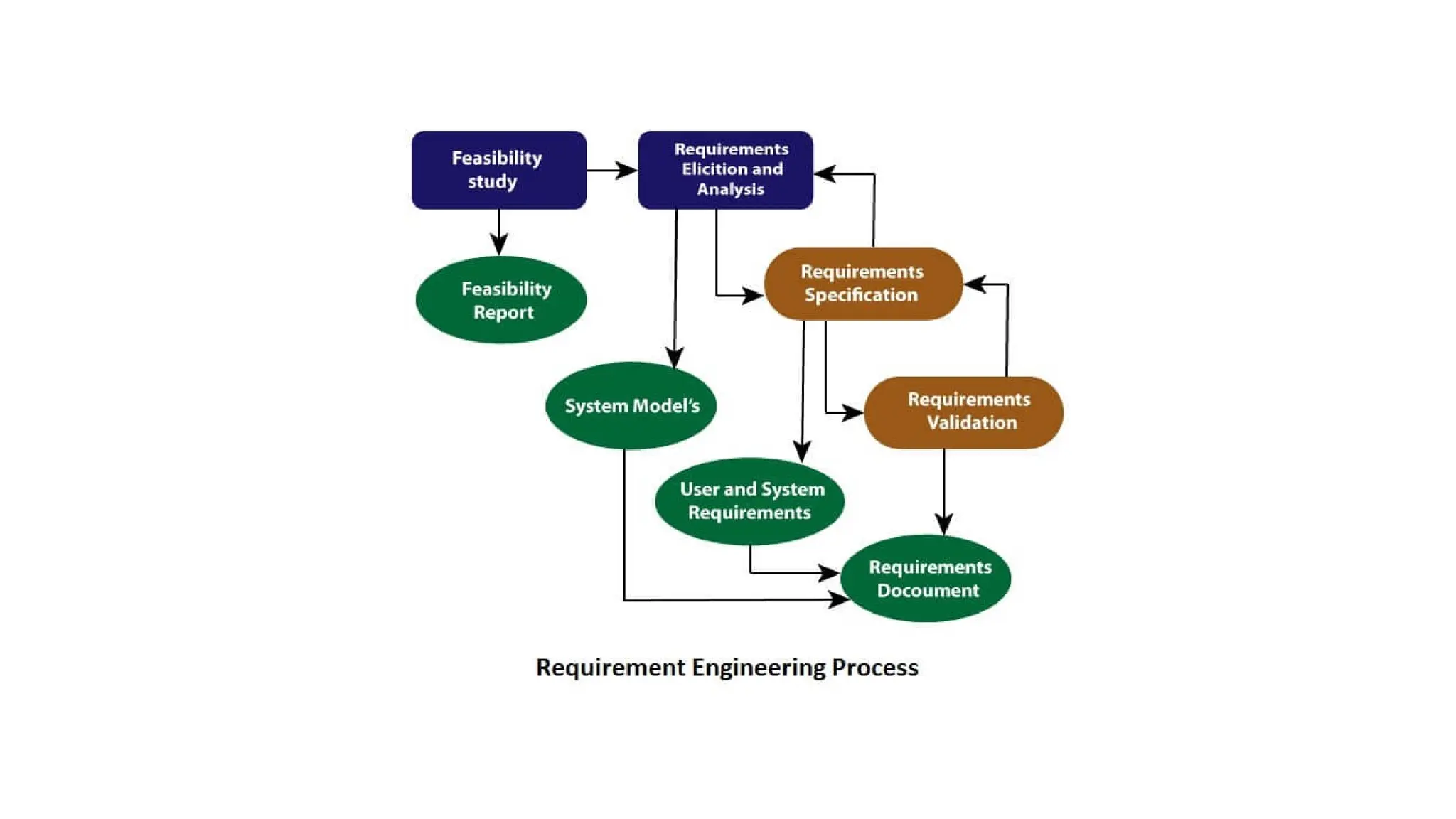
Requirement Engineering Process is a five-step process, which includes -
1.Feasibility Study
2.Requirement Elicitation and Analysis
3.Software Requirement Specification
4.Software Requirement Validation
5.Software Requirement Management
13.
1. Feasibility Study:
•The objective behind the feasibility study is to create the reasons for
developing the software that is acceptable to users, flexible to
change and conformable to established standards.
Types of Feasibility:
1.Technical Feasibility - Technical feasibility evaluates the current
technologies, which are needed to accomplish customer
requirements within the time and budget.
2.Operational Feasibility - Operational feasibility assesses the range
in which the required software performs a series of levels to solve
business problems and customer requirements.
3.Economic Feasibility - Economic feasibility decides whether the
necessary software can generate financial profits for an
organization.
14.
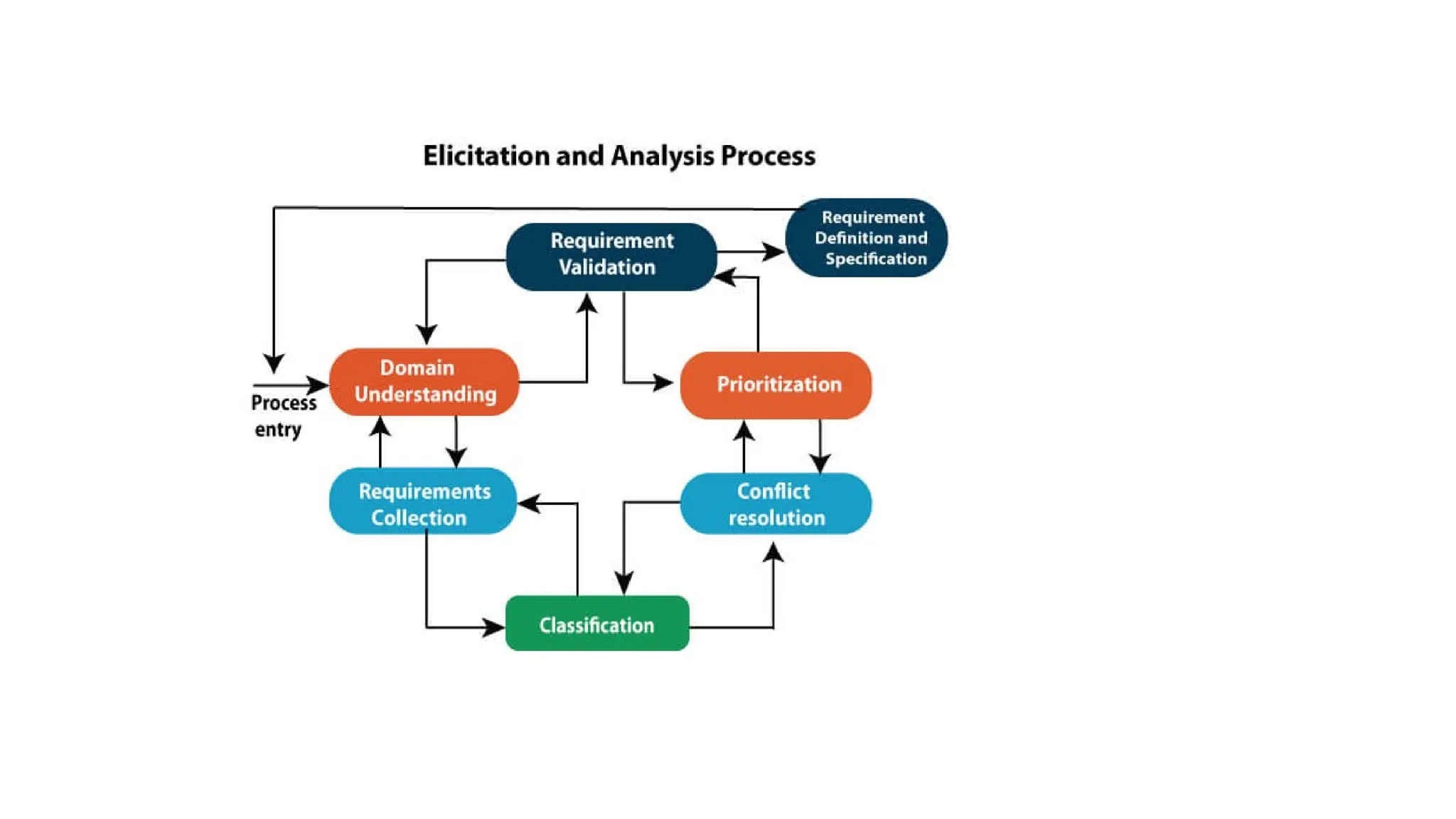
2.Requirement Elicitation andAnalysis:
• This is also known as the gathering of requirements. Here, requirements are
identified with the help of customers and existing systems processes, if
available.
• Analysis of requirements starts with requirement elicitation. The requirements
are analyzed to identify inconsistencies, defects, omission, etc. We describe
requirements in terms of relationships and also resolve conflicts if any.
Problems of Elicitation and Analysis
• Getting all, and only, the right people involved.
• Stakeholders often don't know what they want
• Stakeholders express requirements in their terms.
• Stakeholders may have conflicting requirements.
• Requirement change during the analysis process.
• Organizational and political factors may influence system requirements.
16.
3. Software RequirementSpecification:
• Software requirement specification is a kind of document which is created by a software
analyst after the requirements collected from the various sources - the requirement received
by the customer written in ordinary language. It is the job of the analyst to write the
requirement in technical language so that they can be understood and beneficial by the
development team.
• The models used at this stage include ER diagrams, data flow diagrams (DFDs), function
decomposition diagrams (FDDs), data dictionaries, etc.
• Data Flow Diagrams: Data Flow Diagrams (DFDs) are used widely for modeling the
requirements. DFD shows the flow of data through a system. The system may be a company,
an organization, a set of procedures, a computer hardware system, a software system, or any
combination of the preceding. The DFD is also known as a data flow graph or bubble chart.
• Data Dictionaries: Data Dictionaries are simply repositories to store information about all
data items defined in DFDs. At the requirements stage, the data dictionary should at least
define customer data items, to ensure that the customer and developers use the same
definition and terminologies.
• Entity-Relationship Diagrams: Another tool for requirement specification is the entity-
relationship diagram, often called an "E-R diagram." It is a detailed logical representation of
the data for the organization and uses three main constructs i.e. data entities, relationships,
and their associated attributes.
17.
4. Software RequirementValidation:
• After requirement specifications developed, the
requirements discussed in this document are validated. The
user might demand illegal, impossible solution or experts
may misinterpret the needs. Requirements can be the check
against the following conditions -
• If they can practically implement
• If they are correct and as per the functionality and specially
of software
• If there are any ambiguities
• If they are full
• If they can describe
18.
Requirements Validation Techniques
•Requirements reviews/inspections: systematic manual
analysis of the requirements.
• Prototyping: Using an executable model of the system to
check requirements.
• Test-case generation: Developing tests for requirements to
check testability.
• Automated consistency analysis: checking for the
consistency of structured requirements descriptions.
19.
5. Software Requirementmanagement
A typical requirements management process complements the through these
steps:
• Collect initial requirements from stakeholders
• Analyze requirements
• Define and record requirements
• Prioritize requirements
• Agree on and approve requirements
• Trace requirements to work items
• Query stakeholders after implementation on needed changes to requirements
• Utilize test management to verify and validate system requirements
• Assess impact of changes
• Revise requirements
• Document changes
20.
Some of thebenefits of requirements management include:
• Lower cost of development across the lifecycle
• Fewer defects
• Minimized risk for safety-critical products
• Faster delivery
• Reusability
• Traceability
• Requirements being tied to test cases
• Global configuration management
21.
Requirements Elicitation
• Requirementelicitation can be done by communicating with
stakeholders directly or by doing some research,
experiments. The activities can be planned, unplanned, or
both.
• Planned activities include workshops, experiments.
• Unplanned activities happen randomly. Prior notice is not
required for such activities. For example, you directly go to
the client site and start discussing the requirements
however there was no specific agenda published in advance.
22.
Following tasks arethe part of elicitation:
• Prepare for Elicitation: The purpose here is to understand
the elicitation activity scope, select the right techniques, and
plan for appropriate resources.
• Conduct Elicitation: The purpose here is to explore and
identify information related to change.
• Confirm Elicitation Results: In this step, the information
gathered in the elicitation session is checked for accuracy.
23.
Requirements Elicitation Techniques
•There are several techniques available for elicitation,
however, the commonly used techniques are explained
below:
1) Stakeholder Analysis
• Stakeholders can include team members, customers, any
individual who is impacted by the project or it can be a supplier.
Stakeholder analysis is done to identify the stakeholders who
will be impacted by the system.
2) Brainstorming
• This technique is used to generate new ideas and find a
solution for a specific issue. The members included for
brainstorming can be domain experts, subject matter experts.
24.
• Brainstorming techniqueis used to answer the below
questions:
• What is the expectation of a system?
• What are the risk factors that affect the proposed system
development and what to do to avoid that?
• What are the business and organization rules required to
follow?
• What are the options available to resolve the current issues?
• What should we do so that this particular issue does not
happen in the future?
25.
3) Interview
Interview techniquesshould be used for building strong
relationships between business analysts and stakeholders.
• If the interviewer has a predefined set of questions then it’s
called a structured interview.
• If the interviewer is not having any particular format or any
specific questions then it’s called an unstructured interview.
4) Document Analysis/Review
This technique is used to gather business information by
reviewing/examining the available materials that describe the
business environment. This analysis is helpful to validate the
implementation of current solutions and is also helpful in
understanding the business need.
26.
• Document analysisincludes reviewing the business plans,
technical documents, problem reports, existing requirement
documents, etc. This is useful when the plan is to update an
existing system. This technique is useful for migration projects.
• 5) Focus Group
• The Focus group includes subject matter experts. The objective of
this group is to discuss the topic and provide information. A
moderator manages this session.
• The moderator should work with business analysts to analyze the
results and provide findings to the stakeholders.
• If a product is under development and the discussion is required
on that product then the result will be to update the existing
requirement or you might get new requirements. If a product is
ready to ship then the discussion will be on releasing the product.
27.
• 6) InterfaceAnalysis
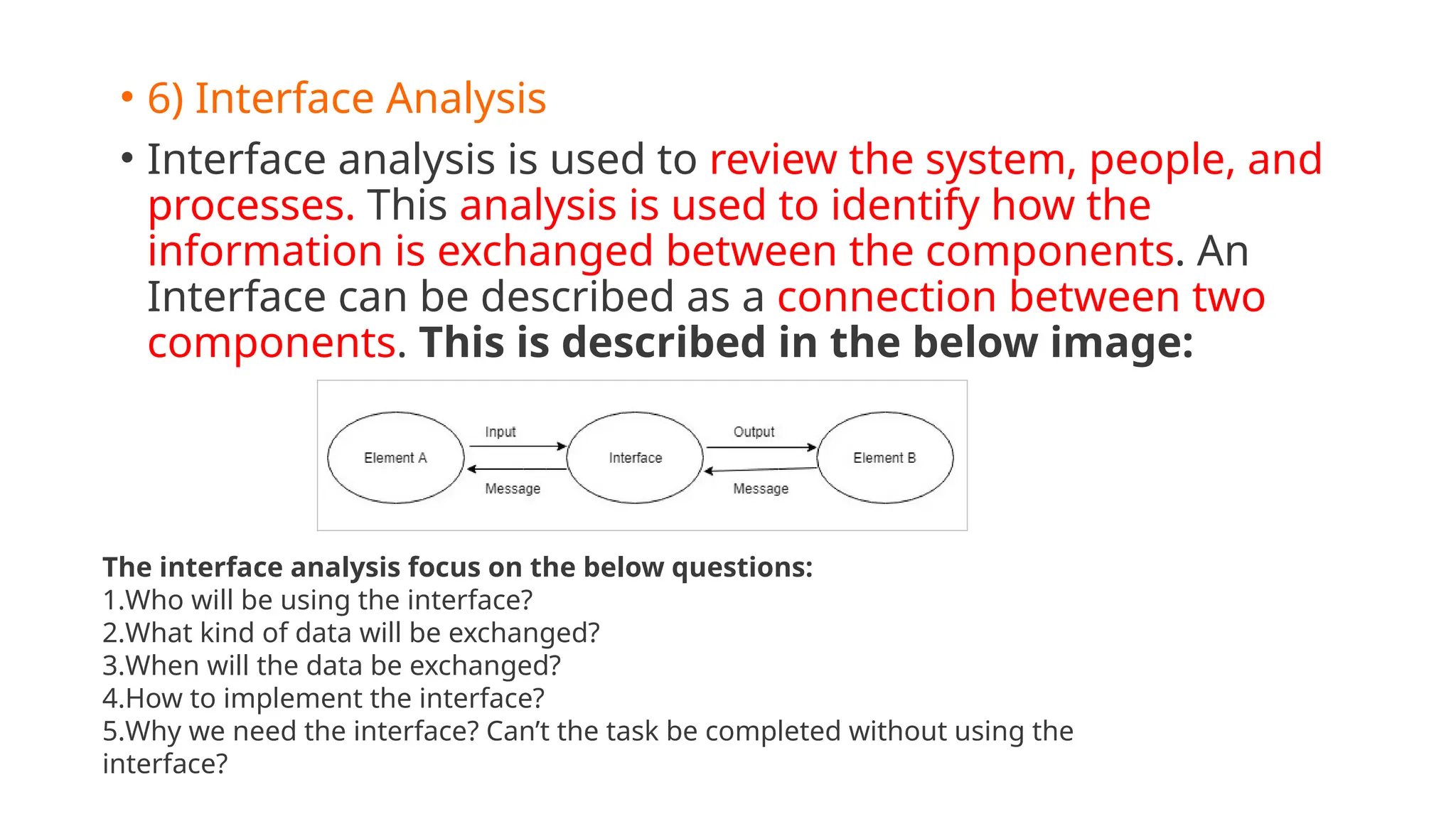
• Interface analysis is used to review the system, people, and
processes. This analysis is used to identify how the
information is exchanged between the components. An
Interface can be described as a connection between two
components. This is described in the below image:
The interface analysis focus on the below questions:
1.Who will be using the interface?
2.What kind of data will be exchanged?
3.When will the data be exchanged?
4.How to implement the interface?
5.Why we need the interface? Can’t the task be completed without using the
interface?
28.
• 7) Observation
•The main objective of the observation session is to understand the
activity, task, tools used, and events performed by others.
• The plan for observation ensures that all stakeholders are aware of
the purpose of the observation session, they agree on the expected
outcomes, and that the session meets their expectations
• During the session, the observer should record all the activities and
the time taken to perform the work by others so that he/she can
simulate the same. Observation can be either active or passive.
• Active observation is to ask questions and try to attempt the work
that other persons are doing.
• Passive observation is silent observation i.e. you sit with others
and just observe how they are doing their work without interpreting
them.
29.
• 8) Prototyping
•Prototyping is used to identify missing or unspecified requirements. In this
technique, frequent demos are given to the client by creating the prototypes
so that client can get an idea of how the product will look like.
• 9) Joint Application Development (JAD)/ Requirement Workshops
• This technique is more process-oriented and formal as compared to other
techniques. These are structured meetings involving end-users. This is used
to define, clarify, and complete requirements.
• This technique can be divided into the following categories:
• Formal Workshops: These workshops are highly structured and are usually
conducted with the selected group of stakeholders. The main focus of this
workshop is to define, create, refine, and reach closure on business
requirements.
• Business Process Improvement Workshops: These are less formal as
compared to the above one. Here, existing business processes are analyzed
and process improvements are identified.
30.
• 10) Survey/Questionnaire
•For Survey/Questionnaire, a set of questions is given to stakeholders to
quantify their thoughts. After collecting the responses from stakeholders,
data is analyzed to identify the area of interest of stakeholders.
• Questions should be based on high priority risks. Questions should be
direct and unambiguous. Once the survey is ready, notify the participants
and remind them to participate.
• Two types of questions can be used here:
• Open-Ended: Respondent is given the freedom to provide answers in
their own words rather than selecting from predefined responses. This is
useful but at the same time, this is time- consuming as interpreting the
responses is difficult.
• Close Ended: It includes a predefined set of answers for all the questions
and the respondent has to choose from those answers. Questions can be
multiple choice or can be ranked from not important to very important.
31.
System Modeling
• Systemmodeling is the process of developing abstract models of a
system, with each model presenting a different view or perspective of
that system.
• most models use some kind of graphical notation representing a
system, which is known as Unified Modeling Language (UML)
Benefits of System Modeling
1. Ease project management tasks.
2. Can provide complete views of a system, as well as detailed views of
subsystems.
3. Clarify structures and relationships.
4. Offer a communication framework for ideas within and between
teams. Can generate new ideas and possibilities.
5. Allow quality assurance and testing scenarios to be generated.
6. Platform independent.
32.
Chapter 5 Systemmodeling
UML Diagram Types
The System Perspectives (last slide) are modeled with diagrams
Activity diagrams, which show the activities involved in a process or
in data processing .
Use case diagrams, which show the interactions between a system
and its environment.
Sequence diagrams, which show interactions between actors and
the system and between system components.
Class diagrams, which show the object classes in the system and the
associations between these classes.
State diagrams, which show how the system reacts to internal and
external events.
32
33.
Requirements Specification andRequirement Validation
• For requirement specification write(SRS)
Once the SRS completed validation begins
Requirement Validation
• The development of software begins once the requirements
document is ‘ready’
• Ensure that the requirements specification (SRS)contains no
errors and that it specifies the user’s requirements correctly.
• If errors present in the SRS will adversely affect the cost if they
are detected later in the development process or when the
software is delivered to the user.
34.
• So itis desirable to detect errors in the requirements before the
design and development of the software begins.
• In the validation phase the requirements are examined for
consistency, omissions, and ambiguity.
• The basic objective is to ensure that the SRS reflects the actual
requirements accurately and clearly.
• objectives of the requirements document are given below.
1. To certify that the SRS contains an acceptable description of the system to be implemented
2. To ensure that the actual requirements of the system are reflected in the SRS
3. To check the requirements document for completeness, accuracy, consistency, requirement conflict‘,
conformance to standards and technical errors.
• Requirements validation studies the ‘final draft’ of the
requirements document while requirements analysis studies the
‘raw requirements’ from the system stakeholders (users).
35.
• Requirements validation:Have we got the requirements right?
• Requirements analysis: Have we got the right requirements?
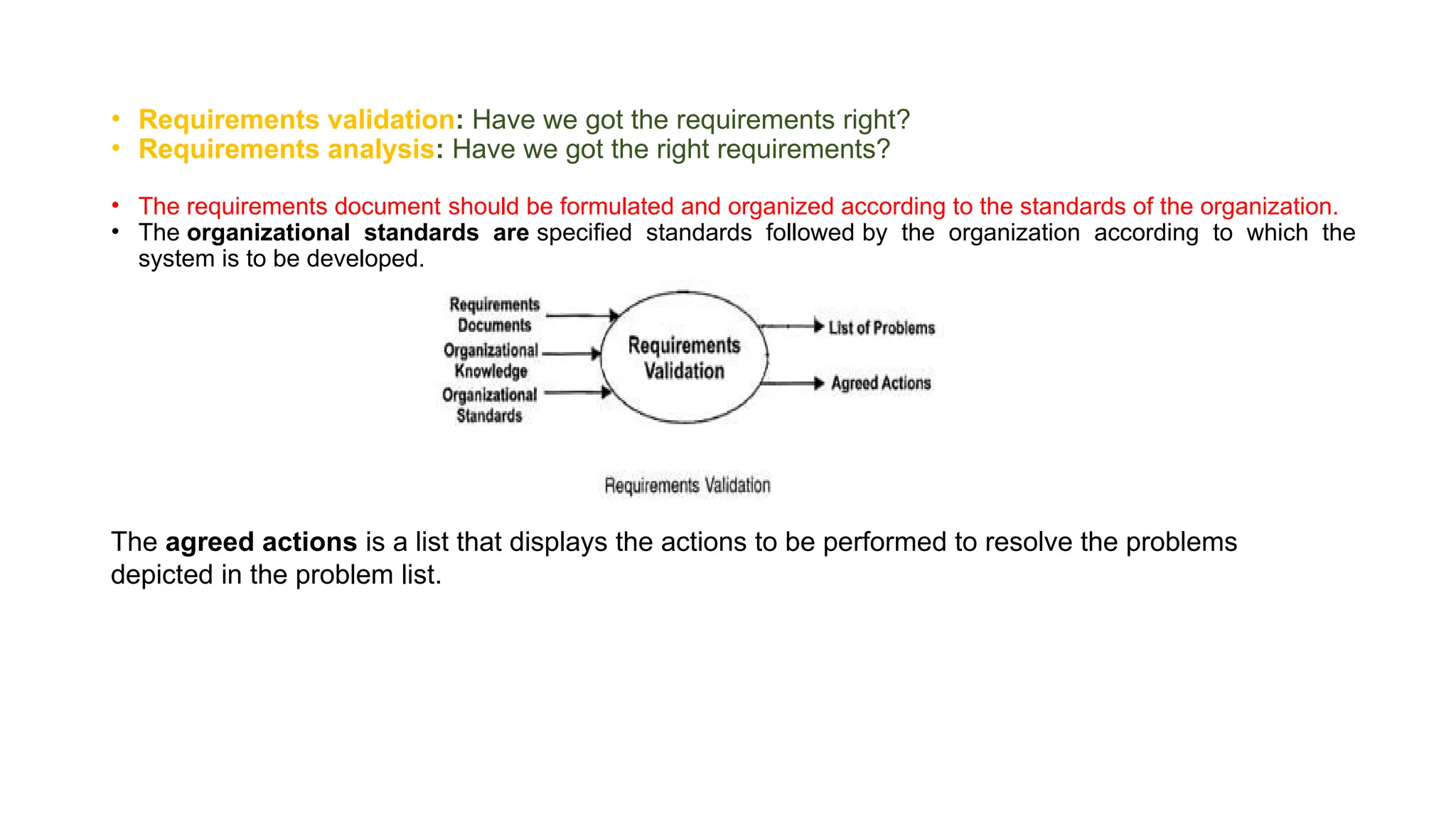
• The requirements document should be formulated and organized according to the standards of the organization.
• The organizational standards are specified standards followed by the organization according to which the
system is to be developed.
The agreed actions is a list that displays the actions to be performed to resolve the problems
depicted in the problem list.
36.
Requirements Review
• Requirementsvalidation determines whether the requirements are substantial to design
the system.
The problems encountered during requirements validation are listed below.
1.Unclear stated requirements
2.Conflicting requirements during requirements analysis stage.
3.Errors in the requirements elicitation and analysis
4.Lack of conformance to quality standards.
• To avoid the problems stated above, a requirements review is
conducted, which consists of a review team that performs a
systematic analysis of the requirements.
• The review team consists of software engineers, users, and
other stakeholders who examine the specification to ensure that
the problems associated with consistency, omissions, and
errors are detected and corrected.
37.
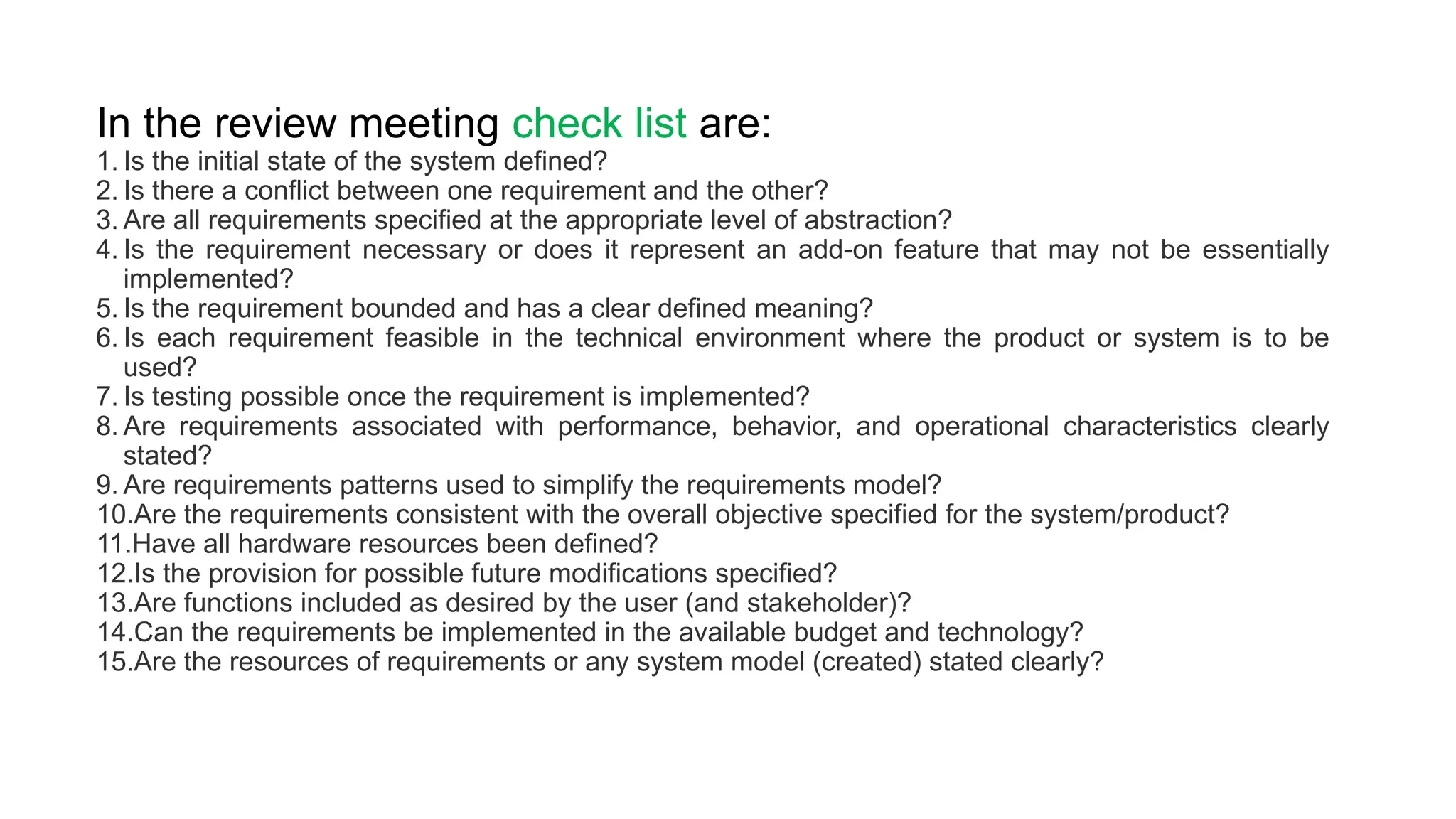
In the reviewmeeting check list are:
1. Is the initial state of the system defined?
2. Is there a conflict between one requirement and the other?
3. Are all requirements specified at the appropriate level of abstraction?
4. Is the requirement necessary or does it represent an add-on feature that may not be essentially
implemented?
5. Is the requirement bounded and has a clear defined meaning?
6. Is each requirement feasible in the technical environment where the product or system is to be
used?
7. Is testing possible once the requirement is implemented?
8. Are requirements associated with performance, behavior, and operational characteristics clearly
stated?
9. Are requirements patterns used to simplify the requirements model?
10.Are the requirements consistent with the overall objective specified for the system/product?
11.Have all hardware resources been defined?
12.Is the provision for possible future modifications specified?
13.Are functions included as desired by the user (and stakeholder)?
14.Can the requirements be implemented in the available budget and technology?
15.Are the resources of requirements or any system model (created) stated clearly?
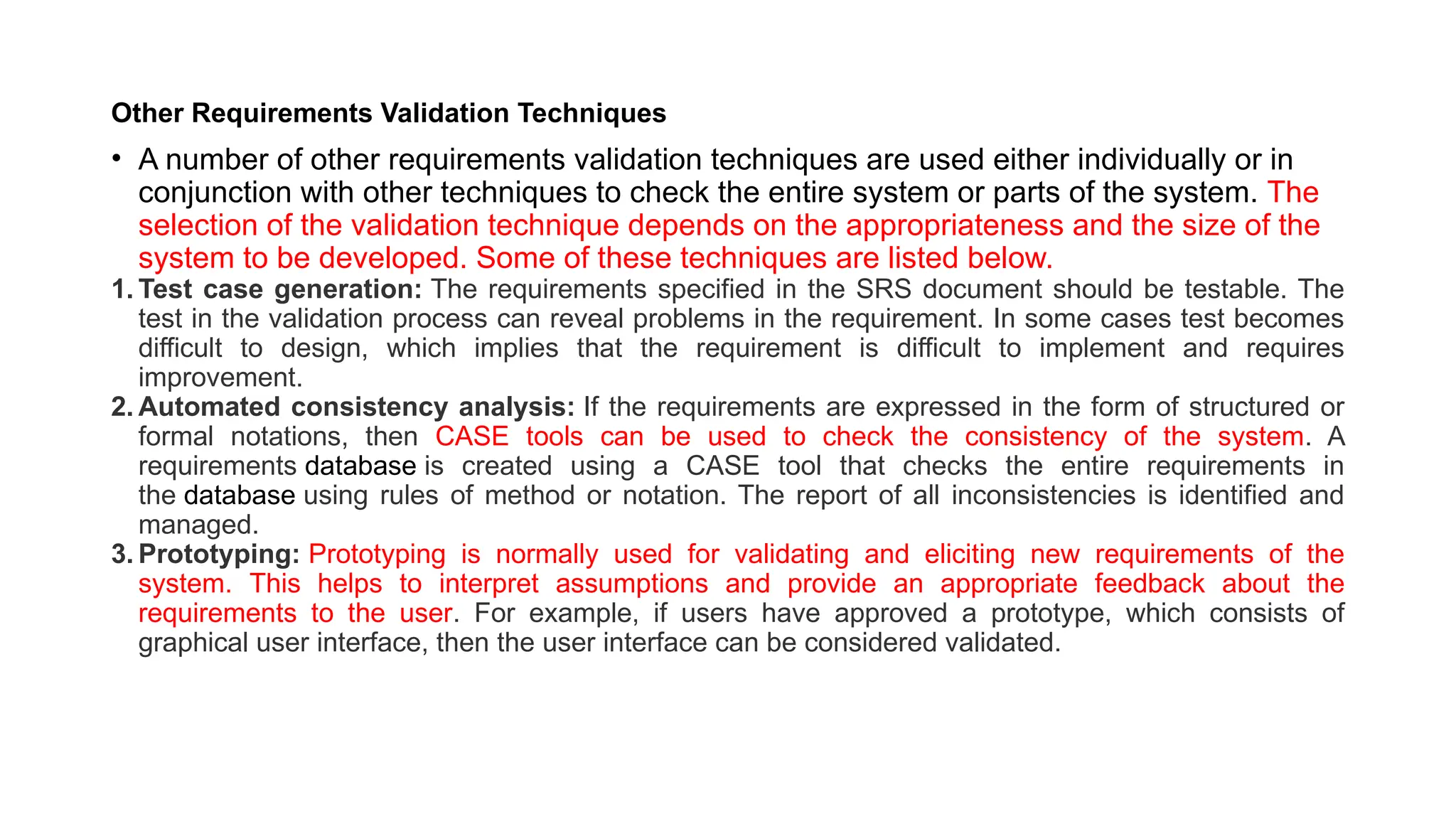
38.
Other Requirements ValidationTechniques
• A number of other requirements validation techniques are used either individually or in
conjunction with other techniques to check the entire system or parts of the system. The
selection of the validation technique depends on the appropriateness and the size of the
system to be developed. Some of these techniques are listed below.
1. Test case generation: The requirements specified in the SRS document should be testable. The
test in the validation process can reveal problems in the requirement. In some cases test becomes
difficult to design, which implies that the requirement is difficult to implement and requires
improvement.
2. Automated consistency analysis: If the requirements are expressed in the form of structured or
formal notations, then CASE tools can be used to check the consistency of the system. A
requirements database is created using a CASE tool that checks the entire requirements in
the database using rules of method or notation. The report of all inconsistencies is identified and
managed.
3. Prototyping: Prototyping is normally used for validating and eliciting new requirements of the
system. This helps to interpret assumptions and provide an appropriate feedback about the
requirements to the user. For example, if users have approved a prototype, which consists of
graphical user interface, then the user interface can be considered validated.
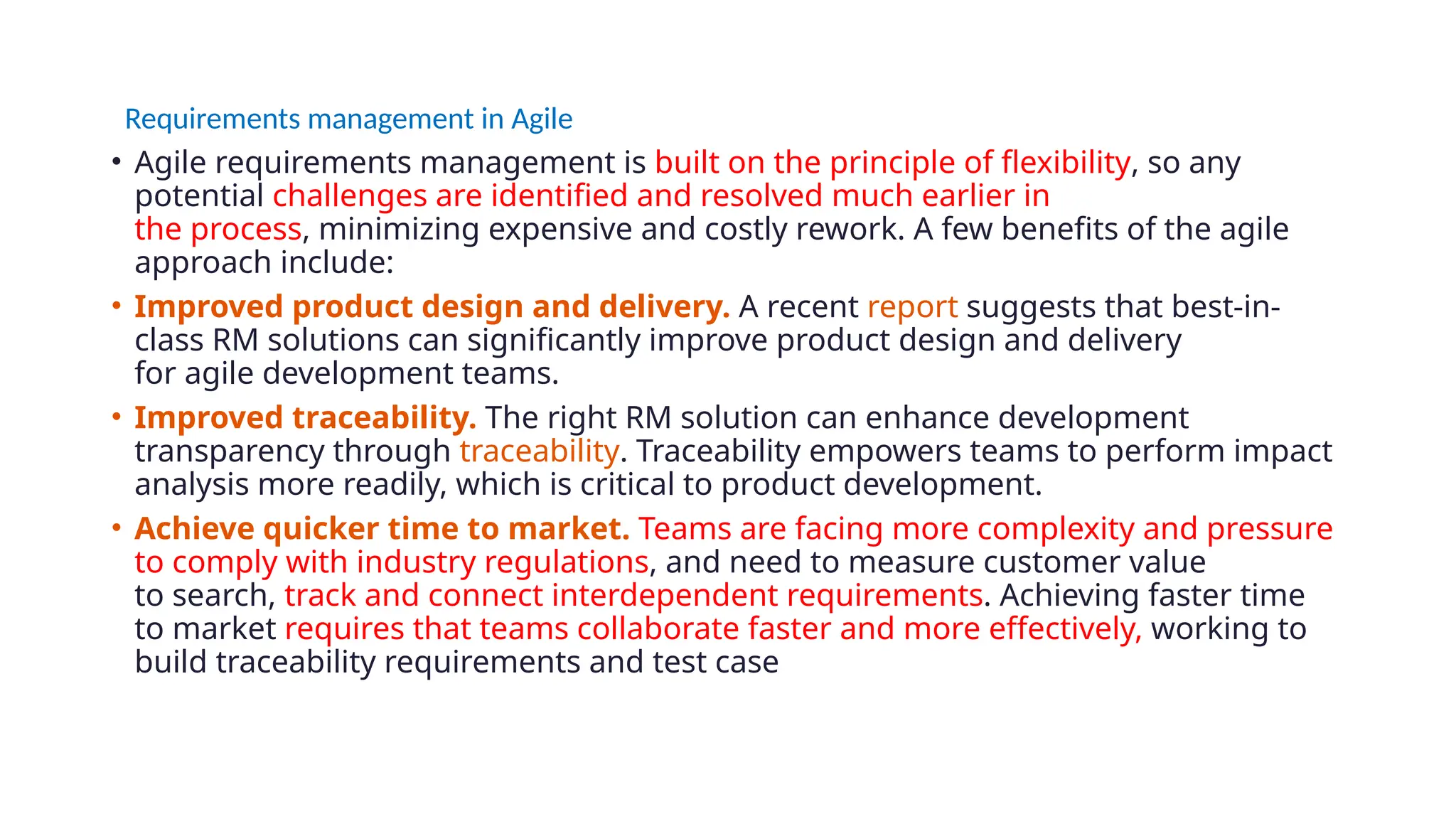
Requirements management inAgile
• Agile requirements management is built on the principle of flexibility, so any
potential challenges are identified and resolved much earlier in
the process, minimizing expensive and costly rework. A few benefits of the agile
approach include:
• Improved product design and delivery. A recent report suggests that best-in-
class RM solutions can significantly improve product design and delivery
for agile development teams.
• Improved traceability. The right RM solution can enhance development
transparency through traceability. Traceability empowers teams to perform impact
analysis more readily, which is critical to product development.
• Achieve quicker time to market. Teams are facing more complexity and pressure
to comply with industry regulations, and need to measure customer value
to search, track and connect interdependent requirements. Achieving faster time
to market requires that teams collaborate faster and more effectively, working to
build traceability requirements and test case
41.
Designing with greaterflexibility through the agile requirements management
lifecycle
The agile requirements management lifecycle is focused on clearly defining a project’s scope,
so that you better understand what needs to happen to meet the desired end goal. It
provides a high-level understanding of business goals, and outlines what is needed for the
project to be a success.
Consider taking the following steps:
• Understand user stories. User stories give you powerful information about the problem
you’re trying to solve. A user story is a quick description of everyday use cases and might
include a few sentences about how the user expects the product to perform.
• Outline the most important requirements. Identify what requirements are most
essential based on the high-level business strategy. These requirements may be supported
by user stories, functional requirements and more based on the specific client goals.
• Transform to product features. This stage is about fine-tuning and translating the details
that you’ve gathered into product features. The development team collaborates to ensure
that any requirements are easily understood by anyone working to implement them. User
stories are linked to features and tasks, so that developers understand what they need to
do – but also why they are doing it.
42.
Collaboration and Buy-In
•It’s difficult to get a company to agree on requirements,
particularly for large projects with many stakeholders. In
practice, it’s not necessary to achieve consensus through
compromise. It’s more important to have team buy-in (before or
after management approves the project) so the development
process can move forward. With buy-in, the team backs the best
solution, makes a smart decision and does what is necessary to
move forward with the requirements management process.
• Team collaboration is key to establishing good requirements.
Collaborative teams work hard to make sure everyone has a
stake in the project and provides feedback. When there is a
commitment and understanding of project goals, team members
tend to support other’s decisions.
43.
Traceability and ChangeManagement
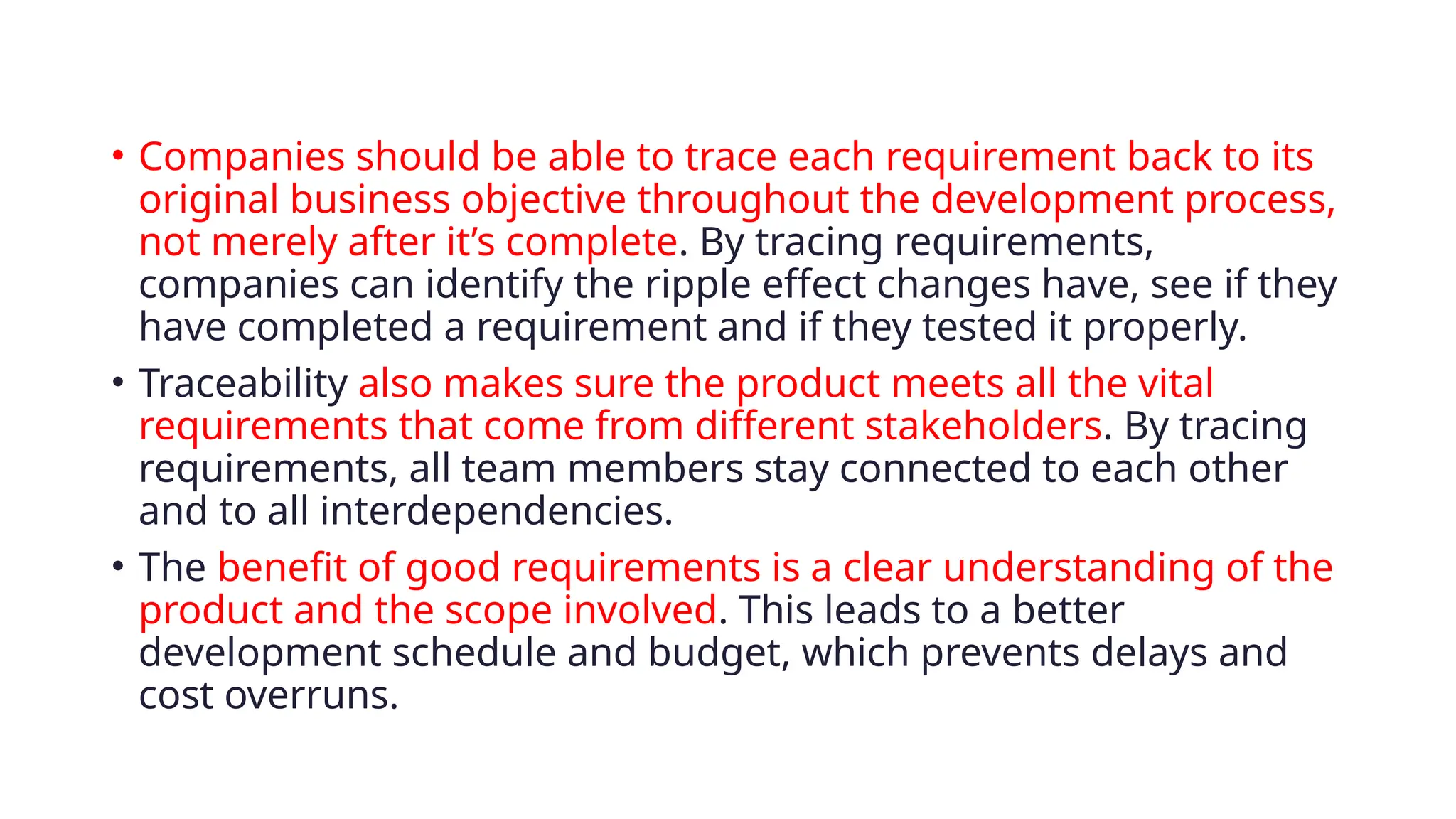
• Requirements traceability is a way to keep everyone in the
loop. It organizes, documents and keeps track of all
requirements, from initial idea to testing. A simple
metaphor for traceability is connecting the dots to identify
the relationships between items within a project. The
following figure shows an example of a common
downstream flow.
44.
• Companies shouldbe able to trace each requirement back to its
original business objective throughout the development process,
not merely after it’s complete. By tracing requirements,
companies can identify the ripple effect changes have, see if they
have completed a requirement and if they tested it properly.
• Traceability also makes sure the product meets all the vital
requirements that come from different stakeholders. By tracing
requirements, all team members stay connected to each other
and to all interdependencies.
• The benefit of good requirements is a clear understanding of the
product and the scope involved. This leads to a better
development schedule and budget, which prevents delays and
cost overruns.
45.
Quality Assurance
• Gettingrequirements right the first time means better quality, faster development
cycles and higher customer satisfaction with the product. Concise, specific
requirements can help companies detect and solve problems earlier rather than later,
when they are much more expensive to fix.
• By integrating requirements management best practices into their quality assurance
process, companies can help teams increase efficiency and eliminate rework.
According to the Carnegie Mellon Software Engineering Institute, 60 to 80 percent of
the cost of software development is in rework. In other words, development teams are
wasting the majority of their budgets on efforts they didn’t perform correctly the first
time.
• Requirements management best practices can appear to be a complex topic, but at its
core, it’s a simple concept. It helps teams answer the question: Does everyone — from
business leaders to product managers and project leaders to developers, QA
managers and testers — understand what is being built and why?
• When everyone is collaborating and has full context and visibility into the discussions,
decisions and changes involved in product development, they maintain high quality
and almost always ensure success.