Software Development
Objectives
 Software development process
 Course revision and paper plan
 Discussion
Software
Computer software, or just software, is a collection of
computer programs and related data that provide the
instructions for telling a computer what to do and how to
do it.
Software
 Computer software, or just software, is a collection of
computer programs and related data that provides the
instructions for telling a computer what to do and how to do
it.
 Types of software:
 Systems software, e.g., device drivers, operating systems, utilities
 Programming software e.g., compiler, linker, text editor
 Application software e.g., web browser, online banking application
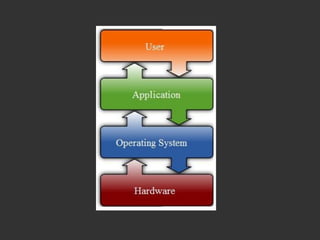
Software Layered Structure
Software Development Process
 A structured set of activities required to develop a
software system
 Specification;
 Design/Coding/Implementation;
 Validation/Testing/Verification; Evolution.
 A software process model is an abstract representation
of a process. It presents a description of a process from
some particular perspective.
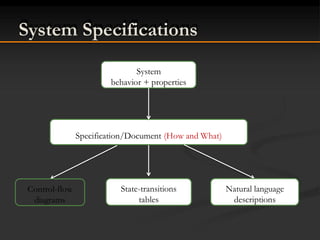
System Specifications
System
behavior + properties
Specification/Document (How and What)
Control-flow
diagrams
State-transitions
tables
Natural language
descriptions
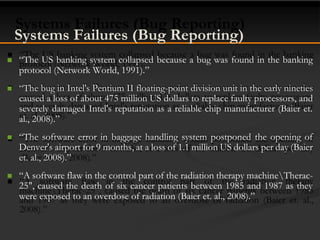
Systems Failures (Bug Reporting)
 “The US banking system collapsed because a bug was found in the banking
protocol (Network World, 1991).”
 “The bug in Intel's Pentium II floating-point division unit in the early nineties
caused a loss of about 475 million US dollars to replace faulty processors, and
severely damaged Intel's reputation as a reliable chip manufacturer (Baier et.
al., 2008).”
 “The software error in baggage handling system postponed the opening of
Denver's airport for 9 months, at a loss of 1.1 million US dollars per day (Baier
et. al., 2008).”
 “A software flaw in the control part of the radiation therapy machineTherac-
25", caused the death of six cancer patients between 1985 and 1987 as they
were exposed to an overdose of radiation (Baier et. al., 2008).”
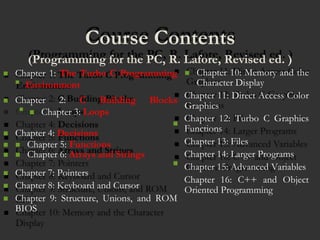
Course Contents
(Programming for the PC, R. Lafore, Revised ed. )
 Chapter 1: The Turbo C Programming

Environment
 Chapter 2: C Building Blocks

Chapter 3: Loops

 Chapter 4: Decisions
 Chapter 5: Functions
 Chapter 6: Arrays and Strings

 Chapter 7: Pointers
 Chapter 8: Keyboard and Cursor
 Chapter 9: Structure, Unions, and ROM
BIOS
 Chapter 10: Memory and the
Character Display
Chapter 11: Direct Access Color
Graphics
Chapter 12: Turbo C Graphics
Functions
Chapter 13: Files
Chapter 14: Larger Programs
Chapter 15: Advanced Variables
Chapter 16: C++ and Object
Oriented Programming
Chapter 1: The Turbo C
Programming Environment
Introduction
Chapter 2: C Building Blocks
 Variables
 Input/output
 Operators
 Comments
Chapter 6: Arrays and Strings
 Arrays
 One dimensional
 Two dimensional
 Strings
 Examples and Exercise
Tests and LAB Work
 Read also class tests and lab work
 https://www.w3resource.com/c-programming-
exercises/
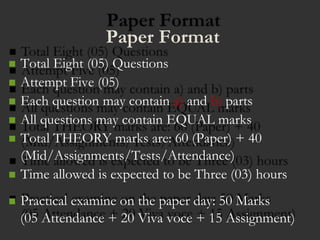
Paper Format
 Total Eight (05) Questions
 Attempt Five (05)
 Each question may contain a) and b) parts
 All questions may contain EQUAL marks
 Total THEORY marks are: 60 (Paper) + 40
(Mid/Assignments/Tests/Attendance)
 Time allowed is expected to be Three (03) hours
 Practical examine on the paper day: 50 Marks
(05 Attendance + 20 Viva voce + 15 Assignment)
Good Luck !!!
Discussion

Software Development Software development process

  • 1.
  • 2.
    Objectives  Software developmentprocess  Course revision and paper plan  Discussion
  • 3.
    Software Computer software, orjust software, is a collection of computer programs and related data that provide the instructions for telling a computer what to do and how to do it. Software  Computer software, or just software, is a collection of computer programs and related data that provides the
  • 4.
    instructions for tellinga computer what to do and how to do it.  Types of software:  Systems software, e.g., device drivers, operating systems, utilities  Programming software e.g., compiler, linker, text editor  Application software e.g., web browser, online banking application
  • 5.
  • 7.
    Software Development Process A structured set of activities required to develop a software system  Specification;  Design/Coding/Implementation;  Validation/Testing/Verification; Evolution.  A software process model is an abstract representation of a process. It presents a description of a process from some particular perspective.
  • 13.
    System Specifications System behavior +properties Specification/Document (How and What) Control-flow diagrams State-transitions tables Natural language descriptions
  • 14.
    Systems Failures (BugReporting)  “The US banking system collapsed because a bug was found in the banking protocol (Network World, 1991).”  “The bug in Intel's Pentium II floating-point division unit in the early nineties caused a loss of about 475 million US dollars to replace faulty processors, and severely damaged Intel's reputation as a reliable chip manufacturer (Baier et. al., 2008).”  “The software error in baggage handling system postponed the opening of Denver's airport for 9 months, at a loss of 1.1 million US dollars per day (Baier et. al., 2008).”  “A software flaw in the control part of the radiation therapy machineTherac- 25", caused the death of six cancer patients between 1985 and 1987 as they were exposed to an overdose of radiation (Baier et. al., 2008).”
  • 15.
    Course Contents (Programming forthe PC, R. Lafore, Revised ed. )  Chapter 1: The Turbo C Programming  Environment  Chapter 2: C Building Blocks  Chapter 3: Loops   Chapter 4: Decisions  Chapter 5: Functions  Chapter 6: Arrays and Strings   Chapter 7: Pointers  Chapter 8: Keyboard and Cursor  Chapter 9: Structure, Unions, and ROM BIOS  Chapter 10: Memory and the Character Display Chapter 11: Direct Access Color Graphics Chapter 12: Turbo C Graphics Functions Chapter 13: Files Chapter 14: Larger Programs Chapter 15: Advanced Variables Chapter 16: C++ and Object Oriented Programming
  • 16.
    Chapter 1: TheTurbo C Programming Environment Introduction
  • 17.
    Chapter 2: CBuilding Blocks  Variables  Input/output  Operators  Comments
  • 20.
    Chapter 6: Arraysand Strings  Arrays  One dimensional  Two dimensional  Strings  Examples and Exercise
  • 23.
    Tests and LABWork  Read also class tests and lab work  https://www.w3resource.com/c-programming- exercises/
  • 24.
    Paper Format  TotalEight (05) Questions  Attempt Five (05)  Each question may contain a) and b) parts  All questions may contain EQUAL marks  Total THEORY marks are: 60 (Paper) + 40 (Mid/Assignments/Tests/Attendance)  Time allowed is expected to be Three (03) hours  Practical examine on the paper day: 50 Marks (05 Attendance + 20 Viva voce + 15 Assignment)
  • 25.