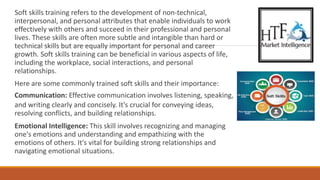
Soft skills training refers to the development of non-technical,
interpersonal, and personal attributes that enable individuals to work
effectively with others and succeed in their professional and personal
lives. These skills are often more subtle and intangible than hard or
technical skills but are equally important for personal and career
growth. Soft skills training can be beneficial in various aspects of life,
including the workplace, social interactions, and personal
relationships.
Here are some commonly trained soft skills and their importance:
Communication: Effective communication involves listening, speaking,
and writing clearly and concisely. It's crucial for conveying ideas,
resolving conflicts, and building relationships.
Emotional Intelligence: This skill involves recognizing and managing
one's emotions and understanding and empathizing with the
emotions of others. It's vital for building strong relationships and
navigating emotional situations.
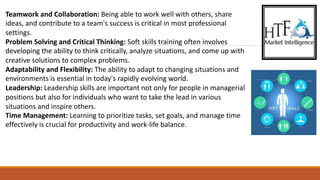
Teamwork and Collaboration: Being able to work well with others, share
ideas, and contribute to a team's success is critical in most professional
settings.
Problem Solving and Critical Thinking: Soft skills training often involves
developing the ability to think critically, analyze situations, and come up with
creative solutions to complex problems.
Adaptability and Flexibility: The ability to adapt to changing situations and
environments is essential in today's rapidly evolving world.
Leadership: Leadership skills are important not only for people in managerial
positions but also for individuals who want to take the lead in various
situations and inspire others.
Time Management: Learning to prioritize tasks, set goals, and manage time
effectively is crucial for productivity and work-life balance.
Conflict Resolution: Being able to manage and resolve conflicts in a
constructive manner is a valuable skill in both personal and
professional relationships.
Networking and Relationship Building: Building and maintaining
relationships can open doors to new opportunities and is essential
for personal and career growth.
Soft skills training can take various forms, including workshops,
seminars, online courses, coaching, and self-help materials. These
programs often involve role-playing, group activities, and feedback
to help individuals practice and improve these skills.
The importance of soft skills has grown in the modern job market,
as employers recognize that candidates with strong soft skills often
excel in teamwork, leadership, and communication, leading to
better organizational outcomes. Therefore, investing in soft skills
training can be a valuable step in one's personal and professional
development.

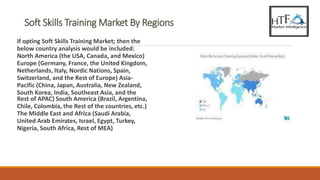
If opting Soft Skills Training Market; then the
below country analysis would be included:
North America (the USA, Canada, and Mexico)
Europe (Germany, France, the United Kingdom,
Netherlands, Italy, Nordic Nations, Spain,
Switzerland, and the Rest of Europe) Asia-
Pacific (China, Japan, Australia, New Zealand,
South Korea, India, Southeast Asia, and the
Rest of APAC) South America (Brazil, Argentina,
Chile, Colombia, the Rest of the countries, etc.)
The Middle East and Africa (Saudi Arabia,
United Arab Emirates, Israel, Egypt, Turkey,
Nigeria, South Africa, Rest of MEA)
Soft Skills Training Market Growth 2023-2029 is the latest research
study released by HTF MI evaluating the market risk side analysis,
highlighting opportunities, and leveraging with strategic and
tactical decision-making support,
https://www.htfmarketintelligence.com/report/global-soft-skills-
training-market
Contact Us :
Craig Francis (PR & Marketing Manager)
HTF Market Intelligence Consulting Private Limited
Phone: +1 434 322 0091
sales@htfmarketintelligence.com
Connect with us at LinkedIn | Facebook | Twitter

Soft Skills Training Market

  • 2.
    Soft skills trainingrefers to the development of non-technical, interpersonal, and personal attributes that enable individuals to work effectively with others and succeed in their professional and personal lives. These skills are often more subtle and intangible than hard or technical skills but are equally important for personal and career growth. Soft skills training can be beneficial in various aspects of life, including the workplace, social interactions, and personal relationships. Here are some commonly trained soft skills and their importance: Communication: Effective communication involves listening, speaking, and writing clearly and concisely. It's crucial for conveying ideas, resolving conflicts, and building relationships. Emotional Intelligence: This skill involves recognizing and managing one's emotions and understanding and empathizing with the emotions of others. It's vital for building strong relationships and navigating emotional situations.
  • 3.
    Teamwork and Collaboration:Being able to work well with others, share ideas, and contribute to a team's success is critical in most professional settings. Problem Solving and Critical Thinking: Soft skills training often involves developing the ability to think critically, analyze situations, and come up with creative solutions to complex problems. Adaptability and Flexibility: The ability to adapt to changing situations and environments is essential in today's rapidly evolving world. Leadership: Leadership skills are important not only for people in managerial positions but also for individuals who want to take the lead in various situations and inspire others. Time Management: Learning to prioritize tasks, set goals, and manage time effectively is crucial for productivity and work-life balance.
  • 4.
    Conflict Resolution: Beingable to manage and resolve conflicts in a constructive manner is a valuable skill in both personal and professional relationships. Networking and Relationship Building: Building and maintaining relationships can open doors to new opportunities and is essential for personal and career growth. Soft skills training can take various forms, including workshops, seminars, online courses, coaching, and self-help materials. These programs often involve role-playing, group activities, and feedback to help individuals practice and improve these skills. The importance of soft skills has grown in the modern job market, as employers recognize that candidates with strong soft skills often excel in teamwork, leadership, and communication, leading to better organizational outcomes. Therefore, investing in soft skills training can be a valuable step in one's personal and professional development.

  • 5.
    If opting SoftSkills Training Market; then the below country analysis would be included: North America (the USA, Canada, and Mexico) Europe (Germany, France, the United Kingdom, Netherlands, Italy, Nordic Nations, Spain, Switzerland, and the Rest of Europe) Asia- Pacific (China, Japan, Australia, New Zealand, South Korea, India, Southeast Asia, and the Rest of APAC) South America (Brazil, Argentina, Chile, Colombia, the Rest of the countries, etc.) The Middle East and Africa (Saudi Arabia, United Arab Emirates, Israel, Egypt, Turkey, Nigeria, South Africa, Rest of MEA)
  • 6.
    Soft Skills TrainingMarket Growth 2023-2029 is the latest research study released by HTF MI evaluating the market risk side analysis, highlighting opportunities, and leveraging with strategic and tactical decision-making support, https://www.htfmarketintelligence.com/report/global-soft-skills- training-market
  • 7.
    Contact Us : CraigFrancis (PR & Marketing Manager) HTF Market Intelligence Consulting Private Limited Phone: +1 434 322 0091 sales@htfmarketintelligence.com Connect with us at LinkedIn | Facebook | Twitter