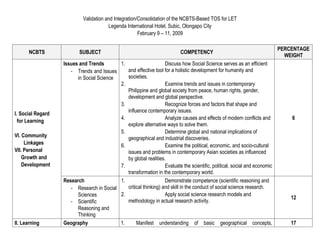
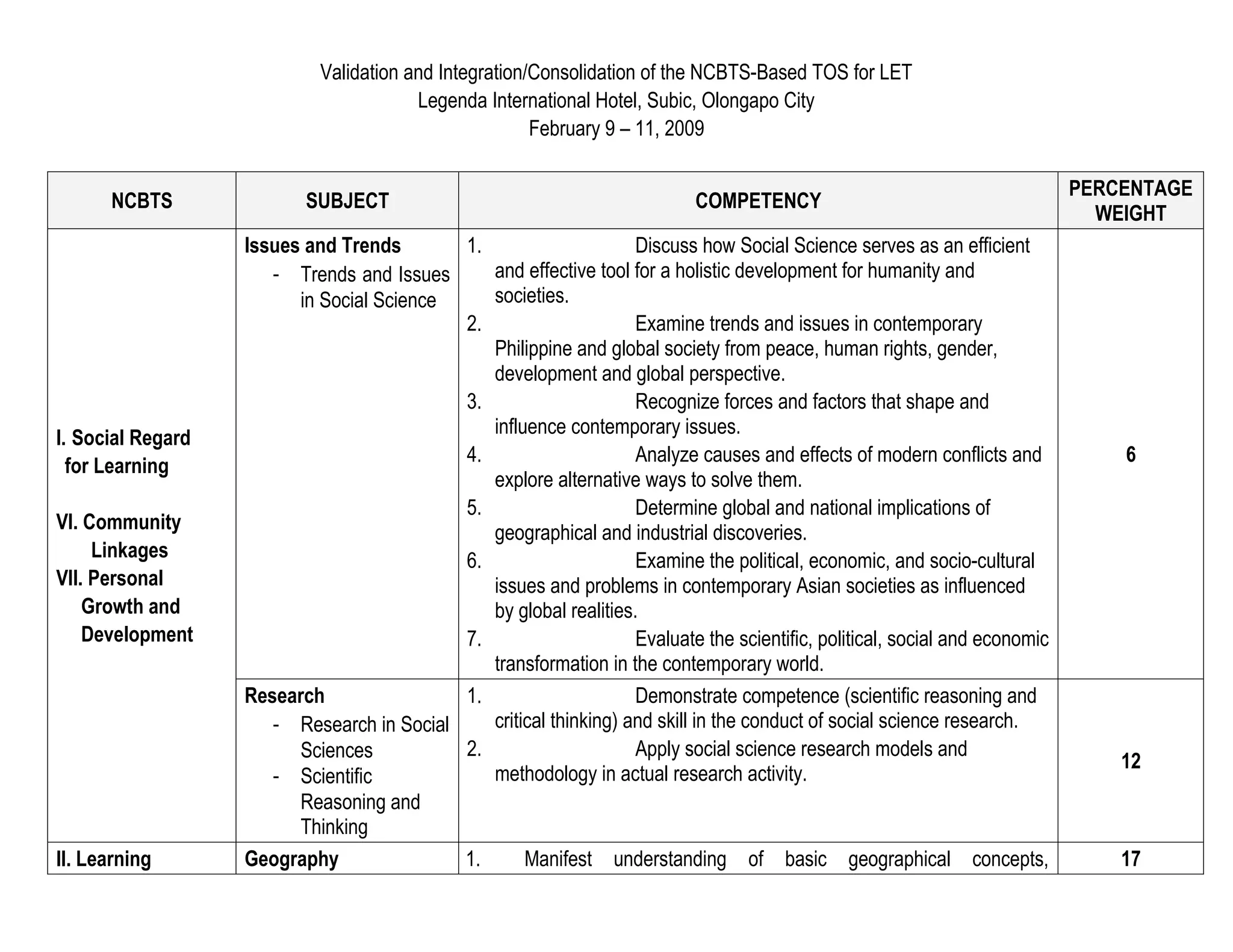
Validation and Integration/Consolidationof the NCBTS-Based TOS for LET
Legenda International Hotel, Subic, Olongapo City
February 9 – 11, 2009
NCBTS SUBJECT COMPETENCY
PERCENTAGE
WEIGHT
I. Social Regard
for Learning
VI. Community
Linkages
VII. Personal
Growth and
Development
Issues and Trends
- Trends and Issues
in Social Science
1. Discuss how Social Science serves as an efficient
and effective tool for a holistic development for humanity and
societies.
2. Examine trends and issues in contemporary
Philippine and global society from peace, human rights, gender,
development and global perspective.
3. Recognize forces and factors that shape and
influence contemporary issues.
4. Analyze causes and effects of modern conflicts and
explore alternative ways to solve them.
5. Determine global and national implications of
geographical and industrial discoveries.
6. Examine the political, economic, and socio-cultural
issues and problems in contemporary Asian societies as influenced
by global realities.
7. Evaluate the scientific, political, social and economic
transformation in the contemporary world.
6
Research
- Research in Social
Sciences
- Scientific
Reasoning and
Thinking
1. Demonstrate competence (scientific reasoning and
critical thinking) and skill in the conduct of social science research.
2. Apply social science research models and
methodology in actual research activity.
12
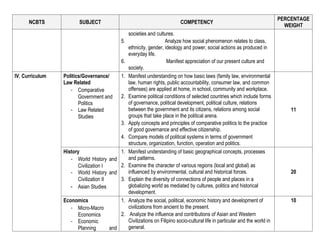
II. Learning Geography 1. Manifest understanding of basic geographical concepts, 17
2.
NCBTS SUBJECT COMPETENCY
PERCENTAGE
WEIGHT
Environment
-Basic Geography
- Places and
Landscapes in a
Changing World
- Geography and
Natural Resources
processes, and patterns
2. Examine the character of the various regions [social and global]
as influenced by environmental, cultural, and historical forces
3. Explain the diversity of connections of people and places in a
globalizing world as mediated by cultures, politics and historical
development
III. Diversity of
Learners
Methods
- Teaching
Approaches in
Secondary Social
Studies
- Production of
Social Studies
Instructional
Materials
- Building Bridges
Across Social
Science Discipline
(MAKABAYAN as
a core learning
area in Basic
Education)
1. Manifest understanding of the basic principles and
theories of teaching – learning processes in social studies and social
science.
2. Apply alternative approaches (collaborative,
conceptual, problem-based, experiential approaches) in teaching
Social Studies based on Constructivist Approach.
3. Apply appropriate innovative approaches, strategies
and techniques in teaching social studies.
4. Apply pedagogical principles in developing
instructional plans.
5. Apply integrative approaches in teaching Social
Studies and MAKABAYAN subjects.
10
Sociology
- Sociology-Cultural
Anthropology
1. Explain factors and conditions that influence cultural
and behavioral differences of different groups and societies.
2. Determine the relationships between culture and
biological traits.
3. Comprehend the basic sociological and
anthropological concepts, theories and perspective.
4. Trace the origin and development of human beings,
6
3.
NCBTS SUBJECT COMPETENCY
PERCENTAGE
WEIGHT
societiesand cultures.
5. Analyze how social phenomenon relates to class,
ethnicity, gender, ideology and power, social actions as produced in
everyday life.
6. Manifest appreciation of our present culture and
society.
IV. Curriculum Politics/Governance/
Law Related
- Comparative
Government and
Politics
- Law Related
Studies
1. Manifest understanding on how basic laws (family law, environmental
law, human rights, public accountability, consumer law, and common
offenses) are applied at home, in school, community and workplace.
2. Examine political conditions of selected countries which include forms
of governance, political development, political culture, relations
between the government and its citizens, relations among social
groups that take place in the political arena.
3. Apply concepts and principles of comparative politics to the practice
of good governance and effective citizenship.
4. Compare models of political systems in terms of government
structure, organization, function, operation and politics.
11
History
- World History and
Civilization I
- World History and
Civilization II
- Asian Studies
1. Manifest understanding of basic geographical concepts, processes
and patterns.
2. Examine the character of various regions (local and global) as
influenced by environmental, cultural and historical forces.
3. Explain the diversity of connections of people and places in a
globalizing world as mediated by cultures, politics and historical
development.
20
Economics
- Micro-Macro
Economics
- Economic
Planning and
1. Analyze the social, political, economic history and development of
civilizations from ancient to the present.
2. Analyze the influence and contributions of Asian and Western
Civilizations on Filipino socio-cultural life in particular and the world in
general.
10
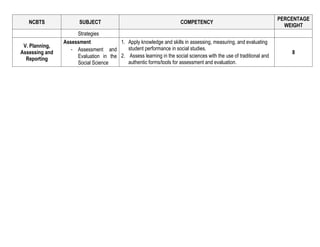
4.
NCBTS SUBJECT COMPETENCY
PERCENTAGE
WEIGHT
Strategies
V.Planning,
Assessing and
Reporting
Assessment
- Assessment and
Evaluation in the
Social Science
1. Apply knowledge and skills in assessing, measuring, and evaluating
student performance in social studies.
2. Assess learning in the social sciences with the use of traditional and
authentic forms/tools for assessment and evaluation.
8
![NCBTS SUBJECT COMPETENCY
PERCENTAGE
WEIGHT
Environment
- Basic Geography
- Places and
Landscapes in a
Changing World
- Geography and
Natural Resources
processes, and patterns
2. Examine the character of the various regions [social and global]
as influenced by environmental, cultural, and historical forces
3. Explain the diversity of connections of people and places in a
globalizing world as mediated by cultures, politics and historical
development
III. Diversity of
Learners
Methods
- Teaching
Approaches in
Secondary Social
Studies
- Production of
Social Studies
Instructional
Materials
- Building Bridges
Across Social
Science Discipline
(MAKABAYAN as
a core learning
area in Basic
Education)
1. Manifest understanding of the basic principles and
theories of teaching – learning processes in social studies and social
science.
2. Apply alternative approaches (collaborative,
conceptual, problem-based, experiential approaches) in teaching
Social Studies based on Constructivist Approach.
3. Apply appropriate innovative approaches, strategies
and techniques in teaching social studies.
4. Apply pedagogical principles in developing
instructional plans.
5. Apply integrative approaches in teaching Social
Studies and MAKABAYAN subjects.
10
Sociology
- Sociology-Cultural
Anthropology
1. Explain factors and conditions that influence cultural
and behavioral differences of different groups and societies.
2. Determine the relationships between culture and
biological traits.
3. Comprehend the basic sociological and
anthropological concepts, theories and perspective.
4. Trace the origin and development of human beings,
6](https://image.slidesharecdn.com/socialstudiesmajorsubic-250316095053-b3873e27/85/Social-Studies-Major-subic-doc-LET-Reviewer-2-320.jpg)