Applying theoretical
frameworks from firm
growth literature to social
enterprise growth
research
Saila Tykkyläinen
LUT School of Business and Management
23.4.2015 | SSFII conference, Oxford
Starting points for the study
The article describes the theoretical point of departure for my PhD study on growth
models of social enterprises.
CONCERN: Much is expected from social entrepreneurship and social
enterprises – how are they able to live up with the expectations, scale and
institutionalize their solutions?
GOAL: To explore social enterprises’ growth process; the growth strategies
and models that are used to spread the social impact. To derive guidelines and
recommendations for practitioners and decision-makers.
Some RQs:
− Is SE growth different from firm growth in general? If so, how?
− Are theories and concepts from entrepreneurship and business research
helpful in investigating SE growth?
LappeenrantaUniversityofTechnologySailaTykkyläinen
Proceedings and selected findings
LappeenrantaUniversityofTechnology
1. Findings from literature review on five comparative studies on social
enterprises and commercial enterprises:
Distinctive features of SEs:
 The nature and development process of (social) business opportunities
 The roles of networks ranging from strategic alliances to collective
entrepreneurship
2. Findings from literature review on social enterprise growth research:
 Opinions regarding SE growth prospects vary a lot
 Growth as a process –research stream dominates, unit of analysis is
most often organization or government structure.
 Hybrid growth models built on collaborative networks preferred by SEs
 Outcomes of growth neglected in research, although increasing social
impact is both a driver, outcome and an indicator of growth.
Synthesis: Social enterprise growth is an iterative process of social opportunity
development
SailaTykkyläinen
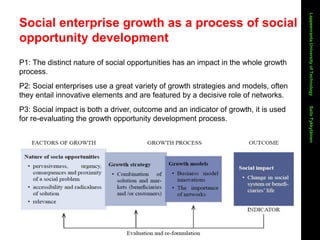
Social enterprise growth as a process of social
opportunity development
P1: The distinct nature of social opportunities has an impact in the whole growth
process.
P2: Social enterprises use a great variety of growth strategies and models, often
they entail innovative elements and are featured by a decisive role of networks.
P3: Social impact is both a driver, outcome and an indicator of growth, it is used
for re-evaluating the growth opportunity development process.
LappeenrantaUniversityofTechnologySailaTykkyläinen
Footer
Conclusions, future research topics
LappeenrantaUniversityofTechnology
Entrepreneurship and business theories can be used and modified to fit SE
context. Complementary concepts and frameworks from eg. the
structuration theory and social innovation diffusion theories are needed, in
order to
− explain the complexities and uncertainties related with diffusion of social
impact
− shift focus on beneficiaries and the business activity or solution
− capture the multiple roles of networks
− understand the outcomes of growth
Accumulating understanding on hybrid growth models may contribute
back to the firm growth literature
SailaTykkyläinen
Let’s stay in touch, saila.tykkylainen@lut.fi
THANK YOU!
KIITOS!
LappeenrantaUniversityofTechnology

Social enteprise growth

  • 1.
    Applying theoretical frameworks fromfirm growth literature to social enterprise growth research Saila Tykkyläinen LUT School of Business and Management 23.4.2015 | SSFII conference, Oxford
  • 2.
    Starting points forthe study The article describes the theoretical point of departure for my PhD study on growth models of social enterprises. CONCERN: Much is expected from social entrepreneurship and social enterprises – how are they able to live up with the expectations, scale and institutionalize their solutions? GOAL: To explore social enterprises’ growth process; the growth strategies and models that are used to spread the social impact. To derive guidelines and recommendations for practitioners and decision-makers. Some RQs: − Is SE growth different from firm growth in general? If so, how? − Are theories and concepts from entrepreneurship and business research helpful in investigating SE growth? LappeenrantaUniversityofTechnologySailaTykkyläinen
  • 3.
    Proceedings and selectedfindings LappeenrantaUniversityofTechnology 1. Findings from literature review on five comparative studies on social enterprises and commercial enterprises: Distinctive features of SEs:  The nature and development process of (social) business opportunities  The roles of networks ranging from strategic alliances to collective entrepreneurship 2. Findings from literature review on social enterprise growth research:  Opinions regarding SE growth prospects vary a lot  Growth as a process –research stream dominates, unit of analysis is most often organization or government structure.  Hybrid growth models built on collaborative networks preferred by SEs  Outcomes of growth neglected in research, although increasing social impact is both a driver, outcome and an indicator of growth. Synthesis: Social enterprise growth is an iterative process of social opportunity development SailaTykkyläinen
  • 4.
    Social enterprise growthas a process of social opportunity development P1: The distinct nature of social opportunities has an impact in the whole growth process. P2: Social enterprises use a great variety of growth strategies and models, often they entail innovative elements and are featured by a decisive role of networks. P3: Social impact is both a driver, outcome and an indicator of growth, it is used for re-evaluating the growth opportunity development process. LappeenrantaUniversityofTechnologySailaTykkyläinen Footer
  • 5.
    Conclusions, future researchtopics LappeenrantaUniversityofTechnology Entrepreneurship and business theories can be used and modified to fit SE context. Complementary concepts and frameworks from eg. the structuration theory and social innovation diffusion theories are needed, in order to − explain the complexities and uncertainties related with diffusion of social impact − shift focus on beneficiaries and the business activity or solution − capture the multiple roles of networks − understand the outcomes of growth Accumulating understanding on hybrid growth models may contribute back to the firm growth literature SailaTykkyläinen
  • 6.
    Let’s stay intouch, saila.tykkylainen@lut.fi THANK YOU! KIITOS! LappeenrantaUniversityofTechnology