An Actuarial Update on
                               the Dodd-Frank Act
                                    SOA Annual Meeting in Chicago
                                       Session 91: Hot Topics
                                      Tuesday, October 18, 2011


Michael Frings, FSA, CFA, MAAA
Vice-President and Senior Actuary
Global Financial Solutions
RGA Reinsurance Company
Presentation Agenda

 Describe events giving rise to Dodd-Frank Act
 Outline significant provisions of Dodd-Frank
 Review key sections impacting actuaries and
  insurance companies
 Update on status of Dodd-Frank implementation


                                                  2
Events Preceding Dodd-Frank Act
 Outsized, Unregulated OTC Derivatives Market
    Bank of International Settlements data
 2008 Collapse of Wall-Street Banks
    Lehman, Bear-Sterns, Morgan Stanley
 Record Number of Home Foreclosures
 Unprecedented US Govt Support & Spending
    Backstop banks and money-market funds
    Bailouts of GM, AIG, Chrystler, etc. etc.
 World-Wide Financial Crisis
    Iceland, Ireland, Greece


                                                 3
Voilà, the Dodd-Frank Act (DFA)
 Officially, the Wall-Street
  Accountability and
  Consumer Protection
  Act of 2010
 Signed into law July 21,
  2010
 Created in response to
  2008 Financial Crisis
 DFA written broadly
 Much of rulemaking left
  to regulators
 10 Sections                     4
Financial Stability: Sections I – VIII
 I. Financial Stability
    Creates FSOC & OFR, Add’l authority to FRB
 II. Orderly Liquidation Authority
 III. Transfer of Powers to the Comptroller of the Currency, SEC
  and FRB
 IV. Regulation of Advisors to Hedge Funds and Others
 V. Insurance
    FIO, State-based ins reform, Non-admitted insurance, Reinsurance
 VI. Improvements to Regulation of Bank and Savings
  Association Holding Companies and Depository Institutions (40
  pages)
 VII. Wall Street Transparency and Accountability Act
    Reg of OTC swaps markets, Reg of security based swap markets
 VIII. Payment, Clearing and Settlement Supervision
                                                                        5
Investor Protections, Consumer
Protections, Mortgage Reform
 Title IX. Investor Protections and Improvements to
  the Regulation of Securities
 Title X. Bureau of Consumer Financial Protection
 Title XIV. Mortgage Reform and Anti-Predatory
  Lending Act
 Miscellaneous
      XI. Federal Reserve System Provisions
      XII. Improving Access to Mainstream Financial Institutions
      XIII. Pay It Back Act
      XV. Miscellaneous Provisions
      XVI. Section 1256 Contracts


                                                                    6
Changes to Roles of Regulators
• The Dodd-Frank Act expands the roles of the US
  Treasury, Federal Reserve, CFTC and SEC
• The Office of Thrift Supervision is eliminated
   – Authority split among the Comptroller of the Currency, SEC and
     the Federal Reserve
• Prudential Regulators Keep Their Authority
• New Regulators are created
   – Federal Stability Oversight Council (FSOC)
   – Consumer Financial Protection Bureau (CFPB in Federal
     Reserve)
   – Federal Office of Insurance (FIO in US Treasury)


                                                                      7
FSOC Key Responsibilities
 Designate specific companies as ―systemically important‖
  financial institutions (SIFI)
 Instruct Federal Reserve to impose measures to regulate
  SIFIs
 Permit the Federal Reserve, in extreme cases, to order
  companies to divest assets (or to be broken up)
 Collect information from other regulators (federal & state)
 Identify regulatory gaps
 Identify other threats to US financial stability
 Facilitate cooperation and resolve disputes among
  regulators
 Monitor US financial markets: integrity, efficiency and
  competitiveness
                                                                8
FSOC Members
        VOTING MEMBERS          NON-VOTING MEMBERS


                                               Selected State
                               Office of         Insurance
                               Financial      Commissioner
                               Research
                                 (in US       (John Huff-MO)
                               Treasury)

 Bureau of
 Consumer
 Financial                                    Selected State
 Protection                                      Banking
                                 Federal
                               Insurance       Supervisor
                                  Office
                                  (in US
                               Treasury)
                                (Michael      Selected State
                                McRaith
                                                Securities
                                              Commissioner
                Independent
                Member with
                  Insurance
                 Experience          3 Insurance Members
               (Roy Woodall)
                                                                9
Federal Insurance Office (FIO)
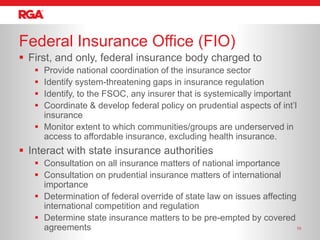
 First, and only, federal insurance body charged to
    Provide national coordination of the insurance sector
    Identify system-threatening gaps in insurance regulation
    Identify, to the FSOC, any insurer that is systemically important
    Coordinate & develop federal policy on prudential aspects of int’l
     insurance
    Monitor extent to which communities/groups are underserved in
     access to affordable insurance, excluding health insurance.
 Interact with state insurance authorities
    Consultation on all insurance matters of national importance
    Consultation on prudential insurance matters of international
     importance
    Determination of federal override of state law on issues affecting
     international competition and regulation
    Determine state insurance matters to be pre-empted by covered
     agreements                                                         10
Federal Insurance Office (FIO)
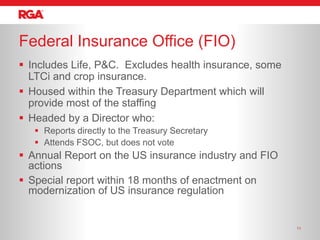
 Includes Life, P&C. Excludes health insurance, some
  LTCi and crop insurance.
 Housed within the Treasury Department which will
  provide most of the staffing
 Headed by a Director who:
    Reports directly to the Treasury Secretary
    Attends FSOC, but does not vote
 Annual Report on the US insurance industry and FIO
  actions
 Special report within 18 months of enactment on
  modernization of US insurance regulation


                                                        11
DFA Eases Rules on Reinsurance
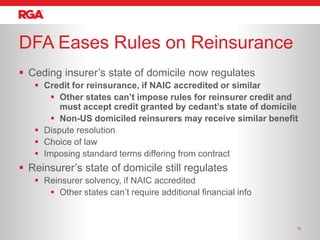
 Ceding insurer’s state of domicile now regulates
    Credit for reinsurance, if NAIC accredited or similar
        Other states can’t impose rules for reinsurer credit and
         must accept credit granted by cedant’s state of domicile
        Non-US domiciled reinsurers may receive similar benefit
    Dispute resolution
    Choice of law
    Imposing standard terms differing from contract
 Reinsurer’s state of domicile still regulates
    Reinsurer solvency, if NAIC accredited
       Other states can’t require additional financial info


                                                                12
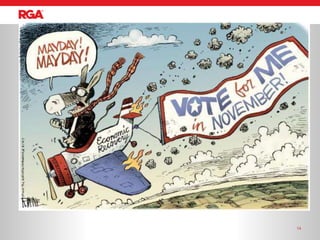
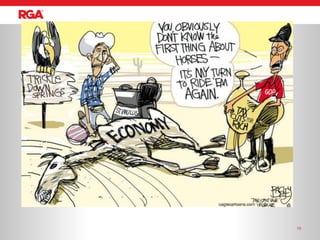
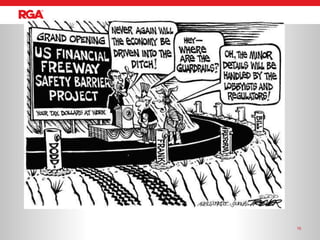
Actions After Dodd-Frank Act


                               13
14
15
16
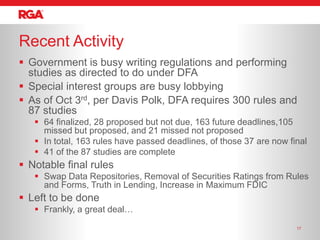
Recent Activity
 Government is busy writing regulations and performing
  studies as directed to do under DFA
 Special interest groups are busy lobbying
 As of Oct 3rd, per Davis Polk, DFA requires 300 rules and
  87 studies
    64 finalized, 28 proposed but not due, 163 future deadlines,105
     missed but proposed, and 21 missed not proposed
    In total, 163 rules have passed deadlines, of those 37 are now final
    41 of the 87 studies are complete
 Notable final rules
    Swap Data Repositories, Removal of Securities Ratings from Rules
     and Forms, Truth in Lending, Increase in Maximum FDIC
 Left to be done
    Frankly, a great deal…
                                                                      17
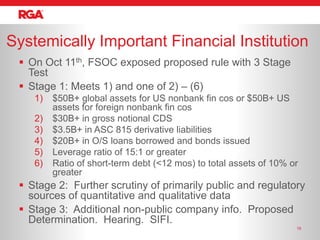
Systemically Important Financial Institution
  On Oct 11th, FSOC exposed proposed rule with 3 Stage
   Test
  Stage 1: Meets 1) and one of 2) – (6)
    1)   $50B+ global assets for US nonbank fin cos or $50B+ US
         assets for foreign nonbank fin cos
    2)   $30B+ in gross notional CDS
    3)   $3.5B+ in ASC 815 derivative liabilities
    4)   $20B+ in O/S loans borrowed and bonds issued
    5)   Leverage ratio of 15:1 or greater
    6)   Ratio of short-term debt (<12 mos) to total assets of 10% or
         greater
  Stage 2: Further scrutiny of primarily public and regulatory
   sources of quantitative and qualitative data
  Stage 3: Additional non-public company info. Proposed
   Determination. Hearing. SIFI.
                                                                    18
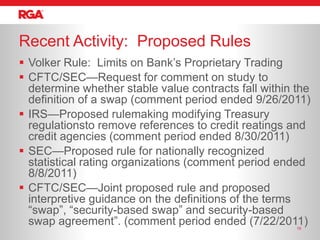
Recent Activity: Proposed Rules
 Volker Rule: Limits on Bank’s Proprietary Trading
 CFTC/SEC—Request for comment on study to
  determine whether stable value contracts fall within the
  definition of a swap (comment period ended 9/26/2011)
 IRS—Proposed rulemaking modifying Treasury
  regulationsto remove references to credit reatings and
  credit agencies (comment period ended 8/30/2011)
 SEC—Proposed rule for nationally recognized
  statistical rating organizations (comment period ended
  8/8/2011)
 CFTC/SEC—Joint proposed rule and proposed
  interpretive guidance on the definitions of the terms
  ―swap‖, ―security-based swap‖ and security-based
  swap agreement‖. (comment period ended (7/22/2011)   19
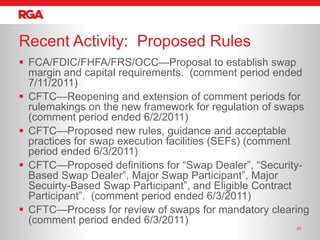
Recent Activity: Proposed Rules
 FCA/FDIC/FHFA/FRS/OCC—Proposal to establish swap
  margin and capital requirements. (comment period ended
  7/11/2011)
 CFTC—Reopening and extension of comment periods for
  rulemakings on the new framework for regulation of swaps
  (comment period ended 6/2/2011)
 CFTC—Proposed new rules, guidance and acceptable
  practices for swap execution facilities (SEFs) (comment
  period ended 6/3/2011)
 CFTC—Proposed definitions for ―Swap Dealer‖, ―Security-
  Based Swap Dealer‖, Major Swap Participant‖, Major
  Secuirty-Based Swap Participant‖, and Eligible Contract
  Participant‖. (comment period ended 6/3/2011)
 CFTC—Process for review of swaps for mandatory clearing
  (comment period ended 6/3/2011)
                                                       20
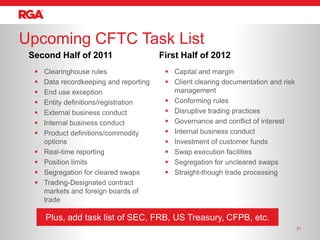
Upcoming CFTC Task List
 Second Half of 2011                     First Half of 2012
     Clearinghouse rules                  Capital and margin
     Data recordkeeping and reporting     Client clearing documentation and risk
     End use exception                     management
     Entity definitions/registration      Conforming rules
     External business conduct            Disruptive trading practices
     Internal business conduct            Governance and conflict of interest
     Product definitions/commodity        Internal business conduct
      options                              Investment of customer funds
     Real-time reporting                  Swap execution facilities
     Position limits                      Segregation for uncleared swaps
     Segregation for cleared swaps        Straight-though trade processing
     Trading-Designated contract
      markets and foreign boards of
      trade

      Plus, add task list of SEC, FRB, US Treasury, CFPB, etc.
                                                                                     21
Summary
 Dodd-Frank Act passed with great fanfare in July 2010
 Designed to fix macro-prudential problems following 2008 Financial
  Crisis
 As a result, broadest single US federal financial law to date
 However, much of the details left to regulators
 Congressional oversight is partisan
    Democrats seek to continue legacy of legislation
    Republicans seek to overturn many provisions, restrict funding, grill agencies
 CFTC, SEC, FRB and other govt agencies continue to implement
 Impact of Dodd-Frank delayed but not defeated
 Impact on Insurance companies directly is less once expected
    Not widely designated as SIFIs
    Impact of swaps regs & margins and consumer protection bureau to be seen
 Will the next financial crisis be adverted or diminished? Europe 2012?
                                                                                      22
QUESTIONS?


             23

Soa chicago2011 10-12-dodd-frank-frings

  • 1.
    An Actuarial Updateon the Dodd-Frank Act SOA Annual Meeting in Chicago Session 91: Hot Topics Tuesday, October 18, 2011 Michael Frings, FSA, CFA, MAAA Vice-President and Senior Actuary Global Financial Solutions RGA Reinsurance Company
  • 2.
    Presentation Agenda  Describeevents giving rise to Dodd-Frank Act  Outline significant provisions of Dodd-Frank  Review key sections impacting actuaries and insurance companies  Update on status of Dodd-Frank implementation 2
  • 3.
    Events Preceding Dodd-FrankAct  Outsized, Unregulated OTC Derivatives Market  Bank of International Settlements data  2008 Collapse of Wall-Street Banks  Lehman, Bear-Sterns, Morgan Stanley  Record Number of Home Foreclosures  Unprecedented US Govt Support & Spending  Backstop banks and money-market funds  Bailouts of GM, AIG, Chrystler, etc. etc.  World-Wide Financial Crisis  Iceland, Ireland, Greece 3
  • 4.
    Voilà, the Dodd-FrankAct (DFA)  Officially, the Wall-Street Accountability and Consumer Protection Act of 2010  Signed into law July 21, 2010  Created in response to 2008 Financial Crisis  DFA written broadly  Much of rulemaking left to regulators  10 Sections 4
  • 5.
    Financial Stability: SectionsI – VIII  I. Financial Stability  Creates FSOC & OFR, Add’l authority to FRB  II. Orderly Liquidation Authority  III. Transfer of Powers to the Comptroller of the Currency, SEC and FRB  IV. Regulation of Advisors to Hedge Funds and Others  V. Insurance  FIO, State-based ins reform, Non-admitted insurance, Reinsurance  VI. Improvements to Regulation of Bank and Savings Association Holding Companies and Depository Institutions (40 pages)  VII. Wall Street Transparency and Accountability Act  Reg of OTC swaps markets, Reg of security based swap markets  VIII. Payment, Clearing and Settlement Supervision 5
  • 6.
    Investor Protections, Consumer Protections,Mortgage Reform  Title IX. Investor Protections and Improvements to the Regulation of Securities  Title X. Bureau of Consumer Financial Protection  Title XIV. Mortgage Reform and Anti-Predatory Lending Act  Miscellaneous  XI. Federal Reserve System Provisions  XII. Improving Access to Mainstream Financial Institutions  XIII. Pay It Back Act  XV. Miscellaneous Provisions  XVI. Section 1256 Contracts 6
  • 7.
    Changes to Rolesof Regulators • The Dodd-Frank Act expands the roles of the US Treasury, Federal Reserve, CFTC and SEC • The Office of Thrift Supervision is eliminated – Authority split among the Comptroller of the Currency, SEC and the Federal Reserve • Prudential Regulators Keep Their Authority • New Regulators are created – Federal Stability Oversight Council (FSOC) – Consumer Financial Protection Bureau (CFPB in Federal Reserve) – Federal Office of Insurance (FIO in US Treasury) 7
  • 8.
    FSOC Key Responsibilities Designate specific companies as ―systemically important‖ financial institutions (SIFI)  Instruct Federal Reserve to impose measures to regulate SIFIs  Permit the Federal Reserve, in extreme cases, to order companies to divest assets (or to be broken up)  Collect information from other regulators (federal & state)  Identify regulatory gaps  Identify other threats to US financial stability  Facilitate cooperation and resolve disputes among regulators  Monitor US financial markets: integrity, efficiency and competitiveness 8
  • 9.
    FSOC Members VOTING MEMBERS NON-VOTING MEMBERS Selected State Office of Insurance Financial Commissioner Research (in US (John Huff-MO) Treasury) Bureau of Consumer Financial Selected State Protection Banking Federal Insurance Supervisor Office (in US Treasury) (Michael Selected State McRaith Securities Commissioner Independent Member with Insurance Experience 3 Insurance Members (Roy Woodall) 9
  • 10.
    Federal Insurance Office(FIO)  First, and only, federal insurance body charged to  Provide national coordination of the insurance sector  Identify system-threatening gaps in insurance regulation  Identify, to the FSOC, any insurer that is systemically important  Coordinate & develop federal policy on prudential aspects of int’l insurance  Monitor extent to which communities/groups are underserved in access to affordable insurance, excluding health insurance.  Interact with state insurance authorities  Consultation on all insurance matters of national importance  Consultation on prudential insurance matters of international importance  Determination of federal override of state law on issues affecting international competition and regulation  Determine state insurance matters to be pre-empted by covered agreements 10
  • 11.
    Federal Insurance Office(FIO)  Includes Life, P&C. Excludes health insurance, some LTCi and crop insurance.  Housed within the Treasury Department which will provide most of the staffing  Headed by a Director who:  Reports directly to the Treasury Secretary  Attends FSOC, but does not vote  Annual Report on the US insurance industry and FIO actions  Special report within 18 months of enactment on modernization of US insurance regulation 11
  • 12.
    DFA Eases Ruleson Reinsurance  Ceding insurer’s state of domicile now regulates  Credit for reinsurance, if NAIC accredited or similar  Other states can’t impose rules for reinsurer credit and must accept credit granted by cedant’s state of domicile  Non-US domiciled reinsurers may receive similar benefit  Dispute resolution  Choice of law  Imposing standard terms differing from contract  Reinsurer’s state of domicile still regulates  Reinsurer solvency, if NAIC accredited  Other states can’t require additional financial info 12
  • 13.
  • 14.
  • 15.
  • 16.
  • 17.
    Recent Activity  Governmentis busy writing regulations and performing studies as directed to do under DFA  Special interest groups are busy lobbying  As of Oct 3rd, per Davis Polk, DFA requires 300 rules and 87 studies  64 finalized, 28 proposed but not due, 163 future deadlines,105 missed but proposed, and 21 missed not proposed  In total, 163 rules have passed deadlines, of those 37 are now final  41 of the 87 studies are complete  Notable final rules  Swap Data Repositories, Removal of Securities Ratings from Rules and Forms, Truth in Lending, Increase in Maximum FDIC  Left to be done  Frankly, a great deal… 17
  • 18.
    Systemically Important FinancialInstitution  On Oct 11th, FSOC exposed proposed rule with 3 Stage Test  Stage 1: Meets 1) and one of 2) – (6) 1) $50B+ global assets for US nonbank fin cos or $50B+ US assets for foreign nonbank fin cos 2) $30B+ in gross notional CDS 3) $3.5B+ in ASC 815 derivative liabilities 4) $20B+ in O/S loans borrowed and bonds issued 5) Leverage ratio of 15:1 or greater 6) Ratio of short-term debt (<12 mos) to total assets of 10% or greater  Stage 2: Further scrutiny of primarily public and regulatory sources of quantitative and qualitative data  Stage 3: Additional non-public company info. Proposed Determination. Hearing. SIFI. 18
  • 19.
    Recent Activity: ProposedRules  Volker Rule: Limits on Bank’s Proprietary Trading  CFTC/SEC—Request for comment on study to determine whether stable value contracts fall within the definition of a swap (comment period ended 9/26/2011)  IRS—Proposed rulemaking modifying Treasury regulationsto remove references to credit reatings and credit agencies (comment period ended 8/30/2011)  SEC—Proposed rule for nationally recognized statistical rating organizations (comment period ended 8/8/2011)  CFTC/SEC—Joint proposed rule and proposed interpretive guidance on the definitions of the terms ―swap‖, ―security-based swap‖ and security-based swap agreement‖. (comment period ended (7/22/2011) 19
  • 20.
    Recent Activity: ProposedRules  FCA/FDIC/FHFA/FRS/OCC—Proposal to establish swap margin and capital requirements. (comment period ended 7/11/2011)  CFTC—Reopening and extension of comment periods for rulemakings on the new framework for regulation of swaps (comment period ended 6/2/2011)  CFTC—Proposed new rules, guidance and acceptable practices for swap execution facilities (SEFs) (comment period ended 6/3/2011)  CFTC—Proposed definitions for ―Swap Dealer‖, ―Security- Based Swap Dealer‖, Major Swap Participant‖, Major Secuirty-Based Swap Participant‖, and Eligible Contract Participant‖. (comment period ended 6/3/2011)  CFTC—Process for review of swaps for mandatory clearing (comment period ended 6/3/2011) 20
  • 21.
    Upcoming CFTC TaskList Second Half of 2011 First Half of 2012  Clearinghouse rules  Capital and margin  Data recordkeeping and reporting  Client clearing documentation and risk  End use exception management  Entity definitions/registration  Conforming rules  External business conduct  Disruptive trading practices  Internal business conduct  Governance and conflict of interest  Product definitions/commodity  Internal business conduct options  Investment of customer funds  Real-time reporting  Swap execution facilities  Position limits  Segregation for uncleared swaps  Segregation for cleared swaps  Straight-though trade processing  Trading-Designated contract markets and foreign boards of trade Plus, add task list of SEC, FRB, US Treasury, CFPB, etc. 21
  • 22.
    Summary  Dodd-Frank Actpassed with great fanfare in July 2010  Designed to fix macro-prudential problems following 2008 Financial Crisis  As a result, broadest single US federal financial law to date  However, much of the details left to regulators  Congressional oversight is partisan  Democrats seek to continue legacy of legislation  Republicans seek to overturn many provisions, restrict funding, grill agencies  CFTC, SEC, FRB and other govt agencies continue to implement  Impact of Dodd-Frank delayed but not defeated  Impact on Insurance companies directly is less once expected  Not widely designated as SIFIs  Impact of swaps regs & margins and consumer protection bureau to be seen  Will the next financial crisis be adverted or diminished? Europe 2012? 22
  • 23.

Editor's Notes

  • #8 “Regulator Swapping” was one of the issues addressed by the Dodd-Frank Act. However, contrary to initial drafts of the Dodd-Frank Act, only one regulator is removed, that is the Office of Thrift Supervision. The OTS’s duties are distributed as follows. The Board of Governors will regulate Thrift Holding Companies and their non-depository subsidiaries. The Comptroller of the Currency will regulate all Federal savings associations. The FDIC will regulate State savings associations. Existing regulators are given more authority to prevent a future, financial crisis.