SNAKE BITE
AND ITS MANAGEMENT
DR. BINDHU CHARLES SELVARAJ, ER

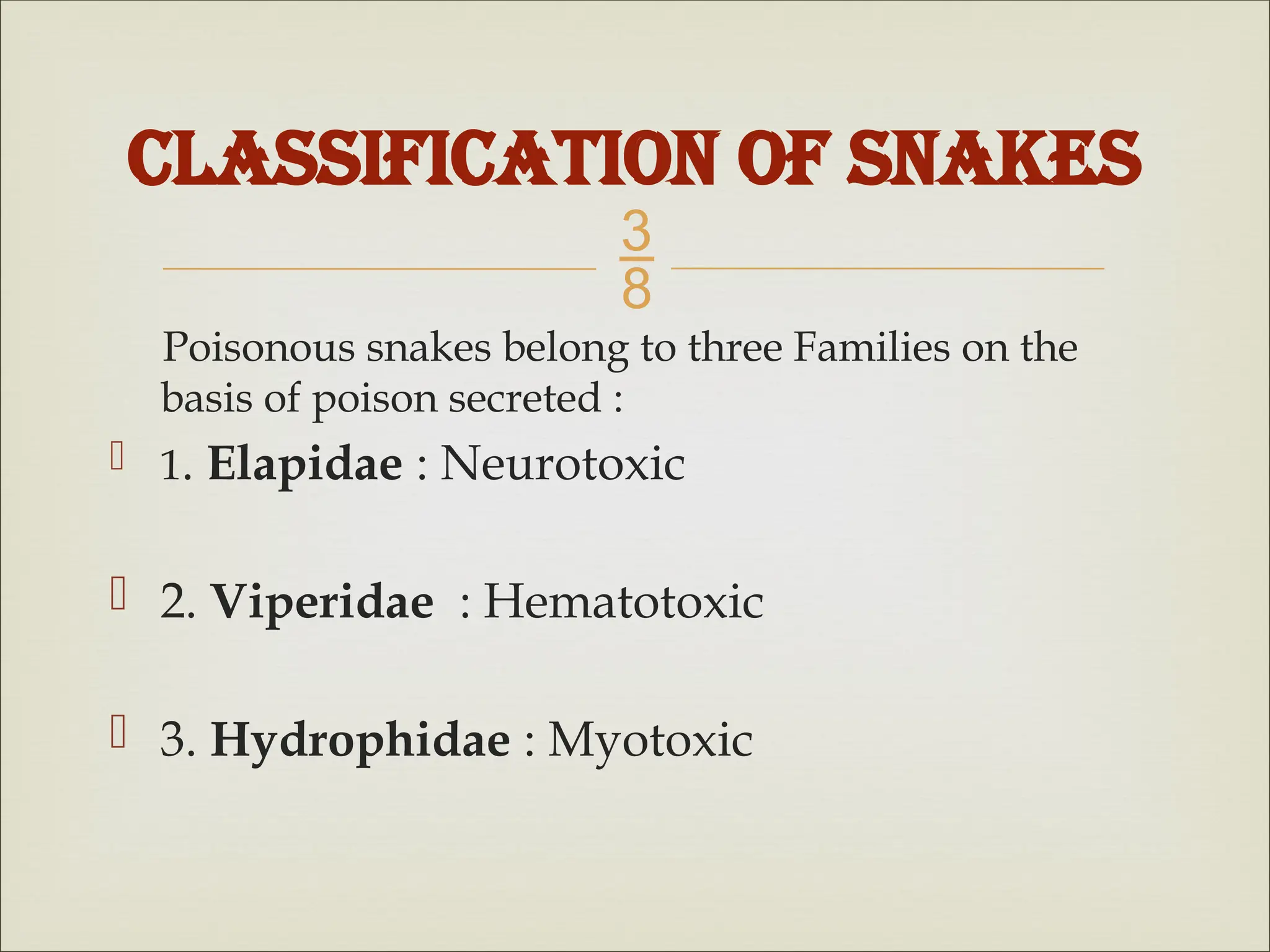
Poisonous snakes belong to three Families on the
basis of poison secreted :
 1. Elapidae : Neurotoxic
 2. Viperidae : Hematotoxic
 3. Hydrophidae : Myotoxic
Classification of snakes

 A) Common Cobra
 B) King Cobra
 C) Krait
ELAPIDAE

Common Cobra
 Seen through out India,
Burma, Srilanka
 Well marked hood
 Single (monocellate) or double
spectacle mark

Monocellate Cobra

COMMON KRAIT
 Neurotoxic

They are grouped into:
 A). Pitless Vipers :
a). Russel ‘s Viper
b). Saw-scaled Viper
 B). Pit Vipers :
a). Pit Viper
b). Common Green Pit Viper
VIPERIDAE

Haematotoxic
Saw scaled viper (carpet viper)

Haematotoxic
Russell’s viper

 20 types of sea snakes found in India.
 All are poisonous.
 They are myotoxic.
HYDROPHIDAE

 When a snake bites, it may excrete venom but this is
dependent on the type of snake – venomous or non
venomous.
 Snake Venom is a Toxin (Hematotoxin, Neurotoxin, or
Cytotoxin)
 It is a varied form of saliva and excreted through a
modified parotid salivary gland
 Located on each side of the skull, behind the eye
 Produced through a pumping mechanism from a sac
that stores the venom, proceeds through a channel,
down a tubular fang, hollow in the center to project
the venom
Snake Bite and Snake Venom

 Snake venoms are
 A combination of proteins and enzymes
 Have 25 different enzymes found in various
venoms and 10 of these occur frequently in
most venoms
SNAKE VENOM

 The most common types of enzymes are proteolytic,
phospholipases and hyaluronidases
 Proteolytic Enzymes: digestive properties
 Phospholipases: degrade lipids
 Hyaluronidases: facilitates venom spread through out
the body
Mechanism of Toxicity of Venom

SIGNS
AND
SYMPTOMS

ELAPID BITE
LOCAL FEATURES
Fang marks
Burning pain
Swelling
Discoloration
Serous discharge
SYSTEMIC FEATURES
Pre-paralytic Stage Paralytic Stage
Vomiting Ptosis
Headache Ophthalmoplegia
Giddiness Drowsiness
Weakness Convulsions
Lethargy Bulbar paralysis
Respiratory
Failure
Death

VIPERID BITE
 Local Features
Rapid swelling at bite site
Discoloration
Blister formation
Bleeding from bite site
Pain
 Systemic Features
Generalized bleeding:
Epistaxis
Hemoptysis
Hemetemesis
Bleeding gums
Hematuria
Malena
Hemaorrhagic areas over skin
and mucosa
Shock
Renal failure

HYDROPHID BITE
 Local Features
Local swelling
Pain
 Systemic Features
Myalgia
Muscle stiffness
Myoglobinuria
Renal failure

Factor Effect
Body weight Bigger the size lesser toxicity
Part bitten Bite on face and trunk are most lethal
Individual
sensitivity
Sensitivity of individual to venom modifies clinical outcome
Bite
characteristic
Type of bite
Bite number, depth, duration of when snake clings to body
Bite through clothes
Amount of venom
Condition of fangs, different species & their lethal dose
Factor affecting snake bite
toxicity

 Time of bite
 Activity at the time of bite
 First aid action taken since the bite
 Clinical examination
 20 mn whole Blood Clotting Test
Prognosis assesment

 20 WBCT-Test positive for viperine bite
 Non Specific- Hemogram, S.Creatinine,
S.Amylase, Creatine Phosphokinase, Coagulation
profile & Fibrinogen level in viper bite interfer with
clotting mechanism.
 ABG, Electrolyte-for systemic manifestion.
 Urine Examination for Proteinuria , Myoglobinuria
 ECG-non specific changes like bradycardia or
AV-block.
Investigations
TREATMENt
TREATMENT
Local
Specific
Supportive
 The first aid being currently recommended is based around the
mnemonic: “Do it R.I.G.H.T.”
R =Reassure the patient. 70% of all snakebites are from non-
venomous species. Only 50% of bites by venomous species
actually envenomate the patient.
I = Immobilise in the same way as a fractured limb. Use bandages
or cloth to hold the splints, not to block the blood supply or
apply pressure. Do not apply any compression in the form of
tight ligatures, they can be dangerous!
G.H. = Get to Hospital Immediately. Traditional remedies have
NO PROVEN benefit in treating snakebite.
T = Tell the doctor of any systemic symptoms such as ptosis that
manifest on the way to hospital.

 DOs-
 Assurance of patient
 Immobilisation
 DON’TS-
 Incision
 Suction
 Application of Ice ,massage or any chemical
treatment
 Application of tourniquet
First Aid

Indication for ASV
 Spontaneous systemic Bleeding
 WBCT > 20 min
 Thrombocytopenia (platelet < 1 lac)
 Shock, paralysis, Rhabdomyolysis, Hyperkalemia.
 Local swelling involving > ½ of bitten limb
 Rapid extension of swelling
Specific treatment Anti snake Venom

 ASV alone not sufficient
 Tracheostomy or Endotrachial intubation &
mechanical ventilation is to be done.
 Inj. Neostigmine-50 to 100 microgram/kg/4hrs as a
continuous infusion
 Glycopyrrolate-0.25 mg can be given before
neostigmine in place of atropine as they don’t cross
blood brain barrier
 Care of bitten part-
Antibiotic prophylaxis & TT injection
For Bulbar Paralysis & Resp. Failure-

 Ideally administer with in 4 hr but effective if given
with in 24 hrs
In mild cases-5 vial (50 ml)
In moderate cases-5 to 10 vial
In severe cases-10 to 20 vial
Additional infusion containing 5 to 10 vial are infused
until progression of swelling ceases and systemic
symptoms are disappeared.
Anti venom Therapy
 ASV can be administer slow i.v. injection or infusion
@ rate of 2ml/min
 ASV dilution is 5-10 ml/kg body weight of normal
saline or 5% dextrose and infused over 1 hr
 ASV should never given locally at site of snake bite.
Disadvantage of ASV
 Pain at injection site
 Hematoma formation
 Increase intra compartmental pressure
ASV SENSTIVITY IS NOT RECOMMONDED NOW
A DAYS (TEST DOSE)
WHY?
Intradermal skin testing may delay treatment and waste
time when the patient needs ASV, and it may pre-
sensitize the patient leading to more severe reaction
when a large amount of ASV is administered.

 For Coagulopathy - if not reversed after ASV therapy
Fresh frozen plasma
Cryoprecipitate (fibrinogen, Factor VIII),
Fresh whole blood,
Platelet concentrate.
Supportive therapy
THANK YOU
LETS DO IT RIGHT

SNAKES, VENOMS, SNAKE BITE AND TREATMENT.pptx

  • 1.
    SNAKE BITE AND ITSMANAGEMENT DR. BINDHU CHARLES SELVARAJ, ER
  • 2.
     Poisonous snakes belongto three Families on the basis of poison secreted :  1. Elapidae : Neurotoxic  2. Viperidae : Hematotoxic  3. Hydrophidae : Myotoxic Classification of snakes
  • 3.
      A) CommonCobra  B) King Cobra  C) Krait ELAPIDAE
  • 4.
     Common Cobra  Seenthrough out India, Burma, Srilanka  Well marked hood  Single (monocellate) or double spectacle mark
  • 5.
  • 6.
  • 7.
     They are groupedinto:  A). Pitless Vipers : a). Russel ‘s Viper b). Saw-scaled Viper  B). Pit Vipers : a). Pit Viper b). Common Green Pit Viper VIPERIDAE
  • 8.
  • 9.
  • 10.
      20 typesof sea snakes found in India.  All are poisonous.  They are myotoxic. HYDROPHIDAE
  • 11.
      When asnake bites, it may excrete venom but this is dependent on the type of snake – venomous or non venomous.  Snake Venom is a Toxin (Hematotoxin, Neurotoxin, or Cytotoxin)  It is a varied form of saliva and excreted through a modified parotid salivary gland  Located on each side of the skull, behind the eye  Produced through a pumping mechanism from a sac that stores the venom, proceeds through a channel, down a tubular fang, hollow in the center to project the venom Snake Bite and Snake Venom
  • 12.
      Snake venomsare  A combination of proteins and enzymes  Have 25 different enzymes found in various venoms and 10 of these occur frequently in most venoms SNAKE VENOM
  • 13.
      The mostcommon types of enzymes are proteolytic, phospholipases and hyaluronidases  Proteolytic Enzymes: digestive properties  Phospholipases: degrade lipids  Hyaluronidases: facilitates venom spread through out the body Mechanism of Toxicity of Venom
  • 14.
  • 15.
     ELAPID BITE LOCAL FEATURES Fangmarks Burning pain Swelling Discoloration Serous discharge SYSTEMIC FEATURES Pre-paralytic Stage Paralytic Stage Vomiting Ptosis Headache Ophthalmoplegia Giddiness Drowsiness Weakness Convulsions Lethargy Bulbar paralysis Respiratory Failure Death
  • 16.
     VIPERID BITE  LocalFeatures Rapid swelling at bite site Discoloration Blister formation Bleeding from bite site Pain  Systemic Features Generalized bleeding: Epistaxis Hemoptysis Hemetemesis Bleeding gums Hematuria Malena Hemaorrhagic areas over skin and mucosa Shock Renal failure
  • 17.
     HYDROPHID BITE  LocalFeatures Local swelling Pain  Systemic Features Myalgia Muscle stiffness Myoglobinuria Renal failure
  • 18.
     Factor Effect Body weightBigger the size lesser toxicity Part bitten Bite on face and trunk are most lethal Individual sensitivity Sensitivity of individual to venom modifies clinical outcome Bite characteristic Type of bite Bite number, depth, duration of when snake clings to body Bite through clothes Amount of venom Condition of fangs, different species & their lethal dose Factor affecting snake bite toxicity
  • 19.
      Time ofbite  Activity at the time of bite  First aid action taken since the bite  Clinical examination  20 mn whole Blood Clotting Test Prognosis assesment
  • 20.
      20 WBCT-Testpositive for viperine bite  Non Specific- Hemogram, S.Creatinine, S.Amylase, Creatine Phosphokinase, Coagulation profile & Fibrinogen level in viper bite interfer with clotting mechanism.  ABG, Electrolyte-for systemic manifestion.  Urine Examination for Proteinuria , Myoglobinuria  ECG-non specific changes like bradycardia or AV-block. Investigations
  • 21.
  • 22.
     The firstaid being currently recommended is based around the mnemonic: “Do it R.I.G.H.T.” R =Reassure the patient. 70% of all snakebites are from non- venomous species. Only 50% of bites by venomous species actually envenomate the patient. I = Immobilise in the same way as a fractured limb. Use bandages or cloth to hold the splints, not to block the blood supply or apply pressure. Do not apply any compression in the form of tight ligatures, they can be dangerous! G.H. = Get to Hospital Immediately. Traditional remedies have NO PROVEN benefit in treating snakebite. T = Tell the doctor of any systemic symptoms such as ptosis that manifest on the way to hospital.
  • 23.
      DOs-  Assuranceof patient  Immobilisation  DON’TS-  Incision  Suction  Application of Ice ,massage or any chemical treatment  Application of tourniquet First Aid
  • 24.
     Indication for ASV Spontaneous systemic Bleeding  WBCT > 20 min  Thrombocytopenia (platelet < 1 lac)  Shock, paralysis, Rhabdomyolysis, Hyperkalemia.  Local swelling involving > ½ of bitten limb  Rapid extension of swelling Specific treatment Anti snake Venom
  • 25.
      ASV alonenot sufficient  Tracheostomy or Endotrachial intubation & mechanical ventilation is to be done.  Inj. Neostigmine-50 to 100 microgram/kg/4hrs as a continuous infusion  Glycopyrrolate-0.25 mg can be given before neostigmine in place of atropine as they don’t cross blood brain barrier  Care of bitten part- Antibiotic prophylaxis & TT injection For Bulbar Paralysis & Resp. Failure-
  • 26.
      Ideally administerwith in 4 hr but effective if given with in 24 hrs In mild cases-5 vial (50 ml) In moderate cases-5 to 10 vial In severe cases-10 to 20 vial Additional infusion containing 5 to 10 vial are infused until progression of swelling ceases and systemic symptoms are disappeared. Anti venom Therapy
  • 27.
     ASV canbe administer slow i.v. injection or infusion @ rate of 2ml/min  ASV dilution is 5-10 ml/kg body weight of normal saline or 5% dextrose and infused over 1 hr  ASV should never given locally at site of snake bite.
  • 28.
    Disadvantage of ASV Pain at injection site  Hematoma formation  Increase intra compartmental pressure ASV SENSTIVITY IS NOT RECOMMONDED NOW A DAYS (TEST DOSE) WHY? Intradermal skin testing may delay treatment and waste time when the patient needs ASV, and it may pre- sensitize the patient leading to more severe reaction when a large amount of ASV is administered.
  • 29.
      For Coagulopathy- if not reversed after ASV therapy Fresh frozen plasma Cryoprecipitate (fibrinogen, Factor VIII), Fresh whole blood, Platelet concentrate. Supportive therapy
  • 30.