SNAKE
BITES
VINAY VERMA
GROUP#612
INTRODUCTION
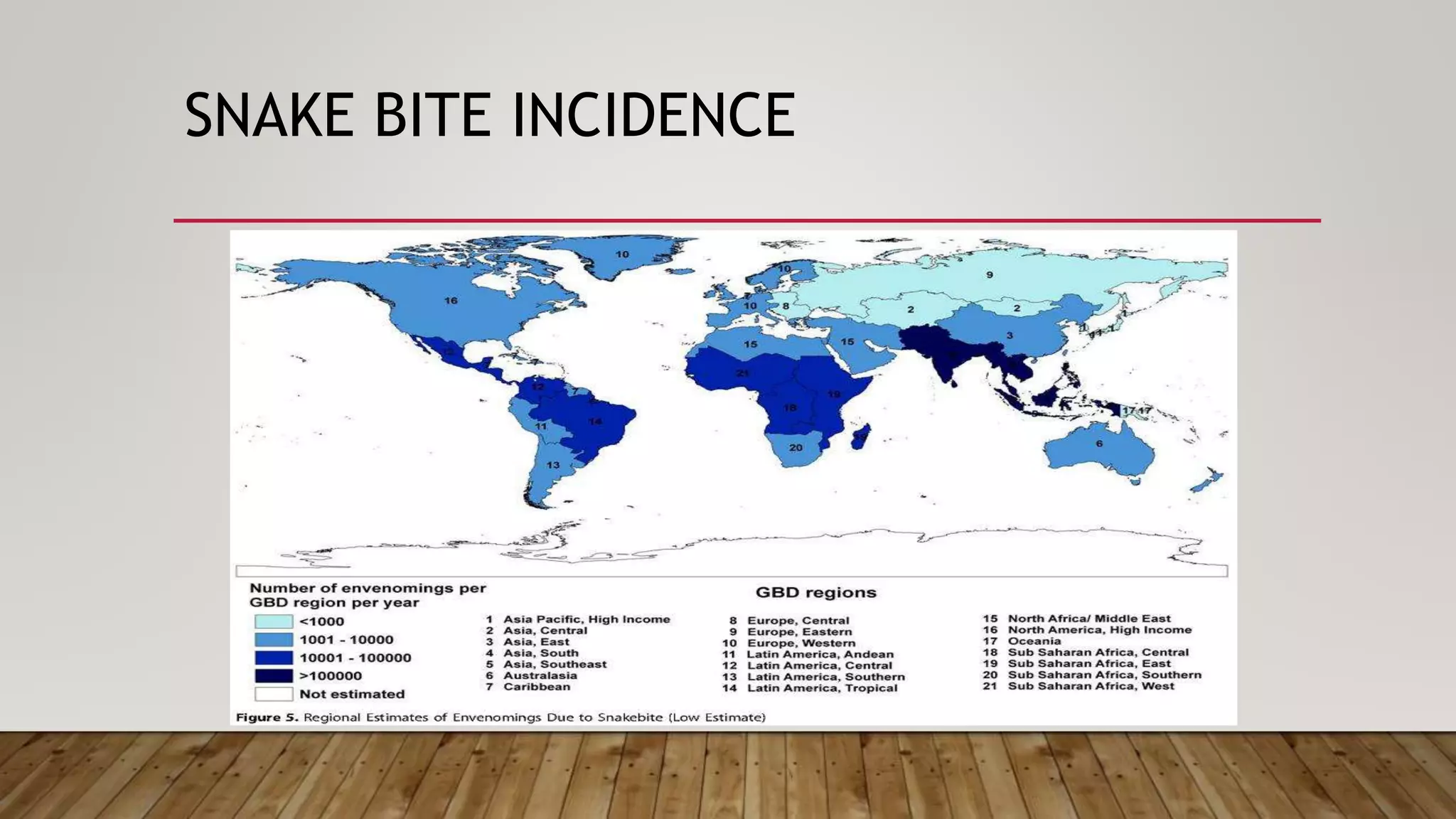
Snake bite is one of the major public health problems in the tropics.
Occupational disease of agricultural workers
 In rural areas of tropical and subtropical countries situated in Africa, Asia,
and Latin America.
Cold Blooded:
No efficient thermoregulatory mechanism.(no sweat glands)
- Venom has digestive enzymes which starts working even before the prey is
swallowed.
THE VENOM APPARATUS
SNAKE BITE INCIDENCE
SNAKE BITE DEATHS WORLDWIDE
EPIDEMOLOGY
Worldwide is about 5 million deaths
400000 snakebite-related amputations each year
Children have both higher incidence rates
CLASSIFICATION
• The family Viperidae.
• The family Elapidae.
Viperidae Russell’s Vipers.,
Saw scaled Vipers.,
Pit Vipers.
Hemotoxic
Elapidae Cobra, Kraits Neurotoxic
Krait
Pit Viper
Cobra
SNAKE VENOM
Combination of
Enzymes & Non-Enzymatic polypeptides.
-Acidic
-Sp Gravity: 1.030-1.070
-On drying Fine needle like crystals.
-Water Soluble.
-Lethal Dose:
Cobra-0.12gm, Krait0.06gm- Russell’s V-0.15gm
IDENTIFICATION FEATURES
PATHOGENESIS
Snake bite-venom injected
enters surrounding tissue
direct venom action
blood vessels lymphatics
Target organs-systemic effect
PRIMARILY NEUROTOXIC
Death results from respiratory depression.
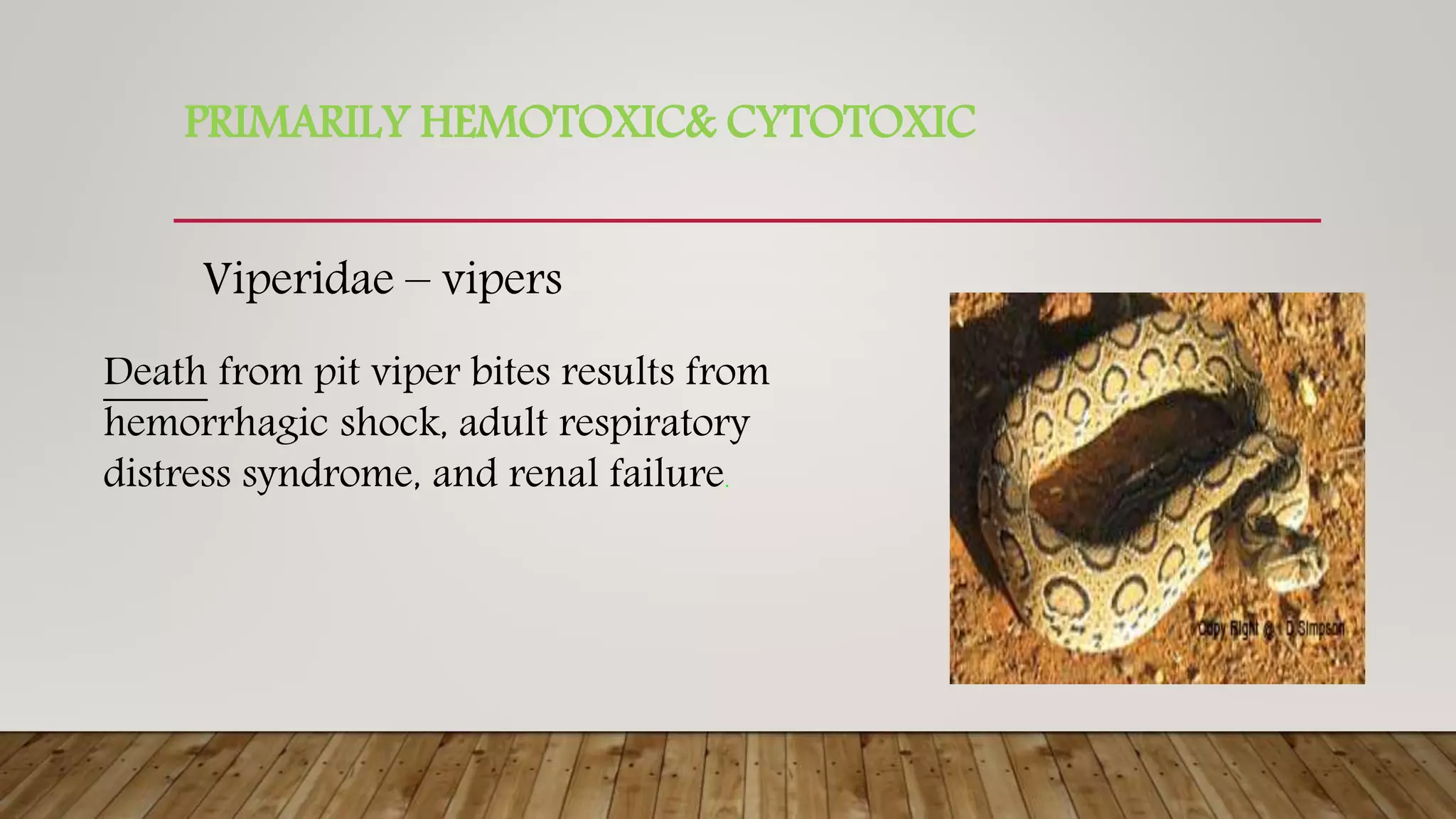
PRIMARILY HEMOTOXIC& CYTOTOXIC
Viperidae – vipers
Death from pit viper bites results from
hemorrhagic shock, adult respiratory
distress syndrome, and renal failure.
CLINICAL FEATURES.
WOUND SITE
Fang marks
Persistent bleeding from
fang marks 40min after
bite of pit viper
Blistering at
site of bite
SPECIES: SIGNS AND SYMPTOMS
Signs/Symptoms and Potential
Treatments
Cobra Krait
Russell’s
Viper Saw Scaled
Viper
Other Vipers
Local pain/ Tissue Damage Yes No Yes Yes Yes
Ptosis/Neurotoxicity Yes Yes Yes! NO No
Coagulation No No Yes Yes Yes
Renal Problems No No Yes NO Yes
Neostigmine & Atropine
Yes No? No? NO No
INVESTIGATIONS
Twenty-minute whole blood clotting test (20WBCT)
Hb/platelet count/peripheral smear prothrombin time
Urine examination
 Biochemistry for serum creatinine/Urea/Potassium
Imaging
 (ABG)
(ELISA) to confirm snakespecies.
SEVERITY OF ENVENOMATION.
MANAGEMENT
•Local
•Specific
•Supportive
• Tourniquet:
• Immobilize affected limb.
• Clean with Normal Saline.
if bite <1hr old: Short skin incision and
suction
SPECIFIC MANAGEMENT
• Anti Snake Venom (ASV)
• Mechanical ventilation
WHAT IS ASV?
• Antivenom is immunoglobulin purified from the serum or
plasma of a horse or sheep that has been immunised with
the venoms of one or more species of snake.
• Potency; 1 ml ASV neutralizes:
0.6mg Cobra, 0.45mg Krait,
0.6mg Rusell’s V, 0.45mg Saw scaled Viper.
-Lethal Dose:
Cobra-0.12gm, Krait0.06gm- Russell’s V-0.15gm
ANTI-SNAKE VENOM ADMINISTRATION
INDICATIONS
Evidence of systemic toxicity.
Hemodynamic or respiratory instability
Hemotoxicity
Neurotoxicity
Evidence of local toxicity
FOLLOW-UP
• After discharge from hospital, victim should be followed.
• If discharged within 24 hours, patient should be advised to return if there is any
worsening of symptoms such as bleeding, pain or swelling at the site of bite, difficulty in
breathing, altered sensorium, etc.
• The patients should also be explained about serum sickness which may manifest after 5–
10 days
THANK YOU

Snake bites