CS513/EE506 Intro to Local and Wide Area Networks                      WPI, Spring 2007
Craig E. Wills                                                 Sliding Window Protocols


Sliding Window Protocols
   • Frames are numbered.

   • Lost frames can be retransmitted.

   • Duplicate frames can be deleted.

   • Out of order frames can be reordered.

   The sender maintains two variables:

   • SL = the number of the “oldest” frame sent, but not ACK’ed.

   • SU = the number of the next frame to send that has not ever been sent.

   • SU − SL = the size of the sender’s window (the number of sending buffers needed)

   The receiver maintains two variables:

   • RL = lowest numbered frame the receiver is willing to accept

   • RU = one more than the highest numbered frame the receiver is willing to accept.

   • RU − RL = size of receiver’s window.


Algorithm
Rough algorithm of the sliding window protocols:

  1. Transmit all frames in the sender’s window (no more than from SL to SU −1 )

  2. Whenever the receiver gets a frame in its window:

      (a) it generates an ACK for the highest frame correctly received (same as the frame
          for protocol 5).
      (b) if the frame RL has been received it passes RL to the host and bumps RL and RU
          (advances the window).

  3. Whenever the receiver gets a damaged frame or a frame not within its window it
     generates a NAK for one less than the frame expected (RL − 1) (only for protocol 6).
4. Whenever the sender receives an ACK for a frame within its window, it marks that
     frame as having been correctly sent and received. If SL is ACKed then increment
     SL and SU (advance the sender’s window) and transmit SU −1 (last previously unsent
     frame).

  5. Whenever a timer goes off, retransmit the corresponding frame.


Relationships
Sequence numbers: 0..(2n − 1)
   SL < S U , R L < R U
   Steady state condition: RL ≤ SU
   Interval of active frames: [SL , RU )
   So RU − SL ≤ 2n and (RU − RL ) + (SU − SL ) ≤ 2n
   where n is the number of bits in the sequence number Two cases:

  1. Receiver window size of one (protocol 5):
        RU − R L = 1
        (SU − SL ) + 1 ≤ 2n
        (SU − SL ) ≤ 2n − 1

  2. Receiver and sender have equal window sizes (protocol 6):
        RU − R L = S U − S L = W
        2W ≤ 2n
        W ≤ 2n−1


Protocol 6 Example
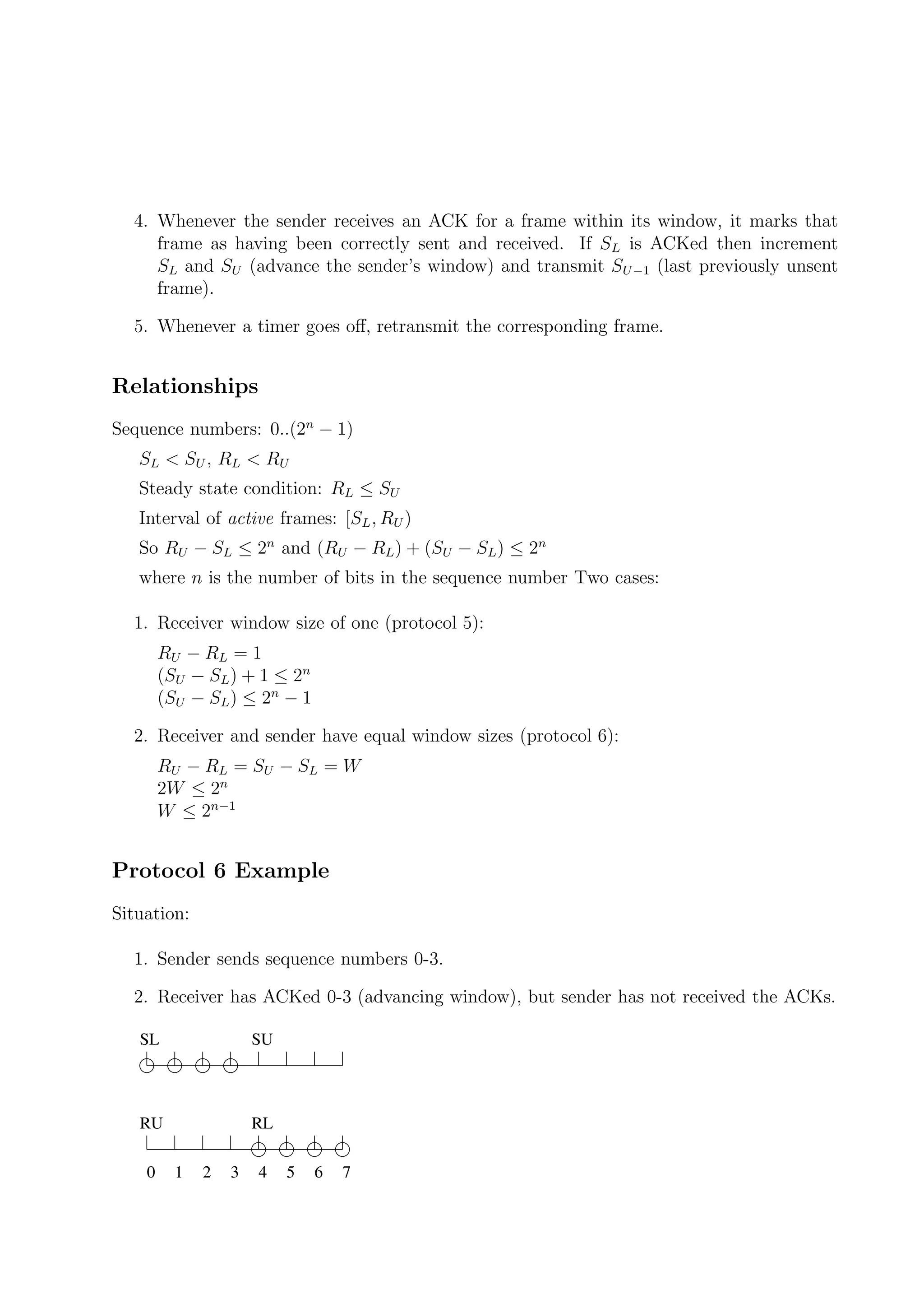
Situation:

  1. Sender sends sequence numbers 0-3.

  2. Receiver has ACKed 0-3 (advancing window), but sender has not received the ACKs.

   SL                 SU


   RU                 RL

    0     1   2   3   4    5   6   7

Sliding window protocol

  • 1.
    CS513/EE506 Intro toLocal and Wide Area Networks WPI, Spring 2007 Craig E. Wills Sliding Window Protocols Sliding Window Protocols • Frames are numbered. • Lost frames can be retransmitted. • Duplicate frames can be deleted. • Out of order frames can be reordered. The sender maintains two variables: • SL = the number of the “oldest” frame sent, but not ACK’ed. • SU = the number of the next frame to send that has not ever been sent. • SU − SL = the size of the sender’s window (the number of sending buffers needed) The receiver maintains two variables: • RL = lowest numbered frame the receiver is willing to accept • RU = one more than the highest numbered frame the receiver is willing to accept. • RU − RL = size of receiver’s window. Algorithm Rough algorithm of the sliding window protocols: 1. Transmit all frames in the sender’s window (no more than from SL to SU −1 ) 2. Whenever the receiver gets a frame in its window: (a) it generates an ACK for the highest frame correctly received (same as the frame for protocol 5). (b) if the frame RL has been received it passes RL to the host and bumps RL and RU (advances the window). 3. Whenever the receiver gets a damaged frame or a frame not within its window it generates a NAK for one less than the frame expected (RL − 1) (only for protocol 6).
  • 2.
    4. Whenever thesender receives an ACK for a frame within its window, it marks that frame as having been correctly sent and received. If SL is ACKed then increment SL and SU (advance the sender’s window) and transmit SU −1 (last previously unsent frame). 5. Whenever a timer goes off, retransmit the corresponding frame. Relationships Sequence numbers: 0..(2n − 1) SL < S U , R L < R U Steady state condition: RL ≤ SU Interval of active frames: [SL , RU ) So RU − SL ≤ 2n and (RU − RL ) + (SU − SL ) ≤ 2n where n is the number of bits in the sequence number Two cases: 1. Receiver window size of one (protocol 5): RU − R L = 1 (SU − SL ) + 1 ≤ 2n (SU − SL ) ≤ 2n − 1 2. Receiver and sender have equal window sizes (protocol 6): RU − R L = S U − S L = W 2W ≤ 2n W ≤ 2n−1 Protocol 6 Example Situation: 1. Sender sends sequence numbers 0-3. 2. Receiver has ACKed 0-3 (advancing window), but sender has not received the ACKs. SL SU RU RL 0 1 2 3 4 5 6 7