Salt Lake Community College
FIRE EXTINGUISHER TRAINING
Legal Basis for Training
Occupational Safety and Health
Administration (OSHA)
Occupational Safety and Health Standards
29 CFR Part 1910
Subpart “L” – Fire Protection
Standard 1910.157
“Portable Fire Extinguishers”
FIRE EXTINGUISHER TRAINING
Legal Basis for Training
International Fire Code
•406.3 Employee Training Program.
Employees shall be trained in fire
prevention, evacuation and fire safety.
•406.3.1 Fire Prevention Training.
Employees shall be apprised of the fire
hazards of the materials and processes to
which they are exposed. Each employee
shall be instructed in the proper procedures
for preventing fires in the conduct of their
assigned duties.
FIRE EXTINGUISHER TRAINING
College Procedure
NEVER IGNORE THE FIRE ALARM
Leave the building immediately. Turn off equipment,
lights and be sure to close the door behind you (A
closed door will prevent the spread of fire and hot
gasses throughout the building.)
Use protected stairways to exit the building. DO NOT
USE THE ELEVATOR.
Once outside, move to a predetermined area away
from the affected building. Keep streets and walkways
clear for emergency responders.
Do not reenter the building until directed to do so by
an authorized Police, Facilities, Building Marshal or
CERT team member.
(Review page 5 of the emergency response manual.)
FIRE EXTINGUISHER TRAINING
College Procedure
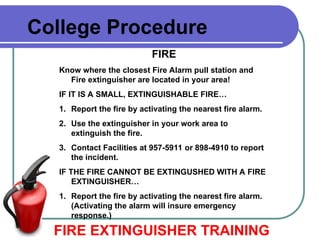
FIRE
Know where the closest Fire Alarm pull station and
Fire extinguisher are located in your area!
IF IT IS A SMALL, EXTINGUISHABLE FIRE…
1. Report the fire by activating the nearest fire alarm.
2. Use the extinguisher in your work area to
extinguish the fire.
3. Contact Facilities at 957-5911 or 898-4910 to report
the incident.
IF THE FIRE CANNOT BE EXTINGUSHED WITH A FIRE
EXTINGUISHER…
1. Report the fire by activating the nearest fire alarm.
(Activating the alarm will insure emergency
response.)
FIRE EXTINGUISHER TRAINING
Objectives
After this training you should be able to:
•IDENTIFY – 3 common classes of fire
•SELECT – the proper type of extinguisher
•EVALUATE – when it is safe to fight an
“early-stage” fire
•APPLY – the P.A.S.S. method to operate a
portable extinguisher
FIRE EXTINGUISHER TRAINING
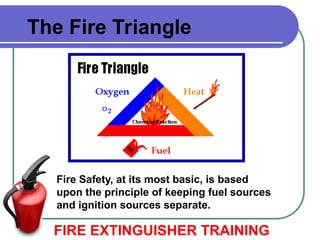
Fire Safety, at its most basic, is based
upon the principle of keeping fuel sources
and ignition sources separate.
FIRE EXTINGUISHER TRAINING
The Fire Triangle
Three things must be present at the same
time to produce fire:
 Enough OXYGEN to sustain combustion
 Enough HEAT to reach ignition
temperature.
 Some FUEL or combustible material
Together, they produce the CHEMICAL
REACTION that is FIRE.
Taking away ANY of these things will
EXTINGUISH the fire.
FIRE EXTINGUISHER TRAINING
The Fire Triangle
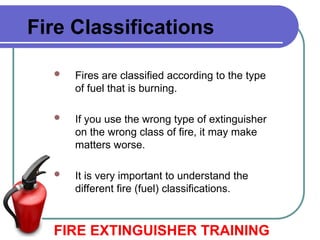
 Fires are classified according to the type
of fuel that is burning.
 If you use the wrong type of extinguisher
on the wrong class of fire, it may make
matters worse.
 It is very important to understand the
different fire (fuel) classifications.
FIRE EXTINGUISHER TRAINING
Fire Classifications
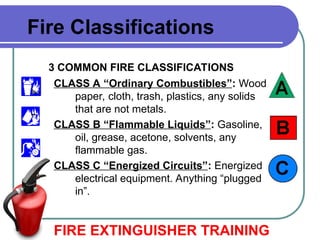
3 COMMON FIRE CLASSIFICATIONS
CLASS A “Ordinary Combustibles”: Wood,
paper, cloth, trash, plastics, any solids
that are not metals.
CLASS B “Flammable Liquids”: Gasoline,
oil, grease, acetone, solvents, any
flammable gas.
CLASS C “Energized Circuits”: Energized
electrical equipment. Anything “plugged
in”.
FIRE EXTINGUISHER TRAINING
Fire Classifications
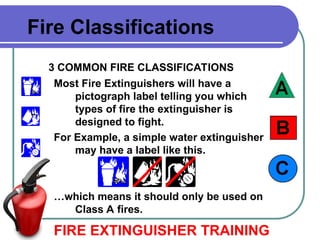
Most Fire Extinguishers will have a
pictograph label telling you which
types of fire the extinguisher is
designed to fight.
For Example, a simple water extinguisher
may have a label like this.
…which means it should only be used on
Class A fires.
3 COMMON FIRE CLASSIFICATIONS
FIRE EXTINGUISHER TRAINING
Fire Classifications
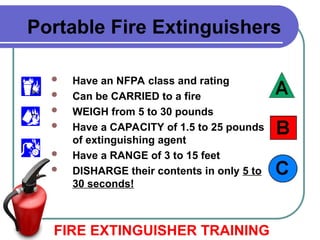
 Have an NFPA class and rating
 Can be CARRIED to a fire
 WEIGH from 5 to 30 pounds
 Have a CAPACITY of 1.5 to 25 pounds
of extinguishing agent
 Have a RANGE of 3 to 15 feet
 DISHARGE their contents in only 5 to
30 seconds!
FIRE EXTINGUISHER TRAINING
Portable Fire Extinguishers
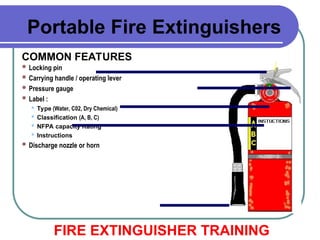
 Locking pin
 Carrying handle / operating lever
 Pressure gauge
 Label :
 Type (Water, C02, Dry Chemical)
 Classification (A, B, C)
 NFPA capacity Rating
 Instructions
 Discharge nozzle or horn
COMMON FEATURES
FIRE EXTINGUISHER TRAINING
Portable Fire Extinguishers
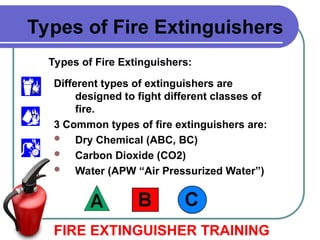
Types of Fire Extinguishers:
Different types of extinguishers are
designed to fight different classes of
fire.
3 Common types of fire extinguishers are:
 Dry Chemical (ABC, BC)
 Carbon Dioxide (CO2)
 Water (APW “Air Pressurized Water”)
FIRE EXTINGUISHER TRAINING
Types of Fire Extinguishers
Dry Chemical (ABC, BC) Fire Extinguishers:
FIRE EXTINGUISHER TRAINING
Types of Fire Extinguishers
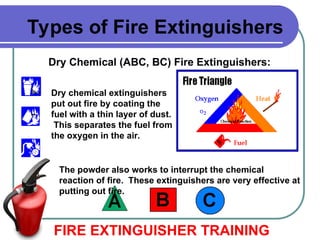
Dry chemical extinguishers
put out fire by coating the
fuel with a thin layer of dust.
This separates the fuel from
the oxygen in the air.
The powder also works to interrupt the chemical
reaction of fire. These extinguishers are very effective at
putting out fire.
Dry Chemical (ABC, BC) Fire Extinguishers:
FIRE EXTINGUISHER TRAINING
Types of Fire Extinguishers
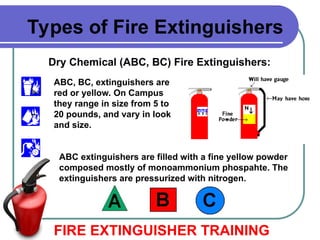
ABC, BC, extinguishers are
red or yellow. On Campus
they range in size from 5 to
20 pounds, and vary in look
and size.
ABC extinguishers are filled with a fine yellow powder
composed mostly of monoammonium phospahte. The
extinguishers are pressurized with nitrogen.
Dry Chemical (ABC, BC) Fire Extinguishers:
FIRE EXTINGUISHER TRAINING
Types of Fire Extinguishers
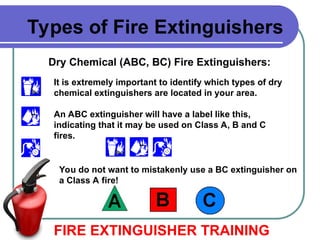
It is extremely important to identify which types of dry
chemical extinguishers are located in your area.
An ABC extinguisher will have a label like this,
indicating that it may be used on Class A, B and C
fires.
You do not want to mistakenly use a BC extinguisher on
a Class A fire!
Dry Chemical (ABC, BC) Fire Extinguishers:
FIRE EXTINGUISHER TRAINING
Types of Fire Extinguishers
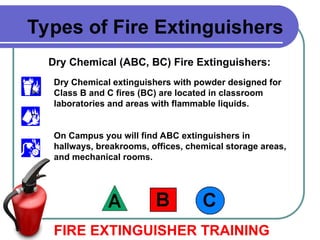
Dry Chemical extinguishers with powder designed for
Class B and C fires (BC) are located in classroom
laboratories and areas with flammable liquids.
On Campus you will find ABC extinguishers in
hallways, breakrooms, offices, chemical storage areas,
and mechanical rooms.
Carbon Dioxide (CO2) Extingushers:
FIRE EXTINGUISHER TRAINING
Types of Fire Extinguishers
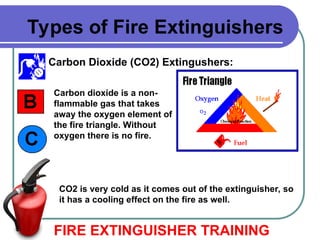
Carbon dioxide is a non-
flammable gas that takes
away the oxygen element of
the fire triangle. Without
oxygen there is no fire.
CO2 is very cold as it comes out of the extinguisher, so
it has a cooling effect on the fire as well.
Carbon Dioxide (CO2) Fire Extinguishers:
FIRE EXTINGUISHER TRAINING
Types of Fire Extinguishers
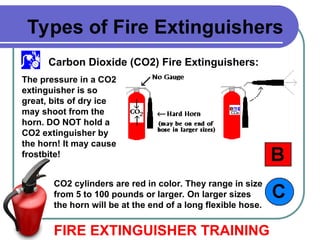
The pressure in a CO2
extinguisher is so
great, bits of dry ice
may shoot from the
horn. DO NOT hold a
CO2 extinguisher by
the horn! It may cause
frostbite!
CO2 cylinders are red in color. They range in size
from 5 to 100 pounds or larger. On larger sizes
the horn will be at the end of a long flexible hose.
In accordance with NFPA regulations (and
manufacturers’ recommendations), all CO2
extinguishers at SLCC undergo hydrostatic testing and
recharge every 5 years.
Carbon Dioxide (CO2) Fire Extinguishers:
FIRE EXTINGUISHER TRAINING
Types of Fire Extinguishers
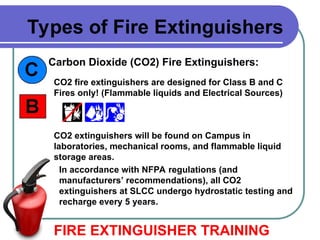
CO2 fire extinguishers are designed for Class B and C
Fires only! (Flammable liquids and Electrical Sources)
CO2 extinguishers will be found on Campus in
laboratories, mechanical rooms, and flammable liquid
storage areas.
Carbon Dioxide CO2 Fire Extinguishers:
FIRE EXTINGUISHER TRAINING
Types of Fire Extinguishers
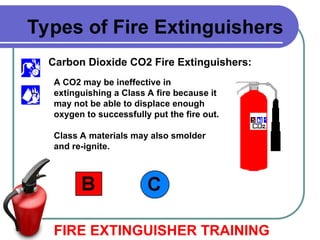
A CO2 may be ineffective in
extinguishing a Class A fire because it
may not be able to displace enough
oxygen to successfully put the fire out.
Class A materials may also smolder
and re-ignite.
Water (APW) Fire Extinguisher:
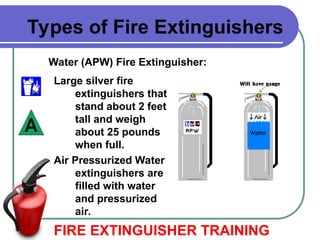
Large silver fire
extinguishers that
stand about 2 feet
tall and weigh
about 25 pounds
when full.
Air Pressurized Water
extinguishers are
filled with water
and pressurized
air.
FIRE EXTINGUISHER TRAINING
Types of Fire Extinguishers
Water (APW) Fire Extinguisher
FIRE EXTINGUISHER TRAINING
Types of Fire Extinguishers
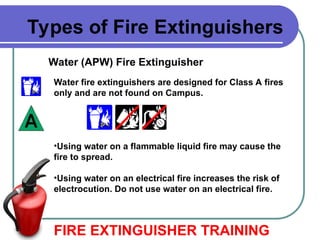
Water fire extinguishers are designed for Class A fires
only and are not found on Campus.
•Using water on a flammable liquid fire may cause the
fire to spread.
•Using water on an electrical fire increases the risk of
electrocution. Do not use water on an electrical fire.
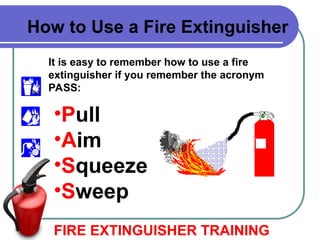
It is easy to remember how to use a fire
extinguisher if you remember the acronym
PASS:
FIRE EXTINGUISHER TRAINING
How to Use a Fire Extinguisher
•Pull
•Aim
•Squeeze
•Sweep
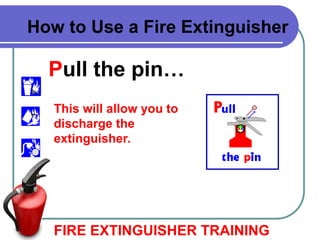
Pull the pin…
FIRE EXTINGUISHER TRAINING
How to Use a Fire Extinguisher
This will allow you to
discharge the
extinguisher.
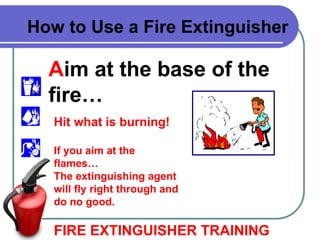
Aim at the base of the
fire…
FIRE EXTINGUISHER TRAINING
How to Use a Fire Extinguisher
Hit what is burning!
If you aim at the
flames…
The extinguishing agent
will fly right through and
do no good.
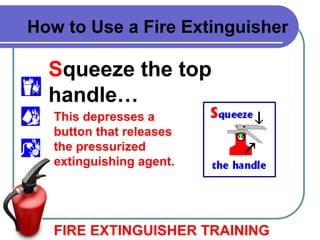
Squeeze the top
handle…
FIRE EXTINGUISHER TRAINING
How to Use a Fire Extinguisher
This depresses a
button that releases
the pressurized
extinguishing agent.
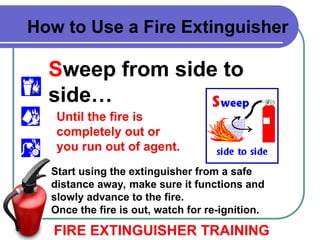
Sweep from side to
side…
FIRE EXTINGUISHER TRAINING
How to Use a Fire Extinguisher
Start using the extinguisher from a safe
distance away, make sure it functions and
slowly advance to the fire.
Once the fire is out, watch for re-ignition.
Until the fire is
completely out or
you run out of agent.
FIRE EXTINGUISHER TRAINING
Fighting Fire
Fires can be very dangerous and you should always be
certain that you will not endanger yourself or others when
attempting to put out a fire.
For this reason, when a fire is discovered…
1. Assist any person in immediate danger to safety, if it
can be accomplished without risk to yourself.
2. IMMEDIATELY! activate the building fire alarm. The
fire alarm will notify the fire department and other
building occupants and shut off the air handling
system to prevent the spread of smoke.
If the fire is small (and only after having done these 2
things), you may attempt to use an extinguisher to put
it out. However . . . .
However . . . .
FIRE EXTINGUISHER TRAINING
Fighting Fire
. . . before deciding to fight the fire, keep these things
in mind:
1. Know what is burning. If you don’t know what’s
burning, you won’t know what kind of extinguisher
to use.
2. Even if you have an ABC fire extinguisher, there may
be something in the fire that is going to explode or
produce toxic fumes.
Chances are you will know what’s burning, or at
least have a pretty good idea, but if you don’t, let
the fire department handle it.
FIRE EXTINGUISHER TRAINING
Fighting Fire
. . . before deciding to fight the fire, keep these things
in mind:
3. Is the fire spreading rapidly beyond the point where
it started? The time to use an extinguisher is at the
beginning stages of the fire.
4. If the fire is already spreading quickly, it is best to
simply evacuate the building.
As you evacuate a building, close doors and
windows behind you as you leave. This will help
to slow the spread of smoke and fire.
FIRE EXTINGUISHER TRAINING
Fighting Fire
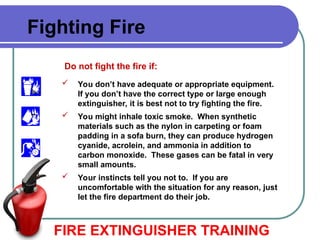
Do not fight the fire if:
 You don’t have adequate or appropriate equipment.
If you don’t have the correct type or large enough
extinguisher, it is best not to try fighting the fire.
 You might inhale toxic smoke. When synthetic
materials such as the nylon in carpeting or foam
padding in a sofa burn, they can produce hydrogen
cyanide, acrolein, and ammonia in addition to
carbon monoxide. These gases can be fatal in very
small amounts.
 Your instincts tell you not to. If you are
uncomfortable with the situation for any reason, just
let the fire department do their job.
FIRE EXTINGUISHER TRAINING
Means of Escape
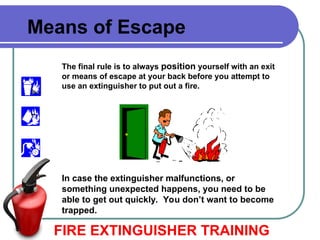
The final rule is to always position yourself with an exit
or means of escape at your back before you attempt to
use an extinguisher to put out a fire.
In case the extinguisher malfunctions, or
something unexpected happens, you need to be
able to get out quickly. You don’t want to become
trapped.
Salt Lake Community College
Fire Extinguisher Training
THANK YOU FOR YOUR
TIME

slcc_fetraining.ppt......................

  • 1.
    Salt Lake CommunityCollege FIRE EXTINGUISHER TRAINING
  • 2.
    Legal Basis forTraining Occupational Safety and Health Administration (OSHA) Occupational Safety and Health Standards 29 CFR Part 1910 Subpart “L” – Fire Protection Standard 1910.157 “Portable Fire Extinguishers” FIRE EXTINGUISHER TRAINING
  • 3.
    Legal Basis forTraining International Fire Code •406.3 Employee Training Program. Employees shall be trained in fire prevention, evacuation and fire safety. •406.3.1 Fire Prevention Training. Employees shall be apprised of the fire hazards of the materials and processes to which they are exposed. Each employee shall be instructed in the proper procedures for preventing fires in the conduct of their assigned duties. FIRE EXTINGUISHER TRAINING
  • 4.
    College Procedure NEVER IGNORETHE FIRE ALARM Leave the building immediately. Turn off equipment, lights and be sure to close the door behind you (A closed door will prevent the spread of fire and hot gasses throughout the building.) Use protected stairways to exit the building. DO NOT USE THE ELEVATOR. Once outside, move to a predetermined area away from the affected building. Keep streets and walkways clear for emergency responders. Do not reenter the building until directed to do so by an authorized Police, Facilities, Building Marshal or CERT team member. (Review page 5 of the emergency response manual.) FIRE EXTINGUISHER TRAINING
  • 5.
    College Procedure FIRE Know wherethe closest Fire Alarm pull station and Fire extinguisher are located in your area! IF IT IS A SMALL, EXTINGUISHABLE FIRE… 1. Report the fire by activating the nearest fire alarm. 2. Use the extinguisher in your work area to extinguish the fire. 3. Contact Facilities at 957-5911 or 898-4910 to report the incident. IF THE FIRE CANNOT BE EXTINGUSHED WITH A FIRE EXTINGUISHER… 1. Report the fire by activating the nearest fire alarm. (Activating the alarm will insure emergency response.) FIRE EXTINGUISHER TRAINING
  • 6.
    Objectives After this trainingyou should be able to: •IDENTIFY – 3 common classes of fire •SELECT – the proper type of extinguisher •EVALUATE – when it is safe to fight an “early-stage” fire •APPLY – the P.A.S.S. method to operate a portable extinguisher FIRE EXTINGUISHER TRAINING
  • 7.
    Fire Safety, atits most basic, is based upon the principle of keeping fuel sources and ignition sources separate. FIRE EXTINGUISHER TRAINING The Fire Triangle
  • 8.
    Three things mustbe present at the same time to produce fire:  Enough OXYGEN to sustain combustion  Enough HEAT to reach ignition temperature.  Some FUEL or combustible material Together, they produce the CHEMICAL REACTION that is FIRE. Taking away ANY of these things will EXTINGUISH the fire. FIRE EXTINGUISHER TRAINING The Fire Triangle
  • 9.
     Fires areclassified according to the type of fuel that is burning.  If you use the wrong type of extinguisher on the wrong class of fire, it may make matters worse.  It is very important to understand the different fire (fuel) classifications. FIRE EXTINGUISHER TRAINING Fire Classifications
  • 10.
    3 COMMON FIRECLASSIFICATIONS CLASS A “Ordinary Combustibles”: Wood, paper, cloth, trash, plastics, any solids that are not metals. CLASS B “Flammable Liquids”: Gasoline, oil, grease, acetone, solvents, any flammable gas. CLASS C “Energized Circuits”: Energized electrical equipment. Anything “plugged in”. FIRE EXTINGUISHER TRAINING Fire Classifications
  • 11.
    Most Fire Extinguisherswill have a pictograph label telling you which types of fire the extinguisher is designed to fight. For Example, a simple water extinguisher may have a label like this. …which means it should only be used on Class A fires. 3 COMMON FIRE CLASSIFICATIONS FIRE EXTINGUISHER TRAINING Fire Classifications
  • 12.
     Have anNFPA class and rating  Can be CARRIED to a fire  WEIGH from 5 to 30 pounds  Have a CAPACITY of 1.5 to 25 pounds of extinguishing agent  Have a RANGE of 3 to 15 feet  DISHARGE their contents in only 5 to 30 seconds! FIRE EXTINGUISHER TRAINING Portable Fire Extinguishers
  • 13.
     Locking pin Carrying handle / operating lever  Pressure gauge  Label :  Type (Water, C02, Dry Chemical)  Classification (A, B, C)  NFPA capacity Rating  Instructions  Discharge nozzle or horn COMMON FEATURES FIRE EXTINGUISHER TRAINING Portable Fire Extinguishers
  • 14.
    Types of FireExtinguishers: Different types of extinguishers are designed to fight different classes of fire. 3 Common types of fire extinguishers are:  Dry Chemical (ABC, BC)  Carbon Dioxide (CO2)  Water (APW “Air Pressurized Water”) FIRE EXTINGUISHER TRAINING Types of Fire Extinguishers
  • 15.
    Dry Chemical (ABC,BC) Fire Extinguishers: FIRE EXTINGUISHER TRAINING Types of Fire Extinguishers Dry chemical extinguishers put out fire by coating the fuel with a thin layer of dust. This separates the fuel from the oxygen in the air. The powder also works to interrupt the chemical reaction of fire. These extinguishers are very effective at putting out fire.
  • 16.
    Dry Chemical (ABC,BC) Fire Extinguishers: FIRE EXTINGUISHER TRAINING Types of Fire Extinguishers ABC, BC, extinguishers are red or yellow. On Campus they range in size from 5 to 20 pounds, and vary in look and size. ABC extinguishers are filled with a fine yellow powder composed mostly of monoammonium phospahte. The extinguishers are pressurized with nitrogen.
  • 17.
    Dry Chemical (ABC,BC) Fire Extinguishers: FIRE EXTINGUISHER TRAINING Types of Fire Extinguishers It is extremely important to identify which types of dry chemical extinguishers are located in your area. An ABC extinguisher will have a label like this, indicating that it may be used on Class A, B and C fires. You do not want to mistakenly use a BC extinguisher on a Class A fire!
  • 18.
    Dry Chemical (ABC,BC) Fire Extinguishers: FIRE EXTINGUISHER TRAINING Types of Fire Extinguishers Dry Chemical extinguishers with powder designed for Class B and C fires (BC) are located in classroom laboratories and areas with flammable liquids. On Campus you will find ABC extinguishers in hallways, breakrooms, offices, chemical storage areas, and mechanical rooms.
  • 19.
    Carbon Dioxide (CO2)Extingushers: FIRE EXTINGUISHER TRAINING Types of Fire Extinguishers Carbon dioxide is a non- flammable gas that takes away the oxygen element of the fire triangle. Without oxygen there is no fire. CO2 is very cold as it comes out of the extinguisher, so it has a cooling effect on the fire as well.
  • 20.
    Carbon Dioxide (CO2)Fire Extinguishers: FIRE EXTINGUISHER TRAINING Types of Fire Extinguishers The pressure in a CO2 extinguisher is so great, bits of dry ice may shoot from the horn. DO NOT hold a CO2 extinguisher by the horn! It may cause frostbite! CO2 cylinders are red in color. They range in size from 5 to 100 pounds or larger. On larger sizes the horn will be at the end of a long flexible hose.
  • 21.
    In accordance withNFPA regulations (and manufacturers’ recommendations), all CO2 extinguishers at SLCC undergo hydrostatic testing and recharge every 5 years. Carbon Dioxide (CO2) Fire Extinguishers: FIRE EXTINGUISHER TRAINING Types of Fire Extinguishers CO2 fire extinguishers are designed for Class B and C Fires only! (Flammable liquids and Electrical Sources) CO2 extinguishers will be found on Campus in laboratories, mechanical rooms, and flammable liquid storage areas.
  • 22.
    Carbon Dioxide CO2Fire Extinguishers: FIRE EXTINGUISHER TRAINING Types of Fire Extinguishers A CO2 may be ineffective in extinguishing a Class A fire because it may not be able to displace enough oxygen to successfully put the fire out. Class A materials may also smolder and re-ignite.
  • 23.
    Water (APW) FireExtinguisher: Large silver fire extinguishers that stand about 2 feet tall and weigh about 25 pounds when full. Air Pressurized Water extinguishers are filled with water and pressurized air. FIRE EXTINGUISHER TRAINING Types of Fire Extinguishers
  • 24.
    Water (APW) FireExtinguisher FIRE EXTINGUISHER TRAINING Types of Fire Extinguishers Water fire extinguishers are designed for Class A fires only and are not found on Campus. •Using water on a flammable liquid fire may cause the fire to spread. •Using water on an electrical fire increases the risk of electrocution. Do not use water on an electrical fire.
  • 25.
    It is easyto remember how to use a fire extinguisher if you remember the acronym PASS: FIRE EXTINGUISHER TRAINING How to Use a Fire Extinguisher •Pull •Aim •Squeeze •Sweep
  • 26.
    Pull the pin… FIREEXTINGUISHER TRAINING How to Use a Fire Extinguisher This will allow you to discharge the extinguisher.
  • 27.
    Aim at thebase of the fire… FIRE EXTINGUISHER TRAINING How to Use a Fire Extinguisher Hit what is burning! If you aim at the flames… The extinguishing agent will fly right through and do no good.
  • 28.
    Squeeze the top handle… FIREEXTINGUISHER TRAINING How to Use a Fire Extinguisher This depresses a button that releases the pressurized extinguishing agent.
  • 29.
    Sweep from sideto side… FIRE EXTINGUISHER TRAINING How to Use a Fire Extinguisher Start using the extinguisher from a safe distance away, make sure it functions and slowly advance to the fire. Once the fire is out, watch for re-ignition. Until the fire is completely out or you run out of agent.
  • 30.
    FIRE EXTINGUISHER TRAINING FightingFire Fires can be very dangerous and you should always be certain that you will not endanger yourself or others when attempting to put out a fire. For this reason, when a fire is discovered… 1. Assist any person in immediate danger to safety, if it can be accomplished without risk to yourself. 2. IMMEDIATELY! activate the building fire alarm. The fire alarm will notify the fire department and other building occupants and shut off the air handling system to prevent the spread of smoke. If the fire is small (and only after having done these 2 things), you may attempt to use an extinguisher to put it out. However . . . . However . . . .
  • 31.
    FIRE EXTINGUISHER TRAINING FightingFire . . . before deciding to fight the fire, keep these things in mind: 1. Know what is burning. If you don’t know what’s burning, you won’t know what kind of extinguisher to use. 2. Even if you have an ABC fire extinguisher, there may be something in the fire that is going to explode or produce toxic fumes. Chances are you will know what’s burning, or at least have a pretty good idea, but if you don’t, let the fire department handle it.
  • 32.
    FIRE EXTINGUISHER TRAINING FightingFire . . . before deciding to fight the fire, keep these things in mind: 3. Is the fire spreading rapidly beyond the point where it started? The time to use an extinguisher is at the beginning stages of the fire. 4. If the fire is already spreading quickly, it is best to simply evacuate the building. As you evacuate a building, close doors and windows behind you as you leave. This will help to slow the spread of smoke and fire.
  • 33.
    FIRE EXTINGUISHER TRAINING FightingFire Do not fight the fire if:  You don’t have adequate or appropriate equipment. If you don’t have the correct type or large enough extinguisher, it is best not to try fighting the fire.  You might inhale toxic smoke. When synthetic materials such as the nylon in carpeting or foam padding in a sofa burn, they can produce hydrogen cyanide, acrolein, and ammonia in addition to carbon monoxide. These gases can be fatal in very small amounts.  Your instincts tell you not to. If you are uncomfortable with the situation for any reason, just let the fire department do their job.
  • 34.
    FIRE EXTINGUISHER TRAINING Meansof Escape The final rule is to always position yourself with an exit or means of escape at your back before you attempt to use an extinguisher to put out a fire. In case the extinguisher malfunctions, or something unexpected happens, you need to be able to get out quickly. You don’t want to become trapped.
  • 35.
    Salt Lake CommunityCollege Fire Extinguisher Training THANK YOU FOR YOUR TIME