Development of skin……
Dr. Amy Mary Sebastian
Development of
•Epidermis
•Specialized cells within epidermis
•Dermis & hypodermis
•Dermal epidermal junction
•Skin appendages
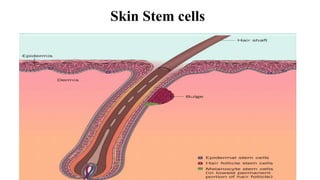
Skin stem cells
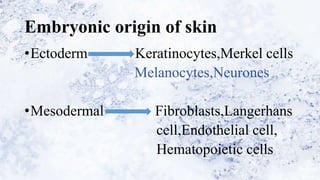
Embryonic origin of skin
•Ectoderm Keratinocytes,Merkel cells
Melanocytes,Neurones
•Mesodermal Fibroblasts,Langerhans
cell,Endothelial cell,
Hematopoietic cells
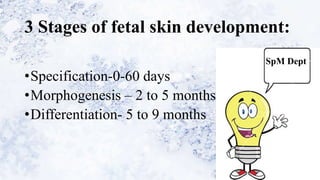
3 Stages of fetal skin development:
•Specification-0-60 days
•Morphogenesis – 2 to 5 months
•Differentiation- 5 to 9 months
SpM Dept
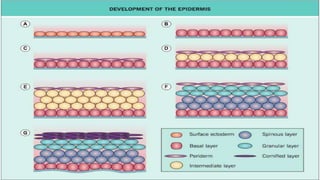
• Single layered surface ectoderm
• Basal layer
• Periderm + Basal layer
• Periderm + Intermediate layer + Basal layer- 8 wk
• Epidermal stratification
• Cornification-22-24 wks
• Periderm sloughs off-24-26wks
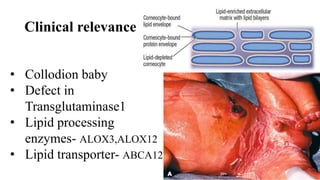
Clinical relevance
• Collodion baby
• Defect in
Transglutaminase1
• Lipid processing
enzymes- ALOX3,ALOX12
• Lipid transporter- ABCA12
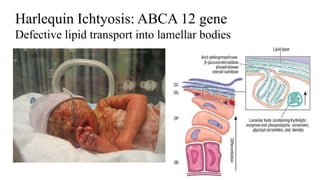
Harlequin Ichtyosis: ABCA 12 gene
Defective lipid transport into lamellar bodies
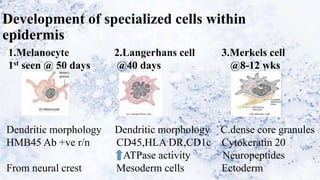
Development of specialized cells within
epidermis
1.Melanocyte 2.Langerhans cell 3.Merkels cell
1st seen @ 50 days @40 days @8-12 wks
Dendritic morphology Dendritic morphology C.dense core granules
HMB45 Ab +ve r/n CD45,HLA DR,CD1c Cytokeratin 20
ATPase activity Neuropeptides
From neural crest Mesoderm cells Ectoderm
Melanocytes
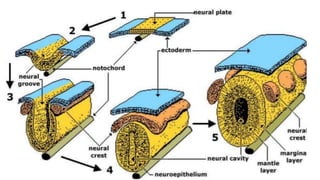
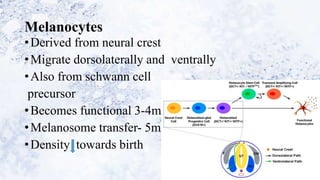
•Derived from neural crest
•Migrate dorsolaterally and ventrally
•Also from schwann cell
precursor
•Becomes functional 3-4m
•Melanosome transfer- 5m
•Density towards birth
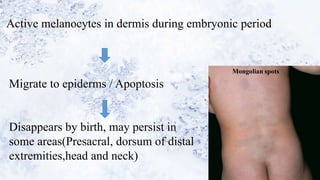
Active melanocytes in dermis during embryonic period
Migrate to epiderms / Apoptosis
Disappears by birth, may persist in
some areas(Presacral, dorsum of distal
extremities,head and neck)
Mongolian spots
Langerhans cell
• Density low in early gestation increases during 3rd
trimester.
Merkel cell
• Highly innervated neuroendocrine cells
• Involved in mechanoception.
• Found in basal layers of epidermis associated with
appendages & nerves.
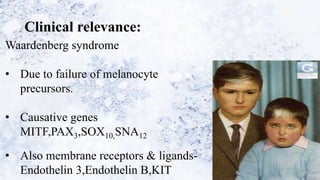
Clinical relevance:
Waardenberg syndrome
• Due to failure of melanocyte
precursors.
• Causative genes
MITF,PAX3,SOX10,SNA12
• Also membrane receptors & ligands-
Endothelin 3,Endothelin B,KIT
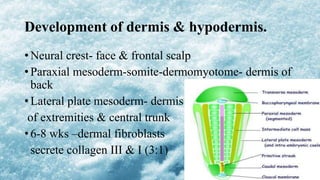
Development of dermis & hypodermis.
• Neural crest- face & frontal scalp
• Paraxial mesoderm-somite-dermomyotome- dermis of
back
• Lateral plate mesoderm- dermis
of extremities & central trunk
• 6-8 wks –dermal fibroblasts
secrete collagen III & I (3:1)
• 9 wks-demarcation b/n dermis & subcutis
• 12 wks-demarcation b/n papillary & reticular
dermis, collagen assemble into fibers
• End of 2nd trimester-dermis shifts from scaring to non
scarring type
• Dermal vasculature-starts at13 wks,matures fully at
birth. Regulated by VEGF,Tie 1&2,Ang 1&2
• Dermal nerves-follows vascular pattern
• Hypodermis-starts during 2nd trimester,continues in 3rd
Clinical relevance
• EDS-dermal structural proteins are
defective
• Cutis laxa with severe pulmonary,GIT &
Genitourinary malformation-LTBP4
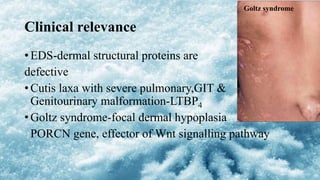
• Goltz syndrome-focal dermal hypoplasia
PORCN gene, effector of Wnt signalling pathway
Goltz syndrome
Development of dermo-epidermal junction
• Flat embryonic DE junction-L. densa & L. lucida
composed of molecules common to all BM.
• 8wks-skin specific components
• 12wks-structures of mature DEJ-
hemidesmosomes,anchoring filaments,BPAG etc.
• Finally acquires rete ridges & dermal papillae like
adult DEJ.
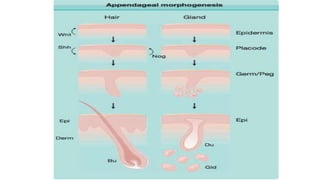
Development of skin appendages
• Epidermal & dermal components
• Signals sent back & forth b/n epidermis & dermis.
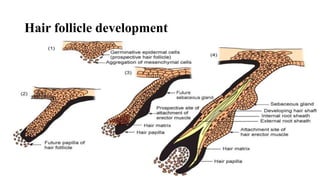
Hair follicle development
• Epidermal placodes (10-11 wks)
• Presumptive dermal papillae
• Hair germ (12-14 wks)
• Hair peg
Hair follicle development
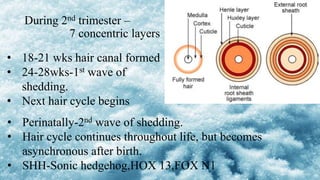
During 2nd trimester –
7 concentric layers
• 18-21 wks hair canal formed
• 24-28wks-1st wave of
shedding.
• Next hair cycle begins
• Perinatally-2nd wave of shedding.
• Hair cycle continues throughout life, but becomes
asynchronous after birth.
• SHH-Sonic hedgehog,HOX 13,FOX N1
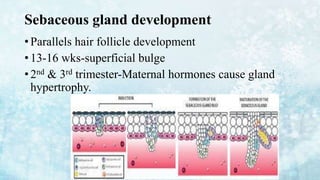
Sebaceous gland development
• Parallels hair follicle development
• 13-16 wks-superficial bulge
• 2nd & 3rd trimester-Maternal hormones cause gland
hypertrophy.
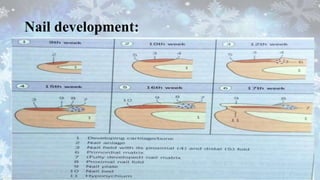
Nail development:
• 8-10 wks-folds visible at dorsal digital tips
• 13wks-proximal nail folds
• Ventral to nail fold nail matrix cells produce nail
plate
• Preliminary nail is shed-hard nail plate 4th mth
• Nail completely covers nail bed 5th mth
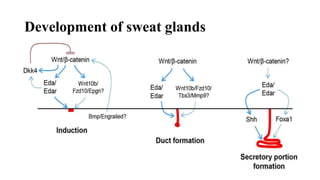
Eccrine & apocrine sweat gland development.
• Palmplantar eccrine –large mesenchymal pads
(55-65 days)
• Parallel ectodermal ridges overlying the pads
• At regular intervals, individual eccrine gland primordia buds
along the ridges.
• Buds elongate as cords-enter M.pads
• 16 wks-glandular structures & dermal duct canalization
• 22wks-epidermal duct canalization
Development of sweat glands
Interfollicular eccrine glands
• Arise independently -5th mth
• Do not function in utero
• Begin functioning post nataly
Apocrine glands
• Upper portion of hair follicle-5th mth
• Clear cells & dark cells(mucin secreating)-7th mth
• Quiscent in neonates, starts functioning during puberty
Clinical relevance
• Hypohydrotic ectodermal dysplasia(HED)-
Ectodysplasin A
• Also from genes involved in epidermal development.
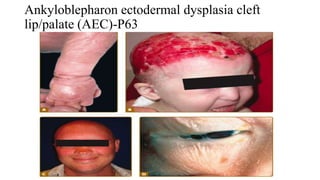
• Ankyloblepharon ectodermal dysplasia cleft lip/palate
(AEC)-P63
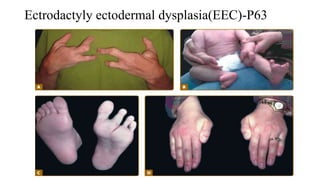
• Ectrodactyly ectodermal dysplasia(EEC)-P63
Ankyloblepharon ectodermal dysplasia cleft
lip/palate (AEC)-P63
Ectrodactyly ectodermal dysplasia(EEC)-P63
Skin Stem cells
In a nutshell….
• Surface ectoderm gives rise to keratinocytes
& merkel cells,while Neurectoderm –
melanocytes & dermis of face & frontal scalp.
• Development of skin is conceptually divided into
specification , morphogenesis & differentiation.
• Basal cells of epidermis gives rise to periderm f/b
intermediate layer , finally epidermal stratification &
cornification leading onto sloughing of periderm.
In a
nutshell..
• Langerhans cells precursors are seen from 40 days, while
merkel cells are detected at 8-12 wks.
• Dermis of face & frontal scalp develop from neural crest,
while paraxial mesoderm gives rise to dermis of back,
whereas dermis of ventral trunk & extremities are from
lateral plate mesoderm.
• Melanocytes migrate from
neural crest following a
characteristic trajectory.
• They become functional by 3-4m & transfers melanosomes
to keratinocytes by 5th m.
In a nutshell…..
• The flat embryonic DEJ acquires skin specific
components by 8 wks,& all structures of mature
DEJ are in place by 12 wks.
• Skin appendages have both epidermal & dermal components
& reciprocal interactions b/n these two are central to their
development.

• Hair follicle progresses through the placode, presumptive
D.papillae, hair germ & hair peg stages to the mature follicle
while sebaceous gland development parallels hair follicle dev
THANK YOU !!

Skin devp

  • 1.
  • 2.
    Development of •Epidermis •Specialized cellswithin epidermis •Dermis & hypodermis •Dermal epidermal junction •Skin appendages Skin stem cells
  • 6.
    Embryonic origin ofskin •Ectoderm Keratinocytes,Merkel cells Melanocytes,Neurones •Mesodermal Fibroblasts,Langerhans cell,Endothelial cell, Hematopoietic cells
  • 7.
    3 Stages offetal skin development: •Specification-0-60 days •Morphogenesis – 2 to 5 months •Differentiation- 5 to 9 months SpM Dept
  • 9.
    • Single layeredsurface ectoderm • Basal layer • Periderm + Basal layer • Periderm + Intermediate layer + Basal layer- 8 wk • Epidermal stratification • Cornification-22-24 wks • Periderm sloughs off-24-26wks
  • 10.
    Clinical relevance • Collodionbaby • Defect in Transglutaminase1 • Lipid processing enzymes- ALOX3,ALOX12 • Lipid transporter- ABCA12
  • 11.
    Harlequin Ichtyosis: ABCA12 gene Defective lipid transport into lamellar bodies
  • 12.
    Development of specializedcells within epidermis 1.Melanocyte 2.Langerhans cell 3.Merkels cell 1st seen @ 50 days @40 days @8-12 wks Dendritic morphology Dendritic morphology C.dense core granules HMB45 Ab +ve r/n CD45,HLA DR,CD1c Cytokeratin 20 ATPase activity Neuropeptides From neural crest Mesoderm cells Ectoderm
  • 13.
    Melanocytes •Derived from neuralcrest •Migrate dorsolaterally and ventrally •Also from schwann cell precursor •Becomes functional 3-4m •Melanosome transfer- 5m •Density towards birth
  • 14.
    Active melanocytes indermis during embryonic period Migrate to epiderms / Apoptosis Disappears by birth, may persist in some areas(Presacral, dorsum of distal extremities,head and neck) Mongolian spots
  • 15.
    Langerhans cell • Densitylow in early gestation increases during 3rd trimester. Merkel cell • Highly innervated neuroendocrine cells • Involved in mechanoception. • Found in basal layers of epidermis associated with appendages & nerves.
  • 16.
    Clinical relevance: Waardenberg syndrome •Due to failure of melanocyte precursors. • Causative genes MITF,PAX3,SOX10,SNA12 • Also membrane receptors & ligands- Endothelin 3,Endothelin B,KIT
  • 17.
    Development of dermis& hypodermis. • Neural crest- face & frontal scalp • Paraxial mesoderm-somite-dermomyotome- dermis of back • Lateral plate mesoderm- dermis of extremities & central trunk • 6-8 wks –dermal fibroblasts secrete collagen III & I (3:1)
  • 18.
    • 9 wks-demarcationb/n dermis & subcutis • 12 wks-demarcation b/n papillary & reticular dermis, collagen assemble into fibers • End of 2nd trimester-dermis shifts from scaring to non scarring type • Dermal vasculature-starts at13 wks,matures fully at birth. Regulated by VEGF,Tie 1&2,Ang 1&2 • Dermal nerves-follows vascular pattern • Hypodermis-starts during 2nd trimester,continues in 3rd
  • 19.
    Clinical relevance • EDS-dermalstructural proteins are defective • Cutis laxa with severe pulmonary,GIT & Genitourinary malformation-LTBP4 • Goltz syndrome-focal dermal hypoplasia PORCN gene, effector of Wnt signalling pathway Goltz syndrome
  • 20.
    Development of dermo-epidermaljunction • Flat embryonic DE junction-L. densa & L. lucida composed of molecules common to all BM. • 8wks-skin specific components • 12wks-structures of mature DEJ- hemidesmosomes,anchoring filaments,BPAG etc. • Finally acquires rete ridges & dermal papillae like adult DEJ.
  • 21.
    Development of skinappendages • Epidermal & dermal components • Signals sent back & forth b/n epidermis & dermis. Hair follicle development • Epidermal placodes (10-11 wks) • Presumptive dermal papillae • Hair germ (12-14 wks) • Hair peg
  • 23.
  • 24.
    During 2nd trimester– 7 concentric layers • 18-21 wks hair canal formed • 24-28wks-1st wave of shedding. • Next hair cycle begins • Perinatally-2nd wave of shedding. • Hair cycle continues throughout life, but becomes asynchronous after birth. • SHH-Sonic hedgehog,HOX 13,FOX N1
  • 25.
    Sebaceous gland development •Parallels hair follicle development • 13-16 wks-superficial bulge • 2nd & 3rd trimester-Maternal hormones cause gland hypertrophy.
  • 26.
  • 27.
    • 8-10 wks-foldsvisible at dorsal digital tips • 13wks-proximal nail folds • Ventral to nail fold nail matrix cells produce nail plate • Preliminary nail is shed-hard nail plate 4th mth • Nail completely covers nail bed 5th mth
  • 28.
    Eccrine & apocrinesweat gland development. • Palmplantar eccrine –large mesenchymal pads (55-65 days) • Parallel ectodermal ridges overlying the pads • At regular intervals, individual eccrine gland primordia buds along the ridges. • Buds elongate as cords-enter M.pads • 16 wks-glandular structures & dermal duct canalization • 22wks-epidermal duct canalization
  • 29.
  • 30.
    Interfollicular eccrine glands •Arise independently -5th mth • Do not function in utero • Begin functioning post nataly Apocrine glands • Upper portion of hair follicle-5th mth • Clear cells & dark cells(mucin secreating)-7th mth • Quiscent in neonates, starts functioning during puberty
  • 31.
    Clinical relevance • Hypohydroticectodermal dysplasia(HED)- Ectodysplasin A • Also from genes involved in epidermal development. • Ankyloblepharon ectodermal dysplasia cleft lip/palate (AEC)-P63 • Ectrodactyly ectodermal dysplasia(EEC)-P63
  • 32.
    Ankyloblepharon ectodermal dysplasiacleft lip/palate (AEC)-P63
  • 33.
  • 34.
  • 35.
    In a nutshell…. •Surface ectoderm gives rise to keratinocytes & merkel cells,while Neurectoderm – melanocytes & dermis of face & frontal scalp. • Development of skin is conceptually divided into specification , morphogenesis & differentiation. • Basal cells of epidermis gives rise to periderm f/b intermediate layer , finally epidermal stratification & cornification leading onto sloughing of periderm.
  • 36.
    In a nutshell.. • Langerhanscells precursors are seen from 40 days, while merkel cells are detected at 8-12 wks. • Dermis of face & frontal scalp develop from neural crest, while paraxial mesoderm gives rise to dermis of back, whereas dermis of ventral trunk & extremities are from lateral plate mesoderm. • Melanocytes migrate from neural crest following a characteristic trajectory. • They become functional by 3-4m & transfers melanosomes to keratinocytes by 5th m.
  • 37.
    In a nutshell….. •The flat embryonic DEJ acquires skin specific components by 8 wks,& all structures of mature DEJ are in place by 12 wks. • Skin appendages have both epidermal & dermal components & reciprocal interactions b/n these two are central to their development. • Hair follicle progresses through the placode, presumptive D.papillae, hair germ & hair peg stages to the mature follicle while sebaceous gland development parallels hair follicle dev
  • 38.