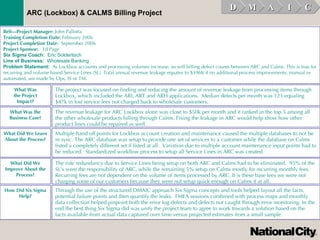
ARC (Lockbox) & CALMS Billing Project What Was the Project Impact? The project was focused on finding and reducing the amount of revenue leakage from processing items through Lockbox, which included the ARI, ART and ARH applications.  Median defects per month was 123 equaling $47k in lost service fees not charged back to wholesale customers.  What Did We Learn About the Process? Multiple hand off points for Lockbox account creation and maintenance caused the multiple databases to not be in sync. The ARC database was setup to provide one set of services to a customer while the database on Calms listed a completely different set if listed at all.  Variation due to multiple account maintenance input points had to be reduced.  Standardized workflow process to setup all Service Lines in ARC was created.  What Did We Improve About the Process? The role redundancy due to Service Lines being setup on both ARC and Calms had to be eliminated.  95% of the SL’s were the responsibility of ARC, while the remaining 5% setup on Calms mostly for recurring monthly fees.  Recurring fees are not dependent on the volume of items processed by ARC. It is these base fees we were not charging some of our customers because they were not setup quick enough on Calms if at all.  How Did Six Sigma Help? Through the use of the structured DMAIC approach Six Sigma concepts and tools helped layout all the facts, potential failure points and then quantify the leaks.  FMEA sessions combined with process maps and monthly data collection helped pinpoint both the error log defects and defects not caught through error monitoring. In the end the best thing Six Sigma did was unify the project team to agree to work towards a solution based on the facts available from actual data captured over time versus projected estimates from a small sample.  Belt—Project Manager:  John Pallotta Training Completion Date:  February 2006 Project Completion Date:  September 2006 Project Sponsor:  Ed Page   Six Sigma Coach:  Eric Solderitsch Line of Business:  Wholesale Banking   Problem Statement:  As Lockbox accounts and processing volumes increase, so will billing defect counts between ARC and Calms. This is true for recurring and volume based Service Lines (SL). Total annual revenue leakage equates to $396K if no additional process improvements, manual or automated, are made by Ops, IS or TM. What Was the Business Case? The revenue leakage for ARC Lockbox alone was close to $50k per month and it ranked in the top 5 among all the other wholesale products billing through Calms. Fixing the leakage in ARC would help show how other product lines could be repaired as well.  D M A I C
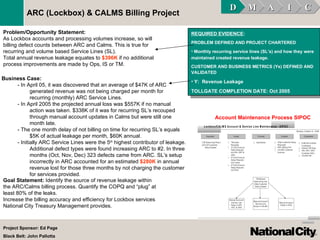
REQUIRED EVIDENCE : PROBLEM DEFINED AND PROJECT CHARTERED Monthly recurring service lines (SL’s) and how they were maintained created revenue leakage.   CUSTOMER AND BUSINESS METRICS (Ys) DEFINED AND VALIDATED Y:  Revenue Leakage  TOLLGATE COMPLETION DATE: Oct 2005 D M A I C ARC (Lockbox) & CALMS Billing Project Project Sponsor: Ed Page Black Belt: John Pallotta Account Maintenance Process SIPOC Business Case:  - In April 05, it was discovered that an average of $47K of ARC generated revenue was not being charged per month for recurring (monthly) ARC Service Lines.  - In April 2005 the projected annual loss was $557K   if no manual action was taken. $338K of it was for recurring SL’s recouped through manual account updates in Calms but were still one month late.  - The one month delay of not billing on time for recurring SL’s equals $5K of actual leakage per month, $60K annual. - Initially ARC Service Lines were the 5 th  highest contributor of leakage. Additional defect types were found increasing ARC to #2. In three months (Oct, Nov, Dec) 323 defects came from ARC. SL’s setup incorrectly in ARC accounted for an estimated  $280K  in annual revenue lost for those three months by not charging the customer for services provided.  Problem/Opportunity Statement: As Lockbox accounts and processing volumes increase, so will billing defect counts between ARC and Calms. This is true for recurring and volume based Service Lines (SL). Total annual revenue leakage equates to  $396K  if no additional process improvements are made by Ops, IS or TM. Goal Statement:  Identify the source of revenue leakage within the ARC/Calms billing process. Quantify the COPQ and “plug” at least 80% of the leaks. Increase the billing accuracy and efficiency for Lockbox services National City Treasury Management provides.
REQUIRED EVIDENCE : MEASUREMENT SYSTEM AND SAMPLING APPROACH VERIFIED Recurring maintenance fees not being charged were collected each month.  BASELINE CAPABILITY AND STABILITY DOCUMENTED TOLLGATE COMPLETION DATE: Nov 2005 D M A I C ARC (Lockbox) & CALMS Billing Project Baseline Performance Project Sponsor: Ed Page Black Belt:  John Pallotta Y Metrics
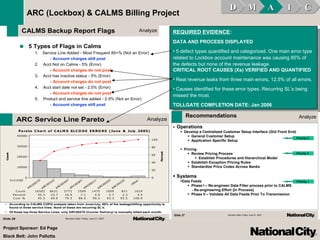
REQUIRED EVIDENCE : DATA AND PROCESS DISPLAYED 5 defect types quantified and categorized. One main error type related to Lockbox account maintenance was causing 85% of the defects but none of the revenue leakage. CRITICAL ROOT CAUSES (Xs) VERIFIED AND QUANTIFIED Real revenue leaks from three main errors, 12.5% of all errors. Causes identified for these error types. Recurring SL’s being missed the most.  TOLLGATE COMPLETION DATE: Jan 2006 D M A I C ARC (Lockbox) & CALMS Billing Project Project Sponsor: Ed Page Black Belt: John Pallotta
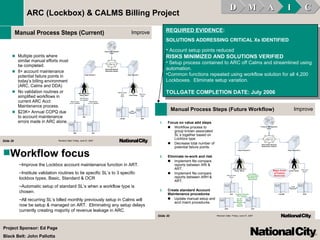
REQUIRED EVIDENCE : SOLUTIONS ADDRESSING CRITICAL Xs IDENTIFIED Account setup points reduced   RISKS MINIMIZED AND SOLUTIONS VERIFIED Setup process contained to ARC off Calms and streamlined using automation.  Common functions repeated using workflow solution for all 4,200 Lockboxes.  Eliminate setup variation. TOLLGATE COMPLETION DATE: July 2006 D M A I C ARC (Lockbox) & CALMS Billing Project Project Sponsor: Ed Page Black Belt: John Pallotta  Workflow focus  Improve the Lockbox account maintenance function in ART. Institute validation routines to tie specific SL’s to 3 specific lockbox types. Basic, Standard & OCR Automatic setup of standard SL’s when a workflow type is chosen.  All recurring SL’s billed monthly previously setup in Calms will now be setup & managed on ART.  Eliminating any setup delays currently creating majority of revenue leakage in ARC.
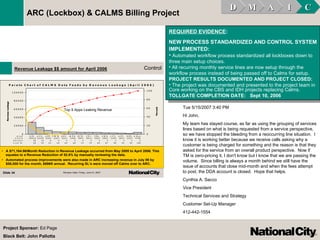
REQUIRED EVIDENCE : NEW PROCESS STANDARDIZED AND CONTROL SYSTEM IMPLEMENTED: Automated workflow process standardized all lockboxes down to three main setup choices.  All recurring monthly service lines are now setup through the workflow process instead of being passed off to Calms for setup.   PROJECT RESULTS DOCUMENTED AND PROJECT CLOSED: The project was documented and presented to the project team in Core working on the CBS and IDH projects replacing Calms.  TOLLGATE COMPLETION DATE:  Sept 10, 2006   D M A I C ARC (Lockbox) & CALMS Billing Project Project Sponsor:  Ed Page Black Belt: John Pallotta Tue 5/15/2007 3:40 PM  Hi John, My team has stayed course, as far as using the grouping of services lines based on what is being requested from a service perspective, so we have stopped the bleeding from a reoccurring line situation.  I know it is working better because we receive calls asking why a customer is being charged for something and the reason is that they asked for the service from an overall product perspective.  Now if TM is zero-pricing it, I don't know but I know that we are passing the volume.  Since billing is always a month behind we still have the issue of accounts that close mid-month and when the fees attempt to post, the DDA account is closed.  Hope that helps. Cynthia A. Sacco Vice President Technical Services and Strategy Customer Set-Up Manager 412-442-1554

Six Sigma Certification Executive Summary And Presentation Arc Calms

  • 1.
    ARC (Lockbox) &CALMS Billing Project What Was the Project Impact? The project was focused on finding and reducing the amount of revenue leakage from processing items through Lockbox, which included the ARI, ART and ARH applications. Median defects per month was 123 equaling $47k in lost service fees not charged back to wholesale customers. What Did We Learn About the Process? Multiple hand off points for Lockbox account creation and maintenance caused the multiple databases to not be in sync. The ARC database was setup to provide one set of services to a customer while the database on Calms listed a completely different set if listed at all. Variation due to multiple account maintenance input points had to be reduced. Standardized workflow process to setup all Service Lines in ARC was created. What Did We Improve About the Process? The role redundancy due to Service Lines being setup on both ARC and Calms had to be eliminated. 95% of the SL’s were the responsibility of ARC, while the remaining 5% setup on Calms mostly for recurring monthly fees. Recurring fees are not dependent on the volume of items processed by ARC. It is these base fees we were not charging some of our customers because they were not setup quick enough on Calms if at all. How Did Six Sigma Help? Through the use of the structured DMAIC approach Six Sigma concepts and tools helped layout all the facts, potential failure points and then quantify the leaks. FMEA sessions combined with process maps and monthly data collection helped pinpoint both the error log defects and defects not caught through error monitoring. In the end the best thing Six Sigma did was unify the project team to agree to work towards a solution based on the facts available from actual data captured over time versus projected estimates from a small sample. Belt—Project Manager: John Pallotta Training Completion Date: February 2006 Project Completion Date: September 2006 Project Sponsor: Ed Page Six Sigma Coach: Eric Solderitsch Line of Business: Wholesale Banking Problem Statement: As Lockbox accounts and processing volumes increase, so will billing defect counts between ARC and Calms. This is true for recurring and volume based Service Lines (SL). Total annual revenue leakage equates to $396K if no additional process improvements, manual or automated, are made by Ops, IS or TM. What Was the Business Case? The revenue leakage for ARC Lockbox alone was close to $50k per month and it ranked in the top 5 among all the other wholesale products billing through Calms. Fixing the leakage in ARC would help show how other product lines could be repaired as well. D M A I C
  • 2.
    REQUIRED EVIDENCE :PROBLEM DEFINED AND PROJECT CHARTERED Monthly recurring service lines (SL’s) and how they were maintained created revenue leakage. CUSTOMER AND BUSINESS METRICS (Ys) DEFINED AND VALIDATED Y: Revenue Leakage TOLLGATE COMPLETION DATE: Oct 2005 D M A I C ARC (Lockbox) & CALMS Billing Project Project Sponsor: Ed Page Black Belt: John Pallotta Account Maintenance Process SIPOC Business Case: - In April 05, it was discovered that an average of $47K of ARC generated revenue was not being charged per month for recurring (monthly) ARC Service Lines. - In April 2005 the projected annual loss was $557K if no manual action was taken. $338K of it was for recurring SL’s recouped through manual account updates in Calms but were still one month late. - The one month delay of not billing on time for recurring SL’s equals $5K of actual leakage per month, $60K annual. - Initially ARC Service Lines were the 5 th highest contributor of leakage. Additional defect types were found increasing ARC to #2. In three months (Oct, Nov, Dec) 323 defects came from ARC. SL’s setup incorrectly in ARC accounted for an estimated $280K in annual revenue lost for those three months by not charging the customer for services provided. Problem/Opportunity Statement: As Lockbox accounts and processing volumes increase, so will billing defect counts between ARC and Calms. This is true for recurring and volume based Service Lines (SL). Total annual revenue leakage equates to $396K if no additional process improvements are made by Ops, IS or TM. Goal Statement: Identify the source of revenue leakage within the ARC/Calms billing process. Quantify the COPQ and “plug” at least 80% of the leaks. Increase the billing accuracy and efficiency for Lockbox services National City Treasury Management provides.
  • 3.
    REQUIRED EVIDENCE :MEASUREMENT SYSTEM AND SAMPLING APPROACH VERIFIED Recurring maintenance fees not being charged were collected each month. BASELINE CAPABILITY AND STABILITY DOCUMENTED TOLLGATE COMPLETION DATE: Nov 2005 D M A I C ARC (Lockbox) & CALMS Billing Project Baseline Performance Project Sponsor: Ed Page Black Belt: John Pallotta Y Metrics
  • 4.
    REQUIRED EVIDENCE :DATA AND PROCESS DISPLAYED 5 defect types quantified and categorized. One main error type related to Lockbox account maintenance was causing 85% of the defects but none of the revenue leakage. CRITICAL ROOT CAUSES (Xs) VERIFIED AND QUANTIFIED Real revenue leaks from three main errors, 12.5% of all errors. Causes identified for these error types. Recurring SL’s being missed the most. TOLLGATE COMPLETION DATE: Jan 2006 D M A I C ARC (Lockbox) & CALMS Billing Project Project Sponsor: Ed Page Black Belt: John Pallotta
  • 5.
    REQUIRED EVIDENCE :SOLUTIONS ADDRESSING CRITICAL Xs IDENTIFIED Account setup points reduced RISKS MINIMIZED AND SOLUTIONS VERIFIED Setup process contained to ARC off Calms and streamlined using automation. Common functions repeated using workflow solution for all 4,200 Lockboxes. Eliminate setup variation. TOLLGATE COMPLETION DATE: July 2006 D M A I C ARC (Lockbox) & CALMS Billing Project Project Sponsor: Ed Page Black Belt: John Pallotta Workflow focus Improve the Lockbox account maintenance function in ART. Institute validation routines to tie specific SL’s to 3 specific lockbox types. Basic, Standard & OCR Automatic setup of standard SL’s when a workflow type is chosen. All recurring SL’s billed monthly previously setup in Calms will now be setup & managed on ART. Eliminating any setup delays currently creating majority of revenue leakage in ARC.
  • 6.
    REQUIRED EVIDENCE :NEW PROCESS STANDARDIZED AND CONTROL SYSTEM IMPLEMENTED: Automated workflow process standardized all lockboxes down to three main setup choices. All recurring monthly service lines are now setup through the workflow process instead of being passed off to Calms for setup. PROJECT RESULTS DOCUMENTED AND PROJECT CLOSED: The project was documented and presented to the project team in Core working on the CBS and IDH projects replacing Calms. TOLLGATE COMPLETION DATE: Sept 10, 2006   D M A I C ARC (Lockbox) & CALMS Billing Project Project Sponsor: Ed Page Black Belt: John Pallotta Tue 5/15/2007 3:40 PM Hi John, My team has stayed course, as far as using the grouping of services lines based on what is being requested from a service perspective, so we have stopped the bleeding from a reoccurring line situation. I know it is working better because we receive calls asking why a customer is being charged for something and the reason is that they asked for the service from an overall product perspective. Now if TM is zero-pricing it, I don't know but I know that we are passing the volume. Since billing is always a month behind we still have the issue of accounts that close mid-month and when the fees attempt to post, the DDA account is closed. Hope that helps. Cynthia A. Sacco Vice President Technical Services and Strategy Customer Set-Up Manager 412-442-1554

Editor's Notes

  • #2 For questions or comments related to this certification document, please contact Craig Latham at 216-222-5644 or craig.latham@nationalcity.com